HAL Id: hal-01570520
https://hal.univ-brest.fr/hal-01570520
Submitted on 14 Mar 2020HAL is a multi-disciplinary open access archive for the deposit and dissemination of sci-entific research documents, whether they are pub-lished or not. The documents may come from teaching and research institutions in France or abroad, or from public or private research centers.
L’archive ouverte pluridisciplinaire HAL, est destinée au dépôt et à la diffusion de documents scientifiques de niveau recherche, publiés ou non, émanant des établissements d’enseignement et de recherche français ou étrangers, des laboratoires publics ou privés.
A game theory approach to solve linear bi-objective
programming problems
Bezoui Madani, Ahcène Bounceur, Reinhardt Euler, Moulaï Mustapha, Youcef
Djeddi
To cite this version:
Bezoui Madani, Ahcène Bounceur, Reinhardt Euler, Moulaï Mustapha, Youcef Djeddi. A game the-ory approach to solve linear bi-objective programming problems. 12th International Conference on Multiple Objective Programming and Goal Programming (MOPGP 2017), Oct 2017, Metz, France. �hal-01570520�
A game theory approach to solve linear bi-objective
programming problems
Madani Bezoui1, Ahcène Bounceur2, Reinhardt Euler2, Mustapha Moulaï3, Youcef Djeddi3
1Department of Mathematics, University M’hamad Bougara of Boumerdes, Boumerdes, Algeria
{mbezoui}@univ-boumerdes.dz
2Lab-STICC UMR 6285, CNRS, Universit´e de Bretagne Occidentale, Avenue Victor Le Gorgeu,
29238, Brest, France
{Ahcene.Bounceur, Reinhardt.Euler}@univ-brest.fr
3Department of operations research, Faculty of Mathematics, University of Sciences and Technology
Houari Boumediene, Algiers, Algeria {mmoulai}@usthb.dz
Keywords: Data collection, Multi-objective optimization, Mobile sink, Energy
minimiza-tion, Game theory, Nash Equilibrium, Pareto front.
1
Introduction
Most real-world problems require simultaneous optimization of multiple competing objectives. Hence, to better capture the real structure of a given problem, the use of the multiobjective approach becomes inevitable and allows to provide better solutions to the posed problem. In contrast to a single criteria optimization problem, the solution to a multi-objective op-timization problem is usually a combination of solutions which form a compromise between different objectives. These solutions are also known as Pareto-Optimal Solutions or efficient solutions. Therefore, the goal of Multiobjective Optimization, also called Multicriteria Op-timization, consists in obtaining optimal Pareto solutions and, consequently, in knowing all possible compromises between the objectives.
Over the past decade, researchers have incorporated the idea of game theory and the notion of balance. However, not all methods can be applied to solving real problems with considerable difficulties. Here is a brief overview of methods that incorporate ideas from the theory of cooperative and/or non-cooperative games.
• [5] developed a multi-objective model of integer linear programming, designed to optimize supply chain planning using game theory.
• A multiobjective categorization method based on the theory of Markov games and pro-cesses is proposed in [1].
• An application of the theory of cooperative and non-cooperative games was presented in [3].
• In [4], the authors propose a realistic representation of a decision maker’s behavior by synthesizing games and purpose programming in a single framework.
• In [2], the authors introduced an iterative method for solving linear multi-objective pro-gramming with an arbitrary number of decision makers. The method is based on the principles of game theory.
Solving multi-objective linear programming problems has received quite some attention from the scientific community. Several researchers have opted for metaheuristics resolution. In this
work, we propose a new method of solving linear bi-objective programming problems. This method finds the Pareto front of a linear programming bi-objective problem by performing a transformation into non-cooperative game theory problem. Then, the problem becames a Nash equilibrium search; we will be able to find the two points that form the limitation of the front defining all efficient solutions to the original problem. Computational tests are performed to show the effectiveness of the proposed technique.
2
Presentation of the method
In this section, we propose a new method based on game theory concepts to solve a linear bi-objective programming problem. This method is based on two phases:
2.1 First phase: Enumeration of feasible basic solutions
This is the oldest method for solving linear programming problems; it is based on the theorem that the optimal solution is an extreme point of the polyhedron defined by the set of feasible solutions. It is summarized by the following steps:
• Determine all extreme points.
• Evaluate the objective function at each of these points.
• Compare the values obtained.
However, this method is very slow for large problems.
2.2 Second phase: Transformation of the bi-objective problem into a game
theory problem
This approach is based on non-cooperative game theory:
It consists of a strategic game with two players where both players try to optimize, respectively, their utility function f1(x1, x2) et f2(x1, x2).
The two players do not communicate with each other and act in their own interest, the set of strategies containing all the pairs (x1, x2) representing each player’s favorable strategy (i.e.,
which optimizes fi(x1, x2), i = {1, 2}) with a prediction of his opponent’s preferred strategy.
The solution of this game is called a Nash equilibrium (x∗1, x∗2).
We obtain a bi-matricial game formulated as a non-cooperative strategic problem < I, X, F > where:
I: The set of players I = {f1(x1, x2), f2(x1, x2)}
X: The set of strategies Xi={extreme points of the bi-objective optimization problem.}
F : The set of payoffs is calculated as follows: ( fk(xi, xi) = fk(xi, xi) fk(xi, xj) = fk(Xi)+fk(Xj) 2 k = {1, 2} (1)
2.3 The proposed method
The goal of this method is to find all the Pareto optimal solutions for a bi-objective linear programming problem. The resolution is carried out in several steps as follows:
Data: A bi-objective linear programming problem. Result: The Pareto optimal solutions of the problem. initialization;
S = ∅ (Strategies);
Determine the decision set D;
Determine the extreme points using an enumeration method;
S ← Pi (Extreme points of the problem);
Calculate the respective payoff of each player by the formula given by Equation 1; Determine the Nash equlibrium {P1, P2} of the game by the best answers method; if The obtained bases are adjacent then
{P1, P2} is the segment representing the efficient solutions else
1. Find paths through the basic solutions of the problem, and compare the first points of each path.
2. Select the dominant point and return its path.
3. The returned path consists of efficient solutions.
end
Algorithm 1: Proposed algorithm.
3
Numerical example
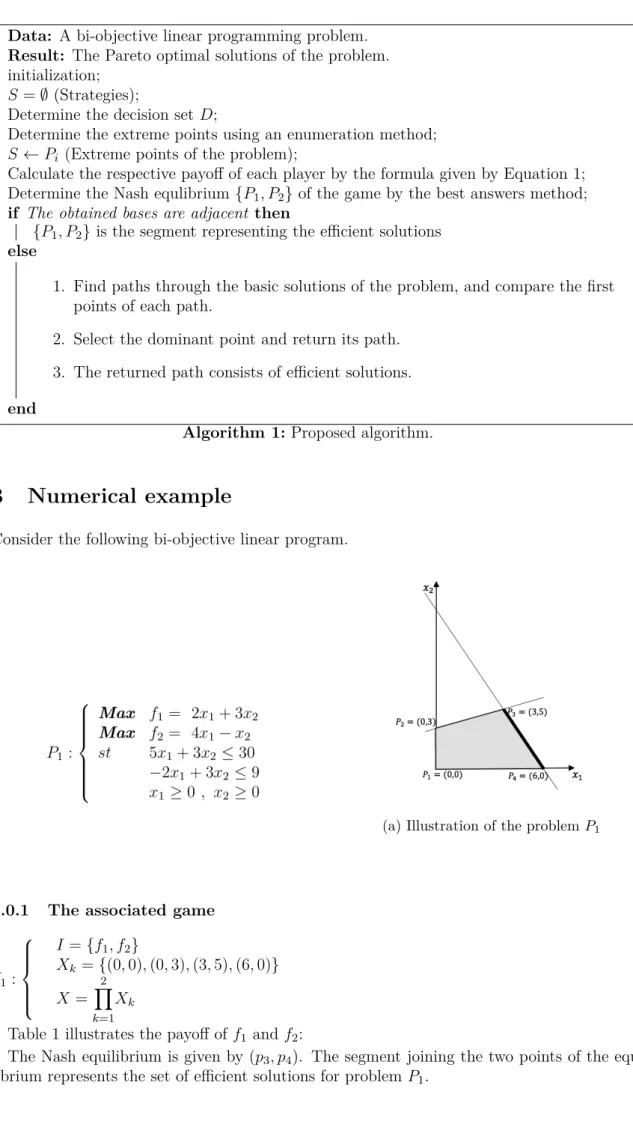
Consider the following bi-objective linear program.
(a) Illustration of the problem P1
3.0.1 The associated game
J1 : I = {f1, f2} Xk = {(0, 0), (0, 3), (3, 5), (6, 0)} X = 2 Y k=1 Xk
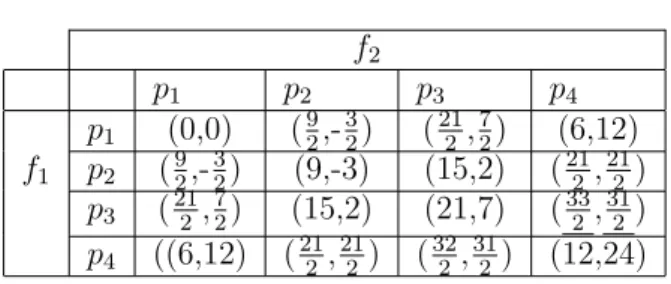
Table 1 illustrates the payoff of f1 and f2:
The Nash equilibrium is given by (p3, p4). The segment joining the two points of the
TAB. 1: Payoff table f2 p1 p2 p3 p4 p1 (0,0) (92,-32) (212,72) (6,12) f1 p2 (92,-32) (9,-3) (15,2) (212,212) p3 (212,72) (15,2) (21,7) (332,312) p4 ((6,12) (212,212) (322,312) (12,24)
4
Conclusion
In this work, we have considered the problem of efficient data collection in wireless sensor networks. We have developed a multi-objective linear program to evaluate the compromise between the maximum amount of energy spent by sensor nodes and the length of the mobile sink route. We propose a new method for solving Bi-Objective Linear Programming problems using game theory. The presented method transforms a multi-objective linear optimization programming problem into a game theoretic one which can be solved using one of the Nash equilibrium search methods. This approach has been implemented to be tested and simulated on examples. The computational results confirm the effectiveness of the proposed method for small problems. We think that the results obtained in this work are very encouraging and deserve further study, and especially applications in the fields of IOT, such as optimization of information gathering in Wireless Sensor Networks, Data mining, etc.
5
Acknowledgment
This work is part of the research project PERSEPTEUR supported by the French Agence Nationale de la Recherche ANR.
References
[1] Wei-Yi Liu, Kun Yue, Tian-Ying Wu, and Mu-Jin Wei. An approach for multi-objective categorization based on the game theory and Markov process. Applied Soft Computing, 11(6):4087–4096, September 2011.
[2] Josip Matejaa and Tunjo Peria. A new iterative method for solving multiobjective linear programming problem. Applied mathematics and computation, 243:746–754, 2014.
[3] Roger A. McCain. Cooperative games and cooperative organizations. The Journal of
Socio-Economics, 37(6):2155–2167, December 2008.
[4] Tahir Rehman and Carlos Romero. Formulating generalised goal games against nature: An illustration from decision-making under uncertainty in agriculture. Applied Mathematics
and Computation, 175(1):486–496, April 2006.
[5] M Zamarripa, A Aguirre, C M´endez, and A Espuna. Integration of mathematical program-ming and game theory for supply chain planning optimization in multi-objective competi-tive scenarios. Computer Aided Chemical Engineering, 30:402–406, 2012.