August 1987 LIDS-P-1698
ASYMPTOTIC ORDERS OF REACHABILITY IN PERTURBED LINEAR SYSTEMS1
CUneyt M. Ozveren2
Alan S. Willsky2
George C. Verghese3
Abstract
A framework for studying asymptotic orders of reachability in
perturbed linear, time-invariant systems is developed. The systems of interest are defined by matrices that have Taylor or Laurent
expansions in the perturbation parameter e about the point 0. The reachability structure is exposed via the Smith form of the
reachability matrix. This approach is used to provide insight into the kinds of inputs needed to reach weakly reachable target states, into the structure of high-gain feedback for pole placement, and into the types of inputs that steer trajectories arbitrarily close to
almost (A,B)-invariant subspaces and almost (A,B)-controllability subspaces.
Work of the authors supported in part by the Air Force Office of
Scientific Research under Grant AFOSR-82-0258, and in part by the Army Research Office under Grant DAAG-29-84-K-0005.
2Department of Electrical Engineering and Computer Science and
Laboratory for Information and Decision Systems, MIT, Cambridge, MA 02139.
3
Department of Electrical Engineering and Computer Science and
Laboratory for Electromagnetic and Electronic Systems, MIT, Cambridge, MA 02139.
I. INTRODUCTION
1.1 MOTIVATION
In this paper, we develop and apply a theory of asymptotic
orders of reachability in linear time-invariant systems
parametrized by some small variable, e. To provide a motivation
for the key issues in our approach, consider the following
discrete time system as an example:
Example 1.1
x[k+l] = ]xr] [1 ]u[k]
This system is reachable but the reachability matrix
[blAb]= [.01 1.03
is not very far from a singular matrix, in that its condition
number is approximately 104. This leads to numerical difficulties
in determining reachability, as shown in [3]. Also, consider the
minimum energy control problem for this system. The minimum
energy control to reach x[2] = [1 0]' (where ' denotes the
transpose) from x[O] = 0 is u1[l] = -. 5 and u1[2] = 1.5, while the
minimum energy control for x[2] = [1 1]' is u2[1] = 49.7 and
u2[2] = -49. This order of magnitude difference between u1 and u2 is another indication of near unreachability. Still further
indications may be obtained, for example by considering how small
a perturbation of the system matrices suffices to destroy
reachability (in this case, 0.01), or by examining the magnitude
of feedback gain required to shift poles by various amounts (in
this case, to move the eigenvalues by 2, feedback gains of
magnitude approximately 102 are required, as illustrated in
Example 3.1).
Our treatment of problems of this type is qualitative rather
than numerical in nature: we assume that small values in the
system are modeled by functions of a small parameter 6, which
implicitly indicates the presence of different orders of coupling
among state variables and inputs. Parametrized linear systems are
studied in general by Kamen and Khargonekar [13] and Brewer et al.
[14]. However, we look at how unreachable the system is in terms
of "orders of e". Specifically, we consider continuous time and
discrete time systems of the form
x(t) = A(e)x(t) + B(e)u(t) (1.1)
x[k+l] = A(e)x[k] + B(e)u[k] (1.2)
where A(e) and B(e) have Laurent expansions around e=O:
A(e) : Rn((6))
IRn((6))
(1.3)B(6) : Rm((6)) ~ Rn((6)) (1.4)
(We write a(e) E IR((e)) if a(e) has a Laurent expansion around
e=O.) Defining these systems over IR((e)) permits us to examine
the effect or necessity of high gain feedback.
This work was particularly motivated by the numerical
problems encountered in various pole placement methods and in
evaluating system reachability. Pole placement and related
numerical issues are addressed using various approaches in the
current literature [4-7]. In multi-input systems, unlike
single-input systems, the feedback matrix that produces a given
set of poles is not unique, and the additional degrees of freedom
may be used to attain other control objectives (see [7]). One
may, for example, attempt to minimize the maximum feedback gain;
[5] addresses this problem via numerical examples on
redistribution of the feedback task among the inputs and balancing
the A and B matrices. These examples contain some intuitive
ideas, but have not led to systematic procedures that work well
for well-defined and substantial classes of systems. One of our
objectives here is to suggest an analytical approach to
understanding and structuring feedback gains for pole placement.
Another area of numerical work involves criteria to measure
controllability. Boley and Lu [9] use the "distance to the
nearest uncontrollable system" as a criterion. They define this
by the minimum norm perturbation that would make a system
uncontrollable. They also relate this concept to state feedback
by measuring the amount that the eigenvalues move due to state
feedback of bounded magnitude. Connections may also be made to
the literature on balanced realizations, [8], where the singular
values of the controllability Grammian are used to indicate
nearness to uncontrollability.
The issue of controllability in perturbed systems of the form
(1.1) has been examined by Chow [15]. He defines a system to be
strongly controllable if the system is controllable at e = 0.
Otherwise, he calls it weakly controllable and concludes that pole
placement of such systems will require controls with large gains.
Chow looks at systems with two time scales (slow and fast), and he
proves that a necessary and sufficient condition for such a
'singularly perturbed' system to be strongly controllable is the
controllability of its slow and fast subsystems.
Our analysis goes further than Chow's in that we examine the
relative orders of reachability of different parts of the state
space. The methods we use have some similarity to those used by
Lou et al. [1,2], who relate the multiple time scale structure of
the system (1.1) to the invariant factors of A(e), when this
matrix has entries from the ring of functions analytic at e = 0.
The Smith decomposition of A(e) plays a key role in their
analysis, while the Smith decomposition of the reachability matrix
is central to the development in this paper. While the primary
focus of the work in [1,2] is on time scale structure, some
attention is paid to control. In particular, [1] gives results on
the use of feedback in (1.1) to change the time scale structure of
the system. The work in [22] may be seen as a continuation of the
work in [1,2] in that it analyzes the effect of control and
feedback on the system of (1.1). This paper is based on the work
in [22].
1.2 OUTLINE
In Section II, we develop a theory of orders of reachability.
We start with discrete time systems and illustrate that the orders
of reachability can be recovered from the Smith decomposition of
the reachability matrix. We define a standard form which displays
these orders explicitly. Also, we show that equivalent results
hold for continuous time systems. In Section III, this theory is
extended to pole placement by full state feedback for systems
whose entries have Taylor expansions around e=O. We also provide
a computationally efficient and numerically well-behaved algorithm
for pole placement. Section IV develops connections with Willems'
work on "almost invariance" [3]. We show that the subspace a
sequence of (A,B)-controllability subspaces converge to is almost
(A,B)-invariant. In Section V, we summarize our results and
suggest problems for further research.
1.3 ASSUMPTIONS
The reachability matrix for the systems in (1.1) and (1.2) is
e(e) = [B(e)lA(e)B(e)j ... An-1()B()] : Rmn(()) n(()).
We assume that the coefficients of the characteristic polynomial
of A(e) are over R[[e]], i.e. they have Taylor expansions around
e=O. We shall show (Proposition 2.6) that this is equivalent to
the system being what we term a proper system. This is not a
restrictive condition for continuous time systems since it can be
achieved by time scaling. However, it is a restrictive assumption
for discrete time systems.
Note that £(e) can be made analytic at e = 0 (i.e. made into
a matrix over R[[e]]) by a simple input scaling, and this will be
done when convenient. In addition, we assume that the
reachability matrix is full row rank for all e e (O,a), aCE+. In
the cases of most interest to us, the reachability matrix will
lose rank for e = 0, and a will be the smallest positive value of
e for which the reachability matrix loses rank. Under these
conditions, we analyze the asymptotic reachability of the system
as e
l0.
II. ORDERS OF REACHABILITY
II.1 ei-REACHABILITY
We start by developing our theory of asymptotic orders of
reachability in an analogous way to existing linear control
theory. In order to provide a motivation for our approach, let us
start with the following counterpart of Example 1.1:
Example 2.1:
x[k+1] = [ 1 ]x[k] + []uk]
so
This system is reachable for all e e (0,2). The minimum energy control sequence needed to go from the origin to x1[2] = [1 0]'
is uj[1] = -1/(2-e) and u1[2] = 3/(2-e), which is 0(1).(4) The
minimum energy control sequence for x212] = [1 1]' is u2[1] =
(-e+1)/6(2-e) and u2[2] = (2e-1)/e(2-e), which is 0(1/e).
We next generalize this characterization of target states by
the order of control sufficient to reach them.
Definition 2.2: x(6) E In[[E]] is ei-reachable if there exists an
0(1/ei) input sequence T(e) E [u'[n-1] *-- u'[O]]' such that x(e)
4f(e) is 0(ek) if lim lf(e)ll/e k exists, where k is an integer, f(e) is
e610o
a scalar, vector or matrix, and II*II denotes the appropriate norm.
N t is k tnk-i k-2
Note that if f(e) is O(e
)
then it is also Oe ), 0(6 ) etc.is reached from zero in n steps using '1(e) (i.e. x(e) = ~(a)~()).
Let Xj be the set of all eJ-reachable states, then 0 c I1 c2 c ... and Xi is an IR[[e]]-submodule of In[[e]]. We term Xi the
6J-reachable submodule.
Note that if x(e) is ej-reachable, then (1/e)x(e) is not
necessarily eJ-reachable. Thus if we had considered target states
in In((e)) in Definition 2.2, then the set of ei reachable states
would not be R((e))-subspaces.
0 2 1 2
In Example 2.1, 0 = Im[1 0]' + eR 2[[e]] , 1 = 2 = ...
R
[[e]]-An interesting property of the set of ei-reachable submodules
is that all the structure is embedded in the e -reachable
submodule. First of all, note that 1O is the image of the
reachability matrix under the set of all control sequence vectors
t(e) in mn[[6]]. Also, the eJ-reachable submodule is simply
obtained by scaling the j -l-reachable submodule by 1/e. To state
this formally:
Proposition 2.3: 10 = {(()JRmn[[6]]}nRn[[e]] and
j = l{ij-1 n Rn[[]]} _ 1 {oj-i n eiRn[[6]]} for nonnegative
6 1
integers i, j and j>i.
Proof: By Definition 2.2, 10 = {(e()Rmn[[,]]}nRn[[e]], or in
general = IJ
{m(el)/ejImn[[e]]}nmn[[e]].
Then, 1 {tJ-in in[[]] = 1 1 i( mn n616.1(e)R [[i]]}- IR[[]]}n
=
{ i,@(.)fRmn[[e]]}flnRn[[e]]
= j= :
The structure of the eJ-reachable submodules is not always as
easily obtained by inspection of the pair (A(e),B(e)) as it was in
Example 2. To illustrate this, consider an e perturbation of
Example 2.1:
Example 2.4:
x[k+l]
['
]x[k] x= [e][k] whereR(6) [1 1+6]
This system is reachable for all e e (O,-). In this case, we find
that x1[2] = [1 0]' is e-reachable, and x2[2] = [1 1]' is
2
e -reachable. Therefore, even an e perturbation may cause drastic changes in our submodules.
II.2 SMITH DECOMPOSITION OF T(e)
The key element in our results is the Smith decomposition of
I(e) since we are interested in how T(e) becomes singular as e10. For simplicity, as noted in the Introduction, let us assume that
T(e) has a Taylor expansion around e=O and that it is full row
rank for all e E (O,a), aR+ , then the nxmn matrix T(e) has a Smith decomposition [1, 2, 11, 12]
%(6) = P(e)D(e)Q(6) (2.1)
where P(e), nxn, is unimodular (detP(O)}O), Q(e), nxmn, is full row rank at e=0, and
D(e) = diag{I, I1 ... kI (2.2)
is nxn where I denotes a pixpi identity matrix with Pi=O Pi
corresponding to absence of the i-th block, and with Pk•O. The
indices Pi, and hence D(e), are unique, though P(e) and Q(e) are
not.
Now, 9j = P(e) i wherej
+ e~j+l + k-1
= Bj+ l[e]] + + k-+k-j ....
~
(2.3) and . = Im[I 0]', n . In fact J- is thei
n.' 1P
eJ-reachable submodule of the original system similarity
transformed by P(e) and its structure immediately follows from the
indices. This property is captured in a standard form defined in
the next section.
II.3 STANDARD FORM
Consider a pair (A(e),B(e)) with a Smith decomposition of its
reachability matrix defined as above. We will term such a system
an e -reachable system with indices no, ... .nk. Let
A(e) = P (e)A(e)P(e) and B(e) = P- (e)B(e). The pair (A(e),B(e)) will be called a standard form for (A(e),B(e)).
The system in Example 2.1 is already in standard form. For
the system in Example 2.4, a Smith decomposition of the
reachability matrix is:
) 1 ] [O ;2] [01 ] = P(6)D(6)Q(e)
Transforming the system by P(e) yields
y[k+l] =
[2
2 I y[k] +which uncovers the previously hidden e2 structure.
A standard form of a system is termed a proper standard form
if it has the following structure:
AO,0(e) 1/6A0 ,1(6) . . . 1/ek AOk(P 6)I o
Ae)= eA1 0 (e) A1 1 (e) . . . 1/6k -lA1 k(6) }Pl (2.4a)
A(e) (2.4a) k k-i Ak
56)
6 Ak ,l() . . . Ak,k(e) )Pk BO(E) }Po EB1(e) )P1 B(e) = (2.4b)k.
6 Bk(e) Pk i where Aij(e) are analytic at e=0, and ni = Pjj=o
Example 2.1 and the transformed version of Example 2.4 are
both in proper standard form. In fact, the next result shows that
finding one proper standard form is enough to conclude that all
standard forms of a pair are proper:
Proposition 2.5: If a pair (A(e),B(e)) has a proper standard form,
then all standard forms of (A(e),B(6)) are proper.
Proof: Let T(e) = P1(e)D(e)Q1(e) = P2(e)D(e)Q2(e), then
Ai( ) =
P()A(e)Pi(e)
Bi(e) = P 1 (e)B(e) for i=1,2 are two standard forms. Suppose that the pair (A1(e),B 1(e)) is a properstandard form. Let Ai(e) = D 1(e)Ai(e)D(e), Bi(e) = D -(e)Bi(e)
for i=1,2. Note A1(e) and B1(e) are both over IR[[e]]. We wish to
show that the same is true for A2 (e) and B2(e). Let
R(e) = -1()P 2 (e)P1(e)D(e), then R(e) is invertible, and
Q2(6) = R(e)Q1(e). But then R(e) = Q2(e)Q(6e) and
R 1 ) = Q1(e)Q2(e)' where Q +() denotes the right inverse of
Qi(e), which exists over R[[e]]. Thus, R(e) is unimodular. Since
(Ai(&),Bl(e)) is over IR[[]] and A2(e) = R(e)A1(6)R (e),
B2(e) = R(e)B1(e), the pair (A2(e),B2(e)) is also over IR[[]].
Therefore, (A2(e),B 2(e)) is a proper standard form.
A pair (A(e),B(e)) is termed proper if it has a proper
standard form. Thus, both of the systems in Examples 2.1 and 2.4
are proper. Our assumption that the coefficients of the
characteristic polynomial of A(e) are over IR[[e]] is necessary and
sufficient for a system to be proper. In general, we have the
following:
Proposition 2.6: The following statements are equivalent for any
pair (A(e),B(e)) such that n(e) is over R[[e]]:
1. (A(e),B(e)) is proper.
2. %(e) is over I[[e]].
3. The coefficients of the characteristic polynomial, a(A(e)), of
A(e) are over R[[e]].
To prove this result, let us first consider the following two
lemmas:
Lemma 2.7: For a pair (A(e),B(e)) with Rn(e) over R[[e]],
e6(e)
is over R[[e]] iff the coefficients of {(A(e)) are in R[[e]].Proof: (-) Follows using the Cayley-Hamilton theorem.
(,-) Suppose not all coefficients of a(A(e)) are in R[[e]], then
some eigenvalue of A(e), say X(e), is not 0(1). Let the Jordan
decomposition of A(e) in some interval ec(O,a) be
A(e)=X-1A(e)X(e), where X(e), A(e) are continuous and X(e) is
scaled such that lim X(e) exists. See [23] for the existence of
elo
such a decomposition. Consider:
X(e)AJ(e)T(e) = Ai(e)X(e)T(6) (2.5)
th
Note that some row of AJ(e), say the ith row, has the form[0O ... 0 Tj(e) 0 ... 0], while the it h
row of X(e){(e) is nonzero and hence of finite order in e. Thus, by choosing j large enough,
we can obtain a right hand side in (2.5) that is not 0(1). It
follows that AJ(e)}(e) is not 0(1) for large enough j. But eT(6)
contains the entries of A(e 6)(e6), so %i(e) is not 0(1).
-Lemma 2.8: Let A(e) = D (e)P - (e)A(e)P(e)D(e),
B(6) = D -l(e)P (-le)B(e), then T{(e) is over R[[e]] iff (}e) is over R[[e]].
Proof: (-) Follows from the transformation.
(v) Clearly In(e)=Q(a) is over IR[[e]], and the rest follows using Lemma 2.3 and the Cayley-Hamilton theorem.
We can now prove Proposition 2.6:
Proof (of Proposition 2.6): (1-2) Follows from the definition of a
proper form and the structure in (2.4).
(2-1) By Lemma 2.8, {a(e) is over IR[[e]]. Consider
Tn+1(e) = [B(e) I A(e)en(e)], which is also over IR[[e]]. Then, B(e) is over IR[[e]]. Also, A(e) is over R[[e]] since n(e) is
full row rank at e=O and therefore has a right inverse over
IR[[6]]. Thus, (D(e)A(e)D- (e),D(e)B(e)) is a proper standard
form.
(2*-t3) Lemma 2.7
As an immediate consequence of statement 2 of Proposition 2.6
we have the following important property of proper systems:
Corollary 2.9: Given a proper pair (A(e),B(e)), x E Ji iff x is
reachable with O(1/e i ) control in p steps, for all p>n.
Let us also supplement Proposition 2.6 with the following:
Corollary 2.10: T(e) is over IR[[]] iff Tn+1(e) is over IR[[e]].
Proof: (-) Since
en+
1(e)
= [B(e)I
A(e)Tn(e)], and Tn(e) is full row rank at e=O, A(e) are B(e) are over Rn[[e]]. Thus, T(e) isover R[[e]].
(+) Trivial.
The standard form will prove to be very useful to us,
especially for finding feedback to place eigenvalues (Section
III). In the Appendix we develop an algorithm to get to a
standard form without first constructing the reachability matrix
and then explicitly determining its Smith decomposition in order
to obtain the transformation matrix P(e). The algorithm works
directly on the pair (A(e),B(e)), and is a natural extension of
the recommended procedure [3] for testing reachability of a
constant pair (A,B).
II.4 CONTINUOUS TIME
The natural counterpart to Definition 2.2 for continuous time
is as follows:
Definition 2.11: x E Rn[[e]] is e -reachable if 3 TER+ and
u(t) e 1/JIRm[[e]] V tC[O,T] such that x(T) = x, with x(O) = O. Let 9J be the set of all eJ-reachable states, then
tO C 1 C 2 C ... and OJ is an R[[e]]-submodule of Rn[[e]]. We
term IJ the eJ-reachable submodule.
-These submodules have properties analogous to those of
discrete time for proper systems, as the following proposition and corollary show (the proofs are given in detail in [22]):
Proposition 2.12: Given a continuous time proper system descibed by the pair (A(e),B(e)), then IO=<A(e)j e>nRn[[e]] where
n
<A(e)j >t-Ai-1(e)6 and Ad is the image of B(e) over R[[e]]. 1
Corollary 2.13: 0 = P(e)D(e)Rn[[e]] where C(e) = P(&)D(e)Q(6) is a Smith decomposition for the reachability matrix.
Using the iterative relation tj+l 1 ,J jneRn[[6]]},
(Proposition 2.2), we can recover all the other reachability
submodules from the Smith decomposition of the reachability matrix and Corollary 2.13. Therefore, all our results for discrete time also hold for continuous time.
III. SHIFTING EIGENVALUES BY 0(1) USING FULL STATE FEEDBACK
In this section, we restrict our attention to systems over
R[[e]]. These systems are proper and all eigenvalues of A(e) are
0(1). We address the problem of arbitrarily shifting these
eigenvalues by 0(1), using full state feedback. In other words,
we wish to find F(e) over R((e)) such that AF(e) = A(e)+B(e)F(e)
has the desired eigenvalues at e=0.
Example 3.1: The eigenvalues of A(e) in Example 2.1 are at 1+0(e)
and 2+0(e). A state feedback of [2 4] shifts these eigenvalues to
3+0(e) and 2+0(e). It is not hard to see that there is no 0(1)
state feedback that can move the eigenvalue at 2+0(e) by 0(1).
However, a state feedback gain of [5 -1/e] shifts the eigenvalues
to 3+0(e) and 4+0(e). Here both eigenvalues are moved by 0(1),
but an 0(1/e) feedback gain has to be used. Note that the closed
loop system
AF(e) 66 11/e] B()
is not over IR[[]] but it is e-reachable with the same indices,
n0=1 and n1=1, as the original system, and is in proper standard
form.
We shall now show that, for systems over IR[[]], the order of
feedback gain necessary and sufficient to move all eigenvalues by
0(1) is directly given by the order of reachability of the system.
Let us start by looking at e -reachable systems. In all that
follows, A denotes a self-conjugate set of n eigenvalues, a(A)
denotes the spectrum of A, and Z denotes the set of all integers.
Define
a = min {rj VA, 3F(e), O(1/er), s.t. a(A(e)+B(e)F(e))j 0=A} (3.1)
rEZ
Hence a is the smallest order of feedback gain that will produce
arbitrary 0(1) eigenvalue placement.
Proposition 3.2: The pair (A(e),B(e)), over R[[e]], is
6 -reachable iff a=O.
Proof: (-) If the pair (A(e),B(e)) is e -reachable, then,
6(e)1
Ehas full row rank. Thus, the pair (A(O),B(O)) is reachable, and
VA, 3F:IRn * En s.t. U(A(e)+B(e)F) e=0 = (A(O)+B(O)F) = A. Hence
a<O. Now assume a<O. Then, lim F(e) = 0 for those F(e) of eo10
0(1/ea) that produce arbitrary 0(1) eigenvalue placement according
to (3.1). But then lim (A(e)+B(e)F(e)) = A(O), so no 0(1)
elo
eigenvalues are moved, which is a contradiction. We conclude that
a=O.
(+) Conversely, assume that a=O, then VA, 3F=F(e) =0 O s.t.
a(A(O)+B(O)F)=A. Thus, the pair (A(O),B(O)) is reachable, and
T(e)IO=0 has full row rank, so the pair (A(e),B(e)) is
0
e -reachable.
Proposition 3.3: The pair (A(e),B(e)), over IR[[e]], is
e -reachable iff a = k.
Proof: (}) If the pair (A(e),B(e)) is e k-reachable, then the pair
A(6) = -l(e)P D (e)A(e)P(e)D(e), B() = D(e)P (6) is
e -reachable and, by Lemma 2.8, is over R[[6]]. Thus, by
Proposition 3.2, VA, 3 an 0(1) F(e) s.t. X(A(e)+B(e)F(e)) =O = A.
Let F(e) = F(e)D- (e)P- (e), then F(e) is O(1/ek). By Lemma 2.4,
the closed loop pair (A{(e),B(e)) is proper and so the
coefficients of its characteristic equation are over IR[[e]].
Thus,
lim a(A(e)+B(e)F(e)) = lim u(A(e)+B(e)F(e)) (3.2)
eo e6lo
and a<k. To see that the equality must hold, note first that
Ao,0(e) eA0o,1(e) . . . 6 Ak()
Aie)
A
1,,() . . . eAlk(e)
A(e)
=
1,0(
Al()***
Ak(
(3.3)
Ako(e) Ak,1 (6) . . . Ak,k(6)
n-nkl1 columns
Now, if a<k, then the last n-nki columns of F(O) =
limF(e)P(e)D(e) = 0 for those F(e) of O(1/ea) that produce
E10
arbitrary eigenvalue placement according to (3.1). But then
lim(A(6)+B(6)F(6))
=[A
(O
(34)
610
* A ](3Ak,k(0)where * denotes some constant entries, and the eigenvalues
corresponding to A kke) are not moved by 0(1), which is a
contradiction. We conclude that a=k.
(-) Clearly, the pair (A(e),B(e)) is eJ-reachable for some j. By
the first part of this proof, a=j. Hence j=k and the pair is
e -reachable.
Note that if some pair (A(e),B(e)) over IR[[e]] is
0
e -reachable then the closed loop pair (AF(e),B(e)), where
AF(e) = A(e)+B(e)F(e), is e -reachable for all F(e) of 0(1). Thus
we have the following result:
Corollary 3.4: Given a pair (A(e),B(e)) over R[[e]], the
eJ-reachability indices n., as defined in Section II.3, are
invariant under any feedback of the form F(e) = F(e)D- 1 -e)()P where F(e) is 0(1). Also, the closed loop pair is proper.
The ej-reachable submodules of the standard form are uniquely
determined by the indices, and the eJ-reachable submodules of the
original system are uniquely determined by the eJ-reachable
submodules of the standard form, via P(e). Thus:
Corollary 3.5: Given a pair (A({),B(e)) over IR[[e]], the
EJ-reachability submodules are invariant under any feedback of the
form F(e) = F(e)D-l (e)P (e), where F(e) is 0(1).
For the more general class of proper systems over R((e)), the
orders of feedback gains do not necessarily match the orders of
reachability. Let us consider the following example:
Example 3.6: The pair
r0
0 0 [1 0A(e) = 0 1/e , B(6) = 1
0 2e 0 .0 0
corresponds to an e-reachable system in proper standard form. Let
F(6) 1= f 22 3 f4 0
where the f. are all scalar constants, then
det(XI-AF(6)) = A3-(f1+f4)X2+(flf4-f2f3-2)X+2fl. Clearly, f.IR can be chosen appropriately to match any third degree polynomial
with real coefficients. Therefore all eigenvalues of A(e) can be
arbitrarily moved by 0(1) using only 0(1) feedback gains. What
happens in this example is that an 0(1) gain for the third state
component produces an 0(1/e) input for the second component.
Therefore, even with 0(1) gains, the input values themselves will
be 0(1/e), as would be expected when producing 0(1) shifts in
eigenvalues for this e-reachable system.
The overall effect of 0(1) feedback on the eigenvalues, even
for systems over IR[[e]], is a more subtle issue than the order of
feedback necessary to shift the eigenvalues by 0(1). Consider the
following example:
Example 3.7: Let
A(6)
=
]
B(e)
[]
The reachability indices are no=1 and n1=2. The eigenvalues of
A(e) are at v/-. Feedback of [-1 -1] moves the eigenvalues to -1
and -e. Thus, the effect of feedback is larger than 0(e), namely
0(v'e). (It is worth noting that the original system did not have
well-behaved time scale structure in the sense of [1,2], and that
the feedback produces well-behaved time scale structure.)
-We leave these problems for further research. Chapter V
suggests some potential extensions.
An extension of Algorithm A.3 can be used to compute the
feedback matrix necessary to shift eigenvalues by some desired
amount. Application of Algorithm A.3 produces a pair
(Ak(e),Bk(e)), where Ak(e) = S 1(e)A(e)R(e), Bk(e) = S 1(e)B(e),
where (Ak(O).Bk(O)) is reachable and S(e) is the product of all
the similarity transformations used to achieve the final pair.
From the pair (Ak(O),Bk(O)), we can compute a feedback matrix F
such that the eigenvalues of AkF(O) = Ak(O) + Bk(O)F are as
desired. We have that O(AkF(e)) l=o=a(AkF(O)) and that -1
(AkF(e),B(e)) is proper. Let F(e) = FS (e) and AF(e) = A(e) + B(e)F(e). Since S(e) is invertible for eE(O,a) for some aER,
(AF(e),B(e)) is also proper. Therefore, as in the proof of
Proposition 3.3, the eigenvalues of AF(e) are as desired.
This algorithm was applied in [22] to a fifth order, weakly
reachable system over IR with one input. The system was first
parametrized by replacing certain small entries by (0(1) multiples
of) powers of e. The feedback gain to place 0(1) eigenvalues
calculated for the parametrized system by the above approach was
evaluated at the specific value of e corresponding to the original
system. This approach produced far better numerical results than
calculating the feedback directly for the given system. Similar
concerns have been expressed by authors interested in numerical
issues of multivariable pole placement for linear time invariant
systems (as explained in I.1). Our approach would attempt to
address those issues by scaling the pair (A,B) appropriately.
Unfortunately, (A,B) has to be parametrized by e first. Further
study of this problem has been left for future research, though
some heuristic suggestions for parametrizations are made in
Section V.
IV. ALMOST INVARIANT SUBSPACES
IV.1 (A(e),B(e))-INVARIANCE AND ALMOST (A,B)-INVARIANCE
In this section, we use our framework to provide some new
insights on the notions of almost (A,B)-invariance and almost
(A,B)-controllability, introduced by J. C. Willems [-17] into the
geometric approach to linear systems, [10].
To give a flavor for our approach, let us consider the
following example:
Example 4.1: Let
A = [ i B '
It is easy to see from the results in [17] that Ia=Im[1 0]' is an
almost (A,B)-invariant subspace. Consider the family of
subspaces, {i(}, generated by [1 e]' for each fixed e E (O,).
Since
[1
0][:]
[]=
[-](
1/) + 0o]these subspaces are (A,B)-invariant, [10]. As we let e - 0,
{6} f a a=Im[1 0]', which is an almost (A,B)-invariant subspace.
So we have found a sequence of (A,B)-invariant subspaces ({e
evaluated at different values of e) that converge to an almost
(A,B)-invariant subspace. Using the relation (-1/e) = F(e)[1 e]'
with F(e) = [-1/e 0], these subspaces are AF(e) invariant where
AF() = A - BF(e)= [1/6 O]
Furthermore, the {( } are coasting subspaces, [17], i.e. they are
(A,B)-invariant but they have no (A,B)-controllable part, whereas
a is a sliding subspace, [17], i.e. it is almost (A,B)-invariant
but it has no (A,B)-invariant part.
Note that an eigenvalue of AF(e) - +" as e-*O. On the other hand, consider the family of (A,B)-invariant subspaces, {(1},
generated by [1 -e]'. As e-*O, (1)-"a also. By going through the
above procedure, we get F'(e) = [1/e 0] and
AF(6) = [1/e 0]
Now the eigenvalue of AF'(e) that blows up approaches -0 as e-*O.
We proceed with proving some results related to the above
observations, but we first state some algebraic properties that we
use extensively.
In((e)) is a vector space over the field IR((e)). Let I be a
subspace of Rn((e)) and let the columns of V(e) = [v1(e)I ...
Iv (e)] be a linearly independent set that spans Ie. Since Ie is
closed under multiplication by elements in IR((e)), it is possible
to pick vi(e) such that vi(e) E IR[[e]] and V(O) has full column rank. Hence V(e) has full column rank for small enough e. Note
that the span of the columns of V(e), for any fixed e, is a
subspace of IRb. Thus it is also possible to think of f e as a
sequence of subspaces of En defined by V(e) for different values of e. We use this to connect our results to their counterparts in
[17] and [10].
Definition 4.2: If C Rn((e)) is (A(e),B(e))-invariant if 3 F(e):
IRn((e)) -, m((e)) s.t. AF(e)Ie C 'e, where AF(e) = A(e) + B(e)F(e).
We denote the family of (A(e),B(e))-invariant IR((e))-subspaces by
V . In some cases, we shall consider (A(e),B(e))-invariant
R((e))-subspaces for A(e)=A and B(e)=B. We use the same notation,
and assume that the reader will infer the relevant underlying
system from the context. Following Willems [17], we denote the
family of (A,B)-invariant subspaces by V.and the family of almost
(A,B)-invariant subspaces by V
A straightforward extension of this definition is the
following well known result [10]:
Proposition 4.3: 1 e V iff A(e)1 C ~ + J, where = B(e)IRm((e)).
Definition 4.4: Given I C Rn and Y C Rn((e)), 1 - f if
a 6 6 a
whenever {v1(e), ... v.(.)), vi(e) e Rn[[e]], is a basis for .e,
the set of vectors {v1(O), ... , v (0) forms a basis for 'a (this
is convergence in the Grassmanian sense).
One can always construct a matrix W(6) over IR[[e]] such that
W(O) = I and vi(e) = W()vi{(O). Thus an alternate representation of 1e would be W(e) a.
The following result enables us to establish a connection
between our framework and the notion of almost (A,B)-invariance.
It provides a method to compute approximations for the
distributional inputs required to steer the trajectories of an
almost (A,B)-invariant subspace exactly through that subspace.
Using these high gain feedback approximations one can steer
trajectories arbitrarily close to an almost (A,B)-invariant
subspace.
Proposition 4.5: For a given pair (A,B), if Ia E V then 3 I Ce V
such that I -I .*
6 a
The proof is very similar in principle to that of Willems
[17] and it is given in detail in [22]. However, note that the
converse of the above proposition does not hold, though [17]
claims that it does. To illustrate this, consider the following
example:
Example 4.6: Let
A [3 03 and B 03]
Consider I = {Vl(e),v2(e),v 3(e)} where vl(e) = [1 0 0 0 e 0]',
v2(e) = [0 0 0 1 0 0]', V3(e) = [0 1 0 0 0 1]' and {-) denotes
span over R((e)). I E V and I -: where
6-0
W = {v1(O),v2(0),v3(O)) and {-) denotes span over R. But 2 is not
an almost (A,B)-invariant subspace.
Willems [17] poses the problem of finding an input that
steers the trajectories of a system arbitrarily close to an almost
(A,B)-invariant subspace. Our approach shows how this can be
done. We show below how to construct an (A,B)-invariant
R((e))-subspace that approaches the almost (A,B)-invariant
subspace in the Grassmanian sense. The desired input then follows
on calculating the feedback that makes the (A,B)-invariant
R((e))-subspace AF(e)-invariant.
Recall from [17] that any almost (A,B)-invariant subspace Ia a can be represented as a=I+9 where I is (A,B)-invariant and a is
a a
almost (A,B)-controllable and any almost (A,B)-controllability
subspace Ia can be represented as ! = eSV where SI is the
supremal (A,B)-controllability subspace in a and s is a sliding
a s
subspace. By a construction in the proof of Proposition 4.5 in
[22], we can find ^Ic E Ve where 1c=Q(e6)s Q(e) over IR[[6]] and Q(O)=I, where If is a coasting R((e))-subspace whose associated
eigenvalues approach -c as e-O. The feedback F(e) that makes c
an AF(e)-invariant R((e))-subspace can be calculated and provides
the desired input. Those eigenvalues of AF(e), for fixed e, that
correspond to sS approach -a as e-KO. This increases the magnitude
of the feedback gains, and the generated inputs and their
derivatives approach impulses in the limit. The eigenvalues
corresponding to No can be assigned by the usual pole placement
methods.
As an illustration of the procedure, consider the following
example, which contains the essential features of the general
case:
Example 4.7: Let
A = 0 0], B = 0, = {(v v2)} where v1 and 2 =[ Ia is an almost (A,B)-invariant subspace, and in fact it is a
sliding subspace. Consider 1e = {v1(e),v 2(e)}, where
Vl(e ) = [1 - e 2]' and v2(e) = [0 1 -2e]'. Note that fI is a coasting R((e))-subspace, i.e. it is (A,B)-invariant but not
(A,B)-controllable. Furthermore, v1(O) = v1, v2(0) = v2 and
Ie0 a Also, vi(e)=P(e)vi, for i=1,2, where
e _~O26 a
1 0 0 P(e) = -e 1 0
2e -e62 1
gets its lower triangular entries from a Pascal triangle
construction with alternating signs (see [22]). Solving the
equations A()[v1(6)1v2(6)]=[vl(e) 1v2(6)]gv(e)+Bgu(6) and
gu(6)=F(e)[v1 (e)Iv2(E)] yields F(e)=[2/e 1/e2 0]' and
.-2/e -1/e 2 O0
AF(e) = A - BF(e) = 1 0 0
0 1 0
with Ie being AF(e)-invariant. Note that the desired input
u(t) = -F(e)x(t). On the other hand, the eigenvalues of AF(e)
that correspond to ,a' for fixed e, are both at -1/e. They are
stable and approach -0 as e6-O.
IV.2 (A(e),B(e))-CONTROLLABILITY AND ALMOST (A,B)-INVARIANCE
We now proceed with the notion of (A(e),B(e))-controllability
R((e))-subspaces, adopting Wonham's definition [10] of
(A,B)-controllability subspaces:
Definition 4.8: e EC In((e)) is an (A(e),B(e))-controllability subspace if there exist maps F(e):IRn((e)) -, m((e)) and
G(e):Rm((6)) Rm((e)) such that l ~ = <A(e)+B(e)F(e)IIm(B(e)G(e)>.
We denote the family of (A(e),B(e))-controllability
R((e))-subspaces by R. For some cases, we consider
(A(e),B(e))-controllability R((e))-subspaces for A(e)=A and
B(e)=B. The same notation is also used for these cases.
Following [17] we denote the family of (A,B)-controllability
subspaces by R and the family of almost (A,B)-controllability
subspaces by R -a .
To put the above definition into a more usable form, consider
the following proposition, which simply restates results of Wonham
[10] in the present framework:
Proposition 4.9: (a). ~ E R iff there exists a map
F(e):n((e)){-Rm ((e)) such that O =
<A(e)+B(e)F(e6)Inf>
where drepresents the range of B(e) over R((e)).
(b). O = <AF(e){}nl> for every map F(e) E F({). where F({)
represents the family of feedback matrices F(e) such that O is
AF(e)-invariant.
Proof: The proofs are very similar to that of Wonham [10] and they
are given in [22].
Let 9i e R and E n Then, it turns out that n is
6 -e 6 n n
almost (A,B)-invariant. Finding inputs for steering trajectories
arbitrarily close to !n is done by calculating an F(e) such that
NE is AF(e)-invariant and the eigenvalues corresponding to AF are 0(1) and asymptotically stable. The following lemma and
proposition show this:
Lemma 4.10: Given a pair (A,B), let A eC R and 9A ----A then V e·' -e 66_~0 n'
0(1) xO s.t. d(xo,0 n) is 0(e) and VT>O, 3 an input function u(t)
s.t. d(xo(t,}),~n) is 0(e) for O<t<T, where-xo(t,e) is the trajectory defined by u(t) and the initial condition xO.
Proof: Here we first need to find a trajectory in N which is 0(1)
for O<t<T. Find F(e) s.t. I is AF(e)-invariant and the eigenvalues of AF(e) corresponding to A are all 0(1) and
asymptotically stable. Then V 0(1) x1 E C , Xl(te) eC Vt>O
where Xl(t,e) is the trajectory defined by the initial condition x1 and the input specified by F(e)x(t). Since the eigenvalues of
AF(e) corresponding to
Ae
are all 0(1) and stable, xl(te) is also 0(1). Therefore, d(x 1(t,e),"n) is O(e), since the 'angle' between6E and 9n is O(e). Consider x2(te), the trajectory defined by
the initial condition x2=xO-X1, with x1 E 9e chosen such that x2
is O(e). Since the eigenvalues of AF(e) are 0(1), VT>O x2 (t,e) is
0(e) for O<t<T. Thus, d(xO(te),n) is 0(e) for O<t<T.
Proposition 4.11: Given a pair (A,B), let % E R and a--- n 6AB, -6t 6 6--)0 then
I
E Vn -a
Proof: Pick some T>O and apply Lemma 4.10. Thus, 3u(t) s.t. d(x(t,e), n) is 0(e) for O<t<T. Then 3 e > 0 s.t.
d(x(t,e),5n) < 6 for O<t<T and Ve<e . Use X(T,e) as the initial condition to reapply Lemma 4.10 for the interval T < t < 2T. Find
61>0 s.t. e61 0and d(x(t ,e1) n) < 6 for T < t < 2T. Repeated use of Lemma 4.10 achieves the desired result.
To illustrate these, consider the following example: Example 4.12: Let
A = 0 0 0, B 1 and = Ime + Im
010J
tool
Note that 5n = Im[1 0 0]'+Im[O 0 1]' and it is an almost
(A,B)-invariant subspace. Let F(e) = [-3 0 -2/e], then ?1 is
AF(e)-invariant and the eigenvalues corresponding to Se are at -2,
-4, asymptotically stable and 0(1). Pick the initial state x0 of Lemma 4.10 as xO = [1 0 0]'. Let x1 = [1 e 0]' E ? . Then,
Xl(t a) = [-e-t x[-e 1(tCe) +2e = -2t -ee -t +26e -2t - -t - ee -2t ]e ]' E ~ , and
d(x1(t,e),9n) is clearly O(e) for any finite
T. On the other
hand, x2 = [0 -e 0]' and x2 (te) = [2e6 - 2t 2 2e -2t 2 -2t
Thus, d(xo(t),n) is O(e). 0 So, in the spirit of Proposition 4.11, this may be bounded by any 6 for any given T by picking an
appropriate e=e . Then, using X(T,e) as the new initial state and
repeated use of this procedure achieves the desired result.
In this section, we examined the notions of almost
(A,B)-invariant and almost (A,B)-controllability subspaces in the framework that we have developed in this paper and [22]. We
outlined a method for calculating inputs that steer trajectories arbitrarily close to almost (A,B)-invariant subspaces or
equivalently force the eigenvalues corresponding to sliding parts of almost (A,B)-controllability subspaces to approach -w. We also analyzed the properties of limits of elements in V and R as
e10
from a trajectory point of view.
V. CONCLUSIONS
In this paper, we have developed an algebraic approach to
high gain controls for linear dynamic systems with varying orders
of reachability. Based on this approach, we addressed the issues
of high gain inputs for reaching target states, high gain feedback
for pole placement and high gain inputs for steering trajectories
arbitrarily close to almost (A,B)-invariant subspaces and almost
(A,B)-controllability subspaces.
The results presented here suggest several direction for
further research. It is of interest to analyze the orders of
feedback gains for shifting eigenvalues by 0(1) in the more
general case of proper systems, rather than just systems over
IR[[e]]. Intuitively, if a mode is e-reachable but
"l/e-observable", in that it has a 1/e coupling to other states,
then it should be possible to shift its eigenvalue by 0(1) using
O(1) feedback gain. A related problem is that of changing the
dynamics of a given continuous time system that has multiple time
scales [1],[2] without changing its time scale structure. This
would involve shifting O(ej) eigenvalues only by O(ej) rather than
0(1).
A key problem that bears attention is that of parametrizing
systems over IR. Two heuristic methods could be suggested for
this. One is to recognize small entries in the matrix, either
isolated or added to another entry, and replace these with powers
of e. Another method for parametrization could come from
numerical reachability tests [3], where for example small singular
values at different stages of a test may be replaced by
(appropriate powers of) e.
It will be important to develop dual results for systems with
observations y[k] = C(e)x[k] or y(t) = C(e)x(t). This could then
lead to research on connections to optimal control, realization
theory and especially to the work on balanced realizations, [8].
APPENDIX
Here we develop an algorithm to recover a standard form
without forming the reachability matrix and computing its Smith
decomposition. The proofs and details on the algorithm are
presented in [22]. Our algorithm can only deal with a pair
(A(e),B(e)) over IR[[e]], so this restriction is assumed here.
Then, the structure of a pair (A(e),B(e)) in standard form is as
follows:
A0 0(e) A0 1( . . ) . AA k(
A(e) = 1,0(e) Alk 1 (A.la)
k k-1
6 AkO(6) 6 Ak, 1(e) . . Akk(e) }pk
Bo(e) }Po
eB1(E) )Pl
B(e) = (A.lb)
BkB() }k
Proposition A.1 : An e k-reachable pair (A(e),B(e)) over R[[e]] is
in proper standard form with indices pO ... * pk iff A(6) and
B(e) satisfy the following condition: Let Fi(e) = D_1(e)A(e)Di(e), Di '
Gi(6) = Di1(e)B(e) where Di(ei i ) = diag{I Po ... iI+ Pi+ + P }
Pk
then the reachable subspace of (Fi(O),Gi(O)) is .i = Im"[ni, for Vi e [O...k].
Definition A.2: Let
AO,O() Ao,1 (e) . . . Ao,i(P6) po
Ai(6 . = A1 1(e) . *. . Alit -) P1p (A.2a)
6 Ai (e) 6 A (e) . . A BO(e) }po eB1 (e) }P Bi(e) = (A.2b) iB 6 Bi(e) }P i
then (Ai(e),Bi(e)) is the e -reachable subsystem of (A(e),B(e))
with indices no, ... n,
n
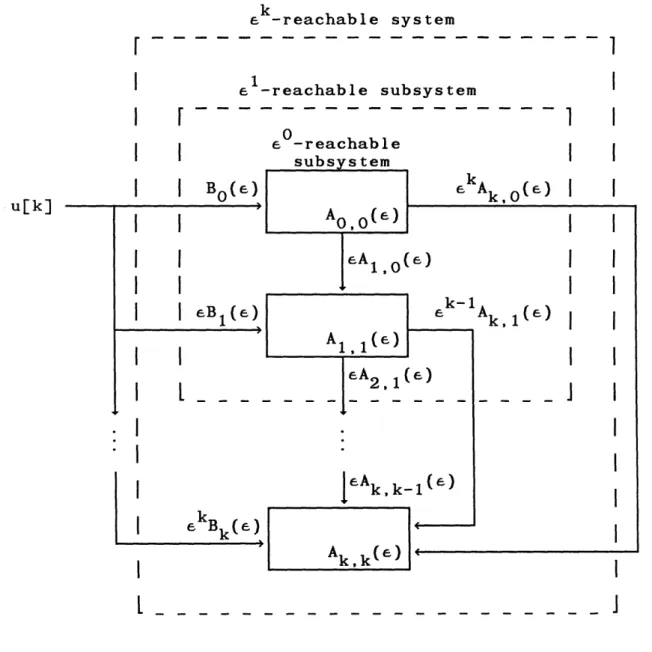
Similar to the submodule structure, the 6 -reachable
subsystem contains all eJ-reachable subsystems for j = 0.
i-1. The subsystems are layered with weak couplings of different
orders of E between each component, as shown in Figure A. Also,
~mn
i+i n-n 0(T (e) e 6 i+l i[[] 3D (A.3)
mn. i+1 n-n 0
and the sequence {%i(e)IR · [[e]]] converges to ° in k steps. In other words, e -reachable submodules of the
i O
6 -reachable subsystems approximate the e6 -reachable submodule of i+l
the system in standard form upto e accuracy. We use this in
Algorithm A.3 below.
Computation of the reachability matrix is very expensive.
One has to calculate Ai(e)B(e) for all the terms in the expansions
of A(e) and B(e). Thus, it is desirable to work directly with the
pair (A(e),B(e)). The following algorithm takes advantage of
Proposition A.1 to recover the ej-reachability indices. At every
step, the reachable subspace of a pair, evaluated at e=O, is
computed. Then the pair is updated by an appropriate scaling of
the unreachable part by 1/e. The algorithm uses the coefficients
of the Taylor expansions of the higher order terms only when
necessary. Also, it is possible to recover the actual Smith
decomposition of the reachability matrix from the algorithm, if
the transformations used in the algorithm are restricted to be
permutation matrices and lower triangular matrices, though this
restriction compromises numerical stability (see [22]).
Algorithm A.3:
Initialize: Ao(e) = A(e), Bo(e) = B(e), i = 0 Step i:
1. Find Ti such that
Ti
Ai(O)T
['
jTBi()
i =[]i
with (A1,B1) reachable. This determines ni.
2. If ni = n then go to End, else continue.
3. Let Ai+1(e) = D.I(e)T i1i ilA(e)TiDi(e), Bi+1 = D i (e)T Bi(e)i where Di(e) = diag{I n eI n-n.i
I 1
(It is not necessary to carry out the computation for all the
coefficients of A.(e) and Bi(e); see Note-1 in [22].)
4. Increment i, go to Step i.
End: k = i, the system is ek-reachable with indices no, ... , nk.
6k-reachable system e1-reachable subsystem
I […1
-6-reachable
subsystem
k BO(6) 6 kAk,o( 6) eA0 (e)I
I
(
)
e
Io|o
I
I
IeB() 1 Akk ()A
1 (1
)e....
,1
I. . . - --- - -- --i Ak k -l( 6 ) A k,k ( )FIGURE A.1 Block diagram showing the structure of an e -reachable
system in standard form (upper off-diagonal blocks of As(e) have
been omitted for clarity).
REFERENCES
[1] X-C. Lou, A. S. Willsky, G. C. Verghese, "An algebraic approach to time scale analysis of singularly perturbed
linear systems", LIDS-P-1604, MIT Dept. of Elec. Eng. and Comp. Sci., Sept. 1986.
[2] X-C Lou, G. C. Verghese, A. S. Willsky, P. G. Coxon, "Conditions for scale-based decompositions in singularly perturbed systems", submitted to Linear Ala. and its Appl.,
special issue on Lin. Alg. in Elec. Eng., Jan. 1987.
[3] C. C. Paige, "Properties of numerical algorithms related to computing controllability", IEEE Trans. Automatic Control, Vol. AC-26, Feb. 1981.
[4] P. H. Petkov, N. D. Christov, "A computational algorithm for pole assignment of linear multi input systems", IEEE Trans. Automatic Control, Vol. AC-31, Nov. 1986, pp 1044-1047.
[5] R. V. Patel, P. Misra, "Numerical algorithms for eigenvalue assignment by state feedback", Proceedings of the IEEE, Vol. 72, Dec. 1984, pp 1755-1764.
[6] G. S. Miminis, C. C. Paige, "An algorithm for pole assignment of time invariant linear systems",Int. J. Control, Vol. 35, No. 2, 1982, pp 341-354.
[7] B. C. Moore, "On the flexibility offered by state feedback in multivariable systems beyond closed loop eigenvalue
assignments", IEEE Trans. Automatic Control, Oct. 1976, pp 689-692.
[8] L. Pernebo, L. M. Silverman, "Model reduction via balanced state space representations", IEEE Trans. Automatic Control, Vol. AC-27, Apr. 1982.
[9] D. Boley, W. S. Lu, "Measuring how far a controllable system is from an uncontrollable one", IEEE Trans. Automatic
Control, Vol. AC-31, Mar. 1986, pp 249-251.
[10] W. M. Wonham, Linear Multivariable Control: A Geometric
Approach, 3rc edition, Springer Verlag, New York, 1985.
[11] G. C. Verghese, T. Kailath, "Rational Matrix Structure", IEEE Trans. Automatic Control, Vol. AC-26, Apr. 1981.
[12] P. M. Van Dooren, P. Dewilde, J. Vanderwalle, "On the determination of the Smith-Mc Millan form of a rational
matrix from its Laurent Expansion", IEEE Trans. Circuits and Syst., Vol. CAS-26, Mar. 1979.
[13] E. W. Kamen, P. P. Khargonekar, "Onthe control of Linear
systems whose coefficients are functions of parameters", IEEE Trans. Automatic Control, Vol. AC-29, Jan. 1984.
[14] J. W. Brewer, J. W. Bunce, F. S. Van Vleck, Linear Systems Over Commutative Rings, Lecture Notes in Pure and Applied Mathematics, Marcel Dekker, Inc., New York, 1986.
[15] J. H. Chow, "Preservation of controllability in linear
time-invariant perturbed systems", Int. J. Control, Vol. 25, pp 697-704, 1977.
[16] T. Kailath, Linear Systems, Prentice-Hall, Inc., New Jersey, 1980.
[17] J. C. Willems, "Almost invariant subspaces: An approach to high gain feedback design - Part 1", IEEE Trans. Automatic Control, Vol. AC-26, Feb. 1981.
[18] H. L. Trentelman, "Almost invariant subspaces and high gain feedback", PhD Dissertation, Rijksuniversiteit Groningen, May 1985.
[19] J. M. Schumacher, "Algebraic characterizations of almost invariance", MIT LIDS Report, LIDS-P-1197, April 1982.
[20] J. C. Willems, A. Kitappi, L. M. Silverman, "Singular optimal control: A geometric approach", SIAM J. Control and
Optimization, Vol 24, Mar. 1986.
[21] G. H. Golub, C. F. Van Loan, Matrix Computations, The Johns Hopkins University Press, 1984.
[22] C. M. Ozveren, "Asymptotic orders of reachability in linear dynamic systems", MS Thesis, MIT, Jan 1987.
[23] T. Kato, A Short Introduction to Perturbation Theory for Linear Operators, Springer, 1982.