Synthesis of poly(norbornene-g-ε-caprolactone) copolymers by
sequential controlled ring opening polymerization
P. Lecomte1, D. Mecerreyes1, P. Dubois2, A. Demonceau1, A. F. Noels1, R. Jérôme1
1 Center for Education and Research on Macromolecules (CERM), University of Liège, SartTilman, B6, B-4000 Liège, Belgium
2 University of Mons-Hainaut, Department of Polymeric and Composite Materials, Place du Parc 20, B-7000 Mons, Belgium
Abstract
Poly(norbornene-g-ε-caprolactone) copolymers have been prepared by the "grafting from" technique. Well controlled polynorbornene containing 5% acetate pendant groups has been firstly synthesized by ruthenium complex-mediated ring opening metathesis polymerization. The acetate groups have been derivatized into aluminum alkoxides by hydrolysis into alcohol followed by reaction of the alcohol with triethylaluminum. The two polymerization steps are under complete control, so that graft copolymers have been synthesized with a narrow molecular weight distribution and are free from any detectable traces of the parent homopolymers as stated by selective fractionation experiments. These original copolymers have been characterized by SEC, FTIR, 1H NMR, DSC, TGA.
Introduction
Ring Opening metathesis (ROMP) of cyclic olefins, such as norbornene (NBE), is a very promising route for the design of new polymeric materials. Indeed, the tolerance of ruthenium based catalysts towards various functional organic compounds has recently paved the way for the synthesis of a wide range of new functional polymers (1). The purpose of this work is the synthesis of polynorbornene (PNBE) grafted by poly-ε-caprolactone (PCL) chains, since the remarkable miscibility of PCL with several useful polymers and its ability to disperse fillers and pigments (2-4) is an added value to PNBE. These graft copolymers are indeed expected to be valuable compatibilizers for blends of
polynorbornene with all the polymers miscible to PCL, e.g. PVC, nitrocellulose and polyepichlorhydrin, and with pigments and fillers.
These graft copolymers have been synthesized by an original "grafting from" technique as shown in scheme 1. The first step consists of ROM copolymerization of a mixture of NBE and norbornene acetate (NBE-Ac), which is commercially available as a mixture of endo and exo isomers. After hydrolysis of the acetate moieties, PNBE chains are thus partly grafted by alcohol groups, which are then reacted with triethylaluminum (1.3 eq Et3Al), with formation of aluminum alkoxides, well known initiators for the ring opening polymerization (ROP) of ε-CL. The livingness of both the ruthenium complex-mediated ROMP of NBE derivatives (5,6) and the aluminum alkoxide-initiated "coordination-insertion" ROP of-ε-CL (7) provides a unique situation for the controlled synthesis of the envisioned graft copolymers.
Scheme 1. Synthesis of poly(norbornene-g-ε-caprolactone) by the "grafting from" strategy.
Experimental Materials
ε-CL (Acros) was dried over calcium hydride for 48 h and distilled just before use. Norbornene was purified by sublimation prior to use. NBE-OAc (Aldrich) and [RuCl2/p-cymene)]2, (Aldrich) were used without any further purification. Toluene and chlorobenzene were refluxed over calcium hydride and distilled. Tetrahydrofuran was dried by refluxing over sodium-benzophenone complex and distilled prior to use. Dry nitrogen was bubbled through toluene, tetrahydrofuran and chlorobenzene for more than 15 minutes prior to polymerization. Et3Al (Fluka) was dissolved in dry toluene and the
concentration was measured by complexometric titration of Al by a standard solution of EDTA. Tricyclohexylphosphine (PCy3) (Strem. Chemicals) was stored under nitrogen for protection against oxidation.
Synthesis of Poly(NBE-co-NBE-OAc)
In a typical experiment, 0.074g [RuCl2(p-cymene)]2 (0.12 mmol), 0.134g PCy3 (0.48 mmol), 1.412g NBE (15 mmol), 0. 152g NBE-OAc (1 mmol) and 179 ml chlorobenzene were added into a one-neck round bottom glass reactor fitted with a three way stopcock connected to either a nitrogen line or a vacuum pump. This glass reactor was previously purged with nitrogen. The reaction was conducted at 60°C under magnetic stirring. 1 ml of a 0.4M solution of trimethylsilyldiazomethane in chlorobenzene was added very rapidly, and 30 sec later, the reactor was cooled down to -78°C and the poly(NBE-co-NBE-OAc) precipitated into methanol, filtrated and dried under vacuum at 25°C overnight.
Deprotection of the acetate groups of polyfNBE-co-NBE-OAc)
In a one-neck round bottom glass reactor previously purged with nitrogen, a solution of poly(NBE-co-NBE-OAc) in THF was added followed by 1.5 equiv n-BuLi with respect to the acetate groups (2.5M n-BuLi in hexane). The reaction was conducted at 0°C for 30 min, and then stopped by addition of an excess of 0.1M HCl solution compared to n-BuLi. The poly(NBE-co-NBE-OH) copolymer was purified by precipitation into methanol, filtrated and dried under vacuum at 25°C overnight. Synthesis of the poly(NBE-g-ε-CL)
0.lg (0.06 mmol OH groups) of poly(NBE-co-NBE-OH) (Mn=190,000, 5 mol% NBE-OH) was added to a previously flamed and nitrogen purged two-neck round bottom glass reactor, and dried by repeated toluene azeotropic distillations. 10 ml. THF were then added through a rubber septum with a stainless steel capillary, and the reaction mixture was cooled down to -78°C. 1.3 equiv (0.08 mmol) AlEt3 with respect to the hydroxyl groups was added with a syringe and reacted at room temperature for 3 h. Finally, 0.2g (1.75 mmol) ε-caprolactone was added to the reaction mixture. The ring opening polymerization was carried out under magnetic stirring at room temperature for 24 h and stopped by the addition of 0.1 M HCl solution in excess to the initiator. After concentration, the solution was precipitated into cold heptane. The crude polymer was dried at room temperature until constant weight (0.26g ; 80%).
Characterization
1H NMR spectra were recorded in CDCl3 with a Brucker AM 250 apparatus at 25°C. Size Exclusion Chromatography (SEC) was performed in THF at 40°C using a Hewlett-Packard 1090 liquid
chromatograph equipped with a Hewlett-Packard 1037A refractive index detector. Columns HP PLgel 5µ (105A, 104A, 103A, 100A) were calibrated with PS standards. IR spectra of film cast on NaCl were recorded with a Perkin Elmer FTIR 075. DSC was carried by with a Dupont 910 Differential Scanning Calorimeter (heating rate = 10°C/min). TGA was performed under nitrogen with a Dupont TGA 51 thermogravimetric analyzer (heating rate = 10°C/min).
Results and discussion
ROM copolymerization of NBE and NBE-OAc mixtures has been promoted by a ruthenium complex developed by some of us (Table 1) (5). Actually, a solution of trimethylsilyldiazomethane, Me3SiCH2,, is added onto a solution of [RuCl2(p-cymene)]2, PCy3 , NBE and NBE-OAc in chlorobenzene at 60°C (see experimental). Under these conditions, a ruthenium carbene complex, [Ru]=CHSiMe3, is formed "in situ" and initiates the copolymerization of the NBE and NBE-Ac mixture (Scheme 1).
Table 1 : Copolymerization of NBE and NBE-OAc mixtures. a) Entry [NBE]0/ [NBE-Ac]0 [M]0/ [Ru]0 time (min) [M]0 (mol/1) conv (%) Mn (g/mol) Mw/Mn % NBE-Ac b) Tg (°C) 1 0/100 94 60 0,047 45 77 000 1,2 100 59 2 60/40 133 10 0,132 76 92 000 1,1 28 44 3 82/18 133 10 0,132 80 112 000 1,3 16 40 4 94/6 133 0,5 0,088 90 125 000 1,2 3 37 5 94/6 266 0,5 0,088 90 257 000 1,4 3 NDc ) a) Conditions : solvent = chlorobenzene ; T = 6O0C ; [Ru]0 / [PCy3]0 = 1 / 4 : [Ru]0 / [TMSD]0 =1/3. b) Comonomer content measured by 'HNMR spectroscopy.
c) Not determined
As a rule, ROMP is not a strictly living process as result of side reaction of the active species with the inner double bonds of the polymer chains. Although the metathesis reaction is not completely selective to the monomer double bond, the larger reactivity of the double bonds of the highly strained monomers compared to those of the polymers allows at least to limit the extent of these transfer reactions by a kinetic 'control: the polymerization time must be short enough for most the monomer to be consumed before the polymer double bonds start to react. Furthermore, it turns out necessary to perform the polymerization in very dilute solution in order to maintain the kinetic control of the polymerization. It must be noted that the copolymerization control is as more difficult as the NBE/NBE-OAc molar ratio is high, as result of the higher reactivity of the propagating carbene of the NBE type compared to the carbene derived from NBE-OAc The copolymerization of reaction mixtures rich in NBE has therefore to be rapidly stopped.
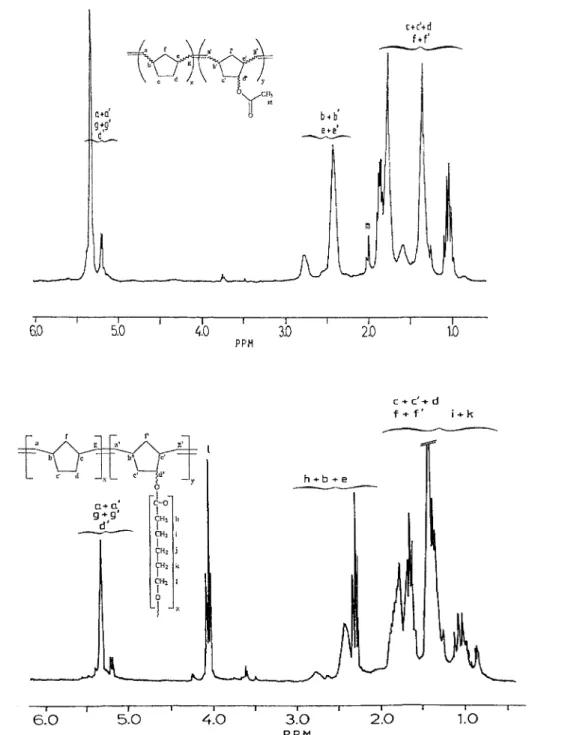
While taking this behavior into account, poly(NBE-co-NBE-OAc) have been prepared with a narrow molecular weight distribution (Mn / Mw=l.l-1.3) and a pendant acetate content dictated by the initial [NBE]0 / [NBE-OAc]0 molar ratio (Table 1). As expected for a controlled polymerization reaction, a twofold increase of the [M]0/[Ru]0, thus the [M]0/[TMSD]0, molar ratio results in a twofold increase of the copolymer molecular weight, Mn. As usually observed for the ROMP conditions used in this study, the PNBE chains contain mainly trans double bonds (70%) (3). The absorption at 1738 cm-1 in the FTIR spectrum confirms that the norbornene acetate has participated to the copolymerization. The content of the acetate groups attached to the polymer backbone has been measured by 1H NMR based on the relative intensity at 2.0 ppm for the acetate protons (CH3C(O)O) and at 2.4 ppm and 2.8 ppm for the allylic protons (-CH-CH=CH-) (Figure 1). As measured by thermal differential scanning
calorimetry, all the samples show only one Tg with a value depending on the content of copolymerized NBE-OAc (Table 1). Indeed, the glass transition temperature increases with the acetate content and reaches 59°C for the homo PNBE-OAc (entry 1, Table 1).
Fig. 1. 1H NMR spectra (CDCl3, TMS) of (a) poly(NBE-co-NBE-OAc) (3mol%NBE-OAc) and (b) poly(norbornene-g-ε-caprolactone).
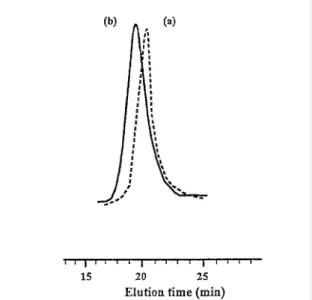
Fig. 2. Comparison of SEC traces for (a) polyCNBE-co-NBE-OH) and (b) poiy(norbornene-graft-ε-caρrolactone) (5 wt%NBE-OH).
PNBE backbone containing 5 mol% acetate pendant groups (Mn = 190,000 and Mw/Mn=1.3) has been used as a macroinitiator for the ε-CL polymerization. The acetate groups have been quantitatively converted into alcohol functions by n-BuLi in THF, as confirmed by the disappearance of the signal at 2.0 ppm in the 1H NMR spectrum (Figure 1) and the FTIR absorption at 1738 cm-1. The hydrolyzed copolymer, poly(NBE-co-NBE-OH), has been analyzed by SEC (Mn=208,000 and Mw/Mn= 1.22) and then reacted with Et3Al in THF at -78°C, in order to form aluminum alkoxide, i.e. the actual initiator of the ε-CL polymerization at room temperature. Figure 2 compares the SEC chromatograms of the PNBE backbone and the final graft copolymer. The molecular weight of the macroinitiator is expectedly shifted toward higher value (Mn=301,000), whereas the molecular weight distribution does not change significantly upon the second monomer conversion. In order to prove that the graft copolymer is not contaminated by homo-PCL, the crude graft copolymer has been cross-linked through the PNBE double bonds. The linking reaction has been achieved in such conditions that PCL is not cross-linked (THF, 25°C, for 24 h). The cross-cross-linked material has been swollen and washed by THF, a good solvent for homo-PCL. The collected THF solution has been evaporated under vacuum and no detectable trace of homo-PCL has been detected.
FTIR absorption at 1725 cm1 is characteristic of the ester group of the ε-CL units and qualitatively confirms the effective grafting onto the PNBE backbone (Figure 3). According to NNM analysis (Figure 1), the graft copolymer contains 43 mol% ε-CL based on the relative intensity of the multiplet (4.5 to 5.5 ppm) of the vinylic protons (CH-CH=CH-CH) of the PNBE backbone and the triplet at 4.05 ppm (CH2-O) for the ε-CL units. On the assumption that the 5 mol% OH functions of the poly(NBE-co-NBE-OH) initiate the copolymerization, Mn of 2,500 has been calculated for the PCL grafted chains. This value is close to the theoretical Mn (2,000) calculated from the equation
Fig. 3. FTIR spectrum of poly(norbornene-g-ε-caprolactone).
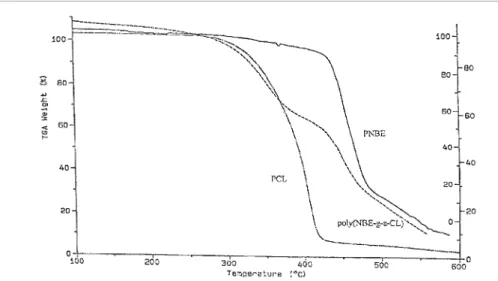
The DSC trace for the graft copolymer (Figure 4) shows a Tg at -60°C and a Tm at 60°C, both typical of the semi-crystalline PCL chains. The melting peak at 60°C prevents Tg of the PNBE backbone from being observed. The thermal behavior of the graft copolymer compared to the parent homopolymers is illustrated by the TGA curves (Figure 5). From this analysis, the graft copolymer appears to contain 45 mol% ε-CL and 55 mol% NBE, in good accordance with the values measured by NMR spectroscopy.
poly(norbornene-g-ε-caprolactone) (the second scan is reported).
Fig. 5. Comparison of TGA traces for poly(NBE-g-ε-CL), PNBE and PCL. Conclusion
The appropriate combination of the controlled ROMP of norbornene and the coordination-insertion ROP of ε-CL has proved to be an efficient strategy for the synthesis of novel graft copolymers of a predictable composition and narrow molecular weight distribution. These copolymers are now currently investigated as compatibilizers for blends for poly-NBE and PCL. The first encouraging experimental results have prompted us to investigate the synthesis of a poly-ε-CL norbornenyl macromonomer which might be ROMP-copolymerized with NBE. These data will be reported in a forthcoming paper.
Acknowledgments
The authors are grateful the "Service des Affaires Scientifiques, Techniques et Culturelles" for financial support and fellowship to Ph. L. in the frame of the "Pôles d'Attraction Interuniversitaires: : Polymères". Ph. D. is a Research Associate by the Belgian National Fund for Scientific Research (FNRS).
References
1. Ivin J. J. (1997) Olefin Metathesis ; Academic Press: London. 2. Brode C. L., Koleske J. V. (1972) J. Macromol. Sci. Chem. A6: 1109. 3. Hubbell D. S., Cooper S. L., (1977) J. Appl. Polym. Sci. 21: 3035. 4. Cruz C. A., Paul D. R., Barlow J. W. (1979) J. Appl. Polym. Sci. 23: 589.
5. Demonceau A., Stumpf, A. W., Saive, E., Noels, A. F. (1997) Macromolecules 30 : 3127 and references therein.
6. Grubbs R. H. (1989) Science 243: 907 ; Nguyen S. T., Grubbs R. H., Ziller J. W. (1993) J. Am. Chem. Soc. 115 : 9858 and references therein.
7. Dubois, Ph., Degée, Ph. Ropson, N., Jérôme R. (1997) "Macromolecular engineering of
polylactones and polylactides by Ring Opening Polymerization" Macromolecular Design of Polymeric Materials, Ed. By K. Hatada, Marcel Dekker Inc., 41 : 247 and references therein.
![Table 1 : Copolymerization of NBE and NBE-OAc mixtures. a) Entry [NBE] 0 / [NBE-Ac] 0 [M] 0 / [Ru]0 time (min) [M] 0 (mol/1) conv (%) M n (g/mol) M w /M n % NBE-Ac b) Tg (°C) 1 0/100 94 60 0,047 45 77 000 1,2 100 59 2 60/40 13](https://thumb-eu.123doks.com/thumbv2/123doknet/5954786.147183/3.892.149.689.425.609/table-copolymerization-nbe-nbe-oac-mixtures-entry-nbe.webp)