HAL Id: inria-00360848
https://hal.inria.fr/inria-00360848v2
Submitted on 17 Feb 2009
HAL is a multi-disciplinary open access archive for the deposit and dissemination of sci-entific research documents, whether they are pub-lished or not. The documents may come from teaching and research institutions in France or abroad, or from public or private research centers.
L’archive ouverte pluridisciplinaire HAL, est destinée au dépôt et à la diffusion de documents scientifiques de niveau recherche, publiés ou non, émanant des établissements d’enseignement et de recherche français ou étrangers, des laboratoires publics ou privés.
A Utility-based Framework for Assessing Fairness
Schemes in Ad-Hoc Networks
Emmanouil Dramitinos, Rémi Vannier, Isabelle Guérin-Lassous
To cite this version:
Emmanouil Dramitinos, Rémi Vannier, Isabelle Guérin-Lassous. A Utility-based Framework for As-sessing Fairness Schemes in Ad-Hoc Networks. [Research Report] RR-6843, INRIA. 2009, pp.15. �inria-00360848v2�
a p p o r t
d e r e c h e r c h e
ISSN 0249-6399 ISRN INRIA/RR--6843--FR+ENG Thème NUMINSTITUT NATIONAL DE RECHERCHE EN INFORMATIQUE ET EN AUTOMATIQUE
A Utility-based Framework for Assessing Fairness
Schemes in Ad-Hoc Networks
Manos Dramitinos — Rémi Vannier — Isabelle Guérin Lassous
N° 6843
Centre de recherche INRIA Grenoble – Rhône-Alpes 655, avenue de l’Europe, 38334 Montbonnot Saint Ismier
Téléphone : +33 4 76 61 52 00 — Télécopie +33 4 76 61 52 52
A Utility-based Framework for Assessing Fairness
Schemes in Ad-Hoc Networks
Manos Dramitinos∗ , R´emi Vannier∗ , Isabelle Gu´erin Lassous ∗
Th`eme NUM — Syst`emes num´eriques ´
Equipe-Projet RESO
Rapport de recherche n° 6843 — Feb 12, 2009 — 14 pages
Abstract: Fairness in multihop ad hoc networks has received considerable attention in the literature. A plethora of protocols have been proposed, which compute the “optimal” bit rates of the transmitting mobile nodes over short time-scales so that a certain fairness criterion is met. However, there has been limited research on the impact of the varying short-term allocations of these protocols due to nodes mobility on the user-perceived QoS (and social welfare) for services of long duration. In this paper, we introduce a utility-based framework, based on QoS-aware history-dependent utility functions. These functions quantify the satisfaction that the users of the MANETs obtain from the way their long-lived service sessions are allocated bandwidth, due to the behavior of the fairness protocols proposed for ad hoc networks. Finally, we demonstrate the framework’s usefulness, by performing a comparative assessment of the fairness protocol of [19] with the standard IEEE 802.11.
Key-words: Ad hoc, fairness, history-dependent utility function, MANET, QoS, social welfare
∗
ENS Lyon - 46, all´ee d’Italie 69364 Lyon Cedex 07 - FRANCE
Des fonctions d’utilit´
e pour ´
evaluer l’´
equit´
e dans
les r´
eseaux ad-hoc
R´esum´e : On peut trouver une litt´erature consid´erable `a propos de l’´equit´e dans les r´eseaux ad hoc multi-sauts. Les nombreux protocoles qui ont ´et´e propos´es d´eterminent les d´ebits “optimaux” pour les nœuds ´emetteurs sur de courtes ´echelles de temps selon un certain crit`ere d’´equit´e. En re-vanche, l’impact des variations `a court terme de ces allocations dues aux d´eplacements des nœuds sur la qualit´e de service per¸cue par l’utilisateur pour des services de longue dur´ee a fait l’objet de peu de recherches. Dans ce rapport, nous proposons un cadre d’´evaluation s’appuyant sur des fonctions d’utilit´e `a m´emoire. Ces fonctions quantifient la satisfaction des utilisateurs selon la mani`ere dont ´evolue la bande passante que le r´eseau leur alloue, et donc le comportement des protocoles des r´eseaux sans-fil sous-jacents. En-fin, nous utilisons ce cadre en comparant le standard IEEE 802.11 avec le protocole ´equitable de [19].
Mots-cl´es : Ad hoc, Equit´e, fonctions d’utilit´e m’emoire, MANET, QoS, choix social
A Utility-based Framework for Assessing Fairness Schemes in MANETs 3
1
Introduction
Mobile ad hoc networks (MANETs) are wireless, self-configuring networks of mobile nodes, the union of which form arbitrary topology. The nodes that also serve as routers are free to move arbitrarily; thus, the network’s topol-ogy may change rapidly and unpredictably. MANETs can be used by their nodes to exchange content or acquire Internet access via the dynamic net-work topology. Due to its simplicity and its commercial availability, most of these networks are based on the underlying wireless technology IEEE 802.11. Some works have shown that this use raises issues in terms of ef-ficiency and fairness [5]. Different protocols that attempt to improve the unfair way that the various flows are allocated bandwidth in the standard IEEE 802.11 protocol have been proposed (see for instance [2, 16, 19, 23]). Most of these studies evaluate the performance of the proposed solutions on a short time scale: each scenario is evaluated under a given topology (that can be a random one) with fixed pairs communicating according to a given traffic. These evaluations validate or not the effectiveness of the bandwidth allocations on a short time scale, i.e. they show if flows penalized in some configurations have their throughput increased or not. Henceforth, these al-locations are called instantaneous bandwidth alal-locations. But in a long time period, traffic patterns may vary, also due to the nodes mobility. Therefore, it is very likely that flows, penalized under a configuration during a given time period, do not encounter any fairness issues during the remaining time. Therefore, we think it is meaningful to perform a higher-level evaluation of the ad hoc fairness schemes. This evaluation should be economic-aware, that is it should reflect the economic value of the long-duration service ses-sions. This value is well defined for the services, as opposed to that of the uncorrelated “utilities” computed over the instantaneous rates allocated. Also, users only care about their service QoS, while they are indifferent to-wards the underlying network protocols and fairness schemes. These issues motivate the use of utility functions, which can serve as a common ground of comparison of the various fairness schemes whose maximization goals are inherently different (e.g. max-min fairness, proportional fairness etc.). In this paper, we propose a utility-based framework for the assessment of the performance of MANETs under various fairness schemes, which relies on the definition of QoS-aware history-dependent utility functions pertaining to the various services.
The remainder of this paper is organized as follows: In Section 2, we briefly overview related work and introduce our utility-based framework. Section 3 contains a classification of user services with respect to their sen-sitivity to various QoS parameters. In Section 4, we define utility functions for the services of these classes. In the penultimate section of the paper, we apply the proposed framework to comparatively assess the performance of the fairness scheme of [19] with that of standard IEEE 802.11 and provide
4 M. Dramitinos & I. Gu´erin-Lassous & R. Vannier
some experimental results thereof. Section 6 contains directions of future research and some concluding remarks.
2
Related work and our approach
Since the seminal work of John von Neumann and Oscar Morgenstern [20], utility functions have been extensively used in economics, decision-making, game theory, grid and computing systems (refer to [6], [18] [21] and references therein). There have been some research efforts to use utility functions in order to measure user satisfaction in wireless networks [15], [17], [13], [11]. The utility functions used in these works, depicted as Figure1, quantify the benefit that users obtain from being allocated a certain bit rate in very short time scales. These benefit values are not correlated and thus neglect the severe impact of important QoS parameters, such as delay, on the user-perceived QoS for the service of long duration. Finally, there are also studies on the impact of fairness schemes on the network performance, however no association with users’ utility is performed [10], [3], [12]. Therefore, we believe that assessing the impact of the various ad hoc fairness schemes upon the resulting user-perceived QoS and the social welfare attained is both of high importance and an open research issue.
QoS-aware history-dependent utility functions are an extension of stan-dard utility functions for expressing the value attained over a long time scale from receiving various levels of QoS at short time scales, henceforth referred to in this paper as slot1. In particular, various QoS parameters such as the vector of instantaneous bit rates, delay and/or total quantity of resources allocated impact the values of the correlated marginal utilities and the overall expected level of users’ satisfaction. This format of the uti-lity functions enables an accurate quantification of the user-perceived QoS. History-dependent utility functions have been originally proposed in [7] for auction-based resource allocation in UMTS networks and subsequently used by other works [8], [14].
In this paper, we propose a 3-tier framework, depicted as Figure2. This framework uses QoS-aware history-dependent utility functions so as to quan-tify the satisfaction of the ad hoc users from the way their services are al-located bandwidth, due to the short time scale operations of the fairness protocol. In particular, we use a classification of user services, based on the QoS parameters that are of importance, in order to define a utility function for each service class. These utility functions are additive, i.e. defined as the sum of marginal utilities attained at the small time scales on which the ad hoc fairness protocols operate. The values of these marginal utilities are
1
The value of the slot depends on the operation of the underlying routing and ad hoc fairness protocol; a reasonable value for the slot is 1 sec. This value also suffices to capture the impact of QoS variations on user’s attained QoS and subsequently the utility attained. INRIA
A Utility-based Framework for Assessing Fairness Schemes in MANETs 5
Figure 1: Typical utility func-tions. Source: [13].
Figure 2: The proposed utility-based framework.
coupled and depending on the service type and the treatment of the user’s flow by the ad hoc network vary so as to express the user’s satisfaction for the quality of service experienced. Thus, in order to comparatively assess the performance of MANET fairness protocols, it suffices to input the val-ues of the rates of the user flows of the ad hoc network obtained either by real time measurements or simulations (Network plane) to the framework’s utility functions (Utility plane). The latter outputs both the per-flow user-perceived QoS and the social welfare (Assessment plane), which are the performance values of the protocols under investigation. Note that social welfare is a widely used performance evaluation metric. It is also indicative of the acceptance of the proposed fairness schemes in practice; schemes that typically produce low values of social welfare are expected to be of limited acceptance by the users.
We claim that our approach is novel and can serve for the ad hoc research community as an economic-aware performance evaluation tool of the various ad hoc fairness protocols. In this paper, we demonstrate this by utilizing our framework in order to perform a comparative assessment of the scheme of [19] with the standard IEEE 802.11.
3
Services and QoS
Prior to proceeding with the definition of the user utility functions, we focus on the various types of user services and their corresponding QoS requirements. There has been already substantial work in the context of UMTS networks by the 3GPP, in identifying the important QoS parame-ters of services and classifying them thereof. In particular, 3GPP report TS 23.107 [1] defines four QoS classes, namely conversational, streaming, in-teractive and background. Conversational and streaming class both pertain to delay-sensitive services such as voice and real-time audio/video strea-ming respectively. The prominent QoS factors for both these classes are
6 M. Dramitinos & I. Gu´erin-Lassous & R. Vannier
the guaranteed bit rate and the delay. Interactive and background class are well-suited to throughput-sensitive delay-tolerant applications, such as Web browsing and email (or downloading) respectively, for which the quantity of accumulated data is of prominent importance. In our work, we use these QoS classes and their respective dominant QoS attributes for the definition of the framework’s utility functions. This is performed in the next section of this paper.
4
Utility functions definition
Without loss of generality, we assume that the utility us,ithat user i attains
from service s is the sum of the marginal utilities attained at every slot t due to the vector of bit rates allocated < x(1)i , ..., x(t)i > up to slot t. Thus, us,i(x(1)i , ..., x (ts,i) i ) = ts,i P t=1
v(t)s,i(x(1)i , ..., x(t)i ). In this formula, ts,i is the
duration of the user’s service session and x(t)i is the bit rate allocated to user i at slot t. Depending on the class of each service, we need to define an appropriate form of vs,i(t)(x(1)i , ..., x(t)i ). For brevity reasons we henceforth denote vs,i(t)(x(1)i , ..., x(t)i ) as vs,i(t).
4.1 Streaming class
The services which comprise the streaming class are delay and rate sensitive, such as real time streaming audio/video. For these services, we assume that there is a minimum bit rate r0 under which the quality of the service is
unacceptable for the user. This assumption has been verified by works on subjective QoS in wireless networks [22], [9], [4].
We denote the corresponding marginal utility from being serviced con-stantly with a rate r0as v02. Any bit rate less than r0results in zero marginal
utility for the user. Any additional quantity of bandwidth results in extra value ∆Vs· f (x(t)i , tpi) that depends on both the quantity of bandwidth x(t)i
allocated, as well as whether the user type tpi is (a) discretely-adaptive, (b)
linearly-adaptive, or (c) strongly-adaptive (see Figure1). ∆Vs denotes the
extra satisfaction of the user if she were awarded the entire network channel capacity C, while f (.) is an increasing function of bandwidth whose form depends on the user’s type and whose range is [0, 1]. The marginal utility is also multiplied with the αdi
s coefficient, where αs ∈ (0, 1) and di is the
dis-tance between the current and the previous slot during which a rate at least equal to r0 was allocated to user i. Hence, the marginal utility is reduced
if the user is not served satisfactorily for several slots, due to the incurred
2
For both r0 and v0we omit the service subscript s for clarity reasons.
A Utility-based Framework for Assessing Fairness Schemes in MANETs 7
service interrupts (i.e. application content “freezes”) and the corresponding high values of delay for delivering the service content. Therefore:
vs,i(t) = ( [v0(s, i, t) + ∆Vs· f (x(t)i , tpi)] · αdsi , if x (t) i ≥ r0 0 , if x(t)i < r0
Note also that v0(s, i, t) fluctuates over time rather than being constant.
This way, the marginal utility has a “memory” of the quality degradation experienced in the past and fluctuates accordingly. We define:
v0(s, i, t) = v0 , if t = 0 1 √ di · v0 , if di> 1 max{v0, v0(s, i, t − 1) + β · v0} , if di= 0
where β ∈ (0, 1). In order to complete the definition, we also need to define f (x(t)i , tpi). For this definition, we use some standard functions that other
researchers have used in their works [15], [13]:
f (x(t)i , tpi) = x(t)i −r0 C−r0 , if tpi= linearly-adaptive log(x(t)i −r0) log(C−r0) , if tpi= strongly-adaptive
Finally, for discretely-adaptive users, we define f (x(t)i , tpi) to be a step
func-tion whose steps are the points of the linearly-adaptive utility funcfunc-tion, taken from x0 = r0 and for every step kb/s. Thus, the step utility
func-tion of this type of users is a discretizafunc-tion of the utility funcfunc-tion used for linearly-adaptive users.
Concluding, the utility definition for streaming class services captures the effect of dissatisfaction stemming from both a) low bit transfer rates, since this results in both zero marginal utility and a reduction of the value of v0(s, i, t), and b) the duration of these service interrupts, which affect the
values of the delay of the content delivery of the service, by multiplying the value of the marginal utility with the αdi
s coefficient whenever satisfactory
service is resumed. It is also worth noting that the extra units of bandwidth allocated on top of r0 result in different marginal returns of ∆Vs, depending
on user’s type, so as to cover all possible types of users.
4.2 Conversational class
As explained in Section 4, the services of the conversational class are af-fected by the same QoS parameters with the streaming class services. The
8 M. Dramitinos & I. Gu´erin-Lassous & R. Vannier
difference is that the impact of delay results in faster and higher degradation of the user-perceived QoS. Therefore, it suffices to use the utility function definition of the streaming class modified only so that a steeper reduction of the marginal utility v0(s, i, t) occurs in cases of service interrupts. Therefore,
v0(s, i, t) for the conversational class is defined as follows:
v0(s, i, t) = v0 , if t = 0 1 di · v0 , if di> 1 max{v0, v0(s, i, t − 1) + β · v0} , if di= 0
4.3 Background and interactive class
Background and interactive class pertain to delay-tolerant throughput-sensitive services, such as data downloading. Though these services are not QoS-sensitive, for completeness reasons we also define the marginal utility for these services as well. In particular, it suffices to define it as the product of the rate allocated at each slot times a constant utility coefficient v0. Thus,
v0(s, i, t) = v0· x(t)i .
4.4 Discussion
The utility functions definitions of this section are essentially not unique. This is is not important per se for the assessment our framework performs, as long as a) these definitions are rational, i.e. reflect the impact of the QoS parameters of importance on user utility and b) the same utility defi-nitions are used for the comparative assessment of the protocols. Thus, the absolute values of the user-perceived QoS obtained by inputting the allo-cated rates under these protocols to the respective utility functions are not important, but their ordering is. This ranking is insensitive to the actual utility functions definitions and depicts which schemes perform better and for what kind of services, thus providing insight to the inherent properties and performance of the various ad hoc fairness schemes.
5
Usefulness of framework: Assessing fairness in
ad hoc networks
We demonstrate the usefulness of our framework by using it to comparatively assess the performance of the scheme of [19] and standard IEEE 802.11; note however that it can be used for any fairness scheme. An extensive comparative assessment was conducted. However, due to space limitations, a subset of the results attained for traffic comprising only of streaming flows are presented in this section; more results can be provided in the full version of this paper.
A Utility-based Framework for Assessing Fairness Schemes in MANETs 9
The scheme of [19] was designed to solve some of the fairness issues we observe with the IEEE 802.11 standard. By exchanging rate information at the routing layer, this scheme computes the rates achievable by the MAC layer so that all flows are granted a part of the capacity according to a proportional fairness rationale. The ns2 simulator version 2.33, the protocol implementation code of [19] and a set of Perl scripts implementing the Utility and Assessment plane of the framework (see Figure2) comprise the software used for this assessment.
Each experiment is conducted for T slots (seconds) over a square S × S terrain. Each slot is in fact a separate simulation of 100s for which we compute the bandwidth in the last 20 seconds. By doing so, we perform a long-term fairness evaluation of the scheme of [19] without the latter’s performance being affected by the protocol convergence and routing issues. The mobility model adopted prescribes that each node decides at every slot whether to move for δ meters with a probability pmove; the angle of
the node’s movement from its current position is drawn from a uniform distribution having support in [0, 360). For both schemes assessed, each set of experiments regards the same number of streaming video flows F crossing the network, whose start slot of transmission, origin and destination are randomly selected. These flows are simulated as aggressive UDP/CBR flows. The parameters for ns2 are depicted as Table 1, while the utility functions parameters are u0= 10, αs= 0.97, β = 0.1, ∆Vs= 5 · u0.
Physical rate 11 Mbps Real throughput 5 Mbps Routing protocol AODV Transmission range 200 m Carrier sensing range 397 m Capture threshold 10 dB
Radio propagation model TwoRayGround Packet size 1000 Bytes
RTS/CTS disabled
Table 1: Summary of the ns2 simulation parameters.
The first set of experiments depicts the typical performance of the two schemes which are evaluated. It regards the transmission of 5 video flows over a MANET of 20 nodes deployed on a 500m × 500m terrain. Since the total channel utilization can be slightly higher without rate control, one could suppose that this scheme performs better also in terms of user utilities and social welfare. However, this is not the case due to the higher variance of the rates of each flow. Figure3 and Figure4 depict the typical rates attained in our experiments. The framework’s utility functions capture this effect, as depicted in Figure5, where the average social welfare over all simulations is displayed: in terms of social welfare, a protocol that allocates bandwidth regularly such as [19] performs much better.
10 M. Dramitinos & I. Gu´erin-Lassous & R. Vannier
Figure 3: Rates attained un-der IEEE 802.11.
Figure 4: Rates attained un-der the scheme of [19].
Figure 5: Social welfare for a 500x500 ter-rain.
Figure 6: Social welfare for a 250x250 terrain.
A Utility-based Framework for Assessing Fairness Schemes in MANETs 11
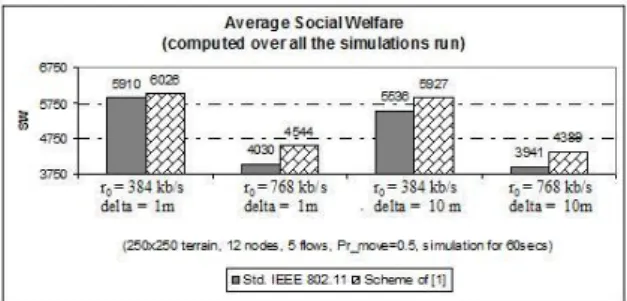
The second group of experiments regards the transmission of 5 video flows over a MANET of 12 nodes, which are randomly deployed on a terrain size of 250m × 250m. Since all communicating nodes are expected to be in carrier sensing range, this is the most favorable case for the performance of the standard IEEE 802.11 protocol. In order to assess the impact of mobility, we comparatively assess the performance of the protocols for pmove = 0.5
with δ being set to 1 and 10 respectively for two subsets of 15 experiments. The channel utilization is similar for both schemes. In particular, for the first subset of experiments (δ = 1m) the standard IEEE 802.11 results in 1.47% higher utilization, while under higher mobility (δ = 10m) the scheme of [19] is 1.05% better. However, the scheme of [19] is always strictly better in terms of social welfare for all the experiments conducted and for all the flows and types of users (i.e. linearly-adaptive, strongly-adaptive and discretely-adaptive). In fact, the higher the base rate r0 of the flows, the higher the
difference in performance becomes. The average social welfare attained over each set of 15 experiments is depicted as Figure6. Finally, the performance of both schemes is close to 0 for high values of r0 if the medium is saturated;
this is to be expected since under congestion it is always impossible for the flows to attain a high bit rate throughout the service time.
Overall, the utility-based framework captures the inherent properties of the schemes under investigation. Fairness schemes, as [19], allocate smoother rates over time; this is very desirable for multi-hop QoS-sensitive flows, thus resulting in higher values of the social welfare attained for a relatively small expense of channel utilization.
6
Conclusions
In this paper, we have presented a utility-based framework, based on QoS-aware history-dependent utility functions. These functions quantify the sat-isfaction that the users of the MANETs obtain from the way their long-lived service sessions are allocated bandwidth, due to mobility and the behavior of the fairness protocols proposed for ad hoc networks. We have argued that our approach is novel and can serve as an economic-aware performance evaluation tool of the various ad hoc fairness protocols. Finally, we have demonstrated the framework’s usefulness, by performing a comparative as-sessment of the fairness scheme of [19] with the standard IEEE 802.11. Using our framework so as to perform an in-depth study of the relationship of fair-ness and QoS in ad hoc networks, as well as a detailed evaluation of more fairness schemes, comprise interesting topics of future research.
12 M. Dramitinos & I. Gu´erin-Lassous & R. Vannier
References
[1] 3gpp specification 23.107 quality of service (qos) concept and architec-ture.
[2] Brahim Bensaou, Y. Wang, and C. C. Ko. Fair Medium Access in 802.11 based Wireless Ad-Hoc Networks. In ACM MobiHoc, pages 99– 106, Boston, Massachusetts, 2000.
[3] G. Berger-Sabbatel, A. Duda, O. Gaudoin, M. Heusse, and F. Rousseau. Fairness and its impact on delay in 802.11 networks. In Proc. of the IEEE Globecom, pages 2697–2973, 2004.
[4] M. Cha, P. Rodriguez, J. Crowcroft, S. Moon, and X. Amatriain.
Watching television over an ip network. In Proc. of the 8th ACM
SIGCOMM conference on Internet measurement, pages 71–84, Vou-liagmeni, Greece, October 2008.
[5] C. Chaudet, D. Dhoutaut, and I. Gu´erin Lassous. Performance Issues with IEEE 802.11 in Ad Hoc Networking. IEEE Communication Mag-azine, 43(7):110–116, July 2005.
[6] C. Courcoubetis and R. Weber. Pricing Communication Networks:
Economics, Technology and Modelling. Wiley and Sons, 2003.
[7] M. Dramitinos, G. D. Stamoulis, and C. Courcoubetis. Auction-based resource reservation in 2.5/3g networks. Kluwer/ACM Mobile Networks and Applications Special Issue on Mobile and Pervasive Commerce, 9(6):557–566, December 2004.
[8] M. Dramitinos, G. D. Stamoulis, and C. Courcoubetis. Auction-based resource allocation in umts high speed downlink packet access. In Proc. of the First EuroNGI Conference Conference on Traffic Engineering, pages 434–441, Rome, Italy, April 2005.
[9] H. Knoche and J. D. McCarthy. Design requirements for mobile tv. In Proc. of the 7th international conference on Human computer interac-tion with mobile devices and services, pages 69–76, Salzburg, Austria, 2005.
[10] C. E. Koksal, H. Kassab, and H. Balakrishnan. An analysis of short-term fainress in wireless media access protocols. In Proc. of the 2000 ACM SIGMETRICS international conference on Measurement and modeling of computer systems, pages 118–119, 2000.
[11] K. Lee. Adaptive network support for mobile multimedia. In Proc. of the 1st annual international conference on Mobile computing and networking, pages 62–74, 1995.
A Utility-based Framework for Assessing Fairness Schemes in MANETs 13
[12] Y. Li, L. Qiu, Y. Zhang, R. Mahajan, and Eric Rozner. Predictable performance optimization for wireless networks. In Proc. of the ACM SIGCOMM, pages 413–426, Seattle, WA, USA, August 2008.
[13] R. F. Liao and A. T. Campbell. A utility-based approach for quantita-tive adaptation in wireless packet networks. Kluwer Wireless Networks, 7:541–557, 2001.
[14] P. Maill´e and B. Tuffin. An auction-based pricing scheme for bandwidth sharing with history-dependent utility functions. In Proc. of the First International Workshop on Incentive Based Computing (IBC’05), pages 30–49, Compiegne, France, September 2005.
[15] D. Miras, R. J. Jacobs, and V. Hardman. Content-aware quality adap-tation for ip sessions with multiple streams. In Proc. of the 8th Interna-tional Workshop on Interactive Distributed Multimedia Systems, pages 168–180, London, UK, 2001. Springer-Verlag.
[16] T. Razafindralambo and I. Gu´erin Lassous. Increasing Fairness and Efficiency using the MadMac Protocol in Ad Hoc Networks. Ad Hoc Networks Journal, Elsevier Ed., 6(3):408–423, May 2008.
[17] J. Sachs, M. Prytz, and J. Gebert. Multi-access management in het-erogeneous networks. Wireless Personal Communications, 48(1):7–32, January 2009.
[18] S. Shenker. Fundamental design issues for the future internet. IEEE Selected Areas in Communications, 13(7):1176–1188, September 1995. [19] R. Vannier and I. Gu´erin Lassous. Towards a Practical and Fair Rate
Allocation for Multihop Wireless Networks based on a Simple Node
Model. In 11th ACM/IEEE International Symposium on Modeling,
Analysis and Simulation of Wireless and Mobile Systems (MSWiM), pages 23–27, Vancouver, Canada, October 2008.
[20] J. von Neumann and O. Morgenstern. Theory of Games and Economic Behavior. Princeton University Press, second edition, 1947.
[21] W.E. Walsh, G. Tesauro, J.O. Kephart, and R. Das. Utility functions in autonomic systems. In Proc. of the International Conference on Autonomic Computing, pages 70–77, 2004.
[22] G. Wikstrand and J. Sun. Determining utility functions for streaming low bit rate soccer video. In Proc. of IASTED International Conference on Internet and Multimedia Systems and Applications (IMSA), page August, Kauai, Hawaii, USA, 2004.
14 M. Dramitinos & I. Gu´erin-Lassous & R. Vannier
[23] Y. Xue, B. Li, and K. Nahrstedt. Optimal Resource Allocation in Wire-less Ad Hoc Networks: A Price-based Approach. IEEE Transactions on Mobile Computing, 5(4):347– 364, April 2006.
Centre de recherche INRIA Grenoble – Rhône-Alpes 655, avenue de l’Europe - 38334 Montbonnot Saint-Ismier (France)
Centre de recherche INRIA Bordeaux – Sud Ouest : Domaine Universitaire - 351, cours de la Libération - 33405 Talence Cedex Centre de recherche INRIA Lille – Nord Europe : Parc Scientifique de la Haute Borne - 40, avenue Halley - 59650 Villeneuve d’Ascq
Centre de recherche INRIA Nancy – Grand Est : LORIA, Technopôle de Nancy-Brabois - Campus scientifique 615, rue du Jardin Botanique - BP 101 - 54602 Villers-lès-Nancy Cedex
Centre de recherche INRIA Paris – Rocquencourt : Domaine de Voluceau - Rocquencourt - BP 105 - 78153 Le Chesnay Cedex Centre de recherche INRIA Rennes – Bretagne Atlantique : IRISA, Campus universitaire de Beaulieu - 35042 Rennes Cedex Centre de recherche INRIA Saclay – Île-de-France : Parc Orsay Université - ZAC des Vignes : 4, rue Jacques Monod - 91893 Orsay Cedex
Centre de recherche INRIA Sophia Antipolis – Méditerranée : 2004, route des Lucioles - BP 93 - 06902 Sophia Antipolis Cedex
Éditeur
INRIA - Domaine de Voluceau - Rocquencourt, BP 105 - 78153 Le Chesnay Cedex (France)
http://www.inria.fr ISSN 0249-6399
![Figure 1: Typical utility func- func-tions. Source: [13].](https://thumb-eu.123doks.com/thumbv2/123doknet/14652743.737726/8.892.411.670.237.390/figure-typical-utility-func-func-tions-source.webp)