
HAL Id: tel-00363037
https://tel.archives-ouvertes.fr/tel-00363037
Submitted on 20 Feb 2009
HAL is a multi-disciplinary open access
archive for the deposit and dissemination of sci-entific research documents, whether they are pub-lished or not. The documents may come from teaching and research institutions in France or abroad, or from public or private research centers.
L’archive ouverte pluridisciplinaire HAL, est destinée au dépôt et à la diffusion de documents scientifiques de niveau recherche, publiés ou non, émanant des établissements d’enseignement et de recherche français ou étrangers, des laboratoires publics ou privés.
Franck Cassez
To cite this version:
HABILITATION À DIRIGER LES RECHERCHES
English Version
Franck Cassez
CNRS/IRCCyN
Control of Timed Systems
École Doctorale : STIM Specialisation : Computer Science
September 21st, 2007 at IRCCyN
Examining Committee Reviewers:
Ahmed Bouajjani Professor, University of Paris 7, France
Oded Maler Research Director, CNRS, VERIMAG, Grenoble, France Jean-François Raskin Professor, Université Libre de Bruxelles, Belgium
Examiners:
Jean Bézivin Professor, University of Nantes, France
Claude Jard Professor, ENS Cachan, Antenne de Bretagne, Rennes, France Kim G. Larsen Professor, Aalborg University, Denmark
Jean-Jacques Loiseau Research Director, CNRS, IRCCyN, Nantes, France Olivier H. Roux Assistant Professor (HDR), University of Nantes, France
Table of Contents
1 Curriculum Vitæ 1
1.1 Positions Held . . . 1
1.2 Professional Experience . . . 1
1.3 Research Activities . . . 2
1.4 Committees and Administrative Duties . . . 2
1.5 Students Supervision and Collaborations . . . 3
1.5.1 Students Supervision . . . 3
1.5.2 Collaborations. . . 4
1.5.3 Reviewing . . . 6
1.5.4 Organisation of Summer Schools, Journal Special Issue . . . 6
1.6 Funded Projects . . . 7
1.6.1 Recent National Projects . . . 7
1.6.2 European Project . . . 7
1.6.3 Visits Abroad . . . 7
1.7 Seminars & Invited talks . . . 8
1.8 Publications . . . 10
1.9 Acronyms . . . 15
2 Overview of my Research Contributions 17 2.1 Introduction . . . 17
2.2 Semantics of Timed Games . . . 20
2.2.1 Rules for Playing Timed Games . . . 20
2.2.2 Strategies . . . 21
2.2.3 Control Objectives . . . 22
2.2.4 Winning Strategies . . . 22
2.2.5 Winning States . . . 23
2.3 Algorithms for Controller Synthesis . . . 24
2.3.1 Controllable Predecessors . . . 24
2.3.2 Symbolic Controllable Predecessors . . . 24
2.3.3 Symbolic Computation of Winning States . . . 25
2.3.4 Synthesis of Winning Strategies . . . 25
2.4 Contributed Results . . . 26
2.4.1 Decidability Issues for Timed Control . . . 27
2.4.2 Specification of Control Objectives . . . 29
2.4.3 Optimal Control . . . 32
2.4.4 Efficient Algorithms for Controller Synthesis . . . 36
2.4.5 Partial Observation: Control and Diagnosis . . . 41
3 Conclusion and Future Work 45
Foreword
To the reader who is not familiar with the French Higher Education system, the “Habilitation à Diriger les Recherches” (HDR) is a French degree which is supposed to acknowledge your ability to become a group leader, and more importantly which entitles you to officially supervise PhD students.
It is also mandatory to hold an HDR if you want to apply for a University Professor position or Research Director (INRIA, CNRS) position. Holding an HDR is a necessary but not sufficient condition.
Indeed, if you hold an HDR you can apply for a Research Director position, but there are not many positions per year and you might have to wait for a while.
An alternative is to apply for a University Professor position. Prior to this, you have to apply for a “Qualification”: this “Qualification” is delivered (or not) by a National French Panel1
, and to obtain it you have to hold an HDR and also to write a careful application (of course the forms you have to fill in are different from the ones you had to fill in when you registered as an HDR student2). If you are “qualified” then you can apply for University
Professor positions (and submit another application in yet another format).
The rules to obtain an HDR can sometimes appear to be inconsistent: you have to demon-strate you were able to write some research articles which is fine but also to show you could supervise PhD students. Here you can notice the French Cartesian tradition: without an HDR you cannot officially supervise PhD students, but to obtain it you must have supervised PhD students.
To sum up, obtaining an HDR requires you: 1) to write a report emphasising your research results and students’ supervisions, and 2) to defend your report in front an Examining Com-mittee. There are no rules for item 1), and you can write a hundred page book or just an extended abstract.
I chose to write an extended abstract and this report is organised as follows: • Chapter 1 consists of a short Curriculum Vitæ;
• Chapter 2 gives an overview of my recent research contributions on the control of timed systems. This has been my main research interest in the last few years;
• Chapter 3 contains an overview of my other research activities and some hints for future work;
• finally Chapter 4 contains the references (sorted by categories) used in this report.
1
the “Commission Nationale des Universités”, CNU; there is one panel per domain e.g., Computer Science.
2
Indeed, when you want to defend an HDR, you register as a University student and you get a nice student’s ID which entitles you the right you for many reduced fees.
Chapter 1
Curriculum Vitæ
Current Professional Address:
Institut de Recherche en Communication et Cybernétique de Nantes (IRCCyN) UMR CNRS 6597 1 rue de la noë BP 92101 44321 Nantes cedex 03 France tel : (+33 | 0) 2 40 37 69 81 fax : (+33 | 0) 2 40 37 69 30 email: [email protected] web: http://www.irccyn.fr/franck Acronyms used in this Chapter like HDRn
are listed page 15.
1.1 Positions Held
1993–1997 Associate Professor, Department of Computer Science, University of Western Brittany (Université de Bretagne Occidentale, UBO1
), Brest, France.
1997–2007 Full-Time Researcher at the Centre National de la Recherche Scientifique (CNRS2
, French National Centre for Scientific Research), affiliated with the Institut de Recherche en Communications et Cybernétique de Nantes (IR-CCyN3
, Research Institute in Communications and Cybernetics of Nantes), France
1.2 Professional Experience
1993–1997 At the University of Western Brittany: Lectures in Computer Science, “DEUG Sciences” (undergraduate), and Masters. Algorithms and Data Structures, Operating Systems, Language Theory, Introduction to Complexity Theory. 1999–2006 At the Ecole Nationale de la Statistique et de l’Analyse de l’Information
(EN-SAI4
), Rennes, France: Introduction to parsing (17h). Graduate level, Engi-1
neering Degree, 3rd year. Lab work with JFlex and JavaCup (Java versions of
Lex& Yacc).
2001–2002 At Ecole Centrale de Nantes (ECN5
), Nantes, France. Modeling and Veri-fication (Lectures: 16h and Lab work: 10h). Specialisation in « Embedded Systems », Graduate level, Engineering Degree, 3rd year. Theory: transition
systems, model-checking, temporal logic, timed automata. Lab work with SPIN6 and UPPAAL7.
2005 At Ecole Centrale de Nantes. Operating Systems (Lectures: 12h and Lab work: 6h). Graduate level, Engineering Degree, 3rd year, specialisation in
Computer Science.
1.3 Research Activities
1990–1993 PhD in Computer Science, École Centrale de Nantes & University of Nantes, France.
1993–1997 Member of the research group Langages et Interfaces pour Machines Intelli-gentes (LIMI), Department of Computer Science, University of Western Brit-tany, Brest, France.
I participated in the following projects:
• European project ESPRIT-WG 23531 Fireworks8 from 1997 to 2000;
• Working group GRAFCET (AFCET);
• Working group GDR CNRS Protocoles-Réseaux-Systèmes (Protocol-Net-works-Systems).
1997–2007 Member of the research group Modélisation et Vérification des Systèmes Em-barqués (MOVES, Modeling and Verification of Embedded Systems) at IRC-CyN, Nantes.
I am involve or have been involved in the following projects: • Distributed Open Timed Systems (DOTS9
) funded by ANR (French Na-tional Research Agency), started January 2007, duration: 4 years;
• Control and Observation of Real-Time Open Systems (CORTOS10
) ACI program11
from September 2003 to January 2007;
• Tools and Algorithms for the Verification of Hybrid Systems (CHRONO12
) ACI program11
from September 2001 to September 2004;
• Working group “GDR ARP” (Architecture, Networks, Parallelism).
1.4 Committees and Administrative Duties
2002– Member of the Steering Committee of the Summer School MOVEP13.
2002–2006 Member of the Editorial Board of the French Journal Technique et Science Informatiques (TSI).
2002–2005 Member of the recruiting (or scientific) committee “commission de spécialistes” of the University of Evry, France.
1.5 Students Supervision and Collaborations 3
1.5 Students Supervision and Collaborations
I am working regularly with my colleagues in Nantes on various research topics (timed au-tomata, time Petri nets). The work described in this report was also carried out with PhD students I was co-supervising and with colleagues from France and abroad with whom I have ongoing collaborations.
1.5.1 Students Supervision
Post Doc Student: • Julien D’Orso.
Subject: Control of Timed Systems.
Funding : ACI CORTOS, January to December 2004. PhD Students:
• Frédéric Herbreteau, PhD defended in December 2002.
Automates à file réactifs embarqués (Embedded Reactive FIFFO Automata). Supervision: Franck Cassez (50 %), Olivier Roux (50%).
Funding: French Ministry of Research.
PhD Committee: B. Boigelot, F. Cassez, A. Finkel, P. Gastin, O. Roux, F. Vernadat. Publications: one journal paper (Journal of Real-Time Systems, [J3]), and one interna-tional conference paper (LATIN’02, [C18]).
Current activity: Associate professor at ENSEIRB, Bordeaux and researcher at LaBRI. • Claire Pagetti, PhD defended in April 2004.
Extension temps-réel d’AltaRica (Timed Extenstion of AltaRica). Supervision: Franck Cassez (50 %), Olivier Roux (50%).
Funding: French Ministry of Research.
PhD Committee: A. Arnold, F. Cassez, J.-P. Elloy, F. Laroussinie, A. Rauzy, O. Roux, R. Valette.
Publications: one journal paper (Fundamentæ Informatica, [J2]) and one international workshop paper (Formal Aspects of Component Software (FACS’03), [C16]).
Current activity: Research Engineer at CERT/ONERA, Toulouse.
I have not co-supervised any other PhD thesis since 2004. In the meantime I have tried to strengthen and develop collaborations with my colleagues abroad (Aalborg, DK; Sydney, AU; Bruxelles, B) and in France (LSV, ENS-Cachan, VERIMAG, Grenoble) and also to expand my research activities. Since 2004, even if I was not supervising them, I have been working with PhD students in my lab: Didier Lime on the expressiveness of time Petri nets [C7, C8, C9] and Guillaume Gardey on the control of time Petri nets [I3, J7]. At the moment I am not considering any new supervision as I have applied for a Mobility Project (Marie Curie European Program) to spend two years abroad.
Master Students:
• Cédric Meuter, Compilation et répartition de programmes ELECTRE sur LEGO Mind-storms (Compiling and Distributing ELECTRE Programs for LEGO MindMind-storms). Mas-ter Thesis in CompuMas-ter Science, Université Libre de Bruxelles, Belgium, 2001/2002.
• Armelle Prigent, Vérification des systèmes SDL par abstraction, (Verification of SDL specifications), co-supervised with Philippe Dhaussy, ENSIETA, Brest and Olivier Roux, IRCCyN, Nantes). Master Thesis in Automatique et Informatique Appliquée (Auto-mated Systems and Computer Science), Nantes, 1999/2000.
• Manuel David, Test de Systèmes Temporisés, Master Thesis in Automatique et Informa-tique Appliquée, Nantes, 1998/1999.
• François Lorillard, Vérification de propriétés d’un logiciel de surveillance médicale avec SPIN, (Verification of Medical Monitoring Software). Master Thesis in Automatique et Informatique Appliquée, Nantes,1997/1998. One publication in a national work-shop [M1].
1.5.2 Collaborations.
National Collaborations. I work on a regular basis with my colleagues in the research group MOVES14 (Modeling and Verification of Embedded Systems) and also with Olivier H.
Roux from the Real-Time Systems group. Hereafter I just mention the collaborations I had or have with other colleagues in France:
• with Philippe Dhaussy (ENSIETA, Brest), during the Master Thesis of François Lorillard in 1998, we have designed a model of the software of a medical monitoring system (used in the main hospital of Brest) and formally verified it. The result of this work was published in a national workshop [M1]. Later on, during the Master Thesis of Armelle Prigent in 2000, we have proposed a translation of SDL in SPIN [C19].
• with Alain Finkel and Grégoire Sutre (LSV, ENS-Cachan) between 1998 and 2002, we have proposed a model for asynchronous infinite state systems, namely FIFFO automata (First In First Fireable Out) and studied the properties of this model (decidability of verification problems). The results we have obtained were published in [C22, C18]. • with François Laroussinie (LSV, ENS-Cachan), since 1999, we have been working on
various problems. We were co-leaders of the project ACI CHRONO12
(2001–2004) which focussed on tools and algorithms for hybrid systems and more particularly for stopwatch automata. Stopwatch automata are interesting because they can be used to model scheduling problems with preemption and complex synchronisation. This collab-oration was pursued with Patricia Bouyer. We have worked on control problems for timed systems during the course of the project ACI-CORTOS10
for which I was the site leader in Nantes. The results we have obtained were published in various confer-ences [I3, C10, C12, C14, C20, E1].
• with Gilles Bernot, Jean-Paul Comet and Franck Delaplace (LaMI, Evry), we have worked on modeling biological regulatory networks. This work was published in the BioCONCUR international workshop [C15].
• with Béatrice Berard and Serge Haddad (LAMSADE, Paris) we have been working since 2005 on the expressiveness of timed automata and time Petri nets. The results were published in [C7, C8, C9].
• with Claude Jard and Thomas Chatain (IRISA, Rennes) since 2005, we have been work-ing on unfoldwork-ings of networks of timed automata. Our results were published in [C6]. This collaboration is now pursued in the French project DOTS9
which started in January 2007.
1.5 Students Supervision and Collaborations 5
• with Karine Altisen and Stavros Tripakis (VERIMAG, Grenoble) we have been working on diagnosis problems for discrete event systems and timed systems. Our results were published in [C4, C3, C5] and in the research report [RR1].
• with André Arnold, Alain Griffault (LaBRI, Bordeaux) and Antoine Rauzy (LMI, Mar-seille) during the PhD Thesis of Claire Pagetti (2004), we have proposed an extension of the language AltaRica for timed systems [J2, C16].
International Collaborations. The collaborations are listed in chronological order: • with Mark Ryan (University of Birmingham, UK) and Pierre-Yves Schobbens (FUNDP,
Namur, Belgium), during the course of the project FIREworks8
. This project addressed the problem of feature integration in requirements engineering which is a real concern in the telecoms industry. The project started in May 1997 and ended in November 2000. Many European groups were involved in FIREworks, in particular the University of Birmingham, LaMI (Evry), FUNDP (Namur, Belgium), and Aalborg University, Den-mark. I was the site leader in Nantes for this project.
Together with Mark Ryan (University of Birmingham, UK) and Pierre-Yves Schobbens (FUNDP, Namur, Belgium) we have contributed some results on the detection of features interaction using the ATL logic. This work has been reported at the FIREworks annual meeting in May 2000 and published in [M2].
Following this collaboration, Mark Ryan joined the Organising Committee of the summer school MOVEP13
until 2004.
• with Kim G. Larsen, Aalborg University, Denmark, we started a collaboration in Septem-ber 1999. Since then, I have visited Aalborg regularly (2 weeks a year). We have first contributed results on the expressiveness of stopwatch automata (published in CON-CUR’2000, [C21]). More recently, we have been working on (Priced) Timed Games [C12, C14] and efficient algorithms for solving timed games [C1, C11].
• with Jean-François Raskin, Université Libre de Bruxelles (ULB) we started to collabo-rate in 2002. We contributed some results on the decidability of some sampling control problems for timed automata. This work was carried out together with Thomas Hen-zinger, UC Berkeley (USA) and published in HSCC’02 ([C17]). More recently we have worked (together with Kim G. Larsen) on the design of efficient algorithms for partially observable timed games [C1].
In 2002, I supervised a Master’s student, Cédric Meuter, from the Université Libre de Bruxelles.
Lastly Jean-François Raskin has been in the organising committee of the school MOVEP since 2002 and hosted the school in Brussels in 2004.
• with Ralf Huuck and Ansgar Fehnker, from NICTA15
, Sydney, Australia, we have worked on modeling sensor networks with timed automata. This work was carried out during a 2-month visit I made at NICTA in 2005. I have applied for a Marie Curie International Outgoing Fellowship (OIF) of the 7th Framework Programme to spend two years at
NICTA from 2008.
• with John Mullins, CRAC16, école Polytechnique de Montréal, Canada, we have worked
on non-interference problems, more precisely on the synthesis of non-interferent sys-tems [C2]. This work was done in collaboration with Olivier H. Roux.
1.5.3 Reviewing
I was a member of the Editorial Board of the French Journal Technique et Science Informa-tiques (TSI) from 2002 to 2006. As a member of the Editorial Board I helped in dispatching papers to reviewers and also reviewing papers for the journal TSI. In 2006, I was Associate Editor with François Laroussinie of a Special Issue of the journal about the Control of Timed and Hybrid Systems [E1].
I am regularly reviewing papers for international conferences: CAV17
, TACAS18 , FOS-SACS19 , CONCUR20 , BioCONCUR21 , LICS22 , HSCC23 , FSTTCS24 , CSL25 and interna-tional journals: Journal of Real-Time Systems, Fundamenta Informaticæ, Discrete Mathemat-ics and Theoretical Computer Science, Information & Computation, Theory and Practice of Logic Programming, Formal Methods in System Design and IEEE Transactions on Automatic Control (since September 2006, I have reviewed one paper for each of the above mentioned journals.)
Since 2006, I am an expert evaluator for the French Research Agency (ANR) now in charge of dispatching the funding for public research in France, and I also served as an expert evaluator for the Canadian Fonds de Recherche sur la nature et les technologies.
1.5.4 Organisation of Summer Schools, Journal Special Issue
Since 1998, I have been in the organising committee of the summer school MOVEP13
. The scope of the school is MOdeling and VErification of parallel Processes and the subjects covered are continuously updated following the new research advances. MOVEP used to be a French summer school (1994, 1996, 1998) and in 2000, I decided to give the school an international dimension. Renowned speakers from Europe and North America gave tutorials and invited talks. For this first international edition of MOVEP, the proceedings were published as a volume in the series Lecture Notes in Computer Science Tutorials [E5]. Ever since, around 120 participants from Europe, North America, India and North Africa have attended each edition of the school. MOVEP is now a well-established and internationally recognised event. It was organised in Brussels in 2004, Bordeaux in 2006 and will be held in Rennes in 2008. The school has been sponsored by national organisations (CNRS) and also European Network of Excellence (ARTIST2 NoE in 2006).
At the last international conference on Concurrency Theory (CONCUR’06, Bonn, Ger-many), I was in charge of organising the workshop CORTOS26
on Control and Observation of Real-Time Open Systems. This workshop was sponsored by the French project CORTOS I was involved in, and gathered around 15 people working on the control of timed systems (6 invited talks were given at the workshop among them 2 were given by participants of the French project CORTOS).
In 2006, I was Associate Editor with François Laroussinie of a Special Issue of the jour-nal Technique et Science Informatiques (TSI) about the Control of Timed and Hybrid Sys-tems [E1].
Since 2004, I am also participating in the programme rencontres élèves-chercheurs, aimed at improving interaction between the research community and students (from Primary school to High school). A few times a year, I am giving short talks in classrooms to present researchers’s activities. I am also participating in the fête de la science, held in October every year in France. For instance in 2007, I will give a talk in Nantes on The limited power of computers.
1.6 Funded Projects 7
1.6 Funded Projects
Since I was hired as an Associate Professor in 1993, I have tried to participate in funded projects. Some of them are mentioned in this section.
1.6.1 Recent National Projects
• Since January 2007, I am involved in the project Distributed Open Timed Systems (DOTS9
) funded by the ANR programme on Sécurité Informatique (Security). The project addresses verification and control problems for distributed and timed systems. The leader of the project is François laroussinie (LSV, ENS Cachan) and the other par-ticipants1are: IRISA Districom, Rennes (Claude Jard); IRCCyN, Nantes (Didier Lime);
LaBRI, Bordeaux (Igor Waluckiewicz); LAMSADE, Paris Dauphine (Serge Haddad) and LSV, ENS Cachan (François Laroussinie). This project spans over 4 years and the total funding is 600 KEuros with 100 KEuros for our group at IRCCyN.
• from September 2003 to January 2007, I was the site leader of the project CORTOS10
(Control and Observation of Real-Time Open Systems). CORTOS was also funded by the ANR programme on Sécurité Informatique (Security). This was a joint project with LSV (ENS Cachan) and VERIMAG (Grenoble) and the project leader was Pa-tricia Bouyer (LSV, ENS Cachan). Total funding for this project was 300 KEuros with 100 KEuros for our group. The results of the project are available from the URL http://www.lsv.ens-cachan.fr/aci-cortos/.
• from September 2001 to September 2004, I was co-leader with François Laroussinie of the project CHRONO12
. The theme of this project was using stopwatch automata to model scheduling problems. We were interested in studying decision problems for subclasses of stopwatch automata. The total funding for this project was 100 KEuros with 30 KEuros for our group.
1.6.2 European Project
From 1997 to 2000, I was involved in the Fireworks8
project. This project addressed the prob-lem of feature integration in requirements engineering which is a real concern in the telecoms industry. The project started in May 1997 and ended in November 2000. Many European groups were involved in FIREworks, in particular the University of Birmingham (UK, project leader), LaMI (Evry), FUNDP (Namur, Belgium), and Aalborg University, Denmark. I was the site leader in Nantes for this project.
Together with Mark Ryan (University of Birmingham, UK) and Pierre-Yves Schobbens (FUNDP, Namur, Belgium) we have contributed some results on the detection of features interactions using the ATL logic. This work has been reported at the FIREworks annual meeting in May 2000 and published in [M2].
The funding for our group in Nantes was around 20 KEuros.
1.6.3 Visits Abroad
I have visited a few research laboratories abroad. These visits were sponsored either by the host laboratory, or by the Direction des Relations Internationales (DRI) of CNRS, or by the
1
funds of the projects listed in Section 1.6.1. Here are some of the groups I visited recently: • Professor Kim Guldstrand Larsen, Aalborg University, Denmark.
– October–November 1999, 2 months, sponsored by BRICS27
, Denmark; – January 2001, 1 month, sponsored by BRICS, Denmark and DRI28
CNRS; – August 2001, 1 month, sponsored by BRICS, Denmark;
– December 2002, 3 weeks, sponsored by BRICS, Denmark and DRI CNRS; – December 2003, 2 weeks, sponsored by BRICS, Denmark;
– February 2005, 2 weeks, sponsored by CISS29
& ACI-CORTOS; – June 2006, 2 weeks, sponsored by CISS & ACI-CORTOS;
• Professor Jean-François Raskin, Université Libre de Bruxelles (ULB), Belgium. – May–June 2002, 2 months, sponsored by FNRS30
;
– November–December 2007, 1 month, sponsored by FNRS; • Professor John Mullins, Ecole Polytechnique de Montréal, Canada.
– June 2005, 2 weeks, sponsored by ACI CORTOS; – April 2007, 2 weeks, sponsored by ACI CORTOS;
• Professors Ron Van der Meyden and Ralf Huuck, NICTA, Sydney, Australia. – November–December 2005, 2 months, sponsored by DREI31
CNRS.
1.7 Seminars & Invited talks
Recently, I have presented the conference papers at ACSD’07, TASE’07, ACSD’06, ATVA’06, FORMATS’05, CONCUR’05, AVoCS’04, GDV’04.
In addition to this, I have given invited talks at projects meetings (FireWorks, ACI CHRONO, ACI CORTOS, ANR DOTS), or conferences or seminars:
1. Efficient Algorithms for Timed Games [I1], FORMATS’07, October 2007, Salzburg, Austria.
2. Contrôle des systèmes temporisés [I4], ETR’07, September 2007, Nantes, France. 3. Sensor Minimization Problems for Finite Automata, Seminar of the Centre Fédéré en
vérification, November 2006, Brussels, Belgium.
4. Fault Diagnosis with Digital Clocks, CORTOS workshop, Bonn, August 2006.
5. Sensor Minimization Problems for Finite Automata, CISS Seminar, Aalborg, June 2006, Denmark.
6. Sensor Minimization Problems for Finite Automata, Joint Workshop of the French projects CORTOS10
1.7 Seminars & Invited talks 9
7. Control of Timed Systems, NICTA, Lectures on the theory of control of timed systems, implementation and optimal control. November–December 2005, Sydney, Australia. 8. Introduction to Control of Timed Systems, NICTA Workshop on Formal Methods, 7–9
November 2005, Sydney, Australia.
9. Optimal Strategies for Priced Timed Games, VERIMAG seminar, October 20th, 2005, Grenoble, France.
10. Introduction to Control of Timed Systems, Invited Talk, MSR’05, October 7th, 2005, Autrans, France.
11. Introduction to Control of Timed Systems, CRAC Seminar, June 2005, Ecole Polytech-nique de Montréal, Canada
12. Efficient Algorithms for reachability control of timed systems, Seminar of Université Libre de Bruxelles, Brussels, May 28th, 2005.
13. From Timed Petri Nets to Timed Automata, CISS Seminar, Aalborg, March 2005, Den-mark.
14. Introduction to Control of Timed Systems, ENS Bretagne, Rennes, January 2005. 15. Optimal Strategies for Priced Timed Games, Journées du Centre Fédéré en vérification,
May 2004, Brussels, Belgium.
16. Optimal Strategies for Priced Timed Games, MVTSI Seminar, May 2004, LaBRI, Bor-deaux, France.
17. Vérification Qualitative – Model Checking et logiques temporelles [I5], Ecole Jeunes Cher-cheurs Ecole Temps Réel, ETR’03, September 2003, Toulouse, France.
18. Comparison of Control Problems for Timed and Hybrid Systems, LIAFA seminar, Paris 7, June 2002, Paris, France.
19. Comparison of Control Problems for Timed and Hybrid Systems, 68NQRT Seminar, February 2003, IRISA, Rennes, France
20. New results for Reactive FIFFO Automata, Seminar of Université Libre de Bruxelles, Brussels, December 2002.
21. Comparison of Control Problems for Timed and Hybrid Systems, LaBRI seminar, Jan-uary 2002, Bordeaux, France.
22. Comparison of Control Problems for Timed and Hybrid Systems, BRICS Seminar, Novem-ber 2001, Aalborg, Denmark
1.8 Publications
Most of the following papers are available from http:www.irccyn.fr/franck.
— Refereed Journal Papers —
International Journals
[J1] Franck Cassez and Olivier H. Roux. Structural translation from time petri nets to timed automata. Journal of Software and Systems, 29:1456–1468, 2006.
[J2] Franck Cassez, Claire Pagetti, and Olivier Roux. A timed extension for AltaRica. Fundamenta Informatica, 62(3–4):291–332, 2004.
[J3] Frédéric Herbreteau, Franck Cassez, and Olivier Roux. Application of Partial-Order Methods to Reactive Systems with Event Memorization. Journal of Real-Time Systems, 20(3):287–316, 2001.
[J4] Olivier Roux, Vlad Rusu, and Franck Cassez. Hybrid Verification of Reactive Systems. Formal Aspects of Computing, 11(4):448–471, 1999.
[J5] Franck Cassez. Formal Semantics for Reactive GRAFCET. European Journal of Au-tomation, 31(3):581–603, 1997.
[J6] Franck Cassez and Olivier Roux. Compilation of the Electre Reactive Language into Finite Transition Systems. Theoretical Computer Science, 146(1–2):109–143, 1995. National Journals
[J7] Karine Altisen, Patricia Bouyer, Thierry Cachat, Franck Cassez, and Guillaume Gardey. Introduction au contrôle des systèmes temps-réel. Journal Européen des Sys-tèmes Automatisés, 39(1-2-3):367–380, 2005.
[J8] Olivier Roux, Denis Creusot, franck Cassez, and Jean-Pierre Elloy. Le langage réactif asynchrone ELECTRE. Technique et Science Informatiques, 11(5):35–66, 1992.
— Invited Contributions —
[I1] Franck Cassez. Efficient on-the-fly algorithms for partially observable timed games. In Proc. of the 5th Int. Conf. on Formal Modeling and Analysis of Timed Systems (FORMATS’07), volume 4763 of LNCS, pages 5–24. Springer, 2007. Invited Paper. [I2] Franck Cassez and Olivier H. Roux. Petri Nets – Theory and Application, chapter From
Time Petri Nets to Timed Automata. Advanced Robotic Systems, Vienna, Austria, 2007. Forthcoming.
[I3] Karine Altisen, Patricia Bouyer, Thierry Cachat, Franck Cassez, and Guillaume Gardey. Introduction au contrôle des systèmes temps-réel. In Actes du 5ème Colloque sur la Modélisation des Systèmes Réactifs (MSR’05), pages 367–380. Hermès Science, 2005. Invited Paper. Also appeared as [J7].
[I4] Franck Cassez and Nicolas Markey. Contrôle des systèmes temporisés. Actes de l’école d’été ETR’07, 2007. Nantes.
11
[I5] Franck Cassez. Vérification qualitative – Model-Checking et Logiques Temporelles. Actes de l’école d’été ETR’03, 2003. Toulouse.
— Refereed Conferences —
International Conferences
The acceptance ratio for the articles of this section are: [C2]: 32%; [C3]: 40%; [C4]: 22%; [C5]: 51%; [C6]: 25%; [C7]: 44%; [C8]: 23%; [C9]: 35%; [C10] et [C11]: 38%; [C13]: 67%; [C14]: 24% ; [C17]: 45%; [C18]: 42%; [C19]: 50%; [C20]: 38%; [C21]: 36%; [C22]: 36%. [C1] Franck Cassez, Alexandre David, Kim G. Larsen, Didier Lime, and Jean-François
Raskin. Timed control with observation based and stuttering invariant strategies. In 5th Int. Symp. on Automated Technology for Verification and Analysis (ATVA’07), LNCS, pages 307–321. Springer, 2007. Forthcoming.
[C2] Franck Cassez, John Mullins, and Olivier H. Roux. Synthesis of non-interferent systems. In 4th Int. Conf. on Mathematical Methods, Models and Architectures for Computer Network Security (MMM-ACNS’07), volume 1 of Communications in Computer and Inform. Science, pages 307–321. Springer, 2007.
[C3] Franck Cassez, Stavros Tripakis, and Karine Altisen. Sensor minimization problems with static or dynamic observers for fault diagnosis. In 7th Int. Conf. on Application of Concurrency to System Design (ACSD’07), pages 90–99. IEEE Computer Society, 2007.
[C4] Franck Cassez, Stavros Tripakis, and Karine Altisen. Synthesis of optimal dynamic observers for fault diagnosis of discrete-event systems. In 1st IEEE & IFIP Int. Symp. on Theoretical Aspects of Soft. Engineering (TASE’07), pages 316–325. IEEE Computer Society, 2007.
[C5] Karine Altisen, Franck Cassez, and Stavros Tripakis. Monitoring and fault-diagnosis with digital clocks. In 6th Int. Conf. on Application of Concurrency to System Design (ACSD’06). IEEE Computer Society, 2006.
[C6] Franck Cassez, Thomas Chatain, and Claude Jard. Symbolic Unfoldings for Networks of Timed Automata. In 4th Int. Symp. on Automated Technology for Verification and Analysis (ATVA’06), volume 4218 of LNCS, pages 307–321. Springer, 2006.
[C7] Béatrice Bérard, Franck Cassez, Serge Haddad, Olivier H. Roux, and Didier Lime. Comparison of the Expressiveness of Timed Automata and Time Petri Nets. In Proc. of the 3rd Int. Conf. on Formal Modeling and Analysis of Timed Systems (FORMATS’05), volume 3829 of LNCS, pages 211–225. Springer, 2005.
[C8] Béatrice Bérard, Franck Cassez, Serge Haddad, Olivier H. Roux, and Didier Lime. When are Timed Automata weakly timed bisimilar to Time Petri Nets ? In Proc. of the 25th Int. Conf. on Foundations of Software Technology and Theoretical Computer Science (FSTTCS’05), volume 3821 of LNCS, pages 276–284. Springer, 2005.
[C9] Béatrice Bérard, Franck Cassez, Serge Haddad, Olivier H. Roux, and Didier Lime. Comparison of Different Semantics for Time Petri Nets. In 3rd Int. Symp. on Automated Technology for Verification and Analysis (ATVA’05), volume 3707 of LNCS, pages 293– 307. Springer, 2005.
[C10] Patricia Bouyer, Franck Cassez, and François Laroussinie. Modal logics for timed control. In Proc. of the 16th Int. Conf. on Concurrency Theory (CONCUR’05), volume 3653 of LNCS, pages 81–94. Springer, 2005.
[C11] Franck Cassez, Alexandre David, Emmanuel Fleury, Kim G. Larsen, and Didier Lime. Efficient on-the-fly algorithms for the analysis of timed games. In Proc. of the 16th Int. Conf. on Concurrency Theory (CONCUR’05), volume 3653 of LNCS, pages 66–80. Springer, 2005.
[C12] Patricia Bouyer, Franck Cassez, Emmanuel Fleury, and Kim G. Larsen. Synthesis of optimal strategies using HyTech. In Proc. of the Workshop on Games in Design and Verification (GDV’04), volume 119 of Elec. Notes in Theo. Comp. Science, pages 11–31. Elsevier, 2005.
[C13] Franck Cassez and Olivier H. Roux. Structural Translation of Time Petri Nets into Timed Automata. In Proceedings of the Workshop on Automated Verification of Critical Systems (AVoCS’04), volume 128 of Elec. Notes in Theo. Comp. Science, pages 145– 160. Elsevier, 2005.
[C14] Patricia Bouyer, Franck Cassez, Emmanuel Fleury, and Kim G. Larsen. Optimal strate-gies in priced timed game automata. In Proc. of the 24th Int. Conf. on Foundations of Software Technology and Theoretical Computer Science (FSTTCS’04), volume 3328 of LNCS, pages 148–160. Springer, 2004.
[C15] Gilles Bernot, Franck Cassez, Jean-Paul Comet, Franck Delaplace, Céline Müller, Olivier Roux, and Olivier Roux. Semantics of Biological Regulatory Networks. In Proc. of the Workshop on Concurrent Models in Molecular Biology (BioConcur’03), Elec. Notes in Theo. Comp. Science. Elsevier, 2003.
[C16] Claire Pagetti, Franck Cassez, and Olivier Roux. Hierarchical Modeling and Verification of Timed Systems in Timed AltaRica. In Workshop on Formal Aspects of Component Software (FACS’03), pages 63–80. UNU/IIST, Macau, 2003. Pisa, Italy, September 8–9, 2003.
[C17] Franck Cassez, Thomas A. Henzinger, and Jean-François Raskin. A Comparison of Control Problems for Timed and Hybrid Systems. In Proc. of the Workshop on Hybrid Systems Computation and Control (HSCC’02), number 2289 in LNCS, pages 134–148. Springer, 2002.
[C18] Frédéric Herbreteau, Franck Cassez, Alain Finkel, Olivier Roux, and Grégoire Sutre. Verification of Embedded Reactive FIFFO Systems. In Proc. of the Latin American Symp. on Theoretical Informatics (LATIN’02), volume 2286 of LNCS, pages 400–414. Springer, 2002.
13
[C19] Armelle Prigent, Franck Cassez, Philippe Dhaussy, and Olivier Roux. Extending the Translation from SDL to Promela. In Proc. of the 9th International SPIN Workshop on Model Checking of Software (SPIN’02), volume 2318 of LNCS, pages 400–414. Springer, 2002.
[C20] Franck Cassez and François Laroussinie. Model-Checking of Hybrid Automata by Quotienting and Constraints Solving. In Proc. of the Int. Conf. on Computer Aided Verification, (CAV’00), volume 1855 of LNCS, pages 373–388. Springer, 2000.
[C21] Franck Cassez and Kim Guldstrand Larsen. The Impressive Power of Stopwatches. In Proc. of the 11th Int. Conf. on Concurrency Theory, (CONCUR’00), volume 1877 of LNCS, pages 138–152. Springer, 2000.
[C22] Grégoire Sutre, Alain Finkel, Olivier Roux, and Franck Cassez. Effective recognizability and model-checking of reactive FIFFO automata. In Proc. of the 7th Int. Conf. on Algebraic Methodology and Software Technology (AMAST’98), volume 1548 of LNCS, pages 106–123. Springer, 1999.
National Conferences
[C23] Franck Cassez and Olivier Henri Roux. Traduction structurelle des Réseaux de Petri Temporels en Automates Temporisés. In 4ème Colloque Francophone sur la Modélisa-tion des Systèmes Réactifs, (MSR’03), 2003.
[C24] Franck Cassez, Frédéric Herbreteau, and Olivier Roux. Reactive Systems with Un-bounded Event Memorization. In Conférence Africaine de Recherche en Informatique, CARI’2000, pages 291–298. INRIA, 2000. Conférence francophone.
[C25] Franck Cassez. Sémantique pour le GRAFCET réactif. In Actes du 1er Colloque sur
la Modélisation des Systèmes Réactifs (MSR’96), 1996.
— Proceedings, Journal Special Issue —
I was co-editor of the following books:
[E1] Franck Cassez and François Laroussinie, editors. Contrôle des applications temps-réel: modèles temporisés et hybrides, volume 25 of Technique et Science Informatiques. Hermès Science, 2006.
[E2] Franck Cassez, Therry Jéron, François Laroussinie, Jean-François Raskin, and Mark Ryan, editors. Proceedings of the Summer School MOVEP’2006. LaBRI, Bordeaux, France, Bordeaux, France, December 2006. 400 pages, in English.
[E3] Franck Cassez, Therry Jéron, François Laroussinie, Jean-François Raskin, and Mark Ryan, editors. Proceedings of the Winter School MOVEP’2004. Université Libre de Bruxelles, Belgique, Bruxelles, Belgium, December 2004. 400 pages, in English. [E4] Franck Cassez, Claude Jard, François Laroussinie, and Mark Ryan, editors. Proceedings
of the Summer School MOVEP’2002. Ecole Centrale de Nantes, 2002. 450 pages, in English.
[E5] Franck Cassez, Claude Jard, Brigitte Rozoy, and Mark D. Ryan, editors. Proc. of the Int. Summer School on Modelling and Verification of Parallel Processes (MOVEP’2k), volume 2067 of Lecture Notes in Computer Science Tutorials. Springer, 2001.
[E6] Franck Cassez, Claude Jard, Brigitte Rozoy, and Mark Ryan, editors. Proceedings of the Summer School MOVEP’2000. Ecole Centrale de Nantes, 2000. 300 pages, in English. [E7] Franck Cassez, Claude Jard, Olivier Roux, and Brigitte Rozoy, editors. Actes de l’école
d’été MOVEP’98. Ecole Centrale de Nantes, 1998. 280 pages, in french.
— Recent Research Reports —
[RR1] Franck Cassez, Stavros Tripakis, and Karine Altisen. Sensor Minimization Problems with Static or Dynamic Observers for Fault Diagnosis. Technical Report RI-2007-1, IRCCyN/CNRS, Nantes, 2007.
[RR2] Franck Cassez, Thomas Chatain, and Claude Jard. Symbolic Unfoldings for Networks of Timed Automata. Technical Report RI-2006-4, IRCCyN/CNRS, Nantes, 2006. [RR3] Patricia Bouyer, Franck Cassez, and François Laroussinie. Modal Logics for Timed
Control. Technical Report RI-2005-2, IRCCyN/CNRS, Nantes, 2005.
[RR4] Béatrice Bérard, Franck Cassez, Serge Haddad, Didier Lime, and Roux Olivier Henri. Comparison of the Expressiveness of Timed Automata and Time Petri Nets. Technical Report RI-2005-3, IRCCyN/CNRS, Nantes, 2005.
[RR5] Patricia Bouyer, Franck Cassez, Emmanuel Fleury, and Kim Guldstrand Larsen. Op-timal Strategies in Priced Timed Game Automata. BRICS Reports Series RS-04-0, BRICS, Denmark, 2004. ISSN 0909-0878.
— Miscallenous —
[M1] Ahmed Bouabdallah, Franck Cassez, Joël Champeau, Philippe Dhaussy, François Lo-rillard, and Olivier Roux. Vérification d’un logiciel temps-réel distribué: étude compar-ative des environnements B, SDT et SPIN. 7ième journées thématiques Informatique et électronique embarquées, Brest, 1998.
[M2] Franck Cassez, Mark D. Ryan, and Pierre-Yves Schobbens. Proving Feature non-interaction with Alternating Time Temporal logic. In 3rd FIREworks Workshop – Language Constructs for Describing Features, pages 85–104. Springer Verlag, London, 2000. Copyright Springer Verlag.
1.9 Acronyms 15
1.9 Acronyms
1– UBO: Université de Bretagne Occidentale (University of Western Brittany), Brest, France. 2– CNRS: Centre National de la Recherche Scientifique, http://www.cnrs.fr
3 – IRCCyN: Institut de Recherche en Communication et Cybernétique de Nantes (Research Institute in Communications and Cybernetics of Nantes), http://www.irccyn.ec-nantes.fr
4 – ENSAI: Ecole Nationale de la Statistique et de l’Analyse de l’Information (French National School in Statistics).
5– ECN: Ecole Centrale de Nantes, France.
6– SPIN: Model-checker for communicating automata, http://spinroot.com/ 7– UPPAAL: Model-checker for timed automata, http://www.uppaal.com 8– FIREworks: Feature Integration in Requirements Engineering
http://www.cs.bham.ac.uk/~mdr/fireworks/
9– DOTS: Distributed Open Timed Systems. Project funded by ANR (French National Research Agency) « Sécurité Informatique », started January 2007, duration: 4 years; http://www.lsv.ens-cachan.fr/anr-dots/ 10– CORTOS: ACI program « Sécurité Informatique », Control and Observation of Real-Time Open Systems
http://www.lsv.ens-cachan.fr/aci-cortos/
11– ACI: Action Concertée Incitative which is a French government program to sponsor research.
12– CHRONO: ACI « Jeunes Chercheurs », Tools and Algorithms for the Verification of Hybrid Systems http://www.irccyn.fr/franck/aci-chrono/
13– MOVEP: Modeling and Verification of Parallel Processes. Summer School. http://movep.labri.fr/ 14– MOVES: Modeling and Verification of Embedded Systems
15– NICTA: National Information and Communications Technology Australia. http://nicta.com.au 16– CRAC: Laboratoire de Conception et de Réalisation des Applications Complexes, Ecole Polytechnique de Montréal, Canada.
17– CAV: Conference on Computer Aided verification.
18 – TACAS: Part of ETAPS, conference on Tools and Algorithms for the Construction and Analysis of Systems.
19– FOSSACS: Foundations of Software Science and Computation Structures. 20– CONCUR: Conference on Concurrency Theory.
21– BioCONCUR: Workshop on Concurrent Models in Molecular Biology. 22– LICS: Conference on Logics in Computer Science.
23– HSCC: Hybrid Systems: Computation and Control.
24– FSTTCS: Foundations of Software Technology and Theoretical Computer Science. 25– CSL: Computer Science Logic
26– Workshop CORTOS: http://www.lsv.ens-cachan.fr/aci-cortos/workshop-concur06/ 27– BRICS: Basic Research In Computer Science, Denmark.
28– DRI: Direction Relations Internationales du CNRS.
29– CISS: Center for Indlejrede Software Systemer (Center for Embedded Software Systems). http://www.ciss.dk
30– FNRS: Fonds National de la Recherche Scientifique; Belgium.
Chapter 2
Overview of my Research
Contributions
In this chapter, I give an overview of some results I have contributed to the domain of control of timed systems. In the last few years I have also been working on the expressive power of time Petri nets and timed automata. I have not developed this line of work as it was done with Olivier H. Roux, and a summary of the results we have obtained together is already available (in French) from Olivier’s “Habilitation à Diriger les Recherches” [84].
Sections (2.1–2.3) give an introduction to the domain of control for timed systems. They were inspired from an earlier synthesis article [9] (in French). This paper was prepared for an invited session at the French conference Modeling of Reactive Systems (MSR in French) where we have presented the results obtained during the course of the project CORTOS (see section 1.3, page 2 and page 15 for the URL). I was in charge of this paper and I presented the invited talk at the conference. For further results, an excellent synthesis of the results on control for timed systems can be found in [8].
In the next section 2.4, I give an overview of some more advanced subjects in the domain of control for times systems, and emphasise some results I contributed to the domain.
2.1 Introduction
A classical approach to verification of critical systems, is model-checking [7]: this amounts to building a model (S) of the system we want to check (e.g., the model can be a finite automaton), to give a formal statement of the correctness property (ψ) the system has to satisfy (e.g., the property can be given in a temporal logic), and to use a model-checking algorithm to check whether S satisfies (or not) the property ψ (“S satisfies ψ” is often denoted S |= ψ). The model-checking technology is now mature enough to be used in an industrial context.
Nevertheless, models like finite automata cannot capture quantitative timing constraints easily nor efficiently. Consider a scheduling problem with complex synchronisation and non-deterministic tasks durations. It is possible to use finite automata and a discrete time domain to model the problem but there are some drawbacks: one has to encode manually all the behaviours (e.g., if the duration of a task is within 1 and 3 time units, the model will contain explicitly the cases for 1, 2 and 3 time units), and moreover if the constants that appear in the specification have different order of magnitude, say 1 to 1000000, one has to consider
that the discrete time scale is 1 and the model will contain explicitly 1000000 different cases; this will result in a huge number of discrete states (state explosion problem) and thus makes verification a very hard task.
To handle features like non-deterministic tasks durations, and to have a compact and concise specification of a system, we can use an extension of the finite automaton model: Timed Automata, TA. Timed automata were introduced in [1], and are finite automata enriched with dense time clocks. Model-checking algorithms (as well as temporal logics) for discrete (finite) systems have been extended to handle the quantitative aspects of TA, and efficient tools were developed to model-check TA: UPPAAL [89], KRONOS [88], CMC [91, 86] or HyTech [87] for Hybrid Automata which are an extended version of TA that can handle more general types of clocks (like stopwatches that can be stopped and resumed).
The Controller Synthesis Problem. To verify the correctness of a system, for instance using a model-checking technique, it is necessary to have a complete model of the system: for a lift system, one has to build a model of the lift and a model of the control program in order to verify anything meaningful. Using an “automated systems” terminology, such systems are closed loop systems.
The environment S the control program has to supervise (e.g., the lift) is called an open system. It is the purpose of controller synthesis to check that a control program, say C, exists such the closed system “S supervised by C” (denoted (S k C) in the sequel), is correct.
If the correctness property is φ, the verification problem is “Does (S k C) satisfy φ?”. The model-checking problem can be formally defined by:
Given S, C and φ, does (S k C) |= φ ? (MC)
As said previously, this approach requires to build a model of the controller C, of the environ-ment S and of the compound system (S k C). Guessing a controller might be a difficult task for complex systems, of for complex properties (e.g., a property involving timing constraints). Moreover, if we can design a controller, it could happen that the property is not satisfied by the closed system. In this case, it is necessary to patch the controller. This process can be applied iteratively until a good controller is found. This guess/check method has some drawbacks: it could be that the handcrafted controller we designed is not very efficient (in terms of lines of code for instance) and a better one exists; even worse, it might be that no controller exists to enforce the property φ on the environment S and the iterative process of guess/check will end up in an infinite loop.
Ideally, we would like to start with a specification of the system to be controlled S, a property to be enforced, φ, and compute or synthesise a controller C s.t. (S k C) |= φ. Before computing a controller, we have to check that one exists. This is the Control Problem (CP) defined formally by:
Given S and φ, is there any C s.t. (S k C) |= φ ? (CP) The answer to the control problem (CP) depends on many parameters: for instance, which type of controllers we are looking for. We can decide to look for a finite state controller (with bounded memory) or a more powerful one which has its own clocks and can measure durations. If the answer to (CP) is “yes”, a natural question is to compute a witness controller: this is the Controller Synthesis Problem (CSP):
2.1 Introduction 19
The previous problems have been identified and studied for discrete event systems in the pioneering work of Ramadge and Wonham [12, 13]. Another way of addressing the control problem is to use the framework of Game Theory.
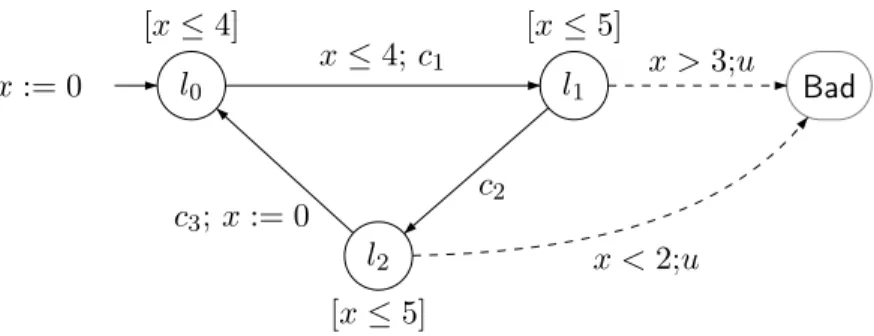
From Control to Games. The control problem can be seen as a game problem in which a controller has to win against an environment. As such, it can formalised using the game theory developed for discrete systems [14, 18, 15, 17] and later extended to timed systems [20, 25, 23, 29]. For instance, an open system can be specified using a Timed Game Automaton (TGA) like the one given in Figure 2.1. A TGA is a standard TA in which the actions are partitioned into two disjoints sets: controllable actions which can be . . . controlled, and uncontrollable actions on which the controller has no control. In the TGA of Figure 2.1, controllable transitions
x:= 0 l0 [x≤ 4] l1 [x≤ 5] l2 [x≤ 5] Bad x≤ 4; c1 c2 c3; x := 0 x <2;u x >3;u
Figure 2.1: A Timed Game Automaton S.
are pictured using plain lines whereas uncontrollable transitions are pictured by dashed lines. The type of a transition is determined by the type of its action. Actions are partitioned into Σc ={c1, c2, c3} for controllable ones and and Σu={u} for uncontrollable ones.
The TGA of Figure 2.1 specifies a control problem where the controller is in charge of Σc
i.e., the controller can choose when to play a Σc-action, and Σu are uncontrollable actions
played by the environment. In this example, the goal of controller is to avoid the state Bad, and this whatever the environment is doing. This type of game where one has to keep the system within a set of good states is called a safety game.
Timed Automata. A timed automaton (TA) is a finite automaton enriched with clocks, the values of which are in a dense time domain like R≥0. In the example of Figure 2.1, x is a clock
of the TA S. The behaviours generated by a TA like S begin in the initial state (ℓ0, x= 0).
The semantics of TA is such that a state has two components: one discrete component which is the location in which the TA is, and the other component is an assignment of the clocks to real values in R≥0. This means that, when a dense time domain is considered, a TA has an
infinite (sometimes uncountable) set of states.
In a TA, the values of the clocks increase synchronously as time elapses. Each location is tagged with an invariant1 which is a constraint imposed on time elapsing. For instance, in
location ℓ0, the invariant is [x ≤ 4]. This imposes that from state (ℓ0, x= 0), the maximum
amount of time that can elapse is 4 time units. For any δ ∈ R≥0 with δ ≤ 4, time can
elapse from (ℓ0, x= 0) and the system S reaches state (ℓ0, x = δ): this is a time transition.
A discrete transition can be fired if the constraints given by the guard of the transition are satisfied: for instance c1 can be triggered when x ≤ 4. The automaton S of Figure 2.1 imposes
that transition c1 occurs before 4 time units have elapsed from the initial state: the invariant
1
[x≤ 4] prevents time elapsing beyond x = 4.
The semantics of a TA is a Timed Transition System (TTS) which is a standard transition system with two types of transitions: time transition labelled by some δ ∈ R≥0 and discrete
transitions labelled by an action in Σc ∪ Σu. A behaviour generated by a TA is a sequence
of alternating time and discrete transitions. For example, the automaton S of Figure 2.1 can generate the following runs2
ρ1 and ρ2: ρ1: (ℓ0,0)−−−→ (ℓ1.55 0,1.55) c 1 −−→ (ℓ1,1.55)−−−→ (ℓ1.67 1,3.22)−→ (Bad, 3.22)u ρ2: (ℓ0,0)−−→ (ℓ1.1 0,1.1) c 1 −−→ (ℓ1,1.1)−−→ (ℓ2.1 1,3.2) c 2 −−→ (ℓ2,3.2) 0.1 −−→ (ℓ2,3.3) c 3 −−→ (ℓ0,0)· · ·
In a TTS there are infinitely many time transitions (with labels δ ∈ R≥0) and infinitely
many states. Nevertheless, for any TA A, the TTS that gives the semantics of A admits a finite abstraction (the region automaton or graph from Alur & Dill [1]) which contains enough information to prove most of the correctness properties of A. The nodes of this abstraction are symbolic states which are pairs of the form (ℓ, Z) where ℓ is a location of A and Z is a zone i.e., a convex set of valuations of the clocks. In the example of Figure 2.1, we can have a symbolic node of the form (ℓ0,1≤ x < 3) (actually this type of nodes with a zone defined by a
non-elementary constraint 1 ≤ x < 3 cannot be in the region graph; it can be encountered in a coarser abstraction of this graph, the simulation graph). In case the set of clocks X has more than one element, zones are subsets of RX
≥0 and can be defined by diagonal constraints [1, 4].
To come back to the safety game defined by S in Figure 2.1, if the controller wants to avoid location Bad, it must restrict the set of behaviours: for instance it should not play c1
in ℓ0 if x > 3, as the environment could reply instantaneously by playing u from ℓ1. When
in location ℓ1 with x ≤ 3, it should not wait too long before playing c2, because as soon as
x >3, the environment can again play u and S reaches location Bad.
2.2 Semantics of Timed Games
When playing a timed game, we must define the rules that the players must follow. In the case of a discrete (no time) game, the possible moves for each player are discrete actions. Each player has its own set of actions, Σc and Σu, and some of them are enabled in each state. The
same semantics apply for discrete transitions in timed games: in the example of Figure 2.1, c1 can be fired from (ℓ0, x≤ 4), and u from (ℓ1, x >3) and (ℓ2, x <2). Still there is another
available action in the timed setting: the “do nothing” or “wait” action. A player can choose to wait before playing a discrete action.
2.2.1 Rules for Playing Timed Games
In discrete games theory [18] (where games are finite automata, pushdown automata, etc), there are two types of games:
• turn-based games in which the moves of the players alternate. At each point in time, one player chooses the next state of the game;
2
2.2 Semantics of Timed Games 21
• concurrent games in which each player chooses a move and the next state is the result of the combination of the two choices.
The turn based semantics is not always adequate for timed games3: the moves of the players
depend on the time elapsed since a particular instant and thus the semantics is similar to concurrent games. Two classical semantics have been proposed for timed games:
• timed games with continuous observation [20, 25]. With this semantics we assume that the players can observe each other continuously. They can choose an action based on the complete history of system’s evolution. In the example of Figure 2.1, in location ℓ1, the controller can choose to wait (until x = 5) or to fire c2: this choice is based on
the current state (full observation) of the system, for instance the controller can choose to wait for x < 3 and to fire c2 when x = 3. Notice that there is no priority in this
semantics: for instance, from the state (ℓ1, x= 4), if the controller chooses to fire c2, the
environment can choose simultaneously to fire u. The next state of the system is chosen non-deterministically from the target states of these two actions i.e., it is either ℓ2 or
Bad. If the controller has to avoid location Bad, it has to enforce the firing of c2 before
the “date” x = 3 (included). As the controller can observe the system continuously, it is never committed to wait for a particular amount of time. In this sense, the environment cannot play a move by surprise.
• timed games with an “element” of surprise [29]. In this semantics, each player must announce its choice for the next move. The choices are pairs (duration, action) where the action is either a discrete move or the special action “do nothing”. A choice for a player is a pair (δ, a) and stands for: “I will do the a-action in δ time units”. Once they have announced their choices, the players cannot change their mind. Assume the controller chooses (δ1, a1) and the environment chooses (δ2, a2). The next state of the
system will be determined by the move that occurs first in the future. From state s, if δ1 < δ2, the next state of the system, s′′, is obtained by computing the state of system
after a continuous evolution of δ1 time units, say s′, and then the successor state of s′
after the discrete move a1. This semantics is symmetric and if δ2< δ1 the next state is
the one obtained after δ2 and a2. In case δ1 = δ2, the next state is non-deterministically
chosen in next states obtained after (δ1, a1) and (δ2, a2). For instance, once the controller
has announced a move (δ1, a1), it cannot change its mind, and in this sense there is an
element of surprise: the environment can play a move before δ1 time units have elapsed.
2.2.2 Strategies
In the framework of game theory, the control problem (CP) amounts to: “Is there a strategy for the controller to win the game?” (the winning condition is discussed in section 2.2.3) i.e., a controller is a strategy and vice versa. The notion of strategy is the standard one which is commonly used in board games. Given a complete history of the game (from the initial state), a strategy indicates which action to play. In the case of real-time games with the continuous observation semantics, a strategy is a partial4 function from the set of runs of the
3
Such a semantics is meaningful when one considers a physical environment which evolves only by continuous moves, and a digital controller that can only react at predefined instants as in [26].
4
It can happen that a run of the system ends in a state from which no Σc actions are enabled and time
cannot elapse. In this case it is not possible to define a strategy for the controller. Either the system is in a deadlock state or the environment can play.
system (i.e., sequences of alternating discrete and time steps) to the set {λ} ∪ Σc where λ
is the special move “do nothing”. For the example of Figure 2.1, we can define the strategy f by: f(ρ.ℓ0, x <2) = λ, f (ρ.ℓ0, x= 2) = c1, where ρ.ℓi stands for “any run ending in ℓi”.
This strategy means: wait when in ℓ0 with x < 2, and do c1 when x = 2. if we use this
strategy to control the system S of Figure 2.1, it is impossible to generate a run ending in (ℓ0, x >2) from (ℓ0, x= 0) as the strategy imposes that c1 be taken when x = 2 is reached.
A strategy restricts the set of behaviours the system can generate and consequently the set of reachable states. Notice also that a strategy must be consistent in the sense that the move it proposes is valid: a strategy f′ with f′(ρ.ℓ
0, x >4) = c1 is not consistent as c1 is not enabled
in (ℓ0, x >4).
A strategy like f above, which depends on the last state of a run and not on the complete history of the game, is a positional or memoryless strategy.
In the semantics with “surprise”, a strategy is a function from the set of runs to the set of pairs of R≥0× ({λ} ∪ Σc). If we impose that all the moves are of the form (0, c) with c∈ Σc,
or (δ, λ) with δ ∈ R≥0 (i.e., both players always propose the same δ when they play the λ
action), the element of surprise disappears.
2.2.3 Control Objectives
In section 2.1, the control problem (CP) is parametrised by the correctness property we want to enforce. The simplest properties are (state or location based) safety or reachability properties. A safety property φ consists of a set of safe (resp. unsafe) states and the objective of the controller (the control objective) is to keep the system within (resp. outside) the set of safe (resp. unsafe) states defined by φ. A control problem with a safety control objective is safety control problem (SCP). A reachability control objective φ is a set of states which must be forced: the control problem amounts to finding a strategy to force the system to reach a state in φ. This version of the control problem is the reachability control problem (RCP). Control objectives can be defined using temporal logic formulae like LTL [16] or TCTL [23]. It is then possible to write a control objective like “the system has to reach a φ1-state infinitely often
and avoid any φ2-state”. Finally, a more expressive class of control objectives is the class of
ω-regular control objectives [18].
2.2.4 Winning Strategies
In this section we focus on safety control problems with the continuous observation seman-tics [20, 25]. Let G be a TGA (like the TGA S in Figure 2.1), and let Reach(G) be the set of states reachable in (the open system) G. Let φ be the safety property which consists of a set of safe states. We consider the SCP for G and φ. A strategy (equivalently a controller) is winning if it keeps the system G in φ states. Notice that even if a strategy f is deterministic, there can be more than one run that can be generated in G supervised by f. The game G supervised or controlled with the strategy f is denoted f(G). A strategy only imposes restric-tions on the date at which a controllable action is taken but uncontrollable acrestric-tions cannot be affected by it. For example, using the strategy f(ρ.ℓ2, x < 1) = λ, and f (ρ.ℓ2, x= 1) = c3
the closed system f(G) can produce the runs (ℓ2, x = ν < 1) −→ (ℓδ 2, x = ν + δ < 1) and
(ℓ2, x= ν < 1)−→ (Bad, x = ν). From the state (ℓu 2, x= 1), there is no priority to controllable
actions (like c2), and the two runs (ℓ2, x= 1) c
3
2.2 Semantics of Timed Games 23
ℓ0 Bad
y >0;c; y := 0
x≥ 1;u
Figure 2.2: Zeno Controller
are possible outcomes of f(G). As a result the set of runs of f(G) is a subset of the set of runs of G and Reach(f(G)) ⊆ Reach(G). The SCP reduces to: “Is there a strategy f s.t. Reach(f(G)) ⊆ φ?”. If a strategy f satisfies the previous inclusion, f is a winning strategy. It could be that the trivial strategy fλ with fλ(ρ) = λ for any run ρ is winning: checking that
fλ is winning can be done using a model-checking algorithm to check that Reach(fλ(G))⊆ φ.
Even if Reach(fλ(G))⊆ φ, this winning strategy is not always valid as it can create a deadlock
in the supervised game. Of course, we want to avoid this and to look for non-blocking strate-gies [20, 22, 38]. Another trick a strategy can play in real-time games is to prevent time from diverging. It can do so by generating zeno behaviours i.e., behaviours containing an infinite number of discrete actions in a finite amount of time. On the example of Figure 2.2, to avoid Bad and keep the system in the safe states φ = {(ℓ0, x, y ≥ 0)}, we can use the following strategy:
• let ρn be the run (ℓ0, x = 0) (δ0,c)
−−−−→ · · · −−−−→ (ℓ(δn,c) 0, x = Pni=0δi) where (δi,c)
−−−→ means “wait δi time units and play c”;
• define f(ρn) = (12 · (1 −Pni=0δi), c).
This strategy f is non-blocking if we take 0 < δ0 <1. The outcome of the strategy contains
a single (infinite) run which avoids Bad. Nevertheless, it prevents time from diverging, as the total duration of this run is upper bounded by 1: f produces a zeno run. If we think of an implementation of this strategy, it has to react faster and faster as time increases. The amount of time between two c actions must become smaller each time c is played, and tends to zero. It is not a realistic or an implementable strategy and some methods have been proposed to build non-zeno strategies [28, 29].
2.2.5 Winning States
A winning state is a state from which there is a winning strategy. Let W be the set of winning states. The control problem can be solved easily if we can compute the set of winning states: if suffices to check that the initial state of the game belongs to W. A good property of the continuous observation semantics is that timed games are determined: this means that each state s of the game is either winning for the controller or winning for the environment (in this case it is losing for the controller). Moreover, if the initial state is winning, there is a (global) strategy f, which is memoryless, and winning (Cf. Theorem 2 in section 2.3.3). The fact that timed games are determined under the continuous observation semantics enables one to reduce reachability timed games to safety games: the control objective “the controller must enforce φ” is transformed into “the environment must avoid φ”.
Timed games under the “surprise” semantics are not determined. Moreover, winning a timed game under this semantics can be more complicated than for the continuous observation
s st s′ X
X
u
×
t δ− t c
Figure 2.3: Controllable Predecessors
semantics and you may need unbounded memory [29] whereas memoryless strategies suffice under the continuous observation semantics (Theorem 2).
2.3 Algorithms for Controller Synthesis
Algorithms for the synthesis of timed controllers have been given in [20, 25] and later gen-eralised in [27, 29]. In this section, we describe an algorithm to compute winning states of safety timed games taken from [20]. The result of the computation of this algorithm for the example of Figure 2.1 is given at the end of this section.
2.3.1 Controllable Predecessors
Let CPre(X) = {s | ∃c ∈ Σc|s −→ sc ′ ∧ s′ ∈ X} and UPre(X) = {s | ∃u ∈ Σu|s −→ su ′ ∧
s′ ∈ X}. These two sets give the states from which there is an outgoing controllable (resp. uncontrollable) transition leading to X.
Figure 2.3 pictures the conditions for a state s to be a controllable predecessor of a set of states X: the controller must be able to force the game into a state of X, first by time elapsing (δ) and then by firing a controllable transition c, and from each state st (with t ≤ δ) encountered
during the time elapsing phase, the environment must not be able to fire an uncontrollable transition leading outside of X (denoted X).
A state s is a controllable predecessor of X iff: 1. there is some δ, δ ≥ 0, s−→ sδ ′∧ s′ ∈ CPre(X)
2. for all 0 ≤ t ≤ δ s.t. s−→ st t, we have st6∈ UPre(X)
The set of controllable predecessors of X is denoted π(X). In the example of Figure 2.1, the state (ℓ1, x= 1) is a controllable predecessor of (ℓ2, x= 2): a controller can let time elapse (1
time unit) until (ℓ1, x= 2) and then fire c2 from ℓ1 to ℓ2. During the time elapsing phase no
uncontrollable transition can be fired.
2.3.2 Symbolic Controllable Predecessors
As said previously, the semantics of a TGA is a TTS and contains infinitely many (even uncountable) transitions and states. To analyse this type of models, states are represented symbolically: a symbolic state is a finite union of pairs of the form (ℓ, Z) where ℓ is a location and Z is zone i.e., a convex set of clock valuations. The operators we have introduced in the previous section have two important properties. Let Z be a zone, then:
2.3 Algorithms for Controller Synthesis 25 Computation of W∗ i ℓ0 ℓ1 ℓ2 0 0≤ x ≤ 4 0 ≤ x ≤ 5 0 ≤ x ≤ 5 1 0≤ x ≤ 4 0 ≤ x ≤ 3 2 ≤ x ≤ 5 2 0≤ x ≤ 3 – –
Most Permissive Strategy f∗
ℓ0 ℓ1 ℓ2
λ x <3 x <3 x <5
c x≤ 3 2 ≤ x x≤ 5
Table 2.1: Symbolic Computation for the example of Figure 2.1. P1: CPre(Z), UPre(Z) and π(Z) are unions of zones,
P2: CPre(Z), UPre(Z) et π(Z) can be effectively computed5.
For the automaton of Figure 2.1, we have CPre(ℓ1, x≤ 3) = (ℓ0, x≤ 3) and if Z = (ℓ0, x≤
4)∪(ℓ1, x≥ 0)∪(ℓ2, x≥ 0) then π(Z) = Z′avec Z′ = (ℓ0, x≤ 3)∪(ℓ1,0≤ x ≤ 3)∪(ℓ2, x≥ 2).
2.3.3 Symbolic Computation of Winning States
For TGA and a safety control objective φ, the set of winning states W (defined in section 2.2.5) is the greatest fixpoint (see [25]) of the function h(X) = φ ∩ π(X) (for reachability games this is the least fixpoint of h(X) = φ ∪ π(X)). Notice that W is the maximal set of winning states: thus s ∈ W iff s is winning. If φ is defined as union of zones, then the symbolic iterative computation X0 = φ, Xi+1 = h(Xi) = φ∩ π(Xi) is such that each (i) Xi is a zone (the
intersection of two zones is a zone) and (ii) there is some index k0 s.t. Xk0 = Xk0+1 = W
∗
and thus the computation of the fixpoint W∗ terminates in a finite number of steps. Then we
can effectively decide whether the initial state belongs to the symbolic representation W∗ of
W and thus we have the following result:
Theorem 1 ([25, 19]) The control problems SCP and RCP are decidable for TGA and EXPTIME-complete.
For the example of Figure 2.1, the iterative computation of W∗ is given in Table 2.1: the
current winning zone is given for each location in the corresponding column. For more complex properties, computing symbolically the winning states requires more involved fixpoints [20, 25, 27, 29].
2.3.4 Synthesis of Winning Strategies
To solve the Control Synthesis Problem for a safety game, we can define a most liberal or most permissive strategy. Actually, this strategy is not a strategy in the sense of section 2.2.2 as it maps states to sets of controllable actions and not to a single controllable action. The most permissive strategy f∗ associates with each run ρ a set of actions from Σ
c ∪ {λ} which are
safe: every non-blocking strategy f (in the sense of section 2.2.2) s.t. f(ρ) ∈ f∗(ρ) is winning
and conversely a strategy f is winning only if f(ρ) ∈ f∗(ρ). This is why f∗ is called the most
permissive strategy. For the synthesis problem we have the following result:
5
To compute π(X), another operator is needed and we do not introduce it here. This operator satisfies properties P1 and P2.






![Figure 2.11: Fault Diagnosis with Digital Clocks [77] Karine Altisen, Franck Cassez, and Stavros Tripakis.](https://thumb-eu.123doks.com/thumbv2/123doknet/14703979.747543/51.892.166.739.183.328/figure-diagnosis-digital-clocks-karine-altisen-stavros-tripakis.webp)
