Publisher’s version / Version de l'éditeur:
Synlett, 2010, 2, pp. 199-202, 2010
READ THESE TERMS AND CONDITIONS CAREFULLY BEFORE USING THIS WEBSITE. https://nrc-publications.canada.ca/eng/copyright
Vous avez des questions? Nous pouvons vous aider. Pour communiquer directement avec un auteur, consultez la première page de la revue dans laquelle son article a été publié afin de trouver ses coordonnées. Si vous n’arrivez pas à les repérer, communiquez avec nous à [email protected].
Questions? Contact the NRC Publications Archive team at
[email protected]. If you wish to email the authors directly, please see the first page of the publication for their contact information.
NRC Publications Archive
Archives des publications du CNRC
This publication could be one of several versions: author’s original, accepted manuscript or the publisher’s version. / La version de cette publication peut être l’une des suivantes : la version prépublication de l’auteur, la version acceptée du manuscrit ou la version de l’éditeur.
For the publisher’s version, please access the DOI link below./ Pour consulter la version de l’éditeur, utilisez le lien DOI ci-dessous.
https://doi.org/10.1055/s-0029-1218576
Access and use of this website and the material on it are subject to the Terms and Conditions set forth at
Solution- and solid-phase synthesis of tetrahydroquinoline-based
polycyclics having α,β -unsaturated γ-lactam and δ-lactone
functionalities
Khadem, Shahriar; Udachin, Konstantin A.; Arya, Prabhat
https://publications-cnrc.canada.ca/fra/droits
L’accès à ce site Web et l’utilisation de son contenu sont assujettis aux conditions présentées dans le site LISEZ CES CONDITIONS ATTENTIVEMENT AVANT D’UTILISER CE SITE WEB.
NRC Publications Record / Notice d'Archives des publications de CNRC:
https://nrc-publications.canada.ca/eng/view/object/?id=ec9e57f4-c689-4ab9-a6eb-91e1458bc1ff https://publications-cnrc.canada.ca/fra/voir/objet/?id=ec9e57f4-c689-4ab9-a6eb-91e1458bc1ff
Solution- and Solid-Phase Synthesis of Tetrahydroquinoline-Based Polycyclics
Having a,b-Unsaturated g-Lactam and d-Lactone Functionalities
Synthesis of Tetrahydroquinoline-Based Polycyclics
Shahriar Khadem,*a,b Konstantin A. Udachin,a Prabhat Aryaa
a Steacie Institute for Molecular Sciences, National Research Council of Canada, 100 Sussex Drive, Ottawa, ON, K1A 0R6, Canada E-mail: [email protected]
b Department of Chemistry, University of Ottawa, 10 Marie Curie, Ottawa, ON, K1N 6N5, Canada
Received 17 July 2009
SYNLETT 2010, No. 2, pp 0199–0202xx.xx.2010
Advanced online publication: 17.12.2009 DOI: 10.1055/s-0029-1218576; Art ID: S08209ST © Georg Thieme Verlag Stuttgart · New York
Abstract: With the goal of the library generation using the tetrahy-droquinoline-based derivative, a simple and practical enantioselec-tive synthesis of the tetrahydroquinoline derivaenantioselec-tives having a,b-unsaturated g-lactam and d-lactone functional groups was achieved. The phenolic hydroxy group in the a,b-unsaturated g-lactam was utilized as an anchoring site for the solid-phase synthesis. The ring-closing metathesis approach yielded the desired tricyclic products on the solid phase.
Key words: lactams, lactones, fused-ring systems, heterocycles, asymmetric synthesis, solid-phase synthesis
We have launched a program that aims to develop a solid-phase, high-throughput synthesis of natural products, like tetrahydroquinoline-based polycyclics, having different ring skeletons.1–4 The choice of the tetrahydroquinoline scaffold was made based on the fact that this is one of the commonly found building blocks in a wide variety of bio-active natural products.5 In particular, we were involved in developing a practical enantioselective synthesis of the tetrahydroquinoline-based polycyclics containing a,b-un-saturated g-lactam 1 and d-lactone 2. These two building blocks offer unique features. The presence of two orthog-onal functiorthog-onal groups (i.e., hydroxy or amine, and the a,b-unsaturated carbonyl) in g-lactam 1 (O-3 position) and d-lactone 2 (N-1 position), respectively, could further be utilized in building complexity by diversification. The particular polycyclics we are discussing here are the tricy-clics pyrrolo[1,2-a]quinoline (4) and pyrano[3,2-b]quino-line (5), presented in Figure 1.
Figure 1 Tricyclic systems presenting in this article
The systems presented in Figure 1 are included in many bioactive, natural and pharmacological products. In this report, the solution- and solid-phase synthesis of our
pyr-roloquinoline and also the solution-phase synthesis of pyranoquinoline will be discussed. As illustrated in Schemes 1 and 2, tetrahydroquinoline-based tricyclics containing a,b-unsaturated g-lactam 1 and d-lactone 2 were prepared from our tetrahydroquinoline scaffold 3 which synthesis has already reported by our group.6 Our approach for the preparing of pyrrolo[1,2-a]quinoline sys-tem is the ring-closing metathesis (RCM) reaction, the method which apparently never used for the construction of this tricyclic system. A similar method was used for the synthesis of pyrano[2,3-b]quinoline system. The solid-phase synthesis of pyrroloquinoline system will also be presented here.
We started our synthesis from 3 (Scheme 1).6 Positions 1 and 2 in this tetrahydroquinoline had to be modified to ac-commodate two terminal olefins. Before this task, the sec-ondary hydroxy group in 3 should be blocked to minimize the formation of the undesired side products. The benzoyl protection on 3 using coupling conditions resulted in a ful-ly protected tetrahydroquinoline compound 6 with excel-lent yield (not shown). 1H NMR showed a doublet at d = 7.94 ppm (J = 7.3 Hz, 2 H) signaling two new aromatic protons close to the carbonyl. This carbonyl in the benzoyl group also showed a peak at d = 166.1 ppm in 13C NMR. Our next task was the preparation of one terminal olefin at position 2 of our tetrahydroquinoline system. Therefore, we needed to remove the TBS group first. The treatment of the fully protected compound 6 with tetra-n-butylam-monium fluoride (TBAF) in acetic acid cleanly afforded compound 7 with a free primary alcohol moiety. The dis-appearance of TBS peaks in both 1H NMR [d = 0.82 (9 H) and –0.01 (6 H) ppm] and 13C NMR [d = 18.4 and –5.2 ppm] is the best indication for the successful deprotection reaction. The oxidation of this alcohol 7 with SO3 –pyri-dine system and a subsequent Wittig reaction gave com-pound 8 with the desired terminal olefin. Because of the low stability of the aldehyde intermediate, purification at the oxidation stage was not efficient. Therefore, it was de-cided to perform the next step (i.e., Wittig reaction) with-out the isolation and purification of the aldehyde. Although this step was successful, the yield was slightly lower than our expectations (55% for two steps). Mass spectra showed a peak at m/z = 468.4 [M + 1]. Moreover, the corresponding olefinic hydrogens and carbons ap-peared on 1H NMR and 13C NMR, respectively. The gen-eration of the second olefinic arm would form the RCM precursor 9. The replacement of the Alloc group with
N N
O pyrano[3,2-b]quinoline pyrrolo[1,2-a]quinoline
4 5
200 S. Khadem et al. LETTER
Synlett 2010, No. 2, 199 – 202 © Thieme Stuttgart · New York acryl performed using the two-step reaction of N-depro-tection with Pd(0) in compound 8 followed by the install-ment of the acryl group in the nitrogen atom without the purification of the corresponding amine intermediate. This resulted in the formation of compound 9 with an av-erage yield of 83% for each step. Although proven with all other methods (i.e., mass, 13C NMR, 1D and 2D NMR), the disappearance of the methylene hydrogens in ‘OCH2 -olefin’ of the Alloc group, at d = 4.50–4.60 ppm, was the easiest way to prove that we performed the reaction cor-rectly. Obviously, we also expected to see another carbo-nyl peak in 13C NMR for the acryl group, which appeared at d = 155.7 ppm. In the last stage of our synthesis, the RCM reaction using the first-generation Grubbs catalyst on 9 cleanly afforded pyrrolo[1,2-a]quinoline 1 in the 80% yield. The structure of this tricyclic compound con-taining a,b-unsaturated g-lactam was comprehensively studied by mass, 1D NMR, 2D NMR, and finally with X-ray crystallography. 1H NMR showed the olefinic (a,b-unsaturated) hydrogens at d = 6.38 and 7.28 ppm. Howev-er, the best sign for a successful RCM reaction is the ex-pulsion of the ethylene molecule, which resulted in fewer number of hydrogen and carbon atoms by six and two, re-spectively. The counted H and C atoms in 1D NMR spec-tra proved this.
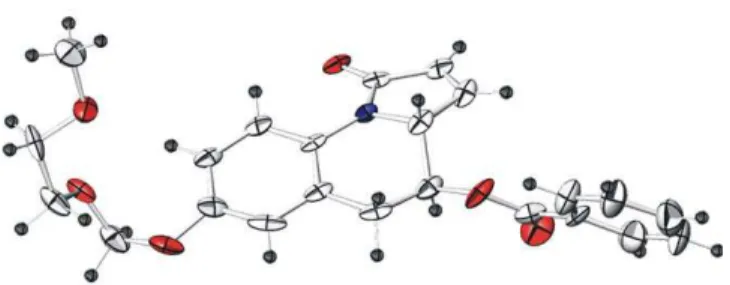
The pyrroloquinoline compound 1 under recrystallization, using an EtOAc–CH2Cl2–hexanes system, resulted in a dark yellow crystal. The X-ray crystallography enabled the ultimate assignment (Figure 2). Interestingly, the pyr-rolidine ring was forced slightly (around 10°) out of the quinoline plane as predicted by Reinhoudt in early 1990s.7 The sophisticated synthesis of pyrrolo[1,2-a]quinoline system in his group was performed via the tert-amino ef-fect involving an intramolecular [1,5]-H transfer.8 Due to its harsh conditions used, such as refluxing in toluene or benzene in a long period of time, this approach is not suit-able for the synthesis of the relatively sensitive com-pounds. Furthermore, it lacks the complexity and necessary substitution for the corresponded solid-phase synthesis (such as an a,b-unsaturated system and the an-choring site). Our RCM approach using the same starting
material, however, can be applied for the solution-phase synthesis of both pyrrolo- and pyranoquinoline systems in addition to the solid-phase synthesis of the pyrroloquino-line compound.
Figure 2 X-ray crystal structure of compound 19
Earlier the starting material 3 for both syntheses of tricy-clics 1 and 2 was shown. However, for the synthesis of pyranoquinoline 2, the experimental target was prepared using compound 8 (which its formation explained above) and could save four steps. For this investigation, the ap-proach to the synthesis of the pyrano[3,2-b]quinoline sys-tem again was a RCM reaction, although no other method was found for the synthesis of this system in the literature. Since the terminal olefin has already been installed in the C-2 position of the tetrahydroquinoline compound 8, an acryl group was used for the proceeding by the RCM reaction. Scheme 2 details the steps for this synthesis. A reduction by lithium aluminum hydride on 8 successfully removed both the Alloc (amide) and benzoyl (ester) groups. The provided amino alcohol 10 (not shown) was also isolated and fully characterized. The disappearance of two carbonyl peaks in 13C NMR indicated that the Alloc and benzoyl groups had been removed.
The secondary amine in this amino alcohol 10 was selec-tively acyl-protected using acetic anhydride and 4-dime-thylaminopyridine (DMAP) as the base to afford 11. The peaks for acetyl group appeared in 1H NMR, that is, d = 2.07 ppm (s, 3 H) for O=CCH3 and d = 170.9 ppm in 13C NMR for the carbonyl group. Alcohol 11 then protected as an acryl by the acryloyl chloride–pyridine system to form
Scheme 1 Synthesis of pyrrolo[1,2-a]quinoline 1
MEMO
N
OH Alloc
OTBS
1) BzOH, DIC, DMAP CH2Cl2, 24 h , 95% 2) TBAF, AcOH THF, 5 h, 98% 1) SO3⋅pyr, Et3N, DMSO, CH2Cl2, 4 h 2) Ph3P=CH2, THF 20 h, 55% (2 steps) MEMO N OBz Alloc OH 1) Pd(PPh3)4, 3 h CH2Cl2, morpholine
2) acryloyl chloride, pyr. CH2Cl2, 1 h, 68% (2 steps) MEMO N OBz Alloc MEMO N OBz O H Grubbs I CH2Cl2, reflux 2 h, 80% MEMO N OBz O 3 7 8 1 9
the second olefinic arm required for the RCM reaction. Similar to the previous implemented system, the first-generation Grubbs catalyst was used for the cyclization reaction in the refluxed CH2Cl2. The appearance of M + 1 (m/z = 348.2) peak in the mass spectrum provided the first approval. This tricyclic compound 2 containing a,b-un-saturated d-lactone showed the olefinic hydrogens at d = 6.36 ppm (1 H) and 7.22 ppm (1 H) in 1H NMR and the lactone carbonyl at d = 170.1 ppm in 13C NMR.
The RCM reaction was also the preferred method for our solid-phase synthesis. Above, we pointed out that, for pre-paring our second tricyclic system, one of our intermedi-ates from the first synthesis was used (i.e., compound 8). For the solid-phase synthesis of the pyrrolo[1,2-a]quino-line system, again, we started with the same intermediate 8 because it had all of the characteristics needed for a suc-cessful solid-phase synthesis, including orthogonal pro-tecting groups and potential anchoring site. Furthermore, it had one arm already equipped with an olefin moiety suitable for the RCM reaction. Treatment of the tetrahy-droquinoline 8 with PTSA (Scheme 3) in methanol pro-duced an excellent yield of the phenolic compound 12 (not shown). Loading was performed on this phenolic compound using treatment with bromo Wang resin in the presence of sodium iodide and cesium carbonate. The yield for loading was 85%, which was considered to be a very good yield. Resin-loaded compound 13 was our starting material in the solid phase. As indicated above, the formation of a second olefinic arm at the nitrogen po-sition, which is needed for the RCM reaction, can be achieved by the replacement of Alloc with acryl group. The Alloc group was removed by using a typical
palladi-um(0)–methylmorpholine system and the acryl group re-placed it using acryloyl chloride–pyridine to form RCM precursor 14. It should be remembered that each step was checked using mass spectroscopy. The RCM reaction was performed on precursor 14 using a second-generation Grubbs catalyst in refluxed CH2Cl2 for six hours. The pre-pared compound 15 (not shown) was treated with TFA, which cleaved the resin, and subsequently purified by col-umn chromatography. The overall yield was calculated and found to be 42% (four steps). In spite of the limited amount of pyrroloquinoline 16 formed, we were able to characterize it completely. Comparing with tricyclic com-pound 1, full sets of protons in 16 were observed using NMR. As expected, the difference was the disappearance of MEM protons and carbon atoms in 1H NMR spectrum. The 2D NMR spectra were also used for the ultimate as-signment. For instance, the COSY spectrum of 16 showed a pattern similar to 1.
In summary, we explained the solution- and solid-phase synthesis of tetrahydroquinoline system pyrrolo[1,2-a]quinoline and also solution-phase synthesis of pyra-no[3,2-b]quinoline. Using this approach, further work is in progress for the library generation from these two scaf-folds, and the results of this work will be reported as they are available.
Supporting Information for this article is available online at http://www.thieme-connect.com/ejournals/toc/synlett. Included are experimental procedures and analysis of 1D and 2D NMR spectra of compounds 1, 2, and 6–16, and also crystal data for compound 1.
Scheme 2 Synthesis of pyrano[3,2-b]]quinoline 2
1) LiAlH4, THF, 5 h, 82% 2) Ac2O, DMAP, CH2Cl2 –10 °C, 92% MEMO N OBz Alloc MEMO N OH Me O MEMO N Me O O O H H 1) acryloyl chloride pyr., CH2Cl2, 1 h 2) Grubbs I CH2Cl2, reflux, 2 h 62% (2 steps) MEMO N OH Me O 8 11 2 11
Scheme 3 Solid-phase synthesis of pyrrolo[1,2-a]quinoline 16
1) PTSA, MeOH 1.5 h, 95% 2) NaI, Cs2CO3 DMF, Br-Wang resin, 85% 1) Pd(PPh3)4, CH2Cl2 N-methylmorpholine 2) acryloyl chloride pyr., CH2Cl2 O N OBz O O N OBz Alloc 1) Grubbs II CH2Cl2, reflux, 6 h 2) 10% TFA 42% overall HO N OBz O H 8 13 14 16
202 S. Khadem et al. LETTER
Synlett 2010, No. 2, 199 – 202 © Thieme Stuttgart · New York Acknowledgment
We thank the NRC genomics program, special VP-research NRC funds for chemical biology and national cancer institute of Canada for the financial support. S.K. thanks the University of Ottawa and the department of chemistry for the Ph.D. admission scholarship.
References and Notes
(1) Arya, P.; Couve-Bonnaire, S.; Durieux, P.; Laforce, D.; Kumar, R.; Leek, D. M. J. Comb. Chem. 2004, 6, 735. (2) Arya, P.; Durieux, P.; Chen, Z.-X.; Joseph, R.; Leek, D. M.
J. Comb. Chem. 2004, 6, 54.
(3) Couve-Bonnaire, S.; Chou, D. T. H.; Gan, Z.; Arya, P.
J. Comb. Chem. 2004, 6, 73.
(4) Prakesch, M.; Sharma, U.; Sharma, M.; Khadem, S.; Leek, D. M.; Arya, P. J. Comb. Chem. 2006, 8, 715.
(5) Katritzky, A. R.; Rachwal, S.; Rachwal, B. Tetrahedron 1996, 52, 15031.
(6) Khadem, S.; Joseph, R.; Rastegar, M.; Leek, D. M.; Oudatchin, K. A.; Arya, P. J. Comb. Chem. 2004, 6, 724. (7) Kelderman, E.; Verboom, W.; Engbersen, J. F. J.; Harkema,
S.; Heesink, G. J. T.; Lehmusvaara, E.; Vanhulst, N. F.; Reinhoudt, D. N.; Derhaeg, L.; Persoons, A. Chem. Mater. 1992, 4, 626.
(8) Groenen, L. C.; Verboom, W.; Nijhuis, W. H. N.; Reinhoudt, D. N.; Van Hummel, G. J.; Feil, D. Tetrahedron 1988, 44, 4637.
(9) Crystallographic data (excluding structure factors) for the structures in this paper have been deposited with the Cambridge Crystallographic Data Centre as supplementary publication no CCDC 730001. Copies of the data can be obtained, free of charge via www.ccdc.cam.ac.uk/conts/ retrieving.html [or from the Cambridge Crystallographic Data Centre, CCDC, 12 Union Road, Cambridge CB2 1EZ, UK; fax: +44 (1223)336033; or email: