Publisher’s version / Version de l'éditeur:
Proceedings of the International Conference on Fuzzy Computation (ICFC 2010),
2010-10-26
READ THESE TERMS AND CONDITIONS CAREFULLY BEFORE USING THIS WEBSITE. https://nrc-publications.canada.ca/eng/copyright
Vous avez des questions? Nous pouvons vous aider. Pour communiquer directement avec un auteur, consultez la première page de la revue dans laquelle son article a été publié afin de trouver ses coordonnées. Si vous n’arrivez pas à les repérer, communiquez avec nous à [email protected].
Questions? Contact the NRC Publications Archive team at
[email protected]. If you wish to email the authors directly, please see the first page of the publication for their contact information.
NRC Publications Archive
Archives des publications du CNRC
This publication could be one of several versions: author’s original, accepted manuscript or the publisher’s version. / La version de cette publication peut être l’une des suivantes : la version prépublication de l’auteur, la version acceptée du manuscrit ou la version de l’éditeur.
Access and use of this website and the material on it are subject to the Terms and Conditions set forth at
Reasoning with the Fuzzy Description Logic fZSI
Zhao, Jidi; Boley, Harold; Du, Weichang
https://publications-cnrc.canada.ca/fra/droits
L’accès à ce site Web et l’utilisation de son contenu sont assujettis aux conditions présentées dans le site LISEZ CES CONDITIONS ATTENTIVEMENT AVANT D’UTILISER CE SITE WEB.
NRC Publications Record / Notice d'Archives des publications de CNRC:
https://nrc-publications.canada.ca/eng/view/object/?id=4088e3d9-d1e3-49de-a238-b5809978a818 https://publications-cnrc.canada.ca/fra/voir/objet/?id=4088e3d9-d1e3-49de-a238-b5809978a818
REASONING WITH THE FUZZY DESCRIPTION LOGIC f
Z
S I
Jidi Zhao
1, Harold Boley
2, and Weichang Du
11Faculty of Computer Science, University of New Brunswick, 540 Windsor Street, Fredericton, Canada {Judy.Zhao, wdu} AT unb.ca
2Institute for Information Technology, National Research Council of Canada, , 46 Dineen Drive, Fredericton, Canada Harold.Boley AT nrc.gc.ca
Keywords: Semantic Web, Uncertain Knowledge, Description Logic, Fuzzy Logic, Linear Programming
Abstract: While applications in different areas have shown the necessity of dealing with uncertain knowledge, Semantic Web techniques based on standard Description Logics do not have such a capability. Motivated by this discrep-ancy, we introduce an expressive fuzzy description logic, fZS I, which extends the classic Description Logic
S Ito deal with uncertain knowledge about concepts and roles as well as instances of concepts and roles. In the family of Fuzzy Logics it is semantically based on Zadeh Logic, which naturally interprets uncertain knowl-edge about concepts and roles as fuzzy sets and fuzzy relations, and interprets uncertain knowlknowl-edge about instances as elements with degrees of membership. The paper focuses on several reasoning methods for the main reasoning problems in fZS I, including consistency checking, instance range entailment, and f-retrieval problems.
1
INTRODUCTION
The Semantic Web initiative aims at creating an ex-tension to the current World Wide Web by develop-ing logic-based standards and technologies that en-able machines to understand the information on the Web, so that they can support richer knowledge infer-ence and automate the performance of various tasks for human beings (Berners-Lee et al., 2001).
The current W3C standard for Semantic Web on-tology languages, Web Onon-tology Language (OWL), is designed for use by applications that need to pro-cess the content of information instead of just pre-senting information to humans (McGuinness and van Harmelen, 2004). It facilitates greater machine in-terpretability of Web content than that supported by other Web languages such as XML, RDF, and RDF Schema (RDFS). This ability of OWL is enabled by its underlying knowledge representation formalism of Description Logics (DLs). DLs (Baader et al., 2003; Horrocks and Sattler, 1999) are a family of logic-based formalisms designed to represent and reason about the conceptual knowledge of arbitrary domains. Elementary descriptions of DLs are atomic concepts and atomic roles. Complex concept descriptions and
role descriptions can be built from the elementary de-scriptions according to construction rules. Different description languages of DLs are distinguished by the kind of concept and role constructors (such as con-junction, discon-junction, and exists restriction) allowed in their description language and the kinds of axioms allowed in their terminologies. The basic
proposition-ally closed DL is
ALC
in which the lettersAL
standfor attributive language and the letter
C
forcomple-ment (negation of arbitrary concepts). Besides
ALC
,other letters are used to indicate various DL
exten-sions. For example, in the Description Logic
S I
(Hor-rocks and Sattler, 1999),
S
is used forALC
extendedwith transitive roles (R+), and
I
for inverse roles. DLshave a model-theoretic semantics, which is defined by interpreting concepts as sets of individuals and roles as sets of pairs of individuals. An interpretation I is
a pair I= (∆I, ·I) consisting of a domain ∆I which is
a non empty set and of an interpretation function ·I
which maps each individual x into an element of ∆I
(x∈ ∆I), each concept C into a subset of ∆I(CI⊆ ∆I)
and each role R into a subset of ∆I×∆I(RI⊆ ∆I×∆I).
The semantics of complex concept and role descrip-tions can be found in (Baader et al., 2003; Horrocks and Sattler, 1999). Furthermore, a knowledge base
(KB) in DLs consists of two parts: the terminological box (TBox T ) and the assertional box (ABox A).
Uncertainty is an intrinsic feature of real-world knowledge, which is also reflected in the World Wide Web and the Semantic Web. Many concepts needed in knowledge modeling lack well-defined boundaries or, precisely defined criteria. Examples are the concepts of young, tall, and cold. The Uncertainty
Reason-ing for the World Wide Web (URW3)Incubator Group
defined the challenge of representing and reasoning with uncertain information on the Web. According to the latest URW3 draft report, uncertainty is a term intended to encompass different forms of uncertain knowledge, including incompleteness, inconclusive-ness, vagueinconclusive-ness, ambiguity, and others (Laskey et al., 2008). The need to model and reason with uncer-tainty has been found in many different Semantic Web contexts, such as matchmaking in Web services (Martin-Recuerda and Robertson, 2005), classifica-tion of genes in bioinformatics (Stevens et al., 2007), multimedia annotation (Stamou et al., 2006), and on-tology learning (Haase and V¨olker, 2005).
Fuzzy Set Theory was first introduced by Zadeh (Zadeh, 1965) as an extension to the classic notion of a set to capture inherent vagueness (the lack of crisp boundaries of sets). Fuzzy Logic is a form of multi-valued logic derived from Fuzzy Set Theory to deal with reasoning that is approximate rather than precise. In Fuzzy Logic, the degree of truth of a statement can range between 0 and 1, and is not constrained to the
two truth values{0, 1} or { f alse,true} as in classic
predicate logic. Formally, a fuzzy set A with respect to a set of elements Ω (also called a universe) is
char-acterized by a membership function µA(x) which
as-signs a value in the real unit interval [0,1] to each
ele-ment x in Ω(x ∈ Ω), notated as µA: Ω→ [0, 1]. µA(x),
often written as A(x), gives the degree of an element x belonging to the set A. Such degrees can be computed based on a membership function. A fuzzy relation R over two fuzzy sets A and B is similarly defined by a
function R : Ω× Ω → [0, 1].
Fuzzy Logic extends the Boolean operations de-fined on crisp sets and relations for fuzzy sets and fuzzy relations. These operations, e.g. complement, union, and intersection, are interpreted as mathemat-ical functions over the unit interval [0,1]. In the fol-lowing, η, θ define the truth degrees of sets and re-lations, ranging between 0 and 1. The mathemati-cal functions for fuzzy intersection are usually mathemati-called t-norms (t(η, θ)); those for fuzzy union are called s-norms (s(η, θ), a.k.a. t-conorms); and those for the fuzzy set complement are called negations (¬η); These functions usually satisfy certain mathematical properties. The most widely known operations in the
Fuzzy Logic family are Zadeh Logic, Lukasiewicz Logic, Product Logic, and G¨odel Logic.
To deal with the ‘crisp limitation’ of classic DLs, considerable work has been carried out on integrating uncertain knowledge into DLs in recent years. The current literature generally follows two approaches. One is Probabilistic Logic based on Probability The-ory; for example the work in (Jaeger, 1994; Koller et al., 1997; Lukasiewicz, 2008). The other is Fuzzy Logic and Fuzzy Sets; for example the work in (Yen, 1991; Straccia, 2001; Zhao and Boley, 2010). A re-view and comparison of these works can be found in (Zhao, 2010). We presented a Norm-Parameterized
Fuzzy Description Logic f
ALC N
and addressed theconsistency checking problem in (Zhao and Boley,
2010). We use fNDL to denote a Fuzzy
Descrip-tion Logic fDL with norm parameter N. Omitting the index N means the fDL is norm-parameterized. In the current paper, we follow the Fuzzy Sets and Fuzzy Logic approach and present the fuzzy
Descrip-tion Logic fZS I. We call this fuzzy Description Logic
fZS Ias
S I
is the underlying Description Logic and Zfixes the norms to Zadeh Logic. This paper is differ-ent from previous work due to the following features.
First, the underlying classic DL
S I
is a moreexpres-sive Description Logic which deals with fuzzy transi-tive roles and fuzzy inverse roles. Second, we com-bine Description Logic, Fuzzy Logic, and Linear Pro-gramming methods in the reasoning procedure. Last
but not least, fZS I supports both fuzzy axioms and
fuzzy assertions for uncertain knowledge representa-tion and reasoning.
2
THE FUZZY DL f
ZS I
fZS I extends the fZALC N DL with inverse roles,
and transitive roles but excludes number restrictions. Due to space limitations, we refer interested readers to (Zhao and Boley, 2010) for the syntax and seman-tics of complex concept descriptions as well as
ax-ioms and assertions for fZALC by specializing the
t-norm to min and the s-norm to max. Here we sim-ply list them in Tables 1 and 2, and then explain the
expressiveness beyond fZALC. A fuzzy knowledge
base in fZS Iconsists of two parts: the fuzzy
termino-logical box consisting of a finite set of fuzzy axioms
(TBox
T
) and the fuzzy assertional box consisting ofa finite set of fuzzy assertions (ABox
A
). As shownin Table 2, a fuzzy axiom or fuzzy assertion is of the
form α[l, u] with 0 ≤ l ≤ u ≤ 1, which is equivalent to
the two inequalities α≥ l and α ≤ u. In what follows,
we use these expressions as needed.
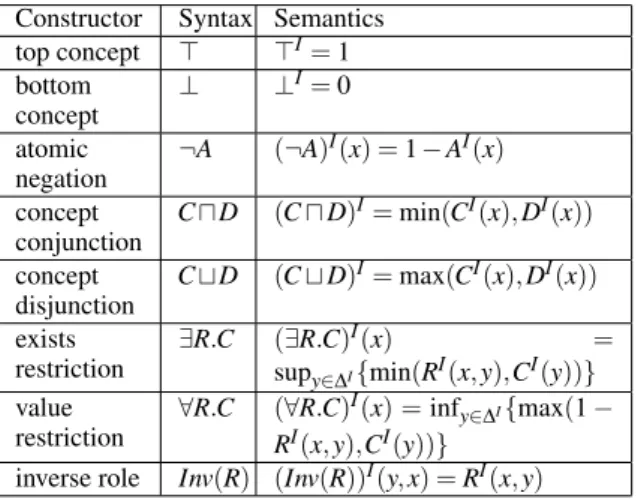
Table 1: Syntax and semantics of fZS Iconstructors. Constructor Syntax Semantics
top concept ⊤ ⊤I= 1 bottom concept ⊥ ⊥I= 0 atomic negation ¬A (¬A)I(x) = 1 − AI(x) concept conjunction C⊓D (C ⊓ D)I= min(CI(x), DI(x)) concept disjunction C⊔D (C ⊔ D)I= max(CI(x), DI(x)) exists restriction ∃R.C (∃R.C)I(x) = supy∈∆I{min(RI(x, y),CI(y))}
value restriction
∀R.C (∀R.C)I(x) = inf
y∈∆I{max(1 −
RI(x, y),CI(y))} inverse role Inv(R) (Inv(R))I(y, x) = RI(x, y)
Table 2: Syntax and semantics of fZS Iaxioms. Axioms Syntax Semantics
concept inclusion A⊑ C ∀x ∈ ∆I, AI(x) ≤ CI(x) concept definition A≡ C ∀x ∈ ∆I, AI(x) = CI(x) concept implica-tion A → C[l, u] ∀x ∈ ∆I,CI(x) ∈ min(AI(x), [l, u]) transitive role Trans(R) RI(a, c) ≥ supb∈△Imin(RI(a, b), RI(b, c))
concept assertion C(a) [l, u] l≤ CI(a) ≤ u role asser-tion R(a, b) [l, u] l ≤ RI(a, b) ≤ u individual inequality a6= b aI6= bI
x, y ∈ △I, (Inv(R))I(y, x) = RI(x, y), where the role
function Inv(R) defines the inverse of a role. The same property holds for a fuzzy symmetric role. For example, the role hasPart is the inverse of the role isPartOf.
In classic DLs, a role R is transitive iff for all x, y, z ∈ △I, RI(x, y) and RI(y, z) imply RI(x, z). While
in Fuzzy Logic, a fuzzy role R is transitive iff for all
x, y, z ∈ △I, it satisfies the following inequality (D´ıaz
et al., 2010):
RI(x, z) ≥ sup
y∈△I
t(RI(x, y), RI(y, z)) (1)
where t(η, θ) denotes a general t-norm. Thus, in the case of Zadeh Logic, a transitive role satisfies:
RI(x, z) ≥ sup
y∈△I
min(RI(x, y), RI(y, z)) (2)
In order to make the following explanations eas-ier, we introduce the role function Trans(R) which
specifies that R is transitive or Inv(R) is transitive. Now, we use some mathematical properties of Zadeh Logic to show that the following property
is satisfied by a role value restriction ∀R.C with
Trans(R).
Lemma 1. Under Zadeh Logic, if(∀R.C)I(x) ≥ l (l ∈
[0, 1]) and R is transitive, then (∀R.(∀R.C))I(x) ≥ l
holds. Proof. (∀R.C)I(x) ≥ l De f inition o f semantics −−−−−−−−−−−−−−→ infz∈∆I{max(¬RI(x, z),CI(z))} ≥ l Equation1 −−−−−−→
infz∈∆Iinfy∈∆I{max(¬(min(RI(x, y), RI(y, z))),CI(z))} ≥ l
De Morgan′s Law
−−−−−−−−−−→
infz∈∆Iinfy∈∆I{max(max(¬RI(x, y), ¬RI(y, z)),CI(z))} ≥ l
Associativity −−−−−−−→
infz∈∆Iinfy∈∆I{max(¬RI(x, y), max(¬RI(y, z),CI(z)))} ≥ l
Commutativity −−−−−−−−→
infy∈∆I{max(¬RI(x, y), infz∈∆Imax(¬RI(y, z),CI(z)))} ≥ l
De f inition o f semantics −−−−−−−−−−−−−−→
infy∈∆I{max(¬RI(x, y), (∀R.C)I(y))} ≥ l
De f inition o f semantics
−−−−−−−−−−−−−−→ (∀R.(∀R.C))I(x) ≥ l
However, in the cases of≤, we cannot derive such
a property for(∀R.C)(x) and Trans(R).
Under Zadeh Logic, by applying the semantics of ∃R.C and negation, it is easy to see that the following equivalence rules hold:
∀a, b ∈ ∆I, ¬¬C ≡ C , (3) ¬∃R.C ≡ ∀R.¬C , (4) ¬∀R.C ≡ ∃R.¬C (5) Then,(∃R.C)I(x) ≤ u Monotonicity −−−−−−−→ ¬((∃R.C)I(x)) ≥ 1 − u Equilvalence4 −−−−−−−−→ (∀R.(¬C))I(x)) ≥ 1 − u Lemma1 −−−−−→ (∀R.(∀R.(¬C)))I(x)) ≥ 1 − u Monotonicity −−−−−−−→ ¬(∀R.(∀R.(¬C))I(x)) ≤ u Equilvalence5 −−−−−−−−→ (∃R.¬(∀R.(¬C)))I(x) ≤ u Equilvalence5 and 3 −−−−−−−−−−−−→ (∃R.(∃R.C))I(x) ≤ u
Therefore, the following property is satisfied with
respect to a role exists restriction∃R.C and Trans(R).
Such a property cannot be inferred from the cases of ≥.
Lemma 2. Under Zadeh Logic, if(∃R.C)I(x) ≤ u and
R is transitive, then(∃R.(∃R.C))I(x) ≤ u holds.
Although we can show that such properties also hold under Product Logic and other logics, we ne-glect it here, as it is out of scope. We will soon see
that these properties will be embodied in the fuzzy
completion rules for the fZS I reasoning algorithm.
3
REASONING ALGORITHM
FOR BUILDING A FUZZY
TABLEAU OF f
ZS I
The reasoning algorithm that we will present is a fuzzy extension to the tableau method and tests the
consistency of a knowledge base KB=<
T
,A
> bytrying to construct a model of KB. A model of KB
in our Fuzzy Description Logic fZS I is a fuzzy
in-terpretation I= (△I, ·I). Similar to the classic DL,
such a model has the shape of a forest, i.e., a col-lection of trees, with nodes corresponding to indi-viduals, root nodes corresponding to named individ-uals, and edges corresponding to roles between
indi-viduals. Each node has a node label
L
(individual),but different from classic DLs, each node in a fZS I
tableau is labeled with a set of fZ
S I
-concepts. Eachelement in the set consists of a pair of elements {concept, constraint}. The sets for all nodes are
re-stricted to subsets of sub(
A
), where sub(A
) is theset of sub-concepts of concepts that appear within an
ABox
A
. Furthermore, each edge is associated withan edge label
L
(individual1, individual2) whichcon-sists of a pair of elements{role, constraint}.
In (Zhao and Boley, 2010), we explained the TBox processing procedure which consists of some prepro-cessing steps to deal with the fuzzy TBox before ap-plying the reasoning algorithm. Those steps are
appli-cable to the fZS Iknowledge base. Therefore, we can
assume all concepts C occurring in KB to be in
nega-tion normal form(NNF) and we only deal with
un-foldable TBox after those preprocessing steps.
How-ever, due to the properties of a fZS I knowledge base,
the TBox processing procedure should include a cou-ple of other steps. First, the TBox processing proce-dure transforms all the assertions in the fuzzy ABox and the fuzzy implication axioms in the fuzzy TBox
with the form α0 [l, u] into two expressions: α0≥ l
and α0≤ u. In order to keep our presentation simple
and compact, in what follows, we use a general form
α op n where op∈ {≥, ≤} and n ∈ [0, 1] whenever
applicable. Second, an fZS I knowledge base may
contain transitive role axioms and inverse roles. We know that if a role R is transitive, the inverse role of R is also transitive. Therefore, for each pair of Trans(R) and Inv(R), the procedure should also add an axiom Trans(Inv(R)). After the application of the TBox pro-cessing procedure, in what follows, we only have to
consider a knowledge base in fZS I only consists of
fuzzy ABox assertions, a set of transitive role axioms, and a finite set of fuzzy implication axioms.
Next, we first present the definitions of fuzzy tableau, clash, and clash-free, and then prove the rela-tion between the consistency of a fuzzy knowledge
base KB=<
T
,A
> and the existence of a fuzzytableau T for KB.
Definition 1. If KB=<
T
,A
> is an fZS Iknowledgebase, RA is the set of roles occurring in
A
, togetherwith their Inv(R)s, a fuzzy tableau T for KB is defined
to be a quadruple (S,
L
, ε,C
) such that: S is a set ofindividuals,
L
: S× sub(A
) → [0, 1] maps eachindi-vidual and a concept which is a subset of sub(
A
) tothe membership degree of the individual to that
con-cept,ε : RA× S × S → [0, 1] maps each role in RAand
a pair of individuals to the membership degree of the
pair to the role, and
C
is a set of constraints must besatisfied. For all x, y ∈ S, A,C, D ∈ sub(
A
), R ∈ RAand n∈ [0, 1], it holds that:
1. For any x∈ S, {x : ⊥ = 0} and {x : ⊤ = 1} ∈
L
(x).2. If{x : ¬(A) op n} ∈
L
(x), then {x : A op 1 − n} ∈L
(x). 3. If{x : C ⊓ D ≥ n} ∈L
(x), then {x : C ≥ n} ∈L
(x) and{x : D ≥ n} ∈L
(x). 4. If{x : C ⊔ D ≤ n} ∈L
(x), then {x : C ≤ n} ∈L
(x) and{x : D ≤ n} ∈L
(x). 5. If {x : C ⊓ D ≤ n} ∈L
(x), then {x : C ≤ n1} ∈L
(x), {x : D ≤ n2} ∈L
(x), and n = min(n1, n2) for some n1, n2. 6. If {x : C ⊔ D ≥ n} ∈L
(x), then {x : C ≥ n1} ∈L
(x), {x : D ≥ n2} ∈L
(x), and n = max(n1, n2) for some n1, n2.7. If{x : ∃R.C ≥ n} ∈
L
(x), then there exists y ∈ Ssuch that{< x, y >: R ≥ n} ∈ ε(R) and {y : C ≥
n} ∈
L
(y).8. If{x : ∀R.C ≤ n} ∈
L
(x), then there exists y ∈ Ssuch that{< x, y >: R ≥ 1 − n} ∈ ε(R) and {y :
C≤ n} ∈
L
(y).9. If {x : ∃R.C ≤ n} ∈
L
(x), then {< x, y >: R ≤n1} ∈ ε(R), {y : C ≤ n2} ∈
L
(y), and n =min(n1, n2) for some n1, n2.
10. If{x : ∀R.C ≥ n} ∈
L
(x), then {< x, y >: R ≤ 1 −n1} ∈ ε(R), {y : C ≥ n2} ∈
L
(y), and n = max(1 −n1, n2) for some n1, n2.
11. {< x, y >: R op n} ∈ ε(R) iff {< y, x >:
Inv(R) op n} ∈ ε(R).
12. If {x : ∀R.C ≥ n} ∈
L
(x) and Trans(R), then{< x, y >: R ≤ 1 − n1} ∈ ε(R), {y : ∀R.C ≥ n2} ∈
L
(y), and n = max(1 − n1, n2) for some n1, n2.13. If{x : ∃R.C ≤ n} ∈
L
(x) and Trans(R), then {<x, y >: R ≤ n1} ∈ ε(R), {y : ∃R.C ≤ n2} ∈
L
(y),14. If{A → C ≥ n} ∈
T
and{x : A ≥ n1} ∈L
(x),then{x : C ≥ n2} ∈
L
(x) and n2= min(n, n1),for any x∈ S.
15. If{A → C ≤ n} ∈
T
and{x : A ≤ n1} ∈L
(x),then{x : C ≤ n2} ∈
L
(x) and n2= min(n, n1),for any x∈ S.
In (Zhao and Boley, 2010), we defined the
se-mantics (C ⊓ D)I as t(CI(x), DI(x)) for various
t-norms. For the case of Zadeh Logic, we have that
if(C ⊓ D)I(x) ≥ n, then CI(x) = n
C, DI(x) = nD, and
min(nC, nD) ≥ n. In this definition, we can draw a
further conclusion based on the properties of the min
norm that CI(x) = n
C≥ n and DI(x) = nD≥ n.
Sim-ilar extensions are conducted on other fZS I concepts
and roles.
Definition 2. Let
A
be an extended fZS I ABox,A
contains a clash if only if one of the following situa-tions occurs:
1. {⊥(a) 6= 0} ⊆
A
2. {⊤(a) 6= 1} ⊆
A
3. {α ≤ n1, α ≥ n2} ⊆
A
and n1< n24. there is no solution for the constraint system of
inequations
C
A
is called clash-free if it does not contain any clash.Lemma 3. An fZS Iknowledge base KB=<
T
,A
>is consistent iff there exists a clash-free fuzzy tableau for KB.
Proof. For the if direction, if T=(S,
L
, ε) is aclash-free fuzzy tableau for a fuzzy knowledge base KB, a
fuzzy interpretation I=(∆I, ·I) can be constructed as:
∆I= S
⊤I={x : ⊤ = 1} ∈
L
(x) for any x in S⊥I={x : ⊥ = 0} ∈
L
(x) for any x in SAI={x : A op n} ∈
L
(x) for all concept names A insub(
A
)RI=
(
ε(R)+ i f Trans(R)
ε(R) otherwise
where ε(R)+denotes the fuzzy sup-min transitive
closure of ε(R) (Lee, 2001; Mitsuishi and Bancerek, 2003).
To prove that I is a model of KB, we show by
induction on the structure of concepts that, if {x :
E op n} ∈
L
(x), then EI(x) op n for any x in S.With-out loss of generality, we only show in the following
the cases with{x : E ≥ n} ∈
L
(x).1. If E the ⊤ or ⊥ concept, and {x : ⊥ = 0} and
{x : ⊤ = 1} ∈
L
(x), then by definition, ⊤I(x) = 1or⊥I(x) = 0.
2. If E is a concept name other than⊤ and ⊥, and
{x : E ≥ n} ∈
L
(x), then EI(x) ≥ n by definition.3. If E= ¬(C) and {x : ¬(C) ≥ n} ∈
L
(x), then {x :C≤ 1 −n} ∈
L
(x) (due to Property 2 in Definition1), so we have CI(x) ≤ 1 − n by induction. Hence,
(¬C)I(x) ≥ 1 − (1 − n) = n, i.e., EI(x) ≥ n.
4. If E= (C1⊓C2) and {x : C1⊓C2≥ n} ∈
L
(x), then{x : C1≥ n} ∈
L
(x) and {x : C2≥ n} ∈L
(x), so byinduction(C1)I(x) ≥ n and (C2)I(x) ≥ n. Hence,
(C1⊓C2)I(x) = min((C1)I(x), (C2)I(x)) ≥ n.
5. If E = (C1⊔ C2) and {x : C1⊔ C2≥ n} ∈
L
(x),since the tableau is clash free, we can find some
n1, n2 so that {x : C1≥ n1} ∈
L
(x), {x : C2≥n2} ∈
L
(x) and n = max(n1, n2). Byinduc-tion(C1)I(x) ≥ n1,(C2)I(x) ≥ n2. Hence,(C1⊓
C2)I(x) = max((C1)I(x), (C2)I(x)) ≥ n.
6. If E = (∃S.C) and {x : ∃S.C ≥ n} ∈
L
(x), thenthere exists y∈ S such that {< x, y >: S ≥ n} ∈
ε(S) and {y : C ≥ n} ∈
L
(y), so by inductionSI(x, y) ≥ n and CI(y) ≥ n. Hence (∃S.C)I(x) =
supy∈∆Imin(SI(x, y),CI(y)) ≥ n.
7. If E = (∀S.C), {x : ∀S.C ≥ n} ∈
L
(x), andSI(x, y) = m, then it would be either of the
fol-lowing two cases.
• {< x, y >: S = m} ∈ ε(S): if m > 1 − n, then
{y : C ≥ n} ∈
L
(y) (due to Property 10 inDef-inition 1), so we have SI(x, y) > 1 − n and
CI(y) ≥ n, hence, (∀S.C)I(x) = in f
y∈∆Imax(1 −
SI(x, y),CI(y)) ≥ n; if m <= 1 − n, then 1 −
SI(x, y) = 1 − m ≥ n, hence (∀S.C)I(x) =
in fy∈∆Imax(1 − SI(x, y),CI(y)) ≥ n.
• {< x, y >: S = m} /∈ ε(S) and there exist l paths
(l≥ 1) such that in each path, {< x, xl1>: S =
ml1} ∈ ε(S), {< xl1, xl2>: S = ml2} ∈ ε(S), · · · ,
{< xln, y >: S = ml(n+1)} ∈ ε(S) and Trans(R).
Thus, the truth degree of< x, y > to the
tran-sitive closure of S, m, would be equal to the supremum value among all the minimum
val-ues of each path. In this case: if m> 1 − n,
then there exists at least one path k,{< x, xk1>:
S= mk1} ∈ ε(S), {< xk1, xk2 >: S = mk2} ∈
ε(S), · · · , {< xkn, y >: S = mk(n+1)} ∈ ε(S), we
have mki > m > 1 − n (1 ≤ i ≤ (n + 1)) (as
m is the minimum value of the path), {xki :
(∀S.C) ≥ n} ∈
L
(xki) (1 ≤ i ≤ n), and {y :(∀S.C) ≥ n} ∈
L
(y) (due to Property 12 inDef-inition 1), so, inducted from{< x, xk1>: S >
1− n} ∈ ε(S) and {xk1:(∀S.C) ≥ n} ∈
L
(xk1),we have SI(x, xk1) > 1 − n and (∀S.C)I(xk1) ≥
n, and thus CI(xk1) ≥ n, hence (∀S.C)I(x) =
in fy∈∆Imax(1 − SI(x, xk1),CI(xk1)) ≥ n; if
m<= 1 − n, then we have max(1 − m,CI(y)) ≥
n, hence(∀S.C)I(x) ≥ n.
a similar way.
For the converse, if I=(∆I, ·I) is a model of
A
, thena fuzzy tableau T=(S,
L
, ε) can be defined as:S= ∆I
ε(R) = RI
L
(x) = {x : C op n} for all x ∈ S and C ∈ sub(A
)To prove that T is a fuzzy tableau of KB, we show that, based on I, all the properties in Definition 1 are satisfied.
1. T satisfies Property 1 - 12, 14, and 15 as a
di-rect consequence of the semantics of fZS I
con-cepts. For example, let {x : C ⊓ D ≥ n} ∈
L
(x),the semantics of fuzzy concept conjunction
im-plies that (C ⊓ D)I(x) = min(CI(x), DI(x)) ≥ n,
thus we have DI(x) ≥ n and DI(x) ≥ n, that is,
{x : C ≥ n} ∈
L
(x) and {x : D ≥ n} ∈L
(x), henceProperty 3 is satisfied. For similar reasons, other properties hold.
2. Property 12 of Definition 1 is satisfied as a re-sult of the semantics and the properties of tran-sitive roles and value restrictions that have been
investigated in Section 2. Hence, if(∀R.C)I(x) ≥
n, Trans(R) then (∀R.(∀R.C))I(x) ≥ n, thus
RI(s,t) ≤ 1 − n1, (∀R.C)I(t) ≥ n2 and n =
max(1 − n1, n2) hold.
3. Similarly, Property 13 is satisfied as a result of the semantics and the properties of transitive roles and role exists restrictions.
From Lemma 3, an algorithm that constructs a
fuzzy tableau for an fZS Iknowledge base can be used
as a decision procedure for the consistency checking problem.
Similar to the tableau algorithm presented by Hor-rocks et al. (HorHor-rocks et al., 2000), our algorithm
works on building a fuzzy tableau for an fZS I
knowl-edge base which may be a completion-forest since the ABox might contain several named individuals with arbitrary edges connecting them. Each node x
is labeled with a set
L
(x) = {{x : C1op n1}, · · · , {x :Cm op nm}} (m ≥ 1) and a constraint set
C
(x) ={{xC1 op n1}, ·, {xCm op nm}}, where Ci ∈ sub(
A
),xCi, ni∈ [0, 1], 1 ≤ i ≤ m, and op ∈ {≥, ≤}. Each edge
< x, y > is labeled with a set
L
(x, y) = {[x, y] : R op n}and a constraint in the set
C
(x, y) = {xRop n}, whereRare roles occurring in
A
.We adapt the conjugation concept in (Straccia, 2001) to represent pairs of fuzzy assertions that form
a contradiction. Let α be a
S I
assertion, two fuzzyas-sertions (α ≥ n1and α ≤ n2) conjugate with each
other if n1> n2. For a given fuzzy assertion, its
conju-gated assertion is not unique, and in fact, infinite. For
example, both{[x, y] : R ≤ 0.5} and {[x, y] : R ≤ 0.3}
conjugate with the fuzzy assertion{[x, y] : R ≥ 0.6}.
Let us recall some notations used in (Horrocks and Sattler, 1999). If nodes x and y are connected
by an edge< x, y > with {R op n} ∈
L
(x, y), then yis called an Rn-successor of x and x is called an Rn
-predecessorof y. Ancestor is the transitive closure of
predecessor. If y is an Rn-successor or an(Inv(R))n
-predecessorof x, then y is called an Rn-neighbor of
x. An expressive DL such as fZS I which allows
tran-sitive roles and inverse roles may lead to nontermina-tion as the fuzzy complenontermina-tion rules can introduce new concepts that are the same size as the decomposed concept. Our algorithm for the consistency
check-ing of an fZS I knowledge base follows the dynamic
blocking presented in (Horrocks and Sattler, 1999)
and uses it to guarantee the termination of the reason-ing algorithm. In dynamic blockreason-ing, blocked nodes are allowed to be dynamically established and broken as the expansion progresses, and expand role value re-striction and role exists rere-striction concepts. This dy-namic blocking strategy is crucial in the presence of inverse roles since information might be propagated up the completion-forest and affect other branches. For example, consider the nodes x, y and z, the edges < x, y > and < x, z >. Suppose x blocks y. In the presence of inverse roles it is possible that z adds in-formation to node x, although z is a successor of x. In that case the block on y must be broken. A node
x is blocked if for some ancestor y, y is blocked or
L
(x) =L
(y). Dynamic blocking uses the notions ofdirectly blocked and indirectly blocked nodes. If a
blocked node x’s predecessor is blocked, x is called indirectly blocked. A blocked node x is called
di-rectly blocked if it has a unique ancestor y such that
L
(x) =L
(y).Now, for an expanded fZS I ABox
A
with a set oftransitive role axioms and a set of fuzzy implication axioms, the algorithm initializes a forest to contain
(1)root nodes, for each individual x occurring in
A
,the root node x is labeled with
L
(x) = {x : C op n}and
C
(x) = {xC op n} for each assertion of the formC(x) op n in
A
, and (2)edges, each edgehx, yicor-responds to an assertion R(x, y) op n in
A
with R bean atomic role or an inverse role and is labeled with
L
(x, y) = {[x, y] : R op n} andC
(x, y) = {xRop n}. Ifan assertion is of the form Inv(P)(x, y) op n, the
cor-responding edge is also labeled with
L
(x, y) = {[y, x] :P op n} and
C
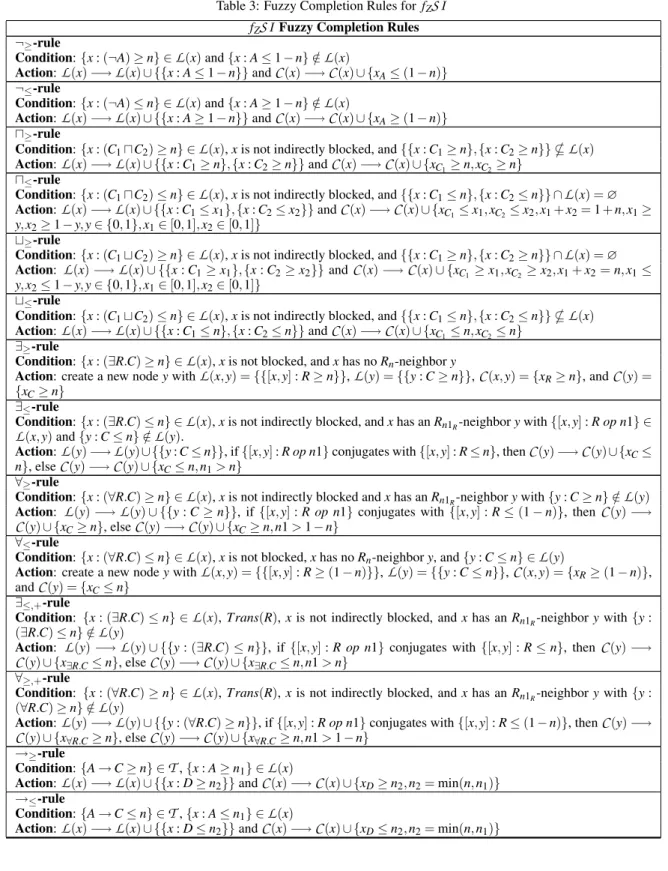
(x, y) = {xPop n}. The completionfor-est is then expanded by repeatedly applying the fol-lowing fuzzy completion rules in Table 3. The com-pletion forest is complete when a clash is detected, or none of the fuzzy completion rules are applicable.
Table 3: Fuzzy Completion Rules for fZS I fZS I Fuzzy Completion Rules ³-rule
Condition:{x : (¬A) ≥ n} ∈L(x) and {x : A ≤ 1 − n} /∈L(x)
Action:L(x) −→L(x) ∪ {{x : A ≤ 1 − n}} andC(x) −→C(x) ∪ {xA≤ (1 − n)} ¬≤-rule
Condition:{x : (¬A) ≤ n} ∈L(x) and {x : A ≥ 1 − n} /∈L(x)
Action:L(x) −→L(x) ∪ {{x : A ≥ 1 − n}} andC(x) −→C(x) ∪ {xA≥ (1 − n)} ⊓≥-rule
Condition:{x : (C1⊓C2) ≥ n} ∈L(x), x is not indirectly blocked, and {{x : C1≥ n}, {x : C2≥ n}}*L(x) Action:L(x) −→L(x) ∪ {{x : C1≥ n}, {x : C2≥ n}} andC(x) −→C(x) ∪ {xC1≥ n, xC2≥ n}
⊓≤-rule
Condition:{x : (C1⊓C2) ≤ n} ∈L(x), x is not indirectly blocked, and {{x : C1≤ n}, {x : C2≤ n}} ∩L(x) =∅ Action:L(x) −→L(x) ∪ {{x : C1≤ x1}, {x : C2≤ x2}} andC(x) −→C(x) ∪ {xC1≤ x1, xC2≤ x2, x1+ x2= 1 + n, x1≥
y, x2≥ 1 − y, y ∈ {0, 1}, x1∈ [0, 1], x2∈ [0, 1]} ⊔≥-rule
Condition:{x : (C1⊔C2) ≥ n} ∈L(x), x is not indirectly blocked, and {{x : C1≥ n}, {x : C2≥ n}} ∩L(x) =∅ Action: L(x) −→L(x) ∪ {{x : C1≥ x1}, {x : C2≥ x2}} andC(x) −→C(x) ∪ {xC1≥ x1, xC2≥ x2, x1+ x2= n, x1≤
y, x2≤ 1 − y, y ∈ {0, 1}, x1∈ [0, 1], x2∈ [0, 1]} ⊔≤-rule
Condition:{x : (C1⊔C2) ≤ n} ∈L(x), x is not indirectly blocked, and {{x : C1≤ n}, {x : C2≤ n}}*L(x) Action:L(x) −→L(x) ∪ {{x : C1≤ n}, {x : C2≤ n}} andC(x) −→C(x) ∪ {xC1≤ n, xC2≤ n}
∃≥-rule
Condition:{x : (∃R.C) ≥ n} ∈L(x), x is not blocked, and x has no Rn-neighbor y
Action: create a new node y withL(x, y) = {{[x, y] : R ≥ n}},L(y) = {{y : C ≥ n}},C(x, y) = {xR≥ n}, andC(y) = {xC≥ n}
∃≤-rule
Condition:{x : (∃R.C) ≤ n} ∈L(x), x is not indirectly blocked, and x has an Rn1R-neighbor y with{[x, y] : R op n1} ∈
L(x, y) and {y : C ≤ n} /∈L(y).
Action:L(y) −→L(y) ∪ {{y : C ≤ n}}, if {[x, y] : R op n1} conjugates with {[x, y] : R ≤ n}, thenC(y) −→C(y) ∪ {xC≤ n}, elseC(y) −→C(y) ∪ {xC≤ n, n1> n}
∀≥-rule
Condition:{x : (∀R.C) ≥ n} ∈L(x), x is not indirectly blocked and x has an Rn1R-neighbor y with{y : C ≥ n} /∈L(y)
Action: L(y) −→L(y) ∪ {{y : C ≥ n}}, if {[x, y] : R op n1} conjugates with {[x, y] : R ≤ (1 − n)}, thenC(y) −→ C(y) ∪ {xC≥ n}, elseC(y) −→C(y) ∪ {xC≥ n, n1 > 1 − n}
∀≤-rule
Condition:{x : (∀R.C) ≤ n} ∈L(x), x is not blocked, x has no Rn-neighbor y, and{y : C ≤ n} ∈L(y)
Action: create a new node y withL(x, y) = {{[x, y] : R ≥ (1 − n)}},L(y) = {{y : C ≤ n}},C(x, y) = {xR≥ (1 − n)}, andC(y) = {xC≤ n}
∃≤,+-rule
Condition: {x : (∃R.C) ≤ n} ∈L(x), Trans(R), x is not indirectly blocked, and x has an Rn1R-neighbor y with{y :
(∃R.C) ≤ n} /∈L(y)
Action: L(y) −→L(y) ∪ {{y : (∃R.C) ≤ n}}, if {[x, y] : R op n1} conjugates with {[x, y] : R ≤ n}, thenC(y) −→ C(y) ∪ {x∃R.C≤ n}, elseC(y) −→C(y) ∪ {x∃R.C≤ n, n1 > n}
∀≥,+-rule
Condition: {x : (∀R.C) ≥ n} ∈L(x), Trans(R), x is not indirectly blocked, and x has an Rn1R-neighbor y with{y :
(∀R.C) ≥ n} /∈L(y)
Action:L(y) −→L(y) ∪ {{y : (∀R.C) ≥ n}}, if {[x, y] : R op n1} conjugates with {[x, y] : R ≤ (1 − n)}, thenC(y) −→ C(y) ∪ {x∀R.C≥ n}, elseC(y) −→C(y) ∪ {x∀R.C≥ n, n1 > 1 − n}
→≥-rule
Condition:{A → C ≥ n} ∈T,{x : A ≥ n1} ∈L(x)
Action:L(x) −→L(x) ∪ {{x : D ≥ n2}} andC(x) −→C(x) ∪ {xD≥ n2, n2= min(n, n1)} →≤-rule
Condition:{A → C ≤ n} ∈T,{x : A ≤ n1} ∈L(x)
The algorithm stops when a clash occurs; KB is consistent iff the completion rules can be applied in such a way that they yield a complete and clash-free completion forest, and KB is inconsistent otherwise. Example 1. Consider a fuzzy knowledge base
KB= { CP → ∃hP.CP [0.5, 1], CP(P002) [0.6, 1],
(∃hP.CP)(P002) [0, 0.4]} where we abbreviate the
concept CancerPatient and the role
hasFirstDe-greeRelatives by CP and hP, respectively. The knowl-edge base describes that the truth degree for a first-degree relative of a cancer patient also being a cancer
patient is greater than or equal to 0.5. PersonP002 is
a cancer patient with certainty greater than 0.6 and
the possibility that one ofP002’s first-degree relative
is also a cancer patient is less than or equal to 0.4. The query is that whether KB is consistent or not.
First, because of the fuzzy concept
implica-tion axiom, {∃hP.CP(P002) [0.5, 1]} is added to
A
. Next, we can initialize the fuzzy tableauby creating a node P002 and label it with
L
(P002) = {{P002 : CP ≥ 0.6}, {P002 : ∃hP.CP ≥0.5}, {P002 : ∃hP.CP ≤ 0.4}} and
C
(P002) = {xCP≥0.6, x∃hP.CP≥ 0.5, x∃hP.CP≤ 0.4}}. Since both {P002 :
∃hP.CP ≥ 0.5} and {P002 : ∃hP.CP ≤ 0.4} are con-tained in the fuzzy tableau, the reasoning algorithm obviously detects a clash. Therefore, it stops the ap-plication of any fuzzy completion rule and returns that KB is inconsistent.
Next, let us look at an example for the∀≥,+-rule.
Example 2. Consider there are two
as-sertions in a fuzzy knowledge base:
(∀hasFriend.Student)(John) [0.75, 1] and
hasFriend(John, Mary) [0.7, 1] where hasFriend is a transitive role.
Following the preprocessing steps, we have
{John : (∀hasFriend.Student) ≥ 0.75} ∈
L
(John)and {[John, Mary] : hasFriend ≥ 0.7}. Since
{[John, Mary] : hasFriend ≥ 0.7} conjugates with
{[John, Mary] : hasFriend ≤ 0.25}, the ∀≥,+-rule
is applicable, thus{Mary : (∀hasFriend.Student) ≥
0.75} is added to
L
(Mary).We can see from Table 3 that all these fuzzy com-pletion rules are based on the properties and the
se-mantics of fZS I concepts. Notice that since we
as-sume all concepts to be in their negation normal form, the fuzzy concept negation rule only applies to con-cept names.
Let us take a second look at the⊔≥-rule and the
⊓≤-rule. The ⊔≥-rule generates several new
con-straints{x1+x2= n, x1≤ y, x2≤ 1−y, y ∈ {0, 1}, x1∈
[0, 1], x2∈ [0, 1]}. We can see that y is an integer
vari-able with value of 0 or 1. When y= 0, we have
x1= 0, x2= n, and thus {xC1 ≥ 0, xC2 ≥ n}; while
y= 1, we have x1= n, x2= 0, and thus {xC1≥ n, xC2≥
0}. These two cases are actually representing the or-branch of the concept disjunction rule in classic DL.
That is, the {0, 1} integer variable y enable the
sim-ulation of or-branching. Furthermore, by the intro-duction of the variable y, we also transform the
non-linear constraint max(x1, x2) ≥ n into a set of linear
constraints. Similar conclusions can be drawn on the
⊓≤-rule. Now we can see that all the fuzzy
comple-tion rules in Table 3 generate only linear constraints, therefore, the resulted constraint set for any node or edge is a linear constraint set. Such a property makes it possible for the reasoning algorithm to call some external Linear Programming solver to solve the con-straint set.
Here is another example to explain how the rea-soning algorithm determines the consistency of a knowledge base.
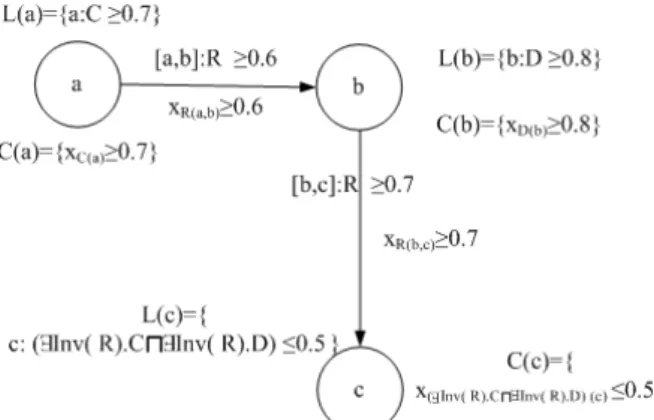
Example 3. Consider the following fuzzy knowledge
base KB= {Trans(R), C(a) [0.7, 1], D(b) [0.8, 1],
R(a, b) [0.6, 1], R(b, c) [0.7, 1], (∃Inv(R).C ⊓
∃Inv(R).D)(c) [0, 0.5]}. We want to check the
consistency of the knowledge base.
With Trans(R) and Inv(R), we have
Trans(Inv(R)). The fuzzy tableau is initialized
as shown in Figure 1.
Figure 1: The initial fuzzy tableau of example 3.
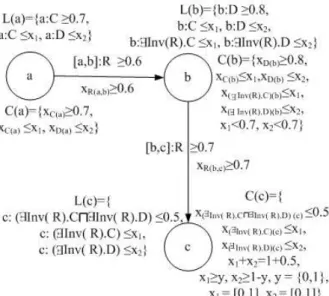
Next, since{c : (∃Inv(R).C ⊓∃Inv(R).D) ≤ 0.5} ∈
L
(c), the ⊓≤-rule is triggered, the reasoningal-gorithm adds {c : (∃Inv(R).C) ≤ x1} and {c :
(∃Inv(R).D) ≤ x2} to
L
(c), adds {x(∃Inv(R).C)(c) ≤x1, x(∃Inv(R).D)(c)≤ x2, x1+ x2= 1 + 0.5, x1≥ y, x2≥
1− y, y ∈ {0, 1}, x1∈ [0, 1], x2∈ [0, 1]} to
C
(c).Next, since {c : (∃Inv(R).C) ≤ x1} ∈
L
(c), {c :(∃Inv(R).D) ≤ x2} ∈
L
(c), and we have [b, c] : R ≥0.7, the ∃≤-rule is applicable, thus the reasoning
al-gorithm adds{b : C ≤ x1} and {b : D ≤ x2} to
L
(b),C
(b). Note that the constraints x1< 0.7 and x2< 0.7are added because of conjugation.
Next, since {c : (∃Inv(R).C) ≤ x1} ∈
L
(c), {c :(∃Inv(R).D) ≤ x2} ∈
L
(c), we have [b, c] : R ≥0.7 and Trans(Inv(R)), the ∃≤,+-rule is also
ap-plicable, thus the reasoning algorithm adds {b :
(∃Inv(R).C) ≤ x1} and {b : (∃Inv(R).D) ≤ x2} to
L
(b), adds {x(∃Inv(R).C)(b)≤ x1, x(∃Inv(R).D)(b)≤ x2} toC
(b).Next, since{b : (∃Inv(R).C) ≤ x1} ∈
L
(b), {b :(∃Inv(R).D) ≤ x2} ∈
L
(b), and we have [a, b] : R ≥0.6, the ∃≤-rule is also applicable, thus the
reason-ing algorithm adds{a : C ≤ x1} and {a : D ≤ x2} to
L
(a), adds {xC(b)≤ x1, xD(b)≤ x2, x1< 0.6, x2< 0.6}to
C
(a).Now the fuzzy tableau is shown in Figure 2. To-gether with the default variable constraints, the rea-soning algorithm forms the following constraint set:
subject to xC(a)≥ 0.7, xD(b)≥ 0.8 xR(a,b)≥ 0.6, xR(b,c)≥ 0.7 x(∃Inv(R).C⊓∃Inv(R).D)(c)≤ 0.5 x(∃Inv(R).C)(c)≤ x1, x(∃Inv(R).D)(c)≤ x2 x1+ x2= 1 + 0.5 x1≥ y, x2≥ 1 − y xC(b)≤ x1, xD(b)≤ x2 x1< 0.7, x2< 0.7 xC(a)≤ x1, xD(a)≤ x2 x1< 0.6, x2< 0.6 x(∃Inv(R).C)(b)≤ x1, x(∃Inv(R).D)(b)≤ x2 xC(a), xD(b), xR(a,b), xR(b,c)∈ [0, 1] x(∃Inv(R).C⊓∃Inv(R).D)(c)∈ [0, 1] x(∃Inv(R).C)(c), x(∃Inv(R).D)(c)∈ [0, 1] y∈ {0, 1} x1, x2, xC(b), xD(b)∈ [0, 1] x(∃Inv(R).C)(b), x(∃Inv(R).D)(b)∈ [0, 1] Using aLinear Programming solver, e.g., the GLPK solver (GLPK, 2008), it is easy to show that the constraint set is unsolvable. Therefore, the fuzzy knowledge base is inconsistent.
Through this example, it is shown that the consis-tency check of a knowledge base can be reduced to a problem of constraints solving in linear programming. The constraints solving can be processed either at the end of the reasoning procedure when no further fuzzy completion rules are applicable, or after each applica-tion of a compleapplica-tion rule. The advantage of the later case is that, in some situations, the computation effort could be saved when the constraints solver can iden-tify unsolvable constraints sets earlier in the reasoning process. However, in other situations, since calling an external solver is time consuming, frequent calls will severely affect the overall performance. In the former case, we only have to call the external solver once. In addition, we can apply some optimization strategies
Figure 2: The extended fuzzy tableau of example 3.
such as trivial clash detection and individual groups to improve the performance.
It is well known that there is always the trade-off issue between the expressive power of a DL and its computational complexity. The more expressive a DL is, the higher its computational complexity. Hor-rocks et. al presented an optimized version of the
tableau algorithm for classic
S I
in (Horrocks et al.,1998), which generates completion trees whose depth
is polynomially bounded by the size of sub(
A
). It isan interesting problem to investigate the applicability of the optimization to the fuzzy case.
4
CONCLUSION
In this paper, we address the fuzzy instance entail-ment problem with respect to a fuzzy knowledge base and then present a fuzzy extension to the expressive
Description Logic
S I
based on Zadeh Logic and theresidual R-implication.
For real-world applications where a knowledge base is considered as a means to store information (both precise and imprecise) about individuals, usu-ally more complex inferences other than consistency checking are required. For example, users may want to pose a query like “Given a knowledge base, what’s the certainty of an assertion?”. Another kind of query can be “How many individuals belong to a given con-cept description with a confidence greater than 0.5, and what are they?” We describe the former query as an instance range entailment problem and the later as an f-retrieval problem. However, due to space
limi-tations, the reasoning methods for these problems are omitted in this paper.
A prototype reasoner using SWI-Prolog and GLPK has been under implementation based on the
ALC
reasoner ALCAS (Spencer, 2006). It currentlysupports functionalities to check consistency, fuzzy
instance entailment and f-retrieval of a fuzzy fZALC
knowledge base. Part of our ongoing work considers further development of the reasoner to support other reasoning problems as well as more expressivity in the fuzzy knowledge base.
As we pointed out in Section 2, the properties for transitive roles and value restrictions also hold under Product Logic. Therefore, another direction of future work is to investigate the reasoning algorithms for ex-pressive fuzzy Description Logics under norms from other logics in the family of Fuzzy Logics.
REFERENCES
Baader, F., Calvanese, D., McGuinness, D. L., Nardi, D., and Patel-Schneider, P. F. (2003). The Description Logic Handbook: Theory, Implementation and Ap-plications. Cambridge University Press, Cambridge, MA.
Berners-Lee, T., Hendler, J., and Lassila, O. (2001). The semantic web. Scientific American, 284(5):34–44. D´ıaz, S., De Baets, B., and Montes, S. (2010). General
results on the decomposition of transitive fuzzy re-lations. Fuzzy Optimization and Decision Making, 9(1):1–29.
GLPK (2008). GNU linear pro-gramming kit. Technical Report http://gnuwin32.sourceforge.net/packages/glpk.htm. Haase, P. and V¨olker, J. (2005). Ontology learning and
rea-soning - dealing with uncertainty and inconsistency. In Proceedings of Uncertainty Reasoning for the Se-mantic Web, pages 45–55.
Horrocks, I. and Sattler, U. (1999). A description logic with transitive and inverse roles and role hierarchies. J. of Logic and Computation, 9(3):385–410.
Horrocks, I., Sattler, U., and Tobies, S. (1998). A PSPACE -algorithm for decidingALC IR+-satisfiability.
LTCS-Report 98-08, LuFg Theoretical Computer Science, RWTH Aachen, Germany.
Horrocks, I., Sattler, U., and Tobies, S. (2000). Reasoning with individuals for the description logicS H I Q. In McAllester, D., editor, Proc. of the 17th Int. Conf. on Automated Deduction (CADE 2000), volume 1831 of Lecture Notes in Computer Science, pages 482–496. Springer.
Jaeger, M. (1994). Probabilistic reasoning in terminological logics. In Proc. of the 4th Int. Conf. on the Principles of Knowledge Representation and Reasoning (KR94), pages 305–316.
Koller, D., Levy, A., and Pfeffer, A. (1997). P-classic: A tractable probabilistic description logic. In Proceed-ings of the Fourteenth National Conference on Artifi-cial Intelligence (AAAI-97), pages 390–397.
Laskey, K. J., Laskey, K. B., Costa, P. C. G., Kokar, M. M., Martin, T., and Lukasiewicz, T. (05 March, 2008). W3C incubator group report. Technical Re-port http://www.w3.org/2005/Incubator/urw3, W3C. Lee, H.-S. (2001). An optimal algorithm for computing the
maxmin transitive closure of a fuzzy similarity matrix. Fuzzy Sets and Systems, 123(1):129–136.
Lukasiewicz, T. (2008). Fuzzy description logic programs under the answer set semantics for the semantic web. Fundamenta Informaticae, 82(3):289–310.
Martin-Recuerda, F. and Robertson, D. (2005). Discovery and uncertainty in semantic web services. In Proceed-ings of Uncertainty Reasoning for the Semantic Web, page 188.
McGuinness, D. L. and van Harmelen, F. (2004). Owl web ontology language overview.
Mitsuishi, T. and Bancerek, G. (2003). Transitive closure of fuzzy relations. Journal of Formalized Mathematics, 15.
Spencer, B. (2006). ALCAS: An ALC Reasoner for CAS. http://www.cs.unb.ca/ bspencer/cs6795swt/alcas.prolog. Stamou, G., van Ossenbruggen, J., Pan, J. Z., and Schreiber,
G. (2006). Multimedia annotations on the semantic web. IEEE MultiMedia, 13:86–90.
Stevens, R., Aranguren, M. E., Wolstencroft, K., Sattlera, U., Drummond, N., Horridge, M., and Rectora, A. (2007). Using owl to model biological knowledge. International Journal of Human-Computer Studies, 65(7):583–594.
Straccia, U. (2001). Reasoning within fuzzy description logics. Journal of Artificial Intelligence Research, 14:137–166.
Yen, J. (1991). Generalizing term subsumption languages to fuzzy logic. In Proc. of the 12th Int. Joint Conf. on Artificial Intelligence (IJCAI’91), pages 472–477. Zadeh, L. A. (1965). Fuzzy sets. Information and Control,
8(3):338–353.
Zhao, J. (2010). Uncertainty and Rule Extensions to De-scription Logics and Semantic Web Ontologies, chap-ter 1, pages 1–22. Advances in Semantic Computing. Technomathematics Research Foundation. accepted. Zhao, J. and Boley, H. (2010). Knowledge
Representa-tion and Reasoning in Norm-Parameterized Fuzzy De-scription Logics. Canadian Semantic Web: Technolo-gies and Applications. Springer.