Architectural Techniques to Unlock
Ordered and Nested Speculative Parallelism
by
Suvinay Subramanian
Master of Science, Massachusetts Institute of Technology (2013) Bachelor of Technology, Indian Institute of Technology Madras (2011)
Submitted to the
Department of Electrical Engineering and Computer Science in partial fulfillment of the requirements for the degree of
Doctor of Philosophy
at the Massachusetts Institute of Technology
February 2019Copyright 2018 Suvinay Subramanian.
The author hereby grants to MIT permission to reproduce and to distribute publicly paper and electronic copies of this thesis document in whole or in part in any medium now known or hereafter created. This work
is licensed under the Creative Commons Attribution 4.0 International License. To view a copy of this license, please visit http: //creativecommons .org/licenses/by/4. 0/.
Signature redacted
A uth or ... ...
Department of Electrical Engineering and Computer Science
Signature redacted
September 28, 2018Certified by ... ...
Daniel Sanchez Associate Professor of Electrical Engineering and Computer Science
Signature redacted
Thesis SupervisorA ccepted by ... ...
MASSAC SETTS INSTITUTE Leslie A. Kolodziejski
OFIUCHNOLOGY '
Professor of Electrical Engineering and Computer Science
FEB 2 1
2019
Chair, Department Committee on Graduate StudentsLIBRARIES
Architectural Techniques to Unlock
Ordered and Nested Speculative Parallelism
by
Suvinay Subramanian
Submitted to the Department of Electrical Engineering and Computer Science on September 28, 2018, in partial fulfillment of the
requirements for the degree of
Doctor of Philosophy in Electrical Engineering and Computer Science
Abstract
Current multicores suffer from two major limitations: they can only exploit a fraction of the parallelism available in applications and they are very hard to program. This is because they are limited to programs with coarse-grained tasks that synchronize infrequently. How-ever, many applications have abundant parallelism when divided into small tasks (of a few tens to hundreds of instructions each). Current systems cannot exploit this fine-grained par-allelism because synchronization and task management overheads overwhelm the benefits of parallelism.
This thesis presents novel techniques that tackle the scalability and programmability issues of current multicores. First, Swarm is a parallel architecture that makes fine-grained parallelism practical by leveraging order as a general synchronization primitive. Swarm programs consist of tasks with programmer-specified order constraints. Swarm hardware provides support for fine-grained task management, and executes tasks speculatively and out of order to scale. Second, Fractal extends Swarm to harness nested speculative paral-lelism, which is crucial to scale large, complex applications and to compose parallel spec-ulative algorithms. Third, Amalgam makes more efficient use of speculation resources by splitting and merging address set signatures to create fixed-size units of speculative work. Amalgam can improve performance and reduce implementation costs.
Together, these techniques unlock abundant fine-grained parallelism in applications from a broad set of domains, including graph analytics, databases, machine learning, and discrete-event simulation. At 256 cores, our system is 40 x -512x faster than a single core
system and outperforms state-of-the-art software-only parallel algorithms by one to two orders of magnitude. Besides achieving near-linear scalability, the resulting programs are almost as simple as their sequential counterparts, as they do not use explicit synchroniza-tion.
Thesis Supervisor: Daniel Sanchez
Title: Associate Professor of Electrical Engineering and Computer Science
Acknowledgments
Over the course of my PhD journey, I have been extremely fortunate in having had in-credible mentors, colleagues, and friends who have helped me connect the dots along the way-scientifically, professionally and personally. I would like to express my sincere and heartfelt gratitude to all of them.
First and foremost, I owe thanks to my research advisor, Professor Daniel Sanchez.
I switched advisors rather late in my graduate career. Daniel quickly brought me up to
speed and guided me towards important and challenging problems. I have gained a deeper and more fundamental understanding of computer systems through my countless hours of discussions and interactions with him. Daniel taught me how to formulate research ideas, how to carefully, patiently, and rigorously develop them, and how to effectively communicate my work to the research community. Daniel's enthusiasm for diving into the details, his willingness to brainstorm or serve as a sounding board, anytime of the day or night, weekday or weekend, and his high standards have been critical to improving the quality and completeness of my research. But most importantly, Daniel developed in me the courage to work on difficult problems that few others in the world would venture to tackle. Daniel took me under his wing when my options were limited; this dissertation is my way of repaying that debt.
Apart from Daniel, I have had the pleasure of working with several other professors during my tenure at MIT. I have learned a great deal from their different styles, and also gained the confidence to pick up any new field and in great depth when required. I started my graduate career working with Professor Li-Shiuan Peh. Apart from her strong technical expertise, Li-Shiuan serves as a role model on how to effortlessly balance work and life, and remain ever ebullient and cheerful. I thank her for her mentorship, guidance and deep interest in my well-being many years after I switched advisors. After Li-Shiuan moved to Singapore, I worked briefly with Professor Hari Balakrishnan and Professor Mohammad Alizadeh. Thanks to Hari, for showing me how to pick problems at their infancy, and Mohammad for showing me how to extract the essence of a concept in the clearest form. Many thanks to Professor Anantha Chandrakasan, who not only welcomed me into his group, but provided valuable guidance and support when I was looking for a new advisor.
I am grateful to my thesis committee members Professor Joel Emer and Professor Srini
Devadas. Joel has been deeply involved in all of the work presented in this dissertation, and brought an enormous degree of clarity to the concepts that we developed. Srini reminds me that systems research should be impactful in the real world, and serves as an inspiration by being a prolific researcher in a diverse array of fields.
This dissertation is the result of joint work with many collaborators: Mark Jeffrey, Cong Yan, Maleen Abeydeera, Hyun Ryong (Ryan) Lee and Victor Ying. Mark has been a partner-in-crime through several projects. I have learned a great deal from his attention to detail, software engineering practices, diligence, and relentless pursuit of perfection. Cong wrestled for several months with silo, one of the more notorious applications in our bench-mark suite. Maleen patiently analyzed several applications, improved the accuracy of our simulator models, tuned our systems, and performed many experiments for our work. Ryan and Victor jumped onto the Fractal project as fresh graduate students and were
tal in ensuring we completed the project in time for ISCA. I cannot wait to see how they further advance the ideas that we developed.
I am grateful to my several collaborators on prior work: Chia-Hsin Chen, Bhavya Daya,
Tushar Krishna, Woo-Cheol Kwon, Sunghyun Park, Anirudh Sivaraman and Keith Win-stein. It was a great pleasure sharing ideas and working together over the last several years.
I am also thankful to the incredibly vibrant Sanchez group: Maleen Abeydeera, Nathan
Beckmann, Nosayba El-Sayed, Yee Ling Gan, Harshad Kasture, Hyun Ryong Lee, Anurag Mukkara, Quan Nguyen, Po-An Tsai, Victor Ying, Cong Yan and Guowei Zhang. A lot of my learning in graduate school has come from the many hours of discussions, feedback and conversations with them. In addition to being the fiercest critics of my work, they have been incredibly fun to hang out with, go hiking, play board games and have engaging discussions on a plethora of topics. Thanks to the Julia group for accepting me as a pseudo-member in their lab space and bringing vitality to my work environment in my final year.
Maria Rebelo, Mary McDavitt and Sally Lee were phenomenal admin assistants, assist-ing with paper work, reimbursements, bookassist-ing travel and conference rooms, and orderassist-ing cakes for my thesis defense. Janet Fischer and Professor Leslie Kolodziejski at the EECS graduate office patiently extended every PhD deadline, and provided helpful advice at var-ious inflection points.
I would not have been able to withstand the vicissitudes of grad school without the army
of friends who supported me, patiently endured and even encouraged my idiosyncrasies, and cheered my various endeavors both professional and personal. Anirudh has been a close friend and mentor through several years in grad school and undergrad. As he often remarks, our technical collaborations capture the quintessential collaborative spirit at MIT. More importantly, I am grateful for his friendship, and his valuable guidance and honest advice at critical junctures. Harshad and Tushar have been a sounding board, providing perspective, reassurance and confidence at many points. I am thankful for their words of wisdom and friendship. My long-term room mates Ujwal and Vaibhav made our apartment a home away from home. The MIT Ohms helped keep my passion for music alive, and provided many fun trips and cherished memories. Aditya, Abhinav, Anand, Anisha, Aritro, Arun, Ashwin, Atulya, Avinash, Chiraag, Deepak, Devendra, Divya, Giri, Jaichander, Karthik, Kaushik, Kumar, Krishna, Murali, Nachiket, Naveen, Nikhil, Parnika, Pranav, Radhika, Raghav, Rahul, Rik, Rohan, Rutu, Sai, Sameer, Sarvesh, Sivaraman, Srini, Sriram, Swati, Tapovan, Tejas, Varun, Vipul, Yashovardhan, and several more friends in Boston, the US and India: thank you for being the kindest, supportive and most wonderful friends. Krithika has been a great source of good cheer in the past year. A special thanks for her patience, support, and belief in me. Her unbounded enthusiasm and gaiety infused in me a sense of
joy, optimism and passion for life.
My brother, Shashank, has consciously or unconsciously helped me keep my sanity by engaging my varied interests and hobbies from across the globe day after day, and
with his ever-jovial attitude. I am grateful for his love and companionship. Finally, and most importantly, I am deeply, deeply grateful to my parents. Without their sacrifices over the years, the value they placed on education, the ethics and values they taught me, and their unwavering support, encouragement and love, I wouldn't be where I am today. This dissertation is dedicated to them.
Contents
Abstract 3
Acknowledgments 5
1 Introduction 17
1.1 C hallenges . . . . 18
1.1.1 Expressing and Extracting Parallelism . . . . 19
1.1.2 Reducing Overheads and Improving Efficiency . . . . 20
1.2 Contributions . . . . 21 2 Background 25 2.1 Overview . . . . 25 2.2 Parallelism in Applications . . . . 25 2.2.1 Regularity of Parallelism . . . . 26 2.2.2 Granularity of Parallelism . . . . 26
2.3 Techniques to Express and Extract Parallelism . . . . 28
2.3.1 Parallelizing Applications With Regular Parallelism . . . . 28
2.3.2 Parallelizing Applications with Irregular Parallelism . . . 28
2.4 Architectural Support for Parallelization . . . 30
2.4.1 Instruction-Level Parallelism . . . 30
2.4.2 Thread-Level Speculation . . . 30
2.4.3 Transactional Memory . . . . 33
2.4.4 Fine-grained Messaging and Task Management . . . 36
2.5 Bloom Filters . .. . . . .. . 36
3 Swarm: A Scalable Architecture for Ordered Parallelism 39 3.1 Motivation . . . 41
3.1.1 Understanding Ordered Parallelism . . . 41
3.1.2 Analysis of Ordered Algorithms . . . 42
3.2 Background on HW Support for Speculative Pa
3.3 Swarm: An Architecture for Ordered Parallelis
3.3.1 Swarm Execution Model . . . .
3.3.2 ISA Extensions . . . . 3.3.3 Task Queuing and Prioritization . . . 3.3.4 Speculative Execution and Versioning
3.3.5 Virtual Time-Based Conflict Detection
3.3.6 Selective Aborts . . . .
3.3.7 Scalable Ordered Commits . . . .
3.3.8 Handling Limited Queue Sizes . . . . 3.3.9 Analysis of Hardware Costs . . . . . 3.4 Experimental Methodology . . . .
3.5 Evaluation of Swarm . . . .
3.5.1 Swarm Scalability . . . .
3.5.2 Swarm vs Software Implementations
3.5.3 Swarm Analysis . . . .
3.5.4 Sensitivity Studies . . . .
3.5.5 Swarm Case Study: astar . . . . .
3.6 Scaling Swarm to Larger System Sizes: Need F
3.7 Spatial Task Mapping with Hints . . . .
3.7.1 Hardware Mechanisms . . . .
3.7.2 Adding Hints to Benchmarks . . . . .
3.8 Evaluation of Spatial Hints . . . .
3.8.1 Effectiveness of Hints . . . .
3.8.2 Comparison of Schedulers . . . .
3.9 Improving Locality and Parallelism with
Fine-3.9.1 Evaluation . . . .
3.10 Data-Centric Load Balancing . . . . 3.10.1 Evaluation . . . . 3.10.2 Putting It All Together . . . . 3.11 Additional Related Work . . . . 3.11.1 Limits of Parallelism . . . . 3.11.2 Thread-Level Speculation . . . . 3.11.3 Scalable Software Priority Queues . .
3.11.4 Scheduling in Speculative Parallelism
3.11.5 Scheduling in Non-Speculative Paralle 3.12 Summary . . . . rallelism . . . 44 m . . . 46 . . . 4 7 . . . 47 . . . 4 8 . . . 49 . . . 50 .. . . .. 53 .. . . .. 53 . .. . . .. 54 .. . . .. 55 .. . . .. 56 . . . .. 59 . . . .. 59 . . . .. 59 . .. . . .. 62 . .. . . .. 64 . .. . . ... 65 or Spatial M apping . . . 66 . . . 6 8 . . . . 6 8 . . . 69 . . . 7 1 . . . 7 1 . . . 7 2 3rained Tasks . . . 75 . . . 77 . . . 7 8 . . . 8 1 . . . 8 1 . . . . 82 . . . . 82 . . . . 82 . . . . 82 . . . . 82 lism . . . . 84
4 Fractal: An Execution Model for Fine-Grain Nested Speculative Parallelism
4.1 Motivation . . . .. ...
4.1.1 Fractal Uncovers Abundant Parallelism . . . . 4.1.2 Fractal Eases Parallel Programming . . . . 4.1.3 Fractal Avoids Over-serialization . . . .
4.2 Fractal Execution Model . . . . 4.2.1 Programming Interface . . . . 84 87 89 89 91 92 93 95 8 . . . .
4.3 Fractal Implementation . . . . 4.3.1 Fractal Virtual Time . . . . 4.3.2 Supporting Unbounded Nesting . . . . 4.3.3 Handling Tiebreaker Wrap-arounds . . . . 4.3.4 Putting It All Together . . . . 4.4 Experimental Methodology . . . . 4.5 Evaluation . . . .
4.5.1 Fractal Uncovers Abundant Parallelism . . . . 4.5.2 Fractal Avoids Over-serialization . . . .
4.5.3 Zooming Overheads . . . . 4.5.4 Discussion . . . . 4.6 Related Work . . . . 4.6.1 Nesting in Transactional Memory . . . . 4.6.2 Thread-Level Speculation . . . . 4.6.3 Nesting With Non-speculative Parallelism . . . . 4.7 Summary . . . .
5 Amalgam: Matching Speculation Resources to Application Needs 5.1 Motivation . . . .
5.1.1 Application Tasks are Diverse . . . .
5.1.2 Impact of Bloom Filter Size on Performance . . . . . 5.1.3 Impact of Commit Queue Size on Performance . . . . 5.2 Amalgam Design . . . . 5.2.1 Signature Splitting . . . . 5.2.2 Signature Merging . . . . 5.2.3 Amalgam Microarchitecture . . . . 5.3 M ethodology . . . . 5.4 Evaluation . . . . 5.4.1 Amalgam vs. Swarm . . . . 5.4.2 Amalgam Analysis . . . . 5.4.3 Sensitivity Studies . . . . 5.5 Summary . . . .
6 Conclusions and Future Work
6.1 Contributions . . . . 6.2 Future Work . . . . 9 96 98 99 102 102 103 104 104 107 108 109 110 110 111 112 112 113 114 114 115 115 116 116 118 119 120 121 121 122 124 124 125 125 126
List of Figures
2-1 Granularity (X-axis) and regularity (Y-axis) are closely intertwined in de-termining the difficulty of extracting parallelism. Instruction-level paral-lelism of all forms is effectively exploited modern cores. Multicores can extract coarse-grained parallelism well. However, irregular fine-grained parallelism is taxing to extract on current systems. . . . 27
2-2 Bloom filter insertion and query for address a for (a) true Bloom filter and
(b) parallel Bloom filter. The Bloom filter has m bits and k random hash
functions. . . . 37
3-1 Dijkstra's single-source shortest paths algorithm (sssp) has plentiful or-dered parallelism . . . 41
3-2 Swarm system and tile configuration . . . 46 3-3 Example execution of sssp. By executing tasks even if their parents are
speculative, SWARM uncovers ordered parallelism, but may trigger selec-tive aborts . . . 47 3-4 Task queue and commit queue utilization through a task's lifetime. . . . 48
3-5 Task creation protocol. Cores send new tasks to other tiles for execution.
To track parent-child relations, parent and child keep a pointer to each other. 48
3-6 Speculative state for each task. Each core and commit queue entry
main-tains this state. Read and write sets are implemented with space-efficient B loom filters. . . . 49
3-7 Local, tile, and global conflict detection for an access that misses in the LI
andL2. ... ... 51
3-8 Commit queues store read- and write-set Bloom filters by columns, so a
single access reads bit from all entries. All entries are checked in parallel. 52 3-9 Selective abort protocol. Suppose (A, 1) must abort after it writes Ox10.
(A, 1)'s abort squashes child (D, 4) and grandchild (E, 5). During
roll-back, A also aborts (C, 3), which read A's speculative write to Ox10. (B, 2) is independent and thus not aborted. ... 53
3-10 Global virtual time commit protocol. . . . 54 3-11 SWARM self-relative speedups on 1-64 cores. Larger systems have larger
queues and caches, which affect speedups and sometimes cause superlinear
scaling. . . . . 60 3-12 Speedup of SWARM and state-of-the-art software-parallel implementations
from 1 to 64 cores, relative to a tuned serial implementation running on a system of the same size . . . . 60 3-13 Speedup of SWARM and software silo with 64, 16, 4, and 1 TPC-C
ware-houses. ... ... 61
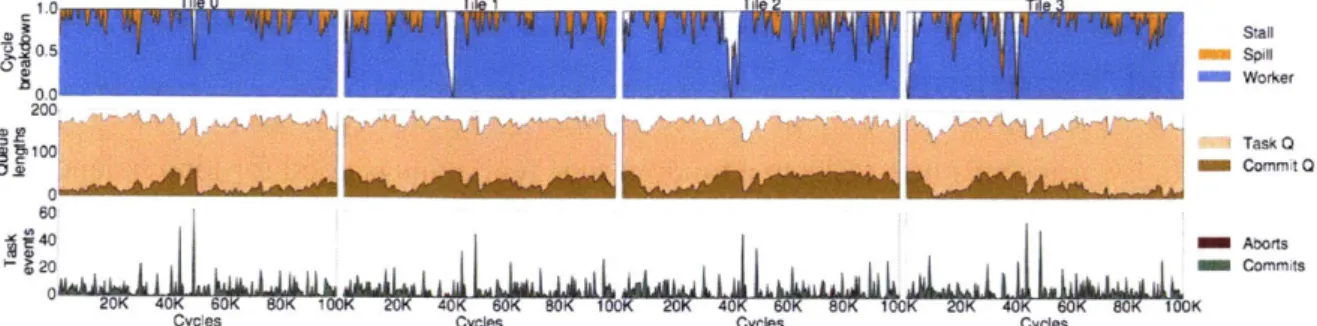
3-14 Breakdown of total core cycles for SWARM systems with 1 to 64 cores. Most time is spent executing tasks that are ultimately committed. . . . . 62 3-15 Average task and commit queue occupancies for 64-core SWARM. . . . . . 63 3-16 Breakdown of NoC traffic per tile for 64-core, 16-tile SWARM. . . . . 63 3-17 Sensitivity of 64-core SWARM to commit queue and Bloom filter sizes. . . . 64 3-18 Execution trace of astar on 16-core (4-tile) SWARM over a 100 Kcycle
interval: breakdown of core cycles (top), queue lengths (middle), and task commits and aborts (bottom) for each tile. . . . . 65 3-19 Performance of Random, Stealing, Hints, and LBHints schedulers on des:
(a) speedup relative to 1-core Swarm, and (b) breakdown of total core cy-cles at 256 cores, relative to Random. . . . . 66 3-20 Classification of memory accesses. . . . . 71 3-21 Speedup of different schedulers from 1 to 256 cores, relative to a 1-core
system. We simulate systems with K x K tiles for K < 8. . . . . 72 3-22 Breakdown of (a) core cycles and (b) NoC data transferred at 256 cores,
under Random, Stealing, and Hints schedulers. Each bar is normalized to R andom 's. . . . . 73 3-23 Classification of memory accesses for coarse-grained (CG) and fine-grained
(FG ) versions. . . . . 76 3-24 Speedup of fine-grained (FG) and coarse-grained (CG) versions, relative to
CG versions on a 1-core system. . . . . 77 3-25 Breakdown of (a) core cycles and (b) NoC data transferred in fine-grained
versions at 256 cores, under Random, Stealing, and Hints. Each bar is normalized to the coarse-grained version under Random (as in Figure 3-22). 78 3-26 Hardware modifications of hint-based load balancer . . . . 79 3-27 Speedup of Random, Stealing, Hints, and LBHints schedulers from 1 to
256 cores, relative to a 1-core system. For applications with coarse- and fine-grained versions, we report the best-performing version for each scheme. 80 3-28 Breakdown of total core cycles at 256 cores under Random, Stealing, Hints,
and LBH ints. . . . . 81 4-1 Execution timeline of (a) maxflow-flat, which consists of unordered
tasks and does not exploit nested parallelism, and (b) maxflow-fractal,
which exploits the nested ordered parallelism within global relabel . . . . . 90 4-2 In maxflow-fractal, each global-relabel task creates an ordered
sub-dom ain. . . . . 9 1
4-3 Speedup of different maxflow versions on 1-256 cores. . . . 91
4-4 Speedup of silo versions on 1-256 cores. . . . 92
4-5 silo-swarm uses disjoint timestamp ranges for different database transac-tions, sacrificing composability. . . . 92
4-6 Speedup of different mis versions on 1-256 cores . . . 93
4-7 Elements of the Fractal execution model. Arrows point from parent to child tasks. Parents enqueue their children into ordered domains where tasks have timestamps, such as A's and M's subdomains, or unordered domains, such as the other three domains. . . . 94
4-8 Swarm VT construction. . . . 97
4-9 Domain VT formats. . . . 98
4-10 Example 128-bit fractal VTs. . . . 98
4-11 Fractal VTs in action. . . . 99
4-12 Starting from Figure 4-11, zooming in allows F to create and enqueue to a subdomain by shifting fractal VTs. . . . 100
4-13 Performance of flat and fractal versions of applications with abundant nested parallelism, using Bloom filter-based or Precise conflict detection. 106 4-14 Performance of flat, swarm-fg, and fractal versions of applications where Swarm extracts nested parallelism through strict ordering, but Frac-tal outperforms it by avoiding undue serialization. . . . 107
4-15 Performance of zoom-tree microbenchmark for different fanouts F, as we vary the number of concurrent levels D supported in hardware. a) Fractal imposes only modest overheads even for small F, D, b) fanouts > 8, as seen in most of our applications, impose negligible overheads. . . . 109
4-16 Different Fractal features make all STAMP applications scale well to 256 cores. . . . 110
5-1 Sensitivity of application performance to various Bloom filter sizes (512: 512-bit 8-way, 1K: 1024-bit 8-way, 2K: 2048-bit 8-way) compared to ide-alized precise address set tracking. Most ordered applications have fine-grained tasks with small footprints and are insensitive to Bloom filter size. . 115 5-2 Sensitivity of application performance to commit queue size (32, 64, 128 entries per tile) when using idealized precise address set tracking. Un-ordered applications are insensitive to the commit queue size, while per-formance of ordered applications improves with larger commit queue size. All numbers are normalized to execution time with 64 commit queue en-tries per tile. . . . 116
5-3 Signature splitting allows Amalgam to track large address sets across mul-tiple Bloom filters. . . . .. . . 117
5-4 Modifications to the baseline Swarm task unit for Amalgam. The commit queue comprises a task metadata table, the Bloom filters, a way table, and an occupancy table. Amalgam additions are shown in orange. Figures (a) and (b) show the state of different structures before and after a signature m erge. . . . 120
5-5 Gmean execution time of Swarm and Amalgam at 256-cores for various de-sign points-64, 32 commit queue entries per tile, and 512-bit 8-way (512), 1024-bit 8-way (1K) and 2048-bit 8-way (2K) Bloom filters. P represents an idealized precise address set tracking scheme. Amalgam gracefully re-sponds to tasks of varying sizes regardless of Bloom filter size and number of commit queue entries. . . . 122
5-6 Breakdown of core cycles at 256-cores for four representative applications. All numbers are normalized to the 2048-bit 8-way Bloom filter with 64
commit queue entries. Amalgam reduces aborts due to false conflicts when application tasks have large address sets by performing signature splitting ((a), (b) and (c)). Amalgam reduces commit queue stalls by merging tasks with tiny address sets ((b) and (d)). . . . 123
List of Tables
2.1 HTM proposals for various points in the TM design space. . . . 33
3.1 Maximum achievable parallelism and task characteristics (instructions and 64-bit words read and written) of representative ordered applications. . . . . 44
3.2 Sizes and estimated areas of main task unit structures. . . . 56
3.3 Configuration of the 256-core system. . . . 57 3.4 Benchmark information: source implementations, inputs, run-times on a
1-core Swarm system, 1-core speedups over tuned serial implementations. 58
3.5 gmean speedups with progressive idealizations: unbounded queues and a zero-cycle memory system (Ic-base = 1-core SWARM baseline without
ide-alizations). . ... ... 63
3.6 Benchmark information: number of task functions, and hint patterns used. 69
4.1 High-level interface functions. . . . 97 4.2 Configuration of the 256-core Fractal system. Core, memory system, and
Swarm parameters as listed in Table 3.3. . . . 103 4.3 Benchmark information: source implementations, inputs, and execution
time on a single-core system. . . . 103 4.4 Benchmarks with parallel nesting: performance of 1-core flat/fractal
vs tuned serial versions (higher is better), average task lengths, and nesting sem antics. . . . 104
5.1 Address set size of tasks (in 64-byte cache lines) of representative applica-tio n s . . . 114
5.2 Configuration of the 256-core Amalgam system. Core, memory system, and Swarm parameters as listed in Table 3.3. . . . 121
1
Introduction
P
phones, to high-end computers in data centers and supercomputing clusters. These ma-ARALLEL machines are pervasive today-ranging from tiny computers that powersmart-chines can have hundreds of cores and provide copious compute capability, up to several teraflops of performance [149] on a single chip.
Yet, only a narrow sliver of individual applications can exploit this available paral-lelism. This is because current architectures are limited in the kinds of parallelism that can be effectively expressed and exploited. Modern computer systems exploit parallelism from problems at two extremes of granularity. At one extreme, systems exploit parallelism at the granularity of individual instructions through techniques such as out-of-order and super-scalar execution. This is commonly referred to as instruction-level parallelism (ILP), and has been the predominant driver of performance improvements over the last three decades. ILP, however, is restricted by control flow and data dependences. Further, the hardware costs needed to exploit ILP-such as the instruction scheduling logic and wide register files-grow quadratically, and hence are not scalable [116].
At the other extreme, systems extract parallelism from applications that can be cast as coarse-grained tasks (several thousand to a few million instructions) with few data depen-dences and relatively infrequent synchronization. But such coarse-grained parallelism is also narrow in scope. It fares well in domains such as dense linear algebra and graphics, where applications have well-defined accesses to data and few unpredictable control and data dependences. By contrast, applications in several domains such as graph process-ing, sparse linear algebra, and discrete-event simulation are ill-served by coarse-grained parallelism. These applications often rely on pointer-based data structures, and data depen-dences are dictated by run-time data values that are difficult to predict statically and a poor match for current techniques.
Between these two extremes lies a wide spectrum of parallelism that has received little attention. Many applications have substantial parallelism when expressed as fine-grained tasks of a few tens to hundreds of instructions. Unfortunately, fine-grained tasks cause large overheads in current systems, because software task management overheads (e.g.,
Chapter 1. Introduction
ing and load balancing) overwhelm the benefits of parallelism. At the same time, exposing such fine-grained parallelism often necessitates frequent and complex synchronization-for instance, to handle producer-consumer relationships, or to coordinate accesses to indi-vidual elements of a data structure. Current systems, however, lack efficient support for such synchronization.
As a result, today's programmers are in an unenviable position. While, sequential pro-gramming is simple and natural, ILP has been yielding diminishing returns over the last decade [16, 103]. On the other hand, parallel programming often requires heroic program-ming efforts to overcome the deficiencies of current architectures. And yet, these efforts may not yield concomitant performance gains. Even worse, the limits of current architec-tures constrain the imagination of algorithm designers and programmers. It biases them to only consider algorithms with parallelism that can be exploited by current architectures, while ignoring more efficient algorithms.
To resolve this conundrum, future parallel systems must provide greater architectural
supportfor parallelization. This dissertation investigates what essential architectural
sup-port is required in order to mine the abundant, yet untapped, fine-grained parallelism in applications. Fundamentally, parallelizing a program consists of two main steps: dividing work into tasks that may run concurrently, and specifying the synchronization of tasks with potential data dependences to ensure correct behavior. The architecture of a parallel ma-chine impacts and constrains both the manner and efficacy of these steps. It determines what forms of parallelism can be expressed, how effectively the parallelism is exposed, and the ability of the machine to exploit this parallelism and scale to a large number of pro-cessors. This not only influences how programs are written (or how code is compiled), but also affects the programmer's choice of data structures and algorithms.
This dissertation advocates that parallel architectures should provide support for order
as a general synchronization primitive among fine-grained tasks. This is for two reasons.
First, many applications require tasks to execute in a certain order to satisfy the seman-tics of the algorithm. Enforcing this order in software for fine-grained tasks incurs large overheads to be practical. Second, support for order naturally captures several complex synchronization patterns. This support enables parallelizing a wide range of general-pur-pose applications. With this architectural support, we show that it is possible to extract parallelism even in the presence of ordering constraints.
1.1
Challenges
We categorize the challenges to successfully exploiting parallelism along two dimensions:
(1) expressing and extracting parallelism, and (2) reducing overheads and improving
ef-ficiency. Current parallel systems are beset with challenges along both these dimensions, severely impairing their ability to parallelize a wide spectrum of applications.
1.1. Challenges
1.1.1
Expressing and Extracting Parallelism
A parallel architecture should ideally allow programmers to easily and effectively express
parallelism of all forms and at all levels. This requires architectural support that is suffi-ciently general to capture many different forms of parallelism in applications. In addition, the architectural mechanisms must scale to a large number of cores.
Providing general support for synchronization: Parallelism arises in many flavors, such as data parallelism, task parallelism, pipeline parallelism and more. A common chal-lenge in exploiting the various forms of parallelism is providing suitable abstractions for expressing synchronization among tasks. There exist several mechanisms in literature, such as locks, barriers, atomics, and producer-consumer relationships, to express such synchro-nization. Among these, a very general form of synchronization is order. With ordered execution, the tasks in a parallel architecture appear to run in an order (total or partial) specified by the programmer, even though the architecture may run tasks in parallel. Or-dered execution is less restrictive than the sequential execution model. OrOr-dered execution allows tasks to be created out of order and in parallel, and relies on the architecture to en-force order. By contrast, the sequential execution model consists of a single, serial stream of instructions or tasks. These form long chains of dependences that preclude them from being created or executed widely out of order.
Order confers several benefits. First, it is expressive enough to capture several com-plex synchronization patterns. In addition, many applications require tasks to execute in a certain order to satisfy the semantics of the algorithm (Section 3.1). Second, using order allows programmers to write and reason about programs almost like a serial program. This implicit approach means that the programmer need not, in general, determine whether par-allelism exists among tasks nor consider how to explicitly express it. While it may seem that order limits parallelism, there are often opportunities for parallelism among ordered tasks that can be exploited with suitable architectural techniques. Unfortunately, current architectures provide limited support for expressing order and extracting parallelism under order constraints.
Extracting parallelism in the presence of ordering constraints often necessitates support for speculative execution. Speculative execution allows a processor to execute tasks out of order in the presence of control and data dependences that are unknown statically. It enables the processor to seize opportunities for parallel execution without violating true dependences among tasks. We find that ordering constraints are often specified conserva-tively, and can be elided subject to true dependences between tasks (Section 3.1). In many applications, these dependences manifest rarely, but can only be resolved at run-time, ne-cessitating speculation to uncover parallelism.
Attempts at performing fine-grained ordered speculation in software have yielded scant benefits due to large overheads [100]. Hardware support for speculation has been provided in thread-level speculation (TLS) and transactional memory (TM) systems. However, the execution model for both TM and TLS are limited. TM does not provide support for order. The TLS execution model targets sequential programs which unnecessarily constrains
par-*1 19 0
Chapter 1. Introduction
allelism in many applications; exposing order in the execution model, by contrast, allows creating tasks out of order exposing greater parallelism. In addition, both TM and TLS suf-fer from implementation challenges: TM sufsuf-fers from poor performance on fine-grained tasks, while TLS mechanisms scale poorly beyond a few cores (Section 2.4).
Providing modular composability: Parallelizing complex real-world applications is ex-tremely challenging. Complex programs consist of several layers of interacting compo-nents, and any given procedure may invoke several nested procedures at other components. These procedures are often parallelizable. To harness all this parallelism, a parallel system should support nested parallelism, i.e., the ability to invoke a parallel algorithm within an-other parallel algorithm. Nested parallelism confers two major benefits. First, it lets the system exploit parallelism at all levels of the application, dramatically improving scala-bility. Second, it makes parallel software easy to compose, making it easy to write large, modular parallel programs.
Nested parallelism is a staple of many parallel languages that extract non-speculative parallelism, such as NESL, Cilk, and OpenMP [27, 81]. However, nested parallelism has been difficult to support in systems that perform speculative parallelization. Nesting in transactional memory systems [20, 206] focus on parallelizing at the coarsest (shallowest) levels, incurring large overheads that squander their potential. Further, to guarantee atomic-ity, nested transactions merge their speculative state with their parent, which is often at odds with the gains realized by parallelization. Finally, transactional memory systems are unable to express all forms of nested parallelism in applications, such as ordered parallelism.
1.1.2
Reducing Overheads and Improving Efficiency
Scaling to large systems introduces unavoidable latencies and imposes bandwidth con-straints. Parallel systems must provide low-overhead mechanisms for communication and synchronization. Further, resource management strategies are also crucial to achieve good utilization and scalability.
Supporting fine-grained tasks: Many applications have substantial parallelism when expressed as fine-grained tasks of a few tens to hundreds of instructions, and are also more naturally expressed in that form. However, the overheads of managing and scheduling such fine-grained tasks in software can be large. Queue operations and synchronization through a shared-memory cache hierarchy incur significant latency, thwarting the benefits of fine-grained parallelism and limiting speedup. Prior work [ 120, 181] has shown that per-forming task management in hardware can yield significant benefits. But this has largely been explored in the context of non-speculative systems. Hardware task management in the speculative context acquires new dimensions-be it for correctness, performance or scalability. It necessitates new hardware structures (for instance, to manage tasks that may be aborted due to dependences), different policies (for scheduling or load balancing) and unique considerations (such as ensuring forward progress, prevention of deadlock and
live-M
1.2. Contributions
lock). Unfortunately, prior work on hardware task management fails to address these con-cerns adequately.
Exploiting locality: To scale effectively, parallelism must not come at the expense of locality: tasks should be run close to the data they access to avoid global communication and use caches effectively. The need for locality-aware parallelism is well understood in non-speculative systems, where prior work has developed programming models to convey locality, and runtimes and schedulers to exploit it. By contrast, most prior work in specula-tive architectures has ignored the need for locality-aware parallelism: in TLS, speculaspecula-tive tasks are executed by available cores without regard for locality [94, 170, 19 1]; in TM, prior work has developed transactional task schedulers that limit concurrency to reduce aborts under high contention [14, 23, 221]. Limiting concurrency, i.e., controlling when to run tasks, suffices for small systems. However, scaling to hundreds of cores also requires solv-ing the spatial mappsolv-ing problem, i.e., controllsolv-ing where to run speculative tasks, schedulsolv-ing them across the system to minimize data movement.
Along with spatial mapping, it is also important to address load balancing. Load bal-ancing improves the distribution of tasks across multiple cores, ensuring good utilization, and consequently better scalability. Load balancing has been studied extensively in the context of non-speculative systems [2, 2, 29, 91, 179, 220]. However, non-speculative ap-proaches, such as work-stealing, work poorly in the speculative context because the signals to detect imbalance are different (Section 3.10).
1.2
Contributions
This dissertation presents novel architectural techniques to unlock ordered and nested spec-ulative parallelism. Specifically we make the following contributions:
" Swarm is a scalable architecture for unlocking ordered parallelism-a type of
par-allelism that is abundant in many domains, such as simulation, graph analytics, and databases, but has been difficult to mine with current software and hardware tech-niques. Swarm successfully scales several challenging applications up to 256 cores while retaining the programming simplicity of their sequential counterparts.
" Fractal is a new execution model that enables seamless composition of ordered and unordered speculative parallelism. Our key insight is to employ order to guarantee atomicity of nested tasks rather than building impractically large atomic units. " Amalgam is a microarchitectural technique that enables matching the speculation
re-sources allotted to a task, to the granularity of the task. It ensures that speculation handles diverse task types across applications gracefully without impacting perfor-mance, while providing area savings.
These techniques were developed collaboratively as part of a multi-year effort involving several graduate students. The individual chapters detail the specific contributions of this dissertation in context.
El 21 M
Chapter 1. Introduction
Swarm: Programs with ordered parallelism have three key features. First, they consist of
tasks that must follow a total or partial order. Second, tasks may have data dependences that are not known a priori. Third, tasks are not known in advance. Instead, tasks dynamically create children tasks and schedule them to run at a future time.
We design Swarm (Chapter 3), an architecture that successfully mines ordered paral-lelism. Swarm relies on a co-designed execution model and microarchitecture to scale efficiently. Swarm executes tasks speculatively and out of order, and efficiently speculates thousands of tasks ahead of the earliest active task to uncover enough parallelism. Swarm adapts existing eager version management (i.e., store speculative data in place and log old values) and conflict detection schemes [219], and contributes several new techniques that allow it to scale to large core counts and speculation windows.
In particular, Swarm's execution model conveys order constraints to hardware without undue false data dependences. Swarm's conflict detection scheme leverages eager version-ing to, upon mispeculation, selectively abort the mispeculated task and its dependents, en-abling greater scalability. We also design a distributed commit protocol that allows ordered commits without serialization, supporting multiple commits per cycle with modest commu-nication. Finally, we develop spatial hints, a technique that conveys program knowledge to exploit locality and enable high-quality task mappings. We enhance spatial hints through a novel data-centric load balancer for the speculative context that redistributes tasks in a locality-aware fashion.
Together, these techniques enable Swarm to scale 10 challenging applications near lin-early up to 256 cores, outperforming state-of-the-art software parallel implementations by
3 - 18 x. Besides achieving near-linear scalability on algorithms that are often considered
sequential, the resulting Swarm programs are almost as simple as their sequential counter-parts.
Fractal: Large, complex programs have speculative parallelism at multiple levels and
often intermix ordered and unordered algorithms. Speculative architectures should sup-port composition of ordered and unordered algorithms to convey all this nested parallelism without undue serialization.
Fractal (Chapter 4) presents a new execution model for nested speculative parallelism. Fractal programs consist of tasks located in a hierarchy of nested domains. Within each domain, tasks can be ordered or unordered. Any task can create a new subdomain and enqueue new tasks in that subdomain. All tasks in a domain appear to execute atomically with respect to tasks outside the domain. Fractal allows seamless composition of ordered and unordered nested parallelism.
Our Fractal implementation builds on the Swarm architecture and supports arbitrary nesting levels cheaply. Unlike prior work, our implementation focuses on extracting par-allelism at the finest (deepest) levels first. It guarantees the atomicity of large domains by enforcing an order among individual tasks rather than building impractically large atomic units. This allows the system to manage tiny speculative tasks that are easy to track in hard-ware, reaping the benefits of fine-grained parallelism, and avoids the problems that plague 0 22
1.2. Contributions
prior nested-parallel HTMs. Together, our contributions make nested parallelism practical in speculative systems.
Fractal uncovers abundant fine-grained parallelism and scales challenging programs that have eluded parallelization for decades. In particular, Fractal is the first architecture that scales the full STAMP suite [134] to hundreds of cores, achieving gmean speedup of
177x at 256 cores and outperforming prior architectures by up to 88 x.
Amalgam: Real-world applications are complex and diverse, featuring tasks of varying sizes. Systems that support speculative parallelization employ probabilistic structures such
as Bloom filters to track the address sets of tasks using a bounded amount of hardware
state [41,42, 219]. These structures are conservatively sized at design time to handle com-monly occurring task sizes. This can, however, lead to inefficient utilization for tiny tasks, while also offering no protection against high false conflict rates for applications with very large tasks.
Amalgam builds on the Swarm architecture and develops microarchitectural mecha-nisms to match Bloom filter resources to the size of the task. On the one hand, large address sets are tracked cooperatively by multiple Bloom filters. On the other hand, multiple tiny address sets are tracked in concert by a single Bloom filter when possible. Amalgam offers a new architectural choice unavailable in prior speculative systems: trading off efficiency of tracking address sets against the degree of ordered speculation at run-time.
Unlike prior speculative architectures, Amalgam gracefully responds to varying task sizes, improving performance and efficiency. At 256 cores, Amalgam can reduce the area consumed by Bloom filters by 4x while slightly improving performance.
M
ORE with the legacy of sequential architectures developed for the uniprocessor context.than a decade after the transition to multicore processors, we remain saddledIt is imperative that we break free of this mold if we are to realize the promise of paral-lel computing. We must systematically explore and rigorously enable paralparal-lel systems to
both express and efficiently exploit all forms of parallelism available in applications. The
techniques presented in this dissertation represent an important step in this direction. They are a culmination of a vertically-integrated approach of studying applications and hardware architectures in concert. These techniques help bridge the semantic gap between hardware and software in current parallel systems, and enable us to realize a new breed of parallel architectures that are more versatile, easier to program, and scale to larger systems sizes efficiently.
2
Background
T
tract these forms of parallelism. We focus on literature that is generally related to theHIS chapter presents an overview on parallelism in applications and techniques to ex-broad themes of this dissertation. Later chapters discuss literature that is specific to the techniques presented in those chapters.2.1
Overview
Fundamentally, parallelizing an application consists of two main steps: organizing the com-putation of the application into a set of tasks that may execute concurrently, and specifying the synchronization of tasks with potential data dependences to ensure correct behavior. We use the term task to refer to a unit of computational work (for example, a short function, or a set of instructions). The architecture of a parallel machine impacts and constrains both the manner and efficacy of these steps. The key to building a versatile parallel architecture is to design an execution model that allows programmers to effectively express parallelism of all forms and support it with an efficient implementation.
In this chapter, we first describe what kinds of parallelism exist in applications (Sec-tion 2.2). While parallelism may be classified in many ways, we present a broad taxonomy that illustrates the challenges in expressing and extracting different forms of parallelism and informs the architectural support needed to effectively exploit them. We then describe the range of techniques to extract those forms of parallelism (Section 2.3). And finally, we review prior architectural support for parallelization and their associated successes and limitations (Section 2.4).
2.2 Parallelism in Applications
We categorize parallelism in applications along two dimensions-regularity and
granu-larity. The first dimension captures how much information we have about the tasks in
Chapter 2. Background
the application statically, which informs the degree of run-time support needed to effec-tively parallelize the application. The second dimension captures the size of the tasks in the application, which informs how much hardware support we need to extract parallelism effectively.
2.2.1
Regularity of Parallelism
Regular parallelism: Applications have regular parallelism when their tasks and data dependences among them are known statically. Regular parallelism commonly arises in applications that manipulate dense matrices and arrays, and have predictable control flow (e.g, matrix-matrix multiplication). These applications typically comprise loops where each iteration performs the same operation on a different data element. If the iterations are independent of one another then they may execute in parallel. Regular parallelism also manifests in applications with pipeline parallelism. Here computation is partitioned into a sequence of stages with each stage producing data consumed by the following stage. Stages may execute in parallel communicating shared data in a deterministic producer-consumer style. Regular parallelism also arises in other domains such as stencil computation [174] and fast Fourier transform (FFT) [1 66].
Irregular parallelism: Applications have irregular parallelism when their tasks or data dependences among them are unknown statically.' Instead, tasks create new tasks at run-time as they find more work to do. Further, the tasks may have data dependences that again manifest at run-time. Irregular parallelism arises in applications that have unpredictable control flow, or operate on data structures accessed in complex non-predictable patterns such as trees and graphs. Examples include Dijkstra's algorithm [58,80], Kruskal's mini-mum spanning forest algorithm [58], and discrete-event simulation [172].
2.2.2 Granularity of Parallelism
Granularity refers to the size of tasks. Parallelism in applications can arise at various granu-larities: ranging from single-instruction tasks (instruction-level parallelism), to fine-grained tasks of a few tens to hundreds of instructions each, to coarse-grained tasks of hundreds of thousands of instructions each. While finer granularities can expose greater parallelism, they also impose larger costs-specifically, task creation, communication, and synchro-nization costs. Thus, the granularity of tasks impacts how much hardware support is
re-quired to get good performance.
'Irregular parallelism has a different connotation in the GPU literature, referring to unstructured compu-tation with varying amount of work or unstructured memory accesses.
2.2. Parallelism in Applications 27 M Regular Fine-grained Coarse-grained Task size 1 10 100 1000 10K 100K IM 10M (instrs) Unexploited Effectively targeted by
Irregular instruction-level parallelism Effectively targeted by in cores multicore processors
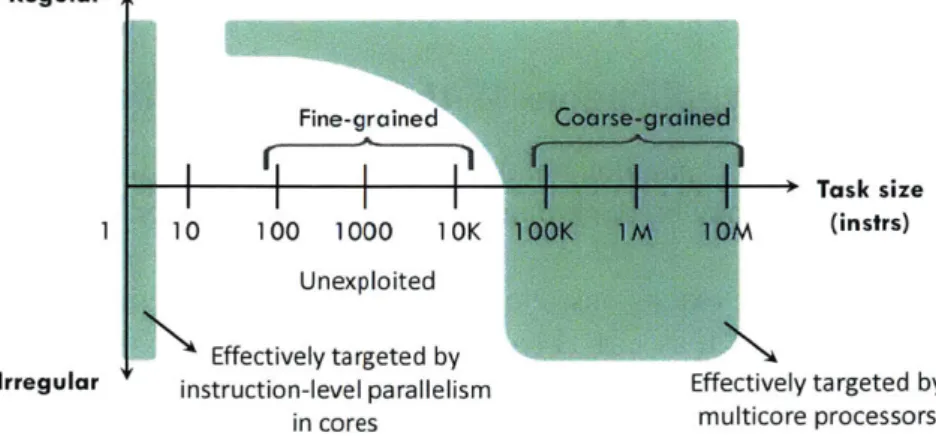
Figure 2-1: Granularity (X-axis) and regularity (Y-axis) are closely intertwined in determining the difficulty of extracting parallelism. Instruction-level parallelism of all forms is effectively exploited modern cores. Multicores can extract coarse-grained parallelism well. However, irregular fine-grained parallelism is taxing to extract on current systems.
Regularity and granularity are closely intertwined in determining the difficulty in ex-tracting parallelism. With regular parallelism, we have advance information of what tasks need to run and when. This enables greater compile-time optimization-such as generation of parallel schedules before running the application-and therefore incurs fewer run-time costs. Irregular parallelism, by contrast, demands greater run-time support to discover and exploit parallelism. Likewise, the cost of managing coarse-grained tasks in software can be amortized and thus imposes lower overheads to parallelization. By contrast, managing fine-grained tasks demands greater hardware support.
Figure 2-1 illustrates the difficulty in extracting different forms of parallelism (Sec-tion 2.3 describes specific techniques). Current multicores exploit coarse-grained regular parallelism very well, enabled by programming languages, compiler tools and architec-tural support. Extracting coarse-grained irregular parallelism has seen limited success, the primary challenges being task management and synchronization. At the other extreme, modem cores effectively target instruction-level parallelism (ILP) in applications; but ILP is ill-suited for multicores. However, fine-grained irregular parallelism has been taxing to extract on current systems. Software-only approaches incur large overheads to be practical. At the same time, current architectural support is insufficient to mine such parallelism.
As we scale to larger multicores, it becomes imperative to extract all available forms of parallelism in applications. Amdahl's Law [9] states that maximum speedup achievable is limited by the non-parallelizable portion of an application. Given N cores, if the paral-lelizable fraction of the application, f, is accelerated by a factor N, then the speedup, S, is given as: S = 1 + . As N increases, the speedup is quickly bounded by - . At
N = 100 cores, even if 99% of the application is parallelizable (f = 0.99), S = 50, and if
the fraction drops to even 95% (f = 0.95), the speedup drops precipitously to S = 17. It
is therefore important to focus on even the hardest forms of parallelism, if we are to realize the benefits of parallel computing. Hence, this dissertation targets fine-grained irregular parallelism.
Chapter 2. Background
2.3 Techniques to Express and Extract Parallelism
2.3.1
Parallelizing Applications With Regular Parallelism
For applications with regular parallelism, it is possible to delineate tasks to be executed in parallel in advance. This may be done manually by the programmer or inferred automati-cally by the compiler.
Programming language extensions allow programmers to express data parallelism ex-plicitly using constructs such as parallel-for in OpenMP [150]. Special purpose lan-guages, such as ZPL [44], have also been proposed for writing data parallel programs. Language extensions such as Cilk [8 1] enable programmers to express task parallelism in applications.
Compiler tools rely on building and analyzing the program dependence graph [75] of the application. The program dependence graph captures control and data dependences among tasks of an application. Techniques such as points-to analysis [12, 51, 60,73, 193]
and shape analysis [47,63,87,92, 123] inspect the program dependence graph and identify
tasks that are independent and hence can be executed in parallel. Using these techniques, compilers can analyze and transform sequential programs into parallel ones.
The runtime systems for these applications tend to be simple, focusing primarily on load-balancing and priority scheduling of tasks on the critical path [29,34].
Architectural support for single-instruction multiple-thread (SIMT) execution [129], common in GPUs, enables better scheduling of coarse-grained parallel tasks. While sup-port for vectorization [175] and single-instruction multiple-data (SIMD) extensions (such as SSE and AVX [109]), enable extracting regular data parallelism at the granularity of individual instructions.
2.3.2
Parallelizing Applications with Irregular Parallelism
Parallelizing applications with irregular parallelism requires greater run-time support. The program dependence graph cannot be determined at compile-time, so static analysis fails to find much parallelism in these applications. Run-time approaches to parallelization may be categorized into two types: speculative and non-speculative.
Non-speculative approaches: Many non-speculative approaches rely on the program-mer to explicitly delineate tasks and handle synchronization through constructs such as locks, semaphores, etc. Unfortunately, such manual code parallelization is a time-consuming and error-prone process. Programmers need to carefully tradeoff parallelism against ease of programming and performance [105]. Further, explicit synchronization techniques such as locks are not composable and require programmers to strictly adhere to locking con-ventions to prevent deadlock and livelock [96]. Finally, in many programs such explicit synchronization can be conservative because many dependences manifest infrequently at run-time [165,207].
2.3. Techniques to Express and Extract Parallelism 290 Software libraries and frameworks can abstract the implementation details from the programmer. Concurrent data structure libraries [37, 102, 105, 128, 198] provide tuned con-current implementations of commonly used data structures such as stacks, lists and queues. Frameworks such as Galois [142, 155], Ligra [185], and GraphIt [223] focus on providing suitable abstractions for expressing irregular parallelism in applications, while handling synchronization and load-balancing under the hood.
Techniques such as inspector-executor [156] and deterministic reservations [25] take a different approach, building a dependence graph at run-time and executing tasks in parallel suitably. The inspector-executor approach builds the dependence graph and determines a schedule for tasks in an inspector phase, followed by an executor phase that executes the tasks in parallel. Deterministic reservations reserve access to data by different tasks in a priority order, followed by a commit phase where tasks with successful reservations execute in parallel and then free reservations to reserved data. These approaches work well with coarse-grained tasks where the run-time overhead of discovering parallelism can be amortized by the parallel execution of tasks.
Speculative approaches: In speculative or optimistic parallelization, the system exe-cutes tasks in parallel assuming that their dependences are not violated. The system soft-ware or hardsoft-ware automatically detects dependence violations and recovers from them. If there is no violation, the results of speculative execution are committed. In case of a viola-tion, the offending tasks are aborted and re-executed. All speculative systems implement the following basic mechanisms: (1) conflict detection to track dependence violations, (2)
version management to manage the speculative memory state of a task, and (3) conflict resolution to determine which task(s) to abort on a dependence violation.
Speculative parallelization is employed widely to exploit parallelism at the granular-ity of individual instructions in modem processors. Programmers simply write sequential code. Compilers can analyze the program to expose parallelism, generate an execution schedule and optimize branches [182]. Architectural support for ILP (Section 2.4.1) can issue and execute multiple instructions in parallel by performing dynamic dataflow analy-sis among instructions, handling operations with variable latency, predicting outcomes of branches, etc. [1 90].
Speculative parallelization has also been employed to parallelize applications with coarse-grained tasks, in domains ranging from transactional databases [121, 154, 205] to graph analytics [142] and discrete-event simulation [77, 112]. However, for applications with fine-grained tasks of a few tens to hundreds of instructions, the overheads of speculative parallelization in software are too large to be practical [10 1]. Further, many software tech-niques (e.g., ordered commits [100]) induce unnecessary serialization, limiting scalability even with plentiful speculative parallelism.
Architectural support for speculative parallelization can tackle some of these overheads. Prior work has proposed hardware techniques for supporting thread-level speculation (TLS) of sequential loops [94, 170, 19 1], and hardware transactional memory to perform specula-tive synchronization [42,95, 104, 162]. However, both the TLS and TM execution models