Prof. J. R. Zacharias H. H. Brown, Jr. R. E. Lyon
Prof. J. G. King A. W. Crooke C. L. Searle
B. B. Aubrey B. DiBartolo G. W. Stroke
V. J. Bates D. S. Edmonds, Jr. R. Weiss
R. D. Haun, Jr.
A. MEASUREMENT OF THE VELOCITY OF LIGHT
One of the major problems in the successful performance of the measurement of the velocity of light is presented by the mechanical guidance of the moving end plate in the cylindrical resonant cavity. Since we are entering the stage of building the apparatus, we would like to state briefly the major problems of the experiment, as they now appear, in order to place the various design features in proper perspective.
a. Manufacture of the high-precision cylindrical quartz cavity to optical toler-ances in microinches.
b. Silver-coating of this cavity to optical uniformity and good electric conductivity. c. Mechanical guidance of the moving end plate parallel to itself, and at a reason-ably uniform velocity to precisions of microinches. (The progress on this part of the problem is described below.)
d. Optical (interferometric) determination of the position and orientation of the moving plate as it advances in the cavity. This will include both translatory and rotational measurements in order to obtain truly axial translation. Calculations on the interferometric information obtained from the optical system by photoelectric detection, using real light sources of finite linewidth, were made. These calculations furnish procedures for determining which of the measurable instrumental parameters are to be watched in order to assure ultimate information accuracy. (Details will be published in a future report.)
e. Microwave source with variable frequency regulated by a highly stable atomic clock, the frequency f being the one that is required in the c = fX relation.
f. Problems associated with microwave feeding and detecting of resonance infor-mation.
g. Simultaneous recording of microwave resonance and cavity-length signals. h. Analytical transformation of the measured guide wavelengths Xg to the free-space wavelengths X that are needed in the evaluation of the speed of light, c. The determination of the "correction factor," referred to in the Quarterly Progress Report of July 15, 1956, page 27, is complicated by the fact that this factor varies with guide length, to a certain extent, because of the Qo variation described in that report. In practice, the measurement procedure will be so arranged that the effect of this vari-ation is minimized with respect to the desired 10- 8
precision in c.
(VI. ATOMIC BEAMS)
We shall now discuss the results that were achieved in the mechanical guidance of the moving end plate. We are trying to move the end plate parallel to itself at an approximately uniform velocity. The precision in uniformity of motion is entirely determined by two considerations:
a. The frequency response characteristics of the detection, amplifying, and recording systems for the optical and microwave signals, which govern the preser-vation of the waveforms of the signals and the corresponding information content.
b. The mechanical microvibrations that arise in the motion, which will affect both signals, manifesting themselves in the form of loss of information as well as in the form of noise.
As originally planned, the M.I.T. diffraction grating ruling engine was considered for adaptation to this measurement. It was proved by recent ruling of remarkably good
gratings that this servo-controlled ruling engine is probably the finest existing mecha-nism for controlled translation in a plane. This is achieved by means of both trans-latory and two-dimensional (planar) rotational servo control through interferometric detection. The end plate in our experiment does not have to be controlled as much in translation as in three-dimensional rotation; that is, the motion of the plate parallel
to itself in space is of primary importance. Moreover, it would have been unreason-ably complicated to carry out the experiment in vacuo on the ruling engine; therefore we decided to build a mechanical system for the express purpose of the present exper-iment, making use of the knowledge accumulated by Dean George R. Harrison and his group with the M.I.T. ruling engine. Thus our new measuring system will have a vertically moving end plate, with the added advantage of operating in vacuo, thereby eliminating the rather difficult refractive index ratio comparison (Quarterly Progress Report, Jan. 15, 1956, p. 59) that would otherwise have been required to reduce air measurements to free space.
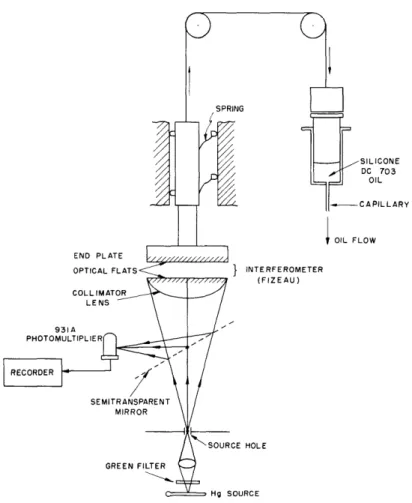
The experimental apparatus is shown in Figs. VI-1 and VI-2. The position of the supporting plate that carries the end plate is determined in one plane by means of three shoes fixed to the supporting plate. This arrangement still leaves the freedom of rotation in the contact plane of the three shoes. Two shoes in a plane at approxi-mately 900 to this first contact plane constrain the rotational freedom and permit only straight-line motion. A group of five spring-supported shoes is arranged to constrain all five shoes to remain in contact with their respective glass planes in the presence of small mechanical disturbances and tilts. The spring-supported shoes contact a pair of optical flats, each of which is essentially parallel to the two guiding flats. It is easily seen that basically the placement of these four optical flats is not critical; arrangements for slightly controlled tilts by means of servomechanisms, making use of the interferometric information from the moving end plate are being con-sidered for the apparatus. Frequently, a kinematic design of this nature is naively
SPRINGS
END PLATE (GLASS)
-SPRINGS
Fig. VI-1.
Simplified schematic diagram of kinematic guiding for the end
plate by means of optical flats and shoes.
END PLATE OPTICAL FLA' COLLIMATOR LENS 931 A PHOTOMULTIPLIEI DC 703 OIL CAPILLARY OIL FLOW INTERFEROMETER (FIZEAU) SOURCE HOLE Hg SOURCE
Fig. VI-Z.
Experimental interferometer, making use of the hydraulic-drive
control and kinematic system of Fig. VI-1.
(VI. ATOMIC BEAMS)
thought to be perfect without making any further effort. When angles of 10- 8 radian are concerned and uniformity of motion to 10- 8 inch is involved, satisfactory results are far from being immediately attained. The precisions are, of course, the results to be achieved; they have been effectively achieved in the case of the two-dimensional ruling engine. The hydraulic system shown in Fig. VI-2 leads to a remarkably uniform motion, as it should under ideal conditions in which the effect of the gradual decrease in the liquid head is small enough.
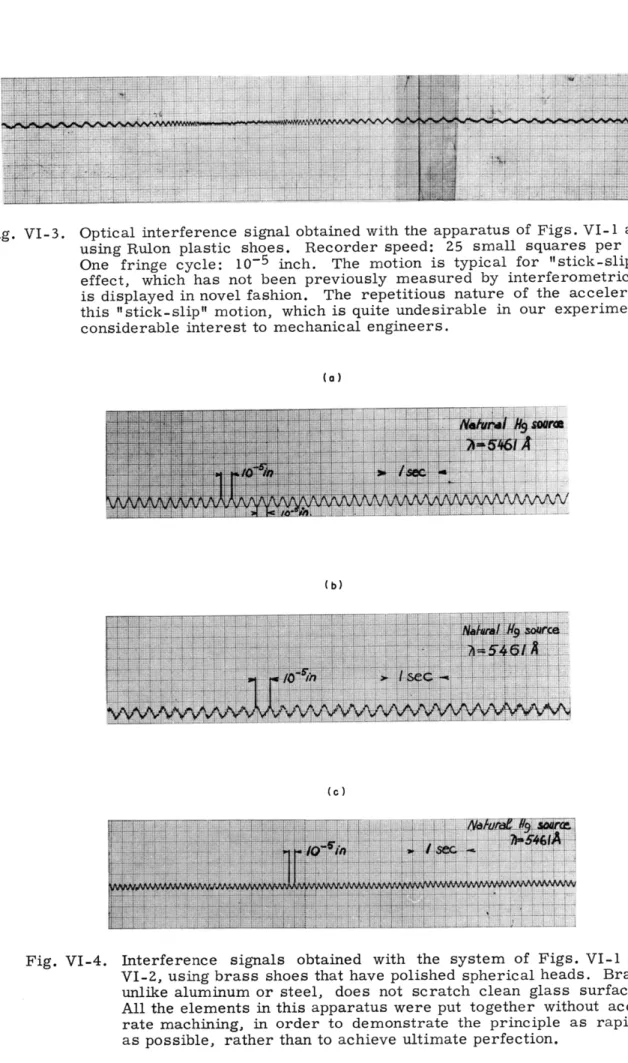
The nature of the shoes is all-important. At first, we used the plastic Rulon; the corresponding stick-slip motion is shown in Fig. VI-3. Each cycle represents a dis-placement of one interference fringe, which at this wavelength is approximately 10- 5
inch per fringe. With a constant pulling force, the plate accelerated and decelerated in a rather typical manner under a great variety of shoe-contact shapes, spring orien-tations, lubrication conditions, and directions of motion (up or down). Care was taken to eliminate effects of pulleys and cords. The use of Rulon was decided upon after it
had proved itself on the ruling engine as an extremely low-friction material under rela-tively high-speed motions of several inches per second, with negligible wear of a 3-mm surface over miles of traverse on glass.
The disappointing effect in the slow-motion case was ascribed to the considerable difference between static and dynamic friction characteristics. With this in mind, polished brass shoes were then tried; their use led to the remarkably good results shown in Fig. VI-4. These records represent sections of motions up to 0. 5 inch, to which the experimental apparatus was limited. The various speeds of motion were obtained by a mere variation of the diameter of the syringe needle. It is worth noting that uniform translatory motion is obtained here without the aid of a screw, simply by the use of uniform flow under constant load. The constancy of this load depends, of course, on the constancy of the friction characteristics in the shoe-glass system. The greater dynamic friction "coefficient" of brass as compared with Rulon seems to be offset, to considerable advantage, by the fact that the difference between static and dynamic friction characteristics is much smaller for brass than for the plastic. This fact seems to be of outstanding importance for the rather slow motions used here. We wish to point out that the noise in the fringe signals arises from pickup and light source fluctuations, the elimination of which can be accomplished with adequate means.
These experiments are fundamental for the apparatus now being designed, which will permit carrying out the measurement in vacuo at translatory speeds, limited only by the considerations of waveform preservation and microvibration. Traverses through the entire cavity in a matter of minutes appear to be quite feasible.
Fig. VI-3.
Optical interference signal obtained with the apparatus of Figs. VI-1 and VI-2
using Rulon plastic shoes.
Recorder speed: 25 small squares per second.
One fringe cycle: 10
- 5inch. The motion is typical for "stick-slip"; this
effect, which has not been previously measured by interferometric means,
is displayed in novel fashion. The repetitious nature of the acceleration
in
this "stick-slip" motion, which is quite undesirable in our experiment,
is of
considerable interest to mechanical engineers.
(a)
Fig. VI-4. Interference signals obtained with the system of Figs. VI-1 and
VI-2, using brass shoes that have polished spherical heads. Brass,
unlike aluminum or steel, does not scratch clean glass surfaces.
All the elements in this apparatus were put together without
accu-rate machining, in order to demonstaccu-rate the principle as rapidly
as possible, rather than to achieve ultimate perfection.
--(VI. ATOMIC BEAMS)
B. STARK EFFECT ON HYPERFINE STRUCTURE
The Stark shift of the cesium1 3 3 hyperfine structure delta-nu was measured over the range of 104 volt/cm to 5 X 10⁴ volt/cm. Resonance curves at 9192.6 mc were obtained with linewidths of 105 cps and signal-to-noise ratios of approximately 20:1. The experimentally observed shift is given by
Av(4 ) = 1.89 X 10- 6 (1
±
0.03) 2 cpswhere & is in volt/cm. Several correction factors (dependent on the dimensions of the apparatus) must be applied to this number in order to obtain the actual shift Av(4 ) of the hyperfine structure delta-nu. Further studies of the Stark shift are now being made.
R. D. Haun, Jr.
C. CRYSTAL OVEN TEMPERATURE CONTROL
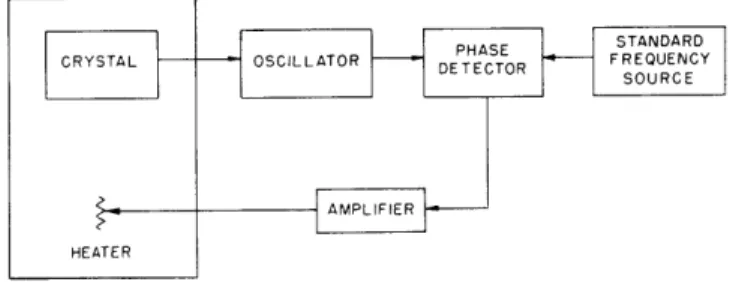
Preliminary investigation of a method of crystal oven temperature control, employing a quartz crystal with a high-temperature coefficient as the measuring ele-ment, was initiated. A block diagram of the system is shown in Fig. VI-5. Assuming that the standard frequency source has absolute stability, we obtain the limit of the sensitivity of the temperature measurement from the crystal temperature coefficient and the oscillator noise. If a is the temperature coefficient in cps/mc/OC, and 6 (in cps/mc) represents the total effect of variations of the oscillator frequency from the crystal frequency and variations of the crystal frequency that arise from factors other than temperature, then the sensitivity of the temperature measurement, for a signal-to-noise ratio of 1, is given by
ATmin = n/a (1)
Since the phase-detector output is the integral of the difference between the oscillator frequency and the standard frequency, variations in the standard frequency
PHASE ST ANDA RD CRYSTL OSCILLATOR D E DETECTOR R FREQUENCY
SOURCE
HEATER