
Performing service design experiments using ethnomethodology and theatre-based reenactment : a Swiss ski resort case study
12
0
0
Texte intégral
(2) Fragnière, Nanchen, and Sitten: Ethnomethodology and Theatre-Based Reenactment in Service Design Experiments. INFORMS holds copyright to this article and distributed this copy as a courtesy to the author(s). Additional information, including rights and permission policies, is available at http://journals.informs.org/.. 90. Service Science 4(2), pp. 89–100, © 2012 INFORMS. In this paper, we explain the notion that for such challenging, multifaceted, multistakeholder environments as private and public sector services, an ethnomethodological study of the workplace environment—analyzing the “taken-for-granted” aspects of daily routine service interactions (also referred to by the Swiss as l’habitude)—can produce a useful method for assessment, measurement, and improvement of the process of service cocreation. To illustrate our approach, we present service script role plays that were designed for the tourist board of Crans-Montana, a Swiss ski resort town. To highlight the characteristics of an advisory service, we chose three situations characteristic of employees’ daily work: providing general information about the resort, managing visitor complaints, and selling ski passes. The first two role plays were staged in the Crans-Montana Tourism offices in Switzerland, and they enabled us to illustrate the service weaknesses of the existing office design. For the third experiment, we tested the new décor. Actors and audiences were composed of staff from the tourist board of Crans-Montana. This process, further illustrated in a more thorough explanation of the examples mentioned above, provides both a methodological basis for the design and improvement of services and an opportunity for students to join in the process of knowledge creation. Because these examples are open-ended scenarios and not closed case studies, students are able to take part in the process of service design, collaborating on the ethnomethodological analysis, script development, and role play of the service scenario itself. The rest of this paper is organized as follows: In the Literature Review section, we briefly present some elements of service science to understand the peculiarities of service production. In the Methodology section, we show how we are employing ethnomethodology to design services. In the Case Study section, we present the design that we performed for Crans-Montana. In the Conclusion section, we explain once more our methodology and provide directions for further research.. Literature Review Service science is an emerging academic field that attempts to better address the peculiarities of service production. We present in this section some major findings that will help the reader to understand the important role that ethnomethodology can play in service science (Fragnière 2009). Although critical of the limits of the definition, Lovelock and Gummesson (2004) acknowledge that “services” are most widely differentiated from goods by their “IHIP” characteristics: intangibility, heterogeneity, inseparability, and perishability. Goods are tangible, as they represent a transfer of ownership from the producer to the consumer; a service acquires value once the client perceives the benefits of it, but the substance of service itself is not necessarily physically tangible (Parasuraman et al. 1985). Service, which produces results based on a process of cocreation between the client and producer, is heterogeneous because of the unique interactions between the client and producer (Vargo and Lusch 2004). Because the salient attributes of the service—the service value itself—are perceived simultaneously at the moment of production, delivery, and consumption, they are said to be “inseparable.” And finally, because service benefits are necessarily consumed at the time of production—such as medical care or legal advice—they are considered perishable (Wild et al. 2007). The IHIP model applies chiefly to the private sector environment of services. In the public sector, this concept is complicated by the decoupling of direct incentives between the service provider and the consumer (Besley and Ghatak 2003). Because there is not necessarily a direct link between the agents of coproduction in a public service environment (for example, a doctor in a public clinic is not necessarily being paid for services by the patient, but rather by the government), the relationship of cocreation can be more difficult to examine, and frameworks for service design and improvement can be more difficult to develop (Chen et al. 2004). Until relatively recently, most service enterprises employed industrial models for designing service experiences, with an emphasis on cost control, rapid task execution, and standardization (Levitt 1976). It was not until recently that services came to be regarded not only as an accompaniment to the sale of products but as a way of externalizing the risk of certain kinds of choice on the basis of expertise (Debely et al. 2007). The production of highly customized, expertise-driven services was viewed as an impediment to efficiency and effectiveness, and prone to excessive variance in quality and delivery. In a move toward the “organization as machine” metaphor in Gareth Morgan’s Images of Organization (Morgan 1986), enterprises increased their use of technology—either “hard” technology in the form of vending machines, self-service checkout counters, or drive-through windows or “soft” technology in the form of packaged services and industrialized service processing—as a way to deliver services in a speedy and highly standardized manner. The McDonald’s fast-food restaurant chain epitomizes this notion in its application of the Taylor scientific management model, which emphasizes the standardization of processes and the strict adherence to best practices (Chase and Apte 2007). Every McDonald’s restaurant is operated according to strict sets of guidelines that.
(3) Fragnière, Nanchen, and Sitten: Ethnomethodology and Theatre-Based Reenactment in Service Design Experiments. INFORMS holds copyright to this article and distributed this copy as a courtesy to the author(s). Additional information, including rights and permission policies, is available at http://journals.informs.org/.. Service Science 4(2), pp. 89–100, © 2012 INFORMS. 91. dictate every part of service production, from the preparation of the food to the interactions with the customers. In this example, the quality of the “service” is judged by the speed of production and the consistency of the end product. It is not a service product intended to provide heavy customization nor is there expected to be a trust relationship. Consequently, the McDonald’s service culture is designed specifically to enforce and improve efficiency along these Tayloresque lines, and this culture is introduced at McDonald’s own training facility, Hamburger University. A slightly different example of the industrialization of services is the online retailer Amazon.com. According to its Q4 2010 financial report (Amazon.com 2011), Amazon earned $34.20 billion in net sales in 2010, and its profile on CrunchBase (2011) displayed over 64 million customers at the end of 2006. Without the benefits of technology, process standardization, 24-hour purchase availability, highly sophisticated logistics operations, and a “virtual” customer support service, would such a huge customer base be possible for a retailer (Lewis et al. 1998)? What if each sale required an interaction between a live human being and the consumer, as in the early days of the Home Shopping Network? As Chase (1981) suggests, a ratio of service efficiency exists such that the potential facility efficiency is a function of the customer contact time divided by the service creation time. Therefore, a service like Amazon.com— which runs on a website 24 hours a day and requires no live interaction with the customer at all in order to complete a transaction1 —operates at near-perfect efficiency according to Chase’s service model. However, despite a more educated and discerning consumer who, with the help of Internet search engines, social media, and consumer activism blogs (such as http://www.consumerist.com), is much more aware of the competitive product and service landscape, firms and organizations have still relied primarily on a Taylor model of cost reduction and operations-driven management (Grönroos 1993). Grönroos states that firms who place a primary importance on operating efficiency create a set of incentives that eventually damage overall customer satisfaction. In working toward a notion of “service management” that takes a holistic view of the client’s overall satisfaction with the delivery of a service and seeks to adjust all organizational functions to the pursuit of this goal, Grönroos (1993) illuminates the need for service science as a way to fully understand the nature and value of coproduction. In today’s growing service economy, it is essential for service providers in both the private and public sectors to understand the important roles that creativity, empathy, and implicit knowledge play in service coproduction in order to meet the demand for highly customized, expertise-dependent service experiences (Spohrer et al. 2007). These factors are even more linked to the business basis for strong service design when considering the notion that there is a strong relationship between customer satisfaction and “willingness to pay” (Homburg et al. 2005). The tourism and travel industry provides numerous examples of the importance of the crafted, “artisanal” model of service experience described above, and it offers a contrast with the industrialized service model. Online travel retailers such as Orbitz.com and Travelocity.com provide price-sensitive consumers with cheap, accessible deals on airfare, lodging, and car rental. However, these sites offer no insights into the local culture, the best time to travel, what the “cool” neighborhoods are, or many of the other factors necessary in ensuring a positive travel experience. Travel agents, however, not only have access to good pricing on travel and lodging but bring experience, implicit knowledge, and a process of cocreation to the client. This kind of expertise increases the client’s confidence that his or her travel experience will be a good one (Stickdorn and Zehrer 2009). Tourist information centers, such as those in ski resort towns, are another example of a service that cannot be industrialized and that relies on an artisanal, human-centric design for success. Tourist information centers are a form of “destination management,” which aggregate knowledge (ski trail maps, restaurant reviews, lists, etc.), decentralized services and subservices (tours, ski lessons), and customer relations (complaints, suggestions, client crises, etc.) under a single roof. According to Stickdorn and Zehrer (2009), for destination management such as a tourist information center to succeed, it must do more than just respond to metrics such as the number of brochures handed out or the number of customer complaints resolved per hour; it must meet the needs of both its internal (vendors, managers, administrators) and external (customers) stakeholders. To succeed, the perceived value of the service delivered must at least match (and ideally exceed) the level of service value expected (Faché 2000). Most discussion of service science has grown out of debate over the effectiveness of scientific management and the shift from a “goods-dominant logic” to a “service-dominant logic” (Vargo and Lusch 2004), and it has therefore been mostly applicable to the private sector. Consumers pay for goods or services directly to the 1. Indeed, interaction is only necessary when there is some difficulty with the transaction, and even then some difficulties can be solved through the built-in automated help..
(4) Fragnière, Nanchen, and Sitten: Ethnomethodology and Theatre-Based Reenactment in Service Design Experiments. 92. Service Science 4(2), pp. 89–100, © 2012 INFORMS. INFORMS holds copyright to this article and distributed this copy as a courtesy to the author(s). Additional information, including rights and permission policies, is available at http://journals.informs.org/.. producer, and so the relationship of cocreation between the consumer and the service producer comes with a classical set of expectations, incentives, and accountability (Vargo et al. 2008). If John pays Jane for legal advice, Jane is incentivized to provide a quality service experience out of self-interest. As the producer, Jane is directly accountable to John the consumer, and the success of her business relies on his perception of what is received for the money he pays. In his article “Ethnomethodology’s program,” Harold Garfinkel (1996, p. 6) defines ethnomethodology as follows: Ethnomethodology’s fundamental phenomenon and its standing technical preoccupation in its studies is to find, collect, specify, and make instructably observable the local endogenous production and natural accountability of immortal familiar society’s most ordinary organizational things in the world, and to provide for them both and simultaneously as objects and procedurally, as alternate methodologies.. Because most services rely on human factors such as expertise, implicit knowledge, empathy, and other immeasurable qualities, most quantitative modeling techniques are insufficient for studying and evaluating the current state of a service environment. Ethnomethodology provides a useful tool for studying the contexts, behaviors, and activities that compose a given service environment, and for gathering the information and insights necessary for suggesting iterative improvements (Makino et al. 2009). Ethnomethodology, or ethnomethodologically influenced ethnography, is already in use and under study in the practice of participatory design (Martin and Sommerville 2004). Ethnomethodology can be extremely useful for understanding patterns in which the rituals of work are organized—such as by division of labor, awareness of work, or time—and such patterns help form an understanding of the environment in which a service is rendered and cocreated. Methods traditionally used by other types of “customer experience” or “user experience” fields, such as wireframing or prototyping, are more geared toward designing for an ideal (but not necessarily realistic) user; taken alone, without the benefit of observation in situ or other ethnomethodological approaches, there is a risk of developing “the perfect solution to the wrong problem(s) of work” in designing or improving services (Crabtree 1998, p. 103). When designing a service experience, the full scope of cultural, operational, and experiential contexts from the perspectives of both the service provider and the client are required for a truly interpersonal experience (Bitner 1992). A full understanding of these concepts is important for the design of the service experience itself; service design necessarily depends on valid, relevant assessments of operating modes, which can only be formulated with an in-depth understanding of the contexts in which the services are being provided.. Methodology The HEG Service Lab has developed a methodology for observing and designing service experiences that adopt the following process (Catenazzo and Fragniere 2012): 1. Ethnomethodology through site visits, immersion work, and semidirected interviews in situ with service providers and service consumers in order to identify the salient attributes of a given service experience: Structured observation of and immersion in the everyday rituals of the service environment can yield key insights into an organization, its culture, and how seemingly irrelevant characteristics can influence service scenarios. By journaling the paths of both the service providers and the client through the service environment, we can “feel” the job by living in it and see what explicit and implicit factors are at play in building the atmosphere in which service cocreation occurs. Observations such as —Where are the offices positioned? How are they furnished? —How are employees dressed? How do they speak with customers? —How do service providers speak with one another? What jargon do they use with the clients and amongst themselves? can lead to insights into important cultural and environmental factors that might not be consciously apparent to those on either side of the service relationship. To gain an understanding of the conscious elements of the service environment, it is important in this phase to perform semidirected interviews of service providers, staff, and clients. The interviews are semidirected in nature, using a general framework as a departure point but allowing for improvisation and exploration as the interview process uncovers new and unexplored territories for discussion. It is important that these interviews be used to learn about the characteristics of the service culture of which the stakeholder groups are aware: for example, awareness of company policy, feelings about customers and coworkers, learned behaviors and career paths, and “tricks of the trade.” The interviews must be conducted in situ in order to properly capture the salient elements as they occur in their natural surroundings, to capture the “habitude” of the service environment..
(5) Fragnière, Nanchen, and Sitten: Ethnomethodology and Theatre-Based Reenactment in Service Design Experiments. INFORMS holds copyright to this article and distributed this copy as a courtesy to the author(s). Additional information, including rights and permission policies, is available at http://journals.informs.org/.. Service Science 4(2), pp. 89–100, © 2012 INFORMS. 93. 2. Development of a service experience script which “tangibilizes” the main service attributes of the experience: Once the information from the interview and observational immersion phase is processed, certain salient elements about the service interaction become apparent. These attributes—the key elements that constitute a service interaction—allow us to design a “script” that fully illustrates the service pathway and renders tangible the previously covert, unidentified aspects of a particular service scenario. This script is paced and written out so as to reproduce the service scenario’s most important elements, and it is developed in a fashion similar to a scene in a play or film. 3. Role play based on the script in order to visualize the problem resolution offered by the service: With the help of trained theatre directors, actors, student collaborators, and collaborators from the sponsor and one or more of the stakeholder groups, the service scenario is reenacted using the fully developed script. Multiple scripts can be used for the purpose of experimentation, reproducing variable, testable elements of a particular service experience. Students and participants are able to review the service interaction as it is replayed, noting the important interactions and “beats” that occur throughout the role play. Qualitative analysis is performed and discussed amongst the stakeholders, participants, and sponsors; survey research can be performed during and after each role play, if other noncollaborating observers are asked to participate and confounding variables are minimized as much as possible (we acknowledge that some aspects of the role play, such as environment, timing, “office realism,” or other factors, might not be able to be compared to a fully realistic scenario). This step provides the basis for both the improvement of the service experience and the opportunity for learning by the students and collaborators. 4. Development of “operating modes” and integration with real production of the service experiences based on the role plays and rehearsals involving the sponsor: The reenactment is performed multiple times, each with subtle variations and adjustments based on participant feedback and feedback included in the ethnomethodological studies. After the completion of the reenactments, the participants and students synthesize the key “takeaways” from each iteration of the reenactments. Discussion of the findings at this point provides yet another learning opportunity for students and practitioners, as the process of service design is highly customized and contains peculiarities that are unique to each service scenario and cannot be wholly provided by a textbook lesson or theoretical framework. The takeaways described above—for example, the discovery that a particular aspect of the service experience can be much improved by a change in the physical layout of a service space or through an addition to a particular employee’s greeting of a customer—provide the basis for the operating modes of the improved service script. These operating modes are the deliverable elements produced from each iteration of the service design process and are testable redesigns of the original scripts developed in Step 2. This approach has been employed during the last three years in the service lab. The main objective of the lab is to train students in the practice of service science and to examine the service design methodology in a variety of contexts. It has also enabled students to become designers for service companies.. Case Study Since 1997, the Crans-Montana Tourism office has had to manage three separate information desks. This situation creates many problems in human resource and financial terms—for example, when the company wishes to extend their opening hours or must buy new equipment. These facts led the management to envision a redesigned tourist center, a unique point in the resort that gathers all the equipment and services that the tourist needs in a single location. Furthermore, almost all of the area’s information and communication supports had received major upgrades except the information center, where employees were still required to assist customers personally for each question—and from behind the same countertops as they had done for decades. The management wanted to modernize the welcome center to give a fresh, dynamic image of the destination. The work performed in this case study was one step toward reaching this goal. Our first goal was to understand the specific service environment of a tourist information office, examine its evolution, and give it new momentum. Like many other services, this one has been revolutionized by the rapid expansion of new technology in information and communication; however, its success relies not on databases— which can only store information, not implicit knowledge—but on the quality of advice and support provided by the employees. Step 1: Ethnomethodology. Between January and March 2011, we conducted semidirected interviews with five employees of Crans-Montana Tourism and 10 customers: 4 had used the Crans-Montana information service, and 6 had visited tourist offices in other locations such as Geneva, Montréal, or Venice. We visited and observed.
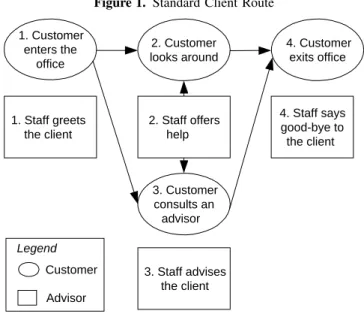
(6) Fragnière, Nanchen, and Sitten: Ethnomethodology and Theatre-Based Reenactment in Service Design Experiments. INFORMS holds copyright to this article and distributed this copy as a courtesy to the author(s). Additional information, including rights and permission policies, is available at http://journals.informs.org/.. 94. Service Science 4(2), pp. 89–100, © 2012 INFORMS. four information centers in Copenhagen, Manchester, Ischgl, and St. Anton. We worked several days in the two offices of Crans-Montana Tourism. In total, we obtained 21 transcriptions, which were analyzed. We have chosen six thematics to realize this first step: description of the service experience, service quality, adequacy between image of the service and that of the destination, reason for visiting, evolution of the job, and potential improvements. The first phase of research brought to light a standard client route (circles) that enabled us to better analyze the progress of service experience. To provide quality service, the advisor must be able to accompany the client during the four steps of this route (boxes). This stage of research provided the following results: • Décor (building, facilities such as a parking lot, office design, etc.) and service are parts of the customer’s experience. • Two services are offered in a tourist office: information and advice. • Information, which often takes the form of a rapid and nonunique answer to a client question (bus schedules, for example), can be found on various media and requires minimal intervention from staff (self-service). • Advice, such as client-specific recommendations for a particular ski trail, cannot simply be retrieved from a database because it is often complex and personal, and it often requires implicit knowledge and expertise. Therefore the role of the advisor is essential for interpersonal service and cannot be automated. • The clients want to converse with someone who knows the region and who can share his or her experiences so that they can benefit from his or her expertise. They appreciate the advisor going beyond the initial request by offering additional services that might be useful for their stay. • Human contact remains an obvious reason for the client’s visit. The Internet in general, its mobile versions (sites or applications) and social networks, do not yet replace advisors. The future of tourist information offices must evolve via a new definition of the job in question. The added value of this service is not information but advice. The employees change their role, as they must from now on be considered as advisors. Step 2: Script writing. To highlight the characteristics of an advisory service—the employees’ new role—we chose three situations characteristic of employees’ daily work: advising clients about the resort, managing client complaints, and selling ski passes. This choice of scripts was made in consultation with the management of the Crans-Montana Tourism office. According to management, the most common request that the employees receive from clients is for advice about the resort. For the information desk manager, managing complaints is the most complex problem to solve. Selling ski passes is an example of additional service that the management wants to develop for the future house of tourism. Step 3: Role play. Three experiments were organized. The scenes were played by the employees. When they were not playing, employees were to observe the experiment and note their impression with an observation guide. This one was based on the four steps of the service (see Figure 1, with the numbering indicating the corresponding step of the service). We asked them to describe and evaluate the service and to propose new ways Figure 1. Standard Client Route 1. Customer enters the office. 2. Customer looks around. 1. Staff greets the client. 2. Staff offers help. 3. Customer consults an advisor Legend Customer Advisor. 3. Staff advises the client. 4. Customer exits office. 4. Staff says good-bye to the client.
(7) Fragnière, Nanchen, and Sitten: Ethnomethodology and Theatre-Based Reenactment in Service Design Experiments. 95. Service Science 4(2), pp. 89–100, © 2012 INFORMS. Figure 2. New Décor for the Third Experiment. Entrance. INFORMS holds copyright to this article and distributed this copy as a courtesy to the author(s). Additional information, including rights and permission policies, is available at http://journals.informs.org/.. Market Welcome Advice. Audience. to resolve the problem. After the performance, a roundtable was convened to process the observations. All the scenes and the debates were filmed. We used these recordings as observation material. The first two role plays took place in two tourism offices (Crans and Montana) of the resort town of CransMontana, Switzerland. They enabled us to evaluate the strengths and weaknesses of the existing office design, which was based around a traditional counter setup. The main issues were • A counter can be seen as a frontier that prohibits the interaction between employees and customers. In this sort of configuration, it is not possible for the advisor to accompany the client throughout the service experience (see Figure 1). • It is difficult for the employee to welcome the customer (Figure 1, Step 1) because of the distance between the entrance and the counter (about six meters in Montana’s office). • If the counter is too close to the entry (about two meters in the Crans office), the customer comes in directly in front of the employee and does not have the opportunity to look around. • In both cases, the counter surface area is too small to deploy a walking map. It is also awkward and difficult to work together on a document in the face-to-face position. • The face-to-face position can unfortunately lead to conflict, especially during complaints. • It is not possible for the staff to escort the customer to the exit and finish the service experience (Figure 1, Step 4). According to the theory of Servicescape (Bitner 1992), we tested a new décor in the third experiment. Two services are proposed in a tourist office: a self-service and an interpersonal service (Bitner 1992). To propose this change, we were also interested in proxemics (Hall 1963). A few explications in images are shown in Figure 2. The results of the last experiment are as follows: • The welcome post allows the client to be looked after immediately. Because of its improved position in the space, the advisor can greet clients as soon as they enter. This area also allows them to answer questions (e.g., about bus timetables, advertisements) that have to be dealt with quickly. An image of the welcome post is shown in Figure 3. • The standing position of the advisor allows them to be very mobile and to offer help to clients. Furthermore, as one of the observers noted, “something happens,” referring to satisfaction with the increased dynamism of the interaction. • The market area (self-service) offers the client access to general information about the resort. This frees up the advisor to provide advice to other clients instead of retrieving self-serve information for the client. Figure 3. Zoom on the Welcome Post.
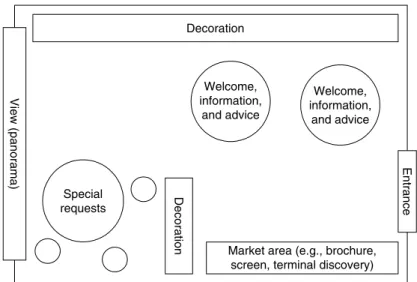
(8) Fragnière, Nanchen, and Sitten: Ethnomethodology and Theatre-Based Reenactment in Service Design Experiments. 96. Service Science 4(2), pp. 89–100, © 2012 INFORMS. • The advisory area allows a personalized meeting (interpersonal service). The client and advisor are seated in a quiet, separate area, and they can take all the time they need to deal with the client’s requests. The advisory area is shown in Figure 4. • In terms of the advisor looking after the client during his or her service experience (route), the proposed design offers a real improvement. To carry out such a service experience in real surroundings, a few adjustments were recommended: • Physical separation of the welcome post and the advisory area causes unnecessary movement; both services must be provided in one place. • Provision of welcome, information, and advice tables with all the equipment (e.g., computer, printer, till, credit card terminal, telephone) is necessary for the employees to perform their work. • Creation of a separate area designated for special requests (e.g., complaints, trying on clothing items, booking accommodation) must be made. This must also be fully equipped. • Provision of both individual terminals for information searches and large-format screens that display a feed of continuous information and views of the resort is needed. • Creation of a relaxation area (space permitting) where the client can look at brochures, wait a few minutes, or use free Wifi is necessary. • A discovery area displaying a particular product from the tourist office (hiking map) and other items on sale (clothing) should be created. • To keep children busy while their parents are making enquiries, a special area can be planned, depending on the available space. • During busy periods, it will be necessary to manage queues by giving clients numbers. In fact, the proposed design no longer allows a queue to form. On the contrary, clients must be able to find information in the market area before speaking to an advisor. In view of the previous remarks, a new design was devised (see Figure 5). This presents a few important points that must be respected if it is to be used in service. Figure 5. New Design Decoration. Welcome, information, and advice. Decoration. Special requests. Welcome, information, and advice. Entrance. View (panorama). INFORMS holds copyright to this article and distributed this copy as a courtesy to the author(s). Additional information, including rights and permission policies, is available at http://journals.informs.org/.. Figure 4. Zoom on the Advisory Area. Market area (e.g., brochure, screen, terminal discovery).
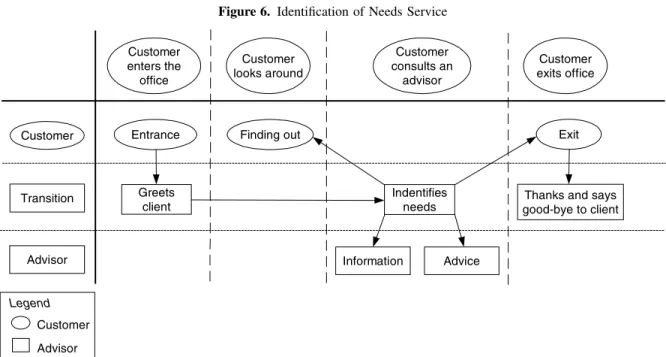
(9) Fragnière, Nanchen, and Sitten: Ethnomethodology and Theatre-Based Reenactment in Service Design Experiments. 97. Service Science 4(2), pp. 89–100, © 2012 INFORMS. INFORMS holds copyright to this article and distributed this copy as a courtesy to the author(s). Additional information, including rights and permission policies, is available at http://journals.informs.org/.. Figure 6. Identification of Needs Service Customer enters the office. Customer looks around. Customer. Entrance. Finding out. Transition. Greets client. Customer consults an advisor. Customer exits office. Exit. Indentifies needs. Advisor. Information. Thanks and says good-bye to client. Advice. Legend Customer Advisor. Step 4: Development of “operating modes” and integration with real production. The new definition of the job considering an employee as an advisor requires new practices. Three operating modes aimed at implementing advisory work were developed: service experience, advice, and complaints. Service Experience The identification of needs is at the core of this operating mode. Thanks to their savoir-faire, advisors will determine whether or not the client needs help and what sort of help that might be. Figure 6 depicts a diagram of this operating mode. Advice The customer comes to the tourist board to obtain general information. The advisor should try to pass the request with suggestions. If the customer is interested, our employee will give advice, delivering added value to the customer. This should lead to client satisfaction, which in turn leads to recurrence. Figure 7 depicts a diagram of this operating mode. Complaints If the advisor realizes that the customer has a complaint, it is necessary to define and resolve the problem. Intervention with the help of benign “tricks” (offering the client a seat or a beverage, for example) may help to defuse potentially contentious situations. The advisor must resolve the problem and bring tangible proof to the Figure 7. Advice Service Advice. Information. Customer. Request. Passes the request. Transition. Advisor. Legend Customer Advisor. Interest. Answer. Suggestion. Profiles the customer. Added value. Advises the customer. Recommendation, reservation, sale, etc.. Satisfaction. Recurrence.
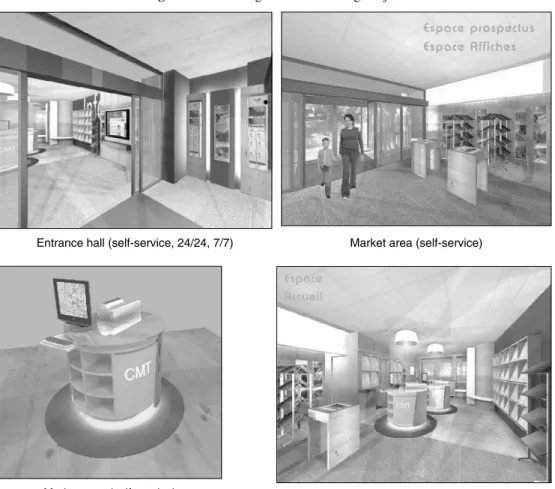
(10) Fragnière, Nanchen, and Sitten: Ethnomethodology and Theatre-Based Reenactment in Service Design Experiments. 98. Service Science 4(2), pp. 89–100, © 2012 INFORMS. Figure 8. Complaints Service. INFORMS holds copyright to this article and distributed this copy as a courtesy to the author(s). Additional information, including rights and permission policies, is available at http://journals.informs.org/.. Information Customer. Request. Transition. Understands the complaint. Advisor. Advice Tangible proof. Suggests to move. Gets the customer comfortable. Explains the process. Confinement. Tricks (e.g., drinks, seat, interlocutor). Resolution (take the complaint, copy, transmission, delay, gift). Satisfaction. Recurrence. Legend Customer Advisor. customer (e.g., transmission, delay, gift). This should lead to client satisfaction, which in turn leads to recurrence. Figure 8 depicts a diagram of this operating mode. Architecture Competition Crans-Montana Tourism decided to renovate its tourist and information offices. An architecture competition was launched in June 2011. A Martigny-based architecture firm won the competition. The inauguration will take place in early July 2012. Figure 9 comprises a few images from the winning project. Figure 9. Four Images of the Winning Project. Entrance hall (self-service, 24/24, 7/7). Market area (self-service). Source. ©Daniel Fournier Interior Concepts. Used with permission.. Market area (self-service). Advice area (interpersonal service).
(11) Fragnière, Nanchen, and Sitten: Ethnomethodology and Theatre-Based Reenactment in Service Design Experiments Service Science 4(2), pp. 89–100, © 2012 INFORMS. 99. INFORMS holds copyright to this article and distributed this copy as a courtesy to the author(s). Additional information, including rights and permission policies, is available at http://journals.informs.org/.. Conclusion The aim of this work is to test the effectiveness of this new application of ethnomethodology in the design of services that meet three qualifying conditions: (1) semidirected service interviews with service providers and service consumers (on both ends of the same coproduction scenario) are conducted, (2) “scripts” based on the results of these interviews are built, and (3) these scripts with the active participation of the sponsor are reproduced and reenacted. By meeting these criteria, we hope to demonstrate the following: —That stronger service development in the public and private sectors can be achieved by reaching a deep understanding of the salient attributes and relevant operating modes achieved through an in-depth ethnomethodological study (as opposed to a pure Tayloresque application of cost and efficiency controls), and —That ethnomethodology in service development informs the service development process in a way that leads to a more satisfying service experience for the consumer and the provider in both private-sector and public-sector contexts. Our work so far has focused on the development of private-sector services such as travel agencies, air travel, and wealth management—industries that have a clear chain of service quality and delivery incentive between the service provider and service consumer. As an illustration, we presented a case study about a Swiss ski resort realized in our HEG Service Lab that strictly applies our methodology and has led to a real change in the way services are produced. We intend to develop this approach to include more social and public services, a realm where we believe there is both a strong demand and clear value proposition. We think that it is also a good way to raise our students’ awareness of important social questions. For instance, we have several ongoing projects related to soupe populaire (or “soup kitchen” in English), and EcoGeste (an environmental stewardship). In the case of the soupe populaire, we are attempting to employ ethnomethodology to study the various cultural settings and operating modes of soup kitchens that might affect service, such as location (is the soup kitchen in a particularly dangerous or remote neighborhood versus a more pleasant setting), serving culture (what is the general mode of delivery? waiting in line, tableside, self-service? who serves the soup, and what is their general attitude and behavior toward the consumers?), and consumer culture (who receives the soup? are there cultural complications or interactions amongst the consumers?). In this case, we are trying to assess a service that is being provided to those who are not directly paying for it, a service that is being paid for by taxpayers, donors, or religious organizations for the indirect benefit of the recipients. In the case of EcoGeste, the challenge is to examine services that, when effectively delivered by the producer (the government or nonprofit organizations), may have delayed benefits (as in the case of decreased electricity bills or product costs) or benefits to the common people (as in the case of recycling and the reduction of toxic pollutant disposal). These services do not necessarily adhere to the same service relationship structures and principles as traditional private-sector services, because they mostly involve instruction, provision of best practices and public information on how to improve one’s environmental stewardship (as in http://www.ecogeste.info), and the “nudging” of behaviors that contribute to a cleaner, more sustainable society. For example, encouraging supermarket consumers to not open the glass refrigerator doors in the frozen food aisle until they have made a decision on which item they want is a form of small behavioral change that could have a greater cumulative impact. The process by which EcoGeste or similar organizations might interact with their stakeholders to learn and employ these behaviors is, in effect, a form of service. This is just one example of the types of scenarios we hope to be able to adapt our method to answer in future study. References Amazon.com (2011) Amazon.com announces fourth quarter sales up 36% to $12.95 billion. Report, Amazon.com Inc., Seattle. http://bit.ly/ exTT1Q. Besley T, Ghatak M (2003) Incentives, choice, and accountability in the provision of public services. Oxford Rev. Econom. Policy 19(2):235–249. Bitner MJ (1992) Servicescapes: The impact of physical surroundings on customers and employees. J. Marketing 56(April):57–71. Catenazzo G, Fragniere E (2012) Small shareholders’ control on listed companies’ administrators during an annual general meeting: An experimental study. Internat. J. Behav. Accounting Finance. Forthcoming. Chase RB (1981) The customer contact approach to services: Theoretical bases and practical extensions. Oper. Res. 29(4):698–706. Chase R, Apte UM (2007) A history of research in service operations: What’s the big idea? J. Oper. Management 25(2):375–386. Chen C-K, Yu C-H, Yang S-J, Chang H-C (2004) A customer-oriented service-enhancement system for the public sector. Managing Service Quality 14(5):414–425. Crabtree A (1998) Ethnography in participatory design. Proc. 1998 Participatory Design Conf. (Computer Professionals for Social Responsibility, Seattle), 93–105. CrunchBase (2011) Amazon. Accessed August 23, 2011, http://bit.ly/eEBhEZ. Debely J, Dubosson M, Fragnière E (2007) The travel agent: Delivering more value by becoming an operational risk manager. Proc. 9th Internat. Res. Seminar Service Management (La Londe les Maures, France), 178–203. Faché W (2000) Methodologies for innovation and improvement of services in tourism. Managing Service Quality 10(6):356–366. Fragnière E (2009) Service innovation: Is it part of the service science discipline? Service Sci. 1(3):i–iii..
(12) Fragnière, Nanchen, and Sitten: Ethnomethodology and Theatre-Based Reenactment in Service Design Experiments. INFORMS holds copyright to this article and distributed this copy as a courtesy to the author(s). Additional information, including rights and permission policies, is available at http://journals.informs.org/.. 100. Service Science 4(2), pp. 89–100, © 2012 INFORMS. Garfinkel H (1996) Ethnomethodology’s program. Soc. Psych. Quart. 59(1):5–21. Grönroos C (1993) From scientific management to service management: A management perspective for the age of service competition. Internat. J. Service Indust. Management 5(1):5–20. Hall T, Edward (1963) A system for the notation of proxemic behavior. Amer. Anthropol. 65(5):1003–1026. Homburg C, Koschate N, Hoyer WD (2005) Do satisfied customers really pay more? A study of the relationship between customer satisfaction and willingness to pay. J. Marketing 69(2):84–96. Levitt T (1976) The industrialization of service. Harvard Bus. Rev. Retrieved January 31, 2011, http://hbr.org/1976/09/the-industrializationof-service/ar/1. Lewis I, Semeijn J, Talalayevsky A (1998) The impact of information technology on travel agents. Transportation J. 37(4):20–25. Lovelock C, Gummesson E (2004) Whither services marketing? In search of a new paradigm and fresh perspectives. J. Service Res. 7(1):20–41. Maglio PP, Spohrer J (2008) Fundamentals of service science. J. Acad. Marketing Sci. 36(1):18–20. Makino Y, Furuta K, Kanno T, Yoshihara S, Mase T (2009) Interactive method for service design using computer simulation. Service Sci. 1(2):121–134. Martin D, Sommerville I (2004) Patterns of cooperative interaction. ACM Trans. Comput.-Human Interaction 11(1):59–89. Morgan G (1986) Images of Organization (Sage, Beverly Hills, CA). Parasuraman A, Zeithaml VA, Berry LL (1985) A conceptual model of service quality and its implications for future research. J. Marketing 49(4):41–50. Spohrer J, Maglio PP, Bailey J, Gruhl D (2007) Steps toward a science of service systems. Computer 40(1):71–77. Stickdorn M, Zehrer A (2009) Service design in tourism: Customer experience driven destination management. Dethinking Service, Rethinking Design: First Nordic Conf. Service Design Service Innovation (Oslo School of Architecture and Design, Oslo, Norway). http://www.aho.no/PageFiles/6819/Stickdorn_Zehrer.pdf. Vargo SL, Lusch RF (2004) Evolving to a new dominant logic for marketing. J. Marketing 68(1):1–17. Vargo SL, Maglio PP, Akaka MA (2008) On value and value co-creation: A service systems and service logic perspective. Eur. Management J. 26(3):145–152. Wild P, Jupp JR, Kerley WP, Eckert CM, Clarkson PJ (2007) Towards a framework for profiling of products and services. Proc. 5th Internat. Conf. Manufacturing Res. (Leicester, UK), 285–290.. Emmanuel Fragnière, CIA (Certified Internal Auditor), is a professor of service management at the Haute École de Gestion de Genève, Switzerland. He is also a lecturer in enterprise risk management at the Management School of the University of Bath. Previously, he was a commodity risk analyst at Cargill (ocean transportation) and a senior internal auditor at Banque Cantonale Vaudoise, the fourth-largest bank in Switzerland. His research is focused on the development of risk management models for decision makers in the service sector. He has published several papers in academic journals such as Annals of Operations Research, Environmental Modelling and Assessment, Interfaces, and Management Science. He is the coauthor (with George Sullivan) of the book Risk Management: Safeguarding Company Assets (Fifty-Minute Crisp Series, November 2006). Benjamin Nanchen has been a scientific collaborator at the Institute of Business Information Systems of the University of Applied Sciences Western Switzerland (HES-SO) since February 2012. He worked for the tourism board of Crans-Montana (Switzerland) for eight years, during which time he occupied various positions in the marketing and communication departments, as well as the position of quality manager. He received his bachelor’s of business administration and master’s in business administration with a major in service management and service engineering from HES-SO. He received the 2011 industry and commerce class of the Society of Arts of Geneva prize for his master’s thesis.. Marshall Sitten has worked as a communications strategy professional since 1998. In 2007, he cofounded Flashing12 Communications, a communications strategy and service design firm where he advises private companies, United Nations agencies, and public-sector organizations on adopting a service-oriented approach to communications and advocacy. He received a B.A. in psychology from the University of Maryland in 1997 and received his MBA in international organizations from the University of Geneva in 2009. In addition to his work with Flashing12, he continues to collaborate with HEG Geneva’s Service Lab on projects and research related to the practice of service design..
(13)
Figure

+2
Documents relatifs
The functional view allows to model the service, its inputs, its outputs and its activity using a mix of IDEF0, IEM [19] languages and integrating UML instantiation notion
At the same time, other concepts need to be explored (around service quality, web services, etc.) and specific issues should be duly addressed (how to select a provider
High degree of service variability can be better supported by static binding (service engi- neering), dedicated instance (service hosting) and tenant level encapsulation
This raises several questions, including how software supporting services differentiate from other kinds of software, how software that better supports service design can
In F M SP , we model the feature Service messaging DP as mandatory be- cause the three modeled communication technologies SOAP , REST and MOM are messaging-based, and the modeled
In this paper we are focusing on high performance computing (HPC) applications for scientific computations where the most common workflow includes repetitive execution of the
Keywords: Cloud Service, FPGA, FPGA as a Service, FaaS Platform, FaaS Tasks, FaaS Deployment, Brute Force Search, NLFSR.. Key Terms: Computation,
Conformance checking aims to find discrepancies between the modeled behavior, i.e., the process model, and the observed behavior, i.e., the event data. As we have access to the
