HD28 .M414
Dewey
WORKING
PAPER
ALFRED
P.SLOAN
SCHOOL
OF
MANAGEMENT
.AGENCY THEORY AND CONTROL STRATEGY: A FIELD STUDY
Morris Mclnnes and Ram T. S. Ramakrishnan
WP 1653-85 April 1985
MASSACHUSETTS
INSTITUTE
OF
TECHNOLOGY
50
MEMORIAL
DRIVE
/agency theory AXD control STRATEGY: A FIELD STUDY
Morris Mclnnes and Ram T. S. Ramakrishnan
lA.i.T. UBRAFfJES
ABSTRACT
"sing an aijency model applied in tho context of lar^je corporate organizations, several liypotheses are derived relating monitoring, evaluation and reward strategies to (l) the level of task uncertainty of responsibility centers, (2) the degree of risk and effort tolerance of managers, and (3) the relative cosL and feasibility of direct monitoring of managerial behavior. The hypotheses are all based on minimizing agency costs. They were tested using data from a sample of 415 managers in 13 major U.S. companies. All were supported by the empirical results, except for the predictions about effort tolerance. As task uncertainty increases there is less reliance on budgets in evaluating and rewarding performance. Moreover, budgets are modified appropriately; as price uncertainty increases there is a shift from monetary to physical units of measurement in the budget, and as task uncertainty more generally increases the budget period lengthens, and the budget becomes more adaptable to reflect unanticipated changes as they occur. Even after adjusting for task uncertainty, greater budget reliance is used for managers with higher risk tolerance, suggesting a tailoring of incentive contracts to this personal trait of managers. Further, managers' risk tolerance is significantly associated with the level of task uncertainty of their responsibility centers, suggesting an effective mechanism for matching persons to organizational roles. Finally, even after adjusting for differences in task uncertainty, significant differences in control strategy are observed across functional groupings. These differences are consistent with greater cost effectiveness of monitoring managerial behavior for research and development and administrative support functions, and conversely with greater cost effectiveness of monitoring outputs for internal operations, purchasing and sales functions.
AGrNTY THEORY AXD CONTROL STaATEHY: A FIELD STUDY
Since the seminal papers by Ross (19731 r.nd Jensen and Meckliiig
(197G), agency theory has advanced rapidly to the point where it offers
the possibility of providing a theoretical foundation for studying management accounting and control systems In organizations (see, for example, Demski and Feltham, 1978; Holmstrom, 1979; Baiman, 1982). The
traditional approach to understanding management control systems has been
guided largely by experiential wisdom, incorporating various theoretical
perspectives in a rather fragmentary manner (see, for example, Anthony,
1965; Vancil, 1973; Lorange and Scott Morton. 1974; Anthony, Dearden and
Bedford, 1984). Another approach to examining management accounting
systems as part of organizations' management control systems has been to
link management accounting with organization theory, especially with
contingency theory. However. Otley (1980) reviewed the accounting
research which has proceeded within this theme, and ho concludes there is little theoretical cohesion to the work. simply some commonality in
perspective and research method.
In this paper an agency framework is used to predict relationships between control strategies and the degree of uncertainty encountered in the managerial task. The predictions are tested, and largely found to be
supported, in a field study involving 415 managers in 13 major U.S. corporations. In the next section the hypotheses tested in the field study are derived. It is demonstrated that these are broadly consistent with the normative assertions proposed by the traditional approach to management control system design, with behavioral theory, and with
findings from studies conducted in a contingency framework. The field research and measurement of the variables used in the study are then
described, and this is followed by a presentation of the results. A final section summarizes the findings, and discusses avenues for further
research suggested by the study.
THEORY .AMD IIYFOTHE.SES
This section begins with a summary of the main features of agency theory. These are then applied to derive the hypotheses which were tested
in the field study. Finally, the hypotheses are reconciled with other literature pertinent to management control system design.
Agency Theory: The economic theory of agency models two persons, a
principal, the residual owner of the firm, and an agent, the supplier of
effort to the firm's production process. Both are assumed to seek to maximize the personal utility they derive from their relationship with the
firm. Four conditions are necessary to make the model interesting: (1) the principal cannot observe with certainty the agent's effort; (2) effort converts into output in a stochastic manner; (3) the agent is effort averse or, stated differently, incurs negative utility by expending
effort. and (4) the agent is risk averse or, again stated differently, incurs negative utility by bearing risk. If any of these conditions is not present, the principal need only compensate the agent exactly for the
effort supplied. This situation is termed the "first-best solution." It obviously pertains if effort can be perfectly observed; similarly, if the production process is perfectly determinable, then effort can be deduced from output and compensated exactly. If agents were not effort averse, effort would be willingly and coatlessly provided to the production process, and no agency problem would exist. Finally, if agents were not risk averse they would be willing to own on their own account the production process, again eliminating the agency problem.
In conditions of uncertainty the agent must inevitably bear some risk.
This is so bec.iuse partial signals of effort may be user] to rleduce and compensate the effort supplied: alternatively, output, which is determined by
factors other than simply the agent's level of effort, may be measured and
used as the basis of an incentive contract. Since the agent is risk averse, the expected mean level of compensation must exceed the pure market rate for
effort by a risk premium. At equilibrium the premium will exactly equal the agent's disutility for the riskiness of the situation. This equilibrium is called the "second-best solution;" that is to say. the solution which efficiently compensates the agent for both effort and risk. In this
circumstance, the residual accruing to the principal comprises the output of
the firm, less the effort and risk compensation to the agent and monitoring
costs
.
The difference between the first-best and second-best solutions is called the agency cost. Intuitively, it can be appreciated that the agency cost will increase as the uncertainty of the effort-output relationship
increases, and as the effort and risk aversion of the agent increase. This
is formally demonstrated by means of a simple agency model in .Appendix 1.
Hypotheses : The agency model outlined in the previous section is applied
here in the context of managers delegated responsibility for the work of defined portions of the overall firm. The manager, then, is the agent, and the organization is the principal. It is proposed that an organization's management control system will be designed in such a way as to minimize agency costs. In point of fact, the study does not examine the whole of the
control system, only that portion which is concerned with evaluating and rewarding managerial performance. Nevertheless, this is an important part of
a control system; indeed. some authors have maintained it is its most important feature (e.g. Drucker. 1964).
The focus (if the research Is on individual manajjers and their responsibility centers: tlie context is large U.S. profit-directed corporate or;ranizations. It is assumed that all of these organizations will have in
place an accounting system to satisfy fiduciary responsibilities by
accumulating an on-going financial record of the organization's cost levels, revenues, profits, assets and equities. The study is concerned with the way the accounting system is modified and used for purposes of managerial control; it interprets this through the managers' perceptions about the way in which their performance is budgeted, monitored, evaluated and rewarded.
The study compares the use of output budget-based incentive contracts
with direct monitoring of managerial behavior as alternative control
strategies. With regard to the use of budgets, several aspects are
considered as follows: the intensity of measurement and the units of
measurement incorporated in budgets. the time period covered by the budget and the extent to which alterations can be made to the bud'^^et during the
operating period to which it refers. the degree to which meeting budget matters in ex-post performance evaluation, the degree to which having produced the best results possible in the circumstances which prevailed during the operating period is disregarded in ex-post performance evaluation, and the extent to which formal rewards - pay increases, bonuses and prospects for promotion - are contingent on meeting budget.
In an overall sense then, a principal feature of the control system which is examined is the degree to which budgets represent inflexible and binding contracts in evaluating and rewarding performance. For convenience, in the remainder of the paper we simply use the term "budget reliance" as a
shorthand to convoy the icln.'i, except when it is important to distinguish specific features within the general concept.
Central to iiiosi. models of ;iiana^erial control are (1) th(? ability to discriminate between good and bad performance. (2) the ability to predict the effects of managerial actions in order to select those actions which will steer the responsibility center away from poor and toward good performance,
and (3) the discretion to choose and implement the managerial actions considered appropriate as circumstances change (Otley and Berry. 1980).
Reduction in any of these - measurability of performance, predictability of
outcomes from actions, or managerial discretion - is likely to increase a manager's sense of uncertainty, and to reduce his or her perception of
having control over the performance of the responsibility center. This in
turn may be interpreted by a manager as being more risky since, lacking any compensating modification to the control system, it will render the effort-reward relationship less specifiable and predictable.
A number of features of the task environment of the responsibility center
are incorporated in the study, as follows; the frequency and predictability of interruptions to the responsibility center's work flow, the degree to
which its work can be standardized, the degree of operating interdependence
of the unit's work with other responsibility centers in the organization, and the frequency and predictability of changes in its operating environment.
Higher task uncertainty is interpreted as being associated with less routinized and standardized work, higher operating interdependence, and more
rapid and less predictable change in the operating environment.
Finally, two attributes of the mangers are considered as follows: risk
The centr.jl question addressed is how the conti'o] system can be designed to redui r .i:.^oncy cost. Clearly, altering the degree of budget reliance could be means of doing this. A budget represents a pre-set performance goal. As uncertainty increases, the likelihood of a pre-set goal continuing to be an
appropriate standard in the light of actual circumstances must surely diminish. Hence, we should expect less budget reliance in the case of responsibility centers which face greater task uncertainty. In a similar
vein, we should expect less budget reliance in the case of managers who have
relatively low risk and effort tolerances. These propositions form the first
hypothesis of the study:
K ; Lower budget reliance is expected to be associated with:
(a) responsibility centers with greater task uncertainty; (b) managers with lower risk and effort tolerances.
An aspect of the control system nested within this hypothesis concerns
the form of measurement incorporated in the budget, in particular distinguishing between physical and financial measures. Additional information should only be used when this clarifies the manager's level of
effort. Since we assume the accounting system usually reports performance
in financial terms, obtaining and reporting physical measures of performance will require additional design effort and cost; this is more likely to be worthwhile in circumstances where a responsibility center's input and output prices are changing relatively rapidly and
unpredictably. This was adopted as the second hypothesis:
H^ : Greater frequency and lower predictability of change in
input and output prices are expected to be associated with a greater propensity to use physical, instead of financial, measurements in the budget.
Consider now the issue of assigning managers to roles, where the roles are characterized by different levels of task uncertainty. It would be i.iesirable, from an agency perspective, for managers with relatively hiyh
toh^ranct-; for risk and orrurt to be assignod to rolt.-a with rolat.ivi.'ly high
task uncertainty, and vici' versa. Clearly, managers are not in practice perft!ctly subst itu tab!e across roles; nor are they necessarily totally
obedient to the organization's dictates in these matters. .Vevertheless
,
it is reasonable to assume that some degree of matching will occur, partly through the organization's assignment mechanisms and partly through
self-selection of roles by managers. This prediction is the basis of the third hypothesis:
11^: Managers with greater risk and effort tolerances are
^ expected
to be associated with responsibility centers with greater task uncertainty.
The first and second hypotheses suggest a tailoring of the control system to the nature of a responsibility center and its manager, whereas the third hypothesis proposes matching managers to the task uncertainty of
responsibility centers. These strategies are not of course mutually
exclusive. Thus, an issue arises concerning the causality in H Suppose h\ holds, so that risk and effort tolerances are positively
associated with task uncertainty. Then, in analyzing H even if budget reliance and task uncertainty are negatively associated, an observed
positive relationship between managers' risk and effort tolerances on the
one hand, and budget reliance on the other may be spuriously low because
of H^'s effect. One way of controlling for this is to test the relationship between the risk and effort tolerances of the managers and a
measure of budget reliance after adjusting for task uncertainty. This
leads to an addendum to H, as follows:
H, ' Even after controlling for differences in the task
uncertainty of responsibility centers, less budget reliance is expected to be associated with managers with lower risk and effort tolerances.
A third feasible strategy for reducing agency costs is simply to monitor effort. instead of. or perhaps in addition to, output. Direct monitoring of effort will be attractive when its cost is less than the risk premium costs of output-based contracts. It is difficult in practice to measure either of these costs directly. Thus, to explore this theme we
resorted to an indirect test using a functional classification of responsibility centers as a proxy for likely variations in the relative feasibility and cost-effectiveness of direct monitoring of effort as
compared with output-based contracts. The responsibility centers were
grouped into four functional groupings as follows: research and
development (R&D): administrative support (AS) including such activities
as finance, personnel and the provision of information; and two current
operating functions, internal operations, including manufacturing and
distribution, and boundary spanning, including purchasing and selling.
Two conditions affecting the most efficient means of control are
likely to vary systematically across these functions, namely geographic
dispersion of activities and the specificity of the production function
which translates effort into outputs. Boundary spanning activities are
likely to be conducted in a much more geographically dispersed mode than
the activities of the other functions: hence, monitoring of effort is not likely to be feasible, resulting 'in greater reliance on monitoring of
outputs. The production functions for internal operations are likely to be sufficiently specific to allow effort to be deduced from output, especially when output is measured in physical units. Hence, for internal operations, monitoring output is more likely than monitoring effort, and physical rather than financial measures of output are also more likely.
or perhaps a few, geographic locations; moreover, in neither case is the production function which translates effort into effertive output very
specific. Thus, direct monitoring of effort is likely to be more feasible and cost effective in these two functions. These predictions were the subject of the fourth hypothesis:
H • Greater budget reliance is expected to be associated with
internal operations, purchasing and sales functions than with research and development and administrative support
functions
.
The preceding hypothesis is based on the argument of the feasibility and relative cost of output-based incentive contracts versus direct
inonitoring of effort. However, if H., holds the hypothesized
relationship could result if there happened to be systematic differences in task uncertainty across functions. There is intuitive reason to believe this could be the case. Therefore, task uncertainty should be
controlled for in testing the reason for H A supplementary hypothesis
4
to K was therefore adopted, as follows:
H ': Even after controlling for differences in task uncertainty, greater budget reliance is expected to be associated with internal operations. purchasing and sales functions than with research and development and administrative support functions
.
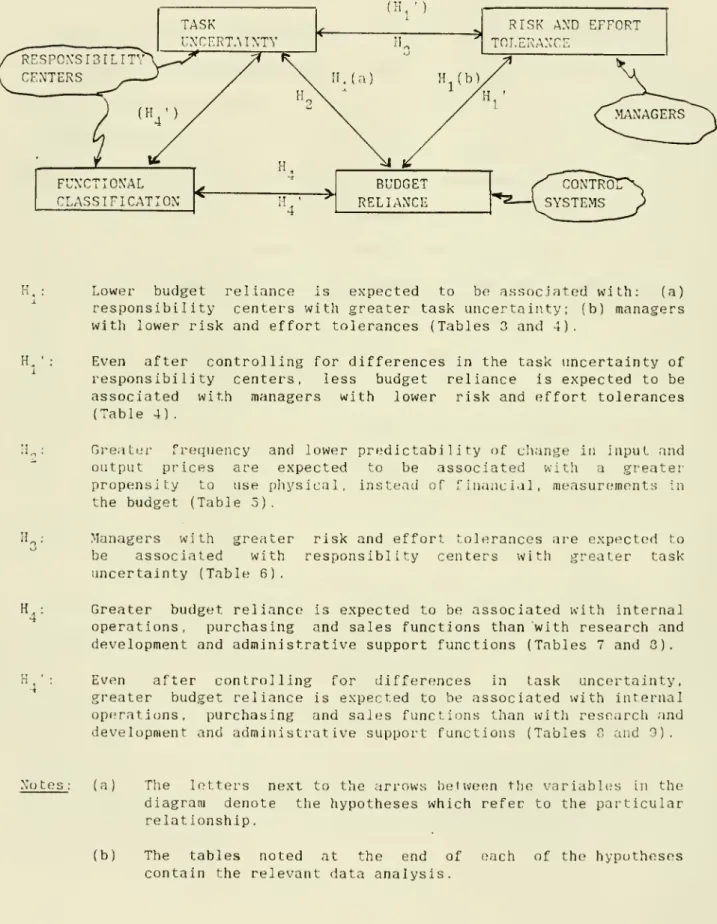
The research framework and the hypotheses of the study are summarized
in Figure 1.
INSERT FIGURE 1 ABOUT HERE
Reconciliation with Other Literature: The hypotheses are not inconsistent
with various other themes in the literature, for instance the normative approach to management control, organizational psychology, and contingency theory applied to management accounting.
Vnncil (1373) identifies t"wo mnin criteria to guiiie the design of performance measui-es to apply to an organization's responsibility centers,
goal congruence and fHirness. Goa] congruence means that if managers act in such a way as to maximize their center's performance as reflected by
the control system's measures, they will simultaneously be maximizing
individual and collective progress toward the organization's goals.
Regarding fairness, Vancil says, "...[a manager] must believe that the
measurement encompasses all the factors he can control and excludes those
over which he has no control" (page 77). This stress on fairness seems to
be justified in terms of sustaining the directive power of the measures, and avoiding negative emotions toward the organization. A similar theme
is found in organizational psychology, based on the evidence that holding people accountable for things over which they perceive themselves to have
no influence raises stress, with dysfunctional consequences for
performance and personal wellbeing. Weick (1983) concludes a review of the literature on stress and stressors with the advice. ".4s much as
possible, people should be given controllable features of a situation."
(page 365). Agency theory, of course, does not contradict these points.
However, fairness is not achieved solely by filtering out of performance measures the effects of stochastic disturbances arising in the operatin.g environment. For one thing, this could cause inattentiveness to the
environment, which is hardly likely to be conducive to goal congruence. And secondly, stress, to a point, may be constructive (Libby, 1983); managers may be different from other people precisely because they are
relatively tolerant of the stressful circumstances frequently encountered in managerial work. .Agency theory's reconciliation with the norm of fairness is in the notion of efficient compensation. In an efficient
equilibrium a manager will be compensated not only for effort, hut also
for the disutility, including: stress. incurred from coping with
uncertainty
.
Otley (:9.j0) provides an excellent review and synthesis of the contingency approach to management accounting. He defines this to be based on "...the premise that there is no universally appropriate accounting system which applies et^ually to all organizations in all circumstances...particular features of an appropriate accounting system
will depend upon the specific circumstances in which the organization finds itself" (page 413). One problem, of course, is deciding what are the pertinent contingencies. Empirical studies have identified
relationships between control system features and the nature of
product-market competition (Khandwalla, 1972, 1973), leadership style
(Hopwood, 1974; Otley, 1978), organization size and structure (Bruns and
Waterhouse, 1975; Merchant, 1981, 1984), and task complexity and
technology (Daft and Macintosh. 1973; Mercliant. 1984). The present study
either incorporates, or controls for, all these variables. The nature
and degree of competition will be reflected in the measures of task uncertainty. In a condition approximating perfect competition, for example, there is very little uncertainty, whereas in an entrepreneurial situation uncertainty is high since there is little relevant experience to inform managerial judgment. The managerial tasks in most large companies are in some intermediate position between these extremes. But in any event, the competitive situation sliould be reflected in the perceived environmental uncertainty expressed by the managers and measured
by the research instruments. Hopwood 's leadership style is included as
part of the concept of budget reliance, and the nature of the task and the
work technology are included in the measures of task uncertainty. Finally, organization size is controlled for by having in the sample only managers from very large companies.
Several studies have. like the present study, dealt with uncertainty
as the contingent variable. Hirst (1983) found higher reliance on
ijuanti tative performance measures (c.f. budget reliance in this study) to be functional in cases of low, and dysfunctional in cases of high, uncertainty. Gordon and Narayanan (1984) found that the type of
information considered most valuable by managers varies with differences
in perceived environmental uncertainty. Finally, Govindarajan (1984) found that greater use of subjective rather than formula-based methods for
awarding managerial bonuses led to higher levels of self -rated performance
in conditions of high uncertainty, and vice versa.
Hayes (1977) tested propositions about differences Ln the sources contributing to managerial effectiveness across functional groupings. Wliile quite different in emphasis from the present study, Hayes' conclusion that monitoring and measurement methods should be tailored to the distinctive characteristics of each function agrees with the spirit of
our last two hypotheses.
.A recent paper by Eisenhardt (1985) relates organization theory and
agency theory in predicting forms of control as a function of task programmability, outcome uncertainty and cost of measuring outcomes; she
presents e.iipirical evidence consistent with her predictions. In contrast to the present study, however, Eisenhardt did not consider in her framework the personal traits of managers. One previous study, by Chow
(1983), did examine, under experimental conditions, skill level and risk
performance-based and fixed compensation schemes. Subjects believing
themselves to possess higher levels uf skill were found, as expei.-ted, to prefer a performance-based reward scheme; but the predicted moderating effect from risk aversion was not found. It is conceivable that the
latter result could be explained by a lack of a sense of risk on the part
of subjects. since the contingent payments in Chow's experiment were both small and notional regardless of whether the task goal was met.
THE RESEARCH
In this section the main features of the field study are presented. The discussion first describes how the data were collected, and then how
each of the variables included in the analysis was measured.
Field Study: .A questionnaire was sent to 605 managers in thirteen major
U.S. companies. Initial contact with companies was made by a letter to
the chief executive, and administration of the research was subsequently
coordinated through a senior member of corporate management. Sample
selection was done by each company's management. Companies were asked to
select a representative sample of their middle-level operating managers. These managers were to be carrying significant functional responsibility, covering only domestic operations, at a level just below general
management. Functional variety in the sample, representative of the
functional mix in the company, was part of the sample design.
The questionnaire was sent to each manager accompanied by a cover letter signed by one of the company's corporate executives. The letter
introduced the study and encouraged participation. A pre-addressed
envelope was included for completed questionnaires to be returned directly
to the research team. Responses could be identified by company, but not
by respondent. This was considered advisable to minimize bias which might
arise if the managers were to believe their responses could be inspected by ttieir corporate mnnagiTnents
.
Completed questionnaires wore received from 415 managers (a response rate of 69%). The respondents averaged 16 years of experience with their companies, and ten years in their present jobs and jobs similar in responsibility and content to their present jobs.
More data were collected by the questionnaire than were used solely
for the study reported in this paper. The questionnaire was pre-tested for clarity of expression and for the time required for its completion
using a sample of 20 managers similar in background, experience and level
of responsibility to those intended as the subjects of the study. The
average time taken in pre-testing to complete the questionnaire was just under 30 minutes.
Most of the questions asked for a response on a seven-point scale, with both ends of the scale being anchored by descriptive captions. In some cases respondents were asked to answer by entering a number ir. a box,
selecting from a numerical scale which was descriptively anchored at the
end points and at salient intervening points. Finally, a few questions required a "yes-no" or a brief verbal type of response.
Managers: Research in the area of decision making under conditions of
risk is well established; Schoemaker (1980) provides an excellent review
of this work and its methodology. Risk preference in this research is usually assessed by means of a series of carefully described lotteries for which subjects are asked to express the certainty equivalents which would
render them indifferent to the respective lotteries. However, this methodology is laborious, and runs a risk of lacking contextual validity. Libby and Fishburn (1977) note that measures of risk preference tend to be
seasitive to both situation and task. For this reason, it was decided in the present study simiJly to ask the subjects to provide a self-rating of two of their personal qualities as managers, their decision-making style
and their risk-reward tendency when making management decisions. The
terminology of Mintzberg's (1973) work on decision-making style was
borrowed for the first question. One end of the scale was anchored by the
term "entrepreneurial," described as having a preference for bold,
dramatic actions and a relative disregard for risk, while the other end was anchored by the term "adaptive," described as preferring a cautious,
one step at a time approach to problem solving, accompanied by a high degree of discussion and consultation with others. The second question
was anchored at one end as having a preference for "low risk, and a moderate pay-off with high certainty," and at the other end by, "high
risk, and a high pay-off but with an appreciable chance of loss." The responses to these questions were significantly correlated with one
another (r = 0.r.02: p < 0.01) in the expected direction. Both were used, with their scales reversed, as proxies for the managers' tolerance for
risk.
Two sets of questions were used to assess effort tolerance, one set
referring to hours spent at work, and the other to the intensity of effort during work hours. Reference was made to the notion of a minimum level of effort acceptable in the organization. Respondents were asked first how much effort, hours and intensity, above this minimum level they usually
expended, and then the level of personal cost, or disutility, they
attributed to this incremental effort. The first response measured their
incremental effort level (say a), and the second measured its marginal
disutility (say b). .411 else equal, the marginal disutility of effort
will liicrcaso with an individual's effort aversion parameter: i.e. b = tV'{a) where V'(a) is increasing with a, and t is the individual's effort aversion. Hence, t increases with (b-a), both of which were measured.
The two estimates of t. one based on hours and the other on intensity of
effort, were correlated with one another (r = 0.626; p < 0.01) in the expected direction. Both were used, with their scales reversed, as
measures of the managers' effort tolerance.
Task Environment: Three sources of task uncertainty were considered in
the study, namely the work flow of the responsibility center, the
interdependence of the responsibility center's work with the work of other organizational units, and the responsibility center's operating
environment. These three sources are roughly consistent with the
framework used by Hayes (1977) in his study, except that he considered the operating environment to include only the environment external to the
firm, whereas we consider the operating environment to include the
corporate as well as the external environment.
The questions about work were based on Perrow's (1967) concept of
production technology. Three questions were used. The first two dealt
with the frequency and predictability of interruptions to the normal work
flow, and the third with the degree to which the basic work was well
understood and could be reduced to a standard routine. Measurement of work interdependence followed Thompson's (1967) notion of reciprocal
interdependence, and included two questions, the first dealing with the
unit's degree of dependence on other units of the organization, and the
second with the degree of dependence of otiier units on the unit in question
.
Aspects of the operating environment measured by the questionnaire
included the volatility and predictability of both inpul and output prices
to the responsibility center, and the dynamism and predictability of change in relevant items other than prices, such as "...technical and legislative factors. policy changes emanating from elsewhere in the organization, and competitor actions." The intent and wording of these
six questions were selected and modified from questions used originally by
Khandwalla (197.T, 1972) in his study.
All eleven of the measured variables are believed to have the
potential to contribute to task uncertainty, placing demands on the
manager of the responsibility center and increasing the sense of risk in terms of diminishing the clarity of the effort-outcome-reward
relationship. The intercorrelations between the eleven variables are
shown in Table 1. Some of these are very significant. However, to avoid the interpretation problems which accompany the reduction of variables by
factor analysis, and since there are in any case only eleven variables, it was decided to use all of them in the data analysis.
INSERT TABLE 1 ABOUT HERE
Respondents were also asked to provide a classification of the work of
their responsibility centers by function. A number of choices were
provided, as follows: exploration, research and development, production,
manufacturing, distribution, purchasing, marketing, and administrative
support; a ninth choice, "other," was also provided, with a request for a
description of the work. The responsibility centers were assigned to four functional classifications. as follows: R&D, including exploration and
research and development: AS, including only administrative support;
interna] operations, including production, manufacturing and distribution;
and boundary spanning operations, including purchasing and marketing. The responses in "other" were assigned to these four categories basfnl on the descriptions given by the respondents.
Budget Reliance: A number of aspects of the budget and its use in the performance evaluation and reward process were measured by the
questionnaire.
One question asked respondents to indicate which of the following
measures are featured in their budgets and performance evaluation; (a) in physical units - inputs, outputs, outputs in relation to inputs, and (b) in monetary units - costs, revenues, profits, return on capital. They were asked to tick as many categories as were appropriate. The number of
ticks was used as an indicator of measurement intensity, and the relative
frequency among measures was used in the analysis of the relative reliance on physical as opposed to financial measures.
Two aspects of the budget were measured: the time period covered by
the budget, and whether any alterations to the budget could be made during the progress of the operating period covered by the budget. Longer budget
periods and greater adaptivity of the budget to reflect unanticipated
conditions were considered possible responses to higher task uncertainty. Two direct questions were used to assess the dominance of the budget
in performance evaluation. These were based on Kopwood's (1973) notions
of budget constrained and profit conscious evaluative styles. The first
asked for an assessment of the importance in performance evaluation of having met budget , and the second asked for an assessment of the
importance of having produced the best results possible in the
circumst.mces which, with hindsight, were known to havo prevailed. The
response to the first question, and the reverse of the response -o the second question, were used as indicators of budget dominance in evaluation of pei-formance
.
An indirect method was used to assess the importance of mef?ting budget
in the allocation of formal rewards. The method was suggested by Hirst's (1903) approach. Respondents were asked to provide an assessment of the
likelihood of receiving incremental amounts of rewards - higher pay, greater bonus, and enhanced prospects of promotion - under four
conditions, as follows: (1) having worked hard and imaginatively at their jobs and having met budget; (2) the same as in (1), except that budget was not met; (3) having worked at only the minimum level of effort acceptable to the organization, but having met budget; (4) the same as in (3). except
that the budget was not met. The difference between the second and third
subjective probabilities (having worked at the minimum acceptable level of
effort but having met budget less having worked hard but having failed to
meet budget) was used as a measure of the strength of the budget/reward contingency. It was so highly correlated across the three different reward elements that it was decided simply to use the numerical average of
the three as a single measure.
The intercorrelations between the six aspects of budget reliance are
shown in Table 2. The coefficients are not especially large, and all six were used in testing the hypotheses
INSERT TABLE 2 ABOUT HERE
RESULTS
The correlations between the aspects of budget reliance and of task
uncertainty of the responsibility centers are reported in Table 3. For n^(a) to hold. we would expect to observe only negative correlations in
i.
this table. In fact, all but nine of the 66 coefficients are negative, and none of these nine is significantly different from zero. More than half the negative coefficients are significant (p < 0.10). All ten coefficients pertaining to the strength of the budget/reward contingency, which is perhaps the most direct indication of budget reliance, are significantly (p<0.01) negative. The importance in ex-post performance evaluation of having met budget is the next most significantly correlated aspect of budget reliance with task uncertainty. The aspects of task
uncertainty which show the most significantly negative correlations with
budget reliance are operating dynamism and unpredictability. The
volatility and unpredictability of input and output prices also show significantly negative correlations with budget reliance, but not as
strongly as in the case of operating dynamism and unpredictability. The
reason for this, as we shall see in a moment, is that in conditions of
high price volatility and unpredictability there is a tendency to use physical rather than financial measurements in the budget, filtering out
the effects of price changes.
INSERT TABLE 3 ABOUT HERE
The linadjusted coi-relaLious between the aspects of budget reliance and
of managers' risk and effort tolerance are shown in panel A of Table 1.
H (b) is strongly supported in the case of risk tolerance; but not in the case of effort tolerance. For risk tolerance eleven of tlie twelve
coefficients are positive, and most are highly significant.
INSERT TABLE 4 ABOUT HERE
In summary then, H is convincingly supported by the empirical evidence, with the exception that the predicted effects between effort
tolerance and budget reliance are not found.
We shall return to H ' in a moment. Proceeding first to examine
H^, the evidence pertaining to it is presented in Table 5. This shows
the t-statistics for comparisons of the mean values of the frequencies of
use of physical and financial measures between the portions of the sample
which have relatively high and low volatility and unpredictability of
input and output prices respectively. The results Indicate that physical
measures are more likely to be used in budgets than financial measures under conditions of higher volatility and unpredictability of input and
output prices. The result is especially strong in the case of output prices, and weaker in the case of input prices, or costs; overall,
however, the evidence supports accepting H^
.
INSERT TABLE 5 ABOUT HERE
Table 6 shows the correlation coefficients between aspects of task
iiiicerta iaty and risk and effort tolt-j'ance. "or H^ to be supported, these coefficlen:.s should all he ijositive. The evidence is supportive in the; case of risk tolerance but jiot ir. tiie cast? of (;ffort tolerance. In the case of risk tolerance 15 of the 20 coefficients are in the expected direction; 12 of these 15 are significant (p < 0.10), whereas only one of the coefficients with the unexpected sign is significant (p < 0.10). Overall llien, the evidence supports accepting H^ in the case of risk
o
tolerance, but not in the case of effort tolerance.
INSERT TABLE 6 ABOUT HERE
Returning now to H, ' , the last result suggests some degree of
matching of managers to tiie task uncertainty of roles on the basis of risk tolerance. Hence, the unadjusted correlation coefficients between aspects of budget reliance and managers' risk tolerance, as reported in panel \ of Table 4, understate the direct relationship. This is so because risk tolerance and task uncertainty are positively correlated, while
uncertainty and budget reliance are negatively correlated. To see the
direct impact of risk tolerance on budget reliance, both have to be adj'usted for the effects on them of task uncertainty. The residuals of
these two variables, obtained from two multiple regressions using in each case uncertainty as the explanatory variable, were correlated, and the
results are shown in panel B of Table 4. This supports H ' for risk
than the unadjusted coefficients; moreover, they are all in the expected direction and almost all are significant, (p •: 0.10).
In view of the lack of any systematic relationship Ijetween budget reliance and effort tolei-ance, established in testing H (h). it was not considered worthwhile to test H ' in the case of effort tolerance.
Taking up H as a first step in the analysis Table 7 presents the relative frequency of use of types of budget measure across the four
functional groupings. A contingency analysis was undertaken. The
"expected" frequency of use of each measure was computed as if this were equal for all groupings. The actual frequency was then compared with the
"expected" using a chi-squared test of significance. The reported comparison of the frequency of use of measures in one functional group is
therefore relative to the frequency of use in the other three functional groups.
INSERT TABLE 7 ABOUT HERE
The internal operations functions, as was conjectured earlier in the discussion, are much more likely than the other three functional groupings
to be measured in physical units. R&D is relatively frequently measured on the basis of physical output. The boundary spanning functions are significantly more frequently measured in terms of revenues and profit. and the R&D function is significantly less frequently measured in financial terms.
Tn panel A of Table 8 t-statistics for comparisons of the mean values aro reported for Mach of '.he functional groupings for each aspect of
budget reliance. Each grouping is compared in turn with the sum of the other three. K&D sliows significantly lower budget reliance in all six aspects; AS also shows lower budget reliance, albeit with somewhat weaker
significance than in the case of R&D. Conversely, internal operations show higher budget reliance, as do the boundary spanning functions, even
though with somewhat weaker significance. These results support accepting
"4-Table 9 shows t-statistics for comparisons of task uncertainty across the functions. It can be seen that R&D faces much greater task uncertainty than any of the other functions. This is followed in descending order of task uncertainty by the boundary spanning functions,
internal operations, and finally by AS which seems to be faced by a relatively certain task environment.
INSERT TABLES 8 AND 9 ABOUT HERE
From the results supporting H , we know that lower budget reliance
is associated with higher task uncertainty. The question therefore arises whether the differences in budget reliance observed across the functional groupings are caused simply by differences in task uncertainty. To test
this, the budget reliance measures were regressed on uncertainty, and the
standardized residuals were used as adjusted measures of budget reliance.
The t-statistics comparing the mean values of the adjusted budget reliance
measures across the groupings are reported in panel B of Table 8. It can
be seen that even after adjusting for task uncertainty there remain
sii'nifleant (iifferences across the functional gi'oupinys in the iJegree of
budget reliance. There is significantly less budget reliance in the case
of 'R&D and considerably more in the case of internal operations. The
other two groups are not so clearly differentiated. However, the
differences in the strength of the budget/reward contingency across the
groups is quite dramatic, and is considerably altered by the adjustment for task uncertainty. In summary, H ' is supported by the empirical
4
evidence
.
DISCUSSION
Considering the difficulty of making reliable empirical measurements
of the kinds of phenomena studied in this research, we consider that the evidence presented provides remarkably strong support of the overall
proposition that organizations design their control systems in such a way
as to reduce agency costs. A number of means of doing this were hypothesized, and the evidence was consistent with all of tht^m being used
in practice. First, as task uncertainty increases, budgets become more adaptable, and less reliance is placed on them in evaluating and rewarding performance. Secondly, the degree of budget reliance is modified in relation to managers' risk tolerance. Thirdly, job matching results in managers with higher risk tolerance finding their ways into those
managerial roles which are characterized by higher levels of task
uncertainty. Finally, higher reliance on direct monitoring of effort, and
correspondingly less reliance on budget-based incentive contracts, is observed in those circumstances in which direct monitoring is likely to be feasible and cost effective, namely high geographical concentration of
activities and low specificity of the production function which translates
effort into effective output.
The only variable for which the evidence did not strongly support the hypothesi;:ed relationships was effort tolerance. or conversely effort
aversion. This suggests that we may have poor measures of effort
aversion, or that effort aversion does not play a sij^nificant role at the
management level being studied. All the managers in the sample are pursuing successful careers with major U.S. corporations. It might be reasonable to suppose that such persons are unlikely to be especially
effort averse; besides, when the need arises their sense of responsibility
is likely to lead them to supply whatever effort is necessary to get a job done. In the case of risk tolerance, it is probably acceptable for a manager to express a preference for caution, or risk aversion, in approaching decisions, and for this to be taken into account in job assignments and in the design of incentive contracts. On the other hand, it is probably less acceptable to express a preference for avoiding work; hence, it is perhaps not surprising that we do not observe effort aversion being allowed for in the design of control strategies and in job assignments
.
The hypotheses of the study were based on agency theory, but it was demonstrated that they are consistent with other theoretical perspectives
on management control system design. One advantage of agency theory is that it provides a directional prediction, following from the assumptions of risk aversion and minimization of agency costs. One disadvantage,
however, is that there is no obvious effectiveness correlate with the minimization of agency cost, such as managerial or organizational
performance: in this sense, agency theory is quite limited. On the other hand, it is not really clear that other theoretical perspectives can provide any better predictions in this regard.
All the usual caveats must be acknowledged in respect to the study's
1 i.nitat ions. There may, for instance. be bias in the data, ai-islng from
the means used to select a sample of mana;jers in each company, and from self selection exercised by managers themselves in choosing whether to respond to the questionnaire; and despite careful pre-testing and the use
of consistency checks across responses, respondents may not have
interpreted questions in precisely the intended manner . Moreover, the
findings may not be generalizable beyond the companies included in the
research. However, since managers from 13 major companies in a wide variety of industries were included in the sample, we feel that the
results have a reasonably strong claim to being representative of large
I.'.S. corporate organizations. However, the findings may not be generalizable to other levels of management. Our judgment on this is that
the findings are likely to apply to lower levels of management; however,
given the need to cope effectively with environmental uncertainty in devising and implementing business strategies, the findings are less
likely to hold at general management levels.
A number of exciting avenues for further research suggest themselves.
For example, the differences observed in control strategies across functions would bear considerably closer examination, with a view to determining the characteristics of control systems most suitable for each
of the functions. Another interesting question, as suggested in the previous paragraph, is whether the reduction of agency costs is observed in the control strategies used at higher levels of management. If it were, an intriguing question would follow, concerning the point at which,
and how, goal congruence is established between managers and the interests of shareholders.
Appendix 1
Let the output of a production pi-ocess be x. Supposi=': X = Q(a) -
7
Where Q(a) is an increasing concave function, a is the effort supplied by the agent, and e is a random variable with normal distribution, zero mean, and variance s .
Suppose the agent is risk averse, with a mean variance utility function for reward r equal to Exp( r)-kVar
( r) . where Exp and Var refer to
the expected value and the variance respectively. The constant k is a risk aversion parameter, specific to the manager, where k >_ . The
principal is assumed to be risk neutral. Suppose further the agent is effort averse, where the disutility of effort a is tV{a). Here t is an effort aversion parameter, specific to the manager, where t >_ . V(a) is
an increasing convex function in a.
Assume that all agents have the same Q and V functions, but differ with regard to risk and effort aversion, i.e. with regard to k and t. Let
us also assume that only linear reward schemes are used. Lot the reward
associated with output x be: r(x) = F + bx
Where F is a fixed wage and b is a bonus rate based on the output x. Suppose the agent chooses effort a. His expected utility will be:
EU = F - bO(a) - kb^s^ - tV(a) (1)
In this case, the optimal effort is given by: bQ' (a) -
tV
(a)Suppose the principal wants the agent to supply a level of effort a. He should set b = tV'(a)/Q'(a). Assuming the agent must get at least zero expected utility, from (1):
F = tV(a) ^ kb^s^ - bQ{a) . .
."
(2)
The principal receives Exp(x-F-bx) . Substituting for F an b. the
principal's benefit from any level of effort is:
G{a) = Q(a) -tV(al - kt-s"[V' (a)/Q' (a)
] {?,)
The last term in equation (3) is termed the agency cost. If t = the agency cost is zero, and the effort will be supplied costlessly. If k or s~ are zero, the agency cost will also be zero and the first-best
solution will be restored. The agency cost will increase as t and k increase, the effort and risk aversion parameters of the agent, and as the
2
variance s increases, the degree of randomness of the production
process. This last term is equated with task uncertainty in this paper.
FIGURE i
: Summary of the Research Framework and Hypotheses
TASK
UXCERT.MXTY
c « 3 *•> •J) w >. C -J 0) c <4-l U o c C 3 3) eo in
—
<0«
— o o o o 39 ift T5< rt eo rr CVJO
— 1o o
o o o
in ffl t- -^ e>j cvjo
-^ o oo
o »3< 00 -' O) <M cj ir: CO -^ CO rt -< c<j -^o
o o o
oo
ift T 0> C- ifi (O ry — 4 flo c^ *^ ^ T CMO "
-^O
oo
oo
oo
Ifl O C~ C- 00 I> — ' ;o CO CO CO <? irtO
O
— 'O
O — ' oo
o oo o o o o
a; c ju—
o -J) «3 —• it-o u s. 7) c>jcoCT«i.omoo UOC-<CC0—'OOCOCOt-OOOO—
'OO
cocooooo
ococooj—
ifsoiftin CM ir;r«o—'Otci.o-'O COCOCMOO — OCM — Oooooooooo
cCiC^ooic-aocvjooit~COCMCM —
OO—
'OO
Table 2
First order correlation coefficients between aspects of budget reliance
Measure- Shor- Lower
ment ter budget
inten- budget adap-sity period tivity
Impor-Table 3
First order correlation coefficients between aspects of budget reliance and task uncertainty
Table 4
First order correlation coefficients between aspects of budget reliance and risk and effort tolerance
Aspects of
risk and effort tolerance Aspects of budget reliance Measure- Shor-ment ter inten- budget sity period
Lower Impor- Disre- Budget budget tance gard reward
adap- of for contin
tivity meeting best gency budget results
A.Risk tolerance
Entrepreneurial style .38i: High risk/return preference .292
.079 .030 312^ 156' 175:
17r
163: 112' .100 .071 1 A.Effort tolerance Hours Intensity .042 .101 014Table 5
Mean differences in price uncertaintyand physical versus monetary budget measurement; T-statistics
Physical Monetary units units Input prices: Volatility 2.20 -1.05 Unpredictability 1.682 -0.62 Output prices: Volatility 3.43^ -1-29^ Unpredictability 2.37 -1.91
1: p <0.10; 2: p <0.05; 3: p <0.01 that the mean for that measure is
significantly different from the mean for the other measures.
Table 6
First order correlation coefficients between aspects of
task uncertainty and risk and effort tolerance
Risk tolerance Effort tolerance
Task uncertainty:
Entrepre-Table 7
Budget measurement and functions
Functions: Internal Sales & Adminis- Research & Total operations purchasing trative
develop-support ment Physical units: Inputs Outputs Outputs/inputs Monetary units: Costs 85 64~ 138 76 364 80.2 69 133.4 78.6 Revenues 19 47'^"^ 54 16 135 37
Table 8
Mean differences in aspects of budget reliance across functions; T-statistics
Table 9
Mean differences in aspects of task uncertainty across functions; T-statistics
Functions: I Internal Sales & Adminis-i operations purchasing trative
Task uncertainty:
support
Research & develop-ment
1. Input price volatility
2. Input price unpredictab. 3. Output price volatility
4. Output price unpredictab.
5. Operating dynamism
6. Operating unpredictability 7. Workflow interruptions
8. Workflow unpredictability 9. Nonstandardization of work 10. Dependence on other units 11. Dependence of other units
-0.38 -1.17 0.20 -0.87, -2.23' -1-17, -o.io' 0.85, -4.08' 0.04 0.86 45^ 15 -0.81 -0.44 61 28 18 -1.59 0.34 -1.11 -0.53 1 1 -2.14 -1.48, -2.16' -2.24' 1.10 1.07 -0.29 -0.06 0.27 -0.13, -2.45' 0.55, 1.80' 2.95i 3.91" 0.29 0.56 1.63 1.00, -0.37, 2.22'
1: p < 0.10; 2: p < 0.05; 3: p < 0.01 that the mean for the function is significantly different relative to the mean for the other functions.
References
Anthony, R. N. (lORo), r^.tuin injj and Control Syst-,om.';: A Franipwork for
Analysis (Division of Research, Harvard Graduate School of Business Administration, 196,").
Anthony, R, N. , Dearden, J. and Bedford. X, (1984), ManaKement Control
Systems ( Irwin. 1984).
Baiman, S. (1982). "Agency Research in Managerial Accounting: A Survey," Journal of Accounting Literature (Spring 1982), pp. 154-213.
Bruns, W. J. and Waterhouse. J. H. (1975), "Budgetary Control and Organizational Structure," Journal of Accounting Research
(Autumn 1973), pp. 177-203.
Chow, C. W. (1933), "The Effects of Job Standard Tightness and
Compensation Scheme on Performance: An Exploration of Linkages," The Accounting Review (October 1983), pp. 667-685.
Daft, R. L. and Macintosh, ". B. (1978), "A New Approach to the Design and Use of Management Information," California Management Review (Fall 1978), pp. 82-92.
Demski, J. S. and Feltham. G. (1978). "Economic Incentives and Budgetary
Control Systems," The Accounting Review (April 1978), pp. 336-359. Drucker, P. F. (1964), "Controls. Control and Management," in Bonini,
C. ?.. Jaedicke. R. K. and Wagner, H. M. (Editors), Management Controls: Xew Directions in Basic Research (McGraw-Hill, 1964), pp. 286-296.
Eisenhardt. K. M. (1985), "Control: Organizational and Economic Approaches," Management Science (February 1935), pp. 134-149.
Gordon, L. A. and Narayanan. V. K. (1984), "Management Accounting Systems, Perceived Environmental Uncertainty and Organization Structure: An Empirical Investigation," Accounting, Organizations and Society
(1, 1984). pp. 33-47.
Govindarajan. V. (1984). "Appropriateness of Accounting Data in
Performance Evaluation: An Empirical Examination of Evironmental Uncertainty as an Intervening Variable," Accounting, Organizations and Society (2, 1934), pp. 125-135.
Hayes. D. (1977). "The Contingency Theory of Management .Accounting," The Accounting Review (January 1977), pp. 22-39.
Hirst, M. K. (1981), "Accounting Information and the Evaluation of Subordinate Performance: A Situational Approach," The Accounting Review (October 1981). pp. 771-784.
(1980), "Reliance on Accounling Performanco Measures, Task Uncertainty, and Dysfunctional Behavior: Some Extensions," Journal of Accounting Research (Autumn 1983), pp. 596-fiO.T.
Holmstrom, B. R. (1979), "Moral Hazard and Observability," The Bell
.Journal of Economics (Spring 1979), pp. 74-91.
Hopwood, A. G. (1974), "Leadership Climate and the Use of Accounting Data in Performance Evaluation," The Accounting Review (July 1974),
pp. 485-495.
Jensen, M. C. and Meckling, W. H. (1976), "Agency Costs and the Theory of the Firm," Journal of Financial Economics (3, 1976), pp. 305-360. Khandwalla, P. X. (1972), "The Effect of Different Types of Competition on
the Use of Management Controls," Journal of Accounting Research (Autumn 1972), pp. 275-285.
(1973), "Effect of Competition on the Structure of Top Management Controls," Academy of Management Journal (.June 1973),
pp. 285-292.
Libby, R. and Fishburn, P. C. (1977), "Behavioral Models of Risk Taking in Business Decisions: A Survey and Evaluation," Journal of Accounting Research (.Autumn 1977), pp. 272-292.
(1983), "Comments on Weick," The Accounting Review (April 1983),
pp. 370-374.
Lorange, P. and Scott Morton, M. S. (1974), "A Framework for Management Control Systems," Sloan Management Review (Fall 1974), pp. 41-50. Merchant, K. A. (1981), "The Design of Corporate Budgeting Systems:
Influences on Managerial Behavior and Performance," The Accounting Review (October 1981), pp. 813-829.
(1984), "Influences on Departmental Budgeting: An Empirical Examination of a Contingency Model," .Accounting,
Organizations and Society (3/4, 1984), pp. 291-307.
Mintzberg, H. (1973), "Strategy-Making in Three Modes," California Management Review (Winter 1983), pp. 44-53.
Otley, D. T. (1978), "Budget Use and Managerial Performance," Journal of Accounting Research (Spring 1973), pp. 122-149.
(1030), "The Contingency Theory of Management Accounting: .Achievement and Prognosis," Accounting, Organizations and Society
(4, 1980), pp. 413-428.
and Berry, A. J. (1980), "Control, Organization and Accounting," Accounting,Organizations and Society (2, 1980), pp. 231-244.
PeMTOw, C. (19G7), "A Framework for the Comparative Analysis of
Organi/:ations,
" American Soniolo^^ical Review (April 1067),
pp. 194-208.
Ross. S. A. (1973), "The Economic Tl^.eory of Agency: The Principal's Problem." American Economic Review (May 197.3), pp. 134-109.
.Schoemaker, P. .J. H. (1930). Experiments on Decisions I'nder Risk: The Expected Utility Hypothesis (Martinus Nijhoff, 1980).
Thompson, J. D. (1967), Organizations in Action (McGraw-Hill. 1967). Vancil, R. F. (1973). "What Kind of Management Control Do You Need?"
Harvard Business Review (March-April 1973), pp. 75-86.
Weick, K. E. (1983), "Stress in Accounting Systems." The Accounting Review (April 1983), pp. 350-369.
MIT LIBRARIES
'<§>
^^
DetelMSEMENT
MY
rag
APR. > ^^*
.^3 2'