A Heuristics-Based Approach
Francis Palma1,2, Johann Dubois1,3, Naouel Moha1, and Yann-Ga¨el Gu´eh´eneuc2
1 D´epartement d’informatique, Universit´e du Qu´ebec `a Montr´eal, Canada [email protected]
2 Ptidej Team, DGIGL, ´Ecole Polytechnique de Montr´eal, Canada {francis.palma,yann-gael.gueheneuc}@polymtl.ca
3 Ecole sup´´ erieure d’informatique,eXia.Cesi, France [email protected]
Abstract. REST(REpresentational State Transfer), relying onresources as its architectural unit, is currently a popular architectural choice for building Web-based applications. It is shown thatdesign patterns—good solutions to recurring design problems—improve the design quality and facilitate maintenance and evolution of software systems.Antipatterns, on the other hand, are poor and counter-productive solutions. There- fore, the detection of REST(anti)patterns is essential for improving the maintenance and evolution of RESTfulsystems. Until now, however, no approach has been proposed. In this paper, we propose SODA-R (Ser- vice Oriented Detection for Antipatterns in REST), a heuristics-based approach to detect (anti)patterns inRESTfulsystems. We define detec- tion heuristics for eightRESTantipatterns and five patterns, and perform their detection on a set of 12 widely-usedREST APIsincluding BestBuy, Facebook, and DropBox. The results show thatSODA-Rcan perform the detection ofREST(anti)patterns with high accuracy. We also found that Twitter and DropBox are not well-designed,i.e., contain more antipat- terns. In contrast, Facebook and BestBuy are well-designed,i.e., contain more patterns and less antipatterns.
Keywords: REST, Antipatterns, Patterns, Design, Heuristics, Detection.
1 Introduction
Over the last decade, there is a paradigmatic shift from the traditional stand- alone software solutions towards the service-oriented paradigm to design, de- velop, and deploy software systems [1]. REST (REpresentational State Trans- fer) [7] architectural style is simpler and more efficient than the traditional SOAP-based (Simple Object Access Protocol) Web services in publishing and consuming services [18]. Thus,RESTfulservices are gaining an increased atten- tion. Facebook, YouTube, Twitter, and many more companies leverageREST.
However, the increased usage ofRESTfor designing and developing Web-based applications confronts common software engineering challenges. In fact, likewise
X. Franch et al. (Eds.): ICSOC 2014, LNCS 8831, pp. 230–244, 2014.
c Springer-Verlag Berlin Heidelberg 2014
any software system,RESTfulsystems must evolve to handle new web entities and resources,i.e., meet new business requirements. Even, the changes in un- derlying technologies or protocols may force theREST APIsto change. All these changes may degrade the design ofREST APIs, which may cause the introduction of common poor solutions to recurring design problems—antipatterns—in oppo- sition todesign patterns, which are good solutions to the problems that software engineers face while designing and developingRESTfulsystems. Anti(patterns) might be introduced even in the early design phase ofRESTfulsystems. Antipat- terns inRESTfulsystems not only degrade their design but also make their main- tenance and evolution difficult, whereas design patterns facilitate them [3, 5, 6].
Forgetting Hypermedia [16] is a common RESTantipattern that corresponds to the absence of hypermedia, i.e., links within resource representations. The absence of such links hinders the state transition of RESTful systems and lim- its the runtime communication between clients and servers. In contrast,Entity Linking [6]—the corresponding design pattern—promotes runtime communica- tion via links provided by the servers within resource representations. By us- ing such hyper-links, the services and consumers can be more autonomous and loosely coupled. ForREST APIs, the automatic detection of such (anti)patterns is an important activity by assessing their design (1) to ease their maintenance and evolution and (2) to improve their design quality.
REST(anti)patterns require a concrete detection approach, to support their rig- orous analysis, which is still lacking. Despite the presence of several technology- specific approaches inSCA(Service Component Architecture) and Web services (e.g., [3, 9–11, 13]), they are not applicable for detecting (anti)patterns inREST. Indeed, the key differences betweenRESTarchitecture and otherSOAstandards prevents the application of these approaches because: (1) traditional service- orientation is operations-centric, whereasRESTis resources-centric, (2)RESTful services are on top ofJSON(orXML) overHTTP, whereas traditional Web services are on top of SOAPoverHTTPor JMS(Java Message Service), (3) Web services useWSDL(Web Service Definition Language) as their formal contracts;RESThas no standardised contract except the human-readable documentations, (4) tradi- tional services are the set of self-contained software artefacts where operations are denoted using verbs; resources inRESTare denoted by nouns and are directly- accessible objects viaURIs, and (5)RESTclients use the standardHTTPmethods to interact with resources; Web services clients implement separate client-stubs to consume services.
Among many others, the differences discussed above motivate us to propose a new approach,SODA-R(Service Oriented Detection for Antipatterns inREST) to detect (anti)patterns inRESTfulsystems.SODA-Ris supported by an underlying framework,SOFA(Service Oriented Framework for Antipatterns) [9] that supports static and dynamic analyses of service-based systems.
To validateSODA-R, first, we perform a thorough analysis ofREST(anti)patterns from the literature [2, 5, 6, 8, 12, 16] and define their detection heuristics. A de- tection heuristic provides an indication for the presence of certain design issues.
For instance, a heuristic “servers should provide entity links in their responses”,
suggests thatRESTdevelopers need to provideentity links in the responses that RESTclients can use. For such case, we define a detection heuristic to check if the response header or body contains any resource location or entity links. Follow- ing the defined heuristics, we implement their concrete detection algorithms, ap- ply them on widely usedREST APIs, and get the list of RESTservices detected as (anti)patterns. Our detection results show the effectiveness and accuracy of SODA-R: it can detect fiveRESTpatterns and eightRESTantipatterns with an aver- age precision and recall of more than of 75% on 12REST APIsincluding BestBuy, Facebook, and DropBox.
Thus, the main contributions in this paper are: (1) the definition of detection heuristics for 13 REST (anti)patterns from the literature, namely [2, 5, 6, 8, 12, 16], (2) the extension of SOFA framework from its early version [9] to allow the detection of REST (anti)patterns, and, finally, (3) the thorough validation of SODA-R approach with 13 REST (anti)patterns on a set of 12 REST APIs by invoking 115RESTmethods from them.
The reminder of the paper is organised as follows. Section 2 briefly describes the contributions from the literature on the specification and detection of SOA (anti)patterns. Section 3 presents our approachSODA-R, while Section 4 presents its validation along with detailed discussions. Finally, Section 5 concludes the paper and sketches the future work.
2 Related Work
It is important to designREST(REpresentational State Transfer)APIsof quality for building well-maintainable and evolvableRESTfulsystems. In the literature, the concept of (anti)patterns are well-recognised as the means to evaluate var- ious design concerns in terms of quality. Despite of the presence of someREST (anti)patterns defined recently by theSOA(Service Oriented Architecture) com- munity, the methods and techniques for their detection are yet to propose.
Indeed, there are few books [2,5,6] that discuss a number of RESTpatterns. In addition, a number of online resources [8, 12, 16] byRESTpractitioners provide a high-level overview of REST(anti)patterns and discuss how they are introduced by developers at design-time. Beyond those contributions, however, the detection of (anti)patterns require a concrete approach, to support their rigorous analysis, which is still lacking in the current literature.
For instance, Erl in his book [5] discussed 85SOApatterns related to service design and composition. Erl et al. [6] also explained the REST and RESTful service-orientation, and discussed seven new RESTpatterns, thus in total, the catalog defines 92SOApatterns. Daigneau [2] introduced 25 design patterns for SOAP(Simple Object Access Protocol) andRESTfulservices related to the service interaction, implementation, and evolution. Moreover, various online resources [8, 12, 16] defined a limited number of RESTantipatterns related to APIdesign with simple examples. All those books and online resources discussed (1) the solutions to recurring design problems (i.e., patterns) or (2) the bad design practices (i.e., antipatterns), but none of them discussed their detection.
A few contributions are available on the detection of SOA(anti)patterns for various SOA standards, e.g., SCA (Service Component Architecture) [3, 9–11]
and Web services [13]. To the best of our knowledge, the detection of REST (anti)patterns, in the literature deserves yet to receive attention. As a contin- uous effort to investigate diverse SOA technologies with the goal of detecting REST(anti)patterns, we focus, in this paper, on analysing theREST APIs, both statically and dynamically.
3 The SODA-R Approach
We propose theSODA-R approach (Service Oriented Detection for Antipatterns inREST) for the detection of REST(anti)patterns. The steps inSODA-Rinclude:
Step 1. Analysis of Patterns and Antipatterns: This manual step involves analysing the description ofREST(anti)patterns to identify the relevant proper- ties that characterise them. We use these properties to define detection heuristics.
Step 2. Detection of Patterns and Antipatterns: This semi-automatic step in- volves the implementation of detection algorithms based on the heuristics defined in the previous step. Later, we automatically apply these detection algorithms on a set ofREST APIs, which return detected (anti)patterns.
The next sections detail the analysis of REST(anti)patterns, the implementa- tion of detection algorithms, and the application of the detection algorithms on REST APIs. The validation of SODA-Ris discussed in Section 4.
3.1 Analysis of Patterns and Antipatterns
For the definition of heuristics, we perform a thorough analysis of REST (anti)patterns by studying their descriptions and examples in the literature [6, 12, 16, 17]. This analysis helps us to identify the static and dynamic prop- erties relevant to eachREST(anti)pattern. A static property is a property that is defined on aRESTfulservice and is obtained statically, i.e., before invoking theRESTmethods.
A dynamic property, on the other hand, is obtained after making a service call to access a resource and can be found in the request/response headers and bodies, at runtime. For instance, theHTTPrequest headersAccept andCache- Control and their corresponding values, respectively used to set the resource formats requested by the clients and to set the caching preferences, correspond to dynamic properties. Similarly, theHTTPresponse headersLocationandStatus and their corresponding values, respectively used to set the new location by servers and to indicate the current context and status of the action performed by the server on a client request, also correspond to dynamic properties. Table 1 shows the relevant static and dynamic properties for each (anti)pattern, which we use and combine in the following section to define detection heuristics.
Table 1.Relevant properties of patterns and antipatterns
REST Antipatterns REST Patterns Properties
Breaking Self-descriptiveness – request-header fields;response-header fields Forgetting Hypermedia Entity Linking http-methods;entity-links;Location Ignoring Caching Response Caching Cache-Control;Cache-Control;ETag Ignoring MIME Types Content Negotiation Accept;Content-Type Ignoring Status Code – http-methods;status;status-code
Misusing Cookies – Cookie;Set-Cookie
Tunnelling Through GET – http-method;request-uri Tunnelling Through POST – http-method;request-uri – End-point Redirection Location;status-code – Entity Endpoint end-points;http-methods
Detection Heuristics of REST Antipatterns and Patterns: Using the static and dynamic properties, we define detection heuristics ofREST(anti)patterns. Fig- ures 1 and 2 show the detection heuristics defined for theForgetting Hypermedia antipattern and the correspondingEntity Linkingpattern, respectively.
1:Forget-Hyper-media(response-header,response-body,http-method) 2: body-links[]←Extract-Entity-Links(response-body)
3: header-link←response-header.getValue(“Link”)
4: if(http-method= GETand(length(body-links[]) = 0orheader-link = NIL))or 5: (http-method= POSTand(“Location:”∈response-header.getKeys()and 6: length(body-links[]) = 0)))then
7: print“Forgetting Hypermedia detected”
8: end if
Fig. 1.Heuristic ofForgetting Hypermedia antipattern
Forgetting Hypermedia [16] is aRESTantipattern that identifies the absence of entity linksin the response body or header. In general, for theHTTP GETrequests, theentity links are provided in the response body or header, hence, checking for the absence of links in the response body (i.e., the size of the array containing the entity-links is zero) or the absence of link in the response header is sufficient (line 4, Figure 1). As for the HTTP POST requests, usually the server provides a location in the response header or links in the response body. Therefore, it is sufficient to look for the absence of Location in the response header (line 5, Figure 1) or the absence of links in the response body (line 6, Figure 1) to detect Forgetting Hypermedia antipattern. The corresponding pattern, Entity Linking[6] (Figure 2) refers to aRESTservice that provides entity links to follow in their response bodies or headers. We put the detection heuristics for the seven otherRESTantipatterns and fourRESTpatterns on our web site1.
Heuristics are more suitable, in particular for the detection of REST (anti)patterns, because they are more intuitive. Moreover, the engineer’s knowl- edge and experience onREST(anti)patterns play a key role in defining heuristics.
3.2 Detection of Patterns and Antipatterns
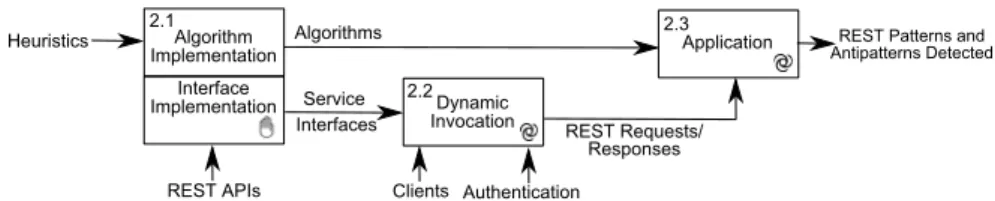
In this section, we detail the detection of REST (anti)patterns. We show the different implementation and application steps in Figure 3.
1 http://sofa.uqam.ca/soda-r/
1:Entity-Linking(response-header,response-body,http-method) 2: body-links[]←Extract-Entity-Links(response-body) 3: header-link←response-header.getValue(“Link”)
4: if(http-method= GETand(length(body-links[])≥1orheader-link= NIL))or 5: (http-method= POSTand(“Location:”∈response-header.getKeys()or 6: length(body-links[])≥1)))then
7: print“Entity Linking detected”
8: end if
Fig. 2.Heuristic ofEntity Linking pattern
Fig. 3.Steps of the detection of REST(anti)patterns
Step 2.1: Implementation - From the heuristics defined in the previous step (in Section 3.1), we manually implement their corresponding detection al- gorithms. These algorithms are thus conform to detection heuristics that use and combine static and dynamic properties. We implement also the service in- terfaces for invokingRESTservices, and later to analyse their static and dynamic properties. These interfaces written in Java contain a set of methods mapped to respectiveHTTPrequests for all REST APIsfrom their online documentations (see Table 4). TheREST APIonline documentations comprise of (1) a list of re- sources, (2) a list of actions to perform on these resources, (3) theHTTPrequests with entity end-points, and (4) a list of parameters for eachHTTPrequest.
Step 2.2: Dynamic Invocation - After we have Java interfaces for REST APIs, we implement the REST clients to invoke each service by providing the correct parameter lists. TheRESTclients must conform to the APIdocumenta- tions. During the detection time, we dynamically invoke the methods of service interfaces. FromRESTpoint of view, invocation of a method refers to performing an action on aresource or on an entity. For some method invocations, clients require to authenticate themselves to the servers. For each authentication pro- cess, we need to have a user account to ask for the developer credentials to the server. The server then supplies the user with the authentication details to use every time to make a signedHTTPrequest. For instance, YouTube and DropBox support OAuth 2.0 authentication protocol to authenticate their clients. At the end of this step, we gather all the requests and responses.
Step 2.3: Application - For the application, we rely on the underlying frame- workSOFA(Service Oriented Framework for Antipatterns) [9] that enables the analysis of static and dynamic properties specific toREST(anti)patterns. We au- tomatically apply the heuristics in the form of detection algorithms on the requests
from the clients and responses from the servers, gathered in the previous step. In the end, we obtain a list of detectedREST(anti)patterns.
From its initial version in [9], we further developed theSOFAframework to sup- port the detection ofREST(anti)patterns.SOFAitself is developed based on the SCA(Service Component Architecture) standard [4] and is composed of several SCAcomponents.SOFAframework usesFraSCAti[15] as its runtime support. We added a newRESTHandler SCAcomponent in the framework. TheRESTHandler component supports the detection of REST(anti)patterns by (1) wrapping each REST APIwith anSCAcomponent and (2) automatically applying the detection heuristics on theSCA-wrappedREST APIs. This wrapping allows us to introspect each request and response at runtime by using an IntentHandler. The intent handler inFraSCAtiis an interceptor that can be applied on a specific service to implement the non-functional features,e.g., transaction or logging. When we invoke a service that uses anIntentHandler, the service call is interrupted and the intent handler is notified by calling theinvoke(IntentJoinPoint)method.
This interruption of call enables us to introspect the requests and responses of an invokedRESTservice.
4 Validation
In this section, we want to show the robustness of SODA-R approach, accuracy of our detection heuristics, and performance of the implemented algorithms.
4.1 Hypotheses
We define three hypotheses to assess the effectiveness of ourSODA-Rapproach.
H1. Robustness:The SODA-R approach is robust.This hypothesis claims that ourSODA-Rapproach is assessed rigorously on a large set ofREST APIsand with a set of differentRESTpatterns and antipatterns.
H2. Accuracy:The detection heuristics have an average precision of more than 75% and a recall of 100%, i.e., more than three-quarters of detected (anti)patterns are true positive and we do not miss any existing (anti)patterns.Having a trade- off between precision and recall, we presume that 75% precision is acceptable while our objective is to detect all existing (anti)patterns,i.e., 100% recall. This hypothesis claims the accuracy of the defined detection heuristics and the im- plemented detection algorithms.
H3. Performance: The implemented algorithms perform with considerably a low detection times, i.e., on an average in the order of seconds.Through this as- sumption, we support the performance of the implemented detection algorithms.
4.2 Subjects and Objects
We define heuristics for eight differentRESTantipatterns and fiveRESTpatterns from the literature. Tables 2 and 3 list those REST antipatterns and patterns
Table 2.List of eightRESTantipatterns
Breaking Self-descriptiveness:RESTdevelopers tend to ignore thestandardised headers,formats, orprotocols and use their own customised ones. This practice shatters the self-descriptiveness or containment of a message header. Breaking the self-descriptiveness also limits thereusabilityand adaptabilityofRESTresources [16].
Forgetting Hypermedia:Thelack ofhypermedia,i.e.,not linking resources, hinders the state transition forRESTapplications. One possible indication of this antipattern is the absenceof URL linksin theresource representation, which typically restricts clients to follow the links,i.e., limits the dynamic communication between clients and servers [16].
Ignoring Caching:RESTclients and server-side developers tend toavoidthe caching capability due to its complexity to implement. However, caching capability is one of the principleRESTconstraints.
The developers ignore caching by settingCache-Control: no-cacheorno-storeand by not providing anETagin theresponse header[16].
IgnoringMIMETypes:The server should representresourcesin various formats,e.g.,xml, json, pdf, etc., which may allow clients, developed in diverse languages, a more flexible service consumption.
However, the server sidedevelopersoften intend to have asingle representationof resources or rely on theirown formats, which limits the resource (or service)accessibilityandreusability[16].
Ignoring Status Code: Despite of a rich set of definedapplication-level status codes suitable for various contexts,RESTdevelopers tend toavoid them,i.e.,relyonly oncommon ones, namely 200, 404, and 500, or even use thewrong or nostatuscodes. The correct use of status codes from the classes2xx, 3xx, 4xx, and 5xx helps clients and servers to communicate in a more semantic manner [16].
Misusing Cookies:Statelessness is anotherRESTprinciple to adhere—session statein the server side isdisallowedand anycookies violateRESTfulness[7]. Sendingkeysortokensin theSet-Cookie orCookieheader field to server-side session is an example of misusing cookies, which concerns both securityandprivacy[16].
Tunnelling ThroughGET: Being the most fundamental HTTPmethod in REST, the GET method retrievesa resource identified by aURI. However, very often the developersrely onlyonGET method to perform any kind of actions or operations includingcreating,deleting, or even forupdating a resource. Nevertheless,HTTP GETis an inappropriate method for any actions other thanaccessinga resource, and does not match itssemantic purpose, if improperly used [16].
Tunnelling ThroughPOST:This anti-pattern is very similar to the previous one, except that in addition to the URI thebody of theHTTP POSTrequest mayembody operationsandparameters to apply on the resource. Thedeveloperstend todepend only onHTTP POSTmethod forsending any types ofrequeststo the server includingaccessing,updating, ordeletinga resource. In general, the proper use ofHTTP POSTis tocreatea server-side resource [16].
collected from the literature, mainly [6, 8, 12, 16, 17]. In Tables 2 and 3, we put the relevant properties for each antipattern and pattern inbold-italics.
As for the objects in our experiment, we use some widely-used and popular REST APIs for which their underlying HTTP methods, service end-points, and authentication details are well documented online. Large companies like Face- book or YouTube provide self-contained documentations with good example sets.
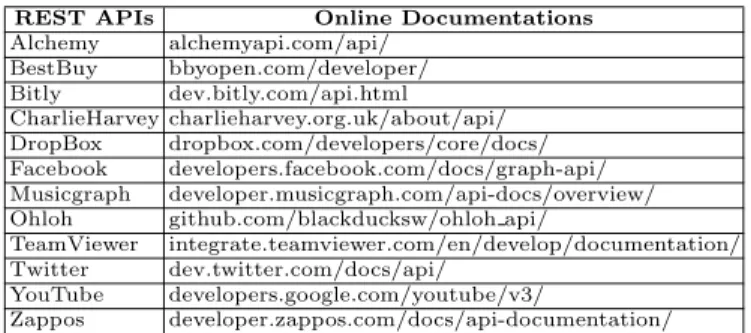
Table 4 lists the 12REST APIsthat we analysed in our experiment.
4.3 Validation Process
Through the implemented clients, we invoked a total set of 115 methods from the service interfaces to access resources and received the responses from servers.
Then, we applied the detection algorithms on theRESTrequests and responses and reported any existing patterns or antipatterns using ourSOFA framework.
We manually validated the detection results to identify the true positives and
Table 3.List of fiveRESTpatterns
Content Negotiation:This pattern supportsalternative resource representations, e.g., injson, xml, pdf, etc. so that the service consuming becomes more flexible withhigh reusability. Servers can provide resources inany standard formatrequested by the clients. This pattern is applied via standardHTTPmedia typesand adhere toservice loose couplingprinciple. If not applied at all, this turns intoIgnoringMIMETypesantipattern [6].
End-point Redirection:Theredirectionfeature over the Web is supported by this pattern, which also plays a role as the means ofservice composition. To redirect clients, servers send a newlocation to follow with one of thestatus codeamong301,302,307, or308. The main benefit of this pattern is—analternative serviceremainsactiveeven if the requested service end-point is not sound [6].
Entity Linking:This pattern enablesruntime communicationvialinksprovided by the server in theresponse body or viaLocation: in theresponse header. By usinghyper-links, the servers and clients can beloosely coupled, and the clients canautomatically findtherelated entitiesatruntime.
If not properly applied, this pattern turns intoForgetting Hypermediaantipattern [6].
Entity Endpoint:Services with singleend-pointsare too coarse-grained. Usually, a client requires at leasttwo identifiers: (1) aglobalfor theservice itself and (2) alocalfor theresource or entity managed by the service. By applying this pattern,i.e., usingmultiple end-points, eachentity (or resource)of the incorporating service can beuniquely identifiedandaddressed globally [12].
Response Caching:Response caching is a good practice toavoid sending duplicate requestsand responses by caching all response messages in the local client machine. In opposed to Ignoring Cachingantipattern, theCache-Control:is set to any value other thanno-cacheandno-store, or anETagis used along with thestatus code 304[6].
Table 4.List of 12 REST APIsand their online documentations.
REST APIs Online Documentations Alchemy alchemyapi.com/api/
BestBuy bbyopen.com/developer/
Bitly dev.bitly.com/api.html CharlieHarvey charlieharvey.org.uk/about/api/
DropBox dropbox.com/developers/core/docs/
Facebook developers.facebook.com/docs/graph-api/
Musicgraph developer.musicgraph.com/api-docs/overview/
Ohloh github.com/blackducksw/ohloh api/
TeamViewer integrate.teamviewer.com/en/develop/documentation/
Twitter dev.twitter.com/docs/api/
YouTube developers.google.com/youtube/v3/
Zappos developer.zappos.com/docs/api-documentation/
to find false negatives. The validation was performed by two professionals who have knowledge onREST and were not part of the implementation and exper- iment. We provided them the descriptions of REST (anti)patterns and the sets of all requests and responses collected during the service invocations. We used precision and recall to measure our detection accuracy. Precision concerns the ratio between the true detected (anti)patterns and all detected (anti)patterns.
Recall is the ratio between the true detected (anti)patterns and all existing true (anti)patterns.
4.4 Results
Table 5 presents detailed detection results for the eightRESTantipatterns and five RESTpatterns. The table reports the (anti)patterns in the first column followed
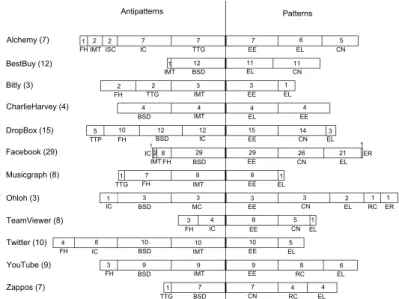
Fig. 4.Bar-plots of the detection results for eight antipatterns and five patterns. (APIs are followed by the number of method invocations in parentheses. The acronyms corre- spond to the (anti)pattern name abbreviation and the numbers represent their detected instances.)
by the analysedREST APIsin the following twelve columns. For eachREST API and for each (anti)pattern, we report: (1) the total number of validated true positives with respect to the total detected (anti)patterns by our algorithms, i.e., the precision, in the first row and (2) the total number of detected true positives with respect to the total existing true positives,i.e., the recall, in the following row. The last two columns show, for allAPIs, the average precision- recall and the total detection time for each (anti)pattern. The detailed results on all the test cases,e.g., 115 methods from 12REST APIs, are available on our web site1.
4.5 Overview on the Results
Figure 4 shows the bar-plots of the detection results for the eight antipatterns and five patterns on the 12REST APIs.
RESTdevelopers are most likely to use their own header fields, data formats, and protocols, which limit the comprehension and reusability ofREST APIs. For example, among more than 80 instances of detectedBreaking Self-descriptiveness (BSD) antipattern: Facebook (29 instances), DropBox (12 instances), and Best- Buy (12 instances) were mostly using customised header fields, data formats, and protocols. Also,Forgetting Hypermedia (FH) antipattern was detected in Face- book (8 instances) and DropBox (10 instances)APIs. Moreover,Ignoring MIME Types (IMT) antipattern was detected in Twitter (10 instances) and YouTube (9 instances)APIs. Among the less frequent antipatterns, Ignoring Status Code
(ISC, 2 instances) andMisusing Cookies(MC, 3 instances) were not significantly observed among the 115 tested methods.
As for REST patterns, Content Negotiation (CN, 70 instances) and Entity Linking (EL, 62 instances) were most frequently applied by REST developers.
Content Negotiation pattern supports the ability to representRESTresources in diverse formats (implemented by RESTdevelopers) as requested by the clients.
Entity Linking pattern facilitates clients to follow links provided by the servers.
Furthermore, someAPIsalso appliedResponse Cashing (RC, 13 instances) and End-point Redirection (ER, 2 instances) patterns.
Overall,REST APIsthat follow patterns tend to avoid corresponding antipat- terns and vice-versa. For example: BestBuy and Facebook are found involved respectively in 0 and 8 instances ofForgetting Hypermedia antipattern; however, these APIs are involved in 11 and 21 corresponding Entity Linking pattern.
Moreover, DropBox, Alchemy, YouTube, and TwitterAPIshad 27 instances of Ignoring Caching antipattern, but they were involved in 8 instances of the cor- responding Response Cashing pattern. Finally, we found Facebook, DropBox, BestBuy, and ZapposAPIsinvolved in only 3 instances ofIgnoring MIMETypes antipattern, which conversely are involved in more than 55 instances of corre- spondingContent Negotiation pattern.
In general, among the 12 analysed REST APIswith 115 methods tested and eight antipatterns, we found Twitter (32 instances of four antipatterns), Drop- Box (40 instances of four antipatterns), and Alchemy (19 instances of five an- tipatterns) are more problematic,i.e., contain more antipatterns than others (see Figure 4). On the other hand, considering the fiveRESTpatterns, we found Face- book (49 instances of four patterns), BestBuy (22 instances of two patterns), and YouTube (15 instances of three patterns) are well designed, i.e., involve more patterns than others (see Figure 4).
4.6 Details of the Results
In this section, we discuss three detection results in detail, obtained in our ex- periment as presented in Table 5.
RESTdevelopers tend to rely on their own customised headers, formats, and protocols, and thus introduce Breaking Self-descriptiveness antipattern. The analysis on the 12REST APIsshows that developers used non-standard header fields and protocols in mostAPIsincluding BestBuy, DropBox, Facebook, and Twitter. For example, Facebook usedx-fb-debugandx-fb-revheader fields, which are mainly used to track a request id for their internal bug manage- ment purpose. Similarly, we found DropBox using thex-dropbox-request-id and Twitter usingx-tfe-logging-request-*and x-xss-protectionheader fields. In general, the designers and implementers often distinguish the standard- ised and non-standardised header members by prefixing their names with “x-”
(a.k.a.eXperimental). Indeed, the “x-” convention was highly discouraged by the Internet Society inRFC822[14]. The manual validation reveals that all our detec- tion was true positives and we reported all existing non-standard header fields and protocols, except two in DropBox where the manual validation considered
Table 5. Detection results of the eightREST antipatterns and fiveRESTpatterns ob- tained by applying detection algorithms on the 12REST APIs(numbers in the paren- theses show total test methods for eachAPI).
RESTAPI (7)Alchemy (12)BestBuy (3)Bitly (4)CharlieHarvey (15)DropBox (29)Facebook (8)Musicgraph (3)Ohloh (8)TeamViewer (10)Twitter (9)YouTube (7)Zappos precision-recall (115)Total Average Precision-Recall DetectionTime
REST Antipatterns
Breaking Self- 0/0 12/12 0/0 4/4 12/12 29/29 0/0 3/3 0/0 10/10 9/9 7/7 p 86/86 100%
21.31s
descriptiveness0/0 12/12 0/0 4/4 12/14 29/29 0/0 3/3 0/0 10/10 9/9 7/7 r 86/88 98.21%
Forgetting 1/1 0/0 2/2 0/0 9/10 8/8 7/7 0/0 3/3 4/4 2/3 0/0 p 36/38 94.58%
19.54s
Hypermedia 1/1 0/0 2/2 0/0 9/9 8/8 7/7 0/0 3/3 4/4 2/2 0/0 r 36/36 100%
Ignoring 7/7 0/0 0/0 0/0 12/12 1/1 0/0 1/1 4/4 8/8 0/0 0/0 p 33/33 100%
18.99s
Caching 7/7 0/0 0/0 0/0 12/12 1/1 0/0 1/1 4/4 8/8 0/0 0/0 r 33/33 100%
Ignoring 2/2 1/1 3/3 4/4 0/0 2/2 8/8 0/0 0/0 10/10 9/9 0/0 p 39/39 100%
19.39s
MIME Types 2/2 1/1 3/3 4/4 0/0 2/2 8/8 0/0 0/0 10/10 9/9 0/0 r 39/39 100%
Ignoring 1/2 0/0 0/0 0/0 0/0 0/0 0/0 0/0 0/0 0/0 0/0 0/0 p 1/2 50%
21.22s
Status Code 1/2 0/0 0/1 0/0 0/0 0/0 0/0 0/0 0/0 0/0 0/0 0/0 r 1/3 25%
Misusing 0/0 0/0 0/0 0/0 0/0 0/0 0/0 3/3 0/0 0/0 0/0 0/0 p 3/3 100% 19.1s
Cookies 0/0 0/0 0/0 0/0 0/0 0/0 0/0 3/3 0/0 0/0 0/0 0/0 r 3/3 100%
Tunnelling 5/7 0/0 0/2 0/0 0/0 0/0 0/1 0/0 0/0 0/0 0/0 0/1 p 5/11 17.86%
28.26s
ThroughGET 5/5 0/0 0/0 0/0 0/0 0/0 0/0 0/0 0/0 0/0 0/0 0/0 r 5/5 100%
Tunnelling 0/0 0/0 0/0 0/0 5/5 0/0 0/0 0/0 0/0 0/0 0/0 0/0 p 5/5 100%
28.64s
ThroughPOST 0/0 0/0 0/0 0/0 5/5 0/0 0/0 0/0 0/0 0/0 0/0 0/0 r 5/5 100%
REST Patterns
Content 5/5 11/11 0/0 0/0 14/14 26/26 0/0 3/3 5/5 0/0 0/0 7/7 p 71/71 100%
19.63s
Negotiation 5/5 11/11 0/0 0/0 14/14 26/26 0/0 3/3 5/5 0/0 0/0 7/7 r 71/71 100%
Entity 6/6 11/11 1/1 4/4 3/3 21/21 1/1 2/2 1/1 5/5 6/6 4/4 p 65/65 100% 19.90s
Linking 6/6 11/11 1/1 4/4 3/3 21/21 1/1 2/2 1/1 5/5 6/7 4/4 r 65/66 98.81%
End-point 0/0 0/0 0/0 0/0 0/0 1/1 0/0 1/1 0/0 0/0 0/0 0/0 p 2/2 100%
20.36s
Redirection 0/0 0/0 0/0 0/0 0/0 1/1 0/0 1/1 0/0 0/0 0/0 0/0 r 2/2 100%
Entity 1/1 0/0 1/1 1/1 1/1 1/1 1/1 1/1 1/1 1/1 1/1 0/0 p 10/10 100%
23.06s
Endpoint 1/1 0/0 1/1 1/1 1/1 1/1 1/1 1/1 1/1 1/1 1/1 0/0 r 10/10 100%
Response 0/0 0/0 0/0 0/0 0/0 0/0 0/0 1/1 0/0 0/0 8/8 4/4 p 13/13 100%
19.23s
Caching 0/0 0/0 0/0 0/0 0/0 0/0 0/0 1/1 0/0 0/0 8/8 4/4 r 13/13 100%
Average p 369/378 89.42%
21.43s r 369/374 94%
them as non-standard practice. This leads to the precision of 100% and the recall of 98.21% for this detection.
Any RESTful interaction is driven byhypermedia—by which clients interact with application servers via URL links provided by servers in resource repre- sentations [7]. The absence of such interaction pattern is known as Forgetting Hypermedia antipattern [16], which was detected in eight APIs, namely Bitly, DropBox, Facebook, and so on (see Table 5). Among the 115 methods tested, we found 38 instances of this antipattern. Moreover, REST APIs that do not have this antipattern well applied the correspondingEntity Linkingpattern [6], e.g., Alchemy, BestBuy, and Ohloh, which is a good practice. This observation suggests that, in practice, developers sometimes do not provide hyper-links in resource representations. As for the validation, 36 instances of Forgetting Hy- permedia antipattern were manually validated; therefore, we have an average precision of 94.58% and a recall of 100%. ForEntity Linking pattern, the man- ual validation confirmed 66 instances whereas we detected a total of 65 instances,
all of which were true positives. Thus, we had an average precision of 100% and a recall of 98.81%.
Caching helps developers implementing high-performance and scalable REST services by limiting repetitive interactions, which if not properly applied violates one of the sixRESTprinciples [7].RESTdevelopers widely ignore the caching ca- pability by usingPragma: no-cacheorCache-Control: no-cacheheader in the re- quests, which forces the application to retrieve duplicate responses from servers.
This bad practice is known asIgnoring Cachingantipattern [16]. In contrast, the corresponding pattern,Response Caching [6] supports response cacheability. We detected sixREST APIsthat explicitly avoid caching capability, namely Alchemy, DropBox, Ohloh, and so on (see Table 5). On the other hand, cacheability is supported by YouTube and Zappos, which were detected asResponse Caching patterns. The manual analysis of requests and responses also confirmed these detections, and we had an average precision and recall of 100%.
4.7 Discussion on the Hypotheses
In this section, we discuss the hypotheses defined in Section 4.1.
H1. Robustness:To validate theSODA-R approach, we performed experiment on 12REST APIsincluding well-known Facebook, BestBuy, DropBox, Twitter, and YouTube. We analysed 115 methods in the form ofHTTPrequests from these APIsand applied detection algorithms of eight common RESTantipatterns and fiveRESTpatterns on them. For each request among 115, we analysed individual request headers and bodies, and the corresponding response headers and bodies.
With such an extensive evaluation and validation, we support our first hypothesis on the robustness of ourSODA-Rapproach.
H2. Accuracy:As shown in Table 5, we obtained an average recall of 94% and an average precision of 89.42% on allREST APIsand for all test methods. The precision ranges from 17.86% to 100%, while we obtained a recall between 25%
and 100% for allREST(anti)patterns. Thus, with an average precision of 89.42%
and a recall of 94%, we can positively support our second hypothesis on the accuracy of our defined heuristics and implemented detection algorithms.
H3. Performance: The total required time includes: (i) the execution time, i.e., sending RESTrequests and receiving RESTresponses (ranges from 19.1s to 24.55s) and (ii) the time required to apply and run the detection algorithms on the requests and responses (ranges from 0.004s to 4.312s). Each row in Table 5 (last column) reports the total required detection time for a pattern or an antipattern, which varies from 19.1s to 28.64s. We performed our experiments on an Intel Core-i7 with a processor speed of 2.50GHz and 6GB of memory. The detection time is comparatively very low (on an average 3% of the total required time) than the execution time. With a low average detection time of 21.43s, we can positively support our third hypothesis on performance.
4.8 Threats to Validity
As future work, we plan to generalise our findings to other REST APIs. How- ever, we tried to minimise the threat to the external validity of our results by performing experiments on 12REST APIsby invoking and testing 115 methods from them. The detection results may vary based on the heuristics defined for the REST (anti)patterns. To minimise the threats to the Internal validity, we made sure that every invocation receives responses from servers with the correct requestURI, and the client authentication done while necessary. Moreover, we tested all the majorHTTPmethods inREST,i.e.,GET,DELETE,PUT, andPOSTon resources to minimise the threat to the internal validity. Engineers may have dif- ferent views and different levels of expertise onREST(anti)patterns, which may affect the definition of heuristics. We attempted to lessen the threat toconstruct validity by defining the heuristics after a thorough review of existing literature on theREST(anti)patterns. We also involved two professionals in the intensive validation of the results. Finally, the threats toreliability validity concerns the possibility of replicating this study. To minimise this threat, we provide all the details required to replicate the study, including the heuristics, client requests, and server responses on our web site1.
5 Conclusion and Future Work
REST(REpresentational State Transfer) is now a popular architectural style for building Web-based applications.RESTdevelopers may apply design patterns or introduce antipatterns. TheseRESTpatterns and antipatterns may respectively:
(1) facilitate and hinder semantically richer communications between clients and servers, or (2) ease and cause difficult maintenance and evolution.
This paper presented theSODA-Rapproach (Service Oriented Detection for An- tipatterns inREST) to define detection heuristics and detectREST(anti)patterns inREST APIs. The detection of (anti)patterns inREST APIsrequires an in-depth analysis of their design, invocation, and authentication. We appliedSODA-R to define the detection heuristics of five commonRESTpatterns and eightRESTan- tipatterns. Using an extendedSOFAframework (Service Oriented Framework for Antipatterns), we performed an extensive validation with 13REST(anti)patterns.
We analysed 12REST APIsand tested 115 methods, and showed the accuracy of SODA-Rwith an average precision of 89.42% and recall of 94%.
In future work, we want to replicateSODA-Ron otherREST APIsand methods with moreREST(anti)patterns. We also intend to enrich the catalog of antipat- terns and patterns by thoroughly investigating a large set of REST APIs.
Acknowledgements. The authors thank Abir Dilou for initiating the study.
This study is supported by NSERC (Natural Sciences and Engineering Research Council of Canada) and FRQNT research grants.
References
1. Bennett, K., Layzell, P., Budgen, D., Brereton, P., Macaulay, L., Munro, M.:
Service-based Software: The Future for Flexible Software. In: Proceedings of Sev- enth Asia-Pacific Software Engineering Conference, pp. 214–221 (2000)
2. Daigneau, R.: Service Design Patterns: Fundamental Design Solutions for SOAP/WSDL and RESTful Web Services. Addison-Wesley (November 2011) 3. Demange, A., Moha, N., Tremblay, G.: Detection of SOA Patterns. In: Basu, S.,
Pautasso, C., Zhang, L., Fu, X. (eds.) ICSOC 2013. LNCS, vol. 8274, pp. 114–130.
Springer, Heidelberg (2013)
4. Edwards, M.: Service Component Architecture (SCA). OASIS, USA (April 2011) 5. Erl, T.: SOA Design Patterns. Prentice Hall PTR (January 2009)
6. Erl, T., Carlyle, B., Pautasso, C., Balasubramanian, R.: SOA with REST: Prin- ciples, Patterns & Constraints for Building Enterprise Solutions with REST. The Prentice Hall Service Technology Series from Thomas Erl. (2012)
7. Fielding, R.T.: Architectural Styles and the Design of Network-based Software Architectures. PhD thesis (2000)
8. Fredrich, T.: RESTful Service Best Practices: Recommendations for Creating Web Services (May 2012)
9. Moha, N., Palma, F., Nayrolles, M., Conseil, B.J., Gu´eh´eneuc, Y.-G., Baudry, B., J´ez´equel, J.-M.: Specification and Detection of SOA Antipatterns. In: Liu, C., Ludwig, H., Toumani, F., Yu, Q. (eds.) Service Oriented Computing. LNCS, vol. 7636, pp. 1–16. Springer, Heidelberg (2012)
10. Nayrolles, M., Moha, N., Valtchev, P.: Improving SOA Antipatterns Detection in Service Based Systems by Mining Execution Traces. In: 20th Working Conference on Reverse Engineering, pp. 321–330 (October 2013)
11. Palma, F., Nayrolles, M., Moha, N., Gu´eh´eneuc, Y.G., Baudry, B., J´ez´equel, J.M.:
SOA Antipatterns: An Approach for their Specification and Detection. Interna- tional Journal of Cooperative Information Systems 22(04) (2013)
12. Pautasso, C.: Some REST Design Patterns (and Anti-Patterns) (October 2009), http://www.jopera.org/node/442
13. Penta, M.D., Santone, A., Villani, M.L.: Discovery of SOA Patterns via Model Checking. In: 2nd International Workshop on Service Oriented Software Engineer- ing: In Conjunction with the 6th ESEC/FSE Joint Meeting, IW-SOSWE 2007, pp.
8–14. ACM, New York (2007)
14. RFC2822: Internet Message Format by Internet Engineering Task Force. Technical report (2001)
15. Seinturier, L., Merle, P., Rouvoy, R., Romero, D., Schiavoni, V., Stefani, J.B.: A Component-Based Middleware Platform for Reconfigurable Service-Oriented Ar- chitectures. Software: Practice and Experience 42(5), 559–583 (2012)
16. Tilkov, S.: REST Anti-Patterns (July 2008),
http://www.infoq.com/articles/rest-anti-patterns
17. Tilkov, S.: RESTful Design: Intro, Patterns, Anti-Patterns (December 2008), http://www.devoxx.com/
18. Vinoski, S.: Serendipitous Reuse. IEEE Internet Computing 12(1), 84–87 (2008)