Publisher’s version / Version de l'éditeur:
Vous avez des questions? Nous pouvons vous aider. Pour communiquer directement avec un auteur, consultez la première page de la revue dans laquelle son article a été publié afin de trouver ses coordonnées. Si vous n’arrivez pas à les repérer, communiquez avec nous à [email protected].
Questions? Contact the NRC Publications Archive team at
[email protected]. If you wish to email the authors directly, please see the first page of the publication for their contact information.
https://publications-cnrc.canada.ca/fra/droits
L’accès à ce site Web et l’utilisation de son contenu sont assujettis aux conditions présentées dans le site LISEZ CES CONDITIONS ATTENTIVEMENT AVANT D’UTILISER CE SITE WEB.
Technical Memorandum (National Research Council of Canada. Associate
Committee on Soil and Snow Mechanics); no. DBR-TM-45, 1957-03-01
READ THESE TERMS AND CONDITIONS CAREFULLY BEFORE USING THIS WEBSITE. https://nrc-publications.canada.ca/eng/copyright
NRC Publications Archive Record / Notice des Archives des publications du CNRC :
https://nrc-publications.canada.ca/eng/view/object/?id=17aaef55-d747-4ef0-9735-5adfe46b0399
https://publications-cnrc.canada.ca/fra/voir/objet/?id=17aaef55-d747-4ef0-9735-5adfe46b0399
NRC Publications Archive
Archives des publications du CNRC
This publication could be one of several versions: author’s original, accepted manuscript or the publisher’s version. / La version de cette publication peut être l’une des suivantes : la version prépublication de l’auteur, la version acceptée du manuscrit ou la version de l’éditeur.
For the publisher’s version, please access the DOI link below./ Pour consulter la version de l’éditeur, utilisez le lien DOI ci-dessous.
https://doi.org/10.4224/40001211
Access and use of this website and the material on it are subject to the Terms and Conditions set forth at
Peat in Canada and Britain economic implications
The Associate Committee on Soil and Snow Mechanics is one of about thirty 3pecial committees which assist the National Research Council in its work. Formed in 1945 to deal with an urgent wartime problem involving soil and snow, the Committee is now performing its intended task of co-ordinating Canadian research studies concerned with the physical and mechanical properties of the terrain of t.rie Dominion. It does this through subcommittees on Snow and Ice, Soil Mechanics, Muskeg, and Fermafrost. The Com-mittee, which consists of about fifteen Canadians ap-pointed as individuals and not as representatives, each for セ 3-year term, has funds available to it for making research grants for work in its fields of interest. In-quiries will be welcomed and should be 。、、イ・ウウセ、 to: The Secretary, Associate Committee on Soil and Snow Mechanics, c/o The Division of Building Research, National Research Council, ottaW2, Canada.
This ーオ「ャゥ」セエゥッョ is one 6f a series being produced by the Associate
cッュュゥエエ・セ on Soil apd Snow Mechanics of the National Research Council. It may therefore be rerroduced, liithout zmendment, rrovided that the Division is told in
advance and that full and due acknowledgment of this publication is always made. No abridgment of this report may be published without the written authority of the Secreta.ry of the aNcNsNsNセAN Extracts may be published for purposes of review only.
PEAT IN
CANADA AND
BRITAIN-ECONOMIC
IMPLICATIONS
by
NORMAN W.
RADFORTH,
M.A.,
Ph.D.
t, [セ
--THE ROYAL SOCIETY OF ARTS
LONDON
Reprinted from The Journal of the Roval Society of Arts, 9th November, 1956. Vol.
crv
pp. 968-979CANADA
AND
BRITAIN-IMPLICATIONS
PEAT
IN
ECONOMIC
A paper by
NORMAN W. RADFORTH, M.A., Ph.D., Professor of Botany, McMaster University, Ontario, read to the Society on Tuesday, ]rd July, I956, with Sir John Simonsen, D.Se., LL.D., F.R./.C., F.R.S., a Member of Council of the Society, in the Chair
THE CHAIRMAN: Since its formation this Society has always had very many over-seas Fellows. Only this year we celebrated the bicentenary of one of our most famous Members from overseas, namely Benjamin Franklin, of whose work in London Professor Andrade gave such an inspiring account in his Trueman Wood Lecture.
During recent years our relationship to overseas Fellows has come even closer, due I think to the overseas visits paid by our Chairman, other members of Council and our indefatigable Secretary. In Canada now we have five honorary corresponding Members. It is therefore fitting that the final paper of this Session should be given by one of our Fellows from overseas. We therefore welcome very cordially our lecturer this evening who, although born in this country, has received, I think, most of his education in Canadian universities. Professor Radforth is now Professor of Botany at McMaster University; unfortunately my knowledge of botany is too limited to enable me to give you any account of his contributions to this subject, although I believe that his main interests lie in experimental morphology and palaeontology. This afternoon he is going to give us an account of a work which I think is very near his heart, namely peat. He is going to tell us something about peaty terrain and its influence as a factor in development over Great Britain and in Canada.
The following paper, which was illustrated with a film and lantern slides, was then read:
THE PAPER
It is not difficult to accept that Britain and Canada are bound together informally, if not formally, by commercial, political and racial ties. On the other hand, it is hard to persuade oneself from casual comparisons that the two countries possess significant physical features in common which are important enough to provide economic limitations at a national level. Yet there is at least one example, as more intensive examination reveals. Peat-land as it is often called in Britain, muskeg as it is known in Canada, is a physiographic medium in which common problems are found.
Peat-land creates a limitation on land use. Unless it can be rehabilitated it has little to reward human enterprise. It does not respond to normal farm management techniques, and presents a serious problem for the torester. Itis, inadequate and unproductive for livestock. High volume production, combined with mechanization, has established new economic horizons for the farmer exploiting mineral terrain. However, this situation ends at the edge of the
THE ROYAL SOCIETY OF ARTS
peat-lands. Here, communications practically break down, foundation engineer-ing is almost overwhelmengineer-ingly difficult, and it is not a practical proposition even to try to work the land while it is in its inherent conditions.
If peat-lands exist as overburden obstructing potential mining development, the normal economics of mining are completely changed. In well-drilling alone the Western Canada oil industry more than doubles its costs when operating on muskeg." Sociologically, peat-lands are making an increasingly serious impact, especially in the face of future laws of survival. The pressure for food, fuel and commodities is forcing us to look again at peat-lands, and increasing populations verging on them are hopeful for action.
This multiple problem gathers significance when field operations are attempted. The reasons are numerous in Britain as well as in Canada. A controlling one is the inability to transport heavy equipment across the terrain. Wheel, and most track vehicles fail to negotiate large areas of peat-land. There are many known cases of vehicles sinking out of sight. In some types of peat-land subsidence is apt to occur so quickly that vehicle operators have little opportunity to free themselves before being submerged.
Avoidance of this and almost all other types of difficulties, primary or secondary, depends upon development of ability to predict terrain conditions in order that all kinds of projected development can be intelligently planned. However, this is not easy because muskeg or its British equivalent lack apparent signs of organization. Where no order reigns, no classification is possible. Without the aid of categorization, sound prediction is not possible. Therefore research is urgently required.
Research on peat-lands in the Commonwealth is now getting some well-deserved support. The McAuley Soil Science Research Institute of Aberdeen encourages a programme of fundamental and applied agricultural research. Instructive field experiments and technical procedures are to be seen in the Scottish lowlands at the field station of the Peat Section, Department of Agriculture, Scotland. Here, methods of peat-land reclamation are investigated after most of the peat coverage has been removed. The Director of the venture, Mr. A. Tornter , is making a marked contribution. The mined surface peat is processed for fuel for final transmutation to electrical energy in northern Scotland. The field demonstration of Dr. John Smith, former Director of Agriculture in the Sudan and now resident in Coalburn, is equally inspiring, more especially -so because his programme provides exciting promise for the crofter. In fundamental research the work of Professor Godwin of Cambridge University has made a considerable contribution to knowledge. Liaison with Canada is maintained by Professor John Walton of Glasgow University. In that country we are glad to hear how solutions to peat-land problems are being met. Advice of the nature of that supplied by Messrs. Gardner, Hunt and Mitchell concerning the 'Muirfad' technique of peat-land improvement- is especially welcome.
Professor Walton is the only overseas member of the Muskeg Sub-committee of the Associate Committee on Soil and Snow Mechanics of the National Research
PEAT I'" CANADA AND BRITAIN
Council of Canada. This is one of four organizations supporting work on muskeg across the sea. The Council is actively engaged in research at the laboratories of the Division of Building Research. Other centres are the Department of Civil Engineering, University of Alberta in Edmonton, The Muskeg Laboratory of the Imperial Oil Co. in Calgary Alta, and the Muskeg Laboratory, Department of Biology, McMaster University, Hamilton, Ontario. A fifth organization, though not participating directly in research, supports the work of the author. This is the Defense Research Board, Ottawa.
In Canada there are well over 500,000square miles of muskeg. Though this is an enormous area, it is no more significant proportionately than the organic mantic covering much of Britain. In the latter case, the obviously greater popu lation pressure offsets the apparent advantage of comparatively small average. The possibility of conquering these vast peat-lands has involved the launching of many projects. In every case for the investigator, disappointment has arisen owing to the apparent disorganization the terrain showed. Consequently this problem has provided the primary objective for peat research. Superficial examination of muskeg was encouraging the belief that organization would never be revealed in peat-land, until finally the suggestion was offered through the results of pal.eobotanical endeavour.3· 4. "
It has been known for some time that successive intervals of accumulated peat can be identified in relation to their time of formation. To do this, botanists drew from the legacy of tree pollens of past ages. These minute bodies, alike only for a given species, settled from the air and became fossilized in the vegetal
debris of other plant parts that together formed the peat banks. From investiga-tions of these tree pollens, the forest history and the record of past climatic change are gradually being revealed. This provided indirectly the first contribu-tion towards soh:il.g the problem of peat organizacontribu-tion, but it was hoped that help could be of a more direct and less general nature. In the far north of Canada the number of tree species was limited to only three or four that showed promise of significant help, and even these did not aid in distinguishing peat which displayed structural differences on a macrostructural basis, but which were removed from the same area.
Tl:e reader may well question why the local problems could not be solved by reference to macro-contrast. This was actually attempted, but the results were of limited or uncertain value. In the first place, chemical change, observable by inspection of colour relations in the peat, differed in rate and in location. The pattern of difference did not seem to coincide too well with the pattern suggested by mechanical change. Thus, macroscopic variation could not be judged entirely on a biological basis. Also, when macro-structure differentiation was attempted for classification purposes it was too difficult to predict how far laterally the type would extend, especially if the types of macro-units were mixed. This made prediction of terrain character from given samples an uncertain proposition. Finally, even when specific macro-unit types predominated in given samples-not a frequent circumstance-the observer tended to be subjective because large units would be favoured, and the significance of small units would be
THE ROYAL SOCIETY OF ARTS
underestimated in importance in the process of predicting terrain properties. Because of these several difficulties it was concluded that true index value, as revealed by macrofossils and involving arbitration, could be evaluated only after justification from microfossil evidence derived from considerations of natural circumstances.
Even with microfossils it was not until attention, and some emphasis, were given to pollens and spores contributed by plants fromin situthat local difference could be accounted for. Pollen from trees might have come from afar, and have contributed insignificantly to the local circumstances governing peat structure. Whereas pollen and spores from non-tree types symbolized with greater certainty the plants which produced them in the immediate environment. The local ones would therefore indirectly index the nature of the structural properties of the organic mat corresponding to the location of the peat sample. To test this proposal large numbers of peat samples were investigated from randomly selected locations over a reasonably wide area (some 600 square miles) in the vicinity of Fort Churchill, Manitoba, immediately south of the southern shore of Hudson Bay (about the same latitude as the Orkney Islands).
Peats vary in depth. There may be only one or two inches of dead organic matter, but on the other hand fifty- to one hundred-foot examples are reported north-west of Edmonton in western Canada. Whatever the depth, the microfossil history, as analyzed inch by inch, accounts for structural composition level by level. Because the microfossils are as unquestionably identifiable as the parent plants giving rise to them, it seems reasonable to claim that macro-structure thus labelled is identified with the least possible artificiality.
DEPTH FROM SURFACE
0-1 INC ....£5 2 - 3 5 - 6
XI'
o 20 M) 60 10 100 120
FREQUENCY
FIGURE I. Histogram pattern showing
fixed type of sequence in microfossil history
0-4IHeWES
PEAT IN CANADA AND BRITAIN
DEPTH FROM SURFACE
2 -.3 . - S
o 20 . 0 60 80 100 120
FREQUENCY
FIGURE 2. Histogram pattern showing shifting type of sequence in microfossil history
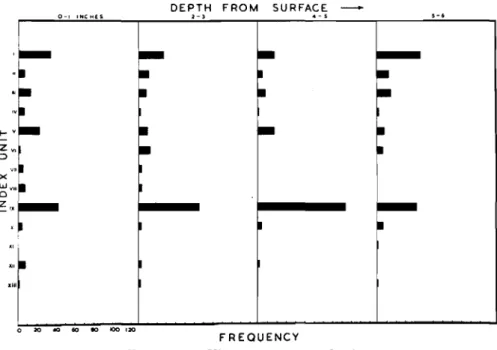
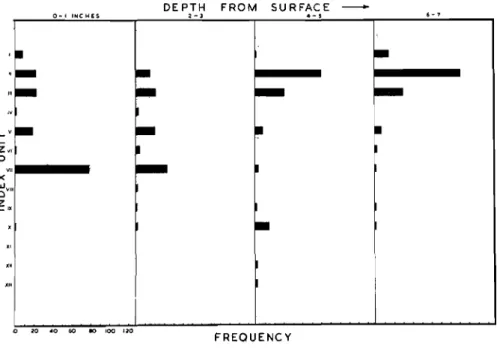
Characterization by micro-fossils is portrayed by histogram bars. A single bar represents the frequency at a given level of one microfossil (index unit). When all bars are displayed in parallel sequence for a given depth, and all depths of the sample are represented, the diagram so derived is known as a histogram pattern (Figure I). All histogram patterns differ in some degree, but major differences are of a characteristic nature. Differentiation is such that categories of histogram patterns arise. Also, if the patterns are examined in detail, some show relative constancy of composition (Figure I), others constitutional change (frequency .changes with depth, Figure 2). Still others reflect a kind of hiological indifference.
Whatever the trend, the pattern can be explained ecologically.
Though there is still much work to be done the claim is now reasonable that peat-land organization can be revealed, and categories of peat identified. Microfossils, the index components that made this possible, facilitate characterization in other ways. In the laboratory where they are isolated and counted" derived histogram patterns are correlated with macrostructure." The latter can be designated in terms of granularity and fibrosity, non-woodiness and woodiness. Also prediction of the extent and eventual modification of the type can be proposed.
Though this means of classification and prediction is encouraging, field identification and terrain analysis remained a problem. Inspection of peat-lands in the field when no laboratory advice was at hand was still accompanied 'by
THE ROYAL SOCIETY OF ARTS
hewilderment, and even if analytical data were available conversion to field reference was a difficult matter; certainly a joh for experts. Hopes therefore turned to the possibility of correlating subsurface characteristics with surface. To do this, reference entities had to be established as indicators of vegetal difference hecause the conspicuous markers were the modern plants constituting the living organic layer covering the peat.
At first it was thought that the vegetal cover could be readily assessed by reference to associations of plant species. There were two major objections to this: utilization of species as reference entities created difficulty for the engineer and for others who were not trained in plant systematics; in the Canadian north, south to latitudes well beyond the so-called tree line, given species showed annoying indifference to what might be their association limits. To approach the first objection, attempts were made to discover whether independent and hotanically untrained observers working in the same area could relocate each others' field station using as guide some function of vegetal character without referring to plant names. In reference procedure it was found that observers made use of such entities as plant stature and structural composition, woodiness, presence or absence of leaves and leaf form, and so forth. Occasionally, relative predominance of these features was noted, and reasonable agreement was encountered among observers involved.
To bring the method into practical and extensive use it was refined for further testing. Statute categories were assigned. Differentiation was not established entirely on an arbitrary basis, because it was discovered that there were stature categories that were not so numerous as to confuse. Other structural entities were combined with stature to provide a classification system for surface vegeta-tion. This was scrutinized and adjusted appropriately to establish validity on the basis of botanical principles.
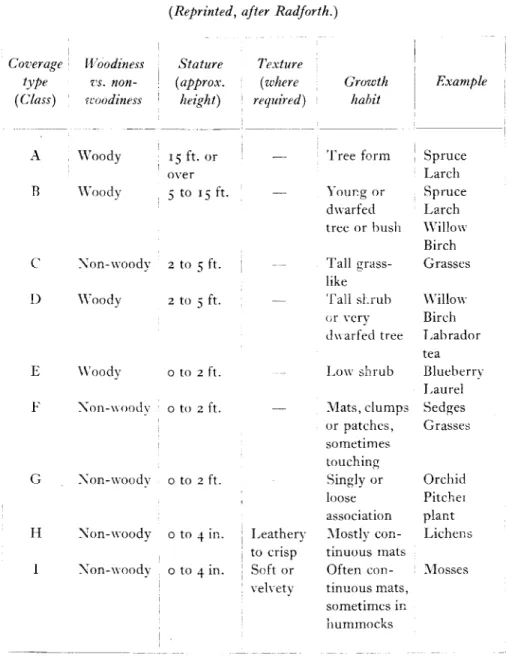
Details of this system have been described elsewhere." The fundamentals of the method require only nine classes of vegetation. These are shown in the table of descriptions, Table I. In combination they are said to constitute formulze.
Fortunately, the number of actual combinations is much smaller than the number that is mathematically possible. There arc fewer than
25
that are common." Each formula shows the predominating class on its left as designated by the appropriate letter symbol. Other classes follow, but a total of no more than three classes constitutes coverage designation. Any element that may be present in the field in an amount less than25
per cent of area covered is regarded as negligible.The next step in correlation of surface with subsurface was to demonstrate relationship between the appropriate systems of reference. When this was achieved the field observer, by determining cover forrnula-, could predict subsurface conditions, sometimes over areas of considerable extent as time and circumstances would direct. Further study revealed that certain topographic factors characterizing the terrain bore discernable relationship to cover types. Examples categorized as to cover by formula FI showed a high incidence of interruption by shallow lakes, ponds or high water table. An example of this
PEAT IN CANADA AND BRITAIN
TABLE I. VEGETAL COVER CLASS DESIGNATIONS AND THEIR MEANINGS.'
(Reprinted, after Radforth.)
Coverage Woodiness Stature Texture
type セGウN non- (approx. (where Gr01vth Example
(Class) tcoodiness height) required) habit
- - - M セ M ⦅ N セ ..--._--
-A Woody 15 ft. or Tree form Spruce
over Larch
R '\loody 5 to 15 ft. YOUl:g or Spruce
dwarfed Larch
tree or bush Willow Birch
C セッョMキッッ、ケ 2 to 5 ft. Tall grass- Grasses
like
D Woody 2 to 5 ft. Tall sl.rub Willow
or very Birch
d warfed tree Labrador tea
E Woody o to 2 ft. Low shrub Blueberry
J.aurel F Xnn-woodv o to 2 ft. :YIats, clumps Sedges
or patches, Grasses sometimes touching G セッョMキッッ、ケ o to 2 ft. Singly or Orchid loose Pitcher association plant H Non-woody o to 4 in. Leathery Mostly con- Lichens
to crisp tinuous mats
1 セッョM||ッッ、ケ o to 4 in. Soft or OftenCOI1- lVlosses
velvety tinuous mats, sometimes in hummocks
_ . _
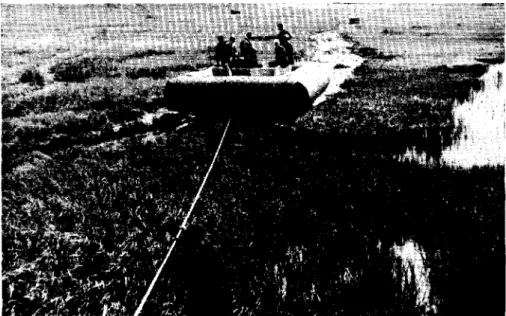
-is shown in Figure 3, in a photograph showing the PI condition III a Scottish
peat bog near Biggar, Lanarkshire. Beneath HE coverage old beach ridges were common. Some other types signified hummocking, others hidden boulders. Terrain irregularities of various types could be linked with vegetation character, The chief physiographical features and cover types with which they are found are listed elsewhere."
THE ROY AI. SOCIETY OF ARTS
FIGURE3. A modified version of the 'lVater Buffalo' trarelling by icincli in FI peatland with open pending
In northern Canada an unusual set of physiographical features arises because of the continental climate and presence of permafrost. Every spring the top of the frozen mass hidden within the peat slowly descends. The insulating effect of the peat ensures that the process of thawing is a slow one. It also obtains that the surface contour of the ice differs as to the pattern, depending in part at least upon the nature of the peat enclosing it. Thus, ice-surface contour hidden beneath the surface, and which is important in assessing terrain, can be suggested by indirect reference to surface cover. This completes the task of relating surface to subsurface and affords the last step facilitating interpretation of subsurface character.
In spite of progress not all the difficulties are solved yet. Earlier it was emphasized that access over certain types of peat-lands is well-nigh impossible. Thus classification, much less utilization, is still difficult to achieve. This is why techniques of aerial survey have been devised and applied. For these matters, a separate study developed with the ground level investigation.
The first aerial photography recording intimate details of muskeg was achieved with the assistance of the Royal Canadian Air Force. With a special camera housed in the belly of a 'plane, and synchronized as to shutter speed with the speed of the 'plane, continuous strip photographs were taken in Kodacolour at altitudes not exceeding 300 feet. These were later supplemented by
air-photo-graphs of the same terrain from several altitudes up to 17,000feet. The operations
were repeated at different times of the summer and the colour records were augmented by photographs in black and white. Finally, from a different source air-photograph records taken at 30,000 feet became available.
PEAT IN CANADA AND BRITAIN
All of this material was brought into use by comparing vegetation patterns experienced on the ground with 'air form' patterns seen in the air-photographs. It will be appreciated that air-ground comparisons in the initial phases of the work required much study, and much checking had to be done before an interpretive method could he devised in reliable fashion. Low altitude air-form patterns seen as configurations on the photographs had to be explained in terms of either single, or more often groups of, cover formula-, Once this had heen achieved for standard conditions, the procedure was extended to include all conditions encountered to r .ooo-foot altitudes. The interpretive method was then constructed on the basis of a number of cases where ground condition could be checked. The results and methods arc now printed in handhook form." The final stage in the aerial work has yet to be completed. However, some results may he offered here. It has been found necessary to delineate for investiga-tion five major types of 3o,000-foot air-form pattern. These are distinctive, and have been named Dermatoid, Stipploid , Terrazzoid, Marbloid and Reticuloid. Each pattern has necessitated its own research investigation. The results were in part expressed in a recent paper presented at the Annual Meeting of the Canadian Institute of Mining and Metallurgy (Petroleum Division). Here reference was made to the fact that the first interpretive data alluding to subsurface conditions, and derived from 3o,000-foot inspection, had been procured.!' It may now be reported that data of this nature are at present being put to practical purpose in northern Canada. It has been possible to advise on route direction for summer access requirements north of The Pas, Manitoba, in an area where transportation of heavy loads is needed for distances up to one hundred miles. Qualitative information is also suggested on relative peat depth, bearing capacity, subsurface ice character and drainability for every quarter mile of route selected.
However, because of the low shear strength of peat mats, and low bearing response to heavy loads, selected routes have a high frequency of deviation. Thus, in many cases route length is as much as one-third longer than the shortest distance connecting the extremities of the routes. When journeys are longer than ten miles, this factor becomes considerahle, and may seriously limit operations or cause them to be discarded.
For this reason particularly, many engineers in Canada are greatly concerned, and it is quite understandable, Attempts are being made to derive engineering tests to parallel those made on mineral soils. Techniques of road construction are under consideration.8, 9>111 Vehicle performance and manceuverability are
subjects of interest and study wherever muskeg is involved. All availahle information is being co-ordinated into a bibliography of muskeg and peat-land research.11
In the matter of vehicle development Britain, in the opinion of the author, is well ahead. The first vehicle to get bogged down in peat-land and pull itself out effectively was designed by James Cuthberton, O.B.E., of Biggar, Scotland. Known as the 'Water Buffalo', this vehicle, operating on tracks, is capable of quite remarkable performance in peats of fairly low shear strength. In that it is
THE ROYAL SOCIETY OF ARTS
buoyant in saturated peat it is never likely to submerge. When tractive effort fails it winches its way out of the predicament on an anchored wire cable. Under these circumstances it can haul several tons, or do the equivalent in other types of work, for example, ditching or laying conduit.
A modified version of the Water Buffalo, also designed under Mr. Cuthber-ton's direction, has recently been produced, and sent off for operations in Canada following successful trials in Lanarkshire. One of the most significant features about it is its complete buoyancy in open fresh water. That it can proceed over the worst category of peat-land notwithstanding its ten tons and a five-ton haul load is nothing short of remarkable. Like its prototype it depends upon a cable when all tractive effort fails. The cable loops over a capstan-type winch which operates at a speed equivalent to that of the tracks. The anchor for the cable is easily secured by half-inch steel tubes which are inserted into the terrain through holes in the anchor plate. Pressure applied by pushing with the palm of the hand on the frec cnd of the tubes is ample for driving them into the soft peat. If more than one passage of the vehicle is required the right-of-way subsequently floods, and the Water Buffalo depends largely upon its buoyancy potential. Complete buoyancy is achieved by the large tanks applied on all sides of the hull.
An extension of the principles employed in the \Vater Buffalo has been suggested-" in what is known as the Slipe Haul System. For this, the hull of the vehicle is somewhat barge-shaped. Four aeroplane-type wheels are built into the hull for buoyancy when traversing intermittent mineral terrain or relatively hard peat-land. Power generated in the machine is applied to a capstan-type winch operating on a three-quarter-inch steel cable. Because the wheels are unpowcred , the machine when in operation depends entirely upon the cable which is laid down over the predetermined route prescribed according to the procedure suggested earlier. These powered Slipes now under development at Biggar are much cheaper than Water Buffaloes, thus allowing for gteater load-carrying potential with less expenditure. Chance for mechanical failure is lessened and the vehicles, several to a cable, can travel the shortest possible route over the most difficult terrain without embarrassment.
It would now seem that the way is clear for a stepped-up programme of peat-land exploitation in both Britain and Canada. With access difficulties largely obviated, construction and utilization can bc encouraged. It is hoped
that muskeg classification and interpretive procedure now possible will give direction on matters of drainage should this be desirable for agricultural and forestry purposes. Removal of peaty overburden for strip-mining can be achieved with happier results economically with the application of interpretive measures, Better and more lasting roads can be built with the improved chances of good planning. For the same reasons it is hop cd that procurement of properly processed peat for consumption in electric power production will be facilitated. Certainly in this and other respects we can hope for better management of peat resources-a conservation measure necessary in wise national economy.
It seems appropriate to mention here that peat-land study as suggested in this
PEAT IN CANADA AND BRITAIN
account is known in Canada as Palseovegetography. The author readily agrees that the expression is somewhat unpalatable. But it does not suggest-and this is worth emphasizing--that muskeg or peat-land is merely peat. For convenience, if for nothing else, it is surely wise to agree that these entities define ordered accumulations of fossilized plant-remains existing in association with specified mineral-soil sublayers. The distinctive living vegetation covering the peat, and the attendant physiographical phenomena, are no less a part of the complex. The whole is now hecoming known as organic terrain.
ACKNOWLEDGMENTS
The author is indebted to the Associate Committee on Soil and Snow Mechanics, National Research Council, Ottawa, and to the Defence Research Board (Geophysics) of Canada for financial aid supporting the Canadian aspects of these investigations.
DISCCSSJON
THE CHAIR'\IAN: I am sure we are all extremely grateful for this very interesting paper. Peat is principally utilized as a source of fuel: many Scots people say there is no fire in a room which is so delightful as a peat fire. More recently, of course, as seen in Ireland and in Scotland, came the attempt to use those great peat deposits as a source of energy to which Professor Radforth has already referred. I think from his paper to-day we see much greater possibilities underlying those well-known peat deposits.
J would like to ask Professor Radforth on my own behalf how far do those deposits, of which he is examining the microfossils, give any insight into the former vegetation which has been studied in the past, I believe, by pollen work especially in Scandinavia? I wonder if these two lines of work are correlated at all ?
THE LECTCRER: I think I can give some sort of encouraging answer. The micro-fossils to which J have been referring are, in fact, I am sorry I did not make this clear, pollens and spores. They are, however, not mainly pollens and spores of trees, they are pollens and spores of plants that have contributed them from in situ positions, that is with direct reference to the area in mind. Pine pollens have been found over Greenland having been blown there from the Labrador coast. We also find pine pollens in the Churchill area and yet there are no pine trees for sixty to seventy miles away and therefore it is somewhat dangerous to refer to these pollens, if we are thinking of tree pollens, unless we can estimate what their relative importance is with respect to the site which we have in mind. However, if we refer to pollens and spores of plants grown ill situ for the history of the peat, then we can get a better idea of the construction and really make valid use of these pollens.
THE CHAIRMAN: I do not think we could have had a better paper to introduce us to this very interesting topic, which is perhaps completely new to us, than that which has been given to us by Professor Radforth. I marvel at the way in which he could speak without a note to his slides or the film, and make everything so wonder-fully clear to us, whether he was dealing with the wilds of Canada, the northern part of Great Britain, or the plague of mosquitos and black fly to which he made just adequate reference. I know from what I have heard from Professor Buxton who worked in that part of the country that it is a real menace. I would therefore like on your behalf to thank Professor Radforth for his very brilliant paper.
A 'Vote of thanks to the Lecturer was carried with acclamation, and the meeting then ended.
THE ROYAL SOCIETY OF ARTS REFERENCES
I. R. A. Hemstock. 'Be-anomie Aspects of Muskeg with respect to Oil Production'. Report Tech. Sess. i.l1uskeg Subcommittee, Assoc. Com. Soil and Snow Mvch, Natl. Res. Coun. Ottawa. 1956.
2. A. L. Gardner, L V. Hunt, and 1. \V. Mitchell. 'The "Muirfad" Technique of Pearland Improvement'. [nl,
British Grassland Soc. Vol. 9. NO.3, September, 1954.
3· N. VV. Radforfh , 'Suggested Classifications of Muskeg for the Engineer'. Engineering [nl. Tg52. 3.5 ; 1-12.
4. 'The Use of Plant Material in the Recognition of Northern Organic Terrain Conditions', Trans. Roy. Soc. Canada, '953. Series III, 47, Sec. V; 53-7!.
5. 'Palaeobotanical Method in the Prediction of Subsurface Summer Ice Conditions inNorthern Organic Terrain'.
Trans. Roy. Soc.cLセョ。、。L 1954. Series III, 48, Sec. V ;UQセVTN
6. 'Organic Terrain Organization from the Air'.Handbook No. 1. (Altitudes less than 1000jeet), Canada, Dept.
of National Defence, Defence Research Board, Ill{ No. 95.
7. 'Muskeg Access with Special Reference to Problems of the Petroleum Industry'. Jnl. CanadianLnst.セャヲゥョゥョァ
and. Metallurgy, 1956 (in press).
8. \"'l.C. Harrison. 'Primary and Secondar-y Access OVer Mudkeg in Forestry Practice'. Proceedings ofthe lllestern Micskrg Research i.Weeting. znd. Morcti, 1955. Technical Memorandum No. 38, National Research Council, Associate Committee on Soil and Snow Mechanics, September, 1955.
9. 1. C. MacFarlane. 'Techniques of Road ConstructionOverOrganic Terrain'. (Paper presented at the Technical
SeS::::iOIl:; (Ifthe Subcommittee Muskegof the Associate CommitteeallSoil and Snow Mechanics, National Research Council, February, 1956.)
10. ] .O. Martineau. 'Muskeg Problems in Quebec Highway Construction'. Proceedings of the lVesterll iWuskeg Research]'vleeting, znd -"larch, 1955. TechnicalJle1norandum No. 38, National. Research Council, Associate Committee on.. Soil and Snou' Mechanics,September, 1955.
II. 1. C. Macf-arlane. 'A Preliminary Annotated Bibliography OIl Muskeg". Division of Building Research National Research Council, September, 1955.
12. Lames Cuthber ton. 'The Slips-Haul Xlethod for Organic Terrain Access' . •"Haauscriptarticle, 1956.
Printed \),
(;E'I. B.\lun:u セ|Z セゥャ|M LTD ..
Ftu-ui v.rl:-i(r't't.H1]1)'lril.
NATIONAL RESEARCH COUNCIL
ASSOCIATE COMMITTEE ON SOIL AND SNOW MECHANICS LIST OF TECHNICAL MEMORANDA
1 Proposed field soil エ・ウエゥョセ device. August 1945
*
2 Report classified "restricted". September 191.5 3 Report classified "confidential". November 19454 Soil survey of the Vehicle Proving Establishment, ottawa, Oct. 1045
*
Method of measuring the significant characteristics of a snow-cover. G. J. Klein. Nov. 1946*
6 Rer-or-t classified "confidential". November 1945 7 Rerort classified "restricted". March 1947. 8 Report cbssified "confidential". June 1947
q Proceedings of the 1947 Civilian Soil Mechanics Conference. Aug. 1947
*
10 Proceedings of the Conference on Snow and Ice, 1947. Oct. 1047*
11 Proceedings of the 1948 Civilian Soil Mechanics Conference. Oct. 1949*
12 Index to Proceedings of Rotterdam Soil Mechanics Conference. Soil MeChanicsBulletin No.1. May 1949
*
13 Canadisn papers: Rotterdam Soil Mechanics Conference. June 1949
*
14 Canadian papers presented at the Oslo meetings of the International Unionof Geodesy and Geophysics. December 1949
15 Canadian survey of physical characteristics of snow-covers. G. J. Klein. April 1950
16 Progress report on organic terrain studies. N.W.Radforth. April 1950 17 Proceedings of the 1949 Civilian Soil Mechanics Conference. Aug. 1950
18 Method of measuring the significant characteristics of a snow-cover. G.J.Klein, D.C.Pearce, L.W.Gold. November 1950
10 Proceedings of the 1950 Soil Mechanics Conference. April 1951
20 Snow studies in Germany. Major M.G.Bekker, Directorate of Vehicle Development, Department of National Defence. May 1951
セャ The Canadian snow survey, 1947-1950. D.C.Pearce, L.W.Gold. Aug. 1951
セR Annual rerort of the Canadian Section of the International Society of Soil Mechanics and Foundation Engineering (June 1950 - June 1951). Soil Mechanics Bulletin No.2.
23 Proceedings of the Fifth Canadian Soil Mechanics Conference, Jan.lO and 11, 1952. May 1952
LIST OF TECHNICAL MEMORAllDA (Continued)
24 A suggested classification of muskeg for the en,;ineer. N.W .Radforth. May 1952
25 26 27 28 29 30 31 32 33 34 35 36
Soil mechanics papers presented at the Building Research Con,;ress 1051. November 1952
Annual report of the Canadian Section of the Internationsl Society of Soil
Mechanics and Foundation Engineering (June 1951 to June 1952). Soil Mechanics
Bulletin No.4. December 1952
Proceedings of the Sixth Canadian Soil Mechanics Conference, Winnipeg,
December 15 and 16, 1952. May 1953
The use of plant material in the recognition of northern organic terrain
characteristics. N.W.Radforth. March 1954
Construction am maintenance of roads over peat. F. E. D..,.t>urgh am E.R. McKillop
(Reprinted with permi.sion of D.S.I.R., Great Britain.) July 1954
Canadian paper. presented at the Third International Conference on Soil
Mechanics am Foundation Engineering. July 1954
The International Classification for Snow. (Issued bythe Commission on Snow
am Ice of the International Association of IIydrology.) aオセウエ 1954
Annual Report of the Canadian Section of the International Society of Soil
Mechanics and Foundation Engbeering. June 1953 to June 1954. Soil Mechanics
Bulletin No.5. July 1954
pイッ」・・、ゥョセウ of the Seventh Canadian Soil Mechanics Conference, Ottawa,
December ioam 11, 1953. September 1954
Palaeobotanical method in the prediction of sub-surface sUlllllllr ice comitions
in northern organic terrain. N.W.Radforth.
Proceedings of the First Regional Soil Mechanics Conference, Fredericton, April ?3 and 24, 1954
Proceedings of the セ Canadian Soil Mechanics Conference, ottawa,
December 16 and 17, 1954. April 1955
37 Guide to the Field Deecription of Soils tor En!tineerin!! Purpoaes , December
1955. Price 10 cents.
38 Proceedings of the Western Muskeg Research Meetin!t March 2, 1955.
Septellber 195 c.
39 Range of Structural Variation in Organic Terrain by Dr. N.W.Radforth,
March 1956.
40 Annual report of the Canadian Section of the International Society at Soil
Mechanics and Foundation Engineering (June 1954 - December 195<;). Soil
Mechanics Bulletin No.6. May 1956
41 Proceedings of the Ninth Canadian Soil Mechanics Conference, Vancouyer,
December 15 and 16, 1955. October 1956
42
Proceedings of the EasT-ern Muskeg Research Meeting, February 22, 1956.October 1956
43 Muskeg Access, with Special Reference toProblemB of the Petroleum Industry
by Dr. N.W. Radforth, November 1956
44 Guide to a "ield Description ofセᄋオウォ・ァN Prepared by 1.0. MacFarlane.
January 1957. Price 10 cents.
Coupons for the purchase of publicatilY.1s of the Associate COlIIIIl1ttee on Soil am Snow Mechanics are availa.ble in denOJllinations of 5, 25 am 50 cents.