Conferences & Meetings 183
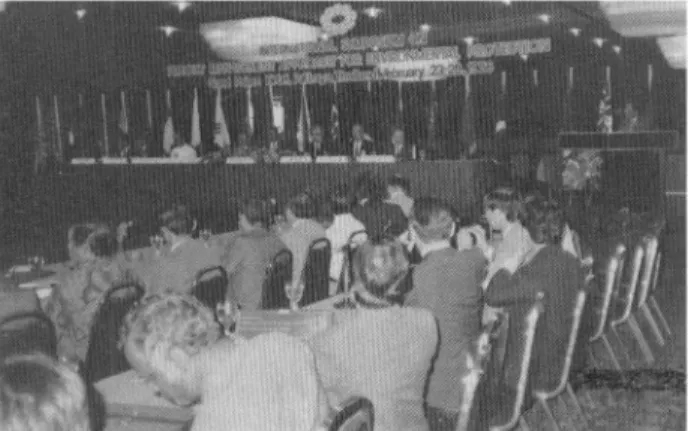
FIG. 1. Looking over a 'wing' of participants to the colourful,
flag-draped and flower-decked platform, with speaker on right.
Anat Arbhabhirama, President of the Thailand Develop-ment Research Institute, that to Theme B by Dr Hans Gottinger, Visiting Professor in the Department of Systems Engineering, University of Virginia, and that to Theme C by Dr Nay Htun, Director and Regional Representative for Asia and the South Pacific, United Nations Environment Programme.
Besides the main sessions dealing in turn with various aspects of those three chosen themes, there were multiple group discussions of each theme which were presented together before the treatment of the next theme began—so enabling participants to interject topics from their own experience and test in many ways, with interchange from a wide range of international expertise, the suitability of the project management approach as a tool for the solution of environmental problems. And whereas the specific refer-ences were most commonly to the developing countries of southeastern Asia, there was plentiful interest for others as well—such that it is much to be hoped that the pick of the papers can be published in dignified book form for world-wide consumption.
The problems resulting from using English as the sole language of the Symposium were effectively circumvented by having almost all of the papers available in well-pre-pared mimeographed form, and this seems to be the solu-tion when simultaneous interpretasolu-tion proves impractica-ble. During the final session, when the undersigned was Chairman and after the scheduled business of the Sympo-sium had been concluded, matters of the future and of definition were discussed, and there seemed to be general agreement among the remaining 85 participants as to the great importance of the project management approach to the environmental movement, even though no formal statement was issued or deemed necessary. Yet widely needed would be due precision in matters of definition—so that all using or hearing a particular term would mean and understand the same by it, or at least be forewarned to explain any divergence in their use of it.
Meanwhile to us, project management is simply the management of projects—regardless of any use of mathe-matical or other formulae, modelling, or whatever. A pro-ject being a prescribed obpro-jective that is commonly reached by planned stages of action, these will need supervised management and due treatment of any contingencies within the framework of the relevant executive, temporal, and budgetary, constraints. Applied to environmental pro-tection, project management incorporates due considera-tion of ecological factors and conservaconsidera-tion of all that
proves practicable among desirable aspects of the local, and ultimately of the global, environment.
Such consideration in an ecosystem context would seem to open up an improved prospect for Man's and Nature's future on Earth, as, surely, it can only be with wise planning and due project management in relation to global plans-of-action that The Biosphere can remain viable and the Earth decently habitable in the face of Man's relentless pandominance. Consequently this could indeed turn out to be, as was said more than once during it, a 'landmark symposium'.
NICHOLAS POLUNIN
WORKING SESSION OF I U C N ' S COMMISSION ON NA-TIONAL PARKS AND PROTECTED AREAS (CNPPA),
HELD IN BARILOCHE, ARGENTINA, 9-14 MARCH
1986
This was the third meeting of the Commission to address protected area issues in the Neotropical Realm. Seventy-one senior park agency officials and representatives from NGOs, UNEP, FAO, UNESCO, and the US Department of the Interior, from 22 countries, gathered for the five-days' session. In the spirit of the Commission's custom of 'keeping its feet on the ground', field trips to the adjacent Nahuel Huapi National Park and the Valdez Peninsula were also offered.
The working session was inaugurated by His Excellency the President of Argentina, Raul Alfonsin, who delivered a major statement on protected areas and conservation at the opening session. The technical session was co-chaired by IUCN's Vice-President and CNPPA Deputy Chairman Marc Dourojeanni, and by Dr Jorge Morello, Director of the host Argentine National Park Administration.
The main purpose of the meeting was to review the cur-rent conservation status of the 350 protected areas (52 million ha) in this diverse realm comprising the Neotro-pics. Forty presentations were made on various aspects of protected area management in their respective countries, which are being published in a proceedings volume. It was clear from the discussions that parks in the realm are in serious trouble owing both to constraints posed by the debt crises and from a host of direct threats—such as de-classif-ication, inappropriate internal development, and illegal narcotics cultivation. The situations in Brazil, Argentina, Costa Rica, and Venezuela, were singled out for special attention in resolutions.
A concluding output of the Working Session was the 'Nahuel Huapi Action Strategy for Protected Areas in the Neotropical Realm'. This document, prepared by the par-ticipants during the course of the meeting, spells out numerous detailed objectives and activities, at both na-tional and internana-tional levels, that must be strengthened or initiated to achieve more complete coverage and more effective management of parks and reserves in the future. The strategy itself (named after the park in which the meet-ing was held) follows in principle IUCN's Bali Action Plan and other protected area action plans that were prepared for the Indomalayan and Oceanian Realms.
JAMES THORSELL, Executive Officer IUCN's CNPPA
World Conservation Centre Avenue du Mont-Blanc
1196 Gland, Switzerland.
https:/www.cambridge.org/core/terms. https://doi.org/10.1017/S0376892900036985