CONFERENCES & MEETINGS
WORKING SESSION OF THE IUCN COMMISSION ON NATIONAL PARKS AND PROTECTED AREAS (CNPPA), HELD IN THE ' W NATIONAL PARK, NIGER, DURING
18-22 MARCH 1987
This was the third meeting sponsored by CNPPA to review protected-area issues in the Afrotropical Realm, for which some 40 senior park agency officials from 17 coun-tries gathered for the five-days' session. Included in the group were representatives from four aid agencies, indicat-ing the growindicat-ing donor interest in supportindicat-ing biological-diversity projects. Also included were, most gratifyingly, representatives of the last two countries in Africa that have not yet created protected areas—Equatorial Guinea and Guinea Bissau.
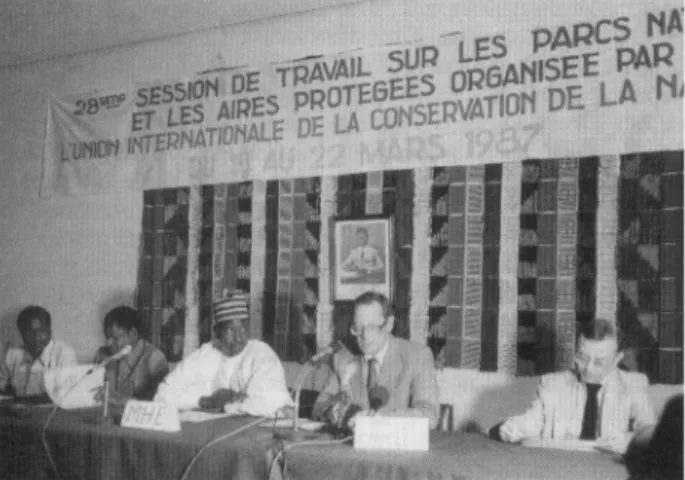
The Working Session was inaugurated in Niamey, capi-tal of Niger, by M. Attaher Darkoye, Minister of Environ-ment, who co-hosted the meeting. The technical sessions were co-chaired by Harold Eidsvik, Chairman of CNPPA, and Abdu Admou, Chief of Niger's Direction des Forets et de la Faune (Fig. 1).
The main purpose of the meeting was to review the cur-rent status of protected areas in the 'francophone' African region. Twelve countries from West Africa presented status reports on various aspects of protected area management in their respective countries, which are being published in a proceedings volume.
A second output from the Working Session was a much-revised third edition of an 'Action Strategy for Protected Areas of the Afrotropical Realm'. This document, which had been developed over the preceding six months by CNPPA members in Africa, was modified by the partici-pants to reflect better the priorities as currently defined in West Africa. The Action Strategy spells out numerous detailed objectives and activities, at both national and international levels, that must be strengthened or initiated to achieve more representative coverage, and more effec-tive management of parks and reserves, in future. The Strategy itself builds on and reinforces IUCN's Bali Action Plan* and the Biosphere Reserve Action Plan,f and com-plements other protected-area action plans prepared for other tropical realms.
* See The Bali Declaration', Environmental Conservation, 10(1), p. 73, 1983.-Ed.
t See 'Action plan for Biosphere Reserves', by Michel Batisse,
Idem, 12(1), pp. 17-27, map, 1985.
FIG. 1. Part of the platform at a Working Session. From left of right
are seen Abdu Admou, Attaher Darkoye, Harold Eidsvik, and Pierre Portas.
Aware that efforts to protect West Africa's natural heri-tage often go unrecognized, CNPPA also presented special valour awards for field officers in Tchad, Senegal, Ivory Coast, and Niger, who have performed special acts of brav-ery and merit in carrying out their duties. These included a token cash prize and were given to the following: — Robert Thei, of Ivory Coast, who was seriously
wounded when intercepting three armed poachers in the Tai National Park.
— Ahmed Tcholli, of Niger, who has been instrumental in involving local people in the planned Air Tenere Re-serve, demonstrating an exceptional ability to integrate protected areas with sustainable development in the Sahel.
— The wardens of the Zakouma National Park, in Tchad, who continued to protect the Park despite the period of civil disturbances, often without equipment or salar-ies.
— Mamadou Sadio, a warden in the Niokolo Koba Na-tional Park, in Senegal, for excepNa-tional efforts in com-bating poaching in the Park.
JAMES THORSELL, Executive Officer CNPPA
International Union for Conservation of Nature and Natural Resources
Avenue du Mont-Blanc &196 Gland
Switzerland.
WORKSHOP ON BOTANICAL RESEARCH AND MANAGE-MENT IN GALAPAGOS, HELD AT THE CHARLES DARWIN RESEARCH STATION, SANTA CRUZ ISLAND, GALAPA-GOS ISLANDS, ECUADOR, DURING 13-19 APRIL 1987 This workshop-conference was held under the joint aus-pices of the Charles Darwin Foundation and the Galapagos National Park Service. Almost 100 invited participants, graduate students, administrative and clerical personnel, assistants and helpers, took part—including the staff of the Charles Darwin Station. Of this total, 30 were from outside and the rest from Ecuador, every opportunity being given to the Ecuadorean participants to have a major role in the discussions.
The Galapagos are an oceanic volcanic group of rela-tively small islands, lying astraddle the Equator about 500-600 miles (800-960 km) west of the mainland of Ecuador, which is one of the more interesting republics of South America. The largely unique native biotas of the islands have been disturbed by Man and his associated plants and animals—beginning with visits by pirates and whalers, who removed large numbers of the remarkable giant tortoises for provisions for their voyages.
Since those early times there has been a steadily increas-ing influence by Man, especially in the form of introduc-tion, deliberately or accidentally, of alien plants and ani-mals. These are altering, irreversibly, the character of one of the world's more interesting collective biotas. In addi-tion, attempts at agriculture—mostly more destructive than productive—have gone on for well over a hundred years, in an environment that is eminently unsuited for agriculture. These attempts have caused serious alterations to considerable areas in the moister uplands of the larger islands. Alien animals, plants, and humans, now comprise major components of most of the island ecosystems in the archipelago.
Serious scientific research of major importance in the islands began with the visit of Charles Darwin on HMS 277
Environmental Conservation, Vol. 14, No. 3, Autumn 1987—© 1987 The Foundation for Environmental Conservation—Printed in Switzerland.
https:/www.cambridge.org/core/terms. https://doi.org/10.1017/S0376892900016635