Developments and Advances in Nonlinear Terahertz Spectroscopy
by
Nathaniel Curran Brandt
B.S. Chemistry, B.A. Mathematics, University of Saint Thomas (2008)
Submitted to the Department of Chemistry
in Partial Fulfillment of the Requirements of the Degree of
Doctor of Philosophy _ __ ___
at the
MASSACHUSETTS INSTITUTE OF TECHNOLOGY
June 2014
MASSACHUSETTS MNVIUE, OF TECHNOLOGYJUN
3
0 2014
LIBRARIES
---- ----.
@
2014 Massachusetts Institute of Technology. All rights reserved
Signature redacted
Sig n
atu re of
Act o r ...
Signature redacted
Department of Chemistry
May 16, 2014
Certified by...
Keith A. Nelson Professor of ChemistryThesis Supervisor
Signature redacted
Accepted by...
Robert W. Field
Chairman, Department Committee on Graduate Students
This doctoral thesis has been examined by a committee of the Department of Chemistry as follows:
Signature redacted
Professor Robert W . Field... ...
Chairperson
Signature redacted
Pro fe sso r Ke ith A . N e lso n... Thesis Supervisor
Signature redacted
Advances and Developments in Nonlinear Terahertz Spectroscopy
by
Nathaniel Curran Brandt
Submitted to the Department of Chemistry
on May 16, 2014, in partial fulfillment of the
requirements for the degree of
Doctor of Philosophy
Abstract
Nonlinear terahertz (THz) spectroscopy is a rapidly developing field, which is concerned with driving and observing nonlinear material responses in the THz range of the electromagnetic spectrum. In this thesis,
I present several advances in nonlinear THz spectroscopy that expand the range of systems in which
responses may be driven, the types of responses that may be initiated, and the way in which these responses may be observed.
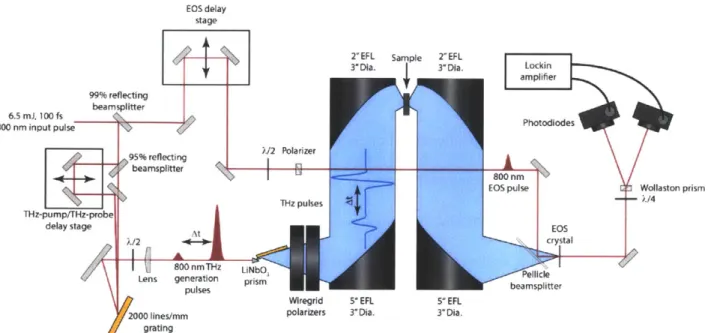
Sufficiently strong THz pulses are generated using the tilted-pulse-front technique, and are collected, focused, and detected using a THz spectrometer specifically designed for maximum peak THz electric field strength and maximum flexibility, allowing for a wide range of experimental geometries to be implemented. Further enhancement in the peak THz electric field strength is obtained through the use of metamaterial structures, which concentrate free-space THz fields in their antenna gaps.
Impact ionization was observed in high-resistivity silicon, a material in which no nonlinear THz response had been previously seen, using metamaterial structures to enhance free space THz electric fields. Using three-dimensional metamaterial structures, the THz magnetic field is shown to also be capable of driving ionization processes both in high-resistivity silicon as well as air. Using metamaterial structures with open gaps, the THz electric field is shown to induce breakdown in air at both high and low pressures due to field ionization processes involving the gold metamaterial antennas. Furthermore, THz-driven electromigration of the gold metamaterial antennas is observed. Probing of THz-driven structural changes in both vanadium dioxide and perovskite ferroelectrics is demonstrated using femtosecond X-ray pulses from the LCLS facility at the SLAC National Accelerator Laboratory. Finally, ongoing results involving energetic materials, stimulated Raman measurements, and Stark effect measurements are discussed. This work, coupled with the ongoing expansion of nonlinear THz techniques and potential applications demonstrates the continued development of nonlinear THz spectroscopy into a robust and valuable method for investigating fundamental processes in a multitude of systems.
Thesis supervisor: Keith A. Nelson Title: Professor of Chemistry
Acknowledgements
This thesis was made possible through the support and inspiration of many, many people, to whom I owe a great deal of thanks.
Even though I was fascinated by the periodic table when I was a child, I didn't always want to study chemistry. However, I was talked into registering for AP Chemistry as a senior in high school by Ms. Natalie Rasmussen, and I soon realized how much I enjoyed the subject, even though I swore up and down I still wanted to be an engineer. Thanks to the intercession of Dr. David Boyd at the University of Saint Thomas, I made the switch to chemistry for good, and I am thankful for his persuasion and support.
I was fortunate enough to perform research in the lab of Dr. Joe Brom at the University of Saint Thomas
for three years. His patient guidance and methodical, rigorous, yet practical approach to problem solving taught me many lessons that would be of great use in my work at MIT. It was my experiences in his lab that led to my desire to attain a PhD in physical chemistry.
My ability to attend the University of Saint Thomas in the first place was made possible through the
generosity of Ryan Companies through the Ryan Construction Company Scholarship. Their financial support of my undergraduate education allowed me the freedom to pursue my undergraduate research work and my goal of post-graduate studies in chemistry.
My time at MIT has been greatly enhanced though the help and support of many people. I have been
truly fortunate to have had Prof. Keith Nelson as an advisor for six years. His relentless energy, enthusiasm and optimism, even in the face of seemingly impossible deadlines and long experimental odds, have been inspiring throughout my time in his group. Keith's guidance and support of my work and my ideas, no matter how far-fetched, has been unwavering, and for that I am truly grateful.
I have had the extremely good fortune to spend the entirety of my time in the Nelson group working
closely with Dr. Harold Hwang. Harold is a truly talented teacher, and his prowess at both running experiments and understanding scientific concepts has been a constant source of inspiration and motivation to me. His contribution to my development as a scientist cannot be understated, and neither can the value of his friendship. Our six years of performing nonlinear THz measurements together have resulted in many experiences which I will not soon forget, including spending late nights fighting with liquid helium equipment, exploring the streets of Kyoto at the crack of dawn, sleeping in a car in the parking lot of the LCLS, frantically trying to purchase a space heater at Target in the middle of the night, repeatedly driving into the Palo Alto Transit Center by mistake, and lighting a campfire with cask strength bourbon and a plastic bag. While I look forward to my future as a postdoctoral associate at the University of Minnesota, I will truly miss working with Harold.
I was lucky enough to have joined "Team THz", as we like to call ourselves, when it consisted of Harold,
Dr. Ka-Lo Yeh, and Dr. Matthias Hoffmann, and nonlinear THz measurements were just starting to work properly. This gave me the opportunity to learn the experimental basics of nonlinear THz spectroscopy
from the very people who had helped develop it into a field in the first place. Matthias was instrumental in teaching me the basics of THz spectroscopy during my first year, and his expertise and undying pursuit of experimental excellence made a strong impression on me. I count myself lucky to have learned from him, and I have enjoyed getting to work with him further at the LCLS in later years.
During my time in the Nelson group, Team THz has also included Dr. Brad Perkins, Dr. Sharly Fleischer, Dr. Xibin Zhou, Zhao Chen, Jian Lu, Yaqing Zhang, Leora Cooper, Xian Li, and Dr. Brandt Pein, in addition to our waveguided counterparts, Dr. Kit Werley, Dr. Steph Teo, Ben Ofori-Okai, and Prasahnt Sivarajah, and I am glad to have worked with each of them. I have had the good fortune to work closely with Ben and Steph in particular, and I am very grateful for their continual help, support, friendship, and encouragement. I won't soon forget late-night liquid helium plumbing with Ben while wearing suits, and
I have been glad to have Steph as my companion in thesis-writing purgatory. I am thankful for Brad's
guidance, especially in all things electrical and mechanical, and our hastily-arranged last-minute trip to the Advanced Photon Source was quite the learning experience. I am glad to have learned from Sharly's experimental prowess and no-nonsense approach to even the most complicated experiments, and he always provided a sounding board for ideas and scientific discussion, as did Xibin and Zhao. Kit's passion for total excellence in all things optical provided a source of many late-night discussions, and many improvements to my experimental designs. I have worked closely with Jian during the last few years as he prepares to take over the lab, and I am confident that his prodigious experimental skill and liberal use of lucky cat statues will take nonlinear THz spectroscopy to new heights. Prasahnt, Leora, Yaqing, Xian, and Brandt are newer additions, and I am excited to see where they take the project in the future. I am especially thankful for Prasahnt's help with SEM imaging and Leora's assistance growing RDX crystals. The Nelson group as a whole has proven to be a supportive and pleasant place to work, and I thank my colleagues for making life enjoyable both inside and outside of lab. In particular, Kara Manke has proven to be a good friend and a source of advice and guidance. I am also thankful for the assistance and guidance of many others, including Dylan Arias, Patrick Wen, Johanna Wolfson, Jeremy Johnson, David Veysset, Felix Hofmann, Alex Maznev, Jeff Eliason, Colby Steiner, Yongbao Sun, and Sam Teitelbaum. Our collaborators at the Boston University Photonics Center in the research groups of Richard Averitt and Xin Zhang are indispensable to the majority of the research presented here through their efforts in designing and fabricating THz metamaterial samples. In particular, Dr. Kebin Fan has been the source of many fantastic sets samples and the necessary simulations to understand their behavior. For his help and support I am very thankful. I have also had the good fortune to work with Dr. Mengkun Liu, Elsa Abreu, and Aaron Sternbach on the vanadium dioxide measurements at the LCLS.
I am extremely grateful to our collaborators at the LCLS, Stanford University, and Argonne National Lab,
in particular Prof. Aaron Lindenberg, Dan Daranciang, Dr. Haidan Wen, Dr. Matt Highland, Frank Chen, Dr. Alex Gray, Dr. Diling Zhu, and Dr. Mike Glownia, for leading and supporting the four LCLS beamtimes in which I have been privileged enough to take part. My time at the LCLS has been an incredible experience, and I thank them and the rest of our teams (see Chapter 6) for making it possible.
Many other people at MIT have contributed directly or indirectly to the success of the research presented in the preceding pages. In particular, Marc Belanger at the Edgerton Machine Shop, Tim McClure at the CMSE, and Li Li at the DCIF have been extremely helpful, as have the wonderful staff of the Chemistry Education Office. Fr. Richard Clancy and Tech Catholic Community have also been a source of guidance and support during my time here.
My good friends and long-time roommates Andrew Horning and Shane Yost have been constants in my
life during my graduate work. Throughout our time as PhD students, we've experienced ups and downs together, jumped out of planes together, vented at one another about whatever was currently broken in lab, and worn a lot of argyle, among many other shared experiences. I greatly value their support and encouragement both inside and outside of lab.
My parents, Mark and Jennie, have been approving of my desire to be a scientist since I was young, even
when I burned their sidewalk, filled their basement with HCI, and set my pants on fire. For their love, support, and encouragement throughout my life, along with that of my sister Hannah, I am very thankful.
Finally, I owe a special thanks to my wonderful fiancde, Lanita Gaworski. My favorite memories of graduate school are the times I've spent with you, including exploring Boston by foot, bicycle, and train, visiting Acadia, Providence, and Manchester-by-the-Sea, grilling in my asphalt backyard, and adopting our cat in the middle of nowhere in the midst of a rainstorm, amongst many others. Your love and support during graduate school has made all the difference, and you've always been there for me when I've needed it the most. We may have spent most of my graduate career 1,124 air miles apart, but I've always known that you were right beside me the whole time. I look forward to spending the rest of my life with you.
In primis Deo gratias.
Nathaniel Brandt
Contents
Chapter 1 - Introduction 17
References 20
Chapter 2 - Generation, Enhancement, Detection, and Analysis of High-Field Terahertz Pulses 23
2.1- Tilted-Pulse-Front THz Generation 24
2.1.1 - Optical Rectification for Low-Power THz Generation 24
2.1.2 - Optical Rectification for Higher Power THz Sources 27
2.1.3 - Optical Rectification in LiNbO3 with Tilted Pulse Fronts 28
2.2 - Free-Space THz Field Enhancement with Metamaterial Structures 32 2.3 - Electro-Optic Detection of Free-Space THz Radiation 35 2.4 - Data Analysis for THz Transmission Spectroscopy 37
2.5 - Conclusions 39
References 39
Chapter 3 - Terahertz Spectrometer Design, Development, and Enhancement 43 3.1 - Basic THz Collection, Focusing, and Use 44
3.2 - Collection Optics for Tilted-Pulse-Front Sources 46
3.3 - Constructed Nonlinear THz Spectrometer 48 3.4 - Experimental Geometries for Various Types of Nonlinear THz Measurements 50
3.4.1- Nonlinear Transmission Measurements 50
3.4.2 - THz-Pump/Optical-Probe Measurements 52
3.4.3 - THz-Pump/THz-Probe Measurements 53
3.4.4 - THz-Pump/ISRS-Probe Measurements 54
3.5 - Conclusions 56
References 57
Chapter 4 - Nonlinear Terahertz Responses of Two- and Three-Dimensional Metamaterials on Silicon 59
4.1 - Background 60
4.1.1 - Nonlinear THz Spectroscopy Driven and Observed Using Metamaterials 60 4.1.2 - Three-Dimensional Metamaterial Structures 61 4.1.3 - High-Field Behavior of Hi-Res Silicon 62
4.2 - Experimental Apparatus 63
4.3 -Sample Description 64
4.4 - Nonlinear THz Spectroscopy of 2D SRR Arrays on Hi-Res Silicon 65
4.5 - Nonlinear THz Spectroscopy of 3D SRR Arrays on Hi-Res Silicon 70
4.6 - Discussion 71
4.7 - Conclusions 76
Chapter 5 - Metamaterial-Enabled Terahertz-Driven Atmospheric
Breakdown Phenomena in Microgaps 79
5.1- Breakdown in Microgaps 80 5.1.1- DC Breakdown Phenomena 80 5.1.2 - AC Breakdown Phenomena 85
5.2 -Sample Description 86
5.3 - Experimental Apparatus 89
5.4 - THz-Pump/THz-Probe Measurements at Atmospheric Pressure 91
5.5 - THz-Pump/THz-Probe Measurements at Low Pressure 97
5.6 - Discussion 101
5.7 - Conclusions 105
References 106
Chapter 6 - Ultrafast X-Ray Probing of Terahertz-Driven Structural Responses 109 6.1 - X-Ray Diffraction Probing Methods 110
6.1.1 - X-Ray Scattering by a Single Atom 110 6.1.2 - X-Ray Scattering by a Lattice 112
6.1.3 - Femtosecond XRD Probing 116 6.2 - Femtosecond X-Ray Pulses from the Linac Coherent Light Source 120 6.3 - THz Implementation at LCLS 122 6.4 - Ultrafast XRD Probing of the Insulator-to-Metal Phase Transition in Vanadium Dioxide 126 6.4.1- Vanadium Dioxide Background 126
6.4.2 - Sample Characterization 130 6.4.3 - THz-Pump/XRD-Probe Measurements of the THz-Driven IMT in V02 132
6.4.4 - V02 Conclusions and Outlook 135
6.5 - Ultrafast XRD Probing of Lattice Dynamics in Perovskite Ferroelectrics 138 6.5.1 - Ferroelectricity Background 138 6.5.2 - Femtosecond XRD Probing of Optically-Driven Responses in Lead Titanate 140 6.5.3 - Femtosecond XRD Probing of THz-Driven Structural Changes in Barium Titanate 147
6.6 - Conclusions 149
List of Collaborators 150
References 152
Chapter 7 - Outlook and Conclusions 155
7.1 - THz-Driven Energetic Material Decomposition 157 7.1.1 - Energetic Material Background 157 7.1.2 - Applying Metamaterial-Driven Field Enhancement to RDX 158 7.1.3 - THz-Driven RDX Removal from SRR Arrays 159
7.1.4 - Analysis of RDX Removal 161
7.1.5 - Discussion of RDX Removal Mechanism 165 7.2. - Probing THz-Driven Vibrations in RDX with Impulsive Stimulated Raman Scattering 166 7.3 - THz Quantum Confined Stark Effect Measurements 171
7.4 - Probing THz Interactions with Shocked Energetic Materials 173
7.5 - Conclusions 175
Chapter 1
Introduction
The infrared region of the electromagnetic spectrum, which extends from frequencies just below those of visible light to roughly 10" Hz, has been studied ever since its existence was discovered in 1800 by William Herschel'. Likewise, the radio and microwave regions of the electromagnetic spectrum, which extend from single Hz frequencies to approximately 10" Hz, have been well-explored
beginning with their demonstration in 1887 by Heinrich Hertz2
. Until recently, however, the frequency range between these two regimes, from approximately 1011 to 10" Hz, has been relatively unexplored. This range is referred to as the terahertz (THz) region of the electromagnetic spectrum, after its central
frequency of 1012 Hz, or 1 THz, and has been referred to as the "THz gap" due to its unexplored nature.
The reason for the lack of investigation into the THz region is easily understood by considering the methods used to generate electromagnetic radiation in each region bordering it. The infrared region may be accessed using optical methods; however, such methods are typically incapable of generating sufficiently low frequencies to access the THz range. Conversely, the microwave region of the spectrum is accessed by electronic means, but state-of-the-art electronics are still not sufficiently fast to reach into the THz range. As a result, the THz region is difficult to access.
The beginnings of filling the THz gap appeared in the 1970's, and involved two separate ultrafast laser-driven phenomena, both of which were to varying degrees investigated by David Auston. First, it was observed that THz-frequency pulses could be generated and detected through optical rectification
processes3-5 that are discussed in detail in subsequent chapters of this thesis. Secondly, Auston
demonstrated the use of photoconductive switches as both sources and detectors of THz radiation6-9 I
these devices, an ultrafast optical pulse irradiates a biased semiconductor and the resulting sudden acceleration of newly created free carriers produces a burst of current that radiates in the THz frequency range; or conversely, an optical pulse irradiates an unbiased semiconductor and an incident THz field provides a transient bias that accelerates the carriers, producing current that is measured electrically to reveal the field polarity and strength. Through the mid-1980's, many of the techniques that would form the backbone of modern THz science were developed, including (as discussed in further
chapters) electro-optic sampling0, the observation of THz Cherenkov radiation in LiTaO311"', THz
spectroscopy of lattice vibrations in LiTaO3"'14, time-domain THz spectroscopy5, and even
optical-16
pump/THz-probe spectroscopy of carriers in GaAs
In 1988, it was demonstrated that THz generation and detection by photoconductive switches
could be done in free space17, with similar demonstrations of free-space THz radiation from optical
rectification sources following'" 9, culminating with the first demonstration of the now-ubiquitous
source of free-space THz from optical rectification in ZnTe in 199420. Free-space THz detection based
upon electro-optic sampling was also developed around the same time 2. At this point, all of the
necessary components were in place to develop modern free-space THz spectroscopy, which has proved useful for observing spectral features in a multitude of systems, ranging from explosives to biological systems to semiconductors.
High-powered THz sources, however, have lagged significantly behind their lower-powered counterparts. Such sources are desirable for the investigation of a broad range of high-field ultrafast material responses, including carrier transport in semiconductors, domain switching in ferroelectric materials, and coupled interactions in molecular crystals. Until very recently, the only high-powered
sources of THz radiation included gas lasers23 and free electron laser-based systems24
poorly suited for laboratory-based nonlinear THz spectroscopy as a result of their narrow bandwidths and long pulse durations (and impracticality, in the case of the latter type of source). The advent of
tilted-pulse-front THz generation in LiNbO3, however, has allowed for tabletop, broadband, high-power
ultrafast sources of THz radiation in the - 0.2-2 THz range which are suitable for generating very strong
transient electric fields and driving nonlinear material interactionSIs-21. This has given rise to the field of
nonlinear THz spectroscopy, which has been demonstrated in a variety of systems, including
semiconductors28-30, liquids3 1
, molecular crystals3 2
, quantum paraelectric crystals33
, graphene34
,
superconductors35'36, and gases37
,38. Further advances into nonlinear THz spectroscopy have been made
possible through the use of metamaterial structures as enhancing structures for free-space THz
fields39
,40. In parallel developments, high fields extending to 10 THz and well into the IR spectral range
have been generated using other nonlinear crystalline materials as well using ionized gas-phase plasmas [refs]. As a result, nonlinear spectroscopy spanning the THz range is now possible on tabletop systems.
This thesis presents recent advances in nonlinear THz spectroscopy, beginning with a thorough background of the techniques necessary to generate, detect, and analyze high-power THz pulses, including a discussion of the use of metamaterial enhancement structures. Nonlinear THz spectrometer design is also covered. Following this, several recent measurements are presented, including metamaterial-enhanced nonlinear THz responses in high-resistivity silicon, metamaterial-coupled THz-driven breakdown phenomena, and femtosecond X-ray probing of THz-THz-driven structural responses. Finally, ongoing results and experimental developments concerning THz-driven responses in energetic materials and quantum dots are presented. The measurements presented here show that nonlinear THz spectroscopy is rapidly developing into a broadly applicable technique with a wide variety of implementations for study of many material classes and phenomena.
References
1. Herschel, W. Experiments on the refrangibility of the invisible rays of the sun. 90, 284 (1800).
2. Hertz, H. Ueber die einwirkung einer geradlinigen electrische schwingung auf eine benachbarte
strombahn. Ann. Phys. 270, 155 (1888).
3. Auston, D. H., Glass, A. M. & Ballman, A. A. Optical rectification by impurities in polar crystals.
Phys. Rev. Lett. 28, 897 (1971).
4. Auston, D. H. & Glass, A. M. Optical generation of intense picosecond electrical pulses. App.
Phys. Lett. 20, 398 (1972).
5. Shen, Y. R. Far-infrared generation by optical mixing. Prog. Quantum. Elec. 4, 207 (1976).
6. Auston, D. H. Picosecond optoelectronic switching and gating in silicon. Appl. Phys. Lett. 26, 101
(1975).
7. Auston, D. H., Johnson, A. M., Smith, P. R. & Bean, J. C. Picosecond optoelectronic detection,
sampling, and correlation measurements in amorphous semiconductors. Appl. Phys. Lett. 37, 371
(1980).
8. Smith, P. R., Auston, D. H., Johnson, A. M. & Augustyniak, W. M. Picosecond photoconductivity in
radiation-damaged silicon-on-sapphire films. Appl. Phys. Lett. 38, 47 (1981).
9. Auston, D. H. Subpicosecond electro-optic shock waves. App/. Phys. Lett. 43, 713 (1983).
10. Valdmanis, J. A., Morou, G. & Gabel, C. W. Picosecond electro-optic sampling system. Appl. Phys.
Lett. 41, 211 (1982).
11. Auston, D. H., Cheung, K. P., Valdmanis, J. A. & Klienman, D. A. Cherenkov radiation from
femtosecond optical pulses in electro-optic media. Phys. Rev. Lett. 53, 1555 (1984).
12. Kleinman, D. A. & Auston, D. H. Theory of electrooptic shock radiation in nonlinear optical media.
IEEEJ. Quantum Electron. 20, 964 (1984).
13. Cheung, K. P. & Auston, D. H. A novel technique for measuring far-infrared absorption and
dispersion. Infrared Phys. 26, 23 (1986).
14. Cheung, K. P. & Auston, D. H. Excitation of coherent phonon polaritons with femtosecond optical
pulses. Phys. Rev. Lett. 55, 2152 (1985).
15. Auston, D. H. & Cheung, K. P. Coherent time-domain far-infrared spectroscopy. J. Opt. Soc. Am. B
16. Nuss, M. C., Auston, D. H. & Capasso, F. Direct subpicosecond measurment of carrier mobility of
photoexcited electrons in gallium arsenide. Phys. Rev. Lett. 58, 2355 (1987).
17. Smith, P. R., Auston, D. H. & Nuss, M. C. Subpicosecond photoconducting dipole antennas. IEEEJ.
Quantum Electron. 24, 255 (1988).
18. Hu, B. B., Zhang, X.-C., Auston, D. H. & Smith, P. R. Free-space radiation from electro-optic
crystals. Appl. Phys. Lett. 56, 506 (1990).
19. Xu, L., Zhang, X.-C. & Auston, D. H. Terahertz beam generation by femtosecond optical pulses in
electro-optic materials. Appl. Phys. Lett. 61, 1784 (1992).
20. Rice, A. et al. Terahertz optical rectification from <110> zinc-blende crystals. App/. Phys. Lett. 64,
1324 (1994).
21. Wu, Q. & Zhang, X.-C. Free-space electro-optic sampling of terahertz beams. Appl. Phys. Lett. 67,
3523 (1995).
22. Jepsen, P. et al. Detection of THz pulses by phase retardation in lithium tantalate. Phys. Rev. E.
Stat. Phys. Plasmas. Fluids. Relat. Interdiscip. Topics 53, R3052 (1996).
23. Nonlinear infrared generation. (Springer-Verlag Berlin Heidelberg, 1977).
24. Williams, G. P. Filling the THz gap-high power sources and applications. Reports Prog. Phys. 69,
301 (2006).
25. Hebling, J., Almasi, G., Kozma, I. & Kuhl, J. Velocity matching by pulse front tilting for large area
THz-pulse generation. Opt. Express 10, 1161 (2002).
26. Yeh, K.-L., Hoffmann, M. C., Hebling, J. & Nelson, K. A. Generation of 10 pJ ultrashort terahertz
pulses by optical rectification. Appl. Phys. Lett. 90, 171121 (2007).
27. Yeh, K.-L., Hebling, J., Hoffmann, M. C. & Nelson, K. A. Generation of high average power 1 kHz
shaped THz pulses via optical rectification. Opt. Commun. 281, 3567 (2008).
28. Hoffmann, M. C., Hebling, J., Hwang, H. Y., Yeh, K. & Nelson, K. A. THz-pump/THz-probe
spectroscopy of semiconductors at high field strengths [Invited]. J. Opt. Soc. Am. B 26, A29
(2009).
29. Hoffmann, M., Hebling, J., Hwang, H., Yeh, K.-L. & Nelson, K. Impact ionization in InSb probed by
terahertz pump-terahertz probe spectroscopy. Phys. Rev. B 79, 161201 (2009).
30. Hebling, J., Hoffmann, M. C., Hwang, H. Y., Yeh, K.-L. & Nelson, K. A. Observation of
nonequilibrium carrier distribution in Ge, Si, and GaAs by terahertz pump-terahertz probe measurements. Phys. Rev. B 81, 035201 (2010).
31. Hoffmann, M. C., Brandt, N. C., Hwang, H. Y., Yeh, K.-L. & Nelson, K. A. Terahertz Kerr effect. App/.
Phys. Lett. 95, 231105 (2009).
32. Jewariya, M., Nagai, M. & Tanaka, K. Ladder climbing on the anharmonic intermolecular potential
in an amino acid microcrystal via an intense monocycle terahertz pulse. Phys. Rev. Lett. 105,
203003 (2010).
33. Katayama, I. et al. Ferroelectric soft mode in a SrTiO3 thin film impulsively driven to the
anharmonic regime using intense picosecond terahertz pulses. Phys. Rev. Lett. 108, 097401 (2012).
34. Hwang, H. Y. et al. Nonlinear THz conductivity dynamics in P-type CVD-grown graphene. J. Phys.
Chem. B 117, 15819 (2013).
35. Matsunaga, R. & Shimano, R. Nonequilibrium BCS state dynamics induced by intense terahertz
pulses in a superconducting NbN film. Phys. Rev. Lett. 109, 187002 (2012).
36. Grady, N. K. et al. Nonlinear high-temperature superconducting terahertz metamaterials. NewJ.
Phys. 15, 105016 (2013).
37. Fleischer, S., Zhou, Y., Field, R. W. & Nelson, K. A. Molecular orientation and alignment by intense
single-cycle THz pulses. Phys. Rev. Lett. 107, 163603 (2011).
38. Fleischer, S., Field, R. W. & Nelson, K. A. Commensurate two-quantum coherences induced by
time-delayed THz fields. Phys. Rev. Lett. 109, 123603 (2012).
39. Liu, M. et al. Terahertz-field-induced insulator-to-metal transition in vanadium dioxide
metamaterial. Nature 487, 345 (2012).
40. Fan, K. et al. Nonlinear terahertz metamaterials via field-enhanced carrier dynamics in GaAs.
Chapter 2
Generation, Enhancement, Detection, and
Analysis of High-Field Terahertz Pulses
Moving beyond low-power THz sources to sources capable of driving nonlinear responses requires moving to THz generation techniques that contain significant advances when compared to their commonly used low-power counterparts. This chapter describes in detail the tilted-pulse-front optical rectification technique, which is capable of generating THz pulses with microjoule energies and was used for all work presented in this thesis. In many materials, however, the free-space THz electric fields that result from tightly focusing the high-energy THz pulses generated by the tilted-pulse-front technique are still insufficient to drive nonlinear responses. In this case, field enhancement is obtained through the use of metamaterial split ring resonator (SRR) structures. Detection of free-space THz pulses through electro-optic sampling is also presented, as well as an overview of the techniques necessary for analysis of the raw data generated from a typical free-space THz spectrometer.
2.1
Tilted-Pulse-Front THz Generation 2.1.1
Optical Rectification for Low-Power THz Generation
Generation of free-space ultrafast THz pulses typically relies upon the interaction of an ultrafast
optical pulse with a nonlinear material, in which the electric field E of the optical pulse generates a
nonlinear polarization P, given by
P = EO(X(CE + XEE2 + X 3)E3 +.--) (2.1)
where go is the vacuum permittivity and the term P represents the xth order susceptibility1. Most THz
sources rely specifically upon the process of optical rectification for THz pulse generation. Physically, optical rectification may be thought of as a special case of difference frequency generation (DFG), in
which an optical pulse at a frequency co undergoes DFG with itself, generating a DC current at zero
frequency, i.e. the AC electric field at w is rectified. For an ultrafast pulse with a finite bandwidth Aco,
this frequency will not be zero and instead a range of frequencies AD up to approximately Aco may be
generated. For typical commercial femtosecond laser systems, the bandwidth Aw, and hence the
frequency span of the generated electric field AD, are on the order of 10 THz.
Optical rectification is described in general terms mathematically as a second-order process with
a nonlinear polarization P(2) given by
where El and E2 represent the electric field components of incident optical pulses and the second-order
nonlinear susceptibility is given by e, which is a material-specific parameter. Note that for a single
ultrafast optical pulse, Eq. 2.2 implies that the nonlinear polarization, and hence the generated THz radiation, will be linearly proportional to the intensity of the ultrafast optical pulse.
For an arbitrary polarization direction k, the nonlinear susceptibility may be related to the material-specific electro-optic tensor through
1P = -_ E n 4 Zg r(ij)ki EE* (2.3)
where r(,flk represent elements of the electro-optic tensor r and no is the (assumed isotropic) optical
index2. Taken together, Eq. 2.2 and 2.3 show that the THz field generated by optical rectification is
expected to depend linearly on the intensity of the optical pulse undergoing optical rectification as well as the relevant electro-optic tensor component of the nonlinear crystal used for the optical rectification medium.
Note that the above analysis of optical rectification ignores the effects of dispersion in the nonlinear crystal, both at THz and optical frequencies. When dispersion is present, the optical pulse and the THz field that it generates may not propagate at the same velocity, and are said to be no longer phase-matched. In this scenario, the efficiency of THz generation will be greatly diminished. This reality
is quantified by the coherence length /c of the optical rectification process, i.e. the length of propagation
in the nonlinear crystal over which phase-matched optical rectification can be expected, given by
1C = (2.4)
COTHZ nopt~Aopt dPt) -nTHz
where corHZ is the THz frequency, n0,, and nTHz are the indices at optical and THz frequencies, respectively,
and 2
opt is the optical wavelength3
. Note that this formalism takes into account the dispersion dnpt/d2 at optical frequencies in the nonlinear material.
As can be seen by examination of Eq. 2.4, the coherence length for THz generation is directly dependent on the difference between the indices of refraction at optical and THz frequencies, the so-called "index mismatch". For ZnTe, a commonly used optical rectification material for low-power THz generation, this mismatch is very small (approximately 0.14)4, giving coherence lengths of several mm
for frequencies between 0 and 2 THz3
. As a result, ZnTe and related zincblende materials, such as GaP and GaSe, are perhaps the most widely used sources for low-power THz pulses with pulse energies on the order of 0.1 nJ being routinely generated using 800 nm femtosecond pulses from commonly
available titanium:sapphire laser systems. Optical rectification from GaSe crystals has been
demonstrated to give much higher energies, but the frequency of the generated THz pulses is typically above 10 THz6.
The suitability of a given THz source for use in nonlinear measurements is dependent on the peak THz electric field strength E, which is a function of the temporal duration and area of the THz pulse, and is given by
E = 2 (2.5)
2irr2cnE0t
where r is the cross-sectional radius of the THz beam, t is the temporal pulse duration, n is the refractive index of the medium through which the pulse is propagating, c is the speed of light, and U is the pulse energy. Typical literature reports of zincblende-based optical rectification sources give maximum field
important material responses in the nonlinear regime, such as semiconductor impact ionization and ferroelectric switching, which demand field strengths in the range of 100 kV/cm to 10 MV/cm''. Field
strengths up to about 1 MV/cm have been reached using GaSe, but, as mentioned previously, most of
the pulse energy is in the long-wavelength IR spectral range, at frequencies exceeding 10 THz9. Different
approaches are needed for high-power THz generation in the .01-10 THz range, which will be explained in the next section.
2.1.2
Optical Rectification for Higher Power THz Sources
Examination of Eq. 2.5 shows that larger THz fields may be obtained through increasing the THz pulse energy, which is a function of the second-order nonlinear polarization. This implies that THz field strengths may be increased either through selecting a material for optical rectification which possesses a high conversion efficiency (i.e. a large electro-optic tensor element r;ik), or through increasing the amount of optical pump intensity being delivered to the optical rectification material. When applied to the zincblende materials discussed in the previous section, the latter approach immediately fails due to
their relatively low damage thresholds0
, necessitating the selection of an alternative optical rectification material for THz sources capable of producing the necessary field strengths for nonlinear THz
spectroscopy. It should be noted that pJ level pulse energies may be obtained from ZnTe through the
use of a large area crystal"; however, the expense and difficulty of obtaining a sufficiently large crystal and the large optical pulse energy needed (and relatively low conversion efficiency) precludes its consideration here.
Efforts to obtain better optical rectification sources for the production of high-energy (and therefore high-field) THz pulses have resulted in two established solutions. The first is the use of exotic
organic crystals, which exhibit extremely high nonlinear coefficients and have been demonstrated to give conversion efficiencies of up to 2%, with resulting field strengths in excess of 1 MV/cm when focused". However, such crystals are difficult to grow and polish and as a result are expensive to obtain, especially in the case of crystals with surface areas large enough for work with amplified 800 nm laser
beams, which typically have diameters of approximately 1 cm.
The second solution is to use a material with a high damage threshold, which will allow for the
application of much greater optical pumping power. For these purposes, LiNbO3 is an ideal choice, as it
exhibits a high nonlinear coefficient (31 pm/V as compared to 4 pm/V for ZnTe4), has a high damage
threshold, and is readily available commercially. However, a serious technical obstacle to optical
rectification in LiNbO3 exists in the form of its high index mismatch between THz and optical
frequencies, for which An is approximately 3, resulting in an extremely short coherence length4. The
next section details the solution to this issue, which involves the use of tilted optical intensity fronts for the optical rectification pump pulse.
2.1.3
Optical Rectification in LiNbO3 with Tilted Pulse Fronts
The high degree of index mismatch in LiNbO3 between optical and THz frequencies results in the
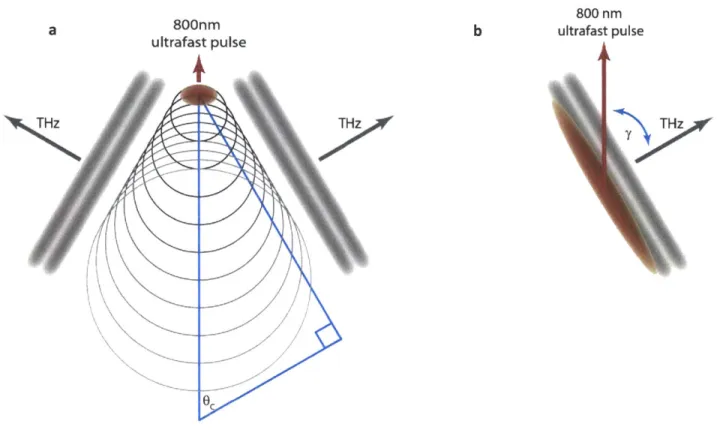
generation of THz radiation in a Cherenkov cone when optical rectification occurs in LiNbO3. The
Cherenkov cone is described by an angle Oc given by
Oc = cos- 1 VTHZ ) (2.6)
where vTHZph is the phase velocity of the generated THz radiation and ypt is the group velocity of the
optical generation pulse '14. This effect can be visualized of through the consideration of wavefronts
(the Huygens principle). If the optical pump pulse is considered as a point source, then the THz radiation that it generates will radiate spherically outward from it. If the index mismatch between the optical pump pulse and the generated THz is low, as in the case of the zincblende materials considered earlier, then the phase matching criterion given by Eq. 2.6 is automatically obtained at the leading edge of the generation pulse, i.e. the generated THz is continually amplified as it co-propagates with the optical pulse that is generating it, giving a high conversion efficiency and planar THz pulses. If the index
mismatch is large, as in the case of LiNbO3, then the generation pulse immediately "outruns" the radially
expanding THz radiation as a result of its lower index, leading to the generation of a series of expanding radial THz patterns, which accumulate into the observed Cherenkov cone (Fig. 2.1 (a)).
The velocity mismatch that is responsible for the appearance of the Cherenkov cone can be corrected through tilting the intensity front of the optical generation pulse (Fig 2.1 (b)), giving the phase-matching condition
cos(y) v0Pt gr = VTHzp (2.7)
where the angle y is the tilt angle specified in Fig. 2.1 (b)14. In this scenario, the optical intensity front
propagates exactly with the THz radiation that it generates, yielding conversion efficiencies that
approach 1x10⁻³
for 800 nm pumping frequencies15,16. Phasematching through pulse front tilting forms
the underlying basis for the so-called tilted-pulse-front generation technique, which was employed as the THz generation technique for the entirety of the work presented in this thesis. The tilted pulse front corrects for velocity mismatch between the THz radiation and the optical pulse generating it in the
the other (vertical) dimension is corrected through the use of a vertical "line" source of optical light that
reaches the LiNbO3 crystal at any instant. With the tilted pulse front, the location of this line moves
laterally across the LiNbQ3 crystal in the horizontal direction as time progresses. The rate of lateral
movement matches the Cherenkov angle so that incoming light continues to drive optical rectification at the phase front of the THz field.
a 800nm ultrafast pulse Oc b 800 nm ultrafast pulse
Figure 2.1 (a) Generation of THz in a Cherenkov cone by an ultrafast laser pulse in two dimensions, in which successive radially diverging THz wavefronts combine at angle Oc. (b) Tilting of the optical pulse by
the angle yyields phasematched THz generation, as given by Eq. 2.7.
In practice, tilting of the optical pulse front is accomplished through the use of a diffraction grating, which yields a continuous tilt as a function of the optical wavelength and the grove spacing of
the grating employed. Imaging the grating surface (i.e. the tilted pulse) into a LiNbO3 prism, which has
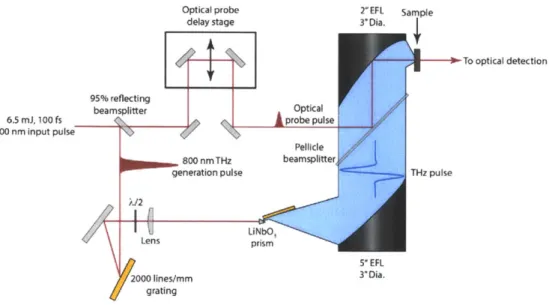
been specially cut to match the pulse front tilt angle, yields a compact source of high energy THz pulses. In the experiments presented here, 6.5 mJ, 100 fs duration pulses at 800 nm central wavelength and 1
kHz repetition rate were used as the generation pulses. The tilted-pulse-front setup that was used for all measurements employed a 2000 lines/mm grating, which was imaged in a 2:1 demagnification ratio
with a single 8 cm focal length achromatic lens into the LiNbO3 generation prism. The prism was cut to
match the tilt angle of 63 degrees (Fig. 2.2). Typical pulse energy conversion efficiencies were 1x10³,
yielding THz pulses with energies of roughly 6.5 pJ. When focused, peak THz electric fields in excess of
730 kV/cm were obtained, with usable frequency components extending to roughly 2.5 THz. Fig. 2.3
shows a typical tilted-pulse-front generated THz pulse, which has been detected by electro-optic sampling (Section 2.3).
Incoming 800 nm
ultrafast laser pulses
I
AX/2
I
Achromatic lens
(8 cm focal length)
n1
U
2000 lines/mm
grating
Figure 2.2. Schematic drawing of the tilted-pulse-front source used for generation of high-energy THz
pulses. Incoming 800 nm ultrafast pulses are diffracted by a 2000 lines/mm grating. The tilted pulse front is then imaged using a 2:1 demagnification ratio with an achromatic lens (8 cm focal length) into a specially cut LiNbO3 prism, shown in the inset, for which the cut angle is equal to the tilt angle of the 800nm optical pulse once it is imaged into the prism, which in this case is 63*. A half-wave plate is used to flip the polarization of the 800 nm pulse to be parallel to the optic axis in the LiNbO3 prism, which results in vertically polarized THz pulses.
LiNbO
3prism
LiNbO
3prism detail
800 104 600 -400-10 0 10 -200 -4001 10 0 0 2 4 6 8 10 0 1 2 3 4 5 6 7 Time (ps) Frequency (THz)
Figure 2.3. THz pulse generated using the tilted-pulse-front setup shown in Fig. 2.2, showing a peak field strength in excess of 700 kV/cm in the time domain (left) and components extending to 2.5 THz in the frequency domain (right).
2.2
Free-Space THz Field Enhancement with Metamaterial Structures
The tilted-pulse-front THz generation technique outlined in the previous section yields THz field strengths on the order of 1 MV/cm, which is sufficiently high for many nonlinear spectroscopy applications. However, field strengths may be increased even more through the use of metamaterial structures, which were used for experiments on silicon impact ionization, air breakdown, and THz-pump/X-ray-probe measurements presented in chapters 4, 5, and 6 of this thesis, respectively.
Metamaterials are patterned structures engineered to mimic bulk material responses when irradiated with a given frequency of electromagnetic radiation. This is accomplished through the use of structures that have geometric features that are far smaller than the wavelength of the applied electromagnetic field yet exhibit coupling to the electric or magnetic fields being applied, yielding an artificially constructed bulk-like electromagnetic response. For frequencies between 0.1 and 10 THz,
which corresponds to wavelengths between 30 pim and 3 mm, sufficiently small structures can be patterned via standard photolithographic techniques. As a result, much progress has been made in recent years toward the use of tailored THz metamaterials in applications including THz sensing,
filtering, switching, and modulation- 3
One particular class of metamaterials, known as split ring resonators (SRRs), is of interest here due to their ability to provide both localized enhancement of free-space THz fields as well as extremely sensitive localized probing of THz-driven material responses. THz-active SRRs with fourfold symmetries were initially developed to suppress coupling to the applied THz magnetic field, yielding an "all-electric"
unit cell, which could then be tailored for specific applications24
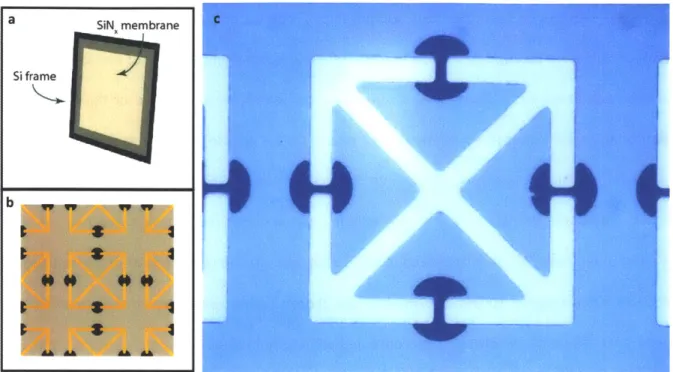
. The SRR pattern used in the work presented here is shown in Fig. 2.4, and consists of a gold structure with four capacitive gaps, each part
of which forms an inductive-capacitive (LC) circuit with a characteristic resonance frequency co
approximated by
woJ (2.8)
where L is the inductance and C the capacitance of the circuit, in addition to higher-frequency
resonances as a result of the ability of each side of the structure to act as a classical dipole antenna2
s
Significant THz field enhancement, calculated to be up to 104 for this type of metamaterial structure, is
expected in sufficiently narrow capacitive gaps24
Field
enhancement
t
Capacitive
gap
Figure 2.4. Schematic illustration of SRR metamaterial structure used for free-space field enhancement,
showing four capacitive gaps, two of which show THz field enhancement for an applied free-space THz
field polarized in the vertical direction.
SRR structures therefore present two very useful characteristics for nonlinear THz spectroscopy. First, the ability to enhance free-space THz fields allows for field strengths well above 1 MV/cm to be reached, which allows responses to be driven that were previously inaccessible with benchtop sources. The ability for THz fields to drive nonlinear responses through SRR coupling and field enhancement has been recently demonstrated through THz-driven phase changes in vanadium dioxide and THz-driven
impact ionization in gallium arsenide26,27. In both cases, SRR coupling resulted in enhancement of the
incident free-space THz field to significantly higher levels, which even resulted in THz-induced dielectric breakdown in the case of vanadium dioxide.
Both measurements also made use of the second useful characteristic of SRR metamaterials, which is the high sensitivity of the THz absorption at the LC and dipole resonances to the conductivity of the material within the capacitive gaps of the SRR structure. Previously, this had been demonstrated in
sensing applications1'2 2 as well as for transient substrate conductivity changes driven by ultrafast laser
pumping17 2 8. In the case of the nonlinear THz measurements, THz probing of the SRR LC resonance
revealed conductivity changes induced by the strong THz pump fields, either by examination of the transmitted THz pump pulse or through the use of a time-delayed THz probe pulse. As such, even
though the nonlinear response only occurs within the micron-scale capacitive gaps, which represent a small percentage of the sample area illuminated by the THz probe pulse, the signal measured by the probe field is extremely sensitive to the changes in conductivity within the gaps because of the resulting SRR resonance frequency shifts.
For the measurements presented in this thesis, all metamaterial structures utilized were designed, fabricated, and simulated by Kebin Fan, Xiaoguang Zhao, and others in the research groups of Richard Averitt and Xin Zhang at the Boston University Photonics Center.
2.3
Electro-Optic Detection of Free-Space THz Radiation
As a result of the very low photon energies of THz-frequency electromagnetic waves, detection
of free-space THz pulses is accomplished through methods that bear little resemblance to the methods typically used for detection of higher-frequency light sources. While area detectors, which are based on pyroelectric or bolometer sensors, are commercially available, no frequency-dependent detection has yet been developed which is sufficient for spectroscopic purposes. Instead, time-domain detection is typically used, which employs pulses from the ultrafast laser that is also used for THz generation.
For the work presented in this thesis, time-domain electro-optic sampling (EOS) detection was used. EOS is based on the Pockels effect, which is a second order nonlinear optical effect in which an
electric field is applied to a non-centrosymmetric material that exhibits a /2P susceptibility'. The
application of the electric field generates a change An in the index of refraction of the material along a specific direction, which is determined by the material symmetry and the polarization direction of the applied field, thereby resulting in a field-induced birefringence.
EOS for time-domain THz detection makes use of an ultrafast optical probe pulse that may be
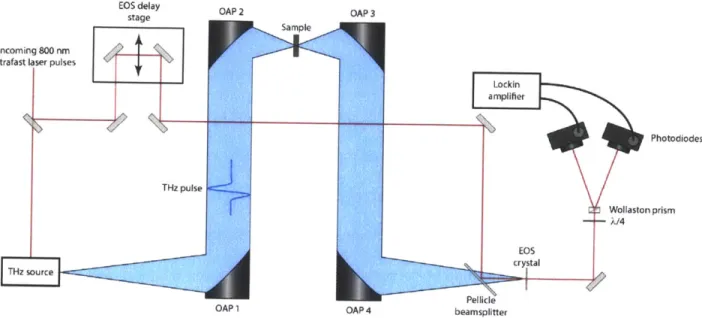
time-delayed relative to the THz pulse and is much shorter in duration than the THz pulse. This allows for the electric field of the THz pulse to be treated as quasi-DC field when gated by the ultrafast optical probe pulse. When the THz field is overlapped with the probe pulse in an electro-optic crystal (typically GaP or ZnTe, as were used for all work in this thesis), the transient birefringence induced by the electric field of the THz pulse in the electro-optic crystal as a result of the Pockels effect modifies the polarization of the probe pulse. The extent of the modification of the probe pulse polarization is directly related to the magnitude of the applied electric field. Scanning the relative delay between the THz and optical pulses sweeps the ultrafast probe pulse over the much longer THz pulse. Therefore, detection of the degree of birefringence induced by the THz pulse, though detection of the degree of polarization modification present in the probe pulse as a result of the THz-induced birefringence, allows the time-domain electric field profile of the THz pulse to be mapped out (shown schematically in Fig 2.5 (a)). The THz field profile in Fig. 2.3 was detected using EOS.
When a linearly polarized probe pulse is used, the degree of depolarization induced by the THz-driven Pockels effect can be measured using the polarization-sensitive optical setup shown in Fig. 2.5
(b), in which the vertical and horizontal polarization components of the probe pulse are balanced by a
quarter-wave plate, separated by a Wollaston prism, and detected by a pair of photodiodes. The difference in intensity between the two photodiodes is related to the magnitude of the applied THz field through
ETHZ = sin-
)
(2r1) (2.9)where A is the wavelength of the probe pulse, n is the refractive index of the electro-optic crystal at the
pulses propagate (i.e. the crystal thickness at normal incidence), r41 is the electro-optic tensor
component, and
l A-B
(2.10)
I A+B
gives the degree of probe depolarization where A and B are the intensities at the two photodiodes in Fig
2.5 (b). Note that in most cases the inverse sine in Eq. 2.9 may be neglected, as the degree of probe
depolarization is typically quite small. Furthermore, Eq. 2.9 assumes linear probe and THz polarizations,
with either 0* or 90* relative orientation29
a time delay Variable Electro-optic crystal b
Photodiodes
Wollaston prism To detection THz pulse EA 14
optics crs
I
800 nm 800 nm
EOS pulse THz pulse EOs pulse
Figure 2.5. (a) Schematic representation of EOS, in which a short optical probe pulse is overlapped with the THz pulse in an electro-optic crystal. The probe pulse is swept over the THz pulse in time using an optical delay stage, and a readout of the THz-induced transient birefringence in the electro-optic crystal records the time-domain profile of the THz electric field. (b) Balanced polarization-sensitive detection scheme for EOS.
2.4
Data Analysis for THz Transmission Spectroscopy
THz spectroscopy, as presented in the preceding sections, is detected in the time domain, as evidenced by Fig. 2.3 (a). Material responses, however, are typically manifested as frequency-specific
absorptions, necessitating frequency-dependent data analysis (though exceptions, such as broadband
conductivity responses in semiconductors30, do exist).
The experiments presented in this thesis rely heavily upon enhancement of free-space THz fields
by metamaterial structures. Extraction of material parameters such as the frequency-dependent index
of refraction and absorption coefficient carries- little physical meaning, as these parameters are heavily dependent on the electromagnetic response of the metamaterial structures themselves. As a result, it is sufficient to examine the frequency-dependent THz transmission and optical density. This is done by collecting two THz pulses, one that is passed through the sample of interest and one that is passed through a reference, which is typically air or, in the cases of samples mounted on a substrate, a piece of the substrate being used. A ratio of the Fourier transforms of the sample and reference THz pulses gives the frequency-dependent transmission as
f_ Eei27vt
T(v) -
J
sam (2.11)|f_ Erefe-i21vt1
where Esam and Eet represent the time-domain THz pulses that were passed through the sample and
reference, respectively. The frequency-dependent THz absorption of the sample is then obtained as the negative common logarithm of Eq. 2.11:
A(v) = -log Eame-i2nt (2.12)
2.5
Conclusions
Nonlinear THz spectroscopy is made possible primarily through adaptations of existing THz spectroscopy techniques. THz pulses with sufficiently high electric fields to induce nonlinear material
responses are generated through optical rectification in LiNbO3 via the tilted-pulse-front technique, in
which the intensity front of an ultrafast 800 nm pulse is tilted in space by a grating so that phasematching may be achieved, resulting in a high conversion efficiency. Enhancement of the resulting free-space THz pulses may be obtained through the use of metamaterial structures, which can also be designed to function as sensitive probes of THz-driven nonlinearities. THz detection through EOS and data analysis in the frequency domain complete the set of techniques that will be used to drive and analyze nonlinear THz responses throughout the rest of the work presented in this thesis.
References
1. Boyd, R. W. Nonlinear Optics. (Academic Press, 2008).
2. Kleinman, D. A. & Auston, D. H. Theory of electrooptic shock radiation in nonlinear optical media.
IEEE J. Quantum Electron. 20, 964 (1984).
3. Nahata, A., Weling, A. S. & Heinz, T. F. A wideband coherent terahertz spectroscopy system using
optical rectification and electro-optic sampling. Appl. Phys. Lett. 69, 2321 (1996).
4. Hebling, J., Stepanov, A. G., Almasi, G., Bartal, B. & Kuhl, J. Tunable THz pulse generation by
optical rectification of ultrashort laser pulses with tilted pulse fronts. Appl. Phys. B Lasers Opt. 78, 593 (2004).
5. L6ffler, T. et al. Comparative performance of terahertz emitters in amplifier-laser-based systems.
Semicond. Sci. Technol. 20, S134 (2005).
6. Huber, R., Brodschelm, A., Tauser, F. & Leitenstorfer, A. Generation and field-resolved detection
7. Kunikiyo, T. et al. A Monte Carlo simulation of anisotropic electron transport in silicon including full band structure and anisotropic impact-ionization model. J. Appl. Phys. 75, 297 (1994).
8. Qi, T., Shin, Y.-H., Yeh, K.-L., Nelson, K. & Rappe, A. Collective coherent control: synchronization
of polarization in ferroelectric PbTiO3 by shaped THz fields. Phys. Rev. Lett. 102, 247603 (2009).
9. Junginger, F. et al. Single-cycle multiterahertz transients with peak fields above 10 MV/cm. Opt.
Lett. 35, 2645 (2010).
10. Liu, J., Schmutz, H. & Merkt, F. Generation of widely tunable Fourier-transform-limited terahertz
pulses using narrowband near-infrared laser radiation. J. Mol. Spectrosc. 256, 111 (2009).
11. Blanchard, F. et al. Generation of 1.5 pJ single-cycle terahertz pulses by optical rectification from
a large aperture ZnTe crystal. Opt. Express 15, 13212 (2007).
12. Vicario, C., Ruchert, C. & Hauri, C. P. High field broadband THz generation in organic materials. J.
Mod. Opt. (2013). doi:10.1080/09500340.2013.800242
13. Auston, D. H., Cheung, K. P., Valdmanis, J. A. & Klienman, D. A. Cherenkov radiation from
femtosecond optical pulses in electro-optic media. Phys. Rev. Lett. 53, 1555 (1984).
14. Hebling, J., Almasi, G., Kozma, I. & Kuhl, J. Velocity matching by pulse front tilting for large area
THz-pulse generation. Opt. Express 10, 1161 (2002).
15. Yeh, K.-L., Hoffmann, M. C., Hebling, J. & Nelson, K. A. Generation of 10 pJ ultrashort terahertz
pulses by optical rectification. Appl. Phys. Lett. 90, 171121 (2007).
16. Yeh, K.-L., Hebling, J., Hoffmann, M. C. & Nelson, K. A. Generation of high average power 1 kHz
shaped THz pulses via optical rectification. Opt. Commun. 281, 3567 (2008).
17. Padilla, W. J., Taylor, A. J. & Averitt, R. D. Dynamical electric and magnetic metamaterial response
at terahertz frequencies. Phys. Rev. Lett. 96, 107401 (2006).
18. Chen, H.-T. et al. Complementary planar terahertz metamaterials. Opt. Express 15, 1084 (2007).
19. Tao, H. et al. Reconfigurable terahertz metamaterials. Phys. Rev. Lett. 103, 147401 (2009).
20. Tao, H. et al. A dual band terahertz metamaterial absorber. J. Phys. D. Appl. Phys. 43, 225102
(2010).
21. Tao, H. et al. Performance enhancement of terahertz metamaterials on ultrathin substrates for
sensing applications. Appl. Phys. Lett. 97, 261909 (2010).
22. Tao, H. et al. Metamaterials on paper as a sensing platform. Adv. Mater. 23, 3197 (2011).
23. Fan, K. et al. Optically tunable terahertz metamaterials on highly flexible substrates. IEEE Trans.
24. Padilla, W. et al. Electrically resonant terahertz metamaterials: Theoretical and experimental investigations. Phys. Rev. B 75, 041102 (2007).
25. Tao, H., Padilla, W. J., Zhang, X. & Averitt, R. D. Recent progress in electromagnetic metamaterial
devices for terahertz applications. IEEEJ. Sel. Top. Quantum Electron. 17, 92-101 (2011).
26. Liu, M. et al. Terahertz-field-induced insulator-to-metal transition in vanadium dioxide
metamaterial. Nature 487, 345 (2012).
27. Fan, K. et al. Nonlinear terahertz metamaterials via field-enhanced carrier dynamics in GaAs.
Phys. Rev. Lett. 110, 217404 (2013).
28. Fan, K., Strikwerda, A., Zhang, X. & Averitt, R. Three-dimensional broadband tunable terahertz
metamaterials. Phys. Rev. B 87, 161104 (2013).
29. Planken, P. C. M., Nienhuys, H.-K., Bakker, H. J. & Wenckebach, T. Measurement and calculation
of the orientation dependence of terahertz pulse detection in ZnTe. J. Opt. Soc. Am. B 18, 313 (2001).
30. Hebling, J., Hoffmann, M. C., Hwang, H. Y., Yeh, K.-L. & Nelson, K. A. Observation of
nonequilibrium carrier distribution in Ge, Si, and GaAs by terahertz pump-terahertz probe measurements. Phys. Rev. B 81, 035201 (2010).