DOI 10.1007/s10493-008-9183-5
In
Xuence of leaf trichomes on predatory mite
(Typhlodromus pyri) abundance in grape varieties
R. Loughner · K. Goldman · G. Loeb · J. Nyrop
Received: 31 March 2008 / Accepted: 18 July 2008 / Published online: 6 August 2008 © Springer Science+Business Media B.V. 2008
Abstract Non-glandular leaf trichomes positively inXuence the abundance of many phytoseiid mites. We characterized the inXuence of grape leaf trichomes (domatia, hairs, and bristles) on Typhlodromus pyri Scheuten abundance over two years in a common garden planting of many grape varieties and 2 years of sampling in a commercial vineyard. In general, a lack of trichomes was associated with much lower predator numbers and in the case of Dechaunac, a cultivar with almost no trichomes, very few T. pyri were found. Phytoseiid abundance was best predicted by a model where domatia and hair had an additive eVect (r2= 0.815). Over two years of sampling at a commercial vineyard there were T. pyri present on all of the 5 cultivars except Dechaunac. At the same time, European red mite prey were present on Dechaunac alone. These results suggest that on grape cultivars lacking leaf trichomes, T. pyri likely will not attain suYcient densities to provide biological control of European red mite, despite presence of the mite food source. The relationship between leaf trichomes and phytoseiid abundance that is observed at the scale of single vines in a garden planting appears to also be manifest at the scale of a commercial vineyard. Because persis-tence of predatory mites in or nearby the habitats of prey mites is important for eVective mite biological control, leaf trichomes, through their inXuence on phytoseiid persistence, may be critical for successful mite biological control in some systems.
Keywords Non-glandular trichomes · Phytoseiid · Domatia · Biological control
Introduction
Presence of acarodomatia or “mite shelters” on the leaf surface has been shown to positively inXuence the abundance of many species of phytoseiid predators (see reviews by
R. Loughner (&) · K. Goldman · G. Loeb · J. Nyrop
New York State Agricultural Experiment Station (NYSAES), Department of Entomology, Barton Lab, Cornell University, 630 W. North St., Geneva, NY 14456, USA
Walter 1996; Sabelis et al. 1999; Agrawal 2000; Romero and Benson 2005, but see Seelmann et al. 2007 for an exception). Leaf domatia are small morphogenetic structures that enclose small (<1 mm3) spaces, typically in vein axils on the underside of leaves (Pemberton and Turner 1989; O’Dowd and Willson 1989; Brouwer and CliVord 1990). Mites found in these structures are typically predatory or fungivorus, with presence of her-bivorous mites less common (Sabelis et al. 1999; O’Dowd and Willson 1989; Willson
1991; O’Dowd and Pemberton 1994, many others). Expression of these leaf structures occurs along a continuum of form and degree, both across and within species (O’Dowd and Willson 1989; Willson 1991); however, in general, domatia may be “composed of tric-homes (‘tuft’ domatia), by an overhanging shelf of leaf tissue enclosing space in the vein axil (‘pocket’ domatia), by an invagination in the leaf lamina at the vein axil (‘pit’ domatia) or by some combination thereof” (O’Dowd and Pemberton 1994). O’Dowd and Willson (1989) describe this categorization of domatia as excluding other specialized chambers on leaves that are not restricted to junctures of veins.
It has been hypothesized that trichomes, and in particular domatia, indirectly contribute to plant defense, with these leaf structures mediating a mite-plant mutualism (O’Dowd and Willson 1991). Although initially controversial, evidence has accumulated in support of this hypothesis (Agrawal and Karban 1997; Norton et al. 2000; English-Loeb et al. 2005; Monks et al. 2007). Trichomes may help moderate the eVects of low humidity (Grostal and
O’Dowd 1994, but see Norton et al. 2001), protect mites from predators (Roda et al. 2000; Norton et al. 2001; Faraji et al. 2002; Seelmann et al. 2007), and increase the capture of alternate food sources such as pollen and fungal spores that promote retention of generalist mite populations (Putman and Herne 1964; Kreiter et al. 2002; Roda et al. 2003). In a recent review, Romero and Benson (2005) suggest current evidence best supports protection from predators.
In grape, leaf structures that may inXuence predatory mite abundance occur predomi-nantly as non-glandular trichomes, although in some species the vein tissue in the primary axil expands inward to form small cave-like domatia (Walter and Denmark
1991; Karban et al. 1995). Trichomes are present in three deWned, although potentially
overlapping, forms following descriptions in IBPGR/OIV (International Board for Plant Genetic Research/OYce International de la Vigne et du Vin) (1989): (1) tuft-form doma-tia in vein axils, (2) upright, short bristles typically along leaf veins, and (3) longer hairs lying across the leaf blade and along leaf veins. The size of domatia and abundance of trichomes in the domatia was associated with increased abundance of the generalist phytoseiid Typhlodromus pyri Scheuten on diVerent accessions of Vitis riparia Michaux (Vitaceae), the riverbank grape (English-Loeb et al. 2002) and across a number of Vitis species for the phytoseiid mite Typhlodromus caudiglans Schuster (Karban et al. 1995). Non-domatia leaf structures (hairs and bristles) also appear to be important to overall predatory mite abundance in grapes (Duso 1992; Karban et al. 1995), although the relative importance of these diVerent classes of non-glandular trichomes has not been fully explored.
The goal of the research presented here was to characterize the inXuence of grape leaf non-glandular trichomes (domatia, hairs, and bristles) on T. pyri abundance over two years in a common garden planting of many grape varieties and during two years of sampling in a commercial vineyard. Our speciWc objectives were (1) to evaluate the contribution of diVerent types of trichomes to T. pyri abundance and (2) to determine whether patterns of T. pyri abundance observed on single plants were manifest in commercial-scale grape plantings.
Materials and methods
Leaf trichomes and predator abundance
Twelve grape varieties with varying levels and types of leaf trichomes were selected in the National Clonal Germplasm Repository (PGRU) vineyard at the New York State Agricul-tural Experiment Station in Geneva, NY. The PGRU vineyard is a common garden planting of a large number of varieties, with two plants of each variety planted adjacent to one another along rows. Leaf pubescence was assessed by collecting 4 mid-shoot leaves per sampling date, 2 from each plant, of each variety and scoring the density of trichomes. Trichome data was collected from leaves sampled once in 2000 on 12 June and twice in 2001 on 26 July and 4 September.
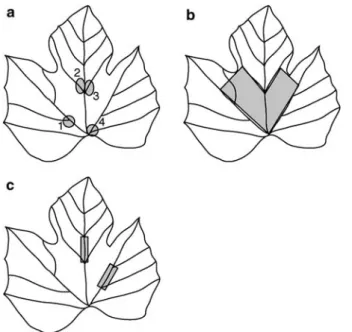
Trichomes were classiWed as either bristles or hairs and assigned a ranking using a 1 (none) to 9 (very dense) scale (IBPGR/OIV (International Board for Plant Genetic Research/OYce International de la Vigne et du Vin) 1989). Bristles and hairs gradate into each other and were distinguished by length and posture. Bristles were shorter (<0.25 mm) and upright while hairs were longer (>0.25 mm) and prostrate. Separate rankings were obtained on each leaf for bristles and hairs along 2 leaf vein sections (Fig.1c) and ran-domly from within 2 areas between veins on the leaf blade (Fig.1b). Hair density ranks were assigned by visual comparison of the 1 to 9 scale with a 2.3 mm long segment of either the leaf vein or leaf blade under 25£ magniWcation. Bristle ranks were similarly assigned using 5 mm long segments under 12£ magniWcation. The bristle scoring system was also applied to 4 vein axils per leaf (Fig.1a) and the mean of these 4 trichome density assessments was used to generate a domatia rank for each leaf. Domatia size was deter-mined by measuring the diameter of the zone of bristles extending away from the same 4 domatia with a micrometer and calculating a mean size per leaf. Thus, leaf trichomes were characterized using six variables; bristles and hairs on the leaf blade, bristles and hairs along leaf veins, and domatia rank and size.
The density of T. pyri on each cultivar was estimated 3 times in 2000 (12 June; 10 and 25 July) and 6 times in 2001 (26 June; 11 and 26 July; 8 and 16 August; and 4 September). Five leaves from each of 2 vines per variety were sampled on each date. Leaves were collected from those mid-way along shoots. Phytoseiid motiles were counted by examining each leaf with a microscope. Up to 10 adult phytoseiids per plant per date were mounted on glass slides for identiWcation. Leaf surface area was approximated by measuring and multi-plying leaf length (from base to the tip of the leaf blade) and leaf width (distance between distal ends of the two veins extending in either direction from the Wrst axil).
For analysis purposes, variety served as the replicate unit and data were averaged for each year across all observations during the season from leaves of both plants for each vari-ety. Relationships between leaf trichome characteristics and the natural log of the mean seasonal T. pyri density per leaf were initially examined by estimating correlations among the 6 leaf trichome variables. Each trichome type (domatia, hair, bristles) was described by a composite variable that was calculated by taking either the mean or a multiplicative summary of highly correlated leaf trichome rankings or measurements. To remove any eVect of variation in absolute values across years, each of these predictor variables was scaled such that a value of 1 corresponded to the highest value for any cultivar in a given year for that variable. Year was incorporated in the model as a categorical variable. Initial model selection began with the natural log of the average predator density as a function of the leaf trichome variables, their interaction with year, and leaf area. Manual stepwise,
backward linear regression (p to remove = 0.1 for initial model) was then used to estimate a model in STATA release 10 (StataCorp 2007).
Commercial vineyard sampling
Five cultivars of varying leaf trichome type and density were sampled from a block of vines at a commercial vineyard in Dresden, NY over 2 years. Fifteen leaves were sampled across multiple vines along each of 2 rows per cultivar (Dechaunac, Elvira, Baco, Concord, and Niagara). Leaves were collected 6 times in 2000 (22 and 28 June; 18 and 28 July; 4 and 21 August) and 7 times in 2001 (29 June; 11 and 26 July; 7, 17, 21, and 29 August). Leaves were passed through a machine that brushes mites on the leaf surface onto glass plates where phytoseiid motiles and European red mite Panonychus ulmi Koch were enumerated using a dissecting microscope. Up to 10 adult phytoseiids per plant per date were mounted on glass slides for identiWcation. The number of phytoseiids per leaf and European red mite per leaf were plotted over time and compared for trends, however no further statistical analysis was done due to the unreplicated sampling design. On 7 August, 2001 a miticide (Kelthane [dicofol] at label rate) was applied by the grower to control European red mite. Leaf trichome data for the sampled cultivars was collected from a separate leaf sample using methods described above in September 2002, except for the cultivar Dechaunac which had been removed from the vineyard. Data from Dechaunac vines in a PGRU vineyard in Geneva, NY were included for comparison. The model developed with the PGRU vineyard varieties was used to compare predictions for mean motiles based on leaf morphology for Dresden varieties with trends in actual mite abundance at the commercial Dresden vineyard. To compare predicted and actual Typhlodromus pyri densities, mite abundance was standardized by subtracting the mean of predicted values or mean of actual counts by year from all respective data points and plotted.
Fig. 1 Locations within grape leaves used for measuring (a) domatia size and rank, (b) leaf blade bristles and
Results
Leaf trichomes and predator abundance
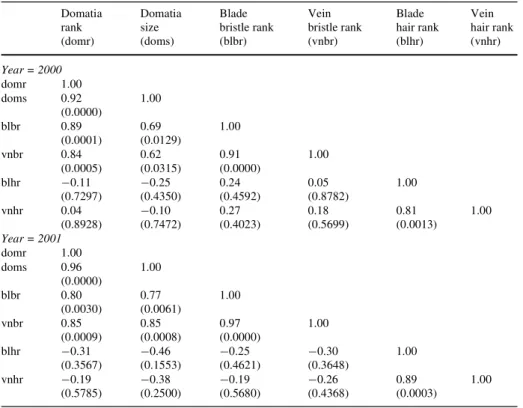
Correlations among the six variables used to characterize leaf trichomes showed strong associations consistent across years between (1) domatia size and domatia rank, (2) blade and vein hair rank, (3) blade and vein bristle rank, (4) domatia rank and blade bristle rank, and (5) domatia rank and vein bristle rank (Table1). Composite measures of the Wrst two sets of correlated variables were developed to model the relationship between individual leaf trichome traits (domatia and hair) and T. pyri abundance. Domatia size and rank were multiplied and are hereafter referred to as the domatia index. Hair rank index was calculated by taking the mean of the blade and vein hair rankings. Bristle rank index was not included in model development due to the high correlation of bristle rank with domatia rank on both the leaf blade and veins (r = 0.89 and 0.84, respectively). Including both highly correlated variables into the regression model introduces multicollinearity, a situation in which a redundant predictor variable impairs the ability to estimate the eVect of other variables and can make standard errors of other estimated eVects larger than if the redundant predictor is removed (Agresti
2002).
The initial full regression model was: log(motiles) = ¡0.824 + 2.584(domatia index) + 2.154(hair rank index) + 0.562(year) + 0.006(leaf area) ¡ 0.907(domatia index by year
Table 1 Correlation coeYcients (r) for 6 leaf trichome variables measured in year 2000 and 2001 from 12
grape varieties in the PGRU vineyard in Geneva, NY Domatia rank (domr) Domatia size (doms) Blade bristle rank (blbr) Vein bristle rank (vnbr) Blade hair rank (blhr) Vein hair rank (vnhr) Year = 2000 domr 1.00 doms 0.92 (0.0000) 1.00 blbr 0.89 (0.0001) 0.69 (0.0129) 1.00 vnbr 0.84 (0.0005) 0.62 (0.0315) 0.91 (0.0000) 1.00 blhr ¡0.11 (0.7297) ¡0.25 (0.4350) 0.24 (0.4592) 0.05 (0.8782) 1.00 vnhr 0.04 (0.8928) ¡0.10 (0.7472) 0.27 (0.4023) 0.18 (0.5699) 0.81 (0.0013) 1.00 Year = 2001 domr 1.00 doms 0.96 (0.0000) 1.00 blbr 0.80 (0.0030) 0.77 (0.0061) 1.00 vnbr 0.85 (0.0009) 0.85 (0.0008) 0.97 (0.0000) 1.00 blhr ¡0.31 (0.3567) ¡0.46 (0.1553) ¡0.25 (0.4621) ¡0.30 (0.3648) 1.00 vnhr ¡0.19 (0.5785) ¡0.38 (0.2500) ¡0.19 (0.5680) ¡0.26 (0.4368) 0.89 (0.0003) 1.00
interaction) ¡ 1.058(hair rank index by year interaction), r2= 0.888, P < 0.001. Domatia index (P < 0.001) and hair rank index (P < 0.001) were highly signiWcant predictors of
T. pyri abundance. The hair rank index by year interaction was marginally signiWcant
(P = 0.096) at p · 0.1. Year and leaf area were non-signiWcant (P = 0.211 and 0.101, respectively). The objective of this work was to develop a model useful for predicting abundance of T. pyri across years, and given the marginal signiWcance of the hair rank index by year interaction, the following simpliWed model was determined from the manual stepwise, backward elimination linear regression procedure: log(motiles) = ¡0.079 + 2.600(domatia index) + 1.984(hair rank index), r2= 0.815, P < 0.001.
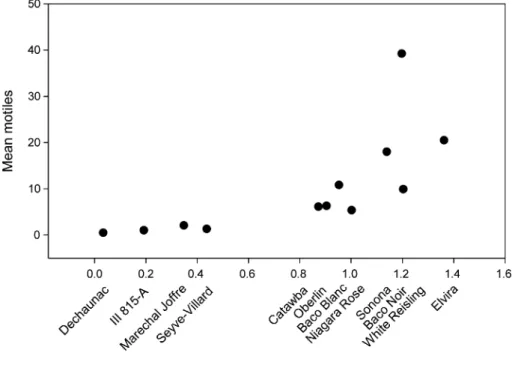
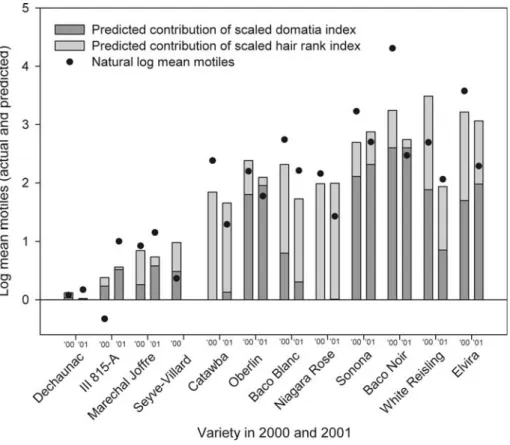
Overall, mite densities were lower in 2001 than 2000. All of the phytoseiids identiWed (306 in 2000 and 263 in 2001) were T. pyri. In general, a low total trichome ranking (values for scaled domatia index and scaled hair rank index each averaged over years and the two values then added together) was associated with low predator numbers (Fig.2). Model predictions for the contribution of domatia index and hair rank index along with T. pyri abundance (Fig.3) show that leaf trichome traits are reasonably consistent across years. The exception was White Reisling for which the domatia index was considerably lower in 2001 than 2000.
Greater numbers of T. pyri were found on varieties with well deWned domatia, such as Baco Noir and Sonona (Fig.3). In contrast, hair rank index explained additional variation in predator abundance not accounted for by domatia index. Catawba and Niagara Rose each had a high hair rank index, little or no domatia, and relatively high numbers of T. pyri.
Fig. 2 Mean Typhlodromus pyri motiles per leaf collected on 12 varieties of grape in the PGRU vineyard.
Relative total trichome (domatia and hair) ranking was calculated by adding together the values for scaled domatia index and scaled hair rank index each averaged over the two years of the study
Several other varieties also had relatively high numbers of T. pyri along with combinations of both domatia and hair (Fig.3). A second group of varieties (Ill 815-A, Marechal JoVre,
Seyve-Villard) was characterized by low domatia index, low hair rank index, and some of the lowest numbers of phytoseiids. Trichomes of any type were almost entirely absent from Dechaunac and very few T. pyri were found during sampling of this variety.
Commercial vineyard sampling
Leaf trichome measurements of the sampled cultivars (Fig.4) showed that the cultivars Baco and Elvira had relatively high domatia indices while Concord, Elvira, and Niagra had hair-type trichomes present. Both domatia and hairs were almost entirely absent from Dechaunac. Over two years of sampling at a commercial vineyard in Dresden, NY, there were T. pyri present on all of the 5 cultivars except Dechaunac (Fig.5). At the same time, European red mite was present on Dechaunac alone, with red mite numbers decreasing only after a miticide application (Fig.5b). All 291 and 279 phytoseiids identiWed in 2000
and 2001, respectively, were T. pyri except for 2 in the year 2000 that were Neoseiulus
fallacis (Garman).
Fig. 3 Natural log of the Typhlodromus pyri motiles per leaf collected on 12 varieties of grape in the PGRU
vineyard in 2000 and 2001 with predicted contribution of domatia index and hair rank index from model parameter estimates. Filled circles represent the natural log mean motiles minus the constraint parameter from the estimated model. Predicted contributions of domatia index and hair rank index are the scaled values (high-est value equals 1) multiplied by the respective parameter (high-estimate in the model
Predictions generated from the above model and morphology data from Dresden grape varieties were reasonably similar to the overall patterns of actual T. pyri abundance data (Fig.6). Overall, the T. pyri density at the Dresden vineyard was lower than the density at the PGRU vineyard. This diVerence in abundance is evident in the standardized values for both Baco and Dechaunac (Fig.6).
Discussion
The abundance of T. pyri on grape is strongly inXuenced by non-glandular leaf trichomes. The highest levels of mite abundance were associated with greater domatia index values in the common garden planting as seen in the varieties Sonona, Baco Noir, White Reisling, Elvira and to a lesser extent Oberlin (Fig.3); however hair-type trichomes were clearly
Fig. 4 Leaf trichome characteristics (a) domatia index and (b) hair rank index for 5 grape cultivars sampled
in a commercial vineyard
Fig. 5 Typhlodromus pyri and European red mite (ERM) per leaf from each of 5 grape cultivars in a
com-mercial vineyard in Dresden, NY in (a) 2000 and (b) 2001. The arrow in panel b indicates the application of miticide by the grower to control ERM
beneWcial to T. pyri in the varieties Catawba and Niagara Rose that had a high hair rank index and limited or no domatia. Varieties with leaves having few trichomes also have low numbers of phytoseiids. The relationship between trichome abundance on leaves and abundance of T. pyri is clearly positive and apparently non-linear (Fig.2). A similar positive relationship between trichomes and mite abundance was observed at the commercial vineyard in Dresden (Fig.5). Cultivars like Dechaunac, lacking completely in trichomes, seem to not provide adequate habitat for these phytoseiid predators.
The general consistency of leaf trichome type and density observed for a given variety across the two years allowed development of a model with high predictive ability for
T. pyri abundance. The additive nature of the relationship between domatia index and hair
rank index suggests that the two types of trichomes in general can substitute for one another in overall trichome contribution to T. pyri abundance on a grape variety. The larger parameter estimate for domatia index (2.600) compared to the estimate for hair rank index (1.984) does, however, indicate that domatia index is somewhat more important than hair rank index. Although bristle type trichomes were not explicitly included in the model and may contribute to mite abundance, a variety with a high bristle rank index is very likely to also have a high domatia index, thus permitting extension of this model to varieties with diVerent amounts of domatia, hair, and bristles.
These results on the population response of T. pyri to trichomes on diVerent grape varie-ties and species are consistent with, and expand upon, Wndings of Karban et al. (1995) where T. caudiglans was the dominant phytoseiid species. In the present study, domatia index (product of domatia size and domatia rank) and hair rank index (average of vein and leaf blade ranks) explained 81% of the variation in T. pyri abundance over a two-year eval-uation. In the earlier study, axil bristle rank (equivalent to domatia rank in our work), vein hair rank, and shelf-form domatia, which we did not observe in the grape varieties in our
Fig. 6 Model predictions and actual values for mean motile abundance per leaf in a commercial vineyard in
Dresden, NY in 2000 and 2001. To reduce variation in Typhlodromus pyri density, mite abundance was stan-dardized by subtracting the mean of predicted values or mean of actual counts by year from all respective data points
study, explained 27% of variation in T. caudiglans in a 1-year study. Reasons for the diVer-ences in amount of explained variation are not clear, but the two studies did identify similar leaf trichome traits as important, in particular, bristles and hairs along veins and tuft-form domatia. In addition, as previously stated, our study indicates that hairs and domatia are interchangeable with respect to T. pyri abundance.
The general pattern of a positive association between leaf trichomes/domatia and abundance of phytoseiid mites is robust, being found within and among numerous plant species in a number of diVerent biogeographic regions of the world (see reviews by Walter (1996) and Romero and Benson (2005)). Despite this broad pattern, responses of phytoseiids are species speciWc and appear sensitive to amounts and forms of trichomes in context with the arthropod community, particularly intraguild predation (IGP) among phytoseiid species. As one example, Seelmann et al. (2007) showed that the smaller Kampimodromus aberrans (Oudemans) is less vulnerable to IGP from the larger phytoseiid Euseius Wnlandicus Oudemans on pubescent leaves while the reverse is true for E. Wnlandicus. Observations in vineyard systems in Italy are consistent with these results where the larger Amblyseius andersoni (Chant) is more likely to become established in more glabrous varieties while the smaller T. pyri becomes established in more pubescent varieties (Camporese and Duso 1996, Duso and Vettorazzo 1999).
Persistence of predatory mites in or near the habitats of prey mites is important for long-term eVectiveness of a biological control program in many perennial plant species (Putman and Herne 1964; McMurtry 1992; Duso 1992; Walde et al. 1992; Croft et al. 1995; Nyrop et al. 1998). Phytoseiid species that leave a plant system in response to lack of prey must recolonize plants to control outbreaks, creating a lag time in response that may lead to bio-logical control failures, even for species that rapidly colonize. Generalist phytoseiids that can reproduce on alternate food sources and survive adverse environmental conditions may not respond quickly to rapid increases in prey numbers; however, their consistent presence in the system generally prevents sudden increases in prey densities. The presence of leaf trichomes appears to play an important role in promoting persistence of some phytoseiid species and therefore may play a crucial role in the success or failure of biological control in perennial crop systems. Indeed, the presence of trichomes for some generalist phytoseiid species is a more important determinant of abundance than mite prey (Duso 1992; Karban et al. 1995; Duso et al. 2003). Although un-replicated and correlative, our results from the commercial vineyard are consistent with this hypothesis in that we only found signiWcant ERM popula-tions on the one grape cultivar lacking trichomes and this was also the one cultivar where no
T. pryi were observed. A similar pattern was observed in commercial apple orchards for
varieties that diVered in trichomes (Downing and Moilliet 1967; Duso et al. 2003).
The relationship between leaf trichomes and T. pyri abundance at the scale of single vines in a garden planting appears to translate up into a similar eVect in a commercial vineyard. Moreover, trichome traits were mostly consistent from year to year within and among grape genotypes. Taken together, these results indicate the potential to enhance biological control of spider mites in grapes by T. pyri through providing the necessary trichome habitat. In the short-term, choice of cultivar is the best way to implement this approach. Tuft-form domatia appear highly heritable (English-Loeb et al. 2002) and therefore, in the long-term, it should be possible to breed beneWcial trichome traits into commercially acceptable varieties (e.g. Poppy and Sutherland 2004).
Acknowledgments Special thanks to Bill Srmack for allowing us to collect leaf samples from the National Clonal Germplasm Repository vineyard in Geneva, NY. Joe Ogrodnick provided photographic expertise. Karen Wentworth, Amy Loveland, Carol Herring, Milo Bonacci, and Jeanie McCann provided laboratory assistance. A special thanks to Amy Roda for guidance and support. This work was supported by the NJ Shaulis Scholarship in viticulture and the New York State Wine and Grape Foundation.
References
Agrawal AA (2000) Mechanisms, ecological consequences and agricultural implications of tri-trophic inter-actions. Curr Opin Plant Biol 3:329–335. doi:10.1016/S1369-5266(00)00089-3
Agrawal AA, Karban R (1997) Domatia mediate plant-arthropod mutualism. Nature 387:562–563. doi:10.1038/ 42384
Agresti A (2002) Categorical data analysis, 2nd edn. Wiley, New York
Brouwer YM, CliVord HT (1990) An annotated list of domatia-bearing species. Notes Jodrell Lab 12:1–33 Camporese P, Duso C (1996) DiVerent colonization patterns of phytophagous and predatory mites (Acari:
Tetranychidae, Phytoseiidae) on three grape cultivars: a case study. Exp Appl Acarol 20:1–22 Croft BA, Kim SS, Kim DI (1995) Leaf residency and interleaf movement of four phytoseiid mites (Acari:
Phytoseiidae) on apple. Environ Entomol 24:1344–1351
Downing RS, Moilliet TK (1967) Relative densities of predacious and phytophagous mites on three cultivars of apple trees. Can Entomol 99:733–741
Duso C (1992) Role of Amblyseius aberrans (Oud.), Typhlodromus pyri Scheuten and Amblyseius
andersoni (Chant) (Acari, Phytoseiidae) in vineyards: III. InXuence of variety characteristics on the
success of A. aberrans and T. pyri releases. J Appl Entomol 114:455–462
Duso C, Vettorazzo E (1999) Mite population dynamics on diVerent grape varieties with or without phytosei-ids released (Acari: Phytoseiidae). Exp Appl Acarol 23:741–763. doi:10.1023/A:1006297225577
Duso C, Pasini M, Pellegrini M (2003) Distribution of the predatory mite Typhlodromus pyri (Acari: Phytoseiidae) on diVerent apple cultivars. Biocontrol Sci Technol 13:671–681. doi:10.1080/09583150310001606264
English-Loeb G, Norton AP, Walker MA (2002) Behavioral and population consequences of acarodomatia in grapes on phytoseiid mites (Mesostigmata) and implications for plant breeding. Entomol Exp Appl 104:307– 319. doi:10.1023/A:1021233027023
English-Loeb G, Norton AP, Gadoury D, Seem R, Wilcox W (2005) Tri-trophic interactions among grape-vines, a fungal pathogen, and a mycophagous mite. Ecol Appl 15:1679–1688. doi:10.1890/04-1939
Faraji F, Janssen A, Sabelis MW (2002) The beneWts of clustering eggs: the role of egg predation and larval cannibalism in a predatory mite. Oecologia 131:20–26. doi:10.1007/s00442-001-0846-8
Grostal P, O’Dowd DJ (1994) Plants, mites, and mutualism: leaf domatia and the abundance and reproduction of mites on Viburnum tinus (Caprifoliaceae). Oecologia 97:308–315
IBPGR/OIV (International Board for Plant Genetic Research/OYce International de la Vigne et du Vin) (1989) Minimal descriptor list for grapevine varieties. Update of IBPRG/83/154 grape descriptors. IBPGR Execu-tive Secretariat, Rome
Karban R, English-Loeb G, Walker MA, Thaler J (1995) Abundance of phytoseiid mites on Vitis species: eVects of leaf hairs, domatia, prey abundance and plant phylogeny. Exp Appl Acarol 19:189–197. doi:10.1007/ BF00130822
Kreiter S, Tixier M-S, Croft BA, Auger P, Barret D (2002) Plants and leaf characteristics inXuencing the preda-ceous mite Kampimodromus aberrans (Acari: Phytoseiidae) in habitats surrounding vineyards. Environ Ento-mol 31:648–660
McMurtry JA (1992) Dynamics and potential impact of ‘generalist’ phytoseiids in agroecosystems and pos-sibilities for establishment of exotic species. Exp Appl Acarol 14:371–382. doi:10.1007/BF01200574
Monks A, O’Connell DM, Lee WG, Bannister JM, Dickinson KJM (2007) BeneWts associated with the domatia mediated tritrophic mutualism in the shrub Coprosma lucida. Oikos 116:873–881. doi: 10.1111/j.0030-1299.2007.15654.x
Norton AP, English-Loeb G, Gadoury DM, Seem RC (2000) Mycophagous mites and foliar pathogens: leaf domatia mediate tritrophic interactions in grapes. Ecology 81:490–499
Norton AP, English-Loeb G, Belden E (2001) Host plant manipulation of natural enemies: leaf domatia pro-tect beneWcial mites from insect predators. Oecologia 126:535–542. doi:10.1007/s004420000556
Nyrop J, English-Loeb G, Roda A (1998) Conservation biological control of spider mites in perennial cropping systems. In: Barbosa P (ed) Conservation biological control. Academic Press, San Diego, pp 307–333 O’Dowd DJ, Pemberton RW (1994) Leaf domatia in Korean plants: Xoristics, frequency, and biogeography.
Vegetatio 114:137–149
O’Dowd DJ, Willson MF (1989) Leaf domatia and mites on Australasian plants: ecological and evolutionary implications. Biol J Linn Soc Lond 37:191–236
O’Dowd DJ, Willson MF (1991) Associations between mites and leaf domatia. Trends Ecol Evol 6:179–182. doi:10.1016/0169-5347(91)90209-G
Pemberton RW, Turner CE (1989) Occurrence of predatory and fungivorous mites in leaf domatia. Am J Bot 76:105–112. doi:10.2307/2444779
Poppy GM, Sutherland JP (2004) Can biological control beneWt from genetically-modiWed crops? Tritrophic interactions on insect-resistant transgenic plants. Physiol Entomol 29:257–268. doi:10.1111/j.0307-6962. 2004.00382.x
Putman WL, Herne DHC (1964) Relations between Typhlodromus caudiglans Schuster (Acarina: Phytoseii-dae) and phytophagous mites in Ontario peach orchards. Can Entomol 96:925–943
Roda A, Nyrop J, Dicke M, English-Loeb G (2000) Trichomes and spider-mite webbing protect predatory mite eggs from intraguild predation. Oecologia 125:428–435. doi:10.1007/s004420000462
Roda A, Nyrop JP, English-Loeb G (2003) Leaf pubescence mediates abundance of non-prey food and the density of the predatory mite Typhlodromus pyri. Exp Appl Acarol 29:193–211. doi:10.1023/A:1025874722092
Romero GQ, Benson WW (2005) Biotic interactions of mites, plants and leaf domatia. Curr Opin Plant Biol 8:436–440. doi:10.1016/j.pbi.2005.05.006
Sabelis MW, Van Baalen M, Bakker FM, Bruin J, Drukker B, Egas M et al (1999) The evolution of direct and indirect plant defence against herbivorous arthropods. In: OlV H, Brown VK, Drent RH (eds) Herbivores: between plants and predators. Blackwell Science Ltd, Oxford, pp 109–166
Seelmann L, Auer A, HoVmann D, Schausberger P (2007) Leaf pubescence mediates intraguild predation between predatory mites. Oikos 116:807–817. doi:10.1111/j.0030-1299.2007.15895.x
StataCorp (2007) Stata statistical software: release 10. StataCorp, College Station, TX
Walde SJ, Nyrop JP, Hardman JM (1992) Dynamics of Panonychus ulmi and Typhlodromus pyri: factors contributing to persistence. Exp Appl Acarol 14:261–291. doi:10.1007/BF01200568
Walter DE (1996) Living on leaves: mites, tomenta, and leaf domatia. Annu Rev Entomol 41:101–114. doi:10.1146/annurev.en.41.010196.000533
Walter DE, Denmark HA (1991) Use of leaf domatia on wild grape (Vitis munsoniana) by arthropods in cen-tral Florida. Fla Entomol 74:440–446. doi:10.2307/3494838
Willson MF (1991) Foliar shelters for mites in the Eastern deciduous forest. Am Midl Nat 126:111–117. doi:10.2307/2426155