Leaf pubescence mediates the abundance of non-prey
food and the density of the predatory mite
Typhlodromus pyri
A. RODA1, J. NYROP2,* and G. ENGLISH-LOEB2
1Department of Molecular Ecology, Max Planck Institute for Chemical Ecology, Winzerlaer Straße 10,
Beutenberg Campus, Jena, D-07745, Germany; 2Department of Entomology, Cornell University, New
York State Agricultural Experiment Station, Geneva, NY 14456, USA; *Author for correspondence (e-mail: [email protected]; fax: +1-315-787-2326)
Received 23 May 2001; accepted in revised form 18 March 2002
Key words: Leaf pubescence, Phytoseiidae, Predatory mites, Tri-trophic interactions
Abstract. Plants with leaves having numerous trichomes or domatia frequently harbor greater numbers
of phytoseiid mites than do plant with leaves that lack these structures. We tested the hypothesis that this pattern occurs, in part, with Typhlodromus pyri because trichomes increase the capture of pollen or fungal spores that serve as alternative food. Using a common garden orchard, we found that apple va-rieties with trichome-rich leaves had 2–3 times more pollen and fungal spores compared to vava-rieties with trichome-sparse leaves. We also studied the effects of leaf trichome density and pollen augmenta-tion on T. pyri abundance to test the hypothesis that leaf trichomes mediate pollen and fungal spore capture and retention and thereby influence phytoseiid numbers. Cattail pollen (Typha sp.) was applied weekly to mature ‘McIntosh’ and ‘Red Delicious’ trees grown in an orchard and, in a separate experi-ment, to potted trees of the same varieties. ‘McIntosh’ trees have leaves with many trichomes whereas leaves on the ‘Red Delicious’ trees have roughly half as many trichomes. With both field-grown and potted trees, adding cattail pollen to ‘Red Delicious’ trees increased T. pyri numbers compared to ‘Red Delicious’ trees without pollen augmentation. In contrast, cattail pollen augmentation had no effect on T.
pyri populations on ‘McIntosh’ trees. Augmentation with cattail pollen most likely supplemented a lower
supply of naturally available alternative food on ‘Red Delicous’ leaves and thereby enhanced predator abundance. These studies indicate that larger populations of T. pyri on pubescent plants are due, in part, to the increased capture and retention of pollen and fungal spores that serve as alternative foods.
Introduction
Leaf surface topography has been found to influence the behavior and abundance of some phytoseiid mites. Densities of some phytoseiids have been shown to be higher on plants whose leaves have many trichomes (Downing and Moilliet 1967; Duso and Vettorazzo 1999; Roda et al. 2001) or have domatia (tufts of hairs, pits or pockets on the leaf surface) (Walter 1996). In fact, leaf traits, and especially the presence or absence of pubescence, can be better predictors of the abundance of some phytoseiid mites than is the availability of the phytoseiids’ spider mite prey (Karban et al. 1995). Laboratory studies have shown that phytoseiids select to re-side and oviposit on trichome-rich leaves more frequently than on leaves with few
trichomes (Rasmy and El-Banhawy 1974; Overmeer and van Zon 1984; Roda et al. 2001). These population density and behavior patterns suggest there is an adaptive advantage to phytoseiids’ residing in these physically complex environments (Roda et al. 2001).
While it is now clear that leaf surface topography influences the density of some phytoseiid species, the mechanisms responsible for this pattern are only partially known. Studies have shown that leaf trichomes and/or domatia provide refuge for predatory mites from their predators (Roda et al. 2000; Norton et al. 2001). The presence of trichomes may also promote phytoseiids by 1) decreasing the likeli-hood that predators are dislodged from the leaf surface, 2) moderating the abiotic environment, especially humidity (Grostal and O’Dowd 1994, but see Norton et al. 2001), or 3) increasing the capture of pollen or fungal spores that might serve as alternative food.
Although primarily identified as predators of mites and small insects, many plant-inhabiting phytoseiid mites can develop and reproduce by feeding on pollen or fungal spores (McMurtry and Croft 1997). For some phytoseiids, reproduction is greater after feeding on certain pollens compared to feeding on spider mite prey (McMurtry and Johnson 1965). Including pollen in their diet may allow predators to remain abundant when prey are scarce (Overmeer 1981). The importance of pol-len for some phytoseiid species is evidenced by field studies that have shown aug-menting pollen increases phytoseiid numbers (Kennett et al. 1979; Grafton-Card-well and Ouyang 1995) and that seasonal fluctuations in the abundance of pollen are correlated with changes in phytoseiid density (McMurtry and Johnson 1965; Kennett et al. 1979; Grafton-Cardwell and Ouyang 1995; Grafton-Cardwell et al. 1999). Thus, there is good evidence that for some species of phytoseiids, pollen is an important food source and its availability influences the abundance of these predators.
The amount of pollen and fungal spores deposited on a leaf surface depends on wind speed and the roughness and/or wetness of the leaf surface (Chamberlain 1975). Indeed, trichomes have been found to increase the capture and retention of some pollens (Tauber 1967). Thus, leaves with trichomes may promote increased populations of some species of phytoseiid mites by capturing and retaining greater amounts of pollen and fungal spores relative to leaves without trichomes.
In the study reported here, we explored the relationships between trichome den-sity on apple leaves, denden-sity of pollen and fungal spores, and abundance of
Typhlo-dromus pyri. TyphloTyphlo-dromus pyri is an important biological control agent in
agricul-tural systems (Walde et al. 1992; Nyrop et al. 1998). Besides feeding on spider mites, T. pyri can also survive and reproduce on a wide range of non-prey food such as pollen, fungal spores, and grape pearl bodies (Chant 1959; von Engel and Ohnesorge 1994a; Wei and Walde 1997). The ability to use these different foods allows T. pyri to persist in a habitat, largely independent of prey numbers (Nyrop et al. 1998).
We hypothesized that trichome-sparse leaves capture and/or retain pollen and fungal spores to a lesser extent than trichome-rich leaves and this leads to differ-ences in T. pyri abundance. To test this hypothesis we conducted two studies. First,
we compared the abundance of pollen and fungal spores on apple varieties with leaves that varied in density of trichomes. Second, we tested whether adding pollen to trees of two apple varieties with different levels of leaf trichomes resulted in different densities of T. pyri on these varieties. We predicted that T. pyri popula-tions on the variety with few leaf trichomes (‘Red Delicious’) would show greater increases in predator density following pollen augmentation compared to popula-tions on the variety with more leaf trichomes (‘McIntosh’). The reasoning behind this hypothesis was that availability of alternative foods does not limit T. pyri abundance on the variety with trichome-rich leaves (‘McIntosh’), but does limit phytoseiid numbers on the variety with fewer leaf trichomes (‘Red Delicious’). Previous observations of T. pyri seasonal dynamics in an orchard with both variet-ies showed that the predators were often more abundant on the trichome-rich vari-ety (‘McIntosh’) independent of prey density (J.P.N. personal observation).
Methods
Influence of leaf trichomes on abundance of pollen and fungal spores
To assess the influence of leaf trichomes on the capture and retention of pollen and fungal spores, we measured the naturally occurring abundance of these alternative foods and the abundance of artificially applied pollen on apple trees with leaves having different levels of leaf pubescence. The measurements were made during July 1999 on apple trees planted at the United States Dept. of Agriculture, Plant Genetic Research Unit experimental orchard (New York State Agricultural Experi-ment Station [NYSAES], Geneva, NY). Two sets of three trees were selected based on whether they had trichome-rich or trichome-sparse leaves and similar canopy sizes. The selected trees were all different varieties and were randomly arranged throughout a large number of other varieties that were not studied. To quantify leaf pubescence, 10 leaves were collected from each tree (variety) and trichome density was measured three times on each leaf. Measurements were made by placing a 3 mm line randomly over the area between leaf veins and recording the number of times trichomes crossed the reference line. Trichome densities on the three tri-chome-sparse varieties were 0.03 crossing trichomes/3 mm (SE ±0.03) on ‘Purple Kobendza’, 1.0 crossing trichomes/3 mm (SE ±0.26) on ‘Ottawa II’, and 0.0 cross-ing trichomes/3 mm (SE ±0.0) on Malus magdebugensis. Trichome densities on the three trichome-rich varieties were 29.7 crossing trichomes/3 mm (SE ±2.2) on ‘Amanishiki’, 39.9 crossing trichomes/3 mm (SE ±3.25) on ‘Stoke Red’ and 30.3 crossing trichomes/3 mm (SE ±4.6) on ‘Schweizer Oranenapfel’.
Four grams of cattail pollen (Typha spp.) were applied to each of the six trees using a pollen applicator (E-Z Power Duster, The Firman Pollen Co., Yakima, WA) attached to a gas powered leaf-blower (Homelite HB-390, Charlotte, NC). The pol-len applicator blasted a cloud of dry polpol-len over the tree that then settled on the leaves. Following the pollen application, forty leaves were collected from each tree
and in the laboratory, 25 nearly identically sized leaves were selected from each set of 40. Each of these 25 leaves was washed in 2 ml of distilled water with 50 µl of Trition X-100 surfactant (Rohm & Haas Co., Philadelphia, PA). The leaf was agi-tated in the solution for 60 s to dislodge pollen and fungal spores and the wash containing the pollen and spores was placed in a vial and stored at 0 °C until pro-cessed. One week after applying the cattail pollen, we re-sampled the same six trees to determine whether there was a difference in loss of cattail pollen between trees that had trichome-sparse or trichome-rich leaves. The trees were sampled and the pollen removed and stored as described for the initial sample.
Pollen and fungal spore density was estimated by first averaging the number of each found in three separate 100 µl drops taken from each leaf washing. This mea-sure gave an estimate for a leaf. The number of alternative food particles per 100 µl drop was then averaged over the 25 leaves washed from each tree to give an estimated value for each variety. Separate counts were made for cattail pollen, naturally occurring pollen, and fungal spores. Because T. pyri pierce and then suck the contents from pollen and spores, we established a lower size limit of 0.005 mm as being potentially consumable. This size limit was determined as one quarter the diameter of an average cattail pollen grain (0.02 mm) All naturally occurring pol-len and fungal spores below this size were not counted. Data were analyzed using repeated measures ANOVA and Huyndt-Feldt (was used to correct for lack of in-dependence in the observations over time (StataCorp. 1999).
Typhlodromus pyri development and oviposition on cattail pollen
The suitability of pollen as a food source for phytoseiids has been found to vary among plant species (McMurtry and Johnson 1965; Kennett et al. 1979; Ouyang et al. 1992; Tanigoshi et al. 1993; von Engel and Ohnesorge 1994a; Yue and Tsai 1996). It is therefore important to verify that pollen used in augmentation is a food that can support development and reproduction. We determined whether cattail pol-len allowed T. pyri to develop and oviposit at rates comparable to those obtained when the predator consumed a known prey, European red mite (Panonychus ulmi (Koch)). We first monitored the development of T. pyri from protonymph (first stage to feed) to adult when fed in excess on cattail pollen or European red mites. ‘McIn-tosh’ apple leaves were collected from trees grown under greenhouse conditions. Disks (2 cm diameter) were cut from the inter-vein area of fully expanded leaves and floated ventral side up on water saturated sponges. Seven European red mite motiles (adults and immatures) or cattail pollen (ca. 0.05 g) were added to each disk. European red mites were gathered from infested trees located at NYSAES (Geneva, NY). Cattail pollen had been collected two months prior and stored at 0 °C. Typhlodromus pyri eggs were taken from a laboratory colony reared on two-spotted spider mites (Tetranychus urticae Koch) for two generations and a single egg was placed on each disk. Each treatment (pollen or European red mite) was replicated 25 times. The disks were placed in climate chambers held at 23 °C, 80– 85% RH with a 16 h light: 8 h dark lighting regime. We made daily observations of developmental stage and replenished the food source as needed to maintain initial
amounts. Protonymphs could be distinguished from larvae by their number of legs. Deutonymph and adult stages were distinguished by the presence of an eight legged exuvium. Once the adult stage was reached, an adult male T. pyri was added to the disk. Daily observations continued until the deposition of the 1st egg. We com-pared the number of days to reach deutonymph, adult, and oviposition of the first egg using t-tests (StataCorp. 1999).
To determine whether cattail pollen could sustain oviposition, we conducted a second experiment to determine the average number of eggs produced per day by females fed cattail pollen. As described above, disks were cut from ‘McIntosh’ apple leaves and suspended ventral side up on water saturated sponges. A recently molted adult female T. pyri that had been reared on cattail pollen was placed on each disk with a male T. pyri obtained in copula from the colony reared on spider mites. The experiment was conducted in climate chambers held at 23 °C, 80–85% RH with a 16 h light: 8 h dark lighting regime and used 16 females and males. The number of eggs oviposited was recorded daily until the female had deposited 10 eggs. Using previous published studies (Duso and Camporese 1991), we compared the average number of eggs/day to the average number produced when females were fed a diet of European red mite and held under similar environmental condi-tions.
Influence of cattail pollen augmentation and leaf trichomes on T. pyri density
When T. pyri abundance is limited by food, augmenting suitable pollens should re-sult in increased densities. However, while plants with trichome-rich apple leaves are hypothesized to intercept and retain more pollen than apple plants with tri-chome-sparse leaves, the affect on phytoseiid abundance of adding pollen is not easily predicted. One possibility is that pollen augmentation results in greater pred-ator increases on apple plants with trichome-sparse leaves compared to plants with trichome-rich leaves because alternative foods (pollen and/or fungal spores) are not limiting on the trichome-rich leaves. Another possibility is that pollen augmenta-tion causes greater increases in predator abundance on trichome-rich leaves because these leaves trap and retain more of the augmented pollen. Either of these scenarios indicates that leaf trichomes play a role in capturing alternative food. No interac-tion between leaf trichome abundance and pollen augmentainterac-tion would indicate that trichomes do not mediate the availability of these alternate foods. We conducted two experiments to explore these patterns. In both experiments we applied cattail pollen to trees of two apple varieties; ‘McIntosh’, which have leaves with many trichomes and ‘Red Delicious’, whose leaves have fewer trichomes. The first ex-periment was conducted with field-grown trees ca. 4 m in height while the second used smaller, potted trees ca. 2 m in height.
In 1998, we applied cattail pollen to mature ‘McIntosh’ and ‘Red Delicious’ trees located in an experimental orchard at the NYSAES (Geneva, NY). Leaf pubescence was quantified as previously described. ‘Red Delicious’ leaves had a mean of 16.8 crossing trichomes/3 mm (SE ±2.4) and ‘McIntosh’ leaves had a mean of 28.8 crossing trichomes/3 mm (SE ±2.4). While these differences were not as extreme
as those found with the non-commercial apple cultivars, they do represent the range that can be found with existing commercially planted trees. The trees used in the experiment were planted in four rows with each row having five ‘Red Delicious’ trees followed by five ‘McIntosh’ trees. For each variety, four trees receiving a pol-len application and another four trees serving as controls (no polpol-len applied), were randomly assigned to an arrangement that allowed at least one tree between a treated and untreated tree between and across rows.
Weekly applications of approximately 1 g of cattail pollen/tree were made using the ‘E-Z Power Duster’ commercial pollen applicator. Pollen applications began the first week of May 1998 and continued through the second week of August 1998. Estimates of the predator populations were made bi-weekly starting 9 June and ending 19 August. To estimate predatory mite abundance, 25 leaves were collected from the treated and control trees. Each leaf was brushed with a mite brushing ma-chine to dislodge mites on to a detergent coated glass plate. All phytoseiid and spi-der mite motiles were counted using a dissecting microscope (10×). Adult female phytoseiids were mounted in Hoyer’s solution and identified to species.
In 1999, we repeated the experiment in the same orchard using a different set of trees. As in 1998, pollen was applied to four trees of each variety. An additional four ‘McIntosh’ and four ‘Red Delicious’ trees did not receive a pollen application and served as the controls. Two applications of propagate (Omite®, Uniroyal
Chem-ical Co. Inc., Middlebury, CT) were made early in June to control an outbreak of European red mite. Besides controlling the European red mite, the miticide appli-cation inadvertently decimated the predatory mite population as well. To remedy this, approximately 100 predators were added to each experimental tree on 8 July by stapling apple leaves collected from an orchard with an established T. pyri population to leaves in the recipient trees. Weekly pollen applications and estimates of predator and spider mite populations were conducted as described for 1998.
Data were analyzed using a repeated measures ANOVA (StataCorp. 1999) with separate analyses for each year. The experiment had two treatment factors; tree cul-tivar (‘McIntosh’ and ‘Red Delicous’) and pollen augmentation (pollen added, con-trol) with the four resulting treatments being replicated four times each. Huyndt-Feldt⑀was used to correct for lack of independence in the observations over time (StataCorp. 1999).
For the second experiment we created a garden composed of potted four year old ‘Red Delicious’ and ‘McIntosh’ trees. The trees were planted in 5 L plastic pots and placed in an open field in May, 1997. Typhlodromus pyri were inoculated by tying 10 apple blossom clusters into each tree (ca. 20–30 predatory mites/tree). Adult female phytoseiids were periodically collected and mounted in Hoyer’s so-lution for species identification. In October, the potted trees were placed into cold storage (10 °C, 80–85% RH).
In April 1998, the trees were removed from cold storage and placed into an open field. Two treatments were assigned to each of five trees of each cultivar; pollen augmentation or control. Cattail pollen (ca. 0.5 g) was applied weekly beginning 16 May using the ‘EZ power’ pollen applicator. From June 16 through August 17, estimates of phytoseiid and spider mite numbers were made bi-weekly by
collect-ing 10 leaves from each tree and removcollect-ing the mites on the leaves to a detergent coated glass plate using a mite brushing machine. All phytoseiid and spider mite adults and immatures were counted and species identification made as previously described.
The data were analyzed using repeated measures ANOVA (StataCorp. 1999). The experiment had two factors; tree variety (‘McIntosh’ or ‘Red Delicious’) and pol-len augmentation (cattail polpol-len added and no polpol-len added), with the four treat-ments being replicated five times. Huyndt-Feldt ⑀was used to correct for lack of independence.
Results
Influence of leaf trichomes on abundance of pollen and fungal spores
The leaves of apple cultivars with trichome-rich leaves captured approximately three times more naturally occurring pollen (not cattail pollen) and fungal spores than did leaves of cultivars with trichome-sparse leaves (F = 11.46, df = 1,4, P = 0.028) (Figures 1A, B). There was no interaction between the trichome classifica-tion and sampling date (F = 3.70, df = 1,4, P = 0.13, Huyndt-Feldt ⑀ > 1.0) al-though there was a marginal effect of sampling date alone on pollen and spore cap-ture (F = 5.4, df = 1,4, P = 0.08). There was no statistical significance between the quantity of cattail pollen captured, or retained, by trichome-rich or trichome-sparse apple leaves (Figures 2A, B) (F = 0.77, df = 1,4, P = 0.43). There also was no significant interaction between trichome classification and time (F = 0.45, df = 1,4, P = 0.54); however, there was a marginal effect of sample date (F = 5.32, df = 1,4, P = 0.08, Huyndt-Feldt⑀> 1.0). The patterns for cattail pollen capture and reten-tion were similar to those for naturally occurring pollen and fungal spores where greater densities were found on the trichome-rich leaves.
Typhlodromus pyri development and oviposition on cattail pollen
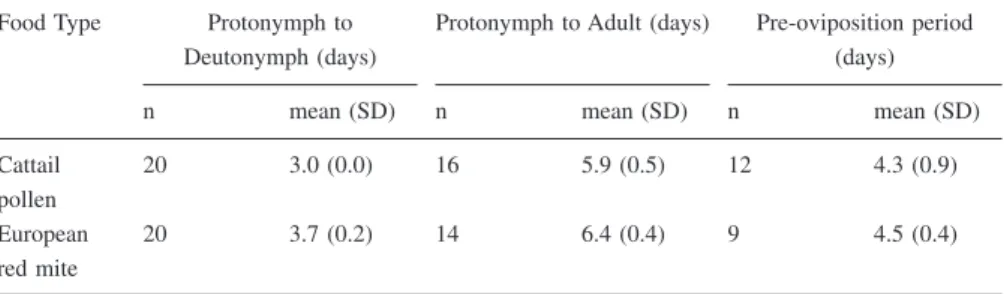
Cattail pollen allowed for successful T. pyri development (Table 1) and oviposition (Figure 3). Typhlodromus pyri were observed piercing and then ingesting the con-tents of the cattail pollen grains. Protonymphs fed cattail pollen developed to the deutonymph stage sooner than protonymphs fed European red mites (t = −3.03, df = 16, P = 0.008). The time that protonymphs took to reach adults and the pre-ovipositional period were similar on both food types (t = −1.4, df = 19, P = 0.18 and t = −0.29, df = 17, P = 0.77, respectively). For the seven day period that ovi-position was recorded, T. pyri females reared on cattail pollen oviposited an aver-age of 1.37 eggs/day with a peak rate of 1.9 eggs/day (Figure 3). In oviposition studies under similar environmental conditions (26–27 °C, 70–90% RH), T. pyri feeding on Panonychus ulmi (Koch) oviposited 0.4-1.02 eggs/day (Duso and Cam-porese 1991). We observed that eggs produced by females fed only cattail pollen
hatched and developed into viable adults. However, colonies fed only cattail pollen gradually decreased in numbers over several generations suggesting that cattail pollen does not provide all the nutrition necessary to sustain T. pyri populations (A.R. personal observation). These results revealed that cattail pollen was a suit-able pollen to use in the augmentation experiments, although cattail pollen prob-ably does not meet all of the nutritional requirements of T. pyri.
Influence of cattail pollen augmentation and leaf trichomes on T. pyri density
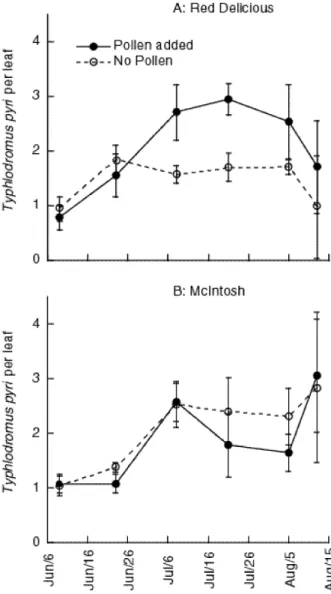
In 1998, the addition of cattail pollen to field grown ‘McIntosh’ and ‘Red Deli-cious’ trees affected T. pyri numbers differently on the two cultivars (variety by pollen augmentation interaction: F = 6.05, df = 1,12, P = 0.03). Because of the significant interaction, we examined the influence of pollen augmentation for each variety separately. Adding pollen to the smoother ‘Red Delicious’ variety increased
T. pyri numbers compared to predator densities in trees that did not receive pollen
applications (Figure 4A) (F = 8.87, df = 1,6, P = 0.02). There was no interaction
Figure 1. Mean number of pollen grains and fungal spores per 100 µl water washed off trichome-rich
and trichome-sparse apple leaves collected July 15 (A) and July 23 (B). Bars represent ±1 standard error of the mean.
between the pollen treatment and time (F = 1.09, df = 5,30, P = 0.38, Huyndt-Feldt
⑀= 0.69) indicating that the temporal pattern of T. pyri abundance on the ‘Red De-licious’ trees was independent of the pollen augmenation. In contrast to the ‘Red Delicious’ trees, applying cattail pollen to trichome-rich ‘McIntosh’ trees had no effect on T. pyri numbers (Figure 4B) (F = 0.6, df = 1,6, P = 0.47) nor was there a significant interaction between the pollen treatment and time (F = 0.41, df = 5,30,
Figure 2. Mean number of cattail pollen grains per 100 µl of rinsate washed off trichome-rich and
tri-chome-sparse apple leaves collected July 15 (A) and July 23 (B). Bars represent ±1 standard error of the mean.
Table 1. Development and oviposition of T. pyri on cattail pollen and European red mite.
Food Type Protonymph to Deutonymph (days)
Protonymph to Adult (days) Pre-oviposition period (days)
n mean (SD) n mean (SD) n mean (SD)
Cattail pollen 20 3.0 (0.0) 16 5.9 (0.5) 12 4.3 (0.9) European red mite 20 3.7 (0.2) 14 6.4 (0.4) 9 4.5 (0.4)
P = 0.83, Huyndt-Feldt⑀> 1.0). Populations of European red mites were very low for the duration of the experiment (density over the sampling period < 0.25 per leaf) and did not vary between variety or treatments.
The data suggest that the number of T. pyri on pollen treated ‘Red Delicious’ trees increased to levels that were similar to those on the pollen treated and non-treated ‘McIntosh’ trees. This may have been because T. pyri on the ‘Red Deli-cious’ trees were food limited, whereas the predators on the ‘McIntosh’ trees were not food limited and adding pollen to the ‘Red Delicious’ trees bridged this gap. Concordantly, pollen applications to ‘McIntosh’ trees had no effect on T. pyri num-bers presumably because there was no shortage of food on these trees. We tested this idea by contrasting the number of T. pyri per leaf found on non-treated ‘Red Delicious’ trees to the density found on the ‘McIntosh’ trees (pooled across treat-ments) and by contrasting the number of predators per leaf on pollen treated ‘Red Delicious’ trees to the number of phytoseiids found on ‘McIntosh’ trees (pooled across treatments). ‘Red Delicious’ trees that did not receive pollen had significantly fewer phytoseiids than did the ‘McIntosh’ trees (F = 4.9, df = 1,10, P = 0.01) while pollen augmented ‘Red Delicious’ trees had predator densities similar to those on the ‘McIntosh’ trees (F = 0.75, df = 1,10, P = 0.41). Neither of the patterns varied over time.
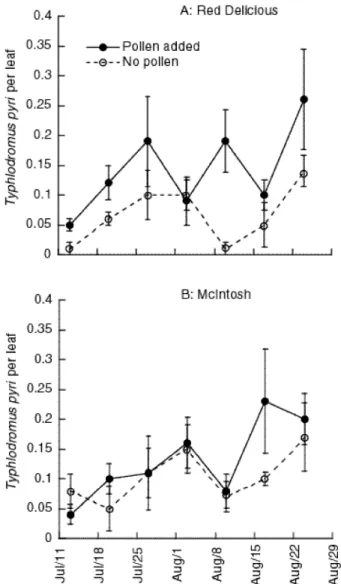
The propargite application in 1999 inadvertently killed many T. pyri and densi-ties were low compared to 1998 numbers. The 1999 data were transformed using a Box-Cox median-symmetry transformation (StataCorp. 1999) to meet ANOVA as-sumptions ( = −3.49). Contrary to the 1998 result where there was a significant interaction between pollen treatment and variety, in 1999 there was no significant interaction between the treatments (F = 1.79, df = 1,12, P = 0.21) although adding pollen did significantly increase predator numbers (F=7.52, df = 1,12, P = 0.03) and this effect was invariant with time (F = 1.01, df = 6,72, P = 0.47, Huyndt-Feldt
⑀> 1.0). The patterns of predatory mite abundance in 1998 and 1999 were similar, despite the lack of significant interaction between the pollen treatment and variety
Figure 3. Mean number of eggs oviposited per day by T. pyri fed cattail pollen. Bars represent ±1
in 1999 (Figure 5). ‘Red Delicious’ trees that received a pollen application gener-ally had more predatory mites compared to ‘Red Delicious’ trees that did not re-ceive pollen (Figure 5A). In contrast, predatory mite numbers on both pollen treated and untreated ‘McIntosh’ trees were quite similar except on one sample date. We suspected that low predator densities coupled with few replicates of each treatment (n = 4) led to low statistical power to test for the variety by treatment interaction. For this reason and because the 1999 data showed trends similar to those found in
Figure 4. Estimated densities of T. pyri on ‘Red Delicious’ and ‘McIntosh’ trees augmented weekly
with cattail pollen (solid line) or with no pollen added (dashed line). Bars represent ±1 standard error of the mean.
1998, we analyzed the data for each variety separately using a repeated measures ANOVA with only one factor, pollen treatment.
‘Red Delicious’ trees receiving pollen had significantly more predatory mites compared to ‘Red Delicious’ trees not receiving pollen (F = 7.94, df = 1,6, P = 0.03). There was no significant interaction between pollen augmentation and time (F = 1.3, df = 6,36, P = 0.28, Huyndt-Feldt⑀> 1.0). ‘McIntosh’ trees receiv-ing a pollen application did not have larger numbers of predatory mite compared to ‘McIntosh’ trees that did not receive pollen (F = 0.6, df = 1,6, P = 0.47) nor was
Figure 5. Estimated densities of T. pyri on ‘Red Delicious’ and ‘McIntosh’ trees augmented weekly
with cattail pollen (solid line) or with no pollen added (dashed line). Bars represent ±1 standard error of the mean.
there an interaction between pollen augmentation and time (F = 0.7, df = 6,36, P = 0.65, Huyndt-Feldt⑀> 1.0). As was found in 1998, adding pollen to ‘Red De-licious’ trees increased predator numbers while adding pollen to ‘McIntosh’ trees had no effect on predator abundance. Numbers of European red mite were very low (density < 0.5 per leaf over the sampling period) and did not vary between varieties or treatments.
As in 1998, the number of T. pyri on pollen-treated ‘Red Delicious’ trees ap-peared to increase to levels that were similar to the treated and non-treated ‘McIn-tosh’ trees (Figure 5). We contrasted the density of T. pyri on non-treated ‘Red De-licious’ trees or pollen treated ‘Red DeDe-licious’ trees to the number found on the ‘McIntosh’ trees (pooled across treatments). Similar to the patterns observed in 1998, ‘Red Delicious’ trees that did not receive pollen had significantly fewer phy-toseiids than the ‘McIntosh’ trees (F = 5.48, df = 1,10, P = 0.04) while pollen-augmented ‘Red Delicious’ trees had predator densities similar to those on ‘McIn-tosh’ trees (F = 0.71; df = 1,10, P = 0.42). Neither of these patterns varied over time.
Typhlodromus pyri were successfully established on the potted trees and by
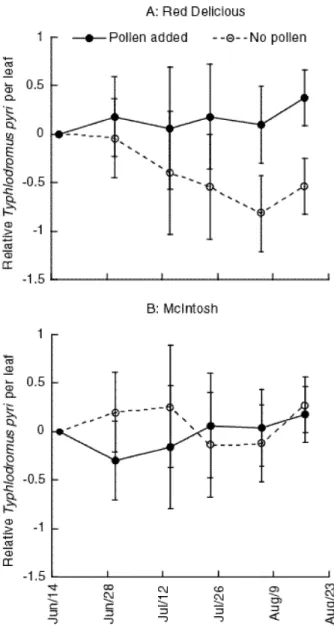
Au-gust 1997, predator densities were approximately 1.5 per leaf on the ‘Red Deli-cious’ trees and approximately 1.7 per leaf on the ‘McIntosh’ trees. On the first sample date in 1998 (June 16), predator numbers varied significantly between the two treatments on the ‘Red Delicious’ trees, although, there were no differences on the ‘McIntosh’ trees. As a result of the differences in initial phytoseiid populations on ‘Red Delicious’ trees, we evaluated the effects of pollen augmentation by ex-amining changes in predatory mite numbers relative to the starting population found on each tree. We calculated a new variable, henceforth referred to as relative den-sity, by subtracting the estimated density of predatory mites on June16 from the density estimated on each of the successive sample dates.
The repeated measures analysis of variance on relative density revealed a sig-nificant variety by pollen treatment interaction (F = 4.04, df = 1,16, P = 0.06) and a significant time by pollen augmentation interaction (F = 3.75, df = 4,64, P = 0.01, Huyndt-Feldt⑀ > 1.0). A plot of the data (Figure 6) suggested that these statisti-cally significant effects arose from the interactions among variety, pollen augmen-tation, and time, even though this three way interaction was not significant in the model. As a result, we estimated models separately for the ‘McIntosh’ and ‘Red Delicious’ trees. For the ‘McIntosh’ trees neither pollen or time significantly influ-enced the relative density of T. pyri. However, on the ‘Red Delicious’ trees, pollen augmentation, time and the interaction of time and augmentation were significant using an ␣ of 0.1 (F = 4.81, df = 1,8, P = 0.06; F = 2.35, df = 4,32, P = 0.07; F = 2.22, df = 4,3, P = 0.09, Huyndt-Feldt ⑀> 1.0). Thus, the patterns of T. pyri abundance observed on the potted trees were similar to those observed on the field grown trees: T. pyri densities on ‘McIntosh’ trees were not influenced by pollen augmentation whereas on ‘Red Delicious’, pollen augmentation led to higher pred-ator numbers.
Figure 6. Relative densities of T. pyri (departure from initial estimate on 6/16/98) on potted ‘Red
De-licious’ and ‘McIntosh’ trees augmented with cattail pollen or receiving no pollen. Bars represent ±1 standard error of the mean. Initial densities were: ‘Red Delicious, pollen added: 0.3 (0.13) [mean (stan-dard error)]; ‘Red Delicious, no pollen: 0.92 (0.18); ‘McIntosh’, pollen added: 0.76 (0.17); ‘McIntosh’, no pollen: 0.68 (0.07).
Discussion
Trichomes are known to increase the capture of airborne particles, including pollen and fungal spores, on leaf surfaces (Chamberlain 1975). We have shown that apple varieties with a high density of trichomes on their leaves captured and retained more pollen and fungal spores than did varieties whose leaves had few trichomes. Apple varieties with trichome-rich leaves have also been shown to harbor larger popula-tions of predatory mites, independent of the abundance of phytophogous mite prey (Downing and Moilliet 1967; Roda et al. 2001). For phytoseiids that can make use of pollen and fungal spores as food, the greater abundance of these resources on plants with trichome-rich leaves compared to trees with trichome-sparse leaves may partially explain the consistent higher densities of the phytoseiids.
Application of cattail pollen to apple trees with rich and trichome-sparse leaves failed to produce significant differences in cattail pollen densities on the two types of leaves, although the sample means suggested that more cattail pol-len was captured on the trichome-rich leaves. One possible reason for our failure to find statistical differences is that the estimates of pollen density had large variances (Figure 2), which our application method likely contributed to. Use of the ‘EZ Power Duster’ to augment pollen on apple trees did not produce natural patterns of pollen deposition. The ‘EZ Power Duster’ blasted a large cloud of cattail pollen forcibly into the tree canopy, a manner very different from normal sedimentation processes (Chamberlain 1975). Furthermore, the cloud of cattail pollen contained clumps or aggregates of pollen that would not naturally occur. In addition, the weather conditions were mild with no rain showers or excessive winds. These weather conditions may also explain why there was not a reduction in pollen on the smooth trees one week after pollen application.
We also demonstrated that adding pollen to apple trees whose leaves had rela-tively few trichomes resulted in an increase in T. pyri numbers, whereas adding pollen to a variety with relatively trichome-rich leaves had no effect on predator density. We observed these patterns on large, field grown trees and on small, potted trees. Because similar results were obtained on mature and young trees, differences in predator abundance can be uniquely attributed to differences in trichome abun-dance, which is independent of tree canopy size and shape. One explanation for these patterns is that trichome-rich leaves trap enough naturally occurring pollen or fungal spores to maintain predator numbers at a level where other factors limit fur-ther population growth, whereas food is limiting on leaves with fewer trichomes and as a result, adding pollen to these trees leads to higher numbers of phytoseiids. This experimental outcome, in combination with the documented greater abundance of naturally occurring pollen and fungal spores on trichome-rich leaves compared to trichome-sparse leaves, is strong evidence that one way in which leaf trichomes mediate the abundance of phytoseiids is by increasing the supply of this food source.
Previous reports have shown that the influence of augmented pollen on phy-toseiid density can depend on when augmentations are made. Spring applications of cattail pollen did not affect Euseius hibisci or E. tularensis numbers in citrus;
however, fall applications increased densities of both predators (Kennett et al. 1979; Grafton-Cardwell and Ouyang 1995). These patterns probably arose because there was an excess supply of pollen in the spring, but an inadequate supply in the fall. This explanation is supported by positive correlations between increases in ply-toseiid numbers and peaks in pollen rains (Kennett et al. 1979; Grafton-Cardwell and Ouyang 1995). It has also been suggested that low pollen abundance in late summer and fall might limit T. pyri at that time of the year (Addison et al. 2000). Our data are equivocal with regards to the influence of temporal variation in the availability of pollen on T. pyri densities.
In our experiments, the influence of temporal changes in pollen availability on predator numbers would be reflected in a time by pollen augmentation interaction. If, as has been suggested, pollen is not limiting early in the season but is limiting later in the season, pollen augmentation should only elevate predator numbers later in the summer. In the experiments using field grown trees we observed no interac-tion between time and pollen augmentainterac-tion. There are three possible explanainterac-tions for this. First, there might in fact not have been any temporal variability in the availability of naturally deposited pollen to predators. Second, the time interval during which the experiments were conducted may have omitted periods (earlier or later than when the experiments were run) when an interaction might have been detected. Third, our ability to detect interactions may have been limited by the number of experimental replicates. If the latter two explanations are discounted, we must conclude that either there was little variability in wind-borne pollen or that temporal variability in naturally deposited pollen did not greatly influence the abun-dance of T. pyri in these experiments. This conclusion should not be construed to mean that pollen availability does not affect T. pyri. Addison et al. (2000) found that between orchard abundance of T. pyri in the spring was correlated with pollen abundance on leaves. This pattern can probably be attributed to spatial variation in airborne pollen rather than temporal variability. Our results from the field grown trees indicate that the influence of temporal changes in pollen availability is not large for T. pyri inhabiting apple trees.
In contrast to the experiments conducted with the field grown trees, the experi-ment using potted trees produced a significant time and pollen augexperi-mentation inter-action. More specifically, predator densities on ‘Red Delicious’ trees receiving pol-len augmentation were significantly greater than predator densities on trees receiv-ing no pollen for the last two sample dates, but were not significantly different on the second through fourth sample dates (LSD test,␣= 0.05). No significant influ-ence of pollen augmentation on T. pyri inhabiting ‘McIntosh’ trees was observed. The patterns observed in this experiment are similar to those previously reported in the literature, albeit with an added nuance. These results suggest that pollen on leaves may be in short supply later in the summer; however, this availability is me-diated by plant characteristics because no influence of pollen augmentation was found with the ‘McIntosh’ trees. Thus, these results suggest that temporal variabil-ity in windborne pollen influences T. pyri abundance on some apple varieties, but not others, probably as a result of differences in leaf trichomes.
Why did we see a time and pollen augmentation interaction with the small pot-ted trees and not with the field grown trees? At present, we can only speculate as to the precise reason but it must lie within the realm of three general causes; differ-ences in windborne pollen and fungal spores in the two areas where the experi-ments were conducted, differences in tree architecture between the field grown and potted trees, and statistical chance.
Pollen and fungal spores are important sources of food for T. pyri when prey is scarce. Our studies show that the abundance of alternative food is influenced by the density of trichomes on leaves and this partially explains the greater number of phytoseiids found on trichome-rich plants (for other explanations also see Grostal and O’Dowd 1994, Roda et al. 2000, and Norton et al. 2001). Most commercially available apple varieties have leaves with a moderately dense trichome cover (A.R. personal observation) suggesting that in commercial apple orchards, pollens and fungal spores that provide T. pyri with alternate food are not limiting, provided there are sources of windborne pollen in proximity to the apple trees. However, we sus-pect that in systems where cultivars have greater variability in the level of leaf pu-bescence (e.g., grapes), low levels of pollen on leaves with few trichomes may have a larger and more important effect on T. pyri numbers. Whether the influence of leaf topography on the capture and retention of pollen and fungal spores will in-fluence phytoseiid abundance is contingent on the production of these non-prey foods in the surrounding environment (Addison et al. 2000). The amount of wind-borne pollen might be substantially different between large continuous areas de-voted to a single crop compared to areas surrounded by or composed of a diverse variety of plants. The task now lies in understanding how the spatial distribution and dispersal of pollen interacts with the structure of the plant to influence the quantity of alternative food available to predatory mites.
Acknowledgements
We thank C. Herring, J. McCann, K. Wentworth, A. Bonacci, and C. Gerling for assistance in data collection and rearing mites. We also thank the United States Dept. of Agriculture, Agricultural Research Service, Plant Genetic Resources Unit, Geneva, New York for supplying apple material and use of the orchards. Drafts of this manuscript were improved by the helpful comments of Cole Gilbert. This work was supported by Cornell College of Agriculture and Life Science Aurthur Bollar research grant (A.L.R.) and by the United States Dept. of Agriculture grant #98-34103-6062 (J.P.N.) and grant #96-35302-3288 (G.E.L.).
References
Addison J.A., Hardman J.M. and Walde S.J. 2000. Pollen availability for predaceous mites on apple: spatial and temporal heterogeneity. Exp. Appl. Acarol. 24: 1–18.
Chamberlain A.C. 1975. The movement of plant particles in plant communities. In: Monteith J.L. (ed.), Vegetation and the Atmosphere. Academic Press, New York, pp. 155–204.
Chant D.A. 1959. Phytoseiid mites (Acarina: Phytoseiidae). Part I. Bionomics of seven species in south-eastern England. Can. Entomol. 91 Suppl. 12: 5–44.
Downing R.S. and Moilliet T.K. 1967. Relative densities of predaceous and phytophagous mites on three varieties of apple trees. Can. Entomol. 99: 738–741.
Duso C. and Camporese P. 1991. Developmental times and oviposition rates of predatory mites
Typhlo-dromus pyri and Amblyseius andersoni (Acari: Phytoseiidae) reared on different foods. Exp. Appl.
Acarol. 13: 117–128.
Duso C. and Vettorazzo E. 1999. Mite population dynamics on different grape varieties with or without phytoseiids released (Acari: Phytoseiidae). Exp. Appl. Acarol. 23: 741–763.
Grafton-Cardwell E.E. and Ouyang Y. 1995. Augmentation of Euseius tularensis (Acari: Phytoseiidae) in citrus. Ann. Entomol. Soc. Am. 24: 738–747.
Grafton-Cardwell E.E., Ouyang Y.L. and Bugg R.L. 1999. Leguminous cover crops to enhance popu-lation development of Euseius tularensis (Acari: Phytoseiidae) in citrus. Biol. Control 16: 73–80. Grostal P. and O’Dowd D.J. 1994. Plants, mites and mutualism: leaf domatia and the abundance and
reproduction of mites on Viburnum tinus (Caprifoliaceae). Oecologia 97: 308–315.
Karban R., English-Loeb G., Walker M.A. and Thaler J. 1995. Abundance of phytoseiid mites on Vitis species: effects of leaf hairs, domatia, prey abundance and plant phylogeny. Exp. Appl. Acarol. 19: 189–197.
Kennett C.E., Flaherty D.L. and Hoffmann R.W. 1979. Effect of wind-borne pollens in the population dynamics of Amblyseius hibisci (Acari: Phytoseiidae). Entomophaga 24: 83–98.
McMurtry J.A. and Croft B.A. 1997. Life-styles of phytoseiid mites and their roles in biological control. Annu. Rev. Entomol. 42: 291–321.
McMurtry J.A. and Johnson H.G. 1965. Some factors influencing the abundance of the predaceous mite
Amblyseius hibisci in Southern California (Acarina: Phytoseiidae). Ann. Entomol. Soc. Am. 58: 49–
56.
Norton A., English-Loeb G. and Belden E. 2001. Host plant manipulation of natural enemies: Leaf domatia protect beneficial mites from insect predators. Oecologia 126: 535–542.
Nyrop J.P., English-Loeb G. and Roda A.L. 1998. Conservation biological control of spider mites in perennial cropping systems. In: Barbosa P. (ed.), Conservation of Natural Enemies of Pests. Aca-demic Press, New York, pp. 307–33.
Ouyang Y., Grafton-Cardwell E.E. and Bugg L.L. 1992. Effects of various pollens on development, sur-vivorship and reproduction of Euseius lularensis (Acari: Phytoseiidae). Environ. Entomol. 21: 1371– 1376.
Overmeer W.P.J. 1981. Alternative prey and other food resources. In: Helle W. and Sabelis M.W. (eds), Spider Mites. Their Biology, Natural Enemies and Control. Elsevier, Amsterdam, pp. 131–140. Overmeer W.P.J. and van Zon A.Q. 1984. The preference of Amblyseius potentillae (Garman) (Acarina:
Phytoseiidae) for certain plant substrates. In: Griffiths D.A. and Bowman C. (eds), Acarology VI. Horwood, Chichester, pp. 591–596.
Rasmy A.H. and El-Banhawy E.M. 1974. Behaviour and bionomics of the predatory mite, Phytoseius
plumifer (Acarina: Phytoseiidae) as affected by physical surface features of host plants. Entomophaga
19: 255–257.
Roda A.L., Nyrop J.P., Dicke M. and English-Loeb G. 2000. Trichomes and spider mite webbing pro-tect predatory mite eggs from intraguild predation. Oecologia. 125: 428–435.
Roda A., Nyrop J., English-Loeb G. and Dicke M. 2001. Leaf pubescence nad two-spotted spider mite webbing influence phytoseiid behavior and population density. Oecologia 129: 551–560.
Tanigoshi L.K., Mégevand B. and Yaninek J.S. 1993. Non-prey food for subsistence of Amblyseius
idaeus (Acari: Phytoseiidae) on cassava in Africa. Exp. Appl. Acarol. 17: 91–96.
Tauber H. 1967. Investigations of the mode of pollen transfer in forested areas. Rev. Palaeobotan. Pa-lynol. 3: 277–286.
von Engel R. and Ohnesorge B. 1994a. Die Rolle von Ersatznahrung und Mikroklima im System
Typhlodromus pyri Scheuten (Acari, Phytoseiidae) - Panonychus ulmi Koch (Acari, Tetranychidae)
auf Weinreben. I. Untersuchungen im Labor. J. App. Ent. 118: 129–150.
von Engel R. and Ohnesorge B. 1994b. Die Rolle von Ersatznahrung und Mikroklima im System
Typhlodromus pyri Scheuten (Acari, Phytoseiidae) - Panonychus ulmi Koch (Acari, Tetranychidae)
auf Weinreben. II. Freilandversuche. J. App. Ent. 118: 224–238.
Walde S.J., Nyrop J.P. and Hardman J.M. 1992. Dynamics of Panonychus ulmi and Typhlodromus pyri: factors contributing to persistence. Exp. Appl. Acarol. 14: 261–291.
Walter D.E. 1996. Living on leaves: mites, tomenta, and leaf domatia. Annu. Rev. Entomol. 41: 101– 114.
Wei Q.C. and Walde S.J. 1997. The functional response of Typhlodromus pyri to its prey, Panonychus
ulmi: the effect of pollen. Exp. Appl. Acarol. 21: 677–684.
Yue B. and Tsai J.H. 1996. Development, survivorship, and reproduction of Amblyseius largoensis (Ac-ari: Phytoseiidae) on selected plant pollens and temperatures. Environ. Entomol. 25: 488–494.