Do individuals care about fairness in burden sharing
for climate change mitigation? Evidence from a lab
experiment
Robert Gampfer
Received: 10 April 2013 / Accepted: 16 February 2014 / Published online: 5 March 2014 # Springer Science+Business Media Dordrecht 2014
Abstract One of the reasons for deadlock in global climate policy is countries’ disagreement on how to share the mitigation burden. Normative theory suggests various fairness criteria for structuring burden sharing, most prominently, historical responsibility for emissions, economic capacity, and vulnerability to climate change. Governments have taken up these criteria in their rhetoric at UNFCCC negotiations. I examine whether normative criteria influence individual burden sharing preferences. This bottom-up perspective is important for two reasons. First, it is unknown if governments’ fairness rhetoric matches citizens’ actual preferences. Second, international climate agreements directly affect individuals through domestic policy measures (e.g. energy taxes), and therefore require domestic public support for successful implementa-tion. I conducted two laboratory experiments where participants have to agree on how to share climate change mitigation costs in an ultimatum game. Treatment conditions include differ-ences between proposer and responder in capacity, vulnerability (experiment 1), and historical emissions (experiment 2). Historical emissions are endogenously determined in a prior game. Capacity inequality strongly affects burden sharing, with richer players ending up paying more, and poorer players less. Vulnerability differences reduce the influence of fairness, leading to suggested cost distributions more unfavorable to vulnerable players. However, vulnerable responders still reject many“unfair” offers. Differences in historical responsibility result in cost distributions strongly correlated with players’ relative contributions to climate change. The results suggest that more nuanced consideration of fairness criteria in burden sharing could make ambitious climate agreements more acceptable for reluctant countries and their citizens.
1 Introduction
In global climate negotiations, countries have so far not managed to agree on how to share the burden of mitigation amongst themselves, which critically hampers negotiation progress. The
Electronic supplementary material The online version of this article (doi:10.1007/s10584-014-1091-6) contains supplementary material, which is available to authorized users.
R. Gampfer (*)
Center for Comparative and International Studies and Institute for Environmental Decisions, ETH Zurich, Haldeneggsteig 4, 8092 Zurich, Switzerland
“common but differentiated responsibilities” principle formulated in Article 3 of the UN Framework Convention on Climate Change (UNFCCC) engendered the distinction between Annex-I and non-Annex-I countries in the Kyoto Protocol, but this rough arrangement has intensified rather than resolved the debate about fair burden sharing (Kallbekken2014).
Whereas many developed countries are reluctant to step up their mitigation activities as long as major emerging economies reject similar commitments, those and other developing countries expect the developed world to bear an even larger share of the burden. These diverging positions result from the use of different criteria to determine burden allocation: current or historical responsibility, ability to pay, emissions per capita, and vulnerability to climate change, among the more frequently used (Hayward2012; Baer2013). These criteria reflect different, but not mutually exclusive, conceptions of distributive justice. Governments frequently invoke these principles in negotiations and public debate to justify their stance on burden sharing (Ringius et al. 2002; International Institute for Sustainable Development
2012b; Stalley2012; Lange et al.2010).
Yet while fairness principles for burden sharing in global climate governance have been extensively analyzed theoretically (Gardiner 2010; Adger et al. 2006; Arnold 2011), and politics has taken up the resulting arguments, empirical research on individual preferences for such principles is scant. In this article I report two experiments investigating the influence of fairness criteria on individual burden sharing preferences. My goal is to identify which fairness principles (if any) individuals take into account for allocating mitigation costs.
What individual citizens perceive as fair in burden sharing matters, first, because govern-ments often claim to follow domestic public opinion when insisting on certain fairness principles in the UNFCCC negotiations, yet it is unknown whether those principles reflect citizen preferences. Second, any effective international climate agreement directly affects individuals through domestic policy measures (e.g. on energy supply and use), and therefore requires (at least in democracies) public support for successful implementation.
I conducted two interactive lab experiments where pairs of participants have to allocate mitigation costs between themselves. A proposer suggests how to split total costs (to be paid from each players endowment), and a responder accepts or rejects this suggestion. In case of rejection, both players lose part of their endowment due to a“climate catastrophe”.1Treatment conditions vary players’ ability to pay, vulnerability, and historical responsibility. Results show that both ability to pay and historical responsibility are strong determinants of agreed cost distributions. Vulnerability mitigates the influence of other fairness criteria, as vulnerable players bargaining position is weaker.
Many studies have experimentally investigated different aspects of global climate gover-nance, mostly using public good games (e.g. Milinski et al.2008; Tavoni et al.2011; Sturm and Weimann2006). Some focus on players’ properties like ability to pay (Brekke et al.2012). Klinsky et al. (2012) use structured decision analysis to study differences in individuals’ justice
rationales regarding mitigation and adaptation. Yet to my knowledge, no study has so far tested fairness criteria for burden sharing in an experimental game setting.
Section2of this article outlines normative-theoretical burden sharing principles and their relation to individual fairness perceptions. Section 3 presents the experimental design and results for capacity and vulnerability, Section4those for historical responsibility. Section5
discusses and synthesizes results, and Section6concludes.
1
This is a variation of the ultimatum game. In its simplest form the proposer suggests how to split an amount of money between him and the responder. If the responder accepts, money is paid out accordingly, if she rejects, none of them receive any money.
2 Burden sharing principles: from normative theory to individual fairness perceptions
2.1 Burden sharing principles in political theory
The 2° climate policy target implies substantial emission reductions by many countries compared to business-as-usual scenarios (Fuessler et al. 2012), requiring large investments over the coming decades. Thus, whereas internationally allocating emission budgets has been framed as a common pool resource issue (Ostrom et al. 2002; Messner et al. 2010; Young
2014), the actual reduction efforts necessary to stay within those budgets are more appropri-ately viewed as contributions to the public good of climate change mitigation (e.g. Barrett and Dannenberg2012; Milinski et al.2008; Stone2009). This mitigation burden has to be shared among countries.
I focus on substantive, as distinguished from procedural, fairness principles discussed in theoretical literature (Ringius et al.2002: 5), because the former directly determine the material outcomes of burden sharing arrangements (which actor has to invest how much into mitiga-tion). Most frequently used equity-based criteria are actors’ causal responsibility and ability to pay (Hayward2012; Page2008). The needs-based criterion vulnerability to climate change is particularly salient in the adaptation context, but is often used concerning mitigation, too (Baer
2013; Ikeme2003).
Causal responsibility principles essentially state that those who contributed most to the problem of climate change should also carry the largest burden in mitigating it. Theorists frequently advocate this“polluter-pays” approach as basis for burden sharing (Caney2005; Gosseries2004; Meyer and Roser2010). To apply it in a fair way, however, more nuanced specifications are necessary (Ringius et al.2002). First, responsibility can be measured based on current or accumulated historical emissions. An argument for using current emissions is that the polluter-pays principle is a means to influence contemporary behavior by internalizing environmental emissions costs (Stevens 1994). However, due to CO2’s persistence in the atmosphere, its stock matters more than current flows–which favours using historical emis-sions, since long-time big emitters have contributed more to climate change (Neumayer2000; Baer et al.2000). Consequentially, the recent literature seems to favor historical responsibility (Hayward2012). Yet this raises the issue of whether current agents can be held liable for an action earlier generations committed (Moellendorf 2009), and whose harmfulness those generations were not aware of (Shue 1999; Miller 2008), since most historical emissions occurred when their impact on climate was unknown or highly uncertain. Therefore, some advocate accounting only for emissions after 1990, when the first IPCC Assessment Report was published (e.g. Miller2008).
The ability-to-pay principle holds that mitigation burden should be shared in accordance with economic capacity (Baer 2013). Distributive justice is thus achieved by allocating collective costs in line with actors’ capacity to carry them. Requiring substantive mitigation action from poor countries, which would benefit also rich ones, embodies poor-to-rich transfers that are objectionable in this view (Caney 2005; Carlson 2009). On pragmatic matters, this principle is easy to apply compared to the complicated attribution of causal responsibility (Hayward2012).
Vulnerability as burden sharing criterion derives from a needs- rather than equity-based distributive justice norm (Konow2010), and thus from ethics of compassion rather than of obligation (Adger and Nicholson-Cole2011; Gardiner2006). Those likely to suffer drastic negative consequences from climate change should receive assistance from the less vulnerable. Theorists usually propose some combination of these principles (Page2008), for example, a polluter-pays approach attributing responsibility only where possible, and allocating the
“remainder” according to actors’ capacity (Caney2010). The Greenhouse Development Rights Framework uses a“responsibility-capacity indicator” to allocate emissions rights and mitiga-tion obligamitiga-tions (Baer et al.2009).
2.2 Burden sharing principles in the UNFCCC process and the relevance of individual fairness perceptions
Theorists state that burden allocations are rather similar no matter which principle is applied (Ringius et al.2002; Caney2005; Baer et al.2000). Developed countries should carry the largest burden because of their high economic capacity, large historical emissions, and huge benefits from emissions. Moreover, they are likely to be the least vulnerable countries. However, recent empirical estimates and simulations of burden sharing rules show that different principles can result in different allocations, especially concerning large emerging economies (Fuessler et al.2012; Elzen and Lucas2005).
International climate politics has partly taken up the academic discussion.“Common but differentiated responsibilities and respective capabilities” implies the need for burden sharing criteria. Nevertheless, while several burden sharing proposals have been debated, a generally accepted arrangement has not emerged.
The UNFCCC stalemate is largely due to the difficulty of aligning interests of multiple heterogeneous negotiation parties (Victor 2011). Yet governments often invoke fairness principles, even if frequently picking those accommodating their country’s economic self interest (Lange et al. 2010). Large emerging economies (India, Brazil, China) are strong advocates of pure historical responsibility, which would place relatively light obligations on them. Still, not only the EU’s high unilateral reduction pledge seems to be driven partly by fairness considerations, but also China’s insistence on fair burden sharing sometimes contra-dicts its economic interests (Stalley 2012). Whether used in good faith or not, fairness arguments often dominate climate negotiations (International Institute for Sustainable Development2012a).
Besides economic self-interest, domestic public support is a motive for governments to defend a particular burden sharing principle. Governments are unlikely to commit to an agreement that will be hard to implement domestically. Any effective international climate change agreement directly affects individual citizens through domestic policy measures, and may thus face substantial resistance. Among other factors, public support depends on if and how normative fairness criteria influence individual burden sharing preferences. In the exper-iments reported below I investigate empirically whether individuals generally tend to minimize their own burden, or whether they take fairness principles into account during burden allocation.
3 Experiment 1: capacity and vulnerability
3.1 Methodology choice
I use interactive lab experiments with monetary incentives to study burden sharing preferences. My goal is not to model international climate negotiations inside the lab—a formalized game consisting of a few one-shot interactions would be a strong oversimplification of a negotiations setting. Rather, my aim is to infer individuals’ preferences by observing their experimental behavior. The experiment is thus structured to fit this purpose, and not to simulate a negotiation process. Recent experimental evidence moreover indicates that fairness principles are salient
not only in repeated interactions with long-established relationships (like real international negotiations), but in anonymous one-shot interactions as well (e.g. Cappelen et al. 2013,
2010).
Participants’ payouts are determined by their behavior during the experiment, so that their decisions on the allocation of mitigation burden have direct and tangible consequences. Online Resource 1compares this revealed-preference approach to other methods, discusses use of monetary incentives and lab experiments’ external validity, and provides technical details of both experiments.
3.2 Design and hypotheses
Instead of dividing up an amount of money as in the simple ultimatum game, players decide how to split the costs of climate change mitigation.2Participants are randomly grouped into pairs with one proposer and one responder. Each player receives an initial endowment of “Experimental Currency Units” (ECU). Figure S1 (Online Resource 1) shows game and payoff structures of both experiments.
The proposer suggests how to split the total cost of climate change mitigation (10 ECU) between himself and the responder. If the responder accepts, the“burden sharing agreement” is implemented and each player’s share is subtracted from her endowment. If the responder rejects, no mitigation is undertaken and a “catastrophic climate event” occurs with a fixed probability of 50 %, where each player loses a certain part of her endowment. Such catastrophe threats are common in experimental designs on climate change (Milinski et al.2008; Tavoni et al.2011). Even if most effects of climate change are expected to be gradual, this setting is not unrealistic. Climate scientists have identified potential thresholds or“planetary boundaries” whose crossing could have irreversible and relatively sudden catastrophic effects (Rockstrom et al. 2009; Schneider 2004), and economists have modeled how the prospect of climate catastrophes affects the feasibility of an international climate agreement (Barrett and Dannenberg2012; Barrett2013).
Participants were randomly assigned to one of four treatment conditions or a baseline (control) group. In the baseline group, both endowment and percentage of endowment lost in case of a catastrophe (“loss rate”) are equal for proposer and responder (30 ECU and 50 %). The treatment conditions vary the differences between proposer and responder in those variables (TableS1). In the two capacity conditions, the proposer is poorer than the responder or vice versa (endowments 30 vs 15 ECU). In the two conditions that combine capacity and vulnerability, the proposer is poorer and has a higher loss rate than the responder, or vice versa (loss rates 2/3 vs 1/3 of endowment). I selected these combinations because they are empiri-cally most prevalent. Poor countries tend to be highly vulnerable to climate change not merely due to their low capacity, but their geographical location and other factors (Füssel2010).
During the explanation of the game, players received a brief introduction to climate change and the burden sharing issue. In the corresponding treatment conditions, the texts additionally mentioned capacity and vulnerability differences (sample text and screenshots in Online Resource 1). Endowment sizes, loss rates, and all other parameters, as well as the game outcome, are common knowledge within each pair of players. Each participant plays three rounds, being matched anonymously with a different partner each time (Online Resource1
2Public goods games are often used for studying diverse aspects of global climate governance in the lab
(Milinski et al.2008; Sturm and Weimann2006). However, I consider the ultimatum game setting more useful in my case, as offers and acceptance/rejection in a one-shot game should more directly reflect basic underlying preferences.
discusses potential learning effects). Role and endowments are assigned anew each round (each player was at least once proposer and once responder). Online Resource1provides mean payouts.
After the experiment participants answered a short questionnaire on their behavior in the game and what they would have considered a fair offer by the proposer. It further contained a few items on environmental preferences, climate change knowledge, and prior participation in lab experiments, to enable controlling for these individual characteristics in later analysis.
In the subgame-perfect equilibrium (SPE) which purely rational actors should play, the proposer offers to pay the lowest amount for which the responder is better off (in expectation) if he accepts rather than rejects3; and the responder accepts this offer. In the baseline condition, this is 3 ECU (the responder’s expected payoff if she rejects is 0.5*30+0.5*15=22.5, accepting the offer leaves her with 30−7=23). However, the experimental literature shows that proposers tend to offer around half the amount to be distributed, or a little less, and responders tend to reject offers below that (e.g. Oosterbeek et al.2004). I thus expect proposers in the baseline condition to offer to pay on average 5 ECU or slightly less, and responders to accept most offers equal or higher than that.
If capacity difference influences burden sharing preferences, I expect rich proposers to offer on average more than 5 ECU, and poor proposers less than 5 ECU (SPE offers are 7 and 3, respectively). Rich responders should more readily accept offers lower than 5 ECU than in the baseline condition, and poor responders should be less likely to accept offers around 5 ECU. If vulnerability works as a needs-based fairness criterion, rich, little-vulnerable proposers should offer even larger shares than in the corresponding capacity condition, and vice versa for poor, highly-vulnerable proposers. Again, this expectation should be reflected in responders’ likelihood to accept. However, vulnerability might also mitigate the influence of fairness principles. If this is the case, I expect rich, little-vulnerable proposers to offer somewhat less than in the corresponding capacity condition, and poor, highly-vulnerable proposers to offer somewhat more, as proposers recognize that poor, highly-vulnerable players are in a weaker position for rejecting offers. Rich, little-vulnerable responders should then be less likely than in the corresponding capacity condition to accept offers below 5 ECU; and poor, highly-vulnerable responders should tend to accept offers less favorable to them than in the corre-sponding capacity condition. SPE offers are 5 ECU in both conditions, with the responder indifferent between accepting and rejecting (assuming risk-neutral actors).
It should be noted that the distance between SPE and a “fair” split potentially affects proposers’ behavior (e.g. with an SPE of 1 instead of 3 in the baseline, proposers might be less inclined to offer the fair split of 5). SPE offers moreover vary together with treatment. Since parameter choice is influenced by several game structure aspects desirable for appropriately reflecting country differences that might invoke fairness norms, this problem is to some degree unavoidable. Thus, while differences between treatment conditions are of primary interest when analyzing results, size and significance of differences between each treatment condition’s SPE and observed behavior have to be examined, too.
3.3 Results
Figure1summarizes proposers’ mean offers in each treatment condition. Standard deviations
are small except in the high-capacity, low-vulnerability proposer group. Group sizes were 48, 51, 48, 48, and 39, respectively (number of interactions). In the baseline group, offered shares 3
In the existing treatment conditions, this strategy always implies a higher expected payoff for the proposer than if he makes an offer the responder should rationally reject.
are slightly below the equal 5–5 distribution, as expected (t-test for difference between result and SPE offer: p-value<0.0001).
Effects of the capacity treatments on proposers’ offers are large (Online Resource 1, Fig.S7). In the low-capacity proposer condition, mean offers were around 2 ECU lower than in the baseline (p-value 0.00001), and also lower than the SPE (3; p-value 0.0112). In the high-capacity proposer condition, offers were almost 2 ECU higher than in the baseline (p-value 0.00001)–but lower than the SPE (7; p-value 0.0002). The differences to the baseline results suggest a strong influence of the ability-to-pay principle.
Effect sizes of the capacity-plus-vulnerability treatments are smaller. A low-capacity, high-vulnerability proposer offered to pay around 0.5 ECU less than a baseline proposer (p-value 0.1023), whereas a high-capacity, low-vulnerability proposer offered to pay around 0.6 ECU more (p-value 0.091). The former mean offer differs significantly from the SPE (5; p-value 0.0003), whereas the other does not (p-value 0.3236).
Differences between capacity and capacity-plus-vulnerability treatments are large and significant. Poor, highly-vulnerable proposers offer to pay 1.6 ECU more than“only-poor” proposers, and rich, little-vulnerable proposers offer 1 ECU less than“only-rich” proposers (p-values 0.00001 and 0.0057, respectively). Thus, vulnerability differences mitigated fairness concerns rather than reinforcing those induced by differing capacities.
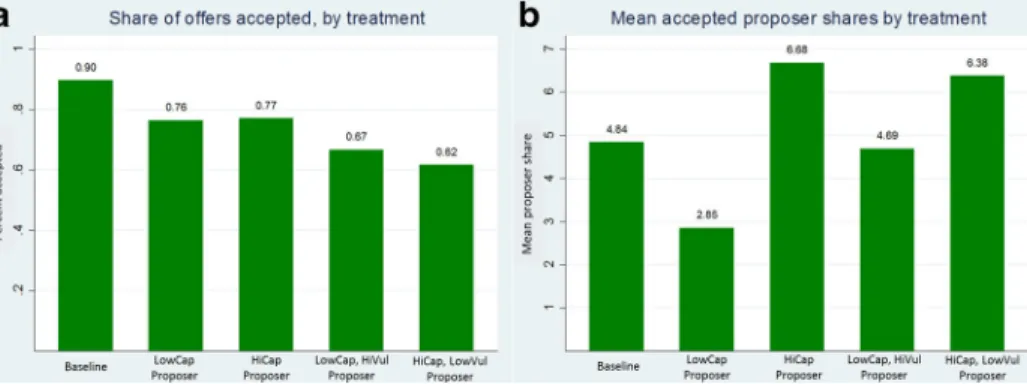
Responder acceptance rates are high across treatments (Fig.2, panel a). Those in the capacity treatments are slightly lower than in the baseline (p-values for Chi2 tests are 0.084 and 0.1 for LowCap and HighCap, respectively). Still lower are those in the capacity-plus-vulnerability treatments (p-values 0.007 and 0.002 for LowCap, HiVul and HiCap, LowVul, respectively).
To obtain uncertainty estimates for these differences, I run permutation tests of the Chi2 estimates. Resulting standard errors and confidence intervals are small relative to the point estimates and corroborate the initial results (TableS2).
Relating proposer to responder behavior, I compare accepted offers between treatments (Fig.2, panel b). Their means are only slightly higher than means of all offers. The notable exception is the high-capacity, low-vulnerability proposer condition, where the mean accepted offer is around 1 ECU higher than the mean of all offers (significant at 0.05 level, t=2.023). In this group, responders also strongly deviate from the subgame-perfect equilibrium decision. Vulnerability therefore appears to be a stronger fairness criterion for responders than for proposers (Section5).
4 Experiment 2: historical responsibility
4.1 Design and hypotheses
The second experiment closely resembles the first in structure. However, in order to credibly endow all participants with an individual “emissions history”, there is a preliminary, non-interactive stage before the ultimatum game. Participants start with a uniform 8 ECU endow-ment to avoid effects from different starting conditions. They then simulate growth in their “one-person economy” by choosing between “high growth” and “low growth” over 5 rounds. Choosing low growth in one round increases the endowment by 1 ECU; choosing high growth, by 5 ECU. Each round of high growth increases climate catastrophe risk by 5 percentage points. As this is common knowledge, the experiment resembles the post-1990 situation when there was sufficient knowledge about greenhouse gas emissions’ effects.
After the fifth round, players begin the ultimatum game with their accumulated wealth (possible values between 13 and 33 ECU) and historical responsibility for climate catastrophe risk (between 0 and 25 %). Since participants are randomly matched in pairs, difference in historical responsibility is randomly assigned. The ultimatum game proceeds as in the first experiment–except that the probability of catastrophe varies across pairs. It is calculated as the sum of both players’ historical contributions and a 15 % baseline risk (thus ranging from 15 % to 65 % in 5 % increments). Participants play three independent rounds, always starting again with their endowment and historical responsibility determined in the preliminary stage. Vulnerability is fixed at a 0.5 loss rate.
If historical responsibility affects preferences, I expect offered burden allocations to be more asymmetric the larger the difference in responsibility is, with those having contributed more to climate risk offering to pay larger shares. Responders should tend to accept offers where proposers pay at least a share commensurate with their relative contribution to climate risk.
4.2 Results
Since climate risk contributions and endowments are determined by individual choices in the preliminary stage, they vary across participants. Mean endowment is 28.6 (Std. dev. 5.09). Median risk contribution is 20 %, resulting in a median probability of 55 % for a climate catastrophe across all pairs.
Fig. 2 Responder behavior, first experiment. Panel a: share of accepted offers by treatment condition. Panel b: mean proposer cost shares of accepted offers by treatment condition
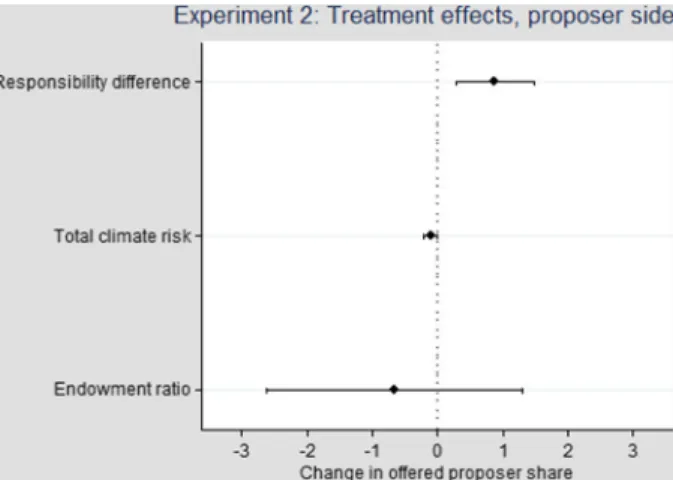
Offers increase in line with proposers’ relative to responders’ contribution to climate risk, indicating that historical responsibility is a salient fairness criterion (Fig.S8). I estimate an OLS regression with proposer offer as dependent variable, and difference in historical respon-sibility as independent variable (defined as proposer’s minus responder’s contribution to climate risk). Control variables are total group climate risk and ratio of proposer’s and responder’s endowment.4 To adjust for non-independence within participants across different rounds, standard errors are clustered on the proposer.
The coefficient of responsibility difference is positive and significant at the 1 % level, that of total climate risk at the 5 % level. Adding an interaction between endowment ratio and difference in responsibilities does not substantively change these results, except that climate risk turns insignificant (TableS3). Figure3shows substantive effects estimated from simula-tions of the above regression (with interaction term). Offers rise by 0.87 ECU for a 5 % increase in responsibility difference. For the simulations I used Clarify (Tomz et al.2003).
For the responder side, I estimate a logistic regression with responder’s acceptance as dichotomous dependent variable. Independent variables are responsibility difference and proposer offer, with total climate risk and endowment ratio as controls. Standard errors are clustered on the responder. An alternative model (R2) includes an interaction between endowment ratio and responsibility difference. Since the effect of responsibility difference could vary depending on the value of the offer, a third model (R3) adds an interaction between these variables.
The effect of the proposer’s offer on the probability to accept is always positive and significant at the 1 % level–unsurprisingly, higher offers are more likely to be accepted. The effect of responsibility difference is negative as expected: higher relative responsibility of the proposer reduces the likelihood of acceptance. While it is significant at the 5 % level in the simple model R1, it turns insignificant in R2 and R3, suggesting that historical responsibility affects responders’ decisions only weakly. Total climate risk is significant at the 5 % level in all three models. The interaction term between offer and responsibility difference in R3 is not statistically significant, suggesting that the impact of differences in historical responsibility is not contingent on the size of the proposer’s offer (TableS4).
In the post-experiment questionnaires, participants described motivations for their behavior that corroborate the findings from both experiments, in particular the influence of capacity and responsibility differences on burden sharing preferences (details in Online Resource1).
5 Discussion
The results indicate that a capacity-related fairness norm strongly influences burden sharing preferences. This is true for rich as well as poor players. Not only do poorer proposers offer substantially less than when endowments are equal, but richer proposers offer more. Furthermore, rich responders also largely accept lower offers from poorer proposers. The larger effect of the low-capacity compared to the high-capacity proposer treatment on the offer suggests that capacity differences are especially salient for fairness perceptions of those who are on the disadvantaged side. This is also indicated by the higher mean of accepted offers than of all offers in this treatment condition. Normative theorists’ advocacy of the ability-to-pay principle (Baer 4Controlling for participant characteristics and preferences (measured in the post-experiment questionnaire)
could increase estimates’ efficiency, as those variables might influence the offer. Omitting them does however not bias the estimates, since all independent variables depend on choices of both proposer and responder and are therefore unlikely to correlate with personal characteristics of the proposer.
2013; Caney2005) is thus clearly reflected in participants’ behavior. Rich players’ higher offers
are also consistent with observations from public goods experiments, where richer participants contributed larger amounts (e.g. Brekke et al.2012; Tavoni et al.2011).
Including vulnerability differences does not seem to induce needs-based fairness norms. Instead, the results bolster my counter-hypothesis stating that vulnerability differences can mitigate other fairness considerations. Theoretical needs-based fairness arguments as proposed e.g. by Adger and Nicholson-Cole (2011) or Baer (2013) appear not to have strong traction in individuals’ preferences. The results may however be more in line with empirical observations of self-serving bias both in experiments and real-world climate negotiations (e.g. Brekke et al.
2012; Lange et al.2010). Both poor, highly vulnerable and rich, little vulnerable participants appear to take into account the weaker position of highly vulnerable players for rejecting an offer. Poor, highly vulnerable players offer almost the baseline share, presumably because their incentive to avoid catastrophe is higher. Knowing that, rich, little vulnerable proposers make lower offers than“only-rich” proposers. However, poor, highly vulnerable responders rejected a considerable number of these lower offers (compare Fig.1and2b).
One possible explanation is that needs-based fairness is more important to disadvantaged actors if they have less influence on the burden-sharing outcome. Responders’ agency opportunities are lower than proposers’, since they are second movers who can only accept or reject a given cost distribution. Disadvantaged proposers might be prepared to make a higher payment offer to ensure acceptance and avoid catastrophe, since this offer is at least their own decision. But disadvantaged responders simply confronted with a low,“unfair” offer might tend to reject such unfair treatment, regardless of the potential material consequences. These potential implications of vulnerability differences have, to my knowledge, been largely unaddressed in the theoretical literature. Potentially counterproductive interactions between different fairness principles, as discovered in this experiment, should furthermore be taken into account when developing burden sharing proposals combining several fairness norms, as in Caney (2010) or Baer et al. (2009).
Historical responsibility also has a strong influence on burden sharing preferences. The higher proposers’ relative contribution to climate risk, the larger the share they offer to pay.
Fig. 3 Simulated marginal effects of independent variables on offered proposer share (OLS regression with interaction between responsibility difference and endowment ratio). Responsibility difference and total climate risk are increased from their median by 0.05, endowment ratio from its median by 0.2. Dots indicate point estimates, whiskered lines 95 % confidence intervals
Responsibility differences do not seem to have a strong direct effect on responders’ likelihood to accept. This could be partly a result of the often high endowments, making it cheaper to pay even a relatively large share than to risk losing a substantial amount, regardless of fairness criteria. However, likelihood of acceptance is strongly influenced by offer size. While this is unsurprising, to the degree that these offers already“price in” responsibility differences–which seems to be the case in the experiment–the absence of a separate effect of responsibility differences on responders’ decisions might be expected. In sum, the responsibility principle strongly endorsed by theorists (e.g. Caney2005; Gosseries2004; Hayward2012) appears to prominently influence empirical burden sharing preferences, too. One should note, though, that the experimental structure obviated some problems in practically applying the principle (Section2.1), potentially making it easier to follow.
Examining participants’ motivations as stated in the post-experiment questionnaire corrob-orates the inferences discussed above. Whereas in the capacity and responsibility treatments a large majority listed fairness as a main reason for their decisions, only few respondents in the capacity-plus-vulnerability treatments related fairness to vulnerability (see Online Resource1).
6 Conclusion
Disagreement about burden sharing in global climate governance is one of the main issues stalling the UNFCCC negotiations. Several fairness principles have been put forward to guide a more differentiated allocation of the mitigation and adaptation burden. This study has focused on three commonly cited fairness criteria–ability to pay, vulnerability, and historical responsibility–and examined experimentally whether and how these criteria influence individ-ual preferences for burden sharing.
Individuals cared strongly about fairness when allocating mitigation burden in the exper-iment. This was especially true for those participants that had lower capacity or lower responsibility than the player they faced, but those in the more“advantageous” position also acted broadly in line with fairness norms. Participants offered and accepted cost distributions that reflected asymmetries in capacity, indicating the salience of the ability-to-pay principle. Differences in historical responsibility were also a strong determinant of offered cost distri-butions, as participants that had contributed more to climate risk offered to pay more. The weaker position highly vulnerable participants had, however, reduced the influence of fairness norms relative to pure self interest and induced offers more unfavorable for highly-vulnerable players. Still, they often rejected too unfair offers, showing that individuals at a disadvantage tend to insist on fairness even if they risk large losses by doing so.
Overall the findings show individual burden sharing preferences to strongly reflect equity-based, but less so needs-based fairness principles from normative theory. Empirically they are consistent with findings from earlier experiments on climate governance, and extend these by using a new game structure, including vulnerability, and endogenizing historical responsibility. The usual caveats for lab experiments apply regarding generalizations and policy implica-tions. Student behavior in highly formalized games should not be extrapolated one-to-one to actual international negotiations. Besides replicating the results with a socially more diverse sample, it would be interesting to run experiments in several countries that differ in their negotiating position on burden sharing. Still, the findings suggest that UNFCCC parties would do well to work towards a burden sharing agreement that takes into account capacity, historical responsibility, and vulnerability in an explicit and differentiated way. While there are undoubt-edly several other factors strongly influencing negotiation success, this would be one step in making an ambitious climate treaty more acceptable to many countries and their citizens.
The vulnerability results suggest a worrying potential implication. On the one hand, if poor, vulnerable countries cannot benefit from needs-based fairness considerations, but rather their weak bargaining position is exploited, ambitious policy demands from AOSIS or others are unlikely to be fruitful. Poor, vulnerable responders’ behavior on the other hand suggests that those countries will hardly submit to an agreement they deem grossly unfair. To avoid continued negotiation deadlock, it may be inevitable that rich countries with high historical responsibility open up towards developing countries’ proposals, offering to carry a larger share of the burden.
Acknowledgments The research for this article was funded by the ERC Advanced Grant‘Sources of Legitimacy in Global Environmental Governance’ (Grant: 295456). I wish to thank three anonymous reviewers, Thomas Bernauer, Jérémy Bouillet, Michel Bourban, Malcolm Fairbrother, Andreas Fischlin, Federica Genovese, Elisabeth Gsottbauer, Aya Kachi, Vally Koubi, Karine Nyborg, Christopher Weber, and Haibin Zhang for helpful comments on earlier versions of the paper. Brilé Anderson provided valuable research assistance, and Stefan Wehrli technical lab support.
References
Adger N, Nicholson-Cole S (2011) Ethical dimensions of adapting to climate change-imposed risks. In: Arnold D (ed) The ethics of global climate change. Cambridge University Press, Cambridge, pp 255–272
Adger N, Paavola J, Huq S, Mace MJ (2006) Fairness in adaptation to climate change. MIT Press, Cambridge Arnold D (2011) The ethics of global climate change. Cambridge University Press, Cambridge
Baer P (2013) The greenhouse development rights framework for global burden sharing: reflection on principles and prospects. Wiley Interdiscip Rev Clim Chang 4(1):61–71
Baer P, Harte J, Haya B, Herzog AV, Holdren J, Hultman NE, Kammen DM, Norgaard RB, Raymond L (2000) Equity and greenhouse gas responsibility. Science 289(5488):2287
Baer P, Athanasiou T, Kartha S, Kemp-Benedict E (2009) The greenhouse development rights framework. Heinrich Böll Foundation, Christian Aid, EcoEquity and the Stockholm Environment Institute, Berlin Barrett S (2013) Climate treaties and approaching catastrophes. J Environ Econ Manag 66(2):235–250 Barrett S, Dannenberg A (2012) Climate negotiations under scientific uncertainty. Proc Natl Acad Sci U S A
109(43):17372–17376
Brekke KA, Konow J, Nyborg K (2012) Cooperation is relative: framing and endowment effects on public goods. Working Paper, University of Oslo
Caney S (2005) Cosmopolitan justice, responsibility, and global climate change. Leiden J Int’l Law 18(4):747–775 Caney S (2010) Climate change and the duties of the advantaged. Crit Rev Int Soc Polit Philos 13(1):203–228 Cappelen AW, Soerensen E, Tungodden B (2010) Responsibility for what? Fairness and individual responsibility.
Eur Econ Rev 54(3):429–441
Cappelen AW, Moene KO, Soerensen E, Tungodden B (2013) Needs versus entitlements - an international fairness experiment. J Eur Econ Assoc 11(3):574–598
Carlson JC (2009) Reflections on a problem of climate justice: climate change and the rights of states in a minimalist international legal order. Transl Law Contemp Probl 18:45–67
Elzen M, Lucas P (2005) The FAIR model: a tool to analyse environmental and costs implications of regimes of future commitments. Environ Model Assess 10(2):115–134
Fuessler J, Herren M, Guyer M, Rogelj J, Knutti R (2012) Emission pathways to reach 2° target. Model results and analysis. Infras and ETH Zurich, Zurich
Füssel H-M (2010) How inequitable is the global distribution of responsibility, capability, and vulnerability to climate change: a comprehensive indicator-based assessment. Global Environ Chang 20(4):597–611 Gardiner SM (2006) A perfect moral storm: climate change, intergenerational ethics and the problem of moral
corruption. Environ Value 15(3):397–413
Gardiner SM (2010) Climate ethics–essential readings. Oxford University Press, New York Gosseries A (2004) Historical emissions and free-riding. Ethical Perspect 11(1):36–60 Hayward T (2012) Climate change and ethics. Nat Clim Chang 2(12):843–848
Ikeme J (2003) Equity, environmental justice and sustainability: incomplete approaches in climate change politics. Global Environ Chang 13(3):195–206
International Institute for Sustainable Development (2012a) Earth negotiations bulletin. http://www.iisd.ca/ climate/
International Institute for Sustainable Development (2012b) Earth negotiations bulletin–COP18.http://www.iisd. ca/climate/cop18/
Kallbekken S (2014) Observations from the climate negotiations: two major challenges and how to approach them. In: Hovi J, Cherry T, McEvoy D (eds) Toward a new climate agreement. Routledge, London Klinsky S, Dowlatabadi H, McDaniels T (2012) Comparing public rationales for justice trade-offs in mitigation
and adaptation climate policy dilemmas. Global Environ Chang 22(4):862–876
Konow J (2010) Mixed feelings: theories of and evidence on giving. J Public Econ 94(3–4):279–297 Lange A, Löschel A, Vogt C, Ziegler A (2010) On the self-interested use of equity in international climate
negotiations. Eur Econ Rev 54(3):359–375
Messner D, Schellnhuber J, Rahmstorf S, Klingenfeld D (2010) The budget approach: a framework for a global transformation toward a low-carbon economy. J Renewable Sustainable Energy 2(3):1003– 1014
Meyer LH, Roser D (2010) Climate justice and historical emissions. Crit Rev Int Soc Polit Philos 13(1):229–253 Milinski M, Sommerfeld RD, Krambeck H-J, Reed FA, Marotzke J (2008) The collective-risk social dilemma and the prevention of simulated dangerous climate change. Proc Natl Acad Sci U S A 105(7):2291–2294 Miller D (2008) National responsibility and global justice. Oxford University Press, Oxford
Moellendorf D (2009) Justice and the assignment of the intergenerational costs of climate change. J Soc Philos 40(2):204–224
Neumayer E (2000) In defence of historical accountability for greenhouse gas emissions. Ecol Econ 33(2):185– 192
Oosterbeek H, Sloof R, van de Kuilen G (2004) Cultural differences in ultimatum game experiments: evidence from a meta-analysis. Exp Econ 7(2):171–188
Ostrom E, Dietz T, Dolsak N, Stern PC, Susan S, Weber EU (eds) (2002) The drama of the commons. National Academy Press, Washington, DC
Page EA (2008) Distributing the burdens of climate change. Environ Polit 17(4):556–575
Ringius L, Torvanger A, Underdal A (2002) Burden sharing and fairness principles in international climate policy. Int Environ Agreements P 2(1):1–22
Rockstrom J, Steffen W, Noone K, Persson A, Chapin FS, Lambin EF, Lenton TM, Scheffer M, Folke C, Schellnhuber HJ, Nykvist B, de Wit CA, Hughes T, van der Leeuw S, Rodhe H, Sorlin S, Snyder PK, Costanza R, Svedin U, Falkenmark M, Karlberg L, Corell RW, Fabry VJ, Hansen J, Walker B, Liverman D, Richardson K, Crutzen P, Foley JA (2009) A safe operating space for humanity. Nature 461(7263):472–475 Schneider SH (2004) Abrupt non-linear climate change, irreversibility and surprise. Global Environ Chang 14(3):
245–258
Shue H (1999) Global environment and international inequality. Int Aff 75(3):531–545
Stalley P (2012) Principled strategy: the role of equity norms in china’s climate change diplomacy. Global Environ Polit 13(1):1–8
Stevens C (1994) Interpreting the polluter pays principle in the trade and environment context. Cornell Int Law J 27(3):577–591
Stone RW (2009) Risk in international politics. Glob Environ Polit 9(3):40–60
Sturm B, Weimann J (2006) Experiments in environmental economics and some close relatives. J Econ Surv 20(3):419–457
Tavoni A, Dannenberg A, Kallis G, Löschel A (2011) Inequality, communication, and the avoidance of disastrous climate change in a public goods game. Proc Natl Acad Sci U S A 108(29):11825–11829 Tomz M, Wittenberg J, King G (2003) CLARIFY: software for interpreting and presenting statistical results.
Stanford University, Stanford
Victor DG (2011) Global warming gridlock. Creating more effective strategies for protecting the planet. Cambridge University Press, Cambridge
Young OR (2014) Does fairness matter in international environmental governance? In: Hovi J, Cherry T, McEvoy D (eds) Toward a new climate agreement. Routledge, London