HAL Id: hal-01683994
https://hal.archives-ouvertes.fr/hal-01683994
Submitted on 29 Apr 2019
HAL is a multi-disciplinary open access
archive for the deposit and dissemination of
sci-entific research documents, whether they are
pub-lished or not. The documents may come from
teaching and research institutions in France or
abroad, or from public or private research centers.
L’archive ouverte pluridisciplinaire HAL, est
destinée au dépôt et à la diffusion de documents
scientifiques de niveau recherche, publiés ou non,
émanant des établissements d’enseignement et de
recherche français ou étrangers, des laboratoires
publics ou privés.
Dating Inter-Comparison Study (MODIS)
Irka Hajdas, Alf Lindroos, Jan Heinemeier, Åsa Ringbom, Fabio Marzaioli,
Filippo Terrasi, Isabella Passariello, Manuela Capano, Gilberto Artioli, Anna
Addis, et al.
To cite this version:
Irka Hajdas, Alf Lindroos, Jan Heinemeier, Åsa Ringbom, Fabio Marzaioli, et al.. Preparation and
Dating of Mortar Samples-Mortar Dating Inter-Comparison Study (MODIS). Radiocarbon, University
of Arizona, 2017, 8th International Symposium, Edinburgh, 27 June – 1 July, 2016, 59 (6),
pp.1845-1858. �10.1017/RDC.2017.112�. �hal-01683994�
PREPARATION AND DATING OF MORTAR SAMPLES—MORTAR DATING INTER-COMPARISON STUDY (MODIS)
Irka Hajdas1*•Alf Lindroos2•Jan Heinemeier3•Åsa Ringbom4•Fabio Marzaioli5•
Filippo Terrasi5•Isabella Passariello5•Manuela Capano5•Gilberto Artioli6•Anna Addis6•
Michele Secco6•Danuta Michalska7•Justyna Czernik8•Tomasz Goslar8,9•
Roald Hayen10•Mark Van Strydonck10•Laurent Fontaine10•Mathieu Boudin10•
Francesco Maspero11•Laura Panzeri12•Anna Galli13•Petra Urbanová14•Pierre Guibert14
1Laboratory of Ion Beam Physics, ETHZ, Otto-Stern-Weg 5, 8093 Zurich, Switzerland. 2Dept. of Geology and Mineralogy, Åbo Akademi University, Finland.
3Aarhus AMS Centre, Department of Physics and Astronomy, Aarhus University, Denmark. 4Department of Art History, Åbo Akademi University, Finland.
5
CIRCE-INNOVA and Department of Mathematics and Physics, Università della Campania“Luigi Vanvitelli” Italy.
6
Dipartimento di Geoscienze, Università di Padova, Italy.
7
Institute of Geology, Adam Mickiewicz University, ul. Bogumiła Krygowskiego 12, 61-680 Poznań, Poland.
8
Poznań Radiocarbon Laboratory, Poznań Park of Science and Technology ul. Rubież 46, 61-612 Poznań, Poland.
9
Faculty of Physics, Adam Mickiewicz University, ul. Umultowska 85, 61-614 Poznań, Poland.
10
Royal Institute for Cultural Heritage, Jubelpark 1, 1000 Brussels, Belgium.
11
CUDAM, Università di Milano-Bicocca, piazza della Scienza 4, 20126 Milano, Italy.
12Dipartimento di Scienza dei Materiali, Università di Milano-Bicocca, via R. Cozzi 55, 20125 Milano, Italy. 13CNR-IFN, Piazza L. Da Vinci 32, 20133 Milano, Italy.
14IRAMAT-CRP2A, UMR5060 CNRS
– Univ. Bordeaux Montaigne, France.
ABSTRACT. Seven radiocarbon laboratories: Åbo/Aarhus, CIRCE, CIRCe, ETHZ, Poznań, RICH, and Milano-Bicocca performed separation of carbonaceous fractions suitable for 14C dating of four mortar samples
selected for the MOrtar Dating Inter-comparison Study (MODIS). In addition, optically stimulated luminescence (OSL) analyses were completed by Milano-Bicocca and IRAMAT-CRP2A Bordeaux. Each laboratory performed separation according to laboratory protocol. Results of this first intercomparison show that even though consistent14C ages were obtained by different laboratories, two mortars yielded ages different than expected from the
archaeological context.
KEYWORDS:14C, intercomparison, MODIS, mortar, OSL.
INTRODUCTION
The idea of performing this intercomparison is rooted in the decades of research conducted by several groups in thefield of chronological studies. The very first attempts to date mortars were made soon after the method was established (for example Delibrias and Labeyrie 1964; Stuiver and Smith 1965; Folk and Valastro 1976). However, it was only a few decades later that Van Strydonck et al. (1983a,b), Ringbom and Remmer (1995), and Heinemeier et al. (1997) pro-posed a more systematic approach to radiocarbon (14C) dating of mortars. Following this, different methodological developments were undertaken:first by Nawrocka et al. (2005) with cryo-breaking of mortars prior to dissolution and later by Lindroos et al. (2007, 2011) with sequential dissolution of mortars. Thanks to the Mortar Dating Project (www.mortardating. com) the 14C dating of mortar became more popular with other laboratories, and new or modified protocols of mortar preparation have appeared (Nawrocka et al. 2009; Marzaioli et al. 2011; Hajdas et al. 2012; Hodgins et al. 2011; Marzaioli et al. 2013; Michalska et al. 2013). Separation of the carbonate fraction that would only contain carbonfixed in mortar at the time of binding (i.e. the binder) is the main goal of the procedure. This can be achieved by physical means such as sieving (dry or wet) or suspension (density separation) and chemical selection of
*Corresponding author. Email: [email protected].
Selected Papers from the 8th Radiocarbon & Archaeology Symposium, Edinburgh, UK, 27 June–1 July 2016 © 2017 by the Arizona Board of Regents on behalf of the University of Arizona
more reactive anthropogenic fraction. A combination of these two methods has been realized differently by the seven 14C laboratories participating in the intercomparison. However, different procedures distinguish the laboratory protocols; for example by the type of acids applied (i.e. hydrochloric versus orthophosphoric) to produce CO2fractions for the separation
principles (i.e. mostly physical versus mostly chemical) and data analyses (14C age profiles versus single fraction ages).
Recently, another approach to dating mortar by optically stimulated luminescence (OSL) has been established. After the first tests on archaeological mortars performed by standard multigrain techniques (Zacharias et al. 2002; Goedicke 2003, 2011; Panzeri 2013), advanced developments by “single grain OSL” technique (SG-OSL), consisting in measure-ments of luminescence signal of each grain individually, have been carried out (Urbanová et al. 2015, 2016; Urbanová and Guibert 2017a). The methodology consists of systematically combining single grain OSL analyses followed by rigorous statistical data treatment with characterization of microdosimetric properties by SEM-EDX carthography and beta auto-radiography (see Urbanová and Guibert 2017a for details and other references). Such dating procedure results in larger uncertainties (5–10%) but allows to overcome the problems of heterogeneous bleaching. This approach has recently been successfully integrated in several archaeological studies providing chronological classification of building phases for Early Medieval monuments such as Saint Seurin basilica in Bordeaux (Urbanová and Guibert 2017b).
The main goal of the intercomparison was to compare results obtained on the same material. Ideally, such samples should be of known age and consist of homogenous material. As discussed below only two samples fulfilled these conditions. Nevertheless, our study allows us to draw some conclusions and provides insights into future developments of the methods. SAMPLES
Four mortar samples were selected for MODIS project included Medieval, Roman and prehistoric lime burial: Thefirst sample, a wall’s bedding mortar from the church of Nagu in the Åboland archipelago (Finland) (Sample 1), was available asfine fraction 45–72 μm and original pieces. A lime conglomerate from a burial of Cova S’Estora (Son Pellisser) on the island of Mallorca (Spain) (Sample 2), which was described by Van Strydonck et al. (2017), was provided as<500 μm fraction and original pieces of lime. The remains of a medieval mortar mixer from Basel Cathedral Hill (Switzerland) (Sample 3) and a rendering from a Roman wall excavated in the city of Tongeren (Belgium) (Sample 4) were available as original pieces. Figure 1 a–e shows pictures of the MODIS samples documented at ETH laboratory. Hayen et al. (2017, 2016), describe details of petrographic investigations of samples and their arche-ological context.
METHODS
In the following preparations methods used by each laboratory (ABO, CIRCE, CIRCe, ETHZ, POZN, RICH, MIL, and IRAMAT-CRP2A Bordeaux) are introduced.
Preparation of Mortar Åbo/Aarhus Team (ABO, Finland/Denmark)
The principles of the procedure are described in detail in Lindroos et al. (2007), Heinemeier et al. (2010), and Lichtenberger et al. (2015). Wet sieving was applied to the mostfine-grained material after crushing the samples with pliers. The 46–75 μm fraction is usually selected for the
hydrolysis. Cathodoluminescence (CL) might be used to cross check for purity (presence of natural carbonates) showing presence of unburnt limestone (Lindroos et al. 2007). Coarser grain size fractions (e.g. 300–500 μm) were checked for alkalinity with phenolphthalein dissolved in alcohol. The hydrolysis was performed with an excess of orthophosphoric acid (H3PO4). In this step about 3 mL of 85% acid (water solution) was added from a burette onto
the dry sample under vacuum. A typical sample size is around 100 mg of sample powder, but small, crushed lime lumps weighing down to 10 mg have been successfully prepared with the same set up. Several CO2fractions can be isolated from each sample and usually thefirst three
are collected and dated. To minimize the amount of CO2 from slowly dissolving natural
carbonates the first fraction was typically collected as rapidly as possible i.e., after the first 3–10 s and the second one in the following 20–30 s. The third fraction is usually collected in 60–90 s. The amount of CO2in each fraction corresponds to 0.2–1.1 mg carbon. Fractions
containing>0.6 mg carbon were split into two vials, one for14C and the other for stable carbon and oxygen isotope measurements. The vials containing the CO2gas were submitted to the
accelerator mass spectrometry (AMS) 14C Dating Centre at Aarhus University for graphiti-zation and AMS14C measurements (Vogel et al. 1984).δ13C andδ18O values were measured using a GV Instruments Isoprime stable isotope mass spectrometer in dual inlet mode to a precision of 0.15‰. The final14C age of the mortar is defined (a) by the plateau of ages of the first fractions (at least two consecutive) or (b) if the first fractions of three different samples from the same building unit agree between each other.
Preparation of Mortar at CIRCE/Università della Campania“Luigi Vanvitelli” (Italy)
The initial CryoSoniC procedure (Marzaioli et al. 2011), which was developed at CIRCE (Centre for Isotopic Research on Cultural and Environmental heritage), was modified after
Figure 1 Pictures of MODIS samples distributed among the laboratories: (a) Sample 1—Finnish mortar; (b) Sample 2—Mallorca lime burial f < 500 µm; (c) Sample 2—Mallorca lime burial original (F); (d) Sample 3—Basel mortar; (e) Sample 4—Roman cocciopesto.
Marzaioli et al. (2013) to Cryo2SoniC in order to increase efficiency of dead carbon suppres-sion. This revised method includes the following steps:
1. Wet (in deionized water) sieving at 500μm, which is following up to 3 cycles of wet freezing and thawing aimed to break mortars (i.e. cryo-breaking).
2. The homogenous powder produced undergoes a first ultra-sonication of the homogenous powder for 10 min with complete water removal to produce a fraction labeled SAND; 3. The residual powder undergoes an extra 30 min ultra-sonication with not-complete
suspension removal (labeled the SUSP fraction).
The centrifuged (at centrifuge acceleration of 7874 times the gravity acceleration for 5 min) fractions (SAND and SUSP) are dried (80°C overnight) and digested under vacuum with 85% H3PO4to completely evolve CO2(McCrea 1950). Collected CO2is graphitized (Marzaioli et al.
2008) and measured by the AMS CIRCE System (Terrasi et al. 2008). The14C ages for both SAND and SUSP fractions are analyzed with the SUSP fraction considered most suitable (Marzaioli et al. 2013; Nonni et al. 2013).
Preparation of Mortar at CIRCe Università di Padova (Italy)
As described by Addis et al. (2016), the mortar samples underwent manual cleaning and gentle disaggregation followed by two ultrasonic baths in ultra-pure water for 60 min, each time sampling the suspended fraction. Then, the suspended fraction was centrifuged three times at 6000 rpm for 30 min, each time the solution was replaced with ultra-pure water. In the next step, the fraction was dispersed inside a graduated cylinder with 500 mL of ultra-pure water for 20 hr in order to obtain dimensional separation of the particles according to Stokes’ Law. At the end of the sedimentation time, the uppermost emulsion containing particles with a size less than 2μm was pipetted and filtered by using a vacuum pump system and 0.1 μm filters.
Before the 14C dating, the dried fraction was analyzed by isotope ratio mass spectrometry, coupled with X-ray powder diffraction and cathodoluminescence spectroscopy. The14C ana-lyses were performed at CIRCE/Università della Campania“Luigi Vanvitelli”.
Preparation of Mortar at ETH Zurich (Switzerland)
A modification of method described by Hajdas et al. (2012) involved testing additional grain size fractions. The original method was based on ages of <32 μm. However, following the discussion at the workshop dedicated to MODIS1, modification has been introduced after Sample 4 was already prepared using only a finest <32 μm fraction. In addition to this, a fraction of 32–63 μm was separated by dry sieving. In case of samples 2 and 3 only fraction of 45–63 μm was targeted, which is similar to what Åbo and Poznań laboratories use. Sample 1 was already pre-sieved to 46–75 μm therefore, there was no sieving applied. The separated fine fractions were then dissolved in 85% H3PO4. Four time intervals were chosen for collecting
CO2: 0–3 s, 4–6 s, 7–9 s, 10–12 s. Fractions were collected by sequential freezing of CO2, which
was evolving in a continuously running reaction, into four separate vials. Typically, the amount of carbon of thefirst and second fractions are lower than 200 μg, therefore samples are frozen into the 4-mm-diameter tubes for direct AMS analyses on CO2.
1Age of anthropogenic carbonates: radiocarbon dating of mortars, limes and stucco. International Workshop on
The collected CO2(50–100 μg C) is analyzed using gas ion source interface for AMS analysis
(Fahrni et al. 2010). In an ideal case, the 14C ages of four fractions are expected to form a plateau of ages. However, this is rarely the case and for most of the samples thefinal age is based on the youngest14C age or if an agreement (within 2σ) between fractions is achieved, these are used to calculate mean value for the mortar age. In the case of Sample 4, two fractions (<32 and 45–63 μm) were analyzed and showed an agreement within the measurement uncertainty, in effect the results were used to build the mean value, which gives the age of the mortar sample (see Table S1 in supplementary information).
Preparation of Mortar at Poznań Institute of Geology and Poznań Radiocarbon Laboratory (Poland)
The preparation protocol of mortar at Poznań laboratory described in Michalska et al. (2017 this volume; Nawrocka-Michalska et al. 2007) has been developed based on experience of different scientific groups (Folk and Valastro 1979; Van Strydonck et al. 1986; Heinemeier et al. 1997; Lindroos et al. 2007; Goslar et al. 2009; Nawrocka et al. 2009; Marzaioli et al. 2013; Nonni et al. 2013; Ringbom et al. 2014; Hayen et al. 2016).
Samples were prepared only after the detailed characterization i.e., petrography, a scanning electron microscope observation (SEM) and chemical analyses using electron dispersive spec-trometer (EDS) (Hayen et al. 2016; Michalska et al. 2017 this volume) were completed. These analyses provided information about the mortars components and allowed to design the sample specific preparation steps namely number of fractions needed to be collected for14C analysis. In the next step samples 1 and 2 were gently crushed into smaller pieces and dry sieved into grain fractions (40–63 μm, 63–71 μm, 63–80 μm, 71–80 μm, 80–100 μm). Samples 3 and 4 were prepared by both methods: dry sieved to obtain appropriate grain fraction and by application of cryo-breaking procedure i.e., repeated freezing and thawing of sample to disintegrate its structure and to separate components (Michalska et al. 2017, this volume). Additionally, samples from sus-pension were also sieved. Sieving was followed by dissolution in 90-95% H3PO4in 80°C.
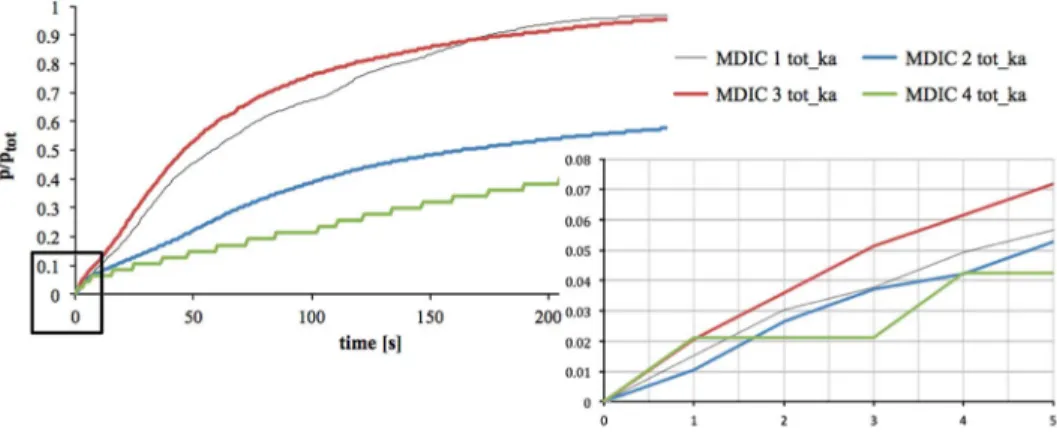
In order to choose an appropriate grain fraction and time interval for the gas collection during hydrolysis, tests of the leaching reaction in orthophosphoric acid were performed (Figure 2; for more details see Michalska et al. 2017 in this volume). Depending on the mortar components, the reaction kinetics influence the percentage of carbonates originating from the binder in a first gas portion (Nawrocka et al. 2009a; Michalska and Czernik 2015). The course and rate of leaching reactions reflect the mortars’ components.
Petrographic composition of the first two samples MDIC1 and MDC2, i.e., Finnish and Mallorca samples, indicated that two dissolution fractions are sufficient for14
C analysis. This included a fraction from the shortest time of the gas collection during leaching reaction, which is known to provide the most reliable material for dating, and gas collected during a longer dissolution time interval, using the last as a control sample.
Samples such as the cocciopesto MDIC 4 and the mortar mixer MDIC 3 (Hayen et al. 2016; Michalska et al. 2017 this volume), were considered to be difficult materials for dating, due to the presence of ceramic dust or different pozzolanic components (Binda and Baronio 1988; Ringbom et al. 2011). These two samples were prepared as suspension and grain fractions. The dissolution time was minimized and CO2was collected for dating in very short time intervals
(first 1–2 s of leaching reactions). To see the influence of mortar components on the dating results, also a gas portion collected in longer time interval was dated (14 s).
Following these preparatory steps, after dissolution with H3PO4of selected fractions, the time
intervals for collecting gas samples were chosen (first 1, 2 s, 2–5 s, 5–10 s, 14 s, 25 s). The collected CO2was then graphitized for AMS analysis. The age of the mortar was based on the
age of the fraction collected in the shortest time (first 1, 2 s in case of Sample 1-Finnish mortar and Sample 2-Mallorca burial lime). The longer time intervals of gas collecting (e.g. 14 s) provided an additional indicator of carbonate content from another source than the binder (Goslar et al. 2009; Ringbom et al. 2014).
Preparation of Mortar at RICH Laboratory (Brussels, Belgium)
The method applied at RICH laboratory is described in detail by Van Strydonck et al. 2009. Samples were dry sieved to the fractions:<38 µm, 38–75 µm, or 75–125 µm. The HCl titration was applied to obtain the CO2. The 38–75 µm fractions were used for the preparation. The total
CO2-yield of the sample was determined by complete acid hydrolysis. Based on the total yield,
the CO2-release was divided into a number of fractions. The corresponding amounts of
hydrochloric acid were applied by titration according to the desired subdivision in fractions. Numerous fractions, if possible 7, were analyzed. Thefinal age of mortar are reported as the extrapolated age of the fraction 0.
Preparation of Mortar at Milano-Bicocca Laboratory (Italy)
Physical procedures applied to separate appropriate material involved: crushing, extraction of lumps and wet sieving to select grains <500 μm. The chemical extraction was done by
∙ Acid digestion (H3PO485%) of 50-100 mg of the grain fraction with a granulometry below
500µm (selected by wet sieving);
∙ Acid digestion (H3PO485%) of 30-40 mg of the lumps with a granulometry above 500µm
(selected from all the collected lumps by dry sieving).
Figure 2 The exemplary course of carbonates decomposition in orthophosphoric acid, in function of time; MDIC 1—the wall’s bedding mortar from the church of Nagu (Finland); MDIC 2—lime conglomerate from Cova S’Estora (Mallorca, Spain); MDIC 3—the medieval mortar mixer from Basel Cathedral Hill (Switzerland); MDIC 4—the Roman cocciopesto mortar from Tongeren (Belgium); tot_ka—fragment of bulk mortar without any additional preparation; the ordinate p/ptot represents the proportion of pressure of CO2
collected after time t to the pressure of the whole collected CO2. The more irregular decomposition takes place in
Roman cocciopesto mortars, which is connected withfinely grained ceramic dust, clay minerals mixed in the binder structure.
In both cases, CO2produced during thefirst 15 s of the reaction is collected and graphitized and
transferred for AMS analyses at CIRCE AMS facility (Caserta, Italy).
For OSL dating, the outer part of the samples was removed in order to eliminate the grains that were exposed to daylight. The quartz fraction was selected under dim red light. All these samples have been crushed and sieved to select grains<500 μm. Some physical and chemical treatments were performed following these steps:
∙ HCl 37% since reaction stopped ∙ H20236% vol
∙ Sieving 125–250 μm
∙ Mineral separation with sodium polytungstate solution at 2.67 g/cm3 ∙ HF 40% for 40 min
∙ HCl 20% for 15 min
Because no detectable luminescence signal from single grains of quartz was observed, a multi-grain aliquot were analyzed. The samples werefixed with silicon oil on stainless-steel discs. The measurements were performed following the single-aliquot regeneration (SAR) dating protocol (Murray and Wintle 2000) using an automated luminescence system (Risø TL/OSLDA-20) equipped with a 90Sr/90Y beta source delivering 0.108 Gy/s (±3%) to the sample position. Quartz OSL was stimulated by an array of blue LEDs (470 ± 30 nm) and OSL shine-down curves were detected using a photon counting technique with an EMI 9635QB photomultiplier tube coupled to a 7.5-mm Hoya U-340filter. The samples were checked for the absence of feldspar contamination using IR stimulation (830 ± 10 nm) on irradiated samples. OSL measurements (40 s) were made at 125°C, after preheating aliquots for 10 s at 260°C. A cut-heat of 160°C was applied to each aliquot before the test dose measurement.
In order to calculate the annual dose rate, the Th and U concentrations of the mortars were measured with total alpha counting using ZnS scintillator discs (Aitken 1985).40K content was deduced from the total concentration of K, obtained byflame photometry. Attenuation of the beta dose was taken into account (Bell 1979). The cosmic ray contribution to thefinal dose rate was based on Prescott and Hutton (1994). Finally, for each sample the saturated water content was derived from the total porosity of the sample and a reconstructed value of the mean water content was calculated for each mortar sample.
Preparation of Mortar for OSL Analysis IRAMAT-CRP2A Bordeaux
The preparation of mortar for luminescence dating involved crushing and sieving of inner parts of the samples under dim red light. The size fraction 200–250 µm underwent the following chemical treatments:
∙ HCl 37 % (dissolution of carbonates)
∙ H2O215 % (if present, dissolution of organic residues)
∙ mixture of H2SiF6with HNO3in ratio 9:1 (dissolution of feldspars)
Extracted quartz grains of size fraction 200–250 µm were fixed on stainless steel discs. The total dissolution of feldspar in the etched fractions from mortars was verified before starting the
dating procedure by IRSL test. All OSL measurements were performed using a TL/OSL DA20 Risø reader using the single aliquot regeneration (SAR) protocol (Murray and Wintle 2000) applying preheat and cut-heat temperatures of 190°C and 160°C, respectively, regeneration doses of 1.4; 2.8; 5.6; 11,2; 0; 1.4 Gy and a test dose 2.8 Gy.
Since the single grain OSL measurements did not give any detectable signal, a standard multigrain technique was applied and several tens of grains are analyzed together. In this case, all the grains contribute to thefinal OSL signal, which results in a measurable OSL response for weakly luminescent mortars, however, some averaging effect due to the presence of well-bleached and poorly bleached grains on the same disc can occur.
The contribution to the annual dose rate arising from mortar matrix (alpha and beta emissions) was evaluated by low background gamma spectrometry (Guibert and Schwoerer 1991; Urbanová et al. 2015). The gamma and cosmic contributions to the annual dose rate could not have been measured in situ (excavations were completed long time ago) and they were therefore assessed using the contents of radioelements K, U, and Th determined by low background gamma spectrometry, adding the value of 0.23 ± 0.03 mGy/yr for cosmic contribution.
According to petrographic, cathodoluminescence, and SEM-EDX observations, the sample did not contain coarse potassium feldspars. This indicates that the annual dose rate is not affected by significant microdosimetric variations, which could complicate the dating process (Guérin et al. 2015; Martin et al. 2015; Urbanová et al. 2015).
RESULTS AND DISCUSSION
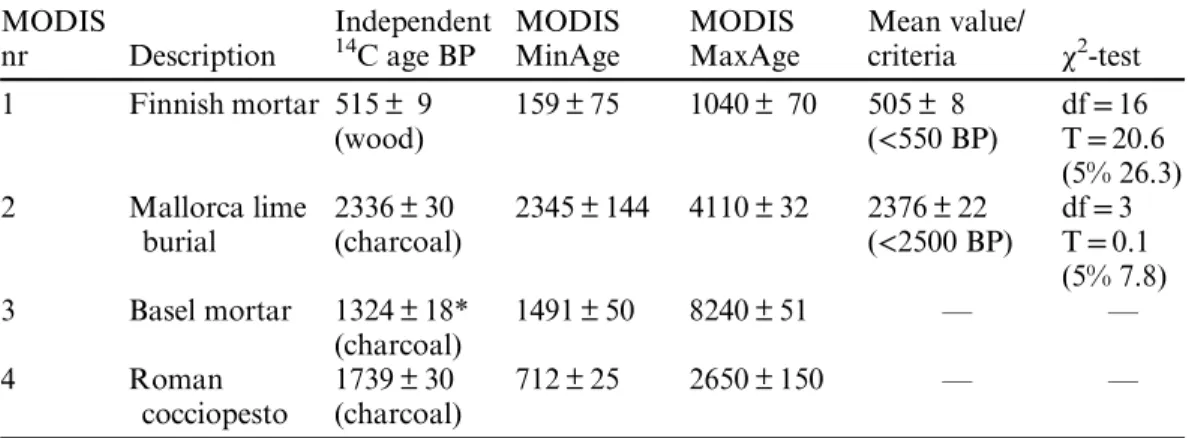
Results of all the analyses performed on the mortar that was distributed as a part of MODIS are summarized in Table 1. All the data are reported in the supplementary Table S1 and discussed by Hayen et al. (2017 this volume).
Table 1 Summary of results obtained for MODIS samples. Independent age control is given as 14C ages of material found in mortar samples. Minimum and maximum ages give the ranges of all14C ages measured in this intercomparison. OSL ages are recalculated to14C ages. MODIS nr Description Independent 14 C age BP MODIS MinAge MODIS MaxAge Mean value/ criteria χ2-test 1 Finnish mortar 515 ± 9 (wood) 159 ± 75 1040 ± 70 505 ± 8 (<550 BP) df= 16 T= 20.6 (5% 26.3) 2 Mallorca lime burial 2336 ± 30 (charcoal) 2345 ± 144 4110 ± 32 2376 ± 22 (<2500 BP) dfT= 0.1= 3 (5% 7.8) 3 Basel mortar 1324 ± 18* (charcoal) 1491 ± 50 8240 ± 51 — — 4 Roman cocciopesto 1739 ± 30 (charcoal) 712 ± 25 2650 ± 150 — —
*Mean value of two samples (ETHZ_charcoal: 1313 ± 22 BP and POZN_charcoal: 1345 ± 30 BP) results in14C age of
1324 ± 18 BP (χ2-test: df
Discussion: Sample 1—Finnish Mortar
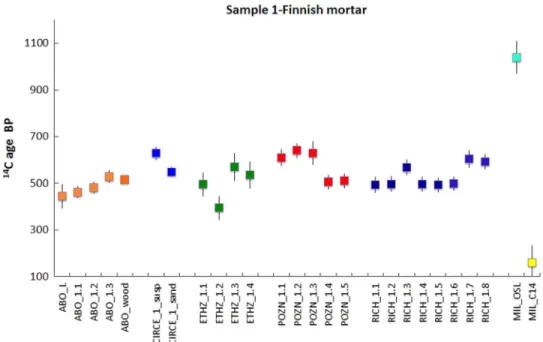
Results obtained by all the laboratories for the medieval Finnish church (Sample 1) are sum-marized in Figure 3. With an exception of the Poznań laboratory, which received original fragments of mortar, others obtained pre-sieved fraction 45–72 µm of this sample. The14C ages appear consistent for most of the laboratories and close to the independent measurement on wood, which should give a maximum age for the building. If samples older than 600 BP (fractions that contain old component) and the one too young sample of MIL_C14 are not included in the combined 14C age, the resulting age of 505 ± 8 BP (χ2-test: df= 16 T = 20.6 [5% 26.3]) is comparable to the 14C age of wood 515 ± 9 BP, calibrated 1410–1432 AD (95.4% conf. level).
Discussion: Sample 2—Mallorca Burial Lime
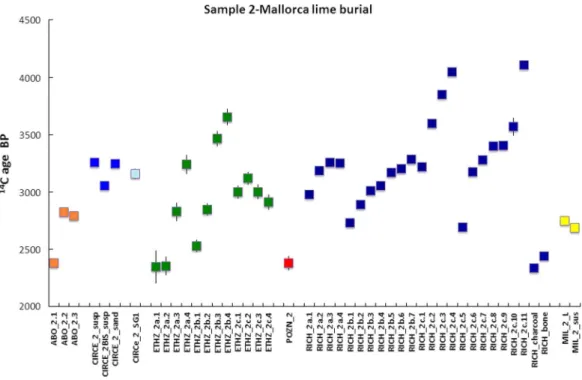
Figure 4 shows results of dating Mallorca burial lime. Two samples were distributed: fine fraction<500 µm and original lime (F). The age of the burial is considered to be close to the measurement on charcoal and bone (RICH_charcoal and RICH_bone: 2336 ± 30 and 2442 ± 30 BP, respectively).14C ages of the fast dissolving component obtained on fraction with grain size smaller than 100µm (ABO_2.1: 46–75 µm; 2 s; ETHZ_2a.1&2: 45–63 µm; 1–3 and 4–6 s, POZN_2: 80–100 µm; 2 s) yields youngest ages (see Figure 4). The combined radiocarbon age of these samples is 2377 ± 22 BP (χ2
-test: df= 3 T = 0.1[5% 7.8]), calibrated 515–396 BC (95.4% conf. level), which is very close to the age of the charcoal (2366 ± 30 BP) obtained by RICH laboratory. The bone is only slightly older (2442 ± 30 BP) excluding older ages of mortar which were obtained on fraction with grain size<500 µm. At ETH laboratory too old ages were obtained forfirst and second fast dissolution product for the whole <500 µm fraction (Figure 4). Similar results, which gave ages that were older than expected, were obtained by other
Figure 3 Sample of Finish mortar—the independent age was obtained on wood ABO_wood 512 ± 9 BP. Additional notes: L-lump, fractions of different dissolution steps (supplementary Table S1) are shown as LAB_1.2, LAB_1.3, etc. Results of each laboratory are shown in different colors (ordered as in Table 1; refer to online version for colors).
laboratories. These results show that the only effective separation involved both methods:fine grain size and fast dissolution.
Discussion: Sample 3—Basel Mortar
Figure 5 shows that independently of the dating method (OSL or14C), the preparation method or grain-size, all analyses resulted in ages older than the charcoal found in mortar. The com-bined age of two charcoal samples (ETHZ_charcoal: 1313 ± 22 BP and POZN_charcoal: 1345 ± 30 BP) results in 14C age of 1324 ± 18 BP (χ2-test: df= 1 T = 0.7 [5% 3.8]) (Table 1), calibrated 655–764 AD (95.4% conf. level). The difference between mortar and charcoal is even larger when two 14C ages: 1055 ± 45 BP and 1105 ± 40 BP, which were obtained on charcoal prior to the MODIS (Hayen et al. 2017 this volume), are considered. The picture is even more complicated by the age of a bone: 1625 ± 55 BP (Hayen et al. 2017 this volume). This scatter of
14
C ages suggests that this sample of mortar is highly heterogeneous. The presence of an old component (Table 1; sample RICH_3a.5: 8240 ± 51 BP) might well explain too old radiocarbon age (Roman instead of Medieval), however it does not explain the scatter of ages observed for charcoal and bone. This complicated picture points to a mixed source of sample material. Discussion: Sample 4—Roman Cocciopesto
As can be seen from Figure 6, results obtained by all the laboratories are consistently younger than the expected Roman age (1739 ± 32 BP; RICH_charcoal). With an exception of the two oldest fraction (POZN_4.3: 2650 ± 150 BP and RICH_4.7: 1540 ± 34 BP) most of the results range from 700 to 1300 BP. Although difficulty in dating cocciopesto has been known from
Figure 4 Sample 2_Mallorca lime burial. Additional notes: Fractions of different dissolution steps (see supplementary Table S1) are shown as LAB_2.1, LAB_2.2 etc. ETHZ: 3 sets of analyses: a, b, c. RICH: 3 sets of analyses: a (HCl-4), b (HCl-7), c (HCl-4). Results of each laboratory are shown in different colors (ordered as in Table 1; refer to online version for colors).
previous studies (Hodgins et al. 2011; Ringbom et al. 2011, 2014; Michalska et al. this volume) consistently too young ages, as compared to the expected one, can probably be explained by processes such as the delayed hardening of mortar that was sampled from deep inside the wall
Figure 5 Sample 3 Basel mortar: This sample was previously dated as discussed by Hayen et al. (2016, 2017).
14C age of charcoal found in the mortar of MODIS is 1313 ± 22 BP (ETHZ_charcoal).
Figure 6 Sample 4 Roman coccipesto: Charcoal from this mortar was previously dated at RICH laboratory (Hayen et al. 2016, 2017).14C age of charcoal was 1739 ± 32 BP (RICH_charcoal).
(Hayen et al. 2017). In this case, nearly coherent ages of thefirst fractions (Figure 6) obtained by the laboratories date the time of hardening, probably delayed by the impermeability of cocci-pesto as well as the sample depth (Heinemeier et al. 1997, 2010).
SUMMARY
Two OSL laboratories and seven 14C laboratories performed analysis on mortar of MODIS study by applying various procedures.
The following common points for14C preparation protocols are based on the MODIS com-parison study:
∙ Prescreening of samples
∙ Particle size (by sieving or suspended fractions centrifuge/gravity) ∙ Dissolution (% of the total or the time of dissolution)
∙ All14C laboratories apply more than one14C analysis per sample
Both OSL laboratories based the dating process on the analyses of coarse quartz fractions measured by the multigrain technique. The OSL dating results obtained by multigrain techni-que from the Basel mortar, which contained enough quartz fraction for OSL analysis, showed general agreement both between OSL laboratories and with14C dating results.
Overall, the results of thisfirst intercomparison provide important observations for a choice of material and prospects for a successful mortar dating. The two homogeneous samples: Sam-ple_1 (Finnish Mortar) and Sample_2 (Mallorca Burial Lime) were successfully dated. How-ever, the complicated material such as Sample 3 (Basel Mortar) and Sample 4 (Roman Cocciopesto) gave coherent results but different from expected ages. These results highlight the complexity of14C dating of mortars indicating the potential but also its limits. Moreover, the exchange of knowledge between laboratories and observations made during this study are an important factor for understanding the results of dating mortars.
ACKNOWLEDGMENTS
We thank Sophie Hueglin for providing the Basel Mortar sample as well as many discussions of the archeological aspects of the sample. IH thanks LIP ETHZ laboratory for the support: Mantana Maurer and Maria Belen Röttig for laboratory preparation, Laura Hendriks and Lukas Wacker for measurements using GIS AMS.
SUPPLEMENTARY MATERIALS
To view supplementary material for this article, please visit https://doi.org/10.1017/RDC. 2017.112
REFERENCES
Addis A, Secco M, Preto N, Marzaioli F, Passariello I, Brogiolo GP, Chavarria Arnau A, Artioli G, Terrasi F. 2016. New strategies for radiocarbon dating of mortars: Multi-step purification of the lime binder. Proceedings of 4th Historic Mortars, Santorini, Greece 10–12 October 2016.
Aitken MJ. 1985. Thermoluminescence Dating. London: Academic Press. 267 p.
Bell WT. 1979. Attenuation factors to absorbed dose in quartz inclusions for thermoluminescence dating. Ancient TL 8:2–13.
Binda I, Baronio G. 1988. Survey of brick-binder adhesion in ‘powdered brick’ mortars and plas-ters, Masonry International Journal 2: pp. 87–92. Fahrni SM, Gaggeler HW, Hajdas I, Ruff M, Szidat
C-14 samples after oxidation in quartz tubes. Nuclear Instruments and Methods in Physics Research B 268:787–9.
Folk RL, Valastro S. 1976. Successful technique for dating of lime mortar by carbon-14 J. Field Archaeology 3(2)203–8.
Folk RL, Valastro S. 1979. Dating of lime mortar by
14C. In: Berger R, Suess H, editors. Radiocarbon
Dating: Proceedings of the Ninth International Conference. Berkeley: University of California Press. p 721–30.
Goslar T, Nawrocka D, Czernik J. 2009.
Foraminiferous limestones in 14C dating
of mortar. Radiocarbon 51(2):857–66.
Goedicke C. 2011. Dating mortar by optically stimulated luminescence: a feasibility study. Geochronometria 38(1):42–9.
Goedicke C. 2003. Dating historical calcite mortar by blue OSL: results from known age samples. Radiation Measurements 37:409–15.
Guérin G, Myank J, Thomsen K, Murray A, Mercier N. 2015. Modelling dose rate to single grains of quartz in well-sorted sand samples: the dispersion arising from the presence of potassium feldspars and implications for single grain OSL dating. Quaternary Geochronology 27:52–65.
Guibert P, Schvoerer M. 1991. TL-dating: Low background gamma spectrometry as a tool for the determination of the annual dose. Nuclear Tracks and Radiation Measurements 14:155–61. Hajdas I, Trumm J, Bonani G, Biechele C, Maurer M,
Wacker L. 2012. Roman ruins as an experiment for radiocarbon dating of mortar. Radiocarbon 54(3–4):897–903.
Hayen R, Van Strydonck M, Boaretto E, Lindroos A, Heinemeier J, Ringbom Å, Hueglin S, Michalska D, Hajdas I, Marzaoili F, Maspero F, Galli A, Artioli G, Moreau Ch, Guibert P, Caroselli M. 2016. Absolute dating of mortars– integrating chemical and physical techniques to characterize and select the mortar samples. Proceedings of the 4th Historic Mortars Conference - HMC2016. 656–67.
Hayen R, Van Strydonck M, Fontaine L, Boudin M,
Lindroos A, Heinemeier J, Ringbom Å,
Michalska D, Hajdas I, Hueglin S, Marzaioli F, Terrasi F, Passariello I, Capano M, Maspero F, Panzeri L, Galli A, Artioli G, Addis A, Secco M, Boaretto E, Moreau C, Guibert P, Urbanova P, Czernik J, Goslar T, Caroselli M. 2017. Mortar dating methodology: intercomparison of available methods. Radiocarbon 59(6):this volume. Heinemeier J, Jungner H, Lindroos A, Ringbom Å,
von Konow T, Rud N. 1997. AMS14C dating of
lime mortar. Nuclear Instruments and Methods in Physics Research B 123:487–95.
Heinemeier J, Ringbom Å, Lindroos A,
Sveinbjörnsdóttir ÁE. 2010. Successful AMS14C
dating of non-hydraulic lime mortars from the medieval churches of the Åland Islands, Finland. Radiocarbon 52(1):171–204.
Hodgins G, Lindroos A, Ringbom Å, Heinemeier J, Brock F. 2011.14C dating of roman Mortars– preliminary tests using diluted hydrochloric acid injected in batches. Commentationes Humanarum Litterarum 128:209–13.
Labeyrie J, Delibrias G. 1964. Dating of old mortars by the carbon-14 method. Nature 201(4920):742. Lichtenberger A, Lindroos A, Raja R, Heinemeier J.
2015. Radiocarbon analysis of mortar from Roman and Byzantine water management instal-lations in the Northwest Quarter of Jerash, Jordan. Journal of Archaeological Science: Reports 2:114–27.
Lindroos A, Heinemeier J, Ringbom Å, Braskén M, Sveinbjörnsdóttir Á. 2007. Mortar dating using AMS 14C and sequential dissolution: examples from medieval, non-hydraulic lime mortars from the Åland Islands, SW Finland. Radiocarbon 49(1):47–67.
Lindroos A, Heinemeier J, Ringbom Å, Brock F, Sonck-Koota P, Pehkonen M, Suksi J. 2011. Problems in radiocarbon dating of Roman Poz-zolana mortars. In: Ringbom Å, Hohlfelder R, editors. Building Roma Aeterna. Current research on Roman Mortar and Concrete. Proceedings of the conference March 27–29, 2008. Commenta-tiones Humanarum Litterarum 128: 214–30. Martin L, Mercier N, Incerti S, Lefrais Y, Pecheyran C,
Guérin G, Jarry M, Bruxelles L, Bon F, Pallier C. 2015. Dosimetric study of sediments at the beta dose rate scale: characterization and modelization with the DosiVox software. Radiation Measurements 81:134–41. DOI: 10.1016/j.radmeas.2015.02.008.8. Marzaioli F, Lubritto C, Nonni S, Passariello I,
Capano M, Terrasi F. 2011. Mortar radiocarbon dating: Preliminary accuracy evaluation of a novel methodology. Analytical Chemistry 83(6):2038–45. Marzaioli F, Nonni S, Passariello I, Capano M, Ricci
P, Lubritto C, De Cesare N, Eramo G, Castillo JAQ, Terrasi F. 2013. Accelerator mass spectro-metry14C dating of lime mortars: methodological aspects and field study applications at CIRCE (Italy). Nuclear Instruments and Methods in Physics Research B 294:246–51.
Marzaioli F, Borriello G, Passariello I, Lubritto C, De Cesare N, D’Onofrio A, Terrasi F. 2008. Zinc reduction as an alternative method for AMS radiocarbon dating: Process optimization at CIRCE. Radiocarbon 50(1):139–49.
McCrea JMJ. 1950. Isotopic chemistry of carbonates and a paleo-temperature scale. J. Chem. Phys. 18:849–57.
Michalska D, Czernik J, Gosar T. 2017. Methodolo-gical aspect of mortars dating (Poznań, Poland, MODIS). Radiocarbon 59(6):submitted. Michalska D, Czernik J. 2015. Carbonates in leaching
reactions in context of 14C dating. Nuclear Instruments and Methods in Physics Research B 361:431–9.
Michalska D, Pazdur A, Czernik J, Szczepaniak M, Żurakowska M. 2013. Cretaceous aggregate and
reservoir effect in dating of binding materials. Geochronometria 40(1):33–41.
Murray AS, Wintle A. 2000. Luminescence dating of quartz using an improved single-aliquot regen-erative dose protocol. Radiation Measurements 32:523–38.
Nawrocka-Michalska D, Michczyńska DJ, Pazdur A, Czernik J. 2007. Radiocarbon chronology of the ancient settlement on the Golan Heights. Radiocarbon 49(2):625–37.
Nawrocka D, Czernik J, Goslar T. 2009.14C dating of carbonate mortars from Polish and Israeli sites. Radiocarbon 51(2):857–66.
Nawrocka D, Michniewicz J, Pawlyta J, Pazdur A. 2005. Application of radiocarbon method for dating of lime mortars. Geochronometria 24: 109–15.
Nonni S, Marzaioli F, Secco M, Passariello I, Capano M, Lubritto C, Mignardi S, Tonghini C, Terrasi F. 2013. 14C mortar dating: the case of the
Medieval Shayzar Citadel, Syria. Radiocarbon 55(2):514–25.
Panzeri L. 2013. Mortar and surface dating with optically stimulated luminescence (OSL): innova-tive techniques for the age determination of buildings. Nuovo Cimento della 36(4):205–16. Prescott JR, Hutton JT. 1994. Cosmic ray
contribu-tion to dose rates for luminescence and ESR dating. Radiation Measurements 23(2-3): 497–500.
Ringbom Å, Remmer C. 1995. Ålands kyrkor, Volym I, Hammarland och Eckerö, Naturvetenskaplig datering. Mariehamn. p 60–8.
Ringbom Å, Heinemeier J, Lindroos A, Brock F. 2011. Mortar dating and roman pozzolana, results and interpretations. In: Ringbom Å, Hohlfelder R, editors. Building Roma Aeterna. Current research on Roman Mortar and Concrete. Pro-ceedings of the conference March 27–29, 2008.
Commentationes Humanarum Litterarum
128:187–208.
Ringbom Å, Lindroos A, Heinemeier J, Sonck-Koota P. 2014. 19 years of mortar dating: learning from experience. Radiocarbon 56(2):619–35.
Stuiver M, Smith CS. 1965. 6th International Con-ference on Radiocarbon and Tritium Dating, Pullman, WA. p 338-343.
Van Strydonck M, Dupas M, Dauchot-Dehon M, Pachiaudi C, Marechal J. 1983a. A further step in the radiocarbon dating of old mortars: Bull Kon Inst Kunstpatrimonium, v XIX, 1982/83. p 155–71.
Van Strydonck M, Dupas M, Dauchot-Dehon M. 1983b. Radiocarbon dating of old mortars. In: Mook WG, Waterbolk HT, editors. 14C and Archaeology, Proceedings. PA C T 8:337–43. Van Strydonck M, Dupas M, Dauchot-Dehon M,
Pachiaudi Ch, Marechal J. 1986. The influence of contaminating carbonate and the variations ofδ13C
in mortar dating. Radiocarbon 28(2A):702–10. Van Strydonck M Boudin, De Mulder G. 2009.14C
dating of cremated bones: the issue of sample contamination. Radiocarbon 51(2):553–68. Van Strydonck M, Aramburu J, Fernández Martínez
A, Alvarez Jurado-Figueroa M, Boudin M, De Mulder G. 2017. Radiocarbon dating of the Son Pellisser lime burial (Calvià, Mallorca). Journal of Archaeological Science: Reports 11:471–9.
Terrasi F, De Cesare N, D’Onofrio A, Lubritto C, Marzaioli F, Passariello I, Rogalla D, Sabbarese C, Borriello G, Casa G, Passariello I. 2008. High
precision 14C AMS at CIRCE. Nuclear
Instruments and Methods in Physics Research B 266:2221–4.
Urbanová P, Hourcade D, Ney C, Guibert P. 2015. Sources of uncertainties in OSL dating of archaeological mortars: the case study of the Roman amphitheatre Palais-Gallien in Bordeaux. Radiation Measurements 72:100–10.
Urbanová P, Delaval E, Dufresne P, Lanos P, Guibert P. 2016. Multi-method dating of Grimaldi castle foundations in Antibes, France. ArchéoSciences -Revue d’archéométrie 40:17–33.
Urbanová P, Guibert P. 2017a. A review on Single grain OSL dating of mortars: a methodological study offive reference archaeological sites. Geo-chronometria. DOI: 10.1515/geochr-2015-0050. Urbanová P, Guibert P. 2017b. La mesure du temps
par luminescence : datation de réemplois dans la crypte de Saint Seurin à Bordeaux, dossier « Atelier doctoral. Les remplois en architecture entre Antiquité et Moyen Âge » des. Mélanges de l’École française de Rome, 129, 1.
Vogel JS, Southon JR, Nelson DE, Brown TA. 1984. Performance of catalytically condensed carbon for use in accelerator mass spectrometry. Nuclear Instruments and Methods in Physics Research B 5:289.
Zacharias N, Mauz B, Michael CT. 2002. Lumines-cence quartz dating of lime mortars. A first research approach. Radiation Protection Dosimetry 101:379–82.