HAL Id: cea-02614130
https://hal-cea.archives-ouvertes.fr/cea-02614130
Submitted on 20 May 2020HAL is a multi-disciplinary open access archive for the deposit and dissemination of sci-entific research documents, whether they are pub-lished or not. The documents may come from teaching and research institutions in France or abroad, or from public or private research centers.
L’archive ouverte pluridisciplinaire HAL, est destinée au dépôt et à la diffusion de documents scientifiques de niveau recherche, publiés ou non, émanant des établissements d’enseignement et de recherche français ou étrangers, des laboratoires publics ou privés.
MFrontInterface.jl MFront material models in JuliaFEM
T. Frondelius, T. Helfer, I. Yashchuk, J. Vaara, A. Laukkanen
To cite this version:
T. Frondelius, T. Helfer, I. Yashchuk, J. Vaara, A. Laukkanen. MFrontInterface.jl MFront material models in JuliaFEM. NSCM32 - 32nd Nordic Seminar on Computational Mechanics, Oct 2019, Oulu, Finland. �cea-02614130�
Proceedings of the 32nd Nordic Seminar on Computational Mechanics
H. Koivurova and A.H. Niemi (Eds.) ©University of Oulu, 2019
MFrontInterface.jl: MFront material models in JuliaFEM
Tero Frondelius1,3, Thomas Helfer4, Ivan Yashchuk2, Joona Vaara3, and Anssi Laukkanen2 (1)University of Oulu, [email protected](2)VTT Technical Research Centre of Finland, [email protected]
(3)W¨artsil¨a Research & Development and Engineering, [email protected] (4)CEA, DEN, DEC, Cadarache F-13108 Saint-Paul-Lez-Durance, France, [email protected]
Summary. This article describes the MFrontInterface.jl package which aims at allowing mechanical
behaviours generated by the MFront code generator to be used in JuliaFEM. MFrontInterface.jl is build on top of the MFrontGenericInterfaceSupport library.
Introduction
This article describes the MFrontInterface.jl package which aims at allowing mechanical be-haviours generated by the MFront code generator to be used in JuliaFEM. MFrontInterface.jl is build on top of the MFrontGenericInterfaceSupport library. See Figure 1 for calrification.
JuliaFEM
MFrontInterface.jl
MFrontGenericInterfaceSupport Shared library generated byMFront' generic interface Implementation of the behaviour'constitutive equations
MFront
Figure 1: Sofware layers involved
A short introduction to MFront and MGIS
Overview of the MFront code generator
The behaviour of solid materials is modelled using so-called constitutive equations which de-scribe how the internal state of the material evolves. Those state variables can dede-scribe many microstructural aspects of the material (i.e. grain size, dislocation density, hardening state) or be considered as purely phenomenological.
More precisely, after discretization in time of the problem, the solver provides an estimate of the local change of loading of the material (for example the strain increment for small strain behaviours) to the constitutive equations which allow:
• The computation of the values of the internal state variables at the end of a time step knowing their values at the beginning of the time step.
• The local thermodynamic forces (for example the stress for small strain behaviours) which affects the material equilibrium at the structural scale.
This step is called behaviour integration. In the following, the term behaviour becomes a synonym for constitutive equations. MFront is an open-source and cross-platform code generator dedicated to various material knowledge, such as material properties, behaviours and simple physical models, see [1, 2] for details. MFront is developed in the framework of the PLEIADES project which is co-developed by CEA, EDF and Framatome.
MFrontprovides a set of domain-specific languages on top of C++ which allows the code of the constitutive equations to be fairly close to the mathematical expressions. Concerning mechanical behaviours, which is the most exciting aspect of MFront regarding this paper, MFront allows the user to implement, small and finite strain behaviours, as well as cohesive zone models. Isotropic and orthotropic behaviours are supported.
Thanks to the notion of interfaces, code specific to various mechanical solvers can be gen-erated. As of version 3.2, MFront provides interfaces for e.g. Cast3M, code aster, Europlexus, Cyrano, CalculiX, Abaqus/Standard and Abaqus/Explcit, AMITEX FFTP, Ansys. The gener-ated code is then compiled a shared library which can be plugged in the targeted solver.
An interface named generic has been introduced in version 3.2. Behaviours generated with the generic interface are meant to be used through the MFrontGenericInterfaceSupport library, which is described hereafter. MFront has been carefully designed to meet the high-quality standards of the nuclear industry. In particular, an extensive set of unit tests has been set up to guarantee its reliability.
Overview of the MGIS library
This MFrontGenericInterfaceSupport library (MGIS) aims at proving tools (functions, classes, bindings, etc...) to handle behaviours written using MFront generic interface, see [3–5] for details. Those tools are meant to be used by (FEM, FFT, etc.) solver developers. Permissive licences have been chosen to allow integration in open-source and proprietary codes. In particular, the MGIS library provides:
• functions to load behaviour from a shared library. Along with a pointer to the function implementing the behaviour, various metadata are also retrieved, such as the number of state variables, their nature (scalar, tensorial), their name. Those metadata can be used to properly allocate the storage of the internal state variable, check that the user input file is consistent (i.e. does not try to initialize a non-existing variable), provides additional information on which variable can be post-processed.
• data structures to store the material states at the beginning of the time and at the end of the time step for one integration points or a set of integration points. Views data structure are available to use externally allocated memory.
• functions to perform behaviour integration over one time step. If a set of integration points is handled, parallelization of the behaviour, integration can be handled by the MGIS library. MGIS is written in C++ and provides bindings for C, Fortran 2003, python and Julia [6] thanks the CxxWrap.jl library. The Julia bindings are written in pure C++ and are barely usable per se.
The MFrontInterface.jl package
The MFrontInterface.jl package wraps MGIS’ Julia bindings to make its usage much more convenient and consistent with the Julia language, in other words make MFront material models
available in JuliaFEM [7–11]. BinaryBuilder.jl package is used for binary dependencies, which makes the package installation easy and convenient, like shown below:
(v1.2) pkg> add MFrontInterface
julia> using MFrontInterface
After adding and using, the following example shows how to load a behaviour in a shared library and how to retrieve some of the metadata:
julia> b = load("data/libBehaviour.so","Norton", mbv.Tridimensional)
behaviour Norton in shared library data/libBehaviour.so for modelling hypothesis Tridimensional generated from Norton.mfront using TFEL version: 3.3.0-dev.
julia> get_parameters(b) 11-element StringsVector epsilon YoungModulus PoissonRatio .... julia> get_external_state_variables(b) 1-element VariablesVector Temperature
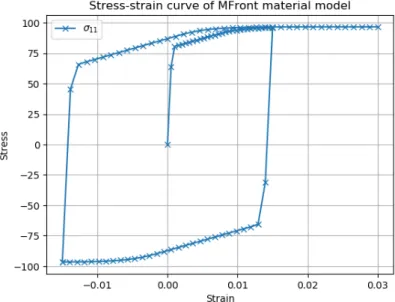
Figure 2: Stress-strain curve of MFront material model calculated with MFrontInterface.jl The MFrontInterface.jl package already allows calling the behaviour on one time step. This has been used to build the stress-strain curve depicted in Figure 2 for a simple plastic behaviour following a kinematic hardening rule introduced by Chaboche et al. [12].
Conclusions
This short extended abstract shows the potential of MFrontInterface.jl package. Development has started but like all open source projects we would appreciate any kind of contributions gracefully. Next step is to get all modified and created packages registered. This will guarantee a nice user experience.
Acknowledgements
The authors would like to acknowledge the financial support of Business Finland in the form of a research projects ISA W¨artsil¨a Dnro 7734/31/2018, and ISA VTT Dnro 7980/31/2018. In ad-dition, this research was supported financially by the CEA in the framework of the ‘PLEIADES‘ project.
References
[1] CEA and EDF. MFront Web Site, 2019.
[2] Thomas Helfer, Bruno Michel, Jean-Michel Proix, Maxime Salvo, J´erˆome Sercombe, and Michel Casella. Introducing the open-source mfront code generator: Application to mechan-ical behaviours and material knowledge management within the PLEIADES fuel element modelling platform. Computers & Mathematics with Applications, 2015.
[3] Thomas Helfer. The MFrontGenericInterfaceSupport project. [4] Thomas Helfer. MGIS. original-date: 2018-06-20T12:41:49Z.
[5] Thomas Helfer. A brief introduction to the MGIS C++ library for mechanical behaviours. [6] Jeff Bezanson, Alan Edelman, Stefan Karpinski, and Viral B Shah. Julia: A fresh approach
to numerical computing. SIAM review, 59(1):65–98, 2017.
[7] Tero Frondelius and Jukka Aho. JuliaFEM —open source solver for both industrial and academia usage. Rakenteiden Mekaniikka, 50(3):229–233, 2017. open access.
[8] Marja Rapo, Jukka Aho, and Tero Frondelius. Natural frequency calculations with Juli-aFEM. Rakenteiden Mekaniikka, 50(3):300–303, 2017. open access.
[9] Marja Rapo, Jukka Aho, Hannu Koivurova, and Tero Frondelius. Implementing model reduction to the JuliaFEM platform. Rakenteiden Mekaniikka, 51(1):36–54, 2018. open access.
[10] Marja Rapo, Joona Vaara, Jukka Aho, Teemu Kuivaniemi, Niclas Liljenfeldt, Antti Vuohi-joki, and Tero Frondelius. Pipe routing optimization to avoid vibration problems by using juliaFEM. Rakenteiden Mekaniikka. open access. ACCEPTED MANUSCRIPT.
[11] Jukka Aho, Ville J¨ams¨a, Teemu Kuivaniemi, Niclas Liljenfeldt, and Tero Frondelius. Ju-liaFEM 2D and 3D beam element implementation. Rakenteiden Mekaniikka. open access. ACCEPTED MANUSCRIPT.
[12] J. L. Chaboche, P. Kanout´e, and F. Azzouz. Cyclic inelastic constitutive equations and their impact on the fatigue life predictions. International Journal of Plasticity, 35:44–66, 2012.