Publisher’s version / Version de l'éditeur:
Vous avez des questions? Nous pouvons vous aider. Pour communiquer directement avec un auteur, consultez la première page de la revue dans laquelle son article a été publié afin de trouver ses coordonnées. Si vous n’arrivez pas à les repérer, communiquez avec nous à [email protected].
Questions? Contact the NRC Publications Archive team at
[email protected]. If you wish to email the authors directly, please see the first page of the publication for their contact information.
https://publications-cnrc.canada.ca/fra/droits
L’accès à ce site Web et l’utilisation de son contenu sont assujettis aux conditions présentées dans le site LISEZ CES CONDITIONS ATTENTIVEMENT AVANT D’UTILISER CE SITE WEB.
2nd International Colloquium on Advanced Structural Reliability Analysis Network
(ASRANet) [Proceedings], pp. 1-9, 2004-07-05
READ THESE TERMS AND CONDITIONS CAREFULLY BEFORE USING THIS WEBSITE.
https://nrc-publications.canada.ca/eng/copyright
NRC Publications Archive Record / Notice des Archives des publications du CNRC :
https://nrc-publications.canada.ca/eng/view/object/?id=64c815bf-e417-4dc0-b891-b79099c12e86 https://publications-cnrc.canada.ca/fra/voir/objet/?id=64c815bf-e417-4dc0-b891-b79099c12e86
NRC Publications Archive
Archives des publications du CNRC
This publication could be one of several versions: author’s original, accepted manuscript or the publisher’s version. / La version de cette publication peut être l’une des suivantes : la version prépublication de l’auteur, la version acceptée du manuscrit ou la version de l’éditeur.
Access and use of this website and the material on it are subject to the Terms and Conditions set forth at
Risk-based maintenance optimization of bridge structures
Risk-based maintenance optimization of bridge structures
Lounis, Z.
NRCC-47063
A version of this document is published in / Une version de ce document se trouve dans :
2
ndInternational Colloquium on Advanced Structural Reliability Analysis Network (ASRANet),
International Center for Numerical Methods in Engineering, Barcelona, Spain, July 5-7, 2004, pp. 1-9
Risk-Based Maintenance Optimization of Bridge Structures
Dr. Z. LounisInstitute for Research in Construction, National Research Council, Ottawa, ON, Canada, K1A 0R6 [email protected].
Abstract
This paper presents an approach for bridge maintenance optimization that takes into account several and possibly conflicting criteria, with emphasis on risk of failure as a governing criterion. The optimal maintenance strategy is defined as the solution that achieves the best compromise between three selected relevant and conflicting criteria: minimization of risk of failure, minimization of maintenance costs, and minimization of traffic disruption. Compromise programming is used to determine the optimal ranking of the maintenance strategies in terms of their effectiveness in risk reduction, cost minimization, and traffic control. A multi-criteria optimality index is proposed as a measure of the effectiveness of the optimal maintenance strategy in achieving a satisfactory trade-off between the above relevant and competing maintenance criteria. The proposed approach is illustrated on a small network of ten bridge projects that are optimized for maintenance by considering the three selected criteria. The weighted and non-weighted multi-criteria indices are generated for these projects.
Keywords
Bridges, maintenance optimization, multi-criteria optimality index, risk analysis.
Introduction
The high costs associated with the maintenance and preservation of the large stock of aging and deteriorating highway bridges and the limited funds allocated for their maintenance require the development of systematic and effective approaches for optimizing their maintenance and ensuring adequate reliability and reduced life cycle costs. Highway bridges are complex structural systems that deteriorate with time as a result of wear, fatigue, multiple aggressive environmental factors, increasing traffic loads, collision, inadequate maintenance and inspection, poor workmanship and design. A large portion of highway bridge structures in North America and Europe are classified as structurally deficient and functionally obsolete. Their rehabilitation and renewal is estimated at hundreds of billions of dollars that cannot be accommodated by highway agencies. The magnitude of the problem poses great technological and economic challenges, specifically which projects should be given high priority for maintenance and what is the optimal maintenance strategy that will reduce the risk of failure and the life cycle cost of the rehabilitated bridges.
To address this problem, several countries have developed or initiated the development of bridge management systems to optimize the inspection and maintenance of deteriorated structures. Different approaches to maintenance optimization have been implemented in the different bridge management systems ranging from simplified economic models to sophisticated Markovian decision processes. The development of a practical and effective bridge maintenance management system depends primarily on the existence of a reliable performance prediction model and an effective optimization algorithm. Given the time-dependence and random nature of bridge performance, a stochastic modeling is required. Furthermore, bridge maintenance management aims at improving the overall performance of a bridge or a network through the satisfaction of several and possibly conflicting objectives which include the minimization of maintenance costs, maximization of service life,
minimization of risk of failure, minimization of bridge closures, accommodation of increased traffic, etc. Multi-criteria optimization techniques provide a practical tool for optimal prioritizing of bridges for maintenance.
In this paper, a multi-criteria approach for the maintenance optimization of deficient bridge structures is presented. It is based on the minimization of the risk of failure, minimization of maintenance costs, and minimization of traffic disruption, with more emphasis on risk minimization. The merits of a risk-based maintenance optimization are discussed. The compromise programming approach is used to determine optimal solutions and a multi-criteria optimality index is proposed as a parameter for the prioritization of projects for maintenance. A numerical example illustrates the application of the proposed approach to the maintenance management of a small network of deficient highway bridge structures.
Risk-Based Maintenance Management of Highway Bridges
Highway bridges constitute a class of safety-critical infrastructure systems that should be analyzed with rigor as their failure can have catastrophic consequences, including multiple fatalities and injuries, complete loss of service, major traffic disruption, and considerable socio-economic impacts. In the literature and in current practice of bridge management, most approaches to maintenance optimization of highway bridges are based on the criteria of life cycle cost or cost-benefit ratio. The life cycle cost represents the present value of all the costs incurred throughout the life cycle of a bridge structure, including, the costs of design, construction, maintenance, repair, rehabilitation, replacement, demolition, and possibly costs of failure (although hard to quantify).
∑ ∑ = = + + + = L tL 0 t t f f t 0 t t (1 r) (t) (t)C P r) (1 C(t) LCC (1)
where: LCC= present value of all costs incurred throughout the life cycle; C(t) maintenance cost at year t; tL= life cycle (or service life); Pf(t)= probability of failure in year t; Pf(t)= cost of
failure in year t; and r= discount rate.
The prioritization for maintenance and the assessment of the effectiveness of different maintenance strategies are based on the conventional condition ratings of bridge elements. These ratings represent a qualitative assessment of the condition of bridge structures, which are obtained by mapping the level of observed damage in the structure during visual inspections and non-destructive evaluation (or predicted using empirical or statistical methods) to a discrete rating scale, e.g. 0 to 5 in Pontis (Thompson and Shepard 1994). Such an approach is quite adequate for the long- and short-term analysis of maintenance needs for a network of hundreds or thousands of structures; however, it has serious shortcomings for the detailed analysis of individual bridge structures or a group of structures, especially safety-critical/high risk structures. Highway bridges consist of several components with multiple failure modes and different consequences of failure.
The assessment of the risk of failure of a deficient bridge structure conveys critical information not only on the level of damage and likelihood of failure of the structure but more importantly on the consequences of its failure. For example, the risk associated with the collapse of a bridge pier is very different from that associated with the collapse of a girder in a multi-girder superstructure, and is totally different from the loss of serviceability or functionality of a deck slab. Such information cannot be captured by the conventional condition ratings. It is therefore clear that the assessment of the risk of failure of bridge structures is critical for the development of appropriate maintenance strategies that will reduce or keep the failure risk at an acceptable level.
Bridge structures deteriorate with time due to increased traffic loads, aggressive environmental factors, collision, inadequate design and workmanship, and lack of maintenance. For a given component or system and a given failure mode, the load effect and strength are time-dependent and present considerable uncertainty in their mean values as well as in their levels of scatter, which increase with time. In general, the strength decreases with
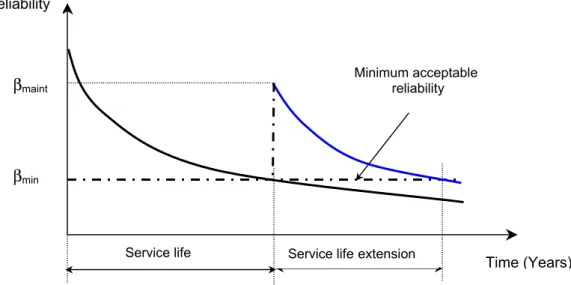
time due to corrosion, fatigue, overload. As a result, the safety (or serviceability) margin and the corresponding reliability index decrease with time. The prediction of the reliability of a bridge structure throughout its life cycle is based on a probabilistic modeling of the load and strength of the bridge structure and system, and on the use of appropriate analytical or numerical structural reliability analysis methods (Melchers 1987; Estes and Frangopol 1999). The failure and the end of life of a bridge structure can be defined as the time interval at which the reliability index reaches a minimum acceptable level, βmin, as in Figure 1. This minimum
value depends on the mode of failure considered, bridge element or system, redundancy, and consequences of failure. This service life is the time at which a maintenance action is required, which can be minor repair, strengthening, or replacement, after which the reliability is increased to an adequate level βmaint.
Despite its practicality and relevance, the use of risk as a criterion for decision-making in the maintenance of highway bridges is not easy given the complexity of assessing the consequences of failure. As opposed to life cycle cost or cost-benefit analyses, which have been used in many types of studies and other structural systems, all losses, including fatalities, injuries, and social costs are quantified in monetary terms. This means that a monetary value must be assigned to human life, and various methods have been developed Given the difficulty of accepting the notion of placing any sort of value on human life, Starr (1969) evaluated the risk of death from various causes and identified two general categories for risk of death: (i) risk associated with voluntary activities in which the individual evaluates and adjusts his exposure to risk; and (ii) risk associated with involuntary activities, which are determined by regulations from governmental agencies. Starr (1969) indicated that the public typically was willing to accept voluntary risks 1,000 times greater than involuntary risks. Paté-Cornell (1994) proposed different ranges of acceptable levels of risks for the public and workers ranging from 10-8 to 10-3 per year.
βmaint
Service life extension βmin Minimum acceptable reliability Service life Time (Years) Reliability
Figure 1. Impact of maintenance on reliability and service life of bridge structures
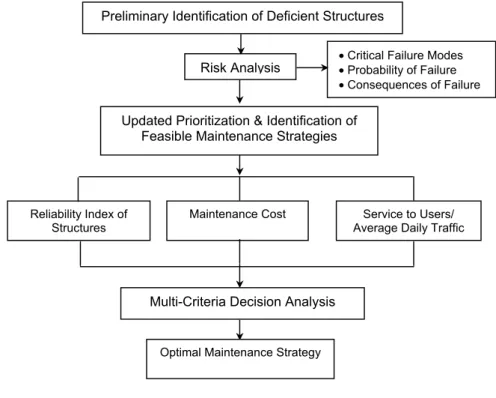
It is clear from the above, the existing approaches to decision making have serious limitations as they consider only one criterion at a time, i.e. life cycle cost (or cost-benefit) or risk of death. In this paper, a multi-criteria approach for decision analysis, which incorporates cost and risk is proposed to solve the maintenance optimization problem. Such an approach enables a better evaluation of the effectiveness of maintenance strategies in terms of several criteria and determines the optimal solution that achieves the best trade-off between all criteria (including conflicting ones, such as cost and risk). Furthermore, the maintenance optimization of bridges is multi-criteria in nature as the bridge owner or manager, and engineer seek to satisfy simultaneously several criteria, such as the minimization of costs to owners and users, improvement of safety, improvement of serviceability and functionality, minimization of maintenance time, minimization of traffic disruption, etc. Figure 2 outlines the methodology for
risk-based maintenance management of highway bridge structures. The development and integration of the proposed decision support tools for risk assessment and maintenance optimization will lead to an effective approach to bridge maintenance management, which optimizes the allocation of maintenance funds and reliability, as well as improves risk management in bridges.
Optimal Maintenance Strategy Multi-Criteria Decision Analysis
Risk Analysis •• Critical Failure Modes Probability of Failure • Consequences of Failure
Service to Users/ Average Daily Traffic Maintenance Cost
Preliminary Identification of Deficient Structures
Reliability Index of Structures
Updated Prioritization & Identification of Feasible Maintenance Strategies
Figure 2. Decision Support Tools for Risk-Based Management of Highway Bridges
Multi-Criteria Maintenance Optimization of Bridges
In the literature, most approaches to maintenance optimization of highway bridges are based on single objective optimization, and more specifically on the minimization of maintenance costs. Similarly, in most bridge management systems, the main criterion used for maintenance optimization is the minimization of life cycle cost, which represents the present value of all the costs incurred throughout the life cycle of a bridge structure, including, the costs of design, construction, maintenance, repair, rehabilitation, replacement, demolition, and in some instances users’ costs. The actual maintenance optimization problem is multi-objective in nature as the bridge owner or manager seeks to satisfy simultaneously several criteria, such as the minimization of costs to owners and users, improvement of safety, improvement of serviceability and functionality, minimization of maintenance time, minimization of traffic disruption, etc. The solution of this maintenance management problem can be obtained using the techniques of multi-criteria or multi-objective optimization.
Several approaches have been developed to solve multi-criteria optimization problems, including multi-attribute utility theory (Von Neumann and Morgenstern 1947; Keeney and Raiffa 1976), weighted sum approach (Zadeh 1963), compromise programming, ε-constraint approach, sequential optimization (Koski 1984; Duckstein 1984; Osyzcka 1984; Fu and Frangopol 1990; Eschenauer et al. 1990; Lounis and Cohn 1993). In this paper, the compromise programming approach is used to solve the multi-objective maintenance optimization problem.
Concept of Pareto Optimality
For single-objective optimization problems, the notion of optimality is very well defined as the minimum or maximum value of some given objective function is sought. In multi-criteria (or vector) optimization problems, the notion of optimality is not obvious because of the presence of multiple, incommensurable and conflicting objectives. In general, there is no single optimal (non-dominated or superior) solution that simultaneously yields a minimum (or maximum) for all objective functions. The Pareto optimality concept has been introduced as the solution to multi-objective optimization problems (Koski 1984; Eschenauer et al. 1990). A maintenance strategy x* is said to be a Pareto optimum if and only if there exists no maintenance strategy in the feasible set of maintenance alternatives that may yield an improvement of some criterion without worsening at least one other criterion. The multi-criteria maintenance optimization problem can be mathematically stated as follows:
Find: x* = Optimum
Such that: f(x)= [ f1(x) f2(x) ………. fm(x) ]T = minimum x ∈Ω (2a)
Σ
C(x) ≤ B (2b)Ω ={x ∈ N: βmin ≤ β(x) ≤ βth} (2c)
where f = vector of optimization criteria (e.g. risk, cost, traffic); C(x)= cost of maintenance strategy x; Ω= subset of the bridge or bridge network that at time t contains deficient bridge components/systems having a reliability index between a minimum value and a threshold value (very critical); N= entire set of bridge projects requiring maintenance.
The concept of Pareto optimality mentioned above, may be stated mathematically as follows (Koski 1984;Lounis and Cohn 1993): x* is a Pareto optimum if:
fi(x) ≤ fi(x*) for i=1,2,…,m (3a)
with fk(x) < fk(x*) for at least one k. (3b)
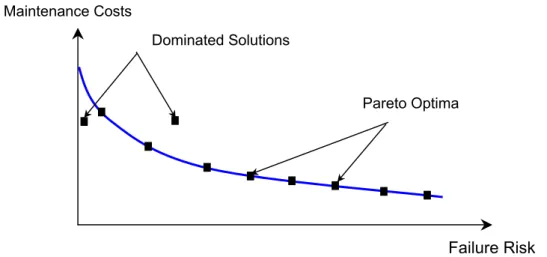
Figure 3 is a schematic illustration of the conflicting nature of the criteria of minimization of maintenance costs and minimization of risk of failure. In general, there are several Pareto optimal solutions (called also non-dominated solutions) for a multi-criteria optimization problem as shown in Fig. 3. In Fig. 3 two dominated solutions are also shown to illustrate the concept of dominance. Once the set of Pareto optima is generated, the “best” solution that achieves the best compromise between all competing objectives is sought. Such a solution is refereed to as “satisficing” solution in the multi-criteria optimization literature (Koski 1984). The determination of this satisficing solution is discussed in the next section.
Dominated Solutions
Pareto Optima
Failure Risk
Maintenance Costs
Figure 3. Schematic illustration of Pareto optima and conflicting optimization criteria
Determination of “Satisficing” Solution
In compromise programming, “satisficing” solution is defined as the solution that minimizes the distance from the set of Pareto optima to the so-called “ideal solution”. This ideal solution is defined as the solution that yields minimum (or maximum) values for all criteria. Such a solution does not exist, but is introduced in compromise programming as a target or a goal to get close to, although impossible to reach. The criterion used in compromise programming is the minimization of the deviation from the ideal solution f* measured by the family of Lp metrics
(Koski 1984; Lounis and Cohn 1993). In this paper, a multi-criteria optimality index, “MOI”, is defined as the value of the weighted and normalized deviation from the ideal solution f* measured by the family of Lp metrics:
1 / p p i wi m 1 = ∑ ) (x) fi max fi(x min − i min − f ) x ( fi(x) (4) p ) x ( MOI =
This family of Lp metrics is a measure of the closeness of the satisficing solution to the ideal solution. The value of the weighting factors wi of the optimization criteria fi (i=1,…,m) depends
primarily on the attitude of the decision-maker toward risk. In this paper structural safety is considered as the governing criterion and a higher weight is placed on the reliability criterion, however, the optimization will also be carried out for equal weighting of all criteria to show the impact of weighting factors on the optimal decision. The choice of p indicates the importance given to different deviations from the ideal solution. For example, if p=1, all deviations from the ideal solution are considered in direct proportion to their magnitudes, which corresponds to a group utility (Duckstein 1984). However, for p ≥2, a greater weight is given to larger deviations from the ideal solution, and L2 represents the Euclidian metric. For p=
∞
, the largest deviationis the only one taken into account and is referred to as the Chebyshev metric or mini-max criterion and L∞corresponds to a purely individual utility (Duckstein 1984; Koski 1984; Lounis and Cohn 1995). In this paper, the Euclidean metric is used to determine the multi-criteria optimality index and corresponding satisficing solution.
Illustrative Example
The approach presented in this paper is applied for the maintenance optimization of 10 deficient structures from different bridges within a network of a given highway agency. In this example, the feasible maintenance strategies are assumed optimized for the individual deficient project based on the conventional life cycle costs minimization approach. The objective here is to optimize the prioritization of the 10 maintenance projects considering simultaneously their reliability, maintenance cost, and average daily traffic subject to the constraint of a total available budget of $1.65 Million. The average daily traffic is a very relevant criterion as it indirectly provides a rating of the importance of the bridge relative to the service provided to the users and the socio-economic activity. If the bridge is posted or closed, users incur immediate economic impacts leading to higher travel costs due to longer travel time, higher fuel consumption, lost time, higher vehicle maintenance costs, and increased environmental impacts due to increased fuel consumption and gas emissions. It can be defined as a criterion for the control of traffic disruption.
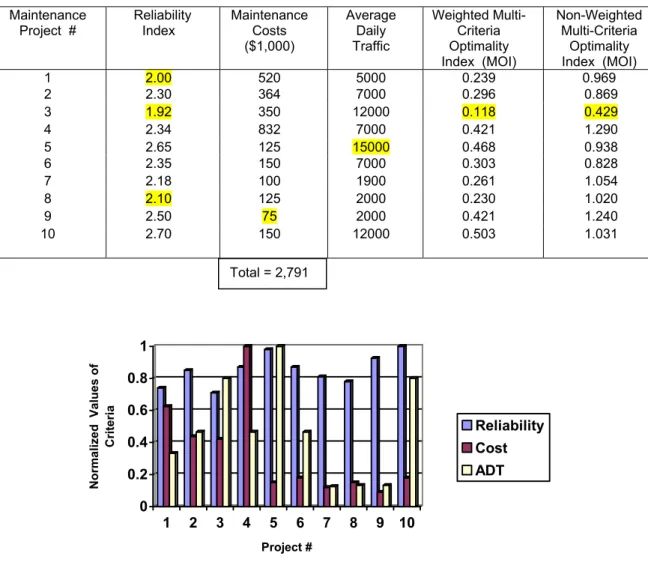
Table 1, shows the values of the reliability index, maintenance cost and average daily traffic associated with each bridge project, while Figure 4 shows their normalized values (normalized with regard to the maximum value). Table 1 and Figure 4 illustrate the conflicting nature of these criteria and the difficulty in prioritizing, as the project with the highest urgency in terms of reliability (Project #3) is neither the same in terms of maintenance cost (Project #9) nor in terms of ADT (Project #5).
If a single-criterion prioritization is undertaken, the projects will be ranked as follows:
(i) Reliability-based prioritization: the projects will be ranked in terms of increasing reliability, i.e. the project with the lowest reliability will given first priority, and end up with the project at which the available budget is exhausted. For the remaining deficient structures, posting or closing of the bridge should be investigated;
(ii) Maintenance cost-based prioritization: the projects will be ranked in terms of increasing cost, i.e. the project with the lowest life cycle cost will given first priority, and end up with the project at which the available budget is exhausted. For the remaining deficient structures, posting or closing of the bridge should be investigated;
(iii) Traffic-based prioritization: the projects will be ranked in terms of decreasing average daily traffic (ADT), i.e. the project with the highest ADT will given first priority, and end up with the project at which the available budget is exhausted. For the remaining deficient structures, posting or closing of the bridge should be investigated.
Using the compromise programming and the L2 metric, the proposed multi-criteria
optimality index (MOI) is determined for the bridge projects for two cases: (i) Case 1: Weighted MOI, in which weights of 0.5, 0.3, and 0.2 are assigned to reliability, maintenance cost, and ADT, respectively (i.e. a risk averse preference)
Table 1. Multi-criteria-based maintenance optimization of bridge structures Maintenance Project # Reliability Index Maintenance Costs ($1,000) Average Daily Traffic Weighted Multi-Criteria Optimality Index (MOI) Non-Weighted Multi-Criteria Optimality Index (MOI) 1 2.00 520 5000 0.239 0.969 2 2.30 364 7000 0.296 0.869 3 1.92 350 12000 0.118 0.429 4 2.34 832 7000 0.421 1.290 5 2.65 125 15000 0.468 0.938 6 2.35 150 7000 0.303 0.828 7 2.18 100 1900 0.261 1.054 8 2.10 125 2000 0.230 1.020 9 2.50 75 2000 0.421 1.240 10 2.70 150 12000 0.503 1.031 Total = 2,791 0 0.2 0.4 0.6 0.8 1 Norma lize d Va lue s of Crite ria 1 2 3 4 5 6 7 8 9 10 Project # Reliability Cost ADT
Figure 4. Normalized Values of Optimization Criteria for Maintenance Projects
The total maintenance costs for these 10 projects is $2.791 millions, which is well in excess of the available budget of $1.65 million. From Table 1, the “ideal” (but non-existing) maintenance solution is associated with the following “ideal” criterion vector f*=[f1min f2min
f3max]T= [1.92, 75000, 15000]T. Using Eq. (4), the values of MOI for the weighted and
non-weighted cases are also shown in Table 1 and in Figure 5. Using the non-weighted MOI, the satisficing solution is found to be Project # 3 for both weighted and non-weighted cases. Figure 5, however, illustrates the differences in the ranking for the other projects, for example the second highest priority is Project #9 for weighted MOI and Project # 6 for non-weighted MOI, which is due to the higher importance given to reliability. The difference in ranking between these two MOI indices varies from 0 for Project #3 to 5 for Project # 5.
0 0.2 0.4 0.6 0.8 1 1.2 1.4 MOI 1 2 3 4 5 6 7 8 9 10 Project # Weighted MOI Non-Weighted MOI
Figure 5. Weighted and non-weighted multi-criteria optimality indices
Considering now the budgetary constraint, the following projects will be scheduled for maintenance:
(i) Weighted MOI-Based Prioritization: Projects #3, #8, #1, #7, #2, and #4 for a total cost of $1.609 million. The other projects are delayed for the next year, however, detailed analysis is required to assess if bridge postings or closures are required. (ii) Non-Weighted MOI-Based Prioritization: Projects #3, #6, #2, #5, #1, and #8 for a
total cost of $1.634 million. The other projects are delayed for the next year, however, detailed analysis is required to assess if bridge posting or closure are required.
Conclusions
The multi-objective optimization approach presented in this paper demonstrates the potential of the multi-criteria decision analysis approach for the maintenance optimization of structurally deficient bridge structures The major merits of the approach are: (i) consideration of all possible (even conflicting) objective functions; (ii) ability to place more emphasis on risk reduction; and (iii) rational decision-making regarding the selection of bridge projects for maintenance. The prioritization of the bridges is based on the satisfaction of several conflicting objectives simultaneously, including structural reliability, maintenance costs, and traffic.
A quantitative risk assessment of deficient bridge structures is critical to ensuring their effective maintenance leading to a reduction or a better management of risk. The use of risk (or reliability) is a major step forward compared to the existing approaches to bridge management that are based on condition ratings, which provide only a qualitative assessment of the condition of deficient structures. The use of multi-criteria optimization is another step towards the development of more powerful bridge management systems that will enable the decision-maker to select several and conflicting criteria and determine the corresponding optimal maintenance strategies.
This paper illustrated that the bridge maintenance management problem could be formulated as a multi-objective optimization problem. The solutions obtained achieved a satisfactory trade-off between several competing criteria, including the minimization of the risk
of failure, minimization of maintenance costs and minimization of traffic disruption. The use of compromise programming and the proposed multi-criteria optimality index yield the optimal ranking of the deteriorated bridges in terms of their priority for maintenance, rehabilitation and replacement.
References
Duckstein, L. “Multiobjective optimization in structural design: The model choice problem.” In
new Directions in Optimum Structural Design, Atrek et al., eds., Wiley, New York, 1984, pp. 459-481.
Eschenauer, H., Koski, J., and Osyczka. A. (eds.) Multi-Criteria Design Optimization:
Procedures and Applications. Springer Verlag, Berlin, 1990.
Estes, A.C. and Frangopol, D.M. “Repair optimization of highway bridges using system reliability approach.” ASCE J. of Struct. Engrg.,Vol. 125, No.7, 1999, pp. 766-775.
Fu, G, and Frangopol, D.M. “Reliability-based vector optimization of structural systems. “ASCE
J. of Struct. Engrg., Vol. 116, No. 8, 1990, pp. 2143-2161.
Keeney, R.L., and Raiffa, H. Decisions with Multiple Objectives: Preferences and Value Tradeoffs. J. Wiley & Sons, New York, 1976.
Koski, J. “Multi-objective optimization in structural design.” In new Directions in Optimum
Structural Design, Atrek et al., eds., Wiley, New York, 1984, pp. 484-503.
Lounis, Z., and Cohn, M.Z. “Multi-objective optimization of prestressed concrete structures.”
ASCE J. of Struct. Engrg.,Vol. 119, No.3,1993, pp. 794-808.
Lounis, Z., and Cohn, M.Z. “An engineering approach to multi-criteria optimization of highway bridges.” J. of Computer-Aided Civil & Infrast. Engrg., Vol. 10, No.4, 1995, pp. 233-238. Melchers, R. E. Structural Reliability- Analysis and Prediction. Ellis Horwood Ltd, 1987,
Chichester, England.
Osyczka, A. Multi-criterion Optimization in Engineering. Ellis Horwood, Chichester,1984. Paté-Cornell, M.E. “Quantitative safety goals for risk management of industrial facilities.” J.
Structural Safety, Vol. 13, 1994, pp.145-157.
Starr, C. “Social benefit vs. technical risk.” Science, American Association for the Advancement of Science, Vol. 165, 1969, pp. 1232-1238.
Thompson, P.D., and Shepard, R.W. “Pontis.” Transportation Research Circular 324, Transportation Research Board, Washington, D.C., 1994, pp.35-42.
Von Neumann, J. and Morgenstern, O. Theory of Games and Economic Behavior. Princeton University Press, 1947, Princeton.
Zadeh, L.A. “Optimality and non-scalar valued performance criteria.” IEEE Trans. Aut. Cont, Vol. 8, No.1, 1963, pp.59-60.