HAL Id: halshs-01534923
https://halshs.archives-ouvertes.fr/halshs-01534923
Submitted on 8 Jun 2017
HAL is a multi-disciplinary open access archive for the deposit and dissemination of sci-entific research documents, whether they are pub-lished or not. The documents may come from teaching and research institutions in France or abroad, or from public or private research centers.
L’archive ouverte pluridisciplinaire HAL, est destinée au dépôt et à la diffusion de documents scientifiques de niveau recherche, publiés ou non, émanant des établissements d’enseignement et de recherche français ou étrangers, des laboratoires publics ou privés.
Some more exceptional discoveries at Ulug-depe
Julio Bendezu Sarmiento, Johanna Lhuillier
To cite this version:
Julio Bendezu Sarmiento, Johanna Lhuillier. Some more exceptional discoveries at Ulug-depe. Dubova, N.A., Antonova, E.V., Kozhin, P.M., Kosarev, M.F., Muradov, R.G., Sataev, R.M. & Tishkin A.A. Transactions of Margiana Archaeological Expedition, To the memory of Professor Viktor Sari-anidi, 6, Staryj Sad, pp.522-528, 2016, 978-5-89930-150-6. �halshs-01534923�
N.N. MIKLUKHO-MAKLAY INSTITUTE OF ETHNOLOGY
AND ANTHROPOLOGY OF RUSSIAN ACADEMY OF SCIENCES
MARGIANA ARCHAEOLOGICAL EXPEDITION
ALTAY STATE UNIVERSITY
TRANSACTIONS OF MARGIANA
ARCHAEOLOGICAL EXPEDITION
Volume 6
To the Memory of Professor Victor Sarianidi
Editorial board
N.A. Dubova (editor in chief),
E.V. Antonova, P.M. Kozhin, M.F. Kosarev,
R.G. Muradov, R.M. Sataev, A.A. Tishkin
Туркменистан, Гонур-депе, 9 октября 2005 г. Turkmenistan, Gonur Depe, October 9th, 2005
УДК 05 [902+572+599+391](31“636/637”/575.4) ББК 63.4+63.3(0)31+63.5(5Тур) Т 78 Труды Маргианской археологической экспедиции. Том 6. Памяти Виктора Ивановича Т 78 Сарианиди / Ред. Н.А. Дубова (гл. ред.), Е.В. Антонова, П.М. Кожин, М.Ф. Косарев, Р.Г. Мурадов, Р.М. Сатаев,А.А. Тишкин – М.: Старый сад, 2016 — 580 с. ISBN 978-5-89930-150-6 Данный выпуск Трудов посвящен памяти открывателя нового центра древневосточной цивилизации, основателя и постоянного руководителя Маргианской археологической экспедиции В.И. Сарианиди. Он состоит из трех разделов. В первый из них включены воспоминания друзей и коллег выдающегося археолога; во второй — описание и анализ новых находок и открытий, сделанных на известном памятнике эпохи бронзы Гонур-депе (2300-1600 до н.э.); а в третий — характеристика Гонура и других объектов Бактрийско-Маргианского археологического комплекса (БМАК) в сравнительном контексте с синхронными памятниками Центральной Азии и Ближнего Востока. Затрагиваются вопросы строительства и архитектуры, древней металлургии, мировоззрения населения, глиптики и сфрагистики, биоархеологических реконструкций, реставрации археологических предметов. Значительное место уделяется анализу торговых и культурных связей в пространстве Евразии, значению древней дельты Мургаба как перекрестка путей. Вводится в научный оборот ряд новых уникальных объектов эпохи бронзы, в том числе найденные и на Гонуре.
Transactions of Margiana Archaeological Expedition. Vol. 6. To the Memory of Professor Victor Sarianidi / N.A. Dubova (editor in chief), E.V. Antonova, P.M. Kozhin, M.F. Kosarev, R.G. Mura-dov, R.M. Sataev, A.A. Tishkin – M.: Staryi sad, 2016 — 580 p.
ISBN 978-5-89930-150-6
This issue of Transactions is devoted to the memory of the discoverer of a new center of an-cient oriental civilization, the founder and the permanent head of the Margiana archaeological expedition Victor Sarianidi. It consists of three sections. The first one included the memories of friends and colleagues about the outstanding archaeologist; the second one – description and analysis of new findings and discoveries made in the famous Bronze Age archaeological site Gonur Depot (2300-1600 BC); and the third one – the characteristics of Gonur and other objects of the Bactria-Margiana archaeological complex (BMAC) in a comparative context with synchronous monuments of Central Asia and the Middle East. The construction and architecture, ancient met-allurgy, ideology, glyptic and sphragistics, bioarchaeological reconstructions, restoration of ar-chaeological objects are affected. The significant attention is given to the analysis of trade and cultural relations in the Eurasian area, to the value of the ancient delta of the Murghab river as the crossroads. New series of unique Bronze age objects, including those have found at Gonur are introducing into scientific circulation.
ТРУДЫ МАРГИАНСКОЙ АРХЕОЛОГИЧЕСКОЙ ЭКСПЕДИЦИИ ТОМ 6 Памяти Виктора Ивановича Сарианиди Подписано в печать 23.09.2016 г. Формат 90х60/8. Усл. печ. л. 66,07. Тираж 1000 экз. Издательство ООО «Старый сад» Типография «Медиагранд» © Институт этнологии и антропологии РАН, 2016 ISBN 978-5-89930-150-6 © Маргианская археологическая экспедиция, 2016
— 522 —
J. Bendezu-Sarmiento1, J. Lhuillier2
CNRS, Paris, France
1 Archéologies et sciences de l’antiquité 2 Hellénismes d’Asie et civilisations orientales
Some more exceptional discoveries at Ulug-depe
F
ounded in 2001, the French Archaeological Mission in Turkmenistan aims to explore and study the multi-chronological site of Ulug-depe, from the Neolithic to the historical periods. In 2014 our work highlighted an excep-tional discovery for the region and the period of the Middle Bronze Age: a quite disrupted, but rather rich burial, situated on a «high terrace» similar to the one found at the proto-urban site of Altyn-depe.A significant site
Located in the prefecture of Kaahka (175 km east of the capital, Ashgabat; fig. 1), Ulug-depe is situated halfway between Namazga-depe (45 km to the west) and Altyn-depe (45 km to the
east). Discovered in 1930 by A. Marushenko, the site was partially excavated in the late 1960’s by Viktor Ivanovich Sarianidi. The results of his study showed the historical importance of Ulug-depe, as being one of the most significant proto-urban site in Southern Central Asia.
Smaller than Namazga-depe and Altyn-depe, Ulug-depe stretches on an area of 13–15 ha on the top and 26 ha at its base, to a height of over 30 m. Its current elevation does probably not match its physical and historical reality, and ten meters can easily be added to its height, as the proximity of Kopet Dagh (13 km away), and the close presence of a ancient bed of the Kelet river caused many episodes of colluvium and alluvial deposits.
— 523 — With an occupation stretching from Neo-lithic (VI millennium BC) to the Achaemenid pe-riod (I millennium BC), Ulug-depe presents the longest stratigraphic sequence known in Central Asia. Alongside Namazga-depe, Altyn-depe, and Khapuz-depe, it can be considered as one of the major components of the ancient cultures in Central Asia that formed the Bactrian-Margian Archaeological Complex (BMAC), also known as Oxus civilization.
Today Ulug-depe is recognized as one of the key sites for the study of interplay between Central Asia, Elam, Mesopotamia and the Indus civilization, but also for helping understand the major Central Asian chrono-cultural interconnections, that are still being discussed in the scientific community.
At the end of the Sixties, during three excavation campaigns (1967, 1968, 1970), the team of the Geoksjur expedition of the Institute of Archaeology of the Academy of Sciences of the USSR, directed by V.I. Sarianidi, managed to identify the main features of the stratigraphy from a half-dozen soundings carried out on various areas of the site, numbered 1 to 7. With the exception of a few articles, almost all of this research remains unpublished.
Apart from a few observations dealing with the results of the excavations, specifically in regard to the Bronze Age and Iron Age (Сари-аниди, 1967, 1968, 1969, 1971, 1972; Сариани-ди, Качурис 1968; Массон, СарианиСариани-ди, 1972), and research work on the ceramic material (Ма-симов, 1971, 1972), the graves (around fifty in total), almost all of them from the Bronze Age, were only partially processed at the time (Сари-аниди, Качурис, 1968; Сари(Сари-аниди, 1969).
Due to its scientific significance, and thanks to the continued support of Viktor Ivanovich Sarianidi, work on the site resumed in 2001 under the direction of Olivier Lecomte (MAFTUR/CNRS) and Mohamed Mamedow (National department for the protection, investigations and conservation of historical and cultural heritage). Currently the work led by Julio Bendezu-Sarmiento (CNRS/DAFA) and Mohamed Mamedow confirms the importance of this site throughout history, particularly during the Chalcolithic, Bronze Age, and Iron Age periods (among others: Lecomte, 2011, 2013; Lecomte et al., 2002; Bendezu-Sarmient,
Lhuillier, 2011; Lhuillier, 2013; Lhuillier et al., 2013, 2015; Luneau, 2014).
The «High Terrace», a significant discovery
In 2014, the trench 41 was opened on the north-eastern flank of the tepe. The excavation, stretching on a 170 sq. m. surface, revealed a massive structure, unfortunately poorly preserved, on the slope of the tepe. This horizontal terrace was occupying two thirds of the oriental part of the trench, and was constructed with dense, homogeneous blocks of
pakhsa1. Quite difficult to identify, these blocks
do not have standard dimensions, and several amongst them have more or less triangular faces of variable dimensions (105 x 110 x 50 cm, 110 x 160 x 95 cm, 100 x 90 x 150 cm, 80 x 40 x 60 cm, 75 x 50 x 60 cm).
The results of surveys and the study of the stratigraphy indicate that the ceramic mate-rial found between the blocks and within the
pakhsa itself can be dated to the period known
as Namazga V (Middle Bronze Age, end of the III– beginning of the II millennia BC)2. Our
pre-liminary results show that this high terrace was 10 m long, for at least the same width, and for a minimum height of 4 m. However, these dimen-sions may still evolve into a larger size, as that of the similar platform (12 m wide and 6 m high) found at Altyn-depe by V.M. Masson (1981).
This kind of construction, generally identified as “ritual buildings”, is usually dated from the III millennium BC. It is the case of the one discovered at Tureng Tepe on the Iranian plateau (Deshayes, 1975), at Konar Sandal and Nad-i Ali in the Afghan Sistan (Ghirshman, 1942; Dales, 1977; Besenval, Francfort, 1994) and at Mundigak (Casal, 1961).
However, the exact function of these buildings, along with the facilities that were probably built at their top, still remains unknown as of today. What seems certain is the combination of this type of architecture with burials, like the tomb of a “priest” featuring a “prestigious” material (small columns and disks) associated with a cult on the high terrace
1 Pakhsa – rammed, broken clay.
2 On the other hand the high terrace was already built on lay-ers dating from the Middle Bronze Age.
— 524 — of Altyn-depe. The same kind of prestigious material, more ritual than utilitarian, was found on the terrace of Tureng Tepe, and the terrace of Ulug-depe seems to adopt the same rule.
An exceptional burial on the terrace
A pit dug on the northern part of the upper terrace (the tomb “Stratigraphic Unit N 41084”) has delivered an exceptional archaeological material. Unfortunately, the limits of the grave remain unclear, as a runoff of water caused the formation of a deep gully in this very part, also probably victim of ancient looting.
In the filling, and especially at the bottom of the pit, human remains were discovered that a first anthropological study identified as belonging to a female individ (Bruzek, Murail, 2006).
Qualitatively and quantitatively very poorly preserved3, the individual seemed to rest on the
left side (head to the east), the right leg flexed (the left one was no longer in place). The left hand, partially connected, was lying on the hipbone of the same side.
The female was wearing a belt made of small, white limestone beads. A second set of human bones, including a right hand, was also discovered in the filling of the pit, close to the body in place. These remains may belong to the same individual, and the hand was associated with limestone beads similar to the ones used for the belt, probably from a bracelet.4
These scattered human remains were asso-ciated with fifteen ceramic vases and eight
ala-baster vases, exceptionally opulent items char-acteristic of the Namazga V period (fig. 2). An imprint of a wicker basket, associated with the vessels, was also discovered.
Accompanying material: the ceramic vases
The fifteen ceramic vases display eight dif-ferent morphological categories, seven of them typical of the Oxus civilization: 1 small globular flask, 1 carinated flask, 1 medium bottle with globular body, 1 medium bottle with ovoid body, 1 bi-conical cup, 1 carinated bowl with S-shaped rim, and 1 large ovoid jar. We can find many ex-amples of theses shapes on neighbouring sites: in the Kopet Dagh area at Altyn-depe (Masson, 1988. Pl. VI, 1, 10, 12; Pl. VI, 15; Pl. XXXI; Pl. XXXII, 4, 6; Pl. XXXII, 11; Pl. XXXIV, 14; Pl. XL, 2; Pl. XXXIII, 15; Pl. XXXIV, 10–11); in Margiana at Gonur-depe (Udeumuradov, 2002. Type 22, 24, shape 103) or Adji Kui 9 (Adji Kui Oasis, 2011. Type 1.A.5; Type 2.C.3; Type 2.H.1-2; Type 2.I.1; Type 3.B.1,3,4; Type 5, shape 105), but also at Auchin-depe (Masson, 1959. Pl. I, 1,
3; Pl. II, 2; Pl. III, 2, 6). All these ceramics were
discovered in levels dated to the Middle Bronze Age, generally associated with burials, except for the large jar, which remains a rather unusual shaped in a funerary context.
3 Only a few fragmentary elements of the spine, pelvis and other bones were found in place.
4 Dozens of beads were discovered in both the filling of the pit and during the search of the gully that had cut the grave.
Fig. 2. Ceramic vases characteristic of the Namazga V period (© MAFTUR). Some more exceptional discoveries at Ulug-depe
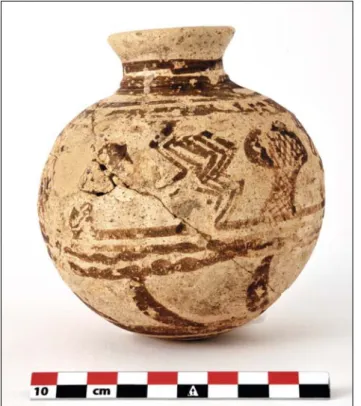
— 525 — As for the eighth form, it attests to the long distance contacts that existed between the Oxus civilization and other contemporary civilizations at the end of the III–early II millennia BC. This form can be described as a small globular pot, with convex base and narrow neck, featuring painted decoration (foreground, centre-right on the fig. 2).
This vase was covered with a thick concretion, and its painted decoration, covering all the body and base, appeared in full only after restoration (fig. 3). The central part consists of a horizontal frieze depicting vertical zigzags alternating with a vegetal pattern featuring reticulated motifs. This frieze is framed on both sides by three parallel horizontal lines. The base and lower part of the body are covered by a radiant pattern.
There are no analogies for this type of vase in Central Asia, although a ceramic of roughly the same shape, but not bearing any decoration was discovered at Gonur-depe (Udeumuradov, 2002. Type 18, shape 99).
Vases featuring a pale fabric with red-brown painted decoration are known in the Indus civilization during the Bronze Age. Among the many existing examples we can cite the globular jars of the Late Harappan phase (Krishnan, Rajesh, 2014. Fig. 6–7). The combination of
vertical geometric patterns to define panels depicting vegetable or animal motifs is common. However, no accurate similarities have been identified (Quivron, 2000).
In the neighbouring region of Makran, globular jars of the Bronze Age (periods IIIc and IV) are similar but not identical, as they present a slightly discoid base, while the painted decoration is only displayed on the upper part of the body (Didier, Mutin, 2013. Fig. 6–7).
The use of vertical zigzags alternating with figurative motif is also prevalent in Sialk, period III, during the first half of the III millennium (Ghirshman, 1938. Pl. XII, XVII, XXI, LXVI). All these analogies seem to point to an origin of this type of production in the Indo-Iranian region.
A unique discovery: alabaster vases and jewellery
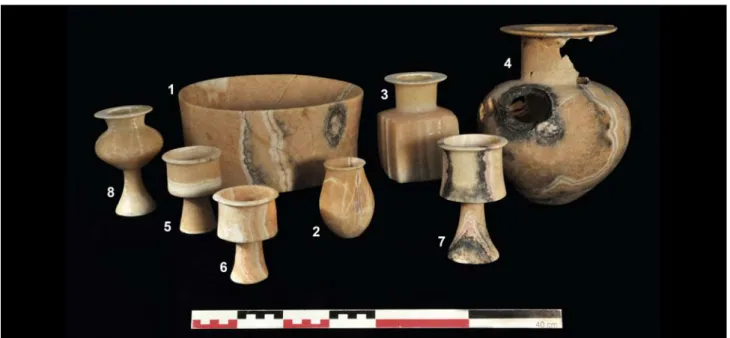
By “alabaster”, we mean real alabaster, as long as translucent white gypsum, and veined marble. It is therefore difficult to comment on the exact nature of the stone used here without extensive physicochemical analysis. However we can postulate that many of these vessels seem to come from a same deposit, as one can observe the same veining.
These vessels include (fig. 4):
1 – A dish with flat base and vertical wall with analogies in the XVc series of Susa, and in many other sites of the Iranian plateau (Casano-va, 1991. P. 37, Pl. 10);
2 – A small pot with ovoid body, with analo-gies in Margiana at Gonur-depe (Sarianidi, 2007. P. 111, N 194–195), in Southern Bactria (Pottier, 1984. N 215; P. 34, fig. 28; P. XXVI), but also in the Vb-c series of Susa and few other sites of the Iranian plateau (Casanova, 1991. P. 35, 5).
3 – A flask with quadrangular body, and vertical mouldings.
4 – A globular pot with long neck.
5, 6, 7 – Three goblets with cylindrical body. 8 – A globular vessel with analogies in Margiana at Gonur-depe (Sarianidi, 2007. P 112, 197), in Southern Bactria (Pottier, 1984. N 216–218; P. 34, fig. 29; P. XXVII). This form, along with the one from 5 – seems to be characteristic of Central Asian sites (Casanova, 1991. P. 40).
Fig. 3. Small globular pot, with convex base and narrow neck
with painted decoration (© MAFTUR).
— 526 — The goblets with cylindrical body are among the items traded with the Indus civilization, exchanges attested to by the treasure of Quetta, which contains two “chalices” of this type (Catalog, 1988. N 168–169).
With the exception of these two forms, the others are either attested throughout the Iranian plateau or, on the contrary, seem to be known only through the specimens discovered at Ulug-depe. It is therefore difficult to comment on the origin of these vases, or to try to ascertain a unique origin. During the Bronze Age, Afghanistan and Pakistan were known centres of alabaster production, while in Iran, Shahr-i Sokhta and Tepe Yahya in Iran were major craft centre, especially thanks to the closeness of alabaster deposits.
In addition to the eight vessels found in the tomb, a ninth vessel was accidentally discovered by one of us in 2001 on the surface of the site, not far from the grave (fig. 5). This was another “chalice” even more delicate than the ones found
in situ. Given the place where it was discovered,
this vase seems to be linked itself to the same exceptional funerary complex.
Finally, regarding the jewellery pieces (dozens of elements), they present a wide variety of shapes and materials (fig. 6): gold, lapis lazuli, carnelian, agate, turquoise, mineral composite (frit).
The etched carnelian beads belong to the production characteristic of the Indus civilization, reflecting a social hierarchy
established at Ulug-depe, and relations based on a long-distance international trade.
As well as the beads, alabaster vessel occupies a significant place in the inter-Iranian trade, and illustrates once more the opulence of this exceptional ensemble, and of the female individual who was buried in this grave. This observation leads us to wonder about the social relations between genders, and the strong role that women could have in the proto-historic societies of Central Asia (Luneau, 2008, 2014).
Fig. 5. «Chalice» alabaster vase (© MAFTUR). Fig. 4. Alabaster vases (© MAFTUR).
— 527 —
Conclusion
It was during the apogee of the Oxus civilization, around the late III and early II millennium BC that the greatest range of exchanges with neighbouring regions (Indian subcontinent, Iranian plateau, Mesopotamia, Gulf regions) was reached. The site of Shortughai (Francfort et al., 1989), a Harappan settlement in the heart of the territory of the Oxus civilization in Bactria, attests to the vitality of these exchanges. Contacts with the Indus civilization in particular were known since the seventies, and were more recently confirmed by the discovery of Harappan seals in Altyn-depe (Masson, 1988. Pl. XXII, 1a, 1b), and by numerous discoveries of seals, ivory sticks, and zoomorphic and anthropomorphic sculptures in Gonur-depe (Sarianidi et al., 2014).
The high terrace, and above all, the tomb of Ulug-depe help thus shed some light on these exchanges. Indeed to our knowledge it is the first time that such amount of alabaster vases featuring a wide morphological variety is discovered. According to M. Casanova (1991. P. 96), the alabaster vases “are no ordinary objects, but hold a significant value provided by the materials they are made of, and by the difficulty brought by their importation; a high value which would explain their use as instruments with symbolic meaning”. In addition, stone and metal object were usually the ones circulating, while the example of the painted vase discovered at Ulug-depe, a unique discovery to date in Central Asia, shows that the most fragile objects, but of great value, could also travel long distances.
Fig. 6. Jewellery pieces of exceptional burial (© MAFTUR).
Bibliography
1. Bendezu-Sarmiento J., Lhuillier J. Iron Age in Turk-menistan: Ulug-depe in the Kopetdagh piedmont // Historical and Cultural sites of Turkmenistan. Discov-eries, Researches and Restoration for 20 years of in-dependence / Ed. M.A. Mamedov. Ashgabat, 2011. P. 238–249.
2. Besenval R., Francfort H.-P. Th e Nad-i Ali ‘Surkh Dagh’: A Bronze Age monumental platform in Central Asia? // From Sumer to Melluha: contributions to the Archaeol-ogy of South and West Asia in Memory of George F. Dales / Ed. J. M. Kenoyer. Wisconsin Archaeological Reports. 1994. Vol. 3. P. 3–14.
— 528 —
3. Bruzek J., Murail P. Methodology and reliability of the sex diagnosis from the skeleton // Forensic Anthropol-ogy and Medicine, two complementary sciences. From recovery to cause of death / Eds. A. Schmitt, C. Cunha, J. Pinheiro. Totowa, 2006. P. 225–242.
4. Casal J.-M. Fouilles de Mundigak. Mémoires de la Délé-gation archéologique française en Afghanistan. T. XVII. Paris, 1961.
5. Casanova M. La vaisselle d’albâtre de Mésopotamie, d’Iran et d’Asie centrale aux IIIe et IIe millénaires av J.-C. Paris, 1991.
6. Catalog. Les cités oubliées de l’Indus. Archéologie du Pakistan. Catalogue de l’exposition du Musée National des Arts Asiatiques Guimet. Paris, 1988. P. 111–128. 7. Dales G.F. New excavations at Nad-i Ali (Sorkh Dagh),
Afghanistan. Berkeley, 1977.
8. Deshayes J. Les fouilles récentes de Tureng Tépé: la ter-rasse haute de la fi n du IIIème millénaire // Comptes rendus de l’Académie des Inscriptions et Belles Lettres. T. Novembre-Décembre. 1975. P. 522–530.
9. Krishnan K., Rajesh S.V. Ceramics // History of Ancient India. Volume II: Protohistoric Foundations / Eds. D. K. Chakrabarti, M. Lal. New Delhi, 2014. P. 235–262. 10. Didier A., Mutin B. La production céramique
protohis-torique du Makran pakistanais dans la compréhension des relations indo-iraniennes // L’archéologie française en Asie centrale. Nouvelles recherches et enjeux socio-culturels / Ed. J. Bendezu-Sarmiento. Cahiers d’Asie Cen-trale. N 21–22. 2013. P. 461–486.
11. Francfort H.-P. [avec la collaboration de Boisset Ch., Bu-chet L., Desse J., Echallier J.-C., Kermorvant A., Willcox G.] Fouilles de Shortughaï. Recherches sur l’Asie centrale protohistorique. Paris, 1989.
12. Ghirshman R. Fouilles de Sialk près de Kashan: 1933, 1934, 1937. Vol. I. Paris, 1938.
13. Ghirshman R. Recherches préhistoriques en Afghanistan. Fouilles de Nad-i Ali dans le Seistan Afghan // Revue des arts asiatiques. T. 13/1, 1942. P. 10–22.
14. Lecomte O. Ulug depe 4000 years of evolution between plain and desert // Historical and Cultural sites of Turk-menistan. Discoveries, Researches and restoration for 20 years of independence / Ed. M. A. Mamedow. Ash-gabat, 2011. P. 221–237.
15. Lecomte O. Activités archéologiques françaises au Turk-ménistan // L’archéologie française en Asie centrale. Nou-velles recherches et enjeux socioculturels / Ed. J. Bende-zu-Sarmiento. Cahiers d’Asie Centrale. N 21–22. 2013. P. 165–190.
16. Lecomte O., Francfort H.-P., Boucharlat R., Mamedow M. Recherches archéologiques récentes à Ulug-Dépé (Turk-ménistan) // Paléorient. Vol. 28. N 2. 2002. P. 123–132. 17. Lhuillier J. Les cultures à céramique modelée peinte en
Asie centrale méridionale. Dynamiques socio-culturelles à l’âge du Fer ancien (1500–1000 av. n.è.). Mémoires de la MAFAC. T. XIII. Paris, 2013.
18. Lhuillier J., Bendezu-Sarmiento J., Lecomte O. Ulug-depe and an overview of the Iron Age in Turkmenistan // Jour-nal of Iranian Archaeology. 2015. Vol. 4/ 2013. P. 78-89. 19. Lhuillier J., Bendezu-Sarmiento J., Lecomte O., Rapin
C. Les cultures à céramique modelée peinte de l’âge du Fer ancien: quelques pistes de réfl exion d’après les exem-ples de Koktepe, Dzharkutan (Ouzbékistan) et Ulug-depe (Turkménistan) // L’archéologie française en Asie
cen-trale. Nouvelles recherches et enjeux socioculturels. Ca-hiers d’Asie Centrale 21-22 / Ed. J. Bendezu-Sarmiento. Paris, 2013. P. 357–372.
20. Luneau E. Tombes féminines et pratiques funéraires en Asie centrale protohistorique. Quelques réfl exions sur le “statut social” des femmes dans la civilisation de l’Oxus // Paléorient. Vol. 34. N 1. 2008. P. 131–157.
21. Luneau E. La fi n de la civilisation de l’Oxus. Transformations et recomposiTransformations des sociétés de l’âge du Bronze fi -nal en Asie centrale méridio-nale (1500-1500/1400 av. n.è.). Mémoires des Missions Archéologiques Françaises en Asie centrale et en Asie moyenne XVI. Paris, 2014. 508 s. 22. Masson V.M. Altyn-depe. Philadelphia: University of
Pennsylvania Museum of Archaeology and Anthropol-ogy, 1988. 170 p.
23. Adji Kui Oasis. Vol. II / Ed. Rossi-Osmida G. La cittadella delle Statuette. Padua, 2011. 302 p.
24. Pottier M.-H. Matériel funéraire de la Bactriane méridi-onale de l’âge du Bronze. Paris, 1984. 232 p.
25. Quivron G. Th e Evolution on the Mature Indus Pottery Style in the Light of the Excavations at Nausharo, Paki-stan // EW. Vol. 50. N. 1/4 (34). 2000. P. 147–190. 26. Sarianidi V.I. Necropolis of Gonur. Athens, 2007. 340 p. 27. Udeumuradov, B.N. Ceramic material from Gonur-depe
Necropolis / Ed. G. Rossi-Osmida, Margiana. Gonur-depe Necropolis: 10 years of excavations by Ligabue Study and Research Centre. Padua, 2002. P. 133-143.
28. Масимов И. Раскопки керамических печей эпохи бронзы в южной Туркмении // Археологические от-крытия 1970 года. Москва, 1971. C. 432-433. 29. Масимов И. Изучение керамических печей эпо-хи бронзы на поселении Улуг-Депе // Каракумские Древности, Вып, IV. Ашхабад, 1972. C. 35-46. 30. Массон В. М. Древнеземледельческая культура Мар-гианы. Материалы и Исследования по Археологии СССР 73. Ленинград, 1959. 31. Массон В. М., Алтын-депе. Ленинград, 1981. 32. Массон В. М, Сарианиди В. И. Каракумы. Заря циви-лизации. Москва, 1972. 33. Сарианиди В.И. Отчёт о работах Геоксюрского от-ряда экспедиции Института археологии АН СССР в 1967 г. Unpublished report, 1967. 34. Сарианиди В.И. Отчёт о работах Геоксюрского отря-да археологгческой экспедиции ИА АН СССР на по-селении Улуг депе. Unpublished report, 1968. 35. Сарианиди В. И. Продолжение работ на Улуг-Депе // Археологическуе открытия 1968 г. 1969. С. 434-435. 36. Сарианиди В. И. Исследование слоев раннежелезного века на Улуг-депе // Археологическуе открытия 1970 г. 1971. С. 433-434. 37. Сарианиди В.И. Раскопки 1970 г. на Улуг-депе // Успехи среднеазиатской археологии. Вып. 1. 1972. С. 53-55. 38. Сарианиди В.И., Бороффка Н., Дубова Н.А. Культур-ные контакты Маргианы (Туркменистан) в III тыс. до н.э. Новые данные по Гонур-депе (погребение № 4150) // Transactions of the Margiana Archaeological Ex-pedition. Vol. 5ю Gonur Depe Studies in 2011–2013 / Ed. V. Sarianidi. М., 2014. P. 127–137.
39. Сарианиди В.И., Качурис К.А. Раскопки на Улуг-депе // АО 1967. 1968. С. 342–345.
— 569 —
Table of contents
EDITORIAL
Foreword ... 6
Dubova N.A.
Victor Ivanovich Sarianidi. Life. Works. Friends. Colleagues ... 8
Kozhin P.M., Dubova N.A.
Margiana in the Central Asian Archaeology ...58
I. WORDS OF FRIENDS Pilipko V.N.
Behind the Dunes are not only the Past, Behind them is a Life ...80
Garner R.
Submission to Victor’s Memorial ...93
Antonova E.V., Letnikova L.V., Stankevitch I.L.
Shortly before Gonur ...95
Kourpalidis G.M.
Аsceticism and The Horizons of Past Civilizations (About Victor I. Sarianidi) ...97
Muradov R.G.
Close to the Legend ... 102
Kovaleva N.A.
Victor Sarianidi – Last Winged Lion of Margiana ... 108
Parpola A.
In memoriam: The Tiger of Margiana ... 125
Begliev M.Y.
So my Acquaintance with Viktor Ivanovich and Gonur Depe began ... 133
Nechvaloda A.I.
Last Photo. Memory of Victor Ivanovich Sarianidi ... 136
Sataev R.M., Kufterin V.V., Sataeva L.V.
In the Same Boat Called «Gonur» ... 141
Hazeli R. (Kei Ashkan Ardalan Afshanderi)
A Great Man in Search of the Iran Veydzh and Zoroastrian Civilization
According to the Geography of the Avesta ... 148
Muradova E.A.
Maitre of Archaeology ... 150
Artemiev V.I., Urmanova A.M.
Talks at Sunset ... 154
Babakov O.
Remembering Victor Ivanovich Sarianidi ... 169
Vrtanesyan G.S.
Southwestern Asia, Margiana and Siberia ... 171
Tirkishova Ya.
The Tireless Archaeologist ... 173
— 570 —
Saparmammedova O.
«Lion of Kara-Kum» and «The Legend of the Central Asian Archaeology» ... 176
Veresotskaya G.E.
Sarianidi Victor Ivanovich. Brief Meetings ... 178
Sidiropoulos N.
The Memorial Evening ... 188
II. GONUR DEPE IS BRINGING NEW DISCOVERIES Antonova E.V.
On the Interpretation of Burials of Sheep in BMAC ... 191
Sataev R.M., Dubova N.A.
Burials of Dogs at the «Royal Necropolis» of Gonur ... 204
Orazov A.
Bronze Age in Margiana: Building Materials and Constructions ... 224
Papachristou O.A.
Experience of Comparison: Metalworkers’ Workshop at Gonur Depe (Turkmenistan)
and the Metalworkers’ Quarter at Shahdad (Iran) ... 232
Kraus S.
Metallurgical Investigations at Gonur Depe, Turkmenistan ... 257
Yuminov A.M., Tyutev Ya. M.
Stone Tools from the Destroyed Workshop
at Admistrative-Ritual Complex of Gonur Depe ... 265
Kufterin V.V.
Features of the Biological and Social Adaptation
of the Population of Margush Country ... 272
Nechvaloda A.I.
Ancient Population of Gonur Depe: Visual Image of the Paleopopulation According
the Physical Anthropological Data ... 295
Sataeva L.V.
Results of the Investigations of the Wood Residues from Gonur Depe excavations ... 307
Veresotskaya G.E.
Research and Restoration of Mosaic Wall decoration
of the Casket-Ostensory of the End of the III Millennium BC
from the Royal Tomb of Gonur Depe (Turkmenistan) ... 315
Begliev M.Y.
Restoration of the Bronze Cauldron from the Tomb 3900
at the Royal Necropolis of Gonur Depe ... 324
Fribus A.V., Grushin S.P.
Ceramic Vessel with the Image of «the Temple Façade»
from the New Excavation at Gonur Depe ... 327
III. MARGUSH COUNTRY AS A CROSSROAD OF CULTURAL RELATIONS Sarianidi V.I.
New View on the Formation and the Development of Ancient Oriental Civilization ... 335
Usmanova E.R.
Unsent Letter or Signs of Margush Country in the Steppe Space of Andron ... 343
Laptev S.V.
Victor Ivanovich Sarianidi and Ancient Oriental Worlds ... 352
— 571 —
Caubet A.
Gonur and the Ivory Road ... 356
Novozhenov V.A.
Communications and Transport of Margush Country Inside the Both Space and Time ... 361
Lyonnet B.
A Grave with a Wooden Wagon in Transcaucasia (Azerbaijan).
Its Relations with Central Asia ... 378
Sotnikova S.V.
The Image of the Charioteer and the Cult of the Sacred Drink:
Reconstruction of Rituals and Beliefs (Based on the Bronze Age Sites) ... 386
Potts D.T.
The Bronze Age Roots of the Nuristani Urei ... 418
Bakry A.H.
Prehistoric Contacts between Central Asia and India ... 422
Codebò M., de Santis H.
Alignments Towards Heavenly North Pole in Lothal (India), Turkmenistan and Egypt ... 436
Salvatori S.
Bactria-Margiana Archaeological Complex:
How Terminology Hides Historical Processes ... 449
Francfort H.-P.
How the Twins Met: Indus and Oxus Bronze Age Civilizations in Eastern Bactria.
Shortughaï Revisited Forty Years Later ... 461
Benoit A.
Axe Representing a Hunting Scene in a Mountainous Landscape ... 476
Winkelmann S.
Some Thoughts About the Wild Haired Snake-Man on BMAC Seals ... 482
Kuehn S.
An Unusual Large Circular Compartmented «Stamp Seal»
of the Goddess with Animals: Some Thoughts on the Religious Symbol System
of the Central Asian Bronze Age Culture of Bactria-Margiana ... 492
Lhuillier J.
Ulug-depe and the Transition Period from Bronze Age to Iron Age in Central Asia.
A tribute to V.I. Sarianidi ... 509
Bendezu-Sarmiento J., Lhuillier J.
Some more exceptional discoveries at Ulug-depe ... 522
Muradova E.A.
On the Study of the Early Iron Age Sites in Turkmenistan ... 529
Bobomulloev S., Vonogradova N.M., Bobomulloev B.
Preliminary Results of the Investigations of Farhor Cemetery –
the Middle Bronze Age Site on the South of Tajikistan in the 2014 Spring ... 534
Grushin S.P., Tishkin A.A.
Chemurchek Culture in the Central Asia
(Historiographical Review and a Brief Description) ... 553
ABBREVIATIONS ... 564
Научное издание ТРУДЫ МАРГИАНСКОЙ АРХЕОЛОГИЧЕСКОЙ ЭКСПЕДИЦИИ Том 6 Памяти Виктора Ивановича Сарианиди Редакционная коллегия: Надежда Анатольевна Дубова (главный редактор), Елена Вадимовна Антонова, Павел Михайлович Кожин, Михаил Федорович Косарев, Руслан Гельдыевич Мурадов, Роберт Мидхатович Сатаев, Алексей Алексеевич Тишкин Рецензенты: д.и.н. Обыденнова Гюльнара Талгатовна, д.и.н. Чвырь Людмила Анатольевна, к.и.н. Аржанцева Ирина Аркадьевна Москва 2016 ISBN 978-5-89930-150-6