HAL Id: hal-01401251
https://hal.inria.fr/hal-01401251
Submitted on 23 Nov 2016
HAL is a multi-disciplinary open access
archive for the deposit and dissemination of
sci-entific research documents, whether they are
pub-lished or not. The documents may come from
teaching and research institutions in France or
abroad, or from public or private research centers.
L’archive ouverte pluridisciplinaire HAL, est
destinée au dépôt et à la diffusion de documents
scientifiques de niveau recherche, publiés ou non,
émanant des établissements d’enseignement et de
recherche français ou étrangers, des laboratoires
publics ou privés.
Seamless content distribution with OpenFlow
Ahmed Loukili, Damien Saucez, Thierry Turletti, Mathieu Bouet
To cite this version:
Ahmed Loukili, Damien Saucez, Thierry Turletti, Mathieu Bouet. Seamless content distribution with
OpenFlow. Student Workshop at ACM CoNEXT, Dec 2016, Irvine, United States. pp.3.
�hal-01401251�
Seamless content distribution with OpenFlow
Ahmed Amine Loukili
∗, Damien Saucez
∗, Thierry Turletti
∗, Mathieu Bouet
†∗
Université Côte d’Azur, Inria – France
†Thales – France
ABSTRACT
With the advent of virtualization and network function softwarization, the networking world shifts to Software De-fined Networking (SDN) and OpenFlow is one of the most suitable candidates to implement the southbound API. In the meanwhile, the generalization of broadband Internet has led to massive content consumption. However, while content is usually retrieved via layer 7 protocols, OpenFlow operations are performed at lower layers (layer 4 or lower) making the protocol ineffective to deal with contents. To address this issue, we define an abstraction to unify network level and content level operations and present a straw-man logically centralized architecture proposal to support it. Our imple-mentation demonstrates the feasibility of the solution and its advantage over fully centralized approach.
1.
INTRODUCTION
Over the last decade we have seen the emergence of Software Defined Networking (SDN) making networks programmable thus enabling network operators to au-tomate their network management. In parallel to the advent of SDN, network communications have diverted to massive content distribution via the HTTP proto-col that operates at the layer 7 of the networking stack (e.g., YouTube). However, OpenFlow ([8]) that is the most prominent solution to implement SDN concepts relies on match-action rules on layers up to 4 such that it cannot be directly used to manage content distribu-tion.
Several approach are taken to reconcile content distri-bution and SDN ([6, 7, 9]) and our approach is to define an abstraction that unifies the network and content re-lated tasks. Our abstraction uses network and content operations as primitives and leaves the details of which layers the operations must be performed on to the im-plementation of the abstraction itself. To implement it, we propose an architecture offering a centralized con-trol with a distributed state by the means of concon-trol plane caches. To validate our straw-man proposal, we implemented a proof-of-concept leveraging, OpenFlow controllers, HTTP proxy, and a REST API. This im-plementation shows that by introducing the notion of
compute node
port2 port1
router
network node storage node {}slice node {} fib route2 -to: 192.0.2.0/24 -via: port2 route1 -to: 203.0.113.0/24 -via: port1 linux
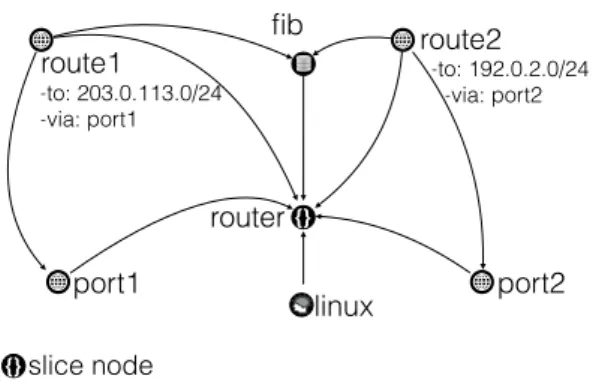
Figure 1: Model of a two ports router with two routes.
control plane caches, a centralized approach can be used to manage content distribution with OpenFlow.
In the remaining of the paper, Sec. 2 defines our OpenFlow content distribution abstraction, Sec. 3 presents a straw-man logically centralized architecture proposal to implement this abstraction, and Sec. 4 provides a first evaluation of the architecture based on a prototype implementation. Finally, Sec. 5 concludes this work.
2.
NETWORK ABSTRACTION
To leverage the SDN principle and distribute contents using OpenFlow, it is necessary to provide a new layer of abstraction that hides the notion of network layers to focus on network operations and on contents. To that aim, we propose to model the content distribution network as an abstract directed graph where each node represents an entity or an operation of the network and where edges indicate the relationship between them.
Our model defines the following three atomic types of node: (i) compute, (ii) network, and (iii) storage. Com-pute nodes are used to represent entities and functions related to processing (e.g., CPU, process) while net-work nodes are used to represent entities and functions related to networking (e.g., NIC, routes). Finally, stor-age nodes are used to represent entities and operations related to contents (e.g., hard-drive, file). As elements
of a content distribution network are often constituted of compute, network, and processing parts our model defines the meta-node type called slice that allows to
compose complex entities. Each node is allocated a
unique identifier such that, in conjunctions with types and attributes, the validity of the model can be verified with static analysis before deploying it in the network. Fig. 1 shows a simple two-network-ports Linux router
with two routes abstract graph representation. The
router is composed of two network ports (port1 and port2) modeled as network nodes, the Linux instance is modeled as a compute node, and the FIB modeled as a storage node. Each route (route1 and route2) is represented by a network node with attributes cor-responding to the destination and the port to use. All these independent nodes are linked to a slice represent-ing the whole router.
3.
ARCHITECTURE
Our abstraction puts at the same level content and network features but content distribution usually relies on HTTP while OpenFlow matching is limited to the lowest level of the network stack. Unfortunately, HTTP is transported over TCP and by virtue of separation principle, no content information is visible at the TCP layer that is the upper layer at which OpenFlow works. In addition, to offer reliability, TCP relies on sessions which state is built before the HTTP flow itself. To implement the abstraction, it is thus necessary to use HTTP proxies that will terminate the TCP connection until they learn the content actually requested in or-der to reconstruct the TCP sessions to the endpoints fulfilling the policies defined in the model. As proxies operations are computationally expensive, they are only performed at the edge where HTTP flows enter the net-work. Each such proxy is also an OpenFlow switch and flows are colored by the proxy with tags that can be processed directly by OpenFlow. To ensure core stabil-ity, it is possible to predefine the tags, at most one per potential path, such that the arrival of a new flow does not cause flow table modifications in the core network. We leverage the centralized nature of OpenFlow to simplify the abstraction implementation via the
Open-Flow controller. However, networks being inherently
distributed, concentrating all information and decisions would impair performances by causing high signaling load. To alleviate the signaling cost but keep the cen-tralized decision making, we introduce the concept of control plane cache. The principle of control plane caches is the same as the flow tables in OpenFlow but extended to our abstraction needs such that packet tagging and statistics are always performed locally by using the con-trol plane cache. Before taking specific decisions, the controller gets statistics from the control plane caches and updates them with the new tagging rules. To ensure
101 102 103
Demand rate [demands/s] 0 200 400 600 800 1000 1200 1400 P ac ke tr at e [p ac ke ts /s ] data plane control plane (a) Centralized 101 102 103
Demand rate [demands/s] 0 200 400 600 800 1000 1200 1400 P ac ke tr at e [p ac ke ts /s ] data plane control plane
(b) Control plane caches
Figure 2: Evolution of the control and data plane rates with content demand.
the scalability of the overall system, the abstraction is implemented by the intermediate of a REST API.
4.
EVALUATION
We prototyped our proposition with open source
soft-ware. We use Open vSwitch [4] and Floodlight [3]
for OpenFlow parts, and CherryProxy for the HTTP parts [1]. The REST API and the control plane cache are implemented with Flask [2] and PostgreSQL [5].
The implementation demonstrates the feasibility of the model and the architecture and illustrates the ben-efits of the control-plane caches. The first scenario is the case where all information and decisions are treated centrally by the controller, i.e., without cache. The sec-ond scenario correspsec-onds to the case where both tagging and statistics are ensured by the control plane caches.
Fig. 2 shows the evolution of the data plane and con-trol plane rates with the content demand rate. Each network function runs in a separate virtual machine de-ployed on the same host. The network is fed with HTTP requests sent according to a Poisson process which av-erage is given on the x-axis. As expected, the control-plane caches approach guarantees a control control-plane load independent of the data plane rate. On the contrary, the centralized scenario shows a direct correlation be-tween control and data plane rates. Interestingly, when control plane caches are used, the proxy requires more CPU cycles to process flows, which reduces data plane rates. This performance drop can be explained by our suboptimal implementation of the control plane with SQLAlchemy that adds overhead.
5.
CONCLUSION
This work proposes an abstraction and a straw-man architecture with logically centralized decision making to implement content distribution with OpenFlow. Our first prototype demonstrates the feasibility of the ap-proach and its potential performance gains.
Acknowledgments
This work is funded by the French ANR under the "ANR- 13-INFR-013" DISCO project on SDN.
6.
REFERENCES
[1] CherryProxy - a filtering HTTP proxy extensible in Python | Decalage. See
http://decalage.info/python/cherryproxy. [2] Flask (A Python Microframework). See
http://flask.pocoo.org.
[3] Floodlight OpenFlow Controller - Project Floodlight. See http:
//www.projectfloodlight.org/floodlight. [4] Open vSwitch. See http://openvswitch.org. [5] PostgreSQL: The world’s most advanced open
source database. See
https://www.postgresql.org.
[6] A. Chanda and C. Westphal. Contentflow: Mapping content to flows in software defined networks. CoRR, abs/1302.1493, 2013. [7] S. K. Fayazbakhsh, Y. Lin, A. Tootoonchian,
A. Ghodsi, T. Koponen, B. Maggs, K. Ng, V. Sekar, and S. Shenker. Less pain, most of the gain: Incrementally deployable icn. In Proceedings of the ACM SIGCOMM 2013 Conference on SIGCOMM, SIGCOMM ’13, pages 147–158, New York, NY, USA, 2013. ACM.
[8] N. McKeown, T. Anderson, H. Balakrishnan, G. Parulkar, L. Peterson, J. Rexford, S. Shenker, and J. Turner. Openflow: Enabling innovation in campus networks. SIGCOMM Comput. Commun. Rev., 38(2):69–74, Mar. 2008.
[9] Y. Sakurauchi, R. McGeer, and H. Takada. Open web: Seamless proxy interconnection at the switching layer. In Networking and Computing (ICNC), 2010 First International Conference on, pages 285–289, Nov 2010.