HAL Id: hal-00295936
https://hal.archives-ouvertes.fr/hal-00295936
Submitted on 8 Jun 2006
HAL is a multi-disciplinary open access
archive for the deposit and dissemination of
sci-entific research documents, whether they are
pub-lished or not. The documents may come from
teaching and research institutions in France or
abroad, or from public or private research centers.
L’archive ouverte pluridisciplinaire HAL, est
destinée au dépôt et à la diffusion de documents
scientifiques de niveau recherche, publiés ou non,
émanant des établissements d’enseignement et de
recherche français ou étrangers, des laboratoires
publics ou privés.
222Rn at Bern, Switzerland
P. Sturm, M. Leuenberger, F. L. Valentino, B. Lehmann, B. Ihly
To cite this version:
P. Sturm, M. Leuenberger, F. L. Valentino, B. Lehmann, B. Ihly. Measurements of CO2, its stable
isotopes, O2/N2, and 222Rn at Bern, Switzerland. Atmospheric Chemistry and Physics, European
Geosciences Union, 2006, 6 (7), pp.1991-2004. �hal-00295936�
www.atmos-chem-phys.net/6/1991/2006/ © Author(s) 2006. This work is licensed under a Creative Commons License.
Chemistry
and Physics
Measurements of CO
2
, its stable isotopes, O
2
/N
2
, and
222
Rn at Bern,
Switzerland
P. Sturm, M. Leuenberger, F. L. Valentino, B. Lehmann, and B. Ihly
Climate and Environmental Physics, Physics Institute, University of Bern, Bern, Switzerland Received: 20 May 2005 – Published in Atmos. Chem. Phys. Discuss.: 9 September 2005 Revised: 29 November 2005 – Accepted: 3 April 2006 – Published: 8 June 2006
Abstract. A one-year time series of atmospheric CO2
mea-surements from Bern, Switzerland, is presented. O2/N2and
Ar/N2 ratios as well as stable carbon and oxygen isotopes
of CO2 and δ29N2, δ34O2 and δ36Ar were measured
peri-odically during a one year period. Additionally, the222Rn activity was measured during three months in the winter 2004. Using the correlation from short-term fluctuations of CO2 and222Rn we estimated a mean CO2flux density
be-tween February 2004 and April 2004 in the region of Bern of 95±39 tC km−2month−1. The continuous observations of carbon dioxide and associated tracers shed light on diurnal and seasonal patterns of the carbon cycle in an urban atmo-sphere. There is considerable variance in nighttime δ13C and
δ18O of source CO2throughout the year, however, with
gen-erally lower values in winter compared to summertime. The O2:CO2oxidation ratio during the nighttime build-up of CO2
varies between −0.96 and −1.69 mol O2/mol CO2.
Further-more, Ar/N2measurements showed that artifacts like thermal
fractionation at the air intake are relevant for high precision measurements of atmospheric O2.
1 Introduction
We present continuous records of atmospheric CO2and
asso-ciated tracers measured in the city of Bern, Switzerland. At this urban site, anthropogenic CO2 emissions (e.g., car
ex-hausts, heating) mix with the background and biogenic CO2
components, which are influenced by circulation, photosyn-thesis and respiration. Local sources and sinks in the catch-ment area of Bern and changing meteorological conditions are expected to lead to large short-term variations of the ob-served tracers. In order to be able to interpret and apportion
Correspondence to: M. Leuenberger
these observations high-resolution measurements of multiple tracers are needed.
Stable carbon and oxygen isotopes in atmospheric CO2
can be used to measure the size of the CO2 fluxes and to
discriminate between the various processes in the carbon cy-cle. Photosynthetic uptake of CO2, plant and soil
respira-tion, and fossil fuel burning lead to carbon and oxygen iso-tope signals of atmospheric CO2, which can be used as a
tracer at various temporal and spatial scales (Friedli et al., 1987; Keeling et al., 1989; Ciais et al., 1997a). Hesterberg (1990) has measured δ13C and δ18O of CO2in Bern during a
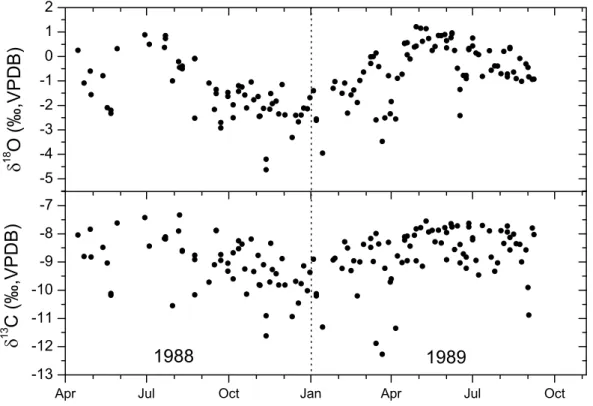
one-year period in 1988/89. His measurements of flask sam-ples collected twice a week showed seasonal differences in the δ13C and δ18O signals (Fig. 1). Another approach in-volves measuring changes of the atmospheric oxygen (O2)
concentration. O2 and CO2are inversely coupled by
pho-tosynthesis, respiration and combustion. However, the dif-ferent processes have difdif-ferent O2:CO2exchange ratios and
thus can be distinguished from each other. The high preci-sion of O2measurements that is necessary to constrain such
carbon fluxes, has given new insights into gas handling pro-cedures and fractionation effects (Bender et al., 1994; Keel-ing et al., 1998; Langenfelds, 2002). Though continuous on-line measurements circumvent any storage related effects as observed in some flask sampling programs (Sturm et al., 2004), they are still susceptible to diffusive fractionation pro-cesses. Fractionation of O2/N2 at the intake as well as at
tees have first been observed by Manning (2001) and have been attributed to molecular thermal diffusion. Fractiona-tion at tees is dependent on the geometry of the tee and the flow ratio at the two outlet branches of the tee. The larger the flow ratio is, the more the tee is subject to tionation. Yet, the exact cause and the points at which frac-tionation can occur in the flow path of air are still not well established. Molecular thermal diffusion results from tem-perature gradients. Heavier molecules generally accumulate in the colder region hence leading to concentration changes
Fig. 1. δ13C and δ18O of CO2in Bern during a one-year period in 1988/89 (Hesterberg, 1990).
(Severinghaus et al., 1996; Chapman and Cowling, 1970). Radon-222 is a radioactive noble gas with a half-life T1/2
of 3.82 days. It is produced in all soils as part of the natural uranium-radium α-decay series and it emanates into the soil air and diffuses to the atmosphere where it is diluted by atmo-spheric transport and radioactive decay. The222Rn flux from ocean surfaces is about two orders of magnitude smaller than from continents (Wilkening and Clements, 1975). Because
222Rn emissions from soils turned out to be rather
homoge-neous in a restricted region and relatively constant in time,
222Rn is a useful tracer to parameterize transport and
dilu-tion in the atmospheric boundary layer (World Meteorologi-cal Organisation, 2004).
This paper first summarizes sampling and analysis tech-niques and reports on tests we have performed to assess frac-tionation effects at the air intake. Results for CO2, its stable
isotopes, O2/N2and222Rn over roughly a one-year period
are described and possible mechanisms for these observa-tions are discussed.
2 Sampling and analysis techniques
2.1 Sampling site
The city of Bern (about 127 000 inhabitants) is situated on the Swiss Plateau. The measurements were made at the Physics Institute, University of Bern (PIUB), which is located on the eastern edge and about 20 m above the city center. The
building is surrounded by residential and urban areas. The air is collected from the roof of the building (46◦5700400N, 7◦2602000E, 575 m a.s.l.) about 15 m above local ground. Meteorological measurements were made by the Institute for Applied Physics, University of Bern. The weather sta-tion is located at the same height about 10 m away from the air intake. The sample air is sucked through a ∼40 m long 6 mm outer diameter Dekabon tube into our laboratory. We use a diaphragm pump (KNF Neuberger, Switzerland, N86KNDC with EPDM diaphragm). The flow rate is be-tween 100 and 300 mL min−1 depending on which instru-ments are connected to the air stream. The air is dried cryo-genically at −70◦C. The total volume of the cold trap (about
250 mL) restricts the time resolution of the measurements to about 2 min.
2.2 CO2mixing ratio
The CO2 mixing ratio was measured by non-dispersive
in-frared adsorption (NDIR) technique. In the beginning the CO2measurements were performed by a S710 UNOR CO2
analyzer (SICK MAIHACK GmbH, Germany). From March 2004 a LI-7000 CO2/H2O analyzer (LI-COR, USA), was
used. The flow rate of the sample gas is about 100 mL min−1 and every minute the mean CO2 mixing ratio is recorded.
The CO2 data are reported on the WMO CO2 mole
frac-tion scale. Primary standards from NOAA/CCGG, Boulder, CO, USA, are used to calibrate the working and secondary
28-Apr-04 30-Apr-04 2-May-04 4-May-04 -1680 -1640 -1600 -1560 -1520 δ Ar /N 2 (p er m e g) 24 20 16 12 8 4 Te m p er at u re (° C )
Fig. 2. Diurnal variations of δAr/N2(top) and outdoor temperature (bottom). Note the inverted axis of the temperature.
standards. However, the CO2mixing ratio of these primary
standards lies in the range of 192 to 363 ppm. The calibration of our CO2scale above 363 ppm is therefore based on
extrap-olation. Still, the accuracy of the CO2data is estimated to be
better than ±0.5 ppm for mixing ratios below 400 ppm and better than ±1 ppm for 400 to 450 ppm.
2.3 δ13C and δ18O of CO2
The carbon and oxygen isotopes of CO2 were determined
in a semi-continuous way by an on-line CO2 trapping
sys-tem connected to a mass spectrometer (Leuenberger et al., 2003). Every 12 min CO2from an air parcel of about 0.5 mL
STP was cryogenically trapped in a glass capillary. The small CO2amount is then released into a low helium stream
(1 mL min−1). This gas stream is additionally split into three similar fluxes entering capillaries of different lengths. A multi-port valve handles the flow path such that the three gas portions are injected one after another via an open split de-vice to an isotope ratio mass spectrometer (DELTAplusXL, Thermo Electron, Bremen, Germany), where the m/z ra-tios 45/44 and 46/44 of the CO2 are measured. The
preci-sion of this method estimated by the pooled standard devi-ations of the triplicate measurements is about ±0.08‰ for
δ13C and ±0.12‰ for δ18O. Constant N2O corrections of −0.23‰ and −0.35‰ are applied to the δ13C and δ18O data, respectively. Variations in the N2O/CO2 concentration
ra-tio of the sample air would lead to varying N2O corrections,
but such effects are expected to be small compared to the
measurement precision. Carbon and oxygen isotopic com-positions are expressed on the Vienna Pee Dee Belemnite (VPDB-CO2) standard scale (Coplen, 1994; IAEA, 1995).
δ18O measurements from flask sampling often face ad-ditional experimental problems, due to the risk of isotopic exchange of CO2 with water, that may occur anywhere in
the sample treatment from the moment of sampling un-til the admission of the sample in the mass spectrometer (Gemery et al., 1996). For example, isotope exchange dur-ing flask storage of CO2with water, that permeates through
the flask seals (Sturm et al., 2004), interferes with any real atmospheric signal. Our flask measurements of δ18O from Jungfraujoch, Puy de Dˆome and Griffin (Sturm et al., 2005b,a) are therefore believed not to represent the true iso-topic composition of atmospheric CO2. Therefore the
advan-tage of the continuous analysis method used here, apart from the high time resolution, is that such storage related effects can largely be circumvent.
2.4 Elemental and isotopic ratios of air
The elemental ratios O2/N2and δAr/N2as well as the
iso-topic ratios δ29N2, δ34O2and δ36Ar are analyzed by an
iso-tope ratio mass spectrometer (DELTAplusXP, Thermo Elec-tron, Bremen, Germany) and expressed in the δ-notation as per meg deviation from our local PIUB reference gas. A glass capillary at a tee takes about 0.2 mL min−1 of the flow to the gas inlet system (Leuenberger et al., 2000; Sturm, 2001) of the mass spectrometer. One measurement
5
10
15
20
25
30
Temperature (°C)
-2200
-2000
-1800
-1600
-1400
δ
Ar
/N
2(
per
m
e
g
)
0.8mm ID, 150ml/min
4mm ID, 250ml/min
4mm ID, 35ml/min
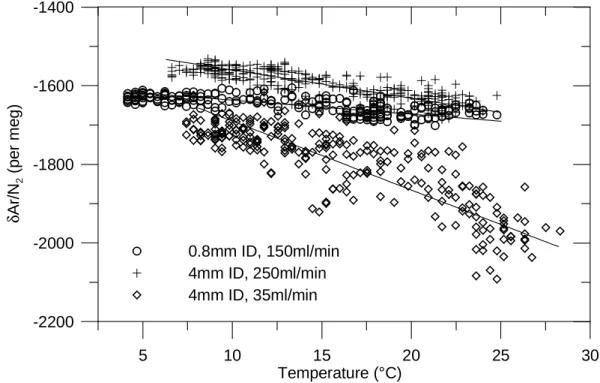
Fig. 3. Correlation of δAr/N2and outdoor temperature for different types of air intake.
0 1 2 3 4 5 6 Flow ve locity (m/s) -20 -16 -12 -8 -4 0 T e m pe ra tu re s en si ti v ity o f δ A r/ N2 (pe r m eg /° C )
Fig. 4. Temperature sensitivity of δAr/N2depending on the gas
velocity at the air intake for the three experiments of Fig. 3.
comprises eight standard/sample cycles and takes about 12 min. Hence one data point represents a mean concentra-tion of the last 12 min.
2.5 222Rn activity
The specific 222Rn activity is measured by an alpha-decay detector (Alphaguard 2000 Pro, Genitron Instruments, Frankfurt, Germany). The instrument was placed on the roof of the PIUB building, about 10 m next to the air intake. Using digital signal processing for pulse shape analysis the detec-tion limit of the detector in a 10-min measuring interval is about 3 Bq m−3(Lehmann et al., 2004). The radon activity is reported as hourly mean values.
3 Results and discussion
3.1 Temperature dependent fractionation at the air intake The Ar/N2 ratio can be measured simultaneously with
O2/N2and is a useful tracer to reveal fractionation effects.
Only the temperature dependence of the gas solubility in sea-water leads to seasonal variations in air-sea fluxes and small changes in atmospheric Ar/N2 ratio (Keeling et al., 2004).
On diurnal timescales, however, the atmospheric Ar/N2
ra-tio is expected to be constant, because no biogeochemical processes influence these inert gases. However, our Ar/N2
measurements revealed large variability. Diurnal variations of δAr/N2and outdoor temperature are shown as an
exam-ple in Fig. 2. The outdoor temperature was measured by a HOBO H8 data logger (Onset Computer Corporation, MA, USA) placed at the bottom of the intake pole. The air in-take is a Dekabon tube with 4 mm inner diameter (ID) and the flow rate was about 250 mL min−1. The higher the air temperature is, the lower the δAr/N2gets.
To assess the causes of the observed δAr/N2 variations
and to better quantify this effect, we conducted tests with different intake tubes and sampling flows. In addition to the Dekabon tube with flow rates of 250 mL min−1 and 35 mL min−1, also a stainless steel tube with 0.8 mm ID and a flow rate of 155 mL min−1 was used. The correlation of
δAr/N2 and outdoor temperature for different types of air
intakes is shown in Fig. 3. Remarkably, the temperature records lag the δAr/N2 variations by 90 to 150 min. This
-60 -40 -20 0 20 40 60 80 100 -2100 -2000 -1900 -1800 -1700 -1600 -1500 -140 -120 -100 -80 -60 -40 -20 0 20 -2100 -2000 -1900 -1800 -1700 -100 0 100 200 300 400 500 -2200 -2100 -2000 -1900 -1800 -1700 -1600 -1500 -50 -40 -30 -20 -10 0 10 20 -2100 -2000 -1900 -1800 -1700 -1600 -1500 (c) y = 7.4(0.7) x - 1807.2(9.5) R 2 = 0.2996 A r / N 2 ( p e r m e g ) 34 O 2 (per meg) (a) y = 3.83(0.05) x - 1626.1(2.8) R 2 = 0.9501 A r / N 2 ( p e r m e g ) O 2 /N 2 (per meg) (d) R 2 = 0.0002 A r / N 2 ( p e r m e g ) 36 Ar (per meg) (b) y = 14.8(1.1) x - 1531.6(20.3) R 2 = 0.4282 29 N 2 (per meg) A r / N 2 ( p e r m e g )
Fig. 5. Correlation plots of δAr/N
2versus O
2/N
2, δ
29N
2, δ
34O
2and δ
36Ar for the “4 mm
ID/35 mL min
−1” experiment (see text). Grey lines represent the expected correlation slopes
obtained from the ratios of the thermal diffusion factors for the respective isotopes and
ele-ments. Black lines are the measured regression slopes using the associated errors as shown
in the bottom part of each graph.
27
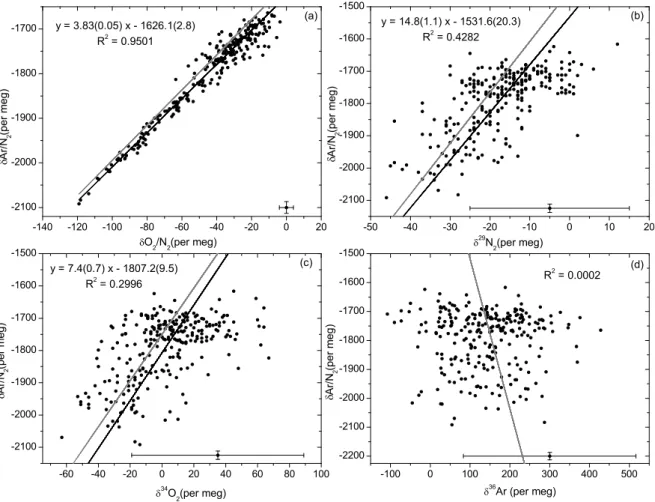
Fig. 5. Correlation plots of δAr/N2versus O2/N2, δ29N2, δ34O2and δ36Ar for the “4 mm ID/35 mL min−1” experiment (see text). Grey
lines represent the expected correlation slopes obtained from the ratios of the thermal diffusion factors for the respective isotopes and elements. Black lines are the measured regression slopes using the associated errors as shown in the bottom part of each graph.
is probably due to a slow response of the temperature logger used for these tests and the fact that the temperature sensor was not exposed to sunlight in contrast to the air intake. This time shift was applied in the calculations of Fig. 3 to obtain the best correlation. The temperature sensitivities obtained by geometric mean regression are −17.5±0.6 per meg/◦C (R2=0.70), −7.2±0.2 per meg/◦C (R2=0.71) and −3.6 ± 0.2 per meg/◦C (R2=0.51) for the “4 mm ID/35 mL min−1”, “4 mm ID/250 mL min−1” and “0.8 mm ID/155 mL min−1” experiments, respectively. As shown in Fig. 4, the tempera-ture sensitivities of δAr/N2mainly depend on the gas
veloc-ity at the air intake.
Variations of the laboratory temperature can also poten-tially influence the δAr/N2 measurements. Especially in
summer there is a diurnal cycle of the laboratory tempera-ture with amplitudes of 2 to 3◦C. However, the most striking feature of the diurnal temperature variations in the labora-tory is a rapid drop of about 3◦C at midnight caused by the air-conditioning. Because in these experiments no change in δAr/N2 can be observed at midnight, the variations in δAr/N2are indeed mainly caused by fractionation at the air
intake. This supposition was further confirmed by actively heating the intake tube, which resulted in large δAr/N2
devi-ations. An explanation is that during the day especially when the sun heats the black coating of the Dekabon tube, there builds up a small temperature gradient between the intake tube and the surrounding air. This leads to thermal diffu-sion with preferential accumulation of the lighter molecules in regions with higher temperatures. A thermal diffusion fac-tor for Ar in N2of α=0.071 (Grew and Ibbs, 1952) would
lead to a steady state fractionation of 240 per meg/◦C. How-ever, a steady state is not achieved at the intake because of the continuous flow of gas. Even though, the lower the flow velocity the more the air can approach a steady state. The slope of the correlation plot of δAr/N2 versus O2/N2 for
the “4 mm ID/35 mL min−1” and the intake heating experi-ments gives 3.8±0.1 (Fig. 5a). This is in good accordance with what is expected from thermal fractionation. With the thermal diffusion factors of Grew and Ibbs (1952) one would expect a slope of 3.9. Keeling et al. (2004) obtained a value of 3.77±0.04.
1-Oct-03 1-Feb-04 1-Jun-04 1-Oct-04 1-Feb-05 -6 -4 -2 0 2 δ 18 O (‰, VPD B) -1200 -800 -400 0 δ O2 /N 2 (per m e g ) 0 5 10 15 20 222 Rn (Bq m -3) 360 400 440 480 520 CO 2 (pp m ) -16 -14 -12 -10 -8 δ 13C (‰, VPDB)
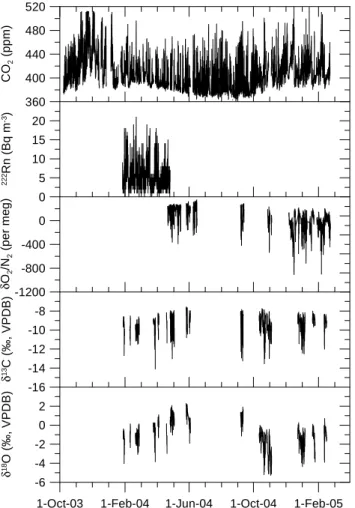
Fig. 6. Atmospheric records of CO2, 222Rn, O2/N2, δ13C and δ18O of CO2 at Bern between October 2003 and February 2005.
The isotopic ratios δ29N2, δ34O2 and δ36Ar show also
small variations that are correlated with the temperature, pro-viding compelling evidence of diffusive fractionation. How-ever the signal-to-noise ratio relative to measurement pre-cision is much higher for Ar/N2 than for δ29N2, δ34O2 or δ36Ar, because Ar/N2is more sensitive to mass-dependent
fractionation processes owing to the comparatively large mass difference between Ar and N2. Figure 5b, c and d
show the correlation plots of δAr/N2 versus δ29N2, δ34O2
and δ36Ar for the “4 mm ID/35 mL min−1” experiment. The mass spectrometric uncertainty is indicated by error bars in the lower right corner of each plot. Regression lines (black lines) were calculated in Figs. 5a, b and c using a measure-ment error model which accounts for the relative magnitude of the errors in both variables (Fuller, 1987). There is no cor-relation between δAr/N2 and δ36Ar (Fig. 5d). The thermal
diffusion factors α of29N2-28N2,34O2-32O2and36Ar-40Ar
at 20◦C are about 0.0045, 0.0099 and −0.0137, respectively (Lang, 1999). The expected correlation slopes for thermal diffusion obtained from these diffusion factors are shown as
grey lines in Fig. 5. Measurements of the isotopic composi-tion of N2, O2and Ar are further discussed in Sect. 3.4.
Experiments showed that the thermal fractionation at the intake could be reduced if instead of Dekabon other types of tubing are used. Intakes both made of transparent plastic and stainless steel significantly reduced this effect, presum-ably because of a smaller influence of solar heating. How-ever, thermal fractionation could also be observed on days with overcast sky. Shading of the intake from sunlight can therefore only reduce but not eliminate this effect. High flow velocities at the intake either by large sampling flows or by intake tubes with small inner diameters may be most help-ful for reducing thermal diffusion at the intake. Additional tests with sample air from a high pressure cylinder showed that there is also a measurable influence of the laboratory temperature on δAr/N2. A cylinder was placed outside the
laboratory where only small and not abrupt temperature vari-ations occur to exclude any fractionation related to the cylin-der or the pressure regulator. Then, the measured δAr/N2
showed to be positively correlated with the laboratory tem-perature (in contrast to the negative temtem-perature sensitivity for fractionation at the intake). Different sources of thermal fractionation inside the laboratory may lead to these effects: a) The cold trap which is partly immersed in silicon oil at
−70◦C. Because of the relatively large volume (∼250 mL) and the large temperature gradient (∼90◦C) thermal diffu-sion is likely to occur inside this cold trap. Changing tem-perature gradients due to varying room temtem-peratures could therefore lead to thermal effects. b) Temperature dependent fractionation at tees (Manning, 2001), and c) Fluctuations of the working gas due to thermally induced effects at the high-pressure gas cylinders. We favor explanation b) based on first tests of divided air fluxes by tees showing a clear thermal dif-fusion effect.
3.2 The CO2record
The prevalent local wind directions are the northern and western wind sector. High wind speeds occur with winds coming from north-east to east (45 to 90◦) and from west to south-west (225 to 270◦), which are the predominant mesoscale wind directions on the Swiss Plateau. Generally, there is a good correlation between CO2 and222Rn for all
wind directions. Also, no significant correlation between wind direction and CO2mixing ratio was found, indicating
that no distinct CO2sources are in the immediate vicinity of
the sampling site.
An overview of atmospheric records of CO2, 222Rn,
O2/N2, δ13C and δ18O of CO2 at Bern between October
2003 and February 2005 is given in Fig. 6. The diurnal variability is much larger than the seasonal variability and is mainly caused by local sources and sinks and by diurnal changes of atmospheric mixing conditions in the boundary layer.
O c t -0 3 N o v -0 3 D e c -0 3 J a n -0 4 F e b -0 4 M a r -0 4 A p r -0 4 M a y -0 4 J u n -0 4 J u l-0 4 A u g -0 4 S e p -0 4 O c t -0 4 N o v -0 4 D e c -0 4 J a n -0 5 F e b -0 5 350 400 450 500 550
Monthly mean diurnal amplitude
Monthly mean
Monthly max value
Monthly min value
C O 2 ( p p m ) Months
Fig. 7. Mean diurnal amplitudes (columns), monthly mean (black circles) and monthly
maxi-mum and minimaxi-mum (triangles) of CO2for the months October 2003 to February 2005.
29
Fig. 7. Monthly mean diurnal amplitudes (columns), monthly mean (black circles) and monthly maximum and minimum (triangles) of CO2
for the months October 2003 to February 2005.
26-Apr-04 27-Apr-04 28-Apr-04 29-Apr-04 30-Apr-04 1-May-04 -1 0 1 2 δ 18 O (‰ , VP D B ) -400 -200 0 200 δ O2 /N 2 (p e r m e g ) 360 400 440 480 520 CO 2 (p p m ) -14 -12 -10 -8 δ 13 C ( ‰ , V P DB )
Fig. 8. Example of continuous CO2, O2/N2, δ13C and δ18O records between 26 April and 1 May 2004. For the O2/N2the original (shaded line) as well as the corrected values (black line) are shown (see text for explanation).
0.0022 0.0024 0.0026 1/CO2 (ppm -1) -0.5 0 0.5 1 1.5 2 δ 18 O o f C O2 ( ‰ , V P D B ) -11 -10.5 -10 -9.5 -9 -8.5 -8 δ 13 C of C O2 ( ‰ , V P D B ) -100 0 100 200 300 400 δ O2 /N 2 ( p er m e g) 380 400 420 440 CO2 (ppm) y = 7231(110) x - 27.4(0.3) R2 = 0.9874 y = 4247(222) x - 9.6(0.6) R2 = 0.7948 y = -5.00(0.05) x + 2170(18) R2 = 0.9931 27/28 April, 2004
Fig. 9. Representative Keeling plot of carbon and oxygen isotope ratios and δO2/N2-CO2correlation during the night (18:00 to 06:00 LT)
of 27/28 April 2004. Note that variations in δO2/N2correspond mainly to variations in O2(see text). The equations shown are derived from
geometric mean regression (uncertainty in parentheses).
CO2 mixing ratios were highest in the wintertime with
nighttime maximum values reaching more than 500 ppm. During atmospheric inversion events, characterized by persistent fog in autumn and winter, the CO2 mixing ratio
was clearly above 400 ppm over a period of several days. Afternoon values in the spring and summer were commonly close to the background value as measured for example at Jungfraujoch (Sturm et al., 2005b). Figure 7 shows the monthly mean diurnal amplitudes and the monthly mean of the CO2mixing ratio for the months October 2003 to
Febru-ary 2005. Diurnal variations of CO2show a minimum in the
afternoon followed by an increase towards the maximum in the early morning hours. The diurnal CO2 amplitudes are
largest in summer (55 to 60 ppm peak-to-peak) and smallest in winter (15 to 25 ppm peak-to-peak) but the monthly am-plitudes (i.e. the difference between the monthly maximum and the monthly minimum) are smallest in summer (118 to 128 ppm peak-to-peak) and largest in winter (120 to 148 ppm peak-to-peak) due to inversion events as mentioned above. 3.3 δ13C of CO2, δ18O of CO2and O2/N2measurements
Isotopic and elemental ratios could only be measured peri-odically, at times when no other applications and measure-ments were run on the analyzers. This results in larger gaps in these records compared to the CO2 record (Fig 6).
Fig-ure 8 shows an example for typical diurnal cycles of CO2,
O2/N2, δ13C and δ18O records between 26 April and 1 May
2004. The O2/N2, δ13C and δ18O measurements mirror the
CO2 variations. The influence of thermal fractionation on
O2/N2was corrected using the δAr/N2measurements as
fol-lows. In a first step, the biogenic and anthropogenic com-ponents of O2/N2 variations were removed by subtracting
the CO2record scaled by the observed O2:CO2ratio.
Vari-ations in the residual O2/N2 are then expected to represent
thermal fractionation effects. Secondly, the fractionation ra-tio of O2/N2 and δAr/N2 was determined by the
correla-tion between the residual O2/N2and δAr/N2. The slope of
this correlation varies between 3.9 and 1.7 (R2=0.8 to 0.4), which either reflects mixed influences of laboratory and out-door temperature fractionation or different flow conditions in the inlet system depending on the measurement setup. With this O2/N2-Ar/N2fractionation ratio, the δAr/N2variations
are then used to finally subtract the thermally induced O2/N2
variations from the original O2/N2 to obtain the corrected
O2/N2. In Fig. 8 the original (shaded line) as well as the
cor-rected O2/N2(black line) are shown. The correction is less
than 5% of the measured O2/N2signal.
A representative Keeling plot of δ13C and δ18O (Keeling, 1958, 1961) and the corresponding δO2/N2–CO2correlation
during the night of 27/28 April 2004 is shown in Fig. 9. Note that variations in δO2/N2 mirror mainly oxygen variations
since atmospheric nitrogen remains nearly constant, except changes due to the seasonal temperature induced variabil-ity of the ocean solubilvariabil-ity. Only nighttime values (18:00 to 06:00 LT) have been used to match the Keeling plot as-sumptions, i.e., a constant background CO2 concentration
-35 -25 -15 -5 δ 18 Osou rc e (‰ , V P D B ) -33 -31 -29 -27 -25 δ 13C so u rce ( ‰ , VPD B) -1.7 -1.5 -1.3 -1.1 -0.9 O2 :C O2 ox idat ion ra ti o (mo l O 2 /m o l C O2 )
1-Jan-04 1-Apr-04 1-Jul-04 1-Oct-04 1-Jan-05 1-Apr-05
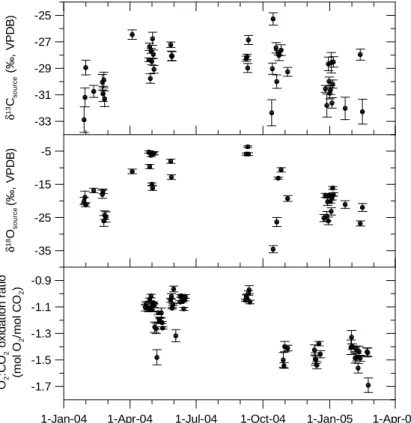
Fig. 10. δ13C and δ18O of source CO2calculated from Keeling plots, and O2:CO2oxidation ratios.
accurately as possible. Still, the δ13Csource, δ18Osource and
O2:CO2ratios mostly represent a flux weighted average of
more than one source and/or sink. Varying proportions of CO2sources containing distinct isotope ratios violate the
as-sumptions of the 2-ended mixing model, and are more com-mon with oxygen than carbon isotopes, causing poorer rela-tionships between δ18O and 1/CO2. In Fig. 10 the nighttime
buildup of CO2was used to derive daily values of δ13Csource, δ18Osourceand O2:CO2by the Keeling plot intercept method.
The correlations were calculated by geometric mean regres-sion and error bars are the standard deviation of the slopes. Only nights with more than 25 measurements, correlation coefficients larger than R2=0.9 for δ13C and O2:CO2 and
larger than R2=0.7 for δ18O were considered. The night-time δ13Csourcevaries between −33‰ and −25‰ with
gen-erally lower values in the winter months than during the rest of the year. This likely represents the larger influence of fos-sil fuel combustion in wintertime. The large variability from one night to the next may be caused by different weather conditions resulting in advection of different air masses or changes in the CO2source distribution. A similar picture can
be seen for the nighttime δ18Osource. The values range from −34‰ to −3‰ with the depleted (more negative) signatures again occurring in wintertime and highly enriched (more pos-itive) values in spring and summer. This seasonal variation of δ18Osourceis somewhat larger than the variations of about −21‰ to −11‰ observed by Pataki et al. (2003) in a similar
study. The δ18O signal of atmospheric CO2is a signal
dom-inated by CO2exchange with the terrestrial biosphere (Ciais
et al., 1997a,b; Keeling, 1995). Fractionation of the oxygen isotopes of CO2occurs in plants owing to differential
diffu-sion of C18O16O and C16O16O and to isotope effects in oxy-gen exchange with chloroplast water. The higher δ18O values in summer compared to winter are most probably caused by strong photosynthetic activity and an associated exchange of
18O with leaf water in plants, which is generally enriched
in δ18O if compared to the ground water due to evapotran-spiration (Dongmann et al., 1974). Furthermore, CO2from
combustion has a δ18O value similar to the δ18O of atmo-spheric O2at −18‰ on the VPDB-CO2scale, corresponding
to 23.5‰ on the SMOW scale (Kroopnick and Craig, 1972). Thus a larger fossil fuel CO2component in winter leads to
decreased δ18O values.
For a possible interpretation of the observed O2:CO2ratios
we consider a simple model. If we assume that the diurnal variations can be described by biogenic and fossil fuel fluxes of carbon and oxygen in the catchment area of the sampling site, then the atmospheric mass balance for CO2and O2can
be written
1CO2=F + B (1)
and
1O2=αFF + αBB, (2)
where 1CO2and 1O2are the observed changes in the
atmo-spheric CO2and O2concentration, F and B are the fluxes
of carbon to the atmosphere due to fossil fuel combustion and the terrestrial biosphere, respectively (positive for re-lease to the atmosphere). The coefficients αF and αB are
average O2:CO2 exchange ratios for fossil fuel and land
biota. We use αF=−1.4 mol O2/mol CO2 (Manning, 2001)
and αB=−1.1 mol O2/mol CO2 (Severinghaus, 1995). By
combining Eqs. (1) and (2) and assuming that F and B are constant over the considered time period, we can estimate from the observed O2:CO2exchange ratio (1O2/1CO2) the
proportion of the biogenic flux in relation to the fossil fuel flux B F = − 1O2/1CO2−αF 1O2/1CO2−αB . (3)
The measured nighttime O2:CO2 oxidation ratios from
April 2004 to February 2005 are between −0.96 and −1.69 (lowest panel in Fig. 10). For nighttime air sampling it is as-sumed that respired CO2is added to the atmosphere and both
fluxes F and B are positive. This would lead to O2:CO2
ra-tios between −1.1 and −1.4. However, almost half of the summer values are between −0.96 and −1.1. This could only be explained with a biogenic CO2sink up to four times
as strong as the fossil fuel source, which is obviously not the case, since the CO2concentration is increasing and not
decreasing during the night. The same considerations can also be applied to the δ13Csource data, where no conflicting
picture can be seen. The measured δ13Csource are in the
range between an assumed δ13C of the biospheric compo-nent of about −26‰ and the more depleted values of the fossil fuel component. One possibility to explain these low O2:CO2 ratios would be an overestimation of the span of
our CO2scale by more than 10%. Comparison of our CO2
data with CO2measurements from Laboratoire des Science
du Climat et de l’Environnement, CE Saclay, France, (Sturm et al., 2005a) and our internal measurements of the calibrated NOAA CO2 standards on the WMO CO2 scale lead to the
conclusion that this is highly unlikely. An underestimation of the O2/N2span of this magnitude can not be ruled out a
priori, though. Since international intercomparison programs for O2/N2measurements are being initiated only now, we do
not have any independent validation of our O2/N2scale yet.
Measurement effects related to the mass spectrometric tech-nique like cross contamination (Meijer et al., 2000) could potentially lead to an underestimation of the O2/N2 span.
However, no such effects have been reported by other labo-ratories also measuring O2/N2by mass spectrometry so far.
Another alternative to explain the observed O2:CO2ratios is
that processes with O2:CO2 exchange ratios of about −1.0
play a major role in nighttime build-up of CO2. Stephens
et al. (2001) have also reported on O2:CO2relationships that
are considerably smaller than theory would suggest, but po-tential atmospheric or physiological origins for such relation-ships are unknown.
3.4 δ29N2, δ34O2and δ36Ar of air
Measurements of the isotopic composition of N2, O2and Ar
are shown in Fig. 11. These isotopic ratios are as a first ap-proximation constant within measurement precision during the observation period of almost one year. Measurement pre-cision is largely represented by the range of the short-term variations in these records. The small long-term variations of the mean appearing in Fig. 11 are due to changes in mass spectrometer performance. Owing to the relatively high sam-pling rate of 5 measurements per hour, there are also diurnal variations detectable. However, because of the many gaps in the available record and the poor signal-to-noise ratio it is difficult to quantify these effects. As already mentioned in Sect. 3.1, thermal diffusion fractionation at the air in-take is considered to be the dominant cause for such diurnal variations. An assumed variation in δAr/N2of 200 per meg
due to thermal diffusion would correspond to variations in
δ29N2, δ34O2and δ36Ar of about 13, 28 and 39 per meg,
re-spectively. This might be consistent with the observed di-urnal variations for δ29N2 and δ34O2. For δ36Ar the
mea-sured amplitude of the variations seems to be larger (about 150 per meg) than what is expected from thermal fractiona-tion, thus δ36Ar is probably also influenced by other uniden-tified measurement artifacts.
The δ18O of atmospheric O2(δ34O2) is affected by
photo-synthesis and respiration in the carbon/oxygen cycle and by the hydrological cycle, similar to the oxygen isotopic com-position of CO2. Could we potentially detect
biogeochem-ical variations of δ18O of atmospheric O2 in our record?
The δ18O of atmospheric oxygen is enriched by 23.5‰ rel-ative to average ocean water (Kroopnick and Craig, 1972), which is known as the Dole effect. The δ18O produced by photosynthesis is similar to that of the water from which the oxygen isotopes originate, whereas respiration fraction-ates by about −20‰ relative to atmospheric O2(Guy et al.,
1993). The δ18O of leaf water is elevated by 4 to 8‰ compared to oceanic water due to evapotranspiration (Dong-mann, 1974; Farquhar et al., 1993). If we assume that a diur-nal increase in atmospheric O2/N2of 500 per meg is driven
by the input of photosynthetic O2 that is about 20‰ lower
in δ18O than atmospheric O
2, we would expect a change
in δ18O of O2 of 10 per meg. The seasonal variability of
O2/N2 (∼150 per meg) leads to an even smaller signal in δ18O of O2 (∼3 per meg). The measurement precision
de-fined as the standard deviation of a single measurement is about 40 per meg for δ34O2. Thus, detecting such small
vari-ations is very difficult with current mass spectrometric mea-surements.
3.5 222Rn tracer method to estimate regional CO2
emis-sions
The222Rn activity was measured during a three month period between 27 January and 26 April 2004. The specific activity
1-Apr-04 1-Jul-04 1-Oct-04 1-Jan-05 1-Apr-05 -400 0 400 800 δ 36 A r ( per me g) -40 0 40 δ 29N 2 (p e r m e g ) -50 0 50 100 δ 34 O2 (p e r m e g )
Fig. 11. Measurements of the isotopic ratios δ29N2, δ34O2and δ36Ar at Bern between April 2004 and February 2005.
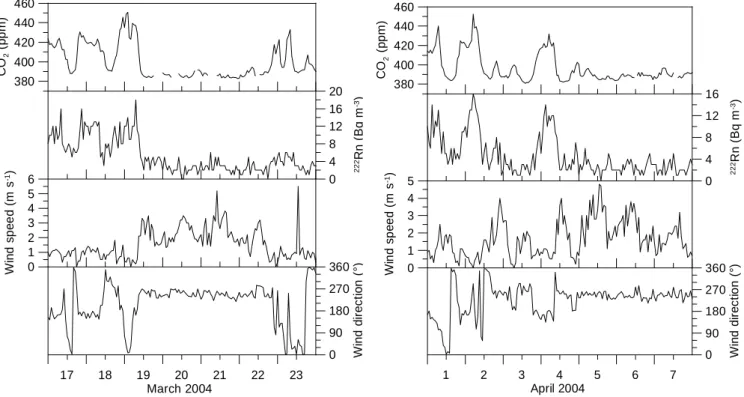
ranged from 0 to 20 Bq m−3 (Fig. 6). Examples of hourly mean values of CO2 and 222Rn, together with local wind
speed and wind direction between 17 and 23 March 2004 and between 1 and 7 April 2004 are shown in Fig. 12. Dur-ing the first days of these periods wind speeds are low with frequently changing directions. The trace gas concentration records show a typical diurnal pattern caused by nighttime inversion situations. On 19 March and 4 April, respectively, winds change to westerly directions with persistently high wind speeds. The CO2 and222Rn concentrations are then
close to continental background levels (Schmidt et al., 1996). The correlation between222Rn and CO2will be used to
esti-mate CO2fluxes for the catchment area of the sampling site.
The222Rn measurements can be used to infer CO2
emis-sion by using a simple 1-D approach. This method has been used for other greenhouse gases and at different sites and is described in detail by Schmidt et al. (2001). Assuming that each trace gas is released to the atmosphere at a constant rate
jiand that it accumulates in a well-mixed boundary layer of
height H (t ), the short-term change in concentration 1ci(t )
is then:
1ci(t )
1t =
ji
H (t ). (4)
Since H (t ) is the same for222Rn and CO2, we can eliminate
H (t )by combining both tracers
jCO2 =jRn
1cCO2
1cRn
. (5)
The CO2flux can thus be calculated from the measured slope
between CO2and222Rn variations and the222Rn exhalation
rate. The radioactive decay of222Rn in the atmosphere dur-ing a typical nighttime inversion situation lastdur-ing about 12 h leads to a net222Rn loss of about 5%. Therefore a mean cor-rection factor of 0.95 is applied when estimating222Rn-based CO2fluxes.
Daily CO2/222Rn correlations were determined using
geometric mean regression. To derive a mean value for the period from February to April 2004 only those days were included for which more than 12 hourly mean values ex-isted and which showed a correlation coefficient larger than
R2=0.4. 33 days (39%) satisfy this criterion. The mean CO2/222Rn slope is 5.2±1.7 ppm/Bq m−3. This is larger
than estimates from other European sites. Schmidt et al. (1996) have measured CO2–222Rn slopes at Schauinsland,
Germany, in the range of 1.8 to 3.5 ppm/Bq m−3 for the winter months. A wintertime estimation for western Eu-rope from the Mace Head record by Biraud et al. (2000) gives a slope of 1.4 to 2.1 ppm/Bq m−3 for all selected events and 4.7 to 6.8 ppm/Bq m−3 for “polluted” events. The 222Rn flux emitted over continents is not strictly uni-form, but depends mainly on the soil type and the hydro-logical conditions. There is no regional map of observed
222Rn emissions available, but222Rn flux measurement at
different sites in Germany showed an average flux of about 50 Bq m−2h−1, corresponding to 0.7 atoms cm−2s−1 (D¨orr and M¨unnich, 1990; Schmidt et al., 2001). The uncertainty of the222Rn exhalation rate is estimated as ±25% (Schmidt et al., 2001). Using this estimation of the 222Rn exhala-tion rate one obtains a mean CO2 flux density during the
period February/March/April 2004 for the Bern region of
17 18 19 20 21 22 23 March 2004 0 1 2 3 4 5 6 W ind sp ee d ( m s -1) 380 400 420 440 460 CO 2 (p pm) 0 4 8 12 16 20 222 Rn ( B q m -3) 0 90 180 270 360 W ind dir e c tion (° ) 1 2 3 4 5 6 7 April 2004 0 1 2 3 4 5 W in d sp ee d ( m s -1) 380 400 420 440 460 CO 2 (p pm) 0 4 8 12 16 222 Rn (Bq m -3) 0 90 180 270 360 W ind dir e c ti o n (° )
Fig. 12. Examples of hourly mean values of CO2and222Rn, together with local wind speed and wind direction between 17 and 23 March
2004 (left panel) and between 1 and 7 April 2004 (right panel).
11.0±4.5 mmole m−2h−1or 95±39 tC km−2month−1. This CO2flux includes both biogenic and fossil fuel fluxes. The
two main sources of uncertainty for this estimate, namely the222Rn flux and the CO2/222Rn correlation amount to an
overall uncertainty of the CO2flux estimate of ±41%. To
reduce this uncertainty the exact source areas of both CO2
and222Rn should be known. This would require an explicit transport model, which can resolve the spacial and temporal patterns of the CO2and222Rn sources.
4 Summary and outlook
We summarize first results from on-going continuous mea-surements of CO2, its stable isotopes and O2/N2 in Bern.
Concurrent Ar/N2 measurements revealed that diffusive
fractionation due to thermal gradients at the air intake is an important modifying process for high precision O2/N2
mea-surements. The CO2, O2/N2, δ13C and δ18O of CO2data
show strong diurnal and seasonal cycles. The diurnal varia-tions are modulated by surface uptake and release by vegeta-tion and soils, emissions from fossil fuel combusvegeta-tion, and by the diurnal development of the atmospheric boundary layer. Both stable carbon and oxygen isotopes showed depletion in the winter and enrichment in the summer due to changes in the proportions of fossil fuel combustion and biogenic respi-ration at different times of the year. Additionally,222Rn was used to estimate a mean CO2flux density in the catchment
area of the sampling site. As the measurements go on and more data will become available the CO2isotope and
mix-ing ratio data can be used to quantify with a mass balance calculation the proportional contribution of each component to the total CO2 source. We also expect to observe
inter-annual variations of the seasonal cycle, and changes in CO2
mixing ratio relative to background sites, such as Jungfrau-joch. Comparison of boundary layer mixing ratios with back-ground mixing ratios should help to improve our understand-ing of atmosphere/surface exchange of CO2on the
continen-tal scale.
Acknowledgements. We thank P. Nyfeler for technical assistance,
L. Martin (Institute of Applied Physics, University of Bern, Switzerland) for providing the meteorological data and R. Hes-terberg for the δ13C and δ18O data of Fig. 1. This work was supported by the Swiss National Science Foundation, in particular the R’equip program, and the EU Projects AEROCARB and CARBOEUROPE-IP.
Edited by: U. Baltensperger
References
Bender, M. L., Tans, P. P., Ellis, T. J., Orchardo, J., and Habfast, K.: A high precision isotope ratio mass spectrometry method for measuring the O2/N2ratio of air, Geochim. Cosmochim. Acta, 58, 4751–4758, 1994.
Biraud, S., Ciais, P., Ramonet, M., Simmonds, P., Kazan, V., Monfray, P., O’Doherty, S., Spain, T. G., and Jennings, G. S.: European greenhouse gas emissions estimated from continuous atmospheric measurements and radon 222 at Mace Head, Ireland, J. Geophys. Res., 105, 1351–1366, 2000.
Chapman, S. and Cowling, T. G.: The Mathematical Theory of Non-Uniform Gases, Cambridge Univ. Press, Cambridge, 1970. Ciais, P., Denning, A. S., Tans, P. P., Berry, J. A., Randall, D. A., Collatz, G. J., Sellers, P. J., White, J. W. C., Trolier, M., Mei-jer, H. A. J., Francey, R. J., Monfray, P., and Heimann, M.: A three-dimensional synthesis study of δ18O in atmospheric CO2,
1. Surface fluxes, J. Geophys. Res., 102, 5857–5872, 1997a. Ciais, P., Tans, P. P., Denning, A. S., Francey, R. J., Trolier, M.,
Meijer, H. A. J., White, J. W. C., Berry, J. A., Randall, D. A., Collatz, G. J., Sellers, P. J., Monfray, P., and Heimann, M.: A three-dimensional synthesis study of δ18O in atmospheric CO2,
2. Simulations with the TM2 transport model, J. Geophys. Res., 102, 5873–5883, 1997b.
Coplen, T.: Reporting of stable hydrogen, carbon and oxygen iso-topic abundances, Pure and Applied Chemistry, 66, 273–276, 1994.
Dongmann, G.: The contribution of land photosynthesis to the sta-tionary enrichment of18O in the atmosphere, Radiat. Environ. Biophys., 11, 219–225, 1974.
Dongmann, G., N¨urnberg, H. W., F¨orstel, H., and Wagner, K.: On the enrichment of H182 O in the leaves of transpiring plants, Ra-diat. Environ. Biophys., 11, 41–52, 1974.
D¨orr, H. and M¨unnich, K. O.:222Rn flux and soil air concentration profiles in West-Germany. Soil222Rn as tracer for gas transport in the unsaturated soil zone, Tellus, 42B, 20–28, 1990.
Farquhar, G. D., Lloyd, J., Taylor, J. A., Flanagnan, L. B., Syvert-sen, J. P., Hubick, K. T., Wong, S. C., and Ehleringer, J. R.: Vegetation effects on the isotope composition of oxygen in at-mospheric CO2, Nature, 363, 439–443, 1993.
Friedli, H., Siegenthaler, U., Rauber, D., and Oeschger, H.: Mea-surements of concentration,13C/12C and18O/16O ratios of tro-pospheric carbon dioxide over Switzerland, Tellus, 39B, 80–88, 1987.
Fuller, W. A.: Measurement Error Models, Wiley Series in Proba-bility and Statistics, John Wiley & Sons, New York, 1987. Gemery, P. A., Trolier, M., and White, J. W. C.: Oxygen
iso-tope exchange between carbon dioxide and water following at-mospheric sampling using glass flasks, J. Geophys. Res., 101, 14 415–14 420, 1996.
Grew, K. E. and Ibbs, T. L.: Thermal Diffusion in Gases, Cambridge Univ. Press, Cambridge, 1952.
Guy, R. D., Fogel, M. L., and Berry, J. A.: Photosynthetic Frac-tionation of the Stable Isotopes of Oxygen and Carbon, Plant Physiol., 101, 37–47, 1993.
Hesterberg, R.: Das Kohlendioxid und seine stabilen Isotope in At-mosph¨are und Boden, Master’s thesis, Physics Institute, Univer-sity of Bern, Bern, Switzerland, 1990.
I.A.E.A.: Reference and intercomparison materials for stable iso-topes of light elements, IAEA, Vienna, 1995.
Keeling, C. D.: The concentration and isotopic abundances of at-mospheric carbon dioxide in rural areas, Geochim. Cosmochim. Acta, 13, 322–334, 1958.
Keeling, C. D.: The concentration and isotopic abundances of car-bon dioxide in rural and marine air, Geochim. Cosmochim. Acta,
24, 277–298, 1961.
Keeling, C. D., Bacastow, R. B., Carter, A. F., Piper, S. C., Whorf, T. P., Heimann, M., Mook, W. G., and Roeloffzen, H.: A three-dimensional model of atmospheric CO2transport based on
ob-served winds: 1. Analysis of observational data, in: Aspects of Climate Variability in the Pacific and the Western Americas, edited by: Peterson, D. H., Geophys. Monogr. Ser., 55, 165–236, AGU, Washington D.C., 1989.
Keeling, R.: The atmospheric oxygen cycle: The oxygen isotopes of atmospheric CO2and O2and the O2/N2ratio, Rev. Geophys., Supplement, 1253–1262, 1995.
Keeling, R. F., Stephens, B. B., Najjar, R. G., Doney, S. C., Archer, D., and Heimann, M.: Seasonal variations in the atmospheric O2/N2ratio in relation to the kinetics of air-sea gas exchange,
Global Biogeochem. Cycles, 12, 141–163, 1998.
Keeling, R. F., Blaine, T., Paplawsky, B., Katz, L., Atwood, C., and Brockwell, T.: Measurement of changes in atmospheric Ar/N2
ratio using a rapid-switching, single-capillary mass spectrometer system, Tellus, 56B, 322–338, 2004.
Kroopnick, P. and Craig, H.: Atmospheric Oxygen: Isotopic Com-position and Solubility Fractionation, Science, 175, 54–55, 1972. Lang, C.: Bestimmung und Interpretation der Isotopen- und El-ementverh¨altnisse von Luft aus polaren und alpinen Eisbohrk-ernen, insbesondere zur Temperaturrekonstruktion unter Aus-nutzung des Effekts der Thermodiffusion, PhD thesis, Physics Institute, University of Bern, Bern, Switzerland, 1999.
Langenfelds, R. L.: Studies of the global carbon cycle using at-mospheric oxygen and associated tracers, PhD thesis, Univ. of Tasmania, Hobart, Tasmania, Australia, 2002.
Lehmann, B. E., Ihly, B., Salzmann, S., Conen, F., and Simon, E.: An automatic static chamber for continuous220Rn and 222Rn flux measurements from soil, Radiation Measurements, 38, 43– 50, 2004.
Leuenberger, M., Nyfeler, P., Moret, H. P., Sturm, P., and Huber, C.: A new gas inlet system for an isotope ratio mass spectrometer improves reproducibility, Rapid Commun. Mass Spectrom., 14, 1543–1551, 2000.
Leuenberger, M., Eyer, M., Nyfeler, P., Stauffer, B., and Stocker, T. F.: High-resolution δ13C measurements on ancient air ex-tracted from less than 10 cm3of ice, Tellus, 55B, 138–144, 2003. Manning, A. C.: Temporal variability of atmospheric oxygen from both continuous measurements and a flask sampling network: Tools for studying the global carbon cycle, PhD thesis, Univer-sity of California, San Diego, California, USA, 2001.
Meijer, H. A. J., Neubert, R. E. M., and Visser, G. H.: Cross con-tamination in dual inlet isotope ratio mass spectrometers, Inter-national Journal of Mass Spectrometry, 198, 45–61, 2000. Pataki, D. E., Bowling, D. R., and Ehleringer, J. R.: Seasonal cycle
of carbon dioxide and its isotopic composition in an urban atmo-sphere: Anthropogenic and biogenic effects, J. Geophys. Res., 108(D23), 4735, doi:10.1029/2003JD003865, 2003.
Schmidt, M., Graul, R., Sartorius, H., and Levin, I.: Carbon dioxide and methane in continental Europe: a climatology, and222Radon-based emission estimates, Tellus, 48B, 457–473, 1996.
Schmidt, M., Glatzel-Mattheier, H., Sartorius, H., Worthy, D. E., and Levin, I.: Western European N2O emissions: A top-down
approach based on atmospheric observations, J. Geophys. Res., 106, 5507–5516, 2001.
Severinghaus, J. P.: Studies of the terrestrial O2and carbon cycles in sand dune gases and in Biosphere 2, PhD thesis, Columbia University, New York, USA, 1995.
Severinghaus, J. P., Bender, M. L., Keeling, R. F., and Broecker, W. S.: Fractionation of soil gases by diffusion of water va-por, gravitational settling, and thermal diffusion, Geochim. Cos-mochim. Acta, 60, 1005–1018, 1996.
Stephens, B., Bakwin, P., Tans, P., and Teclaw, R.: Measurements of atmospheric O2variations at the WLEF tall-tower site, in Sixth
International Carbon Dioxide Conference, Extended Abstracts, Tohoku Univ., Sendai, Japan, I, 78–80, 2001.
Sturm, P.: Entwicklung eines neuen Einlasssystems f¨ur die massen-spektrometrische Messung des O2/N2 Verh¨altnisses, Master’s
thesis, Physics Institute, University of Bern, Bern, Switzerland, 2001.
Sturm, P., Leuenberger, M., Sirignano, C., Neubert, R. E. M., Meijer, H. A. J., Langenfelds, R., Brand, W. A., and Tohjima, Y.: Permeation of atmospheric gases through polymer O-rings used in flasks for air sampling, J. Geophys. Res., 109, D04309, doi:10.1029/2003JD004073, 2004.
Sturm, P., Leuenberger, M., Moncrieff, J., and Ramonet, M.: Atmo-spheric O2, CO2and δ13C measurements from aircraft sampling
over Griffin Forest, Perthshire, UK, Rapid Commun. Mass Spec-trom., 19, 2399–2406, doi:10.1002/rcm.2071, 2005a.
Sturm, P., Leuenberger, M., and Schmidt, M.: Atmospheric O2,
CO2and δ13C observations from the remote sites Jungfraujoch,
Switzerland, and Puy de Dˆome, France, Geophys. Res. Lett., 32, L17811, DOI:10.1029/2005GL023304, 2005b.
Wilkening, M. H. and Clements, W. E.: Radon 222 From the Ocean Surface, J. Geophys. Res., 80, 3828–3830, 1975.
World Meteorological Organisation: 1stInternational Expert Meet-ing on Sources and Measurements of Natural Radionuclides Ap-plied to Climate and Air Quality Studies, Gif sur Yvette, France, 3–5 June 2003, Tech. Rep. 155, World Meteorol. Organ. Global Atmos. Watch, Geneva, Switzerland, (2004).