arXiv:1010.1466v3 [hep-ex] 8 Dec 2010
Search for single vector-like quarks in p¯
p collisions at
√
s = 1.96 TeV
V.M. Abazov,35 B. Abbott,72 B.S. Acharya,29M. Adams,48 T. Adams,46 G.D. Alexeev,35 G. Alkhazov,39 A. Altona,60G. Alverson,59G.A. Alves,2 L.S. Ancu,34 M. Aoki,47Y. Arnoud,14M. Arov,57A. Askew,46B. ˚Asman,40
O. Atramentov,64 C. Avila,8 J. BackusMayes,79 F. Badaud,13 L. Bagby,47 B. Baldin,47 D.V. Bandurin,46 S. Banerjee,29 E. Barberis,59 P. Baringer,55J. Barreto,2 J.F. Bartlett,47 U. Bassler,18 V. Bazterra,48 S. Beale,6
A. Bean,55 M. Begalli,3 M. Begel,70 C. Belanger-Champagne,40 L. Bellantoni,47 S.B. Beri,27 G. Bernardi,17 R. Bernhard,22 I. Bertram,41 M. Besan¸con,18R. Beuselinck,42V.A. Bezzubov,38 P.C. Bhat,47 V. Bhatnagar,27 G. Blazey,49 S. Blessing,46 K. Bloom,63 A. Boehnlein,47 D. Boline,69T.A. Bolton,56E.E. Boos,37 G. Borissov,41 T. Bose,58A. Brandt,75 O. Brandt,23 R. Brock,61G. Brooijmans,67A. Bross,47D. Brown,17J. Brown,17X.B. Bu,47
M. Buehler,78 V. Buescher,24 V. Bunichev,37 S. Burdinb,41 T.H. Burnett,79 C.P. Buszello,40 B. Calpas,15 E. Camacho-P´erez,32M.A. Carrasco-Lizarraga,55B.C.K. Casey,47 H. Castilla-Valdez,32 S. Caughron,67 S. Chakrabarti,69 D. Chakraborty,49K.M. Chan,53 A. Chandra,77 G. Chen,55 S. Chevalier-Th´ery,18 D.K. Cho,74
S.W. Cho,31S. Choi,31 B. Choudhary,28 T. Christoudias,42S. Cihangir,47 D. Claes,63 J. Clutter,55M. Cooke,47 W.E. Cooper,47 M. Corcoran,77F. Couderc,18 M.-C. Cousinou,15A. Croc,18 D. Cutts,74 M. ´Cwiok,30A. Das,44
G. Davies,42 K. De,75 S.J. de Jong,34 E. De La Cruz-Burelo,32 F. D´eliot,18 M. Demarteau,47 R. Demina,68 D. Denisov,47 S.P. Denisov,38 S. Desai,47 K. DeVaughan,63 H.T. Diehl,47 M. Diesburg,47 A. Dominguez,63 T. Dorland,79A. Dubey,28 L.V. Dudko,37 D. Duggan,64 A. Duperrin,15 S. Dutt,27 A. Dyshkant,49 M. Eads,63 D. Edmunds,61J. Ellison,45 V.D. Elvira,47Y. Enari,17H. Evans,51A. Evdokimov,70V.N. Evdokimov,38G. Facini,59
T. Ferbel,68 F. Fiedler,24 F. Filthaut,34W. Fisher,61H.E. Fisk,47 M. Fortner,49 H. Fox,41S. Fuess,47 T. Gadfort,70 A. Garcia-Bellido,68V. Gavrilov,36 P. Gay,13W. Geist,19 W. Geng,15, 61 D. Gerbaudo,65C.E. Gerber,48 Y. Gershtein,64 G. Ginther,47, 68 G. Golovanov,35 A. Goussiou,79 P.D. Grannis,69S. Greder,19 H. Greenlee,47 Z.D. Greenwood,57 E.M. Gregores,4 G. Grenier,20 Ph. Gris,13J.-F. Grivaz,16 A. Grohsjean,18 S. Gr¨unendahl,47
M.W. Gr¨unewald,30 F. Guo,69G. Gutierrez,47 P. Gutierrez,72 A. Haasc,67 S. Hagopian,46 J. Haley,59L. Han,7 K. Harder,43 A. Harel,68J.M. Hauptman,54 J. Hays,42 T. Head,43 T. Hebbeker,21 D. Hedin,49 H. Hegab,73 A.P. Heinson,45 U. Heintz,74C. Hensel,23I. Heredia-De La Cruz,32 K. Herner,60G. Hesketh,59 M.D. Hildreth,53 R. Hirosky,78T. Hoang,46 J.D. Hobbs,69B. Hoeneisen,12 M. Hohlfeld,24 S. Hossain,72 Z. Hubacek,10, 18N. Huske,17
V. Hynek,10I. Iashvili,66 R. Illingworth,47 A.S. Ito,47 S. Jabeen,74 M. Jaffr´e,16S. Jain,66D. Jamin,15 R. Jesik,42 K. Johns,44M. Johnson,47 D. Johnston,63 A. Jonckheere,47 P. Jonsson,42J. Joshi,27 A. Justed,47K. Kaadze,56
E. Kajfasz,15 D. Karmanov,37P.A. Kasper,47 I. Katsanos,63R. Kehoe,76 S. Kermiche,15 N. Khalatyan,47 A. Khanov,73A. Kharchilava,66Y.N. Kharzheev,35D. Khatidze,74 M.H. Kirby,50 J.M. Kohli,27 A.V. Kozelov,38
J. Kraus,61 A. Kumar,66 A. Kupco,11T. Kurˇca,20 V.A. Kuzmin,37 J. Kvita,9 S. Lammers,51 G. Landsberg,74 P. Lebrun,20 H.S. Lee,31S.W. Lee,54W.M. Lee,47 J. Lellouch,17 L. Li,45 Q.Z. Li,47 S.M. Lietti,5 J.K. Lim,31 D. Lincoln,47J. Linnemann,61 V.V. Lipaev,38R. Lipton,47 Y. Liu,7Z. Liu,6 A. Lobodenko,39 M. Lokajicek,11
P. Love,41 H.J. Lubatti,79 R. Luna-Garciae,32 A.L. Lyon,47 A.K.A. Maciel,2 D. Mackin,77 R. Madar,18 R. Maga˜na-Villalba,32S. Malik,63 V.L. Malyshev,35 Y. Maravin,56J. Mart´ınez-Ortega,32R. McCarthy,69 C.L. McGivern,55 M.M. Meijer,34A. Melnitchouk,62 D. Menezes,49 P.G. Mercadante,4M. Merkin,37 A. Meyer,21 J. Meyer,23N.K. Mondal,29G.S. Muanza,15M. Mulhearn,78 E. Nagy,15M. Naimuddin,28 M. Narain,74R. Nayyar,28
H.A. Neal,60J.P. Negret,8 P. Neustroev,39 S.F. Novaes,5T. Nunnemann,25 G. Obrant,39J. Orduna,32 N. Osman,42 J. Osta,53 G.J. Otero y Garz´on,1 M. Owen,43 M. Padilla,45 M. Pangilinan,74 N. Parashar,52 V. Parihar,74 S.K. Park,31J. Parsons,67R. Partridgec,74 N. Parua,51A. Patwa,70B. Penning,47M. Perfilov,37 K. Peters,43
Y. Peters,43 G. Petrillo,68 P. P´etroff,16 R. Piegaia,1 J. Piper,61 M.-A. Pleier,70 P.L.M. Podesta-Lermaf,32 V.M. Podstavkov,47 M.-E. Pol,2 P. Polozov,36 A.V. Popov,38 M. Prewitt,77 D. Price,51 S. Protopopescu,70 J. Qian,60A. Quadt,23 B. Quinn,62 M.S. Rangel,2K. Ranjan,28 P.N. Ratoff,41 I. Razumov,38 P. Renkel,76 P. Rich,43 M. Rijssenbeek,69 I. Ripp-Baudot,19 F. Rizatdinova,73 M. Rominsky,47 C. Royon,18 P. Rubinov,47 R. Ruchti,53 G. Safronov,36 G. Sajot,14A. S´anchez-Hern´andez,32M.P. Sanders,25B. Sanghi,47A.S. Santos,5 G. Savage,47L. Sawyer,57 T. Scanlon,42 R.D. Schamberger,69Y. Scheglov,39 H. Schellman,50 T. Schliephake,26 S. Schlobohm,79 C. Schwanenberger,43R. Schwienhorst,61 J. Sekaric,55 H. Severini,72 E. Shabalina,23 V. Shary,18
K.J. Smith,66 G.R. Snow,63 J. Snow,71 S. Snyder,70S. S¨oldner-Rembold,43L. Sonnenschein,21 A. Sopczak,41 M. Sosebee,75 K. Soustruznik,9B. Spurlock,75 J. Stark,14 V. Stolin,36 D.A. Stoyanova,38M. Strauss,72D. Strom,48
L. Stutte,47L. Suter,43 P. Svoisky,72 M. Takahashi,43A. Tanasijczuk,1 W. Taylor,6 M. Titov,18V.V. Tokmenin,35 Y.-T. Tsai,68 D. Tsybychev,69 B. Tuchming,18C. Tully,65 P.M. Tuts,67 L. Uvarov,39S. Uvarov,39S. Uzunyan,49
R. Van Kooten,51 W.M. van Leeuwen,33 N. Varelas,48 E.W. Varnes,44 I.A. Vasilyev,38 P. Verdier,20 L.S. Vertogradov,35M. Verzocchi,47 M. Vesterinen,43 D. Vilanova,18P. Vint,42 P. Vokac,10 H.D. Wahl,46 M.H.L.S. Wang,68J. Warchol,53G. Watts,79M. Wayne,53 M. Weberg,47 L. Welty-Rieger,50A. White,75 D. Wicke,26
M.R.J. Williams,41 G.W. Wilson,55 S.J. Wimpenny,45 M. Wobisch,57 D.R. Wood,59 T.R. Wyatt,43Y. Xie,47 C. Xu,60 S. Yacoob,50 R. Yamada,47 W.-C. Yang,43T. Yasuda,47 Y.A. Yatsunenko,35 Z. Ye,47 H. Yin,47 K. Yip,70 S.W. Youn,47J. Yu,75 S. Zelitch,78 T. Zhao,79B. Zhou,60J. Zhu,60 M. Zielinski,68D. Zieminska,51and L. Zivkovic67
(The D0 Collaboration∗)
1Universidad de Buenos Aires, Buenos Aires, Argentina 2LAFEX, Centro Brasileiro de Pesquisas F´ısicas, Rio de Janeiro, Brazil
3Universidade do Estado do Rio de Janeiro, Rio de Janeiro, Brazil 4Universidade Federal do ABC, Santo Andr´e, Brazil
5Instituto de F´ısica Te´orica, Universidade Estadual Paulista, S˜ao Paulo, Brazil
6Simon Fraser University, Vancouver, British Columbia, and York University, Toronto, Ontario, Canada 7University of Science and Technology of China, Hefei, People’s Republic of China
8Universidad de los Andes, Bogot´a, Colombia 9Charles University, Faculty of Mathematics and Physics,
Center for Particle Physics, Prague, Czech Republic
10Czech Technical University in Prague, Prague, Czech Republic 11Center for Particle Physics, Institute of Physics,
Academy of Sciences of the Czech Republic, Prague, Czech Republic
12Universidad San Francisco de Quito, Quito, Ecuador 13LPC, Universit´e Blaise Pascal, CNRS/IN2P3, Clermont, France
14LPSC, Universit´e Joseph Fourier Grenoble 1, CNRS/IN2P3,
Institut National Polytechnique de Grenoble, Grenoble, France
15CPPM, Aix-Marseille Universit´e, CNRS/IN2P3, Marseille, France 16LAL, Universit´e Paris-Sud, CNRS/IN2P3, Orsay, France 17LPNHE, Universit´es Paris VI and VII, CNRS/IN2P3, Paris, France
18CEA, Irfu, SPP, Saclay, France
19IPHC, Universit´e de Strasbourg, CNRS/IN2P3, Strasbourg, France
20IPNL, Universit´e Lyon 1, CNRS/IN2P3, Villeurbanne, France and Universit´e de Lyon, Lyon, France 21III. Physikalisches Institut A, RWTH Aachen University, Aachen, Germany
22Physikalisches Institut, Universit¨at Freiburg, Freiburg, Germany
23II. Physikalisches Institut, Georg-August-Universit¨at G¨ottingen, G¨ottingen, Germany 24Institut f¨ur Physik, Universit¨at Mainz, Mainz, Germany
25Ludwig-Maximilians-Universit¨at M¨unchen, M¨unchen, Germany 26Fachbereich Physik, Bergische Universit¨at Wuppertal, Wuppertal, Germany
27Panjab University, Chandigarh, India 28Delhi University, Delhi, India
29Tata Institute of Fundamental Research, Mumbai, India 30University College Dublin, Dublin, Ireland
31Korea Detector Laboratory, Korea University, Seoul, Korea 32CINVESTAV, Mexico City, Mexico
33FOM-Institute NIKHEF and University of Amsterdam/NIKHEF, Amsterdam, The Netherlands 34Radboud University Nijmegen/NIKHEF, Nijmegen, The Netherlands
35Joint Institute for Nuclear Research, Dubna, Russia 36Institute for Theoretical and Experimental Physics, Moscow, Russia
37Moscow State University, Moscow, Russia 38Institute for High Energy Physics, Protvino, Russia 39Petersburg Nuclear Physics Institute, St. Petersburg, Russia 40Stockholm University, Stockholm and Uppsala University, Uppsala, Sweden
41Lancaster University, Lancaster LA1 4YB, United Kingdom 42Imperial College London, London SW7 2AZ, United Kingdom 43The University of Manchester, Manchester M13 9PL, United Kingdom
44University of Arizona, Tucson, Arizona 85721, USA 45University of California Riverside, Riverside, California 92521, USA
46Florida State University, Tallahassee, Florida 32306, USA 47Fermi National Accelerator Laboratory, Batavia, Illinois 60510, USA
48University of Illinois at Chicago, Chicago, Illinois 60607, USA 49Northern Illinois University, DeKalb, Illinois 60115, USA
50Northwestern University, Evanston, Illinois 60208, USA 51Indiana University, Bloomington, Indiana 47405, USA 52Purdue University Calumet, Hammond, Indiana 46323, USA 53University of Notre Dame, Notre Dame, Indiana 46556, USA
54Iowa State University, Ames, Iowa 50011, USA 55University of Kansas, Lawrence, Kansas 66045, USA 56Kansas State University, Manhattan, Kansas 66506, USA 57Louisiana Tech University, Ruston, Louisiana 71272, USA 58Boston University, Boston, Massachusetts 02215, USA 59Northeastern University, Boston, Massachusetts 02115, USA
60University of Michigan, Ann Arbor, Michigan 48109, USA 61Michigan State University, East Lansing, Michigan 48824, USA
62University of Mississippi, University, Mississippi 38677, USA 63University of Nebraska, Lincoln, Nebraska 68588, USA 64Rutgers University, Piscataway, New Jersey 08855, USA 65Princeton University, Princeton, New Jersey 08544, USA 66State University of New York, Buffalo, New York 14260, USA
67Columbia University, New York, New York 10027, USA 68University of Rochester, Rochester, New York 14627, USA 69State University of New York, Stony Brook, New York 11794, USA
70Brookhaven National Laboratory, Upton, New York 11973, USA 71Langston University, Langston, Oklahoma 73050, USA 72University of Oklahoma, Norman, Oklahoma 73019, USA 73Oklahoma State University, Stillwater, Oklahoma 74078, USA
74Brown University, Providence, Rhode Island 02912, USA 75University of Texas, Arlington, Texas 76019, USA 76Southern Methodist University, Dallas, Texas 75275, USA
77Rice University, Houston, Texas 77005, USA 78University of Virginia, Charlottesville, Virginia 22901, USA
79University of Washington, Seattle, Washington 98195, USA
(Dated: December 8, 2010)
We present a search for hypothetical vector-like quarks in p¯p collisions at√s = 1.96 TeV. The data were collected by the D0 detector at the Fermilab Tevatron Collider and correspond to an integrated luminosity of 5.4 fb−1. We select events with a final state composed of a W or Z boson
and a jet consistent with a heavy object decay. We observe no significant excess in comparison to the background prediction and set limits on production cross sections for vector-like quarks decaying to W +jet and Z+jet. These are the most stringent limits to date for electroweak single vector-like quark production at hadron colliders.
PACS numbers: 12.60.-i, 13.85.Rm, 14.65.Jk
The standard model (SM) of particle physics, despite its many successes in accurately describing interactions below the TeV scale, is known to suffer shortcomings at higher energy scales. A wide range of theories have therefore been proposed to describe phenomena at the TeV scale and beyond, among them warped extra di-mensions [1], universal extra didi-mensions [2], and little Higgs [3] models. There exist particular realizations of each of these theories that predict the existence of
∗with visitors from aAugustana College, Sioux Falls, SD, USA, bThe University of Liverpool, Liverpool, UK,cSLAC, Menlo Park,
CA, USA,dICREA/IFAE, Barcelona, Spain,eCentro de
Investiga-cion en ComputaInvestiga-cion - IPN, Mexico City, Mexico,fECFM,
Uni-versidad Autonoma de Sinaloa, Culiac´an, Mexico, andgUniversit¨at
Bern, Bern, Switzerland.
vector-like quarks [4–6], massive particles which share many characteristics with SM quarks. The notable ex-ception is that the right-handed and left-handed compo-nents of vector-like quarks transform in the same way under SU (3) × SU(2) × U(1), hence their name.
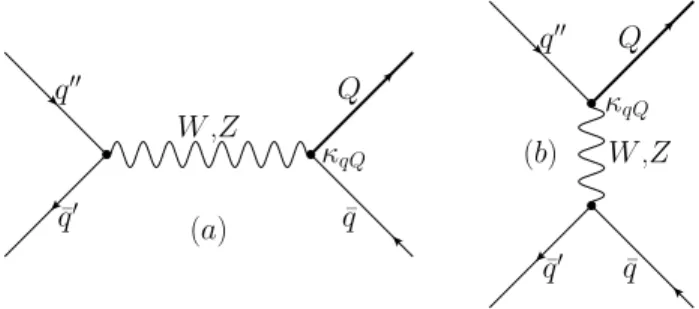
Previous searches for strong pair production of vector-like quarks at the Fermilab Tevatron Collider have ex-cluded masses of up to 338 GeV at the 95% C.L. [7]. However, recent years have seen the development of the-oretical scenarios in which corrections to SM quark cou-plings arising from their mixing with vector-like quarks cancel out, permitting the two types of quarks to mix to a degree unconstrained by precision electroweak mea-surements and b-factory results. Such large mixing with no introduction of anomalous couplings allows for single production of vector-like quarks at hadron colliders via the weak interaction [4]. Diagrams for single electroweak
FIG. 1: s-channel (a) and t-channel (b) electroweak produc-tion of a vector-like quark Q at the Tevatron.
vector-like quark production are shown in Figure 1. Generally, electroweak couplings to SM quarks are set by the parameter κqQ: κqQ= v mQ ˜ κqQ, (1)
where v is the vacuum expectation value of the SM Higgs field, mQ is the mass of the vector-like quark, and ˜κqQ is the coupling strength. Provided this coupling is not too small, a search for singly produced vector-like quarks can benefit from the lower kinematic threshold compared to pair production and stands to improve the mass limit considerably.
In this Letter, we present a search for singly produced vector-like quarks using data corresponding to an inte-grated luminosity of 5.4 fb−1 collected by the D0 detec-tor [8] at the Fermilab Tevatron Collider. We consider a model [4] in which there are two doublets of vector-like quarks that couple to the first generation of SM quarks. Vector-like quark final states are characterized by either a W or Z boson and at least two jets, one of which results from the decay of the vector-like quark, while another is produced in association with the vector-like quark at the primary vertex. We select events in which the vector boson decays to either electron(s) or muon(s).
The D0 detector is described in detail in [8]. The region of the D0 detector closest to the interaction point con-tains a central-tracking system consisting of a silicon mi-crostrip tracker (SMT) and a central fiber tracker (CFT), both of which are located within a 2 T superconducting solenoidal magnet. Hits in these two detectors are used to reconstruct tracks from charged particles. Surrounding the two tracking subdetectors are liquid-argon and ura-nium calorimeters, both electromagnetic and hadronic, which have a central section (CC) covering pseudorapidi-ties [9] |η| . 1.1, and two end calorimeters (EC) that extend coverage to |η| ≈ 4.2, with all three housed in separate cryostats. Electrons are identified as isolated energy clusters in the electromagnetic calorimeter, with a shape consistent with that of an electron, matched to a track in the inner detector. Jets are reconstructed in the calorimeters using the iterative midpoint cone
algo-rithm [10] with a cone of radius R = 0.5 in η − φ space. An outer muon system, providing coverage for |η| < 2, consists of a layer of tracking detectors and scintillation trigger counters in front of 1.8 T toroids, followed by two similar layers after the toroids. Muons are identified via a combination of reconstructed tracks in both the outer muon system and the central tracking system, and are re-quired to be isolated from both tracker and calorimeter activity.
Vector-like quark signals and background processes which include electrons or muons from W or Z boson decays are modeled using Monte Carlo (MC) simula-tion. Signal samples are generated using madgraph [11], with CTEQ6L1 [12] parton distribution functions, LO cross sections from [4] and vector-like quark resonance widths calculated with bridge [13]. Subsequent parton shower evolution is generated with pythia [14]. We set ˜
κuD= 1, ˜κuU = √
2 and ˜κdU = ˜κdD= 0, such that down-type vector-like quarks decay exclusively to W q and up-type quarks decay exclusively to Zq. This choice, while affecting the production rates and therefore the excluded vector-like quark masses, does not affect the cross sec-tion limits themselves. We generate up- and down-type vector-like quark signals with masses between 280 GeV and 700 GeV. Backgrounds from t¯t, W → ℓν+jets, and Z → ℓℓ+jets production are modeled using alpgen [15], also interfaced to pythia. For these events, we use a matching procedure to avoid double counting partons produced by alpgen and those added by the shower-ing in pythia [16]. Diboson samples are generated with pythia, and single top quark production is modeled us-ing the comphep [17] generator. All MC samples are passed through a geant [18] simulation of the D0 detec-tor and are overlaid with data events from randomly cho-sen beam crossings to simulate the effect of multiple p¯p interactions and detector noise. MC events are then re-constructed using the same software that is used for data reconstruction. The W +jets and Z+jets samples are normalized to the leading-log cross section reported by alpgentimes a k-factor calculated by MCFM [19]. The t¯t samples are normalized to a next-to-next-to-leading or-der (NNLO) cross section for mt= 172.5 GeV [20], and the diboson samples (W W , W Z and ZZ) to the NLO cross section predicted by MCFM [21]. All simulated events are corrected for differences in trigger and recon-struction efficiencies between data and simulation.
We conduct the search in two channels, correspond-ing to vector-like quark decays to (W → ℓν)+jet and to (Z → ℓℓ)+jet. In the W +jets channel, we initially select events which have passed a single lepton trigger and contain exactly one electron (|η| < 1.1) or muon (|η| < 2.0) with transverse momentum pT > 20 GeV, at least two jets with pT > 20 GeV and |η| < 2.5, and miss-ing transverse energy E/T, corrected for the momentum of any muons in the event, greater than 15 GeV. We also require 2MW
trans-verse mass of the lepton-E/T system, in order to suppress the multijet background. In the Z+jets channel, we ini-tially select events with exactly two electrons or muons in addition to at least two jets, all with same pT thresh-olds as used in the W +jets channel. Events are selected by a mixture of single lepton, dilepton and lepton plus jets triggers. Due to the low rate of background without real Z bosons, electrons are also accepted in the endcap electromagnetic calorimeters (1.5 < |η| < 2.5). The two leptons are required to have an invariant mass between 70 and 110 GeV, i.e. consistent with that of a Z boson. Additionally, we require E/T < 50 GeV, as this channel contains only instrumental sources of missing transverse energy.
The largest physics background to the single lepton channel is W (→ ℓν)+jets production, with smaller con-tributions from Z+jets, t¯t, diboson, and single top quark processes. The main instrumental background arises from multijet events in which one of the jets is misiden-tified as a high-pT isolated lepton in the detector. We model this background using data events which fail the calorimeter shower shape requirements for the electron or the isolation requirements for the muon, but pass all other selection criteria. In the single electron channel, we estimate the relative fraction of real electrons from W boson decays and misidentified electrons from jets by determining the efficiencies for each type of event to pass a tighter selection. These efficiencies are calculated in Z → ee data for real electrons and in a E/T < 20 GeV sample for misidentified electrons. In the single muon channel, we scale the events failing the muon isolation requirement to match the number of events obtained af-ter subtracting the expected number of real W bosons satisfying the event selection from the number of events observed in data.
In the dilepton channel, (Z → ℓℓ)+jets events domi-nate the SM background. In order to correct the Monte Carlo for the small trigger inefficiency in the data, we apply a global normalization determined using a pure Z → ℓℓ sample. The ratio between the data yield in this sample and the predicted yield from the inclusive Z boson cross section multiplied by the branching ra-tio is associated with the overall trigger efficiency, and the Monte Carlo distributions are scaled by this ratio. The multijet background is modeled using data events in which both leptons fail quality criteria (for electrons) or isolation criteria (for muons), and is normalized to the difference between data and MC in the dilepton mass window between 40 and 70 GeV.
The signal contains events with a W or Z boson and jets, all with high transverse momentum, as the de-cay products of a high mass resonance. We apply sev-eral kinematic selection criteria to select events of this type and to minimize the contributions from SM back-ground processes. In the single lepton channel, we re-quire lepton pT > 50 GeV, highest jet pT > 100 GeV,
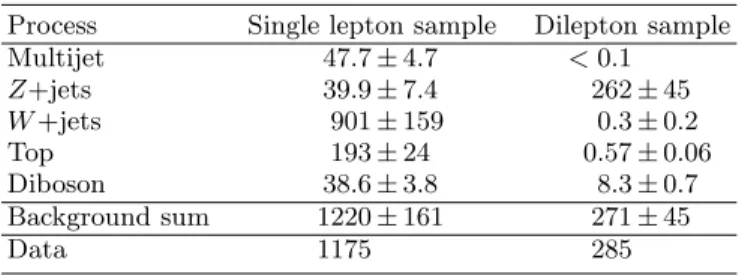
TABLE I: Predicted number of background events including total uncertainties and observed number of data events after final selection.
Process Single lepton sample Dilepton sample
Multijet 47.7 ± 4.7 < 0.1 Z+jets 39.9 ± 7.4 262 ± 45 W +jets 901 ± 159 0.3 ± 0.2 Top 193 ± 24 0.57 ± 0.06 Diboson 38.6 ± 3.8 8.3 ± 0.7 Background sum 1220 ± 161 271 ± 45 Data 1175 285
E/T > 40(50) GeV for the muon (electron) channel, and that the separation in azimuthal angle φ between the lep-ton and the E/T be less than 2. As the signal contains real W bosons, we additionally require MW
T < 150 GeV. Finally, we exploit the relationship between the lepton charge and the η of the jet with the second-highest pT in the signal topology. This jet, which we assign to the SM quark produced in association with the vector-like quark, is emitted, in general, into one of the forward regions of the detector, and its direction is strongly correlated with the charge of the produced vector-like quark, and thus also with the charge of the lepton from its decay. We therefore require Qℓ× ηj2 > 0, where Qℓ is the lepton charge and ηj2 is the η of the jet with the second-highest pT in the event. This selection is efficient for the signal (≈ 85%), while reducing the SM background by roughly a factor of two.
In the dilepton channel, we similarly select events with properties characteristic of a heavy resonance decay to a Z boson and a jet. We require the pT of the dilepton system to be greater than 100 GeV, the spatial separation of the two leptons in η − φ space (∆R) to be less than 2.0, and the leading jet pT to be greater than 100 GeV.
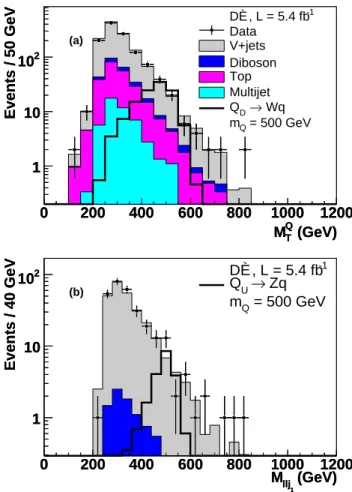
Table I displays the observed number of data events, along with estimated background yields, after the final event selection in the single lepton and dilepton chan-nels. Fig. 2 shows the reconstructed vector-like quark transverse mass, defined as
(MTQ) 2 = (qp2 TW + M 2 W + pTj1)2− (~pTW + ~pTj1) 2 , (2)
for the single lepton channel, where MW = 80.3 GeV is the mass of the W boson and ~pTj1refers to the transverse momentum of the leading jet in the event. Also shown in Fig. 2 is the vector-like quark mass in the dilepton chan-nel, reconstructed as the invariant mass of the dilepton + leading jet system.
Major sources of systematic uncertainty common to both analyses include modeling of W/Z+jets back-grounds (15%); cross sections for t¯t (10%), diboson (6%), and W /Z+jets (6%) production; and jet energy scale and resolution (1%–5%). Major systematic
(GeV) Q T M 0 200 400 600 800 1000 1200 Events / 50 GeV 1 10 2 10 (GeV) Q T M 0 200 400 600 800 1000 1200 Events / 50 GeV 1 10 2 10 (a) -1 DØ, L = 5.4 fb Data V+jets Diboson Top Multijet Wq → D Q = 500 GeV Q m (GeV) 1 llj M 0 200 400 600 800 1000 1200 Events / 40 GeV 1 10 2 10 (GeV) 1 llj M 0 200 400 600 800 1000 1200 Events / 40 GeV 1 10 2 10 (b) -1 DØ, L = 5.4 fb Zq → U Q = 500 GeV Q m
FIG. 2: (a) Vector-like quark transverse mass and (b) vector-like quark mass for the single lepton and dilepton channels, respectively. Distributions for signal processes QD → W q
and QU→ Zq are normalized to the integrated luminosity of
the data and include detector acceptance and reconstruction efficiencies. These assume ˜κuD= 1 and ˜κuU =√2.
ties unique to the single lepton analysis include inte-grated luminosity (6.1%) [22], lepton identification effi-ciencies (3%), high-pT muon modeling, and trigger mod-eling (1%). A systematic uncertainty of 5% is assigned to the global background normalization applied to the dilep-ton MC samples. Systematic uncertainties on multijet normalization are 6.5%–100%, depending on the chan-nel. These do not have a large effect on the overall back-ground prediction, as the estimated multijet backback-ground is small after the final selection.
We observe no significant excess of data over the back-ground prediction in either channel, therefore we set lim-its on vector-like quark production cross sections. We employ a modified frequentist approach using the D0 like-lihood fitter [23] that incorporates a log-likelike-lihood ratio (LLR) test statistic [24]. We calculate confidence levels for the signal plus background (CLs+b) and background-only (CLb) hypotheses by integrating the (LLR) dis-tributions obtained by generating pseudo-experiments using Poisson statistics. Systematic uncertainties are
(GeV) Q m 300 350 400 450 500 550 600 650 700 Wqq) (fb) → Qq → p (p σ 2 10 3 10 4 10 (GeV) Q m 300 350 400 450 500 550 600 650 700 Wqq) (fb) → Qq → p (p σ 2 10 3 10 4 10 DØ, L = 5.4 fb-1 Observed Limit Expected Limit 2 s.d. ± Expected Limit 1 s.d. ± Expected Limit =0 dU κ∼ =1, uD κ∼ LO Prediction, =0 uD κ∼ =1, dU κ∼ LO Prediction,
FIG. 3: Excluded production cross section for a vector-like quark Q decaying to W q as a function of mQ, compared to
LO predictions of vector-like quark production with different ˜ κqQ. (GeV) Q m 300 350 400 450 500 550 600 650 700 Zqq) (fb) → Qq → p (p σ 2 10 3 10 (GeV) Q m 300 350 400 450 500 550 600 650 700 Zqq) (fb) → Qq → p (p σ 2 10 3 10 -1
DØ, L = 5.4 fb Observed LimitExpected Limit 2 s.d. ± Expected Limit 1 s.d. ± Expected Limit =0 dD κ∼ , 2 = uU κ∼ LO Prediction, =0 uU κ∼ , 2 = dD κ∼ LO Prediction,
FIG. 4: Excluded production cross section for a vector-like quark Q decaying to Zq as a function of mQ, compared to
LO predictions of vector-like quark production with different ˜
κqQ.
treated as uncertainties on the expected number of sig-nal and background events. The 95% confidence level limit is defined as the signal cross section for which CLs≡ CLs+b/CLb is 0.05. Using as discriminant vari-ables the vector-like quark transverse mass for decays to W q and the vector-like quark mass for decays to Zq, we obtain 95% C.L. limits on vector-like quark production cross sections. These are shown in Figs. 3 and 4, along with leading order theoretical predictions for two differ-ent scenarios. For the case of ˜κuD = 1 and ˜κuU =
√ 2 with no coupling to the down quark, we exclude masses below 693 GeV for a vector-like quark decaying exclu-sively to W q and masses below 551 GeV for a vector-like quark decaying exclusively to Zq at the 95% C.L. For an alternate scenario defined by ˜κdU = 1 and ˜κdD=
√ 2 with no coupling to the up quark, the corresponding mass limits are 403 GeV and 430 GeV, respectively.
In summary, we have presented a search for single vector-like quark production at the Tevatron in the W +jets and Z+jets final states. The observed data are consistent with the background expectation and limits on vector-like quark cross sections are derived. We ex-clude vector-like quark masses below 693 GeV for decays to W q and masses below 551 GeV for decays to Zq at 95% C.L. assuming vector-like quark – SM quark mixing parameters ˜κuD = 1 and ˜κuU =
√
2 along with 100% branching ratios to the respective final states.
We thank the staffs at Fermilab and collaborating institutions, and acknowledge support from the DOE and NSF (USA); CEA and CNRS/IN2P3 (France); FASI, Rosatom and RFBR (Russia); CNPq, FAPERJ, FAPESP and FUNDUNESP (Brazil); DAE and DST (In-dia); Colciencias (Colombia); CONACyT (Mexico); KRF and KOSEF (Korea); CONICET and UBACyT (Ar-gentina); FOM (The Netherlands); STFC and the Royal Society (United Kingdom); MSMT and GACR (Czech Republic); CRC Program and NSERC (Canada); BMBF and DFG (Germany); SFI (Ireland); The Swedish Re-search Council (Sweden); and CAS and CNSF (China).
We additionally thank Marcela Carena and Anupama Atre of the Fermi National Accelerator Laboratory for providing the madgraph implementation of the vector-like quarks model.
[1] L. Randall and R. Sundrum, Phys. Rev. Lett. 83, 3370 (1999).
[2] T. Applequist, H.C. Cheng, and B.A. Dobrescu, Phys. Rev. D 64, 035002 (2002).
[3] N. Arkani-Hamed, A.G. Cohen, E. Katz, and A.E. Nelson et al., J. High Energy Phys. 07, 034 (2002).
[4] A. Atre, M. Carena, T. Han, and J. Santiago, Phys. Rev.
D 79, 054018 (2009).
[5] K. Kong, S.C. Park, and T.G. Rizzo, J. High Energy Phys. 07, 059 (2010).
[6] T. Han, H. Logan, B. McElrath, and L. Wang, Phys. Rev. D 67, 095004 (2003).
[7] T. Aaltonen et al. (CDF Collaboration), Phys. Rev. Lett. 104, 091801 (2010).
[8] V.M. Abazov et al. (D0 Collaboration), Nucl. Instrum. Methods Phys. Res. A 565, 463 (2006).
[9] The D0 detector utilizes a right-handed coordinate sys-tem with the z axis pointing in the direction of the proton beam and the y axis pointing upwards. The azimuthal an-gle φ is defined in the x-y plane measured from the x axis. The pseudorapidity is defined as η = −ln[tan(θ/2)], where θ = arctan(px2+ y2/z). Transverse variables are
defined as projections of the variables onto the x-y plane. [10] G.C. Blazey et al., arXiv:hep-ex/005012.
[11] J. Alwall et al., J. High Energy Phys. 09, 028 (2007). [12] J. Pumplin et al., J. High Energy Phys. 07, 012 (2002);
D. Stump et al., J. High Energy Phys. 10, 046 (2003). [13] P. Meade and M. Reese, arXiv:hep-ph/0703031. [14] T. Sj¨ostrand et al., Comput. Phys. Commun. 135, 238
(2001).
[15] M.L. Mangano et al., J. High Energy Phys. 07, 001 (2003).
[16] S. H¨oche et al., arXiv:hep-ph/0602031.
[17] E. Boos et al., Nucl. Instrum. Methods Phys. Res. A 534, 250 (2004).
[18] R. Brun and F. Carminati, CERN Program Library Long Writeup W5013, 1993 (unpublished).
[19] J. Campbell and R.K. Ellis, Phys. Rev. D 65, 113007 (2002).
[20] S. Moch and P. Uwer, Phys. Rev. D 78, 034003 (2008). [21] J.M. Campbell and R.K. Ellis, Phys. Rev. D 60, 113006
(1999).
[22] T. Andeen et al., FERMILAB-TM-2365 (2007). [23] W. Fisher, FERMILAB-TM-2386-E.
[24] T. Junk, Nucl. Instrum. Methods Phys. Res. A 434, 435 (1999); A. Read, J. Phys. G 28 2693 (2002).