SHARED FACILITY by
Stuart E. Madnick John J. Donovan
March 1973 648-73
* This paper is based upon a paper entitled "Application and Analysis of the Virtual Machine Approach to Information System Security and
Isolation" that was presented at the ACM Workshop on Virtual Computer Systems, March 26-27, 1973, Harvard University, Cambridge, Massachusetts.
Shared Facility
ABSTRACT
Security Is an Important factor If the programs of Independent and possibly malicious users are to coexist on the same computer system. In this paper we show that a combined virtual machine monitor/operating system (VMM/OS) approach to Information system Isolation provides substantially better software security than a conventional multiprogramming operating system approach. This added protection s derived from redundant security using Independent mechanisms that are Inherent In the design of most VMM/OS systems.
I. INTRODUCTION
During the past decade the technique of multiprogramming (i.e., the concurrent execution of several Independent programs on the same computer system) has been developed to take full advantage of medium- and large-scale computer systems (e.g., cost economics, flexibility, ease of operation, hardware reliability and redundancy, etc.). Unfortunately, In transferring physically
Isolated Information systems (see Figure (a)) to physically shared nformation systems (see Figure 1(b)), we must cope with
the problems of: operating system compatibility, reliability, and security. In this paper we show that the Virtual Machine approach provides effective solutions to these problems.
* Assistant Professor, Project MAC and Sloan School of Management. ** Associate Professor, Project MAC and Department of Electrical Engineering.
Work reported herein was supported In part by Project MAC, an M.I.T. research project sponsored by the Advanced Research Projects Agency, Department of Defense, under Office of Naval Research Contract Nonr-4102(01) and in part by the MIT-IBM Security Study Project.
Term ina Ils* System S2 Storage Devices System S3 r Central D.tr, I "* " CJ ^ W I ,l -:]:~lil, I Memory P31 P32 P33
4cz
(a) Physically Isolated Information Systems
Storage Devices
als include
ntional I /O units, such as 'eaders, printers, TTY, etc. (b) Physically Shared Information System
Figure . Isolated and Shared Information Systems
J
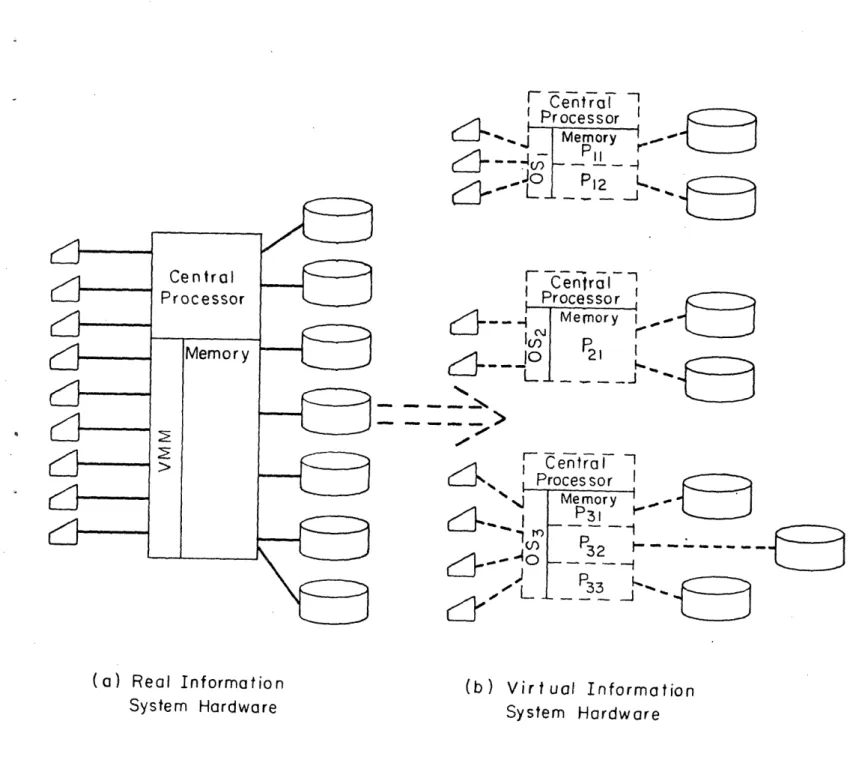
/"' __._, ~ ~" I t) (n Te,---II. VIRTUAL MACHINE APPROACH TO ISOLATION AND COMPATIBILITY Since descr bed Parmelee(6)) virtual mach system smul (VMM) sof tv Goldberg (3, VM/370 syst functional y (i.e., multi computer sy Isolated sys virtual machines extensively in , we will only i ne may be define ated by a comblna rare program and a 4) for a more pre
:em enables a s
as If It were ple "virtual mach 'stem function as
5tems as depicted
and their applications have been
the literature (Madnick(5),
briefly review the key points. A :d as a. replica of a real computer tlion of a Virtual Machine Monitor ippropriate hardware support. (See ;cise definition). For example, the
single IBM System/370 to appear
multiple independent System/370's ines"). Thus, a VMM can make one
if It were multiple physically
In Figure 2. A VMM accomplishes this feat by controlling the multiplexing of the physical hardware resources In a manner analogous to the way that the telephone company multiplexes communications enabling separate and, hopefully, isolated conversations over the same wires.
A VMM Is totally unlike a conventional operating system. A VMM restricts Itself to the task of multiplexing and allocating the physical hardware, it presents an Interface that appears Identical to a "bare machine". In fact, t is necessary to load a conventional operating system nto each virtual machine in order to accomplish, useful work. This latter fact provides the basis for the solution to the operating system compatibility problem. Each virtual machine Is controlled by a separate, and
r Central 1 ." Processor I - Memory TVP2---- PL
r?"L
-.-
'
-
~~
r Central Processor - Mernor I < 10 2 L -r rI I _J(a) Real Information
System Hardware (b) Virtual InformationSystem Hardware
Figure 2. Real and Virtual Information Systems
c--K:31.
KV~
-_·_ 1__1___1_1___11·_1_11_1__1-__11__ --_·_.__I_ICI_---_I- _LI-ll__ 1 -Ca l I..-=7 p~f rr Ir · rIf necessary different, operating system. ! The feasibility of this solution has been demonstrated on the VM/370 system and the earlier CP-67 system. The extra VMM software and hardware do
Introduce additlonal overhead In the Information system operation, but this overhead can be kept rather low (e.g., 10-15%). Depending upon the precise economics and benefits of a large-scale system, the VMM approach Is often preferable to the operation of the multiple physically Isolated real' systems.
III. SECURITY AND RELIABILITY IN A VIRTUAL MACHINE ENVIRONMENT
In machine dlfferen the preceeding approach solves t operating sy
section t was shown that the v the OS compatibility problems by al
stems to run and coexist on the
computer at the same security and rellabill will show that the vir
that Is much less conventional multiprogr software reliability reliabillty fallure Is the system to cease "crashes"), a securlty that allows one user's programs computer time. In th ty In a vlrtu. tual machine ai suscepti ble amming operat and security any action of correct ope failure s a Is secti al machi pproach to such Ing syst are a user's ration form of on we wl.ll anal ne environment. results n a sys failures than
em. The problems qul te simil lar.
program that cau (e.g., "s tops "
reliability fall
program to access or destroy
of another Isolated user system. The reliability
yze We tem a of A ses or ure I rtual lowing same the data or or gain control of the entire
problem has been studied by
_I.I__I^CI_ I1I1- ---____1__.
_---111··--Buzen, Chen, and Goldberg (1).
j Contem.norary Operat i n Systelm Envi ronment
Most contemporary operating systems, In conjunction wl th
appropriate hardware support, provide mechanisms to prevent
reliability and security falL res (e.g.., supervisor/problem state modes of operation, etc.). In this paper we are only concerned
about complete solation security (.e., no user s allowed
access to any other user's information). The problem of
generalized controlled access (i.e., a user Is allowed
restrictive access to another user's information) Is much more difficult but, fortunately, such a facility s not needed for the environment illustrated n Figure 1.
Under "ldeal" circumstances, most current operating systems can provide Isolation security. OS/360, for example, uses the System/360's lock and key protection to Insulate users from each
other and from the operating system. The supervisor/problem
state modes further prevent users from "gaining control" of the system. Thus, It should be possible to solate users.
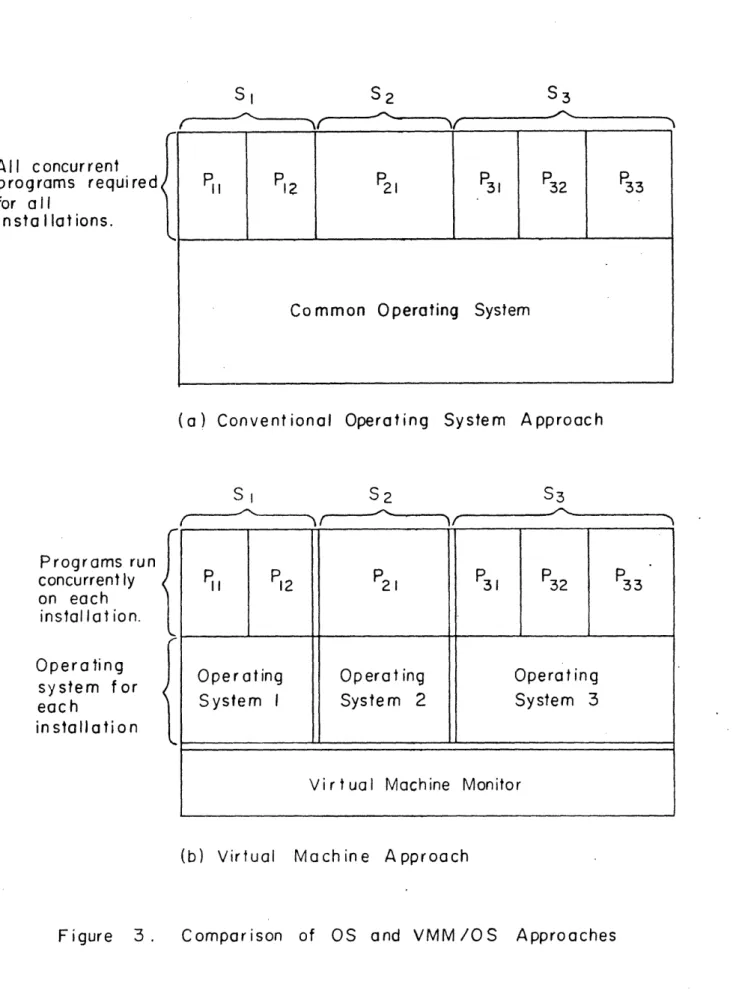
Figure 3(a) Illustrates the on the same nformation system.
a security violation f a sngl
were to occur. Typical modern
thousands, possibly millions, of interface with the operating
coexistence of multiple programs Such a system s susceptible to e hardware or software failure
operating systems consist of
Instructions. The user programs system through hundreds of
SI All concurrent programs required .for all installations. (a) Conventional SI
Operating System Approach
S2 S3 Programs run concurrent ly on each instal la t ion. Operating system f or each installation
(b) Virtual Machine Approach
3 . Comparison of OS and VMM/OS
S3
F
1P
2P
21P
3 1P
32P
33r
Operating Operat ing OperatingL
System I System 2 System 3Virtual Machine Monitor
---- --'-
-I---^-"-I---I--~---I`--'
1-~---
~111-"-S2
parame ter I zed Interrupts, I/0 time there Is no entries requests known way (e.g., supervisor
and nterrupts, etc.). to systematically val
cal ls,
At the Idate the
functioning of the operating system for all poss ble parameters for all entries. In fact, most systems tend to be highly vulnerable to nvalid'parameters. For example, a popular form of sabotage s to Issue certain data-returning supervisor calls
(e.g., "what time Is t?" request) providing an Invalid address as a parameter. The operating system, running with protection disabled and assuming that the address parameter corresponds to a user's data area, transfers the return data to that location. If the address provided actually corresponds to locations within the operating system, the system can be made to destroy or disable
I tself. kind of complete
Most "secure" systems, of error but there are many security Is unlikely.
course, attempt other sabotage
to detect this techniques and
Referring back to Figure 3(a) we can see some of the factors contributing to the problem. In order to provide sufficient
functionality to be effective for a large and heterogeneous
collection of user programs, the operating system must be quite comprehensive and, thus, more vulnerable to error. In general, a single logical error In the operating system software can Invalidate the entire security mechanism, Furthermore, as depicted In Figure 3(a), there is no more protection between the programs of differing user groups or the operating system than there is between the application programs of a single user group. program present correct
The security of such conventional operating systems is sufficiently weak that the military has strict regulations that appear to forbid the use of the same information system for both SECRET and TOP SECRET use - even though using separate systems Is more costly. Even Industrial competitors or different functions
In the same company (e.g., payroll and engineering) are often reluctant to share the same computer.
2, VYrtual Machl ne Evironment
Figure 3(b) Illustrates the virtual machine approach to a physically shared system. This arrangement has numerous security advantages. If we define Ps(P) to be the probability that a given run of program P will cause a security violation to occur,
the following conditions would be expected to hold:
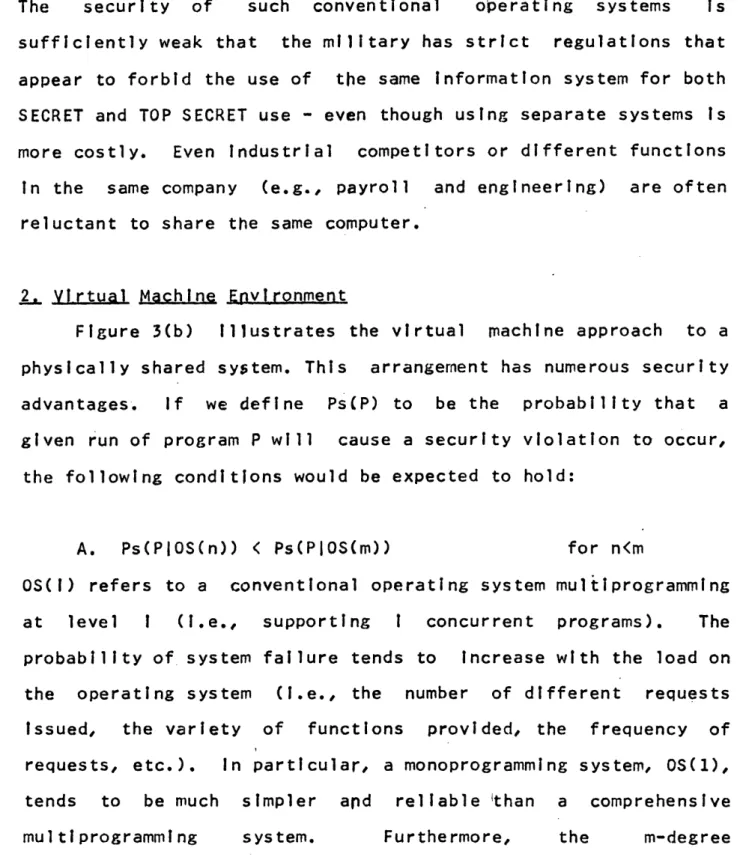
A. Ps(PIOS(n)) < Ps(PIOS(m)) for n<m
OS(I) refers to a conventional operating system multiprogramming at level I (I.e., supporting I concurrent programs). The probability of system failure tends to ncrease with the load on the operating system (.e., the number of different requests Issued, the variety of functions provided, the frequency of requests, etc.). In particular, a monoprogramming system, OS(1), tends to be much simpler apd reliable 'than a comprehensive multiprogramming system. Furthermore, the m-degree multiprogramming system often requires Intricate alterations to support the special needs of the m users, especially If m Is large. These problems have been experienced In most large-scale
--_1I-I_--_I·_.11-_..-11__1---multiprogramming systems. These problems are diminished in a VM environment since each virtual machine may run a separate operating system. Each operating system may be simpler and less error-prone than a single comprehensive all-encompassing operating system.
B. Ps(OSIVMM(k)) < Ps(PIOS(m)) for k<m
VMH(I) means a virtual machine monitor, VM, supporting I virtual machines. The operating system, OS, on a particular virtual machine has the same relationship to the VMM(k) as a user's program, P, has to a conventional multiprogramming operating system, OS(m). Using the same rationale as in A above, the smaller the degree of multiprogramming (i.e., k<m), the smaller the probability of a security violation, Furthermore, since virtual machine monitors tend to be shorter, simpler, and easier to debug than conventional multiprogramming operating systems, even when k=m, the VMM Is less error-prone, For example, since the VMM s defined by the hardware specifications of the real machine, the field engineer's hardware diagnostic software can be used to checkout the correctness of the VMM.
We can define the probability of a program P on one virtual machine violating the security of another concurrent program on another virtual machine as:
C. Ps(PiOS(n)IVMM(k)) = Ps(PIOS(n))xPs(OSIVMM(k))
Based on the Inequalities of A and B above and the multiplicative dependency In C, we arrive at the conclusion:
D. Ps(PIOS(n)IVMM(k)) <<(( Ps(PIOS(m)) for n,k<m
Ps(PIOS(n)IVMM(k)) Is the probability of the simultaneous security failure of P's operating system and the virtual machine monitor. if a single operating system's security falls, the VMM Isolates this failure from the other virtual machines. If the VMM's security fails, It exposes Information of other virtual machines to the operating system of one virtual machine. But, If functioning correctly, P's operating system will not take
advantage of the security breach. This assumes that the designers of the Individual operating systems are not in collusion with malicious users, this seems to be a reasonable hypothesis; otherwise, using the same collusion, Ps(PIOS(m))=1 could be attained by subverting the common operating system.
We are parti
security, that s,
occurs due to any computed by:
E. Ps(P11, P12
cularly concerned about the overal
the probability that a security program n the system. This situati
2,...,P33) = Ps(P11)x(1-Ps(P12))x... x( + (1-Ps(Pll))xPs(P12)x...x( 1. system violation on can be 1-Ps(P33)) I-Ps(P33)) + 0.. + Ps(Pll)xPs(P12)x...xPs(P33) Alternately, It can be represented as:
Ps(P11,P12,...,P33) = 1 - (1-Ps(P11))x(1-Ps(P12))x...x(1-Ps(P33)) We note that Ps(P11,P12,...,P33) Is minimized when the Individual
Ps's are minimized. The effect Is accentuated due to the multiplicative nature of Equation E. Thus, from the Inequality
of D, we conclude:
F. Ps(Pll, P12,...,P3310S(n)IVMM(k)) <<< Ps(P11, P12,...,P3310S(m)) for n,k<m.
That is, the security In a virtual machine environment Is very much better than In a conventional multiprogramming operating system environmenti. This conclusion depends upon the probabilistic Independence of the security failures. In the following section we show that the Independence condition applies.
_L Redundant Security Mechanisms
If the Individual operating systems, OS, and the virtual machine monitor, VMM, used Identical security mechanisms and
algorithms, then any user action that resulted In penetration of one could also penetrate the other. That Is, first take control of the OS and then, using the same technique, take control of the
VMM. This s logically analogous to placing one safe Inside another safe - but having the same combination on both safes. To combat this danger, the OS and VMM must have redundant security based upon Independent mechanisms. A similar approach has been taken In the PRIME modular computer system being constructed at the University of Californla, Berkeley. They use the term dvnamic verification to mean "that every time a decision Is made there Is a consistency check performed on the decision using Independent hardware and software" (Fabry(2)).
In a VMM/OS environment using VM/370 and OS/360 as example
systems. Let us consider main memory security first. OS/360
uses the System/360-370 lock and key hardware to Isolate one user's memory area from invalid access by another user's program. VM/370, on the other hand, uses the System/370 Dynamic Address Translation (DAT) hardware to provide a separate virtual memory (i.e., address space) for each virtual machine - Independent of
the locks and keys. Thus, a malicious user would have to
overwhelm both the lock and key and the DAT mechanisms to violate the Isolation security of another coexisting program on another
virtual machine. The software algorithms, of course, used by
OS/360 and V/370 for memory ecurity are quite different since
the mechanisms that are used are so different. Thus, It Is
highly unlikely that they would both be susceptible to the same penetration techniques.
We find the same kind of redundant security In the area of secondary storage devices. OS/360, especially with the Resource
Securt y System (RSS) option, provides an elaborate set of
mechanisms to restrict access to data sets (files). Each storage volume has a recorded label that Is read by OS/360 to verify that It Is the correct volume to be used (i.e., Automatic Volume Recognition, AVR). Furthermore, under RSS, the specific data sets on the volume may be ndividually protected by means of password codes or user authorization restrictions. VM/370, on the other hand, may have the volumes assigned to the virtual machines by the computer operator or a directory on the basis of
FUNCTION 11 VMM Mechanism I OS Mechanism II II (e.g., VM/370) I (e.g., OS/360) II
Main Memory II Dynamic Address I LQcks and Keys
II
Security 11 Translation (DAT)I II
… ++ 44...
. ...--- + ……4--4. ++
Storage Device
ii
Device Address I Volume LabelII
Security
II
Mapping i Verification andII
II
I Data Set Passwordsll...++ . . ... - --- . --- --- ++
Process Allocation
II
Clock Comparator I Priority InterruptilSecurity
II
and Tlme-Slicing I (and, optionally, IiIi I interval Timer)
I I
Table 1.
Examples of Redundant Security Mechanisms In a VNMM/OS Environment
the physical storage device address being used. Once again, the logical mapping of OS/360 s Independent of the physical mapping of VM/370. These redundant security mechanisms can be found In many other areas.
Although most existing VMMIs were not designed specifically to provide such comprehensive Isolation, they frequently nclude substantial redundant security mechanisms. In order to provide the needed solation, future VMM's may be designed with Increased redundant secur ty.
IV. CONCLUSIONS
In this paper we have shown that the VMM/OS approach to Information system Isolation provides substantially better
software reliability and security than a conventional multiprogramming OS approach. This added protection Is obtained through the use of redundant security mechanisms that are
Inherent in the design of most VMM/OS systems.
REFERENCES
1. Buzen, J. P., Peter P. Chen, Goldberg, "Virtual Machine Techniques System Reliability", Proceedings of the Virtual Cmputer Systems, (March 26-27,
and Robert P. for Improving ACH klorksho on 197,).
2. Fabry, R. S., "Dynamic Verification of Operating System Decisions", submitted for publication in the Communications aof the A, (February 23, 1972).
3. Goldberg, R. P., "Virtual Examples", ProceedLnz$ of Conference, (September 1971),
Machines: Semantics and
IEEE Com2utr Society
141-142.
4. Goldberg, R. S., Architectural PrinciPles for Virtual ComDuter Systems, PhD dissertation, Harvard University, (November 1972). 5. Madnick, S. Machine Concept vs 2, 3 (March 1969), 6. Parmelee, R. and D. J. Hatfie Machine Concepts", 99-130.
E., "Time-Sharing Systems: Virtual Conventional Approach", Modern Data 34-36.
P., T. I. Peterson, C. C. Tillman, ld, "Virtual Storage and Virtual