Publisher’s version / Version de l'éditeur:
Vous avez des questions? Nous pouvons vous aider. Pour communiquer directement avec un auteur, consultez la première page de la revue dans laquelle son article a été publié afin de trouver ses coordonnées. Si vous n’arrivez pas à les repérer, communiquez avec nous à [email protected].
Questions? Contact the NRC Publications Archive team at
[email protected]. If you wish to email the authors directly, please see the first page of the publication for their contact information.
https://publications-cnrc.canada.ca/fra/droits
L’accès à ce site Web et l’utilisation de son contenu sont assujettis aux conditions présentées dans le site LISEZ CES CONDITIONS ATTENTIVEMENT AVANT D’UTILISER CE SITE WEB.
Journal of Astronomical Telescopes, Instruments, and Systems, 5, 02,
2019-04-05
READ THESE TERMS AND CONDITIONS CAREFULLY BEFORE USING THIS WEBSITE. https://nrc-publications.canada.ca/eng/copyright
NRC Publications Archive Record / Notice des Archives des publications du CNRC :
https://nrc-publications.canada.ca/eng/view/object/?id=35045120-49f6-47e1-b397-41fcfa1af1dc
https://publications-cnrc.canada.ca/fra/voir/objet/?id=35045120-49f6-47e1-b397-41fcfa1af1dc
Archives des publications du CNRC
This publication could be one of several versions: author’s original, accepted manuscript or the publisher’s version. / La version de cette publication peut être l’une des suivantes : la version prépublication de l’auteur, la version acceptée du manuscrit ou la version de l’éditeur.
For the publisher’s version, please access the DOI link below./ Pour consulter la version de l’éditeur, utilisez le lien DOI ci-dessous.
https://doi.org/10.1117/1.JATIS.5.2.020901
Access and use of this website and the material on it are subject to the Terms and Conditions set forth at
Review: far-infrared instrumentation and technological development for the
next decade
Farrah, D.; Smith, K. E.; Ardila, D.; Bradford, C. M.; Dipirro, M.; Ferkinhoff, C.;
Glenn, J.; Goldsmith, P.; Leisawitz, D.; Nikola, T.; Rangwala, N.; Rinehart, S. A.;
Staguhn, J.; Zemcov, M.; Zmuidzinas, J.; Bartlett, J.; Carey, S.; Fischer, W.J.;
Kamenetzky, J.; Kartaltepe, J.; Lacy, M.; Lis, D. C.; Locke, L.; Enrique, L. R.;
MacGregor, M.; Mills, E.; Moseley, S. H.; Murphy, E.J.; Rhodes, A.; Richter, M.;
Rigopoulou, D.; Sanders, D.; Sankrit, R.; Savini, G.; John-David, S.; Stierwalt, S.
Duncan Farrah, Kimberly Ennico Smith, David Ardila, Charles M. Bradford, Michael Dipirro, Carl Ferkinhoff, Jason Glenn, Paul Goldsmith, David Leisawitz, Thomas Nikola, Naseem Rangwala, Stephen A. Rinehart, Johannes Staguhn, Michael Zemcov, Jonas Zmuidzinas, James Bartlett, Sean Carey, William J. Fischer, Julia Kamenetzky, Jeyhan Kartaltepe, Mark Lacy, Dariusz C. Lis, Lisa Locke, Enrique Lopez-Rodriguez, Meredith MacGregor, Elisabeth Mills, Samuel H. Moseley, Eric J. Murphy, Alan Rhodes, Matt Richter, Dimitra Rigopoulou, David Sanders, Ravi Sankrit, Giorgio Savini, John-David Smith, Sabrina Stierwalt, “Review: far-infrared instrumentation and technological development for the
Review: far-infrared instrumentation
and technological development for the
next decade
Duncan Farrah
Kimberly Ennico Smith
David Ardila
Charles M. Bradford
Michael Dipirro
Carl Ferkinhoff
Jason Glenn
Paul Goldsmith
David Leisawitz
Thomas Nikola
Naseem Rangwala
Stephen A. Rinehart
Johannes Staguhn
Michael Zemcov
Jonas Zmuidzinas
James Bartlett
Sean Carey
William J. Fischer
Julia Kamenetzky
Jeyhan Kartaltepe
Mark Lacy
Dariusz C. Lis
Lisa Locke
Enrique Lopez-Rodriguez
Meredith MacGregor
Elisabeth Mills
Samuel H. Moseley
Eric J. Murphy
Alan Rhodes
Matt Richter
Dimitra Rigopoulou
David Sanders
Ravi Sankrit
Giorgio Savini
John-David Smith
Sabrina Stierwalt
Review: far-infrared instrumentation and
technological development for the next decade
Duncan Farrah,a,b,*Kimberly Ennico Smith,cDavid Ardila,dCharles M. Bradford,d,eMichael Dipirro,f Carl Ferkinhoff,gJason Glenn,hPaul Goldsmith,dDavid Leisawitz,fThomas Nikola,iNaseem Rangwala,c,j Stephen A. Rinehart,fJohannes Staguhn,k,fMichael Zemcov,l,dJonas Zmuidzinas,eJames Bartlett,d Sean Carey,mWilliam J. Fischer,nJulia Kamenetzky,oJeyhan Kartaltepe,lMark Lacy,pDariusz C. Lis,q,e Lisa Locke,p,rEnrique Lopez-Rodriguez,cMeredith MacGregor,sElisabeth Mills,tSamuel H. Moseley,f Eric J. Murphy,oAlan Rhodes,c Matt Richter,uDimitra Rigopoulou,v,w David Sanders,bRavi Sankrit,n,c
Giorgio Savini,xJohn-David Smith,yand Sabrina Stierwaltm
aUniversity of Hawaii, Department of Physics and Astronomy, Honolulu, Hawaii, United States bUniversity of Hawaii, Institute for Astronomy, Honolulu, Hawaii, United States
cNASA Ames Research Center, Moffet Field, California, United States
dJet Propulsion Laboratory, California Institute of Technology, Pasadena, California, United States
eCalifornia Institute of Technology, Division of Physics, Mathematics, and Astronomy, Pasadena, California, United States fNASA Goddard Space Flight Center, Greenbelt, Maryland, United States
gWinona State University, Department of Physics, Winona, Minnesota, United States
hUniversity of Colorado, Department of Astrophysical and Planetary Sciences, Boulder, Colorado, United States iCornell University, Cornell Center for Astrophysics and Planetary Sciences, Ithaca, New York, United States jBay Area Environmental Research Institute, NASA Research Park, Moffet Field, California, United States
kJohns Hopkins University, The Henry A. Rowland Department of Physics and Astronomy, Baltimore, Maryland, United States lRochester Institute of Technology, School of Physics and Astronomy, Rochester, New York, United States
mCalifornia Institute of Technology, Infrared Processing Analysis Center, Pasadena, California, United States nSpace Telescope Science Institute, Baltimore, Maryland, United States
oWestminster College, Salt Lake City, Utah, United States
pNational Radio Astronomy Observatory, Charlottesville, Virginia, United States
qSorbonne Universite, Observatoire de Paris, Universite PSL, CNRS, LERMA, Paris, France
rNational Research Council Canada, Herzberg Astronomy and Astrophysics, Victoria, British Columbia, Canada sCarnegie Institution of Washington, Department of Terrestrial Magnetism, Washington, DC, United States tBoston University, Department of Astronomy, Boston, Massachusetts, United States
uUniversity of California at Davis, Department of Physics, Davis, California, United States vUniversity of Oxford, Department of Physics, Oxford, United Kingdom
wRAL Space, Science, and Technology Facilities Council, Rutherford Appleton Laboratory, Didcot, United Kingdom xUniversity College London, Physics and Astronomy Department, Gower Street, London, United Kingdom
yUniversity of Toledo, Department of Physics and Astronomy, Toledo, Ohio, United States
Abstract. Far-infrared astronomy has advanced rapidly since its inception in the late 1950s, driven by a matur-ing technology base and an expandmatur-ing community of researchers. This advancement has shown that obser-vations at far-infrared wavelengths are important in nearly all areas of astrophysics, from the search for habitable planets and the origin of life to the earliest stages of galaxy assembly in the first few hundred million years of cosmic history. The combination of a still-developing portfolio of technologies, particularly in the field of detec-tors, and a widening ensemble of platforms within which these technologies can be deployed, means that far-infrared astronomy holds the potential for paradigm-shifting advances over the next decade. We examine the current and future far-infrared observing platforms, including ground-based, suborbital, and space-based facili-ties, and discuss the technology development pathways that will enable and enhance these platforms to best address the challenges facing far-infrared astronomy in the 21st century.© The Authors. Published by SPIE under a Creative Commons Attribution 4.0 Unported License. Distribution or reproduction of this work in whole or in part requires full attribution of the original publication, including its DOI. [DOI:10.1117/1.JATIS.5.2.020901]
Keywords: instrumentation; detectors; interferometers; miscellaneous; photometers; spectrographs; space vehicles; instruments; bal-loons; telescopes.
Paper 17072V received Sep. 5, 2017; accepted for publication Mar. 7, 2019; published online Apr. 5, 2019.
1
Introduction
Far-infrared astronomy, defined broadly as encompassing sci-ence at wavelengths of 30 to 1000 μm, is an invaluable tool in understanding all aspects of our cosmic origins. Tracing its roots to the late 1950s, with the advent of infrared detectors sensitive enough for astronomical applications, far-infrared astronomy
has developed from a niche science, pursued by only a few teams of investigators, to a concerted worldwide effort pursued by hundreds of astronomers, targeting areas ranging from the origins of our Solar System to the ultimate origin of the Universe.
By their nature, far-infrared observations study processes that are mostly invisible at other wavelengths, such as young stars still embedded in their natal dust clouds or the obscured, rapid assembly episodes of supermassive black holes. Moreover, the 30 to 1000 μm wavelength range includes a rich and diverse *Address all correspondence to Duncan Farrah, E-mail:[email protected]
assembly of diagnostic features. The most prominent of these are as follows:
• Continuum of absorption and emission from dust grains with equilibrium temperatures approximately in the range from 15 to 100 K. The dust is heated by any source of radiation at shorter wavelengths and cools via thermal emission.
• Line emission and absorption from atomic gas, the most prominent lines, including [O I], [N II], [C I], [C II], and several hydrogen recombination lines.
• A plethora of molecular gas features, including but not limited to CO, H2O, H2CO, HCN, HCOþ, CS, NH3,
CH3CH2OH, CH3OH, HNCO, HNC, N2Hþ, H3Oþ,
their isotopologs (e.g.,13CO and H18
2O), and deuterated
species (e.g., HD, HDO, and DCN).
• Amorphous absorption and emission features arising from pristine and processed ice and crystalline silicates. These profusion and diversity of diagnostics allow for advances across a wide range of disciplines. We briefly describe four examples in the following paragraphs:
Planetary systems and the search for life:Far-infrared con-tinuum observations in multiple bands over 50 to 200 μm mea-sure the size distributions, distances, and orbits of both trans-Neptunian objects1–4and zodiacal dust,5which give powerful
constraints on the early formation stages of our Solar System and of others. Molecular and water features determine the com-position of these small bodies, provide the first view of how water pervaded the early Solar System via deuterated species ratios, and constrain how water first arrived on Earth.6–8
Far-infrared observations are also important for characterizing the atmospheric structure and composition of the gas giant planets and their satellites, especially Titan.
Far-infrared continuum observations also give a direct view of the dynamics and evolution of protoplanetary disks, thus con-straining the early formation stages of other solar systems.9–12
Deuterated species can be used to measure disk masses and ice features, and water lines give a census of water content and thus the earliest seeds for life,13 whereas the water lines
and other molecular features act as biomarkers, providing the primary tool in the search for life beyond Earth.14,15
The early lives of stars:The cold, obscured early stages of star formation make them especially amenable to study at far-infrared wavelengths. Far-far-infrared continuum observations are sensitive to the cold dust in star-forming regions, from the fil-amentary structures in molecular clouds16to the envelopes and
disks that surround individual premain-sequence stars.17They, thus, trace the luminosities of young stellar objects and can con-strain the masses of circumstellar structures. Conversely, line observations such as [O I], CO, and H2O probe the gas
phase, including accretion flows, outflows, jets, and associated shocks.18–24
For protostars, as their spectral energy distributions (SEDs) peak in the far-infrared, photometry in this regime is required to refine estimates of their luminosities and evolutionary states25–27
and can break the degeneracy between inclination angle and evo-lutionary state (at midinfrared and shorter wavelengths, a more evolved protostar seen through its edge-on disk has an SED sim-ilar to a deeply embedded protostar viewed from an intermediate angle28). With Herschel, it has become possible to measure tem-peratures deep within starless cores,29and young protostars have
been discovered that were only visible at far-infrared and longer wavelengths.30 These protostars have ages of ∼25;000 years, only 5% of the estimated protostellar lifetime.
In the T Tauri phase, where the circumstellar envelope dis-perses, far-infrared observations probe the circumstellar disk.31
At later phases, the far-infrared traces extrasolar analogs of the Kuiper belt in stars, such as Fomalhaut.32
Future far-infrared observations hold the promise of under-standing the photometric variability of protostars. Herschel has shown that the far-infrared emission from embedded protostars in Orion could vary by as much as 20% over a timescale of weeks,33 but such studies are limited by the <4-year lifetime
of Herschel. Future observatories will allow for sensitive mapping of entire star-forming regions several times over the durations of their missions. This will enable a resolution to the long-running question of whether protostellar mass accretion happens gradually over a few hundred thousand years or more stochastically as a series of short, episodic bursts.34
The physics and assembly history of galaxies:The shape of the mid/far-infrared dust continuum is a sensitive diagnostic of the dust grain size distribution in the interstellar medium (ISM) of our Milky Way, and nearby galaxies, which in turn diag-noses energy balance in the ISM.35–38Emission and absorption
features measure star formation, metallicity gradients, gas-phase abundances and ionization conditions, and gas masses, all inde-pendently of extinction, providing a valuable perspective on how our Milky Way, and other nearby galaxies, formed and evolved.39–43Continuum and line surveys at far-infrared
wave-lengths measure both obscured star formation rates and black hole accretion rates over the whole epoch of galaxy assembly, up to z ≳ 7, and are essential to understand why the comoving rates of both star formation and supermassive black hole accretion peaked at redshifts of z¼ 2 − 3, when the Universe was only 2 or 3 billion years old and have declined strongly since then.44,45
Of particular relevance in this context are the infrared-lumi-nous galaxies in which star formation occurs embedded in molecular clouds, hindering the escape of optical and ultraviolet radiation; however, the radiation heats dust, which reradiates infrared light, enabling star-forming galaxies to be identified and their star formation rates to be inferred. These infrared-lumi-nous galaxies may dominate the comoving star formation rate density at z > 1 and are most optimally studied via infrared observations.46–50Furthermore, far-infrared telescopes can study
key processes in understanding stellar and black hole mass assemblies, whether or not they depend directly on each other and how they depend on environment, redshift, and stellar mass.51–53
The origins of the Universe:Millimeter-wavelength investi-gations of primordial B- and E-modes in the cosmic microwave background (CMB) provide the most powerful observational con-straints on the very early Universe, at least until the advent of space-based gravitational-wave observatories.54,55 However, polarized dusty foregrounds are a pernicious barrier to such obser-vations, as they limit the ability to measure B-modes produced by primordial gravitational waves, and thus to probe epochs up to 10−30 s after the Big Bang. Observations at far-infrared
wave-lengths are the only way to isolate and remove these foregrounds. CMB instruments that also include far-infrared channels thus allow for internally consistent component separation and fore-ground subtraction.
The maturation of far-infrared astronomy as a discipline has been relatively recent, in large part catalyzed by the advent of
truly sensitive infrared detectors in the early 1990s. Moreover, the trajectory of this development over the past two decades has been steep, going from one dedicated satellite and a small num-ber of other observatories by the mid-1980s to at least eight launched infrared-capable satellites, three airborne facilities, and several balloon/sub-orbital and dedicated ground-based observatories by 2018. New detector technologies are under development, and advances in areas such as mechanical coolers enable those detectors to be deployed within an expanding range of observing platforms. Even greater returns are possible in the future, as far-infrared instrumentation capabilities remain far from the fundamental sensitivity limits of a given aperture.
This recent, rapid development of the far-infrared is reminis-cent of the advances in optical and near-infrared astronomy from the 1940s to the 1990s. Optical astronomy has benefited greatly from developments in sensor, computer, and related technolo-gies that had been driven in large part by commercial and other applications, and which by now are fairly mature. Far-infrared astronomers have only recently started to benefit from compa-rable advances in capability. The succession of rapid technologi-cal breakthroughs, coupled with a wider range of observing platforms, means that far-infrared astronomy holds the potential for paradigm-shifting advances in several areas of astrophysics over the next decade.
We here review the technologies and observing platforms for far-infrared astronomy and discuss potential technological developments for those platforms, including in detectors and readout systems; optics; telescope and detector cooling; plat-form infrastructure on the ground, sub-orbital, and in space; software development; and community cohesion. We aim to identify the technologies needed to address the most important science goals accessible in the far-infrared. We do not review the history of infrared astronomy, as informative historical reviews can be found elsewhere.56–65We focus on the 30- to 1000 μm
wavelength range, though we do consider science down to ∼10 μm, and into the millimeter range, as well. We primarily address the U.S. mid/far-infrared astronomy community; there also exist roadmaps for both European66and Canadian67
far-infrared astronomy, and for THz technology covering a range of applications.68–70
2
Observatories: Atmosphere-Based
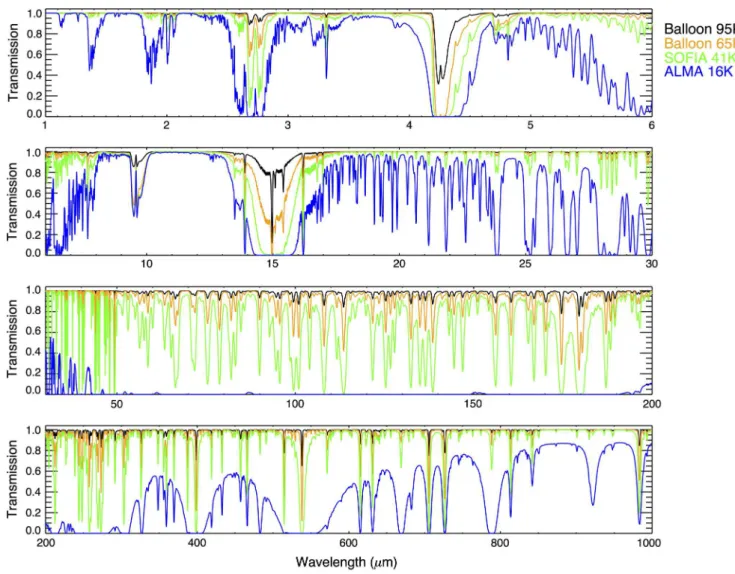
2.1 Ground-BasedFar-infrared astronomy from the ground faces the fundamental limitation of absorption in Earth’s atmosphere, primarily by water vapor. The atmosphere is mostly opaque in the midin-frared through far-inmidin-frared, with only a few narrow wavelength ranges with modest transmission. This behavior is shown in Fig. 1, which compares atmospheric transmission for ground-based observing, observing from Stratospheric Observatory for Infrared Astronomy (SOFIA) (Sec.2.2), with two higher alti-tudes that are accessible by balloon-based platforms. The diffi-culties of observing from the ground at infrared wavelengths are evident. Moreover, the transmissivity and widths of these win-dows are heavily weather-dependent. Nevertheless, there do exist spectral windows at 34, 350, 450, 650, and 850 μm with good, albeit weather-dependent transmission at dry, high-alti-tude sites, with a general improvement toward longer wave-lengths. At wavelengths longward of about 1 mm, there are large bands with good transmission. These windows have enabled an
extensive program of ground-based far-infrared astronomy, using both single-dish and interferometer facilities.
2.1.1 Single-dish facilities
Single-dish telescopes dedicated to far-infrared through millimeter astronomy have been operated for over 30 years. Examples include the 15-m James Clerk Maxwell Telescope (JCMT), the 12-m Caltech Submillimeter Observatory (CSO, closed September 2015), the 30-m telescope operated by the Institut de Radioastronomie Millimétrique (IRAM), the 12-m Atacama Pathfinder Experiment (APEX), the 50-m Large Millimeter Telescope (LMT) in Mexico, the 10-m Submillimeter Telescope (formerly the Heinrich Hertz SMT) in Arizona, and the 10-m South Pole Telescope. These facilities have made major scien-tific discoveries in almost every field of astronomy, from planet formation to high-redshift galaxies. They have also provided stable development platforms, resulting in key advances in detector technology, and pioneering techniques that subsequently found applications in balloon-borne and space missions.
There is an active program of ground-based single-dish far-infrared astronomy, with current and near-future single-dish telescopes undertaking a range of observation types, from wide-field mapping to multiobject wideband spectroscopy. This, in turn, drives a complementary program of technology develop-ment. In general, many applications for single-dish facilities motivate development of detector technologies capable of very large pixel counts (Sec.5.1). Similarly, large pixel counts are envisioned for planned space-based far-infrared observatories, including the Origins Space Telescope (OST; see Sec. 3.3). As far-infrared detector arrays have few commercial applica-tions, they must be built and deployed by the science community itself. Thus, ground-based instruments represent a vital first step toward achieving NASA’s long-term far-infrared goals.
We here briefly describe two new ground-based facilities: CCAT-prime (CCAT-p), and the LMT:
CCAT-p: It is a 6-m telescope at 5600-m altitude, near the summit of Cerro Chajnantor in Chile.72CCAT-p is being built by
Cornell University and a German consortium that includes the universities of Cologne and Bonn, and in joint venture with the Canadian Atacama Telescope Corporation. In addition, CCAT-p collaborates with CONICYT and several Chilean universities. The project is funded by a private donor and by the collaborating institutions and is expected to achieve first light in 2021.
The design of CCAT-p is an optimized crossed-Dragone73
system that delivers an 8-deg field of view (FoV) with a nearly flat image plane. At 350 μm, the FoV with adequate Strehl ratio reduces to about 4 deg. The wavelength coverage of the antici-pated instruments will span wavelengths of 350 μm to 1.3 mm. With the large FoV and a telescope surface root mean square of below 10.7 μm, CCAT-p is an exceptional observatory for sur-vey observations. As the 200 μm zenith transmission is ≥10% in the first quartile at the CCAT-p site,74 a 200 μm observing capability will be added in a second-generation upgrade.
The primary science drivers for CCAT-p are (1) tracing the epoch or reionization via [CII] intensity mapping; (2) studying the evolution of galaxies at high redshifts; (3) investigating dark energy, gravity, and neutrino masses via measurements of the Sunyaev–Zel’dovich effect; and (4) studying the dynamics of the ISM in the Milky Way and nearby galaxies via high spectral resolution mapping of fine structure and molecular lines.
CCAT-p will host two facility instruments: the CCAT Heterodyne Array Instrument (CHAI), and the direct detection
instrument Prime-Cam (P-Cam). CHAI is being built by the University of Cologne and will have two focal plane arrays that simultaneously cover the 370- and 610-μm bands. The arrays will initially have 8 × 8 elements, with a planned expan-sion to 128 elements each. The direct detection instrument P-Cam, which will be built at Cornell University, will encompass seven individual optic tubes. Each tube has a FoV of about 1.3 deg. For first light, three tubes will be available: (1) a four-color, polarization-sensitive camera with 9000 pixels that simul-taneously covers the 1400-, 1100-, 850-, and 730-μm bands; (2) a 6000-pixel Fabry–Pérot spectrometer; and (3) a 18,000-pixel camera for the 350-μm band.
LMT: The LMT is a 50-m diameter telescope sited at 4600 m on Sierra Negra in Mexico. The LMT has a FoV of 4′ and is optimized for maximum sensitivity and small beam size at far-infrared and millimeter wavelengths. It too will benefit from large-format new instrumentation in the coming years. A notable example is TolTEC, a wide-field imager operating at 1.1, 1.4, and 2.1 mm, and with an anticipated mapping speed at 1.1 mm of 12 deg2mJy−2hour−1 (Table1). At 1.1 mm, the
TolTEC beam size is anticipated to be ∼500, which is smaller
than the 6″ beam size of the 24 μm Spitzer extragalactic survey
maps. As a result, the LMT confusion limit at 1.1 mm is pre-dicted to be ∼0.1 mJy, thus making LMT capable of detecting sources with star formation rates below 100 M⊙year−1at z ∼ 6.
This makes TolTEC an excellent “discovery machine” for high-redshift obscured galaxy populations. As a more general exam-ple of the power of new instruments mounted on single-aperture ground-based telescopes, a ∼100-object steered-beam multi-object spectrometer mounted on the LMT would exceed the abilities of any current ground-based facility, including Atacama large millimeter/submillimeter array (ALMA), for sur-vey spectroscopy of galaxies, and would require an array of ∼105.5 pixels.
2.1.2 Interferometry
Interferometry at far-infrared wavelengths is now routinely pos-sible from the ground and has provided order of magnitude improvements in spatial resolution and sensitivity over single-dish facilities. Three major ground-based far-infrared/millimeter interferometers are currently operational. The NOEMA array (the successor to the IRAM Plateau de Bure interferometer) consists of nine 15-m dishes at 2550-m elevation in the French
Fig. 1 Atmospheric transmission over 1 to 1000 μm.71The curves for ALMA and SOFIA are computed
with a 35-deg telescope zenith angle. The two balloon profiles are computed with a 10-deg telescope zenith angle. The PWV for ALMA (5060 m), SOFIA (12,500 m), and the 19,800- and 29,000-m altitudes are 500, 7.3, 1.1, and 0.2 μm, respectively. The data are smoothed to a resolution of R ¼ 2000.
Alps. The submillimeter array (SMA) consists of eight 6-m dishes on the summit of Mauna Kea in Hawaii (4200-m eleva-tion). Both NOEMA and the SMA are equipped with hetero-dyne receivers. NOEMA has up to 16-GHz instantaneous bandwidth, whereas the SMA has up to 32 GHz of instantaneous bandwidth (or 16 GHz with dual polarization) with 140-KHz uniform spectral resolution.
Finally, the ALMA is sited on the Chajnantor Plateau in Chile at an elevation of 5000 m. It operates from 310 to 3600 μm in eight bands covering the primary atmospheric windows. ALMA uses heterodyne receivers based on supercon-ductor–insulator–superconductor (SIS) mixers in all bands, with 16-GHz maximum instantaneous bandwidth split across two polarizations and four basebands. ALMA consists of two arrays: the main array of fifty 12-m dishes (of which typically 43 are in use at any one time), and the Morita array (also known as the
Atacama Compact Array), which consists of up to twelve 7-m dishes and up to four 12-m dishes equipped as single-dish telescopes.
At the ALMA site (which is the best of the three ground-based interferometer sites), the precipitable water vapor (PWV) is below 0.5 mm for 25% of the time during the five best observing months (May to September). This corresponds to a transmission of about 50% in the best part of the 900-GHz window (ALMA band 10). In more typical weather (PWV¼ 1 mm), the transmission at 900 GHz is 25%.
There are plans to enhance the abilities of ALMA over the next decade by (1) increasing the bandwidth, (2) achieving finer angular resolutions, (3) improving wide-area mapping speeds, and (4) improving the data archive. The primary improvement in bandwidth is expected to come from an upgrade to the ALMA correlator, which will effectively double the instantaneous
Table 1 Selected examples of sensitivities achieved by far-infrared to millimeter-wave detector arrays, along with some required for future missions. Observatory and instrument Waveband μm Aperture meters Taper K Tdet K NEP W∕ ffiffiffiffiffiffi Hz p Detector technology Detector count Notes JCMT–SCUBA 450/850 15 275 0.1 2 × 10⁻¹⁶ Bolometers 91/36 JCMT–SCUBA2 450/850 15 275 0.1 2 × 10⁻¹⁶ TES 5000/5000 APEX–ArTeMis 200 to 450 12 275 0.3 4.5 × 10⁻¹⁶ Bolometers 5760 APEX–A-MKID 350/850 12 275 0.3 1 × 10⁻¹⁵ KIDs 25,000 APEX–ZEUS-2 200 to 600 12 275 0.1 4 × 10⁻¹⁷ TES 555 R ∼ 1000
CSO–MAKO 350 10.4 275 0.2 7 × 10⁻¹⁶ KIDs 500 Low-$/pix
CSO–Z-Spec 960 to 1500 10.4 275 0.06 3 × 10⁻¹⁸ Bolometers 160
IRAM–NIKA2 1250/2000 30 275 0.1 1.7 × 10⁻¹⁷ KIDs 4000/1000
LMT–TolTEC 1100 50 275 0.1 7.4 × 10⁻¹⁷ KIDs 3600 Also at 1.4, 2.1 mm
SOFIA–HAWC+ 40 to 250 2.5 240 0.1 6.6 × 10⁻¹⁷ TES 2560
SOFIA–HIRMES 25 to 122 2.5 240 0.1 2.2 × 10⁻¹⁷ TES 1024 Low-res channel
BLAST–TNG 200 to 600 2.5 240 0.3 3 × 10⁻¹⁷ KIDs 2344
Herschel–SPIRE 200 to 600 3.5 80 0.3 4 × 10⁻¹⁷ Bolometers 326
Herschel–PACS bol. 60 to 210 3.5 80 0.3 2 × 10⁻¹⁶ Bolometers 2560
Herschel–PACS phot. 50 to 220 3.5 80 1.7 5 × 10⁻¹⁸ Photoconductors 800 R ∼ 2000
Planck–HFI 300 to 3600 1.5 40 0.1 1.8 × 10⁻¹⁷ Bolometers 54
SuperSpec 850 to 1600 — N/A 0.1 1.0 × 10⁻¹⁸ KIDs ∼102
R ≲ 700 SPACEKIDS — — N/A 0.1 3 × 10⁻¹⁹ KIDs 1000
SPICA–SAFARI 34 to 210 3.2 <6 0.05 2 × 10⁻¹⁹ 4000
SPIRIT 25 to 400 1.4 4 0.05 1 × 10⁻¹⁹ ∼102
OST–imaging 100 to 300 5.9 to 9.1 4 0.05 2 × 10⁻¹⁹ ∼105
OST–spectroscopy 100 to 300 5.9 to 9.1 4 0.05 2 × 10⁻²⁰ ∼105
R ∼ 500 Note: Requirements for the SPICA/SAFARI instrument are taken from Ref.75. Requirements for the SPIRIT interferometer (whose aperture is the effective aperture diameter for an interferometer with two 1-m diameter telescopes) are taken from Ref.76.
bandwidth and increase the number of spectral points by a factor of 8. This will improve ALMA’s continuum sensitivity by a fac-tor ffiffiffi
2 p
and will make ALMA more efficient at line surveys. Further bandwidth improvements include the addition of a receiver covering 35 to 50 GHz (ALMA band 1, expected in 2022) and 67 to 90 GHz (ALMA band 2). To improve angular resolution, studies are underway to explore the optimal number and placement of antennas for baseline lengths of up to tens of kilometers. Other possible improvements include increasing the number of antennas in the main array to 64, the incorporation of focal-plane arrays to enable wider field imaging, and improve-ments in the incorporation of ALMA into the global very long baseline interferometry network.
2.2 Stratospheric Observatory for Infrared Astronomy
The SOFIA77is an effective 2.5-m diameter telescope mounted
within a Boeing 747SP aircraft that flies at altitudes of 13,700 m to get above over 99.9% of the Earth’s atmospheric water vapor. The successor to the Learjet observatory and NASA’s Kuiper Airborne Observatory (KAO), SOFIA saw first light in May 2010, began prime operations in May 2014, and offers ∼600 h per year for community science observations.78SOFIA is the only existing public observatory with access to far-infrared wavelengths inaccessible from the ground, though CMB polari-zation studies at millimeter wavelengths have also been pro-posed from platforms at similar altitudes to SOFIA.79
SOFIA’s instrument suite can be changed after each flight and is evolvable with new or upgraded instruments as capabil-ities improve. SOFIA is also a versatile platform, allowing for (1) continuous observations of single targets for up to 5 h, (2) repeated observations over multiple flights in a year, and (3) in principle, observations in the visible though millimeter-wavelength range. Example flight paths for SOFIA are shown in Fig.2. Each flight path optimizes observing conditions (e.g., elevation, percentage of water vapor, and maximal on-tar-get integration time). SOFIA can be positioned to where the sci-ence needs, enabling all-sky access. Annually, SOFIA flies from Christchurch, New Zealand, to enable Southern Hemisphere observations.
SOFIA’s instruments include the 5- to 40-μm camera and grism spectrometer FORCAST,80,81the high-resolution (up to
R¼ λ∕Δλ ¼ 100;000) 4.5- to 28.3-μm spectrometer EXES,82
the 51- to 203-μm integral field spectrometer FIFI-LS,83 the
50- to 203-μm camera and polarimeter HAWC,84 and the R∼ 108 heterodyne spectrometer GREAT.85,86The
first-gener-ation HIPO87 and FLITECAM88 instruments retired in early
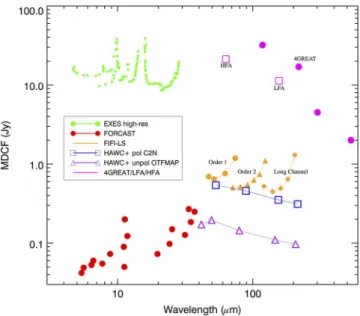
2018. The sensitivities of these instruments as a function of wavelength are presented in Fig. 3. Upgrades to instruments over the past few years have led to new science capabilities, such as adding a polarimetry channel to HAWC (HAWC+89), and including larger arrays and simultaneous channels on GREAT (upGREAT90 & 4GREAT, commissioned in 2017),
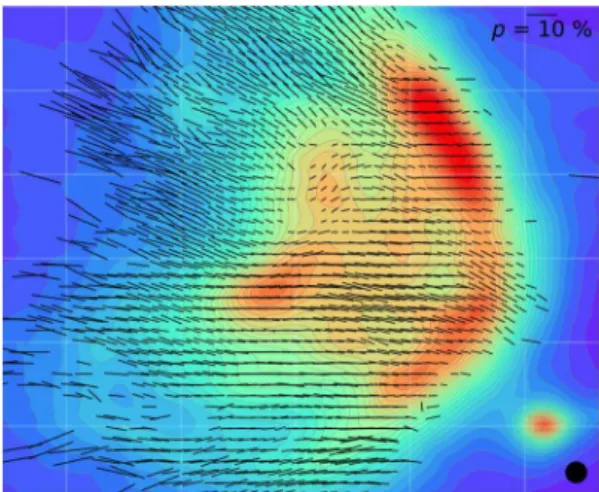
making it into an efficient mapping instrument. Figure4shows early polarimetry measurements from HAWC+.
Given the versatility and long-term nature of SOFIA, there is a continuous need for more capable instruments throughout SOFIA’s wavelength range. However, the unique niche of SOFIA, given its warm telescope and atmosphere, the imminent era of the James Webb Space Telescope (JWST), and ever more capable ground-based platforms, is high-resolution spec-troscopy. This is presently realized with two instruments (GREAT and EXES). An instrument under development, the
Fig. 2 (a) The world’s largest flying infrared astronomical observatory, SOFIA (Sec.2.2). (b) Two flight plans, originating from SOFIA’s prime base in Palmdale, California. In a typical 8- to 10-h flight, SOFIA can observe one to five targets.
Fig. 3 The continuum sensitivities, as a function of wavelength, of SOFIA’s mid- to far-infrared instrument suite. Shown are the 4σ mini-mum detectable continuum flux densities for point sources in janskys for 900 s of integration time.
high-resolution midinfrared spectrometer (HIRMES), scheduled for commissioning in 2019, will enhance SOFIA’s high-resolu-tion spectroscopy capabilities. HIRMES covers 25 to 122 μm, with three spectroscopic modes (R¼ 600, R ¼ 10;000, and R¼ 100;000), and an imaging spectroscopy mode (R ¼ 2000). As SOFIA can renew itself with new instruments, it provides both new scientific opportunities and maturation of technology to enable future far-infrared space missions. SOFIA offers a 20-kVA cryocooler with two compressors capable of servicing two cold heads. The heads can be configured to operate two cryo-stats or in parallel within one cryostat to increase heat-pumping capacity, with second-stage cooling capacity of Q2 ≥ 800 mW at 4.2 K and first-stage cooling capacity of Q1 ≥ 15 W at 70 K. Instruments aboard SOFIA can weigh up to 600 kg, excluding the instrument electronics in the counterweight rack and PI Rack (s), and can draw power up to 6.5 kW. Their volume is limited by the aircraft’s door access and must fit within the telescope assembly constraints.
Capabilities that would be invaluable in a next-generation SOFIA instrument include, but are not limited to, the following:
• Instruments with ≥100 beams that enable low- to high-resolution spectroscopy (up to sub − kms−1velocity
res-olution) from 30 to 600 μm. This would enable large-area, velocity-resolved spectral line maps of key fine-structure transitions in giant molecular clouds and complement the wavelengths accessible by JWST and ground-based tele-scopes. The current state of the art in SOFIA is upGREAT LFA: 14 beams, 44 kHz channel spacing.
• Medium- to wide-band imaging and imaging polarimetry from 30 to 600 μm, with 104−5pixels and FoVs of tens of
arcminutes. The current state of the art in SOFIA is HAWC+, with a 64 × 40 pixel array and a largest possible FoV of 8.00×6.10.
• High spectral resolution (R¼ 4000 to 100,000) 5 to
30 μm mapping spectroscopy with factor≥3 and greater observation efficiency and sensitivity than EXES. This would complement JWST, which observes in the same
wavelength range but at R < 3300 with the midinfrared instrument (MIRI). Such an instrument on SOFIA could then identify the molecular lines that JWST may detect but not spectrally resolve. The current state of the art in SOFIA is EXES, with R ∼ 100;000 and sensitivitiesð10σ; 100sÞ of 10 Jy at 10 μm; 20 Jy at 20 μm (NELB, 10σ, 100 s: 1.4 × 10⁻⁶Wm−2sr−1 at 10 μm; 7.0 × 10⁻⁷W m−2sr−1 at
20 μm).
• High-resolution (R ∼ 100;000) spectroscopy at 2.5 to 8 μm, to identify several gas-phase molecules. These mol-ecules are not readily accessible from the ground (Fig.1) and cannot be reliably identified by JWST as its near-infrared spectrometer NIRSpec only goes up to R¼ 2700. Currently, SOFIA does not have such an instrument.
• A wide-field, high-resolution integral-field spectrometer covering 30 to 600 μm. This would allow rapid, large-area, spectrally-resolved mapping of fine structure lines in the Milky Way, and integral field-spectroscopy of nearby galaxies. The current state of the art in SOFIA is FIFI-LS, with FoV 12″ over 115 to 203 μm and with FoV 6″ over 51 to 120 μm.
• A broadband, wide-field, multiobject spectrograph, with resolution R¼ 103− 104 and up to 1000 beams, over
30 to 300 μm. Such an instrument could map the velocity fields in galaxies or star-forming regions with enough beams to allow mapping of complex regions. SOFIA currently does not have any multiobject spectroscopic capability.
• An instrument to characterize exoplanet atmospheres: an
ultraprecise spectroimager optimized for bands not avail-able from the ground and with sufficient FoV to capture simultaneous reference stars to decorrelate time-variable effects. JWST’s and European Space Agency (ESA)’s ARIEL mission will also contribute to this science. SOFIA currently does not have this capability. However, during early science with first-generation instruments, SOFIA demonstrated that it could measure atmospheres with transiting exoplanets with performance similar to existing ground assets.
• A mid/far-infrared spectropolarimeter. Spectropolarimetric observations of the relatively unexplored 20 μm silicate feature with SOFIA would be a unique capability and allow for, e.g., new diagnostics of the chemistry and com-position of protoplanetary disks. SOFIA currently does not have a polarimetry shortward of 50 μm.
Other possible improvements to the SOFIA instrument suite include: (1) upgrading existing instruments (e.g., replacing the FIFI-LS germanium photoconductors to achieve finer spatial sampling through higher multiplexing factors), and (2) instru-ments that observe in current gaps in SOFIA wavelength cover-age (e.g., 1 to 5 μm, 90 to 150 μm, and 210 to 310 μm).
More general improvements include the ability to swap instruments faster than a 2-day timescale, or the ability to mount multiple instruments. Mounting multiple instruments improves observing efficiency if both instruments can be used on the same source, covering different wavelengths or capabil-ities. This would also allow for flexibility to respond to targets of opportunity, time domain, or transient phenomena, and increase flexibility as a development platform to raise technology read-iness levels (TRLs91,92) of key technologies.
Fig. 4 The 89 μm image (intensity represented by color) with polari-zation measurements at the same wavelength (black lines), taken using HAWC+ on SOFIA, of ρ-ophiucus (courtesy of Fabio Santos, Northwestern University, Illinois). The length of the line is the degree of polarization. The SOFIA beam size is 7.8″, which is indicated by the black circle in the lower right.
2.3 Scientific Ballooning
Balloon-based observatories allow for observations at altitudes of up to ∼40;000 m (130,000 ft). At these altitudes, <1% of the atmosphere remains above the instrument, with negligible water vapor. Scientific balloons, thus, give access, relatively cheaply, to infrared discovery space that is inaccessible to any ground-based platform, and in some cases even to SOFIA. For example, several key infrared features are inaccessible even at aircraft alti-tudes (Fig.1), including low-energy water lines and the [N II] 122-μm line. Scientific ballooning is, thus, a valuable resource for infrared astronomy. Both standard balloons, with flight times of 24 h, and long duration balloons (LDBs) with typical flight times of 7 to 15 days (though flights have lasted as long as 55 days) have been used. Balloon projects include the Balloon-borne Large Aperture Submillimeter Telescopes (BLAST93–95),
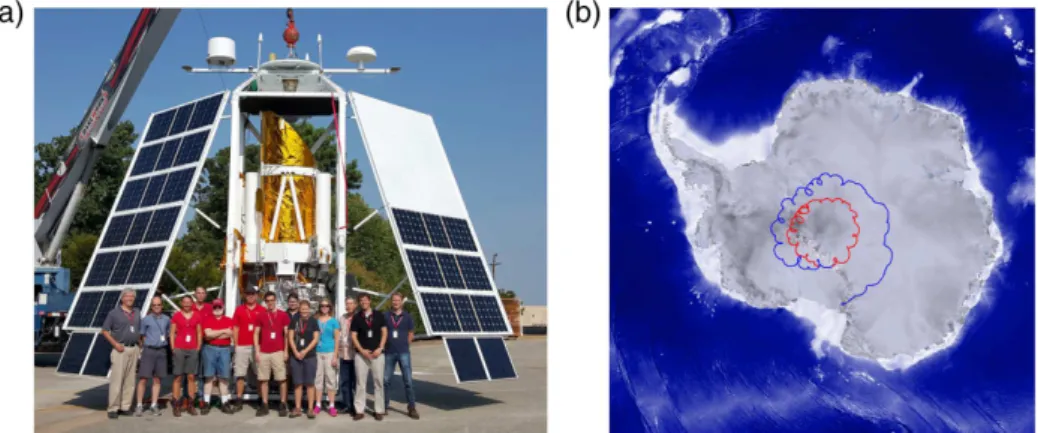
PILOT,96 the Stratospheric Terahertz Observatory97 (Fig. 5),
and Far-Infrared Interferometric Telescope Experiment (FITE)99and Balloon Experimental Twin Telescope for Infrared Interferometry (BETTII),100 both described in Sec. 4.1.
Approved future missions include GUSTO, scheduled for launch in 2021. With the development of ultra-LDBs (ULDBs), with potential flight times of over 100 days, new possibilities for far-infrared observations have become available.
A further advantage of ballooning, in a conceptually similar manner to SOFIA, is that the payloads are typically recovered and available to refly on ∼1-year timescales, meaning that bal-loons are a vital platform for technology development and TRL raising. For example, far-infrared direct-detector technology shares many common elements (detection approaches, materi-als, and readouts) with CMB experiments, which are conducted on the ground,101–103from balloons,104–106 and in space. These
platforms have been useful for developing bolometer and read-out technology applicable to the far-infrared.
All balloon projects face challenges, as the payload must include the instrument and all of the ancillary equipment needed to obtain scientific data. For ULDBs, however, there are two additional challenges:
Payload mass: Whereas zero-pressure balloons (including LDBs) can lift up to about 2700 kg, ULDBs have a mass limit of about 1800 kg. Designing a payload to this mass limit is non-trivial, as science payloads can have masses in excess of
2500 kg. For example, the total mass of the GUSTO gondola is estimated to be 2700 kg.
Cooling: All far-infrared instruments must operate at cryo-genic temperatures. Liquid cryogens have been used for instru-ments on both standard and LDBs, with additional refrigerators (e.g.,3He, adiabatic demagnetization) to bring detector arrays
down to the required operating temperatures, which can be as low as 100 mK. These cooling solutions typically operate on timescales commensurate with LDB flights. For the ULDB flights, however, it is not currently possible to achieve the nec-essary cryogenic hold times. Use of mechanical coolers to pro-vide first-stage cooling would solve this problem, but current technology does not satisfy the needs of balloon missions. Low-cost cryocoolers for use on the ground are available, but have power requirements that are hard to meet on balloons, which currently offer total power of up to about 2.5 kW. Low-power cryocoolers exist for space use, but their cost (typ-ically ≳1M) does not fit within typical balloon budgets. Cryocoolers are discussed in detail in Sec.5.5.
In addition to addressing the challenges described above, there exist several avenues of development that would enhance many balloon experiments. Three examples are as follows:
• Large aperture, lightweight mirrors for 50 to 1000 μm observing (see also Sec.5.7).
• Common design templates for certain subsystems, such as star cameras, though attempting to standardize on gondola designs would be prohibitively expensive as most systems are still best implemented uniquely for each payload.
• Frameworks to enhance the sharing of information, tech-niques, and approaches. Although balloon experiments are in general more “PI-driven” than facility-class observatories (as much of the hardware is custom-built for each flight), there does exist a thriving user community in ballooning, within which information and ideas are shared. Nurturing the sharing of information would help in developing this community further. The PI-driven bal-loon missions also serve as pathfinders for larger facilities, as was the case for BLAST and Herschel, and thus may lay the groundwork for a future “general observatory”-class balloon mission.
Fig. 5 (a) The STO balloon observatory and science team, after the successful hang test in the Columbia Scientific Balloon Facility in Palestine, Texas, in August 2015. This image originally appeared on the Netherlands Institute for Space Research (SRON) STO website. (b) The second science flight of the STO took place from McMurdo in Antarctica on December 8, 2016, with a flight time of just under 22 days. This image was taken from Ref.98.
2.4 Short Duration Rocket Flights
Sounding rockets inhabit a niche between high-altitude balloons and fully orbital platforms, providing 5 to 10 min of observation time above the Earth’s atmosphere, at altitudes of 50 to ∼1500 km. They have been used for a wide range of astrophysi-cal studies, with a heritage in infrared astronomy stretching back to the 1960s.107–110
Though an attractive way to access space for short periods, the mechanical constraints of sounding rockets are limiting in terms of size and capability of instruments. However, sounding rockets observing in the infrared are flown regularly,111 and
rockets are a viable platform for both technology maturation and certain observations in the far-infrared. In particular, measurements of the absolute brightness of the far-infrared sky, intensity mapping, and development of ultra-low-noise far-infrared detector arrays are attractive applications of this platform.
Regular access to sounding rockets is now a reality, with the advent of larger, more capable Black Brant XI vehicles to be launched from southern Australia via the planned Australian NASA deployment in 2019–2020. Similarly, there are plans for recovered flights from Kwajalein Atoll using the recently tested NFORCE water recovery system. Long-dura-tion sounding rockets capable of providing limited access to orbital trajectories and >30- min observation times have been studied,112and NASA is continuing to investigate this possibil-ity. However, no missions using this platform are currently planned, and as a result the associated technology development is moving slowly.
3
Observatories: Space-Based
All atmospheric-based observing platforms, including SOFIA and balloons, suffer from photon noise from atmospheric emis-sion. Even at balloon altitudes, of order 1% emissivity on aver-age through the far-infrared remains from residual water vapor, which can contaminate astrophysical water lines, unless they are shifted by velocities of at least a few tens of km s−1. The
tele-scope optics is another source of loading, with an unavoidable 2% to 4% emissivity. Though the total emissivity can be <5%, these ambient-temperature (∼250 K) background sources domi-nate that of the zodiacal and galactic dusts. Space-based plat-forms are, thus, for several paths of inquiry, the only way to perform competitive infrared observations.
There exists a rich history of space-based mid/far-infrared observatories (Fig.6), including Infrared Atmospheric Sounder (IRAS),113 Midcourse Space Experiment,114 the Infrared Telescope in Space,115 Infrared Space Observatory (ISO)116
Submillimeter Wave Astronomy Satellite (SWAS)117 Odin,118
Akari,119 Herschel,120 Wide-Field Infrared Survey Explorer,121
and Spitzer.122 Far-infrared detector arrays are also used on space-based CMB missions, with past examples, including Planck,123 Wilkinson microwave anisotropy probe,124 and
Cosmic Background Explorer,125,126 as well as concepts, such
as primordial inflation explorer,127 LiteBIRD,128 and Cosmic
Origins Explorer.129
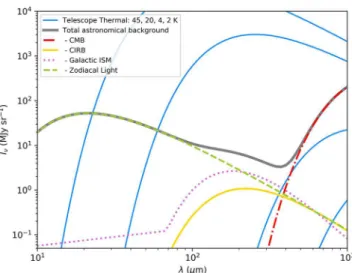
It is notable, however, that the performance of many past and present facilities is limited by thermal emission from telescope optics (Fig. 7). The comparison between infrared telescopes operating at 270 K and temperatures of a few kelvins is
Fig. 6 Four examples of satellites that observe at mid/or far-infrared wavelengths (Sec.3). (a) Spitzer and Herschel and (b) Planck and JWST, which also use V-groove radiators (thermal shields) to achieve passive cooling up to <40 K.
analogous to the comparison between the sky brightness during the day and at night in the optical. Even with Herschel and its ∼85 K telescope, the telescope emission was the dominant noise term for both its Photodetector Array Camera and Spectrometer (PACS133) and Spectral and Photometric Imaging Receiver
(SPIRE134). Thus, the ultimate scientific promise of the far-infra-red is in orbital missions with actively cooled telescopes and instruments. Cooling the telescope to a few kelvins effectively eliminates its emission through most of the far-infrared band. When combined with appropriate optics and instrumentation, this results in orders-of-magnitude improvement in discovery speed over what is achievable from atmospheric-based plat-forms (Figs.8and9). A “cold” telescope can bring sensitivities at observed frame of 30 to 500 μm into parity with those at shorter (JWST) and longer (ALMA) wavelengths.
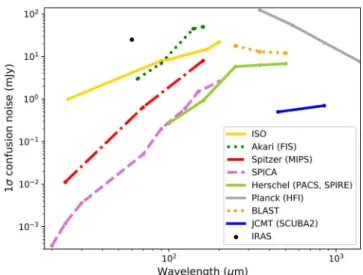
A further limiting factor is source confusion—the fluctuation level in image backgrounds below which individual sources can no longer be detected. Unlike instrument noise, confusion noise cannot be reduced by increasing integration time. Source con-fusion can arise from both smooth diffuse emission and fluctua-tions on scales smaller than the beam size of the telescope. Outside of the plane of the Milky Way, the primary contributors to source confusion are structures in Milky Way dust emissions, individually undetected extragalactic sources within the tele-scope beam, and individually detected sources that are blended with the primary source. Source confusion is, thus, a strong function of the location on the sky of the observations, the tele-scope aperture, and observed wavelength. Source confusion is a concern for all previous and current single-aperture infrared
Fig. 7 A comparison between the primary astrophysical continuum backgrounds at infrared wavelengths (the Cosmic Microwave Background,130 the Cosmic Infrared Background,126 Galactic ISM
emission,131and Zodiacal emission from interplanetary dust132) and
representative thermal emission from telescope optics at three temperatures, assuming uniform thermal emissivity of 4%. The astro-physical backgrounds assume observations outside the atmosphere toward high ecliptic and galactic latitudes, and at a distance of 1 AU from the Sun. The advantages of “cold” telescope optics are apparent; at 300 μm the thermal emission from a 4-K telescope is 5 orders of magnitude lower than for a telescope at 45 K and enables the detec-tion of the CIRB, Galactic ISM, and zodiacal light.
Fig. 8 Detector sensitivity requirements to meet photon background levels in the far-infrared. With a cryogenic space telescope, the fun-damental limits are the zodiacal dust and galactic cirrus emission, and the photon noise-level scales as the square root of the bandwidth. Of particular interest is the requirement for moderate-resolution disper-sive spectroscopy (blue). Also shown are detector sensitivity mea-surements for the TES, KID, and QCD technologies described in Sec.5.1. The magenta dotted line shows the photon-counting thresh-old at 100 Hz: a device that can identify individual photons at this rate (photon counting) at high efficiency is limited by the dark count rate rather than classical NEP.
Fig. 9 A comparison of the times required to perform a blank-field spatial-spectral survey reaching a depth of 10−19W m−2 over one
square degree, as a function of wavelength, for various facilities. This figure uses current estimates for sensitivity, instantaneous bandwidth covered, telescope overheads, and instantaneous spatial coverage on the sky. The OST curves assume R ¼ 500 grating spectrometers with 60 to 200 beams (depending on wavelength), 1:1.5 instantaneous bandwidth. Pixels are assumed to operate with a NEP of 2 × 10⁻²⁰WHz−1∕2. The SPICA/SAFARI-G curve is for a
2.5-m telescope with R ¼ 300 grating spectrometer modules with four spatial beams, and detector arrays with a NEP of 2 × 10⁻¹⁹WHz−1∕2.
ST30 is a ground-based 30-m telescope with 100 spectrometer beams, each with 1:1.5 bandwidth, ALMA band-averaged sensitivity, and survey speed based on 16 GHz bandwidth in the primary beam.
telescopes, especially space-based facilities whose apertures are modest compared to ground-based facilities. A summary of the confusion limits of some previous infrared telescopes is given in Fig.10.
A related concept is line confusion, which is caused by the blending and overlapping of individual lines in spectral line sur-veys. Although this is barely an issue in, e.g., H I surveys as the 21-cm H I line is bright and isolated,142it is potentially a perni-cious source of uncertainty at far-infrared wavelengths, where there are a large number of bright spectral features. This is true in galactic studies143 and in extragalactic surveys. Carefully
chosen spatial and spectral resolutions are required to minimize line confusion effects.144
Several approaches have been adopted to extract information on sources below the standard confusion limit. They include detection methods applied to single-band maps,145 the use of prior positional information from higher spatial resolution images to deconvolve single far-infrared sources,146,147and
com-bination of priors on positions with priors from SED modeling.148,149 Finally, the spatial–spectral surveys from upcoming facilities such as SAFARI on Space Infrared Telescope for Cosmology and Astrophysics (SPICA) or the OST Survey Spectrometer on the OST should push significantly below the classical confusion limit by including spectral infor-mation to break degeneracies in the third spatial dimension.150
There are two further challenges that confront space-based far-infrared observatories, which are unfamiliar to suborbital platforms:
Dynamic range: Moving to “cold” telescopes, sensitivity is limited only by the far-infrared sky background. We enter a regime where the dominant emission arises from the sources under study, and the sky has genuinely high contrast. This imposes a new requirement on the detector system—to observe the full range of source brightness—that is simple from subor-bital platforms but challenging for cooled space-based plat-forms, as the saturation powers of currently proposed high-resolution detector arrays are within ∼2 orders of magnitude
of their noise equivalent power (NEP is, briefly, the input signal power that results in a signal-to-noise ratio of unity in a 1-Hz bandwidth—the minimum detectable power per square root of bandwidth. Thus, a lower NEP is better. In-depth discussions of the concept of NEP can be found in Refs.151–153.). This would limit observations to relatively faint sources. Dynamic range limitations were even apparent for previous-generation instru-ments such as the multiband imaging photometer onboard spit-zer and PACS onboard Herschel, with saturation limits at 70 μm of 57 and 220 Jy, respectively. Thus, we must either design detector arrays with higher dynamic range or populate the focal plane with detector arrays, each suited to part of the range of intensities.
Interference: The susceptibility of cooled detector arrays to interference from ionizing radiation in space was noted in the development of microcalorimeter arrays for x-ray telescopes.154–156Moreover, this susceptibility was clearly
dem-onstrated by the bolometers on Planck. An unexpectedly high rate and magnitude of ionizing radiation events were a major nuisance for this mission, requiring corrections to be applied to nearly all of the data. Had this interference been a factor of ∼2 worse, it would have caused significant loss of science return from Planck. Techniques are being developed and demonstrated to mitigate this interference for x-ray microcalorimeters by the addition of a few-micron-thick layer of gold on the back of the detector frame. It is likely that a similar approach can mitigate interference in high-resolution far-infrared detector arrays as well. Moreover, work on reducing interference in far-infrared detector arrays is being undertaken in the SPACEKIDS program (Sec.5.1.2).
NASA, the ESA, and the Japan Aerospace Exploration Agency (JAXA), in collaboration with astronomers and technol-ogists around the world, are studying various options for cryo-genic space observatories for the far-infrared. There are also opportunities to broaden the far-infrared astrophysics domain to new observing platforms. We give an overview of these space-based observing platforms in the following sections. We do not address the JWST, as comprehensive overviews of this facility are given elsewhere.157 We also do not review
non-U.S./E.U. projects, such as Millimetron/Spektr-M.158,159
3.1 Space Infrared Telescope for Cosmology and Astrophysics
First proposed by JAXA scientists in 1998, the SPICA160–164
garnered worldwide interest due to its sensitivity in the mid-and far-infrared, enabled by the combination of the actively cooled telescope and the sensitive far-infrared detector arrays. Both ESA and JAXA have invested in a concurrent study, and an ESA–JAXA collaboration structure has gelled. ESA will pro-vide the 2.5-m telescope, science instrument assembly, satellite integration and testing, and the spacecraft bus. JAXA will pro-vide the passive and active cooling systems (supporting a tele-scope cooled to below 8 K), cryogenic payload integration, and launch vehicle. JAXA has indicated commitment to their portion of the collaboration, and the ESA selected SPICA as one of the three candidates for the Cosmic Visions M5 mission. The ESA phase-A study is underway now, and the downselect among the three missions will occur in 2021. Launch is envisioned for 2031. An example concept design of SPICA is shown in Fig.11. SPICA will have three instruments. JAXA’s SPICA MIRI will offer imaging and spectroscopy from 12 to 38 μm. It is designed to complement JWST-MIRI with wide-field mapping (broadband and spectroscopic), R ∼ 30;000 spectroscopy with
Fig. 10 A summary of literature estimates of confusion noise levels for selected telescopes. The confusion levels are not calculated with a uniform set of assumptions, but are comparable in that they are applicable to regions of sky away from the galactic plane, and with low galactic cirrus emission. Shown are estimates for IRAS at 60 μm,135 ISO,136 Spitzer,137 Herschel,138 Planck,139,140 Akari,
SPICA,141and JCMT. The confusion limits for interferometers such
an immersion grating, and an extension to 38 μm with anti-mony-doped silicon detector arrays. A polarimeter from a French-led consortium will provide dual-polarization imaging in 2 to 3 bands using high-impedance semiconductor bolometers similar to those developed for Herschel-PACS, but modified for the lower background and to provide differential polarization. A sensitive far-infrared spectrometer, SAFARI, is being pro-vided by an SRON-led consortium.165,166 It will provide
full-band instantaneous coverage over 35 to 230 μm, with a longer wavelength extension under study, using four R¼ 300 grating modules. A Fourier transform module, which can be engaged in front of the grating modules, will offer a boost to the resolving power, up to R¼ 3000. A U.S. team is working in collaboration with the European team and aims to contribute detector arrays and spectrometer modules to SAFARI167 through NASA’s
Mission of Opportunity. 3.2 Probe-Class Missions
Recognizing the need for astronomical observatories beyond the scope of Explorer-class missions but with a cadence more rapid than flagship observatories, such as the Hubble Space Telescope (HST), JWST, and the Wide-Field Infrared Survey Telescope, NASA announced a call for Astrophysics Probe concept studies in 2017. Ten probe concepts were selected in Spring 2017 for 18-month studies. Probe study reports will be submitted to NASA and to the Astro 2020 Decadal Survey to advocate for the creation of a probe observatory line, with budgets of $400 million to $1 billion.
Among the probe concepts under development is the far-infrared Galaxy Evolution Probe (GEP), led by the University of Colorado Boulder and the Jet Propulsion Laboratory. The GEP concept is a two-meter-class, mid/far-infrared observatory with both wide-area imaging and follow-up spectroscopy capa-bilities. The primary aim of the GEP is to understand the roles of star formation and black hole accretion in regulating the growth of stellar and black hole mass. In the first year of the GEP mis-sion, it will detect ≥106 galaxies, including ≳105 galaxies at
z >3, beyond the peak in redshift of cosmic star formation, by surveying several hundred square degrees of the sky. A unique
and defining aspect of the GEP is that it will detect galaxies by bands of rest-frame midinfrared emission from polycyclic aro-matic hydrocarbons (PAHs), which are indicators of star forma-tion, while also using the PAH emission bands and silicate absorption bands to measure photometric redshifts.
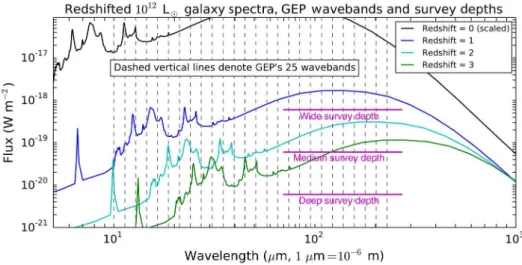
The GEP will achieve these goals with an imager using ∼25 photometric bands spanning 10 μm to at least 230 μm, giving a spectral resolution of R ≃ 8 (Fig.12). Traditionally, an imager operating at these wavelengths on a 2-m telescope would be sig-nificantly confusion-limited, especially at the longer wave-lengths (see e.g., the discussion in the introduction to Sec.3). However, the combination of many infrared photometric bands, and advanced multi-wavelength source extraction techniques, will allow the GEP to push significantly below typical confusion limits. The GEP team is currently simulating the effects of con-fusion on their surveys, with results expected in early 2019. The imaging surveys from the GEP will, thus, enable new insights into the roles of redshift, environment, luminosity, and stellar mass in driving obscured star formation and black hole accretion over most of the cosmic history of galaxy assembly.
In the second year of the GEP survey, a grating spectrometer will observe a sample of galaxies from the first-year survey to identify embedded active galactic nucleus (AGN). The current concept for the spectrometer includes four or five diffraction gratings with R ≃ 250, and spectral coverage from 23 μm to at least 190 μm. The spectral coverage is chosen to enable detec-tion of the high-excitadetec-tion [NeV] 24.2-μm line, which is an AGN indicator, over 0 < z < 3.3, and the [OI] 63.2-μm line, which is predominantly a star formation indicator, over 0 < z 2. Recent advances in the far-infrared detector array technology have made an observatory such as the GEP feasible. It is now possible to fabricate large arrays of sensitive kinetic inductance detectors (KIDs; see Sec. 5.1.2) that have a high-frequency multiplex factor. The GEP concept will likely employ Silicon blocked impurity band arrays (similar to those used on JWST-MIRI) for wavelengths from 10 to 24 μm and KIDs at wavelengths longer than 24 μm. Coupled with a cold (∼4 K) telescope such that the GEP’s sensitivity would be photon-limited by astrophysical backgrounds (Fig. 7), the GEP will detect the progenitors of Milky Way-type galaxies at z¼ 2ð≥ 1012L
⊙Þ. Far-infrared KID sensitivities have reached the
NEPs required for the GEP imaging to be background-limited (3 × 10⁻¹⁹W∕Hz−0.5169,170), although they would need to be
lowered further, by a factor of at least 3, for the spectrometer to be background-limited. The GEP would serve as a pathfinder for the OST (Sec.3.3), which would have a greater reach in red-shift by virtue of its larger telescope. SOFIA and balloons will also serve as technology demonstrators for the GEP and OST. The technology drivers for the GEP center on detector array size and readout technology. Whereas KID arrays with 104− 105pixels are within reach, investment must be made
for the development of low-power-consumption readout tech-nology (Sec.5.1.4). Large KID (or other direct-detection tech-nology) arrays with low-power readouts on SOFIA and balloons would raise their respective TRLs, enabling the GEP and OST. 3.3 Origins Space Telescope
As part of the preparations for the 2020 Decadal Survey, NASA is supporting four studies of flagship astrophysics missions. One of these studies is for a far-infrared observatory. A Science and Technology Definition Team (STDT) is pursuing this study with support from NASA Goddard Space Flight Center (GSFC). The
STDT has settled on a single-dish telescope, and coined the name “Origins Space Telescope.” The OST will trace the history of our origins, starting with the earliest epochs of dust and heavy-element production through to the search for extrasolar biomarkers in the local universe. It will answer textbook-altering questions, such as “How did the universe evolve in response to its changing ingredients?” and “How common are planets that support life?”
Two concepts for the OST are being investigated, based on an Earth-Sun L2 orbit, and a telescope and instrument module actively cooled with 4 K-class cryocoolers. Concept 1 (Fig.13) has an open architecture, similar to that of JWST. It has a deployable segmented 9-m telescope with five instruments covering the mid-infrared through the submillimeter. Concept 2 is smaller and simpler and resembles the Spitzer Space Telescope architecturally. It has a 5.9-m diameter telescope (with the same light collecting area as JWST) with no deploy-able components. Concept 2 has four instruments, which span the same wavelength range and have comparable spectroscopic and imaging capabilities as the instruments in concept 1.
Because OST would commence in the middle of the next de-cade, improvements in far-infrared detector arrays are antici-pated, both in per-pixel sensitivity and array format, relative to what is currently mature for spaceflight (Sec.5.1). Laboratory demonstrations, combined with initial OST instrument studies which consider the system-level readout requirements, suggest that total pixel counts of 100,000 to 200,000 will be possible, with each pixel operating at the photon background limit. This is a huge step forward over the 3200 pixels total on Herschel PACS and SPIRE, and the ∼4000 pixels anticipated for SPICA.
The OST is studying the impact of confusion on both wide-and deep-survey concepts. Their approach is as follows. First, a model of the far-infrared sky is used to generate a three-dimen-sional (3-D) hyperspectral data cube. Each slice of the cube is then convolved with the telescope beam, and the resulting cube is used to conduct a search for galaxies with no information given on the input catalogs. Confusion noise is then estimated by comparing the input galaxy catalog to the recovered galaxy catalog. The results from this work are not yet available, but this approach is a significant step forward in robustness compared to prior methods.144
3.4 CubeSats
CubeSats are small satellites built in multiples of 1U (10 cm × 10 cm × 10 cm, <1.33 kg). Because they are launched within containers, they are safe secondary payloads, reducing the cost of launch for the payload developer. In addition, a large ecosystem of CubeSat vendors and suppliers is available, which further reduces costs. CubeSats, thus, provide quick, affordable access to space, making them attractive technology pathfinders and risk mitigation missions toward larger observa-tories. Moreover, according to a 2016 National Academies report,171CubeSats have demonstrated their ability to perform
high-value science, especially via missions to make a specific measurement, and/or that complement a larger project. To date, well over 700 CubeSats have been launched, most of them 3Us.
Fig. 12 A mid/far-infrared galaxy spectrum, the GEP photometric bands, and notional survey depths. The spectrum is a model of a star-forming galaxy168exhibiting strong PAH features and far-infrared
dust continuum emission. The black spectrum is the galaxy at a redshift of z ¼ 0, but scaled vertically by a luminosity distance corresponding to z ¼ 0.1 to reduce the plot range. The same spectrum is shown at redshifts z ¼ 1, 2, and 3. The vertical dashed lines mark the GEP photometric bands. As the galaxy spectrum is redshifted, the PAH features move through the bands, enabling photometric redshift mea-surements. This figure does not include the effects of confusion noise.
Fig. 13 A concept image for the proposed OST (Sec.3.3). This image shows a design for the more ambitious “concept 1.” The design includes nested sunshields and a boom, in which the instrument suite is located. The color coding of the image gives a qualitative indi-cation of telescope temperature.