Automated Semantic Correlation between
Multiple Schema for Information Exchange
by
David Wang
Submitted to the Department of Electrical Engineering and Computer Science
in partial fulfillment of the requirements for the Degrees of
Master of Engineering in Electrical Engineering and Computer Science
and
Bachelor of Science in Computer Science and Engineering
at the
MASSACHUSETTS INSTITUTE OF TECHNOLOGY
June, 2000
©
M.I.T., MM. All rights reserved.
The author hereby grants to M.I.T. permission to reproduce and distribute publicly
paper and electronic copies of this thesis document in whole or in part, and to grant
others the right to do so.
Signature of A uthor ... ...
Department of Electrical Engineerin9 and Computer Science
May 22, 2000
Certified by ...
...
..
...
...
Amar Gupta
Co-Director, PROFIT Initiative
Thesis Supervisor
Accepted by ...
...
.-...
s ... .7... .. U ...Arthur C. Smith
Chairman, Department Committee on Graduate Theses
MASSACHUSETTS INSTITUTE
OF TECHNOLOGY
ENG
Automated Semantic Correlation between
Multiple Schema for Information Exchange
by
David Wang
Submitted to the Department of Electrical Engineering and Computer Science on May 22, 2000 in Partial Fulfillment of the
Requirements for the Degrees of
Master of Engineering in Electrical Engineering and Computer Science and
Bachelor of Science in Electrical Science and Engineering
Abstract
The X-Map system for automated semantic correlation between multiple schemas represents a novel perspective for mediating XML data interoperability between multiple heterogeneous systems. In-stead of using time consuming data-domain modeling or other pre-constructed knowledge about the systems' data-domain, X-Map relies on three techniques to do its job, none of which require pre-construction of anything: relevant definition of equivalence and other classes of relations, spec-ulative evaluation of relations between data-domains, and a regenerative association engine to re-evaluate speculations. Restriction to valid XML data also gives X-Map some advantage, including well-formedness, parsing, and data element identification. Essentially, X-Map uses the definition of equivalence to plant seeds of possible correlation between schema elements, speculates on the relation's correctness, then continuously re-evaluates the correctness of the speculative relations when given additional information from newly introduced schemas. In effect, X-Map generates and harbors a large growing body of knowledge between the elements of the many schemas that it en-counters. Furthermore, this knowledge is store in valid XML format (XLink linkbase and standard valid XML), enabling other XML-compliant applications to perform related mediation tasks such as data transformation and translation.
Thesis Supervisor: Dr. Amar Gupta
Title: Co-Director, Productivity From Information Technology (PROFIT) Initiative. MIT Sloan School of Management.
Acknowledgments
The road to completing this thesis has been fast-paced and furiously exciting. However exciting as it may have been, this thesis could not have been possible without the aid and contributions of others, whom I'd like to acknowledge personally, in no particular order.
First, I'd like to thank Michael Ripley for being a great supervisor and going the "extra mile" in providing critical comments, suggestions, and support all throughout the process. Very much appreciated indeed.
I'd also like to thank Roger Costello for being a great supervisor and taking the long hours to bring me up to speed with XML. Without his guidance and well-seasoned explanations, I could not even begin to talk about, much less reason with or use, XML.
I'd like to thank the people on the XML-dev list for offering me incisive answers to my barrage of
questions concerning various XML technologies. Without them, I could not have progressed much in my understanding of XML.
I'd like to thank Aditya Damle for his insightful technical discussions with me on the design,
imple-mentation, and performance issues related to X-Map. Many of the X-Map's key features resulted from his influence.
I'd like to thank Cindy Wang, my sister, for her tireless efforts to bring my jumble of tech-babble
into proper English. The astute reader should also be thankful.
I'd like to thank Dr. Amar Gupta, my thesis supervisor, for being overly patient and accommodating
with me and also pushing me along at the right times with the right advice and suggestions to even complete this thesis on time!
I'd also like to thank Dingli Chen for her efforts to introduce Dr. Gupta to me and get everything
rolling.
And of course, all Course Vlers should thank Anne Hunter for being the most amazing course administrator and general savant; I do not know what it'd be like without her administering Course VI students, but I do not even want to think of that scenario.
I must admit that Classical Music rules! Writing, deciphering, and otherwise editing text should be
done while immersed in fine Classical Music by musical geniuses such as Mozart, Haydn, Beethoven, and Chopin.
Last of all, I'd like to thank my mother, without whom any of this would not have been possible. Look, I'm all done!
Contents
1 Introduction 11
1.1 Interoperability . . . . 12
1.1.1 Traditional Interoperability . . . . 12
1.1.2 Interoperability using Approach #1 . . . . 12
1.1.3 Interoperability using Approach #2 . . . . 13
1.2 Applications of Interoperability . . . . 13
1.3 Goals and Assumptions . . . . 14
1.4 Thesis Outline . . . . 15
2 Background 17 2.1 Literature Survey . . . . 18
2.1.1 Issues with Data Heterogeneity . . . . 19
2.1.2 Traditional Interoperability Approaches . . . . 21
2.2 Interoperability Frameworks . . . . 23
2.2.1 Protg6 . . . . 24
2.2.2 COntext INterchange . . . . 25
2.3 Interoperability Technologies . . . . 26
2.3.1 eXtensible Markup Language . . . . 27
2.3.2 Architectural Form . . . . 28
2.3.3 Topic Map . . . . 29
2.3.5 Resource Description Framework . . . 2.3.6 XML Schema . . . .
2.3.7 XML Stylesheet Language Transforms 2.4 Summ ary . . . .
3 Project Design and Requirements
3.1 Company Background . . . . 3.1.1 Joint Battle InfoSphere . . . .
3.1.2 Fuselets . . . .
3.2 Project Description . . . .
3.3 Design Goals . . . . 3.3.1 X-Map Design Goals Wish List . . . 3.3.2 X-Map Design Goals Rationale . . . 3.3.3 X-Map Design Implications . . . . . 3.3.4 Mediator Design Goals Wish List
3.3.5 Mediator Design Goals Rationale
3.3.6 Mediator Design Implications . . . .
3.4 Requirements . . . . 3.4.1 Semi-Automated System to Discover 3.4.2 Association Language . . . . 3.4.3 Transformation Language . . . . 3.4.4 Mediation Engine . . . . 3.4.5 Summary of Background . . . .
4 Project Design and Implementation
4.1 Design Overview . . . . 4.2 X-Map Design and Rationale . . . . 4.2.1 Enumeration of Relation Classes . .
Associations 51 53 53 57 33 35 35 36 38 38
4.2.2 Discovering Relations . . . . 61
4.2.3 X-Map's Strategies . . . . 63
4.2.4 Regenerative Association Engine . . . . 68
4.2.5 Preservation of Relations for Accessibility . . . . 68
4.3 Association Language Description and Rationale . . . . 70
4.4 Transform Language . . . . 75
4.5 Mediator Design . . . . 77
4.6 Summary of Design . . . . 79
List of Figures
2-1 Sample RDF Statement . . . . 34
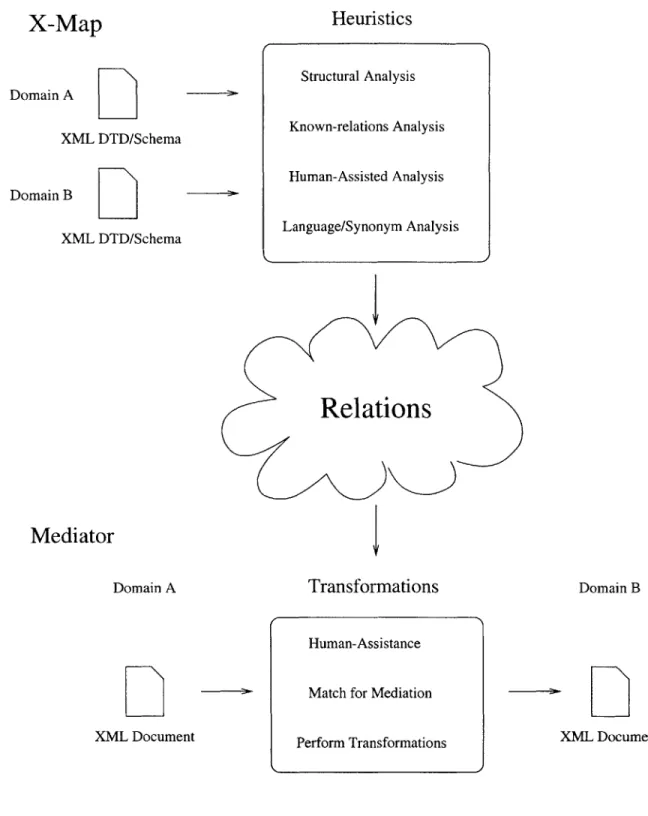
4-1 Design Overview . . . . 52
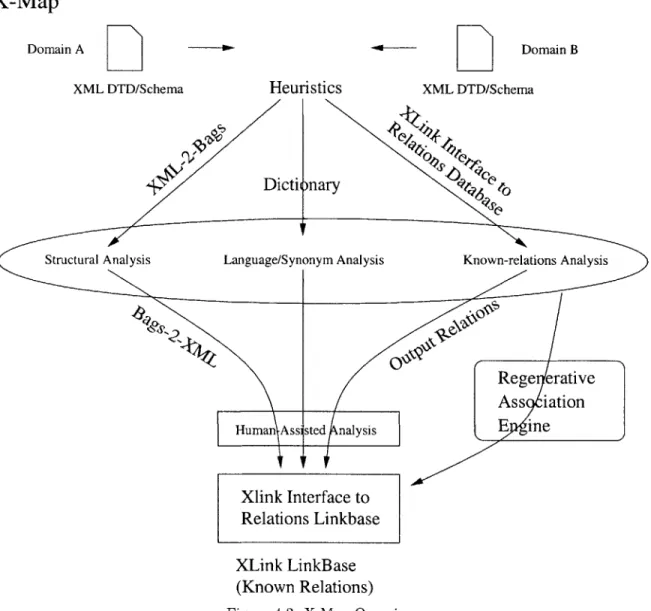
4-2 X-Map Overview . . . . 54
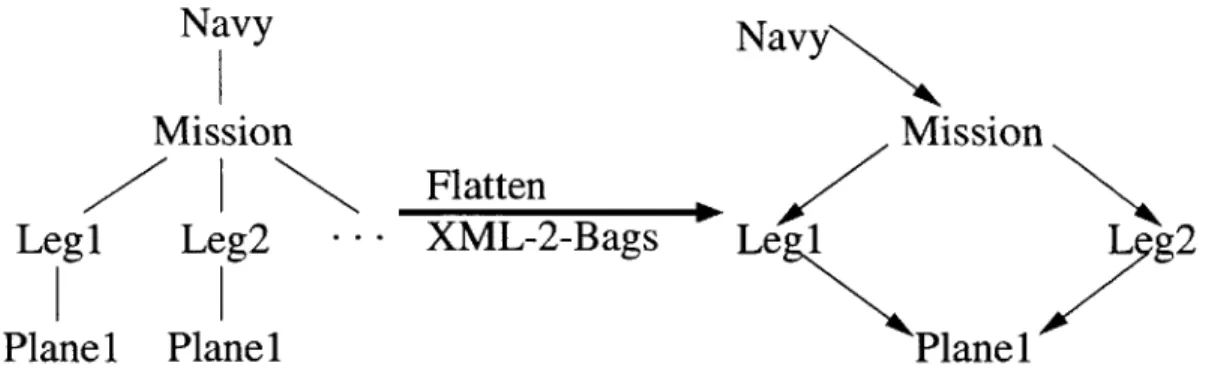
4-3 Collapsing Trees into a Directed Graph . . . . 62
4-4 XML-2-Bags Pseudo-code . . . . 65
4-5 Hierarchical Association Discovery . . . . 66
4-6 Cyclical Association Discovery . . . . 67
4-7 Association Language Overview . . . . 71
List of Tables
2.1 Data Conflict Taxonomy . . . . 20
2.2 Prot6g6 Summary . . . . 25
2.3 Useful XML Definitions . . . . 27
Chapter 1
Introduction
Whenever two people want to converse with each other, two ground-rules are implicit in effect. One, they speak the same language' and dialect; two, they speak with the same grammar structure. The same rules apply to two separate processes in a computer system. In order for the two processes to communicate with each other and exchange data, they have to agree to speak the same "language" (i.e. are bytes big-endian or little-endian?) and also the same "grammar structure" (i.e. what is the meaning of each byte sequence?). In effect, these two processes must agree on the same two implicit ground-rules as humans do.
Even more abstractly, the processes themselves can be viewed as entities encompassing specific and distinct data-domains and the data as a collection of relational linkages - that is, in order for data in one data-domain to "make sense" in the other data-domain, the mapping function between the two data-domains must know the language of each domain and have identifiable structures with which to relate.
'Throughout this thesis, the author will use "language" to mean "the set of words in the appropriate universe of discourse" (the universe depending on context) and "grammar" to mean "the rules that structure the aforementioned language to convey intellectual meaning". Although Alphabet more succinctly describes the concept described by
1.1
Interoperability
The process by which two separate entities coordinate and ultimately decide on the same implicit ground-rules captures the essence of interoperability. That is, in order for two processes to communi-cate and exchange data, they must first agree to interoperate with the same language and grammar structure.
This agreement can happen with the following approaches, non-exclusively:
1. Explicitly: Both processes agree to interoperate by using a common language and grammar
structure.
2. Implicitly: External mediators which share a common language and grammar structure "translate" for either/both processes to achieve interoperability. The processes operate as they always do, without explicit recognition of the mediators at work.
1.1.1
Traditional Interoperability
Traditionally, interoperability has been achieved through a combination of both approaches - two systems consciously employ mediators to translate their own internal formats to a common language and structure understood by the other - which immediately achieves interoperability. However, this practice has many drawbacks for the systems involved, including external dependencies on the mediators by the systems when either system's internal structures change.
1.1.2
Interoperability using Approach #1
More recently, interoperability based solely on approach #1 has made some progress, but unfortu-nately economics and politics dampen its effects. This approach naturally fits industries since it essentially entails an industry-wide agreement on a single language and grammar structure for
inter-operability. Considering that organizations within an industry commonly share the same language, the remaining problems stem mostly from differing grammatical structure. However, politics2 and economics commonly corrupt any agreement since the industry leaders often want greater influence over the structural format to give themselves the advantage.
1.1.3
Interoperability using Approach #2
That leaves the less explored, solely #2 approach to interoperability - powerful mediators that dynamically or statically adapt translations between systems, shuttling mapped data back and forth, while ensuring complete independence of the internal formats of all systems involved. At first glance, this approach solves many of the aforementioned problems: the politics and economics of approach #1 are irrelevant since the interoperating systems do not even need to be cognizant of each other, and dynamic adaptation in translation can effectively deal with changes in the internal formats of systems. Thus, it warrants further investigation.
1.2
Applications of Interoperability
In addition to its theoretical importance, interoperability also has many real-life applications. In general, any situation involving more than one entity that wants to communicate with another contains at least one instance of interoperability as outlined in Section 1.1. They are shown in the following examples:
1. Two businesses with different cooperating business products need to exchange data with each
other but are designed differently, so they both actively translate to and communicate via a shared common language and protocol.
2
Case in point: Biztalk and Open-OASIS are both trying to establish industry-wide sharing of XML schemas, but different organizations with different goals are at play - Biztalk (www.biztalk.org) was founded by Microsoft (www.microsoft.com), while Open-OASIS (www.oasis-open.org) is a non-profit international organization.
2. A startup wants to compete against an established industry giant and translates its output via a mediator to the industry standard to interoperate with the industry leader.
3. Two military branches need to cooperate in a joint battle initiative; passive mediators placed
between the communication channels of both branches silently translate data for either side.
Needless to say, the subject of interoperability is important - it underlies all of communication and enables much of computer science and by the previous associations, even life.
1.3
Goals and Assumptions
The exploration of the interoperability approach outlined in Section 1.1.3 forms the focus of this thesis because it offers a rich array of challenging problems, including the specification of an open representation of the mappings to facilitate its use by multiple mediators, which directly affects the larger problem of how to dynamically discover and adapt mappings between systems.
Thus, this thesis will investigate the subject of interoperability between multiple data-domains with only one assumption - the processes involved in interoperability have already agreed to use the same language in communication. This assumption has wide-ranging effects that simplify the investigation by taking the guesswork out of determining a common language. Namely, once a communication language is agreed upon, a mediator only has to worry about how to map and represent the identifiable structures in each data-domain in order to facilitate interoperability. Top priority tasks of this thesis include the means of performing these two interoperability tasks. Now, this assumption is valid and safe to make within the context of this thesis because it assumes that the data-domains are not actively "hostile" toward each other - that is, the data-domains want to be understood by each other. Otherwise, exchanging data between data-domains will be meaningless if the data-domains do not agree a priori on a language - there will be no useful way to identify, map, or even "make sense" of the parts of the data being exchanged.
The common communication language that all data-domains agree to use for this thesis investigation is the eXtensible Markup Language (XML) [7]. XML is a flexible meta-language useful in the creation of new data-describing languages, and it offers additional benefits if the XML document is valid3.
As the remainder of this thesis will soon discuss, XML has many properties and benefits that aid interoperability.
1.4
Thesis Outline
The remaining chapters of this thesis is organized as follows:
Chapter 2 provides a summary of existing interoperability literature and research and integrates it in light of recent XML developments. A practical discussion of existing and upcoming platforms and technologies then commences, and their relations to existing interoperability works are noted wherever applicable.
Chapter 3 gives the motivational project behind this thesis and a possible avenue of application.
The design goals, requirements, and rationale for each of the project deliverables and how each relates to XML Interoperability is given. The three deliverables, in order of discussion, are X-Map, Association Language, and Mediator. As a compromising requirement, the Mediator further breaks down into the Mediation Engine and an accompanying Transformation Language.
Chapter 4 expounds on the technical details of the deliverables' designs according to their design
goals and requirements. An overview of each of the deliverables preface the detailed discussion of each, starting with X-Map, then Association Language, and finally Mediator. Much work remains on the full implementation of this design, but the fundamental outline and framework of action has
3
been tackled by this thesis.
Chapter 5 closes with a few remarks on our contributions and the trade offs that X-Map makes
Chapter 2
Background
As stated earlier, the main topic of this thesis is how to map identifiable structures between data-domains given the assumption that the data-data-domains agree to use XML as the common communica-tion language. Collectively, this simplificacommunica-tion shall be denoted by the term "XML Interoperability", which captures the notion of interoperability as enabled through usage of XML. Evidently, this sim-plification is significant in the following ways:
1. The protocol for exchanging data is a given. That is, the problem of figuring out how to
transmit and reconstruct data (including XML) between systems is not a part of the XML Interoperability problem. XML Interoperability can be considered only after data are trans-formed into a form useful as XML.
2. The semantics of describing data structure in each data-domain is also a given - this is the huge advantage that XML brings to the interoperability task - its schema definitions for validation and conformation.
Not surprisingly, the subject of interoperability, with or without using XML, has a long history in both the academic and industrial realms. Thus, it is important to note the ramification of existing
research and solutions on this investigation before proceeding onto the design goals and requirements
of this thesis.
First, a survey of existing literature and research is presented and synthesized to extract the essential
approaches that have been taken in the past. Then, short discussions of various present-day
interop-erability technologies and platforms commence, and their abilities to enable XML Interopinterop-erability
summarized and judged. Finally, the author makes some allusions to the design and goals of this
thesis.
2.1
Literature Survey
The subject of interoperability exists in this world because no one system satisfies everything for
everyone - thus, everyone rushes to create his own autonomous system to solve his own problems, occasionally thinking of cooperating with others. Besides, as software engineering practices readily
admit, such a monolithic system will more likely than not suffer from several potentially fatal
problems. To name a few:
" Maintenance nightmares due to complex and multiple dependencies.
" Extra sensitivity to failure since there are more interconnecting parts.
" Difficulty to generate momentum to evolve a "better" design.
However, with autonomous systems, interoperability comes to the forefront due to the variety of
differences possible. In their report on the NSF workshop on Heterogeneous Database Systems in
1989, Scheuermann et al. [30] noted that there were three different types of autonomy, each with
Design Autonomy: The ability for a system to choose its own information, data-model, and
implementation procedures.
Communication Autonomy: The ability for a system to choose what systems to
commu-nicate with and what information to convey.
Execution Autonomy: The ability for a system to decide how and when to execute a received
request.
Naturally, design autonomy leads to a variety of heterogeneity and conflict between systems. Com-mon practice leads the author to break design autonomy apart and distinguish between data
het-erogeneity (see Section 2.1.1) and system hethet-erogeneity. The former refers to the variety of ways in
which data can be organized and interpreted while the latter refers to differences in data-models, data manipulation language, etc. Thus, one clearly sees design autonomy as the major obstacle in achieving semantic interoperabilityl amongst heterogeneous systems since the data can be inter-preted differently in addition to being modeled and manipulated differently.
Now, communication and execution autonomy pose their own challenges to interoperability, but they represent operational problems outside the semantic-centric scope of this thesis. The same applies to system heterogeneity since XML Interoperability implicitly unifies the data-model and data manipulation language to be XML.
2.1.1
Issues with Data Heterogeneity
The classes of conflict that spring from data heterogeneity partitions into three rough sections, all well documented in literature. Their major differences are in:
1. Schematic Conflict: How data are structured or logically organized [23] [24].
2. Semantic Conflict: How data are interpreted (i.e. what does this mean?) [31] [28].
3. Intensional Conflict: What context (sources of information available to the sender and
receiver) does the data require [18].
One notes that the line between #1 and #2 remains fuzzy despite the preponderance of literature because of one simple fact: schematic structure and organization often say something about the semantics of the data, and the semantics of the data at minimum suggest and at most dictate its structure and organization. In other words, the two concepts intertwine with each other.
The remainder of this section reviews the taxonomy of sources for data conflicts (see Table 2.1), which provides a quick synthesis of existing literature on this subject [18].
Schematic Data Type Use of different primitive data types to represent the same data value (i.e. String vs. Date for date representation)
Labelling Synonyms or homonyms amongst schema elements (i.e. like-named attributes referring to different things or conversely dif-ferently named attributes referring to the same thing)
Aggregation How should data be clustered together in the data-model (i.e. should a person's name, SSN, and birth date be clustered under name[SSN, birth date] or SSN[name, birth date])?
Generalization How should entities relate (i.e one system can have managers and engineers to be distinct types while another can cluster both as employees with different attributes)?
Semantic Naming Use of different names for the same thing (i.e. SSN, S.S.N., Social Security Number)
Scaling Use of different measures or scales (i.e. English vs. Metric, 4.0 vs.
5.0 GPA scale)
Confounding Just plain confusion over what something means (i.e. "latest trade price" could mean real-time, 5 minutes delayed, or 20 minutes delayed)
Intensional Domain Difference in the underlying universe of discourse; that is, either a disjoint, strict subset, identical, or other non-trivial intersection Integrity Difference in the assumed invariants between systems (i.e.
differ-ent uniqueness or range constraints) Table 2.1: Data Conflict Taxonomy [18]
2.1.2
Traditional Interoperability Approaches
Within the last fifteen years, a plethora of proposals and research prototypes aimed at enabling interoperability amongst autonomous and heterogeneous systems has appeared. Sorting through the hype, two discernible patterns emerge as key differentiators:
1. Difference in the underlying data-model - depending on the data-model, certain schematic and semantic transformations become feasible to resolve certain data conflicts.
2. Differences in the execution strategy - either a tight-coupling strategy or a loose-coupling strategy.
Obviously, difference #1 directly affects difference #2 since different data-models often trade off on execution requirements and intensiveness. Meanwhile, the distinctions between the tight-coupling and loose-coupling strategies succinctly characterizes themselves along two dimensions:
1. Who is responsible for identifying the conflicts and how to circumvent them.
2. When the conflicts are finally resolved.
Clearly, the two tasks must work in tandem - task #1 must precede task #2 since one must identify the conflicts before resolving them. The remainder of this section will describe the most salient features of these two strategies since they typify current interoperability approaches. Now, one must keep in mind that the following discussion aims to draw a sharp contrast between the two approaches by emphasizing their trade offs. Most systems in the world fall somewhere in the middle of these two poles and achieve mediocre performance. This is squarely due to the fact that the coupling strategies simply do not leverage each other well since they postulate different premises on how to best capture and manipulate data semantics.
Tight-Coupling Strategy
In this strategy, the job of detecting the conflicts (and the means to resolve them) rests squarely on the shoulders of the systems administrator for the data-domains. The administrator typically defines, a priori, a unified and shared schema for all interested parties. Then, the relevant portions of the shared schema are sectioned off and handed to each interested party - sharing common fields are allowed and encouraged. These "mini-schemas" then insulate the schema users from the massive underlying canonical representation that everyone shares.
Obviously, exchanges of information between participating parties using different schemas now be-come as easy as figuring out the relations between the relevant parts of the shared canonical schema since it is all shared.
Examples of this approach can be seen in the prototypes of Breitbart and Tieman (ADDS) [81 and Templeton, et al. (Mermaid) [32], and more recently, the same strategy has shown up in systems using object-oriented data-models such as Pegasus [1], amongst others.
In virtually all of the above cases, the technique used for conflict resolution is similar to that proposed
by Dayal and Hwang [12] and involves the introduction of a supertype that encapsulates all of
the necessary functions and fields necessary for interoperability. Basically, tight-coupled strategy involves insane amounts of cooperation amongst all participants and a lumbering but growing unified schema.
Loose-Coupling Strategy
In contrast to the tight-coupling strategy, the loose-coupling approach believes that the creation and maintenance of a shared canonical schema (or even a couple) to be infeasible for any nontrivial number of participants. Thus, instead of resolving all conflicts a priori, conflict detection and resolution are carried out at run-time by the users themselves. This is based on the assumption that
most users only need to interact with a limited subset of the fields in any schema at once, so it may never be necessary to resolve all of the conflicts between the schemas up front as the tight coupling strategy proposes.
At first glance, this strategy appears to make conflict resolution a distributed2 computational task. However, just as distribution decentralizes computational needs for resolving conflicts, it also de-centralizes schema coherency - that is, when schemas and/or semantics change, a new means of resolving this conflict must be distributed to everyone interested. This is a non-trivial task that any Information Systems professional readily confesses. Likewise, the lack of a central schema authority means finding the most efficient database resource exposing the preferred schema is hard.
2.2
Interoperability Frameworks
Pursuant to the buzz surrounding the aforementioned literature and research, frameworks and plat-forms that support interoperability have sprung up like wildfire. The following sections represent a survey of a small but diverse sampling of academic work on the forefront of semantic interoperability. Both approaches attempt to organize and otherwise categorize information about their disparate data-domains so that they can be used later for mediation. However, the similarity between their efforts stops there, with Protege [?] favoring an extensional3 organization of information while
COn-text INterchange (COIN) [18] prescribes to an intensional4
organization of information. As a result, their strategies take completely divergent paths toward the goal of interoperability.
2
1n general, distributed anything is a good thing at the present time.
3
Extensional means an explicit statement of fact; that is, every known fact must be expressed.
4
2.2.1
Protege
Extensive research at the Knowledge Modeling Group5 at Stanford produced Prot6g6, which is a knowledge-based design and acquisition system for managing multiple and large-scale ontologies. An ontology is a hierarchical structuring of knowledge about things obtained by subcategorizing them according to their essential relevant and/or cognitive qualities. Prot6g6 separates knowledge into classes, instance, slots, and facets, where classes embody the higher-level "concepts" in a data-domain, instances are concrete representations of classes, slots are properties of classes and instances, and facets are properties of slots. Its main power lies in its ability to leverage existing ontologies, enabling system developers to construct large, extensional knowledge bases rapidly. It does this by first allowing them to describe the domain's knowledge as an ontology and then draw associations between the classes/slots of these ontologies. Furthermore, Prot6g6 can use the RDF specification (see Section 2.3.5) to describe its ontologies.
However, Prot6ge does not presently have facilities to automate the merging or aligning of ontologies (i.e. automatically drawing equivalence or super/sub-type relationships), nor does it resolve the inevitable namespace issues of using/maintaining multiple ontologies.
Thus, Prot6g6 currently helps as an abstraction layer for drawing one-to-one associations between arbitrary elements of two or more data-domains, visualizing the associations, and optionally storing the knowledge. Table 2.2 best summarizes it:
5
Classes "Concepts" in the knowledge domain Knowledge Instances Specific occurrence of a Class
Description Slots Properties of Classes and Instances Facets Properties of Slots
Mapping Associating elements of two ontologies as equivalent
Concepts Merging Creating a new element that encompasses the merged elements Aligning Determining the super/sub-type relations between the elements Visually create ontologies
Functions Visually acquire data for an ontology
Expandable platform to access other knowledge-based systems
Table 2.2: Prot6g6 Summary
2.2.2
COntext INterchange
A result of intensive research into data aggregation done at the Massachusetts Institute of
Technol-ogy, COntext INterchange' (COIN) introduces a novel twist in performing interoperability. Instead of trying to state all known facts about the systems involved in information exchange (extensional), it favors the intensional description of axioms that underlie the facts about the systems. These axioms allow COIN, when given a mediation request, to reason about what the right thing to do is. In fact, COIN can be formulated with a formal logical mathematical model, thus enabling its correctness to be proven [18].
COIN shuns a semantic data-model's description of the world due to the variety of problems that plague that fragile model. To increase a semantic data-model's descriptiveness, more attributes are often added to the model, leading to an explosion in the property list of attributes for the model. Furthermore, the meanings of the appropriate transformation functions and modifiers in each semantic model are often non-obvious, forcing one to resolve these conflicts before meaningful mediation can occur.
Instead, COIN subscribes to a context-based model, where the requested information is interpreted based on the contexts of the source and destination domains. The contexts are described by COIN's own flavor of mathematical axiom language, which is then "objectified" to enjoy the benefits of being
6
object oriented - inheritance, subclassing, and overriding of contexts described by these axioms are now possible, which greatly expands COIN's ability to reason about how to mediate a given request across data-domains [18].
However, COIN does not discover nor keep track of the proper associations between data-domains - it expects the requester to provide it with that initial knowledge via a query so that it can then figure out what the right thing to do is to fulfill that request. Thus, it faces a potentially steep start-up cost as one must populate the axioms for all mediated systems by-hand.
2.3
Interoperability Technologies
It is undeniable that XML has been hyped as the industrial sector's savior for interoperability. While it is still undetermined whether XML lives up to its hype, this much is certain - it certainly has enabled many technologies aimed at resolving the interoperability issue when reformulated in XML. Independent of the various semi-closed frameworks and platforms proposed by academia, the fol-lowing selection of XML technologies represent a broad survey of the "state-of-the-art7" in XML
Interoperability.
In general, each of the following technology addresses, in a direct or indirect manner, some subset of the aforementioned schematic and semantic conflicts in Table 2.1. In addition, technologies such as Architectural Form and XSLT also allow one to directly transform XML documents from one schema to another, a necessity for performing interoperability. Unsurprisingly, as the reader will shortly discover, none has a complete and coherent strategy that assaults the XML Interoperability barrier.
7
The ink on many of the technologies' specifications is not even dry yet, if they had even reached that stage of maturity. However, these technologies represent revisions and augmentations of old, tried and true techniques at enabling interoperability with new, XML-infused twists, so their effects remain heavily anticipated.
2.3.1
eXtensible Markup Language
As mentioned earlier, eXtensible Markup Language (XML) is a flexible meta-language useful in the creation of new data-describing languages. Several key definitions [7] need to be stated before proceeding:
Language Character Set The set of defined values (typically Unicode [34]) that map to certain alphanumeric and other non-printable symbols in the given language
Character An atomic unit of Text in the Language Character Set. Valid XML Characters include Unicode8
Text A sequence of Characters which may represent Markup or
Char-acter Data
XML Document A well-formed arrangement of Text. One can view an XML
Document either physically (as entities) or logically (as elements) Entity The basic physical storage unit of data in an XML Document Parsed Entity Entity whose Content consists of Text considered a part of the
XML Document
Unparsed Entity Entity whose Content may or may not be Text Markup One of start-tag, end-tag, and empty-element tags9
Character Data All Text that is not Markup
Content The Text between the start and end tags
Start/End Tag Markup that denotes the start and end of an Element Element The basic logical unit of data in an XML Document Well-Formed Entities, Elements, and Tags that are properly nested
Well-Formed XML Document An XML Document that has exactly one root element and all start-tag consists of well-formed tags
Valid XML Document A Well-Formed XML Document which also conforms to a given
schema
Schema Description of the logical structure and storage of a document. This description can be defined in one of two ways: through a Document Type Declaration (DTD) or XML Schema [33] Document Type Definition A document that contains Markup declarations that provide
grammar for a class of documents Table 2.3: Useful XML Definitions [7]
Note that these definitions are not exact copies of the official XML definitions but rather slightly abridged forms that remove unnecessary details that otherwise clutter the discussion of this thesis. Common usage convention has "XML Document" meaning "Well-formed XML Document" and will
8
Actually, Valid XML Characters consist of the ISO/IEC 10646 [22] character set, legal graphic Unicode characters, line feed, carriage return, and tab.
9
Actually, Markup consists of start-tag, end-tag, empty-element tags, entity references, character references, com-ments, CDATA section delimiters, document type declarations, or processing instructions.
be the meaning the author adopts unless specified otherwise. Also, one must note that validity implies well-formedness, but not the other way around.
Now, XML is a streamlined subset of Standard Generalized Markup Language10 (SGML), a widely
used international text processing standard. In particular, XML aims to "enable generic SGML to be served, received, and processed on the Web in the way that is now possible with HTML" [7]. Combined with its abilities as a meta-language, it is clear that XML documents, in particular valid XML documents, play a central part in interoperability. Valid XML documents not only declare the language and encoding of its data implicitly or explicitly but also the logical structure of the data it contains. These advantages allow XML to clear several traditional interoperability hurdles such as deciphering encoding and structural description, leaving the discovery of the actual mapping between data-domains and its associated processing and storage requirements the major issues.
2.3.2
Architectural Form
Originally a concept conceived for SGML, Architectural Form (AF) [19] represents a pragmatic approach to interoperability. Namely, in addition to defining the syntax for associating elements between different DTDs (the "data-domains"), it also defines the semantics for actually extracting and rearranging data between the domains. Thus, it attacks the interoperability problem on two fronts - the mapping of identifiable structures between data-domains and the actual mechanism for extracting and rearranging data of the identified structures. It accomplishes this feat through clever redefinitions of SGML attributes and substitution/processing rules of entities within the SGML
document.
AF's abilities appear straight-forward once one considers its original intent - to allow a rough in-heritance of SGML DTDs. It does this by enabling an XML document's Client-DTD" to derive
0
1SO 8879:1986 Information processing - Text and office systems - Standard Generalized Markup Language
(SGML). More information can be obtained from http://www.iso.ch/cate/d16387.html
11
elements, attributes, and notations from at least one Meta-DTD1 2. Thus, AF allows freedom in mixing and matching of elements in one DTD to elements in its Meta-DTD(s), and likewise with at-tributes". It should be obvious that AF favors a tight-coupled strategy to achieving interoperability through the "derivation" of Client-DTDs from Meta-DTDs.
Thus, logically, AF views an SGML document as a parsed tree with the following properties:
* Nodes can be removed (pruned) at will (through suppression of processing).
" Nodes can be swapped (grafted) in a well-nested manner (through inclusion in processing).
" Leaves can be extracted and its values used (i.e. nodes can be grafted and the values in the
leaves can be also switched around).
The AF concept has recently migrated to XML. As a concept, the pruning, grafting, and extracting actions described by AF is similar to the effects produced from amalgamating parts of several XML technologies, including eXtensible Stylesheet Transformation (see Section 2.3.7 for XSLT [10]) and XML Schema (see Section 2.3.6 for XML Schema [33]). Basically, AF's actions are analogous to combining the effects of several XSLTs, and the association syntax is similar to XML Schema's
equivalence class attribute. Since AF actually pre-dates both technologies, it comes as no surprise
that both supersede it in functionality.
2.3.3
Topic Map
Another pre-existing concept inherited from SGML, Topic Map holds promise in aiding interoper-ability because it defines a syntax for describing (hence associating) the implicit structure modeled
by data in disparate data-domains. The original concept was motivated by the need to be able to 12
Meta-DTD is purely a logical label refers to the additional DTDs that an XML document can derive elements from. A Client-DTD could be its own Meta-DTD!
13
However, Architectural Form does not allow a match between an element and attribute, which seriously hampers it from dealing with labelling data conflicts.
merge indexes to offer navigational aid to the reader (i.e make searching for information easier for the researcher). The key insight to merging indexes, as Steve Newcomb, one of the original prime movers, explains:
... was that indexes, if they have any self-consistency at all, conform to models of the structure of the knowledge available in the materials that they index. But the models are implicit, and they are nowhere to be found! If such models could be captured formally, then they could guide and greatly facilitate the process of merging modeled indexes together [3].
The "models of the structure of the knowledge" is what Topic Map attempts to capture and provide easy access to. Not coincidentally, the problems that plague merging indexes also affect other forms of navigational aid such as tables of contents, glossaries, thesauri, cross references, etc, since they all attempt to provide access to information based on a model of the knowledge contained within it. At the heart of the model lies the concept of the topic; hence Topic Map aims to address this issue
[3].
Topic Map views the world as a set of subjects, of which topics are specific, actual occurrences. Basically, topics reify1 4
subjects. Associations specify relationships between topics, while the topics play specified association roles. Topics and associations can also have "types", which represent a sort of class-instance relationship between the topics.
It is clear that the meaning of the word "topic" depends highly on the nature of the information and the uses demanded of the Topic Map. For example:
Encyclopedia: One could have Spain as the topic and subject (recall that topics are the
actual occurrences of the more ephemeral notion of subjects) and a topic type of country.
1 4
Reify (Webster's New World Dictionary, 1994): to treat (an abstraction) as substantially existing, or as a concrete material object.
Computer Science: One could have meta-languages as the subject, XML as the topic, and
implementation as the topic type.
Additionally, topics may be linked to one or more information resources that are relevant to the topic in some manner; those resources are considered occurrences of the topic. A corresponding notion of occurrence role, which describes the type of relevance, also exist. Basically, an occurrence represents a very tight and well defined notion of relevance between a topic and some associated resource. For example, a graphical map of Spain is an occurrence of the topic of Spain, and the occurrence role would be "map".
Finally, associations represent the heart of Topic Map - the ability to express, describe, and cate-gorize associations between topics. Association type is the analog of topic type, so associations also have a class-instance relationship, while association role is the analog of occurrence role, which is the description of the topic association. For example, for the statement "Shakespeare wrote the play
Hamlet", Shakespeare and Hamlet would be the topics, wrote would be the association, written-by
could be an association type, and playwright and play would be the association roles for the topics Shakespeare and Hamlet, respectively.
Thus, one can view Topic Map as a means of categorizing elements in data-domains and describing the relationship between arbitrary elements in arbitrary data-domains, labelling roles that topics play in the associations. This flexibility aids interoperability because it deals with the naming, labelling, and generalization data conflicts - not only does Topic Map define the relations between comparable identifiable data structures (erasing naming and labelling conflicts), but it also describes the relationship between them (eliminating generalization conflicts). That means that an automated knowledge tool can leverage the uniform descriptions to extract and rearrange data appropriately between data-domains. However, Topic Map does not include the actual means of describing how to rearrange the data.
2.3.4
XML Linking Language
A relatively new specification that tackles the problem of drawing associations between arbitrary
resources on the Web, XML Linking Language (XLink) can be viewed as "Topic Map-lite" -that is, XLink [16] is a restricted instance of Topic Map. XLink fixes the types of its topic and association analogs to be resource and arc, respectively, and this instantly restricts one's ease with expressing class-instance relationships. However, this restriction does not make it impossible, only more cumbersome, so XLink remains capable to deal with generalization conflicts. XLink also removes from Topic Map the notion of occurrences and its roles and focuses instead on the topic and the association role that it plays. It adds the idea of a linkbase, which is an external XML document that contains the actual XLinks which point to other resources. The linkbase can be viewed as a small "index of arbitrary links" external to the resources so no existing documents need to be modified to be a resource capable of being XLink'd.
An obvious observation one can make about XLink is that it trades off the generalized concepts of occurrences and types from Topic Map for immediate practicality - its specifications hint heavily at a browser being its target application: arcs can only be actuated "onLoad" or "onRequest" and shown either as new, replace, or embed - notions that clearly favor browsing/viewing applications. Thus, the beauty of XLink lies in its simplicity. It does one thing and does it well - expressing links between resources - without all the psychological baggage a full-blown solution like Topic Map entails. Thus, it makes drawing associations between data-domains trivial. However, it sacrifices meaningful role descriptions for the resources, which means that automated correlation of elements from differing XML documents becomes harder.
2.3.5
Resource Description Framework
The primary goal behind RDF is to create a framework for metadata . Simply put, RDF is:
... a foundation for processing metadata; it provides interoperability between applica-tions that exchange machine-understandable information on the Web. RDF uses XML to exchange descriptions of Web resources but the resources being described can be of any type, including XML and non-XML resources [9].
The foundation of RDF is a model for representing named properties and property values. The basic data model consists of three object types:
" Resources: All things described by RDF expressions are resources. A resource can be a
URI 6 , a part of a URI, a collection of URIs, or even an object that is not directly accessible
via the Web.
" Properties: A specific aspect, characteristic, attribute, or relation used to describe a resource.
* Statements: A specific resource together with a named property plus the value of that property for that resource is an RDF statement.
The three individual parts of a statement defined above are called, respectively, the subject, the predicate, and the object. The object of a statement (i.e., the property value) can be another resource or it can be a literal; i.e., a resource (specified by a URI) or a simple string or other primitive datatype defined by XML [25].
Consider the following simple example:
Ora Lassila is the creator of the resource http://www.w3.org/Home/Lassila.
1 5
Metadata is data which describes other data.
16Uniform Resource Identifier[2] (URI)
-a comp-act string of ch-ar-acters for identifying -an -abstr-act or physic-al resource.
This sentence has the following parts:
Subject (Resource): http://www.w3.org/Home/Lassila
Predicate (Property): Creator
Object (literal): "Ora Lassila"
Thus, one can view any RDF statement (and essentially a relation) pictorially using directed labeled
graphs, as shown below:
http://www.w3.org/Home/Lssila Creator 0- Ora Lassila
Figure 2-1: Sample RDF Statement [25]
However, RDF does not define any platforms nor provide any pragmatics tools to perform the processing of its statements. It does not even provide any standard semantic models for processes
- it simply provides the most basic elements to enable those models and tools to be constructed. An interesting aside: Topic Map and by association XLink can be viewed as predefined notions and models of particular resource descriptions layered on top of the more generic RDF; that is, one can "describe" XLink or Topic Map using the RDF even though it makes those languages more verbose and cumbersome. Thus, it is possible to leverage generic RDF automation tools on XLink or Topic Map when they do appear in the future. The RDF allows the descriptions themselves to be uniformly understandable so that the descriptions can then model relationships among web resources. In other words, the resources agree to use uniform description semantics offered by RDF but retain the ability to create proprietary tags for richer, more resource-specific data description.
2.3.6
XML Schema
XML Schema is a schema description language for XML written in XML [17] [33] [4]. What XML Schema brings to XML Interoperability is its ability to assign/create the legal XML Namespaces for elements, assign super/sub-type relationships between elements, and identify elements in the same equivalence class. This gives it the ability to at least identify and eliminate generalization conflicts while aiding in the identification of data type conflicts. While not inherently obvious, XML Schema also contains the necessary information that a mediator would need to resolve labelling, naming, and some aggregation data conflicts. This is due to the fact that schema gives structure to data; thus, anything conforming to a given XML Schema automatically associates elements between namespaces and schemas by default in an expository manner. It is up to a mediator to glean the necessary information from it.
Unfortunately, XML Schema neither specifies nor provides the means to transform data between data-domains, limiting its immediate usefulness toward XML Interoperability.
2.3.7
XML Stylesheet Language Transforms
XSLT is a language for transforming XML documents that conform to any well-defined schema to another XML document (see Table 2.3). It views an XML document in a similar manner as Architectural Form (see Section 2.3.2) - as a parsed tree, with the content at the leaves and the tags at the nodes. Furthermore, it defines semantics for manipulating nodes, so the end result is a "transform language" that is able to rearrange, insert, and delete nodes arbitrarily within an XML document. It also provides simple programming facilities to express logic that can be applied recursively during the transform to add/extract/remove data from the leaves of the nodes.
However, XSLT is not a language to describe relations it can simply perform the actions a relation may describe. Thus, one can only embed relations within the logic of the XSLT stylesheet - the
stylesheet becomes a specific sort of translator.
2.4
Summary
Hopefully, by now the reader sees the advantages of having XML as a constraint on the traditional interoperability problem. If not, review this chapter! Now, without getting too far ahead, the author wishes to claim without proof that XML addresses the following issues in interoperability; the reader can judge its effective by the end of this thesis..
Data Type Conflict: Largely resolved with XML.
Labelling Conflict: To be addressed by thesis proposal with aid of XML. Aggregation Conflict: To be addressed by thesis proposal with aid of XML. Generalization Conflict: To be addressed by thesis proposal with aid of XML. Naming Conflict: To be addressed by thesis proposal.
Scaling Conflict: To be addressed by thesis proposal. Confounding Conflict: Outside of thesis scope. Domain Conflict: Not addressed by thesis proposal. Integrity Conflict: Not addressed by thesis proposal.
Thus, current progress on XML Interoperability as discussed earlier can be summarized as having focused on the following two aspects:
1. The language to describe the associations between structural elements of each data-domain
2. The mechanics to rearrange and modify the associated data elements physically (XSLT, Ar-chitectural Form).
The astute reader will realize that a third aspect of XML Interoperability has barely been scratched, which is:
The process of discovering the above associations between the structural elements of each data-domain (COIN and somewhat Prot g6).
Both Proteg6 and COIN have this problem within their sights; all other efforts skirt around this critical know how issue. Thus, this thesis will attempt to tackle this problem along with leveraging existing research and technology for the other aspects.
Chapter 3
Project Design and Requirements
From the preceding discussions, a consistent theme in XML Interoperability arises: how something in a data-domain is described is no longer an issue and is not as important as what is described. Clearly, re-interpreting the interoperability problem into XML solves several technical hurdles (such as parsing and character encoding recognition). XML frees one to focus attention on the real problem - the semantics of interoperability. Once one gains a hold on identifying the individual "something" in a particular data structure, what is it? What does it mean? What does it relate to and how? As fortune may have it, these sort of questions underlie a class of problems that The MITRE Corporation is currently attempting to solve for its clients and is an additional motivating factor behind the research of this thesis.
3.1
Company Background
The MITRE Corporation is a not-for-profit corporation that was formed to deal with critical national issues such as defense, commercial aviation, and taxation. The majority of work done at MITRE is concentrated in three Federally Funded Research Development Centers (FFRDC), which service
the Department of Defense (DOD), the Federal Aviation Administration, and recently, the Internal Revenue Service and the Treasury Department.
Unlike most corporations, FFRDCs are prohibited from manufacturing products or otherwise openly competing with the industry. Instead, they work together with commercial corporations from plan-ning and concept design to technology insertion and integration. As agents for the government, FFRDCs specialize in scientific research and analysis, systems development, and systems acquisi-tion.
The FFRDC of MITRE working with the DOD is currently focusing on developing more thorough cooperation among command and control systems, with the ultimate goal of a single, integrated command and control system that can support joint and coalition operations worldwide. The re-search within this thesis is directly in line with this goal, as it examines the fundamental knowledge and technology underlying and enabling fuselets.
In order to understand the importance of fuselets, one must understand the context and environment in which they operate. This requires a short diversion to explain the overall goals of the Joint Battle InfoSphere (JBI), since fuselets are a component of the JBI [36].
3.1.1
Joint Battle InfoSphere
The goal of the JBI is to enable our armed forces to prevail and win in combat. To accomplish this task, the JBI plans to provide information superiority to our warriors, which enables them to
"interpret information and make decisions faster than the other guy ... " [36].
This advantage is achieved by adhering to a publish and subscribe mechanism, which basically facilitates the sharing of information between interested parties, manipulation of information to create knowledge, and dissemination of that new knowledge to other interested parties upon creation. Basically, the interested parties send information via messages asynchronously back and forth. To
do this, the JBI provides three major functions:
1. Information Input
2. Information Manipulation to create Knowledge
3. Knowledge Output and Interaction
These functions correspond roughly to any classical system design except information is now the input and knowledge the output.
3.1.2 Fuselets
The role that fuselets play in the JBI amounts to enhancing and automating all three functionalities. That is, fuselets "fuse" information from several subscribed sources into knowledge. To do this, a fuselet subscribes to its interested information sources in the JBI, and upon the publishing of information matching its subscription, it is triggered to perform its task. This usually leads to the generation of new, synthesized information or knowledge from the fuselet's information subscription sources.
Thus, fuselets have many uses: they can bring information into the JBI, transform sets of JBI objects into aggregated objects, or gather objects for presentation and automatic report generation [36].
3.2
Project Description
The particular MITRE project that this thesis supports, "Fuselet Architecture for Adaptive Infor-mation Structures", revolves around the same themes as XML Interoperability. The goal of the project is to enable adaptive data interoperability between two participating systems through a transparent mediator. The mediator, in this case, also happens to be a particular type of fuselet.
Now, in order to accomplish this task, several pieces of information are needed, including:
1. The actual mappings between the appropriate data structure(s) (i.e. what goes to what?).
2. A semi-automated way of deriving these mappings (i.e. a human can probably do this better but will never be fast enough nor have enough stamina).
3. Preferably, a means of representing and storing these mappings such that the knowledge can
be easily reused by other applications1.
4. An automated and intelligent way of using the knowledge of mappings to facilitate the medi-ation of data between systems.
5. Preferably, a means of representing the transformations done by the mediation so that the
knowledge can be easily reused.
Clearly, tasks #1, #3, and #4 address the semantics of interoperability - what maps to what, how to represent that knowledge, and how to use that information for the interoperability task of mediation. Thus, the remainder of this thesis can conveniently concentrate on the project's requirements, design, and implementation since it encompasses the goals of XML Interoperability. In fact, as the author will shortly discuss in Sections 3.3 and 3.4, the project has three deliverables
that encompass the tasks listed above. They are:
X-Map: An application that performs tasks #1, #2, and #3 - X-Map will attempt to semi-automatically discover the associations and store that result.
Association Language: An XML-based language that describes and facilitates the
expres-sion of X-Map's associations (a.k.a. an X-Map expresexpres-sion language)and enables other appli-cations, such as a mediator, to do its job. It is a separate deliverable from X-Map but is considered a part of X-Map design-wise since X-Map generates it while performing task #2. This is a key benefit sought by this project - associate once, reuse anytime and anywhere.
![Figure 2-1: Sample RDF Statement [25]](https://thumb-eu.123doks.com/thumbv2/123doknet/14130933.469065/34.918.170.747.423.521/figure-sample-rdf-statement.webp)