Publisher’s version / Version de l'éditeur:
Journal (American Water Works Association), 44, pp. 923-939, 1952
READ THESE TERMS AND CONDITIONS CAREFULLY BEFORE USING THIS WEBSITE. https://nrc-publications.canada.ca/eng/copyright
Vous avez des questions? Nous pouvons vous aider. Pour communiquer directement avec un auteur, consultez la première page de la revue dans laquelle son article a été publié afin de trouver ses coordonnées. Si vous n’arrivez pas à les repérer, communiquez avec nous à [email protected].
Questions? Contact the NRC Publications Archive team at
[email protected]. If you wish to email the authors directly, please see the first page of the publication for their contact information.
NRC Publications Archive
Archives des publications du CNRC
This publication could be one of several versions: author’s original, accepted manuscript or the publisher’s version. / La version de cette publication peut être l’une des suivantes : la version prépublication de l’auteur, la version acceptée du manuscrit ou la version de l’éditeur.
Access and use of this website and the material on it are subject to the Terms and Conditions set forth at
Soil temperatures in water works practice
Legget, R. F.; Crawford, C. B.
https://publications-cnrc.canada.ca/fra/droits
L’accès à ce site Web et l’utilisation de son contenu sont assujettis aux conditions présentées dans le site LISEZ CES CONDITIONS ATTENTIVEMENT AVANT D’UTILISER CE SITE WEB.
NRC Publications Record / Notice d'Archives des publications de CNRC:
https://nrc-publications.canada.ca/eng/view/object/?id=346eecc2-b046-4022-a764-61dcfc31377d https://publications-cnrc.canada.ca/fra/voir/objet/?id=346eecc2-b046-4022-a764-61dcfc31377dIIEI'RISTI~D FItOlI A S U COPTIIIGIITBI) A S A PhllT 01;
JOCI~SAL AJIBI~ICAS \YATER WOI~ICS L ~ s s o ~ ~ . 4 ~ r r o s
'4
pa&, f, $r=+, 1701. 44, S o . 10, Octol~cr 1951 -A $;.-h-
=;Printed in U. S. A.
Soil Temperatures
in
Water Works Practice
B y
R.
F.
Leggefand C.
B.
Crawford
A paper- preseilted or1 M a y 26, 1952, at the Ca~zadialz Sectior~ Mectirlg, iMontl-eal, Qzle., b y R. F. Leggct, Di7-ector-, a7ld C . B . Cra.iclfo,-d, A s s t . Researclz O f i c e r , both of f l ~ e Diu. of Bziilclillg Research, Natiolzal R e - search Coi~ncil, 0 ttasua, Oltt.
THE
variation of the temperature of the soil, throughout the year and at different depths below ground sur- face, might seem to be a scientific curi- osity of little practical interest to the water worlcs engineer until the relation of soil temperature to the freezing of water pipes is appreciated. The freez- ing of water in buried inains is due, largely, to the cooling of the surround- ing soil below the freezing point of water. This cooling is but one par- ticular feature of a general pattern of the changing soil temperature profile as the effect of winter air tenlperatures is felt beneath the surface of the ground.Soil temperature variations are un- usually complex, and have a wide prac- tical significance. They affect the per- forinance of buried pipes used for the passage of fluids which freeze at nor- mal temperatures, and are clearly a deterillilling influence in the perform- ance of heat pumps. Soil temperature variations are related to the flow of heat in the ground, and thus influence heat losses from the baseinents and foundations of buildings, the perform- ance of cold storage buildings, and the innumerable problems associated with foundation designs. Frost-boil and as- sociated difficulties in road and airfield construction are further evidences of changiilg soil temperatures.
Canada's Div. of Building liesearch, Kational Research Council. is lteenlv interested in this in~portant natural phenomenon. T h e initial studies of the senior author were begun in 1943, and were transferred to Ottawa at the start of the worlc of the Div. of Build- ing Research in 1947. T h e r e were serious snow and ice problems in Ot- tawa the following winter, which re- sulted in difficulties in water main maintenance. The division was con- sulted by the Worlis and W a t e r Worlcs Commissioners of Ottawa about these difficulties. A s the Ottawa problenls were closely linlced to the inore general soil temperature studies already being conducted by the division, a coopera-
tive program was developed. This
paper represents the first i ~ t b l i c prog- ress report upon the work.
Many variables are encountered in soil temperature studies, one of which is the weather. Ironically, t h e winters in Ottawa since this cool~erative \vorlt started have not been exceptionally cold and there has been no opportunity to study extreme conditions. As the time ulht in all soil teinperature work is one year, and as weather is not yet susceptible t o control, this limitation upon experimental worlc lnust be ac- cepted, but the reporting of results callllot Ile delayed too long if they are to he of general interest. T h i s paper
924 R. P. LEGGET & C. B. CRAWPORD Jotlr. A kt.' W A
represents a sharing of experience to at Ottawa is 12 F , and the mean soil date rather than a finished statement teinperature at 20 ft is approximately of specific results. The authors feel 48 F. Ground temperatures near the that the information which has been surface, however, must naturally vary developed will be of assistance to water greatly throughout the year.
mrol-1;s engineers in solvingillaintenance Figure 1 shows the general pattern problems. of soil temperature in the upper 20 ft
Jan. Feb. Mar. Apr. M a y June July Aug. Sept. O c t Nov. Oec.
Month
Fig. 1. Temperatures i n Undisturbed Clay With Natural Snow Cover
T h e te~r@eratures w e r e recor*ded it^ Ottazua f o r the year. 1950 by nzealts of sensitizte ~r~easzlri,rg devices itrserted into litinzite Izoles forrrled iit t l ~ e s i d e s of a Pit.
Soil Temperature Variations
If accurate measurements of the tem- perature in the ground are made and recorded throughout a year, it will be fo1111d that there is no appreciable vari- ation in temperature below a depth of approsilllately 20 ft. The steady tem- perature at this depth is usually slightly above the mean annual air temperature for the locality, a s is the usual tem- perature of ground water-for exam- ple, the mean annual air temperature
of the earth's crust, which is the region of interest to water utilities. The maill features are a rapid decrease in the range of temperature, and a steadily increasing time lag, both varying with depth. T h e time lag, which is due to the slow transfer of heat through the ground, eventually reaches approsi- mately six months at a depth of 2 0 ft in Ottawa. Thus, the coolest spot in Ottawa in mid-August is 20 ft below the surface of the ground, where the
Oct. 1952 SOIL TEMPERATURES 925
ter Line of Road
Pig. 2. Installation of Temperature- Recording Instruments i n Ottawa T l ~ e i 7 z s t r ~ ~ ~ ~ l e l ~ t s are autoii~atic, ?rlercury b l ~ l b , a i d liue1.e illstalled rlizder t w o c i t y streets, 2 arzd 5 ft zl~zder th e center of t h e
street, t h e glitter, and flze boulevard. full effect of the previous winter is just being esperienced.
This pattern of soil temperature variation is an understandable one and for homoge~leous soil conditions can be determined by calculation, using cer- tain simplifying assumptions. T h e pat- tern sholvn in Fig. 1 is based on rec- ords talteil in undisturbed ground. This means, in practice, that the rec- ords of temperature have been talten by ineans of sensitive measuring de- vices inserted into minute holes formed in the sides of a pit, and long enough horizontally to eliminate the effects of the distur1,ance of the soil in the pit. F o r such conditions, and with undis- turbed snolv cover, it has been found that frost penetration is muc11 less than is generally supposed.
Some of the factors which influence soil temperature include : the state of the soil, \vhether disturbed or undis- turbed; the type of soil; the state of the sno\v cover, \vhether disturbed o r undistul-bed : the nature of the ground surface: and the moisture contellt and thermal properties of the soil. All these factors nlay influence the soil temperature profile throughout the year, particularly in the upper few feet, the critical few feet from the point
of view of the water works engineer. Agricultural soil scientists have studied estensively the effect of these factors in the top few inches of the soil pro- file, and some engineering studies have been made. T h e junior author has inade a detailed analysis of the engi- neering literature in this field ( 1 ) .
As would be espected, the engineer- ing literature emphasizes the overrid- ing influence of the annual variations in air temperature. T h e character of the surface cover is also a n i m ~ ~ o r t a n t factor, particularly the insulating value of undisturbed snow, but this is an uncertain quantity as snow can and does vary so inuc11 with time. The type of soil is naturally important, but the degree of disturbance a s repre- sented by its density relative to its uildisturbed density is perhaps the fac- Switch Box Hous~ng, (Ground Water Piezometer
Snow Removed
b\
Snow NotRemovedh
U n d ~ s t u r b e d Soil
,Switch Box Hous~ng
Fig. 3. Installation of Temperature- Recording Instruments a t Montreal
Road Laboratories
T h i s installatioi~ nvas plailized for a t l ~ e o - retical s t u d y of air t & ? n p e r a t ~ ~ r & , S ~ L O W
cover, d e n s i t y of soil, t y p e of soil, a ~ z d distl~rba7tce of clay soils. 0 r e p r e s e l ~ t s a
92 6 R. F. LEGGET S: C. B. CRAIVFORD J o ~ r ? . A T,T'Wrl
tor of greatest significance. The pres- ence or al~sence of zround water within u the top few feet is another inlportant factor. Thus it call I)e seen that any statements about the depth of frost for any general area call only be approsi- mate and may even be misleading. The excavation of trenches for water main installation autoillatically intro- duces a special conlplication into the local soil temperature condition.
or boulevard, as shown in Fig. 2. One set of instruments \vas illstalled in sandy soil and the other set in a clay type soil. Continuous readings during illost of the year \\-ere ol~tained in the sailcl from No\7ember 1948 until June 1950, and in the clay froill KO\-eml~er 1948 until September 1951.
For a inore theoretical study of some of the basic factors affecting soil tem- peratures mncler field conditions, two test sites \\-ere chosen at the I\lontreal Road Laboratories of the Kational Re- search Council, one site in sand and
Nov. Dec. Jan. Feb. Mar. Apr.
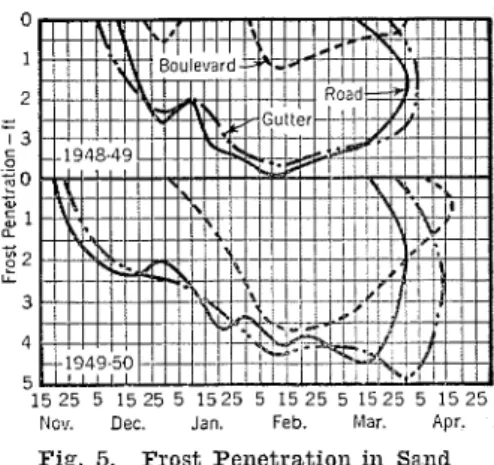
Fig. 5. Frost Pelletratio11 ill Sand J I ~ ~ a s r l i - c r i ~ c i ~ f s rocr-c iiladc i ~ r 0 f f a ; ~ ~ n ju1-
flrc years 1948-50. Fig. 4. Frost Penetration in Clay
d4casllr-ci/lcilts zacre ~ n a d e ift Ottazaa f o r tile otller ill clay. This project \\-as
the ycnrs IY-/S-jl. planned particularly for the study of
Experimental Installations
The field installations for the study of soil temperatures have been de- scribed by Legget and Pecliover ( 2 ) and, therefore, only a general descrip- tion \\-ill be given. I n Ottawa, auto- matic, mercury-bulb, temperature-re- cording instruments were installed uilder two city streets in November 1948. T h e bulbs \yere placed 2 and
5
ft under the center of the street, the gutter, and the adjoining strips of turf,five variables-air temperature, sno\\- cover, density of soil, type of soil, and disturbance of clay soils. Four test pits, S ft square and
6
ft deep, \\-ere dug at each site, and each pit was equipl~ecl with t l ~ e r m o c o ~ ~ p l e s at 1-it inter\7als of depth and \\-as backfilled under controllecl coilditiolls (Fig. 3 ) .Two pits at each location \\-ere bacli- filled loosely and t\vo were made com- pact with ~ n e u m a t i c tampers. During the winter, one loose and one dense pit
Oct. 1952 SOIL TEMPERATURES 927 at each site \\-ere kept cleared of snow.
Measurements are also being inade in unclisturbecl clay to 15 ft below the surface. Temperature readings were begun in December 1949 and are con- tinuing. Moisture meters were in- stalled with the thermocouples, but these have proved to be unsatisfactory. Soil moisture variation is being meas- ured using samples obtained from test borings.
Freezing Index-degree.days
Pig. 6 . Frost Depths and Freezing Index in Winter Excavations
T i l e dcsigrr cro-zfc i~lclrlded iri file figlcrc w a s deimcloped b y tllc U . S . C o r p s of E z g i -
rleers (3-5) frorrr nrl arlalysis of frost peilctratiorz records of t h e ~ l o r t l r e r ~ l U . S .
l.cprese~zts 1947-48 frost dcptlr ill rlrl-
classified soil.
x
r c p r ~ s c l l t s 1950-51 frost dcpfll i l l s a r ~ d .Results in Ottawa
AIany difficulties were encountered in the field work. Corrosion of the recorder bull~s at the clay installation in Ottawa made replacement necessary in Septeinber 1949, and interrupted record continuity. I t was necessary to remove the recorders in the sand when the instrulllents were damaged by van- dals during the summer of 1950. After reviewing the r e s ~ ~ l t s , it became appar- ent that three measuring points under the road and three under the boulevard would have given illore satisfactory data. Such ai, installation ~vould have
eliininatecl gutter measurements which were of linlitecl value as it was im- possible to control snow cover at the edge of the roadway. Probably the most serious error was the discovery, after installation, that a 12-in. sewer line was located near the measuring I~ulbs in the sand. This sewer line has complicated the analysis of soil tem- peratures, but at the same time, has shown how significantly a sewer will
100 80 .- 60 50
'5
40-
30 " L I-
g 20 r; 10 200 400 600 1,000 2,000 4,000 6,000 Freezing I n d e x - d e g r e e - d a y sPig. 7. Maximum Frost Penetration and Maximum Freezing Index dJcasrrr-c1lierrts wo.e 71znde in Otfazcra for t h e ye1a1.s 1947-51. Tlrc r i g l ~ t - 1 ~ a ~ t d erld oJ fllc I~or.icor~ta1 lirlc irrdicates ~rra.rir~lrrrrl frost d c p f l ~ at 1rla.rirrrlrrr1 free-iug i1rdc.r. Tire left-llarrd cud ixdicatcs f r e e z i ~ ~ g irrdex at file firrle of ~rla.uirirllil~ frost depfll. 0
refers to 11rcasllre1rle~tts w a d e i l l s a i d
( i ~ l t e r P o l a f c d ) ;
0
clay ( i ~ i t c r p o l n t e d ) ,X snrld ( b y e x c a i ~ a f i o 1 r ) ; arld
+
clay ( b y e.vcai1atiorr).raise the temperature of the surrouud- ing soil.
Severtheless, some pertinent obser- vations can be nlacle from t h e records ~vhich are s h o ~ v n in Fig. 4 and
5.
T h e frost penetration was generally deepest froill mid-1;ebruary until mid-March, and was considerably greater under the center of the road than under the gutter o r I~oulevard. A11 exception, probably a result of the selver, occurred in the sand, where the frost penetration925 R. F. LEGGET &
under the gutter was nearly as great, and at one time greater, than that under the road. T h e effect of the sewer at the sand installation is evident in Fig. 5. T h e tenlperature at the 5-ft depth under the center of the road was consistently warmer than the tempera- ture of the surrounding soil at 5 it. T h e reverse occurred at the clay site. A s the frost depth was interpolated assunling a linear tenlperature gradient between 2 and 5 it, the computed pene- tration in sand is less than it would be under nornlal conditions. T h e winter temperatures under the boulevard are usually warmer than the others. I11
one winter, 1948-49, at the clay site, the gutter temperatures were warmer than the boulevard temperatures, prob- ably a result of the greater snow cover over the gutter. I n February 1950 the trend of the frost line under the gutter and boulevard in the clay sud- denly reversed. A transfer of snow froill the gutter to the boulevard ap- pears to be a reasonable esplanation for this change.
S n o ~ v conditions at the clay site were observed during 1950-51. F o r Feh- ruary these records sholv an average of 3 in. of paclted snow on the road, 3; ft of snolv over the gutter, and I in. of snow on the boulevard. During this period, tenlperatures at the 2-ft depth under the gutter were abnormally high. Cooler temperatures under the boule- vard in clay, during the summer of 1950, illustrate the insulating effect of sod. This insulation is also present during the winter, although probably to a lesser extent. Sod does, ho~vever, complicate an evaluation of snolv cover alone.
I n addition to recording tempera- tures at these two sites in Ottawa, the W a t e r Worlts Dept. has recorded frost depths in most winter excavations
C. B. CRAWFORD Jour. A J.I/ W A
which have been made since 1947. This record has provecl to be valuable, perl~aps nlore valuable to the water works engineer than the nleasure~llent of actual soil temperatures, as it gives average values of frost penetration throughout the city rather than values at certain sites that a r e assumed to be typical. These data a r e given in Fig.
6, 7, and S. Figure 6 sholvs the rela- tion bet~veen freezing index, which will be described later, and measured frost
Fig. 8. Approximate F r o s t Penetration in Ottawa Area
penetration. T h e "design curve" de- veloped by the U.S. Corps of Engi- neers (3-5) fro111 an analysis of many records of frost penetration in northern U.S., illeasured mainly under snow- cleared airport runways on stabilized base course, is also sholvn in Fig. 6.
T h e values for Ottawa show a trend parallel to the design curve but con- siderably above it.
T h e design curve, l~owever, is based o n maximum freezing index and maxi-
Oct. 1 9 2 SOIL TEMPERATURES 929 mum frost penetration for each winter.
This relation is shown in Fig. 7, to- gether with the horizontal displace~llent obtained by sho~ving the freezing index at the tinlc of ~llaxinluin frost depth. T h e data are in agreenlent wit11 the design curve for conservative estiinates of frost penetration, except for the frost depths observed in sand excavations.
often show maxiinuill frost penetration occurring several weelts before maxi- inum freezing index for the winter. I n veste ern Canada the reverse is usu- ally true as ~naxillluill frost penetration occurs long after the ~naxinluin freez- ing index. Water mains have frozen as late as June in Winnipeg. T h e rea- son for the later occurrence of maxi-
Pig. 9. Cumulative Freezing Index a t Ottawa T h e upper point at 84 in. penetration
occurred during the winter of 1 9 4 7 4 8 , which appears to have been more se- vere than the freezing index indicates. Figure 8 shows variatioils in frost pene- tration between ground-temperature nleasuring illstallations and frost pene- tration as deterinined by excavation. These curves, compared with Fig. 9,
inuin frost depth in western Canada is due to greater time lag with the deeper frost line. Even when the mean daily temperature is well above freezing, heat continues to flow fro111 the frost line to the lowest temperature region in the soil which nlay be several feet above the frost line. This extraction of heat will send the frost line deeper.
930 R. F. LEGGET & C. B. CRAWFORD J o ~ i r . A l.I/ %'A!
TABLE 1
~VIaxinzurn Frost Pe~zetration at Montreal Road Laboratories
--
I
1
hlasirnum Frost Penetration-flI Sand 1949-50 - 4.1 4.2 1 1 9 5 0 - 5 1 -
1
1.51
1.4 Soil T y p e Clay 1949-50 U ~ ~ c o v e t e c l Soil~~~~~~
I l e n s e Soil Loose S u i l Sno~r-Covered SoilI:nrlisturbed I,ense Soil
Soil Loose Soil
Results a t Road Laboratories
T h e first soil temperatures were re- corded at the Nlontreal Road L a l ~ o r a - tories of the Div. of Building Research in the winter of 1949-50. During the first winter trouble Iras experienced with instrumentation and there may be some illaccuracies in the records, but subsecluent records are considered ac- curate. T h e average penetration of the 32 F isotherm for two winters is s h o ~ r n in Fig. S and T a l ~ l e 1.
A s inore records become arailal~le, a better interpretatioil of the results ma)- I)e made. A t present only a few general statenlents call 11e iuade :
1. Density of the soil appears to haye little effect on frost penetration. T h i s conclusioll inay not he valid ~ r h e n the actual density of the soil in the pits is checked.
2. Frost penetration averages allout 1 times as deep in sand as in clay, jrith, or without, snow cover. T h e effect of snow cover in this respect is not clear.
3. Disturbance of clay soils increases frost penetration to 1 3 times the depth in undisturbed clay.
4. Frost penetration is c o n s i d e r a l ~ l ~ reduced by a blanket of undisturbed
snow. T h e actual effect is uncertain I~ecause the snolv blanliet of 1919-50 was unusual, as shown in Fig. 10. Iluring the ~vinter of 1949-50, snow cover had little effect. I n the follo\ving winter, 1950-51, reinoval of the snow t r i ~ l e d the frost penetr a t. ion.
Factors Affecting Soil Temperature
X
brief examination of the theory of heat flow (6) indicates some of the practical difficulties of a purely theo- retical analysis of soil temperature vari- ations.A
simple equation expresses the rate of heat flolv along a thermal gradient fro111 warm t o cold areas :\\here
a
= quantity of heat flowing,I< = thermal conductivity,
i
= thermalgradient,
A
= area, and t = tiine. 'Thus the rate of heat flow over ally given area is prol~ortional to the ther- mal conductivity and t o the thermal gradient.T h e rate of change of temperature is expressed I)y a more complicated dif- ferential equation involving the thernlal diffusivity of the soil. "Thermal dif- fusivity" is a term which expresses the ease with which teinperature
Oct. 19-72 SOIL TEMPERATURES 93 1 changes can occur in the soil. If the
soil freezes, latent heat is released, ~vhich adds to the co~nplications.
These theoretical relations show that the rate of heat flow is proportional t o the thermal conductivity, but the rate of temperature change, or the rate of frost l ~ e i ~ e t r a t i o ~ ~ , is proportional to a more complex set of varial~les.
A detailed clisc~~ssion of all the fac- tors affecting soil temperature is not necessary, but sonle consideration of the variables is essential for an under- standing of the problem. T h e variables lnay be divided into external factors
Nov. Dec. Jan. Feb. Mar.
Pig. 10. Undisturbed Snow Depths a t Montreal Road Laboratories and intrinsic factors
(7).
T h e external factors are meteorological, such as air temperature, precipitation, sunshine, relative humic1it)-, wii~cl velocity, dew l~oint, ancl barollletric pressure. 111- trinsic factors include topographic posi- tion, nature of surface and type of cover, nloisture content of soil and its thermal conductivity, specific heat, or- ganic content, specific gravity, radia- tion, absorption, texture and structure, el-aporation, and concentratio11 of salts in s o l ~ ~ t i o n . This is a formidable list of variables, pet they are so interrelated that they compensate one another to asurprising degree. They illustrate, ho~vever, the difficulties in a theoretical calculation of frost penetration.
As present lino~rledge of the ther- mal properties of soils is limited, it is necessary to neglect many of the vari- ables in both the theoretical and prac- tical analyses. Of the external factors, only air temperature can be conven- iently considered, but, fortunately, changes in the other external factors are generally reflected in the air tem- perature. Sollie of the intrinsic factors must be I~IIOWII for the theoretical analysis. A glance at some others will suffice to indicate their relative effect on soil teml~eratures.
Air temperature is, of course, the most inlportant factor. T h e second most important variable is probably surface cover-for examnle. snow and A ,
vegetation reduce frost penetration and frost retreat. Pavement, on the other hand, increases pelletratio11 and ac- celerates retreat. Darlc surface colors increase the absorption of solar energy -high temperature radiation-but do not have the same effect on the emis- sion of heat fro111 the soil-low tem- perature radiation. Racliatio~l from the soil is governed largely by the soil's water content. All soils, n;hen met, tend to lose heat by radiation equally, as if they were black bodies. Many of the intrinsic factors are closely related to the texture ancl structure of the soil. About all that call be safely said of these variables is that frost pel~etration is generally greater in granular soils than in fine-grained cohesive soils.
Frost Penetration
High thermal conductivity aids frost penetration. Organic matter generally increases moisture content which. in , turn, affects thermal conductivity and
932 R. F. LEGGET h
voluinetric heat capacity. I n general, moisture appears to be a temperature modifier, reducing fluctuations and rapid penetration. Topographic posi- tion has an appreciable effect on frost penetration, northern exposures having greater frost penetration than south- ern exposures.
T h e freezing point of the soil has been a controie~sial subject for some time. I t is thought that fine-grained soils freeze at a temperature slightly lower than 32 F. Dissolved salts in the soil moisture would coiltribute to the lo\vering of the freezing point. Many colnparisons by the U.S. Corps of Engineers (4) of soil tempera- tures with actual frost penetration, measured Ijy excavation, show that the average freezing temperature is close to 32 F.
Theoretical reasoning indicates that density and ~vater content nlay have considerable eflect on frost peiletr a t' lon in soil owiilg to the effect of these vari- ables on the volumetric heat capacity ailcl the therinal conductivity of the soil. A s noted previously, the ease with ~vhich teinperature changes can occur in soil is governed by the thermal dif- fusivity. Thermal diffusivity is equal to the therinal conductivity divided by the volunletric heat capacity. Thermal conductivity indicates the amount of heat flowing per degree Fahrenheit, and the voluinetric heat capacity indi- cates the amount of heat required to raise or lower the temperature
1
F. A s increases in deilsitv or moisture content cause increases in both thermal conductivity and volumetric heat ca- pacity, these changes may have little effect on the thermal diffusivity of the soil.Heat Flow
A t the present time, the calculation of heat flow in the ground is based on
C. B. C R A W F O R D Jorrr. A bf' l.t.'A
general heat flow theory, using values of the coefficient of conductivitv inodi- fied to compensate for the efiect of moisture. These special values of the coefficient of conductivity are usually determined by placing a soil sample between a heated and a cooled plate, and measuring the heat input and tem- perature after steady-state conditions are achieved. It is generally recog- nized that under such a temperature gradient, the moisture begins to inove iron1 the hot side to the cold side. There is considerable discussion in the literature (S-10) of nihetl~er the water moves a s liquid or by a process of evap- oration, vapor migration, and condensa- tion, o r both. These opposing points of view have not yet been resolved, but are important in determining heat transmission in the ground. If any appreciable nloisture movement as va- por talces place, resulting in the trans- inissioil of additional heat as latent heat in the migrating vapor, the usual heat flow theory may not be adequate.
The effect of vapor inigration is to increase the heat flow, not only in the laboratory tests inade to determine the coefficieilt of conductivity values, but also in the ground. T h e relative rates of vapor migration, however, may vary widely between the laboratory tests and the actual ground conditibils, so that considerable errors may result. I t is possible that future xvorlc will indicate such vapor migrations to be negligible in the soil. Until this is demonstrated, ho\vever, the possibility of error froin this source nu st be admitted.
Transient methods capable of meas- uring the therinal properties of soils in place a r e now being developed (11, 1 2 ) . These methods enlploy heated wires o r spheres, and testing is carried out over a period of a few minutes. The migration of inoisture occurring
Oct. 1952 SOIL T E M P E R A T U R E S 933 during such a short time might be
small but the rate of migration might be relatively high, and if the moisture movement occurs as water vapor, it might lead to fictitious results. I t has been suggested that more heat arrives at a cooled coil in the ground-such as is used for a heat punlp system of heating-than can be explained on
Effect
ofAir Temperature
As stated previously, air tempera- ture is the lnost important factor af- fecting soil temperature and frost peue-
tration. T h e common method of
expressing the effect of minter air tem- peratures is the freezing index (13).
The freezing index is the cunlulative
Year
Fig. 11. Freezing Index Computatioils for the Years 1885-1950
the basis of the usual theory. T h e cause of this apparent discrepancy may well be the transmission of heat as latent heat in the migrating vapor.
Until the coinbined inechanisins of heat and moisture flow are more ade- quately understood, the application of heat flow theory alone in assessing the effects of density and moisture content must be made wit11 reservations.
total of degree-days
*
Ibelolv freezing point in any winter. T o coinpute the indes, the mean air temperature for each day is subtracted from 32 F to obtain the degree-clays of frost, and the values obtained are added together for the whole winter. Values for mid-*
A unit representing l o of declination from a given point (here 32 F) i n the mean outdoor temperature for one day.934 R. F. LEGGET &
winter days with mean temperatures above freezing-that is, negative values of freezing indes-are subtracted from the total. In the spring when the temperature trend is upward and tem- peratures are above freezing, the cumu- lation is discontinued.
Computatiou of the freezing index using nlean daily tenlperatures is la- borious if many years of records are to be analyzed. I t is eclually accurate to use the monthly ineans for Decem-
0.5 1 2 5 10 20 50 80 90 95 95 99
Winters With Greater Freezing Index- per cent
Fig. 12. Freezing Index Freclnency Curve for the Years 1885-1950
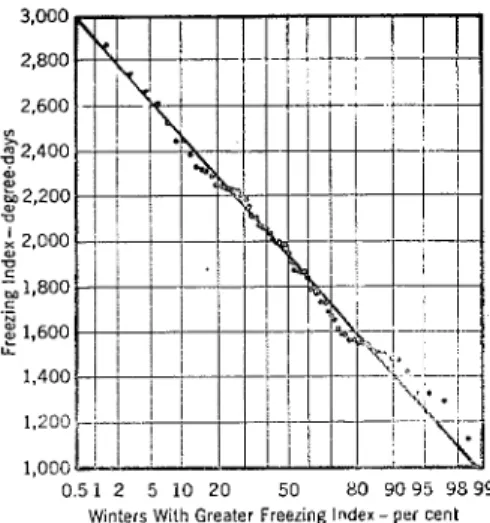
T h e freqlrci~cj~ curi7e ; ~ n s obtaik~ed frow a statirticnl atlaljls~s of records of the
e.vfieriiiwiltal farru at Otfaewa. ber, January, February, and March if a correction is applied for the transi- tional months in the fall and spring. T h e follo\ving formula can then be used :
Freezing index = 30.3,T
+
correction in which 30.3 is the average number of days in December, January, February, and March, and s is the average of the monthly means for these four months subtracted from 32 F. T h e correction is the cun~ulative total of the degree-C. B. CRAWFORD Jocir. A W W A
days of frost for the fall and spring montl~s, and usually includes frost in late November and early April. T h e cumulation does not necessarily begin at first frost as its effect may be can- celled I)y subsequent higher tempera- tures. T h e freezing index for Ottawa air temperature records has been plotted for four years in Fig. 9.
The freezing index has also been computed from the records of the Es-
perimental Farm at Ottawa for the
T ~ m e
Fig. 13. Freezing Index f o r Two Winters T h e t w o euinters had t h e saiite total fl-cczing i l ~ d e x bz~t w e r e of different
duration.
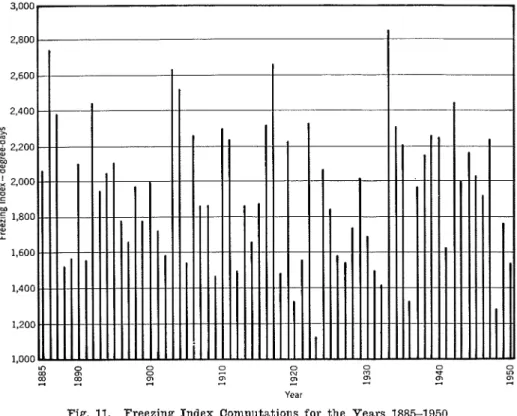
years 1885 to 1950, and the results o i these conlputations are shown in Fig.
11. T h e freezing index frequency, which was obtained from a statistical analysis of these records, is shown in Fig. 12. This figure shows that the 50 per cent frequency was 1,930 degree- days-that is, that half of the years studied had winters with a freezing index greater than 1,930 degree-days- and the 10 per cent frequency was 2,460 degree-days. T h e winter of
1947-48 had 2,234 degree-days of frost. T h e records indicate that a winter with this freezing index will occur every four or five years.
Oct. 1952 SOIL TEMPERATURES 935 T h e classilication oi the severity of
~vinters using the freezing index is probably oversimplified but no alterna- tive has yet been suggested. F o r ex- ample, the winter of 1947-48 had sonle peculiarities which indicate that it was Inore severe than would be gathered froin the freezing index. Figure 9 shows that it was a normal fall and an early spring, the nlaxiinum number of degree-days occurring in mid-March. Furthermore, it was a year of light snowfall-59 in. T h e 50-yr average for Ottawa is SS in. T h e winter of
Log Freezing Index
Fig. 14. Relation of Freezing Index t o Frost Penetration
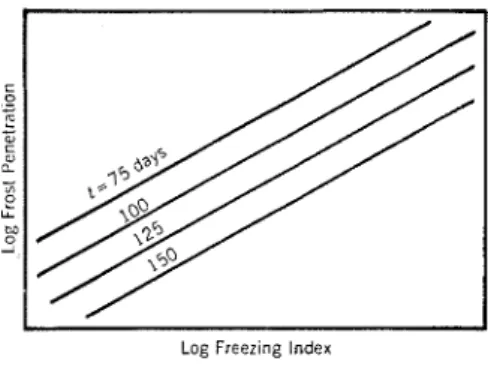
Tize time factor accounts f o ~ a t8ar.iety of zweati~el- co~zditio~zs ti~ro~cgizotct the
cololtl-y.
1942-43 hat1 2,770 degree-days of frost but the sno~vfall was 116 in. I t is reasonable to believe that snowfall and the rate of accuinulation of degree- clays have some effect on winter sever- ity. Figure 13 shows a qualitative plot of freezing index for two winters hav- ing the same total freezing index but of different duration. It is possible that the winter of 100 days duration ivould be more severe than the longer winter owing to the greater thermal gradient acting at the surface. If this reasoning is correct, it may be possible to draw a series of curves (Fig. 1 4 )
which ~ ~ o u l d inclucle a time factor to account for a variety of weather concli- tions throughout the country. The p ~ ~ r p o s e of this fanlily of curves is to show greater frost penetration for a steeper freezing iilclex curve, and was a suggestion oi
N.
B. Hutcheon of thc University of Sasltatche~van, a consul- tant to the Div. of Building Research.The Ottawa wiilter of 19474S,
which had a steep freezing index curve and deep frost penetration, lends strength to this conviction. In addi- tion, the rapid accunlulation of degree- days during 1947-4s at Ottawa is simi- lar to the norinal winter weather in western Canada, and it seenls unliltely that only one curve of frost penetration against freezing index xvould accu- rately inclucle the wide variety of neather experienced in Canada. l/Iany field records of frost penetration will be required to conlplete this analysis, ancl it is hoped that a collectioil of these will begin during the next winter season.
Effect of Snow Cover
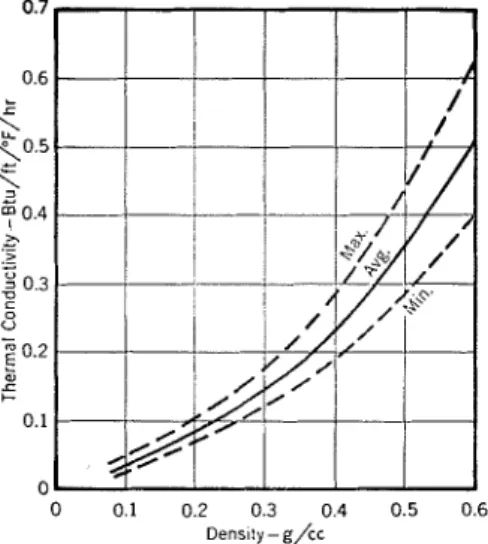
Snoiv cover has considerable effect on soil temperatures ancl frost peile- tration. Some investigators of winter soil temperatures have noted its effect in the undisturbed state, a n d a few have compared the effect of undis- turbed and colnpacted silow. All have agreed that snow cover will appre- ciably reduce frost penetration. The therinal conductivity of snow is a func- tion of its density. Independent in- vestigators have agreed, within fairly narrow limits, in their measurements of conductivity, as shown in Fig. 15, ~vllich is based upon a study of the properties of snow and ice (14).
Snow depths and density have been measured by the Div. of Building Re-
936 R. F. LEGGET & C. B. CRAWFORD J o r ~ r . A 1,lf l.I/A
TABLE 2
U?zdislz~rbed Snozo Depllzs and Dem-il,ies"
search since 1918. These data a r e shown in Fig. 9 and Table 2, and from them the values of thernlal con- ductivity for ui~disturbecl snow call be estimated. Date oi Obserra- tion 12/1/49 12/15/49 2/16/50 3/8/50 3/16/50 1/15/51 1/30/51 -- -- - - 2/15/51 "The
T h e w a r ~ n i n g effect of snow cover is clearly shown in Fig. 16, which shows that maximum frost penetration during 1950-51 in sand with 110 snow cover
L;lboratories. .t Coefficient of conductivity. Specific G r a ~ ~ t p of Snow 0.21 0.31 0.22 0.24 - 0.28 0.25 0.24 0.36 0.33 0.14 0.22 0.16 -- 0.25 0.20 0.12 0.19 - 0.28 0.22 0.24 0.30 made Illevation o f Sqmples r l r . 4 2 4; 7; -- 2 5 9 ---- 2 6 12 ---- ---- 3 7 - 2 4 9 11 --- 3 7 12 15 .- observations were
was 36 in.. and with snow cover was 15 i n . ; in clay with no snow cover it was 29 in., and with snow cover was 11 in. I n undisturbed clay with snow cover, the penetration was 0 1 1 1 ~
6
in.Part of the difference between the mean
Snow Deptli in. 7 3 10 - 12 15 10 10 - 11 - 17 a t t h c
anilual air temperature and the almost constant soil temperature at 15 or 20 ft below the surface can be attributed to the iilsulating effect of snow.
Heat flows along the thermal gradient
from warm to cold regions. Snow
acts as a n insulating blanket which re- duces the penetration of frost. A s frost penetration is dependent on more than simple relations of thermal con- ductivity, the degree of protectioll of- fered by snow cover is not a simple function of its depth a n d density. I t is interesting to note, ho~vever, the relative values of thermal conductivity for the various materials affecting soil temperatures-for esanlple, in terms of British thermal units per degree Fah- renheit per foot per hour, the thermal conductivity for unclisturl~ed s11ow is 0.1 ; for ice, 1.3 ; for concrete, 0.5; and for soil, 0.5. Obviously these values are rough appro~imations, as the ther- inal conductivity is usually a function of such variables as density, moisture content, and mineral type and also depends on whether o r not the soil is frozen. Nevertheless, the numerical values give an impression of the pro- tection offered by s n o ~ \ ~ , ice, concrete, and soil. Of the four thermal conduc- tivity values given, the most significant value is that for ice, which shows that the protection against heat loss offered by pure ice is less than that of soil.
I t may be more illustrative to com- pare, in a general way, the values f o r thermal diffusivity of soil, sno~v, a n d ice. O n the average, the thermal dif- fusivity of ice is about 3 times as great as that of undisturbed, but not fresh, snow, a n d the thermal diffusivity of soil ranges from 2 to 3 times that of snow. These values indicate that, for a certain thermal gradient, ice and soil \\-ill change temperature at about the
;\rerage kl' B I I L / / ( / ~ F / I ~ ) . 0.09 0.16 0.10 0.12 0.14 0.08 0.08 0.13 hlontrcal I<oad
O C ~ . 1952 SOIL TEMPERATURES 93 7 same rate, and that undisturbed snow
will resist temperature change as much as 1+ o r 2 times its depth of soil.
T h e protection against frost pro- vided by partially disturbed snow was revealed by a study of field records of excavations in 0ttaxva of actual frost penetration under snow-free streets and the adjacent snow-covered boulevard. These records show that frost pene- tration is reduced by 1.7 to 2.7 ft for
Fig. 15. Thermal Conductivity of Snow each foot of snoxv cover. T h e proba- bility average of the records is ap- proximately 2 ft.
Conclusions
A n unclerstanding of soil tempera- ture variations in soils of different types, both disturbed and undisturbed, is a basic requirenlent for a full appre- ciation of the problen~ of freezing water mains. Although lcno\vledge of all as- pects of soil variations is still far froin complete, a steadily increasing interest is being shown. As more field obser- vations are published, and details of laboratory investigations are reported,
the unlcnowns in the problem will grad- ually be reduced.
Theoretical equations for the conl- putation of f r o s t depth have been de- veloped by several worlcers, but com- parisons of actual and theoretically con~puted frost depths indicate that the theoretical approach is not yet free
from error. An empirical design
curve, developed by the U.S. Corps of Engineers (3-5), appears to be, at present, the best aid in frost prediction, and its application under Ottawa con- ditions is illustrated in this paper.
I n spite of the uncertainties still awaiting solution, a careful study of the results obtained from the experi- mental work conducted at Ottawa sug- gests certain general conclusions :
1. T h e significant difference between the depth of frost penetration in dis- turbed ancl undisturbed soil suggests that if soil can be baclcfillecl to some- thing approaching its original undis- turbed condition. sonle reduction in the depth of pipe trenches might be pos- sible. This possibility is being studied. 2. I t is clear that water pipes nlay safely be placed at less depth in clay soils than in sandy soils.
3. T h e design curve shown in Fig. 6
sho~vs a reasonable relation 11et.cveen frost penetration and freezing index for nlost of the soils studied, but its use nlust be tempered xvith caution until more corroborative eviclence is available for Canadian conditions.
4. If 500 o r Illore degree-days occur before the end of Decenlber in Ottawa, some consideration should be given to restricted snow plowing in areas where water pipes a r e vulnerable.
5. T h e authors suggest a modifica- tion of the freezing index concept to talce account of the rate at xvl~ich freez- ing weather occurs. A n outline of this inodification has been given ; the au-
938 R. F. LEGGET S: C. B. CRAIVFORD Jonr. f l [.I/ 1,VA
Fig. 16. Effect of Snow Cover on Frost Penetration iMeas~~i.c~i~eilts s u e ~ e ?rlade iiz tile Ottaccra test pits ill 1950-51. thors hope to publish design curves
when sufficient evidence has been accu- mulated.
6. T h e extent of the effect of snow cover in its various states is still in doubt. I t is now ltnown, however, that a n undisturbed continuous snow cover will reduce frost penetration in
the Ottawa climate by a n amount e q ~ ~ a l to or greater than its o ~ v n thickness.
7.
Traffic-paclted snow mill reduce frost penetration somewhat more than pure ice, depending on the deilsity of the snow. This points to the desira- bility of conserving sno\v cover when- ever possible in water works practice.Oct. 1952 SOIL TE3IPERATURES 939 Only by the steady and patient ac- port No. 2 on Frost Action in Soils, cuniulation of factual evidence will it p. 17 (1952).
tle
possil,le to in this 2. LEGGET,n.
F., E; PECI<OVER, F. L. Soil Temperature Studies-A First Prog- wit11 confidence. A number of research ress Report. Proc. 29th Annual Meet- .organizations are conducting investiga- in:, I-Iighway Research Board (1949). lions under controlled conditions and 3. CORPS OF EXGRS., NEW ESGL.\SD DIV.in laboratories. Additional informa- tion is recluired, however, froin actual field experience.
Acknowledgments
T h e inforn~ation presented in this paper represents a careful selection from the results of a large aillount of ~ ~ a t i e n t observation.
he
authors are therefore indebted to many associates for assistance in the ~ v o r k and, in par- ticular, to their own colleagues in the Soil Mechanics Section of the Div. of Cuilding Research. T h e y have 1)ene- filed by many helpful discussions withN. B. I-Iutcheon, Prof. of i\/lech. Eng., University of Sasliatchewan, and coil- sultant to the division. They wish to pay special tribute to the cooperation extended to the division and to them, ~lersonally, by all the officials of Ottawa
11-110 have been concerned with the co- operative ~ r o g r a n ~ and, in particular, t o W. E. MacDonald, TVater TVorlis Comn~issioner, and members of his staff; Cecil Wight, Director oi Plau- n i n g ; aucl J. I-I. Irvine, Commissioner of TYorks, and members of his staff. T h e interest shown by these men has been a continuing encouragement to the division. Permission to publish the data obtained in cooperation \\:it11 the city of O t t a ~ v a is gratefully aclinowledged.
References
Report oil Frost Iitvcstignfior~ 1944- 1945. U . S . Army, Boston (1947). 4. CORPS OF ENGRS., N E W ESGLASD DIV.
i l d d o l d r l ~ r ~ N o . 1 , 1945-1947, f o Report or! Frost I n v c s f i g n f i o i ~ , 1944-1945. U.S. Army, Boston (1919).
5. SII:\XSOX, 1.V. L. Prediction of Frost Penetration. J. New Engl. Watcr Works Assn., 59 :4 :356 (1945). 6. ISGERSOLL, L. R.; ZODELL, 0 . J . ; 6r
IX(;ERSOI.L, A. C. Hcnt Coildite/iot~ l l / i f h E ~ ~ g i i ~ e e r i t l g arrd Geologicnl Ap- ~licatiorls. McGram-Hill Bool; Co., Xew Yorlc (1948).
7. Bor:~oucos, G. J. An Investigation of Soil Temperature and Some of the Most Important Factors Influencing It. Michigan Agric. College Espt. Sta., Tech. Eul. No. 17 (1913).
8. SAIITII, W. 0. Thcrmal Transfer of A~loisture in Soils. Trans. Am. Geo- physical Union (1943). p. 511. 9. \ V I X ' ~ E R I ~ O R X , H . F. Fundamental Simi-
larities Between Electro-osmotic and Thermo-osmotic Phcnomena. Proc. 27th Annual Meeting Hig11u.a)- Re- search Board (1947).
10. I - I ~ T C I ~ E O N , N. B., & PASTOX, J. A.
Lloisture Migration in a Closed Guarded H o t Plate. Heating, Piping, Air Conditioning, 24 :4 (1952). 11. HOOPER, F. C. The Thermal Conduc-
tivity Probe. Highway Research Board Special Report No. 2 on F r o s t -4ction in Soils, p. 57 (1952).
12. L~IISENER, A. D. A11 --Ibsolute AIctllod of Determining Thermal Concluctivity and Diiiusivity of Soils. I-Iighway Re- search Board Special Report No. 2 on Frost Action in Soils, p. 51 (1952). 15. C:\S.%GRANDE, A. D~SCLISS~OII on Frost Heaving. Proc. Highway Research Board, 11 :I68 (1931).
1. C R A ~ % ~ ~ ~ ~ ~ , CARL B. Soil Temperatures 14. ~I.\sTIs, HOMER T. The Properties of (-4 Review of Published Records). Snow and Ice. Eng. E s p t . Station, I l i g h ~ v a y Research Board Special Re- University of llinnesota (1951).