Short Communication
Lotus japonicus Nodulates and Fixes Nitrogen with the Broad Host Range
Rhizobium sp. NGR234
A.K.M. Anwar Hussain', Qunyi Jiang
1, William J. Broughton
2and Peter M. Gresshoff
11 Plant Molecular Genetics and Center for Legume Research, The University of Tennessee, Knoxville, TN 37901-1071, U.S.A. 2 Laboratoire de Biologie Moleculaire des Plantes Superieures, University of Geneva, CH-1292 Chambesy, Switzerland
Lotus japonicus possesses major advantages as a
model legume for the study of plant-microbe interactions. The relative absence of genetic information on its normal microbial partner (i.e., Mesorhizobium loti) could limit its utility in research. Here we show for the first time that the broad host range Rhizobium strain NGR234 nodulates and fixes nitrogen in symbiosis with Lotus japonicus ecotypes "Gifu" and "Funakura". We demonstrate that bacterial mutants deficient in nodulation or nitrogen fixation possess the expected phenotype with L. japonicus. Nodulation of
L. japonicus was sensitive to nitrate. Vermiculite was an
efficient synthetic growth substrate, allowing axenic growth in Magenta jars. The genetic analysis of the Lotus
japo-nicus-Mesorhizobium interaction should be accelerated
through the use of this well-defined microsymbiont.
Key words: DAF — ERIC — Genetics — Legume —
Ni-trogen fixation — Nodulation — Symbiosis.
It is clear that genetic analysis of symbiotic nitrogen fixation is essential to achieve a clearer understanding of structure-function relationships. The genetics of bacteria have revealed many integrated processes, by which plant development and function are channeled (Long 1996). Likewise, plant genetics, through induced or natural mu-tants, have revealed many mechanisms, such as the sys-temic control of nodulation through the shoot (Carroll et al. 1985, Gresshoff 1993) or the involvement of ethylene in infection control (Penmetsa and Cook 1997). Molecular biology helped through the description of novel proteins (called nodulins) which function in the nodule environment (Legocki and Verma 1979).
The significance of coupling genetics to plant physiol-ogy and development analysis is well illustrated in
Arabi-dopsis thaliana. Unfortunately, this crucifer is unable to
nodulate and fix nitrogen (Kolchinsky et al. 1994). As a member of the brassica family, it also lacks mycorrhizal Abbreviations: ARA, acethylene reduction assay; DAF, DNA amplification finger printing; ERIC, Enterobacterial repeti-tive intergenic consensus.
associations (Wegel et al. 1998). These reasons, and the concomitant problems with existing crop legumes in terms of large genome sizes (e.g., l x l O ' b p for soybean), the high degree of repeated DNA sequences, and difficulty of high efficiency transformation, have led to the acceptance of model legumes such as Lotus japonicus (Jiang and Gres-shoff 1997, Handberg and Stougaard 1992) and Medicago
truncatula (Pentmetsa and Cook 1997). The latter is
par-ticularly attractive because of the extensive bacterial ge-netics available in Sinorhizobium meliloti. In contrast,
L. japonicus was deemed less attractive, because of the
limited genetics of M. loti.
L. japonicus has genetic, biological and experimental
advantages (Handberg and Stougaard 1992, Jiang and Gresshoff 1997). It is a true diploid (n=6) with a small genome (about 400 Mb per haploid genome), has a short generation time, large self-fertile flowers, large number of small seeds per pod, is easy to cross sexually, and is easily transformed by Agrobacterium tumefaciens and A.
rhizo-genes facilitating insertional mutarhizo-genesis and gene tagging
(Thykjaer et al. 1995, Stiller et al. 1997, Schauser et al. 1998, Oger et al. 1996). A skeletal molecular map con-taining arbitrary and microsatellite markers allowing the mapping of symbiotic mutations is available (Jiang et al. 1999). For example the hypernodulation and altered root mutant, har-1 (Szczyglowski et al. 1998) was mapped to linkage group 2 close to two DNA amplification finger printing (DAF) markers (Jiang et al. 1999).
The fast-growing Rhizobium NGR234 strain nodu-lates more than 110 genera of legumes, as well as the non-legume Parasponia (Pueppke and Broughton 1999). Its 536-kb symbiotic plasmid pNGR234a (Perret et al. 1994, Freiberg et al. 1997) including most nodulation and nitro-gen fixation nitro-genes, as well as novel type III secretion system genes (Viprey et al. 1998), has been entirely sequenced. The chemical structures of NGR234 synthesized lipo-oligosac-charide nod-factors are known, and sufficient amounts for physiological experiments are available (Price et al. 1992, Jabbouri et al. 1998). Large numbers of symbiotic mu-tants, as well as those altered in related metabolism (such as surface polysaccharide biosynthesis) have been isolated and characterized.
Here we demonstrate that this broad host range 894
Rhizobium strain nodulates L. japonicus effectively and
efficiently and fixes nitrogen, as measured by acetylene reduction, to the same extent as M. loti (Lopez Lara et al. 1995, Sullivan and Ronson 1998), thereby removing a limitation to further genetic and physiological analysis of plant-microbe interactions in this symbiosis.
Bacterial strains—Rhizobium sp. NGR234 (Fix+),
NGR-{AfixF (Nod+, Fix"); Jabbouri et al. 1996), NGR(AnodABC (Nod", Relic et al. 1994) and Mesorhizobium loti NZP2235 (a gift from Dr. Frans de Bruijn, Michigan State Univer-sity, East Lansing, MI, U.S.A.) were grown at 28°C in YMB medium (Handberg et al. 1994) with antibiotics at 100 mg liter"1 rifampicin for NGR234; at 100 mg liter"1 each rifampicin and streptomycin for ~HGR(AfixF) (Lewin et al. 1990) and NGR(z1 nodABQ, and no antibiotics for NZP2235.
Plants—Lotus japonicus ecotypes B-129-S9 "Gifu"
and B-581 "Funakura" seeds were originally obtained from the University of Aarhus, Denmark (Dr. Jens Stougaard), and then propagated in our greenhouses. Both ecotypes were the ones used as the parents for our mapping popu-lation and derived recombinant inbred lines (RILs) (Jiang and Gresshoff 1997, Jiang et al. 1999).
Seed sterilization—Seeds of L. japonicus were
scari-fied by gentle treatment with sand paper, then sterilized for 15 min in 3% H2O2 in 70% ethanol followed by five rinses with sterile water. The sterilized seeds were germinated on a wet filter paper pile in Petri-dishes in the dark, at 24°C for 1 d.
Plant media—Germinated seedlings were transferred
to plastic cups and growth pouches containing different commercially available media with sterile B&D solution (1/4 strength; Broughton and Dilworth 1971) plus 2mM KNO3. Three days after transfer, 2 ml inoculant per plant was added (1 x 10⁹ cells ml"1). All plants were grown in the greenhouse with an 18/6 h day/night cycle and 24°C/18°C
1
61
a. iI
5!
« 2 • •Dg
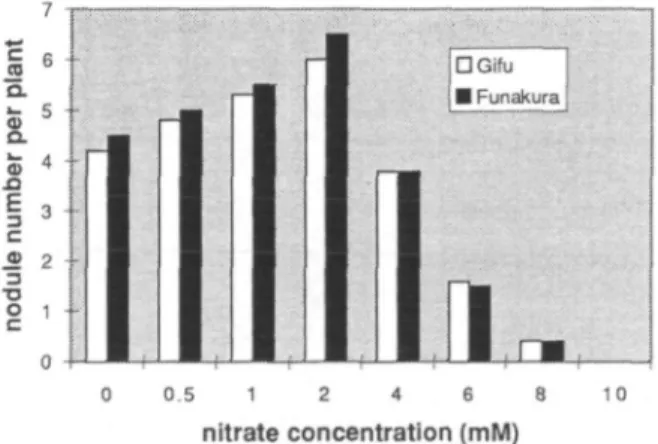
| • Gifu | • Funakura 0.5 1 2 4 6 8 nitrate concentration (mM) 10Fig. 1 Nodule numbers of L. japonicus as affected by different concentrations of nitrate (KNO3, mM) in vermiculite after 4 weeks of seed germination.
day/night temperature regime for 4 weeks. 1/4B&D solu-tion was added on alternative days to compensate for depleted plant nutrients and liquid. Ten plants were grown for each strain and ecotype. A preliminary experiment with "Gifu" and "Funakura" in vermiculite using different rates of potassium nitrate (0, 0.5, 1, 2, 4, 6, 8 and 10mM) showed that addition of 2 mM nitrate with B&D was re-quired for L. japonicus as basal dose, which did not ham-per nodulation (Fig. 1) and growth (data not shown). The effect on nitrogen fixation was not measured.
After selecting the best medium for nodulation of
L. japonicus, Magenta jars with 1/4B&D wetted
vermicu-lite in the upper chamber and liquid 1/4B&D medium in the lower reservoir were used routinely for nodulation tests (Lewin et al. 1990).
Acetylene reduction assay—Plant roots with intact
nodules were severed at the hypocotyl node and individ-ually placed in 30 ml test tubes, sealed with a serum stop-per, and 10 percent of the air was replaced with acetylene. Nodulated roots were incubated at room temperature and 1 ml subsamples were analyzed for ethylene production at 5 and 25 min after incubation by using a flame ionization gas chromatograph. After assaying, the nodules and roots were collected separately, weighed and used for further study.
Isolation and characterization of bacteria from nod-ules—The nodules were immerged in 90% ethanol for one
min, then transferred to solution of hydrogen peroxide (5%), soaked for 5 min and washed three times with sterile saline solution (0.9%). Afterwards the nodules were crush-ed with a glass rod and dilutcrush-ed with saline solution. The suspension was streaked onto Yeast-mannitol agar plates containing antibiotics. Individual colonies were picked and tested for renewed nodulation ability on Magenta jar-grown "Gifu" and "Funakura" plants.
DNA isolation—DNA was extracted for 10 d old
co-lonies the DNA of the isolates was extracted for DAF (Bassam et al. 1992). Bacterial genomic DNA was lysed by DNAzol (Chomczynski 1997) and the genomic DNA was precipitated from the lysate with 100% ethanol. Following a 95% ethanol wash, DNA was solubilized in water.
DAF and Enterobacterial Repetitive Intergenic Con-sensus (ERIC) analysis—DAF was used to evaluate the
molecular genotype of parental and nodule isolates (Cae-tano-Anolles and Gresshoff 1994, Cae(Cae-tano-Anolles et al. 1991). The reaction mixture in a total volume of 10 ml contained 4ng template DNA (2ng/ul~1), 3 mM oligo-nucleotide primer (National Biosciences; Plymouth, MN, U.S.A.), 2 units Stoffel fragment polymerase (Perkin-Elmer, Emeryville, CA, U.S.A.), 0.2 mM of each dNTP, 10 mM Tris-HCl (pH 8.3), 10 mM KC1 and 4 mM MgSO4. The total reaction mixture was overlaid with a drop of heavy mineral oil and amplified in a thermocycler (Ericomp Inc., San Diego, CA, U.S.A.) for 35 cycles (using two-step
Table la Nodule number and total biomass production (dry matter) per plant in ver-miculite medium Strain Control NZP2235 NGR234 UGRAfixF NGRAnodABC Gifu Nodule number 0 5.2±0.4 4.6±0.2 3.2±0.2 0 Dry matter (mg) 18.8±0.6 15.6±0.7 12.6±0.7 17.4±1.1 16.6±1.1 Funakura Nodule number 0 5.8±0.4 2.0±0.3 1.6±0.2 0 Dry matter (mg) 34.8±1.0 31.4±1.4 21.0+1.4 28.2±2.1 32.4±1.4 Nod plants grew well because of limiting nitrate in the medium.
cycles of 1 s at 96°C and 1 s at 30°C, then one final cycle at 72°C for 5 min; heating and cooling rates were 23°C min~' and 14°Cmin~', respectively). Amplification pro-ducts were separated on 5% polyacrylamide gels (7 M urea), backed by Gel-Bond film (FMC, Rockland, ME, U.S.A.; for stability and later handling) by electrophoresis and silver stained (Bassam et al. 1991). Enterobacterial Repetitive Intergenic Consensus (ERIC) analysis (Versa-lovic et al. 1994) was performed on all parental material and nodule re-isolates to confirm the identity.
Growth medium selection and nodulation—M. loti
NZP2235 and Rhizobium sp. NGR234 were used for nodulation of L. japonicus ecotypes "Gifu" and "Funa-kura" growing in different substrates. Significantly higher nodule numbers (about 6 per plant after 4 weeks of growth) and good plant growth (about 19 to 38 mg per plant dry weight) of both ecotypes were obtained in vermiculite medium. "Funakura" repeatedly grew faster than "Gifu", giving a plant mass nearly twice that of "Gifu" after 4 weeks of growth.
Plants could be grown and nodulated on sealed agar plates. However, roots exposed to light developed green nodules with low nitrogenase activity and delayed appear-ance (data not shown). We conclude that light exposure to
roots is detrimental to L. japonicus nodulation.
Nodule numbers—In two chambered Magenta jars
(being modified from Leonard jars), nodule number of both "Gifu" and "Funakura" did not differ when in-oculated with NZP2235. In contrast, inoculation with two NGR234 strains [NGR234 (wild type) and NGRAfix (fix~)], resulted in significantly lower nodule numbers in "Funakura" compared to "Gifu". There was a trend to decrease total biomass production when the plants were inoculated with either NZP2235 or NGR234 (Table la). Uninoculated plants, and those inoculated with NZP2235 showed no significant difference in root length, but showed a decrease when inoculated with NGR234 (Table lb). This effect was independent of the nitrogen fixation capability of nodules.
Nitrate equally inhibited nodulation of "Gifu" and "Funakura" (Fig. 1). Plants inoculated with strain NZP2235 were grown in Magenta jars filled with vermiculite. Low levels of nitrate up to 2 mM increased nodule number per plant, presumably because of increased plant size. The ni-trate inhibition curve was similar to that seen in soybean (Carroll et al. 1985). High nitrate (10 mM) completely eli-minated nodulation and affected plant growth.
Nitrogen fixation and nodule occupancy—Specific ace-Table lb Shoot length (SL), root length (RL), and nodule fresh weight (NFW) per plant
Strain Control NZP2235 NGR234 NGRAfixF NGRAnodABC SL (cm) 12.4±0.6 11.0 + 0.5 11.3 + 0.6 12.8±0.7 11.3 + 0.5 RL (cm) 6.4±0.3 5.9±0.5 4.8±0.4 5.0±0.4 5.2±0.3 Gifu NFW (mg) 0 1.04 ±0.01 1.63+.0.01 0.97 ±0.02 0 Specific NFW (jug) 0 200 354 303 0 SL (cm) 12.7±0.5 13.7±0.6 11.5+0.8 12.6±0.6 11.6+0.4 Funakura RL (cm) 8.7±0.6 8.4±0.5 6.2±0.4 5.8±0.3 8.0±0.4 NFW (mg) 0 1.60±0. O.83±O. 0.19±0. 0 04 01 00 Specific NFW fog) 0 276 415 369 0 The nutrient solution (1/4 strength B&D medium with 2 mM nitrate) was changed every 2 d.
Table 2 ARA of L. japonicus
ARA Strain Gifu Funakura
Specific acetylene reducing activity'
Total acetylene reducing activity'
NZP2235 NGR NGRAfixF NZP2235 NGR NGRAfixF 34.5 ±0.7 46.4±0.6 0 6.9±0.1 11.6±0.3 0 7.1±0.1 17.1±0.2 0 1.8 + 0.1 5.7±0.1 0
The data are means±SE of 8-10 plants. " nmol C2H4 produced g"1 (FW) nodule h"1.
b nmol C2H4 produced plant"1 h~'.
tylene reduction activity (ARA) and total ARA of "Gifu" was 2 to 4 times greater than that of "Funakura" in both NGR234 and NZP2235 inoculated plants (Table 2). There was no apparent explanation for this, but it is noteworthy in relation to the differential growth rate of "Gifu" always being slower than "Funakura" for the first 30-40 d after germination.
Genetic confirmation of NGR234 nodulation of Lotus japonicus—We tested Koch's postulates by colony
re-iso-lation, testing, and re-infection. Results confirmed that strain NGR234 was the causative organism for L. japonicus nodules. Colonies derived from surface-sterilized nodules,
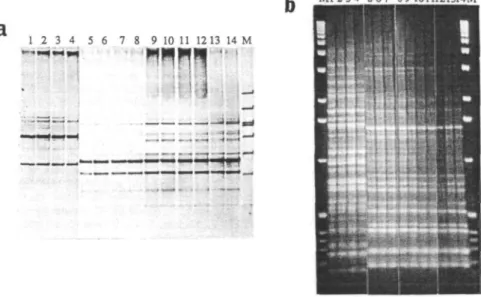
grown on YMB plates, showed the same microbiological (growth rate, color, colony morphology, and antibiotic resistance profile) characteristics as those of the inoculant strains. DAF and ERIC analysis, using arbitrary primer technology or repetitive DNA sequences respectively, of the nodule isolates showed the same band pattern as the inoculant strains (Fig. 2).
The ability of strain NGR234 to nodulate and fix nitrogen in L. japonicus was demonstrated. Vermiculite provided the best and most easily attainable substrate for nodule and plant growth. This was a convenient alternative to the more optimal "pillow" system used by Szczyglowski
M 1 2 3 4 5 6 7 8 9 1011121314M
1 2 3 4 5 6 7 8 9 10 11 1213 14 M
Fig. 2 DNA amplification (DAF) profile and ERIC analysis of Lotus japonicus nodule isolates and inoculant strains. A. DNA amplification profile of NZP2235, NGR234, NGRAfixF and NGRAnodABC using primer HpA41 (5'GCGAAAGCCCA3'). Lane 1, NZP2235; Lanes 2 to 4, Isolates from nodules inoculated with NZP2235; Lane 5, NGR234; Lanes 6 to 8, Isolates from nodules inoculated with NGR234; Lane 9, NGRAfixF; Lanes 10 to 12, Isolates from nodules inoculated with NGRAfixF; Lane 13 to 14,
NGRAnodABC; Lane 15, Molecular weight marker. B. Box-PCR of NZP2235, NGR234, NGRAfixF and NGRAnodABC. Lane 1,
NZP2235; Lanes 2 to 4, Isolates from nodules inoculated with NZP2235; Lane 5, NGR234; Lanes 6 to 8, Isolates from nodules inoculated with NGR234; Lane 9, NGRAfixF; Lanes 10 to 12, Isolates from nodules inoculated with NGRAfixF; Lane 13 to 14,
et ai: (1998).
We confirmed interesting differences of seedling growth rates (Jiang and Gresshoff 1997) between "Gifu" and "Funakura" and noted differences in nodule number per plant as well as specific and total nitrogen fixation rates. Specific ARA was similar to those measured for
M. truncatula (Penmetsa and Cook 1997) and Trifolium repens (Carroll and Gresshoff 1983). All measurements,
however, cannot be taken as absolute activities, as plants were not incubated in an open-flow system and may have been affected by trauma- or acetylene-induced oxygen bar-rier effects.
For optimal growth and nodulation of L. japonicus in the presence of Rhizobium, we suggest to use 2 mM nitrate as basal nitrogen supplement. "Gifu" developed more nodules with NGR234 than "Funakura".
The demonstration that strain NGR234 nodulates and fixes nitrogen with this model legume opens the entire ge-netic, chemical and microbiological aspects of this strain for further experimentation. Coupled with genetic ap-proaches in the plant itself, we foresee a fertile period of analysis.
We thank Eppley Foundation for Research (New York, U.S.A.) for providing funds and the Racheff Endowment for laboratory facilities. Dr. Frans de Bruijn of Michigan State Uni-versity is thanked for ERIC analysis.
References
Bassam, B.J., Caetano-Anolles, G. and Gresshoff, P.M. (1991) A fast and sensitive silver-staining for DNA in polyacrylamide gels. Anal. Biochem. 196: 80-83.
Bassam, B.J., Caetano-Anolles, G. and Gresshoff, P.M. (1992) DNA amplification fingerprinting of bacteria. Appl. Microbiol. Biotechnol. 38: 70-76.
Broughton, B.J. and Dilworth, W.J. (1971) Control of leghaemoglobin synthesis in snake beans. Biochem. J. 125: 1075-1080.
Caetano-Anolles, G., Bassam, B.J. and Gresshoff, P.M. (1991) DNA amplification fingerprinting using very short arbitrary oligonucleotide primers. BioTechnology 9: 553-557.
Caetano-Anolles, G. and Gresshoff, P.M. (1994) DNA amplification fingerprinting using arbitrary mini-hairpin oligonucleotide primers.
BioTechnology 12: 619-623.
Carroll, B.J. and Gresshoff, P.M. (1983) Nitrate inhibition of nodulation and nitrogen fixation in white clover. Z. Pflanzenphysiol. 110: 77-88. Carroll, B.J., McNeil, D.L. and Gresshoff, P.M. (1985) Isolation and
properties of soybean mutants which nodulate in the presence of high nitrate concentrations. Proc. Natl. Acad. Sci. USA 82: 4162-4166. Chomczynski, P., Mackey, K., Drews, R. and Wilfinger, W. (1997)
DNAzol: a reagent for the rapid isolation of genomic DNA.
BioTech-niques 22: 550-553.
Freiberg, C , Fellay, R., Bairoch, A., Broughton, W.J., Rosenthal, A. and Perret, X. (1997) Molecular basis of symbiosis between Rhizobium and legumes. Nature 387: 394-401.
Gresshoff, P.M. (1993) Molecular genetic analysis of nodulation genes in soybean. Plant Breed. Rev. 11: 275-318.
Handberg, K., Stiller, J., Thykjeer, T. and Stougaard, J. (1994) Transgenic plants: agrobacterium-mediated transformation of the diploid legume
Lotus japonicus. In Cell Biology: a Laboratory Handbook. Edited by
Celis, J. pp. 119-125. Academic Press, London.
Handberg, K. and Stougaard, J. (1992) Lotus japonicus, an autogamous,
diploid legume species for classical and molecular genetics. Plant J. 2: 487-496.
Jabbouri, S., Hanin, M., Fellay, R., Quesada-Vincens, D., Reuhs, B., Carlson, R.W., Perret, X., Freiberg, C , Rosenthal, A., Leclerc, D., Broughton, W.J. and Relic, B. (1996) Rhizobium species NGR234 host-specificity of nodulation locus III contains nod- and fix-genes. In Biology of Plant-Microbe Interactions. Edited by Stacey, G., Mullin, B. and Gresshoff, P.M. pp. 319-324. St. Paul, MN, U.S.A.
Jabbouri, S., Relic, B., Hanin, M., Kamalaprija, P., Burger, U., Prome, D., Prome, J.C. and Broughton, W.J. (1998) nolO and noeL (HsnIII) of
Rhizobium sp. NGR234 are involved in 3-O-Carbamoylation and
2-O-methylation of nod factors. J. Biol. Chem. 273: 12047-12055. Jiang, Q., Anwar Hussain, A.K.M. and Gresshoff, P.M. (1999) Towards
the establishment of molecular maps in the model legume Lotus
japonicus. Physiol. Mot. Biol. Plants (submitted).
Jiang, Q. and Gresshoff, P.M. (1997) Classical and molecular genetics of the model legume Lotus japonicus. Mol. Plant-Microbe Interact. 10: 59-68.
Kolchinsky, A.M., Funke, R.P. and Gresshoff, P.M. (1994) Dissecting molecular mechanisms of nodulation: taking a leaf from Arabidopsis.
Plant Mol. Biol. 26: 549-552.
Legocki, R. and Verma, D.P.S. (1979) A nodule-specific plant protein (Nodulin-36) from soybean. Science 205: 190-193.
Lewin, A., Cervantes, E., Wong, C.H. and Broughton, W.J. (1990)
nodSU, two new nod genes of the broad host range Rhizobium strain
NGR234 encode host-specific nodulation of the tropical tree Leucaena
leucocephala. Mol. Plant-Microbe Interact. 3: 317-326.
Long, S. (1996) Rhizobium symbiosis: nod factors in perspective. Plant
Celli: 1885-1898.
Lopez Lara, I.M., van der Berg, J.D., Thomas Oates, J.E., Glushka, J., Lugtenberg, B.J. and Spaink, H.P. (1995) Structural identification of the lipo-chitin oligosaccharide nodulation signals of Rhizobium loti.
Mol. Microbiol. 15: 627-638.
Oger, P., Petit, A. and Dessaux, Y. (1996) A simple technique for direct transformation and regeneration of the diploid legume species Lotus
japonicus. Plant Sci. 116: 159-168.
Perret, X., Fellay, R., Bjourson, A.J., Cooper, J.E., Brenner, S. and Broughton, W.J. (1994) Subtraction hybridisation and shot-gun se-quencing: a new approach to identify symbiotic loci. Nucl. Acids Res. 22: 1335-1341.
Price, N.P.J., Relic, B., Talmont, F., Lewin, A., Prome, D., Pueppke, S.G., Maillet, F., Denarie, J., Prome, J.C. and Broughton, W.J. (1992) Broad-host-range Rhizobium species strain NGR234 secretes a family of carbamoylated, and fucosylated, nodulation signals that are O-acetylat-ed or sulphatO-acetylat-ed. Mol. Microbiol. 6: 3575-3584.
Pueppke, S.G. and Broughton, W.J. (1999) Rhizobium sp. NGR234 and
R.fredii USDA257 share exceptionally broad, nested host-ranges. Mol. Plant-Microbe Interact. 12: 293-318.
Penmetsa, R.V. and Cook, D.R. (1997) A legume ethylene-insensitive mutant hyperinfected by its rhizobial symbiont. Science 275: 527-530. Relic, B., Perret, X., Estrada-Gracia, M.T., Kopcinska, J., Golinowski,
W. and Krishnan, H.B. (1994) Nod factors of Rhizobium are a key to the legume door. Mol. Microbiol. 13: 171-178.
Schauser, L., Handberg, K., Sandal, N., Stiller, J., Thykjajr, T., Pajuelo, E., Nielsen, A. and Stougaard, J. (1998) Symbiotic mutants deficient in nodule establishment identified after T-DNA transformation of Lotus
japonicus. Mol. Gen. Genet. 259: 414-423.
Stiller, J., Martirani, L., Tuppale, S., Chian, R.-J., Chiurazzi, M. and Gresshoff, P.M. (1997) High frequency transformation and regeneration of transgenic plants in the model legume Lotus japonicus. J. Exp. Bot. 48: 1357-1365.
Sullivan, J.T. and Ronson, C.W. (1998) Evolution of rhizobia by acqui-sition of a 500-kb symbiosis island that integrates into a phe-tRNA gene.
Proc. Natl. Acad. Sci. USA 95: 5145-5149.
Szczyglowski, K., Shaw, R.S., Wopereis, J., Copeland, S., Hamburger, D., Kasiborski, B., Dazzo, F.B. and deBruijn, F.J. (1998) Nodule or-ganogenesis and symbiotic mutants of the model legume Lotus
japoni-cus. Mol. Plant-Microbe Interact. 11: 684-697.
Thykjjer, T., Stiller, J., Handberg, K., Jones, J. and Stougaard, J. (1995) The maize transposable element Ac is mobile in the legume Lotus
japonicus. Plant. Mol. Biol. 27: 981-993. in Rhizobium. Mol. Microbiol. 28: 1381-1389.
Versalovic, J., Schneider, M., deBruijn, F.J. and Lupski, J.R. (1994) Wegel, E., Schauser, L., Sandal, N., Stougaard, J. and Parniske, M. Genomic fingerprinting of bacteria using repetitive sequence-based (1998) Mycorrhiza Mutants of Lotus japonicus define genetically in-polymerase chain reaction. Methods Mol. Cell. Biol. 5: 25-40. dependent steps during symbiotic infection. Mol. Plant-Microbe Inter-Viprey, V., Greco, A.D., Golinowski, W., Broughton, W.J. and Perret, act. 11: 933-936.
X. (1998) Symbiotic implications of type III protein secretion machinery