HAL Id: inserm-00140857
https://www.hal.inserm.fr/inserm-00140857
Submitted on 4 May 2007
HAL is a multi-disciplinary open access
archive for the deposit and dissemination of
sci-entific research documents, whether they are
pub-lished or not. The documents may come from
teaching and research institutions in France or
L’archive ouverte pluridisciplinaire HAL, est
destinée au dépôt et à la diffusion de documents
scientifiques de niveau recherche, publiés ou non,
émanant des établissements d’enseignement et de
recherche français ou étrangers, des laboratoires
Towards an hybrid system for annotating brain MRI
images
Ammar Mechouche, Christine Golbreich, Bernard Gibaud
To cite this version:
Ammar Mechouche, Christine Golbreich, Bernard Gibaud. Towards an hybrid system for annotating
brain MRI images. Workshop on OWL Experiences and Directions, 2006, Athens, United States.
�inserm-00140857�
Towards an hybrid system for
annotating brain MRI images
Ammar Mechouche1, Christine Golbreich2, Bernard Gibaud1
1 INSERM, U746, Campus de Villejean, F-35043 Rennes, France 1 INRIA, VisAGeS, Univ. Rennes I, CNRS, UMR 6074, F-35042 Rennes, France
{Ammar.Mechouche, Bernard.Gibaud}@irisa.fr
2LIM, University Rennes I, Av du Pr. L´eon Bernard, 35043 Rennes, France [email protected]
Abstract
This paper describes a method combining symbolic and numerical techniques for annotating brain Magnetic Resonance images. The goal is to assist existing automatic labelling methods which are mostly statis-tical in nature and do not work very well in certain situations such as the presence of lesions. The system uses existing statistical methods for generating ABox facts that constitute a set of initial information sufficient for fruitful reasoning. The reasoning is supported by an OWL ontology extended with rules, and the facts extracted by the statistical component
1
Introduction
Identifying anatomical structures in brain Magnetic Resonance Images (MRI) is an important aspect of the preparation of a surgical intervention in neurosurgery, especially when the lesion is located in the cerebral cortex. A precise labelling of cortical structures (gyri, sulci) surrounding the lesion is particularly necessary to determine an optimal surgical strategy. Existing automatic approaches for annotating brain images are often statistical, e.g., based on Statistical Probabil-ity Anatomy Maps (SPAMs). A SPAM is a 3D probabilistic map associated to a particular anatomical structure. The value at each voxel position represents the probability of belonging to this structure at that location. The statistical data used in our system were derived from a database of 305 normal subjects, after re-alignment of MRI data into a common reference system (called stereotaxic space). SPAMs-like methods have an important drawback. They are not robust against deformations and shifts caused by a lesion in the brain. A symbolic method, using a priori knowledge about topological relations between the cere-bral structures may be an alterative or a complement to compensate it, since in contrast topological relations are preserved. This paper describes a new hybrid
HAL author manuscript inserm-00140857, version 1
HAL author manuscript
method for annotating brain images where SPAMs are used to get a sufficient set of initial facts for reasoning. Reasoning is supported by an OWL [1] ontol-ogy about the brain cortex anatomical structures and Horn rules capturing the topological dependencies between the brain structures.
2
Method
The method consists of two main steps. The first step is the segmentation of the brain and the extraction of the sulci tracks from an MRI exam. The second step, is the annotation of a region of interest (ROI) selected from the sulci graph. This paper mainly focuses on the second step.
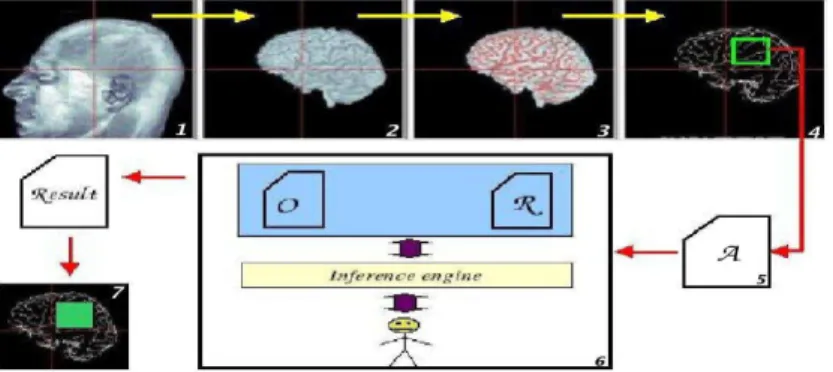
Figure 1: The general diagram
Reasoning is performed from an ontology of the brain structures enriched by rules representing their topological dependencies, and initial facts provided by numerical and statistical tools (SPAMs). Figure 1 illustrates the complete pro-cess of the application: (1) acquiring the patient MRI ; (2) brain segmentation; (3) extraction of the external tracks of the sulci; (4) selection by the user of a region of interest and extraction of the corresponding subgraph of sulcus seg-ments delimiting surfaces corresponding to the parts of gyrus (called patches) present in the region; (5) initialization of the ABox A. The above numerical and statistical treatments lead to the initial facts, OWL individuals and role values representing their topological relations, as explained thereafter; (6) reasoning based on the brain ontology O, the rule base R, and the ABox A (with some user interaction), (7) inferred labels of the structures involved in the ROI.
2.1
Populating the Abox
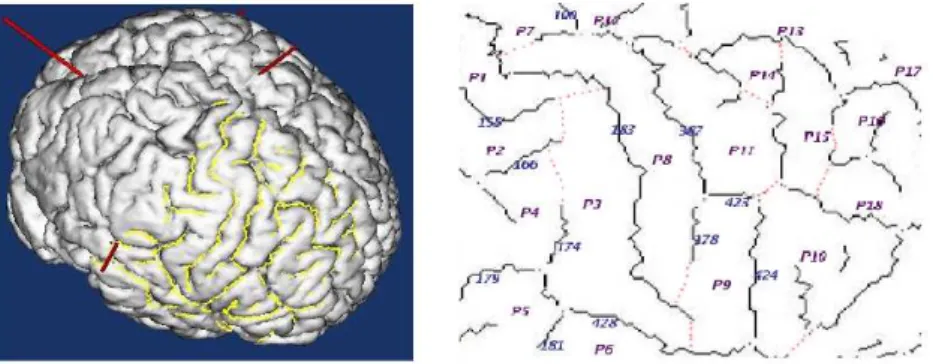
First, the numerical tools extract the sulci of a ROI and delimit the surfaces limited by the sulci (patches). They also provide the topological relations and the orientations between the different patches and sulcus segments.
Figure 2: Extraction of the ROI graph
The yellow segments figure 2 (left) show the sulci of the ROI. The patches (e.g.; P 7, P 8, P 9 etc.) are delimited by the sulci (e.g.; 178, 124 etc.) (right). The facts extracted by the numerical tools from this graph are represented in OWL DL (figure 3 left). For example P 9 is an individual of the class Patch while 178 is a SulcusSegment. The property isM AEBoundedBy has a value (individual of the class AttributedEntity) expressing that P 9 is bounded by the segment 178 with a posterior orientation, and other segments 423, 424 etc.
<Patch rdf:ID="p9"> ... <isMAEBoundedBy> <AttributedEntity rdf:ID="AttEntity1"> <entity> </entity> <SulcusSegment rdf:ID="178"/> <orientation> <Unknown rdf:ID="unknown2"/> </orientation> <MAEBounds rdf:resource="#p9"/> </AttributedEntity> </isMAEBoundedBy> ... </Patch> <owl:Class redf:ID="Orientation"> <rdfs:subClassOf> <owl:Class rdf:ID="Posterior"/> </rdfs:subClassOf> </owl:Class> <owl:ObjectProperty rdf:ID="isMAEBoundedBy"> <inverseOf> <owl:objectProperty rdf:about="#MAEBounds"> </inverseOf> </owl:ObjectProperty> <orientation> <Posterior rdf:ID="posteriorTo"/> </orientation> <orientation> <Unknown rdf:ID="unknown1"/> </orientation>
Figure 3: Facts in the ABox (left), OWL class and ObjectProperty (right) These facts are then completed by data computed from the SPAMs. A SPAM is a 3D image file associated to a particular anatomical structure, for instance, a particular gyrus. The information at each point of this 3D image pt(x, y, z) represents an estimate of the probability to belong to this particular structure. Each segment si of the ROI is a set of points. We first transform the points
coordinates into coordinates of the reference space, i.e. the stereotaxic space.
`````
```````
SulcusSegment
Gyrus
Precentral Postcentral Angular SupTemporal ...
ID = 183 0.384 0.186 0 0 .
ID = 178 0.218 0 0 0 .
ID = 155 0 0.477 0.105 0 .
ID = 298 0 0.038 0 0.076 .
Figure 4: Example of probabilities
Then we calculate the probability pijof the segment sito belong to a SPAM spj
by calculating the average of the probabilities of all its (transformed) points. For each segment we store the two highest probabilities that have been computed (figure 4). These values computed from the SPAMs, and the abstractions rules presented below enable to automatically acquire the initial facts of the Abox A. Computing the boundaries and separations. Some heuristics have been defined to determine whether a sulcus ’bounds’ a SPAM or ’separates’ two SPAMs: if the two highest probabilities are small, over a given threshold M IN , then the segment is asserted to separate or to bound the corresponding SPAMs, else if they are very big, over a given threshold M AX, then the segment is asserted to be inside the corresponding SPAM. The thresholds M IN and M AX are defined empirically. More precisely, the rules that abstract the topological relations regarding the boundaries and separations are:
Figure 5: Computing facts about separation and boundary from SPAMS
• if(pi1 ∈ [M IN, M AX] and pi2 ∈ [M IN, M AX]) then si separates sp1
and sp2. Indeed it means that si is located between sp1 and sp2that is si
separates them, e.g.; S1 figure 5).
• if (pi1 ∈ [M IN, M AX] and pi2 < M IN ) then si bounds sp1, indeed
low values mean that si is located at the extremity of the SPAM thus it
is a boundary (e.g.; S3 figure 5)
• if (pi1 > M AX and pi2 < M IN ) then si isInside an instance sp1,
indeed these values indicate that siis within the SPAM (e.g.; S2figure 5)
Computing the orientations. Each entity has three orientations: (Right or Left), (Posterior or Anterior) and (Superior or Inferior). To determinate the orientations of the segments w.r.t SPAMs, for example that a segment si
bounds a SPAM spj with an anterior orientation, we compare the coordinates
(x, y, z) of the centre of the segment, transformed into the reference space, to the coordinates (x0, y0, z0) of the SPAM centre.
The heuristic rules below abstract the orientations:
• if x > x0 then s
i isRightT o spj else si isLef tT o spj
• if y > y0 then s
i isAnteriorT o spj else si isP osteriorT o spj
• if z > z0 then s
i isSuperiorT o spj else si isInf eriorT o spj
Since such rules could not be used by KAON2, they were applied using a
C + + procedural program. The resulting role values, e.g.; separates(s0, (prcgr,
anteriorT o, rightT o, superiorT o), (pcgr, posteriorT o, lef tT o, inf eriorT o))
are represented in OWL (figure 5).
2.2
Brain ontology and rules
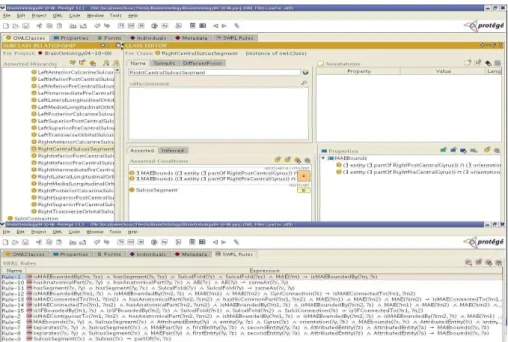
The knowledge base consists of the brain ontology enriched with rules. For the moment, the ontology about the sulci and gyri is represented in OWL DL, the rules in SWRL. They have been edited using Prot´eg´e OWL and the SWRL plugin [2](figure 6).
• Tbox: the Tbox provides the logical definitions of concepts (classes), roles
(properties) and the asserted axioms. For example, the necessary and suf-ficient condition to be a segment of the right central sulcus is1(figure 6):
RightCentralSulcusSegment ≡ ((∃ MAEBounds ((∃ entity (∃ partOf Right-PostCentralGyrus)) u (∃ orientation Anterior))) u ((∃ MAEBounds ((∃ entity (∃ partOf RightPreCentralGyrus)) u (∃ orientation Posterior)))).
This OWL definition expresses that a segment of central sulcus is bounded by a part of postcentral gyrus with an orientation which is an instance of Anterior, and is bounded by a part of precentral gyrus with an orientation which is an instance of Posterior.
• Rule-box: The Rule-box contains all the rules extending the ontology, for
example the rule R1 (figure 6) expresses that a boundary is propagated 1this is not the exact definition but a simplification for the example
Figure 6: Brain ontology and rules
from parts to whole: isMAEBoundedBy(?x, ?y) ∧ hasSegment(?z, ?y)
∧ SulcalFold(?z) ∧ SulcalFold(?y) ∧ MAE(?x) → isMAEBoundedBy(?x, ?z). If a material anatomical entity x is bounded by a sulcal fold y,
and y is a segment of z, then x is bounded by z. Such rules are needed to infer the missing knowledge of the classes definitions for instance retrieval. Rules are also useful to express queries. For example, to find all possible instances of gyri of which patches piof a ROI are part: Q(?xi, ..., ?xn) ←
∧i=1 to n(AE(?xi)) ∧ partOf (pi, ?xi).
• Abox: The Abox contains the individuals (instances of classes) and the
instances of relations between them as defined section 2.1.
All the knowledge, the ontology in OWL DL (Tbox), the Horn rules (Rule-box), and the facts (A(Rule-box), are gathered within a single file provided as input to the reasoner.
3
Reasoning for brain labelling
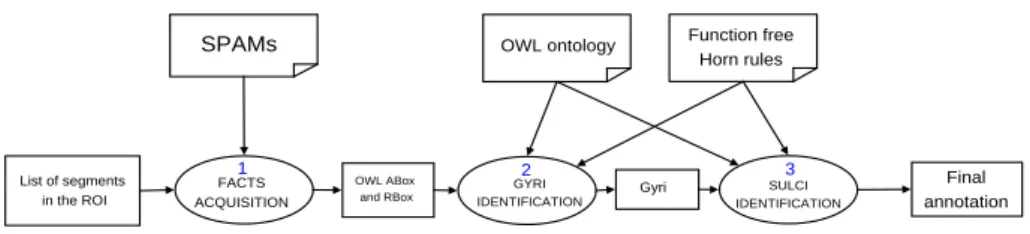
Figure 7 shows the overall process of reasoning: (1) From the list of sulci (seg-ments) of the ROI and the list of SPAMs we get a table of probabilities (such as Figure 4). This table is first created as an XML file. The heuristics pre-sented above derive the topological relations between the anatomical entities.
SPAMs OWL ontology Function free Horn rules List of segments in the ROI FACTS ACQUISITION OWL ABox and RBox GYRI IDENTIFICATION Gyri SULCI IDENTIFICATION Final annotation 1 2 3
Figure 7: Labelling process
The resulting facts are stored in an OWL file. This file is merged with the ontology, the rules, and the other facts coming from the numerical tools. (2) From this file, the inference engine labels the patches as described below. The user validates the result. (3) Next, the reasoner labels the sulci according to the ontology definitions enriched by rules. The user validates this step, and finally the labelled image is obtained. The reasoning is performed as follows :
Labelling the patches. The patches are first labelled using the rules below. The main rule used is a rule (RM) that makes a matching between the facts
extracted from the images by the numerical tools and the facts computed about their boundaries and orientations w.r.t the SPAMs:
• MAEBounds(?x, ?c) ∧ AttributedEntity(?c) ∧ entity(?c, ?d) ∧ Patch(?d) ∧ orientation(?c, ?b) ∧ MAEBounds(?x, ?y) ∧ SulcusSegment(?x) ∧
At-tributedEntity(?y) ∧ entity(?y, ?z) ∧ Gyrus(?z) ∧ orientation(?y, ?b) ∧ Orientation(?b) ) → partOf(?d, ?z)
This rule expresses that if it is known from the extracted facts that a segment
x bounds a given patch d with a given orientation b and it comes out from the
computed orientation that x bounds a SPAM z with the same orientation, then this patch belongs to the gyrus corresponding to that SPAM. The probability associated to it is the probability pi calculated as explained section 2.1.
In fact, the above rule is simplified and the real rule used involves a sameAs construct. Indeed, as the Abox A is issued from two generated files that are merged into a single OWL file, a same individual has got different ID depending on the file it comes from:
• MAEBounds(?x, ?y) ∧ SulcusSegment(?x) ∧ AttributedEntity(?y) ∧
en-tity(?y, ?z) ∧ Gyrus(?z) ∧ orientation(?y, ?b) ∧ MAEBounds(?x, ?c) ∧ AttributedEntity(?c) ∧ entity(?c, ?d) ∧ Patch(?d) ∧ orientation(?c, ?b’)
∧ Orientation(?b) ∧ Orientation(?b’) ∧ sameAs(?b, ?b’) → partOf(?d, ?z)
As there is a possible incertitude in the computed orientations mainly due to the approximations caused by the SPAMs, it may occur that a segment bounds two SPAMs with the same orientation, hence a patch d is inferred to belong to several gyri zi with probabilities pi. To decide to which gyrus d finally belongs,
we calculateP(pi) for each gyrus and keep the gyrus with the highest result.
The second rule (RS) below infers boundaries from a separation: if a given
sulcus separates two gyri then it bounds each of them. This rule is used to infer boundaries from the known separations, information which is needed to fire the first rule above.
• separates(?x, ?y) ∧ SulcusSegment(?x) ∧ MAEPair(?y) ∧ firstEntity(?y,
?z) ∧ secondEntity(?y, ?a) ∧ AttributedEntity(?z) ∧ AttributedEntity(?a)
→ MAEBounds(?x, ?z)
Labelling the sulci. After the patches, the sulci are next labelled thanks to the ontology definitions and the rules. If a given segment sisatisfies a definition
of a given sulcus suj in the ontology, i.e. if it meets the necessary and sufficient
condition of suj, then si is classified as an instance of suj.
Simplified example.
• Let be a segment s0 and two patches p1, p2 of the ROI.
• the facts provided by the numerical tools include the individuals p1and p2
and the relation separates(s0, (p1, anteriorT o, rightT o, superiorT o), (p2,
posteriorT o, lef tT o, inf eriorT o)) where anteriorT o, rightT o, superior-T o, posteriorsuperior-T o, lef tsuperior-T o, and inf eriorsuperior-T o are respective individuals of the
classes Anterior, Right, Superior, Posterior, Left, and Inferior.
• the facts computed from the SPAMs include the relation separates(s0,
(prcgr, anteriorT o, rightT o, superiorT o), (pcgr, posteriorT o, lef tT o,
inf eriorT o)) where RightPreCentralGyrus: prcgr and
RightPostCentral-Gyrus: pcgr.
The labels of the patches are obtained by answering the query Q(?xi, ...,
?xn) ← ∧i=1 to n(AE(?xi)) ∧ partOf(pi, ?xi). Applying the rule RS, facts
about boundaries are derived from the initial facts about separations, then as the body of the matching rule RM can be satisfied by bindings its variable to
known individuals, the reasoner infers: partOf (p1, prcgr) and partOf (p2, pcgr).
Next, at a second step, the labels of the segments are obtained from the class definitions if the ontology. As s0 satisfies the N&S condition of
RightCentral-SulcusSegment, the reasoner infers that s0 is an instance of the
RightCentral-SulcusSegment.
4
Results and discussion
This section presents some results obtained for real data with the method pre-sented above. The experiments are achieved with the reasoner KAON2 [3], which accepts ontologies extended with rules [4]. The region of interest is the
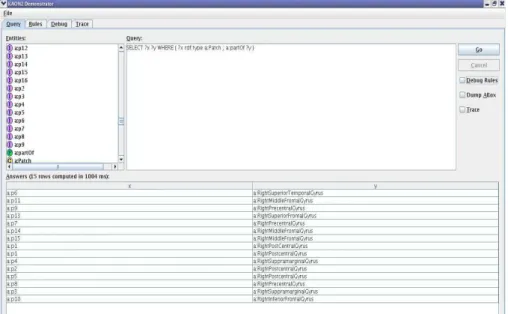
Figure 8: Results obtained with KAON2
automatically extracted region displayed figure 2. We used 45 SPAMs corre-sponding to the most important gyri of the brain. The M IN value approxi-mated from the computations is 0.05 and the M AX value 0.75.
Labels of patches. The SP ARQL query2 SELECT ?x ?y WHERE ?x
rdf:type a:Patch ; a:partOf ?y asks for each patch all the possible entities it is part of. The answers of KAON2 to that query provide the labels of the patches, for example patch P 6 is a part of the right superior temporal gyrus (figure 8). Labels of sulcus segments. The query SELECT ?x WHERE ?x rdf:type a:central sulcus right asks for the right central sulcus segments. KAON2 returns the segment 183, which is the single segment of the right central sulcus for this ROI.
For the two experiments reported in this paper, more than 80% of the results given by the reasoner are correct regarding the labels of the patches and over 70% for the labels of the sulcus segments (according to our expertise). For ex-ample the patch P 8 is inferred to be a part of the right precentral gyrus, P 1 is inferred to be a part of the right postcentral gyrus, and the segment 183 is inferred to be an instance of the right central sulcus segment, which is correct since it separates parts of the right precentral gyrus from parts of the right postcentral gyrus. This is an ongoing work. It will be interesting in the future
2The query language of KAON2
to assess how this percentage is affected by various aspects of the ontology and rules, and the respective effect of the SPAMs and of the reasoning on the results. The proposed method was adapted to comply with some language and tools lim-itations, in particular with the version of the KAON2 reasoner available online and the Prot´eg´e SWRL editor, for example:
• For the moment the ontology was simplified using OWL DL instead of
OWL1.1 [5]. We used existential restriction instead of qualified cardinal-ity restrictions (QCR). But, it should be noted that the real Tbox requires both QCR, disjunctions, inverse. For example, the ontology should express that each right PostCentralGyrus is bounded exactly by one right Central-Sulcus. Besides, the rules cannot be expressed as role inclusion axioms (cf. rule (RM) or the rules of the online Annex at http://idm.univ-rennes1.fr/˜
obierlai/). Thus the required knowledge is not expressible in the EL++
fragment of OWL1.1.
• we defined subclasses of Orientation, e.g.; Posterior, Anterior etc. with
individual e.g., posteriorTo and used existential restrictions instead of enu-meration or hasValue restrictions, because KAON2 does not support nom-inals.
• KAON2 reasoner is based on the DL-safe rules assumption [4]. Although
the rules used for our system are not DL-safe, KAON2 provides the ex-pected answers for the reported experiments. Indeed, in these cases the rules were fired, because given the initial facts asserted, their body was satisfied by bindings their variable to known individuals. However, this approach is not always relevant and situations may occur where solutions are missed because of the existential construct. For example, a patch is defined with an existential in the equivalent class expression (rhs). Hence, it may happen in some cases that a rule expressing the propagation of a property from parts to whole cannot be not fired, because an instance of Patch is defined without being connected to a known instance of gyrus by the relation partOf [6]. KAON2 does not draw all the consequences according to the first order semantics of SWRL, but only consequences under the ”the DL-safe semantics”.
• all n-ary relations were transformed into binary relations, using
reifica-tion for example we defined an artificial class AttributedEntity for it. The ontology was edited using Prot´eg´e rules editor which allows to edit only SWRL rules and does not support ordinary predicate that are not DL predicates. KAON2 extends the standard SWRL syntax and offers a swrl:PredicateAtom that allows ordinary predicates, but according to the authors their SWRL extensions were still experimental at the time of these experiments. It would be preferred to have a language extension and tools allowing n-ary relations. N-ary relations is a general needs for example also encountered with the Foundational Model of Anatomy ontol-ogy which exhibits more than 30 attributed relationships and where more than 2300 nested classes were generated for their values [7].
• The heuristic rules section 2.1 were implemented in C + +. A
declara-tive approach was not possible with KAON2 since at the moment it does not handle OWL DL datatypes or OWL1.1 user-defined datatypes and restrictions involving datatype predicates.
5
Conclusion
This paper reports the current stage of development of an hybrid system com-bining numerical and symbolic techniques for brain MRI images description, and its present limitations. The method is based on an OWL DL ontology extended with rules, and facts coming from numerical tools and SPAMs. Future work will investigate how to overcome some of the work-arounds employed to circumvent the limitations encountered with the representation and tools used. At the mo-ment the method was only tested over a limited set of brain images that did not exhibit a lesion. The experiments will be extended to more cases and to brain images exhibiting a lesion in order to assess its robustness.Automatizing the annotation of the semantic content of digital images presents promising perspectives for new applications such as retrieval of similar cases for decision support, or statistical medical studies in large populations.
References
[1] OWL Web Ontology Language : Overview, http://www.w3.org/tr/owl-features/.
[2] Prot´eg´e, http://protege.stanford.edu. [3] KAON2, http://kaon2.semanticweb.org/.
[4] B Motik, U Sattler, and R Studer. Query answering for OWL DL with rules. In ISWC 2004, LNCS 3298 Springer. Springer-Verlag, 2004.
[5] OWL 1.1 Web Ontology Language Syntax: http://www-db.research.bell-labs.com/user/pfps/owl/syntax.html.
[6] C Golbreich. Web rules for Health Care and Life Sciences: use cases and requirements. In RoW Workshop at WWW2006, 2006.
[7] C Golbreich, S Zhang, and O Bodenreider. The Foundational Model of Anatomy in OWL: Experience and Perspectives. In Journal of Web
Seman-tics, (4)3, 2006.
6
Acknowledgement
We are grateful to Louis Collins of the Montreal Neurological Institute for pro-viding us with the SPAMs database and to the Regional Council of Brittany for supporting this project.