Publisher’s version / Version de l'éditeur:
Engineering Journal, 55, 3, pp. 12-17, 1972-03
READ THESE TERMS AND CONDITIONS CAREFULLY BEFORE USING THIS WEBSITE. https://nrc-publications.canada.ca/eng/copyright
Vous avez des questions? Nous pouvons vous aider. Pour communiquer directement avec un auteur, consultez la
première page de la revue dans laquelle son article a été publié afin de trouver ses coordonnées. Si vous n’arrivez pas à les repérer, communiquez avec nous à [email protected].
Questions? Contact the NRC Publications Archive team at
[email protected]. If you wish to email the authors directly, please see the first page of the publication for their contact information.
NRC Publications Archive
Archives des publications du CNRC
This publication could be one of several versions: author’s original, accepted manuscript or the publisher’s version. / La version de cette publication peut être l’une des suivantes : la version prépublication de l’auteur, la version acceptée du manuscrit ou la version de l’éditeur.
Access and use of this website and the material on it are subject to the Terms and Conditions set forth at
Comparison of earthquake, blast, and pulse excitations
Ferahian, R. H.; Graefe, P. W. U.
https://publications-cnrc.canada.ca/fra/droits
L’accès à ce site Web et l’utilisation de son contenu sont assujettis aux conditions présentées dans le site LISEZ CES CONDITIONS ATTENTIVEMENT AVANT D’UTILISER CE SITE WEB.
NRC Publications Record / Notice d'Archives des publications de CNRC:
https://nrc-publications.canada.ca/eng/view/object/?id=b187b070-aa0c-46e6-96f3-b0d7d9c15987 https://publications-cnrc.canada.ca/fra/voir/objet/?id=b187b070-aa0c-46e6-96f3-b0d7d9c15987
R. H. Ferahian and P. W. U. Graefe
Price 10 cents
R e ~ r i n t e d from ENGINEERING JOURNAL Vol. 55, No. 3, March 1972
p . 12 to 17
Research Paper No. 520 of the
Division of Building Research
OTTAWA March 1972
La presente etude compare la nornbre de fre- quences et la garnrne de reactions d'un seisrne avec celles des explosions a acceleration maximum, cette acceleration etant presque egale a celle d'un seisrne rnais ayant des durees differentes. On constate que la reaction depend beaucoup de
la duree de I'excitation; de plus, une augrnenta- tion de I'arnortissernent n'entraine pas necessaire- rnent une diminution de la reaction rnais depend aussi du nornbre de frequences de I'excitation. L'ordinateur hybride employe s'est revele un instrument ideal pour determiner les garnrnes de reactions. On presente aussi les garnrnes de reactions des impulsions en triangle, pour fin de cornparaison, et on a rnontre comment celles-ci peuvent Qtre utilisees dans la conception de cornposantos structurales qui peuvent resister aux explosions dornestiques dues au gaz.
Velocity and Displacement Spectra, respectively. used to design structural components to withstand If the spectral acceleration, velocity, and displace- gas explosions. ment, are designated by S,, S,, and Sd, then
Fourier Analysis
sa
=
(U
+
xO)rnay
To determine which frequencies contain the most energy and are therefore the most important, Fourier analysis of the input record is carried out.
This is a convenient method of identifying the 8, =
(u),,,
important frequencies of the input acceleration.A computer program7 developed to carry out For zero damping it is obvious that independent Fourier analysis of digitized records was used in of the input acceleration the maximum spring this study. The Fourier amplitude and phase force, given by nl
.
S,, is also equal to K S d angles were evaluated a t specified intervals Af ofthe frequency f. Where the record length was less K
than l/Af, the given record had to be exteirded to = - m = o: & =
(;)"
sd
the length required for the specified resolution(Af) by adding a length of record of zero Now let pseudo-velocity spectrum S,, be defined
magnitude. by
Response Spectra Spu =
s a / ~ o
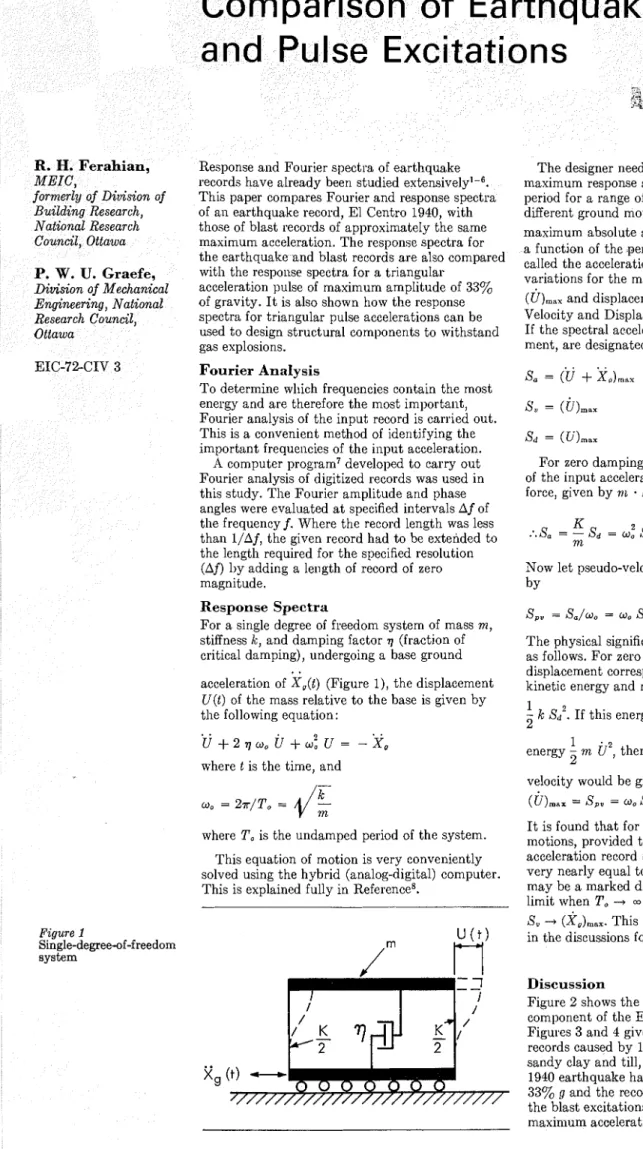
= Wos d For a single degree of freedom system of mass m,
stiffness Ic, and damping factor
v
(fraction of The physical significance of S,, may be explained critical damping), undergoing a base ground as follows. For zero damping, the maximum. .
displacement corresponds to a condition of zero acceleration of X,(t) (Figure 1)) the displacement kinetic energy and maximum strain energy U(t) of the mass relative to the base is given bythe following equation: - k
sd2.
If this energy were in the form of kinetic. .
2U + 2 ~ w o u + w ~ u =
- x u
1energy - m
u2,
then the maximum relativewhere t is the time, and 2
velocity would be given by:
(U)rnax = S p u = Wo s d
It is found that for most earthquake ground where TO is the undamped period of the system. motions, provided that the length of the input
This equation of motion is very conveniently acceleration record td is greater than To, S, is solved using the hybrid (analog-digital) computer. very nearly equal to S p v 9 . When To
>
td, there This is explained fully in Reference8. may be a marked difference. This is obvious in thelimit when To -+ m ; then S,. -+ 0, while S, -+
(x,),,,.
This will be further demonstratedin the discussions for the pulse acceleration loads.
Discussion
Figure 2 shows the Fourier analysis for t h e N-S
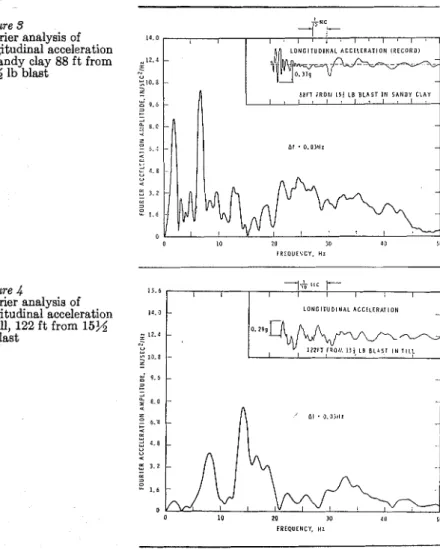
component of the El Centro 1940 earthquake. Figures 3 and 4 give the Fourier analysis of blast records caused by 15% lb of dynamite measured in sandy clay and till, respectively. The E l Centro 1940 earthquake had a maximum acceleration of 33y0 g and the record length used is 29 sec.; the blast excitations of Figures 3 and 4 had a maximum acceleration of 37%, duration of 1.2
the earthquake is higher than that of a blast
vs. frequency for both the earthquake and the blast. Most of the vibration energy for the E l Centro earthquake is concentrated in the for the blasts is by comparison more evenly dis- tributed over frequencies ranging to 40 Hz. I t is also interesting to note the two predominant
duration of the vibrations and properties of the same. Again, the reason for the difference is t
site and disturbance source and the distance lengths of the disturbance and the ener between them. frequency content of the earthquake.
Figure 5 shows comparison of the acceleration Towards the end of the paper it is shown response spectra for the El Centro 1940 earthquake response spectra for triangular pulse loads c and the blasts. For undamped systems, the used for the design of structural components to maximum absolute acceleration, when multiplied withstand domestic gaseous explosions. I t is by the mass of the structure, gives the maximum convenient a t this stage t o present these undamped spring force transmitted to the-foundations. Also, spectra (Figure 6), which clearly show the effect of this is acceptabIe in practice for systems with the duration t d of these simple pulses on the moderate damping. The magnification of the response of the structure. These spectra could also magnitude of the foundation acceleration by the be used to represent the response to a theoretical structure can be evaluated from the ratio of the earthquake comprising a single major pulse such as
Figure 2 2 4 0 Fourier analysis of N-S component of the El cX Centro (May 18, 1940) 1 6 0 earthquake + - -1 L Z 8 0 Q z o",
-
+:
z \
z y - 8 0 W u u Q 1 6 0 W T I M E , S E C O N D S n3 might be produced very close to an epicentre. T o
+ -
-I compare the response spectra for 33y0 g triangular
L 1 2 8
z pulse with those of Figure 5 or particularly those Q of E l Centro, the ordinates of Figure 6 need only
z 9 6 be multiplied by 33% g or 128.8 i n . / ~ e c . ~
2
I I t can be clearly seen that the pulse of 1 sec+>
duration can have a response comparable to that2:
6 4"7 of the El Centro earthquake and much greater
d'- than that of a 0.1 sec. pulse. The magnification of u
f
u 3 2 the accelerations for the 1-sec. duration pulse is for
Q practically all periods up to 2.8 sec. I t can also be
OL seen that the maximum magnification for the
: 0
OL triangular pulse is independent of the duration of
3 o 4 a 1 2 16 2 0 the pulse, but the periods corresponding t o these
$2
F R E Q U E N C Y , H Z maxima are not. I n order not to complicate the figure, the curves for q = 10% are not shown, butFigure S
Fourier analysis of
longitudinal acceleration
in sandy clay 88 ft from 15% lb blast
the response was consistently reduced by about 10%.
The responses to the E l Centro 1940 earthquake and the pulse excitations are consistently reduced with increase of damping. The reduction is greater for the former type of excitation. For the blast excitations, however, increase in damping does not necessarily mean decrease of response; in fact there is increase of response for periods greater than 1.5 sec. for the blast of 1.2 sec. duration and maximum acceleration of 37% g (Figure 5). The change of response with damping for the 29% g maximum acceleration blast record is even more unpre- dictable. The reason for this is connected with the duration and the frequency content of the excit- ations. For the earthquake records, because the duration is longer and a wide band of frequencies is present in the excitation, each oscillator practically vibrates a t its own natural frequency and for long enough time for the damping to dissipate energy from the system. Not so for the blast, where the oscillator is forced to vibrate for a short time and usually a t predominant fre- quencies different from its natural frequency. Here the change in the response due t o increase in damping is not easily predictable.
For single-degree-of-freedom systems undergoing periodic forced vibration", i t is a well-known fact
8 8 i l i R 0 I . l 151 LB BLAST I N SANDY CLAY
1 1 1 , 1 l l l l l l
that the transmissibility or magnification of vibrations for frequency ratios less than decreases with an increase in the percentage of critical damping; for frequency ratios greater than
di,
the transmissibility is less than 1 and increases with an increase in damping. The effect of damping on the vibration magnitudes will, therefore, depend on the frequency ratio defined as the ratio of the forcing frequency to the natural frequency of the system.This characteristic of the forced vibrational response of a singledegree-of-freedom system explains the results of Figure 5, where an increase in damping sometimes caused an increased response t o a blast-type ground motion. The validity of the argument was verified by a careful study of the response of systems where this apparently anomalous behaviour occurred. I n each case the frequency ratio was greater than
4.
The predominant frequencies were evaluated from the computer plot-out of the responses. Although these responses were not strictly speaking periodic, they showed fairly clear predominant frequencies and for long enough duration to justify the use of the transmissibility relations mentioned earlier for these explanatory purposes.Examination of Table 1 shows that for zero damping S , equals w? Sdl independent of the type of excitation. And for all intents and purposes this relationship will hold for To
<
3 and 7<
10% (the accuracy is higher for the earthquake record). The spectral displacement can thus be easily obtained from knowledge of the spectral acceler- ation. For small amounts of damping, therefore, maximum elastic forces transmitted to the base are practically independent of the percentage of damping. Table 1 also shows that --- ' aI which
s,
equals - is not approximately equal to 1 for S"
SPD
all the cases. For zero damping is practically
Figure 4 equal to 1 for the El-Centro earthquake, where the
Fourier analysis of
L O N G I T U D I N A L A C C ~ L ~ R ~ , ~ ~ ~ duration of excitation (td = 29 sec) is greater than
longitudinal acceleration
in till, 122 ft from 15% the natural periods considered. This is true for
lb blast most earthquake ground motions. The following
simple harmonic relationship can, therefore, be used in practice for seismic response calculations: 2 8 0 = - re ", u <
e 6 4 4 8 - -
~1
i A! . 0 O l i l l the For Figure blasts the El-Centro 7 and gives the the triangular earthquake, velocity acceleration response the spectral spectra pulses. forvelocities are simply determined using the relationship given above. For both blasts and the triangular pulse loads, the maximum relative
1 1 1 1 ~ ~
velocity S , approaches constant values as the period becomes much greater than td. For small
0 10 20 30 40
F R t Q U t N C Y . H Z S ~ m o u n t s of damping, S , can, in practice, be
twice the record length. For the 33% q triangular therefore, the simple harmonic relationship pulse,
S,
approaches a constant equal to theS,
= w,S,
used for seismic response calculations maximum ground velocity(x
33% q td). does not usually apply. This indicates an important8," difference between earthquakes and blast-pulse For the two blasts, Table 1 shows that - is response.
S"
not normally equal to 1. For the triangular The response of a single degree of freedom acceleration pulses, for periods less than duration structure to a given earthquake or ground of the pulse, this ratio can be much greater than excitation varies with the type of excitation. unity. (Note: for td = 1, q = 0.10, it is 6.12 and 3.5 Damage potential of a ground excitation depends for periods of 0.2 and 0.5 seconds, respectively). on the duration of the excitation, its frequency This means that for elastic structures acted upon content, and its magnitude. An earthquake with by triangular pulse loads of duration greater than high ground acceleration is not necessarily the natural period of the structure, considerable destructive if its duration is very short. This was kinetic energy is imparted to the structure before demonstrated by the Parkfield earthquake on the maximum load is reached. As mentioned June 27, 1966. Two hundred feet from the San earlier, it can be seen from Figure 7 that for the dndreas fault, it produced accelerations as high triangular pulse loads for periods greater than as 50% of gravity (practically in one major pulse) twice the record length
S,
approaches a constant but did relatively little damage because the equal to the maximum ground velocity. Obviously, duration of strong shaking lasted only about one in general for a finite td as T o + m thanS,,
-t 0 second.A I t is extremely important in seismic areas to
and
S,
+X,.
For short duration excitations, know what the probable ground movements are., The ground movements, the response spectra and the damage potential of the earthqualce are veryFigure 6
--- 7 , cp/,
1 much influenced by the nature of the soil,
Acceleratioll response
spectra I' 10% 1 together with the layering and faulting properties
I
of the sitel2. 1 3 . Records taken in the vicinity of - earthquakes of magnitudes greater than five arethe most important for structural engineering. These earthquakes are recorded by strong motion seismographs, and networlcs of such seismographs are now deployed in the west coast and St. Lawrence Valley regions. To date, however, no such records are available for Canada, and engineers have to resort to using records of Californian and Japanese strong earthquakes for
-
design.
r Design of Structural Components for I Explosions
- Recently, concern has mounted for the design of -
structures to withstand loads with small probability of occurrence not specifically mentioned in the '.- codes, e.g. gas explosion and vehicular impact. This concern was prompted by the Ronan Point
0 1 .o 2 . 0 J.Q collapse14 caused by a town gas explosion in the
P E R I O D T o , SECONDS
corner apartment on the eighteenth floor of an apartment block. The 22-storey Ronan Point
I I I - _,_,C._._ . T r i a n g u l a r P u l s e o f xg
-
33mg 12 88 - / t d ' 0.1 S E C 6 , u - - _ ~ - , - , - , - . - . _ . l - . - . - - . - . - . - . - . - . - Y B L A S T Zg-
2 9 m g I d - 0.6 S L Cpulse loads is very much dependent on the shape more research is needed t o determine the gas and duration of the pulse. For gas explosions, for pressures expected in full scale structures14'17. example, the pressure pulse characteristics depend A triangular pressure pulse is taken as a on the type of gas, its percentage in the air-gas reasonable representation of the pressure arising mixture, the size of the room or enclosure and its during a gas explosionl5, 17. The response spectra leakage and venting characteristics. Before design for the triangular pulse accelerations given in pressures can be introduced in codes, the code Figures 6 and 7 can be used to estimate elastic writer must know the magnitude and duration of response of members to triangular pressure pulses.
Consider a beam whose fundamental transverse mode has a frequency, say, a t 10 Hz and another a t 5 Hz, i.e. period of 0.1 and 0.2 sec. respectively. Let us consider pressure pulses of 0.1 and 1 sec. duration. The forces acting on the first beam would be 1.42 and 1 times the applied force for the 0.1 and 1 sec. pulses, respectively. The corresponding figures for the second beam are equal to the applied force (Figure 6). Depending on the magnitude of the pressure pulse, the forces acting on the member could well exceed the yield strength of the
member. Therefore, with regard to loads of small probability of occurrence in the lifetime of the structure, it is good practice to design the member to marshal1 its energy absorptive capacity or 1.0 2.0 3.0 ductility in withstanding these loads. This is a
P E R I O D b . S E C O N D S
well-known procedure in earthquake resistant design where the structure is designed to be capable of withstanding moderate (e.g. El Centro 100
1940) and some major earthquakes by under- Velocity response going large deformations in the inelastic rangel8. spectra for blast and
triangular pulse loads By comparing Figures 5 and 6 it can be clearly seen that a member, e.g. column or wall panel, designed to withstand an earthquake the same type as El Centro, will be able t o withstand
0 triangular acceleration pulses of duration 0.1 to
u
v7
-
1 sec. and with the provision of adequate ductilityZ
- it would automatically be capable of withstanding G most domestic gas explosions. Ductility is defined -
0 as the ratio of the maximum deflection t o the 0
2
Ld deflection a t the yield point.
>
2 10 The variations of the ductility for elasto-
-
+ plastic one-degree-of-freedom undamped systems <
2
LA, acted upon by equilateral triangular loads for
= various ratios of maximum resistance of the
5
member to the applied maximum pulse load areI
x given l 9 and can be used for design.
4
s Designing members with adequate ductility to
withstand large pulse loads representing accidents of small probability of occurrence might well be the only economic way of tackling the problem. I t certainly leads t o unified consistent design process.
Although there has been some experimental
I work done on the evaluation of ductility of
o 1.0 2. o 3.0 members, mostly in connection with earthquake
P E R I O D T,, S E C resistant designlR, 20, there is great need for more
urgently needed in formulating design rules for N.J., 1970.
10 Edwards, A. T . and Northwoo
structures developed in system building, especially
,lntal
Studies of the Effects of B1 structures of the large-panel type. The Engineer, Vol. 210, September(NRC 5792).
Conclusions 12. Ohsaki, Y. and Hagiwara, T.. "On Effects of Soils
In this study, response spectra for an earthquake, and Foundations upon Earthquake Inputs t o Buildings". R R I Research Paper No. 41. Ministry of Construction, blast and pulse acceleration are compared and the Japanese Government 4-Chrome Hyakunin-Cho,
differences shown. For small damping, i.e. q
5
Shinjuku-ku Tokyo, Japan, June 1970.13. Bolton Seed H. and Idriss, Issat M., "Influence of
10010, the spectral accelerations, velocities and Soil Conditions on Building Damage Potential during
displacements So, S, and Sd for earthquakes satisfy Earthquakes". Journal of Struclural Diuision, Proc. Am. Soc. C.E., February 1971.
the relation 14. Report of the Inquiry into the Collapse of Flats a t Ronan Point, Canning Town. MHSO, London, 1968. 15. Alexander, S. J. and Hambly, E. C., "Design of
Sn = W o “3. = W? S d Structures to Withstand Gaseous Explosions, Part 1 and
2", Concrete, February 1970, p. 62-65, and March 1970,
The same relation does not hold for pulse p. 107-116, respectively.
excitations of duration greater than the natural 16. Ferahian, R. H., "Design Against Progressive Collapse", DBR Technical Paper No. 332, (NRCC
11769) 1971.
period of the structure. The relation S. = w? &
17. Astbury, et al, ..Gas Explosions in Bearing
holds independent of the length of the record. For ~ ~structuresn, special publication i ~ k N ~ . 68, ~h~
excitations of short duration i t cannot be generally British Ceramic Research Association, London 1970.
concluded t h a t increase of damping would No. 3, Supplement No. 4 to NBC 1970, Canadian 18. Ferahian, R. H., "Earthquake Loads", Commentary necessarily lead t o decrease of elastic response; this Structural Design Manual. National Research Council of
is a function of the energy and frequency content
Fy&::
~
~
~
c
Engineers,~
~
~
of Structures~
.
o
f
of the excitation and the dynamic characteristics to Resist the Effects of Atomic WeaponsH. Manualof the structure. E M 1110-345-415, 1957.
T h e response spectra for triangular pulse 20. Blume, Newmark and Corning, "Design of Multi- storey Reinforced Concrete Buildings for Earthquake accelerations are introduced to simulate certain Motions", Portland Cement Association, 1961.
short-duration transients such as the air blast 21. Lugez, J. and Zarzycki, A., "Influence de Joints Horizontaux sur la Resistance des Elements Prefabriqubs from an explosion. I n this regard economic de Murs Porteu~s':, Cahiers du Centre Scientifique e t
consideratiolls might dictate that enough ductility Technique du Batlment, Paris, NO, 103, October 1969. 22. Joints for Precast Concrete Components. Symposium
be incorporated in the member to render i t a t University College of Cardiff, December 1970.
capable of withstanding the pressure pulse by Organized jointly by Concrete Society and Institution
undergoing deformations in the inelastic range of Structural Engineers. For summary of papers see Concrete, March 1970, p. 105-106. corresponding t o a given ductility factor. More
research, laboratory and full-scale testing is needed to evaluate the ductility in structures as built nowadays, especially in systems buildings using precast components. Of special interest in such systems is the influeilce of joint character- istics on the effective ductility of the structure.
References
1. Housner, G. W., "Characteristics of Strong-motion Earthquakes", Bull Seismol. Soc. Am., Vol. 37, 1947. 2. Housner, G. W., Martel R. R. and Alford, J. L., "Spectrum Analysis of Strong Motion Earthquakes",
Bull. Seismol. Soc. !m., Vol. 43, 1953.
3. Hudson, D. E., Response Spectrum Techniques in Engineering Seismology", Proceedings, 1956 World Conference, Earthquake Engineering, Earthquake Engineering Research Inst. 1956.
4. Hudson, D. E. and Housner. G. W., "Analysis of Strong-motion Accelerometer Data from the San Francisco Earthauake of March 22. 1957". Bull. Seismol.
Soc. Am., Vol. 48, 1!3?8.
5. Housner, G. W., Properties of Strong Ground Motion Earthauakes". Bull. Seismol. Soc. Am.. Vol. 45, 1955.
6. Housner, G. W., "Behaviour of Structures During Earthquakes". Journal of Enoineering Mechanics Division, PTOC. Am. Sfc. C.E., October 1959. 7. Graefe, P. W. U., Fournier Amplitude and Phase Analysis of Digitized Records", Computer Program, Analysis Section, Division of Mechanical Engineering, National Research Council. Ottawa.
8. Graefe, P. W. U. and Ferahian, R. H., "Use of Hybrid Computer in the Evaluation of Response Spectra", Proceedings of Second Annual Pittsburgh Conference on Modeling and Simulation, March 1971.
This publication is being distributed by th Division of Building Research of the Nationa Research Council of Canada. It should not be r produced in whole or in part without permission of the original publisher. The Division would be glad to be of assistance in obtaining such per- mission.
Publications of the Division may be obtained by mailing the appropriate remittance (a Bank, Express, or Post Office Money Order, or a cheque,
made payable to the Receiver General of Canada, credit NRC) to the National Research Council of Canada, Ottawa. K I A OR6. Stamps are not
acceptable.
A list of all publications of the Division is available
and may be obtained from the Publications Section, Division of Building Research, National Research Council of Canada, Ottawa. K I A OR6.