HAL Id: hal-00297701
https://hal.archives-ouvertes.fr/hal-00297701
Submitted on 2 Jun 2008
HAL is a multi-disciplinary open access
archive for the deposit and dissemination of
sci-entific research documents, whether they are
pub-lished or not. The documents may come from
teaching and research institutions in France or
abroad, or from public or private research centers.
L’archive ouverte pluridisciplinaire HAL, est
destinée au dépôt et à la diffusion de documents
scientifiques de niveau recherche, publiés ou non,
émanant des établissements d’enseignement et de
recherche français ou étrangers, des laboratoires
publics ou privés.
atmospheric potential oxygen (APO) and land-ocean
carbon sink partitioning
C. D. Nevison, N. M. Mahowald, S. C. Doney, I. D. Lima, N. Cassar
To cite this version:
C. D. Nevison, N. M. Mahowald, S. C. Doney, I. D. Lima, N. Cassar. Impact of variable air-sea O2
and CO2 fluxes on atmospheric potential oxygen (APO) and land-ocean carbon sink partitioning.
Biogeosciences, European Geosciences Union, 2008, 5 (3), pp.875-889. �hal-00297701�
© Author(s) 2008. This work is distributed under the Creative Commons Attribution 3.0 License.
Impact of variable air-sea O
2
and CO
2
fluxes on atmospheric
potential oxygen (APO) and land-ocean carbon sink partitioning
C. D. Nevison1, N. M. Mahowald1,4, S. C. Doney2, I. D. Lima2, and N. Cassar3 1National Center for Atmospheric Research, Boulder, Colorado, USA
2Dept. of Marine Chemistry and Geochemistry, Woods Hole Oceanographic Institution, Woods Hole, MA, USA 3Dept. of Geoscience, Princeton University, Princeton, NJ, USA
4now at: Cornell University, Ithaca, NY, USA
Received: 4 July 2007 – Published in Biogeosciences Discuss.: 27 August 2007 Revised: 7 April 2008 – Accepted: 7 April 2008 – Published: 2 June 2008
Abstract. A three dimensional, time-evolving field of
at-mospheric potential oxygen (APO ∼O2/N2+CO2) was
esti-mated using surface O2, N2and CO2fluxes from the WHOI
ocean ecosystem model to force the MATCH atmospheric transport model. Land and fossil carbon fluxes were also run in MATCH and translated into O2tracers using assumed
O2:CO2 stoichiometries. The modeled seasonal cycles in
APO agree well with the observed cycles at 13 global moni-toring stations, with agreement helped by including oceanic CO2in the APO calculation. The modeled latitudinal
gradi-ent in APO is strongly influenced by seasonal rectifier effects in atmospheric transport. An analysis of the APO-vs.-CO2
mass-balance method for partitioning land and ocean carbon sinks was performed in the controlled context of the MATCH simulation, in which the true surface carbon and oxygen fluxes were known exactly. This analysis suggests uncer-tainty of up to ±0.2 PgC in the inferred sinks due to vari-ability associated with sparse atmospheric sampling. It also shows that interannual variability in oceanic O2 fluxes can
cause large errors in the sink partitioning when the method is applied over short timescales. However, when decadal or longer averages are used, the variability in the oceanic O2
flux is relatively small, allowing carbon sinks to be parti-tioned to within a standard deviation of 0.1 Pg C/yr of the true values, provided one has an accurate estimate of long-term mean O2outgassing.
Correspondence to: C. D. Nevison
1 Introduction
Atmospheric O2/N2 measurements provide complementary
information about atmospheric CO2due to the close coupling
between oxygen and carbon fluxes during terrestrial photo-synthesis and respiration (Keeling et al., 1993). In contrast, oceanic O2and CO2 fluxes are more or less decoupled, for
reasons described below. The tracer atmospheric potential oxygen (APO) exploits these differences to remove the ter-restrial contribution to changes in atmospheric O2/N2, thus
allowing the oceanic contribution to be largely isolated. APO is defined as,
APO = O2/N2+
1.1
XO2
CO2, (1)
where 1.1 derives from the approximate – O2:CO2 molar
ratio of terrestrial photosynthesis and respiration (Severing-haus, 1995; Stephens et al., 1998; Keeling et al., 1998). The parameter XO2=0.2098 is the mole fraction of O2 in dry air and converts from ppm O2 to per meg, the units used
for O2/N2 (Keeling and Shertz, 1992). Oxygen and carbon
fluxes are also closely coupled during fossil fuel combustion, but with a slightly larger – O2:CO2molar ratio of ∼1.4. As
a result, fossil fuel combustion exerts a small influence on APO, since it yields changes in O2/N2and CO2that cancel
out mostly but not completely in Eq. 1.
APO data have been used in at least three important carbon cycle applications. First, the seasonal cycle in APO reflects seasonal imbalances between photosynthetic new production in the surface ocean, which occurs largely in spring and sum-mer, and the wintertime ventilation of deeper waters, which are depleted in O2due to remineralization. The amplitude of
the seasonal cycle in APO has been used to infer the rate of seasonal new production at the ocean basin or hemispheric scale (Bender et al., 1996; Balkanski et al., 1999; Najjar and
Keeling, 2000), although temporal and spatial overlap be-tween new production and ventilation cause uncertainties in the inferred rates (Nevison et al., 2005; Jin et al., 2007).
Second, the latitudinal gradient in APO in principle re-flects global-scale patterns of ocean biogeochemistry and ocean circulation, with O2uptake occurring primarily at high
latitudes and outgassing of both O2and CO2taking place in
the tropics. The ocean-induced patterns are superimposed on the overall north-to-south increase in APO due to northern hemisphere-dominated fossil fuel combustion. Early atmo-spheric transport model simulations of the latitudinal gradi-ent in APO found a mismatch with observations, and sug-gested that the cause might be deficiencies in the physics of the ocean carbon models used to force the simulations (Stephens et al., 1998). Later studies suggested that the discrepancies might be attributed mainly to the atmospheric transport models (Gruber et al., 2001; Naegler et al., 2007). A further complication is that the observed APO gradient ap-pears to be evolving with time and displays significant inter-annual variability (Battle et al., 2006).
A third, critically important application of APO data is to constrain the partitioning of anthropogenic CO2uptake
be-tween the ocean and the land biosphere, which together have absorbed more than half of the anthropogenic carbon put in the atmosphere over the last half century (Battle et al., 2000; Bender et al., 2005; Manning and Keeling, 2006; referred to hereafter as MK06). This application involves solving a sys-tem with two equations and two unknowns, as derived from the mass balances for CO2and O2/N2.
1CO2/1t = β(Ffuel−Fland−Focean) (2)
1(O2/N2)/1t = βγ (−αfFfuel+αbioFland) + Zeff, (3)
where β=0.471 is the conversion from Pg C to ppm CO2,
γ =1/XO2 is the ppm to per meg conversion factor described above, Zeffis an oceanic O2outgassing term in per meg units,
and αbio=1.1 and αf=1.4 are the – O2:CO2 molar ratios of
terrestrial respiration and photosynthesis and fossil fuel com-bustion. Ffuel is the release of fossil carbon to the
atmo-sphere, which is known from industry data (Marland et al., 2002), while Flandand Focean, the two unknowns, are CO2
uptake by land and ocean, defined here as positive when they act as sinks for atmospheric CO2. Eqs. 2 and 3 can be
com-bined according to the definition of APO in Eq. 1 to yield the APO time derivative:
1(APO)/1t=βγ ((αbio−αf)Ffuel−αbioFocean)+Zeff (4)
One can solve for Flandand Foceanusing either the system
of equations 2 and 3 or 2 and 4 based on the global rates of change of CO2 and O2/N2 or CO2 and APO, respectively,
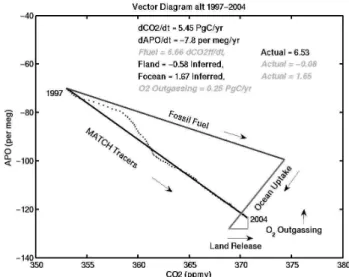
observed by global atmospheric monitoring networks. The above method, originally presented as a vector dia-gram (Keeling et al., 1996), assumes that the O2:CO2
stoi-chiometries of fossil fuel combustion and terrestrial respira-tion and photosynthesis are known, but that oceanic O2and
CO2fluxes are decoupled. The vector method is often
con-sidered the best way to monitor the partitioning of sinks for anthropogenic CO2on a continual basis, allowing the
detec-tion of trends or changes, e.g., the increased land sink of the 1990s relative to the 1980s (Prentice et al., 2001). Alterna-tive methods for estimating ocean and land sinks are gener-ally more difficult to update quickly. Ocean inventory meth-ods, for example, require a large new set of ocean cruise data (e.g., Matsumoto and Gruber, 2005).
Despite the advantages of the APO vs. CO2 method, its
inherent uncertainties may be so large that it cannot con-strain the carbon sink partitioning to within better than
∼±0.7 PgC/yr (LeQuere et al., 2003). This uncertainty rep-resents a substantial fraction of the mean total land and ocean sinks, which are estimated at 1.9 and 1.2 PgC/yr, respec-tively, for 1990–2000 (MK06). Among the inherent un-certainties in the method are those associated with fossil fuel combustion inventories and the assumed – O2:CO2
stoi-chiometries of combustion and terrestrial photosynthesis and respiration. However, the single largest uncertainty for esti-mating the ocean carbon sink is the Zeffterm associated with
oceanic O2fluxes (MK06).
Early applications of the vector method assumed that the atmosphere-ocean system for O2was still essentially in
equi-librium and thus that the net annual mean air-sea flux of O2
was approximately zero (Keeling et al., 1993; 1996). This assumption was closely related to the reasons for the decou-pling of oceanic O2 and CO2 fluxes. First, O2 is far less
soluble than CO2, with only 1% of the O2 in the
ocean-atmosphere system partitioning into the ocean compared to 98% for CO2. Second, the buffering effect of carbonate
chemistry in seawater increases the air-sea CO2equilibration
time scale by an order of magnitude relative to that of O2.
Third, fossil fuel combustion and deforestation have raised atmospheric CO2 by ∼35% relative to preindustrial levels,
thus providing the geochemical driving force for net global oceanic CO2 uptake. In contrast, these processes have
re-duced atmospheric O2/N2by only ∼240 per meg, or less than
0.03% of the total O2burden, since atmospheric monitoring
of O2/N2began in the late 1980s (MK06).
Although the assumption of a net zero annual oceanic O2
flux initially seemed reasonable, it has long been known that natural interannual variability in oceanic O2fluxes, due,
e.g., to incomplete ventilation of O2-depleted thermocline
waters in some years, followed by deep convection events in subsequent years, can create a non-zero net oceanic O2
flux over a given year or even period of years (Keeling et al., 1993). Thus the vector method is generally applied to longer, e.g., decadal averages, of APO and CO2 data with
the assumption that the interannual variability will average to zero. In addition to natural interannual variability, re-cent studies have recognized that long-term ocean warm-ing may be inducwarm-ing net O2 outgassing, with reinforcing
feedbacks associated with biology and ocean stratification (Sarmiento et al., 1998; Bopp et al., 2002; Plattner et al.,
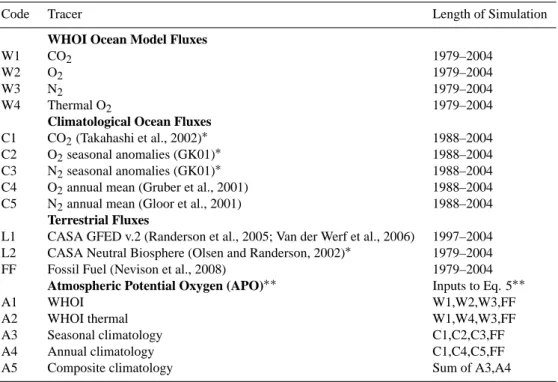
Table 1. Summary of surface fluxes used to drive MATCH simulations and the resulting tracers used to calculate APO.
Code Tracer Length of Simulation
WHOI Ocean Model Fluxes
W1 CO2 1979–2004
W2 O2 1979–2004
W3 N2 1979–2004
W4 Thermal O2 1979–2004
Climatological Ocean Fluxes
C1 CO2(Takahashi et al., 2002)∗ 1988–2004
C2 O2seasonal anomalies (GK01)∗ 1988–2004
C3 N2seasonal anomalies (GK01)∗ 1988–2004
C4 O2annual mean (Gruber et al., 2001) 1988–2004
C5 N2annual mean (Gloor et al., 2001) 1988–2004
Terrestrial Fluxes
L1 CASA GFED v.2 (Randerson et al., 2005; Van der Werf et al., 2006) 1997–2004 L2 CASA Neutral Biosphere (Olsen and Randerson, 2002)∗ 1979–2004 FF Fossil Fuel (Nevison et al., 2008) 1979–2004
Atmospheric Potential Oxygen (APO)∗∗ Inputs to Eq. 5∗∗
A1 WHOI W1,W2,W3,FF
A2 WHOI thermal W1,W4,W3,FF
A3 Seasonal climatology C1,C2,C3,FF A4 Annual climatology C1,C4,C5,FF A5 Composite climatology Sum of A3,A4
∗Surface flux is cyclostationary (i.e., the same seasonal cycle is repeated each year). ∗∗
The same code is used to refer to APOoc(calculated without F F ) and O2/Noc2 (calculated from Eq. 6 without F F and COoc2).
2002). Both natural interannual variability and long-term net O2outgassing are quantified based on empirical relationships
between dissolved O2and potential temperature extrapolated
to observed heat fluxes, although these relationships are not well understood (Keeling and Garcia, 2002). MK06 estimate the combined effects of these two processes on uncertainty in ocean and land carbon sink partitioning at ±0.5 Pg C/yr.
Here we present a model-based analysis of atmospheric APO and CO2focusing on interannual variability in oceanic
O2fluxes and their contribution to uncertainty in the APO
vs. CO2 method for partitioning carbon sinks. To
esti-mate oceanic O2, N2and CO2fluxes, we employ a
process-based ocean ecosystem model coupled to a general circula-tion model, which represents an advance over the OCMIP-based (i.e., phosphate-restoring) ocean carbon models that were used predominantly in previous APO studies (Stephens et al., 1998; Naegler et al., 2007). The ocean fluxes are used to force atmospheric transport model simulations that include full interannual variability in the meteorological drivers. We also force the transport model with fossil and terrestrial CO2
fluxes, which can be scaled to O2 based on assumed
stoi-chiometries. Our simulation encompasses a complete set of atmospheric tracers that can be used to evaluate uncertainties in the APO vs. CO2method in a controlled model context in
which the true surface CO2and O2fluxes are known exactly.
We begin in Sect. 2 with a description of the atmospheric
tracer transport model (ATM) and ocean, land, and fossil fuel fluxes as well as the APO observations used to evaluate model results. We present a comparison of model vs. ob-served seasonal cycles and latitudinal gradients in Sects. 3.1 and 3.2, respectively. In Sect. 3.3 we characterize the inter-annual variability in model APO and in Sect. 3.4 we analyze the impact of interannual variability in oceanic O2fluxes on
the APO vs. CO2method for partitioning carbon sinks. This
section also includes an analysis of errors in the method as-sociated with sparse sampling of the ATM at grid points cor-responding to APO monitoring stations. We conclude with a summary of our results in Sect. 4.
2 Methods
2.1 Atmospheric transport model
The Model of Atmospheric Transport and Chemistry (MATCH) (Rasch et al., 1997; Mahowald et al., 1997) was used to simulate the atmospheric distribution of a range of surface O2, CO2 and N2 fluxes. The model was run
at T62 horizontal resolution (about 1.9◦ latitude by longi-tude) with 28 vertical levels and a time step of 20 min us-ing archived 6 hourly winds for the years 1979–2004 from the National Center for Environmental Prediction (NCEP)
reanalyses (Kalnay et al., 1996). The surface fluxes used to force the simulations are described below and summarized in Table 1. See also Nevison et al. (2008) for additional details. 2.2 Air-sea fluxes of O2, CO2and N2
Oceanic O2 and CO2 fluxes were obtained for 1979–2004
from the WHOI-NCAR-UC Irvine ocean general circula-tion and marine ecosystem model (abbreviated here as the WHOI model). The ecosystem model includes a nutrient-phytoplankton-zooplankton-detritus (NPZD) food web with multi-nutrient limitation (N, P, Si, Fe) and specific phyto-plankton functional groups (Doney et al., 1996; Moore et al., 2002, 2004). The general circulation model is the NCAR ocean model, which was run at 3.6◦longitude resolution and variable latitude resolution ranging from 0.6◦near the equa-tor to 2.8◦at mid-latitudes, and forced with historical daily-averaged NCEP reanalysis surface wind, heat flux, atmo-spheric temperature and humidity, and satellite data products from 1979–2004 (Doney et al., 1998, 2007). With proper historical forcing, the NCAR ocean model captures well the magnitude and phasing of upper ocean heat content interan-nual variability (Doney et al., 2007).
While O2 and CO2 fluxes were obtained prognostically
from the WHOI model, N2 fluxes were diagnosed based
on the NCEP heat fluxes (Q) as FN2=Q(dSN2/dT )/Cp (Keeling et al., 1998), where dSN2/dT is the tempera-ture derivative of N2 solubility evaluated at the NCEP
sea surface temperature. A similar equation was used to estimate the thermal component of the WHOI O2 flux:
FO2 thermal=Q(dSO2/dT )/Cp, but with two modifications recommended by Jin et al. (2007), who optimized the for-mula based on comparisons to explicitly modeled thermal O2
fluxes. First, the magnitude of FO2 thermal was scaled down by a factor of 0.7 to account for incomplete thermal equili-bration of O2. Second, the flux was delayed for half a month
to account for non-instantaneous air-sea equilibration. Sim-ilar modifications may be needed for FN2, but were not ap-plied in the current study, since their appropriateness for N2
has not yet been evaluated (X. Jin, personal communication). In addition to the interannually-varying WHOI and NCEP-based fluxes, MATCH was also run from 1988–2004 with a variety of climatological oceanic CO2, O2, and N2 fluxes.
These included the monthly sea surface CO2 flux
clima-tology of Takahashi et al. (2002) (corrected to 10 m height windspeeds) and the monthly O2and N2flux anomaly
cli-matology of Garcia and Keeling (2001) (hereafter referred to as GK01). The GK01 O2 fluxes are based on linear
regressions that use ECMWF heat flux anomalies to spa-tially and temporally extrapolate historical dissolved O2data.
These empirical regressions reflect both biology and circula-tion and thermal-driven variacircula-tions in oxygen flux. The N2
flux anomalies are calculated from the same formula for FN2 above, but use climatological ECMWF values rather than interannually-varying NCEP data for Q. The monthly O2
and N2 flux anomalies have an annual mean of zero at all
gridpoints and thus do not provide realistic spatial distribu-tions. To fill this gap, additional simulations were performed with O2 and N2fluxes from the annual-mean ocean
inver-sions of Gruber et al. (2001) and Gloor et al. (2001). The inversions are based on ocean inventory data and are subject to ocean general circulation model biases but independent of atmospheric transport influences.
2.3 Fossil fuel and land biosphere carbon fluxes
Fossil fuel carbon emissions were constructed from decadal 1◦×1◦maps (Andres et al., 1996; Brenkert, 1998) that were interpolated between decades based on the annual regional totals of (Marland et al., 2003). The carbon fluxes were run in MATCH from 1979-2004. The atmospheric O2
distribu-tions resulting from fossil fuel combustion were estimated from MATCH CO2multiplied by a mean fossil fuel O2:CO2
stoichiometry of –1.4 (MK06).
Two versions of the CASA land biosphere model were used for terrestrial CO2 fluxes. The first (L1 in Table 1)
was the Global Fire Emissions Database (GFED v2) ver-sion of CASA, which incorporates satellite-based estimates of burned area (Randerson et al., 2005; Van der Werf et al., 2006) and for which the biomass burning component of the emissions was optimized based on CO inversion results (Ka-sibhatla et al., manuscript in preparation). The second (L2) was a cyclostationary (i.e., the same seasonal cycle repeated every year) “neutral biosphere” version, run in MATCH from 1979–2004, in which annual net ecosystem production was assumed to be zero at each grid cell (Olsen and Randerson, 2004). The L1 fluxes provide more realistic interannual vari-ability in atmospheric CO2than the L2 fluxes, but are limited
to 1997–2004 (Nevison et al., 2008). At their original 1◦×1◦ resolution, the global mean L1 carbon flux was constrained to equal zero over the 1997–2004 period, and the L2 flux had an annual mean of zero every year. However, a small interpo-lation error in converting to the T62 MATCH grid resulted in a small net source of CO2to the atmosphere of ∼+0.1 PgC/yr
for both versions of the land flux over these respective peri-ods.
2.4 Model APO
Model atmospheric potential oxygen (APO) was calculated somewhat differently than observed APO (Eq. 1), since O2
and N2 were run as separate tracers in MATCH. We used
equation 5, in which all individual O2, N2and CO2 tracers
are in ppm of dry air and APO is in per meg units (Stephens et al., 1998; Naegler et al., 2007).
Fig. 1. Seasonal cycles of APOocat 12 selected stations. Gray filled squares are fit to the Battle et al. (2006) observed climatological seasonal cycle; black solid line is APOocfrom the WHOI-MATCH A1 simulation; black dotted line is the A3 seasonal climatology simulation; gray solid line is WHOI-MATCH COoc2 from the C1 simulation, converted to per meg units; black dashed line is the A2 simulation, i.e., APOoc calculated with WHOI thermal O2rather than total Ooc2 . Mean seasonal cycles were calculated by detrending the MATCH results with a 3rd
order polynomial and taking the average of all Januaries, all Februaries, etc. (a) Alert, Canada (ALT), (b) Barrow, Alaska (BRW), (c) Cold Bay, Alaska (CBA), (d) Sable Island, Nova Scotia (SBL), (e) La Jolla, CA (LJO), (f) Kumukahi, Hawaii (KUM), (g) Samoa (SMO), (h) Cape Grim, Tasmania (CGO), (i) Macquarie Island, Australia (MQA), (j) Palmer Station, Antarctica (PSA), (k) Syowa, Antarctica (SYO),
(l) South Pole (SPO).
APO= 1 XO2 (Ooc2 −1.4COF F2 )− 1 XN2 Noc2 + 1.1 XO2 (COoc2 +COF F2 ) (5) where the superscripts oc and F F denote ocean and fossil fuel tracers, respectively. XO2 and XN2 are the fractions of O2and N2in air (0.20946 and 0.78084, respectively). Land
O2and CO2tracers could have been included in the first and
third right hand side terms of Eq. 5, respectively, but simply would have canceled out, since we assumed that Oland2 = – 1.1 COland2 . In practice, the COF F2 terms were important for latitudinal gradients, but had little effect on seasonal or in-terannual variability. For some applications, the fossil terms were omitted to yield a quantity we refer to as APOoc, which includes only the oceanic tracers. To examine the conse-quences of neglecting COoc2 in calculating APOoc, a third quantity, referred to here as O2/Noc2 , was computed:
O2/N2oc= 1 XO2 Ooc2 − 1 XN2 Noc2 (6) 2.5 Observed APO
For comparison to model results, we used observed seasonal cycles from Battle et al. (2006), who computed the 1996– 2003 climatological cycles at 13 land-based atmospheric monitoring stations, including both the SIO (Keeling et al., 1998) and Princeton (Bender et al., 2005) networks. Battle et al. also determined the latitudinal gradient in APO from the annual mean offsets of sinusoidal fits to the observed sea-sonal cycles at the land-based monitoring stations and from additional ship-based measurements in the Pacific Ocean.
3 Results and discussion
3.1 Seasonal cycles
The seasonal cycles in APO predicted by the WHOI-MATCH simulation (A1 in Table 1) generally agree well with the observed cycles (Figs. 1–2). The model amplitude is cap-tured to within ±10 to 20% at most stations and the agree-ment in phasing is excellent at all stations, except Palmer Sta-tion, Antarctica (PSA), where the model minimum is a month
Fig. 2. Taylor diagrams summarizing the comparison of MATCH seasonal cycles to Battle et al. (2006) observations. The angle θ from the
x-axis in the polar plot is the arccosine of the correlation coefficient R between the model and observed cycle, which reflects the agreement in shape and phasing. The value on the radial axis is the ratio of standard deviations: σmodel/σobs, which represents the match between the
amplitude of the model and observed seasonal cycle (Taylor, 2001). Each symbol represents 1 of the 12 stations in Fig. 1, or a 13th station, Amsterdam Island, France (AMS). The 13 stations are sorted into 4 latitude bands according to the figure legend. The following MATCH simulations are shown: (a) WHOI APOoc(A1) (b) WHOI O2/Noc2 (A1, but COoc2 not included), (c) seasonal climatology APOoc(A3).
earlier than observed. Oceanic CO2, although sometimes
neglected when calculating the APO seasonal cycle (e.g., GK01; Blaine, 2005), appears to contribute in a small but non-negligible manner to the amplitude agreement at some stations. Neglecting COoc2 leads to a greater underestimate of the seasonal amplitude at the tropical SMO and KUM sta-tions, where the COoc2 and Ooc2 seasonal cycles are in phase, and a tendency to overestimate the seasonal amplitude at ex-tratropical southern stations, where COoc2 opposes Ooc2 . In comparison to A1, the A3 MATCH simulation with climato-logical ocean fluxes yields seasonal cycles in APO that agree less well in shape and phasing with observations, and over-estimate the observed amplitude by 30–40% at most extrat-ropical stations and by nearly 100% at the Cold Bay, Alaska (CBA) station.
In general, thermal and biological O2fluxes tend to
rein-force each other over the seasonal cycle. In fall and win-ter, the increased solubility of cooling surface waters causes thermal ingassing, while the breakdown of the seasonal ther-mocline leads to biological uptake as deep waters depleted in O2 by microbial decomposition are ventilated (Keeling
et al., 1993). Conversely, in spring and summer, warming of surface waters tends to coincide with biological O2
out-gassing due to new production. However, comparison of the WHOI model A1 and A2 simulations suggests that net to-tal oceanic O2fluxes do not always correlate well with
ther-mal O2fluxes (Fig. 1), as is assumed by the GK01 seasonal
O2climatology. At southern extratropical stations in
particu-lar, thermal O2fluxes are only moderately well correlated in
shape and phasing (R=0.4–0.9) and only account for 10–15% of the amplitude of net O2seasonal cycle, with the
remain-der due to biology and circulation. At tropical and northern stations, the thermal O2flux tends to correlate better and to
account for a larger (20–40%) share of the seasonal ampli-tude. In most regions of the ocean, Figs. 1–2 suggest that the explicit modeling of ocean biology and circulation provided by the WHOI model yields superior results to the climatol-ogy. Similarly, the more sophisticated ocean ecosystem dy-namics of the WHOI model appears to yield more realistic seasonal cycles in APO than the P-restoring OCMIP ocean biology parameterizations tested by Naegler et al. (2007).
A caveat on the above discussion is that the choice of at-mospheric transport model can influence the amplitude of the model seasonal cycle in APO (Battle et al., 2006; Naegler et al., 2007), since many atmospheric transport models produce a seasonal “rectifier” in APO (Stephens et al., 1998; Gruber et al., 2001; Blaine et al., 2005). The concept of seasonal rec-tification was first defined in atmospheric CO2studies
(Pear-man and Hyson, 1980; Keeling et al.,1989; Denning et al., 1995), and involves a covariation between seasonal variabil-ity in transport and surface fluxes that can yield annual-mean surface concentrations of an atmospheric tracer that are not zero, even when the annual mean surface flux of the tracer is zero.
Previous studies have found that ATMs with strong sea-sonal APO rectifiers, like TM3, tend to yield larger seasea-sonal amplitudes in APO than weak rectifiers like TM2. Naegler et al. (2007) used the average of simulations with TM2 and TM3 as the best estimate of true APO, but Battle et al. (2006) suggested that TM3 may overestimate tracer concentrations and thus seasonal amplitudes due to excessive vertical trap-ping in surface layers. This latter suggestion is supported by the extreme overestimate of the seasonal amplitude at CBA in the A3 simulation (Figs. 1–2). Transport model differences may explain the discrepancy between the results of GK01 with TM2, which captures the amplitude of the observed
O2/Noc2 cycle to within ±10% at most stations, and those
shown in Fig. 2c, in which the A3 simulation with the same flux climatology tends to overestimate the observed APO seasonal cycle. Uncertainties associated with atmospheric transport are discussed further below in the context of latitu-dinal gradients.
3.2 Latitudinal gradient
In the A3 simulation, in which climatological seasonal flux anomalies have an annual mean of zero at all grid points for O2and N2, MATCH predicts non-zero annual mean APOoc.
Positive values of up to ∼20 per meg are predicted over northern ocean regions centered around 45–60◦N (encom-passing the CBA station) and up to ∼10 per meg at compa-rable southern latitudes (Fig. 3a). Similar but weaker pat-terns appear in the A1 simulation with seasonally varying WHOI fluxes (Fig. 3b). In contrast, the annual mean clima-tology simulation (A4) yields negative annual mean values of APOocover the mid to high latitude oceans (Fig. 3c), con-sistent with the known patterns of net oceanic O2uptake in
these regions. We also constructed a “composite” climatol-ogy (A5), as per Gruber et al. (2001) and Battle et al. (2006), by adding the results of MATCH simulations with the annual climatology and the GK01 seasonal anomalies. The com-posite climatology yields an APOoc field similar to that of the WHOI model (Fig. 3d). The results shown in Fig. 3 suggest that the MATCH transport model introduces a sea-sonal rectifier for simulations that include seasea-sonally varying oceanic O2fluxes. Because the WHOI model itself predicts
O2uptake over the mid to high latitude oceans (not shown), it
must be that the atmospheric transport model, rather than the ocean model, is responsible for the positive APOocvalues in the A1 results around 45–60◦latitude (Fig. 3b).
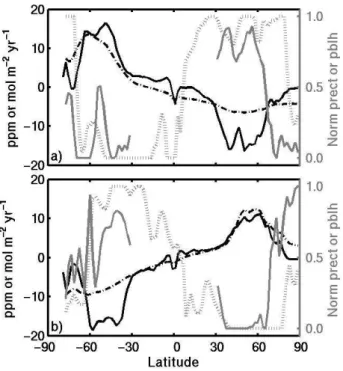
The MATCH seasonal rectifier in APO is caused by at least two interrelated mechanisms. First, the MATCH planetary boundary layer is shallower in summer over the ocean than in winter, due to increased convective heat release in wintertime (Fig. 4). Since positive sea-to-air O2 flux anomalies occur
during summer at mid to high latitudes, they are more likely to be trapped near the surface, resulting in a net positive APO anomaly. Stephens et al. (1998) and Gruber et al. (2001) found a similar effect with the TM2 and GCTM transport models. A second, related mechanism also contributes to the MATCH rectifier effect. The sum of convective and large-scale precipitation, which is effectively a proxy for venti-lation of surface layers by upward motion associated with storms, displays strong seasonal and hemispheric differences (Fig. 4). More storms occur over the ocean in the northern vs. the southern hemisphere and more storms occur in win-ter vs. summer in both hemispheres. Thus, negative winwin-ter O2fluxes are more likely to be ventilated from the boundary
layer, especially in the northern hemisphere, helping to ex-plain the winter and summer pattern in both hemispheres as well as the stronger seasonal difference in the north.
The “APO Transcom” intercomparison showed that the majority of nine transport models tested, using the GK01 seasonal anomalies to produce the quantity referred to in this study as O2/Noc2 , yielded similar rectifier effects to those
de-scribed above (Blaine, 2005). MATCH:NCEP fell among the strong rectifiers, but produced weaker annual mean val-ues than some of the other ATMs in that class. TM2 fell among the weak rectifiers, especially when forced with the 1986 ECMWF winds used by GK01.
The MATCH seasonal rectifier is difficult to confirm or disprove based on comparison with observed APO. The “equatorial bulge” in APO, a prominent feature of the obser-vations, is flattened in the A1 simulation by the strong mid to high latitude O2maxima associated with the seasonal
recti-fier (Fig. 5a,d). In contrast, the A4 simulation with the annual mean O2 flux climatology captures the “equatorial bulge”
relatively well (Fig. 5c,f). There are no seasonal rectifier ef-fects in the A4 runs, since the O2fluxes are uniform
through-out the year and thus can not covary with transport. The com-posite climatology (A5) yields a rectifier-effect-dominated latitudinal gradient that resembles the A1 results but captures the equatorial bulge better, especially when model results are subsampled in the tropical Pacific, where ship-based mea-surements are made, rather than zonally averaged (Fig. 5b,e). Battle et al. (2006) found similar results for TM3 simulations using the same composite climatology.
Aside from the equatorial bulge, both the A1 and A5 simulations produce a south-to-north gradient that agrees reasonably well with observations (Fig. 5d,e). Both sim-ulations, particularly A5, overestimate the observed annual mean value at CBA, suggesting an exaggerated seasonal rec-tifier effect in that area of the North Pacific. However, the an-nual mean simulation (A4), which lacks a seasonal rectifier, substantially underestimates APO at midlatitudes relative to the tropics, particularly in the northern hemisphere. Collec-tively, the above results suggest, in agreement with Naegler et al. (2007), that the APO seasonal rectifier probably exists to some degree in the real world, although both MATCH and TM3 may tend to exaggerate it. Overall, our results support the conclusion of Naegler et al. (2007) that evaluating ocean models (or flux climatologies) based on the latitudinal gradi-ent in APO is compromised by uncertainties in atmospheric transport models. The interannual variability and complexity of the observations further complicate the evaluation (Battle et al., 2006).
3.3 Interannual variability
A breakdown of APO from the WHOI-MATCH simulation (A1) into its components shows that oceanic O2fluxes are
the main drivers of interannual variability in model APO (Fig. 6a,b). Most of the variability originates at mid to high latitudes, especially in the Southern Ocean (Fig. 6a). COoc2 also contributes substantially to interannual variabil-ity in APO in the tropics, accounting for as much as half of
Fig. 3. The annual mean seasonal rectifier in APOoc, calculated by averaging detrended MATCH tracers from 1988–2004 and subtracting the global mean:
APOoc= 1 XO2 (Ooc2 −mean Ooc2 ) − 1 XN2 (Noc2 −mean Noc2 ) + 1.1 XO2 (COoc2 −mean COoc2 )
(a) seasonal climatology (A3), (b) WHOI (A1), (c) annual climatology (A4), (d) composite climatology (A5) (Note: Takahashi et al. (2002)
COoc2 is used in both the seasonal and annual climatology, but is counted just once in the composite climatology).
the relatively low total variability predicted there (Fig. 6b). In general, interannual variability in the MATCH simulation with WHOI total O2(W2 in Table 1) is moderately correlated
to variability in thermal O2 (W4) (R∼0.6 to 0.8), but the
ratio of total:thermal variability is spatially heterogeneous, with highest ratios in the Southern Ocean and lowest ratios in the tropics (Fig. 6c). The underlying total O2 flux:heat
flux ratios of the WHOI model, which drive the patterns in Fig. 6c, range from >10 nmol/J in some seasons in the Southern Ocean to 1–2 nmol/J in the tropics and <0 in the equatorial upwelling zone, where, in contrast to most ocean regions, solubility and biology and circulation act in oppo-site directions on O2(Stephens et al., 1998). These patterns
are generally consistent with O∗2vs. θ slopes observed in the ocean thermocline (Keeling and Garcia, 2002), where O∗2is O2 corrected for biological activity based on the observed
phosphate concentration and the Redfield O2:P ratio (e.g.,
Gruber et al., 2001).
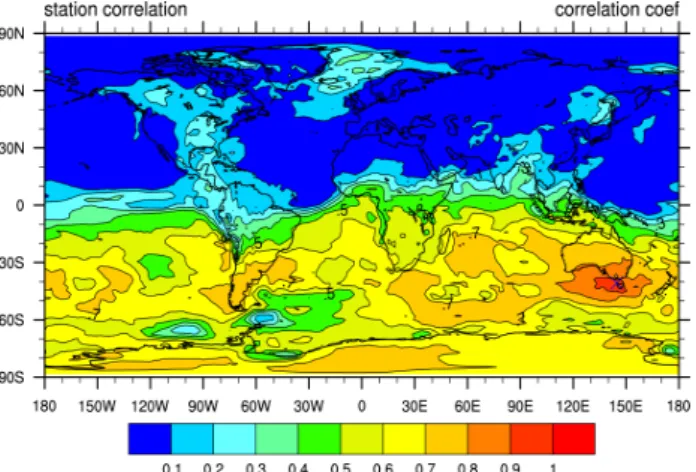
The A1 simulation predicts that interannual variability is moderately coherent among monitoring stations within a hemisphere (Fig. 7). For example, the correlation coefficient R for modeled interannual variability at CGO (41◦S, 145◦E) vs. MQA (54◦S, 159◦E) is ∼0.65. Similar correlation coef-ficients are found among the SIO networks stations within each hemisphere, suggesting the presence of common large-scale signals as well as local variability around each station
Fig. 4. Zonal averages (over ocean regions only) exploring the
cause of the seasonal rectifier effect for (a) January, (b) July. Black solid line is the WHOI oceanic O2flux (mol m−2yr−1); black
dot-dash line is the WHOI-MATCH O2seasonal anomaly (ppm) from
the W2 simulation; gray dotted line is the MATCH planetary bound-ary layer height (pblh); gray solid line is the sum of MATCH large scale and convective precipitation (prect), a proxy for ventilation of surface layers by upward motion associated with storms. Both pblh and prect are normalized at each latitude band according to the an-nual mean value in that band. Prect is masked equatorward of 30◦ because convective precipitation has strong patterns there that dis-tract from the mid-latitude patterns the figure seeks to emphasize.
(Hamme et al., 2006; Hamme and Keeling, 20081).
The amplitude of interannual variability in simulated APO ranges from ±5 to ±10 per meg year−1at the 12 monitor-ing stations in Fig. 8. Observed APO from the Princeton University network (Bender et al., 2005) shows a similar to somewhat larger range of variability (Fig. 8). APO obser-vations from the SIO network (not shown in Fig. 8) vary on the order of 5 to 10 per meg year−1(Hamme and Keel-ing, 20081). The A1 model results show higher frequency variability than the Princeton data (Fig. 8), probably due, at least in part, to the different smoothing algorithms applied. The Princeton data have been smoothed and deseasonalized with a 620-day smoothing algorithm (Thoning et al., 1989), whereas we have used a 13-month weighted running average for the model output. The SIO data, which are deseasonal-ized with a four-harmonic fit and smoothed with a six-month
1Hamme, R. and Keeling, R.: Ocean ventilation as a driver of
interannual variability in atmospheric potential oxygen, submitted to Tellus B, 2008.
Fig. 5. Left column: Components of MATCH zonally averaged
an-nual mean APO, in which all values are normalized to the South Pole and expressed in per meg units. Heavy black line is total APO, including fossil fuel; solid gray line is oceanic CO2; dotted black
line is oceanic O2; dashed black line is oceanic N2; dash-dot black
line is fossil fuel. (a) WHOI (A1) (b) composite climatology (A5),
(c) annual climatology (A4). Right column: Compares MATCH
an-nual mean latitudinal gradient in APO to Battle et al. (2006) station (gray squares) and shipboard (gray triangles) data. Black squares are MATCH annual mean values at the Battle et al. (2006) stations, which differ in some cases from the zonal averages (thin black line). Black triangles are MATCH annual-mean values along the Pacific transect described by Battle et al. (2006). Since the values at the SPO are arbitrary, all results have been shifted to aid visual com-parison.
running mean, also show higher frequency variability than the Princeton data (Hamme and Keeling, 20081). In gen-eral, the A1 simulation appears to predict a realistic range of variability in APO (±5 to ±10 per meg year−1), although
model APO is not well correlated temporally with either the Princeton (Fig. 8) or SIO observations (Hamme and Keeling, 20081).
3.4 Partitioning carbon sinks using APO and CO2
The MATCH simulations described in Table 1 offer a self-contained system for exploring some of the uncertainties in the APO-vs.-CO2 method for partitioning land and ocean
carbon sinks in a more controlled manner than is possible in the real world. The model simulation contains no mea-surement error or drift in 1CO2/1t and 1APO/1t and no
uncertainties in αbio, αf, Ffuel, or Zeff. In addition, Fland
Fig. 6. (a) Interannual RMS variability 1988–2004 in WHOI-MATCH APOoc(A1 simulation) computed as the RMS of the differences between each month and the corresponding month from the MATCH climatological seasonal cycle (e.g., model January 1998 minus model climatological January). (b) Ratio of RMS variabilities 1.1 COoc2 :Ooc2 (W1:W2). (c) Ratio of RMS variabilities Ooc2 :Othermal2 (W2:W4).
Fig. 7. Spatial coherence of interannual variability in WHOI-MATCH APO (A1 simulation). Shows the correlation coefficient R between the Cape Grim, Tasmania station and all other gridpoints in the 1988–2004 deseasonalized A1 time series. Station location is indicated by a blue X.
the fluxes used to force MATCH. These “true” fluxes can be compared to the Flandand Foceanterms inferred by
solv-ing Eqs. 2 and 4 ussolv-ing the time derivatives of MATCH APO and total CO2(Fig. 9). Having eliminated most conventional
sources of uncertainty, the model analysis allows us to ex-amine the uncertainty in the method arising from 1) variabil-ity introduced by transport acting on surface fluxes and sam-pling of the resulting atmospheric tracers at a limited number of stations, and 2) the O2outgassing term Zeff, which, like
the true carbon sinks, can be calculated exactly by globally integrating the oceanic O2fluxes used to force MATCH.
Early applications of the vector method solved the O2/N2
mass balance (Eq. 3) first for Flandand then used that result
to solve the CO2 mass balance (Eq. 2) for Focean (Keeling
et al., 1996). We have followed the more recent preference for solving the APO mass balance (Eq. 4) first for Foceanand
then using Eq. 2 for Fland(Bender et al., 2005; MK06). This
second approach offers several advantages over the O2/N2
vs. CO2 system, including the ability to use “global”
at-mospheric CO2 datasets from the NOAA CCGG network
to solve Eq. 2 instead of CO2 data from the more limited
number of O2/N2monitoring stations (MK06). We calculate
1APO/1t from the A1 simulation and 1CO2/1t by adding
either W1+FF+L1 or W1+FF+L2.
Although our ultimate goal is to examine the uncertainty in the method associated with O2outgassing, we first
exam-ine the method’s performance when the exact Zeffis used in
Eqs. 2 and 4. In these first tests, any discrepancies between the estimated and true Flandand Focean terms must be
intro-duced by atmospheric transport and sampling errors. Fig-ure 10a demonstrates that transport and sparse spatial sam-pling introduce large uncertainties, especially in Fland, when
individual station data are used to estimate 1CO2/1t. This
transport and sampling uncertainty is reduced when global
1CO2/1t (calculated by integrating all gridpoints in the
MATCH surface layer) is substituted for the individual sta-tion data (Fig. 10b). The uncertainty is further reduced when
1APO/1t is calculated from the average of a group of
sta-tions rather than a single station (Fig. 10c). In this figure, calculations with L1 (with realistic interannual variability in land CO2) yield larger deviations from true Flandthan
calcu-lations with L2, the cyclostationary land CO2tracer. All of
the station groupings shown in Fig. 10c, which were cho-sen because they have been used in real-life applications, give a good approximation of the truth. The ALT, LJO and CGO combination (favored by MK06) is used in Fig. 10d to explore the impact of staggered decadal intervals on the APO vs. CO2 method. Figure 10d shows that staggered
decadal time spans (using L2) have some scatter associated with transport and sampling uncertainty, but give true Fland
and Focean to within ±0.2 PgC/yr or better, with a standard
Fig. 8. Interannual variability in APO from the A1 WHOI-MATCH
simulation at the stations (a) to (l) defined in Fig. 1. Model APO is calculated from monthly mean output using Eq. 5. The seasonal cycle is removed with a 13-month weighted running average and interannual variability in per meg year−1is calculated as the time derivative of the deseasonalized time series. Observed interannual variability from Bender et al. (2005) is shown (blue curve) at BRW, CGO, SMO, and SYO.
From the above results, we conclude that transport and sparse sampling introduce a small error of ∼±0.2 PgC/yr into the CO2 land and ocean sinks inferred using the APO
vs. CO2 method. This error reflects uncertainty not only
in the partitioning between land and ocean sinks, but also
Fig. 9. Vector diagram showing MATCH time derivatives
1APO/1t (from A1 simulation) and 1CO2/1t (from W1+FF+L1
simulations) sampled at station Alert. The carbon sinks Flandand
Focean inferred by solving Eqs. 4 and 2 are compared to the
“ac-tual” surface fluxes used to force the MATCH simulation. The time derivative of the MATCH fossil fuel tracer 1COF F2 /1t (simulation
F F ) is also compared to the actual surface flux Ffuelused to force
MATCH. The O2outgassing term (Zeff) is computed as
Zeff=( 1 XO2 (f Ooc2 ) − 1 XN2 (f Noc2 ))/M ∗ 106/(βγ αbio),
where f Ooc2 and f Noc2 are the globally integrated WHOI ocean fluxes in moles/yr used to force MATCH, M=1.768×10²⁰ is the total moles of dry air in the atmosphere, and β, γ and αbioare con-version factors defined in the text that convert per meg to Pg C. Gray italic text denotes quantities known in the model simulation but unknown in the real world. Unless labeled otherwise, all these quantities are in PgC/yr, averaged over the 8 year interval 1997– 2004. Note that Flandin the model is actually a small source of
carbon and thus has a negative value in the diagram, since Fland
and Foceanare defined as positive when they act as sinks.
in the absolute magnitude of the combined sinks (which is set by the difference Ffuel−1CO2/1t), since the transport
and sampling uncertainty affects 1CO2/1t. The analysis
in Fig. 10 does not necessarily identify an optimal spatial sampling strategy, since the results may be influenced by transport biases in the particular atmospheric transport model (MATCH) used here. It is possible, for example, that spu-rious seasonal rectifier effects for both APO, as discussed above, and CO2(Denning et al., 1995; Gurney et al., 2003)
may bias the model uncertainty relative to the real world. In the results discussed thus far, the true Zeffis known
ex-actly and used to solve Eqs. 4 and 2. Figures 10c, 11 and 12 investigate what happens in the more realistic case where the O2outgassing term is not exactly known. Figure 10c shows
that ignoring O2outgassing entirely leads to a clear
Fig. 10. Summary of calculations testing the sensitivity of Flandand
Focean, estimated by solving Eqs. 4 and 2 using WHOI-MATCH
tracers, to different spatial sampling strategies, time spans, land CO2tracers, and inclusion or omission of the O2outgassing term
Zeff. 1APO/1t is calculated from the A1 WHOI-MATCH
sim-ulation and 1CO2/1t is calculated by adding either W1+FF+L1
or W1+FF+L2. The difference between inferred and actual Fland and Foceanis shown on the x and y-axis, respectively, in Pg C/yr.
The “truth” at x=0, y=0 is marked with a star. (a) 1997–2004 us-ing the L1 land CO2tracer. 1APO/1t and 1CO2/1t are
evalu-ated separately at 13 individual stations, as labeled on plot, using legend symbols described in Fig. 2. (b) same as (a) except using global 1CO2/1t . (c) 1997–2004 using L1 (circles) or L2 (squares)
land CO2tracer. The numbers 1–5 indicate the combination of
sta-tions used to calculate average 1APO/1t : 1=ALT, LJO; 2=ALT, LJO, CGO; 3=BRW, SMO, CGO; 4=ALT, LJO, KUM, CGO, PSA; 5=ALT, CBA, LJO, KUM, SMO, CGO, PSA. Global 1CO2/1t is
used for all cases. Gray symbols are corresponding solutions when the O2outgassing correction is omitted. (d) Shows 17 staggered
10-year intervals, using the L2 land CO2 tracer, from 1979–1988
(lightest circle) to 1995–2004 (darkest). Uses global 1CO2/1t and
the ALT, LJO, CGO station average for 1APO/1t. The 4 intervals featured in Fig. 11 are explicitly labeled.
the L1 or L2 land CO2tracer is used. The neglect of Zeff
leads to a compensating overestimate of the true land sink in the L2 case, but partly cancels transport and sampling error in Flandin the L1 case, such that the true Flandis estimated
about equally well with or without Zeff(Fig. 10c).
In real-life applications of the APO vs. CO2method, O2
outgassing is not ignored (Battle et al., 2000; Bender et al., 2005; MK06). Rather, current studies have an arguably good estimate of the long-term mean Zeff (Bopp et al., 2002;
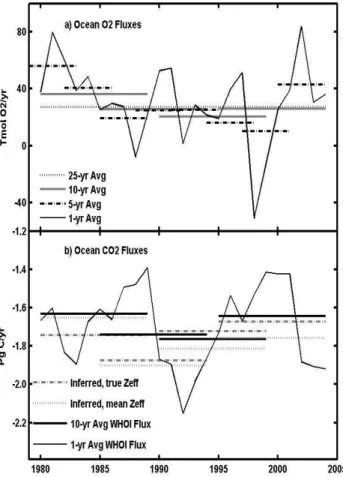
Fig. 11. (a) Globally integrated WHOI sea-to-air O2flux (in Tmol
O2/yr) shown as 1-yr (thin black line), 5-yr (dot-dash lines), 10-yr (gray solid line) and 25-yr (dotted line) averages. (b) Globally inte-grated WHOI sea-to-air CO2flux (in Pg C/yr) shown as 1-yr (thin
black line) and 10-yr (heavy black line) averages. Gray lines show inferred Foceanfrom calculation described in 10d solved for 4
dif-ferent 10-yr intervals, using true Zeff(dash-dot) and 25-yr average
Zeff(dotted).
Keeling and Garcia, 2002; Plattner et al., 2002). How-ever, these studies still assume that interannual variability in oceanic O2fluxes averages to zero for the time period
(com-monly ∼1decade) over which the method is applied. Fig-ure 11 shows that the decadal assumption is reasonable for the WHOI model. In Fig. 11a, four different 10-year av-erage O2 fluxes, calculated at staggered intervals over the
25-year span of the W2 simulation, deviate relatively little (σ =±6 Tmol O2/yr) from the long-term 25-year mean of
30 Tmol O2/yr. This is true despite the relatively large range
of interannual variability (–50 to +85 Tmol O2/yr) in the O2
fluxes. The model 25-year mean corresponds closely to the value of Zeff used in calculations involving observed APO
and CO2(Keeling and Garcia, 2002; MK06). When this
25-year mean is substituted for the true 10-25-year averages in the APO vs. CO2mass balance calculations, the resulting Focean
deviates only slightly more from the truth than the Focean
and sampling-related background error that already exists in the calculation (Fig. 11b).
When one moves to shorter, e.g., 5-year, averages, the above conclusions start to break down. The eight staggered 5-year average O2fluxes shown in Fig. 11a deviate more
sub-stantially (σ =±16 Tmol O2/yr) from the 30 Tmol/yr
long-term mean than did the 10-year averages. Accordingly, the values of Focean calculated by substituting the long-term
mean Zeff for the true 5-year averages display larger
de-viations from the truth, with errors ranging up to ±0.5 Pg C/yr. For even shorter time intervals, e.g., 1-year averages, the problem is compounded further, leading to large errors and unrealistic year-to-year swings in the inferred value of
Focean of ±1 PgC/yr or more, consistent with previous
stud-ies (McKinley et al., 2003; Bender et al., 2005).
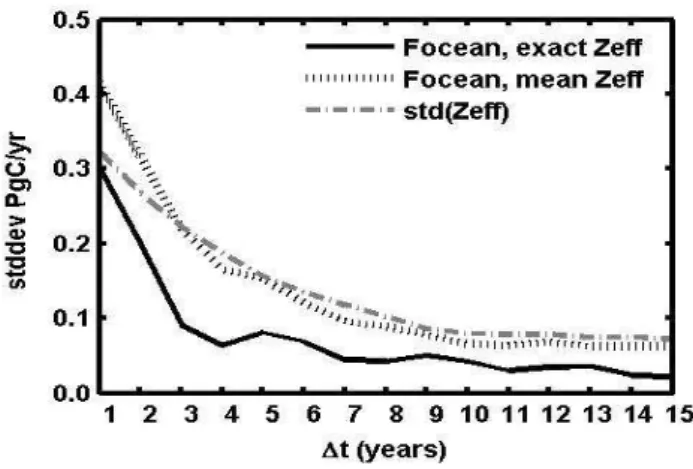
To quantify more systematically the error in the APO vs. CO2method as a function of time span, we solve Eqs. 4
and 2 using the MATCH A1, and W1+FF+L2 time series over 1t intervals ranging from 1 to 15 years and compute the standard deviation from the “truth” in Focean. We
con-sider all whole-year staggered intervals for each respective
1t between 1980 and 2003. We perform these calculations
using both the long-term mean Zeffand the true Zeffin order
to distinguish between errors due to uncertainty in O2
out-gassing versus in transport and sampling. For calculations using true Zeff, the standard deviation σ of Focean from the
truth is <0.1 PgC/yr for 1t=3 to 15 years, with a small in-creasing trend in σ as 1t decreases (Fig. 12). Intervals of
1t ≤3 years show a steeper increase in σ associated with
the increased uncertainty in 1APO/1t and, to a lesser ex-tent, global (surface level) 1CO2/1t. This result suggests
that time spans of 3 years or less are too short to yield accu-rate estimates of Focean due to errors associated with sparse
sampling and transport, even if O2outgassing is known
ex-actly. Calculations substituting the 1980–2003 mean Zefffor
the true Zeffyield a somewhat larger deviation from the true
Focean for all time intervals, but σ remains <0.1 PgC/yr for
1t ranging from 15 to ∼9 yrs. However, as 1t decreases to
9 years or less, σ begins to increase more sharply, paralleling the increasing standard deviation of true Zefffrom long-term
mean Zeff(Fig. 12). For 1t≤3 years, the increase in σ
steep-ens still more, due to the increased influence of transport and sampling uncertainties, as discussed above.
4 Conclusions
Forward simulations with the MATCH atmospheric transport model, using surface fluxes from the WHOI ocean ecosystem model, appear comparable or superior to those with observed climatological ocean fluxes in terms of reproducing observed seasonal and spatial patterns in atmospheric potential oxy-gen (APO). However, atmospheric transport uncertainties, especially those associated with the seasonal rectifier effect in APO, compromise our ability to evaluate ocean models
Fig. 12. Summary of standard deviations of inferred minus true
Focean (in Pg C/yr). Calculations use deseasonalized
WHOI-MATCH results over 1t intervals ranging from 1 to 15 years, in which all whole-year staggered intervals for each respective 1t be-tween 1980 and 2003 are considered (e.g., N =24 intervals for 1t=1 and N =10 intervals for 1t=15). Black solid line shows results using true Zeffover the interval 1t; black dotted line shows results using the 1980–2003 mean Zeff; Gray dot-dash line shows the standard
deviation of mean minus true Zeff(converted to PgC/yr as described
in Fig. 9) for the N staggered intervals at each 1t . All calculations use global 1CO2/1t from the W1+FF+L2 simulation and the ALT,
LJO, CGO station average for 1APO/1t from the A1 simulation.
with APO. Oceanic O2fluxes dominate seasonal, spatial and
interannual variability in simulated APO, but oceanic CO2
fluxes can contribute substantially to all three types of vari-ability, especially in the tropics. The WHOI model predicts strong interannual variability in the annual-mean ocean O2
flux (range –50 to +85 Tmol O2/yr), which is concentrated
largely at high latitudes. An analysis of the APO vs. CO2
mass balance method for partitioning land and ocean carbon sinks, performed in the controlled context of the MATCH simulation, in which the true surface carbon and oxygen fluxes are known exactly, suggests a small uncertainty (rang-ing up to ±0.2 Pg C) in the sinks due to errors associated with atmospheric transport and sparse sampling. Natural interan-nual variability in ocean O2fluxes introduces only a small
ad-ditional error into the inferred carbon sink partitioning when the APO–vs.-CO2 method is applied over decadal periods,
but this error becomes larger when the method is applied over shorter intervals.
Acknowledgements. We acknowledge the support of NASA grant
NNG05GG30G and NSF grant ATM0628472. We also thank Mark Battle, Hernan Garcia, Sara Mikaloff Fletcher, Ralph Keeling, Michael Bender, Jim Randerson, Guido van der Werf, and Prasad Kasibhatla for providing APO data and model or climatological fluxes. The MATCH simulations were conducted at the National Center for Atmospheric Research, a National Science Foundation funded facility.
References
Andres, R. J., Marland, G., Fung, I., and Matthews, E.: A 1◦×
1◦ distribution of carbon dioxide emissions from fossil fuel consumption and cement manufacture, 1950–1990, Glob. Bio-geochem. Cy., 10, 419–429, 1996.
Balkanski, Y., Monfray, P., Battle, M., and Heimann, M.: Ocean pri-mary production derived from satellite data: An evaluation with atmospheric oxygen measurements. Glob. Biogeochem. Cy., 13, 257–271, 1999.
Battle, M., Bender, M. L., Tans, P. P., White, J. W. C, Ellis, .J. T., Conway, T., and Francey, R. J.: Global carbon sinks and their variability inferred from atmospheric and δ13C, Science, 287, 2467–2470, 2000.
Battle, M., Mikaloff Fletcher, S., Bender, M. L., Keeling, R. F., et al.: Atmospheric potential oxygen: New observations and their implications for some atmospheric and oceanic models, Glob. Biogeochem. Cy., 20, GB1010, doi:10.1029/2005GB002534, 2006.
Bender, M., Ellis, T., Tans, P., Francey, R., and Lowe, D.: Variabil-ity in the O2/N2ratio of southern hemisphere air, 1991–1994:
Implications for the carbon cycle, Glob. Biogeochem. Cy., 10, 9–21, 1996.
Bender, M., Ho, D., Hendricks, M. B., Mika, R., Battle, M. O., Tans, P., Conway, T. J., Sturtevant, P. B., and Cassar, N.: Atmo-spheric O2/N2changes, 1993–2002: Implications for the
parti-tioning of fossil fuel CO2sequestration, Glob. Biogeochem. Cy., 19, GB4017, doi:10.1029/2004GB002410, 2005.
Blaine, T. W.: Continuous Measurements of Atmospheric Ar/N2as
a Tracer of Air-Sea Heat Flux: Models, Methods, and Data, Ph. D. Thesis, University of California, San Diego, La Jolla, 225 pp., 2005.
Bopp, L., Le Quere, C., Heimann, M., Manning, A. C., and Mon-fray, P.: Climate-induced oceanic oxygen fluxes: Implications for the contemporary carbon budget, Glob. Biogeochem. Cy., 16, GB1022, doi:10.1029/2001GB001445, 2002.
Brenkert, A. L.: Carbon dioxide emission estimates from fossil-fuel burning, hydraulic cement production, and gas flaring for 1995 on a one degree grid cell basis, (available at http://cdiac.esd.ornl. gov/ndps/ndp058a.html), 1998.
Denning, A. S., Fung, I. Y., and Randall, D. A.: Latitudinal gradient of atmospheric CO2due to seasonal exchange with land biota,
Nature, 376, 240–243, 1995.
Doney, S. C., Glover, D. M., and Najjar, R. G.: A new coupled, one-dimensional biological-physical model for the upper ocean: Applications to the JGOFS Bermuda Atlantic Time-series Study (BATS) site, Deep-Sea Res. Pt. II, 43, 591–624, 1996.
Doney, S. C., Large, W. G., and Bryan, F. O.: Surface ocean fluxes and water-mass transformation rates in the coupled NCAR Cli-mate System Model, J. CliCli-mate, 11, 1420–1441, 1998.
Doney, S. C., Yeager, S., Danabasoglu, G., Large, W. G., and McWilliams, J. C.: Mechanisms governing interannual variabil-ity of upper ocean temperature in a global hindcast simulation, J. Phys. Oceanogr., 37, 1918–1938, 2007.
Garcia, H. E. and Keeling, R. F.: On the global oxygen anomaly and air-sea flux, J. Geophys. Res., 106, 31 155–31 166, 2001. Gloor, M., Gruber, N., Hughes, T. M., and Sarmiento, J. L.: An
inverse modeling method for estimation of net air-sea fluxes from bulk data: Methodology and application to the heat cycle, Glob. Biogeochem. Cy., 15, 767–782, 2001.
Gruber, N., Gloor, M., Fan, S.-M., and Sarmiento, J. L.: Air-sea flux of oxygen estimated from bulk data: Implications for the marine and atmospheric oxygen cycles, Glob. Biogeochem. Cy., 15, 783–803, 2001.
Gurney, K. R., Law, R. M., Denning, A. S., Rayner, P. J., et al.: Transcom 3 CO2 inversion intercomparison: 1. Annual mean
control results and sensitivity to transport and prior flux infor-mation, Tellus B, 55, 555–579, 2003.
Hamme, R.C., Keeling, R.F., and Paplawsky, W.J.: Explaining ob-served variability in the interhemispheric gradient of atmospheric potential oxygen, AGU Fall Meeting, San Francisco, USA, 11– 15 December 2006, OS52C-03, 2006.
Jin, X., Najjar, R. G., Louanchi, F., and Doney, S. C.: A model-ing study of the seasonal oxygen budget of the global ocean. J. Geophys. Res., 112, C05017, doi:10.1029/2006JC003731, 2007. Kalnay, E., Kanamitsu, M., Kistler, R., Collins, W., Deaven, D., et al.: The NMC/NCAR 40-year reanalysis project, B. Am. Meteo-rol. Soc., 77, 437–471, 1996.
Keeling, R. F. and Shertz, S. R.: Seasonal and interannual variations in atmospheric oxygen and implications for the global carbon cycle, Nature, 358, 723–727, 1992.
Keeling, R. F. and Garcia, H. E.: The change in oceanic O2
inven-tory associated with recent global warming, P. Natl. Acad. Sci. USA, 99, 7848–7853, 2002.
Keeling, C. D., Piper, S. C., and Heimann, M.: in Aspects of climate variability in the Pacific and Western Americas, AGU Mono-graph, 55, edited by: Peterson, D. H. (AGU, Washington DC), 305–363, 1989.
Keeling, R. F., Najjar, R. P., Bender, M. L., and Tans, P. P.: What atmospheric oxygen measurements can tell us about the global carbon cycle, Glob. Biogeochem. Cy., 7, 37–67, 1993.
Keeling, R. F., Piper, S. C., and Heimann, M.: Global and hemi-spheric CO2sinks deduced from changes in atmospheric O2
con-centration, Nature, 391, 218–221, 1996.
Keeling, R. F., Stephens, B. B., Najjar, R. G., Doney, S. C., Archer, D., and Heimann, M.: Seasonal variations in the atmospheric O2/N2ration in relation to the kinetics of air-sea gas exchange, Glob. Biogeochem. Cy., 12, 141–163, 1998.
Le Qu´er´e, C., Aumont, O., Bopp, L., Bousquet, P., et al.: Two decades of ocean CO2sink and variability, Tellus B, 55, 649–
656, 2003.
Mahowald, N. M., Rasch, P. J., Eaton, B. E., Whittlestone, S., and Prinn, R. G.: Transport of radon-222 to the remote troposphere using the Model of Atmospheric Transport and Chemistry and assimilated winds from ECMWF and the National Center for En-vironmental Prediction/NCAR, J. Geophys. Res., 102, 28,139– 28,151, 1997.
Manning, A. C. and Keeling, R. F.: Global oceanic and land biotic carbon sinks from the Scripps atmospheric oxygen flask sam-pling network, Tellus B, 58, 95–116, 2006.
Marland, G., Boden, T. A., and Andres, R. J.: Global, regional, and national CO2emissions, in Trends: A Compendium of Data on
Global Change, pp. 505–584, Carbon Dioxide Inf. Anal. Cent., Oak Ridge Natl. Lab., US Dep. of Energy, Oak Ridge, Tenn., (available at http://cdiac.esd.ornl.gov/trends/emis/tre glob.htm), 2003.
Matsumoto, K. and Gruber, N.: How accurate is the estima-tion of anthropogenic carbon in the ocean? An evaluation of the 1C* method, Glob. Biogeochem. Cy., 19, GB3014,
doi:10.1029/2004GB002397, 2005.
McKinley, G. A., Follows, M. J., Marshall, J., and Fan, S.M.: In-terannual variability of air-sea O2fluxes and the determination of CO2sinks using atmospheric O2/N2, Geophys. Res. Lett., 30,
1101, doi:10.1029/2002GL016044, 2003.
Moore, J. K., Doney, S. C., Kleypas, J. C., Glover, D. M., and Fung, I.Y.: An intermediate complexity marine ecosystem model for the global domain, Deep-Sea Res. Pt. II, 49, 403–462, 2002. Moore, J. K., Doney, S. C., and Lindsay, K.: Upper ocean
ecosystem dynamics and iron cycling in a global three-dimensional model, Glob. Biogeochem. Cy., 18, GB4028, doi:10.1029/2004GB002220, 2004.
Naegler, T., Ciais, P., Orr, J. C., Aumont, O., and Roedenbeck, C.: On evaluating ocean models with atmospheric potential oxygen, Tellus, 59B, 138–156, 2007.
Najjar, R. G. and Keeling, R. F: Mean annual cycle of the air-sea oxygen flux: A global view, Glob. Biogeochem. Cy. 14(2), 573– 584, 2000.
Nevison, C. D., Keeling, R. F., Weiss, R. F., Popp, B. N., Jin, X., Fraser, P. J., Porter, L. W., and Hess, P. G.: Southern Ocean ven-tilation inferred from seasonal cycles of atmospheric N2O and
O2/N2at Cape Grim, Tasmania, Tellus, 57B, 218–229, 2005.
Nevison, C. D., Mahowald, N. M., Doney, S. C., Lima, I. D., van der Werf, G. R., Randerson, J. T., Baker, D. F., Kasibhatla, P., and McKinley, G. A.: Contribution of ocean, fossil fuel, land biosphere and biomass burning carbon fluxes to seasonal and in-terannual variability in atmospheric CO2, J. Geophys. Res., 113,
G01010, doi:10.1029/2007JG000408, 2008.
Olsen, S. C. and Randerson, J. T.: Differences between sur-face and column atmospheric CO2 and implications for
carbon cycle research, J. Geophys. Res., 109, D02301, doi:10.1029/2003JD003968, 2004.
Pearman, G. I. and Hyson, P.: Activities of the Global Biosphere as Reflected in Atmospheric CO2Records, J. Geophys. Res., 85,
4457–4467, 1980.
Plattner, G. K., Joos, F., and Stocker, T. F.: Revision of the global carbon budget due to changing air-sea oxygen fluxes, Glob. Bio-geochem. Cy., 16, GB1096, doi:10.1029/2001GB001746, 2002. Prentice, I. C., Farquhar, G. D., Fasham, M. J. R., Goulden, M. L., Heimann, M., Jaramillo, V. J., Kheshgi, H. S., and Le Qu´er´e, C.: The carbon cycle and atmospheric carbon dioxide, in Climate
Change 2001: The Scientific Basis, Contribution of Working Group I to the Third Assessment Report of the Intergovernmental Panel on Climate Change, edited by: Houghton J. T., Ding, Y., Griggs, D. J., et al., pp. 183–287, Cambridge Univ. Press, New York, 2001.
Randerson, J. T., van der Werf, G. R., Collatz, G. J., Giglio, L., Still, C. J., Kasibhatla, P., Miller, J. B., White, J. W. C., De-Fries, R. S., and Kasischke, E. S.: Fire emissions from C3 and C4 vegetation and their influence on interannual variability of atmo-spheric CO2and δ13CO2, Glob. Biogeochem. Cy., 19, GB2019, doi:10.1029/2004GB002366, 2005.
Rasch, P. J., Mahowald, N. M., and Eaton, B. E.: Representations of transport, convection, and the hydrologic cycle in chemical transport models: Implications for the modeling of short-lived and soluble species, J. Geophys. Res., 102, 28 127–28 138, 1997. Sarmiento, J. L., Hughes, T. M. C., Stouffer, R. J., and Manabe, S.: Simulated response of the ocean carbon cycle to anthropogenic climate warming, Nature, 393, 245–249, 1998.
Severinghaus, J. P.: Studies of the terrestrial O2and carbon cycles in sand dune gases and in Biosphere 2, Ph.D. thesis, Columbia University, New York, 1995.
Stephens, B. B., Keeling, R. F., Heimann, M., Six, K. D., Murnane, R. and Caldeira, K.: Testing global ocean carbon cycle models using measurements of atmospheric O2and CO2concentration,
Glob. Biogeochem. Cy., 12, 213–230, 1998.
Takahashi, T., Poisson, A. Metzl, N., Tilbrook, B., Bates, N., and coauthors: Global sea-air CO2flux based on climatological
sur-face ocean pCO2, and seasonal biological and temperature ef-fects, Deep-Sea Res. Pt. II, 49, 1601–1622, 2002.
Taylor, K. E.: Summarizing multiple aspects of model performance in a single diagram, J. Geophys. Res., 106, 7183–7192, 2001. Thoning, K. W., Tans, P. P., and Komhyr, W. D.: Atmospheric
carbon dioxide at Mauna Loa Observatory: 2. Analysis of the NOAA GMCC data, 1974–1985, J. Geophys. Res., 94, 8549– 8565, 1989.
Van der Werf, G. R., Randerson, J. T., Giglio, L., Collatz, G. J., Kasibhatla, P. S., and Arellano, Jr., A. F.: Interannual variability in global biomass burning emissions from 1997 to 2004, Atmos. Chem. Phys., 6, 3423–3441, 2006,