HAL Id: hal-01307079
https://hal.sorbonne-universite.fr/hal-01307079
Submitted on 26 Apr 2016
HAL is a multi-disciplinary open access
archive for the deposit and dissemination of
sci-entific research documents, whether they are
pub-lished or not. The documents may come from
teaching and research institutions in France or
abroad, or from public or private research centers.
L’archive ouverte pluridisciplinaire HAL, est
destinée au dépôt et à la diffusion de documents
scientifiques de niveau recherche, publiés ou non,
émanant des établissements d’enseignement et de
recherche français ou étrangers, des laboratoires
publics ou privés.
Distributed under a Creative Commons Attribution| 4.0 International License
Paolo Panci
To cite this version:
Paolo Panci. New Directions in Direct Dark Matter Searches. Advances in High Energy Physics,
Hindawi Publishing Corporation, 2014, pp.681312. �10.1155/2014/681312�. �hal-01307079�
Review Article
New Directions in Direct Dark Matter Searches
Paolo Panci
Institut d’Astrophysique, CNRS, UMR 7095 & Universit´e Pierre et Marie Curie, 98 bis Boulevard Arago, 75014 Paris, France Correspondence should be addressed to Paolo Panci; [email protected]
Received 9 January 2014; Accepted 3 February 2014; Published 16 April 2014 Academic Editor: Anselmo Meregaglia
Copyright © 2014 Paolo Panci. This is an open access article distributed under the Creative Commons Attribution License, which permits unrestricted use, distribution, and reproduction in any medium, provided the original work is properly cited. The publication of this article was funded by SCOAP3.
I present the status of direct dark matter detection with specific attention to the experimental results and their phenomenological interpretation in terms of dark matter interactions. In particular I review a new and more general approach to study signals in this field based on nonrelativistic operators which parametrize more efficiently the dark matter-nucleus interactions in terms of a very limited number of relevant degrees of freedom. Then I list the major experimental results, pointing out the main uncertainties that affect the theoretical interpretation of the data. Finally, since the underlying theory that describes both the dark matter and the standard model fields is unknown, I address the uncertainties coming from the nature of the interaction. In particular, the phenomenology of a class of models in which the interaction between dark matter particles and target nuclei is of a long range type is discussed.
1. Introduction
One of the most exciting open questions at the interface between particle physics and cosmology is the nature of Dark Matter (DM). The first person who provided evidence and inferred the presence of DM was a Swiss-American astrophysicist, Fritz Zwicky. He applied the virial theorem to the Coma cluster of galaxies and obtained evidence of unseen mass. Roughly 40 years following the discoveries of Zwicky and others, Vera Rubin and collaborators conducted an extensive study of the rotation curves of isolated spiral galaxies. They announced the discovery that the rotational curves of stars in spiral galaxies exhibit a characteristic flat behaviour at large distance in contrast with Kepler’s law. Many other evidence of unseen mass on distance scales of the size of galaxies and clusters of galaxies appeared throughout the years, but the most precise measurement of the total amount of DM comes from cosmological scales. In particular, the measurements of modern precision cosmology (the Cosmic Microwave Background (CMB) and the surveys of the Large Scale Structure (LSS) of the Universe) provide the current most relevant evidence. Apart from the qualitative agreement, it is the quantitative fitting of the wealth of available data that allows the amount of DM to be one of the cosmological parameters now most precisely measured
(Ω𝜒ℎ2= 0.1199 ± 0.0027; see [1, Table 2]). Therefore, we have
compelling evidence of unseen mass, but the microscopic features of this new kind of matter remain unknown yet. Direct and indirect searches may shed light on the nature of DM, and therefore a careful study of their phenomenology is fundamental. For a pedagogical review on this subject, see,
for example, [2].
Direct searches for DM aim at detecting the nuclear recoils arising from scattering between DM particles and target nuclei in underground detectors. DM direct detec-tion experiments are providing exciting results in terms of measured features which have the right properties to be potentially ascribed to a DM signal. For example in
addition to the long-standing DAMA results, nowadays
there are other experiments, such as CoGeNT,
CRESST-II, and CDMS-Si that start to see some anomalies in their counting rates. On the other hand, the situation in this field is extremely unclear and confusing, because, on top of these positive result experiments, the constraints coming
from null results, like XENON100, COUPP, PICASSO
and very recently LUX, are very stringent and put the
interpretation of the anomalies in terms of a DM interaction in serious trouble. Nevertheless, there are at least two main caveats when the results from the experiments commented upon above are interpreted. The first is that one has to
Volume 2014, Article ID 681312, 19 pages http://dx.doi.org/10.1155/2014/681312
treat with great care the fine experimental details associated with the results quoted by each experiment. The second caveat is instead associated with the interpretation of the data within a very simple-minded DM model. For instance, the DM-nucleus spin independent contact interaction is just a benchmark example. Upon relaxing some of these assumptions, the current complicated experimental puzzle can probably be solved.
The scope of this work is to present the status of direct DM detection with specific attention to the experimental results and their phenomenological interpretation in terms
of DM interaction. In particular in Section 2, I review a
new and more general approach to study signals in this field based on nonrelativistic operators which parameterize most efficiently the DM-nucleus interactions in terms of a very limited number of relevant degrees of freedom. In Section 3, I review the experimental results and their inter-pretation in terms of the “standard” spin independent (SI) interaction. I list then the main uncertainties that affect the theoretical interpretation of the data: this is a very promising area of research since only major advancements here can probably reconcile the complicated puzzle showed by the
experiments up. Finally inSection 4, I pose my attention on
the uncertainties coming from the nature of the interaction. In particular the phenomenology of a class of models in which the interaction between DM particles and target nuclei is of a long range type is discussed.
2. Basics of Direct Detection Computations
2.1. Kinematics. As already stated, when a DM particle
scatters off a nucleus, depending on the DM properties, one can envision at least two distinct kinematics, the elastic and the inelastic one. The elastic scattering is represented by
𝜒 + N(𝐴N, 𝑍N)at rest→ 𝜒 + N(𝐴N, 𝑍N)recoil, (1)
while the inelastic is
𝜒 + N(𝐴N, 𝑍N)at rest→ 𝜒+ N(𝐴N, 𝑍N)recoil. (2)
In (1) and (2),𝜒 and 𝜒are two DM particle states, and𝐴N,
𝑍N are, respectively, the mass and atomic numbers of the
nucleusN.
We know, thanks to rotational curves data, that the
velocity of𝜒 in the vicinity of the Earth is of the order of 10−3𝑐.
Hence the scattering between a DM particle with velocityV
and mass 𝑚𝜒 and a nucleus at rest with mass 𝑚N occurs
in deeply nonrelativistic regime. This is analogous with the collision between two billiard balls and therefore the recoil energy can be simply obtained by considering energy and
momenta conservation separately. In the detector rest frame, such scattering would end up into a nuclear recoil of energy:
𝐸𝑅=2𝜇 2 𝜒N 𝑚N V2( 1 − (V2 𝑡/2V2) − √1 − (V2𝑡/V2) cos 𝜃 2 ) , V𝑡= 0, elastic scattering, V𝑡 ̸= 0, inelastic scattering, (3)
where𝜇𝜒N = 𝑚𝜒𝑚N/(𝑚𝜒+ 𝑚N) is the DM-nucleus reduced
mass,𝜃 as usual is the scattering angle in the center-of-mass
frame, andV𝑡 = √2𝛿/𝜇𝜒N is a threshold velocity. Here𝛿 =
𝑚𝜒 − 𝑚𝜒 is the mass splitting between 𝜒 and 𝜒, and the
equation above holds for 𝛿 ≪ 𝑚𝜒, 𝑚𝜒. Elastic scattering
occurs for𝛿 = 0, while 𝛿 ̸= 0 implies inelastic scattering. The
minimal DM velocity providing the𝐸𝑅recoil energy can be
then obtained by putting𝜃 = −𝜋 in (3). One gets
Vmin(𝐸𝑅) = √𝑚N𝐸𝑅
2𝜇2
𝜒N
(1 + 𝜇𝜒N𝛿
𝑚N𝐸𝑅) . (4)
2.2. Formalism of Nonrelativistic Operators. Having a
dis-posal the basic quantityVmin that fully describes the
kine-matics of the DM-nucleus scatterings in (1) and (2) and the
differential rate of nuclear recoil expected in a given detector can be achieved by weighting the differential cross section
d𝜎N/d𝐸𝑅 with the DM velocity distribution 𝑓𝐸( ⃗V) in the
velocity range allowed by the kinematics. It reads as follows:
d𝑅N d𝐸𝑅 = 𝜉N 𝑚N 𝜌⊙ 𝑚𝜒∫ Vesc Vmin(𝐸𝑅) d3VV𝑓𝐸( ⃗V)d𝜎N d𝐸𝑅 (V, 𝐸𝑅) , (5)
where𝜉Nare the mass fractions of different nuclides (𝜉N =
103𝑁𝐴𝑚N𝜁N/kg 𝐴, where 𝑁𝐴 = 6.022 × 10²³ is
Avo-gadro’s number, 𝜁N are the numeric abundances and 𝐴 ≡
∑N𝜁N𝐴N.), and 𝜌⊙ ≃ 0.3 GeV/cm3 is the DM energy
density at the Earth’s location. This is the canonical value
routinely adopted in the literature (see, e.g., [2–4]). Recent
computations have found a higher central value of it, still
subject for some debate [5–7]. The integral in the right-hand
side of the equation above is a key ingredient because it contains all the information related to the geometry of the DM halo, the nature of the DM-nucleus interaction, and in turn the nuclear response of the target. In the following we present the formalism of nonrelativistic (NR) operators and then we describe how to write down the main observables in terms of it.
(i) As already stated, the weight of the velocity integral
is the DM velocity distribution 𝑓𝐸( ⃗V). In the rest
frame of our Galaxy it can be roughly approximated with a Maxwell-Boltzmann distribution due to the
fact, as pointed out in [8], that the violent relaxation
of the gravitational potential at the formation of the Milky Way leads to fast mixing of the DM
phase space elements. Therefore, DM particles were basically frozen in high-entropy configuration which are indeed Maxwell-Boltzmann-like. This has been roughly confirmed by some recent numeral
simula-tion, but as one can see in [9, Figure 2], there are
some deviations due to the DM assembly history of the Milky Way. Indeed one can see different features both at low and high velocities that of course are not present in the case of a Maxwell-Boltzmann distribution. Furthermore the geometry of the halo predicted by this kind of numerical simulation is not exactly spherical but tends to a triaxial configuration
(see, e.g., [10]).
Keeping in mind that this is not the truth because we have not directly measured the properties of the DM halo yet, what we know for sure is that, since we are setting in the Earth laboratory frame, one has to boost the DM-nucleus relative velocity with the drift velocity of the Sun around the galactic center and the Earth’s orbital velocity projected in the galactic plane.
Therefore the DM velocity distribution𝑓𝐸( ⃗V) in the
Earth frame is related to the DM velocity distribution
in the galactic one 𝑓𝐺( ⃗𝑤) by the Galilean velocity
transformation𝑓𝐸( ⃗V) = 𝑓𝐺( ⃗V + ⃗V𝐸(𝑡)), where
⃗V
𝐸(𝑡) = ⃗V⊙+ ⃗V⊕(𝑡) . (6)
Here ⃗V⊙= ⃗V𝐺+ ⃗V𝑆is the sum of the galactic rotational
velocity of the local system ⃗V𝐺 = (0, V0, 0) (here V0 ≃
220 ± 50 km/s is the local DM velocity) and the Sun’s
proper motion ⃗V𝑆 ≃ (10, 13, 7) km/s with absolute
value V⊙ = 233 ± 50 km/s, while ⃗V⊕(𝑡) is the time
dependent Earth’s orbital velocity with period of one year, phase around June 2nd (when it is aligned to
⃗V
⊙), and sizeV⊕ ≃ 30 km/s, and it is inclined of an
angle𝛾 ≃ 60∘with respect to the galactic plane. More
details can be found in [11–13]. Since in (6) the Earth’s
orbital velocity projected in the galactic planeV⊕cos𝛾
is relatively small compared toV⊙, we can approximate
⃗V
𝐸(𝑡) with its component directed toward the galactic
center. We can then write
V𝐸(𝑡) ≃ V⊙+ ΔV cos [2𝜋 (𝑡 − 𝜙)
𝜏 ] , (7)
whereΔV = V⊕cos𝛾 ≃ 15 km/s. Here 𝜙 ≃ 152.5 days
(June 2nd) is the phase and𝜏 ≃ 365 days is the period
of the Earth motion around the Sun.
Therefore, in general, it is expected an annual modu-lation in the counting rate of direct detection exper-iment, as the incoming flux of DM particles toward us contains small oscillatory terms due to the Earth’s proper motion around the Sun during the years. More details on this model independent signature can be
found, for instance, in [14, 15]. It is worth stressing
that looking for an annual modulation of the counting rate in direct detection is very challenging from the experimental point of view, simply because the mod-ulus of the time dependent component of the velocity
is relatively small compared to the constant one; in better words, the size of the modulated signal that
experiments like DAMA and CoGeNT are looking
for is suppressed with respect to the unmodulated one, due basically to the collective motion of the Solar system around the galactic center.
(ii) In the nonrelativistic limit the differential cross sec-tion can be written in the usual form:
d𝜎N d𝐸𝑅 (V, 𝐸𝑅) = 1 32𝜋 1 𝑚2 𝜒𝑚N 1 V2MN2, (8)
where|MN|2is the DM-nucleus matrix element that
encodes all the information related to the nuclear physics and the nature of the interactions. Since, as already stated, the velocity of the DM particles in the vicinity of the Earth is much smaller than the speed of light, the framework of relativistic quantum field theory is not too much appropriate to study signals in this field, especially if we do not have any clue about the underlying theory that describes the DM-quark interactions. A more useful and general framework is actually the one based on nonrelativistic operators. Indeed, since, for the elastic scattering, the relevant degrees of freedom are the DM-nucleon
relative velocity ⃗V, the exchanged momentum ⃗𝑞, the
nucleon spin 𝑁⃗𝑠 (𝑁 = 𝑝, 𝑛 can be proton or
neutron), and the DM one 𝜒⃗𝑠 (if different from zero),
the scattering amplitude will then be a rotationally invariant function of this variables. In this regard,
with ⃗V, ⃗𝑞, ⃗𝑠𝑁, and 𝜒⃗𝑠 [16], we can construct a basis
for 16 operators, which includes all possible spin
configurations (the complete list and the numbering
of the nonrelativistic operators can be found in [17–
19]). The DM-nucleon matrix element can then be
written as a linear combination of these operators, with coefficients that may depend on the momenta
only through the𝑞2orV2scalars (DM models feature
a long range interaction with the Standard Model fermions provide perhaps the most notable example. Indeed, in this case, the differential cross section is enhanced at smaller exchanged momenta, due to the
negative power dependence of𝑞. A specific realization
is offered by models in which DM particles can carry small but nonzero electric charge, electric dipole moment, or magnetic one. Their phenomenology in the context of DM direct searches has been studied in
[20–31] and references therein.). In particular it reads
M𝑁= 16 ∑ 𝑖=1c 𝑁 𝑖 (𝜆, 𝑚𝜒) ONR𝑖 , (9)
where the coefficients c𝑁𝑖 are functions of the free
parameters of the underlying relativistic theory, such as mediator masses, mixing angles, and couplings
constants (collectively denoted by 𝜆), and the DM
a fermionic DM𝜒 and the nucleon 𝑁 is described
by the “standard” SI Lagrangian 𝑔𝑁/Λ2 𝜒𝜒 𝑁𝑁,
the only nonrelativistic operator involved will be
the identity (ONR
1 = l). Before moving on, it
is worth stressing that the operators above, which entirely describe the nonrelativistic physics of the DM-nucleus scattering, are many and they can either
depend on the exchanged momenta ⃗𝑞 or the relative
velocity ⃗V. As a consequence, focussing on just one
operator (e.g.,ONR1 ) is not the most model
indepen-dent way to study signals in direct DM searches, since theories can predict several operators entering together with the possibility that some of them may even interfere.
Since now the nucleus is of course made of protons and neutrons, one has to correct the DM-nucleon
matrix element (9) with the nuclear responses, which
are a sort of form factors that take account of the finite
size of the target nuclei. According to [17, Equation
(55)] we can then write the spin-averaged amplitude
squared for scattering off a target nucleus N with
mass𝑚Nas MN2= 𝑚 2 N 𝑚2 𝑁 16 ∑ 𝑖,𝑗=1 ∑ 𝑁,𝑁=𝑝,𝑛 c𝑁𝑖 c𝑁𝑗𝐹𝑖,𝑗(𝑁,𝑁). (10)
The𝐹𝑖,𝑗(𝑁,𝑁)(V, 𝐸𝑅, N) are the nuclear responses and
they depend critically on the type of scattering
nucleusN: they are also functions of 𝑚𝜒,V, and the
nuclear recoil energy 𝐸𝑅 = 𝑞2/2𝑚N. In Figure 1,
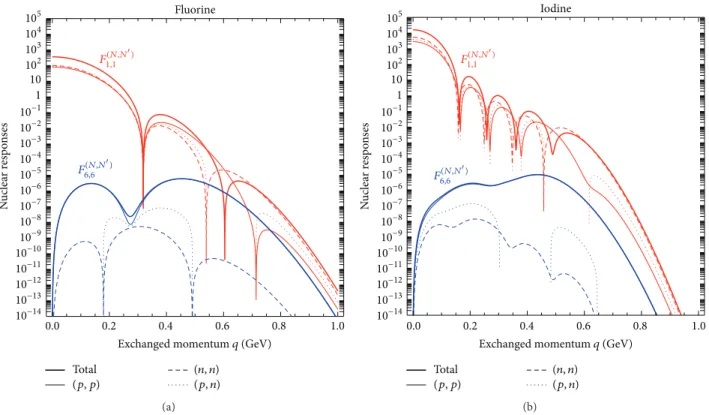
the nuclear responses for both light element (on the left panel) and heavy one (on the right panel), considering two completely different kinds of inter-actions, are depicted. On a more specific level, in thick red the total nuclear response for the standard SI interaction is shown. As we can see, in the energy range of interest in direct DM experiments (few keV),
it is enhanced by the canonical 𝐴2N factor: this is
due to the fact that, in this case, the incoming DM particles see the nucleus as a point-like object with
𝐴N scatter centers. On the other hand, we show in
blue the nuclear responses of a completely different type of interaction which is both momenta and spin
dependent (ONR
6 = ( ⃗𝑠𝜒⋅ ⃗𝑞)( ⃗𝑠𝑁⋅ ⃗𝑞)). This type of
inter-action can give rise if the DM-nucleus interinter-action is mediated by a pseudoscalar particle. We can see that the nuclear responses are dominated by the scattering with protons, simply because neither the fluorine nor the iodine has unpaired neutrons and moreover the interaction goes to zero in the small momenta transferred limit.
A complete set of these nuclear responses for each
pair of nucleons(𝑁, 𝑁), each pair of nonrelativistic
operators (𝑖, 𝑗), and for several target nuclei N has
been provided in the appendices of [17]. This is
extremely useful because, for the first time, different
types of interactions can be studied in a more general ground. However, since this kind of computations is quite new, the uncertainties, especially for the spin, momenta, and velocity dependent interactions, are still quite large.
Having a disposal the general relation of the DM-nucleus
matrix element (10), the differential cross section (8), and in
turn the rate of nuclear recoil (5) can be rewritten, following
[32], in a very general way. It reads
d𝑅N d𝐸𝑅 = 𝑋𝜉N 16 ∑ 𝑖,𝑗=1 ∑ 𝑁,𝑁=𝑝,𝑛 c𝑁𝑖 (𝜆, 𝑚𝜒) × c𝑁𝑗(𝜆, 𝑚𝜒) F(𝑁,𝑁 ) 𝑖,𝑗 (𝐸𝑅, N) , (11) where we defined 𝑋 ≡ 𝜌⊙ 𝑚𝜒 1 32𝜋 1 𝑚2 𝜒𝑚2𝑁 , (12) F(𝑁,𝑁𝑖,𝑗 )(𝐸𝑅, N) ≡ ∫Vesc Vmin(𝐸𝑅)d 3V1 V𝑓𝐺( ⃗V + ⃗V𝐸(𝑡)) 𝐹(𝑁,𝑁 ) 𝑖,𝑗 (V, 𝐸𝑅, N) . (13)
2.2.1. “Standard” SI Contact Interaction. To give a concrete
example, in the following the coefficient and the nuclear responses for the “standard” SI contact interaction are showed explicitly. In particular, when experiments present results in terms of this interaction, they implicitly assume (probably inspired by supersymmetric neutralino scattering) the fol-lowing DM-nucleon effective Lagrangian:
L𝑁SI = 𝜆𝑁SI𝜒𝜒𝑁𝑁. (14)
From this the DM-nucleon matrix element can be obtained
by contracting (14) with initial and final states of the
scatter-ing. Performing then the nonrelativistic limit one gets
M𝑁SI ≡ ⟨𝜒𝑁 L𝑁SI 𝜒𝑁⟩ ≃ 4𝜆𝑁SI𝑚𝜒𝑚𝑁O
NR
1 , (15)
whereONR1 = l is the operator that describes the
nonrela-tivistic limit of (14) and the coefficient is obviously given by
c𝑁1(𝜆𝑁SI, 𝑚𝜒) = 4𝜆𝑁SI𝑚𝜒𝑚𝑁.
For the SI scattering, DM-proton and DM-neutron
cou-plings are customarily assumed to be equal and thus𝜆𝑝SI =
𝜆𝑛
SI≡ 𝜆SI(isospin violating process is not taken into account).
Plugging back then the coefficient in the general equation (11)
and defining𝜎SI = 𝜆2SI/𝜋⋅𝜇2𝑁(𝜇𝑁is the DM-nucleon reduced
mass) to make contact with the usual physical cross sections, the differential rate of nuclear recoil reduces to the very well-know compact form:
d𝑅N d𝐸𝑅 = 𝜉N 𝑚N 𝜌⊙ 𝑚𝜒[ 𝑚N 2𝜇2 𝑁𝜎SI𝐹 tot N (𝐸𝑅) I (𝐸𝑅)] , (16)
Fluorine 0.0 0.2 0.4 0.6 0.8 1.0 105 104 103 102 10 1 10−1 10−2 10−3 10−4 10−5 10−6 10−7 10−8 10−9 10−10 10−11 10−12 10−13 10−14 N u cl ea r r esp o n se s
Exchanged momentumq (GeV) Total (p, p) (n, n)(p, n) F1,1(N,N) F6,6(N,N) (a) 0.0 0.2 0.4 0.6 0.8 1.0 Iodine 105 104 103 102 10 1 10−1 10−2 10−3 10−4 10−5 10−6 10−7 10−8 10−9 10−10 10−11 10−12 10−13 10−14 N u cl ea r r esp o n se s
Exchanged momentumq (GeV) Total
(p, p) (n, n)(p, n)
F1,1(N,N)
F6,6(N,N)
(b)
Figure 1: Nuclear responses of the fluorine (a) and the iodine (b) targets considering two completely different types of interactions. On a more specific level, we show, in red, the nuclear responses for the “standard” SI contact interaction, while in blue those for another kind of interaction described in the nonrelativistic limit by the operatorONR
6 = ( ⃗𝑠𝜒⋅ ⃗𝑞)( ⃗𝑠𝑁⋅ ⃗𝑞). The different hatching refers instead to the possible
choices of nucleon pairs in the nucleus. In particular, the solid, dashed, and dotted lines are for(𝑝, 𝑝), (𝑛, 𝑛), and (𝑝, 𝑛) pairs, while the thick ones are obtained by summing over all of them (total nuclear responses). Notice that the total nuclear responses for the “standard” SI contact interaction (thick red lines) reduce to𝐴2N𝐹Helm2 (𝑞), where 𝐹Helm2 (𝑞) is the customary Helm form factor [33].
where we define the total SI nuclear response as
𝐹tot
N (𝐸𝑅) = ∑
𝑁,𝑁=𝑝,𝑛
𝐹(𝑁,𝑁)
1,1 (𝐸𝑅, N) . (17)
Here, since𝜆𝑝SI = 𝜆𝑛SI, the total nuclear response reduces to
the square of the customary Helm form factor [33] multiplied
by the coherent enhancement of the cross section𝐴2N. In
particular it reads𝐹Ntot(𝐸𝑅) = 𝐴2N𝐹Helm2 (𝐸𝑅). The function
I(𝐸𝑅) = ∫Vesc
Vmind
3V𝑓
𝐺( ⃗V + ⃗V𝐸(𝑡))/V is instead the velocity
integral encountered many times in the literature. It is worth
noticing thatI(𝐸𝑅) can be written in this way because in the
“standard” SI interaction the operator that the describes the nonrelativistic limit of the effective Lagrangian does not carry
any dependences on the relative velocity ⃗V. In Section 3.2
the interpretation of the experimental results in terms of the “standard” SI interaction is briefly reviewed.
2.3. Experimental Observables. Since, as already stated, the
Earth’s orbital velocity projected in the galactic plane is relatively small compared to the drift velocity of the Sun, we
can then expand the recoil rate (11), assuming that the velocity
distribution is not strongly anisotropic. Then, by means then
of (7), one gets d𝑅N d𝐸𝑅 (𝑡) ≃ d𝑅N d𝐸𝑅V𝐸=V⊙ +𝜕V𝜕 𝐸 d𝑅N d𝐸𝑅V𝐸=V⊙ΔV cos [ 2𝜋 (𝑡 − 𝜙) 𝜏 ] . (18)
In order now to properly reproduce the experimental rate of nuclear recoil and in turn the expected number of events in a certain energy bin, one should take into account the response of the detectors as well. It can be done by the following energy convolution and transformation:
d𝑅 d𝐸 = ∑ N 𝜖 (𝐸) ∫∞ 0 d𝐸𝑅KN(𝑞N𝐸𝑅, 𝐸 )d𝑅N d𝐸𝑅 (𝐸𝑅) , (19)
where 𝐸 is the detected energy and the functions
KN(𝑞N𝐸𝑅, 𝐸) and 𝜖(𝐸) are the energy resolution centered
in 𝑞N𝐸𝑅 and the detector’s efficiency, respectively. Here
the sum runs over the different species of the detectors
(e.g., DAMA is a multiple target experiment composed
quenching factor that takes account of the partial recollection of the released energy in the detector. After convolving with
all the experimental effects, (19) must be averaged over the
energy bins of the detector. For each energy bin𝑘, we then
obtain the number of the unmodulated events𝑁0 𝑘th and of
the modulated ones𝑁𝑚 𝑘th as
𝑁th 0 𝑘= 𝑤𝑘∫ Δ𝐸𝑘 d𝐸 d𝑅 d𝐸 V𝐸=V⊙ , (20) 𝑁th 𝑚 𝑘= 𝑤𝑘ΔV ∫ Δ𝐸𝑘 d𝐸𝜕V𝜕 𝐸 d𝑅 d𝐸 V𝐸=V⊙ , (21)
where𝑤𝑘is the exposure (expressed kilograms per day) and
Δ𝐸𝑘is the width of the𝑘th-esime energy bin. 𝑁0 𝑘th and𝑁𝑚 𝑘th
are the relevant quantities that one can use for the analysis of the experiments which address the annual modulation effect,
namely, DAMA and CoGeNT. For the other experiments,
only𝑁0 𝑘th is instead relevant.
Collecting all the elements in the previous equations we
expand (20) and (21) and write
𝑁th 0 𝑘= 𝑋 16 ∑ 𝑖,𝑗=1 ∑ 𝑁,𝑁=𝑝,𝑛 c𝑁𝑖 (𝜆, 𝑚𝜒) c𝑁𝑗(𝜆, 𝑚𝜒) × ̃F(𝑁,𝑁𝑖,𝑗 )(𝑚𝜒, 𝑘) V𝐸=V⊙, 𝑁th 𝑚 𝑘= 𝑋ΔV 16 ∑ 𝑖,𝑗=1 ∑ 𝑁,𝑁=𝑝,𝑛 c𝑁𝑖 (𝜆, 𝑚𝜒) c𝑁𝑗(𝜆, 𝑚𝜒)𝜕V𝜕 𝐸 × ̃F(𝑁,𝑁𝑖,𝑗 )(𝑚𝜒, 𝑘) V𝐸=V⊙. (22)
Here ̃F(𝑁,𝑁𝑖,𝑗 )(𝑚𝜒, 𝑘) is a sort of integrated form factor that
encapsulates all the information related to nuclear physics, astrophysics, and the detector dependency of the rate. There is
one of these factors for each energy bin𝑘 of each experiment
under consideration and for each choice of the operators pair
(𝑖, 𝑗) and nucleons pair (𝑁, 𝑁). It reads explicitly
̃ F(𝑁,𝑁𝑖,𝑗 )(𝑚𝜒, 𝑘) = 𝑤𝑘∑ N 𝜉N∫ Δ𝐸𝑘 d𝐸𝜖 (𝐸) × ∫∞ 0 d𝐸𝑅K𝑇(𝑞N𝐸𝑅, 𝐸 ) × F(𝑁,𝑁𝑖,𝑗 )(𝐸𝑅, N) . (23)
It is worth noticing that the linearity of the expected number of events in the integrated form factors is a funda-mental ingredient. This, indeed, lets us parametrize the model dependent part of the rate from the model independent
one, encapsulated in the function ̃F(𝑁,𝑁𝑖,𝑗 )(𝑚𝜒, 𝑘). Therefore,
if the experimental collaborations, instead of presenting the experimental results in terms of a specific DM model,
release all of this finite number of integrated form factors, one will be easily able to obtain the expected number of events for any kind of interactions, whose particle physics
is completely encapsulated in the coefficient c𝑁𝑖 . A first
example of the potentiality of such parametrization has been
presented in [32]. In particular the authors provide a
self-contained set of numerical tools based on the integrated form
factors above, to derive the bounds from some current direct
detection experiments on virtually any arbitrary model of DM elastically scattering on target nuclei.
3. Direct Detection Status
3.1. Experimental Landscape. The elusive nature of DM
parti-cles makes their detection a challenge for experimentalist: in fact, considering typical atomic masses for the target nuclei
of𝑚N = 100 GeV and typical properties for the DM halo
(Maxwell-Boltzmann distribution with dispersion velocity
V0 = 220 km/s), DM particles should induce tiny nuclear
recoil in the range1 ÷ 103keV with a total rate lower than
1 cpd/kg/keV (here cpd refers to counts per days). Due to this rare phenomenon, the experimental priorities in this field are as follows:
(i) the detectors must work deeply underground in order to avoid the high rate interaction induced by cosmic rays scattering off on target nuclei,
(ii) they must use active shields and very clean materials against the residual radioactivity in the tunnel (mostly 𝛼-particles, neutrons, and photons),
(iii) they must distinguish multiple scattering, simply because DM particles do not interact twice in the detector, being of course weakly interacting particles. A variety of different experimental techniques with the aim of measuring the tiny energy released by a DM interac-tion have been developed. In the following the main channels by which the scattered nucleus can deposit energy in the detectors are summarized as follows.
(i) Scintillation detection: a particle interacting within a scintillating target induces the emission of light produced by the deexcitation of exited atoms. This light can be detected by appropriate photomultipliers. Typically NaI(Tl) and xenon are used as scintillators. (ii) Ionization detection: a particle interacting inside a target produces an amount of free electron-ion pairs that can be detected with a collecting drift field and a device sensitive to the electric charge.
(iii) Phonon detection: a particle interacting inside a detector releases a tiny energy deposition with a subsequently increase of the temperature. Cryogenic apparatus working at very low temperature (around few mK) are able to measure this small variation making this detection technique possible.
Since various types of interacting particles release a different amount of energy in the channels commented upon above, for a better rejection of the background events, most
of the experiments are designed to be sensitive to more than one of them. Indeed, thanks to this ability, the ratio between two channels can be used to distinguish between nuclear (due to a DM interaction) and electromagnetic recoils.
The only two experiments that do not use this kind
of experimental technique are DAMA and CoGeNT that,
perhaps not coincidentally, were the only two detectors
(until the CRESST-II and recently the CDMS-Si results)
observing an excess in their counting rate. In particular, since both the experiments are not able to disentangle the nuclear recoil signals from the electromagnetic ones, they infer the presence of DM in our halo by exploiting the model independent annual modulation signature in the counting rate. As follows, I review the most important experiments in this field.
3.1.1. DAMA. The DAMA experiment, located at the
National Laboratory of Gran Sasso, is an observatory for rare processes made of highly radiopure scintillators (NaI(Tl)
crystals). In particular the former DAMA/NaI and the
current DAMA/Libra experiments have the main aim of
investigating the presence of DM particles in the galactic halo by exploiting the model independent annual modulation induced by a DM interaction.
The DAMA detector is only able to measure the fraction
of energy deposited in scintillation light, while the phonon excitation due to multiple nuclear interactions is not detected.
This effect, as commented upon inSection 2.3, is taken into
account by the so-called quenching factor. In particular, for
NaI(Tl) crystals, one normally considers𝑞Na ≃ 0.3 and 𝑞I ≃
0.09 [34]. It is, however, known [34–36] that some scattered
nuclei can travel long distances along the crystallographic axes and planes without colliding with other nuclei. This process is called channeling effect, and since no phonon excitation is produced, the scattered nuclei deposit all the
energy in the detector electromagnetically (𝑞N ≃ 1). The
fraction of channeling depends on the nucleus itself, on the recoil energy and strongly on the temperature. It has been
calculated, for instance, in [35] and, in particular, it has been
found that, for low energy recoiling Na and I ions, the fraction of channeled events can be relatively large. Nevertheless, this
result has not been confirmed by other theoretical [37–39]
and experimental studies [40], which instead suggest that the
channeling effect in NaI crystals is negligible.
The DAMA collaboration published results of the
combined DAMA/NaI and DAMA/Libra experiments [41,
42], corresponding to an exposure of 1.17 ton⋅yr for a target.
They observed a cosine-like modulation, present only in the
single-hit events, with a measured period𝜏 = (0.999 ± 0.002)
yr and a phase𝑡 = (146 ± 7) days well compatible with the
roughly 152.30 days expected for DM signals (see the previous section). The modulation is present only in the low energy window (2–6) keVee (here, keVee refers to electron equivalent recoil energy. This must be converted with the quenching factor in order to get the total energy released to the nucleus
by the scattering process (𝐸𝑅[keV] ≡ 𝐸𝑅[keVee]/𝑞N)) and its
amplitude𝑁𝑚 (2–6)exp is equal to (0.0116 ± 0.0013) cpd/(kg⋅keV)
at 8.9𝜎 CL [42].
3.1.2. CoGeNT. The CoGeNT experiment employs p-type
point-contact Germanium detectors operating in the Soudan Underground Laboratory.
Like DAMA, the experiment performs just one of the
techniques commented upon above; namely, the p-type point-contact germanium detectors only measure the frac-tion of energy deposited by incident particles in the form of ionization. The lack of energy measured is again taken into account by the quenching factor that can be extracted
through the following empirical relation𝐸det= 0.2𝐸1.12𝑅 [43].
By virtue of its low energy threshold (0.4 keVee) and the ability to reject surface backgrounds, this type of detector is particularly sensitive to light DM candidates, although large background contamination may be present for these low energies.
In 2010 the collaboration has reported a step rise of nuclear recoil spectrum at low energy which is not directly
explainable in terms of known radioactive background [44].
The energy region probed by CoGeNT partially overlaps
with the one in which the DAMA apparatus reported the
annual modulation signal, and therefore it is natural to inter-pret the excess at low energy due to a DM interaction. In view
of that, fifteen months of cumulative CoGeNT data (442 live
days) have been also examined in order to look for an annual
modulation signature [45]. In particular the CoGeNT data
seem to favor a cosine-like modulation slightly shifted in
phase with respect to the one measured by DAMA. The
modulation is again only present at low energy with a statis-tical significance of 2.8𝜎 CL, limited by the short exposure.
Very recently, the collaboration presented a 3.4-year data taking, with an improved analysis that allows a better discrimination between pure bulk and pure surface events
[46, 47]. In the same energy region, where in 2010 they
observed a step rise of the nuclear recoil spectrum, they still reported a preference for an annual modulation in the pure bulk counting rate. Although the statistical significance of the modulation is modest (2.2𝜎 CL), the phase is compatible with
the one observed by DAMA.
3.1.3. CRESST-II. The CRESST-II cryogenic dark matter
experiment, located at the national laboratory of Gran Sasso,
employs 300 g of scintillating CaWO4crystals.
In particular the eight moduli of the experiments measure the deposited energy in the form of phonons and scintillation light. The former provides a precise measure of the energy deposited, while the ratio between them gives an excellent rejection of the background events.
In 2011 the collaboration completed a 730 kg⋅day data
taking [48]. In particular, 67 events were found in the DM
acceptance region with an expected background contribu-tions in the same band which is not sufficient to explain all the observed events. The resulting statistical significance, at which the background-only hypothesis is rejected, is roughly 4.5𝜎 CL.
3.1.4. CDMS. The CDMS experiment, located at the
Soudan Underground Laboratory, is composed by germa-nium and silicon cryogenic detectors.
In particular 19 germanium and 11 silicon detectors measure the deposited energy in the form of phonons and ionization through superconducting technology. Thanks to the ability of detecting these two signals, the rejection of the electromagnetic recoils can be obtained by the ratio among them.
In 2009 the CDMS collaboration [49] has reported
no significant evidence for DM interaction. In particular, only germanium detectors were used with an exposure of 612 kg⋅days. The collaboration observed two events in the signal region with energy 12.3 keVnr and 15.5 keVnr (here, keVnr refers to nuclear recoil energy. Unlike the electron equivalent recoil energy, it already represents the total energy
released to the nucleus by the scattering process (𝐸𝑅[keV] ≡
𝐸𝑅[keVnr])), against an expected background of radiogenic
neutrons, cosmogenic neutrons, and misidentified surface events equal to roughly 0.9 events.
More recently, the collaboration has also presented results
based on the silicon analysis [50,51]. In [51], a blind analysis
of 140.2 kg⋅days revealed three DM candidate events in the signal region with an expected background of roughly 0.62 events. A profile likelihood ratio statistical test of the three events yields a 0.19% probability when the known-background-only hypothesis is tested, against the alternative DM + background hypothesis.
3.1.5. Xenon Experiments. Direct detection experiments
based on liquid/gaseous xenon have done stunning pro-gresses in the last decade. Indeed, thanks to the advantage in scale ability and to the good reconstruction of the three-dimensional coordinates, these experiments are among the largest in terms of fiducial mass.
Discrimination between nuclear and electromagnetic recoils is achieved by the ratio between the scintillation signal due to a particle interaction in the liquid xenon and the subsequent ionization signal in the gas phase of the detector. Furthermore, the large mass number of the xenon nuclei makes them an excellent target for the detection of DM particles with SI interaction. However, the experiments based
on liquid xenon are also sensitive to the𝑛-DM spin dependent
interaction, by virtue of the unpaired neutron of the 129Xe
and 131Xe isotopes.
In the following the results of the main experiments using the double-phase xenon technology are summarized.
(i) XENON experiment: the XENON detector is a
two-phase time projection chamber located at the national laboratory of Gran Sasso. The first stage of the experi-ment was installed underground during March 2006, and it searched for DM interactions until October 2007. In 2008 the collaboration reported a blind
analysis with an exposure of5.4 × 58.6 kg⋅days, which
yields no significance evidence for DM interactions
[52].
More recently the XENON10 experiment has been
superseded by XENON100 with more than one
order of magnitude improvement in sensitivity. In
[53], the collaboration reported the results of the last
run, a blind analysis with an exposure of 34 ×
224.6 kg⋅days which again yielded no evidence for DM interactions. In particular, the two observed events in the predefined nuclear recoil energy range of 6.6–43.3 keVnr were consistent with the background expectation of roughly 1 event.
(iii) LUX experiment: the LUX experiment is a
dual-phase xenon time-projection chamber operated at the Sanford Underground Research Facility in South
Dakota. Like the XENON100 experiment, it
mea-sures both the scintillation light and the ionization in the gas phase to disentangle the nuclear recoils from
the electromagnetic ones. In [54], a nonblind analysis
was performed on data, collected with an exposure of 118.3 × 85.3 kg⋅days. After cuts, 160 events were found within the signal energy region. The collaboration found that all of these events are compatible with the expected electron recoil background.
3.1.6. COUPP. The COUPP experiment operating at
SNO-LAB in Ontario is a 4 kg CF3I bubble chamber. By virtue of
its unpaired proton, the fluorine nucleus gives an excellent
sensitivity for𝑝-DM spin-dependent interactions, while the
iodine enhances the sensitivity for the SI ones.
Particles entering the liquid in the superheated phase create an ionization tracks, around which the liquid vapor-izes, forming microscopic bubbles. Bubbles grow in size as the chamber expands, making the detector able to record them both photographically and by pressure and acoustic measurements. The discrimination between nuclear and elec-tromagnetic recoils can be achieved by choosing an appro-priate chamber pressure and temperature. Indeed, under this condition, the abundant gamma-ray and beta-decay backgrounds do not nucleate bubbles.
In [55], data obtained for an effective exposure to single
recoil events of 437.4 kg⋅days (taking into account the 79.1% detection efficiency) were presented. Twenty single nuclear recoil events passing all the analysis cuts were observed over the three energy bins. Due to uncertainties in the neutron background estimation, the collaboration has not attempted any background subtraction and instead has treated all of them as DM events.
3.2. Interpretation in Terms of the “Standard” SI Interaction.
There are many studies in literature that try to analyze the
implications of the results of DAMA and the anomalies
in CoGeNT and CRESST-II and recently in CDMS-Si
together with the null results from other experiments in terms of specific DM models and interactions. A routine way to compare results from different DM experiments is by assuming a particular DM velocity distribution and a certain type of DM-nucleus interaction. The custom-ary choices that can often be found in literature are (i) a truncated Maxwell-Boltzmann velocity distribution with
isotropic velocity dispersion V0 = 220 km/s and (ii) DM
particles coupling through a contact SI interaction with equal strength to the protons and neutrons. In this case one
defined inSection 2.2.1together with the DM mass𝑚𝜒as free parameters, since the bounds and the allowed regions from different experiments can be compared on the same plot.
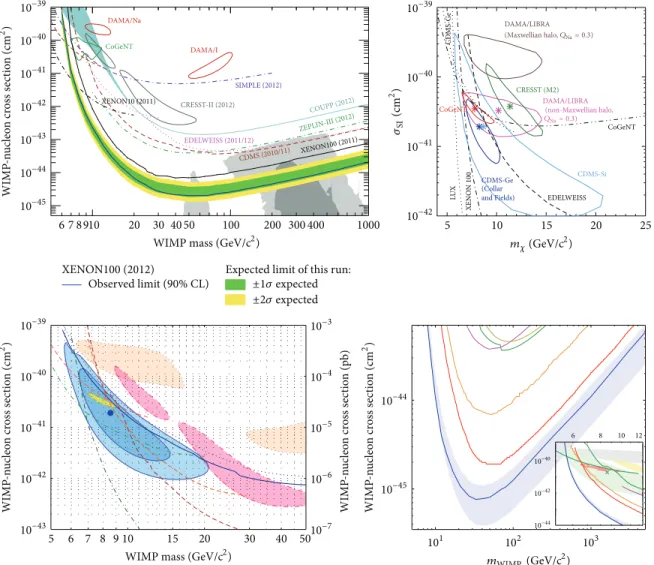
InFigure 2a compilation of the allowed regions of the positive results experiments and the constraints coming from null results taken from different experimental collaborations are shown. Without entering in the details of the different analysis, we summarize the interpretation of the datasets of the positive results experiments listed above in terms of the “standard” SI contact interaction as follows.
(i) The DAMA modulation signal effect has been
shown to be compatible with two areas in the (𝑚𝜒, 𝜎SI)
parameter space, due to the different kinematics experienced by the two targets in the scintillator. In particular, a region pointing towards DM masses in
the 10 GeV ballpark and towards a cross section𝜎SI≃
2 × 10−40cm2can be associated with a DM particle
scattering off with sodium (see, e.g., the red
con-tour in the top left-handed plot ofFigure 2denoted
by DAMA/Na). Another region around DM masses
of roughly 60 GeV is instead due to the scattering with the iodine. In this case the cross section is enhanced by a larger coherent factor and indeed the
favored value is𝜎SI ≃ 10−41cm2(red contour denoted
by DAMA/I).
(ii) The modulation in CoGeNT is mostly concentrated
in the first two energy bins, close to the lower thresh-old of the detector. If this anomaly is interpreted in terms of SI contact interaction, it will be fitted by light DM candidates (around 9 GeV) with a total SI cross
section𝜎SI≃ 3 × 10−41cm2(see, e.g., the red contour
in the top right-handed plot ofFigure 2).
(iii) Like DAMA, the CRESST-II experiment is a
mul-tiple target detector and therefore more than one allowed region is in general expected. In particular, as
one can see inFigure 2, the region pointing towards
light DM masses (around 12 GeV) and 𝜎SI ≃ 5 ×
10−41cm2 is due to the scattering with oxygen and
calcium. On the other hand, the one pointing towards heavier DM mass (around 30 GeV) and cross section
𝜎SI ≃ 10−42cm2can be associated with a DM particle
scattering off with tungstenum. These regions are, for instance, denoted as gray contours in the top
left-handed plot ofFigure 2.
(iv) Very recently, also the 11 silicon detectors of
the CDMS experiment reported an excess in their
counting rate. Again, if the anomaly is interpreted in terms of SI contact interaction, it will be fitted by light DM particles (around 9 GeV) with a SI total
cross section𝜎SI ≃ 2 × 10−41cm2(blue regions in the
bottom left-handed plot ofFigure 2).
The interesting feature is that all the experiments employ-ing light target nuclei seem to be compatible with a DM inter-pretation, which, for the “standard” SI contact interaction, pin-points the properties of the DM particle quite precisely; namely, it leads to DM masses in the 10 GeV ballpark and total
cross section in the range (2 × 10−41cm2–2 × 10−40cm2).
On the other hand, the constraints coming from null
results are very stringent, and in particular the XENON100
and recently the LUX results severely exclude the allowed
parameter space of the positive results experiments. On a
more specific level, before LUX, the XENON100
experi-ment provided the most stringent constraints for a DM mass
above roughly 8 GeV, with a minimum of𝜎SI≃ 1.8×10−44cm2
(see, e.g., the thick blue line in the top left-handed plot of Figure 2). Nowadays this bound has been beat out by the one
of LUX by a factor ∼2.5 (see the blue line in the bottom
right-handed plot ofFigure 2). Other relevant analyses can
be found in [56–68].
3.3. Uncertainties. Nevertheless, since the actual range
of masses and cross section critically depends on several assumptions, one always bears in mind all the uncertainties that enter in this field when interpreting the data in terms of a specific DM interaction.
(i) A first class of uncertainties comes from the poor knowledge of the properties of the DM halo. The often used Maxwell-Boltzmann halo with isotropic velocity dispersion is only a benchmark choice, not the physical description of it. Other possible choices (spherical halo with nonisotropic velocity dispersion, axisymmetric halo, triaxial halo, and the possibility to have corotating halo with different number densities) must be taken into account, in order to have a much better idea of how the velocity distribution affects the final results. In particular, it has been recently demonstrated that the uncertainties on the astrophysical part of the rate can be removed by
comparing different experimental results in theVmin
space (see, e.g., [69–77]). In this way one can, for
instance, relax a bit the tension between the positive
results and the constraints showed in Figure 2 up.
However, this is not still sufficient to reconcile the complicated puzzle the experimental data have left to
us (see, e.g., [77–80]).
(ii) A second class of uncertainties comes from the exper-imental side. For instance, the direct measurements of quenching factor are performed with reference detec-tors, and thus the systematic uncertainties, important for all the detectors in direct DM searches, could be larger than what we normally assumed. These must be carefully investigated, because they produce a significant shift of the allowed regions in the total cross section/DM mass plane.
(iii) Together with these main uncertainties, the third and perhaps the most important class of them comes from the nature of the DM interaction and in turn from the nuclear responses of the target nuclei. Most of the models tested in recent years are based on the assumption that the mechanism of interaction is realized through a contact interaction. Deviations from this standard phenomenological approach are interesting to study, since, from more general con-ditions, the DM parameter space can be analyzed.
10−3 10−4 10−5 10−6 10−7 6 5 7 8 9 10 15 20 30 40 50 10−39 10−40 10−41 10−42 10−43
WIMP mass (GeV/c2)
WIMP -n uc leo n cr oss s ec tio n (cm 2 ) WIMP -n uc leo n cr oss s ec tio n (pb) 10−44 10−44 10−45 WIMP -n uc leo n cr oss s ec tio n (cm 2) 10−40 10−42 101 102 103 mWIMP(GeV/c2) 12 6 8 10 67 8910 20 30 4050 100 200 300 400 1000 5 10 15 20 25 DAMA/I DAMA/Na CoGeNT CDMS (2010/11) EDELWEISS (2011/12) XENON10 (2011) XENON100 (2011) COUPP (2012) SIMPLE (2012) ZEPLIN-III (2012) CRESST-II (2012) XENON100 (2012) Observed limit (90% CL)
Expected limit of this run:
10−39 10−40 10−41 10−42 10−39 10−40 10−41 10−42 10−43 10−44 10−45
WIMP mass (GeV/c2)
WIMP -n uc leo n cr oss s ec tio n (cm 2 ) ±1𝜎 expected ±2𝜎 expected 𝜎SI (cm 2) DAMA/LIBRA DAMA/LIBRA (Maxwellian halo,QNa= 0.3) CRESST (M2) (non-Maxwellian halo, CoGeNT CDMS-Si EDELWEISS CD MS-G e LU X XEN O N 100 CDMS-Ge (Collar and Fields) QNa= 0.3) m𝜒(GeV/c2) CoGeNT
Figure 2: A compilation of the allowed regions and the constraints for the “standard” SI contact interaction in the (𝑚𝜒, 𝜎SI) plane. The plots on
the top row are taken from [53] (left) and from [46] (right), while those in the bottom row are taken from [51] (left) and from [54] (right). The galactic halo has been assumed in the form of an isothermal sphere with velocity dispersionV0= 220 km/s and local DM energy density 𝜌⊙= 0.3 GeV/cm3.
In particular, there is a concrete possibility to remove the uncertainties coming from the nature of inter-action thanks to the formalism of nonrelativistic
operator reviewed inSection 2.2. On a more specific
level, if the experimental collaborations, in addition to presenting the results in terms of a specific DM-nucleus interaction, also provide all the model inde-pendent integrated form factors, it will be extremely useful for the community. Indeed, in this way one can easily compute the expected number of events for any kind of interactions (e.g., including isospin violating interactions, momentum-dependent form factors, and velocity dependent form factors) and compare it directly with the experimental results. Therefore the data must be treated very prudently with a maximally conservative attitude, simply because slightly modification of the assumptions summarized above can affect the theoretical interpretation of the experimental results in
a relevant way. In the next section, I will focus on the uncertainties coming from the nature of interaction and in particular I am going to show how the allowed regions and constraints are modified, if an exchanged momentum dependent DM-nucleus interaction is taken into account.
4. Long Range Interaction
So far, the LHC has not reported any evidences of physics
beyond the standard model. An optimistic point of view is that the new physics threshold is truly around the corner. A pessimistic and maybe more realistic point of view is
that the LHC results are instead telling us that the TeV
scale is not a fundamental energy scale for new physics and therefore all the new theories beyond the standard model are, let us say, unnatural. Within this picture there is not any particular reason to expect new particles in the TeV mass range weakly interacting with ordinary matter. Therefore it
should be time to ask ourselves whether there are other indications of the relevant energy scale. DM may play a
central role in this picture. Indeed, the closeness betweenΩ𝜒
andΩ𝑏, usually referred to as a cosmic coincidence problem,
might suggest a profound similarity between the dark and the
ordinary sectors. Indeed, both𝜌𝜒 and𝜌𝑏 scale as1/𝑎3with
the expansion of the Universe, and their ratio is independent of time. Why these two fractions are then comparable, if the ordinary and the dark sectors have a drastically different nature and different origin? A hidden parallel sector (mirror world (the idea of a mirror world was suggested before
the advent of the standard model (see, e.g., [81, 82]). The
idea that the mirror particles might constitute the DM of
the Universe was instead discussed in [83, 84])) may shed
light on this cosmic coincident problem [85]. Indeed, it is
tantalizing to imagine that the dark world could be similarly complex (CP violating and asymmetric), full of forces (e.g., dark electromagnetism), and matter (dominant constituent with a mass around few GeV) that are invisible to us. For a
review of mirror dark world; see, for example, [86,87].
To be more concrete the phenomenology of a complex dark sector, in which the matter fields are charged under
an extra 𝑈(1) gauge group, is particularly interesting. In
this case, the physics of the dark sector in itself can be as complicated as the one of our sector, providing at the same time also a feeble interaction between the two worlds. Indeed, thanks to the following renormalizable Lagrangian:
L = 𝜖𝜙
2𝐹𝜇]𝐹𝜇] , (24)
the new 𝑈(1) gauge boson 𝜙 may possess a small kinetic
mixing 𝜖𝜙 with the ordinary photon. Here 𝐹𝜇] and 𝐹𝜇]
are the field strength tensors of the ordinary and “dark” electromagnetism, respectively. One effect of this mixing is to cause DM particles to couple with ordinary particles with
effective millicharge𝜖𝜙𝑒 [88–90], and therefore a
Rutherford-like interaction gives rise if the mass of the new𝑈(1) gauge
boson is smaller than the typical exchanged momentum in the interaction.
4.1. Derivation of the Main Equations. Apart from the
the-oretical motivations which are interesting and quite strong, what describes in the nonrelativistic limit the scattering between millicharged DM particles and the protons (notice that the interaction here maximally violates the isospin; e.g., the DM-neutron coupling is zero) is the following Yukawa potential:
𝑉 (𝑟) = 4𝜋𝜖𝜙 𝑒𝑒𝑟𝜒𝑒−𝑚𝜙𝑟, (25)
where𝜖𝜙𝑒 is the effective millicharge of the protons inside the
nucleus felt by a DM particle with “dark” charge𝑒𝜒. Here𝑚𝜙
is the mass of the dark photon that acts like an electronic cloud which screens the charges of the particles involved in the scattering. The DM-proton matrix element can be then
obtained by performing the Fourier transform of (25) which
writes M𝑝= 4 𝑚𝑝𝑚𝜒∫∞ 0 d𝑟 2𝜋𝑟 2∫+1 −1 d cos𝜃𝑒 −𝑖 𝑞 𝑟 cos 𝜃𝑉 (𝑟) = c𝑝𝑌(𝑞2) ONR 1 , (26)
where𝑞 = (2𝑚N𝐸𝑅)1/2 is the exchanged momentum,𝜃 is
the scatter angle in the centre-of-mass frame, andc𝑝𝑌(𝑞2) =
4𝜖𝜙𝑒𝑒𝜒𝑚𝑝𝑚𝜒/(𝑞2 + 𝑚2
𝜙). Since ONR1 = l, the interaction, as
already mentioned in Section 2.2, is SI like the usual case
but with a coefficient which is instead dependent on the exchanged momentum in the scattering. Summing now over
the total number of protons in the nucleus𝑍Nand, if the dark
sector is made of stable composite particles, over the total
number of charge elementary constituents𝑍𝜒, the square of
the DM-nucleus matrix element reads
MN2= 16𝑚2N𝑚2𝜒( 𝜖𝜙𝑍N𝑒𝑍𝜒𝑒𝜒 𝑞2+ 𝑚2 𝜙 ) 2 𝐹Helm2 (𝑞2) , (27)
where𝐹Helm2 (𝑞2) is the usual Helm form factor. Notice that in
general this equation should be also multiplied for the form factor of the composite DM particle. For our computation we assume it to be equal to one. Plugging back the DM-nucleus
matrix element in (8) the differential cross section will be
d𝜎N d𝐸𝑅 = 8𝜋𝑚N V2 𝜖2𝜙𝛼2𝑘2𝜒(𝑞2+ 𝑚1 2 𝜙 ) 2 𝑍2N𝐹Helm2 (𝑞2) , (28)
where 𝛼 = 𝑒2/4𝜋 is the electromagnetic fine structure
constant and 𝑘𝜒 = 𝑍𝜒𝑒𝜒/𝑒 is a factor that measures the
strength of the DM-dark photon coupling.
In order to have a rough comparison with the “standard” picture (SI contact interaction), the differential rate of nuclear recoil can be cast in the following form:
d𝑅N d𝐸𝑅 = 𝜉N 𝑚N 𝜌⊙ 𝑚𝜒 [ 𝑚N 2𝜇2 𝑁𝐴 2 N𝜎𝑝𝜙𝛾I (𝐸𝑅) 𝐹Helm2 (𝐸𝑅)] × G (𝐸𝑅) , (29) where 𝜎𝜙𝛾𝑝 =16𝜋𝛼 2𝜖2 𝜙𝑘2𝜒 𝑚4 𝑁 𝜇2𝑁 ≃ ( 𝜖𝜙 10−5) 2 (𝑘𝜒 1) 2 ( 𝜇𝑁 1 GeV) 2 10−40cm2 (30)
is a normalized total cross section that encapsulates all the dependences on the dark sector vertex and the kinetic mixing parameter, and the function
G (𝐸𝑅) = 𝑍2N 𝐴2 N [ 𝑚𝑁2 𝑞2+ 𝑚2 𝜙 ] 2 = 𝑍2N 𝐴2 N [ 𝑚2𝑁 2𝑚N𝐸𝑅+ 𝑚2 𝜙 ] 2 (31)
measures the deviation of the allowed regions and constraints compared to the “standard” SI contact cross section. Here the
functionG(𝐸𝑅) is a sort of DM form factors which clearly
exhibits two limits.
(i) Point-like limit (𝑞 ≪ 𝑚𝜙): in this regimeG(𝐸𝑅) =
(𝑍N/𝐴N)2𝑚4𝑁/𝑚4𝜙 is independent of 𝐸𝑅and
there-fore the interaction is of a contact type. Indeed, the rate of nuclear recoil turns out to be proportional to
𝛼2𝜖2𝜙𝑘2𝜒/𝑚4𝜙, which plays the same role of the Fermi’s
constant in weak interaction. The factor(𝑍N/𝐴N)2
shows up the fact that millicharged DM particles only couple with protons. Therefore, it is expected that the allowed regions and bounds in the plane
(𝑚𝜒, 𝜎𝜙𝛾𝑝) will be rigid shifted of a factor∼4 up with
respect to the “standard” SI scenario, in which a DM particle symmetrically couples both with neutrons and protons.
(ii) Long range limit (𝑞 ≫ 𝑚𝜙): in this regimeG(𝐸𝑅) =
(𝑍N/𝐴N)2𝑚4𝑁/(4𝑚N2𝐸𝑅2) and therefore the
differen-tial cross section acquires an explicit dependence on the nuclear recoil energy, and a Rutherford-like cross
section gives rise (d𝜎N/d𝐸𝑅 ∝ 1/𝑞4). Experiments
with low energy thresholds and light target nuclei
(e.g., DAMA and CoGeNT) are therefore more
sensitive than the ones with high thresholds and
heavy targets (e.g., XENON100). The compatibility
among the experiments could therefore be improved.
Considering typical nuclei (𝑚N ∼ 100 GeV) and recoil
energies (few keV) in the range of interest of the current experiments, the transition between the two limits is obtained
for 𝑚𝜙 ∼ O(10) MeV. Since 𝑞2 ∝ 𝑚N, increasing 𝑚N
the transition occurs at lower𝑚𝜙. Notice that once the long
range regime is reached (𝑚𝜙≲ 10 MeV), the differential cross
section is independent of the mass of the mediator.
4.2. Results. In our analysis we consider as free parameters
the normalized total cross section𝜎𝜙𝛾𝑝 , the mass of the dark
photon 𝑚𝜙, and of course one of the DM particle 𝑚𝜒.
The velocity distribution has been assumed to be
Maxwell-Boltzmann-like with a velocity dispersionV0= 220 km/s. For
the local DM density we have chosen𝜌⊙ = 0.3 GeV/cm3.
For all the positive results experiments we use a different technique for analyzing the datasets with respect to the one often found in literature. Specifically, we adopt the same
approach of [91], in which the null hypothesis is tested. From
this kind of statistical test we can then extract the level at which the absence of signal on top of the background
in CRESST-II and the absence of modulation in DAMA
and CoGeNT is rejected.
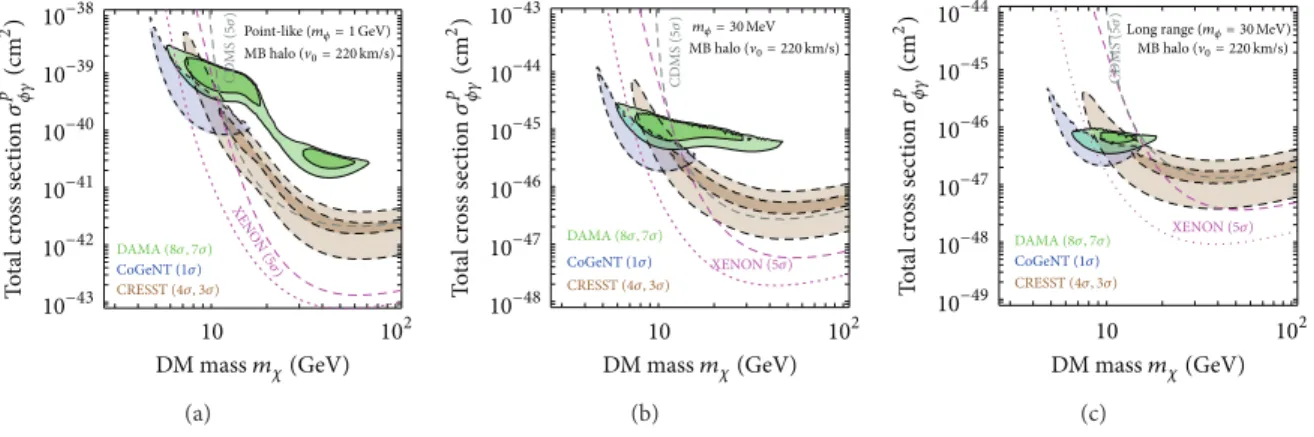
In Figure 3 the allowed regions of the positive results experiments and constraints coming from null results in the
plane (𝑚𝜒, 𝜎𝑝𝜙𝛾) are shown. For a better visualization of the
transition from the contact to the long range regime, we have fixed three values of the dark photon mass; namely,
𝑚𝜙 = 1 GeV (left plot corresponding to the contact limit),
𝑚𝜙 = 30 MeV (central plot), and 𝑚𝜙 = 0 (right plot
corresponding to the pure long range regime). In all plots the solid green contours individuate the regions compatible with
the DAMA annual modulation [41,42], without considering
the channeling effect. The short-dashed blue contour refers
to the region derived from the CoGeNT annual modulation
signal data published in [45] (in [46,47] the collaboration
reanalyzed the data finding that the background of surface events was underestimated. In view of that we expect that
the CoGeNT allowed regions in the (𝑚𝜒, 𝜎𝜙𝛾𝑝 ) plane will
shrink around its best value, like the one reported for the “standard” SI contact interaction (see, e.g., the red contour
in the top right-handed plot of Figure 2)). The dashed
brown contours individuate the allowed regions compatible
with the CRESST-II excess [48]. For each experiment the
contour lines cover at least one area in the (𝑚𝜒, 𝜎𝜙𝛾𝑝) plane.
Specifically, they refer to regions where the absence of annual modulation can be rejected at 7𝜎 CL (outer region) and 8𝜎
CL (inner region) for DAMA, and 1𝜎 CL for CoGeNT.
For CRESST-II the absence of an excess is instead excluded
at 3𝜎 CL (outer region) and 4𝜎 CL (inner region).
Very recently, also the 11 silicon detectors of the CDMS
experiment have reported an excess in their counting rate.
Since the results presented in Figure 3 are based on [24]
published in 2011, we do not include a full statistical analysis
of the CDMS-Si datasets. We attempt however an analytical
comparison between the results arising from the interaction studied here and the standard SI contact picture (blue regions
in the bottom left-handed plot ofFigure 2). More precisely,
defining⟨G⟩ ≡ G(⟨𝐸𝑅⟩), where ⟨𝐸𝑅⟩ ≃ 10 keV is the average
recoil energy of the three events observed [51], the
CDMS-Si allowed region in the (𝑚𝜒, 𝜎SI) plane can be projected
in the parameter space of Figure 3, through the relation
(𝑚𝜒, 𝜎𝜙𝛾𝑝 ) ≡ (𝑚𝜒, 𝜎SI/⟨G⟩). Recalling now that the best fit
value of the SI cross section is𝜎SIbest≃ 2×10−41cm2, we expect
that the CDMS-Si allowed region in the (𝑚𝜒, 𝜎𝑝𝜙𝛾) plane will
still point towards light DM candidate, but with a normalized
total cross section𝜎𝜙𝛾𝑝 = 𝐴2Si/𝑍2Si𝑚4𝜙/𝑚4𝑁𝜎SIbest ≃ 10−40cm2
in the point-like regime (𝑚𝜙 = 1 GeV), and
𝜎𝑝𝜙𝛾 = 𝐴2Si/𝑍Si24𝑚2Si⟨𝐸𝑅⟩2/𝑚4𝑁𝜎
best
SI ≃ 3 × 10−47cm2 in
the long range one (𝑚𝜙= 0).
Constraints, derived at 5𝜎 CL, are shown as dashed gray
lines for CDMS-Ge and magenta lines for XENON100. In
particular, in order to bracket as much as possible the uncer-tainties coming from the poor knowledge of the detection
efficiency close to the lower threshold; for the XENON100
bound, we adopt two approaches: (i) a case (dotted lines) in which the constraints are computed with the nominal value of the lower threshold of 4 PHE and of the effective luminosity
[92], which is a sort of quenching factors in liquid xenon and
(ii) another case (dashed lines) in which the constraints are computed by considering a higher threshold of 8 PHE: this is in order to determine a situation which is nearly independent of the poor knowledge of the effective luminosity (especially at very low nuclear recoil) and more important on the statistical distribution of the few PHE collected close to the