HAL Id: hal-01914562
https://hal.archives-ouvertes.fr/hal-01914562
Submitted on 19 Sep 2019
HAL is a multi-disciplinary open access
archive for the deposit and dissemination of
sci-entific research documents, whether they are
pub-lished or not. The documents may come from
teaching and research institutions in France or
abroad, or from public or private research centers.
L’archive ouverte pluridisciplinaire HAL, est
destinée au dépôt et à la diffusion de documents
scientifiques de niveau recherche, publiés ou non,
émanant des établissements d’enseignement et de
recherche français ou étrangers, des laboratoires
publics ou privés.
An estimate of average lower mantle conductivity by
wavelet analysis of geomagnetic jerks
Mioara Mandea Alexandrescu, Dominique Gibert, Jean-Louis Le Mouël,
Gauthier Hulot, Ginette Saracco
To cite this version:
Mioara Mandea Alexandrescu, Dominique Gibert, Jean-Louis Le Mouël, Gauthier Hulot, Ginette
Saracco. An estimate of average lower mantle conductivity by wavelet analysis of geomagnetic jerks.
Journal of Geophysical Research, American Geophysical Union, 1999, 104 (B8), pp.17735-17745.
�10.1029/1999JB900135�. �hal-01914562�
JOURNAL OF GEOPHYSICAL RESEARCH, VOL. 104, NO. B8, PAGES 17,735-17,745, AUGUST 10, 1999
An estimate of average lower mantle conductivity
by wavelet analysis of geomagnetic jerks
• Dominique
Gibert = Jean-Louis
Le Mou/•l,
Mioara Mandea Alexandrescu,
,
Gauthier Hulot, • and Ginette Saracco
=
Abstract. It has recently been proposed that geomagnetic jerks observed at the Earth's surface could be viewed as singularities in the time behavior of the
geomagnetic
field with a regularity of about 1.5 when wavelet analyzed. Such a
signal should have suffered
some distortion when diffusing
from the core-mantle
boundary
(CMB) through the conducting
mantle. Assuming
that the upper mantle
is an insulator and given the electromagnetic
time constant of the mantle, we
compute the distortion that a pure singularity introduced at the CMB suffers as it traverses the mantle. We compute this distortion through its effects on the
so-called ridge functions extracted from the wavelet transform of the signal. This
distortion is very similar to the small but significant one that we observe in real data. We therefore speculate that jerks must have been pure singularities at the
base of the mantle and infer an average estimate for the mantle electromagnetic
time constant from the way the signal is distorted by fitting the synthetic ridge
functions to the experimental ones. Assuming, for example, a thickness of 2000 km for a uniform lower conducting mantle, we find an electrical conductivity smaller
than 10 $ m -1. This value is in reasonable
agreement
with values
derived
from
high-pressure
experiments for a silicate mantle.
1. Introduction
Variations of the geomagnetic field are the sum of external variations (whose sources are located in the ionosphere or farther out in the magnetosphere) and the so-called secular variation of the main field of inter-
nal origin. The secular variation gives information on the motions in the fluid core [e.g., Hulot et al., 1992] and provides tests for the different models of field genera- tion which have been put forward. Also, and this is the subject of the present paper, the shortest-period com- ponents of the secular variation reaching the Earth's surface which are not completely screened by the man- tle make it possible to estimate some average value of its electrical conductivity.
Examination of geomagnetic data from worldwide ob- servatories has revealed sudden changes of the trend of the secular variation, which have been called "geomag- netic jerks" or "secular variation impulses" and have been discussed by a number of authors [Courtillot et al., 1978; Malin and Hodder, 1982; Malin et al., 1983;
l Institut de Physique du Globe de Paris, France.
2G•osciences Rennes- CNRS/INSU, Universit• de Rennes 1, France.
Copyright 1999 by the American Geophysical Union. Paper number 1999JB900135.
0148-0227/99/1999JB 900135509.00
Courtillot and Le Mougl, 1984; Kerridge and Barra- clough, 1985; Gavoret et al., 1986; Gubbins and Tomlin- son, 1986; Whaler, 1987; Golovkov et al., 1989; McLeod, 1992; Stewart and Whaler, 1992]. These former anal- yses have shown the global character and the internal origin of these events. In order to recover more accu- rate information about these events (time of occurrence, duration, distribution, and other characteristics), we re- cently applied a wavelet analysis to geomagnetic time series from •0 100 observatories [Alexandrescu et al., 1995, 1996]. We found that seven, and only seven, such events took place during the 1900-1990 period, two of
which (1969 and 1978) at least could be described
as
global
in character.
The events
reveal
a singular
behav-
ior with a regularity (see
equation
(27)) close
to 1.5. A
more recent geomagnetic jerk occuring in 1991 has been discussed by Macmillan [1996] and De Michelis et al.
[1998]
and also has a worldwide
character
[Le Huy et
al. , 1998].
The identification of these geomagnetic jerks origi- nating within the core, observed at the top of the man- tle, and having a short time constant produced a flurry of interest in the topic of lower mantle conductivity.
Ducruix et al. [1980], Achache
et al. [1980, 1981],
Backus
[1983], Courtillot et al. [1984], and McLeod
[1994]
took this observation
as a stimulus
to reconsider
mantle conductivity estimates by the theory of electro- magnetic diffusion through the mantle [Runcorn, 1955].
Ducruix et al. [1980] and Achache
et al. [1980, 1981]
17,736 MANDEA ALEXANDRESCU ET AL.' MANTLE ELECTRICAL CONDUCTIVITY
used the secular variation impulse to constrain deep mantle conductivity "from the bottom" and the 11-yr response to the external field to constrain conductivity "from the top." They proposed that the conductivity is
everywhere
smaller
than a few hundred
S m-1 Backus
[1983] developed and applied a mantle filter theory, con- cluding that an arbitrarily large value of the conductiv- ity is still allowed in the deepest layers of the mantle. Courtillot et al. [1984], using the formalism of Backus [1983] in relation to the 1969 geomagnetic jerk, con- cluded that, the electrical conductivity is probably lower than a few hundred S m- • in > 97% of the mantle vol- ume. Finally, McLeod [1994] derived a global geomag- netic response function consistent with a conductivity
of about,
3 S m -1 at,
the core-mantle
boundary
(CMB).
2. Diffusion Through the Conductive
Mantle
In this section our work is complementary to that. of previous investigators [Smylie, 1965' Backus, 1983' Benton and Whaler, 1983] who also examined the case of the diffusion of a rapid impulsive change produced at the CMB. In the following, a similar approach is used with the view of computing the response of the mantle to a jerk signal (see section 5) with a noninteger regu- larity. The two-layer mantle model is spherically sym- metric and consists of an internal shell (r• < r _< to) of conductivity •r and an insulating outer shell (to < r<_ RE) where r• and RE are the radius of the outer core and of the Earth, respectively. For the sake of sim- plicity, we consider the conductivity of the lower shell uniform; in fact, what. we are interested in is the electro-
magnetic
time constant
• tt•r('ro
- 're)
• of the mantle,
where/• is the magnetic permeability of free space. The problem we address is to obtain the magnetic field at the Earth's surface from the time-varying mag- netic field given at. the CMB. The poloida] component
(which is the one of interest, in the present problem) of the magnetic field B(r, t) in the mantle may be stud- ied independently of the toroidal component and can be derived from a scalar potential p (r, t) [e.g., Le Mou•'l, 1976; Backus et al., 1996]'
B (r,t)- V x [V x rp (r,t)], (1)
where r is the radius vector with spherical coordinates (r, 0, ½). The potential p satisfies a diffusion equation in the internal conducting shell:
Op
vP-
< <
(2)
of spherical harmonics Y• (0, •),
p (r, t) - • Z s• (r, t) Y•"•
(0,
g),
(4)
n m
where %m coefficients lnust satisfy' partial differential equations derived from (2) and (3). In the conducting shell (r• < r _< to) we have
and in the insulating shell (to < r_< R•),
1 a
"'
(" +
o
Assuming a field of internal origin whose sources are located inside the sphere r- '%, (6) gives
•,• (/•, t)
ro
n+l
C t). (7) '" ('r•., t) and •"* (to t) is more The link between s• % ,
complicated to derive due to the presence of the time variable in the diffusion equation (5). It, can be shown [S'mglie, 1965] that, the relationship sought is a convo- lution integral:
m
•Fc
•0
oc
S n (l'cr, t) -- -- s•" (r•, •)k• (t - •)d•, (8) where the causal convolution kernels k• (t) have the fol- lowing form:
i Tn,i
The coefficients n•,i and the time constants v,•,i are such
that
M• (r•, 7-,•-]•)
- 0
(10)
andn•i:
' ror• [dM,•(r•,q)
dq -1 (11)- r-. 1' the function/1/I,•
(r, q) is, within
a mul-
where
q
n,,,
tiplicative factor, the Laplace transform of %m and sat- isfies the differential equation
dUM,•
n (n+
1)
M,•
(r q)
- t_,o'qM,•
(r,
q) (12)
subject to the boundary conditions'
M• (%,q) - 1, (13) and the Laplace equation in the insulating upper part
of the mantle'
vp-0
(3)
In both shells the potential may be written as a series
dM•) _ n
dr r ----
r •r
l'cr
(14)
We can find an analytical expression for the function
MANDEA ALEXANDRESCU ET AL.' MANTLE ELECTRICAL CONDUCTIVITY 17,737
where
3
,2- -/•rrq,
H•
•) and
H0(2)are
Hankel
functions
of the first and second kinds, respectively.
By combining (7) and (8), we obtain the relationship between the spherical harmonic coefficients of the po- tential a.t the CMB and at the surface of the Earth:
.'•(•,t) -
•
,'•
• -- •,• (,.•, •).
ß •.,• (t - •) d•. (•6) We now derive expressions for the magnetic field mea- sured at the Earth's surface and created by a magnetic jerk occurring at the CMB. From the results just de-
rived (equations (4) and (11)) we have
u (r,t) - v x Iv x rp(r,t)] (•7)
B(r,t) - EEK 7x K7xr --
]
s•"' (r•, •)k• (t - •)d• , (18) subjec[ [o the condi[ion [hat [he field is computed ou[- side [he conducting shell, i.e., r > r•.
We shall assume thai the time variation of [he coeffi-
cien[s s• a[ the CMB is independent of bo[h degree and order m. This hypothesis is based on [he observa- tions thai [he regulari[y of [he signals recorded at
observa[ories is [he same all over the Earth wi[hin
uncertainty estimates. We can wri[e
s,,'• (r•, t)- g•' (r•)j (t), (•9)
where the g•,"
(re) coefficients
define the geometry
of
the field emitted at the CMB and the function j (t) describes the time behavior (i.e., the jerk in sections 3 and 5) of this field.
Thus the convolution product may be removed from the summation over m, and (18) becomes
B(r,t) - E
j(•)k,•(t-•)d•.
n
ß X7x X7xr
again with the condition r > r•. Defining in (r > to),
Pn aS
pn(r)
-(?'rr)n+l
-- --rc
E m m
•,, (,'•) U (0, •), (2•)and the poloidal field of degree n, B, (r), by
n. (•) - v • Iv • •p. (•)], (22) (20) may be rewritten as
n
At the surface of the Earth, (23) reduces to
n ß j (g) k. (t - g)dg. (24) 0.20 0.15
•0.10
0.05 0.00 0 50 60 n=l ... n=2 n=3 n=4'--,'::4 .... ...
10 20 30 40 Time (months)17,738 MANDEA ALEXANDRESCU ET AL- MANTLE ELECTRICAL CONDUCTIVITY -2 a 3 0 500 1000 1500 Time (months) 2000
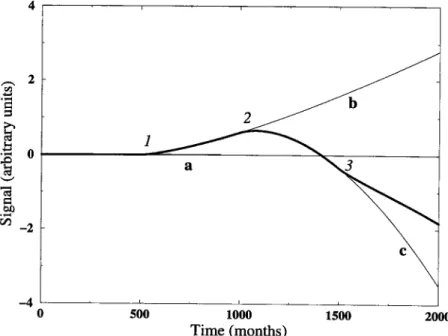
Figure 2.
Thick
solid
line is synthetic
signal
composed
of three
jerks
located
at to -
(500,
1000,
1500)
with
regularities
c•
= (1.4,
1.7,
1.5)
and
amplitudes
• = (+l.0,-0.5,
+1.5).
The
thin
solid
lines
are
extrapolations
of th
e signal
obtained
by extinguishing
several
jerks'
line
a is
what
the
signal
would
have
been
in the absence
of jerks
l, 2, and
3' line
b is what
the signal
would
have
been
if jerks
2 and 3 were
absent,
and line c is what
the'signal
would
have
been
if
jerk 3 was absent.
wavele[ [ransform 6 _10 4 0 500 1000 1500 Time (months) 2000
Figure
3. (top)
Wavelet
transform
of the
(bottom)
signal
shown
in Figure
2. The
analyzing
wavelet
is the
third
time
derivative
of a Gaussian
(see
Alexandrescu
et al. [1995]
for details).
Observe
the three
cone-like
patterns
converging
toward
the starting
dates
of the three
jerks
present
in the analyzed
signal.
The solid
lines
are lines
of extrema
of the wavelet
transform
from
which
the ridge
functions
shown
in Figure
4 are extracted.
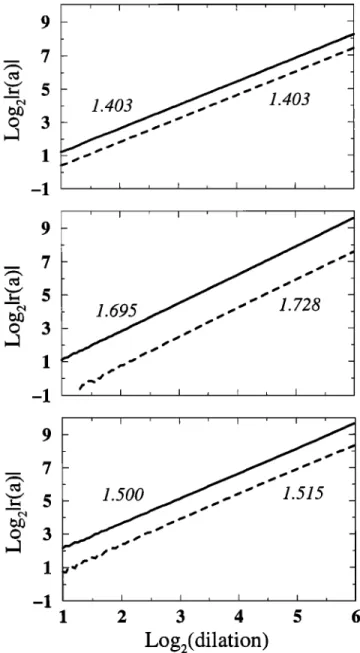
MANDEA ALEXANDRESC[ ET AL MANTLE ELECTRICAL CONDUCTIVITY 17,739 3 1 -1 -1 -1 1 500 .- 1 515 1 2 3 4 5 6
Log2(dilation)
Figure 4. Ridge functions r (a) extracted from the wavelet transform shown on Figure 3 and corresponding to the jerks labeled (top) l, (middle) 2, and (bottom) 3 in Figure 2. The solid lines are the ridge functions lo- cated on the left part of the cone pattern of the wavelet transform, and the dashed lines are the ridge functions located on the right. The numbers are the slopes ob- tained by least squares fitting of a straight line. Observe that these slopes fall very near the theoretical values (1.4, 1.7, and 1.5 respectively).
Note that Bn are also taken at the surface of the Earth
and that (24) may be used to account for the geometry of a time-varying field measured on the Earth. In this way we incorporate the spatial structure of the 1969 jerk into our synthetic data. This is important in practice since, depending on the geographical position on the Earth, the relative amplitudes of the Bn can vary and the temporal variations of the field B may differ from one place to another, since the kernels k,• display some dependence upon the degree n, as shown in Figure 1.
3. Ridge Functions
The data used in this study are a set of ridge functions
(see
section
4), and what we actually
have to produce
for comparison
are synthetic
ridge functions. A ridge
function is a subset of the continuous wavelet trans-
form of a signal f (t) which contains
the information
useful for characterizing abrupt variations in the signal
[Grossmann,
1986]. The continuous
wavelet
transform
of f (t) is defined
by the convolution
product
[;•'f
[[,
a]
-- /_-1-•
,.f (•)
•[;a
(t
--
•)
d•, (25)
where the wavelets ½'a (t) are obtained by dilating an analyzing wavelet 0 (t),l½(t)
(26)
-- ., .
with a dilation a > 0. In the present study the ana- lyzing wavelet is the third time derivative of a Gaus- sian as already used by Alexandrescu et al. [1995,
1996]. Among the numerous
attractive properties
of
the wavelet transform (see. for instance, Holschneider
[1995]),
we exploit
the fact that the wavelet
transform
acts like a mathematical zoom lens useful for analyz-
ing the local homogeneity
characteristics
(i.e., the local
self-similar behavior) of a signal.
In the present study we shall focus on so-called jerk signals whose general expression is
j(tl•,•,t,,)
-
/3n(t-to)(t-to)
• ,
(27)
where H (t) is the Heaviside distribution, fi is an am- plitude factor, t0 is the starting date of the jerk, and a is its regularity. The larger the regularity, the smoother the variation of the fi•nction. Let, us, for instance, con- sider a signal f (t) composed of three jerks:
f (t) : j (tl•.4, t, 500) + j (tll.7,-0.5, looo)+ +j (tll.5, 1.5, 1500). (28) This signal is shown on Figure 2, and its wavelet trans- form is displayed on Figure 3. We observe that the wavelet transform has three cone-like features point- ing (zooming) toward the starting dates to of the three jerks composing the analyzed signal. It can be shown [Alcxandrescu et al., 1.9.95; Holschneider, 1.9.95] that each cone-like pattern possesses self-similar properties controlled by the homogeneity of its related jerk and that. useful information can be recovered by simply tak- ing the absolute value of the wavelet transform along only one of the lines of extrema of the cone-like pattern (Figure 3). The set of absolute values of the wavelet transform on a given line of extrema and ranked with respect to the dilation a defines what will be referred to as a ridge function r (c•). When plotted on a log-log diagram, the ridge functions are straight lines whose
17,740 MANDEA ALEXANDRESCU ET AL.' MANTLE ELECTRICAL CONDUCTIVITY
Log2(dilation)
Log2(dilation) Log2(dilation)
Log2(dilation)
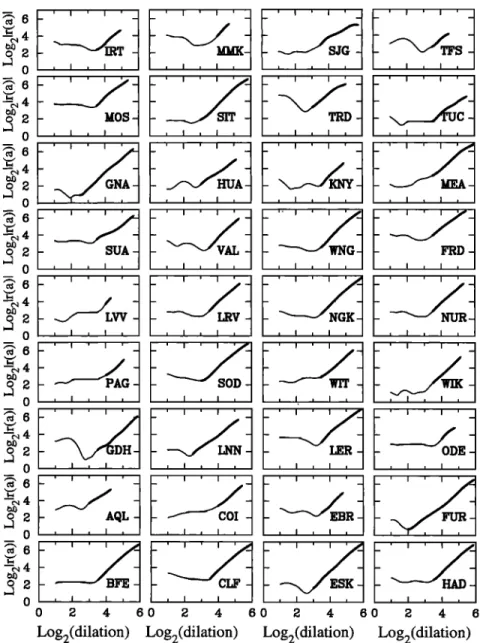
Figure 5. Thin lines are observed
ridge
functions
for the 36 observatories
considered
in this
study. Solid lines are parts of the ridge fimctions used in the inversion.
slopes equal the regularity c• of the corresponding jerk (Figure 4).
4. Data
The data set used in this study is composed of the ridge functions (Figure 5) corresponding to the 1969 jerk and obtained through the wavelet analysis of the monthly mean series of 36 observatories [Alezandrescu ½t al., 1995, 1996]. We focus on the 1969 event because it is the best documented and appears to be less af- fected by fields of external origin than the others [see Alexandrescu et al., 1995, 1996]
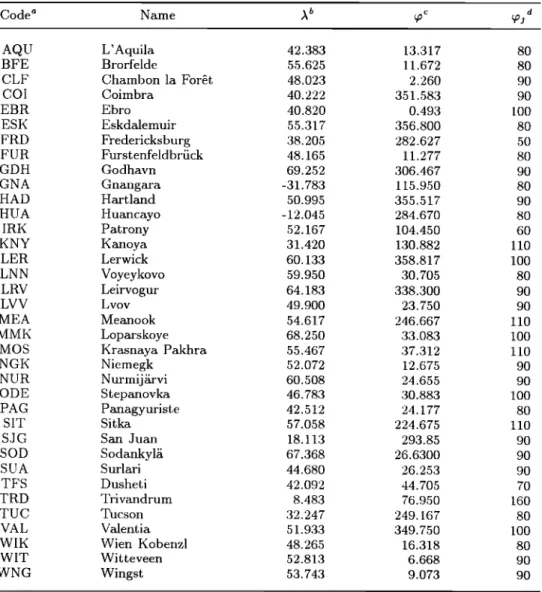
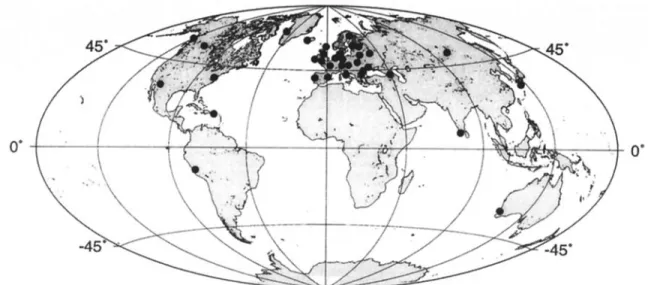
The geographical coordinates of the observatories and their International Association of Geomagnetism and Aeronomy (IAGA) codes are listed in Table 1, and their global distribution is shown in Figure 6. For each observatory the ridge function was extracted from the
wavelet transform computed for a linear combination of
the X (north) and Y (east) components of the field, and the regularity a was found to vary between 1.5 and 1.7. The uncertainty associated with estimating the regular-
ity in this wety
is about 10% [Alexandrescu
et al., 1996].
The analyzed signal for the lth observatory is
Ht (t) = qt ß Bt (t), (29) where Bt (t) is the magnetic field at the /th observa- tory and qz is a unit horizontal vector pointing in the direction of the jerk vector, estimated with an error of
--• 5 o [see Alcxandrescu
et al., 1996]; the direction
of
this vector is given in Table 1 for each observatory.
5. Synthetic Jerks
Alexandrescu et al. [1995, 1996] supposed that the jerks observed at the Earth's surface were pure singu-
MANDEA ALEXANDRESCU ET AL.- MANTLE ELECTRICAL CONDUCTIVITY 17,741
Table 1. Observatories Considered in the Present Study
c d
Code
a
Name
'Xb
•
•3
AQU L'Aquila BFE Brorfelde CLF Chambon la Forat COl Coimbra EBR Ebro ESK Eskdalemuir FRD Fredericksburg FUR Furstenfeldbrfick GDH Godhavn GNA Gnangara HAD Hartland HUA Huancayo IRK Pattony KNY Kanoya LER Letwick LNN Voyeykovo LRV Leirvogur LVV Lvov MEA Meanook MMK Loparskoye MOS Krasnaya Pakhra NGK Niemegk NUR Nurmijarvi ODE Stepanovka PAG Panagyuriste SIT Sitka SJG San Juan SOD Sodankylii SUA Surlari TFS Dusheti TRD Trivandrum TUC Tucson VAL Valentia WIK Wien Kobenzl WIT Witteveen WNG Wingst 42.383 55.625 48.023 40.222 40.820 55.317 38.205 48.165 69.252 -31.783 50.995 -12.045 52.167 31.420 60.133 59.950 64.183 49 900 54 617 68 250 55 467 52 072 60 508 46 783 42 512 57.058 18.113 67.368 44.680 42.09'3 8.483 32.247 51.933 48.265 52.813 53.743 13.317 80 11.672 80 2.260 90 351.583 90 0.493 100 356.800 80 282.627 50 11.277 80 306.467 90 115.950 80 355.517 90 284.670 80 104.450 60 130.882 110 358.817 100 30.705 80 338.300 90 23.750 90 246.667 110 33.083 100 37.312 110 12.675 90 24.655 90 30.883 100 24.177 80 224.675 110 293.85 90 26.6300 90 26.'253 90 44.705 70 76.950 160 249.167 80 349.750 100 16.318 80 6.668 90 9.073 90a According to the IAGA convention. b Latitude of the observatory, in degrees.
CLongitude of the observatory, in degrees, positive eastward. a Jerk direction, in degrees, positive eastward.
larities of the form given by (27) with straight ridge functions. Actually, when looking at experimental ridge functions (Figure 5), one observes a small downward curvature for many observatories. Such a curvature could be due to diffusion of the signal through the con- ductive mantle. We therefore speculate that the signal
j (t) emitted at the CMB is a pure jerk as given
by (27)
and that the curvatures observed in the ridge functions of the surface data are caused by diffusion modeled by the convolution equation (24). The transfer functions k, (t) are causal positive functions (Figure l) and act as low-pass filters whose cutoff frequency is controlled
by the electromagnetic
time constant
• /•r(ro - r•) 2
and by the degree n of the elementary harmonic con- sidered. The larger the electromagnetic time constant, the stronger the filtering, and the ridge functions ob- tained through a wavelet analysis will depart more from
a straight line when plotted in a log-log diagram. An example of this situation (computed for the Chambon la For•t observatory coordinates, see below) is shown in Figure 7 for ro- r• = 2000 km, a = 1.5, and
•r = 1, 4, 16, 64 S m -• We observe
that the ridge func-
tions present a downward curvature that increases with increasing •r. An intuitive assessment of this feature can be made by observing that the transfer function is a localized filter. Then, for su•ciently large dilations of the wavelet transform the filter is well approximated by a Dirac distribution, and the ridge function is asymp- totically a straight line whose slope is the exponent a of the jerk produced at the CMB. For smaller dilations in- volving shorter timescales the finite duration of the filter cannot be ignored, and the signal is both smoothed and damped. Accordingly, this smoothing results in a larger regularity at the timescales considered, and the corre-
17,742 MANDEA ALEXANDRESCU ET AL.: MANTLE ELECTRICAL CONDUCTIVITY
... • ... •'• ... 45
45'
Figure 6. Distribution
of the 36 observatories
considered
in the present
study.
sponding part of the ridge function has a larger slope at the corresponding dilations. The ridge function of the surface jerk is therefore a curved line located below its asymptote which is the linear ridge function of the pure singularity jerk at the CMB.
In order to complete the expression of the synthetic jerk to be compared with the observed one, through their respective ridge functions, we need the harmonic field coe•cients B, We take as B,the results of the
analysis of Le Hu.y ½t al. [1998]. This study is basi- cally a spherical harmonic expansion of the jump of the first time derivative of the field from the jump observed at the observatories. This is only a first approxima-
tion for two reasons: (1) the analysis is performed from the data of the observatories, including the diffusion ef- fect which we are trying to characterize; and (2) owing
to the small number of observatories, the coe•cients of the spherical harmonic expansion are not very accu- rate. Nevertheless, this expansion is acceptable for the needs of the present investigation (a two-step computa- tion could be performed, i.e., recomputing the B, after a first determination of the singularity at the CBM, but this appears to be unnecessary). The expansion of
Le Huy et al. [1998] (limited to order and degree
4)
compares well with previous studies [Malin and Hod- der, 1982; Gu. bbins, 1984]. Moreover, at each observa-
10
regularity
= 1.50
.-' (16)
// (64 S/m)
1 2 3 4 5
Log2(dilation)
Figure 7. Ridge
functions
obtained
for a surface
jerk (corresponding
to c• - 1.5 at the CMB)
filtered
through
a conducting
shell
with ro- rc- 2000
km and for er - 1, 4, 16, and 64 Sm
-1
(see
text for details).
The curvature
of the ridges
is more
pronounced
for larger
conductivities.
MANDEA ALEXANDRESCU ET AL.: MANTLE ELECTRICAL CONDUCTIVITY 17,743
:48.•8
'J•'
•
'
--25.5
1 10 100 1000
Electrical conductivity (S/m)
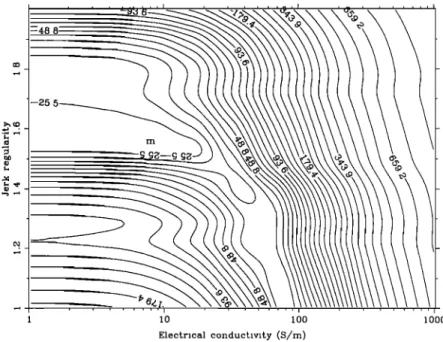
Figure 8. Misfit function C' (G, rr) (equation (33)) obtained by fitting synthetic ridge functions to the experimental ridge functions of 36 observatories. The symbol m is located at the absolute
minimum
(22.4) whose
coordinates
are c• = 1.$$,
and rr -- 8 Sm
-1.
tory the directions qt of the jerk computed using (29) are close to those obtained by the wavelet analysis of the data. The synthetic ridge functions have been com- puted from synthetic series obtained from (24) subject to the same projection as in (29):
Z qt' B• (RE,
Or,
n
ß j (•1 G,/•, to)'
ß k,• (t - •) d•, (30) where (0t, qh) are the coordinates of the/th observatory and the directions of the unit vectors qt are given in Table i (as noted, they are very close to those of Le Huy et al. [1998]).
Equation
(30) has been used
to compute
a collection
of ridge
functions
rt,•,,,,
(a) for the values
(0t, ½t) of the
coordinates of each of the 36 observatories and for r•, -
rc- 2000
km, G G [1.0,2.0]
and rr G [1, 1024
Sm-1].
Then, for each (G, rr) pair belonging to these intervals, a misfit was computed:C (a, rr)
- • E [r, (aj) - r,,a,a
(aj)]
2
t j
(31)
where the index j runs over the discrete dilations for which the ridge function of a given observatory is avail- able. A contour map of the misfit function C
is shown
in Figure 8. The absolute
minimum (22.4)
is located
at the point c• = 1.55 and rr = 8 S m -1.
One can observe that the isovalues of C (G, rr) define a well-marked valley of minime[ surrounded by steep
gradients, especially toward high conductivities. The valley widens toward small conductivities with a rather fiat bottom indicating that the domain of acceptable
solutions extends itself on the left of the absolute min-
imum. Values of G along the valley axis get smaller as rr increases, leading to an increasingly more singular
source: for G = i the first time derivative is discon-
tinuous at to, implying an unrealistic discontinuity in the velocity flow at the CMB responsible for the jerk [Le Huy et al., 1_998]. If we choose a regularity as high
as possible, the conductivity rr must be taken smaller
than 10 Sm -•. In any case,
it is safe to say that on
the basis of the misfit criterion we have adopted, the conductivity rr is less than a few tens of Sin-•.
We have up to now considered a 2000 km thick con- ductive shell, but an infinite number of acceptable so-
lutions exist which belong
to the class
of conductivity
distributions
having the same kernels k,• (n = 1,4).
Limiting ourselves to the subclass of constant conducti- vity distributions, the curves shown in Figure 9 give the (to - re, rr) pairs equivalent, from the point of view
of the present
computation,
to (r•- rc = 2000 km,
cr -- 8 S m -1). Of course,
the computations
could
be
extended to any regular rr(r) distribution. 6. Discussion
The present study is based on a simplistic two-shell model of the Earth, the outer insulating and the in- ner having a constant conductivity. It is known that the conductivity of the upper mantle is very low (<
1 S m -1) [Achache
et al., 1981; Constable,
1993; Pe-
17,744 MANDEA ALEXANDRESCU ET AL' MANTLE ELECTRICAL CONDUCTIVITY o lOO lO
}"•
...
n=
1
x'. ... - ... n=2 x .' .... - .... n=3•.. ...
n =4
,•,:-.. 1•0 •00 1000 1000Thickness of the conductive layer (km)
Figure 9. Relationship between the thickness r(,- re of the conductive layer and its conductivity rr giving the same transfer fonctions k•(t) as those obtained with ro- rc = 2000 km and rr = 8 Sm -•. For example, for n = i the diffusive effects of a layer with ro- rc = 2000 km and
rr = 8 Sm
-• and of a layer with ro- rc = 500 km and rr = 108 Sm
-• are identical.
conductivity distribution (as a function of depth) of the silicate lower mantle is regular [Shankland et al., 1993]. Our upper bound estimate bears in fact on the electro- magnetic time constant r of the mantle, transla, ted in terms of the conductivity of an inner shell. Of course,
most of the contribution to r could be concentrated
in a thin layer at the bottom of the ma. ntle (reducing
(to- r•)"" and increasing
rr). In order to establish
the
existence of such a layer, other kinds of evidence have to
be found. Buffett et al. [1990], for example, proposed ohmic dissipation in a thin conducting layer at the base
of the mantle as the source of a sinall residual out-of-
phase component in the retrograde annual nutation of the Earth. A heterogeneous high-conductivity layer has also been invoked to explain the preferred geomagnetic virtual pole (VPG) pa. ths during reversals [Laj et al.,
1991; Runcorn, 1992]. However, some investigators find
it difficult to explain the formation and existence of such a thin highly conductive layer at the base of the mantle [Poirier and Le Mou•'l, 1992; Le Mou•'l et al., 1997; Poirier et al., 1998; Katsura et al., 1998]. We are inclined to conclude tha. t the conductivity of the lower mantle is basically that of solid silicates and oxides for which diamond anvil experiments [Poiricr and Peyron- neau, 1992; Shankland et al., 1993; Poirier et al., 1996]
indicate a conductivity distribution which is weak and slowly increasing with depth; in general agreement with the estimates we obtain in the present study.
It should be emphasized that our study relies on the assumption that a jerk is a singularity at the CMB. Some assumptions are necessary in studies of the mantle filter for which we know the output but not the input.
The assumption that the jerk originated as a singularity introduced at the base of the mantle is the simplest possible.
Acknowledgments. We thank David Barraclough and Cathy Constable for cmmnents. This study has been partly funded by the CNRS-INSU progrmn "Intdrieur de la Terre."
This is IPGP contribution 1599.
References
Achache, J., V. Courtillot, J. Ducruix, and J.-L. Le Moui51, The late 1960's secular variation i•npulse: further con- straints on deep mantle conductivity, Phys. Earth Planet. Inter., 23, 72-75, 1980.
Achache, J., J.-L. Le Mou;S1, and V. Courtillot, Long-period gemnagnetic variations and •nantle conductivity: An in- version using Bailey's •nethod, Geophys. J. R. A stroh. Soc., 65, 579-601, 1981.
Alexandrescu, M., D. Gibert, G. Hulot, J.-L. Le Mou[1, and G. Satacco, Detection of geomagnetic jerks using wavelet analysis, J. Geophys. Res., 100, 12557-12572, 1995. Alexandrescu, M., D. Gibert, G. Hulot, J.-L. Le MouiS1, and
G. Saracco, Worldwide wavelet analysis of gemnagnetic jerks, J. Geophys. Res., 101, 21975-21994, 1996.
Backus, G.E., Application of •nantle filter theory to the •nag- netic jerk of 1969, Geophys. J. R. Astron. Soc., 74{, 713- 746, 1983.
Backus, G.E., R.L. Parker, and C. Constable, Foundations of Geomagnetism, 369 pp., Cronbridge Univ. Press, New York, 1996.
Benton, E., and K. Whaler, Rapid diffusion of the poloidal gemnagnetic field through the weakly conducting mantle: A perturbation solution, Geophys. J. R. A stroh. Soc., 75,
77-100, 1983.
Bufferr, B., T. Herring, P. Mathews, and I. Shapiro, Anoma- lous dissipation in the Earth's forced nutation: Inferences
MANDEA ALEXANDRESCU ET AL.: MANTLE ELEC, TRICAL CONDUC, TIVITY 17,745
on electrical conductivity at the core-mantle boundary, Eos Trans. A G U, 71,496, 1990.
Constable, S., Constraints on mantle electrical conductiv- ity from field and laboratory measurements, 2. Geomagn.
Geoelectr., 45, 707-728, 1993.
Courtillot, V., and J.-L. Le Moual, Geomagnetic secular variation impulses, Nature, 311,709-716, 1984.
Courtillot, V., J. Ducruix, and J.-L. Le Moual, Sur une accd•ration r•cente de la variation s•culaire du champ magn•tique terrestre, C. R. A cad. $ci., Set. D, 287, 1095-1098, 1978.
Courtillot, V., J.-L. Le Moual, and J. Ducruix, On Backus' mantle filter theory and the 1969 geomagnetic impulse,
Geophys. J. R. A stron. Soc., 78, 619-625, 1984.
De Michelis, P., L. Cafarella, and A. Meloni, ¾Vorldwide character of the 1991 jerk, Geophys. Res. Left., 25, 377-
380, 1998.
Ducruix, J., V. Courtillot, and J.-L. Le Mou•.l, The late 1960s secular variation impulse, the 11 year magnetic vari- ation and the electrical conductivity of the deep mantle,
Geophys. J. R. Astron. $oc., 61, 73-94, 1980.
Gavoret, J., D. Gibert, M. Menvielle, and J.-L. Le Mou•l, Long-term variations of the external and internal compo- nents of the Earth's magnetic field, J. Geophys. Res., 91,
4787-4796, 1986.
Golovkov, V.P., T.I. Zvereva, and A.O. Simonyan, Common feature and differences between "jerks" of 1947, 1958, and 1969. Geophys. Astrophys. Fluid Dyn., •9, 81-96, 1989. Grossmann, A., ¾Vavelet transform and edge detection, in
Stochastic Processes in Physics and Engineering, edited by M. Hazewinkel, pp. 149-157, D. Reidel, Norwell, Mass.,
1986.
Gubbins, D., Geomagnetic field analysis, II, Secular vari- ation consistent with a perfectely conducting core, Geo- phys. J. R. Astron. $oc., 77, 753-766, 1984.
Gubbins, D., and L. Tomlinson, Secular vm'iation from monthly means from Apia and Amberley magnetic ob- servatories, Geophys. J. R. Astron. Soc., 86, 603-616,
1986.
Holschneider, M., Wavelets: An analysis tool, 423pp., Ox- ford Univ. Press, New York, 1995.
Hulot, G., J.-L. Le Mou•l, and J. Wahr, Taking into account truncation problems and geomagnetic model accuracy in assessing computed flows at the core-mantle boundary, Geophys. J. Int., 108, 224-246, 1992.
Katsura T., K. Sato, and E. Ito, Electrical conductivity of silicate perovskite at lower-mantle conditions, Nature, 395, 493-495, 1998.
Kerridge, D.J., and D.R. Barraclough, Evidence for geomag- netic jerks from 1931 to 1971, Phys. Earth Planet. Inter., 39, 228-236, 1985.
Laj, C., A. Mazaud, R. Weeks, M. Fuller, and E. Herrero- Bervera, Geomagnetic reversal paths, Nature, 351, 447,
1991.
Le Huy, M., M. Alexandrescu, G. Hulot, and J.-L. Le Mou[1, On the characteristics of successive geomagnetic jerks, Earth Planets Space, 50, 723-732, 1998.
Le Mou[1, J.-L., L'induction dans le globe, in Trait• de G•o- physique Interne, vol. 2, edited by J. Coulomb and G. Joberr, pp. 129-158, Masson, Paris, Vol. 2, 1976. Le Mou[1, J.-L., G. Hulot, and J.-P. Poirier, Core-mantle in-
teraction, in Earth's Deep Interior, edited by D.J. Cross- ley, pp. 197-221, Gordon and Breach, New York, 1997. Macmillan, S., A geomagnetic jerk for the early 1990's,
Earth Planet. Sci. Lett., 137, 189-192, 1996.
Malin, S., and B. Hodder, ¾Vas the 1970 geomagnetic jerk of internal or external origin?, Nature, 296, 726-728, 1982. Malin, S., B. Hodder, and D. Barraclough, Geomagnetic
secular variation: A jerk in 1970, Ebro Obs. Mere. Publ., 14, 239-256, 1983.
McLeod, M.G., Signals and noise in magnetic observatory annual means: Mantle conductivity and jerks, J. Geophys. Res., 97, 17261-17290, 1992.
McLeod, M.G., Magnetospheric and ionospheric signals in magnetic observatory monthly means: electrical conduc- tivity of the deep mantle, J. Geophys. Res., 99, 13577-
13590, 1994.
Petersons, H.F., and S. Constable, Global mapping of the electrically conductive lower mantle, Geophys. Res. Lett.,
23, 1461-1464, 1996.
Petiau, G., La Th•orie des Fonctions de Bessel, 477 pp., Cent. Nat. de Rech. Sci., Paris, 1955.
Poirier, J.-P., and J.-L. Le Mou[l, Does infiltration of the core into the lower •nantle affect the observed geomagnetic field?, Phys. Earth Planet. Inter., 73, 29-37, 1992. Pokier, J.-P., and J. Peyronneau, Experimental determina-
tion of the electrical conductivity of the material of the Earth's lower mantle, in High-Pressure Research: Appli- cation to Earth and Planetary Sciences, Geophys Monogr. Set., vol. 67, edited by Y. Syono and M. Manghnani, pp. 77-87, AGU, Washington, D.C., 1992.
Poirier, J.-P., A. Goddat, and J. Peyronneau, Ferric iron dependence of the electrical conductivity of the Earth's lower mantle material, Philos. Trans. R. Soc. London, Ser. A, 35Y•, 1361-1369, 1996.
Poirier, J.-P., V. Malavergne, and J.-L. Le Mou[l, Is there a thin electrically conducting layer at the base of the man- tle?, in The Core-Mantle Boundary Region, Geodyn. Set., vol. 28, edited by M. Gurnisct al., pp. 131-137, AGU, ¾Vashington, D.C., 1998.
Runcorn, S.K., The electrical conductivity of the Earth's mantle, Eos Trans. AGU, 36, 191-198, 1955.
Runcorn, S.K., Polar path in geomagnetic reversals, Nature, 356, 654-656, 1992.
Shankland, T.J., J. Peyronneau, and J.-P. Poirier, Electrical conductivity of the Earth's lower mantle, Nature, 366, 453-455, 1993.
Smylie, D.E., Magnetic diffusion in a spherically-symmetric conducting mantle, Geophys. J. R. Astron. Sot., 9, 169-
184, 1965.
Stewart, D.N., and K.A. Whaler, Geomagnetic disturbance fields: An analysis of observatory monthly means, Geo- phys. J. Int., 108, 215-223, 1992.
Whaler, K.A., A new method for analysing geomagnetic im- pulses, Phys. Earth. Planet. Inter., •48, 221-240, 1987.
D. Gibert, and G. Saracco, G•osciences Rennes, Univer- sit• de Rennes 1, Bat. 15 Campus de Beaulieu, 35042 Rennes cedex, France. ([email protected]; ginet@univ- rennesl.fr)
G. Hulot, J.-L. Le Mou[l, and M. Mandea Alexandrescu, Institut de Physique du Globe, B.P. 89, 4 Place Jussieu, 75252 Paris cedex 5, France. ([email protected]; [email protected]; [email protected]. fr)
(Received October 20, 1998; revised March 24, 1999; accepted April 2, 1999.)