HAL Id: hal-00296933
https://hal.archives-ouvertes.fr/hal-00296933
Submitted on 9 May 2006
HAL is a multi-disciplinary open access
archive for the deposit and dissemination of
sci-entific research documents, whether they are
pub-lished or not. The documents may come from
teaching and research institutions in France or
abroad, or from public or private research centers.
L’archive ouverte pluridisciplinaire HAL, est
destinée au dépôt et à la diffusion de documents
scientifiques de niveau recherche, publiés ou non,
émanant des établissements d’enseignement et de
recherche français ou étrangers, des laboratoires
publics ou privés.
Cyclogenesis in the lee of the Atlas Mountains: a factor
separation numerical study
K. Horvath, L. Fita, R. Romero, B. Ivancan-Picek, I. Stiperski
To cite this version:
K. Horvath, L. Fita, R. Romero, B. Ivancan-Picek, I. Stiperski. Cyclogenesis in the lee of the Atlas
Mountains: a factor separation numerical study. Advances in Geosciences, European Geosciences
Union, 2006, 7, pp.327-331. �hal-00296933�
SRef-ID: 1680-7359/adgeo/2006-7-327 European Geosciences Union
© 2006 Author(s). This work is licensed under a Creative Commons License.
Advances in
Geosciences
Cyclogenesis in the lee of the Atlas Mountains: a factor separation
numerical study
K. Horvath1, L. Fita2, R. Romero2, B. Ivancan-Picek1, and I. Stiperski1
1Meteorological and Hydrological Service of Croatia, Gric 3, 10000 Zagreb, Croatia 2University of the Balearic Islands, Ctra. de Valldemossa, 07122 Palma de Mallorca, Spain
Received: 23 October 2005 – Revised: 13 December 2005 – Accepted: 20 December 2005 – Published: 9 May 2006
Abstract. The initiation of a deep and severe impact Mediterranean cyclone in the lee of Atlas Mountains is in-vestigated by a series of numerical experiments using the MM5 forecast model. Roles of orography, surface sensible heat flux and an upper-level potential vorticity anomaly are identified using factor separation method. Results of model simulations show that orography blocking is responsible for generation of the low-level shallow vortex in the first phase of lee development. Upper-level potential vorticity is a princi-pal ingredient of this event, responsible for a dominant deep-ening effect in the later stage of lee formation. Analysis of cyclone paths shows that orography tends to keep the cyclone stationary, while upper-level dynamical factors are crucial for advection of the system to the Mediterranean Sea. The most noteworthy influence of surface sensible heat flux is identi-fied as an afternoon destruction of a surface baroclinic zone and associated weaker cyclogenesis.
1 Introduction
The purpose of this paper is to analyse the first phase of a deep Mediterranean cyclone that originated in the lee of the Atlas Mountains and caused a range of severe weather events throughout its movement over the Mediterranean Sea in November 2004. In this study, the Factor Separation method will be applied to investigate the influences of orog-raphy, sensible heat flux and an upper-level potential vortic-ity anomaly as well as their mutual interactions during the lee stage of cyclone development. The paper is organised as fol-lows: Sect. 2 gives an observational evidence of the analysed case while Sect. 3 presents the model description and con-trol run simulation. Section 4 analyses the Factor Separation method results and provides a related discussion. Finally, concluding remarks are summarised in Sect. 5.
Correspondence to: K. Horvath
2 Observational data
Observational data in Sahara region is rather sparse, so usu-ally reliance is made on the ability of the model to fore-cast regional weather events (Fig. 1). However, for the pur-pose of analysis and a rough model verification, we will in-spect EUMETSAT water-vapor (Fig. 2) Meteosat MSG im-agery. A strong upper-level trough extended over the wide Mediterranean and Western European region. A notable dark stripe on the figure indicates the subsidence area on the cy-clonic part of the jet stream, identifying the area of very low water vapor content and the highest upper-level PV values. Near the southern end of the dark stripe, above the lee of the High Atlas, evidences of the early stage of cyclogene-sis can be identified. On 14 November, in a maturing stage of the cyclone development, a strong frontal activity can be identified over the southern Italy on the high-resolution visible spectra satellite image (not shown), indicating the existence of heavy flood-raising precipitation that reached 200 mm/24 h. At about the same time, strong pressure gra-dients got built up over the region of Dinaric Alps, giving rise to severe mesoscale Bora phenomenon along the Eastern Adriatic coast. Measurements showed the existence of sus-tained winds of 35 ms−1 over the 24 h interval over a wide area of Eastern Adriatic coast and gusts occasionally reach-ing 60 ms−1, that were one of the highest Bora gust values ever recorded.
3 Model description and the control run
The simulations were performed with the non-hydrostatic version of the fifth generation Pennsylvania State Univer-sity – National Center for Atmospheric Research mesoscale model MM5 (Dudhia, 1993; Grell et al., 1994). Initial and boundary conditions were provided from the global NCEP/NCAR (National Centers for Environmental Predic-tion/National Center for Atmospheric Research) Final Anal-ysis (FNL).
328 K. Horvath et al.: Cyclogenesis in the lee of the Atlas Mountains
Fig. 1. The Western Mediterranean and North-West Africa region
with sites mentioned in the text. The area corresponds to a 24-km resolution model orography in the domain, with contours every 300 m, starting from 300 m.
Fig. 2. Water-vapour 6.2 level 1.5 Meteosat MSG image for 12
Nov 2004 12:00 UTC showing an upper level trough over Western Europe and North Africa. The arrow (A) denotes the jet stream, the dashed line (B) the associated dark stripe, while the point C denotes the cyclone initiation point.
The synoptic setting, within which the range of severe weather events over the Mediterranean area developed be-tween 13 to 15 November 2004, followed a deep cyclogene-sis initiated in the lee of the Atlas Mountains. The synoptic pattern at low levels was dominated by an stationary Azore
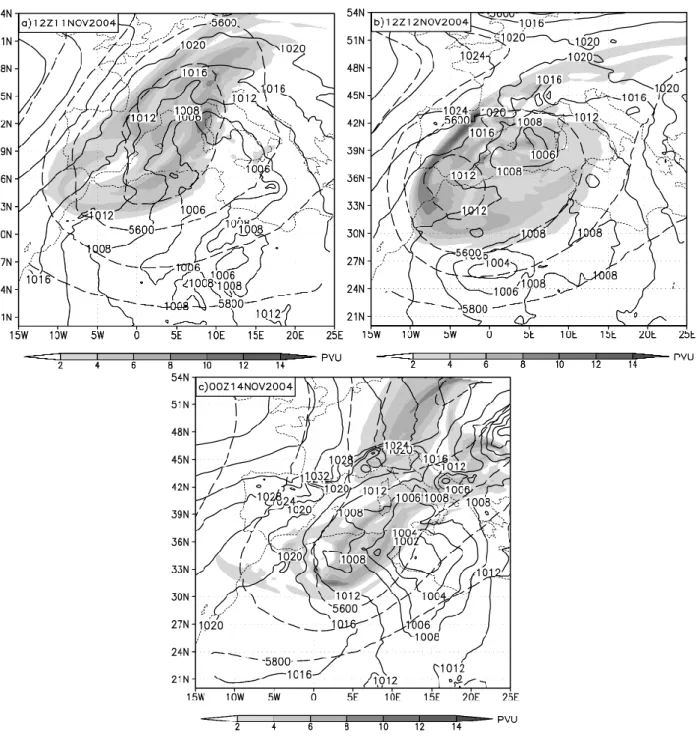
anticyclone producing a strong northerly winds over eastern Atlantic and Portugal area (Fig. 3a). The initiation of the low-level vortex was rather well simulated, although with a small time delay. The upper-level potential vorticity core at 300 hPa reached 14 PVU at the time it was advected over the Atlas region. This cut-off upper tropospheric low induced a closed upper-air circulation as indicated by the geopotential height distribution (Fig. 3b). On 14 November 00:00 UTC, cyclone left the lee and entered the Mediterranean area reach-ing 1000 hPa in the centre, characterized with a well-defined frontal structure (Fig. 3c). The simulation reasonably well captured the lee cyclone initiation and the associated atmo-spheric synoptic conditions.
4 Factor separation on the Atlas lee cyclogenesis
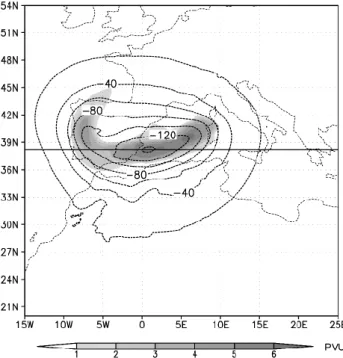
Factor Separation (FS) method allows us to quantify not only the contributions of the sole factors, but also their mutual synergies and is a useful approach if interactions among in-vestigated factors are expected. The method is fully de-scribed in Stein and Alpert (1993), and has been used in many studies (e.g. Alpert et al., 1996; Romero et al., 1997). The factors chosen in this study were the Atlas orography, an upper-level PV anomaly and surface sensible heat flux. Whilst the first two factors influenced the cyclone formation and deepening in line with a general theory of lee cycloge-nesis, surface sensible heat flux was chosen to shed light on its specific influence in the arid Saharan region of the lee of the Atlas Mountains. The removal of the upper-level potential vorticity anomaly from initial conditions was per-formed by applying a piecewise PV inversion scheme (Davis and Emanuel, 1991) on the Ertel’s potential vorticity fields. However, in the simulations with the total upper-level PV anomaly removed from the initial conditions, the cyclone was excessively changed, both in intensity and in path. Thus, in order to keep the similarity with the real case, a PV per-turbation used for our sensitivity study addressed only part of the total PV anomaly (Fig. 4). This resulted in the upper-level PV anomaly that e.g. on 12 November 06:00 UTC reached 8 PVU at 300 hPa level, compared to the almost 14 PVU reached by the upper-level PV anomaly in the control run. This should be kept in mind when considering the quantita-tive contributions of the upper-level potential vorticity and its interactions. Figure 5 presents the time evolution of the factor contributions to the mean sea level pressure value il-lustrating the dominance of different processes at different stages of cyclone development. The analysis focused on the period starting at 12 November 00:00 UTC (24 h after the simulation started) what is the approximate time of cyclo-genesis commencement in the simulation.
The first pronounced cyclogenetic influence was an oro-graphic one, starting around 12 November 00:00 UTC, cu-mulatively exerting a 5 hPa deepening on the cyclone. This influence was associated with a frontal retardation and cre-ation of a thermal and a low-level PV anomalies in the lee of the High Atlas that were not present in the simulations
Fig. 3. Model forecast of synoptic scale evolution at 11 Nov 12:00 UTC (a), 12 Nov 12:00 UTC (b) and 14 Nov 00:00 UTC (c). Mean
seal-level pressure contours are plotted in continuous line with 4 hPa above 1008 hPa and 2 hPa below 1008 hPa values. Upper-level potential vorticity values at 300 hPa are shaded (white under 2 PVU black over 14 PVU), while geopotential at 500 hPa is plotted in dashed line (every 100 gpm).
without orography. At 13 November 06:00 UTC, the oro-graphic influence first diminished, and then became strongly cyclolytic (a destruction of cyclone). This type of duality of the orographic influence was already noticed in a study of the Alpine cyclogenesis by Alpert et al. (1996) and was probably due to the cyclone movement out the favourable lee area. The upper-level potential vorticity started to contribute to the cyclogenesis at the time its strongest core got advected
over the Atlas lee on 12 November 18:00 UTC. Its influence in the subsequent period was associated with a reduced sta-bility of the troposphere and creation of a slightly stronger thermal anomaly at the surface (the inclusion of upper-level PV cooled the air impinging on the Atlas). Furthermore, a stronger positive vorticity advection at upper levels induced greater low-level vertical velocities (e.g. in accordance with the quasi-geostrophic omega equation) and a stronger
low-330 K. Horvath et al.: Cyclogenesis in the lee of the Atlas Mountains
Fig. 4. Upper-level potential vorticity perturbation at 300 hPa
re-moved from the initial conditions at 11 Nov 00:00 UTC, the model simulations starting time. The associated geopotential perturbations at the 300 hPa level are superimposed in dashed line.
Fig. 5. The 48-hour time evolution for 7 local contributions to the
cyclone deepening (hPa), after 24 h of simulation. F1, F2 and F3 are influences of orography, surface sensible heat flux and upper-level PV perturbation, respectively and are plotted in continuous line. Contributions of synergies are plotted in dashed line (e.g. F13 denotes the contribution of a synergy between orography and upper-level potential vorticity perturbation).
level convergence, resulting in a more intense low-level vor-tex development.
The most pronounced contribution of surface sensible heat flux seems to be the afternoon cyclolysis. In simulations without surface sensible heat flux, the absorbed energy dur-ing the daytime (when SSHF is directed upwards) caused higher ground temperatures, but lower surface air
tempera-Fig. 6. Time evolution of the cyclone centres in 9 simulations. f0 is
the simulation with all three investigated factors withheld, f123 is the control run, while f PV is the simulation with a totally removed upper-level potential vorticity anomaly from the initial conditions.
tures near the ground and a less intensive atmospheric bound-ary layer (ABL). In this environment, a weaker ABL and less vertical mixing contributed to a stronger baroclinic zone and a more intensive cyclone deepening. Similar cyclolytic in-fluence in the early stage of a cyclone development has been noticed in work done by Kuo et al. (1991), although their case took place over the sea.
The cyclone centre paths in the factor separation simula-tions are shown on Fig. 6. The cyclone centre path for the simulation with the total upper-level PV anomaly removed from the initial conditions is added to the picture. Consider-ing the latter first, we can see that without the upper-level PV anomaly in the initial conditions the cyclone initiation point and movement were excessively changed. The shallow cy-clone was indeed formed in the lee of the Ahaggar mountain (refer to Fig. 1), dominated by a weak advection of upper-level PV from the boundary conditions over that area. Thus, the analysis suggests that a strong upper-level PV advection is crucial for the cyclogenesis in the lee of the Atlas to oc-cur. The influence of orography on the cyclone paths was clearly resolved – the four closest cyclone paths to the Atlas range corresponded to the four simulations with orography included. Therefore, in the first place orography tended to move the location of the cyclone initiation to the favourable lee area where orographically induced low-level PV and ther-mal another-malies were the strongest. In contrast, inclusion of the upper-level PV perturbation moved the position of the cyclone formation away from the mountain. It seems that the stability of the lower atmosphere on the windward side of the Atlas played an important role in localising the forma-tion place. Namely, in simulaforma-tions with the upper-level PV perturbation included, the lower atmosphere was less stable underneath. A closer look reveals that in those simulations cold air parcels on the windward side were able to cross the mountain more efficiently moving the thermal anomaly more to the south-east.
There were significant differences noted in the times the cyclone reached the Mediterranean Sea. The two slow-est cyclones were attached to orographically, while the two fastest ones to upper-level potential vorticity dominated sim-ulations. Sensible heat flux did not have a significant impact on the cyclone track variability. The aforementioned strong dependency indicates that the orographic influence was to keep the cyclone in the mountain lee, while the upper-level PV anomaly tended to induce a faster advection of the low-level pressure system to the Mediterranean Sea.
5 Conclusions and final remarks
The numerical sensitivity study investigated the initial phase of a deep Mediterranean cyclone that took place in the lee of the Atlas Mountains in November 2004, and caused a range of severe weather events throughout the Mediterranean re-gion.
Orography proved responsible for the first phase of the lee cyclogenesis, where a shallow cyclone formed over the barotropic area in the lee of the High Atlas, due to frontal retardation and creation of the associated thermal anomaly. The second phase of the deepening was characterised by the cyclogenetic influence of the upper-level potential vorticity perturbation (a part of the upper-level PV anomaly). With the total upper-level PV anomaly removed from the initial con-ditions, the cyclone did not form in the lee of the Atlas, what proves that upper-level dynamical factors were necessary in-gredients of the Atlas lee cyclogenesis. It seems that the most pronounced feature of the surface sensible heat flux contri-bution was an afternoon cyclolysis. Namely, SSHF was ac-companied with an increased vertical mixing in the afternoon ABL and an associated weakening of the baroclinic zone, in-ducing less intensive cyclone deepening.
The spread of the cyclone centres in the model simulations was shown to be a powerful tool in understanding the effect of different factors on the cyclone evolution. For instance, orography moved the cyclone initiation closer to the moun-tain and the favourable lee area where the thermal anomaly was the strongest and tended to keep the cyclone more sta-tionary. On the other hand, the upper-level potential vorticity moved the cyclone formation location away from the moun-tain and was responsible for the faster advection of the cy-clone to the Mediterranean Sea.
Acknowledgements. The work of K. Horvath and I. Stiperski has been supported by the Ministry of Science, Education and Sports of Republic of Croatia under project number 0004001 and Ministerio de Medio Ambiente of Spain (Instituto Nacional de Meteorologia) scholarship grant (K. Horvath). The work of L. Fita has been supported by MEDEXIB: REN 2002-03482 grant.
Edited by: V. Kotroni and K. Lagouvardos Reviewed by: anonymous referee
References
Alpert, P., Tsidulko, M., Krichak, S., and Stein, U.: A multi-stage evolution of an ALPEX cyclone, Tellus, 48A, 209–220, 1996. Davis, C. A. and Emanuel, K.: Potential vorticity diagnostics of
cyclogenesis, Mon. Wea. Rev., 119, 1929–1953, 1991.
Dudhia, J.: A nonhydrostatic version of the Penn State/NCAR mesoscale model: Validation tests and simulation of an Atlantic cyclone and cold front, Mon. Wea. Rev., 121, 1493–1513, 1993. Grell, G. A., Dudhia, J., and Stauffer, D. R.: A description of the fifth-generation Penn State/NCAR mesoscale mode (MM5), NCAR Techincal Note, NCAR/TN-398+STR, 117 p., 1994. Kuo, Y.-H., Reed, R. J., and Low-Nam, S.: Effects of surface
en-ergy fluxes during the early development and rapid intensifica-tion stages of seven explosive cyclones in the Western Atlantic, Mon. Wea. Rev., 119, 457–475, 1991.
Romero, R., Ramis, C., and Alonso, S.: Numerical simulation of an extreme rainfall event in Catalonia: Role of orography and evaporation from the sea, Q. J. R. Meteorol. Soc, 123, 537–559, 1997.
Stein, U. and Alpert, P.: Factor separation in numerical simulations, J. Atmos. Sci., 50, 2107–2115, 1993.