LCA Methodology
Ambiguities in Decision-Oriented Life Cycle Inventories
T h e R o l e o f M e n t a l M o d e l sFrank W e r n e r 1. a n d R o l a n d W. Scholz 2
1 Swiss Laboratories for Materials Testing and Research (EMPA), Ueberlandstrasse 129, CH-8600 Duebendorf, Switzerland 2Swiss Federal Institute of Technology, Natural and Social Science Interface (ETH-UNS), Haldenbachstr. 44, CH-8092 Zurich,
Switzerland
*Corresponding author ([email protected])
DOh http://dx.doi.or _o/10.1065Bca2002.11.098
Abstract. If the complexity of real, socio-economic systems is acknowledged, life cycle inventory analysis (LCI) in life cycle assessment (LCA) cannot be considered as unambiguous, ob- jective, and as an exclusively data and science based attribu- tion of material and energy flows to a product. The paper thus suggests a set of criteria for LCI derived from different scien- tific disciplines, practice of product design and modelling char- acteristics of LCI and LCA. A product system with its respec- tive LCI supporting the process of effective and efficient decision-making should ideally be" a) complete, operational, decomposable, non-redundant, minimal, and comparable; b) efficient, i.e., as simple, manageable, transparent, cheap, quick, but still as 'adequate' as possible under a functionalistic per- spective which takes given economic constraints, material and market characteristics, and the goal and scope of the study into account; c) actor-based when reflecting the decision-mak- ers' action space, risk-level, values, and knowledge (i.e. men- tal model) in view of the management rules of sustainable de- velopment; d) as site- and case-specific as possible, i.e. uses as much site-specific information as possible. This rationale stresses the significance of considering both (i) material and energy flows within the technosphere with regard to the sus- tainable management rules; (ii) environmental consequences of the environmental interventions on ecosphere. Further, the marginal cost of collecting and computing more and better information about environmental impacts must not exceed the marginal benefits of information for the natural environment. The ratio of environmental benefits to the economic cost of the tool must be efficient compared to other investment op- tions. As a conclusion, in comparative LCAs, the application of equal allocation procedures does not lead to LCA-results on which products made from different materials can be com- pared in an adequate way. Each product and material must be modelled according to its specific material and market charac- teristics as well as to its particular management rules for their sustainable use. A generic LCA-methodology including prefer- ences on methodological options is not definable.
Keywords: Allocation; attribution; decision theory; inventory analysis; life cycle inventory (LCI); mental model; product sys- tem; subjectivity; valuesphere
1 Ambiguities in the Life Cycle Inventory Step
Modelling the product system as a model of the life cycle of a product with its respective life cycle inventory (LCI) is considered an ambiguous task. Although guidelines for con- ducting an LCA are available (e.g. the series of standards ISO 14 040), in any practical, real world application, there still remain many degrees of freedom during the modelling of a product system that implicitly or explicitly rely on sub- jective decisions. The influence of subjective elements can- not be explained by the scope and goal dependency of an LCA. The influence of subjective, functional issues are the consequence of the fundamental epistemological conditions of the life cycle inventory analysis: it is not possible to at- tribute material and energy flows out of a complex (highly interlinked) socio-economic context to the product under study in an unambiguous way. Subjective methodological choices are necessary in the inventory analysis whenever material and energy flows cannot unambiguously be attrib- uted to a product based on a fundamental physical, chemi- cal, biological or technical relationship. In unambiguous decision situations, the decision-makers' mental models (knowledge representations) and their value systems finally guide the setting up of the product system and of its LCI. Thus: "Accounting frameworks are more than just a set of bookkeeping rules and conventions. They represent a par- ticular conceptualisation or worldview of how the economy and ecological systems operate" (Patterson 1998, p. 108). Decisions during the inventory analysis that require the im- plicit or explicit use of mental models or values are, e.g.: 9 System boundary setting between nature and techno-
sphere;
9 Demarcation of life cycle stages, modules, sub-modules, and finally unit processes;
9 Selection of a level of insignificance that allows one to cut off (ignore) material and energy flows;
9 Distinction between products, co-/byproducts, and waste when allocating co-production processes (Frischknecht
1994);
9 Choice of an allocation factor for joint co-production processes in the descriptive approach to LCA (Frisch- knecht 1994, Hofstetter 1998);
LCA Methodology
Subjectivity
9 Selection of an open-loop allocation procedure (Ekvall et al. 1997, Hofstetter 1998);
9 Selection criteria for substituted or additionally-caused processes in the marginal approach to LCA;
9 Handling of the (structural) ignorance about future proc- esses, e.g. related to reuse and recycling.
It has often been analysed that methodological choices in LCA can have a significant impact on the overall result and on the ranking of products assessed (e.g. Lindfors et al. 1995,
Werner and Richter 2000b). A sensitivity analysis is recom- mended in unambiguous decision situations during the con- duct of an LCA (e.g. ISO/EN 14 041, chap. 6.5.2, dot 3). But sensitivity analysis can only provide insight into the impact of a methodological decision on the overall result. For decisions resulting in far reaching consequences, further criteria have to be applied in order to determine the prefer- ence of methodological options in order to allow for state- ments and conclusions that support decision-making. The influences of subjective elements within LCA method- ology have been discussed since the broader perception of this tool. Originally derived from energy accounting, LCA has been developed as a tool to 'measure' the environmental relevance of products (Consoli et al. 1993, Elkington and Hailes 1993).
A slightly different position on objective and subjective ele- ments within LCA was held by the research group at the Centre of Environmental Science in Leiden (CML), which in 1992 proposed a groundbreaking methodology for the assessment step of LCA. This group spotted the subjective parts in the valuation step. 'Objective' and 'subjective' ele- ments were distinguished within the framework of LCA as follows: "In the goal definition, discussions take place be- tween different participants, such as commissioners, con- sumers and LCA scientists, and technological information is needed about product alternatives that can be significantly compared with each other in relation to the goal of the study. The inventory is pre-eminently a subject of systems analysis theories and process technology. The classification is based on environmental sciences, while the valuation is a subject of social sciences (e.g. decision theory): The improvement analysis is based on applied mathematics and knowledge about process technology" (Guin4e et al. 1993, p. 3). A few years ago, doubts arose concerning the postulate of objectiveness of LCA, even in its life cycle inventory step (K16pffer 1998). Some years later, Hofstetter et al. (2000) argue that "(...) subj ective elements should be integrated into all phases of LCA rather than treated separately, but that the subjective elements have to be organised in a sophisti- cated manner that acknowledges social science knowledge in particular" (Hofstetter et al. 2000, p. 161). They suggest explicitly complementing the models for the technosphere and for the ecosphere with a model for the valuesphere, "as this framework provides a consistent treatment of value judgements and is able to deal with distinct worldviews. (...) The proposed framework thus allows (...) an incorporation of the decision-makers' value systems into goal and scope definition, inventory analysis, impact assessment and valua- tion" (Hofstetter et al. 2000, p. 162).
Obviously, Hofstetter et al. (2000) propose that LCA should be used and interpreted in a different way. Instead of claim- ing the 'measuring of environmental impacts', they stress the characteristics of LCA as a decision support tool with its close linkage to the decision-makers' conceptualisation of the decision situation. This consists of a radical depar- ture from the general consensus, namely to describe the ecosphere and the technosphere by pure 'objective' elements, and to allow 'subjective' elements in the assessment step only. In this alternative approach, "it is the subjective elements that determine the view of the eco- and of the technosphere and shape the models representing them" (Hofstetter et al. 2000, p. 162). Hence, if there is no unambiguous (objec- tive) way of modelling a life cycle model of a product in LCI, then there is at least a subjectively best way.
From this point of view, LCA, and the inventory analysis in particular, must be seen as a context-related, multi-layered optimisation problem. In practice, decision-makers choose LCA as a decision support tool because they consider the procedure and resulting models as adequate and because they encounter their value systems and world-view properly addressed. On the other hand, the descriptive power of each tool has its limitations, especially in a complex context. Thus, the optimisation problem consists in describing the life cy- cle of a product and its environmental relevance as appro- priately as possible according to the goals of the decision- makers and other stakeholders of an LCA under the particular constraints given.
We will present a set of criteria which the (optimal) product system and the model of the product's life cycle with its respec- tive LCI has to fulfil for properly providing the decision sup- port expected from LCA. This set of criteria gives guidance for ambiguous methodological choices related to attribution (Heijungs 1997) and allocation in the inventory analysis. LCA is discussed as a modelling technique (chapter 2) and the characteristics of the models set up when conducting an LCA are analysed (chapter 3). With this background, criteria of the product system with its respective LCI are derived from: 9 Several studies on experiences with LCA in product-re-
lated decision-making (chapter 4);
9 Standard literature of decision theory and management sciences and their criteria on decision support tools (chapter 5).
Assessing the descriptive power of life cycle impact assess- ment methods in view of the management rules of sustain- able development (chapter 7).
The paper concludes with the summary of the criteria for optimal product systems and with the consequences for the inventory analysis and LCA as decision support tool (chap- ter 8). An excursus discusses the question of whose values and mental models are to be depicted in LCA (chapter 6).
2 From Real World to Models and Back
The main purpose of LCA is to generate information on environmentally relevant impacts of products. This infor- mation is supposed to support the process of rational deci-
sion-making in the sense of providing the environmentally soundest action out of a set of alternatives 1. LCA generates this information by modelling.
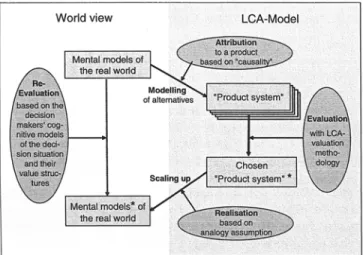
Fig. 1 illustrates the conduct of LCA as a modelling tech- nique and decision support tool and its relation to the deci- sion-makers' mental models of the 'real world'. Mental models (Newell and Simon, 1972, Johnson-Laird 1983, Pennington and Hastie 1993, Jungermann et al. 1998) or cognitive models (Zimbardo 1992, Anderson 1985) are knowledge representations of partial aspects of our world, e.g. models of how our socio-economic system works with respect to certain goals or functions.
world in Fig. 1). This means that the action, for which the information was generated, is executed.
Ideally, the interventions deduced from LCA are consistent with the decision-makers' mental models of the decision situ- ation and their value systems. This means that they lead to intended environmental improvements from those perspec- tives the decision-makers are focussing on if a re-evaluation from a 'macro-perspective' would be organised (the dotted arrow in Fig. 1). The descriptive power of LCA - and in fact its usefulness as a decision support tool - is given by the degree of how well the 'real world'-interventions deduced from LCA reflect the decision-makers' world-view and men- tal models of the decision situation and their value systems when re-evaluated from a 'real world'-perspective.
Two symmetries in Fig. I are crucial for the consistency of this modelling-evaluation-realisation-(re-evaluation) circle of LCA: 9 The 'causality' in the attribution of material and energy flows to the product under study, allowing the analogy assumption of the life cycle model with the real world; 9 The correspondence of the LCA valuation methodology
with the decision-makers' value-structures.
The first of the two points, the vertical symmetry, is dis- cussed in chapter 3; the second point, the horizontal sym- metry, is discussed in chapter 7.
Fig. 1: The modelling-evaluation-realisation-(re-evaluation) circle of LCA
We target decision-makers' use of LCA for generating infor- mation on the environmental relevance of products. For this purpose, a model is set up covering the material and energy flows attributed to a product and their evaluation in view of their environmental impacts. The decision-makers expect LCA to depict the environmental relevance of products 'ad- equately' and to provide recommendations that are in line with their values and with their understanding of the real world (their cognitive or mental models of 'their real world'). In decision situations where LCAs are conducted, at least two alternatives (products or design options) are defined as product systems and evaluated with impact assessment meth- ods. The corresponding model of the alternative selected (the chosen 'Product system'* in Fig. 1) must be understood as a creative model for 'real world'-interventions (realisation), assuming analogy between the product system and the deci- sion-makers' mental models of the 'real world'. In LCA, this intervention is, e.g., the choice of an environmentally pref- erable product, or the implementation of an environmen- tally preferable design option. With this intervention, the mental models of the real world are transferred to the envi- ronmentally preferable situation (mental models* of the real
1 The reviewers of this paper argued that LCA also serves other purposes
such as environmental hot spot identification. The authors completely
agree. Nonetheless, a product system for hot spot identification must also
be set up in a way that it meets the modelling-evaluation-realisation-(re- evaluation) circle presented below.
3 Modelling Characteristics of the Life Cycle Inventory The modelling characteristics of the life cycle inventory are a first determinant of the representativeness of a product system. Modelling is reductionistic by definition. Models reflect reality in a symbolic way. Modelling the life cycle of a product as a product system means separating, structur- ing and describing a small part of the 'real world'. Model- ling the product system requires dealing with the socio-eco- nomic system, the technosphere, and its interconnection with the ecosphere as a complex whole-system. Many of the characteristics of LCA-methodology must be seen as the intent to reduce this complexity in order to generate a depictable, limited, simple, thus 'manageable', model as a basis for rational decision-making. Such characteristics of LCA-methodology are, e.g.:
9 Ceteris paribus assumption to limit the extension of the system under study;
9 Linearity assumption in order to reduce the complexity (in fact the non-linearity) of economic, social and envi- ronmental cause-effect relations;
9 Static modelling as a compression of time;
9 Compression of space by assuming an undifferentiated socio-economic and environmental unit world.
As a consequence of the socio-economic and environmen- tal unit world assumption, equal environmental interven- tions can be summed up as LCI for the impact assessment. Thus, during the modelling of a product system, the mass- and energy flows attributed to a product are completely abstracted from their temporal and spatial context (e.g. Hofstetter et al. 1998, ISO/EN 14 040, 1997). The result- ing model is an a-historical, site-independent input-output
LCA Methodology
Subjectivity
model representing the life cycle of a product, with no link- age to local, regional or global and historic, actual or de- sired sustainable material and energy flows. The creative rule for the modelling of the product system can thus be reduced to an a-temporal and spatially insensitive attribu-
tion (Heijungs 1997).
Spatial and temporal information is, in principle, not com- pletely lost during the modelling of the product system. Tracking emissions back to their causing processes is still possible. The interpretation step within LCA-methodotogy still allows one to address temporal and spatial aspects of the inventory analysis or the assessment step on a qualita- tive basis. Nonetheless, spatial and temporal information is not integrated into the calculation routines of the inventory analysis, nor in the assessment step.
The static input-output modelling and the assumption of a unit world have to be considered a rather simplistic approach for dealing with the complexity of the real world. On the other hand, the static modelling and the assumption of a unit world limit the huge data requirements of dynamic and site-specific modelling approaches to a still considerable quantity (see, e.g., Hofstetter 1998). Still, the question arises as to the representativeness and adequacy (validity) of the static, input-output model as life cycle of a product in view of the complexity of the 'real world' material and energy flows (and their environmental impacts). Referring to chapter 2 and Fig. 1, the question can be reformulated: how can 'causal- ity' be assured in the definition of the product system such that recommendations derived from LCA can be consid- ered 'suitable' for interventions on the 'real world' mate- rial and energy flows, given the constraints of LCA-model- ling characteristics?
In view of the input-output modelling characteristic of the product system and its respective LCI, special attention has to be given to the adequate attribution as the basic model- ling principle in order to obtain a 'causal' relationship be- tween the object to be depicted and the model. The validity of a product system and its related environmental impacts only depends on if processes held causally related to a prod- uct are considered at all and if they are considered in the
'right' way. The set of criteria presented below will provide
criteria allowing decisions during the attribution in the in- ventory analysis in a way that meets best the 'causality' of a product and its environmental impacts in the eyes of the decision-makers.
4 Criteria Derived from LCA-Application in Product-Design A first set of criteria on a product system is derived from recent literature on the experiences with the use of LCA in product-related decision-making (Bhamra et al. 1999, Brezet et al. 1999, Frankl et al. 1998, Hannsen 1995, Keller et al. 1999, Poole et al. 1999, Ritz4n et al. 1999, Wenzel et al. 1999). In summary, current experience with LCA in envi- ronmental product design is taken from various surveys. The strengths of LCA are perceived to be as follows:
9 LCA considers the whole life cycle of a product for ma- terial and process selection;
9 LCA makes the connection between product features and environmental impacts understandable;
9 LCA allows for the understanding of environmental trade-offs;
9 LCA provides a learning effect on environmental matters; 9 "LCA is not simply a method for calculation, but, po- tentially, a completely new framework for business think- ing" (Portisch 1997, p. 100).
Further, LCA is hampered with some weaknesses impeding its wider use:
9 LCA results are disputable;
9 LCA still is burdened with general methodological diffi- culties;
9 LCA has high data demands in the early stages of prod- uct development, but at the early stages of design data are in low volume and of low quality;
9 LCA generally has large data requirements;
9 LCA is a very cumbersome tool, but at all stages of de- sign, designers often only want a tool which will allow 'quick alternatives analysis', enabling them to make de- cisions about which material or other option to take; 9 LCA is costly. However, costs are not always regarded as a
handicap for the use of LCA. To our knowledge, this as- pect has been stressed more in some counties (e.g. Switzer- land and Germany) than in others (e.g. Sweden or Italy). Despite these weaknesses, an increased direct application of LCA in research, development and design was expected. This can be interpreted as a reorientation of LCA applications from a retrospective, analytical, and descriptive perspective towards a forecasting, planning perspective.
From these experiences, the following criteria of a product system can be deduced from practical experience in using LCA in product-oriented decision-making. The model set up during the inventory analysis must be:
9 Comparable;
9 As simple, as manageable, as transparent, as cheap, as quick but still as 'adequate' as possible under the given economic constraints, depending on goal and scope of the study, and must allow instant recalculation (for di- rect applications);
9 Actor-based, i.e. reflecting the decision-makers' space for action.
9 As site- and case-specific as possible, i.e. uses as much site-specific information as possible.
The importance of site-specificity and of an actor-based per- spective very much support the claim derived from decision theory, that tools applied in decision-making should be 'de- scriptive of the problem environment' (see below). From a management science point of view, two characteristics have to be fulfilled for a rational use of LCA:
9 Balance between benefits and costs of LCA: the mar- ginal cost of collecting and computing more and better information about environmental impacts should not
exceed the marginal benefits of information for the natu- ral environment (Schaltegger 1997a);
Eco-efficiency: the ratio of environmental benefits to the economic cost of the tool must stand in an efficient relation compared to other investment options (Schaltegger 1997b).
5 Criteria on LCA as Decision Support Tool
Further criteria on a product system are derived from stand- ard literature of decision theory. During the conduct of an LCA, models are set up which describe the life cycle of a product as the sum of material and energy flows caused by a product and their corresponding environmental relevance. From a decision theoretic perspective, these models are part of the problem description. As such, these models have to comply with some criteria common to all models developed within decision support tools. According to yon Winterfeld and Edwards (1986), problem descriptions of decision sup- port tools should be:
9 Simple: the decision-makers should be able to understand inputs, processes, and outputs of the problem descrip- tion as a precondition to affect their decisions;
9 Descriptive of the problem environment: "A problem description must, of course, capture the analyst's (and with some luck, the decision-makers') intuitions about the important aspects of the problem including values, structures, and other features of the organisation and processes, entities, and phenomena that specify its envi- ronment" (von Winterfeldt and Edwards
1986,
p. 35f). 9 Manageable: value choices that are too numerous or too difficult for the decision-makers as well as excessively te- dious or expensive computations will not serve the deci- sion-making process.Keeney and Raiffa (1976) mention the following as desirable properties of a problem description:
9 Complete: it should cover all the important aspects of the problem;
9 Operational: it can be meaningfully used in the analysis; 9 Decomposable: aspects of the evaluation process can be
simplified by breaking it down into parts;
9 Non-redundant: double counting of impacts can be avoided;
9 Minimal: the problem dimension is kept as small as possible.
This is, of course, also true for LCA as Scholz and Weiden- haupt (1998) state, especially related to the second of the above mentioned points of von Winterfeldt and Edwards (1986): "An LCA (...) only makes sense if the object to be inventoried and assessed as well as the related impacts are recorded appropriately and the value structures of the user are suitably taken into account" (Scholz and Weidenhaupt
1998,
p. 39; translated from German, WF).The question arises: which are the elements that make an LCA and the product system as model of the life cycle of a product 'descriptive of the problem environment'? Several elements can be listed that have to be appropriately depicted in LCA in order to provide a descriptive model (for a de-
tailed derivation, see Werner 2002a). Among the most im- portant mental models influencing modelling in the life cy- cle inventory analysis are the:
9 Life cycle of a product itself: first of all, the product sys- tem as life cycle model of a product is a mental model itself. The life cycle of a product is a theoretical con- struct that has to be concretised during modelling in the life cycle inventory analysis;
9 Technosphere and ecosphere as demarcations or segre- gations which are basically given by the assessment meth- ods applied in the impact assessment step;
9 Internal structure of technosphere, i.e. knowledge on processes and technologies, guiding the definition of mod- ules, sub-modules and unit processes, and closely related; 9 Material and market characteristics of the materials and
products involved;
9 Organisational principle of the socio-economic system. This rfiental model is relevant whenever changes within technosphere have to be modelled, e.g. if substitution effects or marginal changes have to be depicted, or if 'arbitrary' allocation factors have to be chosen;
9 Range of the decision-makers' responsibility in view of the management rules for sustainable development de- fines the life cycle steps and processes the decision-mak- ers feel responsible for. This mental model is especially relevant when reuse and recycling are modelled in the life cycle inventory analysis. It is also closely linked to the following point;
9 Role of environmental information for different actors for the achievement of sustainable development, which possibly guides the choice of a marginal or descriptive LCA, but which is also closely linked to the mental model of the range of the decision-makers' responsibility. The decision-makers' values involved in the definition of the product system and expressed as preferences are stated in the following decision situations:
9 Attribution of material and energy flows to the product system in the sense of 'less is better';
9 Level of relevance for cut-off (the percentage) below which 'irrelevant' inputs and outputs (mass, energy or environmental interventions) are cut off;
9 Valuation of outputs (or functions) as co-products of a multifunctional process, which get attributed environ- mental interventions in contrast to 'by-products' or 'waste', which go free of environmental interventions during allocation procedures;
9 Valuation of the functionality of input and output mate- rials when deciding on modelling closed-loop or open- loop recycling. This valuation is strongly influenced by the mental model of the organisational principle of the socio-economic system;
9 Definition of material-specific management rules for a sustainable use of the materials involved, which is closely linked to the mental models of the material and market characteristics. This point affects the attribution of ma- terial and energy flows to the product system in-a funda- mental way (see chapter 7);
LCA Methodology
Subjectivity
9 Modelling of changes within the socio-economic system stating the decision-makers' attitude towards risk expressed in their temporal preferences. This is particularly relevant when modelling future reuse and recycling options. All these mental models and values guide the setting up of the product system as attribution problem in LCA. These mental models and values have to be properly addressed and depicted in a product system if the results of an LCA should be relevant for decision-makers. It is at least doubt- ful whether results provided by a decision support tool will be considered in the decision-making process if the models developed do not fulfil all three points mentioned by von Winterfeld and Edwards (1986) and properly address the mental models and values/preferences listed above.
6 Excursus: Whose Values and Mental Models are to be Represented in LCA?
If the decision-makers' cognitive or mental models and val- ues shape the models developed within LCA, a crucial ques- tion arises on the validity of LCA-results: whose values and mental models are to be represented in LCA?
LCA as a decision support tool is situated between the re- quirement of being representative for the decision field and the decision-makers on the one hand, and of being 'objec- tive' in the sense of allowing unbiased comparison of the environmental relevance of products on the other. So the questions arise a) which values, and b) which mental mod- els the modelling in LCA should be based on.
Should it be based on the decision-makers' values and men- tal models in order to be 'descriptive of the problem envi- ronment' (see chapter 5) and to raise, thus, the chance of an LCA becoming relevant in the decision-making situation? Or should 'generally agreed on' accounting and assessment rules be applied, risking that the outcome of an LCA is ig- nored by the decision-makers for not being
descriptive?
Ad a)
LCA has been developed as a decision support tool within the philosophy of environmental management, which basi- cally refers to the concept of sustainable development. Hence, sustainable development can be considered as the overall tar- get direction and underlying value system for environmental decision support tools. Still, sustainable development as a nor- mative concept will never be fully operational, nor will an interpretation of it ever be generally agreed on.Another set of values influencing the conduct of an LCA are the decision-makers' personal preferences, in particular tem- poral preferences. They are influencing the way ignorance of future processes is dealt with and relate to the decision- makers' attitude towards risk. For this set of values, the same reasoning is valid as outlined below for mental models.
Ad b)
the answer to the question of which mental models should be depicted in LCA is less obvious. Mental models constitute a particular worldview and can be the result of particular interests. Conflicts can arise between the repre- sentation of the decision-makers' mental models and theclaim of LCA to provide new insight and knowledge in a 'reliable' way.
Obviously, particular (economic) interests should not bias LCA. On the other hand, it should provide recommenda- tions on environmental improvement options that do not obviously contradict market and material characteristics. Further, LCA should not be based on assumptions of the organisational principles of the socio-economic system that are not shared by the decision-makers. In fact, a common sense between the different stakeholders of a particular LCA should be obtained on any assumption (including mental models and values) made during the conduct of an LCA. Stakeholders of a particular LCA are, e.g., the decision- maker(s), the modeller(s), the members of an eventual steer- ing committee, the representatives of other material groups in comparative studies, eventually, the internal or external peer reviewer(s), etc.
Some of the mental models applied during the conduct can be backed up by literature of resource economics, material sciences, environmental sciences, etc. Still, some decisions during the definition of a product system require the appli- cation of values or mental models, on which several lines of reasoning can be justified from scientific literature. In these cases, the selection can only be justified on an argumenta- tive basis when re-evaluating the optimisation options de- rived from an LCA from a 'real world'-perspective accord- ing to the above-mentioned criteria.
To adequately model the decision-makers values and men- tal models, the conduct of an LCA has to be perceived and structured as a group modelling process (see e.g. Vennix 1996, Vennix et al. 1996). The design of group modelling processes for LCA is still an open research field.
7 Descriptive Power of LCA
LCA by itself does not generate values. It is based on under- lying concepts of 'environmental soundness' or 'sustain- ability', commonly considered the target state in the actual public environmental discussion. LCA as a methodology has been developed within these normative concepts and should depict them as a tool used for environmentally conscious decision-making. In this part, the descriptive power of LCA in view of the management rules of sustainable development is discussed. This discussion refers to the horizontal symme- try shown in Fig. 1.
Reference is made to current impact assessment methods such as the CML-method (Heijungs et al. 1992, Guin~e et al. 2001), the ecoscarcity-points method (Ahbe et al. 1990, Brand et al. 1998), the critical volumina method (Habersatter 1991), the EPS-method (Steens et al. 1992), or the Eco-indi- cator 95 and Eco-indicator 99 (Goedkoop 1995, Goedkoop and Spriensma 2000).
Considering the diversity of aspects of the environmental dimension of sustainable development (see e.g. Messner 1999, Radke 1999), it is obvious that only a few aspects
are covered by current LCA practice. LCA, with its input- output model, addresses very well environmental improve- ment options related to more effective and efficient use of resources in process optimisation (under the assumption that 'causality' is properly reflected during attribution of material and energy flows!). LCA can be a very effective tool for relative comparisons, particularly if a mix of en- ergy-related, material application-related and process-re- lated aspects plays a role. This is especially true for global impact categories like potential greenhouse gas emissions, or potential ozone depletion.
LCA is less descriptive in situations in which toxic/hazard- ous substances are involved because of the compression of time and space. This compression does not allow for the integration of regional background contamination or inter- ventions, environmental thresholds, temporally and spatially resolving use patterns of resources, risk etc. into impact as- sessment methods (see, e.g. Schaltegger 1997a).
Some further aspects of the environmental dimension of sus- tainable development are not covered at all, or are not a
priori
covered by current impact assessment methods, e.g.: 9 Demand-related issues, e.g. the aspect of sufficiency; 9 Resource consumption (see, e.g., Brezet et al. 1999,Goedkoop et al. 2000);
9 Mechanical impacts such as soil compression; 9 Risk-related considerations;
9 Effects on genetic biodiversity;
9 The management of material and energy flows within technosphere, e.g. the entropic aspects of material use or the intended substitution of non-renewable materials by renewable ones.
The latter point deserves special attention. The entropic as- pect of material use, i.e.. the lowest possit~le over-all increase of entropy over the life cycle of a product or material as- suming a 'spaceship economy' (e.g. Daly 1974), is not cov- ered by current impact assessment methods. But if consid- ered relevant for a specific material, it can be integrated into a product system in the inventory analysis when depicting reuse and recycling through the selection of value- or 'mate- rial quality'-based allocation procedures (see Werner and Richter 2000a and 2000b, Werner 2002b).
Also, the intended substitution of non-renewable materials for renewable ones can be integrated into LCA when taking environmental 'opportunity cost' related to possible substi- tution effects into account in the inventory analysis (see Werner 2002c).
The above shortcomings can be stated independently of the chosen impact assessment method. Thus, additionally to the management of environmental interventions from techno- sphere on ecosphere, sustainable development and its opera- tionalisation also cover the management of the material and energy flows
within
technosphere (e.g. BUWAL 1997, Daly 1990, Messner 1999).From the viewpoint of resource management within techno- sphere it has to be stated that:
9 Management rules for a sustainable use of renewable and non-renewable resources differ, though they are in- terconnected as it is assumed that renewable resources will increasingly substitute for non-renewables; 9 Management rules for sustainable material flows have to
be specified for each resource and the materials gained from it in its specific context of current (and future) use, as the context of extraction, production, use/consumption, waste treatment and recycling can vary for each resource. These circumstances must be respected with case-specific (ma- terial specific) modelling while attributing material and en- ergy flows to a product in the inventory analysis. Here, once again, the interdependency of the attribution of material and energy flows to a product and the decision-makers' value sys- tem becomes apparent. Respecting this interdependency in the inventory analysis is essential i f inconsistencies between the LCA and the decision-makers' value system-and thus sub- optimal recommendations-shall be avoided. Only in this way does the attribution of material and energy flows to a product under study effectively cover the 'causality' of these flows as perceived by the decision-makers (see also Fig. 1).
Further criteria for the product system and its LCI can be derived from the above:
A product system with its respective LCI that best supports the process of rational decision-making:
9 Covers the decision-makers' mental models of their range of responsibility in view of the management rules of sus- tainable development;
9 Provides improvement options that are in line with the sustainable management rules referring to the:
a) ,Material- and energy flows within technosphere; b) Environmental consequences of the environmental in-
terventions on ecosphere.
8 Conclusions
The criteria of product systems and their respective LCIs within LCA can be summarised as follows. A product sys- tem with its respective LCI that best supports the process of effective and efficient decision-making - and thus the most adequate descriptive model of the life cycle of a product in LCA should be:
9 Complete, operational, decomposable, non-redundant, minimal, and comparable;
9 As simple, as manageable, as transparent, as cheap, as quick, but still as 'adequate', as possible under the given economic constraints, depending on the goal and scope of the study, and allows for instant recalculation; 9 Actor-based, i.e. reflect the space for action and the de-
cision-makers' mental models of their range of responsi- bility in view of the management rules of sustainable de- velopment;
9 As site- and case-specific as possible, i.e. use as much site-specific information as possible.
It respects:
9 Material and market characteristics of the materials in- volved in the definition of the life cycle of a product;
LCA Methodology
Subjectivity
9 The decision-makers' cognitive or mental models of the organisational principle of the socio-economic system; 9 The decision-makers' attitudes towards risk when mod-
elling future processes. It provides:
9 Improvement options that are in line with the sustain- able management rules referring to the:
a) Material and energy flows within technosphere; b) Environmental consequences of the environmental in-
terventions on ecosphere.
Apart from that, the marginal cost of collecting and comput- ing more and better information about environmental impacts must not exceed the marginal benefits of information for the natural environment and the ratio of environmental benefits to the economic cost of the tool must stand in an efficient relation compared to other investment options.
The above reasoning has several consequences for LCA as a decision support tool:
9 In comparative LCA, the application of equal allocation procedures does not lead to LCA-resuhs on which prod- ucts made from different materials can be compared in an adequate way. Each product and material must be modelled according to its specific material and market characteristics as well as to its particular management rules for its sustainable use. A generic LCA-methodol- ogy including preferences on methodological options is not definable if material and market characteristics of different products and materials should be depicted in an adequate way.
9 The evaluation of changes provides insight into the suit- ability of the models developed in descriptive LCA. A partial validation of the product system as model of a product life cycle can be made if improvement options deducible from an LCA contradict material and market characteristics of the materials involved, or if 'recom- mended' improvement options lead to sub-optimal solu- tions if reassessed from a macro-perspective.
9 Decisions in the inventory analysis related to the attri- bution (and 'allocation') of environmental interventions to the product under study shall be made in accordance to the above-stated characteristics. Only in this way do the outcomes of an LCA - and thus its underlying mod- els - become relevant for the decision-makers in a way that they influence their actions. Indeed, this is the real challenge for LCA practitioners and the final arbiter on any methodological proposition for LCA.
Acknowledgements. The authors acknowledge the valuable comments of Prof. Dr. S. Schaltegger, Dr. K. Richter, and of three anonymous re- | viewers on previous ve_rsions_o__f t_hi._s p ap__er[. ... J
References
Ahbe S, Braunschweig A, Miiller-Wenk R (1990): Methodik fiir Okobilanzen auf der Basis 6kologischer Optimierung. Schrif- tenreihe Umwelt SRU 133, Bundesamt fiJr Umwelt, Wald und Landschaft (BUWAL), Bern
Anderson JR (1985): Cognitive Psychology and Its Implications. 2nd ed, WH Freeman and Company, New York
Bhamra TA, Evans S, McAloone TC, Simon M, Poole S, Sweatman A (1999): Integrating Environmental Decisions into the Prod- uct Development Process; Part 1: The Early Stage. In: Proceed- ings of the First International Symposium on Environmentally Conscious Design and Inverse Manufacturing 1999, Tokyo, 329-337
Brand G, Scheidegger A, Schwank O, Braunschweig A (1998): Bewertung in Okobilanzen mit der Methode der 6kologischen Knappheit. Okofaktoren 1997. Schriftenreihe Umwelt SRU 297, Bundesamt fiir Umwelt, Wald und Landschaft (BUWAL), Bern Brezet H, Stevels A, Rombouts J (1999): LCA for EcoDesign; The Dutch Experience. In: Proceedings of the First International Symposium on Environmentally Conscious Design and Inverse Manufacturing 1999, Tokyo, 36-40
BUWAL (1997): Nachhaltige Entwicklung; Aktionsplan fiir die Schweiz. Bundesamt fiir Umweh, Wald und Landschaft (BUWAL), Bern
Consoli F, Allen D, Boustead I, Fava JA, Franklin WE, Jensen AA, de Oude N, Parrish R, Perriman R, Postlethwaite D, Quay B, Seguin J, Vigon BW (1993): Guidelines for Life-Cycle Assess- ment: A Code of Practice. 1st ed, Society of Environmental Toxicology and Chemistry (SETAC), Brussels, Washington/DC Daly HE (1974): The Economics of the Steady State. In: Amer
Econ Rev 64 (2): 15-21
Daly HE (1990): Towards some Operational Principles of Sus- tainable Development. In: Ecol Econ 15 (2): 1-6
Ekvall T, AM Tillman (1997): Open-Loop Recycling: Criteria for Allocation Procedures. In: Int J LCA 2 (3): 155-162
Elkington J, Hailes J (1993): The LCA Sourcebook. A European Business Guide to Life-Cycle Assessment. SustainAbility, Lon- don 1993
Frankl P, Rubik F (1998): Application Patterns of Life Cycle As- sessment in German, Italian, Swedish and Swiss Companies. Comparative Results and Conclusions. Schriftenreihe des Instituts fiir Okologie und Wirtschaft 130/98, Institut fiir Okologie und Wirtschaft, Berlin/Heidelberg
Frischknecht R (1994): Allocation - An Issue of Valuation? In: G Huppes, Schneider F (eds): Proceedings of the European Work- shop Allocation in LCA. Centrum voor Milieukunde (CML), Leiden, Society of Environmental Toxicology and Chemistry (SETAC), Brussels, 122-131
Goedkoop M (1995): The Eco-indicator 95; Final Report. Vol 9523 Netherlands Agency for Energy and the Environment (NOVEM) Ammersfoort
Goedkoop M, Spriensma R (2000): The Eco-indicator 99; A Dam- age Oriented Method for Life Cycle Impact Assessment, Meth- odology Report. 2nd ed, Pr~ Consultants B.V., Amersfoort Guin~e JB, Udo de Haes HA, Huppes G (1993): Quantitative Life
Cycle Assessment of Products: Goal Definition and Inventory. In: J Cleaner Prod 1 (1): 3ff
Guin6e JB, Gorr6e M, Heijungs R et al. (2001): Life Cycle Assess- ment; An Operational Guide to the ISO Standards; Final Re- port, May 2001. Ministry of Housing, Spatial Planning and Environment (VROM) and Centrum voor Milieukunde (CML), Rijksuniversiteit, Leiden, http://www.leidenuniv.nl/cml/lca2/ index.html
Habersatter K (1991): Okobilanzen yon Packstoffen, Stand 1990. Schriftenreihe Umwelt SRU Nr 132, Bundesamt fiir Umwelt, Wald und Landschaft (BUWAL), Bern
Hannsen OJ (1995): Preventive Environmental Strategies for Prod- uct Systems. In: J Cleaner Prod 3 (4): 181-187
Heijungs R (1997): Economic Drama and the Environmental Stage; Formal Derivation of Algorithmic Tools for Environmental Analysis and Decision-Support from a Unified Epistemologi- cal Principle. Diss, Centrum voor Milieukunde (CML), Rijks- universiteit, Leiden
Heijungs R, Guin6e JB, Huppes G, Lankreijer RM, Udo de Haes HA, Wegener Sleeswijk A, Ansems AMM, Eggels PG, van Duin R, de Goede HP (1992): Environmental Life Cycle As- sessment of Products, Guide and Background. Centre for Mili- eukunde, Leiden
Hofstetter P (1998): Perspectives in Life Cycle Impact Assessment; A Structured Approach to Combine Models of the Techno- sphere, Ecosphere and Valuesphere. Kluwer, Dordrecht Hofstetter T, Baumgartner T, Schoh RW (2000): Modelling the
Valuesphere and the Ecosphere: Integrating the Decision Mak- er's Perspectives into LCA. In: lnt J LCA 5 (3): 161-175 ISO/EN 14'040 (1997): Environmental Management- Life Cycle
Assessment - Principles and Framework (ISO/EN 14'040: 1997). ISO/TC 207/SC5, CEN European Commitee for Stand- ardization, Brussels
Johnson-Laird PN (1983): Mental Models. Cambridge Univer- sity Press, Cambridge
Jungermann H, Pfister H-R, Fischer K (1998): Die Psychologie der Entscheidung. Spektrum Akademischer Verl., Heidelberg Keller C, Wegmiiller M, Winkler R (1999): Ecodesign in Swiss
Industries - Overview of the Current Situation; An Empirical Research among Marketing and Research and Development Departments. Verl. Eco-Performance, Zfirich
Kl6pffer W (1998): Subjective is not Arbitrary. In: Int J LCA 3 (2): 61-61
Lindfors LG, Christiansen K, Hoffman L, Virtanen Y, Juntilla V, Leskinen A, Hanssen O J, Ronning A, Ekvall T, Finnveden G (1995): LCA-Nordic Technical Reports No 1-9. TemaNord
1995:502, Nordic Council of Ministers, Kopenhagen Messner F (1999): Nachhahiges Wirtschaften mit nicht-erneu-
erbaren Ressourcen. Verl. Peter Lang, Frankfurt a.M., Berlin, Bern, Brussels, New York, Wien
Newell A, Simon HA (1972): Human Problem Solving. Prentice- Hall, Englewood Cliffs/NJ
Patterson M (1998): Commensuration and Theories of Value in Ecological Economics. In: Ecol Econ 25 (1): 105-125 Pennington N, Hastie R (1993): Reasoning in Explanation-Based
Decision Making. In: Cognition 49:123-163
Poole S, Bhamra TA, Evans S, McAloone TC, Simon M, Sweat- man A (1999): Integrating Environmental Decisions into the Product Development Process; The Later Stage. In: Proceed- ings of the First International Symposium on Environmen- tally Conscious Design and Inverse Manufacturing 1999, To- kyo, 334-337
Radke V (1999):Nachhaltige Entwicklung; Konzept und Indika- toren aus wirtschaftstheoretischer Sicht. Umweh und Okono- mie Vol 30, Physica-Verl., Heidelberg
Ritz4n S, Norell M (1999): Environmental Consciousness in Inte- grated Product Development. In: Proceedings of the First In- ternational Symposium on Environmentally Conscious Design and Inverse Manufacturing 1999, Tokyo, 346-350
Schaltegger S (1997a): Economics of Life Cycle Assessment; Inef- ficiency of the Present Approach. In: Business Strategy and the Environment 6:1-8
Schaltegger S (1997b): Information Cost, Quality of I.nformation and Stakeholder Involvement - The Necessity of International Standards of Ecological Accounting. In: Eco-Manag Audit 4: 87-97
Schoh RW, Weidenhaupt A (1998): Fazit Okobilanzen; Okobilan- zen auf dem Weg in die Praxis. In: Bulletin ETH Zfirich 268: 28-41
Steens B, Ryding SO (1992): The EPS-Enviro-Accounting Method; An Application of Environmental Accounting Principles for Evaluation and Valuation of Environmental Impact in Product Design. IVL Report No B1080, Swedish Environmental Re- search Institute (IVL), Gothenburg
Vennix JAM (1996): Group Model Building; Facilitating Team Learning Using System Dynamics. John Wiley and Sons, Chich- ester, New York, Brisbane, Toronto, Singapore
Vennix JAM, Henk A, Akkermans A, Rouwette AJA (1996): Group Model-Building to Facilitate Organizational Change: An Exploratory Study. In: System Dynamics Review 12(1): 39-58
von Winterfeldt V, Edwards W (1986): Decision Analysis and Behavioral Research. Cambridge University Press, New York Wenzel H, Alting L (1999): Danish Experience with the EDIP
Tool for Environmental Design of Industrial Products. In: Pro- ceedings of the First International Symposium on Environmen- tally Conscious Design and Inverse Manufacturing 1999, To- kyo, 370-379
Werner F, Richter K (2000a): Economic Allocation and Value- Corrected Substitution; Reply to the 'Letter to the Editor' by Gjalt Huppes. In: Int J LCA 5 (4): 189-190
Werner F, Richter K (2000b): Economic Allocation in LCA: A Case Study About Aluminium Window Frames. In: Int J LCA 5 (2): 79-83
Werner F (2002a): Interdependencies Between LC-modelling and t h e Use of LCA in Product Design-related Decisions; Influence of Cognitive Models and Values on the Modelling of Reuse and Recycling and Other End-of-Life Options. Diss. ETH No 14'750, Swiss Federal Institute of Technology (ETH), Zurich (to be published)
Werner F (2002b): Treatment of Recycling of Aluminium in LCA; Development and Evaluation of the Value-Corrected Substitu- tion Procedure Applied on Window Frames. Research and Work Report 115/47, Eidg. Materialpriifungs- und Forschungsanstalt (EMPA), Duebendorf
Werner F (2002c): Modelling of Wooden Products in Life Cycle Assessment with Special Emphasis on Recycling and End-of-life; Model Requirements, Allocation Procedures and Recommen- dations Derived from LCAs of Railway Sleepers and Particle Board. Research and Work Report 115/48, Eidg. Materialprii- fungs- und Forschungsanstalt (EMPA), Duebendorf
Zimbardo PG (1992): Psychologie. 5. Aufl., Springer Verl., Ber- lin, Heidelberg, New York
Received: January 15th, 2002 Accepted: November 5th, 2002 OnlineFirst: November 6th, 2002