Ministry of Higher Education and Scientific Research
Faculty of Foreign Languages
Department of English
A Dissertation Submitted in Partial Fulfillment of the Requirements for a
Master’s Degree in Didactics and Applied Linguistics
Submitted by: Zakia Kouloughli
Board of examiners:
University of Mostaganem
Souad Hamerlain
Dr
:
Chair
University of Mostaganem
Boudjelal
apha
Must
Dr
:
Examiner
University of Mostaganem
Dr Hayat Aoumeur
Supervisor:
Academic
year : 2018/2019
DEDICATION
To My husband
Acknowledgements
.
First of all, I thank Allah for giving me courage and
help to finish this work.
I would like also to express my deepest appreciation
for my supervisor Dr Aoumeur for helping me and
giving me advices to achieve my goal
.
My gratitude goes to my teachers; Dr Elouchdi, Dr
Ziani, Dr Djoub, Dr Benosmane, Dr Alichaouch, Dr
Adnani, Dr Hirech and Dr Mouley Hacene.
My special thanks go also to my friends Samira
Bechlaghem and Dadi Amrani, to my brother Zakaria
Kouloughli and my daughter Saba Bekhechi.
I would like also to thank the board of examiners Dr
Hamerlain and Dr Boudjelal for evaluating and
Abstract
Some pupils do not pay attention in the classroom and try to disturb their classmates, as a result the teachers have negative attitudes towards them and blame parents for their education. The present study is designed to investigate teachers’ attitudes towards their inattentive pupils and the main aim is to discover and to determine how they contribute to keep the attention of those primary age children learning with Attention Deficit Hyperactivity Disorder. Thus, a classroom observation and an interview with the teachers were conducted for data gathering. The sample of this paper are primary school teachers of fifth grade in three Algerian schools; Bekhtawi Mohamed, Belkacem Saadoun and Commandant Ferraj primary schools in Oran city. The findings of this investigation show that the majority of primary teachers have negative attitudes while interacting with inattentive pupils, and unfortunately they do not know that some cases of pupils’ inattentiveness are due to a pathological cause and need specific attention.
List of Abbreviations
ADD: Attention Deficit Disorder
ADHD: Attention Deficit Hyperactivity Disorder
CHADD: Children and Adults with Attention Deficit Disorder.
ADDA: Attention Deficit Disorder Association.
RAS: Reticular Activating System.
List of Figures
Figure1. 1: The Reticular Activating System ………..………..…….4
Figure1. 2: Types of attention……….………..……...6
Figure 3.1: Activity one………..…………..………...……..…….39
Figure 3.2: Activity two………...………40
List of Tables
Table 2.1: Teachers’ personal information ………..……….17
List of Graphs
Graph 2.1: Teachers’ use of colors ……….…..………..……...………22
Graph 2.2: Teachers’ permission for movement.……….……….….23
Graph 2.3: Teachers pupils’ selection………….………….…. ....………….……...24
Graph 2.4: Teachers’ maintaining discipline. ….………....….……….…...25
Graph 2.5: Pupils with teacher 05……….…..………...26
Graph 2.6: Pupils with teacher 06 ….………….………..………..…..….27
Graph 2.7: Seating arrangement’s reasons……….….…....29
Graph 2.8: Causes of distraction ……….…….……..……….……….…...30
Dedication...Ⅰ Acknowledgements... ...Ⅱ Abstract... Ⅲ List of Abbreviations... ..Ⅳ List of Figures... Ⅴ List of Tables... Ⅵ List of Graphs... Ⅶ Table of Contents...Ⅷ General Introduction ... ... 1
Chapter One: Literature Review 1-1 Introduction... 3
1-2Definition of Attention... 3
1-3Types of Attention... 5
1-4Factors related to Attention...6
1-5Importance of Attention in Learning ... 7
1-6Gender and Attention in learning... 8
1-7Attention Deficit Hyperactivity Disorder...9
1-8Teachers Attitudes... 11
1-9 Conclusion ... 13
Chapter Two: Methodology, data collection and analysis 2-1 Introduction...14 2-2Research Design...14 2-2-1Research Type...14 2-2-2The Participants...15 2-2-2-1 The Schools………..15 2-2-2-2The Teachers...16
2-3Data Collection Tools... 18 2-3-1Observation... 18 2-3-2Interview ... 19 2-4Data Analysis... 20 2-4-1Observation... 20 2-4-2Interview... 27 2-5Data Discussion... 31 2-5-1Observation……... 32 2-5-2Interview... 32 2-6 Conclusion ... 34
Chapter Three: Suggestions and recommendations 3-1 Introduction...35 3-2Suggestions...35 3-3 Activities of Attention………38 3-4 Conclusion...41 General conclusion...42 References………...43 Appendices………..46
GENERAL INTRODUCTION
Parents generally blame teachers for their techniques of teaching their children at school. They find themselves repeating the same process of explaining classroom’s lessons at home. On the other hand, teachers blame parents for poor education which leads to pupils’ lack of performance in class. After all, how can a teacher expect to teach well when the classroom is filled with daydreamers, hyper actives, and pupils with bad manners? It is true that good parenting skills are indispensable to quality education but is it fair to place all blame solely on the parents?
In the current dissertation, we shed some light on how skilled and how well-equipped the Algerian teacher is in handling everyday elementary classroom challenges. To carry this out, we investigate performance standards applied in developed countries, in this case the US, and we seek to determine if today’s primary school teacher keeps up, exceeds, or falls behind in their knowledge of best teaching and class management practices.
Because the research could be lengthy and due to time constraint, we choose to focus on one particular element that is our research question: does the Algerian teacher adapt his/her teaching techniques to deal with behavioural issues such as inattentiveness in class? We think to give the teachers the benefit of a doubt and assume that they are implementing all the tools available to them to keep their pupils attention in the classroom.
To illustrate this, we investigate performance expectations and guidelines commonly applied in developed countries; and by means of observation and by means of interviewing teachers, we can assess teachers’ performance and efficacy in the classroom environment and could answer the question of whether the teachers are doing a great job at keeping pupils’ attention on the lesson.
use as a sample for the study then we attended each class for two days in a row and observed how lessons were being conducted; then we fill in the checklist previously prepared. After the end of each class session, we interviewed each teacher to complete any missing information. Based on the data collected, the researcher will make an assessment on whether the teacher effectively used the tools available to them to successfully keep the pupils attention on the lesson.
1.1. Introduction
Attention is a wide term and it is a mature area of investigation in education, psychology, neuroscience and cognitive neuroscience because of its importance in life. In this chapter, the concept of attention is clarified by firstly, a definition and its types. Secondly, it deals with the importance of attention in learning. Thirdly, gender in learning and the factors which affect learning in the classroom, focussing on the attention deficit disorder then the attitudes of teachers towards such a phenomenon and finally a conclusion to sum up the whole chapter.
1.2. Definition of Attention
According to Oxford student‟s dictionary (2012), attention is „watching, listening to or thinking about somebody or something carefully‟. Masquetiaux (2013) the French psychologist states that attention has the meaning of fixing one‟s mind to something, and it is the concentration of the mental activity. In everyday life, the human being pays attention to several things, objects, actions, and so on, for instance, driving a car needs attention, following a lecture in a classroom needs attention too. Driving a car needs another type of attention in order to manipulate the wheel and naturally to comply with the code of conduct too. Listening to a radio and doing many actions at the same time like cooking and talking on the phone needs attention too.
Masquetiaux (2013) advocates also that it is the potential to orient selectively the attention upon pertinent and relevant data rather than non-relevant ones. Therefore, it is the function of the brain which affects the resources of the cognitive process to focus on
information or stimuli through the five senses (watching, listening, smelling, tasting and touching).
According to Gaddes (1994), there are two main forms of attention: the passive form and the active one. The former is about an involuntary process which is guided by external factors like a bright flash or a sudden noise. The latter is however a voluntary process whose alertness, concentration, interest and needs (curiosity and hunger) are the monitors of such a process and need energy (cited in Thorne & Thomas, 2009). And this is our concern since it is very important and it is the first step in the learning process. (Levine, 1997). (cited in ibid)
Some researchers as Levine (1998) and Barkley (1997) stated that attention has some components. These components are alertness, arousal, selectivity, saliency determination distraction, duration, previewing, planning, self-monitoring, self-regulation, need for stimulation and body movement. (cited in Thorne & Thomas, 2009)
In the brain, more exactly at the back of the neck, there is The Reticular Activating System or RAS which is the part responsible to make the human being feel alert or tired. Then the second step is the ability of the brain to select the stimulus or the most important information since it is impossible to pay attention to several events at the same time and it is called saliency determination. After that, the brain tries to ignore the other stimuli in order to stick with the most relevant and it is distractibility. Nevertheless, attention needs an amount of time with the ability to regulate and control by oneself something in order to accommodate to something else or to monitor the self-presentations by the body movements. (ibid)
1.3. Types of Attention
In general, attention is divided into four types: the divisible attention, the selective, the alternating and the sustained one.
The first one is the Divisible Attention. It is to react to two different events or tasks at the same time. This means to split attention into two parts since there are several sources. It is referred to a multi-tasking (cited in the Peak Performance Centre). For instance, speaking to a sick father in the phone and listening to a daughter asking help at the same time demands some effort.
The second one is the Selective Attention. In fact, it is to attend at any given moment only one source of information from others and to select it consciously then to focus on and to ignore the other sources. Therefore, it is to be able to avoid distraction from external influences as noise and internal ones as thought. (ibid). Taking the example of the classroom, despite the big noise of the students, the persons try to select their attention to listen to the teacher‟s lesson.
The third one is the Alternating Attention. The focus of attention here changes completely from one task to another task or “to shift the focus between two different tasks with different cognitive demands” (Kimberly, 2009, p. 7). At this level, the person consciously changed their focus completely from one task or event to another one unlike the divided attention whose focus is divided into two different tasks happening at the same time.
Finally, the Sustained Attention is “the ability to focus on one specific task for a continuous amount of time without being distracted” (Bilimoria & Wheel, 1995, p.67). Here it is a matter of concentration since it concerns a long period of time of a mental effort in maintaining concentration as in reading a book or listening to a lesson. Therefore, this type of attention is our concern.
1.4. Factors related to Attention
There are some factors which contribute to the improvement of attention, and they are of two types. The first one includes the external factors which are: size, intensity, movement, contrast, repetition, change and novelty. In other words, things being bigger or smaller than the normal ones attract attention in addition to loud sounds, deep colours and moving things. The second one is the internal factors as desire, interest, motives, goal, past experience and attitude improve attention too. Thus, to be interested in something rise too much attention, as to be thirsty or sick push attention to water or medicines and finally, the aim of a student in medical field is to become a doctor and that of a pupil in examination is to succeed (Lawrence, 2018).
1.5. Importance of Attention in Learning
The term learning has been defined as “the activity or process of gaining knowledge or skill by studying, practicing, being taught, or experiencing something” (Merriam-Webster, 2018). It means that learning involves instruction and study because whenever the word learning is uttered the meaning is automatically related to “study, education, schooling and teaching and all of these demand attention.
Learning is related to the human being senses:
“According to Fatt (2000), “People use their five
senses to gather information and then channel it through three separate routes, called representational systems, to make sense of it” (p. 34). Those representational systems include visual, auditory, and kinaesthetic types of learners. (Fatt, 2000). Each individual shows a preference towards one of these systems, and specific communication accustomed to the learning style can improve communication with others (Fatt, 2000). He says that people with a visual learning
preference “see the world by constructing or remembering mental images” (p. 35). Fatt (2000) says that visual learners would prefer reading, observing, and the display of data and visual aids. Visual students would rather learn by watching movies, film strips, pictures, and graphs which help integrate the subject (Fatt, 2000).
(cited in Ellington and Benders, 2012, p. 6) When we show the baby or the child a flower for the first time, he is going to take it, to smell it and to taste it, as a result he will recognize it when he sees the flower again, because he had stored the image, as well as the smell in his brain due to his attention as well as the person who guides this child. Thus, the kinaesthetic learner remembers best by doing things with his hands, the auditory learner by hearing, and the visual one by seeing. Moreover, the teacher, the mother or the broadcasting play a major role for teaching children, additionally to the process of the children‟s attention. Generally speaking, learning and teaching go hand in hand, and the teacher should understand the learning style of the pupil in order to facilitate his learning‟s process. For instance, the visual learner learns best by looking at graphs or charts. However, the auditory one prefer to listen to a lesson orally explained by the teacher or a recording rather than reading written forms as books or newspapers. Finally, the kinaesthetic learner learns by touching, manipulating and doing things.
1.6. Gender and attention in learning
Males and females are physically different but both of them need the same process of learning in order to be socialised. This difference makes their brains different so as their tasks too. It is stated that “Research has found that males and females learn differently in
many aspects of education. First of all, female and male brains are constructed differently affecting the way they learn”. (Cited in Bartleby, 2018)
Some doctors have done an ultrasound scanner to the foetus of 26 weeks and they found that the male brain is 10% bigger than that of female but it doesn‟t mean that they are more intelligent. (Cited in Bloggersarina, 2017)
Moton says that few researchers advocated that the gender difference in learning is not a matter of attention but the problem is that boys need to hear louder than the girls do. For that reason, the teacher tries to attract the attention of all the learners by speaking louder but the girls do not appreciate such a teacher‟s reaction (cited in Bartleby,2018). However, specialists in Oto-rhino-laryngologists did not find any hearing difference between boys and girls unless the boys are exposed to a very noisy environment.
Some researchers find that teachers considered better the boys than the girls. They think that boys need more attention than girls. Lynch (2016) advocates that “boys simply tend to demand more attention, while girls tend to be quieter and more reticent” that is why the boys lack attention and try to disturb the girls within the classroom.
1.7. Attention Deficit Hyperactivity Disorder
ADHD is a neurobehavioral disorder. It is identified via behavioural and not physical characteristics. People with ADHD are described to be, inattentive and distracted. They cannot focus their attention. They are nervous and impatient. Abaoud (2013) points out that:
“Attention deficit / hyperactivity disorder (ADHD) , a
behavioural syndrome characterized by inattention and
distractibility, restlessness, inability to sit still, and difficulty concentrating on one thing for any period of time. ADHD most
commonly occurs in children, though an increasing number of adults are being diagnosed with the disorder. (p, 11)
Abaoud stated that there are three types of ADHD which are: Predominantly inattentive type: the child cannot:
- Pay attention to details.
- Stay focused on his activities as reading, or when the teacher explained the lesson.
- Listen to his teacher because he day dreams. - Manage his time to respect the deadlines of tasks.
Therefore, he forgets daily tasks and loses and forgets his school instruments. Predominantly hyperactive impulsive type:
- He is unable to stay seated.
- He makes too much noise when playing. - He talks too much (talkative).
- He blurts on answers before the teacher finishes his question. - He cannot wait his turn.
- He likes interrupting his classmates. (Cited in American Psychiatric Association).
Combine type: is the combination of inattentive type and hyperactivity. In other words, this type of pupils have the characteristics of inattentiveness in addition to
ADHD is considered a neurological disorder, and there is a difference between an ADHD brain and a normal one at the level of the prefrontal cortex and it can be
prefrontal cortex that are smaller or less active than normal in people with ADD. There is also a tendency for ADD to be genetic” (Greenbaum & Markel, 2006, p.174)
Barkley (1995) advocated that it is seen in an early age in which people can distinguish a normal child from ADHD child. In fact, the child is unable to perform what other children do in his age. (Bimbo, 2004)
It is related to brain function and it is diagnosed through the test of conners (Conners, 2008). This test evaluates the anxiety of the child, his self-esteem and how much hyperactive is he.
It consisted of three questionnaires given to first the parent, second to the teachers and finally to the doctors in order to diagnose such a deficit disorder. (cited in Portail enfance) Brock & Al (2009) suggested that interviews are useful in addition to the questionnaire with the same persons. (Cited in Abaoud; 2013, p.09)
From Britannica dictionary (2017), ADHD affects three times more males than females and impacts 3% to 6% of all children. Although evidence of the syndrome is prevalent in all countries, the United States remains the country with most children diagnosed with the syndrome.
1.8 Teachers attitudes
As noticed that, nowadays our world is full of distractions than ever before and it is of crucial importance to teach children both learning how getting rid of things which may distract them and teaching them how to sustain their attention in an early age.
The teacher‟s attitudes have a big impact on his learners in maintaining his classroom management and without a shadow of doubt by taking the appropriate behaviour in his classroom.
The teacher should understand that he is a teacher and not an architect. He is going to teach a human being and more precisely a child. Moreover, he has to take into consideration each child unique character (his age, sex, feelings and his needs).
The teacher has to bear with his pupils because he spent all his time explaining the lectures to them (William & Mercer & Ryan, 2015, p. 45) because he has an objective to achieve. This objective is to motivate them first, whatever learners‟ motivation is (intrinsic or extrinsic or not motivated), then to succeed in conveying the message and finally to finish the syllabus on time.
Obviously, teachers may differ in their teaching styles. There are some teachers who like to take power in the classroom, and there are others who are more flexible and less severe than the preceding ones. Ehrman and Dornyei (1998) emphasize that power is not inherently a “dirty word” whereas it is up to the teacher how to use it, whether positively or negatively. (cited in William & Mercer & Ryan, p. 37)
There are other tips that are taken from Helpguide.org which are as follow:
Teachers should speak frequently with the ADHD pupils and moved around the classroom.
The teacher can accommodate some simple actions as in seating: for example the ADHD ones take seats away from the windows and the door of the classroom and directly in front of the desk. He can accommodate also during the lectures as: To repeat the instructions as necessary.
To choose difficult tasks to do in the morning.
To use all that can attract their visual attention as pictures and colour coding. Additionally , he can accommodate in replacing long texts by short quizzes In addition to dividing the projects into short parts
1.9 Conclusion
The present chapter is all about theory. It gives a general idea about the next chapter. Furthermore, a definition of attention is introduced at the beginning of the chapter with a brief description of the types of attention which are as follow: divisible, selective, alternating and sustained attention, then, the importance of attention in learning is clearly displayed with the factors which can affect the human being attention. In addition to showing the teachers‟ best attitudes towards their inattentive pupils who are named as ADHD. Moreover, this category of children is again a factor of distraction which can affect even the attentive learners and deprive them from listening to the teacher and understanding their lessons.
2.1
Introduction
The present chapter explores the attitudes of elementary school teachers towards their inattentive pupils in the classrooms. Data has been gathered from interviews with eight different fifth grade elementary teachers belonging to four different classrooms, in three different elementary schools in Oran, Algeria.
The study has been carried out with careful consideration of the following: - Description of the population,
- Class environment,
- Data collection tools, as well as - Data analysis
2.2
Research
Design
This research examines teachers‟ attitudes towards their pupils especially the inattentive ones and more precisely those who suffered from the Attention Deficit
Hyperactivity Disorder known as ADHD. It describes both of the type of research and its participant.
2.2.1. Research type:
It is important to note at the onset that ADHD was not diagnosed by clinical means but was identified by means of observation only during class. Two main approaches were considered in the analysis of these attitudes;
- the qualitative approach, which addresses the why and how the teachers had such attitudes, and
- the quantitative approach, which focuses on generating numerical data, quantify attitudes and opinions into usable data for statistical purposes.
The classes chosen for the study were those of the fifth grade primary school. The researcher thought it would be an interesting case to study since pupils may be motivated a little more as their focus maybe on ascending to “a higher grade level” that of sixth grade, in middle school. The researcher relied on a checklist developed by academics (go to Appendix A); and observed whether the teachers‟ behaviour was congruent with the checklist or not.
2.2.2 The participants
To note at the outset that before conducting the present research, it was not possible to contact the intended population without prior permission from Oran‟s department of education, known as “l‟Academie”, the local authority, which handles all matters in relation to education and schools including activities such as conducting research in school premises. The process took a little work but permission was granted. The second step was to get in touch with school authorities of our choice, in this case the school principals, known as “Le directeur” or “la directrice”, to whom we had to approach, explain the purpose of our visit, and seek permission to sit-in in the classroom. School principals were very cooperative, welcoming, and helpful. They even volunteered to provide us with background information about their schools, teachers, pupils and the classroom setting; which they were helpful during the research.
2.2.2.1 The schools
Our choice for schools fell upon the following elementary schools:
a/ Bekhtaoui Mohamed Primary school was a very big school, with a big playground. The school had two fifth grade classes. Both of the classrooms were clean, organized and without any ornament on the wall. In one of the classes, we noticed flowers on the teacher‟s desk, a closet, and coat-racks in the back of the classroom. We also noticed tables
covered with coloured paper matching the colour of beautiful curtains, and a time clock hanged in the centre above the black board.
b/ Belkacem Saadoun Primary school was a nice school with a big beautiful garden full of trees and flowers and a big yard but the hallways and stairs were not properly maintained. The classroom was not very clean however. It was overly decorated with too many unorganized pictures and photos, which covered the walls, the windows, and even the door. Some tables were covered and others were not. There was too much clutter. c/ The last school, Commandant Ferradj Primary school, was an old small school built in an old area of the city centre. The director was a new young lady, and according to the school employees she was absent most of the time. The classroom was clean but everything looked old. It was not well decorated, and somehow the Algerian flags were all over the classroom.
2.2.2.2 The teachers
In Algeria, the ministry of education allocates two teachers for each class. A teacher of Arabic, whose responsibility encompasses teaching Arabic language, mathematics, civic, history, geography, arts & technology, and sports; and a teacher of French, responsible for teaching French language.
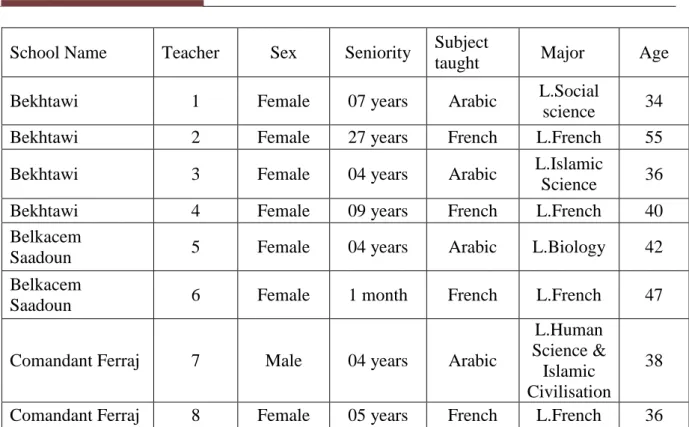
The teachers participating in the research were in total of eight: one male teacher and seven female teachers. They were of different seniority, different age and different background.
All teachers were between 30 and 45 years old of age, except the teacher of French language at Bekhtawi primary school, who was over the age of 55.
School Name Teacher Sex Seniority Subject
taught Major Age
Bekhtawi 1 Female 07 years Arabic L.Social
science 34
Bekhtawi 2 Female 27 years French L.French 55
Bekhtawi 3 Female 04 years Arabic L.Islamic
Science 36
Bekhtawi 4 Female 09 years French L.French 40
Belkacem
Saadoun 5 Female 04 years Arabic L.Biology 42
Belkacem
Saadoun 6 Female 1 month French L.French 47
Comandant Ferraj 7 Male 04 years Arabic
L.Human Science &
Islamic Civilisation
38
Comandant Ferraj 8 Female 05 years French L.French 36
Table 2.1: Teachers’ personal information
2.2.2.3 The pupils files
The pupils‟ age was between 10 and 11 years old and they were from different backgrounds. According to the principal, 96% of pupils ascended from 4th grade while 04% of them were repeating one, and were retaking the fifth grade class. On the economic status, 65% of the pupils come from middle class, from humble backgrounds, while 01% came from wealthy families, and 34% came from very poor families. The number of the pupils at Bekhtawi Elementary was 36 in one class and 30 in the other one. At Belkacem Elementary there were 45 pupils and at Commandant Ferradj there were 27 students.
2.3. Data Collection Tools
To collect data, and ensure validity of results two techniques were implemented. First, we used visual observation to record how teachers interacted with pupils, how they attracted their pupils‟ attention, and how they help them stay focussed. Next, we interviewed teachers to validate results obtained through observation.
2.3.1. Observation
We choose in-class observation as the first method to collect data. This technique provides us with the feel of the classroom environment and the conditions in which the learning process evolves. It also keeps us close to the scene of interaction between teacher and pupils; and it contributes to helping visualize the choice of stimuli pupils respond to. Kothari (2004) said that „ The observation is the most commonly used method especially in studies relating to behavioural sciences…Under the observation method, the information is sought by way of investigator‟s own direct observation without asking from the respondent‟( p. 96).
The main purpose of the observation process was to compare the observed teachers‟ behaviour against the checklist already prepared, which contained tools, teachers have to use during the class session to benefit all pupils including those with attention deficit. We were introduced to the class body by the school director as a guest visitor, who will be attending the daily class work for a limited period of time. Because of time constraint, we were only able to allocate two days of work for each class. Before the class began, we sat in the back of the classroom as to observe better how teachers and students interacted with one another. We relied on a previously prepared
learning techniques. To complement our work, we took additional notes and photos which would be most descriptive of the class environment.
The process of observation started on the 12th and ended on the 30thApril 2018. We began the observing process at 8 a.m. and finished it at 3:30 pm.
The most important task on observation was whether teachers could behave as the attitudes found in the checklist or not. If they did not, so that how did they react? The checklist attached at the Appendix A of this work represented the tips and attitudes to help pupils succeeding in attention within the classroom.
2.3.2. Interview
Once the observation was carried out, an interview (attached to appendix B) was designed to carry on collecting data to improve the validity of observation‟s results, since we have faced some difficulties with some teachers especially those who seemed shy in presenting their lectures, in addition to personal information that helped us to carry on this research. Kothari again said: „„the fact that some people are rarely accessible to direct observation creates obstacle for this method to collect data effectively‟‟. As far as the interview is concerned, its chief merits were “more information and that too in greater depth can be obtained…”, “… greater flexibility under this method” and “ personal information can as well be obtained easily under this method” (98).
Therefore, the interview seemed more flexible than the previous tool since it allowed a cool atmosphere in interacting between the interviewer (we) and the interviewee (teacher). In fact, it took place in the playground of the school at the section of sport with the teachers of Arabic, where they could express themselves freely and without affecting their time, and within the classroom with the teachers of French at the end of the course.
The objective of this interview was to know more about teachers‟ personal information: the age, Seniority, teaching experience. Additionally, asking them Yes/No questions about the attitudes of the checklist and what they could do ones facing the ADD or ADHD pupils.
2.4. Data analysis
After dealing with data collection about the context ant its participants, an analysis was carried out of the same components within the same data gathering tools: observation and interview.
2.4.1 Observation
We attended nearly all the subjects. We noticed that the pupils were more attentive and focused during Mathematics, Arabic, Geography, History, Civic and Islamic Education. All the teachers used the following learning methods: question the class, and ask the pupils to write their answers on the pupils‟ slate, and other times on the class copybook.
Motivational and reward skills vary from one teacher to another. For instance, the teacher 1 was very observant and proactive. She also paid attention to each detail. During interactive question answer session, she designated the pupil with the right answer to display the right answer in front of the class. Such technique led the pupils to be very interactive and caused them to pay close attention to the class exercises.
To motivate the rest of the class, the teacher selected a different pupil to come on stage and display the right answer.
would look at the pupils angrily and obliged them to cross theirs arms and listen to the others; as to say “you are not part of the game”. Other as in teacher 5 and 6, gave permission to the pupils in other classes, a process that created too much noise, wasted time, and disturbed the other classes.
Teacher 7 was a male and he seemed very severe especially with the boys. He did not call them by their names but rather used a colloquial term such as “yaa ssi”, which is a negative connotation of “Mister.” During his class, pupils were very silent and most of all afraid. Even if they had the right answer, they would not volunteer answering for fear of rebuke. However, when teacher 8 entered the same classroom, pupils were all of a sudden happy, participated all the time, and they ask as many questions as they could come up with, in a way, they expressed their true nature, that of curious creatures.
Regarding the process of writing activities, we were able to observe the following: 100% of teachers
gave instructions and repeated as necessary listed the activities on the board
asked pupils to write them down reminded pupils to stay on task kept instructions simple
Teachers‟ use of colours Percentage
Yes 50%
No 50%
Graph 2.1: Teachers’ use of colours
Regarding the usage of the right tools and materials during the teaching process, only 50% of teachers used the right tools and equipment, and made use of colours. We recollected an instance, where the teacher of French language was explaining a lesson which involved a recipe, how to make a lemonade/lemon juice, „comment préparer une citronnade‟, brought the lemons and sugar. Another example in the text of Arabic about puppets, both the teacher and the pupils brought a variety of dolls and it was 50% of teachers who told their pupils what exactly they needed.
50% 50%
Teachers allowing movements Percentage
Yes 25%
No 75%
Graph 2.2: Teachers permission for movement
What was noticed also was that 25% of teachers allowed some pupils to move in the classroom freely and silently and other teachers gave their pupils the permission to leave the classroom and 75% of teachers did not.
Sometimes the teachers cause distraction even to their brilliant pupils. For instance, teacher 7 asked a question of syntax in the exercise of Mathematics, only one girl raised her hand. In spite of her wright answer, the teacher told her that she was wrong. As a result, she was confused and could no more concentrate nor participate. In addition to teacher 5 who made a mistake at the level of vocabulary, the teacher was asked in the text to give the synonym of a word but she gave the opposite. Once the teacher took notice of
25%
75%
her mistake, she could no longer focus on the lesson, as she felt humiliated in front of the researcher. Instead of cushioning the mistake with a small apology, she informed the audience she majored in biology not in Arabic.
Teachers Percentage
Working with advanced 25%
Working with all pupils 75%
Graph 2.3: teachers’ pupils selection
We have noticed that most of the teachers preferred to work with the most brilliant pupils especially when they were working all day long. They made such selection in order not to waste too much energy. As a result this category represented 25% of teachers and the remaining made no selection.
25%
75%
Teachers maintaining discipline percentage
Yes 87%
No 13%
Graph 2.4: teachers’ maintaining discipline
Concerning discipline, the present findings show that 87% of teachers could maintain discipline since the atmosphere seemed very suitable and comfortable for their pupils. In fact, the pupils were listening to their teachers attentively and they were well responding to them too. On the other hand, 13% could not maintain discipline. The causes were that pupils were tired and lacked motivation.
Disciplined pupils Percentage
Yes 77%
no 23%
87%
13%
Graph 2.5: pupils with teacher 5
As far as discipline is concerned, the results in this Graph show that with the teacher of Arabic (5), discipline was maintained since there was not much noise: as a result, only 13% of pupils who were distracted. However, with the same class with the teacher of French (6), the majority of pupils were distracted (85%) .
Disciplined pupils Percentage
Yes 15%
No 85%
77% 23%
Graph 2.6: pupils with teacher 6
2.4.2 Interview
The objective of this interview was to gather personal information about the teachers. The information contained age, field of study, type of diploma obtained, their years of experience teaching, and also to learn additional information about strategies they used once they face challenging pupils.
Two days of work per class was certainly not enough. It was all natural that we could not notice and record everything happening in the classroom. To overcome this to some extent, we resorted to an interview after class observation to complement our input. The interviews took place in French language with the teachers of Arabic outside the classroom in the section of sport but with the teachers of French it was in French language too but inside the classroom, after class by taking written notes. Teachers seem to be: impatient to speak, to express themselves, to add extra information in order to show their capacities and their performances and mainly to give good impression.
15%
85%
The teacher 2 had in her classroom five trainees and their supervisor from the University of Advanced Studies in Oran. They have been with these pupils for three weeks. Teacher 2 was complaining about pupils‟ behaviour, their parents‟ education, the new difficult generation and the director who did not allow the repeating pupils to proceed to the middle school because they were the principle cause of distraction in the classroom.
Reasons for seating arrangement Percentage
For each 15 days 25%
For bad behaviour 25%
For pupil‟s need 25%
Graph2.7: seating arrangement’s reasons
In addition to that, 75% of teachers changed the seating arrangement while 25% did not. Among the 75% of teachers who changed the seating arrangement there were 25% of them who did it each 15 days, the other 25% changed for a reason of pupils‟ bad behaviour and the last 25% was for pupils‟ need.
Teachers blaming parents Percentage
Yes 50% No 50% 25% 25% 25% 25%
Graph 2.8: Causes of distraction
From the result of the interview, 50% of teachers hold the parents responsible for the unacceptable behaviour of their children and for being the source of distraction since they spoiled them so much and 50% of teachers blamed other reasons.
Teachers did not know ADHD percentage
Yes 100%
no 0%
50% 50%
Graph 2.9: Teachers’ lack of knowledge about ADHD
In spite of their level of instruction 100% of them did not know that that they were kinds of inattentive persons and they had never heard about ADHD.
Also, 100% of teachers were convinced that the most inattentive pupils were the boys. 100% of them again said that they never let the inattentive ones alone and encouraged them until they succeeded.
2.5 Data Discussion
The purpose of this paper is to discuss on whether the standard attitudes of primary teachers towards their inattentive pupils are applied in those Algerian primary schools or not. The observation discussion was related to the observation analysis as mentioned before since we were discussing findings within the analysis.
2.
5.1 Observation
During the training, some teachers employed the same tools as mentioned in the checklist concerning the standard attitudes of primary teachers as giving instructions and repeating necessary, keeping instruction simple and writing the activities down in addition
100% YES
to using colours and genuine materials or equipment. Concerning some accommodations for pupils, some teachers allowed some of the pupils with special needs such as ADHD to roam around the classroom freely as long as they kept silent. The lax policy was to enable pupils to sharpen a pencil or get something without interrupting the flow of the course. We noticed also that there were some teachers being selective which could cause as a reaction a partial control. However, the interview was not related since there was a disconnection between what the teachers have said, and what we have understood and commented.
2.5.1 Interview
The interview‟s findings were different from the observation‟s findings. Some teachers did not use the same tools as in the checklist to attract pupils‟ attention, but when interviewed, they spoke about a tool or a technique that they did not use at all but they argued that the circumstances did not allow them that day to use for instance a chart or a map!!
There were some teachers who declared that they never used to beat their pupils because they were not allowed to, even when it came to misbehaving in class. However, the observation of the pupils allowed us to notice that they were harshly punished by some teachers. Again when the pupils gave wrong answers during the exercises, the teacher blamed them because for him they did not do any revision of those lessons. But in the meantime, the teacher has to ask himself whether he was fair while explaining the lesson or not. Again when the teacher was very severe, the ADD pupil pretended to listen to the teacher but in fact he was afraid to be intimidated by the teacher or his classmates when he made a mistake. Each time the pupils used the slates, few pupils got the good answer in
spite of their attention within the classroom. Such a negative attitude would hurt pupils‟ motivation and well-being achievement.
With the teacher 6 she was lacking experience. Her pupils did not study French in the preceding year (4th year). The reason was that this school was without a director for one year and the reasons remained unknown. In fact, the teacher was gentle at the beginning of the class but she flipped out at the end. Her behaviour towards the pupils was not appropriate. She prohibited pupils‟ breaks, thus they were faking the urgent need to relief themselves at the bathroom and again the disaster, too much noise. As a point of view, pupils were still young and needed several breaks of 10mn per day.
As mentioned before, the pupils‟ behaviour with the teacher of French differed completely from that of Arabic of the same classroom. Because they did not understand the French language subsequently they tried to disrupt each other and it became a calamity. This teacher could not handle some situations.
Speaking about gender, the teachers were convinced that girls were more attentive than the boys. However, what the researcher has observed the girls were in some classrooms the source of distraction. Thus they were very careful. They waited their teachers to turn to the board then the girls carried on their bad behaviour.
.
2.6 Conclusion
The present study examines whether teachers had and used their resources to keep pupils attentive in class during the lesson. It analyses the findings of data gathering tools that are: classroom observation and teachers interview. Observation shows that while there were some teachers who connected very well with their pupils, others did not deserve to be
teachers. However, extra information was added to complete the attitudes of teachers which were not observed during the class.
3.1.Introduction
The last part of this research work is concerned with recommendations suggested by the researcher to improve attention and to complete the standard attitude of the primary teachers in the Algerian schools. These suggestions are at the level of the local authority and at the level of schools; for the directors, the teachers and the parents. We have also made a solution of some activities that can help the learner be more attentive.
3.2 .Suggestions
In the analysis of the findings, ADHD was totally ignored by all the teachers from different majors and seniorities. It means that even the department of education is not aware of such a disorder since it does not supply primary schools with psychologists as in the USA, and in other countries. The real issue is to find away how to raise the teaching staff awareness towards the psychological behaviour amongst the learners. The research findings have allowed us to make the following suggestions:
At the level of the local authority, “l‟académie”, which handles all matters in relation to education and schools, to organize two or three days for researchers‟ reception not only one day. The objective here is to motivate the researcher to start his research with a great effort, desire and affect. Therefore, the role of the ministry of education is again very important as to place skilled people into their appropriate jobs in all the fields. For instance, a person with a diploma in biology should have a work in a medical laboratory, otherwise at the University of Natural Sciences teaching Biology. The reason is that those fields lack the principle foundation of Didactic and children‟s psychology which are in their turn of crucial
importance for primary teachers.
The department of education should organize awareness-raising days for teachers in order to educate and sensitize them to be patient with their pupils and for parents to get into the habit of listening well to their children because there are some of them who need more conversations than others to express their thoughts and emotions for their motivations (Leftwich, 2016) and how to behave with them in case of hyperactivity and inattention.
Additionally, at the level of schools, it should be a helpful environment in terms of:
- a permanent physician, a psychiatrist and a psychologist in order to diagnose pupils with learning disabilities and others who have problems with distractibility and disorganization. Therefore, when there is an abnormal behaviour within the classroom, the skilled teacher is going to point it out to the doctors and they will start to take necessary actions and some procedures.
- a clean big playground where children can walk, run and play.
- The directors have to provide the appropriate lighting and temperature for the pupils in addition to making available the materials to the teachers they used to work with. ( Kanar, 1998, p. 191).
The government should create two national organizations dedicated to providing children and adults with ADD with the latest research and information to help them survive and succeed at school then at work as CHADD (Children and Adults with Attention Deficit Disorder) and ADDA (Attention Deficit Disorder Association) as in the United States of America.
As far as schools are concerned, they should organize frequent seminars for all the Algerian teachers from all the urban and the rural areas and invite psychologists, didactic teachers and experts from all over the world especially from Europe and the United States of America to give interesting audio visual lectures about the wright attitudes of teachers towards the inattentive pupils. Moreover, they should bring authentic material in addition to real persons suffering from some learning disabilities to our schools in order to teach our teachers how to deal with such disorders.
To sum up all these suggestions, it is vital to teach and to train the teacher to teach his or her pupils how and when to concentrate.
Finally, the role of teachers is of crucial importance and what they have to do is mentioned in Edutopia (2018) as:
* To provide physical activities as a quick stretching and jumping jacks break in the classroom without making noise in order not to annoy the other classes.
* To teach the child how to pay attention using Attention Breaks and memory games. For example, there are attention and memory activities and games in which pictures or images need a short time to distinguish between things, as the size, intensity, movement, contrast, repetition, change and novelty.
* To call out a word or phrase: as “are you ready?” then to expect the answer from them “we are ready”, or to count “one, two, three, GO”.
* To teach them how to manage their time by giving the appropriate time for each task and forget to do unnecessary things as talking to each other or wasting time as looking for their books or pens inside their schoolbags.
& Mercer & Ryan (1998) suggested that the teacher can rearrange furniture and decorate the walls in some situations by asking his pupils‟ point of view. As a result, he can empower learners to be the chief of the classroom‟s space and bring their ideas.
Another thing to suggest as with Group Maternelle 18:
* The teacher should develop with each pupil the process of how getting rid of distractions and focussing on only the most important things.
* The teacher should teach his pupils how to control their emotions.
* To make the pupils work on projects and to propose relaxation‟s activities.
* To make them self-confident by learning some sentences in their daily life as: „I‟m vigilant‟, „I fix my attention‟, „I have a project and I have to finish it‟, etc.
* And finally asking parent to help them and to point out if there is something wrong at home as social and economic problems.
Sander (2016) points out that if the child has a serious stress at the level of his family, or does not sleep well, or has a poor nutrition, or he takes medicines, or has a very busy schedule he will have his mind elsewhere and cannot concentrate in his classroom. She proposes the puzzles to refresh their minds and to take advantage of a fan break, in addition to memory games which help them to be interested and to be concentrated longer as ever.
3.3. Activities of Attention:
There are some interesting activities to propose for teachers to do in the classroom. In fact, these activities do not take too much time and they help pupils to concentrate and to get rid of
For example, in activity one, the teacher writes on the board vertical and inclined letters, then asked the pupils to find the vertical letter as the T in this example. As mentioned before the exercise does not take too much time but it seems funny at the same time. Consequently, they can learn the letters as well as the positions in only one activity.
Another example of finding the blue L, this time it is up to the pupil to pay attention and to find both the colour and the shape of the blue L though the shape of the letter L is close to the shape of the T.
This is a good exercise to help identify who among the pupils has a visual memory and an analytical mind. The teacher displays a picture on the board which contains 12 distinct items then he challenges his class and asks who could quickly find the same items that are hidden in the picture containing the 2 boys. In fact, it is a little more complicated and demands more time to find the solution.
multiple intelligence strategies. It is obvious to have different types and categories of pupils but how to know which kind of intelligence each pupil possesses and how they can learn? However, the skilled teacher has to differentiate his activities using all the strategies for all the categories. There are some linguistic pupils who are excellent in expressing themselves orally and in the written form. There are others who think mathematically. Spacial pupils are those who perceive the visual world accurately, and musical intelligence is for pupils who are excellent in singing and expressing musical forms. The interpersonal pupils have the ability to perceive people feelings. The kinaesthetic ones use their body or a part of it to express things. In addition to the intra-personal pupils who are brilliant in when and how to act, and finally the naturalist ones who are the expert of the natural environment with all its species. (Levin, 2014)
3.4 Conclusion
A number of suggestions have been offered to improve the attitudes of primary teachers in the Algerian schools. They are directed to the high department of education and the schools including the directors and the teachers. The teacher has a great role for such advancement. If these means are not provided, it is the role of the teacher to investigate and to instruct himself by reading books, magazines and instructive websites. The teacher has to attract pupils‟ attention by using several tips and techniques taking into consideration the affective factors of children by raising their self- confidence and motivation and diminishing their anxiety and negative attitude towards learning.
General conclusion
The present research deals with the issue of to what extent skilled and how well-equipped the Algerian teacher in Oran is in handling everyday elementary classroom challenges to attract their inattentive pupils with primary teachers of three Algerian schools.
Furthermore, the findings of this study clear up the relation between school class condition, teacher’s gender, age, seniority, major, personality type and the attitudes of teachers’ performance standards applied in developed countries.
The study refutes the idea that primary teachers in schools are implementing best teaching practices and the lack of pupils’ attention is solely due to poor parenting and not to their poor teaching.
The interview conducted demonstrates that the Algerian teacher is unaware of what is an Attention Deficit Disorder pupil or child. The teacher of Oran as our sample has negative attitudes towards such category.
In fact, efforts must be made to provide necessary training courses about this deficit disorder in addition to provide each primary school with a psychologist who can diagnose ADD and ADHD.
As far as limitations are concerned, the Department of Education lasted a long time to authorize the researcher to visit the schools. This long process created time constraints to bigger the population and to attend more classes and levels in order to discover other problems and obstacles concerning the teaching and the learning processes and thus other more interesting findings.
References
Abaoud, A ,A. (2013) Elementary school teachers’ Attitudes toward Willingness to Teach Students with ADHD in their classrooms in Riyadh City in Saudi Arabia (176pp), Ohio university. Retried from:
https://etd.ohiolink.edu/rws_etd/document/get/kent1373389287/inline.
Bartleby writing. Gender differences in learning and education essay. Retrieved from : https://www.bartleby.com/essay/Gender-Differences-in-Learning-and-Education-PKCXUUEZTC
Bilimoria, D & Wheel, J.V. (1995). Learning centered education: a guide to resources and implementation. Journal of management education.
Bimbo, L, M, (2004) Slideshare. Barkly’s theory of ADHD.
Deward, C (2010-2011). Comment aider efficacement un enfant souffrant de troubles déficitaires d’attention/hyperactivité (TDA/H) en classe ? Retrieved from
http://tdah.be/sep/DewardCeline-tdahClasse.pdf
Dislen, G. Asos Journal. The journal of Academic Social Science. Retrieved from
www.asosjournal.com/Makaleler/121323120
Dweck. C. (2000). Self theories: Their Role in Motivation, Personality and Development. psychology press, Philadelphia
Ellington,S & Benders, D,S (2012) Learning style and its importance in education. Retrieved from:
https://www.researchgate.net/publication/256022625_Learning_Style_and_it%27s_impor tance_in_Education.
Greenbaw, J & Markel,G. (October 6, 2005) 1 edition; Finding Your Focus: Practical Strategies for the Everyday Challenges Facing Adults with ADD, 187 pages. Mc Graw-Hill, New York.
Group Maternelle 18, DSDEN du cher, L’attention et la concentration. Retrieved from : http://www.ac.orleans-tours.fr/fileadmin/user-upload/ia18/.
Integrating Listening Systems,Copyright 2018. Retrieved from:
https://integratedlistening.com/meet-the-reticular-activating-system-ras/
Isingrini, M. (2017) ; 2nd Edition. Psychologie de l'attention. 336 pages.
KANAR, C (1998). The confident student (3rd
edition). Boston: Honghton Mifflin Company.
Kimberly, (2009). Music Therapy Maven. How to recognize the 4 types of attention. Retrieved from : http://www.musictherapymaven.com/what-is-attention-for-therapists/
Kothary, C.R. & Garg, G. (2014). Research Methodology. Third Edition, New York.302-306 Retrieved from
www.icmr.nic.in/ijmr/2014/august/0819.pdf.
Lawrence, A, S, A. (2012) U.S.P. College, Tenkasi. Retrieved from: Fr.slideshare.net/Arul Lawrence/attention. 1400 3200.
Leftwish, M. (October, 2016). My daughter wasn’t paying attention in class. This is how I helped her. The Washington Post. Retrieved from:
https//www.washingtonpost.com/news/parenting/wp/2016/10/06/my-daughter-wasnt-paying-attention-in-class-so-i-did-this/.
Levin, V, (2014). Ready to teach smarter and save time, how to get kids to pay
attention? Retrieved from:https://www.pre-kpages.com/how-to-get-kids-to-pay-attention/
Lynch, M (2016), The Edvocate. Boys, girls and k-12 classroom gender bias. Retrieved from : https://www.theedadvocate.org/boys-girls-and-k-12-classroom-gender-bias/
Maquestiaux, F. (2013). Psychology de l’attention ; De Boeck.(LMD).
Merriam Webster Dictionary. Retrieved from : (https://www.merriam-webster.com/dictionary/learning)
Portail enfance, 2014. Fiche descriptive, outil d’evaluation pediatrique . Retrieved from http://www.portailenfance.ca/wp/wp-content/uploads/2015/09/CONNERS-3_VG.pdf
Rothwell, J, D (1999). An Introduction to Communication.
Sander, R (2016). Getting Smart.com. Four concentration activities for students. Segal, J & Smith, M (2018), Help guide.org. Teaching students with ADHD. Retrieved
from: https://www.helpguide.org/articles/add-adhd/teaching-students-with-adhd-attention-deficit-disorder.htm
The Peak Performance Center. Types of attention. Retrieved from:
(http://thepeakperformancecenter.com/educationallearning/learning/process/obtaining/typ es-of-attention/).
The Peak Performance Center. Types of attention. Retrieved from :
http://thepeakperformancecenter.com/wp-content/uploads/2015/03/Types-of-Attention.jpg.
Thorne, G & Thomas, A (2009). The Center for Development and Learning. What is attention? Retrieved from: http://www.cdl.org/articles/what-is-attention/ .
Vincent, D (2016), ELT Learning Journeys, 10 tricks for keeping the attention of primary-age children. Retrieved from: http://eltlearningjourneys.com/2016/04/05/10-tricks-for-keeping-the-attention-of-primary-age-children/
WebMD. How male and female brains differ? Retrieved from : https://www.webmd.com/brain/features/how-male-female-brains-differ#1
Williams, M & Mercer,S & Rayan, S. (2015). Eploring Psychology in language learning and teaching. United Kingdom. Oxford University Press.
The Checklist
Adapted from Segal, J & Smith, M (2018) & Vincent, D (2016)
ATTITUDES OF THE TEACHER YES NO REMARK
The teacher gives instructions one at time and repeats as necessary
She uses visuals, charts, pictures, colour coding She gives frequent short quizzes rather than long tests
She accepts late work and gives partial credit for partial work
She mails to parents
She asks pupils to write down assignment and important dates and uses it
She allows time for pupils to organize materials and assignments for home
She signals the start of a lesson with an aural cue, such as an egg timer, a cowbell or a horn (to show how
much time remains in a lesson)
She establishes eye contact with any student who has ADHD
She lists the activities of the lesson on the board She asks them to write them down In opening the lesson, she tells pupils what they are
going to learn and what are her expectations She tells the pupils exactly what materials they will
need
She keeps instructions simple and structured She varies the pace and includes different kinds of
activities
She touches on the shoulder or placing a sticky note on the students desk
She reminds the pupil to stay on task She allows a pupil with ADHD frequent breaks and let
him squeeze a rubber ball or tap something that doesn’t make noise
Teachers’ Interview
Dear teacher,
This interview is designed to gather information about your personal information and your attitudes towards your inattentive pupils.
Thank you for your collaboration, your answers will be kept anonymous.
Q1: How old are you? Q2: What is your seniority?
Q3: How many years did you experience teaching? Q4: Do you give instructions and repeat theme? Q5: Do you use visuals and pictures?
Q6: Do you work with short quizzes or long tests?
Q7: Do you accept late works and give partial credit for partial work? Q8: Do you have a direct contact with parents?
Q9: Do you allow time for pupils to organize their materials for home? Q10: Do you start the lesson with a cowbell?
Q11: Do you tell the pupils exactly what materials do they need? Q12: Do you know what ADHD is?
Q13: Do you establish eye contact with any student who has ADHD? Q14: According to you, what are the reasons of your pupils’ distraction? Q15: Do you change the seating arrangement?
Q16: Do you work with all pupils?