HAL Id: hal-01178328
https://hal.inria.fr/hal-01178328
Submitted on 18 Jul 2015
HAL is a multi-disciplinary open access
archive for the deposit and dissemination of
sci-entific research documents, whether they are
pub-lished or not. The documents may come from
teaching and research institutions in France or
abroad, or from public or private research centers.
L’archive ouverte pluridisciplinaire HAL, est
destinée au dépôt et à la diffusion de documents
scientifiques de niveau recherche, publiés ou non,
émanant des établissements d’enseignement et de
recherche français ou étrangers, des laboratoires
publics ou privés.
Benoît Sagot
To cite this version:
Benoît Sagot. First International Workshop on Lexical Resources. Aug 2011, Ljubljana, Slovenia.
2011. �hal-01178328�
on Lexical Resources
An ESSLLI 2011 Workshop
c
First International Workshop
on Lexical Resources
Program committee
Workshop chair
Benoît Sagot - Alpage, INRIA & Université Paris 7, France
Members
Afra Alishahi - Saarland University, Germany Marianna Apidianaki - INRIA, France Núria Bel - Universitat Pompeu Fabra, Spain
Francis Bond - Nanyang Technological University, Singapore Paul Buitelaar - National University of Ireland - Galway, Ireland Nicoletta Calzolari - Istituto di Linguistica Computazionale, Italy Béatrice Daille - Université de Nantes, France
Laurence Danlos - Université Paris 7, France Helge Dyvik - Bergen University, Norway Tomaž Erjavec - Jožef Stefan Institute, Slovenia Christiane Fellbaum - Princeton University, USA Jennifer Foster - Dublin City University, Ireland
Yoav Goldberg - Ben Gurion University of the Negev, Israel Shu-Kai Hsieh - National Taiwan University, Taiwan Philippe Langlais - Université de Montréal, Canada Éric Laporte - Université Paris-Est Marne-la-Vallée, France Linlin Li - Saarland University, Germany
Piet Mertens - Katholieke Universiteit Leuven, Belgium Karel Pala - Masaryk University, Czech Republic
Stelios Piperidis - Institute for Language and Speech Processing, Greece Adam Przepiórkowski - Polish Academy of Sciences, Poland
Francis Tyers - Universitat d’Alacant, Spain Duško Vitas - University of Belgrade, Serbia
Piek Vossen - Vrije Universiteit Amsterdam, Netherlands Pierre Zweigenbaum - LIMSI, France
First International Workshop
on Lexical Resources
Table of contents
Introduction Benoît Sagot . . . 7 Nomage: an electronic lexicon of French deverbal nouns based on a seman-tically annotated corpus
Antonio Balvet, Lucie Barque, Marie-Hélène Condette, Pauline Haas, Richard Huyghe, Rafael Marín, Aurélie Merlo . . . 9 Evaluating Morphological Resources: a Task-Based Study for French Ques-tion Answering
Delphine Bernhard, Bruno Cartoni, Delphine Tribout . . . 17 A lexicon for processing archaic language: the case of XIXth century Slovene Tomaž Erjavec, Christoph Ringlstetter, Maja Žorga, Annette Gotscharek . . . . 25 T2HSOM: Understanding the Lexicon by Simulating Memory Processes for Serial Order
Marcello Ferro, Claudia Marzi, Vito Pirrelli . . . 33 Developing a lexicon of word families for closely-related languages
Nuria Gala . . . 43 Bilingual lexicon extraction from comparable corpora: A comparative study Nikola Ljubeši´c, Darja Fišer, Špela Vintar, Senja Pollak . . . 49 Construction of a French Lexical Network: Methodological Issues
Veronika Lux-Pogodalla, Alain Polguère . . . 55 Different Approaches to Automatic Polarity Annotation at Synset Level
Isa Maks, Piek Vossen . . . 63 Towards the Automatic Merging of Language Resources
Silvia Necsulescu, Núria Bel, Muntsa Padró, Montserrat Marimon, Eva Revilla 71 A lexicon of Arabic verbs constructed on the basis of Semitic taxonomy and using finite-state transducers
Alexis Amid Neme . . . 79 ARTES: an online lexical database for research and teaching in specialized translation and communication
Mojca Pecman, Natalie Kübler . . . 87 Enriching Morphological Lexica through Unsupervised Derivational Rule Acquisition
Introduction
Lexical resources are one of the main sources of linguistic information for research and applications in Natural Language Processing and related fields. In recent years ad-vances have been achieved in both symbolic aspects of lexical resource development (lexical formalisms, rule-based tools) and statistical techniques for the acquisition and enrichment of lexical resources, both monolingual and multilingual. The latter have allowed for faster development of large-scale morphological, syntactic and/or seman-tic resources, for widely-used as well as resource-scarce languages. Moreover, the notion of dynamic lexicon is used increasingly for taking into account the fact that the lexicon undergoes a permanent evolution.
WoLeR 2011, the First International Workshop on Lexical Resources, aimed at sketching a large picture of the state of the art in the domain of lexical resource mod-eling and development. It was also dedicated to research on the application of lexical resources for improving corpus-based studies and language processing tools, both in NLP and in other related fields, such as linguistics, translation studies, and didactics.
WoLeR 2011 was an ESSLLI 2011 workshop. The European Summer School in Logic, Language and Information (ESSLLI) has been organized every year by the Association for Logic, Language and Information (FoLLI) in different sites around Europe. The main focus of ESSLLI is on the interface between linguistics, logic and computation. In 2011, ESSLLI was held in Ljubljana, Slovenia and was organized by the Slovenian Language Technologies Society (SDJT), the Jožef Stefan Institute (IJS) and The Faculty of Mathematics and Physics (FMF) in Ljubljana, Slovenia. Chair of the Program Committee was Makoto Kanazawa (National Institute of Informatics, Japan), and Chair of the Organizing Committee was Darja Fišer (U. of Ljubljana).
The invited talk at WoLeR 2011 was Caroline Sporleder, head of the “Computa-tional Modelling of Discourse and Semantics” group at the Computa“Computa-tional Linguistics and Phonetics Department, Saarland University located in Saarbücken, Germany. The title of her talk was Towards Large-Scale Lexical Semantic Resources. In the name of all participants, I would like to thank her very warmly for her rich and inspiring talk.
All 22 submissions were reviewed by at least two members of the Program Com-mittee, and 12 were accepted for an oral presentation. They cover a wide range of topics from the point of view of lexical resources, from morphology to syntax and semantics, but also didactics, and a large range of languages, such as Arabic, Dutch, English, French, Spanish, as well as contemporary and 19th century Slovene.
I would like to thank all members of the Program Committee who did an fantastic job in reviewing the submitted papers and providing the authors with invaluable com-ments. I would like to thank also Alpage, a joint team at INRIA and Université Paris Diderot – Paris 7 (France) and the research project EDyLex (ANR-09-CORD-008), funded by the Agence Nationale de la Recherche, for their financial support, as well as FLaReNet for its endorsment. Finally, special thanks go to the ESSLLI 2011 orga-nizers, and in particular Darja Fišer, who have dealt with all the logistics and helped us focusing on the topic of WoLeR: lexical resources.
Benoît Sagot Paris, August 2011
Nomage: an electronic lexicon of French deverbal nouns
based on a semantically annotated corpus
A. Balvet*, L. Barque**, M.-H. Condette*, P. Haas*, R. Huyghe***, R. Mar´ın*, A. Merlo*
*STL, CNRS UMR 8163, **LDI, CNRS UMR 7187, ***EILAU. Lille 3, U. Paris 13, U. Paris 7
[email protected], [email protected], [email protected]
Abstract
ANR-funded Nomage project aims at describing the aspectual properties of deverbal nouns taken from a corpus, in an empirical way. It is centered on the development of two resources: a semantically and syntactically annotated corpus of deverbal nouns based on the French Treebank, and an electronic lexicon, providing descriptions of morphological, syntactic and semantic properties of the deverbal nouns found in our corpus. Both resources are presented in this paper, with a focus on the comparison between corpus data and lexicon data.
1. Introduction
From a theoretical standpoint, the works of (Lees, 1960), through (Chomsky, 1970) and (Grimshaw, 1990), provide a laying ground for our description of deverbal nouns’ prop-erties, though these works focus mainly on morphologi-cal and syntactic aspects. We elaborate on this theoreti-cal framework, by providing fine-grained descriptions of the morphological, syntactic, semantic (more precisely as-pectual) properties of deverbal nouns in an empirical way. In this paper, after a brief revision of related work (sec-tion 2.), we present the Nomage corpus and the semantic annotation process applied to deverbal nouns (section 3.). We then present the structure and content of our lexicon, which describes the deverbal nouns extracted from our cor-pus, alongside the morphologically-related verbs we man-ually associated to each of these nouns (section 4.). Since, in our project, the description of deverbal nouns is carried out by means of two different methods, in the last section we confront annotations taken from the corpus with those taken from the lexicon (section 5.).
2. Related work
Leaving aside Verbaction (Tanguy and Hathout, 2002), an xml database of nominalizations paired with their verbal bases, the resource we present here is, as far as we know, the first attempt to semantically annotate both a corpus and a lexicon of French deverbal nouns.
Similar resources exist for other languages, particularly for English and Spanish. For English, the most relevant re-source is NOMLEX, a lexicon of English deverbal nomi-nalizations containing 1,025 entries (Macleod et al., 1998). It is mainly focused on argument structure: the allowed complements of nominalizations are described and linked to their corresponding verbal arguments. NOMLEX-PLUS (Meyers et al., 2004), an integral part of the NomBank project (Meyers, 2007), is an extension of NOMLEX. It includes 7,050 additional entries: 4,900 for verbs’ nomi-nalizations, 550 for adjectives’ nominomi-nalizations, and 1,600 corresponding to other argument-taking nouns.
different deverbal nominalizations appearing in the anno-tated corpus Ancora-Es (Taul´e et al., 2008). Ancora-Nom not only includes information on argument structure, like NOMLEX, but also on lexical aspect.
3. The corpus
In this section, we outline the main features of the elec-tronic corpus we use, the French Treebank, and we describe the deverbal noun candidates’ extraction process. Then, we proceed by describing our semantic annotation protocol. The French Treebank is a 1 million words corpus of news-paper articles taken from Le Monde. It provides sev-eral levels of linguistic annotations: simple and com-pound tokenization, lemmas, part-of-speech tags aug-mented with morphological information, together with con-stituent boundaries and syntactic functions for half of the corpus (Abeill´e et al., 2003).
Based on morphological cues (suffixes: -ion, -age, -ment, etc.), we extracted over 10,000 nominalization candidates (simple tokens only) from the functionnaly-annotated half of the French Treebank. After close inspection, only 4,042 candidates were considered in the course of the project: all nouns that were not syntactic heads (e.g. un permis de construction (a construction permit) versus la construc-tion europ´eenne (the European integraconstruc-tion)) of a NP were discarded, because of their incompatibility with the trans-formation tests we used for the semantic annotation pro-cess (see below, section 3.2.). Moreover, some nominal-izations stem from an adjectival base, and not a verbal one: e.g.INDULGENCEstems fromINDULGENT, but our project aims exclusively at deverbal nouns. The Nomage project is dedicated precisely to the study of the inheritance of se-mantic and aspectual features from the verbal bases, thus some of the extracted candidates, which were possible con-verted nouns, were also discarded. Even though a link to a verbal lexeme can be found, the directionality of the heritance relationship cannot be clearly established; this in-cludes cases such asVOYAGE(travel, noun) andVOYAGER (travel, verb). Finally, some amount of noise is attributable
tions and false-positives: items such asSARCOPHAGE (sar-cophagus) had to be filtered-out, based either on an auto-matic filtering (“stop-list” lookup) or a manual process. 3.1. Aspectual annotation of deverbal nouns
One of the central methodological features of project No-mage is that the semantic descriptions rely on the applica-tion of transformaapplica-tion tests, carried out by “naive” anno-tators and not on forged examples. These tests were de-vised so as to highlight a selection of semantic properties for each candidate: its aspectual structure, together with its mass/count status. We wish to emphasize here that the transformational tests were intentionally devised so as to be applied by native speakers that had received no training in linguistics. These annotators were not aware of the fine-grained semantic and aspectual distinctions we were try-ing to describe, but rather they were simply asked to assess whether each transformation yielded acceptable sentences or not.
Originally, we had planned to implement a cross-annotation process for each candidate, in order to provide minimal inter-annotator agreement (kappa) assessment. Unfortu-nately, due to a lack of available annotators, this methodol-ogy had to be abandoned: up to 7 “naive” annotators were hired for this project, some of them at different points in time, working on partially intersecting annotation batches, while a minimum of 10 distinct annotators would have been required. Moreover, due to data integrity issues, part of the candidates had to be manually corrected by researchers (and thus far from “naive”) associated to the project. There-fore, it is not possible to provide inter-annotator agreement scores for our data.
3.2. Using transformational tests to assess semantic properties
The transformational tests were voluntarily presented in an unstructured manner to the annotators, so as to avoid any implicit theory-forming on their part. We present below the semantic annotation of nominalization ´EVALUATION, based on our methodology.
L’´evaluation faite selon les crit`eres du BIT (Bureau Interna-tional du travail) n’est pas plus rassurante. [The evaluation carried out by the BIT is not more reassuring.]
T1 Plusieurs : yes : → Plusieurs ´evaluations T2 Avoir lieu : yes → L’´evaluation qui a eu lieu hier T3 ´Eprouver/ressentir : no
T4 Un peu de : no
T5 Durer x temps : yes → L’´evaluation qui a dur´e 2 jours T6 Se trouver (qq part) : yes → L’´evaluation qui se trouve
sur ton bureau
T7 Effectuer/proc´eder : yes → L’´evaluation effectu´ee hier T8 ´Etat de : no
T9 Se d´erouler : yes → L’´evaluation qui s’est d´eroul´ee hier T10 Card : yes → Deux ´evaluations
Table 1: Semantic annotation of ´evaluation
Our tests allow us to uncover two main semantic features: mass/count status, and aspectual structure. Annotators had to assess whether the original determiner could be replaced by plusieurs ‘several’ (test 1), un peu de ‘some’ (test 4) or by a cardinal determiner (test 10). Here, tests 1 and 10 yield a positive outcome, while test 4 is impossible, which allows us to categorize ´EVALUATIONas a count noun.
As for aspectual properties, avoir lieu ‘happen/hold’ (test 2) and effectuer/proc´eder ‘complete/perform’ (test 7) are meant to identify whether the candidate has anevent read-ing. Here, it is precisely the case: both tests can be applied. In addition, “se d´erouler” (test 9) indicates that the consid-ered noun is a durative event. Other tests are aimed at non-event readings: tests such as ´eprouver/ressentir ‘feel’ (test 3) and ´etat de ‘to be in a state of’ (test 8)1allow us to iden-tifystate readings. Here, this occurrence of ´EVALUATION is not compatible with these latter tests, which is, in itself, a confirmation of its event reading. Finally, se trouver (qq part) ‘to stand/be located at’ is meant for capturingobject readings.
3.3. Test outcomes and semantic categorization Test outcomes on our 4,042 items are interpreted so as to yield 3 classes: EVT (events), ETAT (states) and OBJET (objects). In order to be categorized as a state, a candi-date must exhibit at least one positive outcome for tests 3 or 8. For objects, only test 6 is considered, while for events a candidate must yield one positive outcome for test 2. Therefore, even though our tests may appear partly re-dundant, this is intentional, as some tests are considered as more generic and others more specific. In the case of events for instance, test 2 is more generic than test 9, it is thus more discriminating: “avoir lieu” allows us to distinguish event and non-event readings, while test 9 allows us to further specify an event subclass. Moreover, this design serves as a rough control mechanism so as to avoid inconsistencies in annotations: for example a positive outcome to test 9 is supposed to entail a positive outcome for test 2. Annota-tions that do not follow this pattern are easy to spot and are put under close scrutiny in the final validation process. As for test 5, it is used along with test 9 to discriminate a certain subclass of events –the durative ones as opposed to the punctual ones. But test 5 is also valid for states2 and in some cases may help categorize them. As can be seen in table 2, the conjunction of different test outcomes is used to yield “inferred” semantic classes, which will be compared to hand-coded semantic classes in the lexicon, in section 5. Examples (1a) through (1c) and table 2 give an illustration of the semantic classes that can be associated to each oc-currence, based on their respective test outcomes, as coded by our naive annotators.
(1) a. L’´evaluation faite selon les crit`eres du BIT (Bu-reau International du travail) n’est pas plus
ras-1For this test, the sequence “´etat de” has to be inserted between
the candidate and its determiner : * L’´etat d’´evaluation faite selon le BIT . . .
2Test 5, to some extent, is also valid for objects (e.g. Sa t´el´e
a dur´e 2 mois avant de tomber en panne) but has not the same interpretation.
surante. [The evaluation carried out by the BIT is not more reassuring.]
b. Il s’agit de produits r´ecup´er´es `a l’´etat liquide dans les installations de traitements des gaz. [This refers to liquid-state products recovered from gas processing facilities.]
c. Lem´econtentement est de plus en plus grand en Pologne `a la suite des fortes hausses des prix du gaz, de l’electricit´e et de l’eau chaude appliqu´ees au d´ebut de l’ann´ee. [Discontent grows in Poland following a sharp increase in gas, electricity and hot water prices.]
(1a) (1b) (1c)
2. Avoir lieu yes no no
3. ´Eprouver no no yes
5. Durer x temps yes no yes
6. Se trouver yes yes no
7. Effectuer/proc´eder yes no no
8. ´Etat de no no no
9. Se d´erouler yes no no
Inferred class EVT or OBJET OBJECT STATE
Table 2: Interpretation of aspectual test outcomes As can be seen, based on test outcomes (table 2), the oc-currence of EVALUATION in (1a) has two related mean-ings, an action and its result, that can be co-predicated in the same sentence (Pustejovsky, 1995; Godard and Jayez, 1996; Milic´evic and Polgu`ere, 2010).
4. The lexicon
4.1. A lexicon entryThe Nomage lexicon describes each deverbal noun from our corpus (amounting to 746 nominal lexemes)3, as well as their verbal base (679 verbal lexemes). Each nominal lexeme is associated with an aspectual class and a seman-tic argument structure. Note that the aspectual class is not attributed to lexemes according to the results of the tests applied to their occurrences in the corpus (see section 3. above) but following a classical method that will be ex-plained in section 4.1.2. below. We emphasize here that our goal is precisely to contrast two aspectual annotation methodologies.
Tables 3, 4 and 5 below illustrate the kind of in-formation that can be found in the Nomage lexicon, with the description of AMENAGEMENT´ #1 and its ver-bal counterpart AMENAGER´ #1. As illustrated in table 3, AMENAGEMENT´ #1 has two arguments (X and Y) and de-notes an accomplishment (i.e. a durative event).4
3These 746 nominal lexemes correspond to the 4,042 tokens in
the corpus. The average number of examples per lexemes is thus 5.5.
4The aspectual classes assigned to each lexeme are based on
a finer-grained ontology than the habitual three classes (EVT,
Lexeme AMENAGEMENT´ #1
Argument structure ∼ de Y par X Aspectual class ACC
Occurrences in the FT {id:1794 ; id:1929}
Verbal base id:44
Table 3: Description of nounAMENAGEMENT´ #1
Alongside the information given above, each entry points to a verbal source. It is thus possible to have access to a description of the verbal lexemeAMENAGER´ #1 through the nominal oneAMENAGEMENT´ #1. As can be seen in table 4, the verb’s argument structure and aspectual class are also described in our lexicon.
id 44
Lexeme AMENAGER´ #1
Argument structure X ∼ Y Aspectual class ACC
Table 4: Description of verbAMENAGER´ #1
Finally, each entry is associated with its corresponding oc-currences in the original corpus, and the actual realization of the lexeme’s arguments (table 5).
id 1794
Deverbal id:45
Occ. Tout ce travail pr´eparatoire sera fondamental pour l’am´enagement universitaire au cours des cinq prochaines ann´ees.
R´eal. Arg. X:∅, Y:adj. rel.
Table 5: An occurrence ofAMENAGEMENT´ #1
4.1.1. Argument structure
In our lexicon, we describe the semantic arguments of each nominal and verbal predicates in a systematic manner. By semantic arguments we mean the required participants in order to define the state of affairs denoted by the consid-ered predicate (Mel’ˇcuk, 2004a). Semantic arguments are represented by variables (X, Y, Z), as can be seen in the de-scription of AMENAGEMENT´ #1, which is associated with two arguments X and Y. The Dicovalence lexicon (Van den Eynde and Mertens, 2003) frequently helped us to iden-tify the semantic arguments of verbal predicates, which are generally also those of the corresponding nominal predi-cate. This is the case forAMENAGER´ /AMENAGEMENT´ : X represents in both cases the “agent” and Y the “undergoer”. Each lexeme is associated with a description of the sur-face realization of its semantic arguments in the corpus5 (Mel’ˇcuk, 2004b). LexemeAMENAGEMENT´ #1 occurs for example in the following sentences of the corpus :
(2) a. Tout ce travail pr´eparatoire sera fondamental pour l’am´enagement universitaire au cours des cinq prochaines ann´ees. X:∅, Y:adj. rel. (cf. table 5 above)
b. IBM devient ainsi actionnaire de Dassault syst`emes `a hauteur de 10% et assure la commer-cialisation de ses logiciels Catia. X:∅, Y:adj. rel., Verbe Support= X assurer det N
In sentence (2a), argument X ofAMENAGEMENT´ #1 is not realized, while argument Y is realized by a relational adjec-tive (universitaire). Note that arguments that are syntacti-cally dependent from the light verb of a nominalization are also described: for example, semantic argument X ofCOM -MERCIALISATIONis realized as the subject of the light verb assurer in sentence 2a.
4.1.2. Aspectual class
We follow a classical approach to the description of the as-pectual class of the deverbal nouns in our lexicon. We use aspectual tests, taken from the literature, in order to charac-terize their semantic and aspectual properties. In contrast, as has been shown above, the attribution of an aspectual class to each occurrence taken from our corpus was based on a set of transformational tests meant to be applied by “naive” annotators in the original context. We give a com-parison between these annotation methods in section 5. The first four labels retained are taken from Vendler’s clas-sification of verbs (1967), with slight adaptations, particu-larly by using the feature [+/- culminating], and extended to the nominal field. Lexemes of the states class (ETAT) denote non dynamic situations (e.g. POSSEDER´ , ADMI -RATION, etc.). On another branch of the aspectual ontol-ogy, lexemes of the activities class (ACT), such as MAN -IFESTERandPROMENADE denote dynamic, durative and non culminating situations. Accomplishments (ACC), such asREPARER´ andDEM´ ENAGEMENT´ , describe dynamic, du-rative and culminating situations. Finally, lexemes of achievement type (ACH) denote dynamic and culminating but non durative situations (e.g. ADOPTERandACQUISI -TION).
The aspectual descriptions in our lexicon rely on original classes, as we have frequently observed that some lexemes do not match any of the simple classes mentioned above, but seem rather to constitute intermediate categories: thus, between achievements and states, we have proposed “sta-tive achievements” (ACH-ETAT) which react posi“sta-tively to some tests dedicated to achievements but also to some tests accepted for states – particularly tests of duration, when these tests concern a resultant state. This class is dedicated to items such as EMPRISONNEMENTwhich de-note an achievement (the sending to prison) followed by a state that lasts until the end of the process (the coming out of prison). In the same way, we propose “stative ac-complishments” (ACC-ETAT) which describe an accom-plishment followed by a state. This class encompasses cases such as INVASION which refers to the durative ac-tion of the invasion of a territory and to the state of occu-pation of the invaded territory. We have also introduced
“accomplishments-activities” (ACC-ACT), which consti-tute an intermediate class between the ACT and the ACC, and denote activities of which each step could be consid-ered as the final stage. This class comprises items such as REFROIDIR,RETR´ ECISSEMENT´ , etc. This category is also known under the noun of “degree-achievement” (Dowty, 1979). The classes we have just presented apply at the same time to verbal and nominal lexemes. However, the exis-tence of semantic idiosyncrasies in the nominal field has made us consider several new aspectual categories so as to label our nominalizations more finely.
More precisely, for the class of activities, we’ve had to add a label in the nominal field so as to take into account the fact that verbs of activity (e.g. JARDINER,SE PROMENER, MANIFESTER) do not yield a homogeneous class of nom-inalizations (Flaux and Van de Velde, 2000; Haas et al., 2008; Heyd and Knittel, 2009). Indeed, the opposition mas-sive / countable distinguishes, at the aspectual level, two types of nouns derived from verbs of activity: countable nominalizations (e.g. PROMENADE) and massive nominal-izations (e. g. JARDINAGE). From the aspectual point of view, all these nouns describe dynamic, durative and non culminating situations, but only count nouns denote actions which are temporally delimited, i.e. events (Haas and Huyghe, 2010). We keep the ACT label for these de-verbal activity count nouns, which are statistically the most representative of the category, whereas their massive coun-terparts are labeled HAB (for “habitude”), because they can denote routine activities (Barque et al., 2009).
Another particularity of nouns is that, contrary to verbs, they can denote objects, and in this case they are devoid of any aspectual features. This property is known for the nom-inalizations that express the result of an action (Grimshaw, 1990), but it can be extended to a wider set of nominal-izations. So we consider the existence of a class called OBJET, in which we group together nouns that denote ma-terial objects (e. g. CONSTRUCTION), nouns that denote objects with an informational content (e.g.AFFIRMATION), and nouns that denote entities which induce a psycholog-ical state (e.g. OBSESSION). Finally, we have used com-plex classes that include nominal lexemes which are likely to denote a situation and/or an object (Pustejovsky, 1995; Godard and Jayez, 1996; Milic´evic and Polgu`ere, 2010). These lexemes can receive co-predication, as in Son ex-pos´e fut long et ennuyeux, where long, which qualifies the presentation course and progress, applies to the “accom-plishment” aspect of EXPOSE´, whereas ennuyeux, which qualifies the informational content of the presentation, ap-plies to the OBJET meaning. Such a case receives the ACC•OBJET label.
The tests for assigning an aspectual class to verbs are well known in the literature. But the aspectual prop-erties of nouns have been less studied, so we’ve had to adapt the classical verb-oriented tests to this class of lexical units. The set of these tests, which are pre-sented in detail in the documentation of the lexicon (written in French), is available at the following address: http://nomage.recherche.univ-lille3.fr/ (attached in the “d´elivrables” part of the site).
at-tributed to each entry (nominal or verbal) in the lexicon.
Verbal classes ACC, ACC-ETAT, ACH, ACH-ETAT, ACT, ACT-ACC, ETAT
Nominal classes verbal classes + ACC•OBJET, ACH•OBJET, HAB, OBJET
Table 6: Aspectual classes in the lexicon
Table 11 shows the correspondance between the fine-grained classification used in the lexicon and the more gen-eral classification used in the corpus.
Corpus aspectual classes lexicon aspectual classes
EVT ACC, ACT, ACT-ACC, ACH,
(ACC/ACH)-ETAT, (ACC/ACH)•OBJET
ETAT ETAT, ACC-ETAT, ACH-ETAT
OBJET OBJET, ACH•OBJET, ACC•OBJ
Table 7: Two sets of aspectual classes
4.2. Polysemy ratio
Table 8 shows the overall polysemy ratio of nominal and verbal forms from our lexicon.
Nominal lexemes 746
Nominal forms 656
Nominal polysemy ratio 1.14
Verbal lexemes 679
Verbal forms 648
Verbal polysemy ratio 1.04
Table 8: Polysemy ratio in the Nomage lexicon
The low polysemy ratio (1.14 lexemes by entry) can be explained by the fact that our corpus is relatively small (500,000 words) and specialized (newspaper articles). For deverbal nouns, polysemy comes from two main sources: it can either be inherited from the verbal base, or it can be attributed to the noun itself. For example, in the sentences below, eachPROMOTIONlexeme derives from two distinct PROMOUVOIRverbal lexemes.
(3) a. C’est arriv´e apr`es sa promotion au poste de di-recteur financier. (la personne XPROMOUVOIR#1 l’individu Y au poste Z →PROMOTION#1 de Y `a Z accord´ee par X)
b. Chirac va faire lapromotion de son livre en plein marasme judiciaire. (la personne X PROMOU -VOIR#2 Y →PROMOTION#2 de Y par X) In our lexicon, the other source of polysemy is mostly at-tributable to metonymy links that can be observed between an action and one of its participants or between an action and its result (Bisetto and Melloni, 2008). For instance, in our lexicon we describe two lexemes , one
5. Analysing data
5.1. Suffixes and aspectual classes in the lexicon From a morphological point of view, one of the main de-scriptive and theoretical issues is the relationship between the aspectual class of a nominal lexeme and its suffix. The table below is a census of the different semantic class6 → suffix mappings in our lexicon.
EVT STATE OBJ HAB total
-ade 6 - - - 6 -age 45 2 7 2 56 -ance/-ence 10 19 8 2 39 -´ee 13 2 3 - 18 -ion 336 36 61 12 445 -ment 133 12 14 3 162 -ure 11 1 6 2 20 total 554 72 99 21 746
Table 9: Distribution of aspectual classes by suffix As can be seen, the most productive suffix is -ion (60.5%), followed by -ment (20.7%) and -age (7.6%). These re-sults conform to those given by Tanguy & Hathout (2002). Regarding aspectual classes, events are the most frequent (75.3%) class, followed by objects (13.5%) and states (9.8%).
As for the relationship between suffix and aspectual class, we can notice that:
• -ance/-ence is the only suffix with less than 50% of events cases; this suffix also has the strongest tendency to combine with states. This result amends the rather widespread idea (Gaeta, 2002) that suffix -ance/-ence is only compatible with states. Our results show that, though it is true this suffix has a marked preference for states, it also combines with other aspectual classes (Dal and Namer, 2010).
• -age, -´ee, -ment and -ion suffixes behave in similar fashions: between 70% and 80% of words bearing these suffixes are events.
• -ure offers fewer cases of events (55%); it is also the suffix which has the strongest tendency to combine with objects (30%).
Nevertheless, if we compute 95% confidence intervals with an error-rate of 0.05 based on figures of absolute frequen-cies over 100 occurrences, the size of the intervals is sel-dom under 7%. For instance, if we filter-out low-frequency suffix-aspectual class distributions and keep only those suf-fixes over 100 occurrences, the confidence interval for -ion as an EVT (336 occurrences) is [71.5;79.5]. For -ment, as an EVT (133 occurrences), it is [76.2;88]7. Therefore, the
6As illustrated in table 11, we use two distinct set of aspectual
classes : a fine-grained one to classify the lexemes and a more general one to classify occurrences of deverbal nouns in the cor-pus. The class HAB is the only one that can be generalized as
size of the confidence intervals is an indication that these figures are to be taken with extreme caution and should be computed on larger sets of data for higher confidence thresholds. Interestingly, χ2scores computed on these data show that the only suffix for which the null hypothesis should be discarded is -ance/-ence as a STATE8. There-fore, a strong connection between this suffix and the STATE class cannot be attributed to mere chance.
5.2. Verb → Noun inheritance of semantic properties The main issue in this project is to assess whether a de-verbal noun inherits (part of) the semantic and aspectual properties from the associated verbal form or not. In or-der to address this, we have assigned an aspectual class to each verb and noun described in our lexicon (see 4.1.2.), which enables us to compare and analyze matches and dis-crepancies between verbal and nominal domains. Our data indicate a perfect match between verbal and nominal as-pectual class in around 67% of cases (492 perfect matches out of 737 verb-noun pairs). The remaining 245 verb-noun pairs exhibit at least some degree of discrepancy. Two main cases appear:
1. verbs and their nominalizations belong to two different classes entirely;
2. verbs and their nominalizations belong to slightly dif-ferent classes.
5.2.1. Total verb-noun aspectual discrepancy
This case represents 73% (178 cases out of 245) of all mismatches, of which at least a partial explanation can be found in the existence of OBJECT classes for nouns, which by definition have no counterpart in the verbal domain. In this case, nominalizations do not denote an abstract situa-tion (ACT, ACC, ETAT, etc.) but rather an object devoid of all aspectual properties. Around 55% of total discrepan-cies fall in this category (98 out of 178), for example: AG -GLOMERER´ (ACC) → AGGLOMERATION´ (OBJET). The same holds for the HAB (routine activities) class for the nominal domain, which represents around 9% of the total discrepancy cases, e.g. RESISTER´ (ACT) →RESISTANCE´ (HAB). The remaining 64 verb-noun pairs (over 35%) are cases where the observed verb-noun aspectual mismatch cannot be explained by the existence of a class restricted to nouns: in some cases, only a slight discrepancy can be ob-served, e.g.INTERVENIR(ACC) →INTERVENTION(ACT) (in both cases we are dealing with durative events). In other cases, a major discrepancy can be observed, between the verbal and nominal domains, e.g. SOUFFRIR (ACT) → SOUFFRANCE(ETAT) (shift from dynamic to stative situ-ation).
5.2.2. Partial verb-noun aspectual discrepancy 67 verb-noun pairs out of our 178 aspectual discrepancy cases are only partial mismatches. One of the causes for such mismatches is simply the overall discrepancy between verbal and nominal aspectual ontologies: as was presented p
((P oxQo)/n), where Po is the percentage of the observed property, Qo the complementary percentage.
8Standard χ2with 18 degrees of freedom.
above (4.1.2.), we propose complex aspectual classes such as ACH•OBJET, ACC•OBJET, etc., on the one hand, and complex classes such as ACH-ETAT and ACC-ETAT on the other hand. As for partial verb-noun aspectual discrepan-cies, we distinguish cases where:
1. the verb belongs to a complex aspectual class whereas the nominalization belongs to a simple class, which is a subclass of the verb’s complex class. A “reduction” of the verb’s complex aspectual class is thus at play; this is the case for over 37% of verb-noun pairs (25 out of 67), e.g. ACCUSER(ACH-ETAT) →ACCUSATION (ACH);
2. the noun belongs to a complex aspectual class where one of the subclasses corresponds to either a simple verbal class or one of the verbal complex class con-stituents. An elaboration on the verbal aspectual class is thus at play; this is the case for over 62% of verb-noun pairs (42 out of 67), e.g. DEFINIR´ (ACC) → DEFINITION´ (ACC•OBJET). Verbal/nominal Total aspect correspondence Perfect match 492 (66.8%) Mismatch total 67 (9.1%) partial 64 (8.7%)
Other 114 (98 OBJ / 16 HAB)
Table 10: Verb-noun aspectual discrepancies
Cases summed up in the last line of table?? are mismatches stemming from a difference between verbal and nominal aspectual ontology.
5.3. Comparing both methods of aspectual class attribution
In this project, we have used two different semantic anno-tation methods: one based on transformation tests applied on real-life sentences by naive annotators, the other based on forged sentences applied by linguistically trained anno-tators. In this section, we wish to assess whether both meth-ods yield the same classes or not.
As can be seen in table 11, the degree of correspondence between aspectual classes assigned by each method is very high: for events, 2,001 matches out of 2,309 cases; for states, 136 matches out of 217, and for objects 211 out of 232.
CA nb occ distribution in lexicon EVT 2,309 EVT (2,001),
STATE (94), OBJECT (153), Other (61) STATE 217 STATE (136),
EVT (53), OBJECT (22), Other (6) OBJECT 232 OBJECT (211),
EVT (19), STATE (0), Other (2)
Table 11: Comparison of semantic class attribution based on two different methods
The differences stem in most cases from aspectual encod-ing errors in the lexicon. Thirteen occurrences of lexeme PROCEDURE´ (in the sense of legal procedure) are, for in-stance, labeled EVT in the corpus whereas this lexeme ap-pears as an OBJECT in our lexicon, while this lexeme de-notes an activity and thus an event. Other mistakes can be observed, such as: ADMINISTRATION#2 (in the sense of set of persons in charge of the administration of something) which has been described as occurrences ofADMINISTRA -TION#1 (the resulting state of the process). Confronting data extracted from our corpus and data from our lexicon thus allows us to ensure their quality.
6. Conclusion
We have presented in this paper a corpus-based semantic annotation project. The resulting annotated corpus is the groundwork for one of the main outcomes of the project: a semantic and syntactic electronic lexicon for French de-verbal nouns, linked to their occurrences in the French Treebank9. This lexicon will be the first, so far as we know, to propose a description of aspectual properties for French nouns, in the continuity of projects such as Nomlex (Macleod et al., 1998) and SIMPLE (Bel et al., 2000). By combining theoretical and empirical approaches to lin-guistic description, the Nomage project provides stable data available for further analysis regarding nominal aspect. The interaction between both approaches has proven its interest. On the one hand, theory provides the empirical approach with linguistic tests and an ontology. On the other hand, the theoretical approach is challenged by contextual data, which raise the question of vagueness and of the relevance of the theoretical classes.
The relationship between the verbal and nominal aspectual systems also has to be further investigated. There are struc-tural differences, due to the grammatical specificities of each category, that should be questioned. For instance, as long as there are no OBJECT verbs, under which conditions do verbs yield OBJECT nominalizations? Does the mass-count nominal feature correspond to some lexical property in the verbal domain? How can the cases of conversion (e.g. MARCHE MARCHER) be analyzed with regard to aspectual inheritance?
In future work, we intend to extend the semantic annota-tion process to French deadjectival nouns (e.g. FIDELIT´ E´ fromFIDELE` ), and to non deverbal predicative nouns (e.g. crime). We also intend to extend our methodology to other languages: Spanish, English and Catalan.
7. References
Anne Abeill´e, Lionel Cl´ement, and Franc¸ois Toussenel. 2003. Building a treebank for French. In Anne Abeill´e, editor, Treebanks, Building and Using Parsed Corpora. Kluwer, Dordrecht.
Lucie Barque, Richard Huyghe, Anne Jugnet, and Rafael Mar´ın. 2009. Two types of deverbal activity nouns in French. In 5th International Conference on Generative Approaches to the Lexicon, pages 169–175, Pisa.
Nuria Bel, Federica Busa, Nicoletta Calzolari, Elisabetta Gola, Alessandro Lenci, Monica Monachini, Antoine Ogonowsky, Ivonne Peters, Wim Peters, Nilda Ruimy, Marta Villegas, and Antonio Zampolli. 2000. SIMPLE: A General Framework for the Development of Multi-lingual Lexicons. In Proceedings of LREC 2000, pages 1379–1384, Athens.
Antonietta Bisetto and Chiara Melloni. 2008. On the Inter-pretation of Nominals: Towards a Result-Oriented Verb Classification. In Proceedings of the 40th Linguistics Colloquium, Frankfurt.
Noam Chomsky. 1970. Remarks on nominalizations. In A.J. Roderick & P.S. Rosenbaum, editor, Readings in En-glish Tranformational Grammar. Ginn and Co, Waltham (MA).
Georgette Dal and Fiammetta Namer. 2010. Les noms en -ance/-ence du franc¸ais : quel(s) patron(s) construc-tionnel(s)? In Actes en ligne du 2e Congr`es Mondial de Linguistique Franc¸aise, pages 893–907, La Nouvelle Orl´eans, ´Etats-Unis.
David Dowty. 1979. Word Meaning and Montague Gram-mar. D. Reidel Publishing Co., Dordrecht.
Nelly Flaux and Dani`ele Van de Velde. 2000. Les noms en franc¸ais : esquisse de classement. Ophrys, Paris. Livio Gaeta. 2002. Quando i verbi compaiono come nomi.
Un saggio di morfologia naturale. FrancoAngeli, Mi-lano.
Dani`ele Godard and Jacques Jayez. 1996. Types nominaux et anaphores : le cas des objets et des ´ev´enements. In W. De Mulder, L. Tasmowki-De Ryck, and C. Vetters, editors, Cahiers Chronos 1.
Jane Grimshaw. 1990. Argument structure. MIT Press, Cambridge, MA.
Pauline Haas and Richard Huyghe. 2010. Les propri´et´es aspectuelles des noms d’activit´es. Cahiers Chronos, 21. Pauline Haas, Richard Huyghe, and Rafael Mar´ın. 2008. Du verbe au nom : calques et d´ecalages aspectuels. In Congr`es Mondial de Linguistique Franc¸aise (CMLF 2008), pages 2039–2053, Paris.
Sophie Heyd and Marie-Laurence Knittel. 2009. Les noms d’activit´e parmi les noms abstraits : propri´et´es as-pectuelles, distributionnelles et interpr´etatives. Lingvis-ticæ investigationes, 32-1.
Robert B. Lees. 1960. The Grammar of English Nominal-izations. Mouton, The Hague.
Catherine Macleod, Ralph Grishman, Adam Meyers, Leslie Barret, and Ruth Reeves. 1998. NOMLEX: A Lexi-con of Nominalizations. In Proceedings of Euralex’98, Liege, Belgium.
Igor Mel’ˇcuk. 2004a. Actants in Semantics and Syntax I: actants in semantics. Linguistics, 42(1):1–66.
Igor Mel’ˇcuk. 2004b. Actants in Semantics and Syntax II: actants in syntax. Linguistics, 42(2):247–291.
Adam Meyers, Ruth Reeves, Catherine Macleod, Rachel Szekeley, Veronkia Zielinska, and Brian Young. 2004. The Cross-Breeding of Dictionaries. In Proceedings of LREC-2004, Lisbon, Portugal.
http://nlp.cs.nyu.edu/meyers/nombank/nombank-specs-2007.pdf.
Jasmina Milic´evic and Alain Polgu`ere. 2010. Ambivalence s´emantique des noms de communication langagi`ere en franc¸ais. In Congr`es Mondial de Linguistique Franc¸aise (CMLF 2010), Paris.
Aina Peris, Mariona Taul´e, and Horacio Rodr´ıguez. 2010. Semantic Annotation of Deverbal Nominalizations in the Spanish corpus AnCora. In Proceedings of The Ninth In-ternational Workshop on Treebanks and Linguistic The-ories (TLT9), University of Tartu, Estonia.
James Pustejovsky. 1995. The Generative Lexicon. MIT Press, Cambridge.
Ludovic Tanguy and Nabil Hathout. 2002. Webaffix : un outil d’acquisition morphologique d´erivationnelle `a par-tir du web. In Actes de TALN 2002, Nancy.
M. Taul´e, M.A. Mart´ı, and M. Recasens. 2008. Ancora: Multilevel Annotated Corpora for Catalan and Spanish. In Proceedings of 6th International Conference on Lan-guage Resources and Evaluation, Marrakesh, Morocco. Karel Van den Eynde and Piet Mertens. 2003. La valence
: l’approche pronominale et son application au lexique verbal. Journal of French Language Studies, 13:63–104.
Evaluating Morphological Resources:
a Task-Based Study for French Question Answering
Delphine Bernhard
1, Bruno Cartoni
2, Delphine Tribout
1(1) LIMSI-CNRS, 91403 Orsay, France
(2) D´epartement de linguistique, Universit´e de Gen`eve, Suisse [email protected], [email protected], [email protected]
Abstract
Morphology is a key component for many Natural Language Processing applications. In this article, we focus on one prototypical appli-cation, namely Question Answering (QA). In QA, morphological relations, especially those relying on the derivation and compounding processes, are often addressed in a superficial manner. Considering that some resources are able to provide deep and precise knowledge about a large spectrum of morphological processes, the issue lies first in determining the morphological phenomena which are most relevant for QA systems and second in evaluating the coverage of existing resources in this respect. To this aim, we describe a manual annotation and analysis of French question-answer pairs, which was performed in order to produce a unique and well-characterised refer-ence dataset. Based on this study, we evaluate five different morphological resources for French and show that some dedicated resources are still lacking, which would cover phenomena such as denominal adjectives and agent deverbal nouns.
1. Introduction
Morphological resources are central to many Natural Lan-guage Processing applications. Despite their importance, resources are still lacking for many languages and domains, in particular with regard to constructional morphology, i.e. derivation and compounding. Moreover, they are usually evaluated intrinsically by human evaluators. As for extrin-sic evaluations, they focus on the performance gains which can be obtained by using morphological knowledge in a specific applications, e.g. speech recognition (Creutz et al., 2007), machine translation (Koehn and Hoang, 2007) or in-formation retrieval (Hahn et al., 2003). In this article, we propose a new method for evaluating resources which con-sists in manually building a task specific gold-standard in order to measure the coverage and quality of morphological resources. Here we focus on one prototypical application, namely Question Answering (QA).
QA systems aim at providing a precise answer to a given user question. To this aim, they usually rely on an Infor-mation Retrieval (IR) component which attempts to match words in the question and words in the text passages con-taining a potential answer. The major difficulty lies in the lexical gap problem, which occurs when a document is re-lated to a question even though it does not contain the same words as the question. QA and IR systems must thus find a way of retrieving relevant documents without relying only on mere identity between words. In this context, morphol-ogy has often been preferred over semantics because the in-tegration of morphological knowledge is easier. Research in IR and QA has thus tried to incorporate morphological knowledge, either by expanding the query, by indexing doc-uments with morphologically motivated units or by using question reformulation or rephrasing patterns to identify the answer.
Most of the research carried out so far made use of simple heuristic-based stemming techniques which cut off word
efficient for languages with a “less-rich” morphology, such as English, but they are not available for all languages (Mc-Namee et al., 2009). In most cases, the recall is slightly improved, but these techniques also produce some noise, as shown by the example described in Bilotti et al. (2004): organisation and organ are stemmed to the same form by the Porter Algorithm. Another interesting piece of re-search, described in Moreau and Claveau (2006), shows that extending the query by morphological knowledge sig-nificantly improves the results, in most of the European lan-guages for which they performed the experiment. To ac-quire morphological knowledge, they made use of a learn-ing method based on analogy techniques. Consequently, they captured only affixation processes, and moreover only transparent affixation processes (that share a rather long character string), leaving aside conversion, reduction pro-cesses, or affixation on suppletive forms. They also admit-ted that, even with some precautions (long minimal char-acter string, etc.), some incorrect pairs of morphologically related words are captured (pondre with r´epondre). As we have shown, QA applications mostly rely on par-tial or superficial morphological knowledge. Moreover, only few studies specifically address the role of morphol-ogy within such systems. Most of the evaluations are ex-trinsic (based on the measurement of the improvement of an entire system when a morphological “module” is ap-plied), and globally, the use of morphology (either indexing or query expansion) is very coarse.
However, some morphological resources are now able to provide detailed and precise knowledge about a large spec-trum of morphological processes. The issue is more in weighting the relations to be implemented, and in determin-ing the resources to be used – or built if lackdetermin-ing. Hence, we address two specific research questions in this article:
ogy cover these phenomena?
These two aspects are linked together because we first need to characterize the morphological relations wich are rele-vant in a QA task in order to evaluate the use of existing morphological resources in a QA system.
We therefore performed our evaluation of morphological resources for French in two steps. First, we have manually annotated and analysed pairs made of a question on one side, and the snippet containing the answer on the other side, in order to determine the morphological relations in-volved. Secondly, we used this set of pairs of morpho-logically related words as a gold-standard to evaluate the coverage of available resources for French. Since the gold-standard has been carefully characterised, precise measures can be computed for different morphological processes. The contributions of the paper are as follows:
• We present the constitution and the analysis of a unique gold-standard for morphological relations, based on a detailed annotation of three different cor-pora of question-answer pairs. This study provides im-portant insights on the type of morphological knowl-edge to be integrated into QA systems in order to im-prove their performance.
• We evaluate and compare five different morphological resources for French, including both inflectional and derivational morphology.
• We show that resources covering some important morphological phenomena are still lacking for the French language and make concrete proposals about the resources which would be most helpful for QA.
2. Annotation of Question-Answer pairs
2.1. Description of the datasetsThe datasets gathered for the annotation come from three very different QA corpora: Quæro, EQueR-Medical and Conique, which are presented below. Our aim in annotat-ing different types of corpora was to determine if there are significant differences in the morphological processes ob-served depending on the type of data. Table 1 presents sta-tistical information on each corpus.
Quæro The French Quæro corpus has been built for QA evaluation (Quintard et al., 2010) whithin the Quæro project. The corpus consists of 2.5M French documents extracted from the web and a set of 250 questions for the 2008 evaluation and 507 questions for the 2009 evaluation. The document corpus has been constituted by taking the first 100 pages returned by the Exalead search-engine for a set of requests found in the search-engine’s logs. As for the questions, they have been written by French native speakers by using the contents of the documents for the 2008 evalua-tion, and by using only the query logs of the search-engine for the 2009 evaluation. There are three types of questions: factual questions, boolean questions which ask for a yes-no answer and questions requiring a list for answer.
We have constituted our corpus for the annotation task by taking all the snippets returned by the Ritel-QA System
(Quintard et al., 2010) that have been manually validated as containing the correct answer for each factual question of the two evaluation campaigns. We thus obtained 566 pairs of question and snippet containing the answer, 338 from the the 2008 evaluation and 228 from the 2009 evaluation. EQueR-Medical The EQueR evaluation dataset has been constituted within the EQueR-EVALDA evaluation cam-paign for French Question Answering systems (Ayache et al., 2006). The campaign included two main tasks: (i) gen-eral domain QA over a collection of newspaper articles and senate reports and (ii) specialised domain QA over a collec-tion of medical texts. We restricted our annotacollec-tion study to the medical questions. The answer snippets were retrieved by the participant systems and manually validated by a spe-cialised judge.
Overall, the EQueR-Medical dataset comprises 394 ques-tion answer-snippet pairs for 200 different quesques-tions. CONIQUE The CONIQUE corpus has been built with the objective of studying relevant answer justifications for QA systems (Grappy et al., 2010). Answer justifications provide additional material to the user, so that she/he may trust the answer retrieved by the system. The corpus is based on a subset of 291 questions from the French EQueR campaign (Ayache et al., 2006) and several CLEF cam-paigns. Candidate answer snippets have been retrieved from the French Wikipedia using a coarse retrieval mecha-nism and manually annotated by seven annotators. In con-trast to the two previously described datasets, answer snip-pets in CONIQUE do not correspond to the output provided by QA systems. It therefore constitutes an almost full recall dataset, devoid of any bias inherent to QA systems such as high question-snippet token overlap.
We automatically pre-processed the annotated corpus to retrieve question-snippet pairs. We only kept full or partial justifications. Moreover, we reduced the snippet to up to three sentences, centred on an annotated justification. Overall, the dataset we annotated comprises 664 question-answer pairs, for 201 different questions.
2.2. Annotation methodology
The annotation was manually performed by three trained independent annotators,1 using the YAWAT alignment tool (Germann, 2008). YAWAT was originally developed to align words in bilingual sentence-pairs for machine transla-tion evaluatransla-tion. In our case, we aligned words and phrases in question-answer pairs and typed their morphological re-lation. We defined three tags for morphological relations: one for inflection, another for derivation and another for compounding. Since there can be more than one morpho-logical step between two morphomorpho-logically related words we defined specific guidelines for the annotation.
First, we did not annotate inflectional variants of auxiliaries and determiners, as these tend to be very frequent but do not provide any interesting semantic information for use in QA. Second, derivation and compounding supersede inflection. For instance, in the QA pair presented in Figure 1 there are two morphological steps between the noun Australie (eng:
Quæro EQueR-Medical CONIQUE
#Questions 350 200 201
#QA pairs 566 394 664
Avg. question length 8.8 9.9 11.4
Avg. answer length 38.5 29.0 92.4
Table 1: Annotation corpora statistics
Inflection Derivation Compounding
Corpus (qa pairs) nbr % nbr % nbr %
Conique (664) 159 41.8 188 49.5 33 8.7
Quæro (566) 136 61.8 80 36.4 4 1.8
EQueR (394) 69 26.4 81 31.0 111 42.5
Table 2: Inflection, derivation and compounding in the three corpora
Australia) in the question and the feminine adjective aus-tralienne (eng: australian) in the answer: the first step is the derivation of the adjective australien (eng: australian) out of the noun, and the second one is the inflection of the derived adjective in a feminine form. But the relevant mor-phological relation between the question and the answer is the derivation of the adjective australien out of the noun Australie, so that only this one has been annotated. Finally, a specific tag “other” was used to label words that are not directly related (i.e. that are related by more than one mor-phological process).
Q: Quelle est la capitale de l’Australie ?
A: le territoire sur lequel est situ´ee la capitale f´ed´erale australienne, Canberra .
Figure 1: Example of QA pair where both derivational and inflectional information are available
3. Analysis of the annotated data
At the end of the annotation step, we obtained a set of mor-phologically related words, that can be studied according to different points of view. First we studied the repartition of morphological relation types such as inflection, derivation and compounding in the three corpora. Then, we analysed in more details the part-of-speech involved in each morpho-logical relation, the grammatical features expressed by the inflectional processes and the semantic types of derivational processes.3.1. Morphological relation types
Adjectives Nouns Verbs
nbr % nbr % nbr %
Conique (159) 45 28.3 43 27.0 71 44.7
Quæro (136) 9 6.6 55 40.5 72 52.9
EQueR (69) 22 31.9 33 47.8 14 20.3
Table 3: Parts of speech involved in inflectional processes
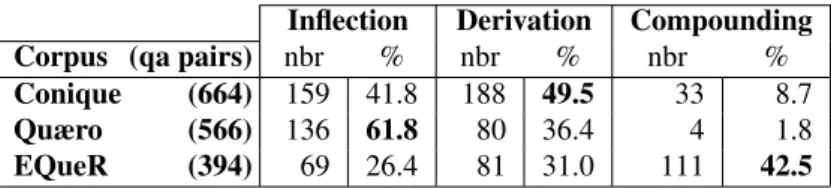
in Table 2. Each question-answer pair (qa pair) does not necessarily contain a morphological relation, and, more importantly, several pairs of words in the same question-answer pair can be morphologically related to one another, with different morphological relations.
The figures in Table 2 show that each corpus seems to favour a particular type of morphological relation: the Conique corpus contains a majority of derivational rela-tions, while the Quæro corpus comprises more inflectional morphology. As for the EQueR corpus, it presents more compounding than any other kind of morphological rela-tion. Moreover, if we consider the type of morphological relation depending on the corpus, inflection has the greatest proportion in the Quæro corpus, derivation is proportion-ally more present in the Conique corpus, while compound-ing is almost absent from Conique and Quæro and very im-portant in EQueR.
The Conique and Quæro corpora show little difference with respect to the proportion of compounding. However, Conique contains more derivational relations than Quæro does. This is due to the way the Conique corpus has been built. It is not based on the output of a QA system, but the answers have been manually retrieved and annotated. QA systems usually have difficulties in dealing with deriva-tional morphology. Moreover, there is a large variation in question and answer length between both corpora, as shown in Table 1. This could also explain the presence of more derivationally related pairs of words in Conique, because the longer the questions and the answers, the more oppor-tunities to observe a derived word and its base. As for EQueR, the great proportion of compounds is certainly re-lated to domain of the corpus: it contains a lot of medical terms, which are often compound nouns, as shown in Fig-ure 2. These morphological characteristics of medical data have already been pointed out by Namer and Zweigenbaum (2004).
In the remainder of this section we detail the annotation results for inflection and derivation only, since there are no morphological resources devoted to compounding which
direct relation two steps two complex
nbr % nbr % nbr %
Conique (188) 174 92.6 2 1.0 12 6.4
Quæro (80) 70 87.5 1 1.3 9 11.2
EQueR (81) 70 86.4 3 3.7 8 9.9
Table 4: Derivational steps between the word in the question and the word in the anwser Conique (174) Quæro (70) EQueR (70)
nbr % nbr % nbr % Noun > Adj 41 23.6 16 22.9 28 40.0 Proper N > Adj 45 25.9 8 11.4 1 1.4 Noun > Noun 29 16.7 5 7.1 7 10.0 Proper N > N 6 3.4 8 11.4 2 2.9 Adj > Noun 3 1.7 0 0 4 5.7 Verb > Noun 41 23.6 30 42.9 25 35.7 Other 9 5.1 3 4.3 3 4.3
Table 5: Derivational processes in question-answer pairs
Q: Quelle est la cons´equence de lacorticoth´erapie sur l’ os?
A: Le probl`eme essentiel des cortico¨ıdes r´eside dans leurs effets secondaires (... ost´eoporose, ost´eon´ecrose aseptique des tˆetes f´emorales ou parfois hum´erales ...).
Figure 2: Example question-answer pair from EQueR
3.2. Inflection
The analysis of the inflectional relations found in the three corpora confirms the difference, already observed at the relation type level (Section 3.1.), between Conique and Quæro on the one hand and EQueR on the other hand. Indeed, in Conique and Quæro most inflectional relations are verbal, whereas in EQueR most of them are nominal and the verbal ones are very few, as shown in Table 3.
3.3. Derivation
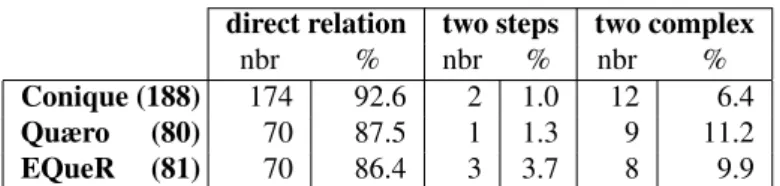
As shown in Table 2, derivation is important in the three corpora (between 30% and 50% of the pairs). In some cases the word in the question and the word in the an-swer are morphologically related by more than one deriva-tional step. For instance lune (eng: “moon”) and alunis-sage (eng: “landing on the moon”) or lait (eng: “milk”) and allaitement (eng: “breastfeeding”). In these cases one word is more complex than the other, but the complex word is not directly derived from the less complex. In some other cases, like joueur (eng: “player”) and jouable (eng: “playable”) the word in the question and the word in the an-swer are morphologically related but neither derives from the other. Instead, they both derive from another word, which is jouer (eng: “play”) for joueur and jouable. Table 4 shows the proportion of direct derivational relations, non direct derivational relations and cases where both words are complex and derive from another word. The figures show that most derivational relations between a word in the ques-tion and a word in the answer are direct (between 86% and 92%). Only very few relations are non direct. There is little
to say about the case when the derivational relation is non direct, since in that case the relation between the two words is pretty unpredictable. That is why we focus our study on the pairs which contain one base and one derivative, with only one derivational process between the two.
While focusing on the direct derivational relations, we can evaluate the proportion of different derivational processes involved. Table 5 presents the result of this evaluation. The figures in Table 5 show that the corpora differ with respect to the derivational processes used. While Conique shows more denominal adjectives (about 47% of the deriva-tional processes), Quæro and EQueR seem to favor noun formation processes (with respectively 61% and 54% of the derivational processes). These two particular derivational processes are described below.
3.3.1. Denominal adjectives
In our data, adjectives which derive from a proper noun (Proper N) are always relational adjectives, like chilien (eng: “chilean”) derived from Chili (eng: “Chile”), or africain (eng: “african”) derived from Afrique (eng: “Africa”). Adjectives deriving from a common noun are mostly relational adjectives too, as shown by the figures in Table 6. For instance pr´esidentiel (eng: “presidential”) derived from pr´esident (eng: “president”), or solaire (eng: “solar”) derived from soleil (eng: “sun”). However there also are some qualifying adjectives. For instance ˆag´e (eng: “old”) which derives from ˆage (eng: “age”) with the meaning ‘having a certain age’ or montagneux (eng: “mountainous”) derived from montagne (eng: “mountain”) with the meaning ‘full of mountains’. Table 6 presents the proportion of relational or qualifying adjectives in our corpora, and shows that relational adjectives are much more frequent in the three corpora. It is also worth noting that the highest proportion of relational adjectives is found in the medical corpus, which confirms previous works such as (Del´eger and Cartoni, 2010).
Relational Adj. Qualifying Adj.
nbr % nbr %
Conique (41) 23 56.1 18 43.9
Quæro (16) 10 62.5 6 37.5
EQueR (28) 24 85.7 4 14.3
Table 6: Types of denominal adjectives
3.3.2. Noun formation processes
As regards the noun formation processes, the three corpora favour deverbal nominalisations, but deadjectival and de-nominal de-nominalisations are also found.2 The formations of noun out of a noun are very few, except in Conique. Those are mostly masculine and feminine profession names, like infirmier and infirmi`ere (eng: “male/female nurse”), directeur and directrice (eng: “male/female direc-tor”), pr´esident and pr´esidente (eng: “male/female presi-dent”), which we considered to be two distinct words rather than one and the same word inflected for gender. There are some suffixed diminutive nouns too, like rame (eng: “ream”) > ramette (eng: “small ream”), and prefixed nouns like pr´esident (eng: “president”) > vice-pr´esident (eng: “vice-president”). We also considered the formation of a noun out of a proper noun to be a denominal nominalisa-tion. These derived nouns are mostly demonyms (names for the resident of a place) which derive from a location denoting proper noun, like Colombien (eng: “Colombian”) derived from the country name Colombie (eng: “Colom-bia”). This kind of nouns is found in the Conique and the Quæro corpora, but there are only two in the EQueR cor-pus, which is not surprising since it is a medical corpus. Deadjectival nouns are very few in the three corpora. None of them is found in Quæro, and there are just a few of them in the other two corpora. These deadjectival nouns are property nouns, like toxicit´e (eng: “toxicity”) which derives from the adjective toxique (eng: “toxic”). Not surprisingly deadjectival nouns denoting a property are mostly found in the EQueR corpus. It can be explained by the fact that the medical corpus contains a lot of disease or trouble nouns (like toxicit´e or insuffisance “insufficiency”) which often refer to the property of being in a particular state (toxicit´e ≈ ‘property of being toxic’, insuffisance ≈ ‘property of being insufficient’).
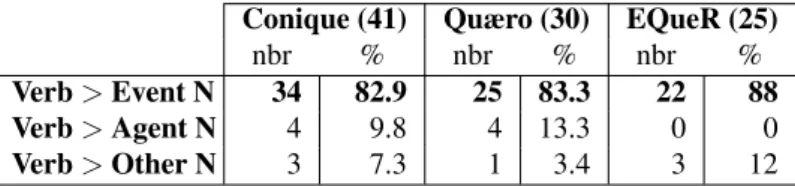
As for deverbal nominalisations, they are most often event nouns in the three corpora, like d´ebarquement (eng: “landing”) derived from the verb d´ebarquer (eng: “to land”). Event denoting nouns represent almost 85% of the deverbal nouns, as shown in Table 7. However, there also are a small number of agent nouns in the Conique and the Quæro corpora, but none in the EQueR corpus. For instance r´ealisateur (eng: “director”) from r´ealiser (eng: “to direct”). And there is a small set of result nouns like produit (eng: “product”) which derives from the verb produire (eng: “to produce”).
3.3.3. Other derivational processes
Other derivational processes include for instance adverbs formation out of adjectives, like compl`etement (eng: “completely”) derived from complet (eng: “complete”), or directement (eng: “directly”) derived from direct (eng: “direct”). There also are some prefixed deverbal verbs like d´eboucher (eng: “unblock”) out of boucher (eng: “block”) or denominal adjectives like international (eng: “interna-tional”) derived from nation (eng: “nation”). Interestingly we observed no deadjectival verb formation (like national “national” > nationaliser “nationalize”) and almost no denominal verb formation. Only four denominal verbs were found in Conique, and none in the other corpora. The absence of denominal verbs could be explained by the rather unpredictable semantic relation between a noun and a derived verb. As stated by Hopper and Thompson (1984) there is an asymmetry in the lexical categories, since a nominalisation still names the event denoted by the verb, whereas a verbalization does not refer to the entity denoted by the noun, but denotes an event associated with that entity. For instance, the noun destruction denotes the same event as its base verb destruct. But in the case of a denominal verb like hospitalize, the verb does not refer to the object denoted by the base noun hospital, but denotes some event related to that object. What is more, the events we could associate to an entity are numerous and various. So, the semantic relation between a noun and its derived verb is less informative than that of a verb and its derived noun. It is not surprising then that so few nouns related to their derived verbs were found in the corpora.
4. Evaluation of morphological resources
The set of morphologically annotated data presented in the previous section forms a gold-standard of morphological relations on which we can evaluate the coverage of existing morphological resources.4.1. Description of the resources
Several resources are available to deal with French morphology. However none of them handles the whole morphology for French. Instead, there are different resources, each of them dealing with a specific area of French morphology. Thus, we took the morphological resources dealing with each type of morphological process we found in the corpora and evaluated them according to their morphological specificity. For inflectional morpho-logy we evaluated two resources : Morphalou and Lefff. For derivational morphology we evaluated three different resources : Verbaction and Dubois for deverbal nouns, and Prolexbase for denominal adjectives.
4.1.1. Morphalou
Morphalou is an inflectional lexicon for French.3 It contains 539,413 inflected forms corresponding to 68,075 lemmas.