HAL Id: hal-02082890
https://hal.archives-ouvertes.fr/hal-02082890
Submitted on 28 Mar 2019
HAL is a multi-disciplinary open access
archive for the deposit and dissemination of
sci-entific research documents, whether they are
pub-lished or not. The documents may come from
teaching and research institutions in France or
abroad, or from public or private research centers.
L’archive ouverte pluridisciplinaire HAL, est
destinée au dépôt et à la diffusion de documents
scientifiques de niveau recherche, publiés ou non,
émanant des établissements d’enseignement et de
recherche français ou étrangers, des laboratoires
publics ou privés.
Advantages and disadvantages of techniques used for
wastewater treatment
Grégorio Crini, Eric Lichtfouse
To cite this version:
Grégorio Crini, Eric Lichtfouse.
Advantages and disadvantages of techniques used for
wastew-ater treatment.
Environmental Chemistry Letters, Springer Verlag, 2019, 17 (1), pp.145-155.
�10.1007/s10311-018-0785-9�. �hal-02082890�
Environmental Chemistry Letters (2019) 17:145–155 https:// doi.org/10.1007/s10311-018-0785-9
Revised version
Advantages and disadvantages of techniques used for wastewater
treatment
Grégorio Crini
1· Eric Lichtfouse
2Abstract
During the last 30 years, environmental issues about the chemical and biological contaminations of water have become a
major concern for society, public authorities and the industry. Most domestic and industrial activities produce wastewaters
containing undesirable toxic contaminants. In this context, a constant effort must be made to protect water resources.
Cur-rent wastewater treatment methods involve a combination of physical, chemical and biological processes, and operations
to remove insoluble particles and soluble contaminants from effluents. This article provides an overview of methods for
wastewater treatment, and describes the advantages and disadvantages of available technologies.
Keywords
Wastewater treatment · Contaminants · Pollutants · Effluents · Technologies available
Introduction
Actually, water pollution by chemicals has become a major
source of concern and a priority for both society and public
authorities, but more importantly, for the whole industrial
world (Sonune and Ghate
2004
; Crini
2005
; Cox et al.
2007
;
Sharma
2015
; Rathoure and Dhatwalia
2016
). What is water
pollution? Water pollution can be defined in many ways.
Pollution of water occurs when one or more substances that
will modify the water in negative fashion are discharged in
it. These substances can cause problems for people, animals
and their habitats and also for the environment. There are
various classifications of water pollution (Morin-Crini and
Crini
2017
). The two chief sources can be seen as point and
non-point. The first refers to the pollutants that belong to
a single source such as emissions from industries into the
water, and the second on the other hand means pollutants
emitted from multiple sources.
The causes of water pollution are multiple: industrial
wastes, mining activities, sewage and waste water,
pesti-cides and chemical fertilizers, energy use, radioactive waste,
urban development, etc. The very fact that water is used
means that it will become polluted: any activities whether
domestic or agricultural but also industrial produce effluent
containing undesirable pollutants which can also be toxic. In
this context, a constant effort must be made to protect water
resources (Khalaf
2016
; Rathoure and Dhatwalia
2016
;
Morin-Crini and Crini
2017
).
The legislation covering liquid industrial effluent is
becoming stricter, especially in the more developed
coun-tries, and imposes the treatment of any wastewater before it
is released into the environment. Since the end of the 1970s,
in Europe, the directives are increasingly severe and zero
rejection is being sought by 2020. Currently, the European
policy on water results from the Water Framework
Direc-tive of 2000 which establishes guidelines for the protection
of surface water, underground water and coastal water in
Europe (Morin-Crini and Crini
2017
).
The Water Framework Directive also classified
chemi-cals into two main lists of priority substances. The first,
the “Black List,” involves dangerous priority substances
considered to be persistent, highly toxic or to lead to
bio-accumulation. The second list, the “Grey List”, gathers
priority substances presenting a significant risk for the
environment. The selection of these substances can either
be based on individual substances of families of substances
* Grégorio Crini
[email protected] Eric Lichtfouse
[email protected]; [email protected]
1 Laboratoire Chrono-environnement, UMR 6249, UFR
Sciences et Techniques, Université Bourgogne Franche-Comté, 16 Route de Gray, 25000 Besançon, France
2 Aix Marseille Univ, CNRS, IRD, INRA, Coll France,
(e.g., metals, chlorobenzenes, alkylphenols) or on the basis
of the industrial sector (e.g., agro-food industry, chemicals
industry, metal finishing sector). Currently, Europe is now
asking industrials to innovate, to reduce and/or eliminate the
release of dangerous priority substances and priority
sub-stances in their wastewaters. Moreover, recycling wastewater
is starting to receive active attention from industry in the
context of sustainable development (e.g., protection of the
environment, developing concepts of “green chemistry,” use
of renewable resources), improved water management
(recy-cling of waste water) and also health concerns (Kentish and
Stevens
2001
; Cox et al.
2007
; Sharma and Sanghi
2012
;
Khalaf
2016
; Rathoure and Dhatwalia
2016
; Morin-Crini
and Crini
2017
). Thus, for the industrial world, the treatment
of effluents has become a priority.
During the past three decades, several physical,
chemi-cal and biologichemi-cal technologies have been reported such
as flotation, precipitation, oxidation, solvent extraction,
evaporation, carbon adsorption, ion exchange, membrane
filtration, electrochemistry, biodegradation and
phytoreme-diation (Berefield et al.
1982
; Liu and Liptak
2000
; Henze
2001
; Harvey et al.
2002
; Chen
2004
; Forgacs et al.
2004
;
Anjaneyulu et al.
2005
; Crini and Badot
2007
; Cox et al.
2007
; Hai et al.
2007
; Barakat
2011
; Rathoure and
Dhat-walia
2016
; Morin-Crini and Crini
2017
). Which is the best
method? There is no direct answer to this question because
each treatment has its own advantages and constraints not
only in terms of cost but also in terms of efficiency,
feasibil-ity and environmental impact. In general, elimination of
pol-lutants is done by physical, chemical and biological means.
At the present time, there is no single method capable of
adequate treatment, mainly due to the complex nature of
industrial effluents. In practice, a combination of different
methods is often used to achieve the desired water quality
in the most economical way.
This short review proposes a general scheme of
wastewa-ter treatment and summarizes the advantages and
disadvan-tages of different individual techniques used. This article is
an abridged version of the chapter published by Crini and
Lichtfouse (
2018
) in the series Environmental Chemistry for
a Sustainable World.
Wastewater treatment
There are various sources of water contamination, e.g.,
households, industry, mines and infiltration, but one of the
greatest remains the large-scale use of water by industry
(Anjaneyulu et al.
2005
; Hai et al.
2007
). Four categories
of water are generally distinguished: (1) rainwater (runoff
from impermeable surfaces), (2) domestic wastewater, (3)
agricultural water and (4) industrial wastewaters (Crini and
Badot
2007
). The last group can be subdivided into cooling
water, washing effluent (of variable composition) and
manu-facturing or process water (biodegradable and/or potentially
toxic). In general, process waters (i.e., wastewaters or
efflu-ents) pose the greatest problems. Wastewaters differ
signifi-cantly from drinking water sources (usually rivers, lakes or
reservoirs) in one important way: The contaminant levels
in most drinking water sources are quite low as compared
with contaminant levels in wastewaters derived from
indus-trial-type activities (Cooney
1999
). However, their
toxic-ity depends, of course, on their composition, which in turn
depends on their industrial origin. In general, the problems
encountered during wastewater treatment are very complex
as the effluent contains pollutants of various types
depend-ing on its origin. So, there are different types of effluents
to treat, each with its own characteristics requiring specific
treatment processes.
General scheme of wastewater treatment
When water is polluted and decontamination becomes
nec-essary, the best purification approach should be chosen to
reach the decontamination objectives (as established by
legislation). A purification process generally consists of
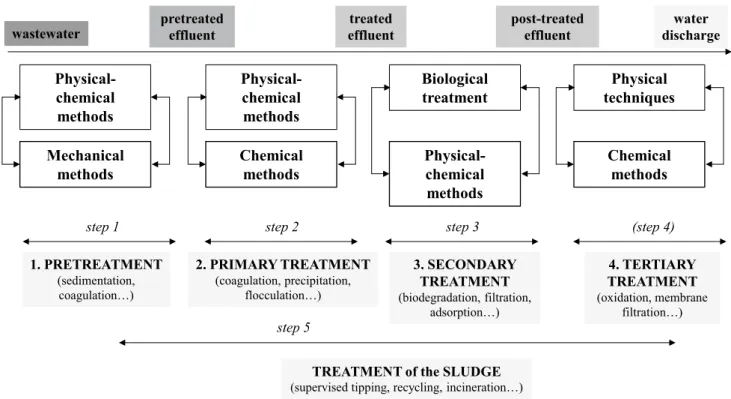
five successive steps as described in Fig.
1
: (1) preliminary
treatment or pre-treatment (physical and mechanical); (2)
primary treatment (physicochemical and chemical); (3)
secondary treatment or purification (chemical and
biologi-cal); (4) tertiary or final treatment (physical and chemibiologi-cal);
and (5) treatment of the sludge formed (supervised tipping,
recycling or incineration). In general, the first two steps are
gathered under the notion of pre-treatment or preliminary
step, depending on the situation (Anjaneyulu et al.
2005
;
Crini and Badot
2007
,
2010
).
Technologies available for contaminant removal
In general, conventional wastewater treatment consists of
a combination of physical, chemical and/or biological
pro-cesses and operations to remove solids including colloids,
organic matter, nutrients, soluble contaminants (metals,
organics, etc.) from effluents. A multitude of techniques
classified in conventional methods, established recovery
pro-cesses and emerging removal methods can be used (Fig.
2
).
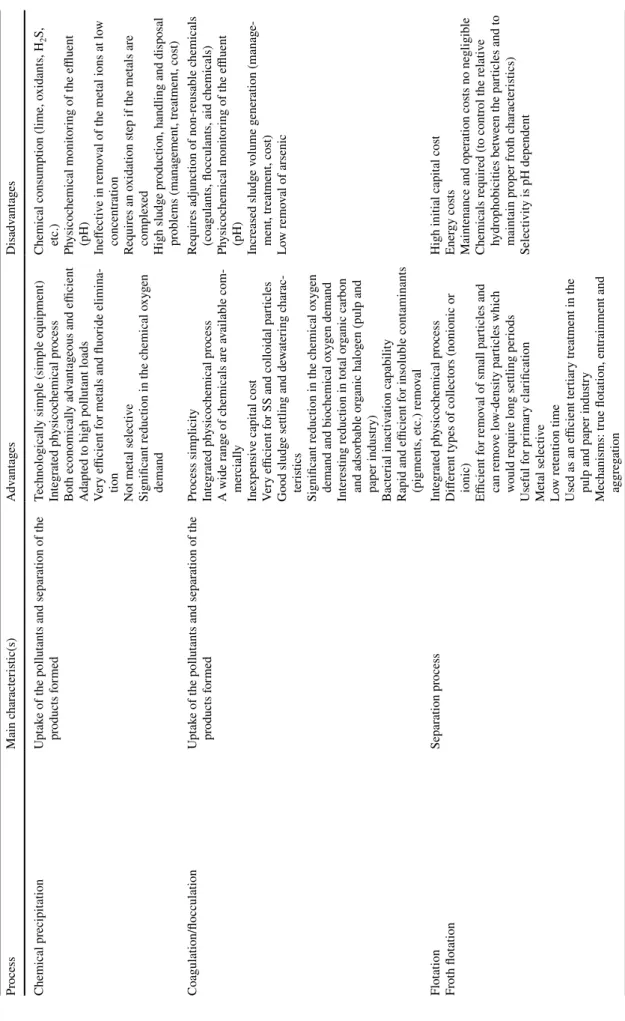
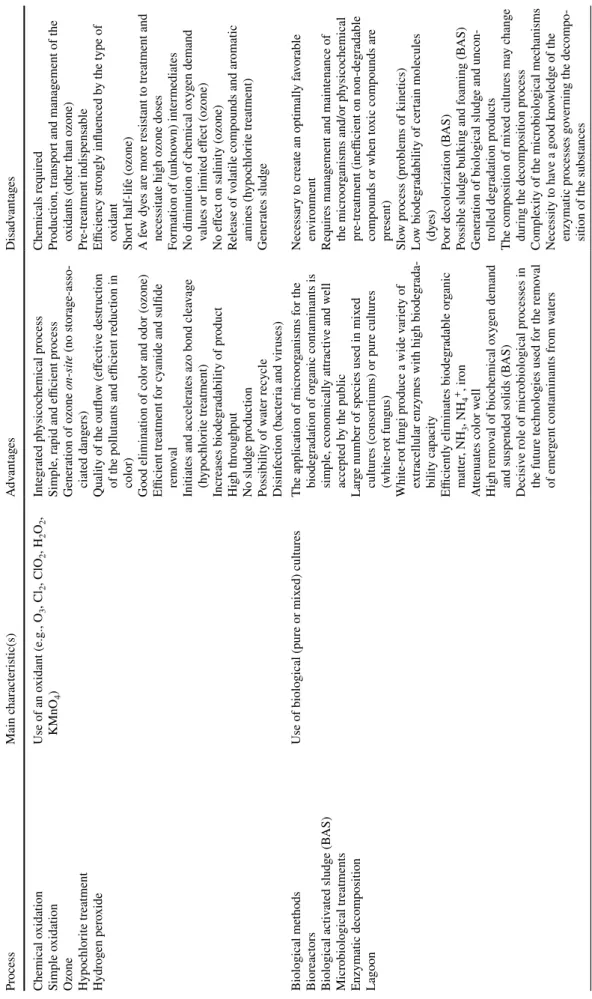
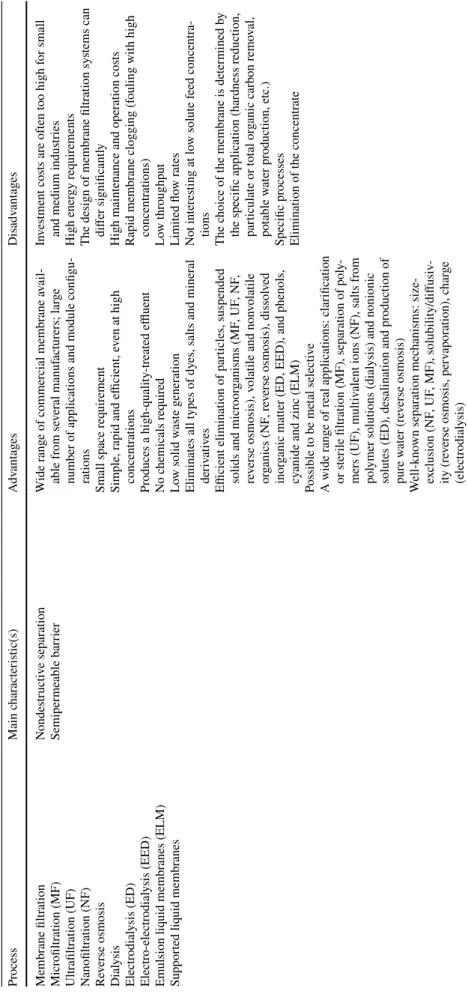
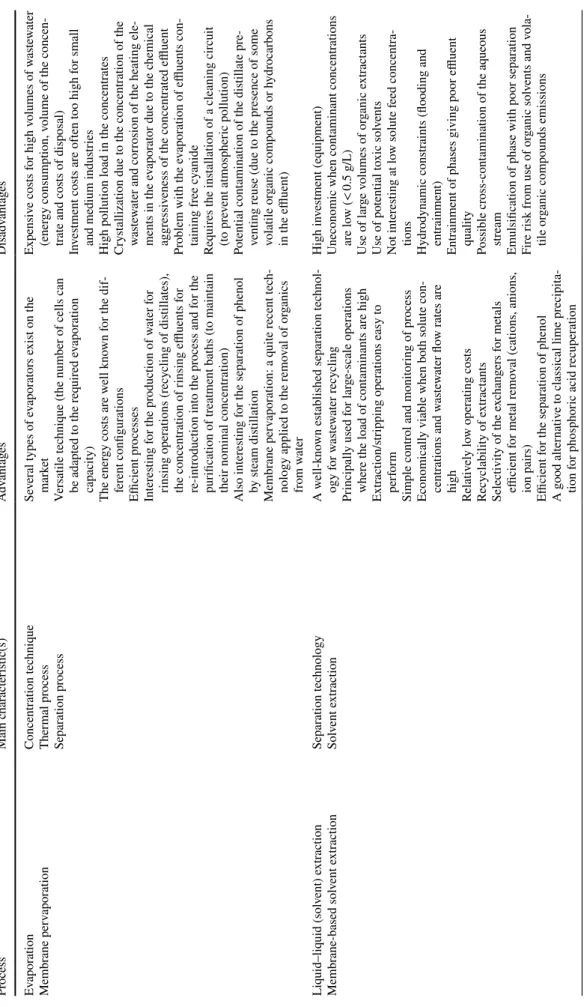
Table
1
lists the advantages and disadvantages of different
individual techniques (Berefield et al.
1982
; Henze
2001
;
Sonune and Ghate
2004
; Chen
2004
; Pokhrel and
Virara-ghavan
2004
; Parsons
2004
; Anjaneyulu et al.
2005
; Chuah
et al.
2005
; Crini
2005
,
2006
; Bratby
2006
; Crini and Badot
2007
,
2010
; Cox et al.
2007
; Mohan and Pittman
2007
; Hai
et al.
2007
; Wojnárovits and Takács
2008
; Barakat
2011
;
Sharma and Sanghi
2012
; Rathoure and Dhatwalia
2016
;
Morin-Crini and Crini
2017
).
Selection of the method to be used will thus depend
on the wastewater characteristics (Anjaneyulu et al.
2005
;
Crini
2005
; Crini and Badot
2007
; Cox et al.
2007
). Each
treatment has its own constraints not only in terms of
cost, but also in terms of feasibility, efficiency,
practica-bility, reliapractica-bility, environmental impact, sludge
produc-tion, operation difficulty, pre-treatment requirements and
the formation of potentially toxic by-products. However,
among the various treatment processes currently cited for
wastewater treatment, only a few are commonly employed
by the industrial sector for technological and economic
reasons. In general, removal of pollutants from effluents
is done by physicochemical and/or biological means, with
research concentrating on cheaper effective combinations
of systems or new alternatives.
pretreated
effluent
discharge
water
wastewater
1. PRETREATMENT
(sedimentation, coagulation…)step 1
Chemical
methods
Physical
techniques
4. TERTIARY
TREATMENT
(oxidation, membrane filtration…)(step 4)
Physical-chemical
methods
Biological
treatment
3. SECONDARY
TREATMENT
(biodegradation, filtration, adsorption…)step 3
2. PRIMARY TREATMENT
(coagulation, precipitation, flocculation…)step 2
treated
effluent
post-treated
effluent
step 5
TREATMENT of the SLUDGE
(supervised tipping, recycling, incineration…)
Mechanical
methods
Physical-chemical
methods
Chemical
methods
Physical-chemical
methods
Fig. 1 Main processes for the decontamination of industrial wastewaters
Technologies available for pollutant removal
Emerging removal
methods
Established
recovery process
Conventional
methods
- advanced oxidation - adsorption ontonon-conventional solids - biosorption - biomass - nanofiltration - solvent extraction - evaporation - oxidation - electrochemical treatment - membrane separation - membrane bioreactors - ion-exchange - incineration - coagulation/flocculation - precipitation - biodegradation - filtration (sand) - adsorption using AC
Table 1 A dv ant ag es and disadv ant ag es of t he main con ventional me thods used f or t he tr
eatment of polluted indus
trial w as tew ater Pr ocess Main c har acter istic(s) Adv ant ag es Disadv ant ag es Chemical pr ecipit ation Up tak e of t he pollut
ants and separ
ation of t he pr oducts f or med Tec hnologicall y sim ple (sim ple eq uipment) Integ rated ph ysicoc hemical pr ocess Bo th economicall y adv ant ag
eous and efficient
Adap ted t o high pollut ant loads Ver y efficient f or me
tals and fluor
ide elimina-tion Not me tal selectiv e Significant r eduction in t he c hemical o xy gen demand Chemical consum ption (lime, o xidants, H2 S,
etc.) Physicoc
hemical monit or ing of t he effluent (pH) Ineffectiv e in r emo val of t he me tal ions at lo w concentr ation Req uir es an o xidation s tep if t he me tals ar e com ple xed High sludg e pr
oduction, handling and disposal
pr oblems (manag ement, tr eatment, cos t) Coagulation/flocculation Up tak e of t he pollut
ants and separ
ation of t he pr oducts f or med Pr ocess sim plicity Integ rated ph ysicoc hemical pr ocess A wide r ang e of c hemicals ar e a vailable com-mer ciall y Ine xpensiv e capit al cos t Ver y efficient f
or SS and colloidal par
ticles Good sludg e se ttling and de water ing c har ac-ter istics Significant r eduction in t he c hemical o xy gen
demand and bioc
hemical o xy gen demand Inter es ting r eduction in t ot al or ganic carbon and adsorbable or ganic halog en (pulp and paper indus try) Bacter ial inactiv ation capability
Rapid and efficient f
or insoluble cont aminants (pigments, e tc.) r emo val Req uir es adjunction of non-r eusable c hemicals
(coagulants, flocculants, aid c
hemicals) Ph ysicoc hemical monit or ing of t he effluent
(pH) Increased sludg
e v olume g ener ation (manag e-ment, tr eatment, cos t) Lo w r emo val of arsenic Flo tation Fr ot h flo tation Separ ation pr ocess Integ rated ph ysicoc hemical pr ocess Differ
ent types of collect
ors (nonionic or
ionic) Efficient f
or r
emo
val of small par
ticles and can r emo ve lo w-density par ticles whic h would r eq uir e long se ttling per iods Useful f or pr imar y clar ification Me tal selectiv e Lo w r etention time
Used as an efficient ter
tiar
y tr
eatment in t
he
pulp and paper indus
try Mec hanisms: tr ue flo tation, entr ainment and agg reg ation
High initial capit
al cos
t
Ener
gy cos
ts
Maintenance and oper
ation cos ts no neg ligible Chemicals r eq uir ed (t o contr ol t he r elativ e hydr ophobicities be tw een t he par ticles and t o maint ain pr oper fr ot h c har acter istics) Selectivity is pH dependent
Table 1 (continued) Pr ocess Main c har acter istic(s) Adv ant ag es Disadv ant ag es Chemical o xidation Sim ple o xidation Ozone Hypoc hlor ite tr eatment Hydr og en per oxide Use of an o xidant (e.g., O3 , Cl 2 , ClO 2 , H2 O2 , KMnO 4 ) Integ rated ph ysicoc hemical pr ocess Sim ple, r
apid and efficient pr
ocess Gener ation of ozone on -sit e (no s tor ag e-asso-ciated dang ers) Quality of t he outflo w (effectiv e des truction of t he pollut
ants and efficient r
eduction in
color) Good elimination of color and odor (ozone) Efficient tr
eatment f
or cy
anide and sulfide
remo
val
Initiates and acceler
ates azo bond clea
vag e (h ypoc hlor ite tr eatment) Incr eases biodeg radability of pr oduct High t hr oughput No sludg e pr oduction Possibility of w ater r ecy cle Disinf ection (bacter ia and vir uses) Chemicals r eq uir ed Pr oduction, tr anspor t and manag ement of t he oxidants (o ther t han ozone) Pr e-tr eatment indispensable Efficiency s trong ly influenced b y t he type of
oxidant Short half-lif
e (ozone) A f ew dy es ar e mor e r esis tant t o tr eatment and necessit
ate high ozone doses
For mation of (unkno wn) inter mediates No diminution of c hemical o xy gen demand
values or limited effect (ozone) No effect on salinity (ozone) Release of v
olatile com pounds and ar omatic amines (h ypoc hlor ite tr eatment) Gener ates sludg e Biological me thods Bior eact ors Biological activ ated sludg e (B AS) Micr obiological tr eatments Enzymatic decom position Lagoon
Use of biological (pur
e or mix
ed) cultur
es
The application of micr
oor ganisms f or t he biodeg radation of or ganic cont aminants is sim ple, economicall y attr activ e and w ell accep ted b y t he public Lar
ge number of species used in mix
ed cultur es (consor tiums) or pur e cultur es (white-r ot fungus) White-r ot fungi pr oduce a wide v ar ie ty of extr
acellular enzymes wit
h high biodeg
rada-bility capacity Efficientl
y eliminates biodeg radable or ganic matter , NH 3 , NH 4 +, ir on Attenuates color w ell High r emo val of bioc hemical o xy gen demand
and suspended solids (B
AS) Decisiv e r ole of micr obiological pr ocesses in the futur e tec hnologies used f or t he r emo val of emer gent cont aminants fr om w aters Necessar y t o cr eate an op timall y f av or able en vir onment Req uir es manag
ement and maintenance of
the micr oor ganisms and/or ph ysicoc hemical pr e-tr
eatment (inefficient on non-deg
radable com pounds or when t oxic com pounds ar e pr esent) Slo w pr ocess (pr oblems of kine tics) Lo w biodeg radability of cer tain molecules (dy es) Poor decolor ization (B AS) Possible sludg e bulking and f oaming (B AS) Gener
ation of biological sludg
e and uncon-trolled deg radation pr oducts The com position of mix ed cultur es ma y c hang e dur ing t he decom position pr ocess Com ple xity of t he micr obiological mec hanisms Necessity t o ha ve a good kno wledg e of t he enzymatic pr ocesses go ver ning t he decom po-sition of t he subs tances
Table 1 (continued) Pr ocess Main c har acter istic(s) Adv ant ag es Disadv ant ag es Adsor ption/filtr ation Commer cial activ ated carbons (C AC) Commer cial activ ated alumina (C AA) Sand Mix ed mater ials Silica g el Nondes tructiv e pr ocess
Use of a solid mater
ial Tec hnologicall y sim ple (sim ple eq uipment) and adap table t o man y tr eatment f or mats W ide r ang e of commer cial pr oducts W ide v ar ie ty of t ar ge t cont aminants (adsor p-tion) Highl y effectiv e pr ocess (adsor ption) wit h f as t kine tics Ex cellent q uality of t he tr eated effluent Global elimination (C
AC) but possibl
y selec-tiv e depending on adsorbent Ex cellent ability t o separ ate a wide r ang e of pollut ants, in par ticular r efr act or y molecules (C AC is t he mos t effectiv e mater ial) CA C: efficient f or c hemical o xy gen demand remo val; highl y efficient tr eatment when coupled t o coagulation t o r educe suspended solids, c hemical o xy
gen demand and color
Sand: efficient f
or turbidity and suspended
solids r emo val Alumina: efficient f or fluor ide r emo val Relativ ely high in ves tment (C AC) Cos t of mater ials (C AC, C AA) Nondes tructiv e pr ocesses Non-selectiv e me thods Per for mance depends on t he type of mater ial (C AC) Req uir ement f or se ver al types of adsorbents Chemical der iv atization t o im pr ov e t heir adsor ption capacity Rapid satur
ation and clogging of t
he r eact ors (reg ener ation cos tly) No t efficient wit h cer tain types of dy es tuffs and some me tals (C AC) Elimination of t he adsorbent (r eq uir es incin-er ation, r eg ener ation or r eplacement of t he mater ial) Reg ener ation is e xpensiv e and r esults in loss of mater ial (C AC) Economicall y non-viable f or cer tain indus tries
(pulp and paper
, te xtile, e tc.) Ion e xc hang e Chelating r esins Selectiv e r esins Macr opor ous r esins Pol ymer ic adsorbents Pol ymer -based h ybr id adsorbents Nondes tructiv e pr ocess W ide r ang e of commer cial pr oducts a vailable from se ver al manuf actur ers Tec hnologicall y sim ple (sim ple eq uipment) W ell-es
tablished and tes
ted pr ocedur es; easy contr ol and maintenance Easy t o use wit h o ther tec hniq ues (e.g., pr ecipit
ation and filtr
ation in an integ rated was tew ater pr ocess) Can be applied t o differ ent flo w r egimes
(con-tinuous and batc
h) High r eg ener ation wit h possibility of e xter nal reg ener ation of r esin
Rapid and efficient pr
ocess Pr oduce a high-q uality tr eated effluent Concentr
ates all types of pollut
ants, par ticu-lar ly miner als Relativ ely ine xpensiv e and efficient f or me tal remo val; cleanup t o ppb le vels (t o pp t le vels for selectiv e r esins) Can be selectiv e f or cer tain me tals (wit h suit-able r esins) Inter es
ting and efficient tec
hnology f or t he reco ver y of v aluable me tals Economic cons
traints (initial cos
t of t
he
selec-tiv
e r
esin, maintenance cos
ts, r eg ener ation time-consuming, e tc.) Lar ge v olume r eq uir es lar ge columns Rapid satur
ation and clogging of t
he r eact ors Satur ation of t he cationic e xc hang er bef or e the anionic r esin (pr ecipit ation of me tals and bloc king of r eact or) Beads easil y f ouled b y par ticulates and or ganic matter (or
ganics and oils); r
eq uir es a ph ysico-chemical pr e-tr
eatment (e.g., sand filtr
ation or carbon adsor ption) t o r emo ve t hese cont
ami-nants Matrix deg
rades wit
h time and wit
h cer tain was te mater ials (r adioactiv e, s trong o xidants,
etc.) Perfor
mance sensitiv e t o pH of effluent Con ventional r esins no t selectiv e Selectiv e r esins ha ve limited commer cial use No t effectiv e f or cer tain t ar ge t pollut ants (dis-perse dy es, dr ugs, e tc.) Elimination of t he r esin
Table 1 (continued) Pr ocess Main c har acter istic(s) Adv ant ag es Disadv ant ag es Inciner ation Ther mal o xidation Cat alytic o xidation Pho tocat alytic des truction Des truction b y combus tion Sim ple pr ocess Useful f or concentr
ated effluents or sludg
es
Highl
y efficient
Eliminates all types of or
ganics Pr oduction of ener gy Initial in ves tment cos ts Tr anspor t and s tor ag e of t he effluents High r unning cos ts For mation of dio xins and o thers pollut ants (me tals, e tc.)
Local communities alw
ay s ha ve opposed t he pr esence of inciner ating plant in t he locality Electr oc hemis try Electr odeposition Electr o-coagulation (EC) Electr o-flocculation (EF) Electr o-flo tation Electr o-o xidation Electr oc hemical o xidation Electr oc hemical r eduction Cement ation Indir ect electr o-o xidation wit h s trong o xidants Pho to-assis ted electr oc hemical me thods Electr ol ysis (E) Efficient tec hnology f or t he r eco ver y/r ecy cling of v aluable me
tals (E); inter
es ting me thod for t he r eco ver
y of gold and sil
ver fr om r inse bat hs Adap tation t o differ ent pollut
ant loads and
differ ent flo w r ates (E) Incr eases biodeg radability (E) Mor e effectiv e and r apid or
ganic matter
sepa-ration t
han in tr
aditional coagulation (EC);
pH contr ol is no t necessar y; g ener ation of
coagulants in situ; economicall
y f easible and ver y effectiv e in r emo
ving suspended solids,
dissol ved me tals, t annins and dy es (effluents from te xtile, cater ing, pe troleum, municipal se wag e, oil–w ater emulsion, dy es tuff, cla y suspension, e tc.)
Efficient elimination of SS, oils, g
reases, color
and me
tals (EC, EF)
EF: widel y used in t he miming indus tries Effectiv e in tr eatment of dr inking w ater sup-plies f
or small- or medium-sized
communi-ties (EC) Very effectiv
e tr
eatment f
or t
he r
eduction,
coagulation and separ
ation of copper (EC)
Cement
ation: efficient f
or copper r
emo
val
High initial cos
t of t he eq uipment Cos t of t he maintenance (sacr ificial anodes,
etc.) Requir
es addition of c
hemicals (coagulants,
flocculants, salts) Anode passiv
ation and sludg
e deposition on
the electr
odes t
hat can inhibit t
he electr
ol
ytic
pr
ocess in continuous oper
ation Req uir es pos t-tr eatment t o r emo ve high concen-trations of ir
on and aluminum ions
EF: separ
ation efficiency depends s
trong
ly on
bubble sizes Filtration pr
ocess f or flocs For mation of sludg e (filter ing pr oblems) Cos t of sludg e tr eatment (electr o-coagulation)
Table 1 (continued) Pr ocess Main c har acter istic(s) Adv ant ag es Disadv ant ag es Membr ane filtr ation Micr ofiltr ation (MF) Ultr afiltr ation (UF) Nanofiltr ation (NF) Re verse osmosis Dial ysis Electr odial ysis (ED) Electr o-electr odial ysis (EED) Emulsion liq uid membr anes (ELM) Suppor ted liq uid membr anes Nondes tructiv e separ ation Semiper meable bar rier W ide r ang e of commer cial membr ane a vail-able fr om se ver al manuf actur ers; lar ge
number of applications and module configu- rations Small space r
eq
uir
ement
Sim
ple, r
apid and efficient, e
ven at high concentr ations Pr oduces a high-q uality -tr eated effluent No c hemicals r eq uir ed Lo w solid w as te g ener ation
Eliminates all types of dy
es, salts and miner
al
der
iv
ativ
es
Efficient elimination of par
ticles, suspended
solids and micr
oor ganisms (MF , UF , NF , re verse osmosis), v
olatile and non
volatile
or
ganics (NF
, r
ev
erse osmosis), dissol
ved
inor
ganic matter (ED, EED), and phenols,
cy
anide and zinc (ELM)
Possible t o be me tal selectiv e A wide r ang e of r
eal applications: clar
ification or s ter ile filtr ation (MF), separ ation of pol
y-mers (UF), multiv
alent ions (NF), salts fr
om
pol
ymer solutions (dial
ysis) and nonionic
solutes (ED), desalination and pr
oduction of pur e w ater (r ev erse osmosis) W ell-kno wn separ ation mec hanisms: size-ex clusion (NF , UF , MF), solubility/diffusiv -ity (r ev
erse osmosis, per
vapor ation), c har ge (electr odial ysis) In ves tment cos ts ar e of ten t oo high f or small
and medium indus
tries High ener gy r eq uir ements
The design of membr
ane filtr
ation sy
stems can
differ significantl
y
High maintenance and oper
ation cos ts Rapid membr ane clogging (f ouling wit h high concentr ations) Lo w t hr oughput Limited flo w r ates No t inter es ting at lo w solute f eed concentr a-tions The c hoice of t he membr ane is de ter mined b y
the specific application (har
dness r eduction, par ticulate or t ot al or ganic carbon r emo val, po table w ater pr oduction, e tc.) Specific pr ocesses Elimination of t he concentr ate
Table 1 (continued) Pr ocess Main c har acter istic(s) Adv ant ag es Disadv ant ag es Ev apor ation Membr ane per vapor ation Concentr ation tec hniq ue Ther mal pr ocess Separ ation pr ocess Se ver al types of e vapor at ors e xis t on t he mar ke t Versatile tec hniq ue (t
he number of cells can
be adap ted t o t he r eq uir ed e vapor ation
capacity) The ener
gy cos ts ar e w ell kno wn f or t he dif-fer ent configur ations Efficient pr ocesses Inter es ting f or t he pr oduction of w ater f or rinsing oper ations (r ecy cling of dis tillates), the concentr ation of r insing effluents f or re-intr oduction int o t he pr ocess and f or t he pur ification of tr eatment bat hs (t o maint ain
their nominal concentr
ation) Also inter es ting f or t he separ ation of phenol by s team dis tillation Membr ane per vapor ation: a q uite r ecent tec h-nology applied t o t he r emo val of or ganics from w ater Expensiv e cos ts f or high v olumes of w as tew ater (ener gy consum ption, v olume of t he
concen-trate and cos
ts of disposal) In ves tment cos ts ar e of ten t oo high f or small
and medium indus
tries
High pollution load in t
he concentr ates Cr ys tallization due t o t he concentr ation of t he was tew
ater and cor
rosion of t he heating ele-ments in t he e vapor at or due t o t he c hemical agg ressiv eness of t he concentr ated effluent Pr oblem wit h t he e vapor
ation of effluents
con-taining fr ee cy anide Req uir es t he ins
tallation of a cleaning cir
cuit (to pr ev ent atmospher ic pollution) Po tential cont amination of t he dis tillate pr e-venting r euse (due t o t he pr esence of some volatile or ganic com pounds or h ydr ocarbons in t he effluent) Liq uid–liq uid (sol vent) e xtr action Membr ane-based sol vent e xtr action Separ ation tec hnology Sol vent e xtr action A w ell-kno wn es tablished separ ation tec hnol-ogy f or w as tew ater r ecy cling Pr incipall y used f or lar ge-scale oper ations wher e t he load of cont aminants ar e high Extr action/s tripping oper ations easy t o per for m Sim ple contr ol and monit or ing of pr ocess Economicall y viable when bo th solute con-centr ations and w as tew ater flo w r ates ar e high Relativ ely lo w oper ating cos ts Recy clability of e xtr act ants Selectivity of t he e xc hang ers f or me tals efficient f or me tal r emo
val (cations, anions,
ion pairs) Efficient f
or t he separ ation of phenol A good alter nativ e t o classical lime pr ecipit a-tion f or phosphor ic acid r ecuper ation High in ves tment (eq uipment)
Uneconomic when cont
aminant concentr ations ar e lo w (< 0.5 g/L) Use of lar ge v olumes of or ganic e xtr act ants Use of po tential t oxic sol vents No t inter es ting at lo w solute f eed concentr
a-tions Hydrodynamic cons
traints (flooding and
entr
ainment)
Entr
ainment of phases giving poor effluent
quality Possible cr oss-cont amination of t he aq ueous str eam
Emulsification of phase wit
h poor separ ation Fir e r isk fr om use of or ganic sol vents and v ola-tile or ganic com pounds emissions
Conclusion
The development of cheaper, effective and novel methods
of decontamination is currently an active field of research,
as shown by the numerous publications appearing each
year. Preserving the environment, and in particular the
problem of water pollution, has become a major
preoccu-pation for everyone—the public, industry, scientists and
researchers as well as decision-makers on a national,
Euro-pean or international level. The public demand for
pol-lutant-free waste discharge to receiving waters has made
decontamination of industrial wastewaters a top priority.
However, this is a difficult and challenging task (Sonune
and Ghate
2004
; Anjaneyulu et al.
2005
; Crini
2005
; Crini
and Badot
2007
; Barakat
2011
; Sharma and Sanghi
2012
).
It is also difficult to define a universal method that could
be used for the elimination of all pollutants from
wastewa-ters. This review described the advantages and
disadvan-tages of technologies available. A multitude of techniques
classified in conventional methods, established recovery
processes and emerging removal methods can be used.
However, among the numerous and various treatment
pro-cesses currently cited for wastewater treatment, only a few
are commonly used by the industrial sector for economic
and technological reasons. Adsorption onto activated
car-bons is nevertheless often cited as the procedure of choice
to remove many different types of pollutants because it
gives the best results in terms of efficiency and technical
feasibility at the industrial scale.
References
Anjaneyulu Y, Sreedhara Chary N, Samuel Suman Raj D (2005) Decolourization of industrial effluents: available methods and emerging technologies—a review. Rev Environ Sci Bio/Technol 4:245–273. https ://doi.org/10.1007/s1115 7-005-1246-z
Barakat MA (2011) New trends in removing heavy metals from industrial wastewater. Arab J Chem 4:361–377. https ://doi. org/10.1016/j.arabj c.2010.07.019
Berefield LD, Judkins JF, Weand BL (1982) Process chemistry for water and wastewater treatment. Prentice-Hall, New Jersey Bratby J (ed) (2006) Coagulation and flocculation in water and
wastewater treatment. IWA Publishing, London, p 407 Chen G (2004) Electrochemical technologies in wastewater
treat-ment. Sep Purif Technol 38:11–41. https ://doi.org/10.1016/j. seppu r.2003.10.006
Chuah TG, Jumasiah A, Azni I, Katayon S, Choong SYT (2005) Rice husk as a potentially low-cost biosorbent for heavy metal and dye removal: an overview. Desalination 175:305–316. https :// doi.org/10.1016/j.desal .2004.10.014
Cooney DO (1999) Adsorption design for wastewater treatment. Lewis Publishers, Boca Raton
Cox M, Négré P, Yurramendi L (2007) Industrial liquid effluents. INASMET Tecnalia, San Sebastian, p 283
Table 1 (continued) Pr ocess Main c har acter istic(s) Adv ant ag es Disadv ant ag es Adv anced o xidation pr ocesses (A OP) Pho tol ysis He ter og
eneous and homog
eneous pho tocat a-lytic r eactions Non-cat alytic w et air o xidation (W AO) Cat alytic w et air o xidation (CW AO) Super cr itical w ater g asification Emer ging pr ocesses Des tructiv e tec hniq ues In situ pr oduction of r eactiv e r adicals Little or no consum ption of c hemicals Miner alization of t he pollut ants No pr oduction of sludg e Rapid deg radation Efficient f or r ecalcitr
ant molecules (dy
es, dr ugs, e tc.) Ver y good abatement of c hemical o xy gen demand and t ot al o xy gen demand W AO: tec hnology suit able f or effluent t oo dilute f or inciner ation and t oo t oxic and/or concentr ated f or biological tr eatment Des truction of phenol in w ater solution: W AO, CW AO Insoluble or
ganic matter is con
ver
ted t
o
sim-pler soluble com
pounds wit hout emissions of dang er ous subs tances (W AO) Labor at or y scale Economicall y non-viable f
or small and medium
indus tries Tec hnical cons traints For mation of b y-pr oducts Lo w t hr oughput High-pr essur e and ener gy -intensiv e conditions (W AO)
pH dependence (in par
ticular f or W AO) W AO: com ple ted miner alization no t ac hie ved
Crini G (2005) Recent developments in polysaccharide-based materi-als used as adsorbents in wastewater treatment. Prog Polym Sci 30:38–70. https ://doi.org/10.1016/j.progp olyms ci.2004.11.002
Crini G (2006) Non-conventional low-cost adsorbents for dye removal. Bioresour Technol 97:1061–1085. https ://doi.org/10.1016/j.biort ech.2005.05.001
Crini G, Badot PM (eds) (2007) Traitement et épuration des eaux industrielles polluées. PUFC, Besançon
Crini G, Badot PM (eds) (2010) Sorption processes and pollution. PUFC, Besançon
Crini G, Lichtfouse E (2018) Wastewater treatment: an overview, chap-ter 1. In: Crini G, Lichtfouse E (eds) Green adsorbents for pollut-ant removal—fundamentals and design, environmental chemistry for a sustainable world, vol 1. Springer, Berlin, pp 1–21. https :// doi.org/10.1007/978-3-319-92111 -2_1. ISBN 978-3-319-92111-2 Forgacs E, Cserhati T, Oros G (2004) Removal of synthetic dyes
from wastewaters: a review. Environ Int 30:953–971. https ://doi. org/10.1016/j.envin t.2004.02.001
Hai FI, Yamamoto K, Fukushi K (2007) Hybrid treatment systems for dye wastewater. Crit Rev Environ Sci Technol 37:315–377. https ://doi.org/10.1080/10643 38060 11747 23
Harvey PJ, Campanella BF, Castro PM, Harms H, Lichtfouse E, Schäffner AR, Smrcek S, Werck-Reichhart D (2002) Phytore-mediation of polyaromatic hydrocarbons, anilines and phenols. Environ Sci Pollut Res Int 9:29–47
Henze M (ed) (2001) Wastewater treatment—biological and chemical processes. Springer, Berlin
Kentish SE, Stevens GW (2001) Innovations in separations technology for the recycling and re-use of liquid waste streams. Chem Eng J 84:149–159
Khalaf MN (ed) (2016) Green polymers and environmental pollution control. CRC Press, Oakville
Liu DHF, Liptak BG (eds) (2000) Wastewater treatment. CRC Press, Boca Raton
Mohan D, Pittman CU (2007) Arsenic removal from waste/wastewater using adsorbents—a critical review. J Hazard Mater 142:1–53.
https ://doi.org/10.1016/j.jhazm at.2007.01.006
Morin-Crini N, Crini G (eds) (2017) Eaux industrielles contaminées. PUFC, Besançon
Parsons S (ed) (2004) Advanced oxidation process for water and waste-water treatment. IWA Publishing, London
Pokhrel D, Viraraghavan T (2004) Treatment of pulp and paper mill wastewater—a review. Sci Total Technol 333:37–58. https ://doi. org/10.1016/j.scito tenv.2004.05.017
Rathoure AK, Dhatwalia VK (eds) (2016) Toxicity and waste manage-ment using bioremediation. IGI Global, Hershey
Sharma SK (ed) (2015) Green chemistry for dyes removal from waste-water. Scrivener Publishing LLC Wiley, Beverley
Sharma SK, Sanghi R (eds) (2012) Advances in water treatment and pollution prevention. Springer, Dordrecht
Sonune A, Ghate R (2004) Developments in wastewater treatment methods. Desalination 167:55–63. https ://doi.org/10.1016/j.desal .2004.06.113
Wojnárovits L, Takács E (2008) Irradiation treatment of azo dye con-taining wastewater: an overview. Rad Phys Chem 77:225–244.