-0 -
The People's Democratic Republic of Algeria Ministry of High Education and Scientific Research
Mentouri University, Constantine Faculty of letters
Department of foreign languages
Raising Learners' Level of English Fluency
Through Classroom Participation
Dissertation Submitted to the Institute of Foreign Languages in Partial Fulfillment of the Requirements of the Degree of Master in Language Sciences
By: Samiya Atma
Examined by: Pr. Ahmed Moumen
Supervisor:
Dr.Larbi Elkolli
-1 -
Dedication
I wish to dedicate this modest work to:
My mother and my father with gratitude and love.
- My sisters and brothers for their encouragement and help
-My nieces and nephew: Maha, Nada, Aya, Sara, Lina, rehab, Ghada, Abrar, and Youcef. -Special thanks are due to my fiancée Riad (el haj) for his patience and care.
-2 -
Acknowledgement
There are many people whose generous assistance, guidance, and support made the completion of this work possible.
First of all, I am deeply grateful to my teacher and supervisor doctor LARBI ELKOLLI for his precious guidance, help, and advice, without whom this work could not be achieved. My profound thanks to all the teachers of English department especially Pr Farida Abderahim, who have contributed to my education.
I am also thankful to all the students who participated with pleasure in this study.
Special thanks are also extended to my friends and colleagues especially Sara, Soumia, Yasmina, Amina,, Fairouz, Radia, Hanan, Souad, and Samira.
-3 - Abstract:
Teachers of English as a foreign language are in a constant search of what may help Their learners in crease their level of language proficiency because using the language in class Frequently and speaks it the amount it should be through active participation techniques and Procedures, mast rig the language skills, and using appropriate methods from the part of the Teacher could enhance the learners level of language fluency.
This research work investigates the effect of the classroom participation in enhancing learners level of English language fluency. To evaluate this, we conduct an experimented design. We divide in to two parts in which the treatment of the experiment is fulfilled. The Learners are supposed to read a text and answer its questions. Their results are analyzed and Marked. The student T- Test is used to show wetter the results obtained are significant or not. Through making the needed substitutions in the t- test formula and comparing the value of The observed t with the critical value, the results obtained are found to be highly significant. This leads as to confirm that classroom participation dose enhance the learners level of English language fluency as stated in the hypothesis.
-4 -
List of Tables
Table 1: Control group and experimental groups' scores of the experiment………..…..19
Table 2: Control group and experimental groups' scores of part one of the experiment...…..21
-5 - List of abbreviations F L: Foreign Language. D M: Direct Method.
C L T: Communicative Language Teaching. G T M: Grammar Translation Method. T L: Target Language.
M T: Mother Tongue.
-6 -
Contents
Introduction……….01
1-Aim of the study………...…………01
2- Statement of the problem………..………..01
3- Hypothesis………...01
4- Research Methodology………02
5- Structure of the study………..………02
Chapter One :……….………..……….03
Section one: Survey the English Teaching Methods and Approaches…...04
1-Introduction………..………04
2-Grammar Translation Method……….…….05
3-The Direct method……….….…….06
4-The Audio-Lingual Method………...…..07
5- The silent way……….……08
6- Active participation……….………09
7- Communicative Language Teaching (C. L.T)………..………..09
8- The Lecture Method………...…...………….10
Section 2: English languages skills………..………11
1-Listening skill………..……….11
2-The Reading skill………...………..11
3-The Speaking skill………..………..12
Conclusion………..………..……12
Section 3: Types of Learners………..………13
1-The Attention seeker………...……….13
2-The Intermittent worker……….………..13
-7 -
4-The Quiet collaborative learner………..………..14
Chapter two.………..16
Introduction………..……….………..16
1-The Target Population…...………...………16
2-Sampling…...………...……….17
3-Procedure and Design of Experimental………...………...………..17
4- Choice and justification of the test………...………...………18
5-Data analysis….……….………..18
-Part One………..………20
-The t-test…………...………..………22
-Conclusion………...…….………..23
-Part Two………...………..24
-The Computation of t-test………...……...……….26
-Conclusion…………...…………...…..………..27
Reporting the Results………..………..28
Reporting the results of part one………..…….28
Reporting the results of part two……….………..29
Conclusion………...….30
General conclusion……..………..………..32
Bibliography……..……….……….35
-8 -
Introduction: 1-Aim of the study
Our aim in this research is to see how we could possibly contribute to improve the learners' level of English fluency through making learners participate more in the classroom.
2-Statement of the problem
I have studied English language for five years in university, and I have noticed that learners at the department of English at the university of Constantine do not use the language frequently.
The problem we are confronted with here is that the importance of classroom participation is almost neglected and of little interest, and the learners are Just passive consumers of the knowledge.
The precise question we would ask here is: do L M D learners at the department of English at the University of Constantine who study at the third year level improve their level of language fluency through classroom participation?
3-Hypothesis
There is a crucial relationship between language fluency and classroom participation. We hypothesize that if the third year L M D English learners at university of Mentouri in Constantine increase their participation in classroom, then they will improve their level of English fluency.
-9 - 4-Research methodology
Concerning this research, the study was conducted in the English language department of Mentouri University in Constantine. It observes students of third year L M D in order to consider the level of English fluency through classroom participation and to be guided by their answers. Under normal conditions, dealing with around four hundred students in English department involve cooperation of many researchers and it’s a time consuming. For this, we choose a sample of thirty students randomly selected for this experiment.
5-Structure of the study
This research is basically divided into two main
Chapter one, is devoted to the review of the literature, and chapter two is concerned with the analysis of quantitative responses and results obtained from the experiment and conclusion. The first part of chapter one deals with the different teaching methods used by teachers and their effectiveness in classroom. We also study the different language skills in relation with learners.
Finally, we give detailed information about the types of learners in classroom.The second chapter includes an investigation of the improvement of classroom participation on language fluency level and the effectiveness of this way on the learners' achievement of language fluency.
-10 -
Chapter one
Content
Introduction1-The Target Population 2-Sampling
3-Procedure and Design of Experimental 4- Choice and justification of the test 5-Data analysis
-Part One………..………20
-The t-test -Conclusion -Part Two
-The Computation of t-test -Conclusion
Reporting the Results
Reporting the results of part one Reporting the results of part two Conclusion
-11 -
Section1: Survey of the English Teaching Approaches and Methods
1 – Introduction
A method is expected to help the students in their everyday learning activities. A method is also expected to help students activate the structural patterning of the language they are learning together and make them aware of how language is actually spoken by native speakers in different natural context of speech .
A method should give confidence to the learner towards the TL. It should arouse in him the desire to learn the FL so that he can pick up-in the most effective way possible - the language he is learning.
In this section, we will present and discuss some current methods and approaches in language teaching. We will also try to explore tentatively some alternatives as to suggest an electic method that would satisfy the students’ needs as well as their input requirements.
A method is a set of procedures and techniques used in systematic way in the study of facts and concepts. An approach is a particular way to use a scientific theory. An approach can be inspired by a given theory, but it does not follow that theory.
The two terms appear with different meanings. In the language teaching field, Richards and Rogers (1986) define the term approach as a set of assumptions, beliefs, and theories dealing with the nature of language and language learning which inspires teachers in their teaching practice.
Each approach / method in language teaching dominated a certain period of time, but without the exclusion of the other approaches / methods. The major language teaching approaches and methods that will be presented in this section is the Grammar Translation Method (G.T.M.), the Direct Method (D.M), the Audio-lingual Method, Active Participation, Lecture Method, Communicative Language Teaching (C.L.T.), and the Silent Way.
-12 -
2- Grammar-Translation Method
Grammar- Translation Method (G.T.M) was originally used in teaching Greek and Latin. Then it has been applied to the teaching of modern languages. Classes are taught in the mother tongue (MT), with little use of the target language (TL) except reading aloud the translated sentences. Hence, the pronunciation of the TL is overlooked.
This method aims at acquiring the TL deductively; it applies a deductive approach to grammar learning. The grammatical rules are presented explicitly. Grammar instruction provides the rules of putting words together; instruction often focuses on the form and inflection of words (Mora 2008).
This method focuses also on the memorization of vocabulary in the form of lists of isolated words. The learning activities consist of the translation of isolated sentences from the TL into the MT and vice versa. On the One hand, the emphasis is on form rather than meaning, and on the other hand, the reading skill is comparatively overemphasized in comparison with the neglected of oral skills. Moreover, errors which are part of any learning process are not tolerated. This has an inhibiting effect on the learners.
However, with this method learners have no opportunity to use the language they are learning. In fact, they become proficient translators but not competent language users. The Grammar teaching does not allow the learners to use grammatical rules creatively, they are simply memorizing the inflections and structuring of words, and have no opportunity to use TL orally except when reading aloud the translated sentences.
-13 -
3- The Direct Method
It was at the turn of the 20th century that the Direct Method (DM) become widely known and practiced. It was developed initially as a reaction to the GTM in an attempt to integrate more use of the TL in instruction. The basic to this teaching method is the belief that the TL is the only language of instruction, which is presented orally to the learners’ right from the beginning. According to this method, oral skills are best learned via practice. There is a frequent use of dialogues, followed by questions in the TL, which are to be answered also in the TL. There is no explicit grammar teaching, and grammar is also acquired via practice. Advocates of this method state that students learn to understand a language by listening to a great deal of it, and that they learn to speak it by speaking it. The stress associating speech with appropriate action, in other words, learning a foreign language has to be through direct association of words with actions and objects without the use of the native language. In fact, it has to be like the way children learn their native language or how foreign children acquire a second language in a second language environment. Among the characteristics of this method, Richards and Rogers (1986) suggest:
In sum, this method requires intensive contact with the TL. Thus, it is time consuming and not practical. This method flourished in around 1900. In the beginning of the twentieth century, it declined, then emerged around 1950’s under the form of a variant method, namely the audio-lingual method.
4- The Audio-lingual Method
Early, it was called the” oral approach” or” aural- oral method”. The term audio-lingual becomes popular around 1960 by Nelson Brooks. This method is based on the principles of behaviouristic psychology, led by Skinner, and structural linguistics led by Leonard
Vocabulary is presented through detonated objects and actions using both the physical and semantic contexts relying on the exclusive use of the TL. The teacher replaced the textbook of the early stages of learning. Speaking began with systematic attention to pronunciation. Both speech and listening comprehension were taught.
-14 -
Bloomfield. The effect of the world war, and the urgent need to teach milletarians serving overseas oral skills of various languages in a brief period of time, in addition to the development technology enhanced the development of the audio-lingual method. A major tenet of this method is that language learning is a matter of habit- formation. This method believes that the learner of the foreign language (FL) must train his ears to ensure good language proficiency. It assumes that learning a language entails mastering the elements or building blocks of the language and learning the rules by which these elements are combined. The Audio-lingual method according to Brooks (1969) considers language as structuralism point of view: sound, word, sentence…etc. He argues that learners go through all these steps by means of imitations, repetition, and memorization.
The student would be required to identify whether the sentence was intended, for example: as a statement, an instruction or a polite request. Rost (1990) says that later variations of aural recognition exercises included recorded situational dialogues and read-aloud written texts
often performed repeatedly by comprehension questions on the content. William Moulton (1961) summed up the basic principles of the audio-lingual method:”
language is speech not writing; a language is a set of habits; teach the language, not facts about the language; a language is what native speakers say, not what someone thinks they ought to say; languages are different.”
This method provides learners with a stock of readymade expressions and sentences which are identified as appropriate responses in some situations. However, it so often happens that learners fail to use these expressions accurately in the appropriate social instances. It produced good speakers in terms of pronunciation and behavioral responses, but not necessarily good communicators who are able to use the foreign language creatively and appropriately in different situations. Finocchiaro (1982) states that:
5- The Silent Way
The silent way developed by Gattegno (1972), characterized as a problem solving approach to learning. Gattegno believed that learners should develop autonomy and responsibility through solving problems related to different linguistic knowledge. This
in the audio-lingual approach, the structuralists and consequently textbooks writers, emphasized the formal properties of language.…The over learning, the attention to form, and the daily exhaustion of teachers after five or six classes using the audio-lingual method still did not produce large numbers of learners who could communicate with either the teachers, their peers, or native speakers of English.
-15 -
method is based on the idea that learning is facilitated if the learner discovers or creates rather than repeats and remembers what is to be learnt.
The teacher is silent much of the time, hence, the name of the method, teachers have to resist their tendency to help students at the slightest difficulty and allow the possibility to work out solutions by themselves. In a silent way classroom, the students have to cooperate with each other in the process of solving language problems. The teacher uses as a material a set of colored rods of varying lengths and a series of colored wall charts. The rods are used to introduce vocabulary, colors, adjectives, verbs…, and syntax: tenses word order …etc. The charts introduce punctuation models (rules) and grammatical paradigms.
According to Newton (1989):" the advantage of the silent way is that it combines a high degree of mental involvement and interest with actual use of the language", i.e. it combines intensive listening and concentration with language production.
The silent way based on the Principle that the teacher should be silent as much as possible and the learner should produce the language as much as possible.
The method uses basically color charts and color rods for the reason that learning will be facilitated by mediating physical objects and problem solving involving the material to be learned. The silent ways method views learning as a problem- solving, creative, and discovering activity in which the learner is a principle actor rather than a listener.
In addition to that, the rods and the color charts create memorable images to facilitate student recall. These visual devices serve as mediators for students learning. For earl Stivick ( 1976, 25): " If the use of associative mediators produces better retention than repetition does, it seems to be the case that quality of the mediators and the student's personal investment in them may also have a powerful effect on memory".
The teacher’s silence is the most demanding aspect of the silent way. The teacher has to resist his desire to remodel, assist, and control students’ responses. Moreover, the teacher is responsible for creating the environment that encourages students risk taking and facilitate learning in the sense that he teaches, tests, and get out of the way (Stervick 1980).
The silent way learners are expected to develop independence, autonomy, and responsibility. They must depend on their own resources, choose proper expressions in a given set of situations, and realize that they are free to choose among any set of choices (Stervick 1980, 42).
-16 - 6- Active Participation
Stimulations provide a unique means of encouraging learners to respond actively and to participate with their fellows. Stervick (1976) argued that absorbing students in interaction encourages attention to input, an essential requirement for language acquisition (Allwright and Bailey: 1991). Learning is more effective the more it engages the learner, and stimulations seek to achieve this.
Active Participation method is defined as what students do in classroom other than merely passively listening to the instruction’s lecture. This method involves the learners to do the work by themselves. In other words, the learners carry out the lecture without any intervention of the teacher. The learners ask questions and expect their colleagues to find the appropriate answers and vice versa. This method emphasized that learners could process great quantities of material if given the role to carry out the lecture by themselves.
7-Communicative Language Teaching (C L T)
The origins of C L T are to be found in the changes in the British language teaching tradition dating from the late 1960s.Scholars of this method saw the need to focus in language teaching on communication proficiency rather than on mere mastery of structure.
Communicative Language Teaching aims to make communicative competence, the goal of language teaching; it means the ability to use the linguistic system effectively and appropriately. It develops procedures for the teaching of the four language skills. It stresses also the importance of providing learners with opportunities to use their English for communication purposes and attempts to integrate such activities into a wider program of language teaching.
Communicative Language Teaching claims that language is acquired through communication, so it is not merely a question of activation an existing but inert knowledge of the language but of stimulating the development of the language system itself. It is then described as "learning to use" English and "using English to learn it" (Yalden 1980, 179). Hilgard and bower (1966) define it as "learning by doing".
The characteristics of C L T are that it is based on the communicative competence (Hymes 1972), it means what in a speech community. The language in communicative language teaching is a system for the expression of meaning and its structure reflects its functional and communicative uses.
-17 -
In C L T the teacher in one hand should facilitate communication process between participants in classroom and between the different activities. In the other hand, he acts as an independent participant, he has to be a guide within the classroom procedures and activities (Breen and Candlin 1980, 99).
Communicative Language Teaching then is a theory of language teaching that starts from a communicative model of language and language use, and that seek to translate this into a design for an instructional system, for material, for teacher and learners roles and behaviors, and for the classroom activities and techniques.
2-3-The lecture method
The term lecture is derived from the Latin word "Legere" means " to read". The Lecture Method is primarily used to be build upon the learners' existing base of knowledge. The teacher in this method controls the topic, aims, content, and organization of the lecture. The reason for the popularity of the lecture is that he can lecture to an auditorium full of learners and the number of students listening to the lecturer is not important. Moreover, the method is familiar to students and teacher alike, and their roles are clearly defined.
However, the Lecture Method has a number of draw backs: the instructor does all or most of the talking i.e. dominating teaching (Bereksi 1993, 18) and the students are not active when only listening. It is difficult to maintain students' interest and attention for the full time of lecture, because of that, information is forgotten quickly during and after the lecture. The communication is one – way from the teacher to the learners. Learners who do participate are few in number and tend to be the same each class.
-18 - Section two: Language skills
In this section, we will study the language skills as important factors in studying foreign languages, and for language teaching namely the listening skill, the reading skill, and the speaking skill.
1-The listening skill
The listening process and the listener's role is crucial in foreign language teaching. Listening skill is a complex process which involves the ability to attend to, to hear, to understand, and to remember aural symbols (Barker 1971).
In other words, listening skill is a process, initiated by incoming data, involving, receiving, attending to, and assigning meaning to aural stimuli. There are many factors which influence the listening comprehension skill. First, the topic dealt with in the listening materials has an effect on the degree of listening comprehension, if the listener receive the necessary activation and motivation from the part of the teacher, understanding will be enhanced. Second, learners' concept of their listening comprehension ability has an influence on their listening performance and achievement. It is proved that we behave according to our self – concept, so if we consider ourselves as poor listeners, we probably will not use the skill we have (Anastasia 1982: 34).
2-Reading skill
The reading skill is the ability of meaning extraction. It is the result of linking the new language on the page of reading with reader's already existing knowledge. In other words, an interaction between thought and language takes place. Harmer (2001: 201) claimed that a total understanding may be reached through getting meanings of the text’s specific details.
But, a general idea about the text's content may be the way to understanding its constituents. There are many factors effecting reading skill vocabulary is an important aspect which has a great influence on reading skill. Learners usually face problems with new textual items they ignore. Listening facing such problem sticks to find definitions in dictionaries which cause the learner interest to fade away.
-19 -
Automaticity is another aspect effecting reading skill. It is the rapid recognition of words by the learners which reading. In other words, if the learner is skillful in word identification, his attention will be focused on processing meaning instead of spending time on the process of decoding. Automaticity will save time to focus more on building interpretation for the text at hand.
Finally, the interest level in the text is an important factor in reading skill. Learners who are highly interested to read a passage are likely to comprehend it. A text which hooks learner's attention is likely to encourage the learner to read it deeply. Widdowson (1978: 80) argues that the learners usually attend what is related to their likes and interest and motivation. So boredom and difficulty while reading may be reduced if the learners read a text which attracts to their preferences.
3-The speaking skill
Speaking skill is an interactive process of constricting meaning that involves producing and processing information. The speaking skill involves a communicative ability to use language to chat and transmit messages in different and appropriate situations. It is to interact with participants and carry a message of some sort.
This skill emphasizes the practice of language used when learning in the possible different situations using different structures and performing actions usually in an interaction talk (Mc Carthy 1991: 136) in order to achieve communicative goals. Being skillful in speaking means to be able to produce the expected patterns of specific discourse situations. In other words, to be able to decide what to say in the situation, saying it clearly, and being flexible during a conversation when a difficult situation comes out.
Conclusion
Listening, reading, and speaking skills are important in mastering a foreign language, but orderly, speaking is developed after the acquisition and competence of listening and reading, so that to be able to communicate in good way.
-20 - Section three: Types of Learners:
Participation usually means student speaking in class, ask questions, make comments, and join in discussion. Students who do not participate in those ways, are due to personality as an effective factor of success and failure in mastering language fluency as Brown (2000) claims. According to that, Galton et al (1980) mentioned four types of students: the attention seekers, the intermitted workers, the solitary workers, and the quiet collaborator learners.
1-The Attention Seekers
This kind is busy with his work and spend the time seeking attention of the teacher in order to discuss various issues or just for feedback. This type is described as having more interaction with the teacher other than with his colleagues. To deal with the attention seekers, the teacher should use specific strategies in order to control carefully this type of learners and encourage them to spend more time on communication and learning with others rather than just follow the teacher.
2-The Intermittent Workers
The Intermittent Learners, try to avoid teacher's attention. When the teacher gets nearer to them, they show the best of them, but as soon as he leaves, they start talking about other topics. It is noticed that this type of learners spend most of the time working, and their achievement level is not much low than others. Teachers should focus their attention on whether these learners can increase the amount of participation in the classroom.
3-The Solitary Workers
They are characterized by their limited interaction with other learners and the teacher, they spend their time on the learning task. This type of learners is hardly seen interacting with others. Most of the time they are busy with their work, they even hope that the teacher will leave them alone doing the work, they get the feedback from listening more than talking or discussing matters with other colleagues.
4-The Quiet Collaborators:
Another type of learners who share common characteristics with the solitary workers, interact limitedly with their colleagues and the teacher. In the other words, they "hope that they will not be called upon to participate openly" (Littlewood 1991, 93).
-21 -
As soon as the teacher gets away, immediately they follow the solitary workers’ style. They want to be left alone and spent time in concentrating on the work between hands. They also cooperate with others through just doing not discussing or talking.
-22 -
Chapter two
Content
Introduction1-The Target Population 2-Sampling
3-Procedure and Design of Experimental 4- Choice and justification of the test 5-Data analysis
-Part One -The t-test -Conclusion -Part Two
-The Computation of t-test -Conclusion
Reporting the Results
Reporting the results of part one Reporting the results of part two Conclusion
-23 - The Experiment
Introduction
The present study is designed to investigate the degree to which classroom participation can improve levels of learners of English. This will be evaluated through using an experiment that will be carried out in two phases. In the first phase, learners are given a text and then they are asked to answer the questions under the supervision of the instructor. In it, subjects were asked to participate actively in this experiment such as explaining difficult words asking questions, and learner- learner discussion. In the next step, subject were asked to read the text and answer the questions only. Before that, the teacher read the passage and ask subjects to answer the questions. Scores obtained in these two experiments were fully analyzed.
1-The target population
Population is all subjects of a particular type when used this term in statistics (Miller (1975, 59)). The population to which we wish to generalize the results of the experiment is third year L M D students. During the 2009/2010 academic year, a total of three hundred students were registered in the third year in English department, university of Constantine. They from eight groups of approximately thirty five students per group. All groups were divided into three branches: applied linguistics, science of language, and civilization. All students had studied English formally for about six years, five years at the intermediate and secondary schools, and have to accomplish more three years at the university to obtain a B A degree in English.
-24 -
2-Sampling
Wright and Fowlere (1986) stated that "a sample is a subset or a relatively small group selected from a population, and we hope that our sample will be representative of the Target Population".
The random sampling procedure was followed to select the sample to conduct the research. Through this technique, an equal chance is guaranteed for each member of the population to be selected (Cohen 8 Manion, 1980, 101). In our case, the sample consists of thirty students from science of language branch ten boys and twenty girls.
This means that we have to select three out of all groups randomly from the total population, ten numbers from each group. The overall age range of the students is between twenty and twenty three years of age.
Moreover, there was no age group division, nor has the number between boys and girls been balanced for the simple reason that this experiment does not aim at testing the profiencies of boys and girls apart.
3-Procedure and design of the experiment
Three groups (two experimental groups and one control group) of ten students each, tested all through the period of experimentation. The experimental groups, who received the experiment and the control group was treated exactly like the experimentals except that it did not receive the experimental treatment.
The experiment is carried out to verify the extent to witch the independent variable (classroom participation) would affect the dependent variable (students' level of English
-25 -
fluency). If the result of the experiment with our sample of students do confirm the hypothesis that classroom participation will improve learners' level of English proficiency, we will explore the possibility to generalize these results to the whole population.
4-Choice and justification of the test
For our experiment, a t - test was chosen. The reasons for the choice of this test are that t- test is parametric, because it makes strong assumptions from a normal population. In other words, t- test shows that the differences obtained do not suggest deviations from normality in the population
5-Data analysis
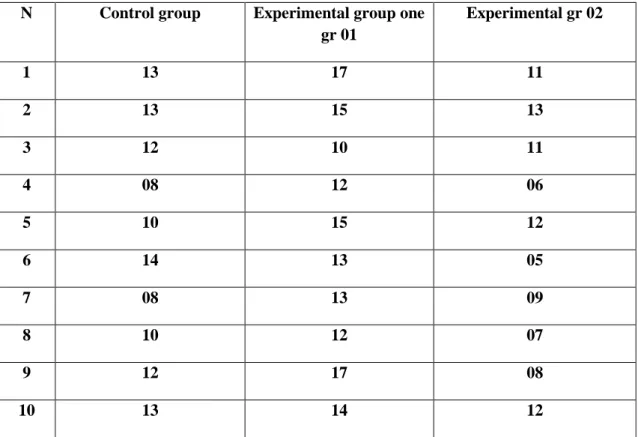
The experiment is done with the aim of confirming the study's hypothesis. The hypothesis claims that if classroom participation is raised, the level of learners' English fluency will be improved. To confirm this , the experiment results are to be reported then discussed. The experiment is divided into two phases. Its results then will be reported in two parts. The results obtained in the whole experiment are presented in the following table:
-26 -
Experimental gr 02 Experimental group one
gr 01 Control group N 11 17 13 1 13 15 13 2 11 10 12 3 06 12 08 4 12 15 10 5 05 13 14 6 09 13 08 7 07 12 10 8 08 17 12 9 12 14 13 10
-27 - Part one
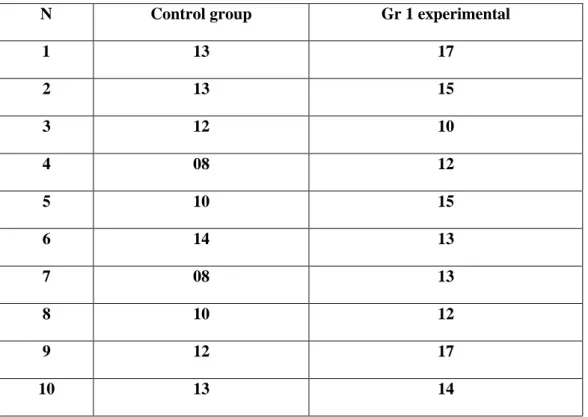
In part one of the experiment, learners' work on a text and questions to be answer without any probable intervention on the part of the instructor, learners ask questions to each other and their friends were supposed to listen and answer fully those questions. In other words, the follow the active student participation such as class discussion and debates. The two groups scores (control and experimental Gr1) in the active participation method's experiment are presented in the following table:
-28 - Gr 1 experimental Control group N 17 13 1 15 13 2 10 12 3 12 08 4 15 10 5 13 14 6 13 08 7 12 10 8 17 12 9 14 13 10
Table 02: the experimental and control groups scores in part one of the experimental
-29 -
The t- test
The t- test is a statistical test which helps in drawing statistical inferences from an experiment's data. This test gives a mathematical formula for computing the value of the observed t. The computational formula of the t- test is as follows:
N1 stands for the number of subjects in the control group. N2 stands for the number of subjects in the experimental group.
stands for the mean of the control group
stands for the mean of the experimental group
stands for the variance of the control group scores stands for the variance of the experimental group scores Note: the critical value is 1.81.
The computation of the observed t
I the two means of the control and experimental group and are calculated using the formula:
Making the substitutions, we find:
and
-30 - Making the substitutions, we find:
and
III-to find the observed
t
, we substitute the value of , , , , , in the test formula:Conclusion
The observed t( ) in part one of the experiment is greater than the critical value of t (1.81), it means that there is a relation between the independent and the dependent variables of the hypothesis. In other words, the prediction we supposed in this piece of work is now proved correct.
-31 - Part two
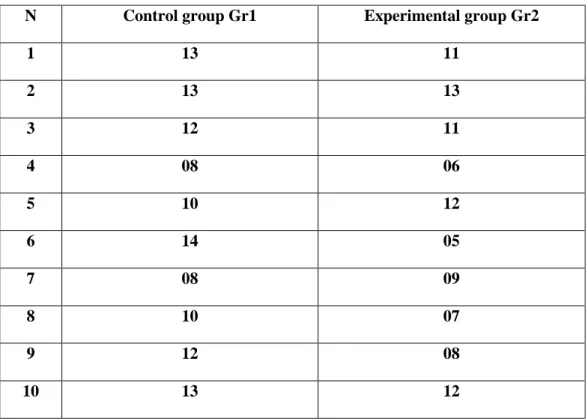
The results obtained in part one of the experiment were a fruitful step. In this part of the experiment, subjects were assigned to a text and questions to answer preceded by a reading from the part of the instructor. No discussion or collaboration among learners were allowed . The scores of the experiment obtained are as follows.
-32 -
N Control group Gr1 Experimental group Gr2
1 13 11 2 13 13 3 12 11 4 08 06 5 10 12 6 14 05 7 08 09 8 10 07 9 12 08 10 13 12
Table 03: the experimental and control groups scores in part two of the experiment
-33 -
The computation of the observed t*
To calculate the observed t* in part two of the experiment, we will follow the same way as in part one, i.e we will calculate the two means of the experimentals and the controls, and the two variances and . The number of subjects of the experimentals and controls groups in part two is the same (10 subjects) with that of part one.
First, the two means of the experimental group and the control group are calculated using the following formula:
After making the substitutions, we find:
and
Second, we calculate the two variances of the two groups : , using the following formula:
After making the substitutions, we find the following values:
Third, to find the observed t*, we make the substitutions of the values of , , , in the t- test formula:
-34 -
Conclusion
Observing the observed t* in the part two of the experiment, we find that the result of the observed t( )is less than the critical value. The result of this comparison is that there is no relation between the two variables of the hypothesis which means that the independent variable is not affecting the dependant variable.
-35 - Reporting the results
Reporting the results of part one
Subjects from the experimental group were asked to read the text carefully and answer the questions and at the same time, they try to interact with the rest of the group. The answers to the questions were immediately corrected and marked, whereas subjects from the control group were just asked to read the text without receiving further help from the part of the instructor.
The scores obtained by both groups tend to vary significantly. The experimental groups' scores range from (10) till (17) and those of the control group from (08) till (14). To detect any probable significant difference between the two groups, t- test was used to see whether or not a significant difference can emerge between the two variables of the hypothesis that was stated at the beginning of this research, i.e. classroom participation and learners' language fluency.
After carrying out the arithmetical computation of t-test, the final value was obtained (tn1+n2-2= 2.50) and after it has been compared to the critical value of t (1.81) t-test was found significant. This means that the experimentals who were asked to perform under task (2) and who were significantly helped by the instructor improve largely their level of English and become fluent while trying to learn English, whereas the controls who receive no help whatsoever from the part of the instructor were incapable of improving their level of English during this short period of time
.
This also indicates, that the more learners receive further help from the teacher instructor and the more they become ready to grasp and understand concepts and words while they are trying to learn how to learn as has been indicated in our hypothesis at the beginning
-36 -
of this research .i.e. The increasing of learners' level of English language fluency through classroom participation.
Reporting the results of part two
The results of the experiment (2) where subjects work on a text assigned by the instructor (see Appendix I) and answer the questions below the text individually with a prior reading from the instructor. The scores obtained show that the experimental group scores range from (5) till (13) and those of the control group from (08) to (14).
After making the computation using t-test, statistical test, the value of t* was obtained (1.69). This value of t* obtained is less than the critical value (1.81). As a result, it is found that the lecture method does not help in increasing learners' English fluency. The reason behind this low scores of the subjects in part two of the experiment is that extraneous variables did not help instructor to achieve better results.
First, the time of the experiment was at 15.30 pm, this means that subjects were really tired and not prepared for doing further works and activities.
Second, the weather was very hot and the room where the experiment is carried out was tremendously hot especially during the evening. These conditions have led subjects to obtain low scores. But this does not mean that our hypothesis is a false on, it is only because of these bad conditions that those low scores of subjects have been gathered, otherwise we should have obtained a much more significant results between the experimental and the controls as has been stated in our hypothesis in the beginning of this research.
Conclusion:
The extent of classroom participation in enhancing the level of English language fluency of students the department of English at the university of Constantine is conducted
-37 -
with the aim of checking the truth of the study supposed prediction: whether classroom participation could raise the learners' level of English proficiency. Since our study falls in the context of teaching and learning English as a foreign language, classroom participation is seen as the best technique to achieve the level of language fluency.
Testing the degree of impact of classroom participation on learners English proficiency is found to be significant. In part one unlike part two, the t-test conducted confirmed that classroom participation using learner-learner discussion, teacher's questions, and explanation of difficult words aids learners to gain high level of English fluency. This leads us to drive the conclusion that classroom participation is an effective procedure in enhancing learners' level of English language fluency.
-38 - General conclusion
This present study, aimed at investigating the impact of classroom participation on raising learners' level of English language fluency. The subjects’ performance in this research was high, thanks to the experiments treatments. The t-test administered on the findings, showed the significance of the experiment's results. This help us to establish the relationship between the hypothesis' independent and dependent variable. In other words, confirming the truth of the prediction we supposed which claimed that classroom participation could raise the learners' level of English language fluency.
Teachers are invited to recognize the importance of classroom participation on raising learners' level. E F L teachers then are provided with a possible solution for learners' low achievement of language proficiency and increase motivation and active performance in class. To develop this procedure ( classroom participation), teachers should through some light on the different methods used in classes the language skills, and the types of learners in order to help learners to enhance their level.
The silent way, is one of the important methods used because it emphasized the silence of the teacher all over the lesson, and let the learners do the work by themselves. The communicative language teaching (C L T) is much important, it aims at making communicative competence the goal of language teaching and provide learners opportunities to use their English for communicative purposes. It stresses also the role of the teacher in classroom as a guide with in classroom procedures and activities, and as an independent participant in the same time. The lecture method helps learners gain knowledge in some extent because it is familiar to them, it is based upon the learners' existing base of knowledge, and the communication is one- way from the part of the instructor. The active participation method allows learner to carry out the lecture by themselves with less instruction from the teacher. It provides much collaboration and communication among learners such as learner- learner discussion, other methods mentioned in this research are also should be studied for the benefits of the learners namely, the direct method, the audio-lingual method, and grammar translation methods.
-39 -
Language skills are of the same importance as the teaching methods in enhancing learners' level. The listening skill is crucial in foreign language teaching, it is an ability of attending, hearing understanding and remembering aural symbols. The factors that influence mastering this skill are the topic dealt with, and the self concept of the learners listening comprehension. The reading skill is the ability of meaning extraction; the most important factors that influence this skill are namely vocabulary, automacity in reading, and the interest level in the text to be read. The speaking skill is the use of language to transmit messages in different and appropriate circumstances. To be skillful in speaking means the ability to decide what to say and clearly in a conversation or other different situations.
Teachers also should know how to deal with the different types of learners in order to enhance their level according to their way of learning. The attention seeker learner is busy with his work and always search for the teacher's attention with less interaction with his colleagues. The intermittent worker avoids teacher’s attention and spends almost his time working on the class taskes. The solitary worker tends avoid interaction with other learners and get his feed Back from the listening rather than discussing and give more importance to the text at hand. The quit collaborator has limited relation with the teacher and other learner's and wants to be left alone. The only way of communication with his colleague is by doing the tasks and discussing.
Finally, we wish this work has helped to through some light on the participation process and its uses in teaching, and that teachers as well as students are going to find some useful and practical basics about language learning. Obviously, problems in enhancing the level of learners' proficiency will continue to exist, so that research and investigation will continue to be done.
-40 - Bibliography
Allwright- R- L. and K. Barly (1991). Focus on the Language Classroom. Cambridge: C. U. P.
Anastasia. T. E. j r. (1982). Listen. Teaching for Improving communication skills. Boston: C B I publishing company.
Barker, L. A. (1971). Listening Behavior. Englewood cliffs, N J: Prentice hall.
Berksi,K. E. S. British American Commonwealth. E N A G Edition. National Enterprise of Graphic Arts. Algiers .
Breen, M., and C. N. Candlin. (1980). The Essentials of a Communicative Curriculum in Language Teaching. Applied Linguistics1(2): 89-112. Brooks, N. (1969). Language and Language Learning: Theory and Practice, (2nd ed.), Harcount Brace, New York, p p.50.
Brown, D. (2000). Principles of Language Learning and Teaching. White Plains, N Y: Longman.
Cohen, L, and L, Manion. (1980). Research Methods in Education. Third Edition
1989. British Library. Cataloguing in Publication Data.
Christenson, L. B. (1980). Experimental Methodology. Allyn Bacon. In c. Boston. London. Sidney, Torino.
-41 -
Finoccharo, M. (1982). Reflection on the Past, The Present and The Future. English Teaching Forum. July., Vol.20, N.3.,PP.2-13
Galton, M & Simon, D & Coll. P (1980): " Inside The Primary Classroom".
Gattegno, C. (1972).Teaching Foreign Languages in schools. The Silent Way. New York: Educational solutions.
Harmer, J. (2001). The Practice of English Language Teaching. Third edition. Pearson Education. L T D.
Hilgard, E. R. and G. H. Bower. (1966). Theories of Learning. New York: Appleton. Century. Croft.
Hymes, D. (1972). On Communicative Competence. I. N j. B. Pride and J. Holmes (eds.). social linguistics, PP. 269-93.
Krashen, D.S. (1984)."Why it works and what it has taught us". Language society. Vol, 12.
Littelwood,W. (1991): Communicative Language Teaching: An Introduction. New direction in Language Teaching, C. U. P.
-42 -
Mc Carthy, Michael. (1991). Discourse Analysis for Language Teachers. C. U. P.
Miller, S. (1975). Experimental Design and Statistics. Methuen.
Mora, Jill.K. (2008). Second Language Teaching Methods: Principles and Procedures. San Diego State University.
http://coe.Sdsu. Edu/ people/ j mora/ allmethods.htm.
Newton, A. C. (1989). Current Trends in Language Teaching in Celce- Murcia, M and Louis Mc Intosh, (eds.). Teaching English as a Second or Foreign Language. Newbury House. Publisher. Pp. 17-26.
Richards, J. C. and T. S Rodgers.(1986). Approaches and Methods in Language Teaching. C.U.P.
Rost, M. (1990). Listening in Language Learning. Longman Group, UK. L T D.
Widdowson, H.G. (1978). Teaching Language as Communication. London and Edinburgh. Morrison and Gibb. L T D. O. U. P.
Wright, G. and C, Fowler. (1986). Investigative Design and Statistics. Penguin Books.
Yalden, J. (1984). The Communicative Syllabus: Evolution, Design and Implementation. Oxford: Perganon.
-43 - Appendix01
The Wheel
The first invention of human beings was the wheel.
Although no wheel forms are found in nature, undoubtedly the earliest 'wheels' were smooth logs which were used for moving weights over the earth's surface. No one recorded who he or she was when it happened, but when ' the first inventor' placed a wheel on an axle, people began to roll from one place to another.
Records of this type of wheel gave been found among Egyptian relies dating back to 2.000 B.C, and earlier Chinese civilizations are credited with independent invention of the same mechanism. The wheel so fascinated the human mind that people have spent centuries building machines around it: yet in over 4.000 years its basic design has remained unchanged.
All about us we see the spinning shafts, gears, flywheels, and rotors which are the descendents of the first wheel. The roaring propeller of an aircraft and the hairspring of ating watch are examples of a rotary motion which characterizes our mechanical world. It is hard to conceive of continuous motion without the wheel.
Questions:
1-select the statement that best expresses the main idea of the paragraph: a-the wheel is used today in industry and transportations.
b-one of human beings' first invention, the wheel, has remained important for 4.000 years. c-the basic design of the wheel has been changed to meet the needs of industrial society. 2-did the original design of the wheel change or not?
-44 - Résumé
Les enseignants de la langue anglaise comme une langue étrangère sont toujours en recherche d'une méthodologie qui permet leur étudiants d'améliorer considérablement leur maitrise de la langue. Car l'utilisation de la langue dans la classe à travers l'utilisation de la participation, et la maitrise des compétences de la langue et les méthodes utilisées par l'enseignant améliore Le niveau des étudiants.
Cette étude est destiné à analyser l'influence de la participation des étudiants dans la classe relativement a leur maitrise de la langue étrangère.
Pour cela, nous avons fait un petit test sur les étudiants titulaire du L M D (3 ans) en institut des langues ( le département de la langue Anglaise) . Ce test s'appuye sur l'influence de la participation faite en classe par les étudiants à l'égard de l'utilisation de la langue. Le test en questions compte également sur un texte sélectionné et de répondre à des questions proposées sur le contenu de texte en discutant la problématique.
Toutefois, les résultats obtenus à travers ce test statistique illustrait que la participation des étudiants en classe est une moyenne pédagogique effectivement utile, surtout lorsqu' elle sera insérée pour donner une opportunité aux étudiants pour interagir dans la classe. Aussi pour améliorer leur niveaux et compétences en utilisant la langue étrangère.
-45 -