HAL Id: tel-01233027
https://tel.archives-ouvertes.fr/tel-01233027
Submitted on 24 Nov 2015
HAL is a multi-disciplinary open access archive for the deposit and dissemination of sci-entific research documents, whether they are pub-lished or not. The documents may come from teaching and research institutions in France or abroad, or from public or private research centers.
L’archive ouverte pluridisciplinaire HAL, est destinée au dépôt et à la diffusion de documents scientifiques de niveau recherche, publiés ou non, émanant des établissements d’enseignement et de recherche français ou étrangers, des laboratoires publics ou privés.
benzene vapors employing screen-printed resistive and
resonant transducers
Pierrick Clement
To cite this version:
Pierrick Clement. Functionalized carbon nanotubes for detecting traces of benzene vapors employing screen-printed resistive and resonant transducers. Electronics. Université de Bordeaux, 2015. English. �NNT : 2015BORD0127�. �tel-01233027�
THÈSE EN COTUTELLE PRÉSENTÉE POUR OBTENIR LE GRADE DE
DOCTEUR DE
L’UNIVERSITÉ DE BORDEAUX
ET DE L’UNIVERSITÉ ROVIRA I VIRGILI
ÉCOLE DOCTORALE UBX
ÉCOLE DOCTORALE DU PARTENAIRE SPÉCIALITÉ : ELECTRONIQUE
Par Pierrick CLEMENT
Functionalized carbon nanotubes for detecting
traces of benzene vapors employing
screen-printed resistive and resonant transducers
Soutenue le 24 septembre 2015Membres du jury :
Dr. Maria PILAR PINA, Universidad de Zaragoza – INA Présidente Pr. Philippe MENINI, Université de Toulouse Paul Sabatier – LAAS Rapporteur Pr. Eduard LLOBET, Universitat Rovira i Virgili – MINOS Directeur de thèse Dr. Hélène DEBEDA, Université de Bordeaux – IMS Directrice de thèse
Titre: Nanotubes de carbone
fonctionnalisés pour la détection de traces
de vapeurs de benzène à l’aide de
transducteurs résistif
s et résonants
sérigraphiés
Résumé:
Ce travail de thèse porte sur l’optimisation des propriétés de nanotubes de carbone pour la détection de gaz. Pour cette application, les nanotubes de carbone ont été déposés sur deux types de transducteur sérigraphiés, résistif et résonant. Les nanotubes de carbone à multi-parois traités par plasma d’oxygène (O-MWCNTs) ont été le point de départ de ces travaux. Les performances de ces nanomatériaux déposés par air-brushing sur le transducteur de type résistif comportant deux électrodes de platine interdigitées préalablement déposées sur un substrat d’alumine ont été étudiées en présence de composés organiques volatils (COVs). Par comparaison aux réponses obtenues sous éthanol et acétone, une meilleure sensibilité et un meilleur temps de recouvrement ont été observés en présence de benzène et de toluène. Les nanotubes de carbone O-MWCNTs ont été ensuite déposés sur une micropoutre piézoélectrique sérigraphiée. Cette dernière, à base de PZT placé entre 2 électrodes, permet simultanément l’actionnement et la mesure de sa fréquence de résonance. De plus, le remplacement de l’électrode supérieure de géométrie rectangulaire par deux électrodes interdigitées a permis la mesure simultanée de la résistance des nanotubes de carbone et de la fréquence de résonance. Grâce à cette nouvelle génération de transducteur, la variation de résistance de la couche de nanotubes de carbone et la variation de masse ont pu être mesurés en présence de COVs mais aussi de monoxyde de carbone et de dioxyde d’azote. Sous forte concentration de vapeurs/gaz, la prise de masse de la couche sensible entraîne des variations de fréquence négatives. En revanche, à plus faible concentration, des variations de fréquence positives ont été observées. Ce phénomène est attribué à une modification de la rigidité de la poutre résonanteMWCNTs de type-p a de plus permis la discrimination du caractère oxydant ou réducteur des gaz/vapeurs. Finalement, face à la difficulté de détecter le benzène à faible concentration, une approche basée sur la reconnaissance moléculaire « host-guest » a été proposée. Afin de promouvoir des interactions spécifiques avec le benzène, les MWCNTs ont été fonctionnalisés avec une molécule de type quinoxaléine en conformation de cavité. Ainsi, la mesure de la résistance de ce nanomatériau hybride a permis la détection de 2,5 ppb de benzène sous air sec avec une limite de détection (LOD) proche de 600 ppt. Ces résultats remarquables démontrent les potentialités des nanotubes de carbone fonctionnalisés pour la détection de faibles traces de composés aromatiques.
Mots clés:
nanotubes de carbone, capteur, résistif,résonant, piézoélectrique, benzène, reconnaissance moléculaire
Title: Functionalized carbon nanotubes for
detecting traces of benzene vapors
employing screen-printed resistive and
resonant transducers
Abstract:
Multiwall carbon nanotubes (MWCNTs) basesensitive layers have been deposited onto different transducer substrates for gas sensing application. Oxygen plasma treated MWCNTs, so-called O-MWCNTs, have been a building block for developing other gas sensitive nanomaterials. At first, O-MWCNTs have been studied as resistive gas sensors. Volatile organic compounds (VOCs) such as benzene, toluene, ethanol, methanol and acetone have been used to characterize this sensitive layer. The sensors show good sensitivity and excellent baseline recovery in the presence of benzene or toluene vapors compared to the others tested VOCs. O-MWCNTs have been studied as adsorbent nanomaterials deposited on PZT piezoelectric resonant cantilevers fabricated by multilayer screen-printing. In the second step, a modification of the rectangular top electrode to become an interdigitated electrode was implemented in order to have a sensor transducer employing two transduction mechanisms. This configuration allowed us to measure, for a single device, the resistance change of the carbon nanotube film and the resonance frequency shift of the PZT cantilever upon exposure to VOCs. The sensing properties of such systems have been studied for benzene, CO, and NO2 contaminants. Positive and negative shifts of the resonance frequency are observed at low and high gas concentrations, respectively. These are attributed to stress or to mass effects becoming dominant at low or high gas concentration levels. Monitoring the resistance of the p-type O-MWCNT film helps discriminating gases/ vapours according to their oxidizing or reducing character. The interest of the double transduction has been demonstrated in the detection of CO. Finally, in front of the difficulty to detect benzene at low concentrations, a different approach based on the host-guest molecular recognition is proposed. To promote
demonstrated with a limit of detection (LOD) near 600 ppt. These remarkable results show the potentiality of functionalized carbon nanotubes in aromatic vapor sensing at traces level.
Keywords:
carbon nanotubes, sensor, resistive, resonant,Unité de recherche
Acknowledgement
Firstly, I would like to express my sincere gratitude to my advisors Prof. Eduard Llobet, Dr. Hélène Debéda and Dr. Claude Lucat for their excellent guidance, support and availability. They always carried me when talking about new ideas and dedicated lot of time for my writing. Also, this thesis has been possible thanks to their respective knowledge and collaboration.
I also thank the CTP funding under grants no. 2011CTP00015 (Catalonia) and no. 369831/36982 (Aquitaine) that financially supported this thesis.
I would like to thank Pr. Pablo Ballester for his collaboration with the use of cavitand as recognition part of the sensor. In that sense, I really thank my colleague and friend Dr. Sasa Korom for his time with the synthesis of the cavitand and all his precious advices related to results interpretation.
I deeply trust that without a strong technical support, a PhD student cannot extend his personal skills and loose lot of time so I would to thank Dr. Raul Calavia Boldu, the Jordi Mare team (Badi, Jaume, …), the electronic microscopy team of Merce Moncusí Mercadé (Lukas, Rita, Marianna). I thank also Dr. Isabelle Favre and Jonathan Argillos for precious help in the microcantilever fabrication and their kindness.
My sincere thanks go to my teacher Stéphane Pagneux, who in critical point of my life, trusted in me and teach me chemistry with passion, that I have received afterwards. In that way, I would like to thank Dr. Franck Berger who gives me the opportunity to go in Spain and know the laboratory of Pr. Eduard Llobet.
Many thanks to Dr. Carla Bittencourt and her student Carla Struzzi for their XPS analysis and relevant comments.
I thank Prof. Nantakan Muensit and Dr. Chalongrat Daengngam for their kind reception by two times in the Prince of Songkhla University (Thailand). We had very interesting talks that have emerged ideas in this thesis.
Of course, I could not have imagined better good time without my labmates. So I sincerely thank Raul, Sergio, Oriol, Enrique, Rosa, Fatima, Giovanni, Marc, Ariadna and Angel. I do not forget my old friends with which I have shared my life, so thank you to Julien, Alexis, Ali and Patrick.
I express my deepest gratitude to all my family for their support and their kindness since always. I will never thanks enough my parents, that taught me what is life, human values and their unconditional love which helped me thousands times.
Finally, I thank Esther for her encouragement, patience and help during these four years. Her advices and love has been a key point for the success of this thesis.
Dedicated to my parents:
Daniel Clément
&
Marie-Brigitte Clément
And to my sister:
Amélie Paris
Table of content
General introduction ... 1
CHAPTER I: State of the art ... 5
1.1. Introduction ... 5
1.2. Overview of benzene toxic vapour ... 7
1.2.1. Benzene properties and emanation origin ... 7
1.2.2. Current techniques for analysing benzene vapours ... 8
1.3. Solid state gas sensors ... 10
1.3.1. Resistive gas sensors ... 10
1.3.2. Resonant cantilever based gas sensors ... 13
1.4. Carbon nanotubes as sensitive layer ... 16
1.4.1. Functionalized CNTs gas sensors ... 17
1.4.2. Metal decorated CNT gas sensors ... 19
1.5. Benzene detection based on CNT composites as gas sensitive interface……. ... 20
References ... 22
CHAPTER II: Transducers fabrication, CNTs deposition and experimental gas sensing setup ... 29
2.1. Transducer fabrication ... 29
2.1.1. Generalities on the screen-printing technique ... 29
2.1.2. Fabrication of the resistive transducer ... 31
2.2.2. On the cantilever transducer ... 42
2.3. Gas sensing test setup ... 43
2.3.1. Sensor test chamber design and fabrication ... 43
2.3.2. Setup for gas sensing characterization ... 48
2.4. Conclusion ... 51
References ... 52
CHAPTER III: Benchmark study of oxygen functionalized MWCNTs as gas sensing interface ... 55
3.1. Overview ... 55
3.1.1. Oxygen functionalization methods ... 56
3.1.2. Structural and electronic properties changing ... 57
3.1.3. Gas sensing interaction mechanism ... 58
3.2. Gas sensor fabrication ... 60
3.2.1. MWCNTs synthesis and functionalization ... 60
3.2.2. Impedance spectroscopy characterization ... 63
3.3. Gas sensing properties of O-MWCNTs ... 64
3.3.1. VOCs detection ... 64
3.3.2. Discussion ... 69
3.4. Conclusion ... 73
References ... 75
CHAPTER IV: Piezoelectric resonant cantilever gas sensor with double transduction ... 79
4.1. Electromechanical characterization of the microcantilever ... 80
4.1.1. Configuration of electrical connections ... 80
4.1.2. Polarization step ... 82
4.1.3. Electro-mechanical characterization ... 84
4.1.4. Theory correlation of experimental observation ... 91
4.2. Microcantilever preparation for gas sensing tests ... 100
4.2.1. Effect of CNTs deposition ... 100
4.2.2. Electrical measurement processing ... 101
4.3. Results and discussion ... 102
4.3.1. Temperature effect ... 102
4.3.2. Detection of volatile compounds at room temperature ... 104
4.3.3. Effect of humidity ... 109
4.4. Conclusion ... 109
References ... 111
CHAPTER V: Cavitand functionalized MWCNTs for sensitive benzene detection ... 113
5.1. Motivation ... 113
5.2. Anchoring of the cavitand on MWCNTs ... 116
5.2.1. Experimental section ... 116
5.2.2. Step by step characterization ... 119
5.2.3. Stability study of thioether-Au bond with temperature ... 124
5.3. Gas sensing properties ... 126
5.3.1. High sensitivity to benzene ... 126
5.3.2. Gas sensing mechanism ... 131
5.3.3. Humidity effect ... 135
References ... 143
General conclusion ... 151
Annex I ... 155
Annex II ... 158
General introduction
The detection of gases and (bio)chemical species with the help of miniaturized sensors is, nowadays, at the center of research efforts, especially for industrial applications (petro chemistry, aeronautic, transport, …), food quality control, disease diagnostic or air and water quality surveillance. Benzene, among other volatile organic compounds (VOCs) is recognized for its high toxicity, so its accurate detection is of paramount importance. In this domain, the use of resonant sensors is attracting interest and, very recently, sensor microsystems based on piezoelectric thick films alone or screen printed on silicon cantilevers are getting promising results. This thesis has as starting point the results of a previous project, which allowed the realization of a detection platform using screen-printed microcantilevers from piezoelectric material (PZT) to generate unusual, in-plane 31-longitudinal vibrations modes. To achieve a low detection limit (<ppm), microcantilevers were coated with different organic and inorganic adsorbing materials. The best results for a reversible detection of benzene at room temperature were obtained with active carbon. These interesting results push us, in the framework of this thesis, to continue optimizing the sensing platform in view of detecting very low benzene concentrations (few tens of ppb). Nevertheless, the previously used active carbon compounds lack of intrinsic selectivity and, therefore, have been replaced by carbon nanotubes. This nanomaterial offers the advantage of being
easily modified employing different strategies in order to obtain higher and more specific interaction with the toxic volatile target to be detected. Additionally, an improvement in the sensitivity and the viability of the detection platform is sought by optimizing the piezoelectric properties of the transducer. Finally, a modification will be brought to the platform in order to measure the conductivity of the sensitive layer additionally to the resonance frequency of the piezoelectric cantilever with the objective to improve selectivity. The manuscript of this thesis is divided in five chapters as follows:
Chapter I presents a general description related to the risks of benzene exposure with the presentation of the conventional analytical techniques for monitoring the environment. Then, it reviews the latest technologies used in gas sensing devices and focuses in benzene detection.
Chapter II describes, at first, the fabrication of the transducers used for the gas sensing application considered in this Thesis. Then, an experimental section describes how transducers are coated with the active layer. Finally the study of the design and fabrication of the test chamber with the different coupled elements for the gas sensing characterization is presented.
Chapter III gives a preliminary study of the gas sensing properties of oxygen functionalized multiwall carbon nanotubes as resistive gas sensors. The study is focused on the structure and electronic properties of these nanotubes with their gas sensing characterization towards different volatile contaminants.
Chapter IV proposes to enhance sensitivity and selectivity by measuring both the resonance frequency shift of a CNT coated piezoelectric cantilevers and the resistance change of CNT films upon the adsorption of gas species. Also, the piezoelectric properties of this new device are compared to the previous one (simple transduction).
Chapter V presents a different approach to enhance the interaction between benzene molecules and the sensitive layer, which is based on host-guest molecular recognition. To achieve this objective, a cavitand, which plays the role to trap benzene, is grafted onto the outer wall of multiwall carbon nanotubes and simple, resistive gas sensors employing this hybrid nanomaterial are fabricated and tested.
CHAPTER I: State of the art
In this chapter, we will give a general description related to the risks of benzene exposure. Also, conventional analytical techniques for monitoring the environment will be presented. Then we will focus on the latest technologies used in gas sensing devices to improve benzene detection.
1.1.
Introduction
Current interests in environmental protection are focused in outdoor and indoor air quality. Harmful gases present in the atmosphere can spoil our environment and cause disease or death to humans and other living organisms. Gas pollutants can be classified as primary or secondary. Primary pollutants are generated from processes (natural or industrial) such as volcanic eruption or gas from motor vehicle exhaust for example. Major primary pollutants include:
Nitrogen oxides (NOx) that are principally generated from
high temperature combustion.
Carbon monoxide (CO) that is a byproduct of incomplete combustion from fuel such as natural gas or wood but its major source comes from motor vehicle exhaust.
Sulfur oxides (SOx) that are produced by volcanic activity
Ammonia (NH3) that is emitted from livestock and
agricultural processes with the incorporation in foodstuffs and fertilizers.
Volatile organic compounds (VOCs) that are well known since they are emitted basically from human activity. They are organic compounds with a very high vapor pressure at room temperature. Among them aromatic compounds such as BTEX (Benzene, Toluene, Ethylbenzene and Xylene) are known to be very toxic at low concentrations and prolonged exposure.
Secondary pollutants are not generated directly and are formed in the air when primary pollutants react or interact. they principally include:
Ozone (O3) that is formed in presence of NOx and VOCs.
In the stratosphere, it constitutes an important role with the Ozone layer by filtering some electromagnetic waves at high energy (UV,…). But at high concentration in air, it forms a smog with other constituents and actuate as a high oxidizing agent with other chemical compounds.
Particulate matter (PM) that is formed from combustion reactions. The presence of ammonia has a role in the formation of particulate matter. PM is responsible for the onset of serious pulmonary diseases.
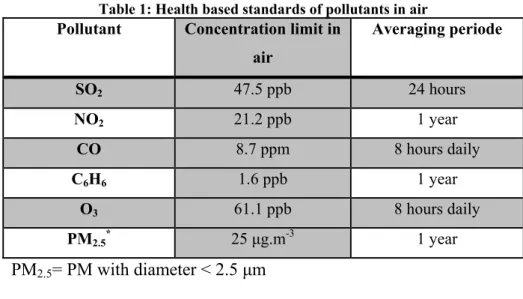
The European Commission has developed an extensive body of legislation which establishes health based standards [1] and objectives for a number of pollutants in air summarized in Table 1.
Table 1: Health based standards of pollutants in air
Pollutant Concentration limit in
air Averaging periode SO2 47.5 ppb 24 hours NO2 21.2 ppb 1 year CO 8.7 ppm 8 hours daily C6H6 1.6 ppb 1 year O3 61.1 ppb 8 hours daily PM2.5* 25 μg.m-3 1 year PM2.5= PM with diameter < 2.5 μm
1.2.
Overview of benzene toxic vapour
1.2.1. Benzene properties and emanation origin
Benzene is a non-polar six-membered ring aromatic hydrocarbon with molecular formula C6H6, with dimensions of ca. 6.0 x 3.5 Å and
a volume of 120 Å3. It belongs to the BTEX (Benzene, Toluene, Ethylbenzene and Xylene) group of compounds. The components of this group feature similar structures but quite different toxicological properties. Benzene is present in the petrochemical industry, land reclamation, petroleum coke oven operators, petrol stations, motor vehicle repair stations, roadside works and many other industries.[2] Cigarette smoking is another important source of exposure to benzene.[3] It is listed among the most harmful VOCs. It generates highly flammable and toxic vapours and is recognized as a human carcinogen by the US Environmental Protection Agency and by the European Commission. Long term exposures to relatively low concentrations of benzene over months or years lead to severe
acute non-lymphocytic leukaemia.[4-6] In the last ten years, the permissible exposure limit has been lowered from 10 ppm to 100 ppb.[7] According to the Directive 2008/50/EC of the European Parliament and of the Council of May 2008, the limit value for the annual average exposure to benzene is 5 μg.m-3 (1.6 ppb).[8]
1.2.2. Current techniques for analysing benzene vapours Nowadays, several methods for detecting benzene traces are in use. They provide fairly accurate and selective gas reading. Most of them involve pumping of the sample and subsequent analysis by employing colorimetric detector tubes, gas chromatography (GC) coupled to a detector like flame ionisation detector (GC-FID) or mass spectrometer (GC-MS), nuclear magnetic resonance (NMR) and Fourier transform infrared spectroscopy (FTIR). These methods are bulky, expensive and do not allow for implementing a continuous monitoring of benzene traces. Furthermore, they require specially skilled and knowledgeable operators. In the last few years, pre-concentration methods and GC equipment have been improved in terms of miniaturization and with a LOD reaching the ppb level for benzene.[9-11] However, such systems are still limited by their long response time, high power consumption and high cost. Alternatively, the use of portable photoionization detectors (PID) has been reported as well (Photovac, Raesystems, Draeger), but PID devices are not selective to benzene and give a total reading for VOCs. The photoionization measurement process consists of the illumination by high energy UV (Ultra Violet) light of a molecule. The photons absorbed provoke the ionization of the molecule. Ions can be detected by applying an electric field. The resulting current measured depends
of the concentration of the molecule ionized. Sensing principle is shown in Figure 1.
Figure 1: Operating principle of a photoionization detector
The lack of selectivity of such a device is clearly dependant on the choice of the ionization lamp. One option to make PID more selective for benzene is to utilize a single-use, disposable and rather expensive filter at the inlet port of the device what would result in a dramatic cost increase of running benzene measurements. Human activity may result in active exposure to benzene and would clearly benefit from affordable, portable, highly sensitive and selective detectors able to run continuous measurements. Keeping this in mind, scientists have intensified their research in another kind of detection systems that can be used for gas identification and control. These are solid state gas sensors and their principle consists of a sensing layer that allows recognizing the target gas with which it interacts and a transducer to
optical signal.
1.3.
Solid state gas sensors
A characteristic of solid state gas sensors is the reversible interaction of the gas with the surface of the solid state material. Several physical effects are used to achieve the detection of gases. In addition to the conductivity change of gas sensing material, the detection of this interaction (transduction) can be performed by measuring the change of the capacitance, work function, mass, optical characteristics or reaction energy released by the gas/solid interaction.[12] The sensing layer can be organic (polymers, complexes,…) and inorganic (metal oxide semi-conductors, electrolytes…). Nowadays, a wide variety of solid state gas sensor has been studied with interdisciplinary science such as chemistry, electronics, biology and many more. In the context of the thesis we will focus on layers of CNTs (carbon nanotubes) as sensitive nanomaterials coating either resonant (cantilevers) or non-resonant (resistive) transducers.
1.3.1. Resistive gas sensors
Resistive sensors (chemoresistors) are among the most commonly used gas sensors. Resistive gas sensors are based on the change in resistance that undergo sensitive layers upon gas exposure. The most typical sensitive layers are semiconductor metal oxides and organic semiconductors.[13] For metal oxides, the most common sensing material used in resistive gas sensing is SnO2. Also, other metal
oxides such as ZnO, TiO2, WO3 and In2O3 have been investigated.
Recently, intensive researches have been focused on the design of monocrystalline and nanostructured metal oxides in order to enhance sensitivity and stability.[14] A general rule linked to the use of metal oxides as gas sensitive layers consists of the formation of nanosized grains that partially adhere to each other. Then, they interact with oxygen to form active oxygen species that alter the electrical charge at that grain surface. By reaction with combustible gases, oxygen active species are depleted, which result in an alteration of the resistance of the device. For example, SnO2 behaves as an n-type
semiconductor due to oxygen vacancies in the crystal structure. As a result, two electrons at a tin atom become free.[13] When tin dioxide is exposed to ambient oxygen, oxygen molecules adsorb at the interface and each oxygen molecule captures electrons via the conduction band of the semiconductor forming adsorbed anionic oxygen species such as O2-, O- and O2- which depend strongly on the
operating temperature.[15] Then, gas molecules can interact with such oxygen reactive species resulting in the surface depletion of charge carriers as shown in Figure 2.
Figure 2: Formation of a charged layer by oxygen chemisorption and the effect of a reducing gas, adapted from [16]
class of gas sensing material. Unlike traditional inorganic sensors, they present innate porosity and a wide range of morphologies are provided adjusting directly synthesis or post-synthesis parameters. Additionally, they can operate at room temperature which is an advantage for very low power consumption. For example, Gaudillat P. et al. have shown superior performance of polymer-phtalocyanine hybrid material for ammonia sensing in high humidity atmospheres. They could detect 30 ppm of ammonia in 10-70% of relative humidity (R.H).[17] Also, Dan Y. et al. have shown sensitive
performance of poly(3,4-ethylenedioxythiophene)
/poly(styrenesulfonate) (PEDOT/PSS) with relative resistance changes of 10.5%, 9% and 4% towards acetone, methanol and ethanol, respectively.[18] Another similar class of compounds based on carbon material are carbon nanotubes (CNTs). They have become the most studied carbon nanomaterial for developing gas sensors.[19] The electronic properties of CNTs have been found to be extremely sensitive to their local environment with a high specific area. Furthermore, gas sensing properties can be tuned thanks to the modification of their external wall as shown in Figure 3.
Figure 3: Possible modifications of CNTs
For all these intrinsic properties, CNTs have been chosen as sensitive layer for the development of benzene gas sensing. Details on their electronic properties and gas sensing mechanism are shown later in chapter III.
1.3.2. Resonant cantilever based gas sensors
First interests in the use of cantilevers as potential chemical or physical sensor come from advances in the study of AFM (Atomic Force Microscopy) probes. During the last two decades, microelectromechanical systems (MEMS) have facilitated the development of sensors that involve transduction of mechanical energy. Bimorph effect is observed with an AFM probe when it is covered with a metallic layer on one side and, afterwards, has been exploited for humidity, temperature [20] and chemical [21] sensor applications. Then, several studies based on the bimorph effect or chemically induced strain effect have been investigated.[22] One of
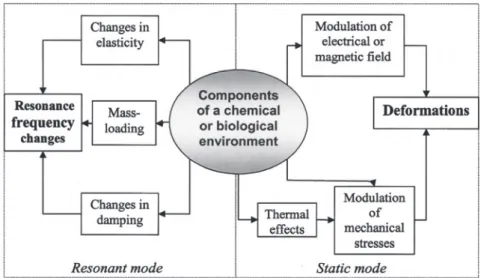
the first systems based on silicon microcantilevers consisted of gas sensors arrays coated with a layer of different polymers allowing to detect simultaneously changes in surface strain induced by adsorption of alcohols that could be distinguished.[15] For chemical sensing, the microcantilever is generally coated with a sensitive layer with the aim to adsorb with more affinity the target species. Then, the adsorbed element can be detected by measuring the quasi-static deflexion (static mode) or the shift of the resonance frequency (dynamic or resonant mode) of the microcantilever.
Figure 4: Conversion of input stimuli into output signals by cantilever transducers is associated with a number of transduction mechanisms. Depending on the measured parameter—structural deformations or resonance
frequency changes—the mode of sensor operation can be referred to as either static or resonant. Each of these modes, in turn, can be associated with
different transduction scenarios.[23]
The measured parameter chosen is directly related to the cantilever deflection or the resonance frequency and the mode of the cantilever operation can be referred to as either static or resonant. Each of these
modes, in turn, can be associated with different transduction scenarios (Figure 4.). For static cantilever deflection, transduction takes place by external forces exerted on the cantilever or intrinsic stresses generated on the cantilever surface (or within the cantilever). On the other hand, for cantilever sensors operating in dynamic mode, variation of the resonance frequency depends upon the attached mass as well as viscoelastic properties of the cantilever and the medium. The bending and the changes of the cantilever resonance frequency can be monitored by several techniques like optical beam deflection,[24] piezoresistivity,[25] piezoelectricity,[26] interferometry,[27] capacitance [28] and electron tunneling [29] for the most important. Previous works have shown that screen-printed piezoelectric cantilevers based on PZT (PbZrxTi1-xO3) can be an
alternative technology to the silicon micromachining for cantilever gas sensors.[30] The advantage of piezoelectric material is that it can be used both for actuating and transducing as a result from mechanical or electrical stimuli. Thus, it allows a simplification of the fabrication process of the microcantilevers and of their actuation/detection mode. All these properties show that PZT printed microcantilevers are good candidates for chemical sensors in gas sensing applications. Also, CNTs (carbon nanotubes) have been chosen as sensitive layer deposited on the cantilever because, as 1D nanomaterial, they present high specific area for gas adsorption.
Carbon nanotubes (CNTs) belong to the family of fullerene structures. Theses allotropes of carbon have been re-discovered by Iijima in 1991 [31] and particular interest has been devoted in many applications of this new class of nanomaterial.[32-34] Their structure arises from the folding of a graphene sheet (planar structure of hexagonal carbon rings), rolled-up into a seamless cylinder with diameter of few nm and length from 1 to 100 μm. CNTs are chiral structures and can be classified in two groups: single wall carbon nanotube (SWCNT) with on single outer wall and multiwall carbon nanotubes (MWCNTs) with multiple concentrically nestled walls (with interlayer graphite distance of 0.34 nm) as shown in Figure 5.
Figure 5: A) Conceptualized depiction of a multiwalled carbon nanotube (MWNT) with concentrically nestled walls. A single-walled carbon nanotube
(SWNT) consists of one wall, or the innermost (red) CNT. B) Schematic depiction of the roll-up vectors (n,m) of a CNT, showing armchair (n=m),
SWCNTs can be either metallic or semiconducting depending to the roll-up vector. If n-m=3q (where q is an integer or zero) it is a metallic SWCNT and when n-m≠3q, it is a semiconducting SWCNT. As far as coaxial SWCNTs (i.e. MWCNTs), calculation have shown that each of the SWCNTs tends to maintain its own behaviour, yet tube interactions may occur that are likely to modify the electronic behaviour for specific relative positions of the superimposed graphene lattices.[36, 37] However, this is specifically sensitive for tubes with relatively small diameters.[38] As soon as radii of curvature are larger than 7 nm (almost always the case for MWCNTs), the band gap energy of the semiconducting SWCNTs is lower than the thermal energy at room temperature, meaning that all MWCNTs whose outer diameter is larger than 14 nm exhibit a metallic behaviour.[39] As mentioned in 1.2.1, pristine (without chemical modifications) CNTs present several advantages to compensate their lack of specificity to different gaseous analytes and also the low sensitivity towards gases that do not interact with CNTs. Functionalization and decoration of CNTs walls can tune the reactivity / interaction with a target gas. Some of such modifications are presented below and their sensing properties are compared to those of pristine CNTs.
1.4.1. Functionalized CNTs gas sensors
Indeed, functionalization of CNTs walls allows creating specific interactions with the target analyte and can also improve the dynamic sensing. The functionalization can be distinguished in two
functionalization. These two pathways differ by the type of the linkage of the functional entity used to functionalize the CNTs wall. The non-covalent functionalization is principally based on the use of multiple weak forces such as Van der Walls and π-stacking interactions for the complexation of a supramolecule and the CNTs wall.[33] This method is non-destructive because the physical properties of the CNTs stay unchanged.[40] Esra Nur Kaya et al. demonstrated that asymmetrically substituted ZnPc (zinc phthalocyanine) bearing one pyrene and six polyoxy groups as side chains linker bind better than symmetrically octasubstitued ZnPc bearing eight polyoxy groups linker. It is shown that SWCNT-pyrene containing ZnPc response towards ammonia vapour was almost 2 times higher than SWCNT without pyrene ZnPc and 6 times higher than pristine SWCNT.[41] Also, Yaqiong Z. et al. have shown the high sensing performance of SWCNTs coated with carbazolylethynylene oligomer (Tg-Car) sensor towards nitroaromatic explosive vapors at low concentration (from ppb to ppt levels). Responses are much higher with opposite signal variation compared to pristine SWCNTs.[42]
The covalent functionalization is, as the name suggests, a covalent link between the CNTs wall and the chemical function or molecule grafted. The most employed covalent functionalized CNTs are based on esterification or amidation of the carboxylic groups that are introduced on defect site of the CNTs wall during acid treatment (cf. Chapter II). For example, L. Niu et al. demonstrated that MWCNTs functionalized by poly(ethylene glycol) showed remarkable gas
sensing properties toward chloroform detection.[43] H. Mu et al. show the superior performance of amino group functionalized MWCNTs for formaldehyde sensing. They could reach high sensitivity (limit of detection of 20 ppb) compared to pristine MWCNTs that remained almost insensitive.[44]
1.4.2. Metal decorated CNT gas sensors
Metals exhibit a broad range of electronic and physico-chemical properties like adsorption capacity, high catalytic activity and efficient charge transfer. Consequently, metal nanoclusters play an important role in the gas sensing pathway in which sensitivity and selectivity can be tuned based on the reactivity of the nanocluster used.[45] Furthermore, metal nanoclusters are mechanically and chemically robust and are able to support high temperature and aggressive environment. Reactivity of metal nanocluster-CNTs upon gas exposure will depend on the metal used and the nature of the charge transfer between the metal nanocluster and the CNT induced by gas adsorption.[46, 32] The general rule of this concept is to use nanoclusters (nanosize for high specific area and maximize effect of the adsorbate on the nanocluster) that donate or accept a significant amount of charge upon adsorption of a volatile molecule resulting in a change of electron transport in the nanotube. For example, I. Sayago et al. have demonstrated the good response to hydrogen of Pd-decorated SWCNTs and their excellent sensitivity respected to the tested interfering gases (octane, toluene and ammonia). M. Penza et al. have improved NO2 and NH3 detection respect to pristine
surface of MWCNTs as resistive gas sensor. The sensors had a working temperature in the range of 100-250°C.
1.5.
Benzene detection based on CNT
composites as gas sensitive interface
In the literature, only few studies have been focused on the detection of benzene vapours using CNTs based sensor at room temperature. Some of them are presented in Table 2.
Table 2: CNTs based gas sensor performance towards benzene
CNTs type Sensor configuration Gas vector Detection limit Ref. Rh-MWCNTs Resistor Air 50 ppb [47]
Pt/Au-SWCNTs Resistor Air 5 ppm [48]
polyurethane-MWCNTs
Resistor Air N/S [49]
FeTPP-SWCNTs FET* Air 500 ppb [50]
MWCNTs PCQMB* Air 95 ppm [41]
HTBN/MWNTs-OH Resistor Air N/S [51]
FET = Field Effect Transistor
PCQMB = PiezoelectriC Quartz Crystal Microbalance
Benzene remains difficult to be detected. Some improvements in the sensitivity by Rh-MWCNTs sensitive layer is observed (LOD = 50 ppb). Nevertheless, no studies with carbon nanomaterials based
chemical gas sensors investigated the selectivity towards benzene. Today, the unique way to achieve a partial selectivity is to employ an array of gas sensors and apply an algorithm of pattern recognition [47, 48, 52] (like principal component analysis, linear discriminant analysis and artificial neural networks).
References
[1] E. N. Kaya, S. Tuncel, T. V. Basova, H. Banimuslem, A. Hassan, A. G. Gürek, et al., "Effect of pyrene substitution on the formation and sensor properties of phthalocyanine-single walled carbon nanotube hybrids," Sensors and Actuators B: Chemical, vol. 199, pp. 277-283, 2014.
[2] C. Manuela, T. Francesco, C. Tiziana, C. Assunta, S. Lara, N. Nadia, et al., "Environmental and biological monitoring of benzene in traffic policemen, police drivers and rural outdoor male workers," Journal of environmental monitoring, vol. 14, pp. 1542-1550, 2012.
[3] S. B. Wilbur, S. Keith, O. Faroon, and D. Wohlers, "Toxicological profile for benzene," Atlanta, Ga, USA: US Department of Health and Human Services, 2007.
[4] D. Dougherty, S. Garte, A. Barchowsky, J. Zmuda, and E. Taioli, "NQO1, MPO, CYP2E1, GSTT1 and GSTM1 polymorphisms and biological effects of benzene exposure—a literature review," Toxicology letters, vol. 182, pp. 7-17, 2008. [5] R. E. Hester and R. M. Harrison, Volatile organic compounds
in the atmosphere: Royal Society of Chemistry, 1995.
[6] A. P. DeCaprio, "The toxicology of hydroquinone-relevance to occupational and environmental exposure," CRC Critical Reviews in Toxicology, vol. 29, pp. 283-330, 1999.
[7] (2014, Apr 4, 2011 ). The National Institute for Occupational Safety and Health, NIOSH Pocket guide for chemical hazards: Benzene. Available: www.cdc.gov/niosh/npg/npgd0049.html [8] (2008, Apr 14, 2008). Official Journal of the European
Union,50/EC of the European Parliament and of the Council of 21 May 2008 on ambient air quality and cleaner air for
Europe. Available:
http://ec.europa.eu/environment/air/quality/legislation/existing _leg.htm
[9] J. Sun, F. Guan, D. Cui, X. Chen, L. Zhang, and J. Chen, "An improved photoionization detector with a micro gas chromatography column for portable rapid gas chromatography system," Sensors and Actuators B: Chemical, vol. 188, pp. 513-518, 2013.
[10] C. Liaud, N. Nguyen, R. Nasreddine, and S. Le Calvé, "Experimental performances study of a transportable GC-PID and two thermo-desorption based methods coupled to FID and MS detection to assess BTEX exposure at sub-ppb level in air," Talanta, vol. 127, pp. 33-42, 2014.
[11] R.-S. Jian, Y.-S. Huang, S.-L. Lai, L.-Y. Sung, and C.-J. Lu, "Compact instrumentation of a μ-GC for real time analysis of sub-ppb VOC mixtures," Microchemical Journal, vol. 108, pp. 161-167, 2013.
[12] M. J. Madou and S. R. Morrison, Chemical sensing with solid state devices: Elsevier, 2012.
[13] F.-G. Banica, Chemical sensors and biosensors: fundamentals and applications: John Wiley & Sons, 2012.
[14] M. Arafat, B. Dinan, S. A. Akbar, and A. Haseeb, "Gas sensors based on one dimensional nanostructured metal-oxides: a review," Sensors, vol. 12, pp. 7207-7258, 2012. [15] H. Lang, R. Berger, F. Battiston, J.-P. Ramseyer, E. Meyer, C.
Andreoli, et al., "A chemical sensor based on a micromechanical cantilever array for the identification of gases and vapors," Applied Physics A: Materials Science & Processing, vol. 66, pp. S61-S64, 1998.
[16] S. Gun-Joo, C. Sun-Woo, J. Sung-Hyun, K. Akash, and K. Sang Sub, "V-groove SnO 2 nanowire sensors: fabrication and Pt-nanoparticle decoration," Nanotechnology, vol. 24, p. 025504, 2013.
[17] M. Bouvet, P. Gaudillat, and J.-M. Suisse, "Phthalocyanine-based hybrid materials for chemosensing," Journal of Porphyrins and Phthalocyanines, vol. 17, pp. 913-919, 2013. [18] Y. Dan, Y. Cao, T. E. Mallouk, A. T. Johnson, and S. Evoy,
"Dielectrophoretically assembled polymer nanowires for gas sensing," Sensors and Actuators B: Chemical, vol. 125, pp. 55-59, 7/16/ 2007.
[19] E. Llobet, "Gas sensors using carbon nanomaterials: A review," Sensors and Actuators B: Chemical, vol. 179, pp. 32-45, 2013.
[20] T. Thundat, R. Warmack, G. Chen, and D. Allison, "Thermal and ambient‐induced deflections of scanning force microscope cantilevers," Applied Physics Letters, vol. 64, pp. 2894-2896, 1994.
[21] T. Thundat, G. Chen, R. Warmack, D. Allison, and E. Wachter, "Vapor detection using resonating microcantilevers," Analytical Chemistry, vol. 67, pp. 519-521, 1995.
[22] R. Raiteri and H.-J. Butt, "Measuring electrochemically induced surface stress with an atomic force microscope," The Journal of Physical Chemistry, vol. 99, pp. 15728-15732, 1995.
[23] N. V. Lavrik, M. J. Sepaniak, and P. G. Datskos, "Cantilever transducers as a platform for chemical and biological sensors," Review of scientific instruments, vol. 75, pp. 2229-2253, 2004.
[24] G. Meyer and N. M. Amer, "Novel optical approach to atomic force microscopy," Applied physics letters, vol. 53, pp. 1045-1047, 1988.
[25] M. Tortonese, H. Yamada, R. C. Barrett, and C. F. Quate, "Atomic force microscopy using a piezoresistive cantilever," in Solid-State Sensors and Actuators, 1991. Digest of Technical Papers, TRANSDUCERS '91., 1991 International Conference on, 1991, pp. 448-451.
[26] B. Rogers, L. Manning, M. Jones, T. Sulchek, K. Murray, B. Beneschott, et al., "Mercury vapor detection with a self-sensing, resonating piezoelectric cantilever," Review of Scientific Instruments, vol. 74, pp. 4899-4901, 2003.
[27] M. Helm, J. J. Servant, F. Saurenbach, and R. Berger, "Read-out of micromechanical cantilever sensors by phase shifting interferometry," Applied Physics Letters, vol. 87, p. 064101, 2005.
[28] D. R. Baselt, B. Fruhberger, E. Klaassen, S. Cemalovic, C. L. Britton Jr, S. V. Patel, et al., "Design and performance of a microcantilever-based hydrogen sensor," Sensors and Actuators B: Chemical, vol. 88, pp. 120-131, 1/15/ 2003.
[29] T. W. Kenny, S. B. Waltman, J. K. Reynolds, and W. J. Kaiser, "Micromachined silicon tunnel sensor for motion detection," Applied Physics Letters, vol. 58, pp. 100-102, 1991.
[30] H. Debéda, R. Lakhmi, C. Lucat, and I. Dufour, "Use of the longitudinal mode of screen-printed piezoelectric cantilevers coated with PEUT for toluene detection: Comparison with
silicon cantilevers," Sensors and Actuators B: Chemical, vol. 187, pp. 198-203, 2013.
[31] S. Iijima, "Helical microtubules of graphitic carbon," nature, vol. 354, pp. 56-58, 1991.
[32] D. R. Kauffman, D. C. Sorescu, D. P. Schofield, B. L. Allen, K. D. Jordan, and A. Star, "Understanding the Sensor Response of Metal-Decorated Carbon Nanotubes," Nano Letters, vol. 10, pp. 958-963, 2010/03/10 2010.
[33] Y.-Y. Ou and M. H. Huang, "High-density assembly of gold nanoparticles on multiwalled carbon nanotubes using 1-pyrenemethylamine as interlinker," The Journal of Physical Chemistry B, vol. 110, pp. 2031-2036, 2006.
[34] I. Sayago, E. Terrado, M. Aleixandre, M. Horrillo, M. Fernández, J. Lozano, et al., "Novel selective sensors based on carbon nanotube films for hydrogen detection," Sensors and Actuators B: Chemical, vol. 122, pp. 75-80, 2007.
[35] D. R. Kauffman and A. Star, "Carbon nanotube gas and vapor sensors," Angewandte Chemie International Edition, vol. 47, pp. 6550-6570, 2008.
[36] P. Lambin, L. Philippe, J.-C. Charlier, and J.-P. Michenaud, "Electronic band structure of multilayered carbon tubules," Computational Materials Science, vol. 2, pp. 350-356, 1994. [37] Y.-K. Kwon and D. Tománek, "Electronic and structural
properties of multiwall carbon nanotubes," Physical Review B, vol. 58, pp. R16001-R16004, 12/15/ 1998.
[38] I. Dumitrescu, P. R. Unwin, and J. V. Macpherson, "Electrochemistry at carbon nanotubes: perspective and issues," Chemical Communications, pp. 6886-6901, 2009. [39] M. Monthioux, Carbon meta-nanotubes: Synthesis, properties
and applications: John Wiley & Sons, 2011.
[40] R. J. Chen, Y. Zhang, D. Wang, and H. Dai, "Noncovalent sidewall functionalization of single-walled carbon nanotubes for protein immobilization," Journal of the American Chemical Society, vol. 123, pp. 3838-3839, 2001.
[41] E. S. Mañoso, R. Herrera-Basurto, B. M. Simonet, and M. Valcárcel, "A quartz crystal microbalance modified with carbon nanotubes as a sensor for volatile organic compounds," Sensors and Actuators B: Chemical, vol. 186, pp. 811-816, 9// 2013.
[42] Y. Zhang, M. Xu, B. R. Bunes, N. Wu, D. E. Gross, J. S. Moore, et al., "Oligomer-Coated Carbon Nanotube Chemiresistive Sensors for Selective Detection of Nitroaromatic Explosives," ACS applied materials & interfaces, vol. 7, pp. 7471-7475, 2015.
[43] L. Niu, Y. Luo, and Z. Li, "A highly selective chemical gas sensor based on functionalization of multi-walled carbon nanotubes with poly (ethylene glycol)," Sensors and Actuators B: Chemical, vol. 126, pp. 361-367, 2007.
[44] M. Haichuan, W. Keke, Z. Shicheng, S. Keyi, S. Shaochi, L. Zhi, et al., "Fabrication and Characterization of Amino Group Functionalized Multiwall Carbon Nanotubes (MWCNT) Formaldehyde Gas Sensors," Sensors Journal, IEEE, vol. 14, pp. 2362-2368, 2014.
[45] A. Star, V. Joshi, S. Skarupo, D. Thomas, and J.-C. P. Gabriel, "Gas Sensor Array Based on Metal-Decorated Carbon Nanotubes," The Journal of Physical Chemistry B, vol. 110, pp. 21014-21020, 2006/10/01 2006.
[46] A. Felten, C. Bittencourt, J.-F. Colomer, G. Van Tendeloo, and J.-J. Pireaux, "Nucleation of metal clusters on plasma treated multi wall carbon nanotubes," Carbon, vol. 45, pp. 110-116, 2007.
[47] R. Leghrib, T. Dufour, F. Demoisson, N. Claessens, F. Reniers, and E. Llobet, "Gas sensing properties of multiwall carbon nanotubes decorated with rhodium nanoparticles," Sensors and Actuators B: Chemical, vol. 160, pp. 974-980, 2011.
[48] Y. Lu, C. Partridge, M. Meyyappan, and J. Li, "A carbon nanotube sensor array for sensitive gas discrimination using principal component analysis," Journal of Electroanalytical Chemistry, vol. 593, pp. 105-110, 2006.
[49] Q. Fan, Z. Qin, T. Villmow, J. Pionteck, P. Pötschke, Y. Wu, et al., "Vapor sensing properties of thermoplastic polyurethane multifilament covered with carbon nanotube networks," Sensors and Actuators B: Chemical, vol. 156, pp. 63-70, 2011.
[50] A. D. Rushi, K. P. Datta, P. S. Ghosh, A. Mulchandani, and M. D. Shirsat, "Selective Discrimination among Benzene, Toluene, and Xylene: Probing Metalloporphyrin-Functionalized Single-Walled Carbon Nanotube-Based Field
Effect Transistors," The Journal of Physical Chemistry C, vol. 118, pp. 24034-24041, 2014/10/16 2014.
[51] Y.-L. Luo, B.-X. Wang, and F. Xu, "Effect of soft–hard segment structure on vapor responsiveness of polyurethane conducting composite thin films loaded with multi-walled carbon nanotubes," Sensors and Actuators B: Chemical, vol. 156, pp. 12-22, 8/10/ 2011.
[52] M. O. Bristeau, R. Glowinski, and J. Periaux, "Numerical methods for the navier-stokes equations. Applications to the simulation of compressible and incompressible viscous flows," Computer Physics Reports, vol. 6, pp. 73-187, 8// 1987.
CHAPTER II: Transducers fabrication, CNTs
deposition and experimental gas sensing setup
In this chapter, we will describe the fabrications of the transducers used and the experimental steps for the deposition of O-MWCNTs on the different substrates studied. Also, the design and the fabrication of a test chamber for the characterization of gas sensing properties will be discussed.
2.1.
Transducer fabrication
2.1.1. Generalities on the screen-printing technique
The screen printing technique has been chosen for the fabrication of the transducers (resistive and cantilever-based) designed for gas sensing application. The “standard” thick layer process allows for the collective fabrication of microchips at very low cost. This process is widely used in hybrid microelectronics for the fabrication of interconnections, passive components and the encapsulation of hybrid circuits. It enables the deposition of patterns with a controlled thickness (from 10 to few tens of microns per coating). The screen-printing technique includes different steps:
Ink fabrication, which generally consists of mixing a powder giving a final functionality of the layer and an
organic binder assuring the required rheological properties essential for the coating of the layer.
A screen is made of a piece of stainless steel mesh stretched over a frame. A stencil is formed by blocking off parts of the screen in the negative image of the design to be printed; that is, the open spaces are where the ink will appear on the substrate. To deposit a layer, a screen is located over and just above the substrate. Like this, the deposition can be accurately executed. Then, the mesh of the screen is brought into line contact with the squeegee and scanned across the screen. The mesh should peel away from the surface immediately behind the squeegee, leaving all the ink that was in the mesh deposited onto the printing surface. A print cycle and description of the different elements are represented in Figure 6.
Drying of the screen-printed layer, which allows the removing the solvents present in the ink.
Firing of the different layers allowing decomposition of the binder giving them functional properties thanks to the sintering.
Figure 6 : Print cycle of the screen-printing process.
2.1.2. Fabrication of the resistive transducer
It is important to choose an adequate substrate to carry out the measurement of the gas sensing properties of the active material. It has to be:
Chemically stable
Withstand high temperature Low cost
Robust
Commercially available alumina substrates (96% Al2O3
10100.635 mm3) were employed to fabricate the transducer
alumina substrate and a platinum heating resistor at the back side. Different screens were used for the two step deposition. First, platinum electrodes were deposited using a 325 meshs screen and a commercial conductive paste (LPA 88/11 S, Heraeus). Once printed, the substrates were left for flattening during 20 min (help in the sintering step during the firing). After, sensor substrate were dried during 15 min at 150°C and fired in a furnace with a ramp of 30°C/min until 1100°C and then during 10 min at this temperature under air atmosphere. Finally, substrates were cooled down until room temperature. After, the heating element was made following the same steps on the backside. The final thickness for the platinum electrodes and heating resistor are approximately 7-8 μm. The alumina substrate is finally bonded on the PCB support with platinum wires (150 μm diameter) using a silver paste.
Figure 7: Screen printed alumina substrate with top view showing interdigitated electrodes, bottom view showing the heater both in platinum and
wire bonded on PCB support
More details about the fabrication of the substrates can be found in reference [1].
2.1.3. Fabrication of the resonant transducer
Electroded PZT cantilevers (2x8x0.1 mm3) are fabricated on an alumina substrate (1x1x0.250 inch3) precut in four elements. By associating the screen-printing technique with the sacrificial layer process the fabrication of a movable cantilever is achieved. Details on this process can be found in [2], where the cantilevers are sandwich ones. For this new generation of cantilevers, a Pt resistive heater is integrated on the alumina substrate, and the top electrode has been replaced by interdigitated electrodes. The role of these new electrodes will be explained in chapter IV. The new patterns are given in Figure 8.
Figure 8: Patterns of the different screen-printed layers
screen-printing consists of the successive deposition of each pattern and after each screen-printed layer, the alumina substrate is dried at 120°C during 30 min in an oven. In case of the thick piezoelectric layer, a specific drying is led in order to limit the presence of cracks or holes in the PZT layer: it is dried at 1°C/mn up to 120°C before its maintaining 30min at this temperature.The fabrication steps are detailed in Figure 9.
Figure 9: Fabrication steps of the (2x8x0.1 mm3) PZT cantilever a)
printing of the PZT pad, b) printing of the sacrificial layer, c) screen-printing of the bottom gold electrode, d) screen-screen-printing of the PZT cantilever,
e) screen-printing of the interdigitated top gold electrodes, f) top view of the cantilever after co-firing at 900°C and sacrificial layer elimination with H3PO4
solution at 1M, g) bottom view with the heater, h) device connected on PCB support.
The PZT (PbZr0.52Ti0.48O3) piezoelectric ink is composed of a
commercial PZT powder (pz26 PZ26 from Ferroperm) and 3 wt% LBCu as sintering aid. LBCu is composed of 25 wt% Li2CO3 (Alfar
Aesar), 40 wt% Bi2O3(Alfar Aesar) and 35 wt% CuO (Sigma Ald).
The piezoelectric powder is first homogenized using a Turbula equipment. Zircone balls (5 mm) and the piezoelectric powder PZT:LBCu (~20g) are rotated in 40 ml methanol during 6 hours in the Turbula. The homogenized powder is afterwards dried under a ventilated hood at ambient temperature. The piezoelectric paste is then prepared, by blending the PZT:LBCu powder with the ESL 400 (ElectroScience Laboratories) organic binder. 86%wt of powder PZT:LBCu are added in the binder to achieve good viscosity. After manual mixing in a mortar, the particles dispersion is optimized during 5 min using a three-roll mill (EXAKT 80S). The sacrificial layer paste is a mixture of 60%wt epoxy CV59 (from ElectroScience Laboratories) and 40%wt strontium carbonate (SrCO3, Carlo Erba),
taking into account its printability. The gold ink is commercially available (ESL8836 from ElectroScience Laboratories).
The characteristics of the chosen screens for the different layer printing are summarized in Table 3:
Sacrificial layer 70 meshs, 50 µm emulsion Piezoelectric pad 70 meshs, 50 µm emulsion Bottom Au electrode 325 meshs, 15 µm emulsion Piezoelectric cantilever 150 µm stencil
Top Au electrodes 325 meshs, 15 µm emulsion
A 150 µm thick stencil is used for the piezoelectric cantilever printing to print ~150 µm thick layer at once. Then, to improve the sample densification before the firing step, the dried layers are isostatically pressed at 40 MPa during 4 min at 65°C. 3D profile analysis has been carried out with the Altisurf 500 after the densification step (before firing) and presented in Figure 10. This device allows running contactless measurements thanks to a polychromatic white beam whose reflection wavelengths depend on surface’s relief.
Figure 10 : 3D profile of the ID microcantilever with a) top view of z axis topography, b) 3D thickness profile, c) top view with grey contrast showing the
cross-section axis analysis of d).
A homogenous deposition of each consecutive screen-printing layer is observed with the thickness profile of the microcantilever. Nevertheless, mesh patterns are visible on the sacrificial layer surface due to the printing technology. The surface remains flat through the cantilever length. A cross-section measurement shows that the thickness of the sacrificial layer and the cantilever are 35 and 120 µm, respectively.
The samples are afterwards co-fired at 900°C. The temperature profile has been optimized regarding the organic binder elimination (30<T(°C)<350), carbonate decomposition (450<T(°C)<650), LBCu eutectic fusion (T~600°C) and the PbO evaporation (onset at T~920°C). Using an heating rate of 1°C/min for 30<T(°C)<400 and 20°C/mn for 400<T(°C)<900, the samples are fired 2 hours at 900°C
20°C/min. They are collected at the end of the firing before reaching 50°C and immersed in ethanol (to prevent the breakage of the microcantilever due to humidity adsorption). The cantilever is finally partially released from the alumina substrate by dissolving the sacrificial layer in 1M of H3PO4 with ultrasonic.
Before poling and testing the piezoelectric cantilevers (chapter IV), silver wires (diameter 300µm) are glued on the gold contacts using an epoxy based paste (ESL1901 from Electroscience) cured 30 min at 120°C.
2.1.4. Microstructural characterization
A SEM analysis has been carried out on a cross section of the cantilever after the firing step. The cantilever has been embedded in a thermosetting resin and then cut following an axis as shown in Figure 11.
Figure 11: SEM image of a) the cross section of the cantilever and b) a zoom-in of the PZT cantilever and c) the axis of the cross section analyzed.
The thickness of the cantilever and gold electrodes are 94 μm and 5 μm, respectively. EDX analysis revealed the atomic composition of the PZT cantilever in Table 4. It is in accordance with the phase diagram of the commercial powder of Pb(Zrx,Ti1-x)O3 with x ~ 0.5,
which corresponds to the mix of the quadratic and rhombohedra crystalline structure for achieving better piezoelectric properties.
Table 4: EDX analysis of the PZT cantilever
Element Weight% Atomic%
C K 45.46 76.22 O K 13.97 17.59 Al K 0.91 0.68 Ti K 2.84 1.19 Zr L 5.64 1.24 Au M 9.23 0.94 Pb M 21.94 2.13 Totals 100.00
2.2.
O-MWCNTs deposition method
2.2.1. On the resistive transducer
The functionalized carbon nanotubes (O-MWCNTs) were dispersed in an organic vehicle (ethanol or DMF), ultrasonically stirred during 20 min at room temperature and subsequently air-brushed onto alumina of resistive sensor substrates while controlling the resistance of the resulting film during the deposition. Details on their functionalization can be found in Chapter III. Controlling film
resistance during deposition enables us to obtain sensors with reproducible baseline values.[3]
To achieve the air brushing deposition, a homemade holder and shadow mask (with an open windows size of 5x5 mm2) have been designed and fabricated to be used during the coating of the electrode area with active films. The holder consists of a PCB support where the sensor can be electrically connected. This allows us to heat the sensor and measure the resistance of the nanomaterial during the deposition. The suspension is introduced inside the container connected to the spraying nozzle at 5 cm from the substrate. A nitrogen gas flow is used at 10 mL.min-1 to overcome the contamination of samples (oxidation). A fine spray from the suspension is generated. Since the airbrush deposition cone is significantly wider than the opening of the shadow mask, the deposited films show high uniformity. During deposition, substrates were kept at 100◦C [4] by applying a suitable voltage to the Pt heating resistor from the holder. It ensured a fast evaporation of the solvent and very good adhesion of carbon nanotubes to the substrate. This set-up is shown in Figure 12.
Figure 12 : Homemade system allowing resistance measurement and heating during the air brushing process with a) the holder, b) the shadow mask (55mm2), c) the overall system and d) the fixation of shadow mask up to the
holder.
100◦C is a temperature that ensures the complete evaporation of the solvent in which O-MWCNTs are dispersed when these reach the heated substrate. Lower temperatures would result in the solvent wetting the substrate during the deposition and higher temperatures would result in the solvent being totally evaporated before nanotubes actually reach the substrate. These two situations are undesirable since the former leads to a non-uniform deposition and the latter to poor adhesion of the films. After encapsulation and wire bonding, the sensors were introduced in the test chamber at 150◦C during 10 min in dry air. This operation allows a ‘cleaning’ of the sensors without affecting the nanotube morphology, thanks to humidity and gas contamination desorption. The cleaning temperature of 150◦C was set
by applying a suitable voltage to the Pt heating resistor included in the sensor substrate.
2.2.2. On the cantilever transducer
A similar procedure is led for the deposition of the CNTs on the surface of the piezoelectric cantilever, with a new shadow mask window (2x8 mm2). Again, thanks to the top gold interdigitated electrodes, the film resistance is controlled during the deposition to achieve the desired value. The cantilever is also placed at 100°C during the CNTs deposition using the Pt resistor heater from the holder.
Figure 13: Homemade system allowing resistance measurement and heating during the air brushing process with a) the holder, b) the shadow mask



![Figure 20 : Interaction COOH groups of the CNTs wall and ethanol molecules [15]](https://thumb-eu.123doks.com/thumbv2/123doknet/14700719.746948/84.748.208.569.104.363/figure-interaction-cooh-groups-cnts-wall-ethanol-molecules.webp)