Publisher’s version / Version de l'éditeur:
Proceedings of the 31st Annual International ACM SIGIR Conference on
Research and Development in Information Retrieval, SIGIR 2008, 2008
READ THESE TERMS AND CONDITIONS CAREFULLY BEFORE USING THIS WEBSITE.
https://nrc-publications.canada.ca/eng/copyright
Vous avez des questions? Nous pouvons vous aider. Pour communiquer directement avec un auteur, consultez la première page de la revue dans laquelle son article a été publié afin de trouver ses coordonnées. Si vous n’arrivez pas à les repérer, communiquez avec nous à [email protected].
Questions? Contact the NRC Publications Archive team at
[email protected]. If you wish to email the authors directly, please see the first page of the publication for their contact information.
NRC Publications Archive
Archives des publications du CNRC
This publication could be one of several versions: author’s original, accepted manuscript or the publisher’s version. / La version de cette publication peut être l’une des suivantes : la version prépublication de l’auteur, la version acceptée du manuscrit ou la version de l’éditeur.
Access and use of this website and the material on it are subject to the Terms and Conditions set forth at
A Boosting Algorithm for Learning Bipartite Ranking Functions with
Partially Labeled Data
Amini, Massih-Reza; Truong, Tuong-Vinh; Goutte, Cyril
https://publications-cnrc.canada.ca/fra/droits
L’accès à ce site Web et l’utilisation de son contenu sont assujettis aux conditions présentées dans le site LISEZ CES CONDITIONS ATTENTIVEMENT AVANT D’UTILISER CE SITE WEB.
NRC Publications Record / Notice d'Archives des publications de CNRC:
https://nrc-publications.canada.ca/eng/view/object/?id=ebeea32c-9cc4-4574-86dd-a87d37188b09
https://publications-cnrc.canada.ca/fra/voir/objet/?id=ebeea32c-9cc4-4574-86dd-a87d37188b09
A Boosting Algorithm for Learning Bipartite Ranking
Functions with Partially Labeled Data
Massih-Reza Amini, Tuong-Vinh Truong
Université Pierre et Marie Curie Laboratoire d’Informatique de Paris 6
104, avenue du Président Kennedy 75016 Paris, France
{amini,truong}@poleia.lip6.fr
Cyril Goutte
National Research Council Canada Institute for Information Technology 283, boulevard Alexandre-Taché Gatineau, QC J8X 3X7, Canada
[email protected]
ABSTRACT
This paper presents a boosting based algorithm for learning a bipartite ranking function (BRF) with partially labeled data. Until now different attempts had been made to build a BRF in a transductive setting, in which the test points are given to the methods in advance as unlabeled data. The proposed approach is a semi-supervised inductive ranking algorithm which, as opposed to transductive algorithms, is able to infer an ordering on new examples that were not used for its training. We evaluate our approach using the TREC-9 Ohsumed and the Reuters-21578 data collections, comparing against two semi-supervised classification algo-rithms for ROCArea (AUC), uninterpolated average precision (AUP), mean precision@50 (mT9P) and Precision-Recall (PR) curves. In the most interesting cases where there are an un-balanced number of irrelevant examples over relevant ones, we show our method to produce statistically significant im-provements with respect to these ranking measures.
Categories and Subject Descriptors
H.3 [Information Storage and Retrieval]: Information Search and Retrieval - Information Routing; H.1 [Models and Principles]: Miscellaneous
General Terms
Algorithms, Experimentation, Theory
Keywords
Learning to Rank with partially labeled data, Boosting, In-formation Routing
1.
INTRODUCTION
Learning with partially labeled data or semi-supervised learning has been widely studied under the classification framework [5, 13, 16, 20, 3, 11, 8]. However, there are many
Permission to make digital or hard copies of all or part of this work for personal or classroom use is granted without fee provided that copies are not made or distributed for profit or commercial advantage and that copies bear this notice and the full citation on the first page. To copy otherwise, to republish, to post on servers or to redistribute to lists, requires prior specific permission and/or a fee.
SIGIR’08,July 20–24, 2008, Singapore.
Copyright 2008 ACM 978-1-60558-164-4/08/07 ...$5.00.
applications where the goal is to learn a ranking function and for which training sets are hard to obtain mainly because the labeling of examples is time consuming, and sometimes even unrealistic. This is for example the case for domain specific search engines or routing systems [18] where, for a stable user’s information need there is a stream of incom-ing documents which have to be dynamically retrieved. The constitution of a labeled training set is, in this case, a diffi-cult task. But, if such a training set is available the goal of learning would be to find a bipartite ranking function (BRF) which assigns a higher score to relevant examples than to ir-relevant ones1.
Recently some studies have addressed the use of unlabeled data to learn a BRF in a transductive setting [1, 22, 24, 23]. In this case, one is given sample points from a labeled train-ing set and an unlabeled test set, and the goal is to build a prediction function which orders only unlabeled examples from the test set. This restriction makes the design of a ranking function that assigns scores to new examples inher-ently inconvenient. Neither can existing work on leveraging unlabeled data for classification of pairwise examples be ap-plied directly to learn a BRF. As some pairs would have the same instances in common, this would violate the indepen-dence assumption on which classifier learning is based.
In this paper we present a new inductive ranking algo-rithm which builds a prediction function on the basis of two labeled and unlabeled training sets: one labeled and one un-labeled. In a first stage, the algorithm loops over the labeled set and assigns, for each labeled training example, the same relevance judgment to the most similar examples from the unlabeled training set. An extended version of the Rank-Boost algorithm [10] is then developed to produce a scoring function that minimizes the average number of incorrectly ordered pairs of (relevant, irrelevant) examples, over the la-beled training set and the tentatively lala-beled part of the unlabeled data. The novelty of the approach is that the al-gorithm optimizes an exponential upper bound of a learning criterion which combines the misordering loss for both parts of the training set.
Experiments on the TREC-9 Ohsumed and Reuters-21578 datasets, show that the proposed approach is effective on AUC, AUP, mT9P and PR ranking measures especially when there are much less relevant examples than irrelevant ones. In addition, comparisons involving two semi-supervised
clas-1These forms of ranking correspond to the bipartite feed-back case studied in [10] and we hence refer to them as the bipartite ranking problems.
sification algorithms indicate that, as in the supervised case [7, 9], the error rate of a semi-supervised classification func-tion is not necessarily a good indicator of the accuracy of the ranking function derived from it.
In the remainder of the paper, we discuss, in section 2, the problem of semi-supervised learning for bipartite rank-ing. In sections 2.1 and 2.2, we present a boosting based algorithm to find such ranking functions. In section 4, we present experimental results obtained with our approach on the TREC-9 Ohsumed and the Reuters-21578 datasets. Fi-nally, in section 5 we discuss the outcomes of this study and give some pointers to further research.
2. SEMI-SUPERVISED BIPARTITE RANKING
In bipartite ranking problems such as information routing [17], examples from an instance space X ∈ Rdare assumed to be relevant or irrelevant to a given search profile or topic. The goal of learning can then be defined as the search of a scoring function H : X → R which assigns higher scores to relevant instances than to irrelevant ones [10].
In this setting, the system is usually given a sample of n labeled instances Zℓ= {xi, yi}i∈{1,...,n}where each example x ∈ Zℓis associated with a relevance judgment yi∈ {−1, 1}, representing the fact that xi is relevant (yi = +1) or not (yi= −1) to that topic. The learning task reduces to min-imization of the average number of irrelevant instances in Zℓscored better than relevant ones by H [10]. In the semi-supervised setting, we further assume that together with labeled examples in Zℓ, we also have a set of m unlabeled examples XU= {x′i}i∈{n+1,...,n+m}and, we propose to learn a ranking function on the basis of these two training sets.
In order to exploit information from XU, we assume that an unlabeled instance from XU that is similar to a labeled instance from Zℓ should have similar label. We begin by selecting examples in XU that are the most similar to a labeled example x ∈ Zℓ and assign them the correspond-ing relevance judgment y. At this stage, a simple approach would consist in adding these new examples from XU to the labeled training set and then learn a ranking function as in the usual supervised case. This training scheme suf-fers from a real drawback in that as unlabeled examples are given error-prone labels, the resulting ranking would be highly dependent on how robust the training scheme is to noisy labels. Therefore, instead of mixing Zℓ with selected examples in XU, we suggest minimizing the ranking errors on each training sets separately.
Formally, let ACbe an unsupervised algorithm which spec-ifies, for each labeled data, the unlabeled instances that are the most similar to it. And, let ZU\be the set of unlabeled examples obtained from AC that have been assigned labels according to similar labeled data. Our goal is thus to find a function H, which minimizes the average numbers of irrel-evant examples scored better than relirrel-evant ones in Zℓ and ZU\ separately. We call this quantity the average ranking loss, ˆRn+m, defined as:
ˆ Rn+m(H, Zℓ∪ ZU\) = 1 PZℓ X x+,x−∈X+×X− [[H(x−) ≥ H(x+)]] + λ P′ ZU\ X x′ +,x′−∈X+′×X−′ [[H(x′−) ≥ H(x′+)]]
Where, X+ and X−(resp.) represent the sets of relevant and irrelevant (resp.) instances in Zℓ, while X′
+ = AC(X+) and X′
− = AC(X−) (resp.) are the sets of unlabeled data which are similar to relevant and irrelevant (resp.) instances in Zℓ. PZℓ = |X−||X+| and P′
ZU\ = |X
′
−||X+′| (resp.) are the number of relevant and irrelevant pairs in Zℓand ZU\(resp.). (x+, x−) and (x′+, x′−) (resp.) denote pairs of (relevant, ir-relevant) examples in X+×X−and X′
+×X−′ (resp.). Finally, λ is a discount factor2and [[π]] is equal to 1 if the predicate π holds and 0 otherwise.
Several successful Machine Learning algorithms, including various versions of boosting and support vector machines are based on replacing the loss function by a convex function [4]. This approach has important computational advantages, as the minimization of the empirical convex functional is fea-sible by, for example, gradient descent algorithms. In the following we extend the majoration of the supervised rank-ing loss proposed by [10] to the semi-supervised bipartite ranking case. Using the upper bound [[x ≥ 0]] ≤ ex, we get the following exponential loss:
En+m(H) = 1 PZℓ X x+,x− eH(x−)−H(x+)+ λ P′ ZU\ X x′+,x′− eH(x′−)−H(x′+)
As for the meta-search task [21] and following [10], we de-fine the final ranking function, H =P
tαtft, as a weighted sum of the ranking features ft. Each ranking feature ft is uniquely defined by an input feature jt ∈ {1, ..., d} and a threshold θt:
ft(x) =
1, if ϕjt(x) > θt
0, else (1)
where, ϕj(x) is the jthfeature characteristic of x.
The learning task is then defined as the search of the com-bination weights αtand the ranking features ftfor which the minimum of the exponential loss En+m(H) is reached.
2.1 A Boosting based Algorithm Derivation
The ranking problem presented in the previous section can be implemented efficiently by extending the RankBoost algorithm proposed in [10]. This extension iteratively main-tains two distributions Dt and ˜Dt over pairs of (relevant, irrelevant) examples in Zℓand ZU\.
At the beginning, all pairs are supposed to be uniformly distributed, that is, ∀(x−, x+) ∈ X−× X+, D1(x−, x+) =
1
PZℓ and ∀(x ′
−, x′+) ∈ X−′ × X+′, ˜D1(x′−, x′+) = P′1 ZU\. At
each round, Dtand ˜Dt are then gradually updated in order to give increasing weights to pairs that are difficult to rank correctly.
The weight for each pair is therefore increased or de-creased depending on whether ftorders that pair incorrectly, leading to the update rules:
Dt+1(x−, x+) =Dt(x−, x+) exp(αt(ft(x−) − ft(x+))) Zt (2) and ˜ Dt+1(x′−, x′+) =Dt(x˜ ′ −, x′+) exp(αt(ft(x′−) − ft(x′+))) ˜ Zt (3)
2For λ = 0, we fall back to the situation of standard super-vised learning.
where Zt = X x−,x+ Dt(x−, x+)eαt(ft(x−)−ft(x+)) and ˜Zt = X x′ −,x′+
Dt(x′−, x′+)eαt(ft(x′−)−ft(x′+))are normalization factors
such that Dt+1 and ˜Dt+1remain probability distributions. The search of the ranking feature ft and its associated weight αt are carried out by directly minimizing the expo-nential loss, En+m. This optimization is performed first by noticing that the exponential loss En+mwrites:
En+m(H) = T Y t=1 Zt+ λ T Y t=1 ˜ Zt, (4)
where, T is the maximum number of rounds. This rewriting results from the update rules (2-3), the use of a linear ranker H = PTt=1αtft, the exponential homomorphism property ex+y = exey and the fact that Dt and ˜Dt sum to one for every t.
The selection of ranking features is presented in section 2.2. The choice of the weight combinations, αt, results from the minimization of (4). At each iteration, this minimization is performed by rewriting the exponential loss as
En+m(H) = At−1Zt+ λBt−1Zt,˜ (5) where, At−1= t−1 Y k=1 Zk and Bt−1= t−1 Y k=1 ˜
Zk. Eq. 5 can then be upper-bounded by the following expression:
En+m(H) ≤ At−1»„ 1 − rt 2 « eαt+„ 1 + rt 2 « e−αt – +λBt−1»„ 1 − ˜rt 2 « eαt+„ 1 + ˜rt 2 « e−αt – , where, rt = X x−,x+ Dt(x−, x+)(ft(x+) − ft(x−)) and ˜rt = X x′−,x′+ ˜ Dt(x′−, x′+)(ft(x′+) − ft(x′−)).
This follows from Jensen’s inequality and the convexity of eαx, which yields eαx≤ (1+x
2 )e
α+ (1−x 2 )e
−α.
The right-hand side of the above inequality is minimized when: α∗t = 1 2ln At−1(1 + rt) + λBt−1(1 + ˜rt) At−1(1 − rt) + λBt−1(1 − ˜rt) (6) Plugging this back into the inequality yields
En+m(H) ≤p(At−1+λBt−1)2− (At−1rt+λBt−1rt)˜ 2 (7) The complexity of the algorithm, if implemented with dis-tributions Dtand ˜Dt, is O(|X−||X+| + |X′
−||X+′|). As in the supervised case, it is possible to reduce this complexity to O(n + |X−′ | + |X+′|) by setting
Dt(x−, x+) = νt(x−)νt(x+) (8) ˜
Dt(x′−, x′+) = νt(x˜ ′−)˜νt(x′+) (9) Where νtand ˜νtare two sets of weights over respectively Zℓ and ZU\.
Thanks to the homomorphism property of the exponen-tial, we have Zt= Z− t .Zt+, with Zt−= X x−∈Zℓ νt(x−)eαtft(x−) and Z+ t = X x+∈Zℓ
νt(x+)e−αtft(x+), and similarly for ˜Zt. As
Algorithm 1: Learning BRF with partially labeled data Given :
• Zℓ= X+∪ X−, a labeled training set and
ZU\= X+′ ∪ X−′, a labeled subset of XU obtained from AC, • Set ν1(x) = 1 |X+| if x ∈ X+ and ν1(x) = 1 |X−| if x ∈ X−, • Set ˜ν1(x′) = 1 |X′ +| if x′∈ X′ + and ˜ν1(x′) = |X1′ −| if x′∈ X′ − • Set A0= 1 and B0= 1. for t := 1, ..., T do
• Train a ranking feature ft: X → R using νt and ˜νt • Choose the weight αt, as defined by equation (6) • Update νt+1(x) = 8 < : νt(x) exp(−αtft(x)) Zt+ if x ∈ X+ νt(x) exp(αtft(x)) Z−t if x ∈ X− where Zt+ and Z −
t normalize νtover X+ and X− • Update ˜ νt+1(x′) = 8 < : ˜ νt(x′) exp(−αtft(x′)) ˜ Zt+ if x ′∈ X′ + ˜ νt(x′) exp(αtft(x′)) ˜ Z−t if x ′∈ X′ − where ˜Z+
t and ˜Zt−normalize ˜νtover X+′ and X−′ • Update At← At−1Zt−Z + t Bt← Bt−1Z˜t−Z˜ + t end
Output : The final ranking function H = T X t=1
αtft
a consequence, eqs. (8) and (9) are preserved by the update rules for Dtand ˜Dt(eqs. 2 and 3), and hold on round t + 1. The pseudocode for this implementation is given in algo-rithm 1, where we have stated the update rules in terms of ν and ˜ν instead of D and ˜D. At each iteration of the algo-rithm, first a ranking feature ftand its associated weight αt are chosen in order to minimize the empirical exponential loss En+m. Then νt and ˜νt are updated, and finally the co-efficients At and Btare estimated for the calculation of the loss (5) in the next round.
2.2
Learning ranking features
In this section, we work for a given t and therefore drop t from the notation.
As in the supervised case [10], ranking features ftcan be learned efficiently in a greedy manner. Indeed, since each ranking feature is {0, 1}-valued (equation 1), learning re-duces to the search in the discrete space of a feature char-acteristics j and thresholds θ of the minimum of the upper-bound (7). This is equivalent to maximizing |Ar + λB˜r|.
Algorithm 2: Semi-supervised learning of ranking fea-tures
Given :
• Two sets of weights ν and ˜ν over respectively Zℓand ZU\
• A set of features {ϕj}d j=1,
• For each ϕj a set of thresholds {θk}K
k=1such that θ1≥ .... ≥ θK, • A, B and λ, • Set r∗= 0. for j := 1, ..., d do • L ← 0 • for k := 1, ..., K do L ← L + A X x:ϕj(x)∈[θk−1,θk[ yν(x) + λB X x′:ϕj(x′)∈[θk−1,θk[ ˜ y′ν(x˜ ′) if |L| > |r∗| then r∗← L j∗← j θ∗← θk end end end Output : (ϕ∗j, θ∗)
Let us first rewrite Ar + λB˜r in terms of ν, ˜ν and f :
Ar + λB˜r = AX x+ X x− ν(x+)ν(x−)(f (x+) − f (x−)) + λBX x′+ X x′− ˜ ν(x′+)˜ν(x′−)(f (x′+) − f (x′−))
As f is {0, 1}-valued and ν (resp. ˜ν) sums to one on each subset X−(resp. X′
−) and X+(resp. X+′), this equation can be rewritten as Ar + λB˜r = A X x|ϕj(x)>θ yν(x) + λB X x′|ϕ j(x′)>θ y′ν(x˜ ′)
The search algorithm for the candidate ranking feature f∗ is described in algorithm 2. For each feature charac-teristic j ∈ {1, ..., d}, the algorithm incrementally evaluates |Ar + λB˜r| on a sorted list of candidate thresholds {θk}K
k=1 and stores the values j∗ and θ∗ for which |Ar + λB˜r| is maximal. Thus a straightforward implementation of this algorithm requires O((n + |X′
−| + |X+′ |) × K × d) time to generate a ranking feature.
3.
EXPERIMENT SETUP
We conducted a number of experiments aimed at evalu-ating how unlabeled data can help to learn an efficient bi-partite ranking function. To this end, we ran two versions of the supervised RankBoost (RB) algorithm [10]. The first one uses the labeled training set only: this provides a base-line which we hope to outperform thanks to the unlabeled data. The second uses both the labeled training set as well as the unlabeled training set with their true labels: this pro-vides an upper bound on the achievable performance, as the latter labels are not available in the semi-supervised setting.
This comparison gives a first insight into the contribution of unlabeled data for learning a BRF.
We also compared our algorithm with two semi-supervised algorithms proposed in the classification framework. The first one is the so-called transductive SVM (TSVM) imple-mented in SVMlight [13]. The second is an EM-like algo-rithm which was successfully applied to extractive document summarization [2]. It operates by first training a logistic regression (LR) classifier on the labeled training set, then outputs of the classifier are used to estimate class labels for unlabeled data and a new classifier is learnt on the basis of both the labeled data and these newly labeled instances. These two steps (labeling and learning) are iterated until a local maxima of the complete data likelihood is reached. We refer to this second algorithm as semi-supervised LR, or ssLR.
The unsupervised algorithm AC used for the constitution of ZU\ was the nearest neighbors (NN) algorithm. For each example in the labeled training set Zℓ, we assigned the same label to k of its nearest neighbors in XU. The choice of the NNalgorithm for AChere is essentially motivated by its com-putational efficiency. We refer to our proposed algorithm by ssRB which stands for semi-supervised RankBoost.
Finally, each experiment is performed over 10 random splits (labeled training/unlabeled training/test) sets of the initial collection.
3.1
Data Sets
We conducted our experiments on TREC-9 Ohsumed and Reuters-21758 datasets. Following TREC-9 filtering tasks, the selected topic categories in Reuters-21758 served as fil-tering topics. We shall now describe the corpora and method-ology.
3.1.1
Ohsumed
The Ohsumed document collection [12] is a set of 348, 566 articles from the on-line medical information database (MED-LINE) consisting of titles and abstracts from 270 journals over a period of 5 years (1987 to 1991). We carried out our experiments on 63 topics defined for the routing track of the TREC-9 Filtering tasks [17]. The number of rele-vant documents varies from 5 to 188 with an average of 59.8 relevant documents per topic. We indexed documents hav-ing an abstract (with an existhav-ing .W field - this represents 233, 445 documents) and took terms appearing in the title, abstract as well as human assigned MeSH indexing terms. All words were converted to lowercase, digits were mapped to a single digit token and non alpha-numeric characters were suppressed. We also used a stop-list to remove very frequent words and also filtered terms occurring in less than 3 documents.
3.1.2
Reuters
The Reuters-21578 collection contains Reuters news arti-cles from 1987 [15]. We selected documents in the collection that are assigned to at least one topic. Each document in the corpus can have multiple labels, but in practice more than 80% of articles are associated to a single topic. In ad-dition, for multiply-labeled documents, only the first topic from the <TOPIC> field was retained.
We only considered documents associated with the 10 most frequent topics, which resulted in 9509 documents, each with a unique label. We carried out the same
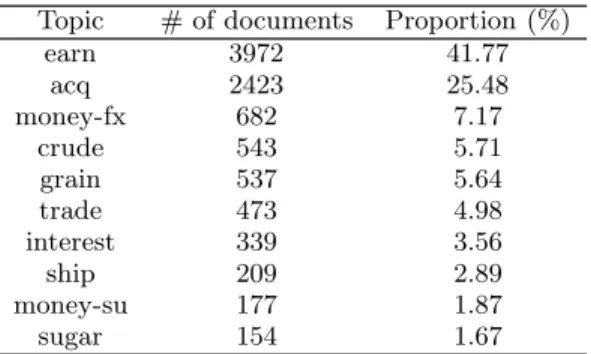
pre-Table 1: The Reuters topics used in our experiments. Topic # of documents Proportion (%)
earn 3972 41.77 acq 2423 25.48 money-fx 682 7.17 crude 543 5.71 grain 537 5.64 trade 473 4.98 interest 339 3.56 ship 209 2.89 money-su 177 1.87 sugar 154 1.67
processing as for the Ohsumed data set. The distribution of the number of relevant documents per topic, given in table 1, varies from 1.67% to 41.77%. These relatively populous topics will allow us to test the behavior of bipartite ranking algorithms when relevant documents are gradually removed from well-represented topics.
3.2
Evaluation Criteria
In order to compare the performance of the algorithms we used a set of standard ranking measures.
As the learning criterion (4) we used to train our model is related to the area under the ROC curve (AUC), we first compared the AUC measure of each algorithm on the test set. If a sample T contains p relevant and m irrelevant instances, the AUC of a scoring function h with respect to this sample represents the average number of relevant examples in T ranked higher than irrelevant ones [6]:
AUC(h, T ) = 1 pm X i:yi=+1 X j:yj=−1 [[h(xi) > h(xj)]]
In addition, we computed the mean average uninterpolated precision (mAUP) and the mean precision@50 (referred as mT9P[17] in the following) across topics on both datasets.
The average uninterpolated precision (AUP) of a given topic τ is defined as the sum of precision value of relevant docu-ments in the r top ranked docudocu-ments divided by the number of relevant documents for that topic, R(τ ). Hence, relevant documents which do not appear in the top r ranked docu-ments receive a precision score of 0:
AUP(τ ) = 1 R(τ ) r X i=1;yi=+1 |{j | yj= 1 ∧ rank(j) ≤ rank(i)}| rank(i)
We used r = 500 on the Reuters dataset, and r = 1000 on the Ohsumed collection[17].
Finally, we plot the Precision/Recall curves [19] of dif-ferent ranking algorithms for a fixed percentage of labeled-unlabeled documents in the training set. At each recall level, the precision score is averaged over all topics.
Each reported performance value is the average over the 10 random splits.
4.
EXPERIMENTAL RESULTS
These experimental results test how unlabeled data affect the ranking performance of the proposed approach, vs. both of the semi-supervised classification algorithms.
4.1
The effect of unlabeled data
We start our evaluation by analyzing the impact of unla-beled data on mean average uninterpolated precision (mAUP) and mean precision@50 (mT9P) for a fixed number of labeled and unlabeled examples in the training set of each topic in Ohsumedand Reuters datasets. In order to effectively study the role of unlabeled data on the ranking behavior we begin our experiments with very few labeled training examples. For Ohsumed, the size of the labeled training sets is hence fixed to 180 documents per topic: 3 relevant and 177 ir-relevant. For Reuters, we use 90 documents per topic: 9 relevant and 81 irrelevant documents. The remaining docu-ments from the collection are used as unlabeled data. The lower proportion of relevant documents in our Ohsumed ex-periments reflect the higher imbalance between relevant and irrelevant documents in that collection. As discussed later in section 4.4, the value of the discount factor λ which pro-vided the best ranking performance for these training sizes is λ = 1. We therefore use that value in our experiments in the three coming sections.
Table 2 summarizes results obtained by RB, TSVM, ssLR and ssRB in terms of mAUPand mT9P. The RankBoost algo-rithm is trained over the labeled part of each training sets and performance of ssRB are shown for different number k of nearest neighbors of each labeled example which are as-signed the same relevance judgment. We use bold face to indicate the highest performance rates. The symbol ↓ indi-cates that performance is significantly worse than the best result, according to a Wilcoxon rank sum test used at a p-value threshold of 0.01 [14].
Three observations can be made from these results. First, all semi-supervised algorithms perform better on both collec-tion, and according to both metrics, than the RB algorithm trained using only the labeled data alone. This shows empir-ically that semi-supervised algorithms are able to partially exploit the relevant information contained in the unlabeled examples. The second observation is that the hyperparame-ter k has a definitive (although not highly significant) impact on the performance of the ssRB algorithm. On Ohsumed, the best results for ssRB are obtained when only one unlabeled instance nearest to each labeled example is labeled (k = 1). On Reuters, the best results are obtained for k = 2. This may be due to the fact that the NN algorithm is less effective on the Ohsumed collection, where the dimension of the doc-ument space is about 7 times higher than on the Reuters dataset. Performance of the ssRB on both datasets is lowest for k = 3, suggesting that this value of k yields too many erroneous label assignment that ssRB is unable to overcome. Finally, both TSVM and ssLR, which have been shown to be effective on classification tasks [13, 2], are less competitive than ssRB on both ranking measures.
4.2
Ranking on unbalanced data
Table 3 gives the AUC performance of the ranking algo-rithms on each topic of the Reuters dataset. For ssRB, the NNparameter was fixed to k = 2, in agreement with results from the previous section. The number of labeled exam-ples in the training set for each of the topics is the same as above. These results show that ssRB is significantly better than TSVM and ssLR on topics presenting a higher dispro-portion of relevant/irrelevant examples in the collection, and not significantly worse than the best on others.
Table 2: mAUP and mT9P measures on the Ohsumed and Reuters document collections. The number of labeled examples per topic is (a) 180 on the Ohsumed collection (3 relevant and 177 irrelevant documents), and (b) 90 on the Reuters collection (9 relevant document and 81 irrelevant documents). All remainig documents were used as unlabeled training set.
Ohsumedcollection Reutersdata set Algorithm mAUP(%), r = 1000 mT9P(%) mAUP(%), r = 500 mT9P(%)
RB 23.5 ± 0.3↓ 33.6 ± 0.2↓ 40.85 ± 0.6↓ 64.51 ± 0.4↓ TSVM 26.2 ± 0.2↓ 36.4 ± 0.1↓ 51.6 ± 0.3↓ 71.01 ± 0.2↓ ssLR 25.3 ± 0.1↓ 35.2 ± 0.2↓ 50.23 ± 0.5↓ 70.83 ± 0.1↓ ssRB, k = 1 30.3±0.2 40.4±0.4 57.32 ± 0.3 74.82 ± 0.1 ssRB, k = 2 28.9 ± 0.1 38.6 ± 0.3 59.36±0.4 76.57±0.5 ssRB, k = 3 27.2 ± 0.5 36.5 ± 0.2 57.6 ± 0.2 73.21 ± 0.3
Referring back to table 2, we can also see that on mAUP and mT9P measures, the relative margin between the perfor-mance of the best ssRB and TSVM is greater on Ohsumed than on Reuters. We recall that the proportion of relevant documents per topic is sizably higher on Reuters than on Ohsumed. For example, considering mT9P scores, the differ-ence in percentage between ssRB (for k = 1) and TSVM on the Ohsumed collection is 4% which represents 58.8% of the interval length between the worse and best mT9P perfor-mance [33.6, 40.4]. While, the difference on perforperfor-mance be-tween the best ssRB (for k = 2) and TSVM on the Reuters dataset is 5.56% which represents 46.1% of the interval length [64.5, 76.5].
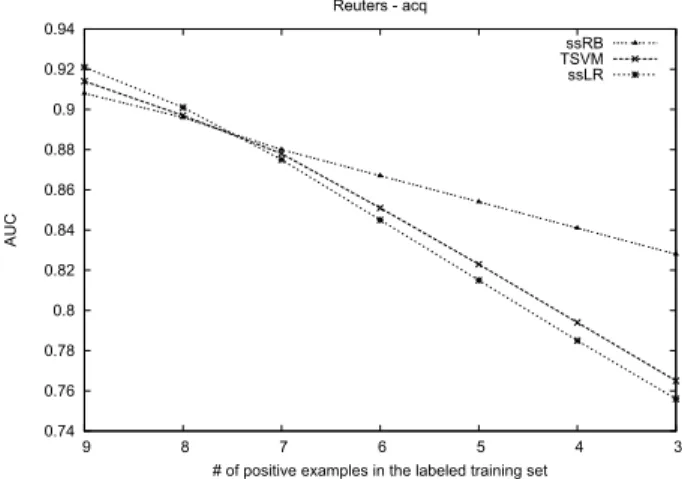
We further investigate the effect on the AUC measure of having less and less relevant documents in a labeled train-ing pool where the number of irrelevant examples is kept fixed. Figure 1 illustrates this effect by showing the evolu-tion on AUC scores of the three semi-supervised algorithms when relevant documents are gradually removed from the labeled part of the acq training set. This topic was, with earn, one of the two topics in Reuters on which ssRB did worse than the two other semi-supervised algorithms. The initial number of relevant/irrelevant documents in the la-beled training set was set to respectively 9 and 81.
These curves show that the decrease rate of the AUC mea-sure of ssRB is lower than the two other semi-supervised classifiers. The loss in AUC for ssRB is less than 9% when
Table 3: AUC measure on the 10 largest topics of the Reuters dataset for RB, TSVM, ssLR and ssRB. Semi-supervised algorithms use 90 labeled examples per topic. The remaining documents in the training set are all unlabeled.
RB TSVM ssLR ssRB earn 85.6 ± 0.7↓ 95.9±0.1 95.4 ± 0.3 94.8 ± 0.1 acq 81.3 ± 0.6↓ 91.6 ± 0.2 92.1±0.3 91.5 ± 0.3 money-fx 83.8 ± 0.4↓ 90.3 ± 0.5↓ 89.7 ± 0.4↓ 92.8±0.7 crude 83.4 ± 0.5↓ 94.5 ± 0.4 93.5 ± 0.4 95.5±0.2 grain 84.5 ± 0.4↓ 91.1 ± 0.6↓ 92.4 ± 0.3↓ 93.1±0.1 trade 84.9 ± 0.6↓ 91.2 ± 0.3↓ 90.4 ± 0.4↓ 92.4±0.5 interest 79.9 ± 0.6↓ 87.6 ± 0.7↓ 88.3 ± 0.2↓ 90.5±0.4 ship 81.2 ± 0.2↓ 85.1 ± 0.4↓ !84.3 ± 0.4↓ 89.7±0.3 money-su 80.2 ± 0.3↓ 86.2 ± 0.3↓ 87.3 ± 0.1↓ 91.3±0.2 sugar 78.6 ± 0.1↓ 86.6 ± 0.2↓ 85.3 ± 0.6↓ 90.3±0.4
the proportion of relevant/irrelevant documents falls from 1/9 to 1/27. This drop is about 16% for TSVM and ssLR.
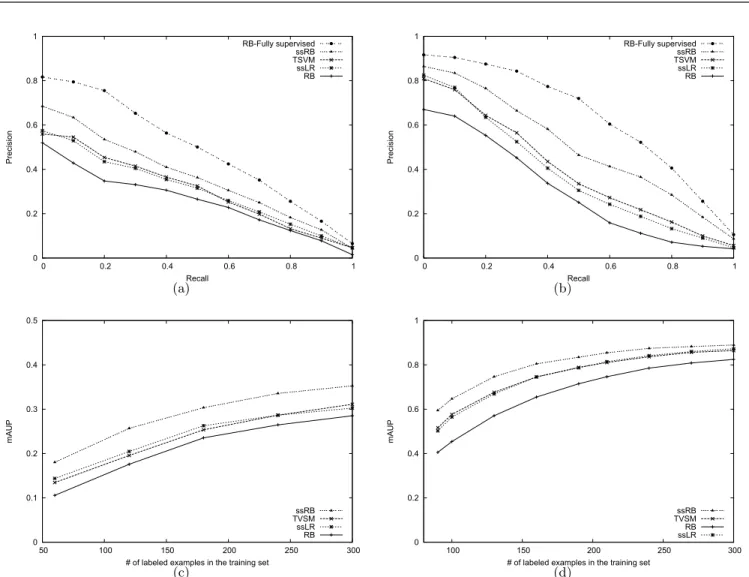
Figure 2, top, shows precision/recall curves on Ohsumed and Reuters collections using the same number of relevant/ir-relevant documents in the respective training sets than what was used in previous experiments. In order to have an em-pirical upper-bound on these results we also plotted the pre-cision/recall curves of a rankboost algorithm trained over all labeled and unlabeled examples, plus their true labels, in the different training sets. We refer to this model as RB-Fully supervised. These results confirm the previous ones as for different precision levels, the relative margin between ssRB and TSVM (or ssLR) is higher on Ohsumed than on Reuters specially for low recall rates. An explanation of these find-ings is that as ssRB learns a scoring function which output is supposed to rank relevant documents higher than irrel-evant ones in both labeled and unlabeled training sets, its performance is less affected by fewer relevant documents.
4.3
The exponential value of labeled data
We finally report on the behavior of different ranking al-gorithms for growing number of labeled data in the train-ing sets. Figure 2 down, illustrates this behavior on the mAUP measures for both of datasets. The addition of new
0.74 0.76 0.78 0.8 0.82 0.84 0.86 0.88 0.9 0.92 0.94 3 4 5 6 7 8 9 AUC
# of positive examples in the labeled training set Reuters - acq
ssRB TSVM ssLR
Figure 1: AUC on Reuters category acq with respect to the number of relevant documents in the labeled training set. The number of irrelevant documents is fixed kept to 81.
Ohsumedcollection Reutersdata set 0 0.2 0.4 0.6 0.8 1 0 0.2 0.4 0.6 0.8 1 Precision Recall RB-Fully supervised ssRB TSVM ssLR RB (a) 0 0.2 0.4 0.6 0.8 1 0 0.2 0.4 0.6 0.8 1 Precision Recall RB-Fully supervised ssRB TSVM ssLR RB (b) 0 0.1 0.2 0.3 0.4 0.5 50 100 150 200 250 300 mAUP
# of labeled examples in the training set ssRB TVSM ssLR RB (c) 0 0.2 0.4 0.6 0.8 1 100 150 200 250 300 mAUP
# of labeled examples in the training set ssRB TVSM RB ssLR
(d)
Figure 2: (Top) Precision recall curves on (a) Ohsumed and (b) Reuters collections. The number of labeled examples per topic is fixed to 180 on the Ohsumed collection with a ratio of 1 relevant document for every 59 irrelevant ones, and 90 on the Reuters data set with a ratio of 1 relevant document for every 9 irrelevant ones. (Bottom) mAUP on (c) Ohsumed and (d) Reuters with respect to different labeled training size.
labeled data on each training sets respects the initial rele-vant/irrelevant proportion of documents on these sets. All performance curves increase monotonically with respect to the additional labeled data. The convergence rate of mAUP scores on the Reuters dataset is however faster. We expect that this is because training sets per topic on this collection contain more relevant information than Ohsumed topics.
4.4
The effect of the discount factor
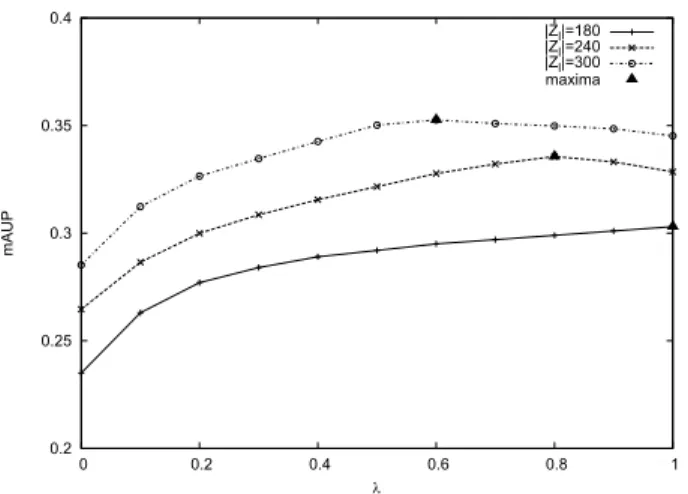
λAnother interesting observation here is that unlabeled ex-amples become relatively less important as more labeled data are available. This observation is confirmed with re-sults on figure 3 which show that for growing number of labeled training size on the Ohsumed collection, the discount factor λ for which a maximum is reached on mAUP moves away from 1. We recall that for λ = 1, unlabeled data play the same role in the training of the scoring function than labeled data.
5.
CONCLUSIONS
We presented a new approach to learn a boosting based, inductive ranking function in a semi-supervised setting, when both labeled and unlabeled data are available. We showed that unlabeled data do help provide a more efficient ranking function and that their effect depends on the initial labeled training size. In the most interesting case, when there are few labeled data, we empirically illustrated that unlabeled data have a large effect on the mAUP measure.
We evaluated and validated our approach using two test collections. We showed through different ranking measures that the new model provides results that are superior to two semi-supervised classification algorithms on both collections. Among other things, these results confirm theoretical and empirical studies made previously in the supervised case, showing that the classification ability of classifiers is not necessarily a good indication of their ranking performance.
0.2 0.25 0.3 0.35 0.4 0 0.2 0.4 0.6 0.8 1 mAUP l |Zl|=180 |Zl|=240 |Zl|=300 maxima
Figure 3: mAUP with respect to the discount factor λ for different labeled training sizes on Ohsumed.
In future work, we will make the discount factor λ depend on each unlabeled example in the training set using a con-tinuous function. The key of that study would be the choice of the function with necessary conditions allowing to take into consideration information contained on unlabeled data as best as possible. Another promising direction to explore would be the optimization of other ranking criterion than the modified AUC for learning ranking functions.
6.
ACKNOWLEDGMENTS
This work was supported in part by the IST Program of the European Community, under the PASCAL Network of Excellence, IST-2002-506778. This publication only reflects the authors’ views.
7.
REFERENCES
[1] S. Agarwal. Ranking on Graph Data. In Proceedings of the 23rd International Conference on Machine
Learning, pages 25-32, 2006.
[2] M.-R. Amini and P. Gallinari. The Use of Unlabeled Data to Improve Supervised Learning for Text Summarization. In Proceedings of the 25th annual international ACM SIGIR, pages 105-112, 2002. [3] M.-R. Amini and P. Gallinari. Semi-Supervised
Learning with Explicit Misclassification Modeling. In Proceedings of the 18th International Joint Conference on Artificial Intelligence, pages 555-560, 2003.
[4] P. L. Bartlett, M. I. Jordan and Jon D. McAuliffe. Large Margin Classifiers: convex Loss, Low Noise and Convergence Rates. In Advances in Neural
Information Processing Systems 16, pages 1173-1180, 2004.
[5] A. Blum and T. Mitchell. Combining labeled and unlabeled data with Co-training. In Proceedings of the Workshop on Computational Learning Theory, pages 92-100, Wisconsin, USA, 1998.
[6] A.P. Bradley. The use of the Area under the ROC curve in the Evaluation of Machine Learning
Algorithms. Pattern Recognition, 30:1145-1159, 1997. [7] R. Caruana and A. Niculescu-Mizil. Data mining in
metric space: an empirical analysis of supervised
learning performance criteria. In Proceedings of the 10th ACM SIGKDD, pages 69-78, 2004.
[8] O. Chapelle, B. Sch¨olkopf and A. Zien.
Semi-Supervised Learning, MIT Press, Cambridge, MA, 2006
[9] C. Cortes and M. Mohri. AUC optimization vs. error rate minimization. In Advances in Neural Information Processing Systems 16, pages 313-320, 2004.
[10] Y. Freund, R. Iyer, R.E. Schapire and Y. Singer. An efficient Boosting Algorithm for Combining
Preferences. Journal of Machine Learning Research, 4:933-969, 2004.
[11] E. Gaussier and C. Goutte. Learning with Partially Labelled Data - with Confidence. In ICML’05 Workshop on Learning from Partially Classified Training Data (ICML’05-LPCT), pages 29-36, 2005. [12] W. Hersh, C. Buckley, T. J. Leone and David Hickam.
OHSUMED: an interactive Retrieval Evaluation and new Large Test Collection for Research. In Proceedings of the 17th annual international ACM SIGIR, pages 192-201, 1994.
[13] T. Joachims. Transductive Inference for Text Classification using Support Vector Machines. In Proceedings of 16th International Conference on Machine Learning, pages 200-209, 1999.
[14] E.L. Lehmann. Nonparametric Statistical Methods Based on Ranks. McGraw-Hill, New York, 1975. [15] D. D. Lewis. Reuters-21578, distribution 1.0
http://www.daviddlewis.com/resources /testcollections/reuters21578/. January 1997. [16] K. Nigam, A.K. McCallum, S. Thrun and Tom
Mitchell. Text classification from labeled and unlabeled documents using EM. Machine Learning 39(2/3):127-163, 2000.
[17] S. Robertson and D.A. Hull. The TREC-9 Filtering Track Final Report. In Proceedings of the 9thText REtrieval Conference (TREC-9). pages 25-40, 2001. [18] I. Soboroff and S. Robertson. Building a Filtering Test
Collection for TREC 2002. In Proceedings of the 26th annual international ACM SIGIR. pages 243-250, 2003.
[19] C. van Rijsbergen, Information Retrieval, Butterworths, London, 1979.
[20] J.-N. Vittaut, M.-R. Amini and P. Gallinari, Learning Classification with Both Labeled and Unlabeled Data. In Proceedings of the 13th European Conference on Machine Learning. pages 468-476, 2002.
[21] C.C. Vogt and G.W. Cottrell, Fusion Via a Linear Combination of Scores. Information Retrieval, 1(3):151-173, 1999.
[22] J. Weston, R. Kuang, C. Leslie and W.S. Noble. Protein ranking by semi-supervised network
propagation. BMC Bioinformatics, special issue, 2006. [23] D. Zhou, J. Weston, A. Gretton, O. Bousquet and B.
Sch¨olkopf. Ranking on Data Manifolds. In Advances in Neural Information Processing Systems 16, pages 169-176, 2004.
[24] D. Zhou , C.J.C. Burges and T. Tao. Transductive link spam detection. In Proceedings of the 3rd international workshop on Adversarial information retrieval on the web. pages 21-28, 2007.