Publisher’s version / Version de l'éditeur:
Vous avez des questions? Nous pouvons vous aider. Pour communiquer directement avec un auteur, consultez la première page de la revue dans laquelle son article a été publié afin de trouver ses coordonnées. Si vous n’arrivez pas à les repérer, communiquez avec nous à [email protected]. Questions? Contact the NRC Publications Archive team at
[email protected]. If you wish to email the authors directly, please see the first page of the publication for their contact information.
https://publications-cnrc.canada.ca/fra/droits
L’accès à ce site Web et l’utilisation de son contenu sont assujettis aux conditions présentées dans le site LISEZ CES CONDITIONS ATTENTIVEMENT AVANT D’UTILISER CE SITE WEB.
Proceedings of Human Language Technology Conference/North American
Chapter of the Association for Computational Linguistics (HLT/NAACL) 2006,
2006
READ THESE TERMS AND CONDITIONS CAREFULLY BEFORE USING THIS WEBSITE. https://nrc-publications.canada.ca/eng/copyright
NRC Publications Archive Record / Notice des Archives des publications du CNRC : https://nrc-publications.canada.ca/eng/view/object/?id=07fcd97a-570b-45e4-a32c-5edef880e6c1 https://publications-cnrc.canada.ca/fra/voir/objet/?id=07fcd97a-570b-45e4-a32c-5edef880e6c1
NRC Publications Archive
Archives des publications du CNRC
This publication could be one of several versions: author’s original, accepted manuscript or the publisher’s version. / La version de cette publication peut être l’une des suivantes : la version prépublication de l’auteur, la version acceptée du manuscrit ou la version de l’éditeur.
Access and use of this website and the material on it are subject to the Terms and Conditions set forth at
Arabic Preprocessing Schemes for Statistical Machine Translation
Habash, N.; Sadat, F.
National Research Council Canada Institute for Information Technology Conseil national de recherches Canada Institut de technologie de l'information
Arabic Preprocessing Schemes for Statistical
Machine Translation *
Habash, N., and Sadat, F.
June 2006
* published in the Proceedings of Human Language Technology
Conference/North American Chapter of the Association for Computational Linguistics (HLT/NAACL) 2006. New York City, New York, USA.
June 5-7, 2006. NRC 48759.
Copyright 2006 by
National Research Council of Canada
Permission is granted to quote short excerpts and to reproduce figures and tables from this report, provided that the source of such material is fully acknowledged.
Arabic Preprocessing Schemes for Statistical Machine Translation
Nizar HabashCenter for Computational Learning Systems Columbia University
Fatiha Sadat
Institute for Information Technology National Research Council of Canada [email protected]
Abstract
In this paper, we study the effect of dif-ferent word-level preprocessing decisions for Arabic on SMT quality. Our results show that given large amounts of training data, splitting off only proclitics performs best. However, for small amounts of train-ing data, it is best to apply English-like to-kenization using part-of-speech tags, and sophisticated morphological analysis and disambiguation. Moreover, choosing the appropriate preprocessing produces a sig-nificant increase in BLEU score if there is a change in genre between training and test data.
1 Introduction
Approaches to statistical machine translation (SMT) are robust when it comes to the choice of their in-put representation: the only requirement is consis-tency between training and evaluation.1 This leaves a wide range of possible preprocessing choices, even more so for morphologically rich languages such as Arabic. We use the term “preprocessing” to de-scribe various input modifications that can be ap-plied to raw training and evaluation texts for SMT to make them suitable for model training and decod-ing, including different kinds of tokenization, stem-ming, part-of-speech (POS) tagging and lemmatiza-tion. We refer to a specific kind of preprocessing as a “scheme” and differentiate it from the “tech-nique” used to obtain it. Since we wish to study the effect of word-level preprocessing, we do not uti-lize any syntactic information. We define the word
1
This paper is based upon work supported by the Defense Advanced Research Projects Agency (DARPA) under Contract No. HR0011-06-C-0023. Any opinions, fi ndings and conclu-sions or recommendations expressed in this paper are those of the authors and do not necessarily reflect the views of DARPA. We thank Roland Kuhn, George Forster, Mona Diab, Owen Rambow, and Martin Jansche for helpful discussions.
(and by extension its morphology) to be limited to written Modern Standard Arabic (MSA) strings sep-arated by white space, punctuation and numbers. Thus, some prepositional particles and conjunctions are considered part of the word morphology.
In this paper, we report on an extensive study of the effect on SMT quality of six preprocessing schemes2, applied to text disambiguated in three dif-ferent techniques and across a learning curve. Our results are as follows: (a) for large amounts of train-ing data, splitttrain-ing off only proclitics performs best; (b) for small amount of training data, following an English-like tokenization and using part-of-speech tags performs best; (c) suitable choice of preprocess-ing yields a significant increase in BLEU score if there is little training data and/or there is a change in genre between training and test data; (d) sophis-ticated morphological analysis and disambiguation help significantly in the absence of large amounts of data.
Section 2 presents previous relevant research. Section 3 presents some relevant background on Arabic linguistics to motivate the schemes discussed in Section 4. Section 5 presents the tools and data sets used, along with the results of our experiments. Section 6 contains a discussion of the results.
2 Previous Work
The anecdotal intuition in the field is that reduction of word sparsity often improves translation quality. This reduction can be achieved by increasing train-ing data or via morphologically driven preprocess-ing (Goldwater and McClosky, 2005). Recent publi-cations on the effect of morphology on SMT quality focused on morphologically rich languages such as German (Nießen and Ney, 2004); Spanish, Catalan, and Serbian (Popovi´c and Ney, 2004); and Czech (Goldwater and McClosky, 2005). They all studied
2We conducted several additional experiments that we do
not report on here for lack of space but we reserve for a separate technical report.
the effects of various kinds of tokenization, lemma-tization and POS tagging and show a positive effect on SMT quality. Specifically considering Arabic, Lee (2004) investigated the use of automatic align-ment of POS tagged English and affix-stem seg-mented Arabic to determine appropriate tokeniza-tions. Her results show that morphological prepro-cessing helps, but only for the smaller corpora. As size increases, the benefits diminish. Our results are comparable to hers in terms of BLEU score and consistent in terms of conclusions. We extend on previous work by experimenting with a wider range of preprocessing schemes for Arabic, by studying the effect of morphological disambiguation (beyond POS tagging) on preprocessing schemes over learn-ing curves, and by investigatlearn-ing the effect on differ-ent genres.
3 Arabic Linguistic Issues
Arabic is a morphologically complex language with a large set of morphological features. These features are realized using both concatenative (affixes and stems) and templatic (root and patterns) morphology with a variety of morphological and phonological adjustments that appear in word orthography and in-teract with orthographic variations. Certain letters in Arabic script are often spelled inconsistently which leads to an increase in both sparsity (multiple forms of the same word) and ambiguity (same form corre-sponding to multiple words). For example, variants of Hamzated Alif, or ✁ are often written without their Hamza (✂):✄. Another example is the optional-ity of diacritics in Arabic script. We assume all of the text we are using is undiacritized.
Arabic has a set of attachable clitics to be dis-tinguished from inflectional features such as gender, number, person and voice. These clitics are written attached to the word and thus increase its ambiguity. We can classify three degrees of cliticization that are applicable in a strict order to a word base:
[CONJ+ [PART+ [Al+ BASE +PRON]]] At the deepest level, the BASE can have a def-inite article (Al+ the)3 or a member of the class of pronominal enclitics, +PRON, (e.g. +hm their/them). Next comes the class of particle pro-clitics (PART+): l+ to/for, b+ by/with, k+ as/such and s+ will/future. Most shallow is the class of con-junction proclitics (CONJ+): w+ and and f+ then.
3
Arabic transliterations are provided in the Buckwalter transliteration scheme (Buckwalter, 2002).
These phenomena highlight two issues related to preprocessing: First, ambiguity in Arabic words is an important issue to address. To determine whether a clitic or feature should be split off or abstracted off requires that we determine that said feature is in-deed present in the word we are considering in con-text – not just that it is possible given an analyzer or, worse, because of regular expression matching. Secondly, once a specific analysis is determined, the process of splitting off or abstracting off a feature must be clear on what the form of the resulting word is to be. For example, the word☎✝✆✟✞✡✠☛✞✡☞ ktbthm has two possible readings (among others) as their writ-ers or I wrote them. Splitting off the pronominal clitic +hm without normalizing the t to p in the nom-inal reading leads to the coexistence of two forms of the noun: ktbp and ktbt. This increased sparsity is only worsened by the fact that the second form is also the verbal form (thus increased ambiguity).
4 Preprocessing: Schemes and Techniques
A scheme is a specification of the form of prepro-cessed output; whereas a technique is the method used to create such output. We examine six different schemes and three techniques.
4.1 Preprocessing Techniques
The different techniques chosen illustrate three de-grees of linguistic knowledge dependence. The first is very light and cheap. The second is more expen-sive, requiring the use of a morphological analyzer. And the third is yet more expensive than the second; it is a disambiguation system that requires an ana-lyzer and a disambiguated training corpus.
✌
REGEX is the baseline technique. It is sim-ply greedy regular expression matching to mod-ify strings and/or split off prefix/suffix substrings that look like clitics indicated by specific schemes. REGEXcannot be used with complex schemes such as EN and MR (see Section 4.2).
✌
BAMA, Buckwalter Arabic Morphological An-alyzer (Buckwalter, 2002), is used to obtain pos-sible word analyses. Using BAMA prevents incor-rect greedy REGEXmatches. Since BAMAproduces multiple analyses, we always select one in a consis-tent arbitrary manner (first in a sorted list of analy-ses).
✌
MADA, The Morphological Analysis and Dis-ambiguation for Arabic tool, is an off-the-shelf resource for Arabic disambiguation (Habash and
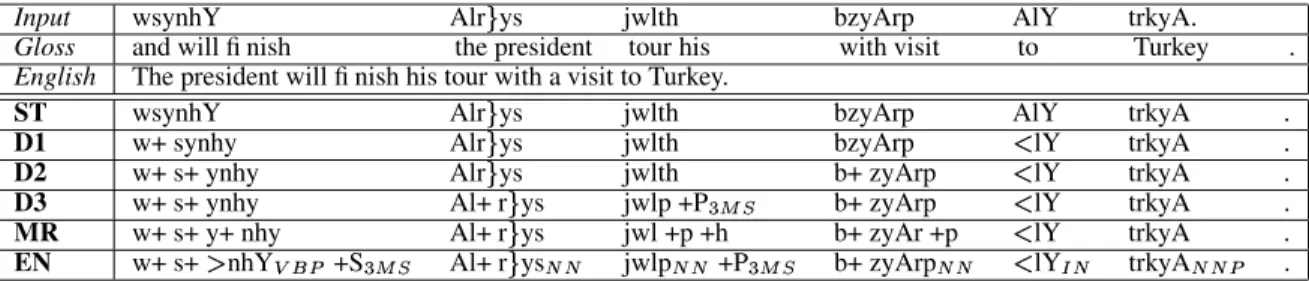
Table 1: The Different Preprocessing Schemes (with MADA Technique)
Input wsynhY Alr ys jwlth bzyArp AlY trkyA.
Gloss and will fi nish the president tour his with visit to Turkey .
English The president will fi nish his tour with a visit to Turkey.
ST wsynhY Alr ys jwlth bzyArp AlY trkyA .
D1 w+ synhy Alr ys jwlth bzyArp ✁ lY trkyA .
D2 w+ s+ ynhy Alr ys jwlth b+ zyArp ✁ lY trkyA .
D3 w+ s+ ynhy Al+ r ys jwlp +P✂☎✄✝✆ b+ zyArp ✁ lY trkyA .
MR w+ s+ y+ nhy Al+ r ys jwl +p +h b+ zyAr +p ✁ lY trkyA .
EN w+ s+✞ nhY✟✡✠✡☛ +S✂☎✄☞✆ Al+ r ys✌✍✌ jwlp✌✎✌ +P✂☎✄✝✆ b+ zyArp✌✎✌ ✁ lY✏✑✌ trkyA✌✍✌✎☛ .
Rambow, 2005). MADAselects among BAMA anal-yses using a combination of classifiers for 10 orthog-onal dimensions, including POS, number, gender, and pronominal clitics.
For BAMA and MADA, applying a preprocess-ing scheme involves movpreprocess-ing features (as specified by the scheme) out of the chosen word analysis and regenerating the word without the split off features (Habash, 2004). The regeneration guarantees the normalization of the word form.
4.2 Preprocessing Schemes
Table 1 exemplifies the effect of the different schemes on the same sentence.
✌
ST: Simple Tokenization is the baseline
prepro-cessing scheme. It is limited to splitting off punc-tuations and numbers from words and removing any diacritics that appear in the input. This scheme re-quires no disambiguation.
✌
D1, D2, and D3: Decliticizations. D1 splits
off the class of conjunction clitics (w+ and f+). D2 splits off the class of particles (l+, k+, b+ and s+) beyond D1. Finally D3 splits off what D2 does in addition to the definite article (Al+) and all pronom-inal clitics.
✌
MR: Morphemes. This scheme breaks up words
into stem and affixival morphemes.
✌
EN: English-like. This scheme is intended to
minimize differences between Arabic and English. It decliticizes similarly to D3; however, it uses lex-eme and English-like POS tags instead of the regen-erated word and it indicates the pro-dropped verb subject explicitly as a separate token.
5 Experiments
We use the phrase-based SMT system, Portage (Sa-dat et al., 2005). For training, Portage uses IBM word alignment models (models 1 and 2) trained
in both directions to extract phrase tables. Maxi-mum phrase size used is 8. Trigram language mod-els are implemented using the SRILM toolkit (Stol-cke, 2002). Decoding weights are optimized using Och’s algorithm (Och, 2003) to set weights for the four components of the log-linear model: language model, phrase translation model, distortion model, and word-length feature. The weights are optimized over the BLEU metric (Papineni et al., 2001). The Portage decoder, Canoe, is a dynamic-programming beam search algorithm, resembling the algorithm described in (Koehn, 2004a).
All of the training data we use is available from the Linguistic Data Consortium (LDC). We use an Arabic-English parallel corpus of about 5 million words for translation model training data.4 We created the English language model from the En-glish side of the parallel corpus together with 116 million words from the English Gigaword Corpus (LDC2005T12) and 128 million words from the En-glish side of the UN Parallel corpus (LDC2004E13). English preprocessing comprised down-casing, sep-arating punctuation from words and splitting off “’s”. Arabic preprocessing was varied using the pro-posed schemes and techniques. Decoding weight optimization was done on 200 sentences from the 2003 NIST MT evaluation test set. We used two dif-ferent test sets: (a) the 2004 NIST MT evaluation test set (MT04) and (b) the 2005 NIST MT
evalua-tion test set (MT05). MT04 is a mix of news, edito-rials and speeches, whereas MT05, like the training data, is purely news. We use the evaluation metric BLEU-4 (Papineni et al., 2001).
We conducted all possible combinations of schemes and techniques discussed in Section 4 with different training corpus sizes: 1%, 10% and 100%. The results of the experiments are summarized in
4
The parallel text includes Arabic News, eTIRR, English translation of Arabic Treebank, and Ummah.
Table 2: Results
MT04 MT05
MADA BAMA REGEX MADA BAMA REGEX
1 10 100 1 10 100 1 10 100 1 10 100 1 10 100 1 10 100
ST 9.4 22.9 34.6 9.4 22.9 34.6 9.4 22.9 34.6 11.2 27.7 37.8 11.2 27.7 37.8 11.2 27.7 37.8 D1 13.1 26.9 36.1 12.9 26.5 35.6 11.4 25.5 34.8 14.9 29.8 37.3 14.5 29.6 37.0 13.2 29.5 38.5 D2 14.2 27.7 37.1 13.7 27.9 36.2 12.0 25.5 35.8 16.3 30.2 38.6 15.5 31.0 37.8 13.4 29.8 38.7 D3 16.5 28.7 34.3 15.9 28.3 34.2 13.6 26.1 34.0 17.7 31.0 36.0 17.3 31.1 35.3 14.7 28.8 36.1 MR 11.6 27.5 34.4 14.2 27.5 33.4 n/a n/a n/a 12.7 29.6 35.9 15.7 29.5 34.3 n/a n/a n/a EN 17.5 28.4 34.5 16.3 27.9 34.0 n/a n/a n/a 18.3 30.4 36.0 17.6 30.4 34.8 n/a n/a n/a
Table 2. All reported scores must have over 1.1% BLEU-4 difference to be significant at the 95% con-fidence level for 1% training. For all other training sizes, the difference must be over 1.7% BLEU-4. Er-ror intervals were computed using bootstrap resam-pling (Koehn, 2004b).
6 Discussion
Across different schemes, EN performs the best un-der scarce-resource condition; and D2 performs best under large-resource condition. Across techniques and under scarce-resource conditions, MADAis bet-ter than BAMA which is better than REGEX. Under large-resource conditions, this difference between techniques is statistically insignificant, though it’s generally sustained across schemes.
The baseline for MT05, which is fully in news
genre like training data, is considerably higher than MT04 (mix of genres). To investigate the effect of different schemes and techniques on different gen-res, we isolated in MT04 those sentences that come from the editorial and speech genres. We performed similar experiments as reported above on this subset of MT04. We found that the effect of the choice of
the preprocessing technique+scheme was amplified. For example, MADA+D2 (with 100% training) on non-news improved the system score 12% over the baseline ST (statistically significant) as compared to 2.4% for news only.
Further analysis shows that combination of out-put from all six schemes has a large potential im-provement over all of the different systems, suggest-ing a high degree of complementarity. For example, a 19% improvement in BLEU score (for MT04 un-der MADAwith 100% training) (from 37.1 in D2 to 44.3) was found from an oracle combination created by selecting for each input sentence the output with the highest sentence-level BLEU score.
7 Future Work
We plan to study additional variants that these re-sults suggest may be helpful. In particular, we plan to include more syntactic knowledge and investigate combination techniques at the sentence and sub-sentence levels.
References
T. Buckwalter. 2002. Buckwalter Arabic Morphological Ana-lyzer. Linguistic Data Consortium. (LDC2002L49). S. Goldwater and D. McClosky. 2005. Improving Statistical
MT through Morphological Analysis. In Proc. of the Con-ference on Empirical Methods in Natural Language Process-ing (EMNLP).
N. Habash. 2004. Large Scale Lexeme Based Arabic Morpho-logical Generation. In Proc. of Traitement Automatique du Langage Naturel.
N. Habash and O. Rambow. 2005. Tokenization, Morphologi-cal Analysis, and Part-of-Speech Tagging for Arabic in One Fell Swoop. In Proc. of the Association for Computational Linguistics (ACL).
P. Koehn. 2004a. Pharaoh: a Beam Search Decoder for Phrase-based Statistical Machine Translation Models. In Proc. of the Association for Machine Translation in the Americas. P. Koehn. 2004b. Statistical Signifi cance Tests For Machine
Translation Evaluation. In Proc. of EMNLP.
Y. Lee. 2004. Morphological Analysis for Statistical Machine Translation. In Proc. of the North American Chapter of ACL. F. Och. 2003. Minimum Error Rate Training in Statistical
Ma-chine Translation. In Proc. of ACL.
K. Papineni, S. Roukos, T. Ward, and W. Zhu. 2001. Bleu: a Method for Automatic Evaluation of Machine Translation. Technical Report RC22176(W0109-022), IBM Research. M. Popovi´c and H. Ney. 2004. Towards the Use of Word Stems
and Suffi xes for Statistical Machine Translation. In Proc. of the Conference on Language Resources and Evaluation. S. Nießen and H. Ney. 2004. Statistical Machine Translation
with Scarce Resources Using Morpho-syntactic Information. Computational Linguistics, 30(2).
F. Sadat, H. Johnson, A. Agbago, G. Foster, R. Kuhn, J. Martin, and A. Tikuisis. 2005. Portage: A Phrase-based Machine Translation System. In Proc. of ACL Workshop on Building and Using Parallel Texts.
Andreas Stolcke. 2002. Srilm - An Extensible Language Mod-eling Toolkit. In Proc. of International Conference on Spo-ken Language Processing.