Publisher’s version / Version de l'éditeur:
Frontiers in Materials, 2016-03-07
READ THESE TERMS AND CONDITIONS CAREFULLY BEFORE USING THIS WEBSITE.
https://nrc-publications.canada.ca/eng/copyright
Vous avez des questions? Nous pouvons vous aider. Pour communiquer directement avec un auteur, consultez la
première page de la revue dans laquelle son article a été publié afin de trouver ses coordonnées. Si vous n’arrivez pas à les repérer, communiquez avec nous à [email protected].
Questions? Contact the NRC Publications Archive team at
[email protected]. If you wish to email the authors directly, please see the first page of the publication for their contact information.
Archives des publications du CNRC
This publication could be one of several versions: author’s original, accepted manuscript or the publisher’s version. / La version de cette publication peut être l’une des suivantes : la version prépublication de l’auteur, la version acceptée du manuscrit ou la version de l’éditeur.
For the publisher’s version, please access the DOI link below./ Pour consulter la version de l’éditeur, utilisez le lien DOI ci-dessous.
https://doi.org/10.3389/fmats.2016.00012
Access and use of this website and the material on it are subject to the Terms and Conditions set forth at
Si/SiGe heterointerfaces in one-, two-, and three-dimensional
nanostructures: their impact on SiGe light emission
Lockwood, David J.; Wu, Xiaohua; Baribeau, Jean-Marc; Mala, Selina A.;
Wang, Xiaolu; Tsybeskov, Leonid
https://publications-cnrc.canada.ca/fra/droits
L’accès à ce site Web et l’utilisation de son contenu sont assujettis aux conditions présentées dans le site LISEZ CES CONDITIONS ATTENTIVEMENT AVANT D’UTILISER CE SITE WEB.
NRC Publications Record / Notice d'Archives des publications de CNRC:
https://nrc-publications.canada.ca/eng/view/object/?id=be545c45-640b-411d-ab65-2cd79e2f1e0c
https://publications-cnrc.canada.ca/fra/voir/objet/?id=be545c45-640b-411d-ab65-2cd79e2f1e0c
doi: 10.3389/fmats.2016.00012
Edited by: Manuel João Mendes, Centro de Investigação em Materiais – I3N, Portugal
Reviewed by: Larysa Yu. Khomenkova, National Academy of Sciences of Ukraine, Ukraine Tatiana S. Perova, Trinity College Dublin, Ireland
*Correspondence: David J. Lockwood [email protected]
Specialty section: This article was submitted to Colloidal Materials and Interfaces, a section of the journal Frontiers in Materials
Received: 05 October 2015 Accepted: 15 February 2016 Published: 07 March 2016
Citation: Lockwood DJ, Wu X, Baribeau J-M, Mala SA, Wang X and Tsybeskov L (2016) Si/SiGe Heterointerfaces in One-, Two-, and Three-Dimensional Nanostructures: Their Impact on SiGe Light Emission. Front. Mater. 3:12. doi: 10.3389/fmats.2016.00012
Si/SiGe Heterointerfaces in One-,
Two-, and Three-Dimensional
Nanostructures: Their impact
on SiGe Light emission
David J. Lockwood1* , Xiaohua Wu2 , Jean-Marc Baribeau2 , Selina A. Mala3 , Xiaolu Wang3
and Leonid Tsybeskov3
1 Measurement Science and Standards, National Research Council, Ottawa, ON, Canada, 2 Information and Communications Technologies, National Research Council, Ottawa, ON, Canada, 3 Department of Electrical and Computer Engineering, New Jersey Institute of Technology, Newark, NJ, USA
Fast optical interconnects together with an associated light emitter that are both compatible with conventional Si-based complementary metal-oxide-semiconductor (CMOS) integrated circuit technology is an unavoidable requirement for the next-generation microprocessors and computers. Self-assembled Si/Si1−xGex nanostructures (NSs), which can emit light at
wavelengths within the important optical communication wavelength range of 1.3–1.55 μm, are already compatible with standard CMOS practices. However, the expected long carrier radiative lifetimes observed to date in Si and Si/Si1−xGex NSs have prevented the attainment
of eficient light-emitting devices, including the desired lasers. Thus, the engineering of Si/ Si1−xGex heterostructures having a controlled composition and sharp interfaces is crucial
for producing the requisite fast and eficient photoluminescence (PL) at energies in the range of 0.8–0.9 eV. In this paper, we assess how the nature of the interfaces between SiGe NSs and Si in heterostructures strongly affects carrier mobility and recombination for physical coninement in three dimensions (corresponding to the case of quantum dots), two dimensions (corresponding to quantum wires), and one dimension (corresponding to quantum wells). The interface sharpness is inluenced by many factors, such as growth conditions, strain, and thermal processing, which in practice can make it dificult to attain the ideal structures required. This is certainly the case for NS coninement in one dimension. However, we demonstrate that axial Si/Ge nanowire (NW) heterojunctions (HJs) with a Si/ Ge NW diameter in the range 50–120 nm produce a clear PL signal associated with band-to-band electron–hole recombination at the NW HJ that is attributed to a speciic interfacial SiGe alloy composition. For three-dimensional coninement, the experiments outlined here show that two quite different Si1−xGex NSs incorporated into a Si0.6Ge0.4 wavy superlattice
structure display PL of high intensity while exhibiting a characteristic decay time that is up to 1000 times shorter than that found in conventional Si/SiGe NSs. The non-exponential PL decay found experimentally in Si/SiGe NSs can be interpreted as resulting from variations in the separation distance between electrons and holes at the Si/SiGe heterointerface. The results demonstrate that a sharp Si/SiGe heterointerface acts to reduce the carrier radiative recombination lifetime and increase the PL quantum eficiency, which makes these SiGe NSs favorable candidates for future light-emitting device applications in CMOS technology. Keywords: silicon, germanium, nanostructures, heterointerface, photoluminescence, quantum, coninement, interfaces
Si Si1-xGex Si EC EV TYPE II Si Si1-xGex Si EC EV TYPE I Si Si1-xGex Si EC EV TYPE II Si Si1-xGex Si EC EV TYPE I A B
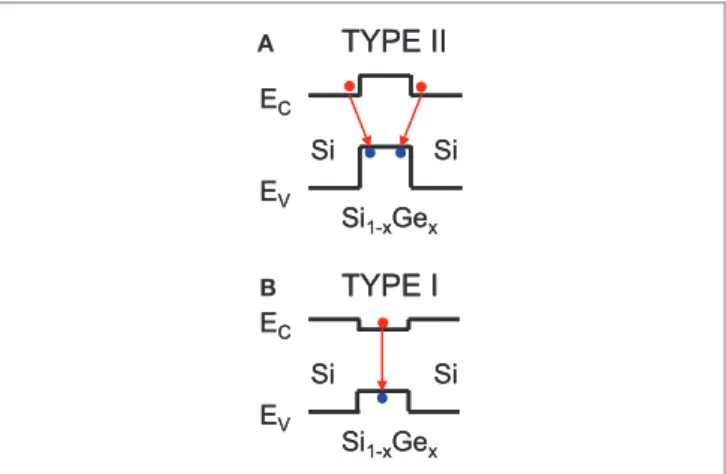
FiGURe 1 | Schematic representation of (A) type ii and (B) type i energy band alignments thought to exist in Si/Si1-xGex nanostructures. EC and EV are the energies of the conduction and valence bands, respectively, in Si and Si1−xGex.
iNTRODUCTiON
he group IV semiconductors silicon and germanium continue to be important materials for optoelectronic and electronic applica-tions (Mangolini, 2013; Ray et al., 2013; Pavesi and Lockwood, 2016). Silicon, which has an indirect band gap of 1.1 eV, is used extensively in the microelectronics industry partly because of the stability of its oxide and this has allowed the development of reliable devices with nanoscale dimensions (Zwanenburg et al., 2013) even though the precise nature of the silicon–silicon oxide interface, even ater decades of research, is still not completely understood (Omura et al., 2013). Germanium has a room temperature direct bandgap of 0.8 eV (~1.55 μm), and it is separated by only 0.14 eV from the indirect band gap of 0.66 eV. hese properties make Ge one of the most promising materi-als for complementary metal-oxide-semiconductor (CMOS) compatible photonic components, including near-infra-red photodetectors (Ahn et al., 2007; Yin et al., 2007; Assefa et al.,
2010; Michel et al., 2010) and, possibly, lasers (Liu et al., 2009,
2010; Camacho-Aguilera et al., 2012; Grydlik et al., 2016) in
the desired wavelength region of 1.3–1.6 μm. However, it is well known that conventional Ge hetero-epitaxy on Si is complicated by the 4.2% diference in Ge and Si lattice constants (Paul, 2004;
Shiraki and Sakai, 2005). Various techniques for building quality
Si/Ge planar heterojunctions (HJs) include multi-step anneal-ing to relax Ge layers and reduce the density of strain-induced dislocations (Saraswat et al., 2006; Ye and Yu, 2014), growth of ultra-thin Ge ilms and superlattices using Si1−xGex alloy transi-tion layers with graded Ge compositransi-tion x (Iyer et al., 1989; Nayak
et al., 1996; Paul, 2004; Saraswat et al., 2006; Shah et al., 2010)
and, alternatively, employ three-dimensional (3D) growth in the form of SiGe clusters and cluster multilayers using the Stranski– Krastanov (S-K) growth mode (Mo et al., 1990; Schmidt et al.,
1999a; Shin et al., 2000; Baribeau et al., 2006). Another promising
approach is to use one-dimensional (1D) growth in the form of nanowires (NWs) produced by the vapor–liquid–solid (VLS) growth mode or similar techniques (Wagner, 1970; Kamins et al.,
2004; Hannon et al., 2006; Zakharov et al., 2006). With regard to
interfacial properties, it should be noted that axial Si/Ge NW HJs, where the heterointerface is perpendicular to the NW axis, have a reduced heterointerface area compared to radial or “core-shell” NW HJs, where the Si/Ge heterointerface is parallel to the NW axis (Lauhon et al., 2002; Xiang et al., 2006; Zakharov et al., 2006).
In such applications, one of the deining parameters afect-ing the application of a Si or Ge nanostructure (NS) is, thus, its interfacial structure with its surroundings. he introduction of an interface modiies bulk material parameters (Barbagiovanni et al., 2012, 2014) and introduces new phenomena. Dangling bonds, stress, and defect states elicit the degree to which the interface potential conines charge carriers (Barbagiovanni et al., 2014). Any termination with atomic impurities, such as hydrogen or oxygen, at the interface inluences the oscillator strength (Guerra
and Ossicini, 2010) and creates polarization efects at the interface
(Guerra et al., 2011). Sub-oxide interface states give rise to
defect-induced carrier recombination efects that can dominate quan-tum coninement (QC) efects (Barbagiovanni et al., 2014, 2015). However, with careful control over the fabrication conditions
(Lockwood et al., 2013a) and with appropriate interface
charac-terization (Cosentino et al., 2014), Ge NSs can be produced that clearly exhibit QC efects (Barbagiovanni et al., 2015).
he development of a Si-based light emitter compatible with CMOS integrated circuit technology and the desired fast opti-cal interconnects is essential for the upcoming generation of high-speed microprocessors and computers. Self-assembled Si/ Si1−xGex NSs that can emit light in the optical communication wavelength range of 1.3–1.55 μm are presently well suited for use in CMOS foundries. However, the long carrier radiative lifetimes observed in such Si/Si1−xGex NSs hinder the development of eicient light-emitting devices and, thereby, the construction of lasers (Sturm et al., 1991; Zheng et al., 1994; Lu et al., 1995;
Lockwood, 1998; Pavesi et al., 2000; Tsybeskov and Lockwood,
2009). he usual model for radiative recombination in Si/Si1−xGex NSs is based on a type II heterointerface energy band align-ment (see Figure 1) (Kamenev et al., 2006; Mala et al., 2013). In type II band alignment, the electrons and holes are spatially separated, with in this case the electrons localized in Si and the holes located in the SiGe NS, which explains the experimentally observed long lifetime of the photoluminescence (PL) in Si/SiGe NSs (Kamenev et al., 2005, 2006; Tsybeskov and Lockwood, 2009;
Mala et al., 2013). he SiGe NS PL saturates quickly, as the slow
radiative recombination cannot compete with the faster Auger recombination even for modest carrier concentrations (Kamenev
et al., 2005, 2006; Tsybeskov and Lockwood, 2009; Mala et al.,
2013). For these reasons, it is necessary to produce Si/Si1−xGex heterostructures with good control over their composition and interface abruptness to enable the production of the sought ater fast and eicient PL at 0.8–0.9 eV.
A review of the light-emitting properties of SiGe NSs in general, including quantum wells (QWs), wires, and dots, has been given elsewhere (Lockwood and Tsybeskov, 2013). In this paper, which also summarizes some older work, we assess how the nature of the interfaces between SiGe NSs and Si in heterostructures strongly afects carrier mobility and recombination for physical conine-ment in one-, two-, or three-dimensions corresponding to the cases of QWs, quantum wires, and quantum dots, respectively.
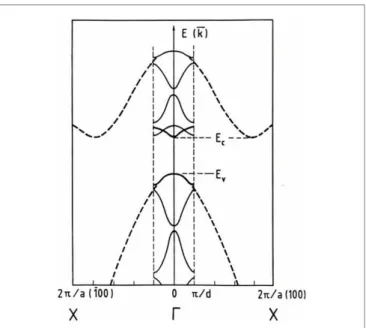
FiGURe 2 | Schematic representation of the Brillouin zone-folding concept in Si resulting from the new superlattice periodicity in the growth direction. Here, the conduction band minimum along the X direction is folded back into the Г point when the superlattice period is about 10 monolayers of Si (Kasper and Schäfler, 1991).
QUANTUM weLLS
he planar epitaxial growth of 100% Ge on Si is made diicult by their 4% lattice mismatch (Paul, 2004). However, the formation of structural defects, such as dislocations, which can give rise to a large number of undesirable non-radiative recombination cent-ers, can be circumvented by the use of controlled-composition Si1−xGex alloys with 0.1 < x < 0.2, which can be grown with techniques, such as molecular beam epitaxy (MBE) or ultra-high vacuum (UHV) chemical vapor deposition (CVD). he resulting heterostructures display a low defect density at the Si/SiGe inter-faces. Such Si/Si1−xGex multilayer NSs with 0.1 < x < 0.2 have been intensively studied in the past as a likely method to conine electron–hole pairs in double HJ, or QW, conigurations and to reduce the thermal quenching of the luminescence at higher temperatures. So far, intense luminescence has been observed only at low temperatures in Si1−xGex in single and multiple QWs for x ≤ 0.2 [see Robbins et al. (1992)]. here have been several studies of the energy band alignment (i.e., to determine whether it is type I or type II; see Figure 1) in these NSs, but no inal con-clusions have yet been reached (Houghton et al., 1995; hewalt
et al., 1997; Shiraki and Sakai, 2005). Si and Ge interdifusion
during the growth of Si/Si1−xGex QWs broadens the heterointer-faces, but this interdifusion can be reduced by using moderately low growth temperatures (less than 550°C). However, it should be noted that SiGe epitaxial growth at temperatures below 500°C usually produces a signiicantly high density of undesirable dislocations (Baribeau et al., 1990; Savage et al., 1999; Shiraki
and Sakai, 2005). By staying within this fairly narrow growth
“window,” high-quality Si/Si1−xGex QWs with x < 0.2 can be pro-duced. Nevertheless, the thermal quenching of the PL quantum eiciency remains an unresolved problem in such QWs for the production of useful light emitters at wavelengths in the range of 1.3–1.5 μm.
Band Structure engineering via Brillouin
Zone Folding in Atomic Layer
Superlattices
Gnutzman and Clausecker (1974) postulated that Brillouin zone
folding within superlattices where the individual layer thicknesses were multiples of the Si or Ge unit cell dimensions would create a new artiicial unit cell along the growth direction that could result in the formation of a direct band gap material. Subsequently, high-quality (SimGen)p atomic layer superlattices, where m and n are the number of monolayers of Si and Ge, respectively, in each superlattice period and p is the number of periods, were grown in the 1980s by MBE (Kasper and Schäler, 1991), which stimu-lated further this idea. he theoretical aspects were reconsidered
by Jackson and People (1986) in 1986 and, thereater, by other
investigators. he essence of the zone-folding concept is demon-strated in Figure 2, where it can be seen that the new superlattice periodicity (d) creates a smaller Brillouin zone extending to ±π/d in contrast to that of the original material, which extends to ±2π/a where a is the lattice constant. he superlattice electronic band structure is then simply obtained by folding back the original band structure into this new reduced Brillouin zone. It is apparent
from Figure 2 that for bulk Si the minimum in the conduction band, and thus a direct gap, can be obtained at the Brillouin zone center for d = 5a/2, which corresponds to 10 monolayers of Si. Given that the zone folding occurs only along the superlattice growth direction and that strains will appear to varying extents within the SimGen superlattice layers, together with modiications to the band ofsets at the heterointerfaces, this somewhat naive picture will be modiied [see, for example, Kasper and Schäler
(1991), Brey and Tejedor (1987), Froyen et al. (1987), Hybertsen
and Schlüter (1987), and People and Jackson (1987)]. heoretical
work has shown that for strained layers of Si and appropriate superlattice periods a direct energy gap can be expected in these SimGen superlattices, but the calculated optical transition prob-ability is still well below that of GaAs as the band-edge electronic states are inappropriately modiied by the zone folding. hus, the expected direct gap obtained by zone folding is now termed a quasi-direct band gap.
Electrorelectance measurements of Si4Ge4 superlattices grown on (001)-oriented Si substrates (Pearsall et al., 1987) provided the irst experimental evidence of the anticipated modiications to the Si and Ge band structures in such superlattices. It was not until later, when strain-symmetrized SimGen superlattices were irst grown on strain-relaxed thick Si1−xGex alloy bufer layers on Si, that indications of the expected enhancement of the PL inten-sity and a smaller energy gap were obtained (Zachai et al., 1990;
Kasper and Schäler, 1991). Further improvements in the crystal
growth conditions led to a positive identiication of both of these novel features (Menczigar et al., 1993). Additional information on the research work on both the modiied band structure and light emission in SimGen atomic layer structures is provided in the extensive review by Abstreiter (1998).
At low temperatures, infrared light emission at energies useful for iber-optic transmission can easily be obtained from such SimGen superlattices. However, both the PL and the electrolu-minescence (EL) from such structures is basically quenched at room temperature primarily due to dissociation of the excitons and subsequent recombination of carriers at heterointerfaces or defects (Menczigar et al., 1992; Presting et al., 1992a). EL structures operating at room temperature have been reported
(Engvall et al., 1993, 1995), but all the same, the infrared light
emission is still quite weak. Results obtained more recently for a p-i-n diode based on a Si/Ge wavy superlattice quote an internal quantum eiciency of just ~10−5 at 300 K (Vescan and Stoica,
1998). Hence, it was thought that light sources based on the zone-folding concept were unlikely to produce useful devices. It was predicted that these atomic layer superlattices would be more likely to ind ultimate use as infrared detectors instead of as light emitters (Presting et al., 1992b; Pearsall, 1994).
Part of the diiculty in reproducing the theoretical structures arises from the practical problem of producing the atomically abrupt interfaces required in these heterostructures. here have been considerable eforts made in trying to grow such atomically abrupt layered structures, but even with the best attempts using MBE there have been problems, such as atomic difusion across interfaces (Lockwood et al., 1993), interface undulations (Lu
et al., 1994), and surface segregation (Baribeau et al., 1996) that
even ater two decades of research have not been fully overcome.
Band Structure engineering via Alloying
Alloying Si with Ge and/or C also permits electronic band structure engineering, where the energy gap may be varied in this case by altering the alloy composition and/or strain (People
and Jackson, 1990; Pearsall, 1994). When designing such
hetero-structures, the Si1−xGex layer thickness must be kept below the critical thickness, which is deined as the maximum thickness for defect-free strained growth of the layer. his implies that layers having larger thicknesses exhibit partial or total relaxation of the layer together with the formation of lattice defects, such as dislocations. he Si1−xGex critical thickness drops rapidly with increasing Ge concentration (Pearsall, 1994) and, hence, the emitting/absorbing regions in infrared emitters/detectors are necessarily quite thin. However, it is possible that wavy Si1−xGex/ Si superlattice structures, which deviate from planar growth (see below), may alleviate this restriction (Baribeau et al., 1999). Moreover, and most signiicantly, it has been found that the alloy band gap remains indirect. hese conditions place severe limits on the device structure. Nonetheless, considerable research has been undertaken on determining the optical properties of Si/ Si1−xGex heterostructures (Pearsall, 1994), which exhibit type I band alignment (People and Jackson, 1990; Houghton et al., 1995) (see Figure 1), and, to a lesser extent, on Si/Si1−xCx or even Si/Si1−x−yGex Cy (St Amour et al., 1995; Orner et al., 1996; Soref
et al., 1996; Sturm, 1998).
Photoluminescence and EL have both been detected from Si1−xGex alloy layers produced in both single epilayer and super-lattice form with a higher intensity than that observed from bulk Si. he alloy layer luminescence energy exhibits the same dependence on x as the bulk energy gap, but it is at an overall
lower energy (Noël et al., 1990; Rowell et al., 1990; Sturm et al.,
1991; Lenchyshyn et al., 1992). he recombination mechanism
can vary depending on the alloy layer thickness, its crystalline quality, and the heterointerface sharpness and can give rise to near band-edge light emission and/or excitonic luminescence
(Noël et al., 1992; Lenchyshyn et al., 1993; Rowell et al., 1993).
In early work, it was found that the EL from Si1−xGex/Si p-i-n diodes was quenched when the temperature was increased above 80 K (Rowell et al., 1990), but EL was later reported at higher temperatures (up to 220 K) in p-i-n diode structures (Robbins
et al., 1991). here has been a continual improvement in
materi-als quality and this, coupled with changes in device design, has continued to advance EL device performance [see, for example,
Fukatsu et al. (1992), Mi et al. (1992), Kato et al. (1995), Förster
et al. (1996), and Presting et al. (1996)] to the point that EL has
been obtained at wavelengths near 1.3 μm at room temperature
(Mi et al., 1992; Presting et al., 1996). From a practical point of
view, one major problem with such devices at present is their low eiciency at room temperature, which results from thermal dissociation of the exciton (Mi et al., 1992; Presting et al., 1996). For example, Si1−xGex/Si p-i-n diodes that had been grown on pat-terned substrates to optimize the unrelaxed alloy layer thickness
(Stoica et al., 1998) had an EL internal quantum eiciency of only
~10−4 at 300 K (Vescan and Stoica, 1998). Again, as for Si mGen heterostructures, interface sharpness, or more-pointedly a lack thereof, is a critical factor in the diode performance.
QUANTUM wiReS
Another remarkable option is to use NWs, which can be produced by VLS 1D growth or similar techniques (Wagner, 1970; Kamins
et al., 2004; Hannon et al., 2006; Zakharov et al., 2006). Compared
to 2D and 3D growth of NSs, NWs can form Si/Ge HJs having diferent geometries (e.g., axial Si/Ge NW HJs, where the Si/Ge heterointerfaces are perpendicular to the NW axes, and radial “core-shell” NW HJs, where the Si/Ge heterointerfaces are paral-lel to the NW axes) and locations (e.g., Ge NW-Si substrate HJs)
(Lauhon et al., 2002; Xiang et al., 2006; Zakharov et al., 2006).
Since Ge has a larger lattice constant (5.658 Å) compared to Si (5.431 Å), it has been proposed that for axial Si/Ge NW HJs the strain created through the 4% lattice mismatch between Si and Ge can be relieved in part at the heterointerfaces via the lateral expansion of the Ge segment of the NW (Kästner
and Gösele, 2004; Ertekin et al., 2005). hus, investigations of
axial Si/Ge NW HJs can open new and interesting prospects for constructing low defect-density NSs for applications in CMOS compatible photonic components. We have investigated such axial structures and summarize our indings below (Wang
et al., 2015).
Nanowire Heterojunctions
For this study, axial Si/Ge NW HJs were grown using the VLS technique and Au nanoparticles as a precursor in a lamp-heated reduced-pressure CVD reactor (Chang et al., 2009). he samples were characterized with a transmission electron microscope (TEM) equipped with a ield emission source and an
Si
Ge
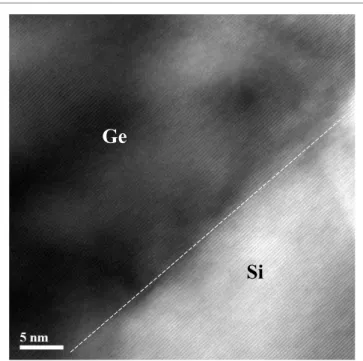
FiGURe 4 | High-resolution TeM image of the Si/Ge Nw HJ interface close to the Nw center with clearly visible (111) lattice fringes (wang et al., 2015).
Ge
Si
20 nm
FiGURe 3 | Transmission electron microscope (TeM) image of the axial Si/Ge nanowire (Nw) heterojunction (HJ) showing an abrupt Si/ Ge heterointerface (marked by the arrow) and an increase in the Nw diameter from 105 nm in the Si segment to 115 nm in the Ge segment of the Nw (wang et al., 2015).
Si
Ge
FiGURe 5 | High-resolution TeM image of the Si/Ge Nw HJ interface close to the Nw surface with clearly observed distortion of the lattice fringes (see box). An amorphous layer of ~ 1 nm thickness at the NW surface is indicated by an arrow (Wang et al., 2015).
energy-dispersive X-ray spectrometer (EDX) with a probe size of 0.2 nm, Raman scattering spectroscopy, and PL spectroscopy.
Figure 3 shows a TEM image at moderate resolution of a single axial Si/Ge NW HJ with a clearly visible Si/Ge hetero-interface and smooth NW surface. he diameter of the Si seg-ment of the NW is ~105 nm and it is nearly constant. he Ge segment of the NW diameter gradually increases from ~105 to 115 nm within ~100 nm from the Si/Ge heterointerface and then remains constant. Figure 4 presents a high-resolution TEM image of the Si/Ge NW heterointerface close to the NW center. A lattice fringe spacing fast Fourier transform (FFT) of the central heterointerface area indicated a nearly ideal crystallinity of the NW center. Figure 5 shows a TEM micrograph at high resolu-tion of the same Si/Ge NW HJ with attenresolu-tion on the area close to the NW surface where a ~1-nm-thick amorphous oxide layer can be seen (marked by an arrow) and structural imperfections (see area marked by a box) are conirmed by a FFT analysis. No other structural defects are observed in the vicinity of the Si/Ge NW HJ.
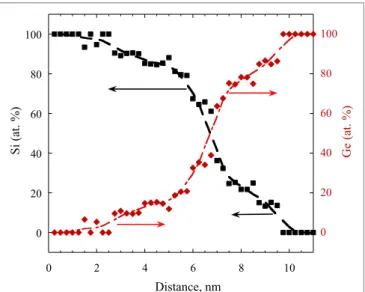
Results of compositional EDX microanalysis of the Si/Ge NW HJs are shown in Figure 6. he Si/Ge NW HJ is comprised of Si and Ge NW segments with a clearly observed ~8-nm-thick SiGe transition layer produced by spontaneous SiGe intermixing. he EDX data indicate that a 2-nm-thick Si0.8Ge0.2 layer is formed close to the Si segment of the NW, and this is known to be a stable SiGe alloy composition produced by spontaneous intermixing
(Brunner, 2002; Kamenev et al., 2004).
Figure 7A shows Raman spectra of Si/Ge NW HJs measured using lasers with diferent wavelengths. Under 515 nm excitation,
we observe three distinct Raman peaks associated with the Si–Si (~520 cm−1), Si–Ge (~400 cm−1), and Ge–Ge (~300 cm−1) types of vibrations with the main Raman peak at 300 cm−1. Under 458 nm
250 300 350 400 450 500 550 ). n u . br a( yti s ne t ni na ma R de zil a mr o N Raman shift (cm-1) 514.5 nm 458 nm 470 480 490 500 510 520 530 Normalized Raman Int ensi ty (arb. un.) Raman shift (cm-1) 700 W/cm2 250 W/cm2 100 W/cm2 A B Excitation 458 nm
FiGURe 7 | (A) Raman spectra of Si/Ge NW HJs obtained under different (indicated) excitation wavelengths. (B) Background-corrected Raman spectra obtained under 458 nm wavelength excitation and different (indicated) excitation intensities (Wang et al., 2015). Note that the second Raman peak around 270 cm−1 under 458 nm excitation is, most likely, associated with a laser plasma line.
0 20 40 60 80 100 0 20 40 60 80 100 0 2 4 6 8 10 Si (at. %) Ge (at. %) Distance, nm
FiGURe 6 | Compositional analysis of the Nw along the growth direction showing a spontaneously formed SiGe transition alloy layer at the SiGe interface (wang et al., 2015).
excitation, we observe the same peaks but with the main Raman peak now at ~520 cm−1. his diference is due to a strong spectral dependence of the Raman scattering cross-section (Cerdeira
et al., 1972). A Raman peak at ~500 cm−1 is better observed using
458 nm excitation and is associated with the Si–Si vibration in the presence of a neighboring Ge atom denoted as Si–Si(Ge) (Alonso
and Winer, 1989). he Raman spectra are also sensitive to the
excitation intensity (see Figure 7B). As the excitation intensity
increases, the major Raman peak at ~520 cm−1 broadens and shits toward lower wavenumbers (similar behavior is observed for the Si–Ge and Ge–Ge Raman peaks, not shown). However, with increasing excitation intensity the Raman peak at 500 cm−1 shits in the opposite direction.
Figure 8A shows the Si/Ge NW PL spectrum measured at low temperature. he PL spectrum clearly reveals at least two peaks: a narrower PL peak at ~1.08 eV (PL1) and a broader PL peak at ~1.03 eV (PL2). No signiicant PL at photon energies close to the bulk c-Si transverse optical (TO) phonon-replica PL peak at ~1.1 eV is found. he spectral positions and relative intensities of these two PL peaks are found to be temperature dependent (see
Figure 8B): both PL peaks change their positions signiicantly
with temperature and exhibit the lowest photon energy at ~60 K. he PL1 peak is detectable even at room temperature and exhibits an asymmetric broadening, which [in agreement with Tsybeskov
et al. (1996)] can be itted by employing Boltzmann thermal
broadening on the high energy side of this feature.
High-resolution TEM studies, analyses of lattice fringes, and EDX measurements (Figures 3–6) indicate that close to the center of the NW in the vicinity of the Si/Ge HJ the lattice-mismatch-induced strain is partially relaxed via spontaneous intermixing and the formation of a ~8-nm-thick SiGe transition layer. Additional structural relaxation occurs by gradual (within ~100 nm from the Si/Ge heterointerface) lateral expansion (i.e., increase in diameter) of the Ge segment of the NW (Figure 3). Close to the NW surface, we ind a distortion in the lattice fringe patterns, which is easily detected by FFT analysis (Figure 5 box). hese structural imperfections are located within a 2–3-nm-thick interface layer between the NW core and an oxide layer at the NW surface and they are slightly extended (up to
0.8 0.9 1 1.1 1.2 ). n u . br a( yti s ne t ni L P de zil a mr o N
Photon energy (eV) 20 K 40 K 60 K 80 K 100 K 300 K 0.8 0.9 1 1.1 1.2 No rm aliz ed PL inte
nsity (arb. un.)
Photon energy (eV) c-Si Si/Ge NW T= 20 K PL 1 PL 2 PL 1 PL 2 A B
FiGURe 8 | (A) Low-temperature photoluminescence (PL) spectrum of the Si/Ge NW HJs showing major peaks PL1 and PL2 and the location of the main (very sharp) PL peak in c-Si. (B) The PL spectra of the Si/Ge NW HJs at various (marked) temperatures. The PL spectra peak shift with temperature increase is indicated by dashed lines (Wang et al., 2015).
5–6 nm) toward the NW core in the vicinity of the Si/Ge NW HJs (Figure 5). We conclude that the Si/Ge NW HJs with a diameter approaching 70–100 nm can have a nearly perfect crystalline core and overall smaller density of structural defects (due to a lesser surface-to-volume ratio) compared to thinner NW HJs. he observation of an easily detectable PL signal (Figure 8) supports this conclusion and indicates that non-radiative recombination centers associated with the NW surface states do not fully control carrier recombination in Si/Ge NW HJs with diameters greater than 50 nm (which is the average diameter of NWs in our samples). Also, the PL1 peak is red-shited by ~20 meV and considerably broadened compared to the c-Si PL spectrum, suggesting that the Si segment of the NW close to the Si/Ge HJ is non-uniformly strained. he PL associated with this segment of the Si/Ge NW HJ exhibits a peak shit toward higher photon energy as the temperature increases from 20 K to above room temperature, indicating that there is compressive stress due to the mismatch in Si and Ge CTEs and, possibly, NW bending. he PL peak at 1.03 eV (PL2) is even more broadened, and it disappears at T > 80K. We attributed PL2 to radiative carrier recombination within the SiGe alloy layer at the Si/Ge heteroin-terface (Chang et al., 2009). he PL2 peak position, signiicant PL2 intensity temperature dependence, and the PL signal disap-pearance at T > 80 K are consistent with exciton localization on compositional luctuations in SiGe alloys (Kamenev et al., 2004). hus, the structure of the interface region strongly afects carrier recombination in Si/Ge NW HJs.
Considering the Raman measurements, we anticipate that under the applied laser excitation intensity of 102–103 W/cm2, the sample temperature increases signiicantly. he Si–Si Raman peak position in Si/Ge NW HJs is in full agreement with the bulk c-Si Raman temperature dependence, but under 700 W/cm2 incident power density, the sample temperature is estimated to be
~680 K. his signiicant laser heating of our samples is due to a reduced thermal conductivity of the Si/Ge NW HJs and results in the behavior observed with increasing excitation power density described above. he temperature increase produces a strong shit of the Raman peak associated with the Si–Si(Ge) vibration mode toward higher wavenumbers, indicating strong (2–3 GPa) compressive strain, as also found from the PL data. his conclu-sion is supported by the Raman polarization dependence in Si/Ge axial NW HJs (Wang et al., 2015).
QUANTUM DOTS
“By the 1990s, a diferent type of SiGe NS, namely the 3D self-assembled system produced by the well-known Stranski– Krastanov, or cluster-layer, growth mode in lattice-mismatched materials, had been demonstrated (Eaglesham and Cerullo, 1990;
Mo et al., 1990; Jesson et al., 1993; Kamins et al., 1997; Baribeau
et al., 2006). It has been shown that dislocation-free SiGe growth
can be achieved using a higher temperature (≥600°C), and that the non-planar geometry is mainly responsible for the signiicant increase of the SiGe critical layer thickness. It has also been found that, compared to two-dimensional (2D) Si/SiGe NSs, the PL and EL quantum eiciency in 3D Si/SiGe NSs is higher (up to 1%), especially for T > 50 K (Cerdeira et al., 1972; Apetz et al., 1995;
Schittenhelm et al., 1995; Schmidt et al., 1999b). Despite many
successful demonstrations of PL and EL in the spectral range of 1.3–1.6 μm, which is important for optical iber communica-tions, the proposed further development of 3D Si/SiGe-based light emitters was discouraged by several studies, indicating a type II energy band alignment at Si/SiGe heterointerfaces (Van
de Walle and Martin, 1986; hewalt et al., 1997; Schittenhelm
et al., 1998; El Kurdi et al., 2006), where the spatial separation
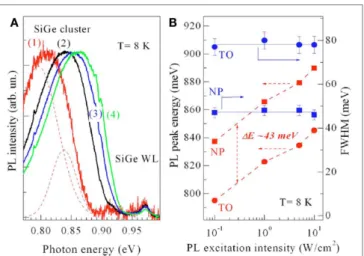
FiGURe 9 | (A) Normalized low-temperature PL spectra in CVD grown Si/ SiGe 3D nanostructures showing the PL spectral shift to higher photon energy under increasing CW excitation intensity [trace (1) 0.1, (2), 1, (3) 5, and (4) 10 W/cm2] at 2.41 eV (514.5 nm). Each spectrum can be itted with two Gaussian spectral bands [the transverse-optic (TO) phonon replica and no-phonon (NP) lines, respectively], as shown, for example, by the dashed lines under trace (1). (B) The NP and TO line positions and widths [full-width at half maximum (FWHM)] as a function of excitation intensity (Lockwood and Tsybeskov, 2010).
Figure 1) was thought to make carrier radiative recombination very ineicient. Later, it was also shown that 3D Si/SiGe NSs exhibit an extremely long (of the order of 10−2 s) luminescence lifetime (Kamenev et al., 2005), which is of the order of a mil-lion times longer than in III–V semiconductors and their NSs. hus, according to this analysis, 3D Si/SiGe NSs cannot be used to achieve eicient and commercially valuable light-emitting devices. Recently, however, it has been shown that despite the fact that the Si/SiGe heterointerface most likely exhibits type II energy band alignment, it is still possible to obtain conditions favorable for an eicient carrier radiative recombination.” For further details of this early work, see the additional review mate-rial given in Lockwood and Tsybeskov (2013).
With 3D coninement, the role of the dot surface and its interface with its surroundings becomes even more critical in determining the physical properties of SiGe NSs. In this sec-tion, we provide a summary of the latest time-resolved and continuous-wave (CW) PL investigations of the recombination dynamics of 3D Si/Si1−xGex multilayer NSs grown by MBE
(Modi et al., 2012a,b; Lockwood et al., 2013b; Mala et al., 2013).
Signiicantly, the Si/Si1−xGex NSs comprised a single Si1−xGex nanometer-thick layer (NL) integrated into Si/Si0.6Ge0.4 cluster multilayers (CMs).
Photoluminescence from SiGe
Nanostructures
he PL spectra typically observed in 3D Si/SiGe NSs is similar to that found for III–V QWs with type II energy band alignment, as the PL exhibits a blue shit on increasing the excitation intensity
(Lockwood and Tsybeskov, 2010). his efect is found in samples
grown by both MBE and CVD. Figure 9A shows PL spectra in a CVD grown sample measured for diferent excitation intensities. At the lowest excitation intensity shown, the PL feature that is shown resolved into two components (see Figure 9A) peaks at ~0.8 eV. On increasing the excitation intensity, an unbroken PL blue shit of 30–40 meV for each decade of excitation intensity increase is observed (see Figure 9B). Under much higher photo-excitation intensity (1–10 kW/cm2), the low energy part of the PL spectrum does not shit any further, while the high energy part continues shiting toward higher energy. A modiied Arrhenius plot of the normalized integrated PL intensity as a function of temperature for the diferent excitation intensities can be it-ted with two thermal quenching activation energies, E1 and E2
(Lockwood and Tsybeskov, 2010). Activation energy E1 is found
to be ~15 meV and is independent of the excitation intensity for all samples. Activation energy E2, however, depends considerably on the excitation intensity: it increases drastically from ~120 to 340 meV when the excitation intensity increases from 0.1 to 10 W/cm2. his high value for E
2 implies that such PL can easily be observed at room temperature.
Low-temperature PL dynamics have been measured for a CVD grown sample using a ~6-ns excitation pulse at 2.33 eV (532 nm) (Lockwood and Tsybeskov, 2010). he initial PL decay is fast (< 20 ns), close to the resolution of the detection system. However, a slower PL component demonstrates a strong dependence on the PL photon energy: at photon energies below
0.8 eV, the PL lifetime is found to be ~20 μs and then it drastically decreases to ~200 ns for PL observed at 0.89 eV.
Single Nanometer-Thick SiGe Nanocluster Sample
A TEM micrograph of a specially fabricated sample containing a very thin Si1−xGex cluster layer above a regular stack of such cluster layers that was grown using Si/SiGe MBE is shown in
Figure 10A (Modi et al., 2012a). he sample is grown on a Si sub-strate and comprises two SiGe cluster layers with a cluster height of ~6–8 nm separated by a Si layer of ~8 nm thickness between the SiGe clusters (i.e., there are two SiGe/Si pairs); a 30-nm-thick Si spacer layer; another ive SiGe/Si layer pairs to initiate 3D growth; a layer of SiGe clusters with a height of approximately 18 nm; a thinner separating Si layer; a inal SiGe cluster layer; and a thin Si cap. he SiGe alloy cluster layers are composed of up to 40 atomic percent (at.%) Ge, and induce considerable global and local strain, which is readily visible in dark-ield TEM imaging (see, for example, Figure 10B). Much of the strain is accommo-dated within a 60–70 nm depth of the Si substrate and within the 30-nm-thick Si spacer layer above it (see the bright regions in
Figure 10B). he top two pairs of Si/SiGe layers, however, show a lower TEM contrast than the layers below them, primarily due to the much thinner (and strained) Si layer sandwiched between the two thicker SiGe cluster layers.
A dark-ield TEM image at greater magniication for the two Si/SiGe cluster layers closest to the Si substrate is presented in
Figure 11 together with results from an EDX alloy-composition
scan. As shown in Figure 10B, this region of the sample has a high strain and likely signiicant strain-induced Si/SiGe intermixing. he EDX analysis shows that the Ge atomic concentration at the Si/SiGe heterointerface increases from 0 to ~35 at.% within
0.0 20 40 0 5 10 15 20 25 Ge (at. %) Position (nm) d A B
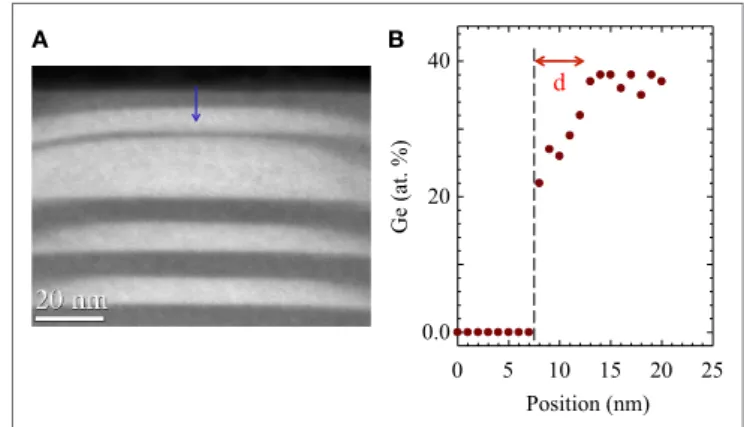
FiGURe 12 | (A) A HAADF-STEM micrograph showing top SiGe cluster layers and EDX scan position (arrow). (B) EDX measured Ge atomic concentration at the topmost Si/SiGe cluster-layer heterointerface. The interface abruptness d is indicated (Modi et al., 2012a).
FiGURe 10 | TeM micrographs showing (A) <011> zone axis bright-ield TeM image and (B) {200} two-beam dark-ield TeM image of the specially engineered Si/SiGe cluster multilayer nanostructure. The SiGe cluster layers are clearly seen as dark areas in Figure 10 (A) (Modi et al., 2012a). 0.0 20 40 0 5 10 15 20 Ge (at. %) Position (nm) d SiGe Si A B
FiGURe 11 | (A) A high angle annular dark-ield scanning transmission electron microscope (HAADF-STEM) micrograph showing the irst and second bottom SiGe cluster layers (counting from the Si substrate) and EDX scan position (arrow). (B) EDX measured Ge atomic concentration at the second bottom Si/SiGe cluster layer heterointerface. The interface abruptness d (which is the distance between pure Si and SiGe with the nominal Ge concentration) is indicated (Modi et al., 2012a).
0 1 2 10-2 10-1 100 ~2 µs Time (µs) < 20 ns 532 nm, 355 nm, 0.6 0.7 0.8 0.9 1
PL intensity (arb. un.)
Photon energy (eV)
405 nm excitation 325 nm excitation 100 101 102 103 104 10-7 10-5 10-3 10-1 Excitation energy density (J/cm2) 532 nm 355 nm A B C
FiGURe 13 | (A) Normalized low-temperature PL spectra (shifted vertically for clarity) collected for different excitation wavelengths. (B) The PL decays measured at 0.78 eV under ~6 ns duration pulsed excitation with the indicated excitation wavelengths. (C) The PL intensity as a function of excitation energy density at different excitation wavelengths. During these measurements, the sample temperature was 15 K (Modi et al., 2012a).
a distance d = 5 nm (Figure 11B). Figure 12 displays the cor-responding information for the two topmost Si/SiGe clusters layers, where the Ge atomic concentration in the cluster reaches a maximum value of ~38 at.% within a much shorter distance d = 3 nm. he EDX scans, thus, reveal that the topmost Si/SiGe cluster layer has a much more abrupt Si/SiGe heterointerface compared to that found in the bottommost cluster layers.
Photoluminescence measurements of this sample (see
Figure 13A) reveal spectroscopic features that are consistent with the TEM and EDX data. Using photoexcitation at a wave-length of 405 nm, which has a penetration depth of ~0.1 μm, a PL peak is observed at 0.78 eV with a full-width at half maximum (FWHM) of ~130 meV. At an excitation wavelength of 325 nm with a penetration depth of only ~10 nm, the PL spectrum is shited slightly toward lower photon energy and has a signii-cantly reduced FWHM (~100 meV). his result demonstrates that the cluster composition and Si/SiGe interface abruptness, as illustrated in Figures 11 and 12, are inluencing the PL behavior:
the more abrupt the Si/SiGe interface, the smaller the FWHM of the PL peak, and, in the topmost SiGe layer, a higher Ge composition results in the PL peak being shited toward lower photon energy (Modi et al., 2012a). In other similar samples, it has been shown that continuous optical excitation at shorter wavelengths produces substantial PL fatigue ater a delay of about 10 min due to the accumulation of charge within the SiGe clusters (Modi et al., 2012b).
he PL lifetimes as a function of incident wavelength and PL intensity as a function of excitation energy density are shown in Figures 13B,C, respectively, both being measured under pulsed laser excitation with a pulse duration of ~6 ns. he PL excited at 532 nm and recorded at 0.78 eV, which originates predominantly from the lowermost Si/SiGe cluster layers, has a lifetime that is approximately 100 times longer than the same
0 10 20 30 40 0 20 40 60 80 100 Co mp osi tio n (a t% ) Distance (nm) Ge Si A B
FiGURe 14 | (A) A cross-sectional transmission electron micrograph (TEM) image showing the Si/SiGe NL/CM nanostructure with the very thin SiGe NL fourth from the top (Si) layer, and (B) energy-dispersive X-ray (EDX) measured composition of the sample’s six topmost layers. The arrow shows the direction of the EDX scan. The scale bar in the TEM image is 20 nm in length (Mala et al., 2014). 0.80 0.85 0.90 0.95 1.00 0.0 0.2 0.4 0.6 0.8 1.0
Normalized PL intensity (arb. un.)
Photon energy (eV) 365 nm 325 nm T=17K 0.80 0.85 0.90 0.95 1.00 0.0 0.2 0.4 0.6 0.8 1.0 No rm aliz ed PL In te ns it y (a .u .) PL Energy (eV) Time-integrated Peak intensity
A B
FiGURe 15 | Low-temperature (17 K) PL spectra recorded under (A) Cw excitation with the indicated excitation wavelengths and (B) pulsed 355-nm excitation using the time-integrated and peak-intensity methods (Mala et al., 2014).
PL excited at 355 nm, which originates predominantly from the topmost Si/SiGe cluster layer. No changes in the PL lifetime are found under 355 nm excitation with energy densities varied from 10−5 to 5 × 10⁻² J/cm2 until the Auger limit has been reached, with the carrier concentration then approaching ~1019 cm−3 [see
Figure 13C and Kamenev et al. (2005)]. here is a dramatic difer-ence in the PL intensity as a function of excitation energy density for excitation at the two diferent wavelengths: the PL intensity under 532 nm excitation quickly saturates, in agreement with the indings of Kamenev et al. (2005) and Cerdeira et al. (1972), while, most impressively, the PL intensity under 355 nm excitation is linear versus excitation intensity for many orders of magnitude (see Figure 13C).
hese results clearly demonstrate that in Si/SiGe 3D NSs the PL peaked near 0.78 eV strongly depends on the Si/SiGe heteroin-terface abruptness. he EDX measurements show that in conven-tional MBE-grown 3D Si/SiGe NSs the transition from pure Si to Si1−xGex with x = 0.3–0.4 in the cluster can require an intermixed SiGe interface whose width is more than 5 nm. hese difused type II Si/SiGe heterointerfaces are responsible for a signiicant electron–hole spatial separation (d > 5 nm) and the observed slow PL, which cannot compete with Auger recombination even at low optical excitation intensities. However, by means of growth engi-neering, more abrupt Si/SiGe heterointerfaces with, for example, d = 3 nm, can be obtained. hese sharper heterointerfaces yield a PL lifetime of <20 ns, which remarkably is only a little slower than that found in direct band-gap III–V semiconductors. his extremely fast PL has a quite high quantum eiciency, which, in contrast to the previously reported results, remains constant over several orders of magnitude of optical excitation intensity.
Single Nanometer-Thick SiGe Quantum Well Sample
he specially prepared MBE-grown single QW sample is depicted in Figure 14A. he sample structure comprises a Si substrate (not visible in the TEM micrograph); a Si1−xGex bufer layer with x = 10 at.% (partly visible at the bottom of the micrograph); eight repeats of combined Si1−xGex cluster (reaching 10 nm thickness in the center) and Si layer pairs; a single 4–5 nm thick Si1−xGex NL followed by a thin Si layer; and a inal Si1−xGex cluster layer capped with Si (Mala et al., 2013). he EDX scan of the sample shown in
Figure 14B reveals that the Si1−xGex NL composition is relatively uniform (x = 8 at.%) while in the Si1−xGex clusters x monotoni-cally increases from ~5 at.% at the Si/SiGe-cluster interface to up to 40 at.% at the cluster center.
Two quite diferent PL spectra obtained using diferent excitation wavelengths but with approximately the same excitation intensities are compared in Figure 15A. he PL obtained under CW 325 nm excitation is peaked near 0.9 eV; whereas under 365 nm excitation, it is now peaked around 0.8 eV. PL spectra obtained with pulsed photoexcitation at 355 nm from a Nd:YAG laser are shown in Figure 15B. he time-integrated measurements were performed using a lock-in ampliier synchronized with the laser pulse; the accumulation time was in the range of 10−3–10−2 s. he PL peak intensity was measured at diferent wavelengths using a digital oscil-loscope with an adjustable time window and employing a much shorter (~0.1 μs) accumulation time. As for the case of CW
excitation at two diferent wavelengths, the two diferent tech-niques, although using the same excitation wavelength in this case, produced quite diferent PL results: the time-integrated spectrum exhibits a peak near 0.8 eV, while the maximum of the peak-intensity spectrum is at ~ 0.92 eV. Such diferences in the PL spectra can be explained by a substantial diference in the lifetimes of the respective PL constituents. Earlier work has shown that the PL lifetime is indeed expected to be much shorter for the 0.92 eV peak compared with the 0.8 eV peak
(Kamenev et al., 2005).
he intensity of the 0.92 eV PL peak is linearly dependent on the excitation energy density with no saturation evident until an energy density of at least ~50 mJ/cm2, while the 0.8 eV PL peak intensity varies with excitation energy density as the square root (Mala et al., 2014). Also, the rise time of this
10-3 10-2 10-1 100 0 5 10-6 1 10-5 Normaliz ed PL In te nsity (a rb. un.) Time (s) 0.92 eV 0.8 eV 10-8 10-7 10-6 10-5 10-4 10-7 10-6 10-5 10-4 10-3 Instant Li fetime (s ) Time (s) 0.8 eV 0.92 eV A B
FiGURe 16 | (A) Low-temperature (17 K) time-resolved PL decays under pulsed excitation energy density of 50 mJ/cm2 recorded at photon energies associated with SiGe NL PL (~ 0.92 eV) and SiGe cluster PL (~ 0.8 eV). (B) Carrier recombination rate as a function of time calculated using the PL decay data. The fast and slow PL decays are from the NL and clusters, respectively (Mala et al., 2014).
latter PL peak decreases with both increasing excitation energy density and temperature.
he PL dynamics associated with the SiGe NL and the SiGe clusters using pulsed laser excitation at a wavelength of 355 nm and 6-ns long in duration are illustrated in Figure 16A. he 0.92 eV PL peak rises even faster than the system time resolution, while the 0.8 eV PL peak has a rise time of 2–3 μs. he former PL peak decays considerably faster compared to the latter PL peak. Non-exponential decays are exhibited by both kinds of PL bands. his suggests that in both cases the carrier recombination pro-cesses are characterized by a time-dependent recombination rate, Ri, and Figure 16B presents these rates that have been extracted from the PL decay data as a function of time. he recombination rate thus obtained is in the range of 106–107 s−1 for the 0.92 eV PL peak and is ~105–104 s−1 for the 0.8 eV peak PL.
interpretation Based on interfacial
Recombination
At low temperatures, carrier difusion is known to be negligible in Si/SiGe NSs (Modi et al., 2012a). Hence, to account for the dif-ference between the PL spectra obtained using shorter (325 nm) and longer (365 nm) wavelength excitation (see Figure 15A), one must allow for the diference in photoexcitation penetration depth, which is ~10−6 cm at 325 nm and ~10−5 cm at 365 nm (Paul, 2004;
Modi et al., 2012a). hus, the PL at ~ 0.9 eV is mostly associated
with the 4–5-nm-thick Si1−xGex NL with x = 8 at.%, while the PL at ~ 0.8 eV is related to SiGe CMs with x reaching a maximum of 40 at.%. he PL in Si1−xGex CMs is shited toward lower photon energies compared to that in bulk Si1−xGex alloys having a similar composition (Weber and Alonso, 1989), which is most likely due to the presence of strain and strain-induced Si/Si1−xGex interfacial mixing (Cerdeira et al., 1972; Schmidt and Eberl, 2000).
With pulsed laser excitation at 355 nm, the PL arising from both the SiGe NL and the SiGe CMs can be observed. he
time-integrated PL signal shown in Figure 15B shows predomi-nantly the PL peak at ~0.8 eV with a weak shoulder at ~0.9 eV, while the PL peak maximum intensity is now at ~0.92 eV (see
Figure 15B). his indicates that the PL at 0.92 eV decays much faster than the 0.8 eV PL (Kamenev et al., 2005). It is noteworthy from the crystal quality point of view that in both the CW and time-resolved experiments no PL associated with crystallographic dislocations (Fukatsu et al., 1996) was found.
At a higher excitation energy density, the 0.8 eV peaked PL demonstrates a sub-linear dependence of the PL intensity on excitation energy density. However, the PL intensity of the 0.92 eV peak exhibits a linear dependence on the excitation energy density, indicating that the experimentally determined recombination rate of 106–107 s−1 is mostly due to radiative recombination. Given that Auger recombination is competing with radiative recombination, it is expected that the long-lived PL would saturate sooner than the short-lived PL. he experimental data in Figure 16A conirm that the decay of the PL peaked at 0.8 eV is indeed signiicantly slower when compared to that of the 0.92 eV PL peak. Figure 16A also shows that the 0.8 eV PL rise time of ~2–3 μs is much longer than the exciting laser pulse duration of ~6 ns. his exceptionally long PL rise time could be associated with a special kind of Auger-assisted carrier spatial redistribution in the Si/SiGe NSs that is termed the Auger foun-tain (Ohnesorge et al., 1996; Lee et al., 2009).
Non-exponential PL decays have been observed before in Si/ SiGe NSs and analyzed by employing a stretched exponential function {exp[(–t/τ)β]}, a power function {1/(1 + αt)m}, or multiple exponential decays (Zrenner et al., 1995; Fukatsu et al.,
1996; Kamenev et al., 2005). he stretched exponential PL decay
phenomenon has been observed in a wide variety of systems apart from Si/SiGe NSs and it provides a good empirical it to the data, although it most likely has no fundamental signii-cance (Kuskovsky et al., 1998). Indeed, the underlying physical mechanism involved in non-exponential PL decay has yet to be
0 5 10 15 103 104 105 106 107 108 Re co mb in a tio n Ra te (s -1 ) ae-h (nm) SiGe NL (0.92 eV) SiGe cluster (0.8 eV)
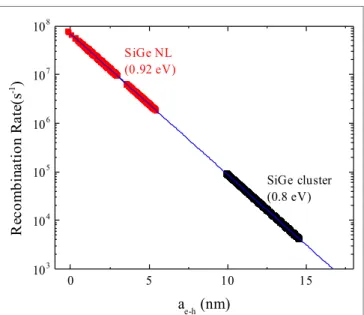
FiGURe 17 | Carrier recombination rates (dots) extracted from the experimental data as a function of the distance between electrons and holes for photon detection energies associated with SiGe NL PL (~ 0.92 ev) and SiGe cluster PL (~ 0.8 ev). The solid line is the theoretically calculated electron–hole recombination rate (Mala et al., 2014).
identiied. In a diferent approach to this issue, we extract the recombination rate directly from the PL decays without requiring any assumption or a speciic physical model. Figure 16B indicates that initially both of the PL bands have an almost time-independ-ent recombination rate, exhibiting single-expontime-independ-ential decays of ~9 × 10⁴ s−1 for the 0.8 eV PL band and ~3 × 10⁷ s−1 for the 0.92 eV PL band. he recombination rate decreases with increasing time, and varies as Ri(t)~t−α with α = 0.67 for the 0.8 eV PL band and α = 0.82 for the PL band peaked at 0.92 eV.
In accordance with the donor–acceptor pair recombination model (homas et al., 1965), the electron–hole time-dependent recombination rate can be explained by assuming that it depends on the average distance separating electrons and holes, ae–h. Due to the previously discussed type II energy band alignment at the Si/SiGe heterointerfaces, it is assumed that the holes are localized within the SiGe and the electrons are located in the Si. he recombination-rate dependence on this distance can be expressed as
R a R a a ( -h 0 )= 0exp− e , (1)
where R0 is the maximum recombination rate (~108 s−1, see
Figure 11B) and a0 is the minimal radius of the localized exciton at the Si/SiGe heterointerface (~1.5 nm). For the Si1−xGex NL with x ~ 8 at.%, ae–h ≤ 5 nm (a value that is comparable to the SiGe NL thickness) while in the Si1−xGex CMs where 0 ≤ x ≤ 40 at.%, ae–h is in the range of 9 nm < ae–h < 14 nm (see Figure 17). hese results are consistent with the TEM and EDX data (see Figure 14). hus, we again see that carrier migration and recombination are both strongly inluenced by the NS interfacial characteristics.
CONCLUSiON
he earlier studies and most recent investigations reported here of Si–Ge interfacial efects in SiGe NSs all demonstrate that for eicient carrier recombination and, hence, best device perfor-mance it is critical to ensure that the as-grown and possibly later-processed heterointerfaces are as sharp as possible. he sharpness is inluenced by many factors, such as growth conditions, strain, and thermal processing, which in practice can make it diicult to attain the ideal structures required. his is certainly the case for NS coninement in one dimension.
However, we have demonstrated that axial Si/Ge NW HJs with good core crystallinity and fairly abrupt heterointerfaces can be fabricated using Au-catalyzed VLS growth. Spontaneous intermixing at the Si/Ge heterointerface and lateral expansion of the Ge segment of the nanowire partially relieves the lattice mismatch-induced strain. With a Si/Ge NW diameter in the range of 50–120 nm, surface-related structural defects and imperfections do not fully control carrier recombination in the Si/Ge NW HJs, and the PL signal associated with band-to-band electron–hole recombination at the Si/Ge NW HJ has readily been measured and attributed to a speciic interfacial SiGe alloy composition revealed by EDX.
For 3D coninement, the experiments outlined here have shown that two quite diferent Si1−xGex NLs when amalgamated with a special Si0.6Ge0.4 CM structure exhibit strong PL that can have a
characteristic decay time as much as 1000 times shorter than that found for PL in regular Si/SiGe CMs. he non-exponential PL decay observed in Si/SiGe NSs has been ascribed to diferences in the distances separating electrons and holes across the Si/ SiGe heterointerface. he results demonstrate that sharp Si/SiGe heterointerfaces can signiicantly reduce the carrier radiative recombination lifetime and thereby increase the PL quantum eiciency. hese SiGe NL/CM combined NSs are now possible contenders for applications requiring light-emitting devices in CMOS compatible optoelectronics.
AUTHOR CONTRiBUTiONS
DL planned and prepared most of this paper as well as participated in the experiments and their interpretation. XHW performed the electron microscopy work. J-MB prepared most of the samples used in this study. SM carried out some of the photoluminescence studies of some samples. XLW carried out some of the photo-luminescence and Raman studies of some samples. LT planned and supervised the experimental work in NJIT and provided interpretation of the results.
ACKNOwLeDGMeNTS
his work is supported in part by NSF grant ECCS-1027770, Hewlett-Packard Laboratories and he Foundation at NJIT. We would like to acknowledge the invaluable contributions over a number of years from our many collaborators on this work and whose names are given in the references to our work in this paper. We thank especially B. Kamenev, E.-K. Lee, H. Y. Chang, and N. Modi of New Jersey Institute of Technology, and T. Kamins of Hewlett Packard Laboratories.
ReFeReNCeS
Abstreiter, G. (1998). “Chapter 2: band gaps and light emission in Si/SiGe atomic layer structures,” in Light Emission in Silicon, ed. D. J. Lockwood (San Diego: Academic Press), 37–76.
Ahn, D., Hong, C., Liu, J., Giziewicz, W., Beals, M., Kimerling, L. C., et al. (2007). High performance, waveguide integrated Ge photodetectors. Opt. Express 15, 3916. doi:10.1364/OE.15.003916
Alonso, M. I., and Winer, K. (1989). Raman spectra of c-Si1− xGex alloys. Phys. Rev.
B Condens. Matter. 39, 10056. doi:10.1103/PhysRevB.39.10056
Apetz, R., Vescan, L., Hartmann, A., Dieker, C., and Lüth, H. (1995). Photoluminescence and electroluminescence of SiGe dots fabricated by island growth. Appl. Phys. Lett. 66, 445–447. doi:10.1063/1.114051
Assefa, S., Xia, F., Bedell, S. W., Zhang, Y., Topuria, T., Rice, P. M., et al. (2010). CMOS-integrated high-speed MSM germanium waveguide photodetector. Opt. Express 18, 4986. doi:10.1364/OE.18.004986
Barbagiovanni, E. G., Cosentino, S., Lockwood, D. J., Costa Filho, R. N., Terrasi, A., and Mirabella, S. (2015). Inluence of interface potential on the efective mass in Ge nanostructures. J. Appl. Phys. 117, 154304. doi:10.1063/1.4918549 Barbagiovanni, E. G., Lockwood, D. J., Simpson, P. J., and Goncharova, L. V. (2012).
Quantum coninement in Si and Ge nanostructures. J. Appl. Phys. 111, 034307. doi:10.1063/1.3680884
Barbagiovanni, E. G., Lockwood, D. J., Simpson, P. J., and Goncharova, L. V. (2014). Quantum coninement in Si and Ge nanostructures: theory and experiment. Appl. Phys. Rev. 1, 011302. doi:10.1063/1.4835095
Baribeau, J.-M., Delâge, A., Janz, S., Lafontaine, H., Lockwood, D. J., McCafrey, J. P., et al. (1999). “Wavy SiGe/Si superlattices: structural and optical properties and application to near infrared light detection,” in Advanced Luminescent Materials, Quantum Coninement, eds M. Cahay, S. Bandyopadhyay, N. Koshida, J. P. Leburton, D. J. Lockwood, M. Meyyappan, and T. Sakamoto (Pennington: Electrochemical Society), 45.
Baribeau, J.-M., Lockwood, D. J., and Syme, R. W. G. (1996). Interfaces in Si/Ge atomic layer superlattices on (001)Si: efect of growth temperature and wafer misorientation. J. Appl. Phys. 80, 1450. doi:10.1063/1.363013
Baribeau, J.-M., Pascual, R., and Saimoto, S. (1990). Interdifusion and strain relax-ation in (SimGen)p superlattices. Appl. Phys. Lett. 57, 1502–1504. doi:10.1063/
1.103377
Baribeau, J.-M., Wu, X., Rowell, N. L., and Lockwood, D. J. (2006). Ge dots and nanostructures grown epitaxially on Si. J. Phys. Condens. Matter 18, R139. doi:10.1088/0953-8984/18/8/R01
Brey, L., and Tejedor, C. (1987). New optical transitions in Si-Ge strained superlat-tices. Phys. Rev. Lett. 59, 1022. doi:10.1103/PhysRevLett.59.1022
Brunner, K. (2002). Si/Ge nanostructures. Rep. Prog. Phys. 65, 27. doi:10.1088/ 0034-4885/65/1/202
Camacho-Aguilera, R. E., Cai, Y., Patel, N., Bessette, J. T., Romagnoli, M., Kimerling, L. C., et al. (2012). An electrically pumped germanium laser. Opt. Express 20, 11316. doi:10.1364/OE.20.011316
Cerdeira, F., Dreybrodt, W., and Cardona, M. (1972). Resonant Raman scattering in germanium. Solid State Commun. 10, 591. doi:10.1016/0038-1098(72)90598-4 Chang, H. Y., Tsybeskov, L., Sharma, S., Kamins, T. I., Wu, X., and Lockwood, D.
J. (2009). Photoluminescence and Raman scattering in axial Si/Ge nanowire heterojunctions. Appl. Phys. Lett. 95, 133120. doi:10.1063/1.3240595 Cosentino, S., Sungur Ozen, E., Raciti, R., Mio, A. M., Nicotra, G., Simone, F., et al.
(2014). Light harvesting with Ge quantum dots embedded in SiO2 or Si3N4.
J. Appl. Phys. 115, 043103. doi:10.1063/1.4863124
Eaglesham, D. J., and Cerullo, M. (1990). Dislocation-free Stranski–Krastanow growth of Ge on Si(100). Phys. Rev. Lett. 64, 1943–1946. doi:10.1103/ PhysRevLett.64.1943
El Kurdi, M., Sauvage, S., Fishman, G., and Boucaud, P. (2006). Band-edge alignment of SiGe/Si quantum wells and SiGe/Si self-assembled islands. Phys. Rev. B Condens. Matter. 73, 195327–195336. doi:10.1103/ PhysRevB.73.195327
Engvall, J., Olajos, J., Grimmeiss, H. G., Kibbel, H., and Presting, H. (1995). Luminescence from monolayer-thick Ge quantum wells embedded in Si. Phys. Rev. B Condens. Matter. 51, 2001. doi:10.1103/PhysRevB.51.2001
Engvall, J., Olajos, J., Grimmeiss, H. G., Presting, H., Kibbel, H., and Kasper, E. (1993). Electroluminescence at room temperature of a SinGem strained-layer
superlattice. Appl. Phys. Lett. 63, 491. doi:10.1063/1.110780
Ertekin, E., Greaney, P. A., Chrzan, D. C., and Sands, T. D. (2005). Equilibrium limits of coherency in strained nanowire heterostructures. J. Appl. Phys. 97, 114325. doi:10.1063/1.1903106
Förster, M., Mantz, U., Ramminger, S., honke, K., Sauer, R., Kibbel, H., et al. (1996). Electroluminescence, photoluminescence, and photocurrent studies of Si/SiGe p-i-n heterostructures. J. Appl. Phys. 80, 3017. doi:10.1063/1.363129 Froyen, S., Wood, D. M., and Zunger, A. (1987). New optical transitions in strained Si-Ge superlattices. Phys. Rev. B Condens. Matter. 36, 4547. doi:10.1103/ PhysRevB.36.4547
Fukatsu, S., Mera, Y., Inoue, M., Maeda, K., Akiyama, H., and Sakaki, H. (1996). Time-resolved D-band luminescence in strain-relieved SiGe/Si. Appl. Phys. Lett. 68, 1889–1891. doi:10.1063/1.116284
Fukatsu, S., Usami, N., Chinzei, T., Shiraki, Y., Nishida, A., and Nakagawa, K. (1992). Electroluminescence from strained SiGe/Si quantum well structures grown by solid source Si molecular beam epitaxy. Jpn. J. Appl. Phys. 31, L1015. doi:10.1143/JJAP.31.L1018
Gnutzman, U., and Clausecker, K. (1974). heory of direct optical transitions in an optical indirect semiconductor with a superlattice structure. Appl. Phys. 3, 9. doi:10.1007/BF00892328
Grydlik, M., Hackl, F., Groiss, H., Glaser, M., Halilovic, A., Fromherz, T., et al. (2016). Lasing from Glassy Ge Quantum Dots in Crystalline Si. ACS Photonics 3, 298–303. doi:10.1021/acsphotonics.5b00671
Guerra, R., Marsili, M., Pulci, O., and Ossicini, S. (2011). Local-ield efects in sil-icon nanoclusters. Phys. Rev. B 84, 075342. doi:10.1103/PhysRevB.84.075342 Guerra, R., and Ossicini, S. (2010). High luminescence in small Si/SiO2 nanocrystals:
a theoretical study. Phys. Rev. B 81, 245307. doi:10.1103/PhysRevB.81.245307 Hannon, J. B., Kodambaka, S., Ross, F. M., and Tromp, R. M. (2006). he inluence
of the surface migration of gold on the growth of silicon nanowires. Nature 440, 69. doi:10.1038/nature04574
Houghton, D. C., Aers, G. C., Eric Yang, S. R., Wang, E., and Rowell, N. L. (1995). Type I band alignment in Si1-xGex/Si(001) quantum wells: photoluminescence
under applied [110] and [100] uniaxial stress. Phys. Rev. Lett. 75, 866–869. doi:10.1103/PhysRevLett.75.866
Hybertsen, M. S., and Schlüter, M. (1987). heory of optical transitions in Si/ Ge (001) strained-layer superlattices. Phys. Rev. B Condens. Matter. 36, 9683. doi:10.1103/PhysRevB.36.9683
Iyer, S. S., Patton, G. L., Stork, J., Meyerson, B. S., and Harame, D. L. (1989). Heterojunction bipolar transistors using Si-Ge alloys. IEEE Trans. Electron Devices 36, 2043. doi:10.1109/16.40887
Jackson, S. A., and People, R. (1986). Optical absorption probability for the zone-folding induced quasi-direct gap in Ge(x)Si(1− x)/Si strained layer
superlat-tices. MRS Proc. 56, 365. doi:10.1557/PROC-56-365
Jesson, D. E., Pennycook, S. J., Tischler, J. Z., Budai, J. D., Baribeau, J.-M., and Houghton, D. C. (1993). Interplay between evolving surface morphology, atomic-scale growth modes, and ordering during SixGe1-x epitaxy. Phys. Rev.
Lett. 70, 2293–2296. doi:10.1103/PhysRevLett.70.2293
Kamenev, B. V., Lee, E.-K., Chang, H.-Y., Han, H., Grebel, H., Tsybeskov, L., et al. (2006). Excitation-dependent photoluminescence in Ge/Si Stranski–Krastanov nanostructures. Appl. Phys. Lett. 89, 153106–153108. doi:10.1063/1.2361198 Kamenev, B. V., Tsybeskov, L., Baribeau, J.-M., and Lockwood, D. J. (2004).
Photoluminescence and Raman scattering in three-dimensional Si/Si1-xGex
nanostructures. Appl. Phys. Lett. 84, 1293. doi:10.1063/1.1650873
Kamenev, B. V., Tsybeskov, L., Baribeau, J.-M., and Lockwood, D. J. (2005). Coexistence of fast and slow luminescence in three-dimensional Si/Si1-xGex
nano-structures. Phys. Rev. B 72, 193306–193309. doi:10.1103/PhysRevB.72.193306 Kamins, T. I., Carr, E. C., Williams, R. S., and Rosner, S. J. (1997). Deposition of
three-dimensional Ge islands on Si(001) by chemical vapor deposition at atmo-spheric and reduced pressures. J. Appl. Phys. 81, 211–219. doi:10.1063/1.364084 Kamins, T. I., Li, X., Williams, R. S., and Liu, X. (2004). Growth and structure of chemically vapor deposited Ge nanowires on Si substrates. Nano Lett. 4, 503. doi:10.1021/nl035166n
Kasper, E., and Schäler, F. (1991). “Strained-layer superlattices,” in Materials Science and Technology, ed. T. P. Pearsall (Boston: Academic Press), 223. Kästner, G., and Gösele, U. (2004). Stress and dislocations at cross-sectional
heterojunctions in a cylindrical nanowire. Philos. Mag. A 84, 3803. doi:10.10 80/1478643042000281389
Kato, Y., Fukatsu, S., and Shiraki, Y. (1995). Postgrowth of a Si contact layer on an air-exposed Si1− xGex/Si single quantum well grown by gas-source molecular