Banded Matrices With Banded Inverses
by
Venugopalan Srinivasa Gopala Raghavan
B.Eng (Aero), Nanyang Technological University, Singapore (2009)
Submitted to the School of Engineering
in partial fulfillment of the requirements for the degree of
Master of Science in Computation for Design and Optimization
at the
NMASSACHUSETTS INSTITUTE OF TECHNOLOGY
September 2010
ARCHIVES
ASSACHUSEFTS IN, iJT
OF TECH NOLoCY
SEP 0 2
2010
LIBRARIES
© Massachusetts Institute of Technology 2010. All rights reserved.
Author ...
School of Engineering July 30, 2010 Certified by ... Gilbert Strang Professor of Mathematics Thesis Supervisor A1 b Accepted by... / ... .... .... .... ---...- - - -. ---Karen E. Willcox Associate Professor of Aeronautics and Astronautics Codirector, Computation for Design and Optimization ProgramBanded Matrices With Banded Inverses
byVenugopalan Srinivasa Gopala Raghavan
Submitted to the School of Engineering on July 30, 2010 in partial fulfillment of the
requirements for the degree of
Master of Science in Computation for Design and Optimization
Abstract
We discuss the conditions that are necessary for a given banded matrix to have a banded inverse. Although a generic requirement is known from previous studies, we tend to focus on the ranks of the block matrices that are present in the banded matrix. We consider mainly the two factor 2-by-2 block matrix and the three factor 2-by-2-by-2-by-2 block matrix cases. We prove that the ranks of the blocks in the larger banded matrix need to necessarily conform to a particular order. We show that for other orders, the banded matrix in question may not even be invertible.
We are then concerned with the factorization of the banded matrix into simpler factors. Simpler factors that we consider are those that are purely block diagonal. We show how we can obtain the different factors and develop algorithms and codes to solve for them. We do this for the two factor 2-by-2 and the three factor 2-by-2 matrices. We perform this factorization on both the Toeplitz and non-Toeplitz case for the two factor case, while we do it only for the Toeplitz case in the three factor case.
We then look at extending our results when the banded matrix has elements at its corners. We show that this case is not very different from the ones analyzed before. We end our discussion with the solution for the factors of the circulant case. Appendix A deals with a conjecture about the minimum possible rank of a permutation matrix. Appendices B & C deal with some of the miscellaneous properties that we obtain for larger block matrices and from extending some of the previous work done by Strang in this field.
Thesis Supervisor: Gilbert Strang Title: Professor of Mathematics
Acknowledgements
I would like to take this opportunity to thank all the people who have helped me in
completing my thesis and also during my journey at MIT.
First and foremost I would like to thank my thesis supervisor Professor Gilbert Strang. He encouraged me to think creatively and differently and was always very willing and patient in explaining many ideas to me which seemed very abstract to me. His suggestions when I got stuck, and feedbacks on a wide variety of issues were truly invaluable and hopefully helped to make me a better researcher. I am truly privileged and indebted to have had the opportunity to work with you, sir.
I would like to thank the administrative staff at MIT for all their help with the formal
procedures and who have helped to ensure that I concentrate more on my courses and thesis. Huge thanks to Mrs. Laura Koller without whose patience and timely reminders I would have missed quite a few of the administrative procedures. Thank you!
I would like to thank the MIT IS&T for helping me out innumerable number of times
when my computer caused issues and in providing me with needed facilities so that I could concentrate on my work as opposed to troubleshooting. Thank you very much!
I would also like to thank my friends here at MIT and especially at CDO. The support I
got from them helped me weather a few storms that I faced. Thanks all!
Last but definitely not the least, I would like to thank my family members who have supported me through thick and thin and whose confidence in me has never ever wavered. Thanks Mom! Thanks Dad! Thanks Venkat! Couldn't have done it without you all! This thesis is dedicated especially to you all!
Contents
1 Introduction ... ...-9
1.1 Banded Matrices ... 9
1.2 Notation with Determinants ... 13
2 Banded Matrices - Two factors with 2-by-2 blocks ... 19
2.1 T oeplitz C ase ... 19
2.2 Solution Process: Toeplitz Case ... 26
2.3 Sample Problem: Toeplitz Case ... 28
2.4 Non-Toeplitz Case ... 29
2.5 Solution Process: Non-Toeplitz Case ... 30
2.6 Tri-Diagonal Matrices ... 32
3 Banded Matrices - Three factors with 2-by-2 blocks ... 35
3.1 Toeplitz C ase ... 35
3.2 Solution Process: Toeplitz Case ... 57
3.3 Sample Problem: Toeplitz Case ... 61
4 Banded Matrices - Three factors with 3-by-3 blocks ... 63
5 Circulant Matrices ... 69
5.1 Two factors with 2-by-2 blocks ... 69
5.3 Three factors with 2-by-2 blocks - Toeplitz ... 73
6 Conclusions and Future Work ... 77
7 Appendices ... 79
Appendix A - Conjecture for a n-by-n matrix formed from the various permutations of n elements ... 79
Appendix B - Miscellaneous Properties ... 85
Chapter 1
Introduction
1.1
Banded Matrices
Matrices are an integral part in the effective working of many of the modem day technologies. The compression of pictures and the prediction of flow over a model fighter aircraft under extremely complicated maneuvers are two examples. In the first case, we make use of the fast Fourier transform that is extremely effective in dealing with very large systems of matrices [1]. In the second case we construct extremely large matrices that need to be inverted quickly, in order to get the solution vector such as the velocity of the aircraft and also other control parameters.
In general, inverting a matrix is a memory intensive and operation intensive process. There are a lot of algorithms that are used to compute the inverse of a matrix and consequently to solve for a linear system of equations. We have the common Gaussian elimination method, the LU decomposition and so on. The Gaussian elimination is of complexity O(n 3)[2] where n is the size of the square matrix. Please note that the number of operations quoted is for the situation where the matrices are full.
The vast majority of matrices that occur in nature are generally sparse. However, there is no guarantee that a sparse matrix will have a sparse inverse. In general this is not the case. A sparse matrix can have an inverse that is full which in turn can increase the overhead when computing solutions to linear equations. However, there are certain conditions under which a sparse matrix will also have a sparse inverse. It is this kind of scenario that we are interested in.
The simplest possible case of a sparse matrix having a sparse inverse is when the matrix under consideration is purely diagonal. In this case the inverse is simply the inverse of each of the elements on the diagonal. We then move on to the scenario where there are non-zero elements in positions apart from the main diagonal. However we restrict the non-zero elements to a small band on either side of the main diagonal, as described in [1]. For the time being we shall consider a matrix that has elements only next to the main diagonal - we call this type of matrix a tri-diagonal matrix. A typical tri-diagonal matrix would be the ID Laplacian finite-difference matrix (K). 2 -1 0 0 0 0- 6 5 4 3 2 1 -1 2 -1 0 0 0 5 10 8 6 4 2
K=
0 -1
2 -1 0
0
1
4
8 129 6 3
0 0 -1 2 -1 0 7 3 6 9 12 8 4 0 0 0 -1 2 -1 2 4 6 8 10 5 0 0 0 0 -1 2- -1 2 3 4 56-While K is indeed banded, its inverse is unfortunately not. In fact we can later try to examine the conditions under which a tri-diagonal matrix's inverse will also be banded.
There are cases when banded matrices also produce banded inverses. These are the cases we are interested in. A typical example of a banded matrix having a banded inverse is shown next
-12 7 20 0 0 0-60 7 20 0 0 0 0 82 12 7 20 0 0 410 60 7 20 0 0 0 0 82 12 7 -0 0 0 410 60 7--1/48 1/48 0 0 0 0 -15/1556 3/1556 -5/1556 5/1556 0 0 _7 _ 205/3112 -41/3112 7/6224 -7/6224 0 0 0 0 -15/1556 3/1556 -5/1556 5/1556 0 0 205/3112 -41/3112 7/6224 -7/6224 0 0 0 0 5/28 -1/28
Why are we so interested in banded matrices and their inverses? Why take the time and effort to
figure out under what conditions the banded matrix will have a banded inverse also? The reason is that if the inverse is also banded, then the speed of the linear transformation performed on an input vector will also be very fast. By being banded we also reduce the memory requirement when dealing with large systems. Computing inverses both ways will be extremely fast.
We wish to make another point here - while we are definitely interested in finding out under what conditions we can get banded inverses, we are also very interested in trying to figure out if we can factorize the banded matrices into much simpler factors. Ideally we are looking to get them as block diagonal matrices for which the inverse can be obtained very easily. However we will also look at some of the other cases where the elements are present on the minor diagonal
and try to figure out if we can extend our methods.
In this work we look at both the forward and reverse directions. In the forward direction, we take the product of simple factors and then examine the structure of the product matrix. We do this to gain a better understanding of what exactly is present in the final product and how it comes about. Once we are done with the forward problem, we try to go in the reverse direction in order to see if we can solve for the individual factors. Please note that the factors we get may not be
the exact same individual factors that were used to construct the product in the first place. However, the product of the factors that we obtain matches the given matrix to within machine precision.
As far as possible we will be looking at both the Toeplitz as well as the non-Toeplitz case. For completeness sake, we furnish here examples of both cases (K=Toeplitz and M=Non-Toeplitz; the repeated elements in the Toeplitz case are highlighted in different colors):
2-1 0 0 0 0 0 0 2 -1 0 0 0 0 0 0 1E 2 -1 0 0 0 0 0 11 3 -9 0 0 0 0 0 0 in 2 -1 0 0 0 0 0 1 4 -7 0 0 0 0 K= 0 i 2 -1 0 0 0 M= 0 0 13 5 -10 0 0 0 0 0 0 ;ll 2 -1 0 0 ' 0 0 0 43 6 4 0 0 0 0 0 C lINl 2 -1 0 0 0 0 0 -25 7 1 0 0 0 0 0 0 1 3illl -1 0 0 0 0 0 1 8 6 0 0 0 0 0 1 1 2 0 0 0 0 0 0 3 9
We will first look at the case where we have only two factors F1 and F2. Each of these is a block
diagonal matrix that has full rank 2-by-2 matrices on the diagonal. We will then move on to the case where there are three factors F1, F2 and F3. F1 and F3 will share the same structure and all
three will be made up of 2-by-2 blocks. For this particular case, we will only consider the Toeplitz form for F1, F2 and F3. In each of the cases, we will also look to obtain the factors. We
then move on to the case with three factors G1, G2 and G3, each of which is made up of 3-by-3
blocks. We will however, not be looking at formulae for the different factors because of the complexity of the problem in the three factor 3-by-3 block case. We will also study the effect of having extra non-zero elements that are far away from the centre - the cyclic/circulant cases. Finally, we will also look at the means to solve for them using the codes that we developed for the non-cyclic cases.
The entire work has been done using MATLAB R2008a. The source codes used in this thesis can be obtained by email from sven.mit(agmail.com
1.2 Notation With Determinants
Consider first a banded matrix that has two block matrices on every two rows. Let us call these block matrices R and S. Previous studies have shown that for banded matrices, the inverse is also
banded only if the following holds [1]:
det(M) = monomial, M = R + Sz, z = arbitrary variable
Let us look closely at the two matrices R and S. Let
R and S =[s S21
We then have for M:
M= r1+s1z r2 +s2z
tr3+s3z r4+s4zI
which then leads to
det(M) = + Siz
r2 + s2Z- (r1 + siz)(r4 + s4z) - (r2 + s2z)(r3 + s3z)
r4 + s4z
It can be seen that the highest degree in the product is z2. The different terms can be written as:
det(M) = (rir4 - r2r3) + (sir4 - s2r3 + s3r2 - s4ri)z + (s1s4 - s2s3)z2
This can be re-ordered as follows:
Where
P = and Q =[r' r2]
Essentially P and
Q
are matrices that embody the combination principle(n)
We then have:
constant term = det(R) coefficient of z2 =
det(S) coefficient of z = det(P) + det(Q) This method of writing the coefficients of the powers of z in the form of determinants makes it easier to understand which terms vanish and which terms remain. It also opens up the possibility of exploring if there is more than one combination that can ensure that makes the matrix
invertible and if so is it banded. The proofs for some of these cases are shown later for which the determinant notation is made use of extensively.
The case that was illustrated was the rather simple case with only two blocks, each of which is a
2-by-2 block. In order to prove the effectiveness of this notation, we look at two other cases
-one when we have three 2-by-2 blocks instead ofjust two (and consequently, three factors) and the other is when we have three 3-by-3 blocks.
Let us first consider the case of three 2-by-2 blocks. Let us denote the blocks by R1, S1 and TI:
R1 = r. r42 S1 = [1 S] T1 =
(tl
t4M1 = R1 + Siz + Tiz 2
M -
[r
1+ siz
+ tz
2r
2 +s
2z
+
t
2z2
The order of the determinant of M in this case would be 4 (since z2.z2 =z4). The determinant
itself would be:
det(M1) = (r1 + s1z + tiz2)(r4 + s4z + t4z2) - (r2 + s2z + t2z2)(r3 + s3z + t3z2)
det(M1) = (rir4 - r2r3) + (r1s4 - r2s3 + r4s1 - r3s2)z + (sis4 - s2s3 + r1t4 - r2t3 + r4t1 - r3t2)z2 + (s1t4 - s2t3 + s4t1 - s3t2)z3 + (tlt4 - t2t3)z4
Which can once again be written as:
det(M1) = det(R1) + (det(P1) + det(Q1))z + (det(S1) + det(U1) + det(V1))z 2
+ (det(W1) + det(X1))z 3 + (det(T1))z 4
Where: _, [r r2 S 3 S4
U
=[r1
r2
Wit3t4
W, 1 2]Q1
rS1 S2 ]-T3 r4rt1
t
2Ir3
74X
1 ISt t2 3 S41Now, we can extend it to the case for the 3-by-3 blocks. Let us denote the blocks as R2, S2 and
T2, where R2, S2and T2are given as:
r2 31 rs
r
6 T8 r9 S 1 S2 = S4 S7 2 3 1 Sg Sg t= T2 = t4 .t7 t2 t31 r5 t6 t8 t9 M2 = R2+ (S2)z + (T2)z2 r1 +s1z+tiz2 r2 +s2z+t 2z 2 r3 +s 3z+t 3z2 M2 = r4+s4z+t 4z 2 rs+s 5z+tz 2 r6 +sz+tz 2 rY7+s 7z+tz 2 r8 +s8z+t 8z2 rg+sz+tqz2 r, R2 = r4 r7The highest power in the determinant of M2 is 6. The coefficients of the various terms are given by
det(M2) =det(R2)+ (det(P2) + det(Q2) + det(U2))z
+ (det(V2) + det(W2) + det(X2) + det(Y2) + det(Z2) + det(A2))z2
+ (det(S2) + det(B2) + det(C2) + det(D2) + det(E2) + det(F2) + det(G2))z3
+ (det(H2) + det(12) + det(J2) + det(K2) + det(L2) + det(N2))z'
+ (det(02) + det(AA2) + det(AB2))z5 + (det(T2))z 6
Where: 1 2 3 r r2 T3 11 S S2 S3 p2
=
4 T5 r6Q
2=
4 s5S6
U
2 r4 -5 T6 S7 S8 S9 r7 T8 r9 r7 r8 T9r1
r2 T31 r1 r2 T3 t1 t2 t31
v2 r4i5
r6 W2 = t4 t5 t6 X2 = i4 r5 r6 t7 t8 t9 7 r8 r9 -i- 7 T8 T9 r1 r2 r3 [S S2 3 [1 S2 3 Y2=
S4 S5 S6Z2=
r4 T5 T6A2=
S4 SS S6 S7 S8 S9 [7 S8 S9- V7 r8 r9 i1 r2 r3 C r1 S2 S31 1- T2 r3B2
S4
Ss 2=
T6ir4-s
T6
D2=
t4
tst6
t7 8 t9 t7 t8 t9 S7 S8 S9 S1 S2 S3 ft1 t2 t3 1t t2 t31 E2 t4 t F2 = S4 S5 S6 G2 = [ 4 T5 r6 7 T i -9 7 i-8 T9 S7 S8 S9ri
i2 i- 1t1 t2 t31
t1 t2 t31
H2= t4 t5 t6 2 [4 -5 i6 12= t4 t5 t6 Lt7 t8 t9 - t7 t8 t9 Y7 T8 T9j Sr S2 S3S
32
S3 t t2 t31
K2= S4 Ss S6 L2 = t4 ts t6 N2 = S4 S5 S6 t7 t8 t9 S7 38 S9 S7 S8 S9S 1 S2 S3 1 1 t2
t
3 t1 t2 t3102 = t4 tS t6 AA2= t4 t5 t6 AB2= s4 s5 S6
t7 t8 t9 s7 s8 sI t7 t8 t9
Naturally, this can be extended to any number of matrices of any order. We can see a particular order in each of the matrices - the entries of any one row come from the same row of the matrices R2, S2 and T2. For example, in AA2, the last row comes from the last row of the matrix
S2, while the first two rows come from the first two rows of T2.
This notation is very powerful and its power will be seen when we attempt to prove a couple of results involving the ranks of the block matrices.
Chapter 2
Banded Matrices
-
Two factors with
2-by-2 blocks
2.1
Toeplitz Case
Let us assume that there are two matrices F1 and F2 and each of them is made up of constantly
repeating 2-by-2 blocks. The matrix F1 has blocks only on its diagonal, while the matrix F2 has
its elements shifted one down and one to the right. We then take the product of F1 and F2. The
resulting matrix is found to have two blocks per row. The structures of the matrices F1, F2 and
the product F12are shown next:
[-a
0 F1 = 0 0 0all
a12]
a21 a22 -k 0 0 F2 = 0 0-0
b =
[bn b12] [bz1 bzz21 fl = bn,F _
-kan
ka2n 0 0 0 0 0 0 0-0
a12bn a22bn 0 0 0 0 0 0 a12bz a22bn 0 0 0 0 0 0 0 0 a2 2bn 0 0 0 0 0 0 a12b1 anlb22 0 0 0 0 0 0 0 0 a22bn 0 0 0 0 0 0 a22bn anlbzz 0 0 0 0 0 0 0 0 a22bn anlbu anlbn 0 0 0 0 0 0 a1 2b1 anb22 0 0 0 0 0 0 0 0 a2 2b11We see that the ranks of the repeated matrices in the product are both of rank one. The rank-one matrices are obtained from the product of a column vector with a row vector. We show now that in order to have exactly two matrices for every two rows in the product and have a banded inverse, the ranks of each of them necessarily need to be unity.
Let the two matrices present in the product be R and S. Let the elements of the matrices be:
LT3 r4 US3 S4
Construct M as usual:
M = R +Sz
This then leads to:
constant term = det(R) coefficient of z2 = det(S) coefficient of z = det(P) + det(Q)
Q
=r
and P
=[r
r2]Case i: rank(R)= 2, rank(S) = 2: Not possible
In this case,
coefficient of z2 = det(S) # 0
=* det(M) = atleast (constant + azz) # monomial
Hence the case of (2, 2) (the first is the rank of R and the second is the rank of S) would definitely not yield a banded inverse.
Case ii: rank(R) = 1, rank(S) = 2: Not possible
The next option would be to look at the case when one rank is 1 and the other rank is 2. Let us assume for simplicity that the rank of R is one and the rank of S is two. We are currently looking at the ordered pair (1, 2) of the ranks. This then leads to:
constant term = det(R) = 0, coefficient of z2 = det(S) # 0
Clearly, if we want the inverse of the banded matrix to be banded, we need that the coefficient of z be zero. (We already have a non-zero term in the coefficient of z2, as S is of full rank):
coefficient of z = 0 = det(P) + det(Q)
The matrix R is of rank one. So, we can re-write the elements of R as:
r2 = pri, r3 = kri -> r4 = kpri
So then we have:
Q
= [Si kri kpri S2 ] and P = r S3 prS4i1det(P) = r1s4 - pr1s3, det(Q) = kprisi - kris2
det(P) + det(Q) = ris4 - pr1s3 + kprisi - kris2 = 0
ri definitely cannot be zero. So we can cancel it from all the terms in the equation. We then get:
S4 - ps3 + kps1 - ks2 = 0
S4 - ks2 = p(s3 - ks1)
Now in the big matrix we have the matrices R and S side-by-side. Using the first row of R to perform elimination leads to:
-xI x2 H = 0 0 0
-0
Si S3 r1 kr1 0 0 S2 S4 pri kpr1 0 0 0 0 S3 r1 kri 0 0 S2 S4 pri kpri 0-0 0 0 Si s3 -0 0 Si (s3- ksi) r 0 0 0 Si (s3-ksi) r1 0 0 0 Si (s3 - ksi) 0 0 0 0 S2 (s4 - ks2) pr1 0 0 0 S2 p(s3 - ksi) pri 0 0 0 S2 p(s3 - ksi) 0 00
0
0
0
S1 S2 (s3-ksi) p(s3-ksi)
0
0
0
0
0 0 0 0 Si (s3- ksi)-0 0 0 0 Si (S3 - ksi). 0 0 0 0 Si (s3- ksi). 0-0 0 0 Si 0-S2 S4 pri 0 0 0 s2 S4 pri 0 0 0 S2 S4 0 0 0 0 -xi x2 0 0 .0-oj
x2 0 0 .0-x1
x2 0 0 0L0
-x1 x2 Hiv = 0 00
-0Clearly we see that there is a zero row in Hi, This means that any matrix that is made up of R and S with ranks 1 and 2 respectively (or vice-versa) will not be invertible (if we impose that the matrix have a banded inverse also)
By a similar argument, we can prove that the same holds (i.e. the matrix will not be invertible) if
R is of full rank and S has rank one.
Case iii: rank(R) = 1, rank(S) = 1: Possible
We write R and S as:
R
r
1pr
1 1R=kr1 kpr1] and S= s1
qs1
Is1 1ys1
Then we have:
constant term = det(R) = 0, coeff icient of z2 = det(S) = 0
coefficient of z = det(P) + det(Q)
ri pri ]and
Q
= [s qsi 1[is lys1] kr1 kpr1
det(P) =
D
1
Pr1 = ris1(lq - 1p), det(Q) = = risi(kp - kq)det(P) + det(Q) = r1s1(1q - 1p) + r1s1(kp - kq) = r1s1(1 - k)(q - p)
Now, we need to take care to ensure that the coefficient of z is not zero. For this, examine where it does become zero.
coefficient of z = 0 = r1s1(1 - k)(q - p) = 0
1 = k or q = p
Consider first that 1 = k:
_x1 x2 0 mat-0 0
L-0
qsi qs1 pri Ipr1 0 0 0 0 qs1 lqs1 pri Ipr1 -x1 x2 0 0 0-L0
There are a couple of zero rows which make the matrix singular. the case when p=q.-x1 x2 0 mat =0 0
.0
siIs
1 ri kr1 0 0 psi lps1 pri kpr1 0 0 0 0 Si Is1 kr1 0 0 psi lps1 pri kpri 0- -x10
X2 0 0 0 0 Si 0 ks1 .0 SiIs
1 r1 kr1 0 0A similar argument applies for
0 0 Si Is1 r1 kr1 0 0 0 0 Si ks.1
-Thus as long as the ratios of the two matrices R and S are not the same then, the coefficient of z is non-zero and in that case it is possible to get an banded inverse matrix.
It can be shown that as long as the two conditions are not met, the reduced row echelon form of the big matrix is the identity matrix. This implies that the matrix indeed is of full rank. And by construction, it satisfies the conditions necessary to have a banded inverse.
x1 x2 0 mat= 0 0 0 Si
Is
1 r1 kr1 0 0 qsi lqs1 pri kpr1 0 0 0 0 SiIs1
r1 kr1 0 0 qsi lqs1 pri kpr1 0 0 0 0 Si Is1 => rref (mat) => qsi qs1 pri 0 0 0 0 0 qsi 0 pri 0 0-0 0 0 Si0-Remark: Please note that if there exist factors F1 and F2 that upon multiplication give matrices R
and S, then we would have:
R = anb22 k = -ab21 and p = [a21b21 a21b2 2
J
al b21 - a12b11 a1 2b1 21 ~ 2 2 b12 S = a2 2b a2 2b12 1 - and q = S12 a1 2 So if we have i) l = k it means: a21 a22 a11 a1 2 a 22a1 1 - a1 2a21 = 0 But:a= a => det(a) = a2 2a11 - a12a21 => det(a) = 0This would mean that the matrix F1 is not invertible in the first place. But we are looking for
factors F, and F2 such that they are invertible. Hence we would need to ensure that I should not
be the same as k
ii) p = q means:
b12 = b22b - bub = 0 bl, b2l
=> det(b) = 0
In this case, F2 would be non-invertible and we would be stuck with the same scenario as in i).
Thus we need to ensure that both 1 does not equal k and p does not equal q.
Next we look at the solution process for the Toeplitz case. 25
2.2
Solution Process: Toeplitz Case
We now look at the solution process for obtaining the 2-by-2 blocks in the factors, for both the Toeplitz and the non-Toeplitz case. We will first consider the Toeplitz case and then extend the same to the non-Toeplitz case. Let us call the two factors as F1 and F2. Now we need to obtain
the blocks that are present in each of F1 and F2.
Denote the two rank one matrices in the product as 'x' and 'y'; we call the first two elements of the first column of F12 as the vector 'w'. Also, let us call the first and second columns of the
matrix a to be a, and a2. We call the rows of the matrix 'b' to be r' and r2. Then we have the
following relations:
a =r2 = x, air1 = y, kai = w, a2buj = yi
where y = [Li 2L2]
To solve this set of equations, we need to set some of the entries of the matrices 'a' and 'b'. The simplest would be to set 'b1 1' to 1 and choose a random value for the variable 'k'. We then get:
W
ai = and a2 = Y1
(i.e.) the second column of the matrix a is the same as the first column of the matrix 'y' in the product.
Now that the vectors a, and a2 are completely known, these can be used in order to solve for the
other unknowns - r' and r2. This is accomplished as follows:
Multiply both sides with a' (aj'ai)r2 = a1'x (ai'x) r2 =(a'a) Similarly (a2'y) = (a 2'a2)
We can check for consistency in our solutions by looking at the solution for ri. We had set 'bII' to be 1. Since r' = [bl1 b12], we need that the first entry of r be 1. We have:
= (a2'[Y1 Y2]) (a2'a2) But we have, a2 = Y1
S=
[(y1'yi) (y1'y2)] (y1-y1) (y1'y1)]=r
[
(1'Y2)]
We see that the first element of r1 is indeed 1 and hence the solution we have obtained is
consistent.
The blocks 'a' and 'b' can now be written as
a = [ai a2], b =
The factor 'k' would go into the matrix F2 as was seen in its structure. The method mentioned
here is exactly the one that is used by the code written to compute the factors. - =(a 2
'a
2)
(a2'Y2)So far we have discussed the methods we use when the shift in position is in the second factor F2.
However, it is quite possible that the shift is not in F2 but instead is in F1. Let us call the new
factors as fi and f2. In this case, a simple tweaking of the code solver2_2x2 is all that is needed.
Instead of using the product f12 and solving for the two factors, we solve for the product
F3 4 = f'2
The structure of F34 will be the same as F12 that we worked with previously. We can then use the
same code to solve for F3 and F4 (for the product F3 4). Then we have
F34 = F3F4 and F34 = f'2
f 12 = F34' = (F3 F4)' = F4'F3'
-> f12 = flf =F 4'F3'
=> fi = F4' and f2 = F3'
Thus we have solved for the factors in a slightly different case by a simple transformation.
2.3
Sample Problem: Toeplitz Case
Let us now apply the solution technique we have just discussed and apply it to the well-known four wavelet coefficients presented by Daubechies [3]. We compare the results obtained with those stated by Strang [4]. We write the problem out in the same way as it has been done in [4].
01
01
W2
The solution we obtain from the codes that were written is:
W =W1
0
.0
W,
_[1+V 3 3 +V-3 I 1 - Vr3 - 3 + 3,A W2 _ [3 - V- 1 - ,IJ 2-3 +V3 -1 - 3k, 0 0 0] 0.5221 -0.3014 0 0]
F1 0 1 2.4286 0 F = 2.7321 4.7321 0 0
F 0 -0.2679 9.0636 0 , 2 0 0 0.5221
---0 0 0 0 0
The solution obtained by Strang [4] is:
k2 0 0 0- [k2 0 0 0' B = 0 1 + \ -1 + N 0
10
2.7321 0.7321 00 1 -
3 1 +
V
0
0 -0.7321
2.7321
0
-0 0 0 -. 0 0 0 V -1 0 0] =1.7321 -1 0 0~ C _1 V- 0 0 _ 1 1.7321 0 0 0 0 --- 0 0 1.7321 ----0 0 1 -- . 0 0 1 -.Clearly, it can be seen that the factors obtained from the two different methods are not equivalent. This does not mean that one of the results is wrong and the other is right. It simply means that the factors are non-unique. Depending on which variables are given values, the individual factors in themselves will change. However, the product remains the same and hence the product of the inverses is the same as the inverse of the matrix W. This is what is necessary and hence this is all that is of concern.
2.4 Non-Toeplitz Case
The major difference in this case is that the blocks on the diagonal are varying. In such a case, we need to determine each of the blocks in each of the factors. The properties concerning the ranks of the matrices in the product F12 are exactly the same as the Toeplitz case. The matrices in
the product should be singular. The argument for the Toeplitz case is valid for the non-Toeplitz case also, when the blocks are no longer constant along the diagonals of the two factors F1 and
F2. We shall now look at solving the interesting problem of finding out all the different blocks on
the diagonals of each of the factors.
2.5
Solution Process: Non-Toeplitz Case
For the time being we shall assume that the shift is in the second factor F2 and the product is F12.
(Solving for the case where F1 has the shift is the same as the one in the Toeplitz case - we
simply solve using the transpose instead of the original product F12). The structures for F1 and F2
are shown next along with the structure F1 2.
-a a1 2 0 0 0 0- -k 0 0 0 0 0 a2 1 a2 2 0 0 0 0 0 bn b12 0 0 0 F= 0 0 An A1 2 0 0 F = 0 b2 b22 0 0 0 1 0 0 A2 1 A2 2 0 0 , 2 = 0 0 0 B11 B1 2 0 0 0 0 0 an
an
0 0 0 B2 1 B22 0 0 0 0 0 al an- .0 0 0 0 0 in. anlk a12bnj a1 2b1 2 0 0 0 -a2lk
a2 2bnj a2 2b1 2 0 0 0 F 0 Anjb2n Anjb22 A12B11 A12B12 0 F ~ 0 A2 1b2j A2 1b22 A2 2B1 1 A22B12 0 0 0 0 anB21 anlB22 al2fll . 0 0 0 a2jB2 1 a2lB2 2 a22flln-Define vector 'w' that consists of the first two elements of the first column of the matrix F12.
Similarly, we define vector's' to consist of the last two elements of the last column of F12. The
matrices that are to the right side of the diagonal element are denoted by 'xi' and the matrices to the left of the diagonal element are denoted as 'yi'. Thus the matrix x starts from the first row while the matrix y1 begins only from the third row.
W = ak= ak, S = 2 11 = a2fl1n
ab
azb - z [ A1
X1=[a 12= a b1 1 al2bl2]
1
2 = A12B11 A12B121
and so on ...-Anlb2
l
Ab 2 2 [ B21 anB22and so on ...
S[A 21b2 A2 1b2 , aBI Bzan d s
In a bid to reduce the number of unknowns, we set the first element of every matrix to be 1 and solve for the rest of the elements of that matrix. By doing this essentially we end up with a situation where for each of the xi, the first column is the same as the -second column of each of the blocks in F1. Similarly, in each of the yi, the first row is the same as the second row of each
of the blocks in F2. This can be understood better by looking it as:
pjqj = xi, where pi is known => solve for qj
ulv' = yi, where vi is known => solve f or ui
Once this is understood, the solution process becomes straightforward and is given by:
pjq1 = x.
(pj'pj)q = (pj'xi)
, (p1'xi) = (p'pj)
And in a similar manner, we have:
(yivj)
U; = (v;'v;)
In order to get the element k that is present in the matrix F1, we simply use:
w1 W2
k = - and a21 =
-all k
Now we have all the blocks and hence we can construct the big matrices F1 and F2 using these
smaller blocks.
2.6 Tri-diagonal Matrices
We will now try to apply what we have derived so far to tri-diagonal matrices. Let us consider a generic tri-diagonal matrix. We then have
-ci d, 0 b1 C2 d2 0 b2 C3 0 0 b3 0 0 0 0 0 0 0 0 0 .0 0 0
R2=
10
2=
C5 6sd
d0
6J Define:Mi = R1 + Siz : det(M1) = det(R1) + (det(P1) + det(Q1))z + (det(S1))z2
det(M1) = b2b3 + (b2d4 + b3d3 - c4c3)z + (d3d4)z 2
Need: det(R1) = 0 and det(S1) = 0
=> det(R1) = b2b3 = 0 and det(S1) = d3d4 = 0
=* b2= 0 or b3 = 0 and d3 = 0 or d4 = 0, Similarly we get:
R 0=2
C],
b2 = 0, b- = 0, b3 = 0, b3 = 0, d = 0 4 0 d3 = 0 d4 = 0 S1 = 0 ,3b4 = 0, ds = 0
b4 = 0 or bs = 0 and ds = 0 or d6 = 0, d=O
bs = 0, d69 = 0
We thus have a total of 16 possible conditions based on what we have derived so far that states that the diagonal matrix K would have a banded inverse. However, studies done on tri-diagonal matrices [5] impose the requirement that for a banded inverse, there can be no two consecutive non-zero entries. This strict requirement is part of the 16 possible conditions. Thus we find that what we have developed is actually a weaker statement, because the general statement did not begin with blocks R1 and S1.
Chapter 3
Banded Matrices
-
Three factors with
2-by-2 blocks
3.1
Toeplitz Case
So far we have analyzed the case where there are only two 2-by-2 blocks in the product. In this chapter we take the next step which would be to increase that number to three. We would then have three factors F1, F2 and F3. For the time being, we shall concentrate on the case where F2
has a shift in its elements. Please note that throughout this section, the structure of F3 is the same
as F1.
For the case of F12 3, it was seen that the ranks of the three matrices (R, S and T) in the product
were one, two and one (when F12 3 is obtained from the product of factors). Once again like the
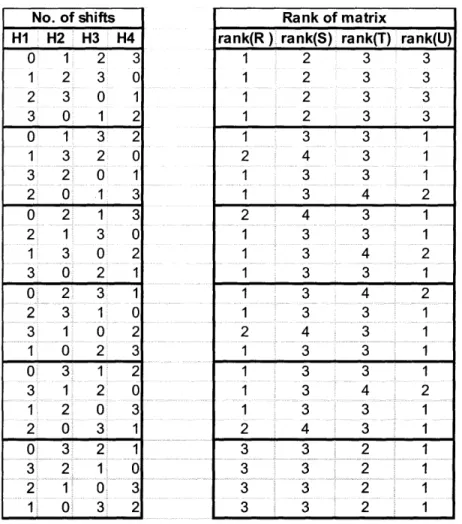
case for the two block case, this can be proved. The proof is what is discussed next. There are six potential cases that need to be considered: (1,1,1), (1,2,1), (1,1,2), (2,1,2), (2,2,1) and (2,2,2). The other scenarios are simply different ways of looking at the above 6 cases.
T =ti t2
Construct
M = R +Sz+Tz2
In the current scenario, the highest power in the determinant will be z4. The coefficients of the
different terms are given by:
constant term = det(R) coefficient of z4 = det(T) coefficient of z = det(P) + det(Q)
coefficient of z2 = det(S) + det(U) + det(V) c
Where:
P =
[r1
Is3 r2] _ [S1 S2]S4 T3 r41
V
[t
t2]
w
S1 S2
]
T3 r41 tt3 t4oefficient of z3 = det(W) + det(X)
U
Ir
1 r2Lt3 t4]
X
=
t1 t2
ts3
S41
We have six cases to examine, out of which only two cases succeed. However, if we are looking to be able to factorize the banded matrix, then there is only one case that works (case vi).
Case i: Ranks are (2, 2, 2)
In this case it is obvious that there will be two non-zero terms in the determinant - the constant term and the coefficient of z4. As a result, the resulting inverse will not be banded (because the
determinant is not a monomial)
Case ii: Ranks are (1, 1, 1)
In this case it is pretty clear to see that the constant term and the coefficient of z4 will both vanish. We now re-write R, S and T as:
r r
2] S =
S1 S2]
r2= pr1, r3 = kri, r4 = kpri s2= qsi, S3 = is1, s4 = lqsi t2 = ut1, t3 = mt1, t4 = mut1 R ri pri R kr1 kpr1
J
Ssiqs
1 LIs1 lqs1] T nt utI (mt1 mut1] Then we have:det(P)
=
i
-ris
= I rlsl(q-
p),
det(U)
=
1
t =r 1t1m(u - p), det(V) = kr1 det(W) = m t1 = s1t1m(u - q), kprdet(X)
=
tk
ut,
risik(p - q) = r1t1k(p - u) = s1t1l(q - u)Which then leads to:
constant term = det(R) = 0 coefficient of z4 = det(T) = 0
coefficient of z = det(P) + det(Q) = r1s1(q - p)(l - k)
coeff icient of z3 = det(W) + det(X) = s1t1(u - q)(I - m)
coefficient of z2 = det(S) + det(U) + det(V) = r
1t1(p - u)(k - m)
If this is to be banded, then exactly one of the terms should be non-zero. Assume that the
coefficient of z is non-zero. Then we need:
coefficient of z2 = r
1ti(p - u)(k - m) = 0
coefficient of z3 = siti(u - q)(l - m) = 0
Which implies:
p = u or k = m, u = q or I = m
There are 4 sub-cases which would need to be considered
i) p=u and u=q=*p=q
=* coefficient of z2 = r
1t1(p - u)(k - m) = 0
-> coefficient of z3 = s
1t1(u - q)(1 - m) = 0 => coefficient of z = r1s1(q - p)(I - k) = 0
This means that for this particular scenario, the matrix is not invertible. Thus this case is unfavorable.
ii) k=m and I=m =>l=k
=> coefficient of z2 = r1t1(p - u)(k - m) = 0
=> coeff icient of z3 = s1t1(u - q)(1 - m) = 0
=> coefficient of z = r1s1(q - p)(l - k) = 0
The matrix is not invertible. As a result having k = m and 1 = m is not favorable.
iii) p=u and l=m
Please note that x =
SX]
is an arbitrary matrix of rank either one or two. Ideally,Is(d.-.b)) 0 Is(d - b) 0
0
0
0
0
0
0
0
0
o
0o
0
Is(d -b)) 0 Is(d - b) 00
00
00
0
o
0 Is(d - b)l Isl Is(d - b) Ts 0 T70
00
0
0
0
o
0 Tsb 'sb TI4I T9dy 0 0 0 0 -Isbi Is) Isb Is 0 0 0 0 0 0 ls(d - b)i 0s(d-b) 0 0 0 0 0 0 ls(d - b)) Is(d - b) 0 0 0 0 0 0 lEs(d -b)) Ts(d -b) 0 0 0 0 id>l lid lsb) 'sb 1d Md 0 0 Tad nsbI Isb 0 0 In, li 0 0 0 0 0 0 In., 0 0 1 1 0El 0 Is) Is 0 Iis S Is 0 0 7 0 T-14 Ul T1 0 0 0 0 0 0 's(d - b)i 0s(d b) 0 0 0 0 0 0 Ts(d -b)l S(d -b) 0 0 0 0 0 0 Ts(d - b)) 's(d -b) 0 00
0
0
0
.td>i U-l lid li Isbi Is 'sb Is lid 1El0
0
0
0
id Ii lEsbi Tij 'sb TS T~mj I~ui Ti L7 0 0 0 0 17 0 0 lily 0 0 0 0 0 0I Is Tv 0T 0 0 0 0 lid v X ZX 0 0 0 0 'itd0
0
0
0
0
0
0 0 lid Tu ZX TX0
0
0
0
0
0
0 0 IUdl Tvj lud Ii "IX EX0
00
00
0 0 0 lEid Ii ZX IX 0 0 0 T0 In, Ii 0 0 0 0 _~u EXThe matrix has a zero column which can be clearly seen. Thus it is not of full rank. Hence p = u and 1 = m also does not allow the big matrix to be invertible.
iv) u=q and k=m
xI X3 r1 kr1 0 0 0 0 x2 x4 pri kpr1 0 0 0 0 x2 x4 pr1 kpr1 0 0 0 0 mt1 Si Is1 r1 kr1 0 0 t1 kt1 Si Is1 ri kr1 0 0 ut1 mut1 qsi lqs1 pri kpr1 0 0 qt1 kqt1 qs1 qs1 pri kpr1 0 0 0 0 ti mt1 Si
Is
1 ri kr1 0 0 t1 -kt1 Si Is1 r1 kr1 0 0 uti mut1 qs1 qs1 pri kpr1 0 0 qt1 kqt1 qsl Iqs1 pri kpr1 0 0 0 0 ti mt1 Si Is1 0 0 0 0 tl kt1 SiI1
x1 x2 t1 0 0 0 x3 x4 kt1 0 0 0 ri pri si 0 t1 0 kr1 kpr1 Is1 0 kt1 0 0 0 r1 (p - q)r si 0 0 0 kr1 k(p - q)r1 Is1 0 0 0 0 0 r, (p - q)r 0 0 0 0 kr1 k(p - q)r1 0-0 0 0 uti mut1 qsi lys1 0 0 0 0 qtj kqt1 qsi qsj 0 0 0 0 ti kt1 Si Is,The last column is a zero column meaning that the matrix is singular. Hence u = q and k = m also does not allow the big matrix to be invertible.
Let us now look at the other two scenarios - where the coefficient of z2 and z3 are respectively
Coefficient of z is non-zero:
coefficient of z3 = siti(u - q)(l - m) # 0
coefficient of zz = r1tj(p - u)(k - m) = 0
coefficient of z = r1s1(q - p)(1 - k) = 0
=> u = p or k = m, q = p or 1 = k
The cases for z3 that we need to consider are very similar to what we did for z. Thus we can
expect that the matrix will not be invertible if we have only the coefficient of z3 to be non-zero.
Coefficient of z2 is non-zero:
coefficient of zz = r1t1(p - u)(k - m) # 0
coefficient of z = ris,(q - p)(1 - k) = 0
coefficient of z3 = sitl(u - q)(1 - m) = 0
=>q =pork =l, u = q or 1 = m
The situation where the coefficient of z2 is non-zero has one particular case that ensures that the
matrix has a banded inverse. This is the case where p = q and 1 = m. However, although this case gives a banded inverse, the matrix cannot be decomposed into factors. We show very quickly why this is so:
S
=
ps1[
anbz2c11+
a 2buc2 1 anb2 2c1 2 + a 2buc2 2] s-s1 l ps1Laubzzcu+
a2 2bujc2j a2 b22c12 + a22bujc22det(S) = 0 = (anb22c11 + a1 2bujc2 1)(a2 b22c1 2 + a22buc2 2)
- (a2 b22c11 + a2 2bujc2 1)(anb22c12 + a 2bulc22) = 0
=> (det(a))bujb2 2(det(c)) = 0
=> det(a) = 0 or det(c) = 0 or bujb2 2 = 0
In each of the cases, the factors will not be invertible. Thus although this case is invertible and produces a banded inverse, it cannot be factorized. Hence for our purposes of being factorizable, it is not useful.
Case iii: Ranks are (1, 1, 2)
The constant term vanishes in this particular case. We now re-write R, S and T as:
2= pri, r3 = kri, r4 = kpri
S2= qsi, s3 = Is1, s4 = lqsi
R
=
r[k
pr
Then we have:
det(P)
=
Ii
i
I
=
r
1s
1l(q
-
p),
det(Q) = = r1syk(p - q)
det(U)
=t
i = r1(t4- pts),det(V)
=k
kri = kr1(pt1 - t2)det(W)
=
q
t
= S1(t4- qt3), det(X-) = t2 =s 1(qt1 - t2)Which then leads to:
constant term = det(R) = 0 coefficient of z4 = det(T) # 0
coefficient of z = det(P) + det(Q) = r1s1(q - p)(I - k)
S=s1 qs1 t1 t21
coefficient of z3 = det(W) + det(X) = s1[(t4 - it2) + q(1t1 - t3)]
coefficient of z2 = det(S) + det(U) + det(V) = r1[(t4 - kt2) + p(kt1 - t3)]
Because det(T) # 0, we need that the other coefficients all disappear. This then leads to:
coefficient of z = det(P) + det(Q) = r1s1(q - p)(1 - k) = 0
=* q = p or 1 = k
coefficient of z3 = det(W) + det(X) = s1[(t4 - it2) + q(1t1 - t3)] = 0
= (t4 - It2 ) = q(t3 - it1)
coeff icient of z2 = det(S) + det(U) + det(V) = r1[(t4 - kt2) + p(kt1 - t3)] = 0
=> I(t4 - ktz) = p(t - kt1i) t -> (k - 0~tz = (q - p)t3 + (kp - ql)t1 Ifq =p = (k - i)t2 = (k - I)pt1 = tz = pt1 Now: (t4 - it2) = q(t3 - lt1) => (t4 - plt1) = q(t3 - it1) => (t4- pit1) = p(t3 -1t1 ),(-: p = q) = (t4 - plt1) = (pt3 - plt1 ), => t4 = pt3