Publisher’s version / Version de l'éditeur:
Proceedings of the Hydrogen and Fuel Cell 2007 International Conference and
Trade Show, 2007, 2007-04-29
READ THESE TERMS AND CONDITIONS CAREFULLY BEFORE USING THIS WEBSITE. https://nrc-publications.canada.ca/eng/copyright
Vous avez des questions? Nous pouvons vous aider. Pour communiquer directement avec un auteur, consultez la
première page de la revue dans laquelle son article a été publié afin de trouver ses coordonnées. Si vous n’arrivez pas à les repérer, communiquez avec nous à [email protected].
Questions? Contact the NRC Publications Archive team at
[email protected]. If you wish to email the authors directly, please see the first page of the publication for their contact information.
NRC Publications Archive
Archives des publications du CNRC
This publication could be one of several versions: author’s original, accepted manuscript or the publisher’s version. / La version de cette publication peut être l’une des suivantes : la version prépublication de l’auteur, la version acceptée du manuscrit ou la version de l’éditeur.
Access and use of this website and the material on it are subject to the Terms and Conditions set forth at
Melt-processed Semi-fluorinated Proton Exchange Membranes and
their Performance in Membrane Electrode Assemblies
Mokrini, A.; Robitaille, L.; Xie, Zhong; Shi, Ken; Holdcroft, Steven
https://publications-cnrc.canada.ca/fra/droits
L’accès à ce site Web et l’utilisation de son contenu sont assujettis aux conditions présentées dans le site LISEZ CES CONDITIONS ATTENTIVEMENT AVANT D’UTILISER CE SITE WEB.
NRC Publications Record / Notice d'Archives des publications de CNRC:
https://nrc-publications.canada.ca/eng/view/object/?id=aba44e2e-2540-4db5-88be-49944206cb91 https://publications-cnrc.canada.ca/fra/voir/objet/?id=aba44e2e-2540-4db5-88be-49944206cb91Melt-processed Semi-fluorinated Proton Exchange Membranes and their Performance in Membrane Electrode Assemblies
a
A. Mokrini, aL. Robitaille, bZhong Xie, bKen Shi and bSteven Holdcroft a
Industrial Materials Institute, National Research Council, 75 de Mortagne, Boucherville, Québec, Canada. J4B 6Y4
b
Institute for Fuel Cell Innovation, National Research Council, 4250 Wesbrook Mall, Vancouver, B.C, Canada. V6T 1W5
Because of the tremendous increase in worldwide demand for energy, there has been a significant increase in R&D in fuel cells over the last 20 years. The proton exchange membrane fuel cell (PEMFC) has received particular attention, because of its potential advantages compared to other energy conversion or storage devices. There is a growing interest in the development of affordable PEMFC systems for automotive, stationary and portable applications. Despite the important breakthroughs made over the last ten years, technical and economical barriers for its commercialization still exist. The major challenges in the development of new polymer materials suitable as electrolytes for fuel cell applications are to design materials that combine high ionic conductivity, good mechanical strength, chemical resistance and reduced cost. Membrane materials are typically phase-segregated materials where a percolated network of a hydrophilic phase can conduct protons while the hydrophobic phase confers the mechanical strength and dimensional stability in the hydrated environment. Melt blending is a potentially cost-effective route toward phase-segregated materials and offers an interesting approach towards large scale PEM materials preparation.
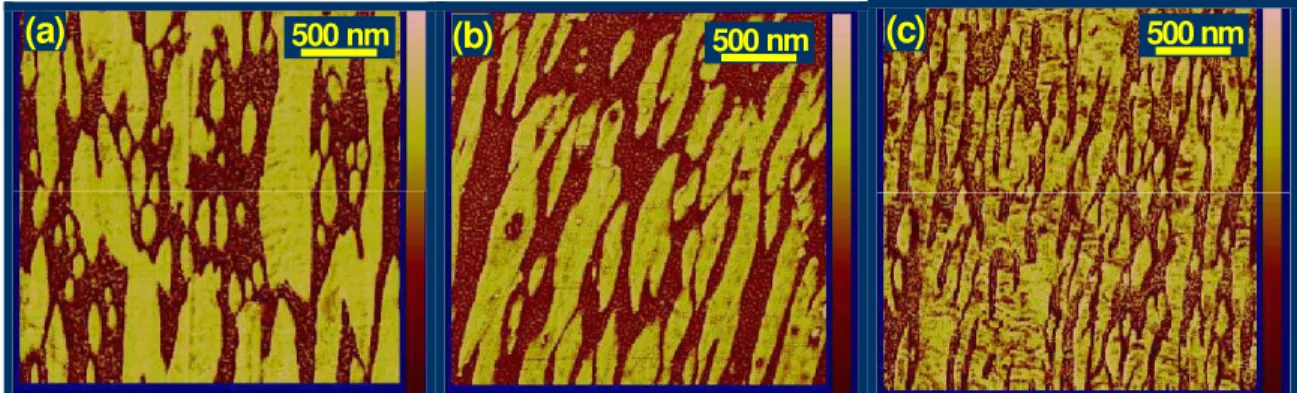
This work reports new routes to prepare functional polymers for PEMFC applications. Several melt-processing technologies, such as twin-screw extrusion, melt blowing and calendering were used to prepare advanced multi-component polymer blends based on fluoropolymers and thermoplastic elastomers. The properties of these polymer blends are to a large level determined by the processing history and the interfacial properties between the different phases. Blend membranes preparation and interface modification were addressed to obtain optimized semi-fluorinated multi-component membranes (Figure 1).
500 nm
(a)
(b)
500 nm(c)
500 nmFigure 1. AFM phase micrographs using tapping mode of 70wt.% PVDF melt extruded composite membrane (TD) with (a) 2wt.% (b) 4wt.% and (c) 6 wt.% compatibilizer
Composition-morphology-properties relationships of the membranes will be presented. Membrane Electrode Assemblies (MEA) were prepared using fluoropolymer in the catalyst layer instead of Nafion, in order to achieve high adhesion and reduced ohmic losses between membranes and electrodes. Performance of complete MEAs in hydrogen or direct methanol fuel cell tests will be discussed.