Publisher’s version / Version de l'éditeur:
IEEE MultiMedia, 19, 2, pp. 92-95, 2009-04-01
READ THESE TERMS AND CONDITIONS CAREFULLY BEFORE USING THIS WEBSITE.
https://nrc-publications.canada.ca/eng/copyright
Vous avez des questions? Nous pouvons vous aider. Pour communiquer directement avec un auteur, consultez la
première page de la revue dans laquelle son article a été publié afin de trouver ses coordonnées. Si vous n’arrivez pas à les repérer, communiquez avec nous à [email protected].
Questions? Contact the NRC Publications Archive team at
[email protected]. If you wish to email the authors directly, please see the first page of the publication for their contact information.
NRC Publications Archive
Archives des publications du CNRC
This publication could be one of several versions: author’s original, accepted manuscript or the publisher’s version. / La version de cette publication peut être l’une des suivantes : la version prépublication de l’auteur, la version acceptée du manuscrit ou la version de l’éditeur.
For the publisher’s version, please access the DOI link below./ Pour consulter la version de l’éditeur, utilisez le lien DOI ci-dessous.
https://doi.org/10.1109/MMUL.2009.32
Access and use of this website and the material on it are subject to the Terms and Conditions set forth at
Harvesting resources for recording concurrent videoconferences
Emond, Bruno
https://publications-cnrc.canada.ca/fra/droits
L’accès à ce site Web et l’utilisation de son contenu sont assujettis aux conditions présentées dans le site LISEZ CES CONDITIONS ATTENTIVEMENT AVANT D’UTILISER CE SITE WEB.
NRC Publications Record / Notice d'Archives des publications de CNRC:
https://nrc-publications.canada.ca/eng/view/object/?id=6554c97a-dbc6-47c6-82b3-ad47538bc1c5 https://publications-cnrc.canada.ca/fra/voir/objet/?id=6554c97a-dbc6-47c6-82b3-ad47538bc1c5
Bruno Emond, Ph.D.
National Research Council Canada Institute for Information Technology
Learning and Collaborative Technologies Group
1200 Montreal Rd., M50, Ottawa, ON, Canada. K1A 0R6 Emond, B. “Harvesting Resources for Recording Concurrent Videoconferences” IEEE
Multimedia – Multimedia @ Work, vol. 19 (2), pp 92-95, April-June 2009. NRC 52530
Contact author Bruno Emond at [email protected]. Contact editor Qibin Sun at [email protected].
Harvesting Resources for Recording Concurrent
Videoconferences
Since 1996, the Virtual Classroom program has helped schools across Canada run numerous videoconferencing events, mostly in the form of extracurricular activities. While videoconferencing can be fairly limited in its pedagogical impact if used simply as a window for viewing talking heads, the Virtual Classroom program is designed to promote a student-centered approach by focusing on problem-solving, discussion, and cooperation between students in an enriched environment filled with domain experts.
During an academic year, an average of four to six classrooms participating in the program engage in a series of three-hour thematic sessions. In 2007, the program was faced with the challenge of organizing a collaborative, three-hour session with over 500 students in six high schools across Canada (St. John’s, Newfoundland; Edmonton, Alberta; Toronto, Ontario; Fredericton, New Brunswick; and two in Ottawa, Ontario). The objective was to provide the visual communication technology to support high levels of interactivity and engagement, but the videoconferencing equipment typically deployed for these events is limited in terms of group interaction. Given the limitation of traditional tools, the Virtual Classroom program needed a solution driven by a one-step, record-and-publish model that could complement the synchronous communication offered by videoconferencing.
This article presents an overview of the Broadband Virtual Camera (BVCam) system, which enables one-step videoconference recording by using idle desktop computers on a network.1
Virtual Classroom program
My research group developed BVCam for the Virtual Classroom program in the 2006 to 2007 school year. The Virtual Classroom program, initiated in 1996 at the Communication Research Centre (see http://www.crc.ca) in Ottawa as part of the Global Interoperability for Broadband Networks project, became a joint venture between CRC and the Broadband Visual Communication Research Program at the Institute for Information Technology, National Research Council Canada (see http://iit-iti.nrc-cnrc.gc.ca) in 1999. The program’s goal is to research and evaluate technologies not only for high-engagement collaboration between geographically distributed organizations and networks but also for advanced infrastructure and multimedia tools for supporting video-based learning in a broadband-enabled environment.
The Virtual Classroom’s pedagogical model is based on peer-learning communities supported by mentors where high-school students are challenged to consider authentic problems. Students explored several topics over the years:
• 9/11: the never-ending war.
• AIDS in Africa. It is not our problem, or is it?
• Climate change: impacts on our northern national parks. • Hana’s suitcase. A reflection on the holocaust.
• People of the street.
• Engaging in stem cell research. • The wisdom of diversity. • Water: a global crisis. • Diet and body image.
In addition to facilitating study in these topics, the virtual classroom program has run numerous videoconference sessions focused on K–12 teachers’ professional development and music education.
The program consists of a series of thematic events where students from schools across Canada discuss issues, seek solutions, and are advised by experts using videoconferencing equipment. The events are designed to involve three to six groups of 30 to 100 students in each school. The size of the groups and the use of multiple sites require an organizational and technical structure that can enable all groups to present while still offering opportunities for unstructured and unscripted debate and discussion.
There were two main challenges to overcome to support visual communication in this context: the group size of up to 500 students and the session duration of three hours. In addition, we needed a scalable solution for conducting both synchronous and asynchronous visual communication. Synchronous communication would occur through the already deployed videoconferencing equipment, while the asynchronous communication would have to follow an easy, one-step, record-and-publish model.
Despite these requirements, investing in a centralized recording system did not fit the organizational structure of separate and autonomous school boards across the country, so we had to create an alternative approach.
BVCam system
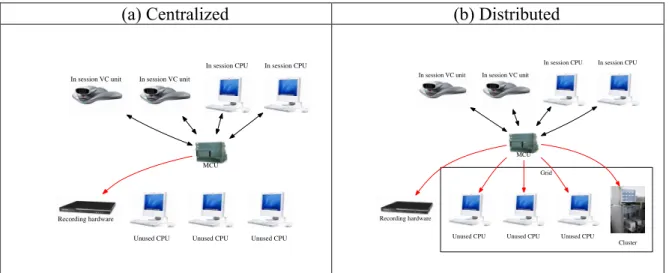
We determined that a grid-approach based on desktop applications would offer a valuable option for leveraging existing resources in lieu of a centralized recording system. With this alternative in mind, the research team at the Institute for Information Technology, National Research Council Canada built a computer cluster as a prototype of a desktop computer grid deployment (see Figure 1).
(a) Centralized (b) Distributed
Figure 1. Videoconference recording systems: (a) centralized and (b) distributed.
The original goal of BVCam was to supplement synchronous visual communication between schools with asynchronous visual communication to facilitate collaboration between groups located across the country. We developed the setup to involve one to four BVCam recording stations in each school, with the idea being that, during an event, students with a reporting role would record short summaries of their local discussions so that students located elsewhere could have a sense of what is being discussed. We designed this framework to facilitate ongoing activity that is parallel to the main videoconference event and at high peek times could support 15 to 20 concurrent recordings.
In technical terms, BVCam is a computer cluster, based on H.323 suite of standards,2that offers video recording and publishing services. It can record sound and
video either from a single H.323 client or from a multipoint session. H.323, which includes standards for real-time, audiovisual, and data communication over IP networks,
In session CPU In session CPU Unused CPU Unused CPU Unused CPU MCU In session VC unit In session VC unit Recording hardware In session CPU In session CPU Grid Cluster Unused CPU Unused CPU Unused CPU MCU In session VC unit In session VC unit Recording hardware
defines a model with four types of entities, each having a particular role: the terminal, the multipoint control unit, the gateway, and the gatekeeper. At the most basic level, H.323 lets users make point-to-point audio calls over the Internet by encoding and decoding speech through A-law- and µ-law-coded audio streams.
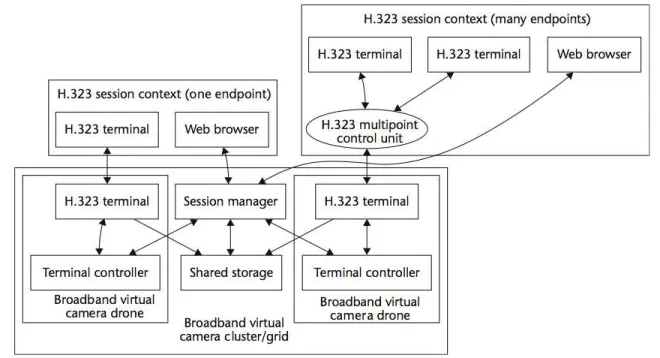
In terms of architecture, BVCam uses a set of distributed computers that act as grid agents to perform concurrent recordings. Any computer on a network with interapplication communication and desktop videoconferencing capabilities can be used as a recording device (see Figure 2). Session recordings can be done either as a simple endpoint using an H.323 terminal —such as units supplied by Tandberg, Polycom, or LifeSize or as a videoconference desktop application and a Web browser. When many endpoints are needed, session recordings can also be done using a multipoint control unit and a set of H.323 terminals, along with a Web browser.
Figure 2. The BVCam system architecture.
By interacting with the session manager through a Web browser, a user can have messages sent to a terminal controller, which, by inter-application communication, controls the recording of a videoconferencing desktop application. To ensure recording quality, the system requires a network of at least 384 kilobits per second. Session recordings reside on a shared storage device. The session manager offers users the ability to view recorded sessions.
Conclusion and future work
Clearly, the ability to record, store, and play back video has changed radically over the past 10 years. The price of video equipment (cameras and playback devices) has declined dramatically, while the emergence of digital video has made it possible to stream, edit, and store video on computers. One fundamental impact of the recent evolution of video technology is that individuals have the tools to produce, edit, and distribute their own video much more easily than ever before. The success of Web sites such as Google Video, YouTube, and MySpace indicates that self-produced digital video will play an increasing role in asynchronous communication, allowing multimedia communication between millions of individuals (see the “Visual Communication over IP Networks” sidebar).
Coinciding with the popularity of asynchronous communication in recent years, videoconferencing systems have also grown in popularity. Once being only possible in dedicated rooms supported by specialized technicians, videoconferencing is becoming more accessible and user friendly either as specialized hardware or desktop applications. Synchronous visual communication and collaboration between large numbers of people (500 to 1000) could benefit from the support of asynchronous visual communication technology. Applications such as virtual town halls or virtual classrooms could be designed with combined synchronous and asynchronous environments to support large group collaboration.
It is our hope that BVCam can serve as a model for the effective combination of synchronous and asynchronous video communications. In terms of the future, we plan to focus on a Session Initiation Protocol3 implementation of BVCam and the development
of a Web-service interface to store multimedia assets. H.323 and SIP are competing options for call signaling and session management, and products that use them are widely deployed for voice over IP and business videoconferencing, making them both viable technologies to use in future BVCam implementations.
Acknowledgments
I thank John Spence and Martin Brooks who have directed the virtual program for many years and provided, with the collaboration of a fantastic group of devoted high school teachers, unique learning experiences to students. I also thank Susan O’Donnell, Bill McIver, and Rodrigue Savoie who have given valuable feedback on initial drafts; as well as Matthew Allen, Michael Postma, and David Scobie for their contribution to BVCam development.
References
1. B. Emond et al., “An H.323 Broadband Virtual Camera for Supporting Asynchronous Visual Communication in Large Groups,” Proc. IEEE Int’l Symp. Technology and Society, IEEE: Piscataway, NJ, 2008, pp. 1-4.
2006.
3. J. Rosenberg et al., SIP: Session Initiation Protocol, IETF RFC 3261, 2002; http://www.ietf.org/rfc/ rfc3261.txt.
Sidebar
Visual Communication over IP Networks
Visual communication over IP networks is currently going through an important growth phase, with forecasts all pointing toward a significant increase in demand for applications and services in this area. Even though the current economic slowdown likely will affect growth for some segments of the telecommunication market, research firm Interactive Data Corp. (IDC)1 is predicting strong growth in wireless subscriptions and rapid spending growth on wireless data services.
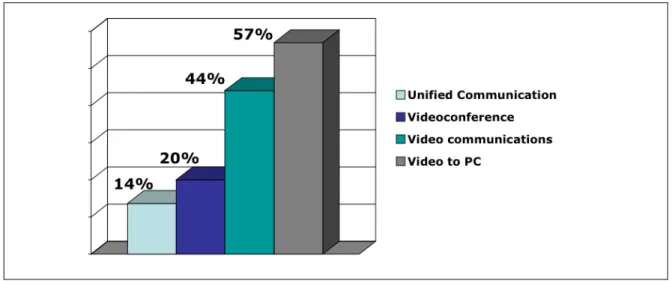
Moreover, Cisco’s visual networking index for the 2006 to 2012 period predicts Internet video to PC (online videos downloaded or streamed) will have a compound annual growth rate of 57 percent to reach 6,216 petabytes per month in 2012, while video communications (internet video calling, video messaging, video monitoring, and webcam traffic) will have a 44 percent growth rate to reach 154 petabytes per month.1 The Cisco report also predicts the latter application segment will experience substantial growth for the 2012 to 2017 period.
The Cisco report makes predictions about these services for the worldwide consumer market segment, excluding business traffic. However, the forecast growth for business videoconferencing is also important, albeit of a smaller magnitude. In August 2008, Business Week reported that a study by Frost & Sullivan found that the worldwide videoconferencing systems and services market, having reached $1.63 billion in 2007, would grow to $4.2 billion (20 percent) by 2012, as more companies try to become greener and cut costs.2
In addition, reports suggest that the need for unified communications will exert pressure to develop more robust of visual communications systems over IP networks. Organizations around the world will need better collaborative environments consisting of integrated messaging, telephony, videoconferencing, and data sharing, all accessible in an ad hoc, multimode fashion through a mobile, single-client interface or within an embedded-application interface.3 According to In-Stat and Wainhouse Research, the entire unified communications products and services market was worth $8.8 billion in 2007 and will grow to $24.2. billion by 2012 (see Figure A).
Figure A. Compound annual growth rate for visual communication 2007 to 2012. (Sources: Cisco & Wainhouse Research.)
Sidebar References
1. T. Olvet et al., Economic Crisis Response: Canadian Telecommunications 2008-2012 Forecast Update, IDC, 2008; http:// www.idc.com/getdoc.jsp?containerId=CA13TM8.
2. ‘‘Cisco Visual Networking Index: Forecast and Methodology, 2007-2012,’’ white paper, Cisco System, 2008; http://www.cisco.com/en/US/solutions/collateral/ns341/ns525/ns537/ns705/ns827/white_paper_c11-481360.pdf. 3. J.L. Schenker, ‘‘Economic Woes Boost Videoconferencing,’’ Business Week, 5 Aug. 2008; http://www.businessweek.com/globalbiz/content/aug2008/gb2008085_094217.htm?chan=technology_technology +index+page_telecom.
4. Wainhouse Research and In-Stat, Unified Communications Products and Services Forecasts, 28 Nov. 2007; http://www.instat.com/catalog/ecatalogue.asp?id=317.