Abstraction in Technical Computing
by
Jeffrey Werner Bezanson
A.B., Harvard University (2004)
S.M., Massachusetts Institute of Technology (2012)
ARCHNES
MASSACHUSETTS INSTITUTEOF TECHNOLOLGY
JUL
0
7
2015
LIBRARIES
Submitted to the Department of Electrical Engineering and Computer
Science
in partial fulfillment of the requirements for the degree of
Doctor of Philosophy
at the
MASSACHUSETTS INSTITUTE OF TECHNOLOGY
June 2015
@
Massachusetts Institute of Technology 2015. All rights reserved.
Author...
Signature redacted
Department of Electrical Engineering and Computer Science
May 20, 2015
Certified by ...
Accepted by...
Signature redacted
...
Alan Edelman
Professor
Thesis Supervisor
Signature redacted
-6
Leslie Kolodziejski
Abstraction in Technical Computing
by
Jeffrey Werner Bezanson
Submitted to the Department of Electrical Engineering and Computer Science on May 20, 2015, in partial fulfillment of the
requirements for the degree of Doctor of Philosophy
Abstract
Array-based programming environments are popular for scientific and technical computing. These systems consist of built-in function libraries paired with high-level languages for in-teraction. Although the libraries perform well, it is widely believed that scripting in these languages is necessarily slow, and that only heroic feats of engineering can at best partially ameliorate this problem.
This thesis argues that what is really needed is a more coherent structure for this func-tionality. To find one, we must ask what technical computing is really about. This thesis suggests that this kind of programming is characterized by an emphasis on operator com-plexity and code specialization, and that a language can be designed to better fit these requirements.
The key idea is to integrate code selection with code specialization, using generic functions and data-flow type inference. Systems like these can suffer from inefficient compilation, or from uncertainty about what to specialize on. We show that sufficiently powerful type-based dispatch addresses these problems. The resulting language, Julia, achieves a Quine-style "explication by elimination" of many of the productive features technical computing users expect.
Thesis Supervisor: Alan Edelman Title: Professor
Acknowledgments
The three people without whom this work would not have been possible are Alan Edelman, Stefan Karpinski, and Viral Shah. Their ideas and their support have been extraordinary. I habitually mentally included them while writing this thesis in the first person plural.
I am especially indebted to Steven Johnson, for explaining to me why Julia is doomed, and subsequently working as much as anybody to make it less doomed. He is the author of the code in appendix B and, along with Homer Reid, is responsible for the example in section 5.7.
I thank Jiahao Chen for coauthoring, contributing to nearly every aspect of our project, and even coming up with the title of this very document, Jean Yang for paper writing help, and Fernando Perez and Brian Granger for welcoming us so generously to the wonderful world of Jupyter.
For their valuable feedback on drafts I am grateful to Jake Bolewski, Oscar Blumberg, Tim Holy, and my committee members Saman Amarasinghe and Gerry Sussman.
It is quite a privilege to be able to cite other people's work to demonstrate and evaluate my own. In this regard I am grateful to Miles Lubin, lain Dunning, Keno Fischer, and Andreas Noack.
At this point, I need to thank so many more people that doing so requires automation. The full list can be found in our git history. As a partial list, I thank for their excellent contributions to the software: Jameson Nash, Tim Holy, Mike Nolta, Carlo Baldassi, Elliot Saba, Andreas Noack, Tony Kelman, Jake Bolewski, Kevin Squire, Isaiah Norton, Amit Murthy, Simon Kornblith, Patrick O'Leary, Dahua Lin, Jacob Quinn, Douglas Bates, Simon Byrne, Mike Innes, Ivar Nesje, Tanmay Mohapatra, Matt Bauman, Rafael Fourquet (largely responsible for the speed of randn described in section 5.8), Arch Robison, Oscar Blumberg, John Myles White, Shashi Gowda, and Daniel Jones.
For generally advancing the Julia community, I thank Evan Miller, Hunter Owens, James Porter, Leah Hanson, and Mykel Kochenderfer.
These collaborators made this far more than a research project: they made it a formidable software project, they gave it global reach, and they made it fun.
Contents
List of Figures 11
List of Tables 13
1 Introduction 15
1.1 The technical computing problem . . . . 17
1.2 The importance of code selection . . . . 18
1.3 Staged programming . . . . 20
1.4 Summary of contributions . . . . 21
2 The nature of technical computing 23 2.1 What is a technical computing environment? . . . . 23
2.1.1 Case study: Vandermonde matrices . . . . 25
2.2 Why dynamic typing? . . . . 28
2.2.1 Mismatches with mathematical abstractions . . . . 29
2.2.2 I/O and data-oriented programming . . . . 29
2.3 Trade-offs in current designs . . . . 30
2.3.1 Vectorization . . . . 30
2.3.2 Data representation . . . . 33
2.4 A compiler for every problem . . . . 34
2.5 Social phenomena . . . . 34
3 Design space 37 3.1 A binding time dilemma . . . . 37
3.2 Domain theory . . . . 40
3.2.1 Program s and dom ains . . . . 41
3.3 Dispatch system s . . . . 44
3.3.1 A hierarchy of dispatch . . . . 45
3.3.2 Predicate dispatch . . . . 48
3.3.3 Symbolic program m ing . . . . 49
3.3.4 Choices, choices . . . . 50
3.4 Subtyping . . . . 51
3.5 Specialization . . . . 53
3.5.1 Parametric vs. ad hoc polymorphism . . . . 53
3.5.2 Separate com pilation . . . . 54
3.6 Easy polymorphism . . . . 54
4 The Julia approach 57 4.1 Core calculus . . . . 57
4.2 Type system . . . . 60
4.2.1 Type constructors . . . . 65
4.2.2 Subtyping . . . . 66
4.3 Dispatch system . . . . 71
4.3.1 Type and m ethod caches . . . . 71
4.3.2 Specificity . . . . 72
4.3.3 Param etric dispatch . . . . 73
4.3.4 Diagonal dispatch . . . . 74
4.3.5 Constructors . . . . 74
4.3.6 Ambiguities . . . . 75
4.4 Generic program m ing . . . . 76
4.5 Staged program ming . . . . 78
4.6 Higher-order program ming . . . . 81
4.6.1 Problem s for code selection . . . . 81
4.6.2 Problem s for code specialization . . . . 83
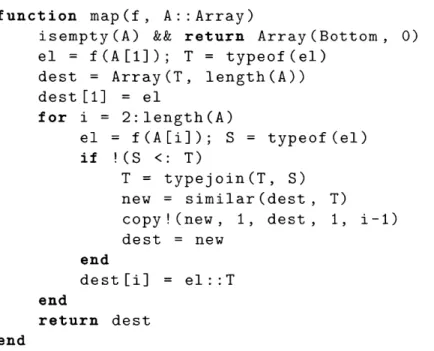
4.6.4 Implementing map... 4.7 Performance . . . . 4.7.1 Type inference . . . . 4.7.2 Specialization . . . . 4.7.3 Performance predictability 4.8 Dispatch utilization . . . . 5 Case studies
5.1 Conversion and comparison 5.2 Numeric types and embeddings 5.3 Multidimensional array indexing
5.4 Numerical linear algebra . . . .
5.5 U nits . . . . 5.6 Algebraic modeling with JuMP 5.7 Boundary element method . . .
5.8 Beating the incumbents . . . .
6 Conclusion
6.1 Perform ance . . . . 6.2 Other future work . . . . 6.3 Project status . . . . A Subtyping algorithm
B Staged numerical integration Bibliography 86 88 88 89 90 90 93 93 95 102 105 107 109 112 117 119 120 120 121 123 129 133 . . . . . . . . . . . . . . . . . . . . . . . . . . . . . . . .
List of Figures
1-1 49 technical computing languages . . . . 16
2-1 Julia implementation of vander . . . . 27
2-2 Performance of vectorized code . . . . 32
3-1 A lattice of array types . . . . 42
4-1 Subtyping algorithm . . . . 66
List of Tables
1.1 Programming language priorities . . . . 17
2.1 Performance of vander . . . . 28
3.1 Attributes of code selection features . . . . 51
4.1 Sharing of function types . . . . 84
4.2 Multiple dispatch use statistics . . . . 91
5.1 Structured matrices and factorizations . . . . 106
Chapter 1
Introduction
Scientific computing has evolved from being essentially the only kind of computing that existed, to being a small part of how and why computers are used. Over this period of time, programming tools have advanced in terms of the abstractions and generalizations they are capable of.
Science as a whole evolves through the incorporation of specialized bits of knowledge into more powerful general theories. There is a parallel in the world of programming languages: special-purpose languages have been subsumed by more powerful and general languages. How has this trend affected scientific computing? The surprising answer is: not as much as we would like. We see scientists and technical users generally either turning away from the best new programming languages, or else pushing them to their limits in unusual ways.
In fact, we have discovered at least
49
programming languages designed for technical computing since Fortran (figure 1-1). This high number begs for an explanation. We propose that technical users crave the flexibility to pick notation for their problems, and language design - the highest level of abstraction - is where you go when you need this level of flexibility. The desire for scientists to rework their code is not so surprising when one reflects on the tradition of inventing new notation in mathematics and science.The need for language-level flexibility is corroborated by the ways that the technical computing domain uses general purpose languages. Effective scientific libraries extensively
Matlab Maple Mathematica SciPy Fortress
SciLab IDL R Octave Chapel
S-PLUS SAS J APL X10
Maxima Mathcad Axiom Sage SAC
Lush Ch LabView O-Matrix ZPL
PV-WAVE Igor Pro OriginLab FreeMat Yorick GAUSS MuPad Genius
SciRuby Ox Stata JLab
Magma Euler Rlab Speakeasy
GDL Nickle gretl ana
Torch7 A+ PDL Nial
Figure 1-1: 49 technical computing languages classified as primarily designed for productivity or performance
employ polymorphism, custom operators, and compile time abstraction. Code generation approaches (writing programs that write programs) are unusually common. Most of these techniques are presently fairly difficult to use, and so programmers working at this level give up the notational conveniences of the purpose-built languages above.
The goal of this thesis is to identify and address the fundamental issues that have made productive and performant technical computing so difficult to achieve. We ask: which general purpose language would also be able to handle technical computing, such that the above workarounds would not have been necessary?
In brief, our answer is to integrate code selection and specialization. The aforementioned flexibility requirement can be explained as a sufficiently powerful means for selecting which piece of code to run. When such mechanisms are used in technical computing, there is nearly always a corresponding need to specialize code for specific cases to obtain performance. Polymorphic languages sometimes support forms of specialization, but often only through a designated mechanism (e.g. templates), or deployed conservatively out of resource concerns. We intend to show that an equilibrium point in the design space can be found by combining selection and specialization into a single appropriately designed dynamic type-based dispatch mechanism.
Mainstream PL Technical computing classes, single dispatch complex operators separate compilation performance, inlining
parametric polymorphism ad hoc polymorphism, extensibility static checking experimental computing
modularity, encapsulation large vocabularies
eliminating tags self-describing data, acceptance of tags data hiding direct manipulation of data
Table 1.1: Priorities of mainstream object-oriented and functional programming language re-search and implementation compared to those of the technical computing domain.
1.1
The technical computing problem
Table 1.1 compares the general design priorities of mainstream programming languages to those of technical computing languages. The priorities in each row are not necessarily oppo-sites or even mutually exclusive, but rather are a matter of emphasis. It is certainly possible to have both parametric and ad hoc polymorphism within the same language, but syntax, recommended idioms, and the design of the standard library will tend to emphasize one or the other. Of course, the features on the left side can also be useful for technical computing;
we exaggerate to help make the point.
It is striking how different these priorities are. We believe these technical factors have contributed significantly to the persistence of specialized environments in this area. Imagine you want just the features on the left. Then there are many good languages available:
Haskell, ML, Java, C#, perhaps C++. Getting everything on the right, by comparison,
seems to be awkward. The most popular approach is to use multiple languages, as in
NumPy [119], with a high-level productivity language layered on top of libraries written in
lower-level languages. Seeking a similar trade-off, others have gone as far as writing a C++ interpreter [120].
the performance of C, C++, and Fortran. To do that, it is almost certain that speculative optimizations such as tracing [51] will not be sufficient - the language will need to be able to prove facts about types, or at least let the user request specific types. It is also clear that such a language must strive for maximum convenience, or else the split between performance languages and productivity languages will persist.
It is fair to say that two approaches to this problem are being tried: one is to design better statically typed languages, and the other is to apply program analysis techniques to dynamically typed languages. Static type systems are getting close to achieving the desired level of flexibility (as in Fortress [4] or Polyduce [28], for instance), but here we will use a dynamically typed approach. We are mostly interested in types in the sense of data types and partial information (for an excellent discussion of the many meanings of the word "type" see [68]). Additionally, some idioms in this domain appear to be inherently, or at least naturally, dynamically typed (as we will explore in chapter 2). The mechanism we will explore provides useful run time behavior and, we hope, performance improvements. Many approaches to statically checking its properties are likely possible, however we leave them to future work.
1.2
The importance of code selection
Most languages provide some means for selecting one of many pieces of code to run from a single point in the program. This process is often called dispatch. High-level languages, especially "dynamic" languages tend to provide a lot of flexibility in their dispatch systems. This makes many sophisticated programs easier to express, but at a considerable performance cost.
There has been a large amount of work on running dynamic languages faster (notable examples are Self [34], and more recently PyPy [18]). These efforts have been very successful, but arguably leave something out: a better interface to performance. Performance-critical aspects of most dynamically typed languages (e.g. arithmetic) have fixed behavior, and it
is not clear what to do when your code does not perform as well as it could. Adding type annotations can work, but raises questions about how powerful the type system should be, and how it relates to the rest of the language. We speculate that this relative lack of control keeps experts away, perpetuating the split between performance and productivity languages. According to our theory, the issue is not really just a lack of types, but an exclusive focus on specialization, and not enough on selection. In technical computing, it is often so important to select the best optimized kernel for a problem that it is worth doing a slow dynamic dispatch in order to do so. Most of the productivity languages mentioned above are designed entirely around this principle. But their view of code selection is incomplete: the dispatch mechanisms used are ad hoc and not employed consistently. Even when an optimizing compiler for the source language is developed, it does not necessarily take all relevant forms of dispatch into account. For example, NumPy has its own dispatch system underneath Python's, and so is not helped as much as it could be by PyPy, which only understands Python method selection.
A dispatch specification, for example a method signature in a multimethod system, de-scribes when a piece of code is applicable. A more expressive dispatch system then allows code to be written in smaller pieces, helping the compiler remove irrelevant code from consid-eration. It is also more extensible, providing more opportunities to identify special cases that deserve tailored implementations. Method-at-a-time JIT compilers (e.g. [57, 115]) can spe-cialize method bodies on all arguments, and so are arguably already equipped to implement and optimize multiple dispatch (even though most object-oriented languages do not offer it). At the same time, dispatch specifications are a good way to provide type information to the compiler.
The remaining question is what exactly we should dispatch on. Naturally, it might be nice to be able to dispatch on any criteria at all. However there is a balancing act to perform: if dispatch signatures become too specific, it becomes difficult to predict whether they will be resolved statically. At one end of the spectrum are mechanisms like static overloading in C++, where the compiler simply insists that it be possible to resolve definitions at compile
time. At the other end of the spectrum, we might dispatch on arbitrary predicates (as in the Scmutils system [116]). We do neither of these. Instead, we only try to make it more likely that types can be statically inferred. We do this by considering the kinds of types that arise in data flow type inference, and allowing dispatch on those. This will be developed in detail in section 4.2.
1.3
Staged programming
In demanding applications, selecting the right algorithm might not be enough, and we might need to automatically generate code to handle different situations. While these cases are relatively rare in most kinds of programming, they are remarkably common in technical computing. Code generation, also known as staged programming, raises several complexities:
e What is the input to the code generator? e When and how is code generation invoked?
* How is the generated code incorporated into an application?
These questions lead to practical problems like ad hoc custom syntax, extra build steps, and excessive development effort (writing parsers and code generators might take more work than the core problem). If code needs to be generated based on run time information, then a staged library might need to implement its own dispatch mechanism for invoking its generated code.
We find that our style of dynamic type-based dispatch provides an unusually convenient substrate for staged programming. The reason is that the types we dispatch on contain enough information to drive code generation for a useful class of problems, while also allowing the dispatch mechanism to be reused for caching and invoking staged code. Code generators are invoked automatically by the compiler, and the results can be called directly or even inlined into user code. Libraries can switch to staged implementations with method-level granularity without affecting client code.
1.4
Summary of contributions
At a high level, our contribution is to identify the priorities that have been implicit in the designs of technical computing systems, and suggest fundamental changes that would better serve those priorities. In the process, we make the following specific contributions:
* To our knowledge, the first complete technical computing system developed by applying automatic type specialization over libraries written in a single high-level language. Our system is the first to combine by-default specialization on all arguments with type widening to automatically limit specialization.
" A novel dispatch system that supports a form of .set-theoretic types including variadic methods. We contribute an answer to the question of how powerful a dynamic dispatch system should be: even if type checking is not done, dispatch should still use types that support decidable subtyping.
" A subtyping algorithm for our system, including a straightforward implementation. This subtyping system is adoptable by dynamically typed languages that might benefit from a richer abstract value domain, for example for describing method applicability or performance-critical aspects of data structures.
* We demonstrate a novel combination of staged programming with generic functions that allows staging to be invoked implicitly, leading to improved usability.
" We show how to implement key features of technical computing languages using our dispatch system, eliminating the need for them to be built in. We preserve flexibility while gaining efficiency and extensibility. (James Morris eloquently observed that "One of the most fruitful techniques of language analysis is explication through elimination. The basic idea is that one explains a linguistic feature by showing how one could do without it." [94])
project, demonstrating that our approach is both practical and appealing to a signifi-cant number of users.
Chapter 2
The nature of technical computing
The original numerical computing language was Fortran, short for "Formula Translating System", released in 1957. Since those early days, scientists have dreamed of writing high-level, generic formulas and having them translated automatically into low-high-level, efficient machine code, tailored to the particular data types they need to apply the formulas to. Fortran made historic strides towards realization of this dream, and its dominance in so many areas of high-performance computing is a testament to its remarkable success.
The landscape of computing has changed dramatically over the years. Modern scientific computing environments such as MATLAB [86], R [63], Mathematica [83], Octave [95], Python (with NumPy) [119], and SciLab [56] have grown in popularity and fall under the general category known as dynamic languages or dynamically typed languages. In these languages, programmers write simple, high-level code without any mention of types like int, float or double that pervade statically typed languages such as C and Fortran.
2.1
What is a technical computing environment?
This question has not really been answered. In fact technical computing software has been designed haphazardly. Each system has evolved as a pile of features taken without what we consider a sufficiently critical argument.
Some languages provide a "convenient" experience that is qualitatively different from "inconvenient" languages. A large part of "convenience" is the reduction of the amount you need to know about any given piece of functionality in order to use it. This leads languages to adopt various forms of loose coupling, automation, and elision of software engineering distinctions that are considered important in other languages.
These systems are function-oriented, typically providing a rather large number of func-tions and a much smaller number of data types. Type definifunc-tions and features for organizing large systems are de-emphasized. But functions are heavily emphasized, and the functions in these systems have a particular character one might describe as "manifest": you just call them, interactively, and see what they do. This notion includes the following features:
e Performing fairly large tasks in one function
* Minimal "set up" work to obtain suitable arguments e No surrounding declarations
e Permissiveness in accepting many data types and attempting to automatically handle as many cases as possible
e Providing multiple related algorithms or behaviors under a single name
Language design choices affect the ability to provide this user experience (though the first two items are also related to library design). Informally, in order to provide the desired experience a language needs to be able to assign a meaning to a brief and isolated piece of code such as sin (x). This leads directly to making declarations and annotations optional, eliding administrative tasks like memory management, and leaving information implicit (for example the definition scopes and types of the identifiers sin and x). These characteristics are strongly associated with the Lisp tradition of dynamically typed, garbage collected languages with interactive REPLs.
However, there are subtle cultural differences. A case in point is the MATLAB midivide, or backslash, operator [85]. By writing only A\B, the user can solve square, over- or under-determined linear systems that are dense or sparse, for multiple data types. The arguments
can even be scalars, in which case simple division is performed. In short, a large amount of linear algebra software is accessed via a single character! This contrasts with the software engineering tradition, where clarifying programmer intent would likely be considered more important. Even the Lisp tradition, which originated most of the convenience features enumerated above, has sought to separate functionality into small pieces. For example Scheme provides separate functions list-ref and vector-ref [3] for indexing lists and vectors. Notably, the Scmutils library [116] for scientific computing adds generic functions.
2.1.1
Case study: Vandermonde matrices
To get a sense of how current technical computing environments work, it is helpful to look at a full implementation example. NumPy [119] provides a function for generating Vandermonde matrices which, despite its simplicity, demonstrates many of the essential language char-acteristics this thesis addresses. The user-level vander function is implemented in Python (here lightly edited for presentation):
def vander(x, N): x = asarray(x)
if x.ndim != 1:
raise ValueError("x must be a one-dimensional array or sequence.") v = empty((len(x), N), dtype=promotetypes(x.dtype, int))
if N > 0:
v[:, 0] = 1 if N > 1:
v[:, 1:] = x[:, None]
multiply.accumulate(v[:, 1:1, out=v[:, 1:1, axis=1) return v
This code has many interesting features. Its overall structure consists of normalizing and
checking arguments, allocating output, and then calling the lower-level kernel multiply. accumulate (written in C) to run the inner loop. Even though most of the work is done in C, notice
argument, relying on asarray to convert it to an array. There is no need to write down requirements on argument x, allowing the set of supported inputs to grow easily over time. Next, an output array of the correct size is allocated. The key feature of this line of code is that the data type to use is computed using the function promote-types. This kind of behavior is difficult to achieve in statically typed languages.
The call to multiply. accumulate invokes a C function called PyUFunc-Accumulate, which is over 300 lines long. The job of this function is to look up an appropriate com-putational kernel to use given the types of the input arguments and the operation being performed (multiply). In other words, it performs dynamic dispatch. This is notable be-cause Python itself is already based on dynamic dispatch. However, Python's class-based dispatch system is not particularly helpful in this case, since the code needs to dispatch on multiple values. Therefore NumPy's C code implements a custom dispatch table. The targets of this dispatch are many compact, specialized loops generated by running C code through a custom preprocessor.
The mechanism is complicated, but the results are appealing: NumPy code has full run time flexibility, yet can still achieve good inner-loop performance. Notice that this result is obtained through a clever, if painstaking, mixture of binding times. Python performs some late-bound operations, then calls an early-bound C routine, which performs its own late-bound dispatch to a loop of early-bound operations.
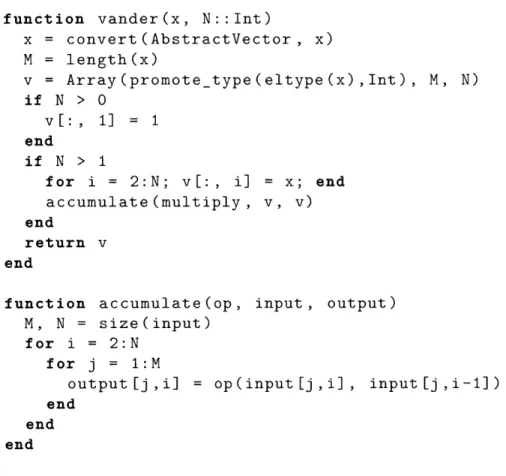
A central message of this thesis is that this kind of program behavior is useful, highly characteristic of technical computing, and can be provided automatically at the language level. Figure 2-1 shows how the above dispatch scheme might be implemented in Julia (mirroring the structure of the Python code as much as possible to facilitate comparison). This code implements the entire vander computation (with some details left out, for example it does not provide the axis argument of multiply. accumulate). The C component is replaced by a general type-based dispatch system that handles specializing and then invoking an efficient implementation of accumulate for each combination of argument types.
function vander(x, N::Int) x = convert(AbstractVector, x) M = length(x) v = Array(promotetype(eltype(x),Int), M, N) if N > 0 v[:, 1] = 1 end if N > 1 for i = 2:N; v[:, i] = x; end accumulate(multiply, v, v) end return v end
function accumulate(op, input, output)
M, N = size(input)
for i = 2:N
for j = 1:M
output[j,il = op(input[j,il, input[j,i-11)
end end end
Figure 2-1: Julia implementation of vander
small matrix sizes, the overhead of the two-language dispatch system in NumPy completely swamps computation time. In the Julia vander, the type of v is known to the compiler, so it is able to generate a direct call to the correct specialization of accumulate, and there is no dispatch overhead. For large data sizes dispatch overhead is amortized, and NumPy is much faster. It is not clear why Julia is still faster in this case; it may be due to NumPy's more general algorithm that can accumulate along any dimension. In some cases, built-in routines in NumPy are slightly faster than Julia implementations. However, the Julia code for accumulate is so compact that it is reasonable to write manually when needed; a fully general library function is not required.
In some cases our compiler would not be able to determine the type of v. We simulated this situation and repeated the benchmark. Results are shown in the rightmost column of the table. Dispatch overhead is now significant for small data sizes. However, performance
Size
#
iter NumPy Julia Julia with dispatch4 x 4 250000 5.43 0.072 0.204
2000 x 2000 1 0.420 0.037 0.037
Table 2.1: Time in seconds to compute vander, 4 x 10⁶ total points arranged in many small matrices or one large matrix.
is still fairly good, since there is only a single layer of dispatch. The dynamic dispatch logic exists in only one place in our code, where it can be extensively optimized.
There is a perception that the performance of technical code is divided into two cases: array code and scalar code. Array code is thought to perform well, and while scalar code has not traditionally performed well, it can be fixed with JIT compilation add-ons or by rewriting in C or by using extensions like Cython [123, 13]. The results here, though simple, demonstrate why we feel a different approach is needed instead: abstraction overhead is important and involves the whole program, not just inner loops.
2.2
Why dynamic typing?
Mathematical abstractions often frustrate our attempts to represent them on a computer. Mathematicians can move instinctively between isomorphic objects such as scalars and 1-by-1 matrices, but most programming languages would prefer to represent scalars and matrices quite differently. Specifying interfaces precisely seems more rigorous, and therefore possibly of use in mathematics, but technical users have voted with their code not to use languages that do this. A perennial debate occurs, for example, around the exact relationship between the notions of array, matrix, and tensor. In MATLAB, scalars and 1 x 1 matrices are indistinguishable. Informal interfaces, e.g. as provided by "duck typing", are a viable way to share code among disciplines with different interpretations of key abstractions.
2.2.1
Mismatches with mathematical abstractions
Programs in general, deal with values of widely varying disjoint types: functions, numbers, lists, network sockets, etc. Type systems are good at sorting out values of these different types. However, in mathematical code most values are numbers or number-like. Numerical properties (such as positive, negative, even, odd, greater than one, etc.) are what matter, and these are highly dynamic.
The classic example is square root (sqrt), whose result is complex for negative arguments. Including a number's sign in its type is a possibility, but this quickly gets out of hand. When computing eigenvalues, for example, the key property is matrix symmetry. Linear algebra provides many more examples where algorithm and data type changes arise from subtle properties. These will be discussed in more detail in section 5.4.
We must immediately acknowledge that static type systems provide mechanisms for deal-ing with "dynamic" variations like these. However, these mechanisms require deciddeal-ing which distinctions will be made at the type level, and once the choice is made we are restricted in how objects of different types can be used. In the domain of linear algebra, for example, it would be useful to have matrices that are considered different types for some purposes (e.g. having different representations), but not others (e.g. different types of matrices can be returned from the same function).
2.2.2
I/O and data-oriented programming
Inevitably there is a need to refer to a datatype at run time. A good example is file I/O, where you might want to say "read n double precision numbers from this file". In static languages the syntax and identifiers used to specify data types for these purposes are usually different from those used to specify ordinary types. A typical example is a constant like MPLDOUBLE [112], used to indicate the data type of an MPI message. Many libraries, especially those for tasks like interacting with databases and file formats, have their own set of such tags. Using more than one of these libraries together can result in boilerplate code to map between tag systems.
Polymorphic languages provide better interfaces in these cases. For example, C++ over-loading can be used to provide the correct tag automatically based on the type of a function argument. However, these techniques only work for statically known types. Code like that in the vander example that determines types using arbitrary computation is excluded. Dy-namic typing provides a complete solution. Indeed, I/O examples are often used to motivate dynamic typing [2]. With dynamic typing, a single set of names can be used to refer to all types regardless of binding time, and the user may write whatever code is convenient to handle classifying data moving in and out of a program.
2.3
Trade-offs in current designs
Current systems accept certain design trade-offs to obtain flexibility. We will look at two examples: vectorization and data representation.
2.3.1
Vectorization
The attitude of vectorization proponents has been somewhat famously summarized as "Life is too short to spend writing for loops." [1] The vectorized style has the following touted benefits:
1. One may write sin(x) to compute the sine of all elements of x, which is more compact than writing a loop.
2. Most execution time can be spent inside an expertly written library, taking advantage of special hardware (e.g. SIMD units or stream processors like GPUs) and parallelism implicitly.
3. The performance of the high-level language being used becomes less relevant.
4. The compiler can optimize across whole-array operations, potentially drastically rear-ranging computations in a way that would be difficult to do by examining one scalar operation at a time.
Under close inspection, this argument begins to break down. An equivocation takes place between being able to write a loop as sin(x) and being required to. The former is all we really want, and it is possible in any language that supports some form of function overloading. There is no inherent reason that a high-performance language like C++ or
Fortran cannot also support more compact, high-level notation.
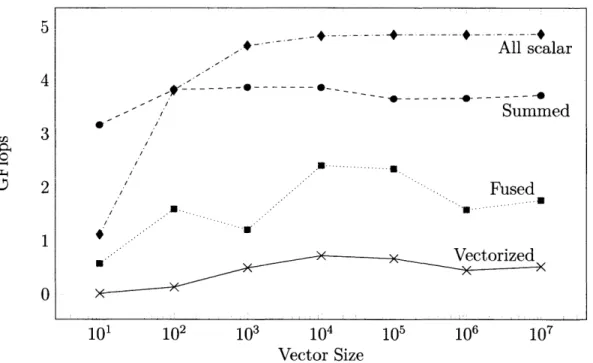
Studies reveal that many real-world applications written in vectorization languages ac-tually do not spend most of their time in libraries [93]. It is possible for an interpreter to be so slow that it cancels the advantage of optimized kernels for a range of realistic data sizes. The final reason, enabling advanced optimizations, is compelling. However at a certain point a "vectorization bottleneck" can be reached, where performance is limited by expressing computations in terms of in-memory arrays. Figure 2-2 compares the operation rate of three different algorithms for evaluating the polynomial x2 + x - 1 over double precision vectors of varying size. The solid line describes a naive algorithm, where each operation allocates a new array and fills it with one intermediate result (a total of three arrays are needed for the full evaluation). The dotted line algorithm is similar in spirit, except the three operations are "fused" into a single loop. Only one pass is made over the data and one new array is allocated. Naturally performance is much better in this case, and advanced array programming environments like APL [46] and ZPL [75 implement this optimization.
However, this level of performance is not impressive compared to the dashed line, which describes the operation rate for computing the same results but summing them instead of storing them. Finally, the dash-dotted line uses no memory at all, instead computing input data points from a linear range. Of course a real use case might require data to be read from memory or stored, so this comparison is unfair (though not entirely, since many numerical environments have represented even simple objects like linear ranges using dense vectors [84]). Still the point should be clear: vectors are not necessarily a good abstraction for high performance. The observation that memory is a bottleneck is not new, but for our purposes the important point is that languages that only support vectorized syntax cannot express the code rearrangements and alternate algorithms that can be necessary to get the
5--- --- --- ---All scalar 4 S---0-0 --- 7-- - - -- +-- - Summed-Summed 3 2 Fused 0 10 102 103 104 105 1 F6 107 Vector Size
Figure 2-2: Performance of evaluating x2 + x - 1 over a double precision vector of length n. Operation repeated 107/n times. (Core i7-3517U 1.9GHz, 4MB cache, 8GB RAM)
best performance. A good technical computing language needs a more general interface to performance.
The performance model resulting from vectorized syntax can be difficult to understand, since it is difficult for users to predict which optimizations will be applied. A good example was discussed on the julia-users mailing list [87]. Jason Merrill discovered a Mathematica [83] list discussion of the fastest way to count how many values fall within a given range. Of many proposed implementations, the fastest turned out to be
Total@Unitize@Clip [data,{min,max},{0,0}]
Arguably, it is difficult to know that this will run faster than, for example,
2.3.2
Data representation
There are two broad categories of programming language data models. The first, favored by static languages, provides structures that are complex and rigid but efficient. Specific data types can be grouped and stored together with known offsets and alignments. Most data is stored directly, and pointer indirection must be explicitly requested. The second kind of data model, favored by dynamic languages, prioritizes flexibility and simplicity. Most data consists of pointers to tagged objects. Indirection is the default.
It's reasonable to guess that these models would trade off about equally. If you want the flexibility to substitute any kind of value in any location at run time, making everything a pointer is the best you can do. The data layouts used by static languages require some amount of metadata to describe, and manipulating this metadata at run time could have significant overhead. In the "dynamic" data model, even though everything is a pointer, at least the code knows that everything is a pointer, and so does not waste time switching between different representations.
Interestingly, this intuition turns out not to be accurate. As memory performance be-comes a larger bottleneck, using less space and avoiding indirection bebe-comes more important. Furthermore, most data in dynamic language programs is not as dynamic as its authors might think, with homogeneous arrays being quite common. Good evidence for this claim was documented as part of work on storage strategies [19], a technique for adapting dynamic languages to use more efficient representations. The authors found that it was worthwhile to represent an array as a wrapper providing a heterogeneous array interface on top of a homogeneous array of varying type, even at the expense of extra dispatch and occasionally changing the representation.
In some sense, our work takes this idea to its logical conclusion: why not support a range of data representations from the beginning, managed by a single sufficiently powerful dispatch system?
2.4
A compiler for every problem
In several prominent cases the language of a scientific sub-discipline is so far removed from conventional programming languages, and the need for performance is so great, that practi-tioners decide to write their own compilers. For example, the Tensor Contraction Engine [11] accepts a mathematical input syntax describing tensor operations used for electronic struc-ture calculations in quantum chemistry. The software performs many custom optimizations and finally generates efficient parallel Fortran code. Other examples of such scientific code generators include Firedrake [102] and FEniCS [78] for FEM problems, PyOP2 [103] for gen-eral computations on meshes, FFTW [49] for signal processing, and Pochoir [117] for stencil computations.
These systems can be highly effective, offering performance and productivity for their problem domains that are not matched elsewhere. In the long term, however, a proliferation of such projects would not be a good thing. It is substantially harder to reuse code between languages and compilers than to reuse library code within a language, and it is harder to
develop a compiler than a library. Mainstream languages have not been doing enough to facilitate these use cases. It would not be realistic to expect to replace all of these systems at once, but Julia's style of type-based dispatch helps. This will be discussed further in section 4.5.
2.5
Social phenomena
In the open source world, the architecture of a system can have social implications. Main-taining code in multiple languages, plus interface glue between them, raises barriers to con-tribution. Making the high-level language fast helps tremendously here, but there are also cultural differences between programmers who understand machine details and want more control, and those who are happy to use defaults chosen by somebody else. We will argue that it is possible to blend these styles, creating an effective compromise between the two camps. Evan Miller expressed this well as "getting disparate groups of programmers to code
in the same language.. .With Julia, it's the domain experts and the speed freaks." [89] This cultural difference often appears in the form of a decision about what to express at the type level. For example, imagine a user has linear algebra code that decides whether to use the QR factorization or the LU factorization to solve a system:
if condition M = qr(A) else M = lu(A) end solve (M, x)
Initially, qr and lu might both return pairs of matrices. Later, linear algebra library develop-ers might decide that each function should return a specialized type to store its factorization in a more efficient format, and to provide dispatch to more efficient algorithms. This decision should not break the user's intuition that the objects are interchangeable in certain contexts. We will discuss more extensive examples of such situations in chapter 5.
Chapter 3
Design space
This chapter will attempt to locate technical computing within the large design space of programming languages. It will discuss how the priorities introduced in section 1.1 relate to type systems and dispatch systems. Our lofty goal is to preserve the flexibility and ease of popular high level languages, while adding the expressiveness needed for performant generic programming.
3.1
A binding time dilemma
Consider the following fragment of a function called factorize, which numerically analyzes a matrix to discover structure that can be exploited to solve problems efficiently:
if istril(A)
istriu(A) && return Diagonal(A) utril = true
for j = 1:n-1, i = j+1:m
if utril && A[i,j] != 0
utril = i == j + 1
end end
utril && return Bidiagonal(diag(A), diag(A, -1), false) return LowerTriangular(A)
The code returns different structured matrix types based on the input data. This sort of pattern can be implemented in object-oriented languages by defining an interface or base class (perhaps called StructuredMatrix), and declaring Diagonal, Bidiagonal, and so on as subclasses.
Unfortunately, there are several problems with this solution. Class-based 00 ties together variation and dynamic dispatch: to allow a value's representation to vary, each use of it needs to perform an indirect call. A major reason to use structured matrix types like Bidiagonal is performance, so we'd rather avoid the overhead of indirect calls. A second problem is that most code operating on Bidiagonal would be implementing algorithms that exploit its representation. These algorithms would have to be implemented as methods of Bidiagonal. However this is not natural, since one cannot expect to have every function that might be applied to bidiagonal matrices defined in one place. This kind of computing is function-oriented.
Let's try a different abstraction mechanism: templates and overloading. That would allow us to write code like this:
if diagonal
solve(Diagonal(M), x) elseif bidiagonal
solve(Bidiagonal(M), x) end
Here, structured matrix types are used to immediately select an implementation of solve. But the part that selects a matrix type can't be abstracted away. We would like to be able to write solve (factorize (M) , x).
Given these constraints, the traditional design of technical computing systems makes sense: pre-generate a large number of optimized routines for various cases, and be able to dispatch to them at run time.
It's clear what's going on here: mathematics is dependently typed. If a compiler could prove that a certain matrix were bidiagonal, or symmetric, there would be no problem. But knowing what a given object is in a relevant sense can require arbitrary proofs, and in
research computing these proofs might refer to objects that are not yet well understood. Most languages offer a strict divide between early and late binding, separated by what the type system can statically prove. The less the type system models the domain of interest, the more it gets in the way. The compiler's ability to generate specialized code is also coupled to the static type system, preventing it from being reused for domains the type system does not handle well. In general, of course, lifting this restriction implies a need to generate code at run time, which is not always acceptable. However run time code generation might not be necessary in every case. A compiler could, for example, automatically generate a range of specialized routines and select among them at run time, falling back to slower generic code if necessary.
Consider the trade-off this entails. The programmer is liberated from worrying about the binding time of different language constructs. With a JIT compiler, performance will probably be good. But without JIT, performance will be unpredictable, with no clear syn-tactic rules for what is expected to be fast. So it is not surprising that software engineering languages shun this trade-off. However we believe it is the trade-off technical computing users want by default, and it has not generally been available in any language.
Designing for this trade-off requires a change of perspective within the compiler. Most compilers focus on, and make decisions according to, the language's source-level type system. Secondarily, they will perform flow analysis to discover properties not captured by the type system. Given our goals, we need to invert this relationship. The focus needs to be on understanding program behavior as thoroughly as possible, since no one set of rules will cover all cases. Usually changing a language's type system is a momentous event, but in the analysis-focused perspective the compiler can evolve rapidly, with "as thoroughly as possible" handling more cases all the time. This approach is still compatible with static typing, although we will not discuss it much. We could pick a well-defined subset of the system, or a separate type system, to give errors about.
3.2
Domain theory
In the late 1960s Dana Scott and Christopher Strachey asked how to assign meanings to programs, which otherwise just appear to be lists of symbols [109]. For example, given a program computing the factorial function, we want a process by which we can assign the meaning "factorial" to it. This led to the invention of domain theory, which can be interpreted as modeling the behavior of a program without running it. A "domain" is essentially a partial order of sets of values that a program might manipulate. The model works as follows: a program starts with no information, the lowest point in the partial order ("bottom"). Computation steps accumulate information, gradually moving higher through the order. This model provides a way to think about the meaning of a program without running the program. Even the "result" of a non-terminating program has a representation
(the bottom element).
The idea of "running a program without running it" is of great interest in compiler im-plementation. A compiler would like to discover as much information as possible about a program without running it, since running it might take a long time, or produce side effects that the programmer does not want yet, or, of course, not terminate. The general recipe for doing this is to design a partial order (lattice) that captures program properties of interest, and then describe all primitive operations in the language based on how they transform elements of this lattice. Then an input program can be executed, in an approximate sense, until it converges to a fixed point. Most modern compilers use a technique like this (some-times called abstract interpretation [38]) to semi-decide interesting properties like whether a variable is a constant, whether a variable might be used before it is initialized, whether a variable's value is never used, and so on.
Given the general undecidability of questions about programs, analyses like these are conservative. If our goal is to warn programmers about use of uninitialized variables, we want to be "better safe than sorry" and print a warning if such a use might occur. Such a use corresponds to any lattice element greater than or equal to the element represent-ing "uninitialized". Such conservative analyses are the essence of compiler transformations
for performance (optimizations): we only want to perform an optimization if the program property it relies on holds for sure.
The generality of this approach allows us to discover a large variety of program properties as long as we are willing to accept some uncertainty. Even if static guarantees are not the
priority, or if a language considers itself unconcerned with "types", the domain-theoretic
model is still our type system in some sense, whether we like it or not (as implied by [108]).
3.2.1
Programs and domains
Program analyses of this kind have been applied to high-level languages many times. A common pitfall is that the analysis can easily diverge for programs that make distinctions not modeled by the lattice.
Consider the following program that repeatedly applies elementwise exponentiation (.)
to an array: A = [n] for i 1:niter A = f(A . A) end return A
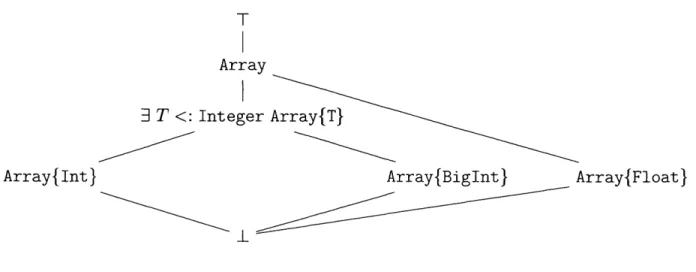
We will try to analyze this program using the lattice in figure 3-1.
The result depends strongly on how the . and ^ functions are defined (assume that calls - on every element of an array). The code might look like this:
function ^(x, y) if trunc(y) == y
if overflows(x, y) function f(a)
x = widen(x) if all(trunc(y) .== y)
end # integer case
# use repeated squaring else
else # general case
# floating point algorithm end
end end
end
T Array
3 T <: Integer Array{T}
Array{Int} Array{BigInt} Array{Float}
Figure 3-1: A lattice of array types
type on overflow, by calling widen.
Assume we initially know that n is an Int, and therefore that A is an Array{Int}. Al-though A really does have this type, the code does not mention types anywhere. Next, the type of an element taken from A (Int) will flow to the y argument of ^. The function's behavior crucially depends on the test trunc (y) == y. It is always true for integer argu-ments, but it is unlikely that the analysis can determine this. Therefore ^ might return an Int, BigInt, or Float, and we can only conclude that A. ^A is an Array. When function f is called, it performs a fairly expensive test to see if every element is an integer. Only through human reasoning about the whole program do we see that this test is unnecessary. However when the analysis considers f applied to type Array, our type information is likely to diverge further to T, since we don't know anything about the array's elements.
The problem is that the program is not written in terms of the underlying value domain, even though it could be. We might have written isa(y, Integer) instead of trunc(y) == y. However, there are reasons that code like this might exist. The programmer might not be aware of the type system, or the conditional might refer to a property that was not originally reflected in the type system but is later, as the language and libraries evolve. Adding type declarations is not an ideal solution since it can restrict polymorphism, and the programmer might not know the type of A. A or even the type of n.
Our solution is to give some simple tools to the library developer (who, of course, is not necessarily a different person). In Julia, one can implement and f as follows:
function ^(x, y) # original code end function ^(x, y::Integer) if overflows(x, y) x = widen(x) end # .. . end function f(a) # original code end function f{T<:Integer}(a::Array{T}) # integer case end
The syntax y: : Integer for a function argument is a dispatch specification. Now, from the same source program, we can conclude that only (x, y: : Integer) is applicable, so we know that the result of A. A is some integer array. The library writer can intercept this case
with the definition f{T<: Integer} (a::Array{T})1, avoiding the check all (trunc(y) .==
y). Since we started with an integer array, the whole program behaves exactly as before. We have neither added restrictions, nor asked for redundant type annotations. All we did is add a dispatch system, and encourage people to use it. Using dispatch in this way is optional, but comes with benefits for structuring programs. For example, the function f above might perform much better on integer arrays. We can implement this case separately from the checks and extra logic that might be needed for other data types, leading to cleaner code and also making the core definition of f smaller and therefore more likely to be inlined. The original version of this code can also be written in our system, though it probably
Although the signature of this method happens to match one of the lattice elements in figure 3-1, this is a coincidence. Method applicability is determined dynamically.
will not perform as well. However, it might still perform better than one would expect, since the functions that it calls are in turn defined using the same dispatch mechanism. This mechanism is expressive enough to be used down to the lowest levels of the system, providing leverage one would not get from an object system or performance add-on.
Having type information attached to user or library definitions increases the value of reverse data flow analysis. One way to describe why analyses of highly dynamic code diverge is that everything in the program monotonically increases the number of cases we need to consider; there is no way to narrow possibilities. But if we know that a function is only defined on type T, every value that passes through its argument list is narrowed to T.
3.3
Dispatch systems
It would be unpleasant if every piece of every program we wrote were forced to do only one specific task. Every time we wanted to do something slightly different, we'd have to write a different program. But if a language allows the same program element to do different things at different times, we can write whole classes of programs at once. This kind of capability is one of the main reasons object-oriented programming is popular: it provides a way to automatically select different behaviors according to some structured criteria (we use the non-standard term "criteria" deliberately, in order to clarify our point of view, which is independent of any particular object system).
However in class-based 00 there is essentially no way to create an operation that dis-patches on existing types. This has been called "the expression problem" [121]). While many kinds of object-oriented programs can ignore or work around this problem, technical programs cannot. In this domain most programs deal with the same few types (e.g. numbers and arrays), and might sensibly want to write new operations that dispatch on them.
3.3.1
A hierarchy of dispatch
It is possible to illustrate a hierarchy of such mechanisms. As an example, consider a simple simulation, and how it can be written under a series of increasingly powerful paradigms. First, written-out imperative code:
while running
f or a in animals
b = nearby-animal(a)
if a isa Rabbit
if b isa Wolf then run(a) if b isa Rabbit then mate(a,b) else if a isa Wolf
if b isa Rabbit then eat(a,b) if b isa Wolf then follow(a,b) end
end end
We can see how this would get tedious as we add more kinds of animals and more behaviors. Another problem is that the animal behavior is implemented directly inside the control loop, so it is hard to see what parts are simulation control logic and what parts are animal behavior. Adding a simple object system leads to a nicer implementation 2
class Rabbit
method encounter(b)
if b isa Wolf then run() if b isa Rabbit then mate(b) end
end
class Wolf
method encounter(b)
if b isa Rabbit then eat(b) if b isa Wolf then follow(b) end
end
2